15 Maximalist Home Office Ideas for Creative Workers
There is a workspace philosophy that understands something the minimalist aesthetic consistently undervalues — that for certain kinds of creative minds, richness is not distraction but fuel, that visual abundance is not noise but nutrition.
The workspace of maximum stimulation is the workspace of maximum creative output. The maximalist home office is the room built on this understanding — it does not edit, does not reduce, and does not apologise for the accumulated quality of a creative environment that has been genuinely lived in.
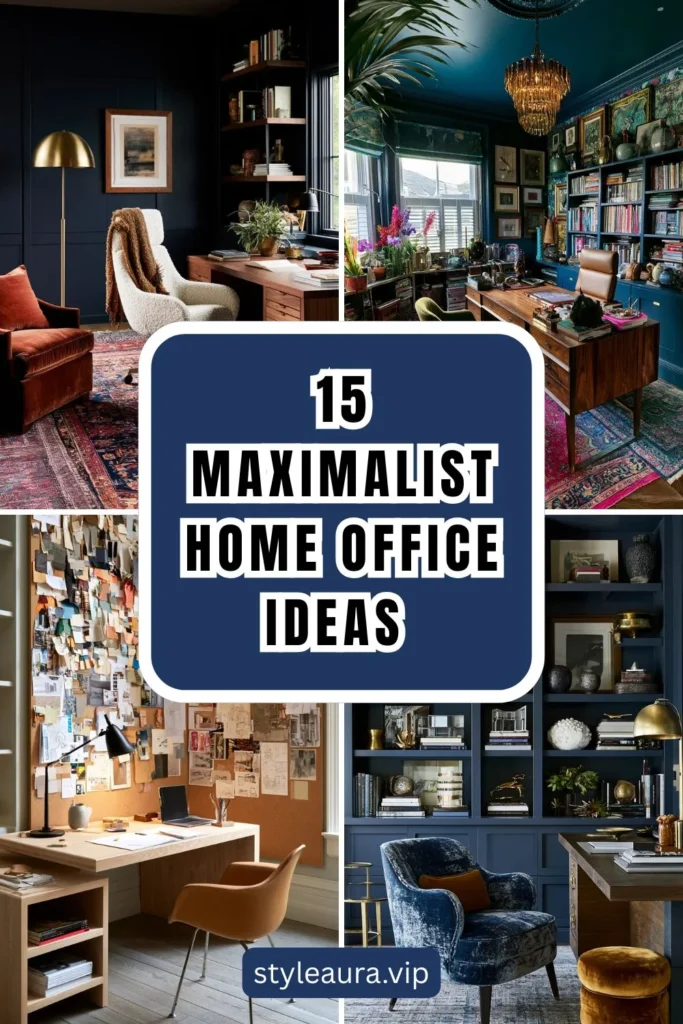
The maximalist creative workspace is not a messy room. It is a rich one. Every element within it was chosen rather than accumulated by default, the richness is composed rather than random, and the visual abundance serves the creative process rather than obstructing it.
It is the workspace of the illustrator whose walls are covered with reference images, of the writer whose shelves contain every book that has ever mattered to them, of the designer whose desk holds the objects that produce the quality of thinking their work requires. The fifteen ideas below cover every element of the maximalist creative home office — from the foundational colour and surface decisions to the finishing details that produce genuine creative richness.
1. The Bold Maximalist Colour Foundation
Budget: $60 – $300
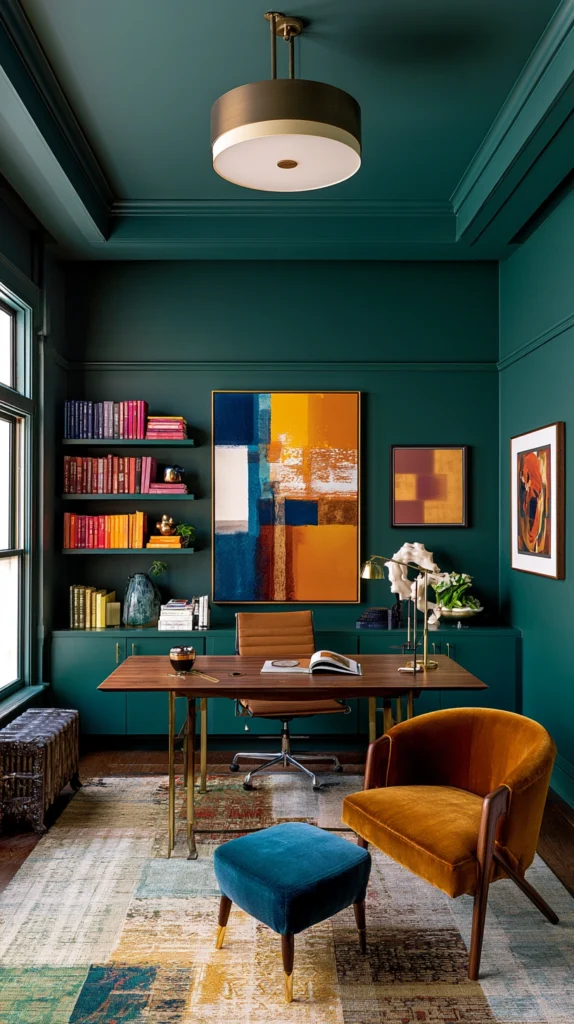
The maximalist creative office begins with a wall colour of genuine commitment — a deep jewel tone, a rich botanical green, a warm terracotta, or a saturated mustard that communicates, from every surface simultaneously, that this is a room of deliberate creative abundance.
The maximalist office does not have a neutral wall. It has a colour that earns its presence by making every object placed in front of it appear more specifically itself. A quality saturated paint in a flat finish costs $20 – $50 per litre, and a standard office requires three to four litres — $60 – $200 in quality paint.
A ceiling taken in the same colour or one shade deeper completes the enveloping quality that a genuinely maximalist workspace requires.
Decor tip: Choose the wall colour by placing a sample behind a representative selection of objects — books, prints, ceramics, plants — and assessing whether the colour makes each one appear more vivid. The correct maximalist wall colour is the one that makes every object in front of it look better. A colour that competes with the objects rather than supporting them is the wrong choice regardless of how beautiful it appears on an empty wall.
2. The Floor-to-Ceiling Reference Board
Budget: $30 – $150
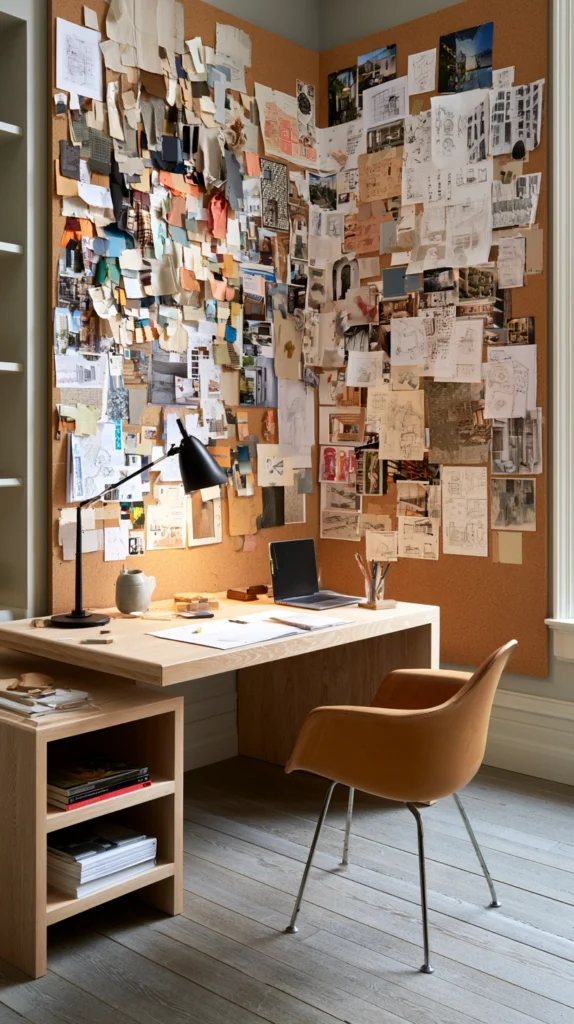
A full wall given over to a reference board — pinboard, corkboard, or a simple system of rails and clips — covered in images, swatches, sketches, printed text, fabric samples, botanical illustrations, and personal photographs is the maximalist creative office’s most specifically functional single installation.
A large corkboard — $20 – $80 from a stationery supplier. A linen-covered pinboard in a dark frame — $30 – $100. A simple picture rail system with clips — $20 – $60.
A painted corkboard surface — cork tiles applied to the full wall and painted in the office’s primary colour — $40 – $120 in cork tiles and paint.
Styling tip: Organise the reference board into loose zones rather than pinning all material at random — current project references in one zone, inspirational material in another, personal work in a third. A zoned reference board reads as a working mind’s organised abundance. An unzoned reference board reads as a pinboard that has been pinned on without thought.
3. The Maximalist Book Collection
Budget: $0 – $500
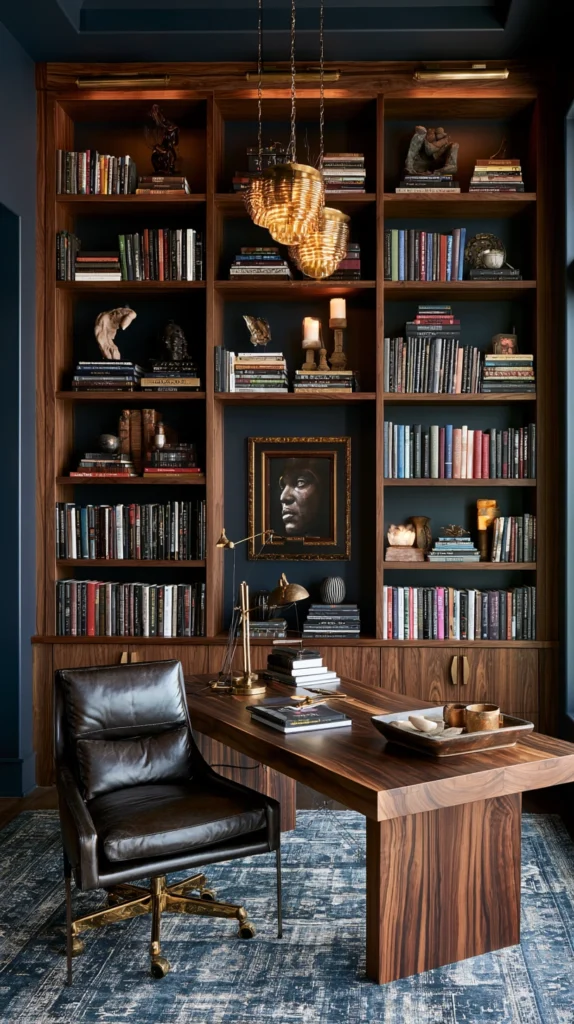
A maximalist book collection — every book already owned displayed simultaneously, arranged by subject matter and personal association with no deference to colour coordination or height alignment — is the maximalist creative office’s most intellectually honest shelving decision.
The maximalist bookshelf says: this person reads, and what they read is too various and too important to be reduced to a curated display. Books already owned are free to relocate and display. Additional shelving — $20 – $60 per floating shelf. A floor-to-ceiling bookcase — $100 – $400.
Styling tip: Stack books horizontally in at least one section of every maximalist bookshelf — a horizontal stack of three to five books creates a visual variation and a sense of accumulated generosity that entirely upright shelving cannot produce.
The horizontal stack also functions as a display surface for small objects placed on top, extending the shelf’s object capacity without requiring an additional shelf.
4. The Multi-Surface Maximalist Desk Setup
Budget: $100 – $800
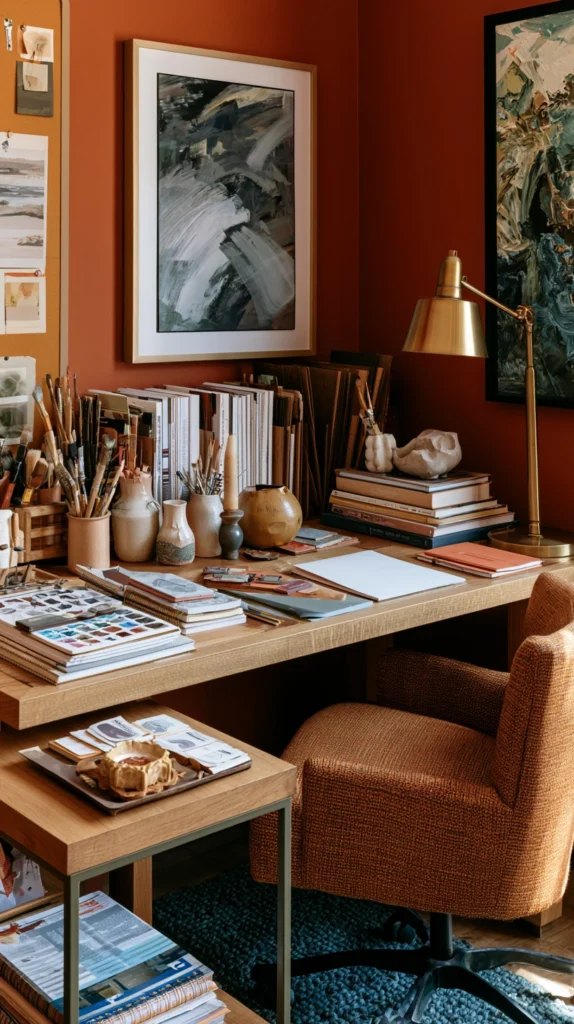
A maximalist desk setup — a large, generous working surface supplemented by a side return, a secondary side table, and every available surface within reach occupied by working materials, reference books, ceramic pen holders, a lamp, a plant, and meaningful objects — communicates that the desk is genuinely worked at rather than maintained for visual quality.
A large timber desk or a farmhouse table repurposed as a desk — $100 – $400. A side return table — $30 – $80. Desk accessories in varied materials — ceramic, timber, glass — already owned or $10 – $30 each.
A quality desk lamp — $40 – $120. A large plant in a decorative pot within arm’s reach — $30 – $80.
Styling tip: Reserve one section of the desk surface as permanently clear — the actual writing or drawing surface — and allow the surrounding surface to accumulate the evidence of active work. A maximalist desk with a clear working zone reads as a productive workspace that happens to be visually rich. One where every surface is covered reads as a visually rich space that happens to be a workspace — which is a less productive version of the same aesthetic.
5. The Layered Textile and Rug Story
Budget: $100 – $600
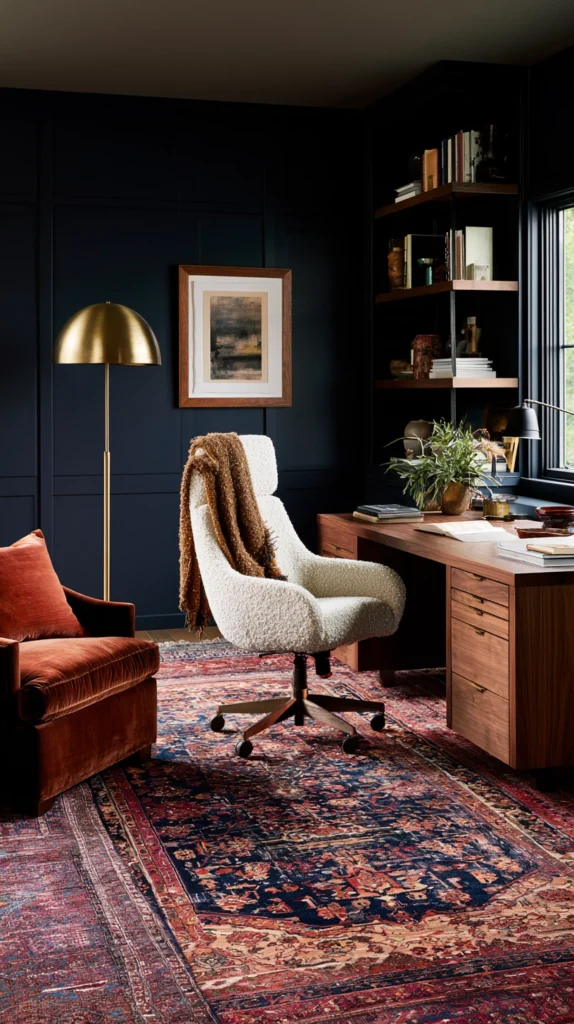
The maximalist creative office’s floor — a large patterned rug with a second smaller kilim or vintage rug overlapping it in the seating area, and a sheepskin or textured throw on the desk chair — is the maximalist aesthetic’s most directly bohemian version of floor-level richness.
Layered rugs communicate that the room was assembled by someone who finds beauty in the specific combination of patterns and that the combination was found rather than designed.
A large patterned rug — $100 – $400. A second smaller rug — $50 – $200. A sheepskin on the desk chair — $40 – $120. A woven throw over the reading chair — $30 – $80.
Styling tip: Choose the two layered rugs from the same warm colour family — both warm-toned, both slightly muted, both with at least one colour in common. Two rugs in the same warm tonal family read as a rich, considered bohemian combination. Two rugs in contrasting colour families read as two rugs placed on top of each other.
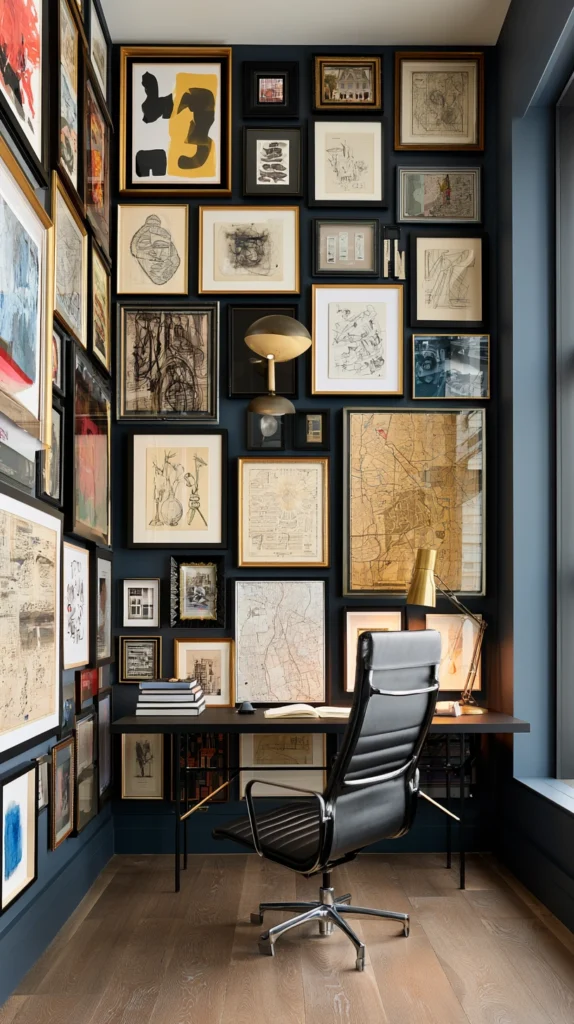
6. The Maximalist Gallery Wall
Budget: $100 – $600
A maximalist gallery wall — frames of every size and style, from tiny postcard frames to large canvas works, covering the full wall from skirting board to ceiling, holding personal work, purchased prints, original art, found objects, pressed botanicals, typographic works, maps, and personal photographs — is the creative workspace’s most visually complex surface.
The maximalist gallery wall communicates the full range of a creative mind’s visual influences simultaneously. Frames of every available size and style — $3 – $30 each from a combination of new, secondhand, and found sources.
A collection of thirty to fifty frames — $90 – $600 in total. Works for framing — a combination of purchased prints, personal work, photographs, and public domain material.
Styling tip: Begin the gallery wall installation by placing all frames on the floor in the intended arrangement before making a single hole in the wall — adjusting the composition until the distribution of sizes, colours, and visual weights reads as complete. A maximalist gallery wall planned on the floor before installation reads as composed. One installed without prior planning reads as pinned.
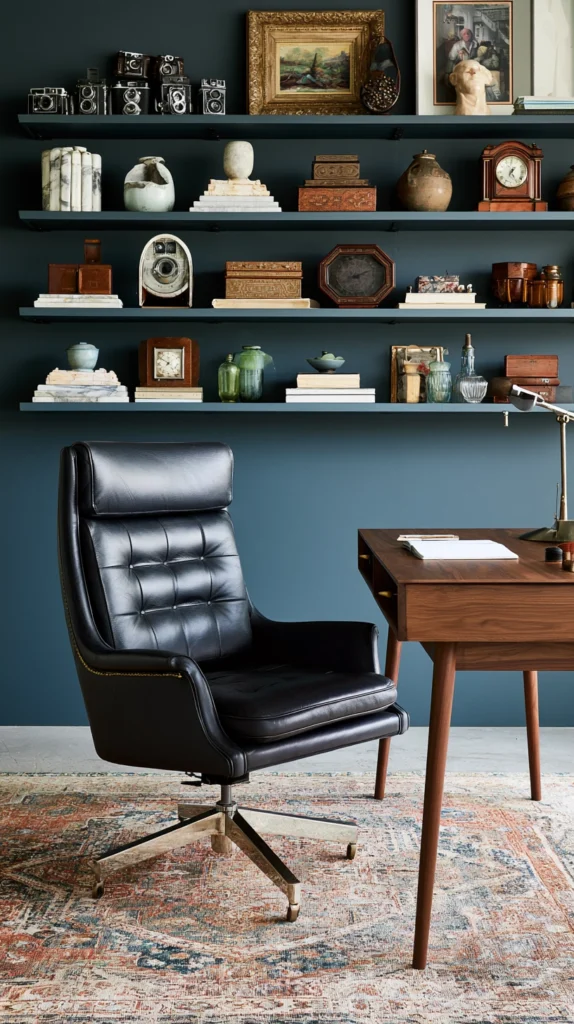
7. The Collected Object Display
Budget: $0 – $300
A curated collection of objects distributed throughout the maximalist creative office — vintage cameras on one shelf, ceramic vessels in a consistent colour family on another, found natural objects on the desk, vintage toys in a glass cabinet — gives the workspace its most personal and intellectually specific collecting dimension.
Objects already owned and displayed — free. Additional objects from markets, estate sales, and charity shops — $3 – $30 each. Display shelving — $20 – $60 per shelf. A glass-fronted display cabinet — $80 – $250.
Styling tip: Concentrate each collection in a single, dedicated display location rather than distributing it across every available surface. A collection of twenty vintage cameras displayed together on one shelf reads as a curated collection of genuine aesthetic significance.
The same twenty cameras distributed individually across every shelf read as twenty cameras placed where there was space. Concentration is the collecting principle that transforms an accumulation into a display.
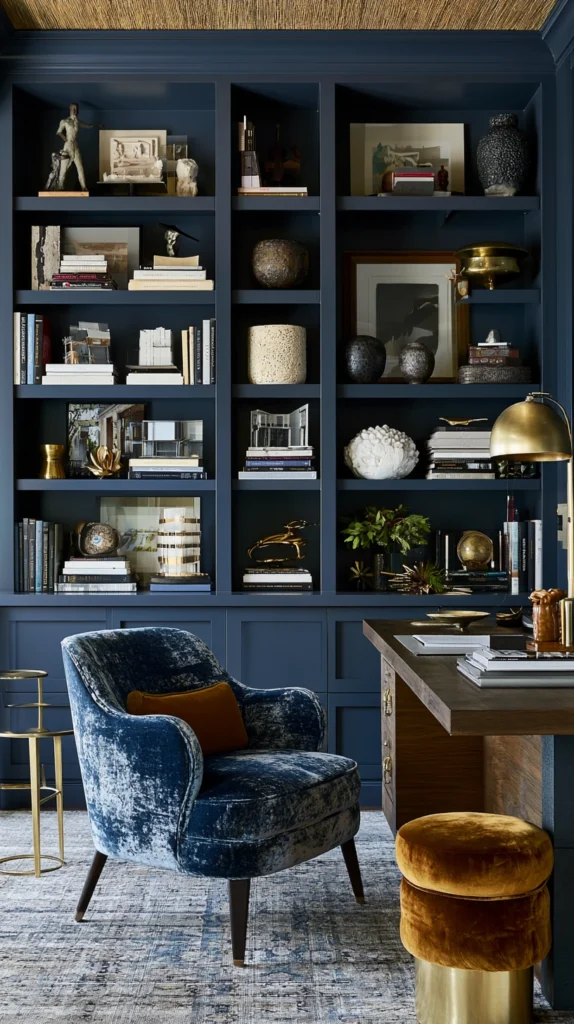
8. The Maximalist Plant Collection
Budget: $50 – $300
A maximalist plant collection — large architectural specimens on the floor, trailing varieties on the shelves, small succulents on the desk, a climbing plant on a moss pole in the corner, and hanging plants from ceiling hooks — transforms the creative workspace into an environment of living, breathing botanical richness.
Plants improve air quality, reduce stress, and produce a specifically productive quality of biophilic connection that no decorative object can replicate.
Large floor plants — monstera, fiddle leaf fig, rubber plant — in statement ceramic pots — $30 – $80 each. Trailing shelf plants — $8 – $20 each. Desk succulents — $3 – $10 each. A climbing plant on a moss pole — $15 – $40. Ceiling hooks — $3 – $8 each.
Styling tip: Group plants in pairs or trios at each display location rather than distributing them individually — a pair of plants in ceramic pots of different heights reads as a composed botanical arrangement. An individual plant in a single pot reads as a plant that was placed somewhere. Grouping by location is the principle that makes the plant collection read as designed rather than accumulated.
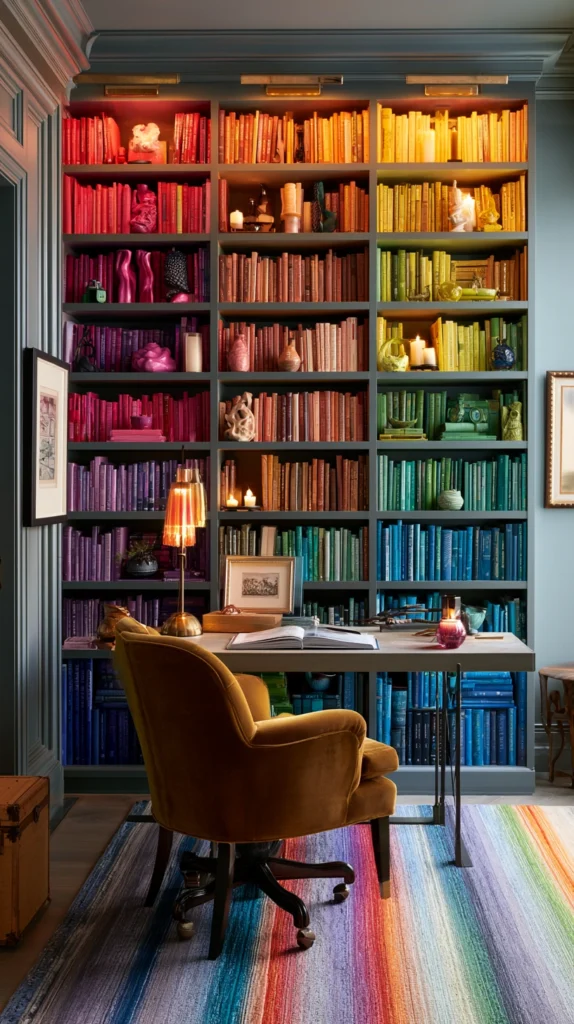
9. The Maximalist Colour-Coded Library
Budget: $0 – $200
A colour-coded library — books arranged by the dominant colour of their spine, producing a rainbow of warm and deep tones across the full shelf wall — is the maximalist creative office’s most specifically visual bookshelf arrangement.
It communicates that the person who arranged it has a genuine aesthetic relationship with their books as objects as well as texts. Books already owned — free to rearrange. Additional coloured books from secondhand bookshops — $3 – $15 each.
Styling tip: Include objects within the colour-coded runs — a small ceramic in the same tone as the surrounding books, a dried botanical in the green section, a gold object in the warm amber section.
The objects within the colour runs extend the palette from the two-dimensional surface of the book spine into the three-dimensional space in front of the shelf, producing a display of greater depth and visual richness than books alone.
10. The Maximalist Lighting Collection
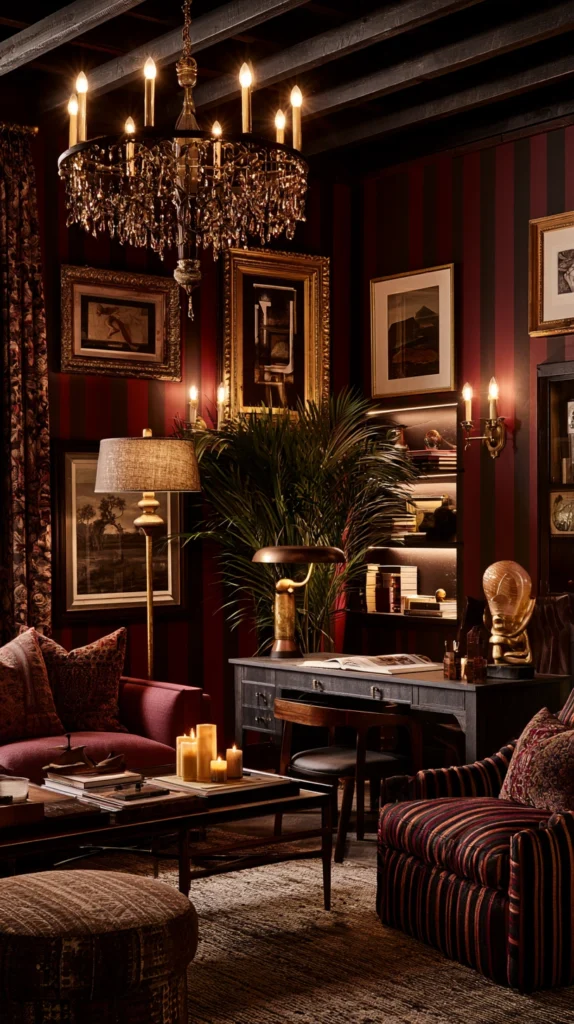
Budget: $100 – $600
Multiple light sources — a pendant or chandelier above the desk, a floor lamp in the reading corner, a desk lamp for task illumination, wall sconces on either side of the reference board, string lights along the bookshelf edge, and candles on every evening surface — produce the layered, warm, atmospheric quality of light that the maximalist creative workspace requires.
A pendant or chandelier — $30 – $150. A floor lamp — $50 – $150. A desk lamp — $30 – $100. String lights — $10 – $25 per reel. Candles in ceramic holders — $8 – $20 each. Total: $128 – $445 for a workspace lit at every height and from every direction simultaneously.
Styling tip: Connect all light sources except the desk task lamp to a smart plug or dimmer — allowing the full ambient light environment to be dimmed simultaneously while the task lamp maintains its working brightness independently.
The ability to dim the ambient light to a warm, low setting while working under focused task light produces the specific quality of a productive working atmosphere within a visually rich room — the richness receding slightly to allow the work to occupy the foreground.
11. The Maximalist Wallpaper Treatment
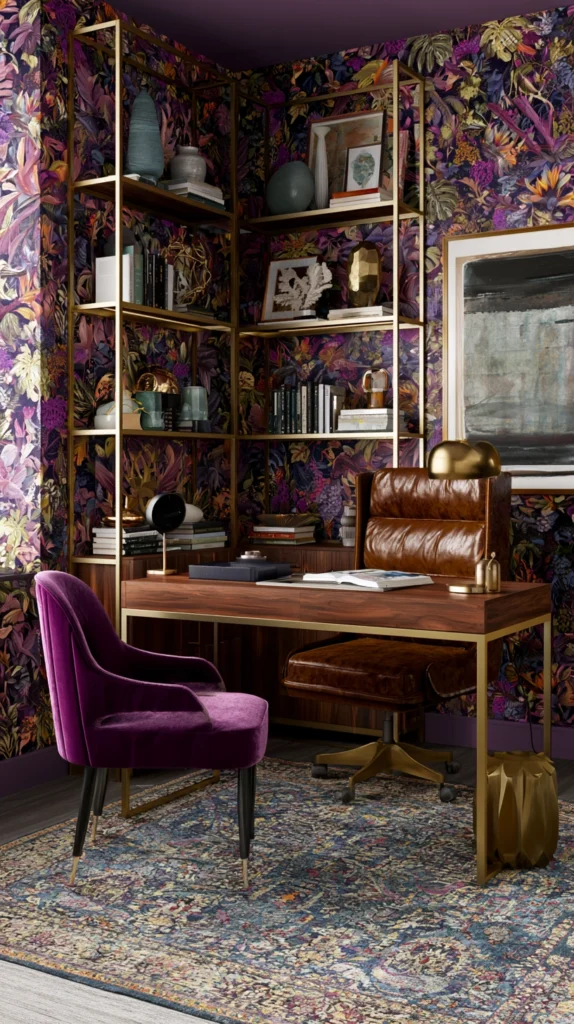
Budget: $80 – $600
A bold wallpaper — a large-scale botanical in deep jewel tones, a maximalist geometric in warm colours, a vintage-inspired pattern in rich reds and greens, or a collage wallpaper of maps, illustrations, and typographic elements — gives the workspace its most pattern-rich and specifically maximalist surface treatment.
A quality maximalist pattern wallpaper — $15 – $50 per roll. Six to eight rolls for a standard office — $90 – $400 in wallpaper. A single feature wall version — two to three rolls at $30 – $150. Professional hanging — $30 – $60 per roll.
Styling tip: Apply maximalist wallpaper to all four walls rather than only to the feature wall — the full room application producing the genuinely immersive quality that the maximalist aesthetic requires.
A single feature wall of bold wallpaper beside three plain walls reads as a decorative gesture. The same wallpaper on all four walls reads as a complete and specifically committed aesthetic environment — which is the quality that distinguishes a maximalist space from a room with one maximalist element.
12. The Creative Pinboard and Mood Board Wall
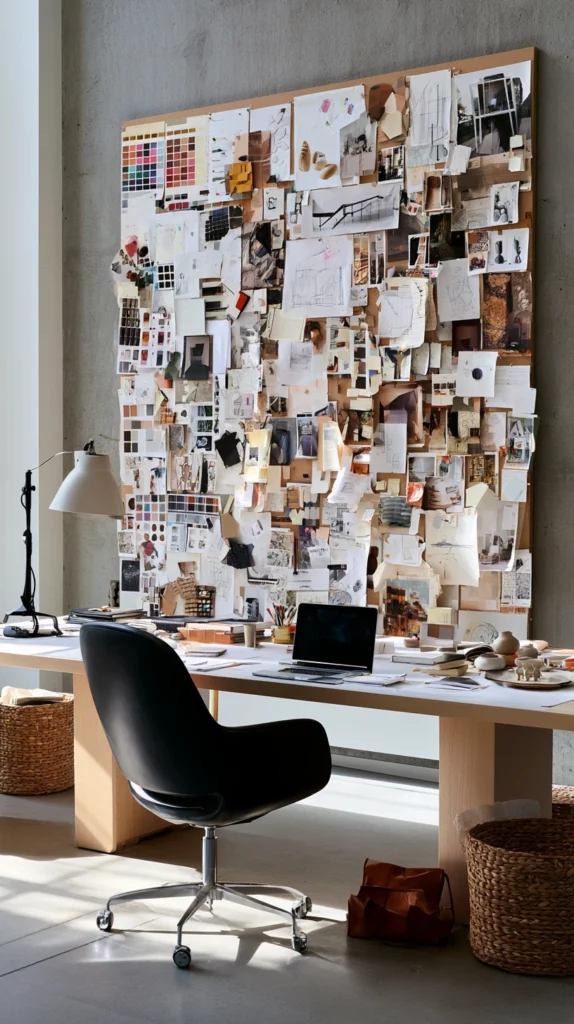
Budget: $20 – $200
A dedicated mood board wall — painted in a chalkboard finish, covered in magnetic paint beneath a layer of the office’s primary colour, or simply used as a free pinning surface with removable adhesive strips — provides a working surface that changes continuously in response to the evolving requirements of the current creative work.
Chalkboard paint — $15 – $40 per litre. Magnetic paint — $20 – $50 per litre. Removable adhesive strips — $8 – $20 per pack.
Styling tip: Change the mood board wall’s content regularly — removing material that has served its creative purpose and replacing it with new references as the work evolves. A mood board wall that changes with the work communicates a living creative process. One maintained as a fixed display communicates a moment in the creative process that has been preserved rather than continued.
13. The Maximalist Vintage and Found Object Collection
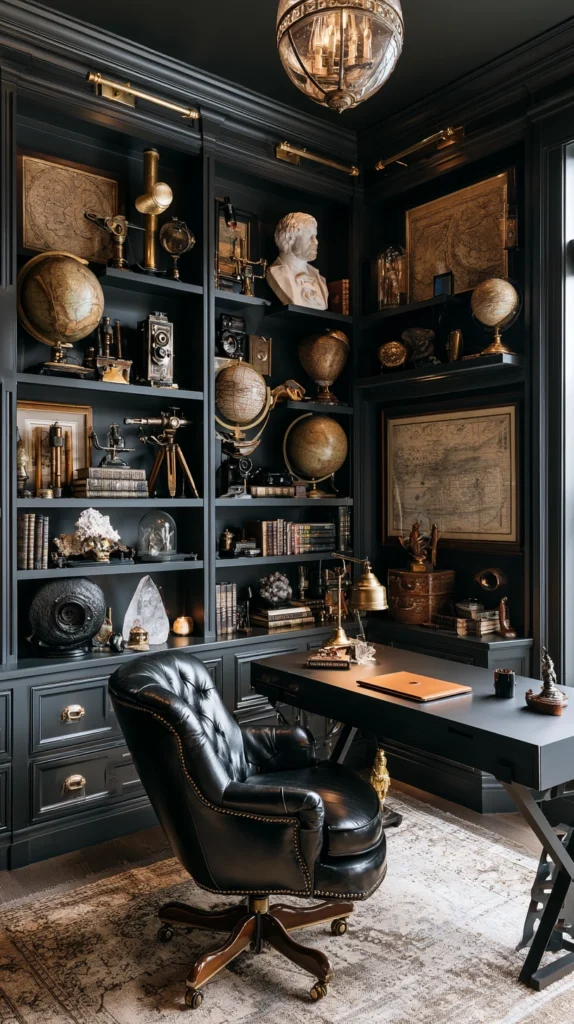
Budget: $50 – $400
Vintage and found objects distributed throughout the maximalist creative office — antique scientific instruments, vintage globes, old clocks, geological specimens, botanical press frames, curiosity cabinet contents, and every object that has made a creative person stop and look — give the workspace its most culturally dense object layer.
The maximalist creative office is, in the best possible sense, a wunderkammer — a wonder cabinet. Objects from antique markets, charity shops, and estate sales — $3 – $50 each. A vintage globe — $40 – $150. A small antique scientific instrument — $20 – $80. A geological specimen — $15 – $50.
Styling tip: Display vintage and found objects at the eye level of the seated working position rather than at the eye level of the standing viewing position.
Objects displayed at seated eye height are seen and engaged with throughout the working day — contributing to the creative atmosphere continuously. Objects displayed at standing eye height are seen on entering and leaving the room and ignored during the hours of active work.
14. The Maximalist Colour-Blocked Ceiling
Budget: $30 – $150
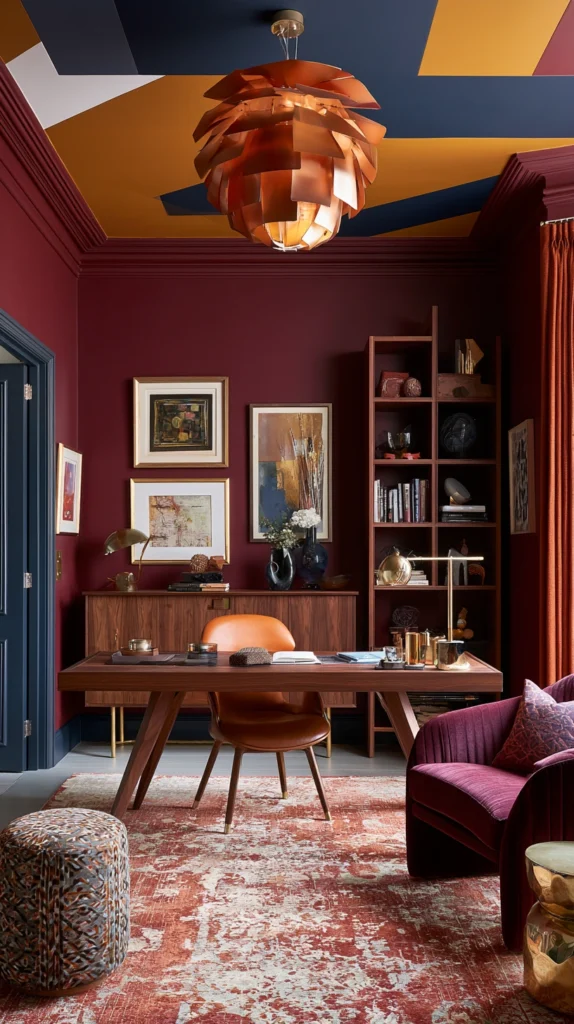
A colour-blocked ceiling — painted in a complementary or contrasting colour to the walls, or given a pattern treatment using the room’s primary and secondary colours in a geometric or irregular arrangement — is the maximalist workspace’s most unexpected and specifically bold decorating decision.
A colour-blocked or patterned ceiling communicates that the office’s aesthetic ambition extends to every surface, including the one most frequently neglected. A ceiling in a complementary colour — one litre of quality paint at $15 – $35. A geometric colour-blocked ceiling in two colours — $30 – $70 in paint materials.
Styling tip: Paint the colour-blocked ceiling before installing any overhead lighting fixture — allowing the ceiling colour to be applied without working around the fixture.
A ceiling painted before fixture installation reads as a complete, deliberate surface treatment. One painted around an existing fixture reads as a colour applied to an existing ceiling — which is the same action but at a different quality of intentionality.
15. The Fully Realised Maximalist Creative Home Office
Budget: $500 – $5,000
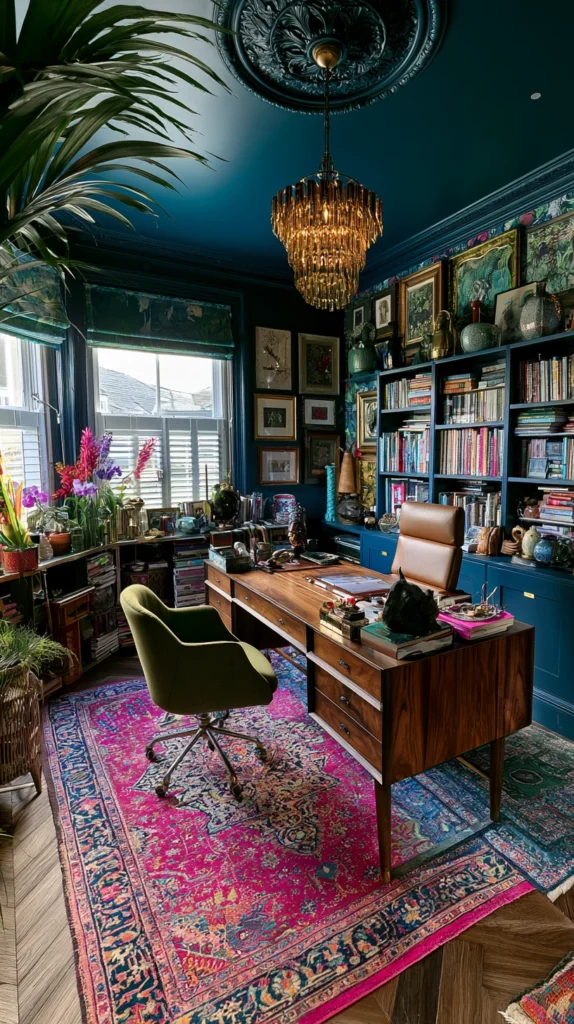
The fully realised maximalist creative home office — deep jewel-tone walls on all four walls with the ceiling in the same colour or a shade deeper, a floor-to-ceiling reference board behind the desk, a full wall of colour-coded books interspersed with objects and ceramics, a maximalist gallery wall covering the primary wall from skirting to ceiling.
A large timber desk covered in the working evidence of active creative practice, layered rugs on the floor in the same warm tonal family, plants in every available position from floor specimens to hanging ceiling plants, multiple warm light sources at every height, vintage and found objects at the seated eye level throughout, a bold wallpaper on the fourth wall.
The specific quality of a room that communicates, from every surface simultaneously, that the person who works here is a person of genuine and abundant creative life — this is the workspace that produces the quality of creative output that the spare, neutral alternative consistently fails to inspire.
Bold paint: $60 – $200. Reference board: $30 – $150. Bookshelf system: $100 – $400. Gallery wall: $100 – $600. Desk setup: $100 – $480. Layered rugs: $150 – $600. Plant collection: $67 – $198. Lighting: $128 – $445. Wallpaper: $90 – $400. Vintage objects: $50 – $400. Total: $875 – $3,873.
Styling tip: Spend thirty minutes each week in the fully realised maximalist creative office doing nothing but looking — sitting in the desk chair without any device open, any task in progress, or any intention to begin working.
The practice of occasional deliberate looking — noticing a new relationship between two objects, discovering a reference image that belongs beside one pinned three weeks later, finding a book spine that introduces a colour connection not previously noticed — is the practice that keeps the maximalist workspace alive rather than merely full.
A room of genuine creative abundance rewards the quality of attention that produced it with a continuously renewable quality of visual and intellectual interest. The thirty-minute weekly looking session is the investment that collects that return.
The maximalist creative home office is the room that understands what creative work has always known — that the mind is not a processor that performs best in a clean, neutral environment but an associative, sensory, richly connected network that performs best when surrounded by material richness, visual abundance, and accumulated meaning.
Fill it with intention. Organise the richness with principle. Let every surface communicate something worth communicating.
And then sit in it and work — in the specific, stimulated, abundantly nourished quality of creative attention that a room built for exactly this purpose has always been able to produce.