14 Black Home Office Ideas for a Sleek Professional Look
There is a colour that communicates professional authority with more directness and more economy than any other available to an interior — a colour that requires no explanation, hedges toward no compromise, and produces in any room it fully inhabits a quality of absolute visual clarity and absolute focused intention.
Black is that colour. Not the black of absence or of oppression but the black of a well-pressed suit, of a quality fountain pen, of the particular authority of a signature on a document that matters. The black home office is the workspace that has made a decision about what it is and has made it completely.

Done correctly — with warm materials to prevent coldness, with genuine lighting to prevent gloom, and with the discipline to choose every object for its quality rather than its availability — a black home office produces a quality of professional atmosphere that no lighter or more cautious alternative can approach. It is the workspace of a person who takes the work seriously enough to take the environment seriously.
The fourteen ideas below cover every approach to the black home office — from a single painted wall to a fully committed workspace of sleek, specific, genuinely professional distinction.
1. The All-Black Wall Treatment
Budget: $40 – $200
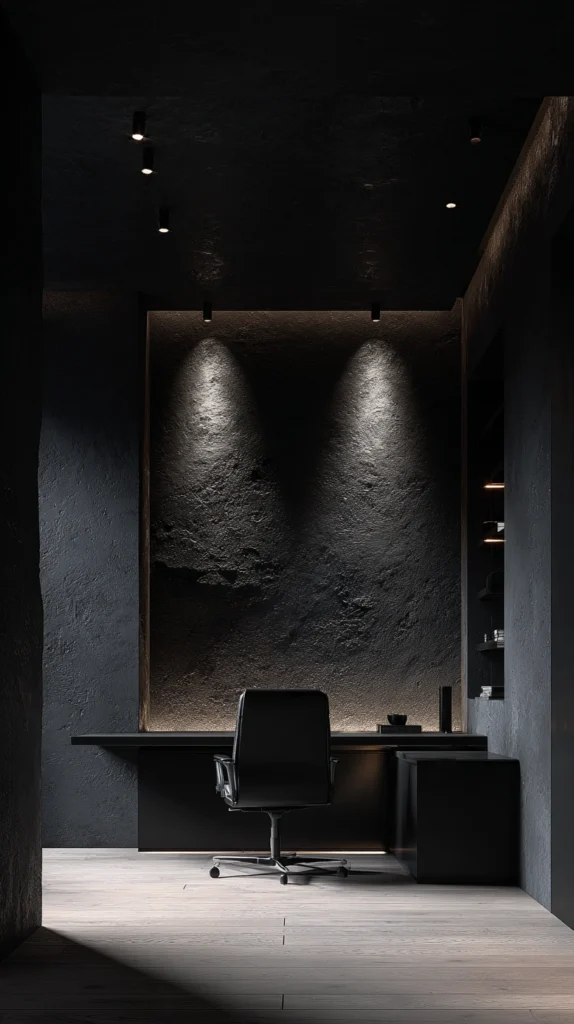
A home office painted in black on all four walls — ceiling in the same black or a very dark charcoal, woodwork in a deep warm tone — is the most committed and the most atmospherically complete version of the black workspace. It produces a room of extraordinary visual focus — every object on the desk and every item on the shelves appearing more precisely defined against the dark background, the quality of the task lighting more specifically directed, and the quality of thought within it more specifically concentrated.
A quality black paint in a flat or eggshell finish costs $20 – $50 per litre. A standard office requires three to four litres for two coats — $60 – $200 in quality paint. A ceiling in the same black or a charcoal one shade lighter maintains the enveloping quality without adding the visual weight of pure black overhead.
Decor tip: Choose a black with a warm undertone rather than a cool one for the home office. A warm black — one with a very slight brown or green undertone — reads as deeply warm and enveloping in artificial lamplight. A cool black with a blue undertone can read as slightly cold and slightly harsh under the same lighting conditions — which is the reverse of the quality the black office is working toward. Test the black paint under the room’s actual artificial light source before committing to the full application.
2. The Black Feature Wall Behind the Desk
Budget: $20 – $80
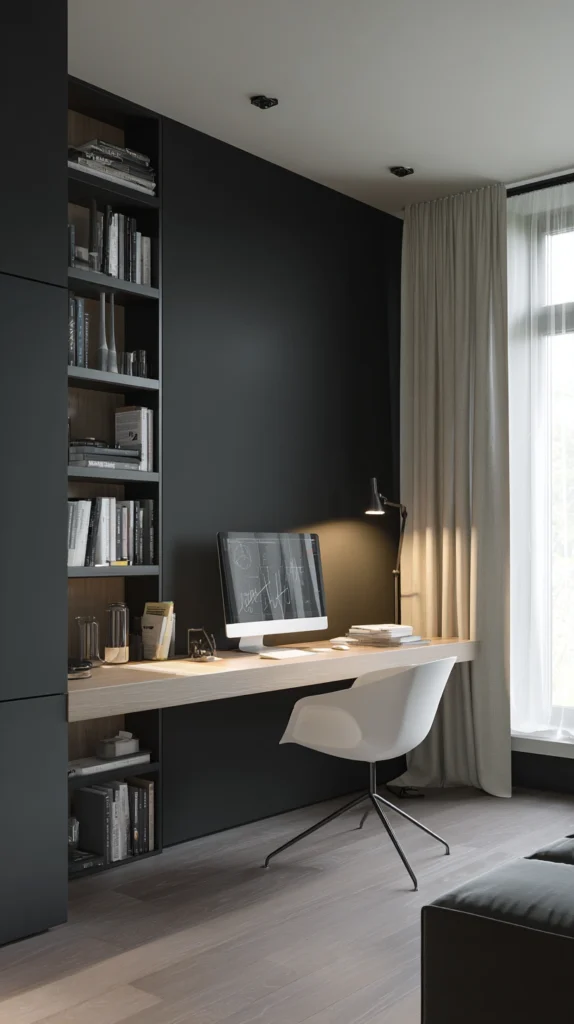
A single black feature wall behind the desk — the wall that forms the primary backdrop of the working position and, critically, the backdrop of every video call made from the desk — is the most immediately impactful and the most professionally communicative single decorating decision available to a home office. One black wall behind a quality desk communicates more about the occupant’s professional seriousness than any amount of pale, cautious decoration on all four walls.
One to one and a half litres of quality black paint covers a standard feature wall in two coats — $20 – $50 in paint. The remaining three walls in a warm white, a warm grey, or a very pale warm tone — $15 – $35 per litre — provide the contrast that makes the black wall read as a deliberate architectural decision rather than an unfinished room.
Styling tip: Extend the black feature wall six to eight centimetres onto the adjacent walls on either side — so that the black reads as a volume rather than a flat surface at the back of the room. A black wall that wraps slightly onto the side walls produces a depth and a spatial envelopment that a black wall stopping precisely at the corner cannot achieve. The wrapped extension costs nothing additional and communicates the quality of a room designed by someone who understood the difference between painting a wall and making a spatial decision.
3. The Black and Warm Brass Combination
Budget: $50 – $400
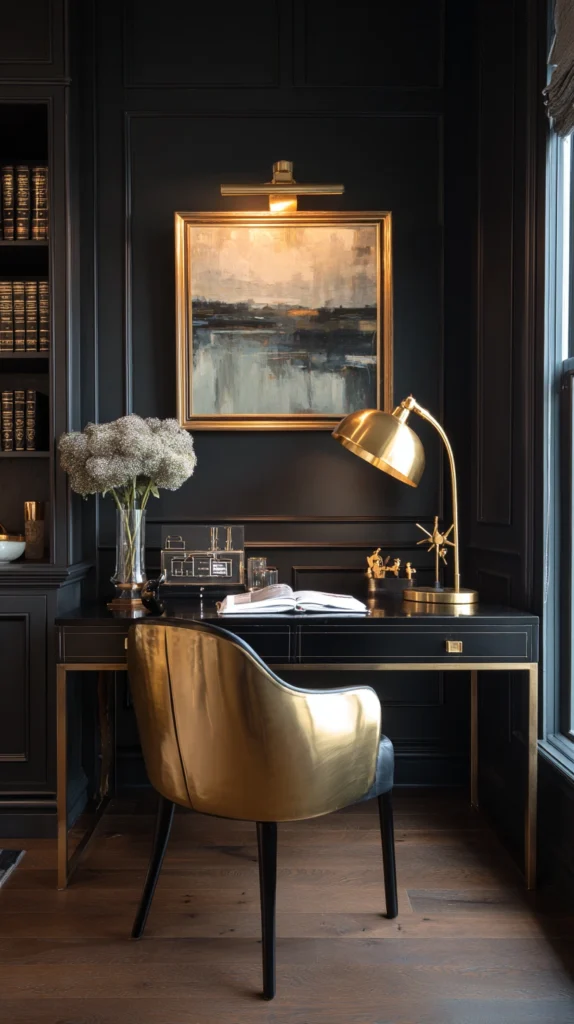
Black and aged brass — the deep, absorbing quality of the black walls and the warm, slightly dull gold of unlacquered metal — is the black home office material combination that reads as the most specifically sophisticated and the most quietly luxurious. The warm brass provides the colour quality that an all-black environment requires to prevent coldness, and the black provides the depth that makes the brass appear richer and more specifically warm than it does beside any lighter background.
Aged brass desk lamp — $60 – $200. Brass drawer handles — $5 – $15 each. Brass picture frames — $10 – $30 each. Brass curtain rod — $25 – $60 per window. A brass pen holder on the desk — $15 – $40. Brass shelf brackets — $8 – $20 each. Total black and brass investment: $123 – $365 for a material language of consistent and genuinely beautiful sophistication.
Decor tip: Use unlacquered or aged brass rather than polished bright gold throughout the black home office. Polished gold beside black can read as slightly decorative — the high shine of the metal introducing a quality of glitter that works against the specifically focused and specifically serious atmosphere the black office is producing. Aged brass beside the same black reads as warm, considered, and specifically intentional — the dulled patina of the metal contributing to the room’s quality of settled authority rather than competing with it.
4. The Black and Natural Timber Office
Budget: $150 – $1500
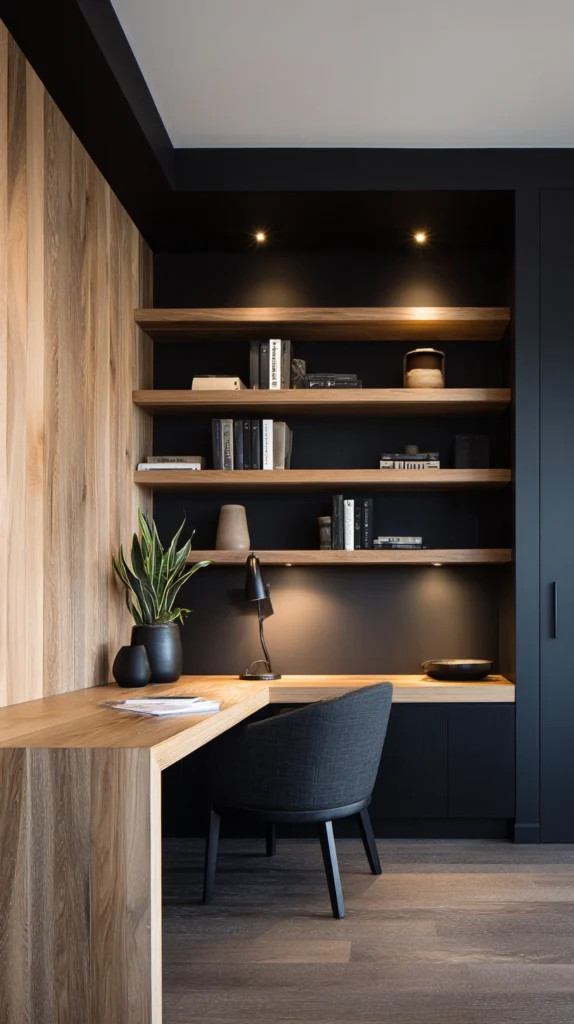
Black walls with warm natural timber — a honey oak desk surface, warm pine shelving, or a light walnut bookcase — is the black home office’s most warm and most specifically grounded material combination. The warmth of the timber mediates between the depth of the black and the human need for material warmth within a working environment, preventing the all-black scheme from reading as cold while maintaining its quality of focused visual authority.
A natural oak desk surface on black or dark-painted legs — $150 – $500. Natural timber floating shelves on black walls — $20 – $60 per shelf installed. A warm pine or oak bookcase — $100 – $400. Timber desk accessories — $10 – $30 each. A natural timber-framed mirror — $40 – $150.
Styling tip: Choose timber pieces in a warm, golden-toned finish rather than a pale or very light blonde timber for the black home office. Very pale blonde timber beside black walls can produce a contrast that reads as slightly stark — the extreme difference between the lightest possible timber and the darkest possible wall colour producing a visual tension without warmth. Warm golden or honey-toned timber beside the same black reads as genuinely warm — the amber quality of the wood filling the space between the black’s depth and the human need for material comfort.
5. The Black Painted Desk and Furniture Suite
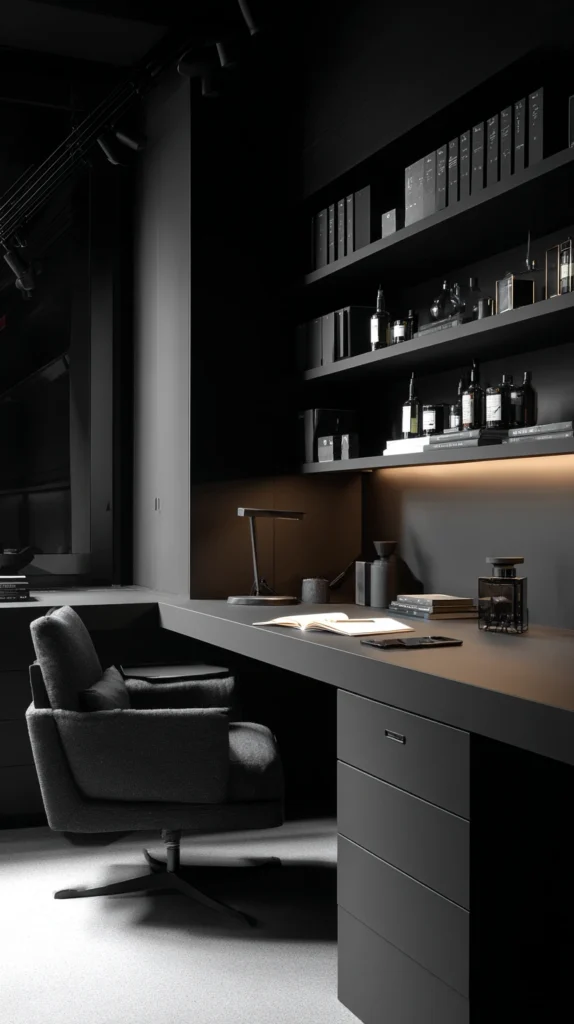
Budget: $30 – $500
A desk, a bookcase, and a filing cabinet all painted in the same black as the office walls — the furniture and the wall sharing a single material identity — creates the specific quality of a room where the boundaries between architecture and furniture are deliberately removed. A black bookcase against a black wall reads as part of the wall’s surface. A black desk against a black wall reads as a working surface that emerged from the architecture. The entire office reads as a single, unified black environment interrupted only by the warm materials — timber, brass, plants — that make it habitable.
Furniture repainted in black chalk paint — $15 – $40 in paint per piece. A new black desk — $100 – $400. A black filing cabinet — $80 – $250. A black-painted bookcase — $15 – $40 in paint applied to an existing piece or $80 – $200 for a new black unit.
Styling tip: Apply black chalk paint to furniture surfaces rather than standard black emulsion — chalk paint adheres to most surfaces without priming, produces a flat, matte finish that belongs to the same tonal register as a flat-painted black wall, and can be waxed for additional durability on a desk surface that will sustain daily use. Standard emulsion on unprepared furniture surfaces produces an uneven, slightly glossy finish that reads as painted rather than finished — an important distinction in a room working toward the quality of a professionally specified workspace.
6. The Black Office With a Single Strong Accent
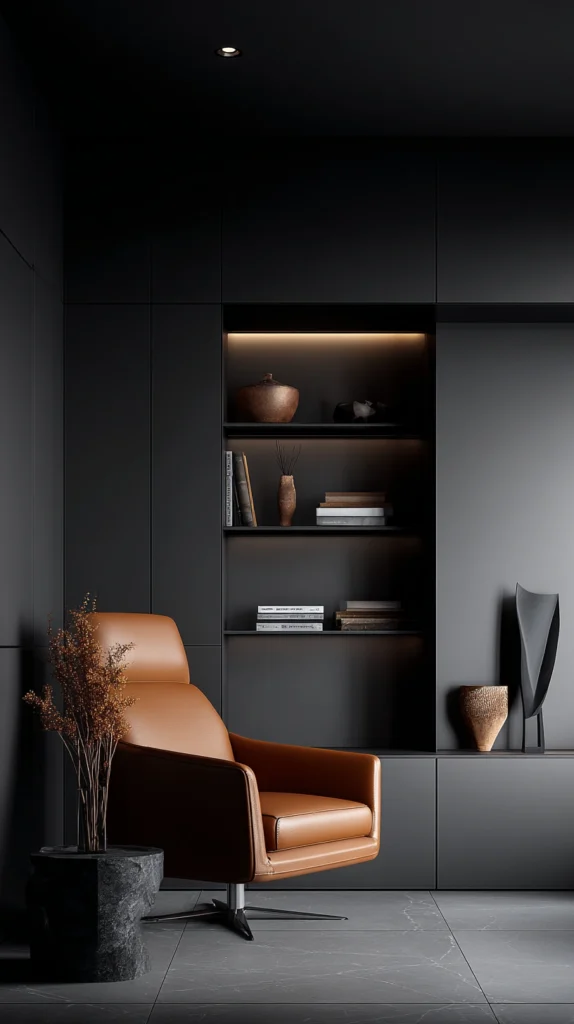
Budget: $20 – $200
A black home office given one carefully chosen accent colour — a single large architectural plant in vivid green, a warm red leather desk accessory, a single cognac leather chair beside the black desk, or one warm amber wood piece among the black furniture — demonstrates the specific quality of a black room, which is that it communicates every colour placed within it more powerfully and more specifically than any other background. A green plant beside a white wall is a plant. The same plant beside a black wall is a statement.
A large architectural plant in a black or terracotta ceramic pot — $40 – $100. A warm cognac leather desk blotter — $30 – $80. A single warm timber element among the black furniture — $50 – $200. A warm amber or terracotta object on the black desk surface — $10 – $30.
Styling tip: Choose the accent colour with deliberate precision — limiting it to a single colour introduced through one or two elements rather than distributed across the full room. A black office with one specific green accent reads as a design decision. The same office with green, red, and amber accents reads as a black office that has not yet decided what it wants to be. The power of the accent in a black room is directly proportional to its restraint.
7. The Black Floating Shelf System
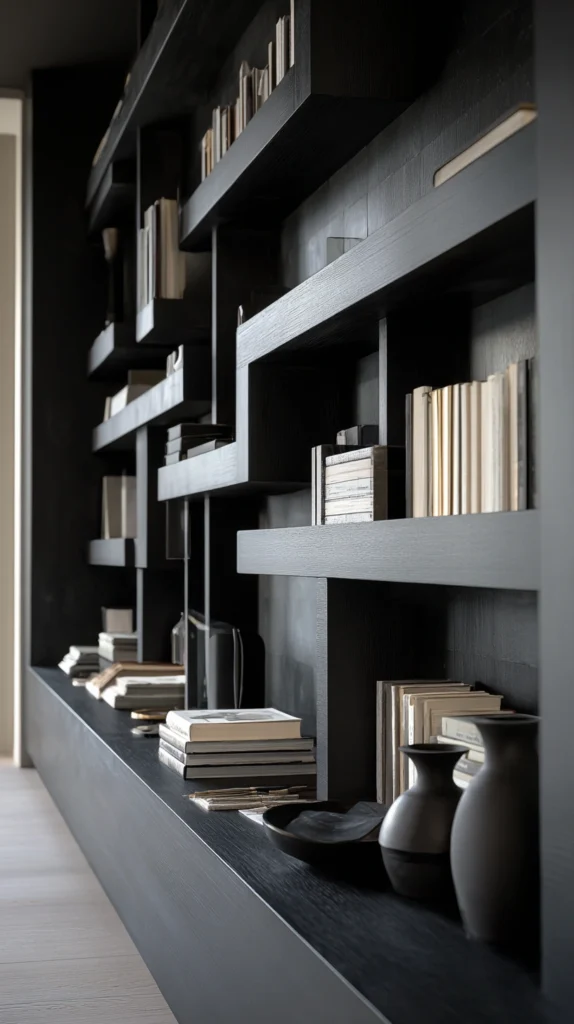
Budget: $80 – $400
Black floating shelves on a black wall — the shelves and the wall sharing the same material identity, books and objects on the shelves appearing to float in a field of uniform dark — is the black home office’s most specifically graphic and the most spatially sophisticated shelving solution. The objects displayed become more visually present against the dark background of both shelf and wall, and the overall impression is of objects curated for display rather than stored for access.
Black powder-coated or painted floating shelves — $15 – $40 each. A set of four to six shelves on a single wall — $60 – $240 in shelf materials plus $10 – $30 in fixings. Black brackets — $5 – $15 each pair — maintaining the uniform black surface of shelf and wall. Books and objects displayed on the shelves in a tonal arrangement of dark and warm tones.
Styling tip: Leave visible air between every object on the black floating shelves — a minimum of five centimetres between each book or accessory and its neighbour. Objects displayed with consistent breathing space on a black shelf read as presented and specifically chosen. Objects packed closely together on the same shelf read as stored — and storage in a professional workspace communicates a different quality from display.
8. The Black Office With a Statement Mirror
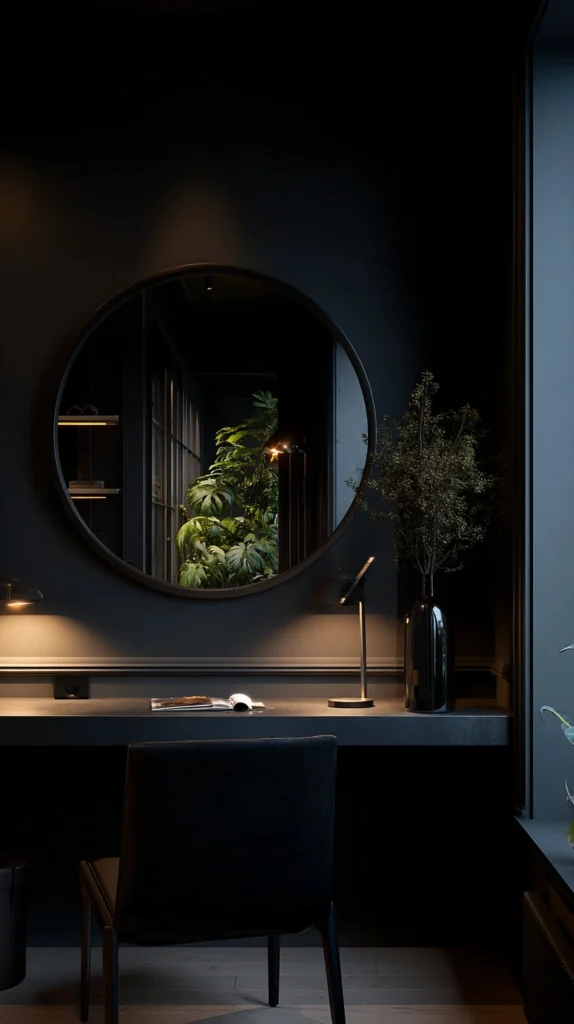
Budget: $40 – $300
A large mirror in a black home office — in a thin black iron frame, a dark brushed metal, or a bold architectural form — performs a specific function that is even more valuable in a black-walled room than in a light one. It introduces depth into a room that might otherwise read as enclosed, doubles the warm quality of the artificial lighting, and communicates a quality of considered spatial thinking that a room without a mirror cannot approach.
A large architectural mirror in a thin black metal frame — $60 – $200. An arched mirror in a dark iron finish — $80 – $250. A full-length mirror in a matte black frame — $40 – $150. The mirror should be positioned to reflect the room’s primary warm light source — the desk lamp, the floor lamp, or the window — rather than reflecting a dark wall or a storage surface.
Styling tip: Position the black office mirror to reflect the most beautiful element of the room’s light — ideally the warm amber glow of a brass lamp or the natural light from the window — rather than another dark wall. A mirror in a black room that reflects the room’s warm light appears to create a second warm light source where none exists. A mirror that reflects a dark wall creates the impression of a room extending into more darkness — which is not the spatial improvement that the mirror was installed to produce.
9. The Black Office Lighting Design
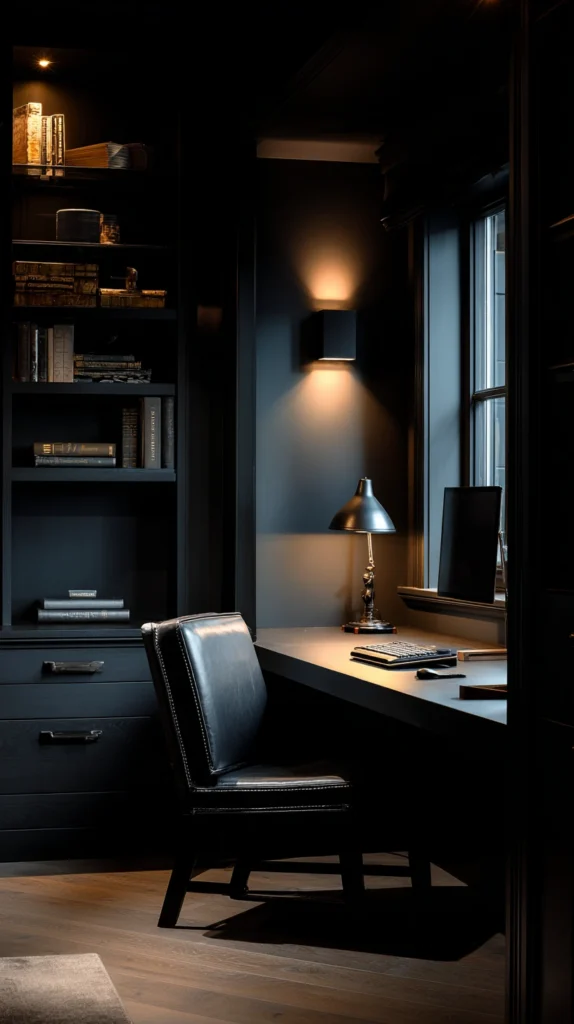
Budget: $100 – $800
The lighting scheme of the black home office is the single most important factor determining whether the dark walls read as oppressive or as genuinely enveloping and specifically focused. A black room with poor lighting is a dark room. A black room with a correct, layered, warm lighting scheme is one of the most atmospherically complete and the most specifically beautiful working environments available in a domestic context.
A quality articulated brass or dark iron desk lamp providing focused task illumination — $60 – $200. A floor lamp behind the desk chair in a warm tone — $60 – $200. Wall sconces in a warm finish providing ambient light at the wall level — $40 – $100 each, two required. Warm LED bulbs at 2700K throughout — $5 – $15 per pack. A dimmer switch on every circuit — $15 – $30 each installed.
Styling tip: Install at least four independent light sources in the black home office — a task lamp at the desk, a floor lamp for ambient support, a sconce or shelf light for the bookshelf or gallery wall, and an overhead fixture on a dimmer for general ambient control. Four independent sources allow the room to be lit at exactly the level each specific activity requires — from bright task illumination for focused work to deeply dimmed ambient warmth for video calls or end-of-day thinking. A single overhead light source in a black room produces uniform illumination of inadequate warmth for a room of this colour depth.
10. The Black and White Gallery Wall
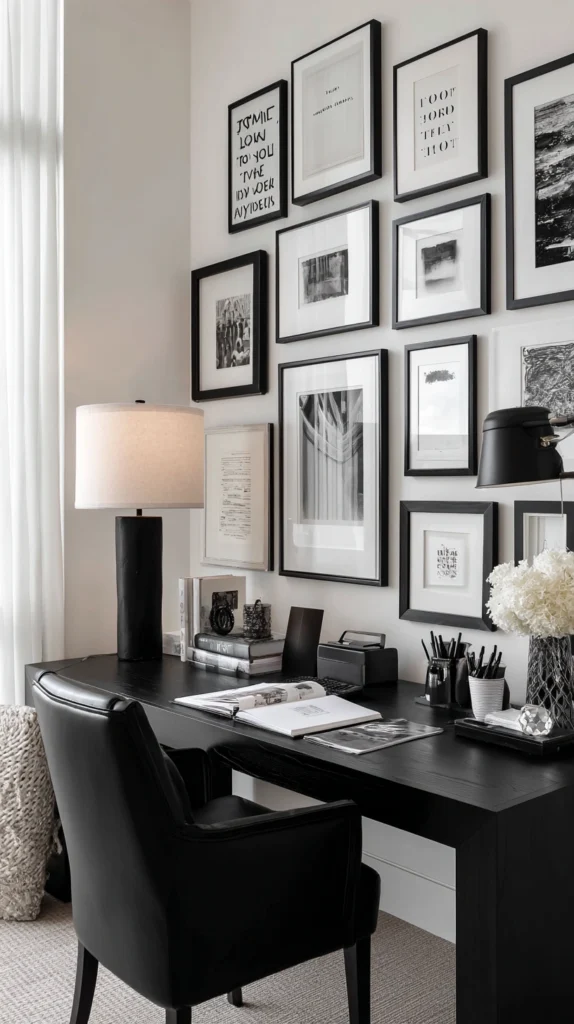
Budget: $60 – $300
A gallery wall in the black home office — consistent frames in matte black, holding photographs, architectural drawings, typographic works, and significant documents all printed in black and white or in a tonal monochrome palette — is the black workspace’s most graphically resolved and the most specifically professional display surface. A black and white gallery wall in a black office communicates aesthetic certainty and visual discipline simultaneously.
Matte black frames in varying sizes — $5 – $20 each. A collection of eight to ten frames — $40 – $200 in total. Black and white photographs — personal or from the public domain. Architectural drawings — from public archives or commissioned. Typographic prints in a bold serif or sans-serif — $10 – $25 from independent makers. Total gallery wall investment: $50 – $225 for the black office’s most graphically authoritative surface.
Styling tip: Hang the black and white gallery wall with consistent spacing between every frame — a gap of three to five centimetres between each frame maintained precisely throughout the full arrangement. Consistent spacing in a gallery wall communicates intentionality. Inconsistent spacing communicates that the frames were placed as they appeared to fit rather than arranged according to a specific principle. In a black office where every surface is making a deliberate statement, the spacing between the frames on the gallery wall is itself a statement.
11. The Black Home Office With Leather Accessories
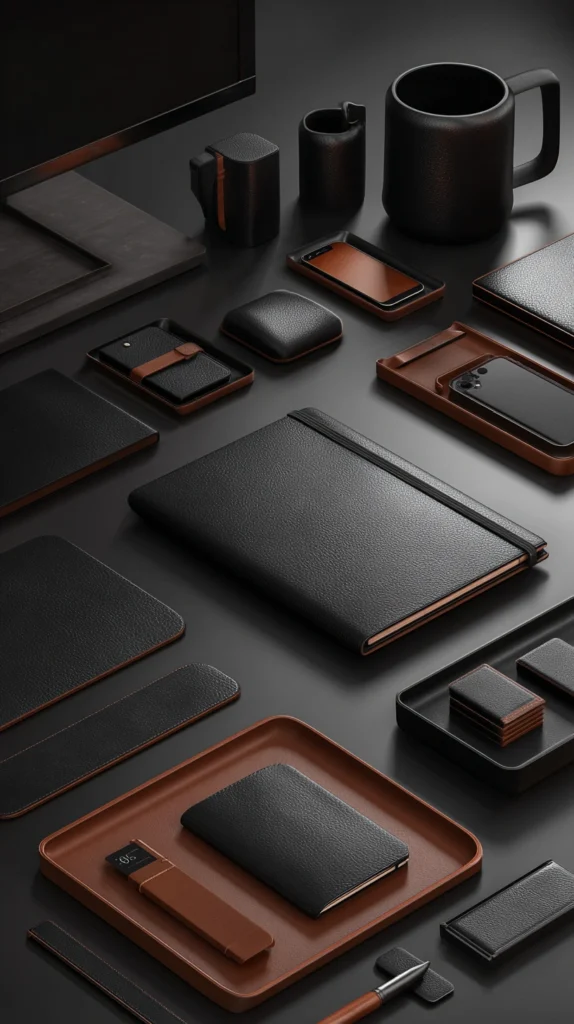
Budget: $50 – $300
Leather desk accessories in the black home office — a leather desk blotter in a warm cognac or a deep chocolate, a leather pen case, a leather notebook cover, and a small leather desk tray — introduce the material warmth and the material quality that a black working surface specifically requires. Leather in a black office occupies the same warm, serious, specifically professional register as the room itself — warm enough to prevent coldness, dark enough to maintain the room’s tonal authority.
A full-surface leather desk blotter in cognac or chocolate — $50 – $150. A leather pen case — $20 – $60. A leather notebook cover — $30 – $80. A small leather desk tray — $20 – $60. Total leather accessory investment: $120 – $350 for a desk surface that reads as specifically and genuinely professional at the level of the smallest detail.
Styling tip: Choose leather desk accessories in a consistent colour — all cognac, or all chocolate brown, or all black — rather than a mixture of leather tones across the desk surface. A desk with consistently coloured leather accessories reads as a considered collection. The same desk with multiple leather tones reads as a desk where leather accessories accumulated over time without reference to each other — which communicates a different and less specifically professional quality of attention to the working environment.
12. The Black Office With Geometric Architectural Detail
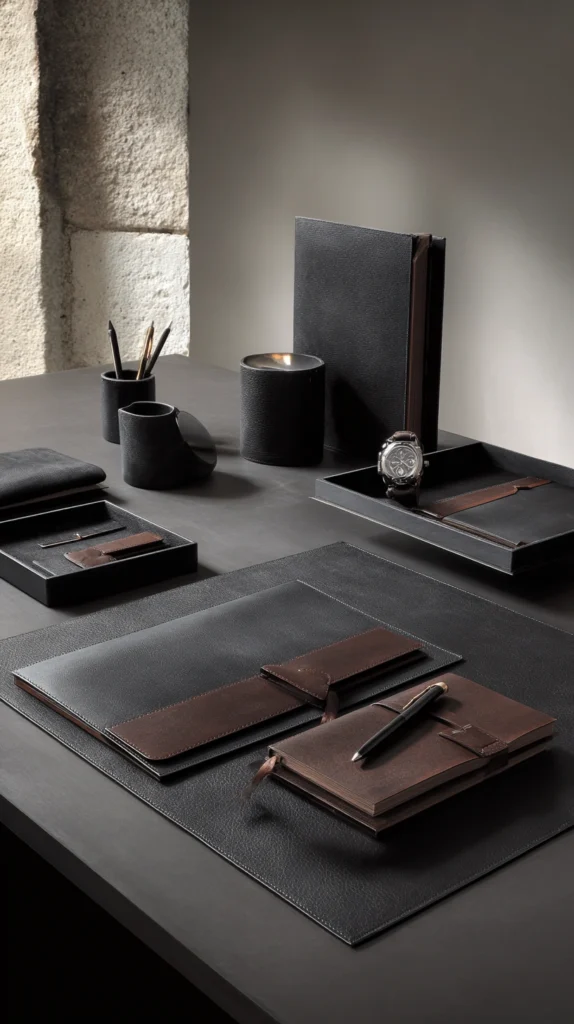
Budget: $30 – $500
A black home office given geometric architectural detail — a simple grid of black-painted timber battens on one wall, a graphic wallpaper in a black and white geometric pattern, or a series of black-painted panel mouldings creating a geometric wall composition — introduces visual complexity into the black environment without introducing any additional colour. The geometry communicates design sophistication and the quality of a space where the black is not merely paint applied to flat walls but a considered architectural treatment.
Black-painted timber battens arranged in a geometric grid — $30 – $120 in timber and paint materials. A black and white geometric wallpaper — $20 – $60 per roll. Black-painted panel mouldings in a regular grid — $40 – $150 in moulding and paint materials. Total geometric detail investment: $30 – $150 for a wall treatment that transforms the quality of the black surface from a flat painted one to a specifically designed architectural element.
Styling tip: Apply the geometric architectural detail to the feature wall behind the desk — the wall most visible from the working position and most prominent in video calls — rather than to the side walls or the wall behind the desk chair. A geometrically detailed feature wall within the daily visual field enriches the working environment at the level of the surface most consistently observed during the working day. The same detail on a wall seen only occasionally provides the same investment at a fraction of the visual return.
13. The Standing Black Desk and Monitor Setup
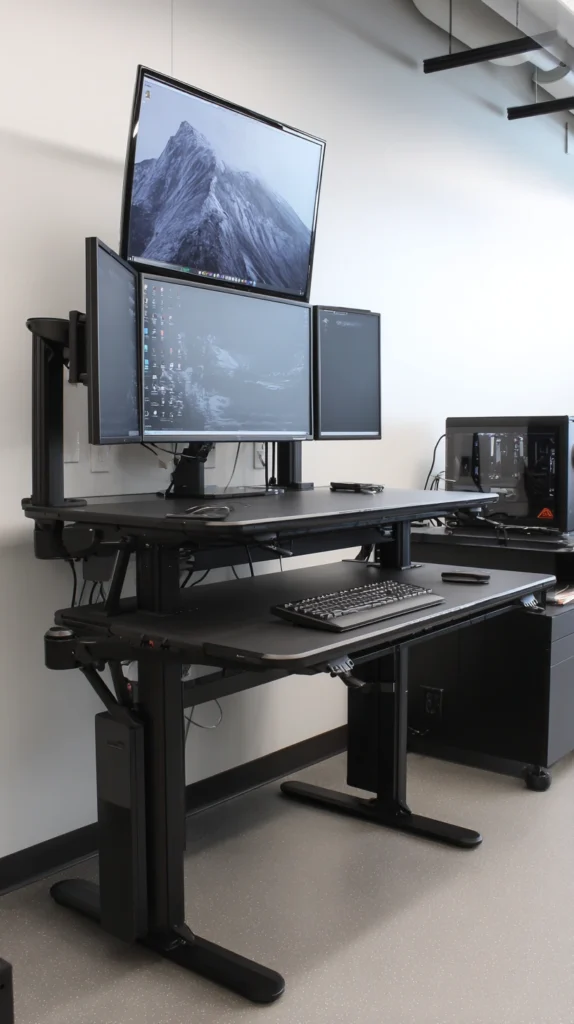
Budget: $300 – $2000
A black sit-stand desk — the desk frame, the legs, the monitor arm, the cable management system, and the desk surface all in the same matte black — is the black home office’s most technologically coherent and the most specifically contemporary furniture specification. A black desk with black technology infrastructure reads as a single, unified working surface rather than a desk with cables and equipment placed upon it.
A black-framed electric sit-stand desk — $300 – $1000. A black dual or single monitor arm — $50 – $200. A matte black cable management tray beneath the desk — $15 – $40. A black wireless keyboard and mouse — $40 – $150. A matte black monitor — $200 – $600. Total black desk setup: $605 – $1990 for a working surface that reads as a single considered technological object rather than a desk with equipment placed on it.
Styling tip: Route every cable through the cable management tray or conceal it within cable sleeves in the same black as the desk before any styling or accessory placement is made. A black desk with visible cables reads as approximately half as resolved as the same desk with concealed cables — the cables introducing a visual randomness that contradicts the specific quality of deliberate order that the black office is working toward. Address cable management first and assess the desk only after every cable is concealed.
14. The Fully Realised Black Home Office
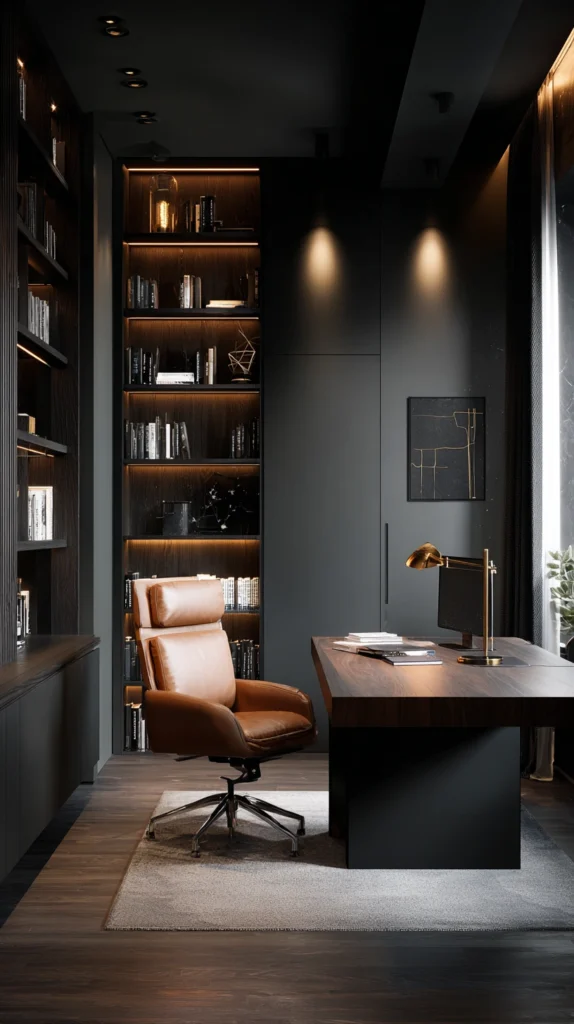
Budget: $800 – $8000
The fully realised black home office — matte black walls with warm ivory woodwork, black floating shelves holding books and brass-framed objects with consistent breathing space between every displayed item, a warm oak desk surface on black-framed legs with a cognac leather desk blotter and an aged brass task lamp at the correct height, a quality leather desk chair in chocolate brown, a warm Persian or monochrome rug with the chair’s front legs upon it, heavy black linen curtains from ceiling height, a black and white gallery wall with consistently spaced matte black frames on the primary video call wall, two large architectural plants in matte black or terracotta pots, a black sit-stand desk mechanism with a black monitor arm and concealed cabling, a quality audio system at ear height, warm LED sources at 2700K throughout on independent dimmers, and no object on any surface that was not chosen for its quality and its specific contribution to the working environment — is the black home office that makes every working hour feel like the most focused and the most professionally resolved working hour of the year.
Matte black paint: $60 – $200. Floating shelves: $80 – $300. Oak desk and black frame: $150 – $500. Leather chair: $300 – $1000. Persian rug: $200 – $1500. Black curtains: $120 – $400. Brass lighting: $120 – $400. Gallery wall: $50 – $225. Plants: $80 – $200. Sit-stand desk: $300 – $1000. Audio system: $200 – $800. Leather accessories: $120 – $350. Total fully realised black home office: $1780 – $6875 for a workspace built on the understanding that the most focused and the most professionally authoritative working environment available in a domestic context is the one that committed, completely and without apology, to the colour that communicates both of those qualities most directly.
Styling tip: After the black home office is fully assembled, stand at the door and assess the room with the desk lamp on, the overhead on its lowest dimmer setting, and no other light source present. This is the room’s primary working state — the task lamp providing focused illumination at the desk and the ambient dimmed overhead providing just enough general light to define the room’s boundaries without competing with the lamp’s focused quality.
If the room reads as enveloping, warm, and specifically focused in this state, every decision was correct. If it reads as dark and uncomfortable, the warm light sources require adjustment before any other assessment is made. The lighting is the room’s foundation. All other qualities rest upon it.
The black home office is the workspace that communicates, without equivocation and without apology, that the person within it has made a decision about the quality of the environment they require for the quality of the work they intend to do. It is not a room for the undecided or the cautious. It is a room for the person who has looked at every available option and chosen the most committed, the most focused, and the most specifically professional of them all.
Make it warm. Make it lit correctly. Choose every object for quality. Conceal every cable.
And then sit in it, open the work, and discover what a genuinely focused environment — built with conviction and furnished with precision — can do for the quality of what is produced within it.