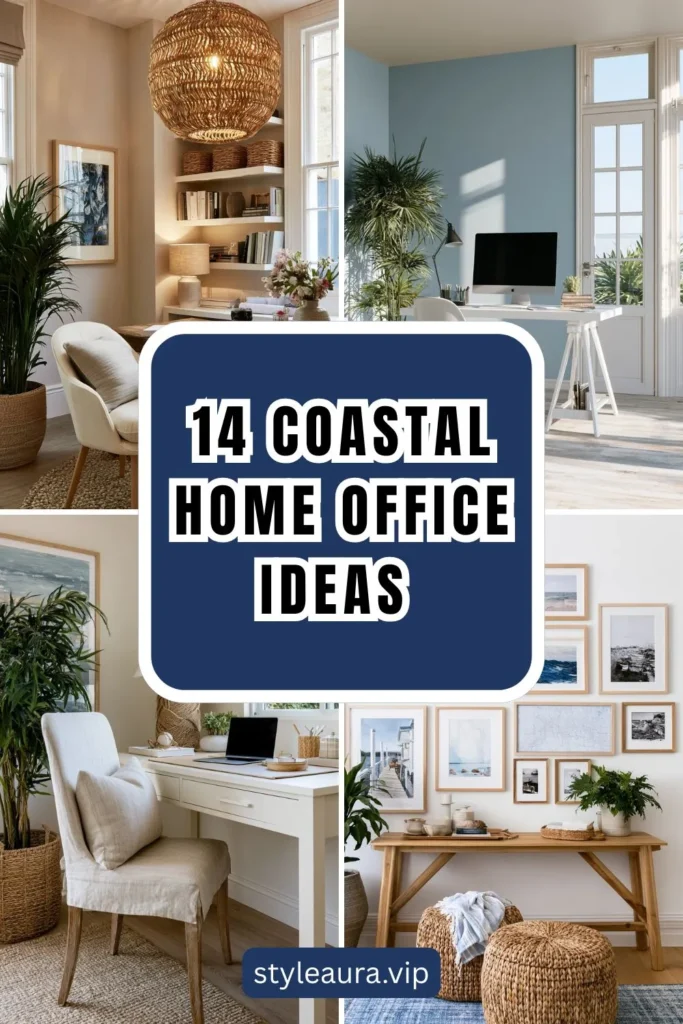
14 Coastal Home Office Ideas for a Relaxed Work Vibe
There is a particular quality of mental clarity that proximity to water and open skies has always produced in the people fortunate enough to experience it — the quality of thought that arrives when the mind is simultaneously stimulated by the complexity of the natural world and calmed by its fundamental unhurriedness.
The coastal home office is the attempt to bring that quality indoors — to create a workspace that carries, in its colours and its materials and its light, the specific atmosphere of a room beside the sea, and that produces in the person working within it some fraction of the focused, unconstrained quality of thought that the actual coast has always generated.
It is not a room of seashells arranged on a windowsill and a print of a lighthouse on the wall. It is a room of genuine material honesty — driftwood and linen and the pale, weathered tones of things that have spent time in honest relationship with wind and water. It is the workspace that communicates, without any literal coastal imagery required, that the person who works here understands the relationship between a calm environment and the quality of what is produced within it.
The fourteen ideas below cover every element of the coastal home office — from the foundational material decisions to the finishing details that produce a genuine, specific, and consistently relaxed work vibe.
1. The Coastal Colour Palette Foundation
Budget: $30 – $150
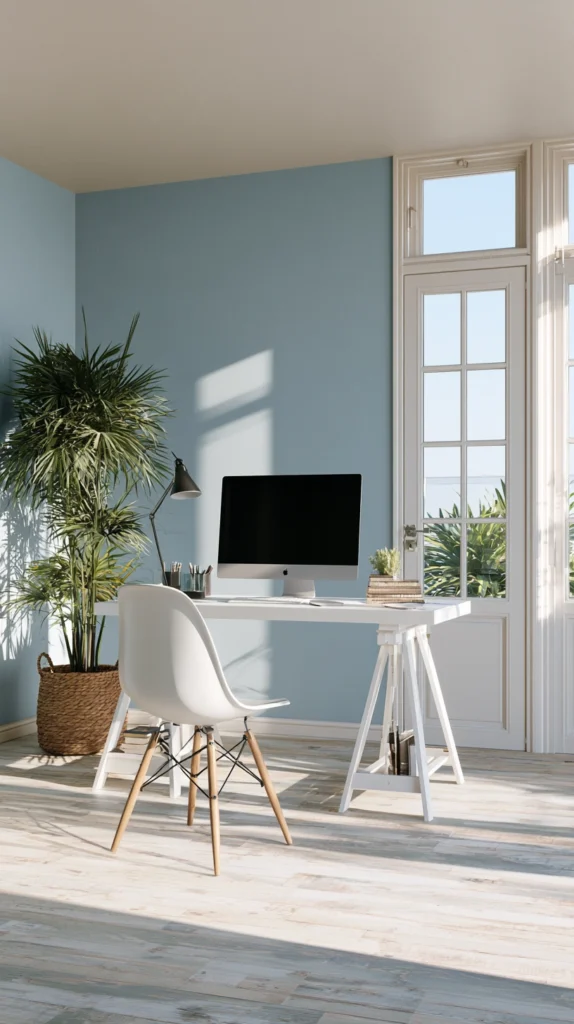
The coastal home office palette runs in the specific tones of the shoreline — the pale, slightly warm white of bleached sand, the weathered grey-blue of driftwood, the soft sage of sea grass, the warm honey of natural rope, and the particular pale blue of shallow coastal water on an overcast day. These are colours of specific restraint and specific warmth — muted rather than saturated, warm rather than cool, and specific to the natural world they reference rather than to any commercial interpretation of the coastal aesthetic.
A quality pale coastal blue or weathered grey-blue paint in a flat finish costs $20 – $50 per litre. A standard office requires two to three litres — $40 – $150 in quality paint. The palette works at any scale from a single painted wall to the full room.
Decor tip: Avoid the bright, saturated navy and white of the nautical aesthetic if the coastal home office is working toward a relaxed work vibe rather than a graphic, bold statement. Saturated navy communicates authority and precision — qualities appropriate to a formal home office but at odds with the specific quality of relaxed, coastal-inflected focus the coastal workspace is designed to produce. The pale, weathered, slightly muted coastal palette produces a genuinely relaxed atmosphere. The saturated nautical palette produces a smart one.
2. The Driftwood Desk
Budget: $100 – $800
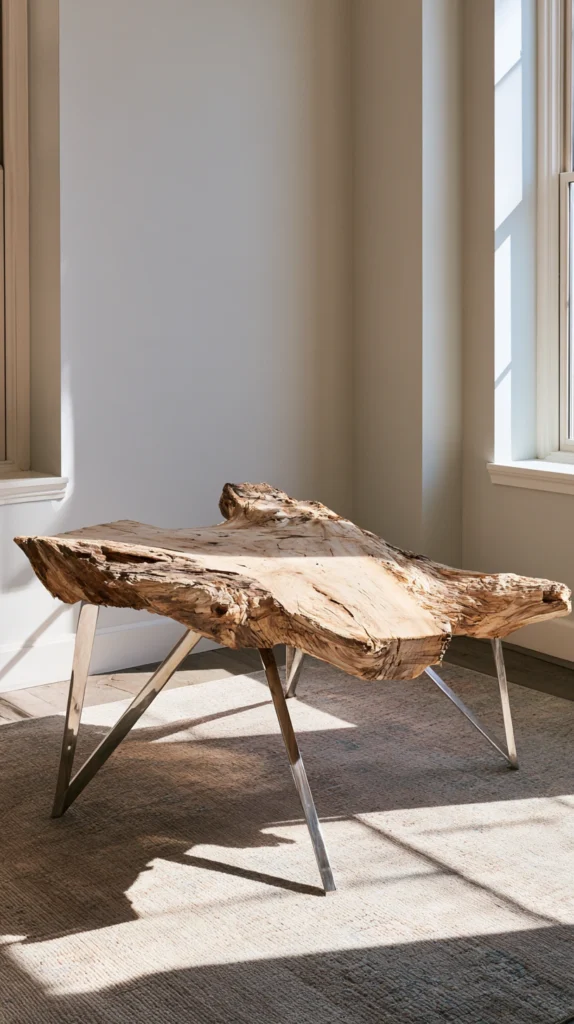
A desk incorporating genuine driftwood — either a solid driftwood slab as the desk surface supported on simple metal or timber trestle legs, or a standard desk given a driftwood-effect treatment through limewashing or a grey-wash paint technique — is the coastal home office’s most specifically material and the most directly coastal single piece of furniture. Driftwood carries the specific quality of wood shaped by water and time, and its presence in a workspace communicates the coastal aesthetic through the material’s own history.
A genuine driftwood slab desk surface — $150 – $600 from a specialist driftwood furniture maker or a coastal salvage yard. Driftwood trestle legs — $80 – $250. A standard timber desk grey-washed to a driftwood appearance — $20 – $60 in grey-wash paint applied to an existing piece. A pale limewashed timber desk — $100 – $300 from a furniture retailer with a weathered finish.
Styling tip: Oil a genuine driftwood desk surface with a clear penetrating oil rather than a film-forming varnish or lacquer — the clear oil protecting the surface from moisture and pen marks while maintaining the specific dry, slightly rough, and specifically beautiful surface quality of genuine driftwood. A varnished driftwood surface reads as a driftwood-pattern desk. An oiled driftwood surface reads as a genuine piece of coastal material that happens also to be a working surface.
3. The Coastal Blue Wall Treatment
Budget: $40 – $200
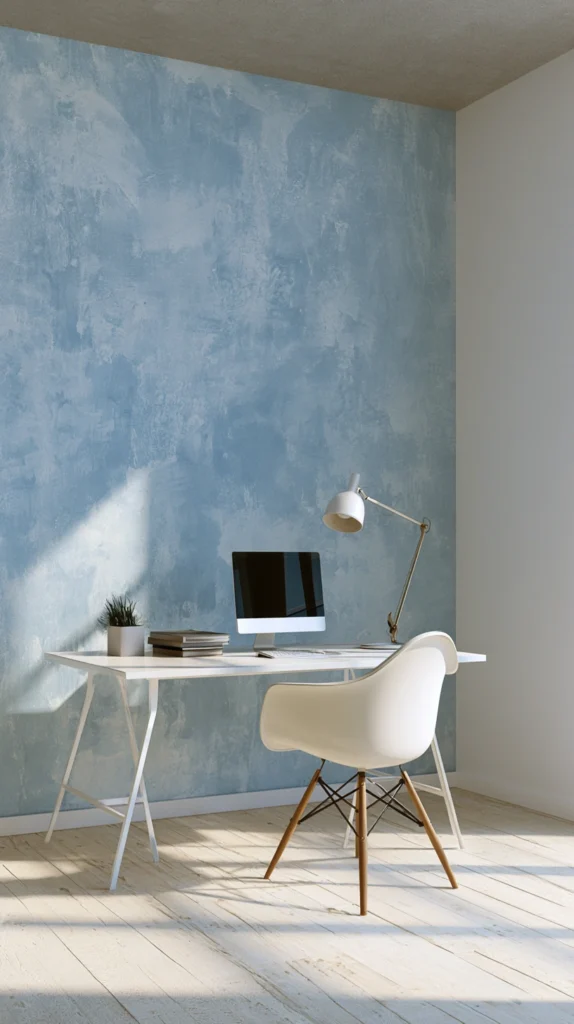
A coastal blue wall — in a pale, slightly grey-toned blue that references the colour of shallow coastal water on a bright day or the particular grey-blue of a sea horizon on an overcast morning — is the coastal home office’s most atmospherically significant single decorating decision. The correct coastal blue makes the room feel physically cooler and mentally clearer in a way that no other colour palette produces.
A quality coastal blue paint — pale, slightly grey, specifically watery — in a flat or eggshell finish costs $20 – $50 per litre. A feature wall application requires one to one and a half litres. A full room application — the most atmospherically complete version — requires three to four litres at $60 – $200.
Styling tip: Apply the coastal blue wall treatment in a limewash or a slightly textured application rather than a flat standard paint — the natural variation of a limewash finish producing the specific quality of a wall that has been weathered by proximity to the coast. A flat standard paint in the same coastal blue reads as a painted wall. A limewash in the same colour reads as a wall with a history.
4. The Natural Linen and Rope Textile Layer
Budget: $40 – $250
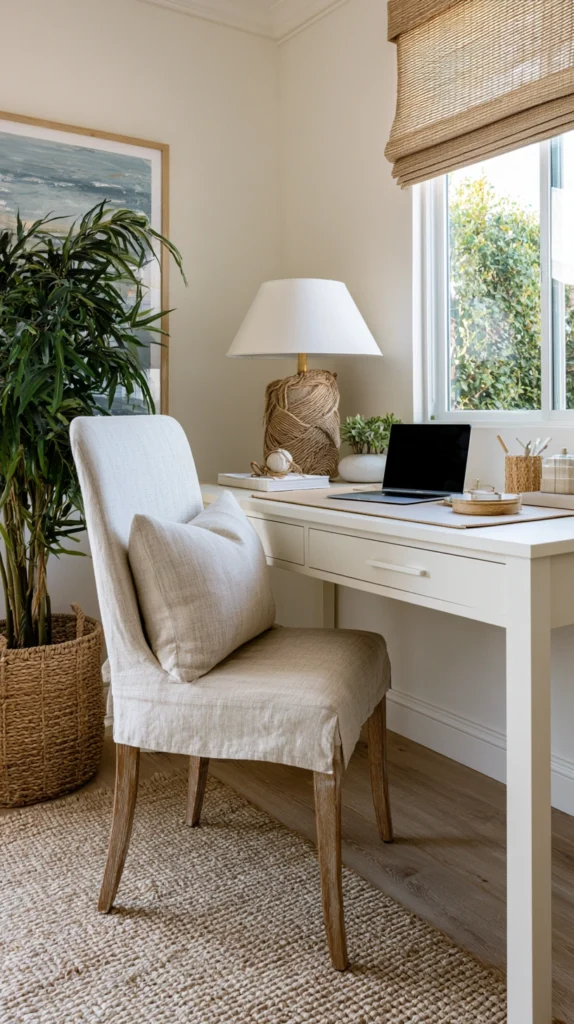
The coastal home office’s textiles — a natural linen desk chair cushion, rope-bound accessories, a woven sea grass basket for storage, and a linen window treatment that filters the light to a warm, diffused quality — introduce the specific material warmth of natural coastal fibres into the workspace at the level of touch as well as sight. Natural linen, sea grass, and rope are the coastal home office’s most honest and most specifically appropriate textile materials.
A natural linen desk chair cushion — $25 – $60. A rope-bound pen holder — $8 – $20. A woven sea grass storage basket — $15 – $40. Natural linen curtain panels — $40 – $100 per panel. A jute desk mat — $20 – $50. Total textile investment: $108 – $270 for a complete natural material textile story.
Styling tip: Choose linen in its most natural, least processed state — undyed or barely dyed, with the specific warm quality of raw linen fibre rather than the bright white of bleached cotton. Natural undyed linen beside a coastal blue wall reads as a genuinely coastal material combination — both materials belonging to the same world of honest, unprocessed natural things. Bleached white linen beside the same wall reads as a sharp contrast — clean and graphic but less specifically coastal in its material character.
5. The Coastal Bookshelf and Display
Budget: $30 – $200
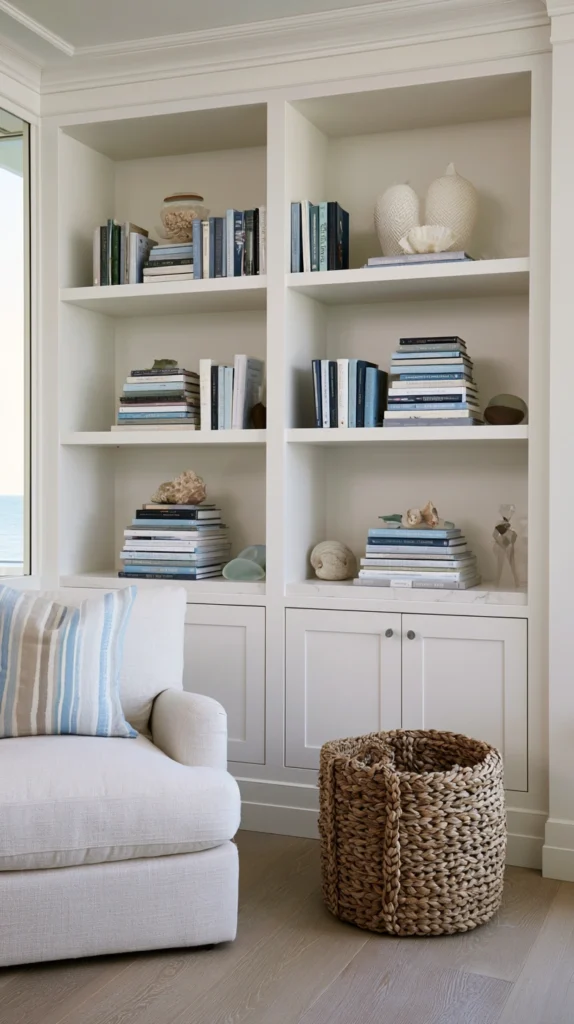
A bookshelf in the coastal home office — books arranged without colour organisation, interspersed with coastal natural objects, sea glass in glass vessels, smooth river or sea stones, small pieces of driftwood, and a dried botanical arrangement — communicates the coastal aesthetic at the most personal and the most intimate display scale without requiring any literal coastal imagery.
Books already owned — free to reorganise. Sea glass in a glass or ceramic vessel — free if personally collected, or $5 – $15 from a coastal craft supplier. Smooth sea or river stones — free if gathered. A small piece of genuine driftwood — free from a coastal walk or $10 – $30 from a coastal salvage source. A dried botanical arrangement in a simple vessel — $15 – $40.
Styling tip: Include at least one object on the coastal bookshelf that was personally collected from a genuine coastal environment — a stone, a piece of sea glass, a shell, or a piece of driftwood — rather than purchasing all objects from a coastal home accessories collection. A personally collected object communicates a genuine relationship with the natural world the workspace references. A fully purchased coastal object collection communicates a decorating decision about the coastal aesthetic — which is related to but different from the genuine coastal connection.
6. The Sea Glass and Natural Object Desk Display
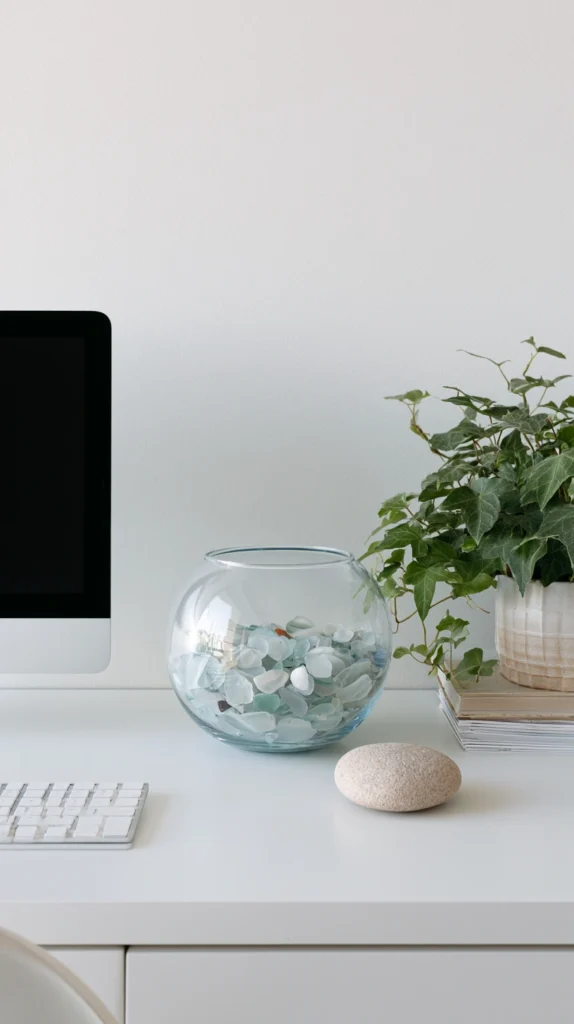
Budget: $5 – $80
A small desk display of coastal natural objects — sea glass arranged by colour in a low glass vessel, a smooth white stone from a beach walk used as a paperweight, a small dried sea lavender arrangement in a ceramic bud vase, and a piece of bleached coral or a small piece of weathered timber as a pen rest — gives the coastal home office desk its most specifically personal and its most directly natural decorating layer.
Sea glass — free if personally collected or $5 – $15 from a coastal craft supplier. A smooth beach stone — free if personally collected. A dried sea lavender arrangement — $8 – $20. A small ceramic bud vase — $5 – $15. A piece of bleached coral or weathered timber — free if found or $8 – $20 if purchased. Total desk display investment: $26 – $70 for the workspace’s most intimate and most specifically coastal object arrangement.
Styling tip: Arrange the coastal desk objects in a single, compact group rather than distributing them across the full desk surface — all the natural objects together in one corner of the desk, leaving the rest of the working surface clear. A compact group of coastal objects reads as a considered collection with a specific position. The same objects distributed individually across the desk read as objects placed where there was space — which communicates a different and less specifically considered quality of desk organisation.
7. The Coastal Home Office With a View Orientation
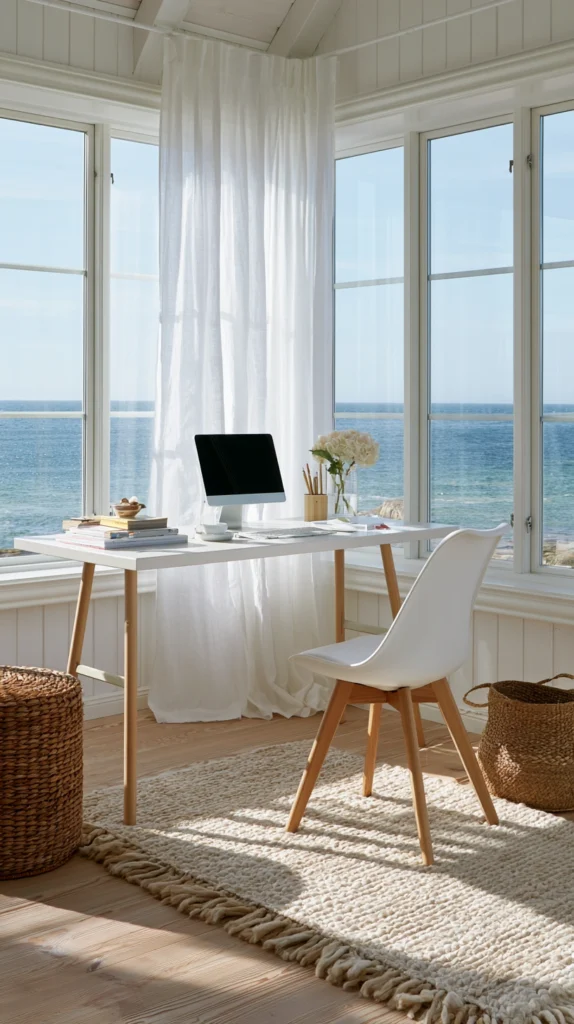
Budget: $0 – $200
A coastal home office arranged specifically around its best available view — the desk positioned perpendicular to the window to receive natural light from the side while providing a clear view of the garden, the sky, or any water visible from the workspace, the chair height and position calibrated so that the occupant’s natural resting gaze direction looks toward the most sky-filled part of the available view — uses the room’s existing view as its primary coastal decorating element.
Repositioning existing desk furniture — free. A desk at the correct height with the correct chair adjustment — $0 if existing furniture is ergonomically appropriate. Sheer linen curtain panels to filter rather than block the view — $40 – $100 per panel. A window bird feeder visible from the working position — $10 – $30. Total view-orientation investment: $50 – $130 for the coastal home office’s most immediately available and most consistently beautiful atmospheric element.
Styling tip: Position the desk so that the window providing the best view is to the side rather than directly in front of or directly behind the desk. A window directly in front of the desk produces glare on the screen and visual fatigue from the brightness contrast between the screen and the window. A window to the side provides natural light on the working surface, allows the view to be seen with a simple head turn, and prevents the screen glare that a front-facing window consistently produces.
8. The Whitewashed Timber Wall Panelling
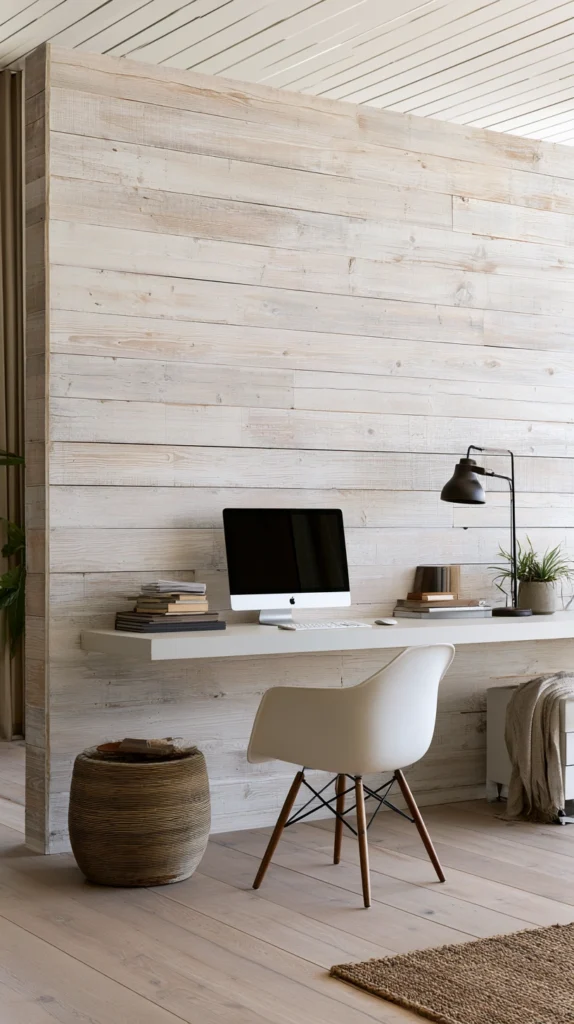
Budget: $100 – $600
Whitewashed timber wall panelling — simple timber boards applied horizontally or vertically to the office walls, painted or whitewashed in a pale, slightly warm white that allows the timber grain to read through the paint — gives the coastal home office its most specifically architectural and the most warmly rustic wall treatment. Whitewashed timber communicates the specific quality of a beach hut or a coastal cottage interior — a wall that has been painted many times in warm weather and has absorbed salt air and summer light in each layer.
Timber planks applied horizontally — $40 – $150 in timber materials. A whitewash paint or a diluted warm white applied over the timber — $15 – $40 in paint. Vertical tongue-and-groove panelling — $60 – $200 in panelling materials. Professional installation — $100 – $300 for a standard office wall. Total whitewashed panelling investment: $115 – $490 for a wall treatment of genuine coastal material warmth.
Styling tip: Apply the whitewash in a diluted rather than a full-coverage application — thinning the white paint with water to approximately 50 percent coverage so that the timber grain remains clearly visible through the white. A full-coverage whitewash produces a white wall with a slight wood texture. A 50 percent diluted whitewash produces a warm white surface where the specific warmth comes from the visible timber grain reading through the paint — which is specifically coastal in character and significantly more beautiful than the full-coverage alternative.
9. The Coastal Gallery Wall
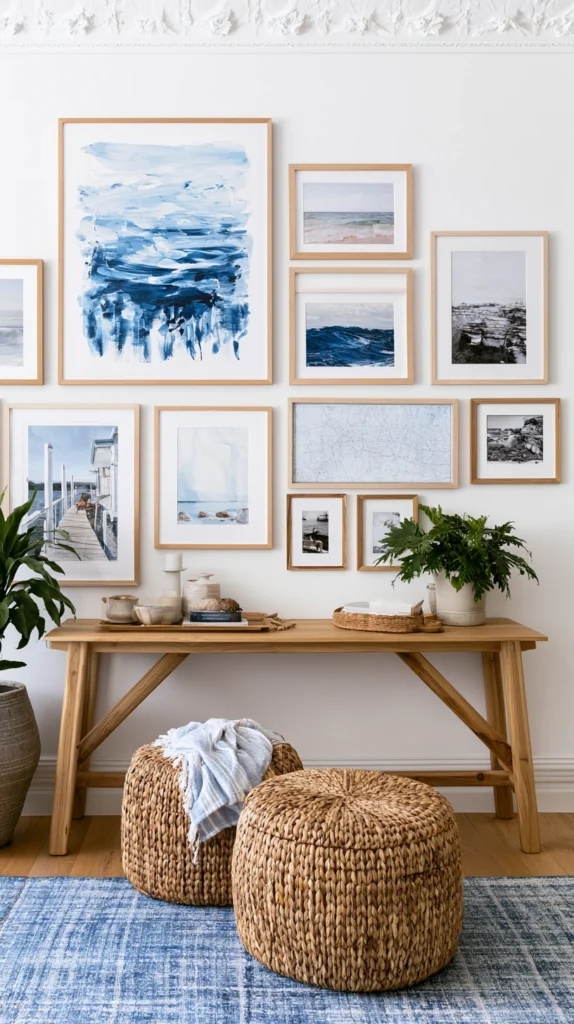
Budget: $40 – $250
A gallery wall in the coastal home office — driftwood or pale timber frames holding coastal watercolours, hand-drawn maps of coastal areas of personal significance, black and white coastal photography, pressed sea lavender or dried coastal botanicals in simple frames, and one or two personal coastal photographs — is the workspace’s most personally expressive and the most specifically narrative display surface.
Driftwood or pale timber frames — $8 – $25 each. A collection of six to eight frames — $48 – $200 in total. Coastal watercolour prints — $10 – $30 each from independent artists or public domain sources. Dried coastal botanical specimens — pressed and framed for $3 – $8 per frame. A hand-drawn coastal map — from public domain cartographic archives — free to download and print.
Styling tip: Include at least one image in the coastal gallery wall that references a specific coastal place of genuine personal significance — a watercolour of a particular stretch of coastline, a map of a specific bay, or a photograph of a specific beach — rather than generic coastal imagery. A gallery wall with one specifically personal coastal reference communicates a genuine relationship with the place the aesthetic references. One composed entirely of generic coastal imagery communicates an aesthetic preference for the coastal rather than a genuine connection to it.
10. The Coastal Home Office With Natural Sound
Budget: $20 – $150
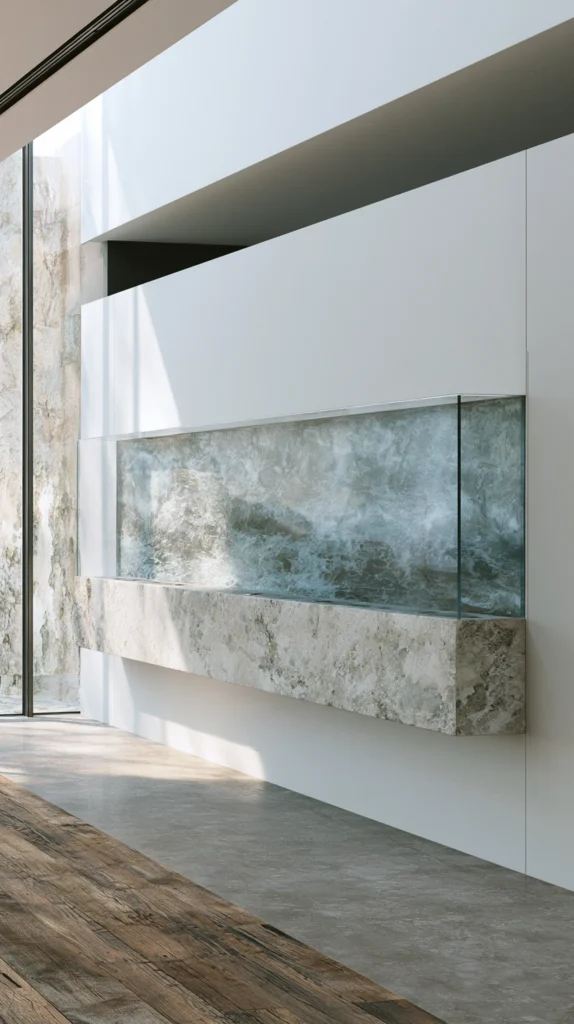
Sound in the coastal home office — a small tabletop water feature providing the continuous gentle sound of moving water, a quality speaker playing recordings of actual coastal sounds or wave recordings during working sessions, or the specific quality of wind through an open window on a windy day — introduces the auditory dimension of the coastal aesthetic into the workspace and produces the specific quality of mental calm that the sound of water consistently generates.
A small tabletop water feature — $25 – $80. A quality portable speaker for coastal sound recordings — $30 – $100 if not already owned. Freely available wave and coastal sound recordings — from streaming services or free audio platforms.
Styling tip: Set the tabletop water feature at a distance of two to three metres from the desk rather than on the desk surface — the sound most calming and most specifically conducive to focused work at this distance. Directly on the desk, the water sound is too immediate and too present. At the far end of the room, it is too distant to provide the continuous ambient quality that makes the water sound specifically useful as a working environment sound. The two-to-three-metre distance produces the specific quality of a background sound that is present without demanding attention.
11. The Coastal Home Office With Indoor-Outdoor Connection
Budget: $50 – $500
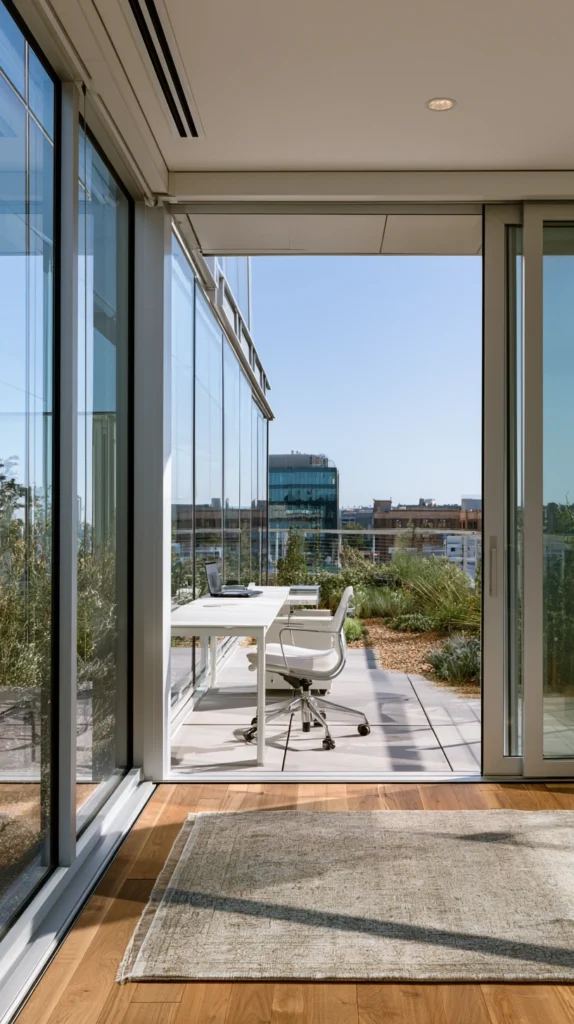
A coastal home office with a deliberate indoor-outdoor connection — a glass door or large window that opens the workspace to a garden or a terrace, a sliding or folding door that allows the working space to expand into the outdoor space during warm weather, or simply a window that opens fully rather than partially — is the workspace that most directly delivers the actual coastal quality the aesthetic references.
A sliding glass door connecting office to garden — $500 – $2000 professionally installed. A large opening window — $0 if already present, or $200 – $600 to replace an existing small window. An outdoor workspace extension — a simple table and chair on the terrace immediately outside the office window — $50 – $200 in furniture.
Styling tip: Work in the genuinely outdoor or indoor-outdoor position for at least one working session per week when the weather allows — not merely opening the window or the door but actually sitting at the outdoor position for a complete morning or afternoon.
The coastal home office aesthetic is ultimately an attempt to bring outdoor working conditions indoors. Working outdoors within the same domestic environment confirms whether the indoor version is producing the quality of atmosphere it was designed to reference — and it consistently produces a quality of thought that reminds the coastal home office occupant why the indoor version is worth maintaining with genuine attention.
12. The Rope and Maritime Detail Layer
Budget: $20 – $150
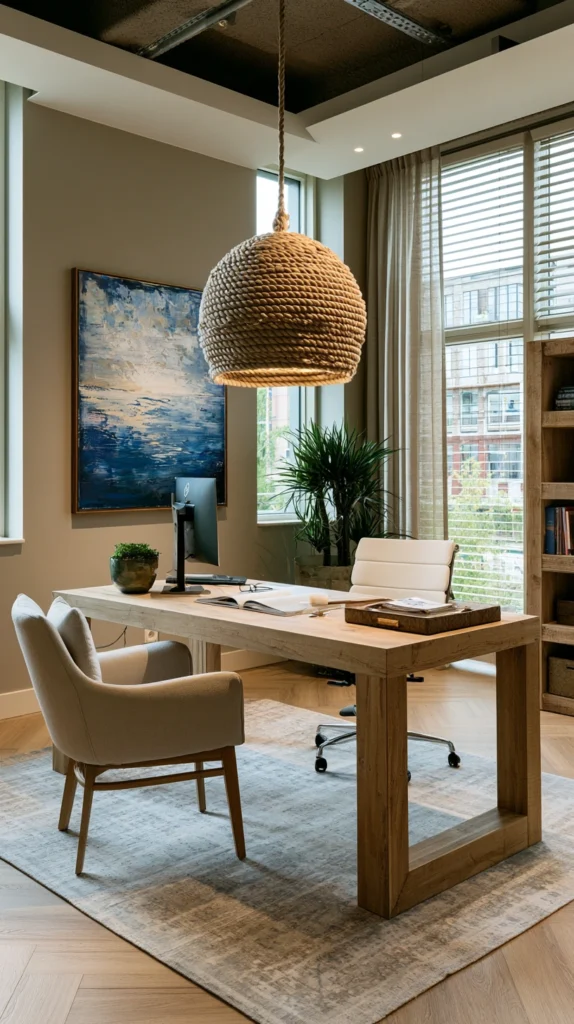
Rope and maritime detail in the coastal home office — a rope-wrapped lamp base, rope handles on storage baskets, a rope noticeboard in a natural hemp cord frame, or a simple knot displayed as a framed decorative object — introduces the specific material vocabulary of the maritime tradition into the workspace at the level of small, considered details that cost very little and communicate the aesthetic with genuine specificity.
A rope-wrapped ceramic lamp base — $30 – $80 from a coastal home accessories supplier or $5 – $15 in rope to wrap an existing lamp. A rope-handled storage basket — $15 – $40. A hemp cord framed noticeboard — $15 – $40. A framed maritime knot diagram — free to download from public domain maritime archives and $5 – $15 to frame.
Styling tip: Use natural, undyed hemp or manila rope for any rope detail in the coastal home office rather than dyed or synthetic alternatives. Natural rope in its undyed state belongs to the same honest, unprocessed material world as driftwood, sea grass, and raw linen — the materials that collectively produce the specific quality of coastal material authenticity. Dyed or synthetic rope reads as a coastal reference rather than a coastal material, which is a different quality impression.
13. The Coastal Lighting Scheme
Budget: $60 – $400
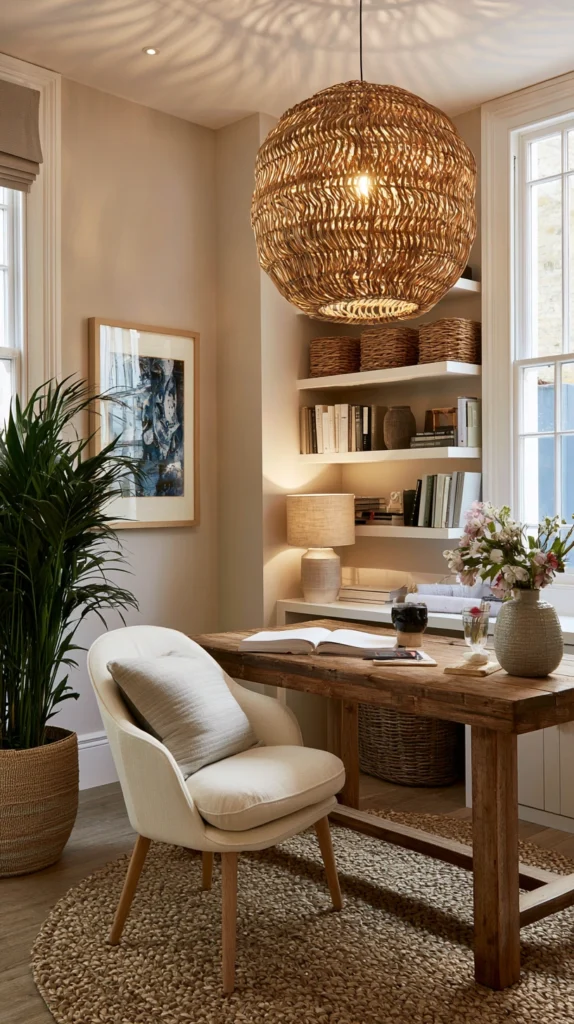
The coastal home office’s lighting — warm natural light filtered through linen curtains during the day, a warm rattan or driftwood pendant above the desk providing the primary task illumination, a small warm table lamp in the corner for ambient evening support, and warm LED bulbs at 2700K throughout — produces the specific quality of warm, slightly diffused light that the coastal environment generates on its most beautiful days.
A rattan or driftwood pendant above the desk — $25 – $100. A small warm ceramic or timber table lamp — $30 – $80. Natural linen curtain panels to filter rather than block the natural light — $40 – $100 per panel. Warm LED bulbs at 2700K — $5 – $15 per pack. Total coastal lighting investment: $100 – $295 for a lighting scheme of consistent, warm, specifically coastal quality.
Styling tip: Choose a rattan pendant in a natural, slightly irregular weave — the irregularity of a hand-woven rattan shade casting a slightly dappled light pattern on the ceiling and walls around it rather than a uniform overhead illumination. The dappled light pattern of a hand-woven rattan pendant produces, in a small coastal-palette office, a quality of light that references filtered sunlight through coastal foliage — one of the most specifically beautiful and the most genuinely coastal lighting effects available in a domestic workspace.
14. The Fully Realised Coastal Home Office
Budget: $400 – $3000
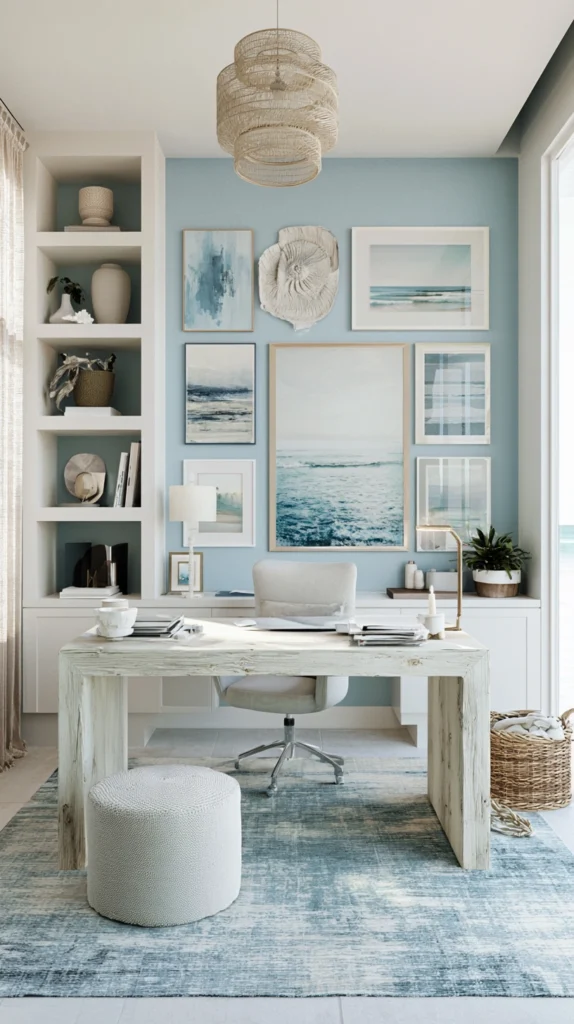
Pale coastal blue limewash covers the walls, while whitewashed horizontal timber planking creates a feature wall behind the desk. A genuine driftwood slab desktop sits on pale timber trestle legs. A natural linen chair cushion adds comfort and texture.
A rattan pendant light glows warmly above the workspace. A coastal gallery wall in driftwood and pale timber frames complements bookshelves styled with books and personal coastal objects. Natural linen curtains softly filter daylight throughout the room.
A sea glass collection and smooth beach stone paperweight decorate the desk surface. A tabletop water feature, woven seagrass basket, and large architectural plant add organic character. Warm 2700K lighting completes a workspace designed for calm, focused productivity.
Limewash paint: $80 – $240. Whitewashed timber planking: $115 – $490. Driftwood desk: $150 – $600. Chair and cushion: $100 – $400. Rattan pendant: $25 – $100. Gallery wall: $40 – $200. Bookshelf objects: $30 – $100. Water feature: $25 – $80. Desk objects: $26 – $70. Linen curtains: $80 – $200. Textile accessories: $40 – $150. Plant and pot: $30 – $80. Total fully realised coastal home office: $741 – $2710 for a workspace of genuine, specific, and consistently relaxed coastal atmosphere.
Styling tip: Spend five minutes each morning before beginning work arranging the desk to its ideal working state — the sea glass vessel in its correct position, the beach stone paperweight in place, the linen cushion adjusted, and the water feature switched on — as a deliberate transition ritual between domestic life and working life.
The coastal home office’s quality of relaxed focus is produced not only by its materials and its colours but by the daily practice of inhabiting it with genuine attention — the five-minute morning arrangement being the daily act that confirms the workspace as a specific, intentional destination rather than a room in which a desk happens to be located.
A workspace arrived at with intention produces a different quality of working session from one arrived at by default. The five minutes communicates to the mind that the work about to begin is worth the preparation.
The coastal home office is, ultimately, a practice of paying attention to the relationship between the quality of the working environment and the quality of the thinking produced within it — the specific understanding that a workspace of genuine material honesty, genuine natural warmth, and genuine atmospheric connection to the outdoor world consistently produces a quality of focused, sustained, and genuinely pleasurable work that the standard home office, however functionally adequate, consistently fails to approach.
Bring in the natural materials. Let the light filter through linen. Switch on the water feature. Sit at the driftwood desk.
And then do the best work of the day in the room that was made, with genuine care and genuine coastal intelligence, for exactly this purpose.