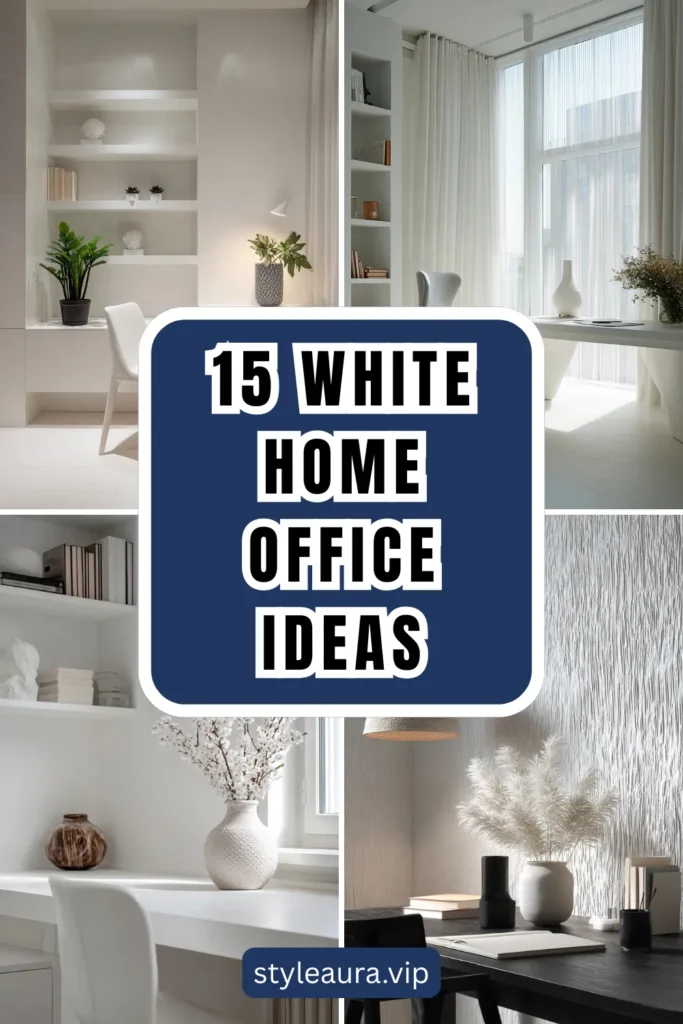
15 White Home Office Ideas for a Clean Minimal Workspace
A white home office is not a blank room waiting to become something. It is a considered decision — the deliberate creation of a space where thought is the primary activity and visual noise is the primary enemy.
White does not mean cold. It does not mean empty. It means that every object in the room was chosen rather than accumulated, that every surface earns its presence, and that the quality of the light — natural and artificial — is given the conditions it needs to perform at its best.
The fifteen ideas below cover every approach to the white minimal home office — from a single desk against a white wall to a fully realised workspace of genuine architectural quality.
1. The All-White Desk and Wall Setup
Budget: $100 – $600
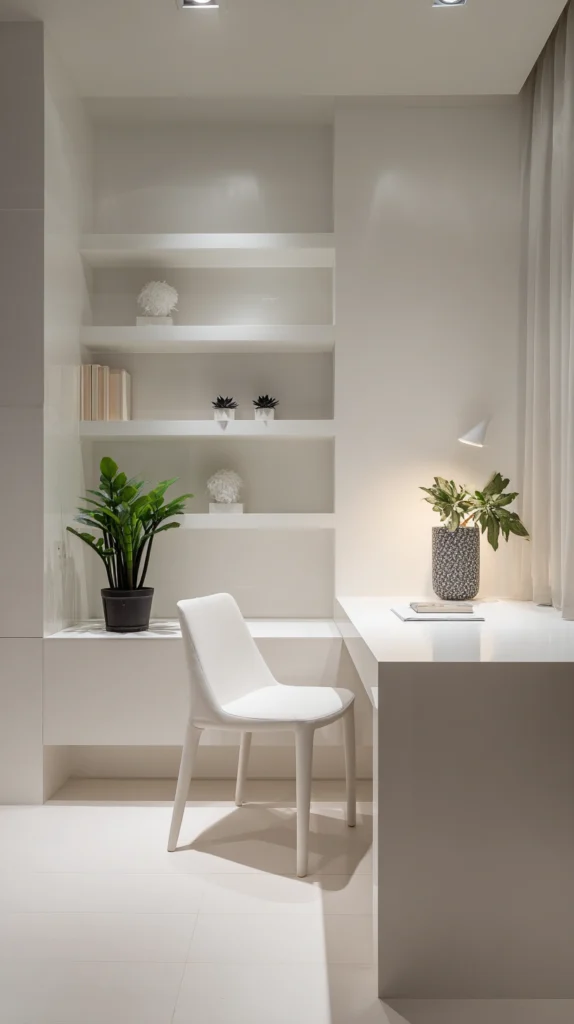
A white desk against a white wall — the desk surface, the wall behind it, and the shelving above all in the same warm white — is the minimal home office in its purest and most considered form. Everything within the visual field during working hours is the same tone. The mind has nowhere to wander except the work.
A quality white desk in a simple form — $80 – $300. A wall-mounted shelf above in the same white — $20 – $60 installed. A white desk lamp with a warm bulb — $25 – $80. White or warm white paint on the wall behind — $15 – $35 per litre.
Styling tip: Choose a desk lamp with a warm rather than cool bulb — 2700K rather than 4000K. Cool white light in a white room produces a clinical brightness that makes the space feel like a hospital corridor. Warm white light in the same room produces the specific quality of focused clarity that a good workspace requires.
2. The Floating White Desk
Budget: $80 – $400
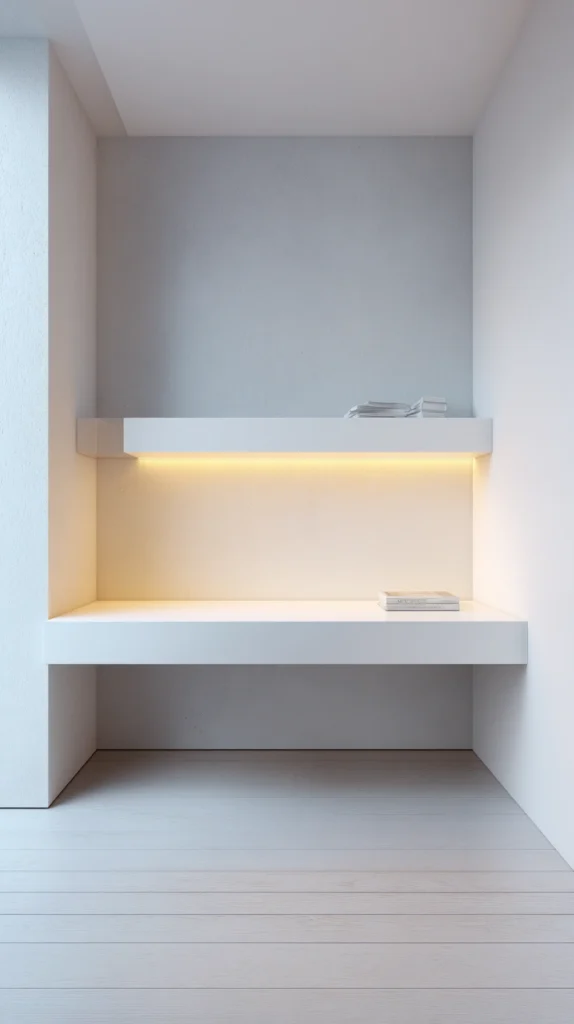
A floating desk — a wall-mounted white surface with no legs and no base unit, projecting from the wall at working height — is the most spatially efficient home office solution available. It leaves the floor completely clear, makes the room feel larger than its dimensions, and communicates a quality of purposeful restraint that a freestanding desk cannot approach.
A wall-mounted floating desk in white MDF or timber — $60 – $200 in materials for a DIY installation. A purchased floating desk unit — $80 – $300. A minimalist wall-mounted shelf above at monitor height — $20 – $60. The total footprint consumed is the depth of the desk surface and nothing more.
Styling tip: Mount the floating desk at 73 to 75 centimetres from the floor — the ergonomic standard for a seated working surface. A desk mounted at visual-proportion height rather than ergonomic height looks correct from across the room and produces discomfort within twenty minutes of sitting at it.
3. The White Shaker or Panel Wall Office
Budget: $200 – $1500
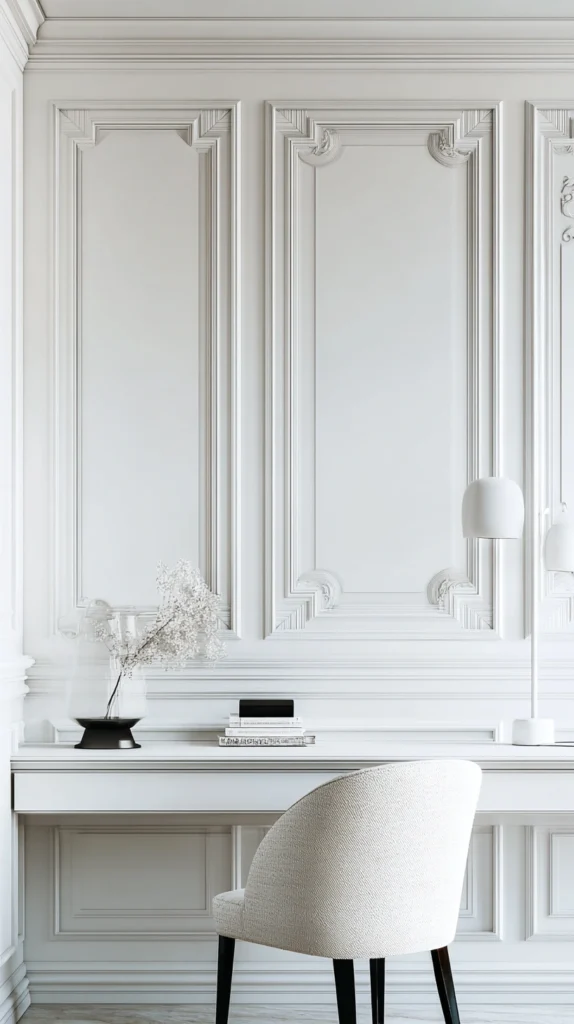
A home office wall treated with white-painted timber panelling — shaker-style panels, a simple board and batten arrangement, or a classic dado rail with painted lower panels — gives the workspace architectural character without introducing any colour or complexity. The panelling communicates quality and permanence rather than the temporary quality of a desk placed in a spare room.
White-painted MDF panelling — $100 – $400 in materials. A simple board and batten arrangement — $80 – $250 in timber. A desk integrated into the panelling — a projecting surface mounted between two panel pilasters — $100 – $300 additional.
Styling tip: Paint all panelling elements — the panels, the rails, the stiles, and the skirting — in the same white rather than using different tones for the wall surface and the panel face. A single consistent white across the full panelled wall reads as architectural. Two slightly different whites on the same wall read as an attempt at panelling that did not quite achieve colour matching.
4. The White and Natural Timber Office
Budget: $200 – $1000
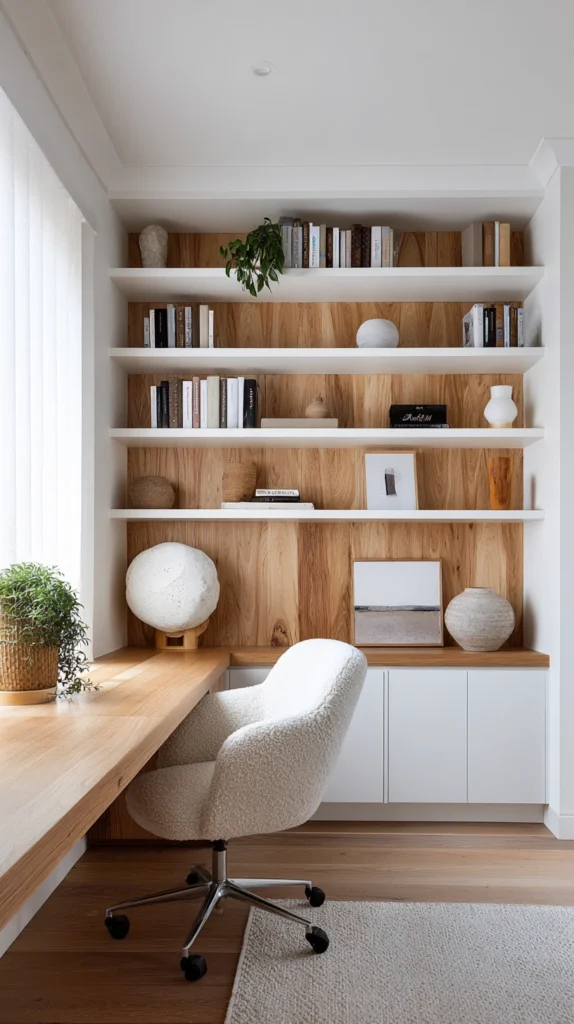
White walls and ceiling with natural warm timber as the primary desk and shelving material — honey oak, warm pine, or a light walnut — is the minimal home office’s most specifically warm and most materially considered version. The white provides the clarity. The timber provides the warmth that prevents the clarity from reading as coldness.
A natural timber desk surface on white powder-coated or white-painted legs — $150 – $500. Open timber shelving on white walls — $20 – $60 per shelf installed. A small timber accessory or two on the desk — a pen holder, a small tray — $10 – $30 each.
Styling tip: Choose timber pieces in a consistent species and tone rather than mixing timber types across the desk, the shelving, and the accessories. A home office where every timber element is in the same warm oak reads as a considered material decision. One where the desk is pine, the shelves are walnut, and the accessories are beech reads as assembled from available pieces without a unifying material intention.
5. The Minimal White Gallery Wall Office
Budget: $60 – $300
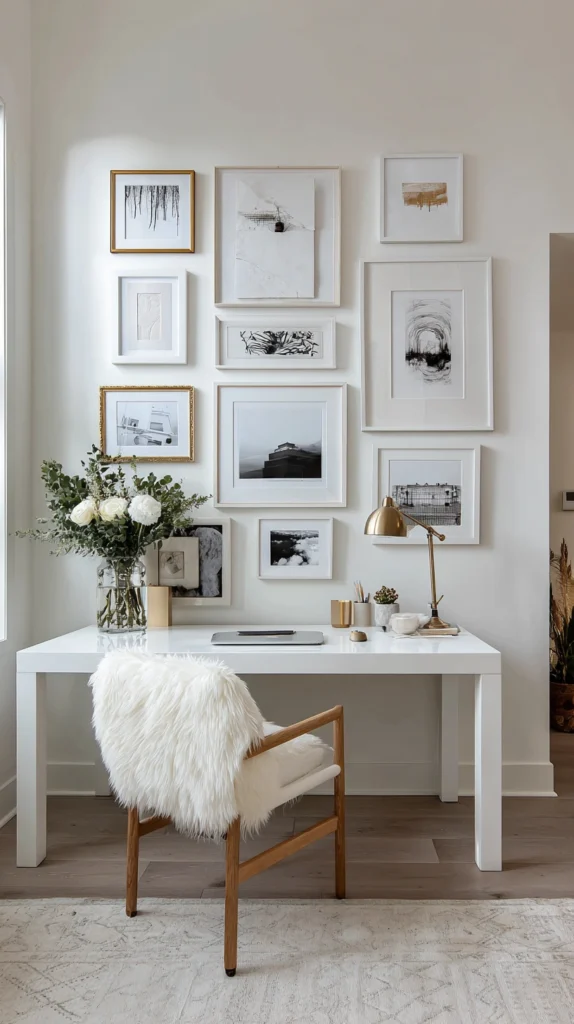
A white home office given a curated gallery wall — simple white or natural timber frames at varying sizes, holding prints, diagrams, typographic works, and one or two personal images, all in a tonal palette of black, white, and warm grey — introduces visual interest into the minimal workspace without introducing colour that distracts from the work at the desk.
Simple white or natural timber frames — $5 – $20 each. A collection of six to eight frames — $30 – $160 in total. Black and white or tonal prints — downloaded free from public domain archives. A typographic print relevant to the work done in the room — $10 – $25 from an independent printmaker.
Styling tip: Position the gallery wall on the wall visible during the working day — the wall the desk faces or the wall in the peripheral vision of the working position — rather than on the wall behind the desk chair. A gallery wall visible from the desk provides the visual interest that a long working day requires without requiring the occupant to turn away from the work to see it.
6. The White Office With a Single Colour Accent
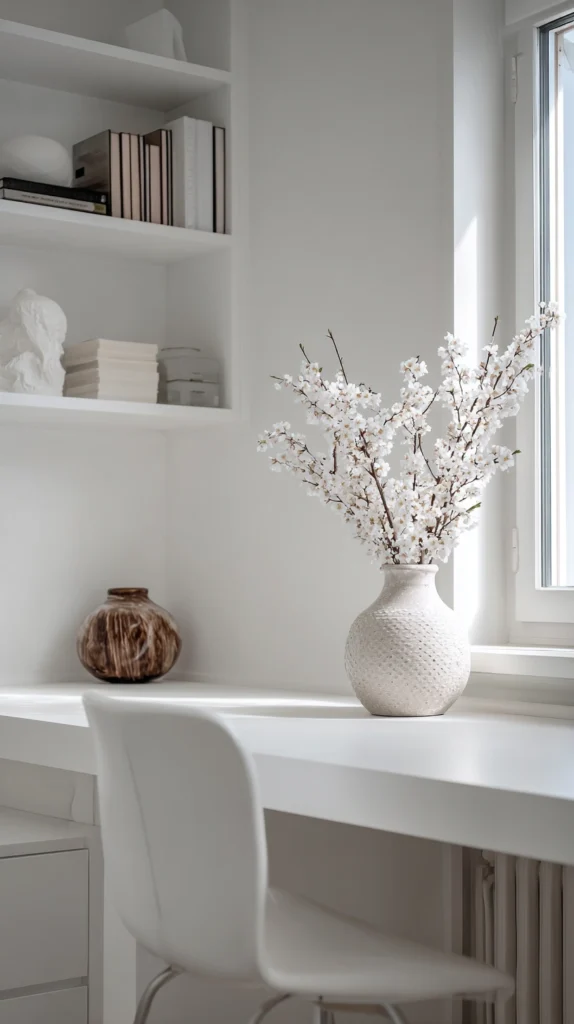
Budget: $30 – $200
A white home office with one carefully chosen accent colour — a sage green plant, a warm terracotta pot, a single sage or navy book on an otherwise white shelf, or a warm-toned chair cushion — demonstrates that the minimal white office does not require total colourlessness to achieve its quality of visual clarity. One colour, chosen with precision and present in small quantities, communicates that the restraint was deliberate rather than the result of a failure to decide.
A large healthy plant in a terracotta or white ceramic pot — $20 – $60. A single sage green cushion on a white desk chair — $20 – $50. One or two books with warm-toned spines on an otherwise white shelf — free if already owned. A small object in the accent colour on the desk surface — $5 – $20.
Styling tip: Choose the accent colour from the warm side of the spectrum — sage, terracotta, warm amber, or a dusty blush — rather than a cool or saturated alternative. A warm accent in a white room reads as a considered addition of natural warmth. A cool or saturated accent reads as a decision that introduced colour without deciding what quality of colour the room required.
7. The Built-In White Bookshelf Office
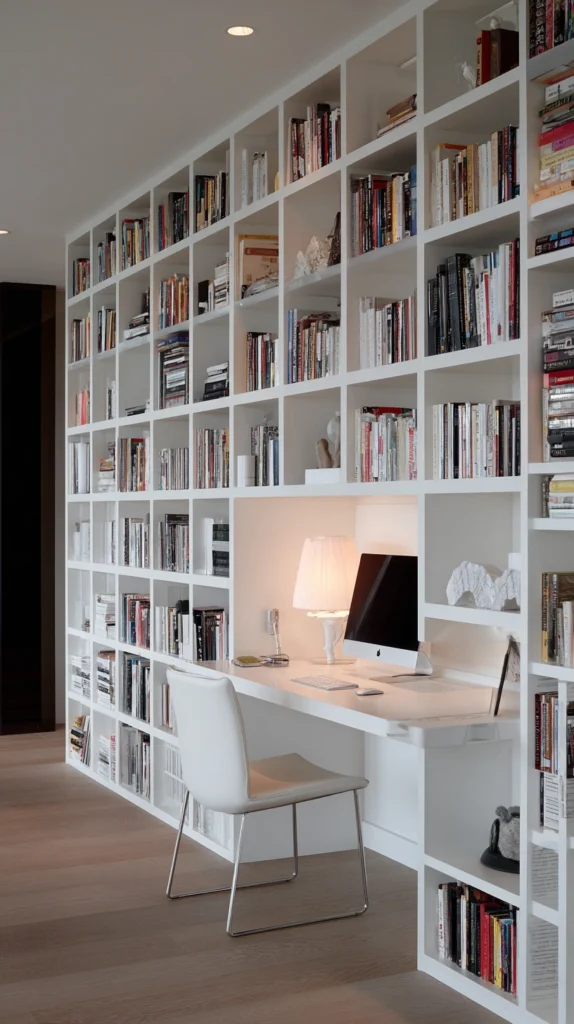
Budget: $400 – $3000
A home office built around a wall of white-painted built-in bookshelves — the desk integrated into the shelving unit at the base, the shelves running from floor to ceiling on either side and above, all painted in the same white as the walls — is the most architecturally complete and the most spatially efficient home office format. The shelving and the desk share a material identity rather than appearing as separate pieces placed in proximity.
White-painted MDF built-in shelving and integrated desk — $400 – $1500 in materials for a DIY build. Professional bespoke joinery — $1000 – $3000 for a custom installation. The desk surface integrated into the shelving unit — at the same depth as the lowest shelf — at standard desk height.
Styling tip: Leave a consistent gap between the books and objects on each shelf and the shelf above — a minimum of two to three centimetres of visible white shelf above every item on display. This gap prevents the shelves from reading as stuffed and produces the airy, considered quality of a minimal office bookshelf. Shelves filled to maximum capacity read as storage. Shelves with consistent space above every item read as a curated display.
8. The White Office With Arch or Alcove Feature
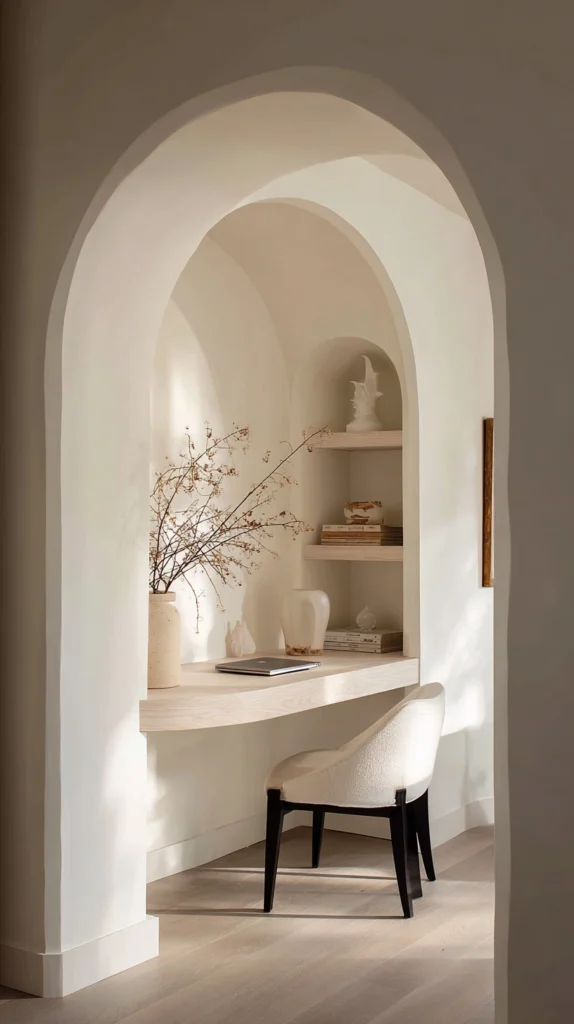
Budget: $100 – $1500
A desk positioned within an arch or an alcove — the recess creating a defined zone for the work surface without any additional division of the room — gives the white home office its most architecturally resolved workspace without consuming any additional floor space. The arch frames the desk the way a room frames its furniture — providing context and definition that an open-plan desk position cannot produce.
A painted arch on a white wall — created with a semi-circular stencil and a contrasting paint or wallpaper within the arch — $30 – $80 in materials. An existing alcove fitted with a desk surface and shelving — $80 – $300 in materials. A bespoke arch construction — $300 – $1500 professionally built.
Styling tip: Paint the interior of the arch in a tone two to three shades deeper than the surrounding wall — a warm grey or a slightly deeper white — rather than in a contrasting colour. A deeper tone within the arch reads as architectural shadow — the depth quality that makes an arch appear genuinely structural rather than decoratively painted. A contrasting colour within the arch reads as a painted circle rather than an architectural feature.
9. The Standing Desk White Office
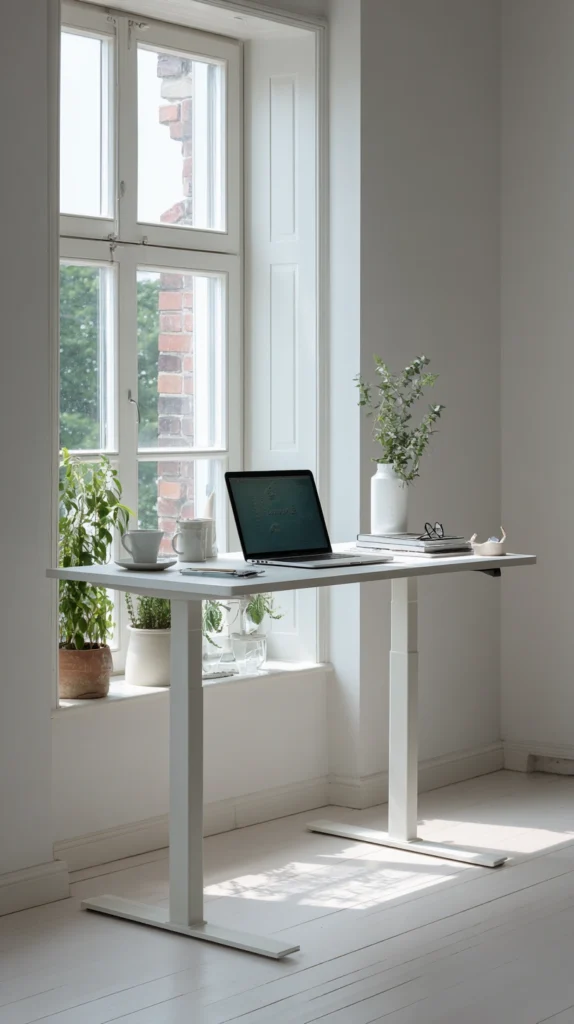
Budget: $200 – $1500
A standing desk — or a sit-stand desk with a height adjustment mechanism — in a white home office communicates that the workspace was designed for the full range of working postures rather than only the seated one. It is the minimal home office’s most specifically health-conscious and most practically considered furniture decision.
A white-framed sit-stand desk with an electric height adjustment mechanism — $300 – $1000. A white manual crank version — $200 – $600. A simple fixed-height standing desk — $100 – $300. An anti-fatigue mat in a warm grey or natural rubber tone beneath the desk — $30 – $80.
Styling tip: Set the standing desk height so that the forearms rest at a 90-degree angle with the shoulders relaxed — typically 100 to 110 centimetres from the floor depending on height. A standing desk set at an incorrect height produces the same postural problems as a seated desk set at an incorrect height — and the standing position amplifies physical discomfort more quickly than the seated one.
10. The White Office With Textured Wall Treatment
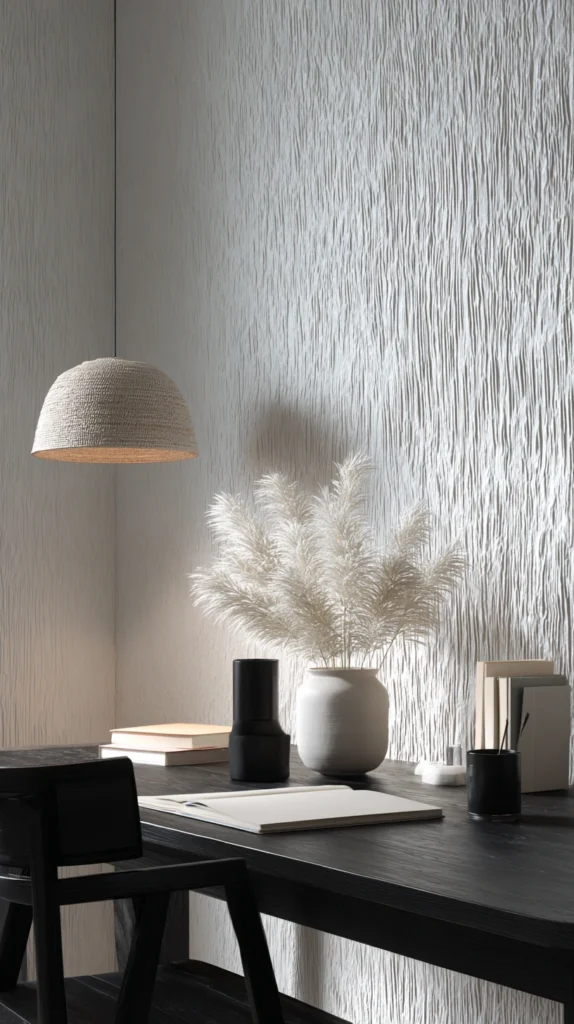
Budget: $50 – $400
A white office wall given a textured treatment — a limewash paint application, a Roman clay finish, a subtle grasscloth wallpaper in white or warm white, or a Venetian plaster effect — produces a workspace with genuine surface quality that a flat-painted white wall does not provide. The texture introduces visual and tactile richness into the minimal scheme without introducing any colour that competes with the white’s defining quality of clarity.
A limewash paint application — $25 – $60 per litre, slightly more expensive than standard paint but producing a surface depth and variation that no standard paint achieves. A grasscloth wallpaper in white or warm white — $20 – $60 per roll, three to four rolls for a standard wall. A Roman clay finish applied with a trowel — $30 – $80 in materials for a DIY approach.
Styling tip: Apply the textured wall treatment to the wall the desk faces rather than the wall behind the desk chair. A textured wall within the daily visual field enriches the working environment without requiring the occupant to look away from the desk. A textured wall behind the chair is seen only on entering and leaving the room — which is too infrequent to justify the investment in a textured finish’s typically higher cost.
11. The White Office With Warm Metallic Hardware
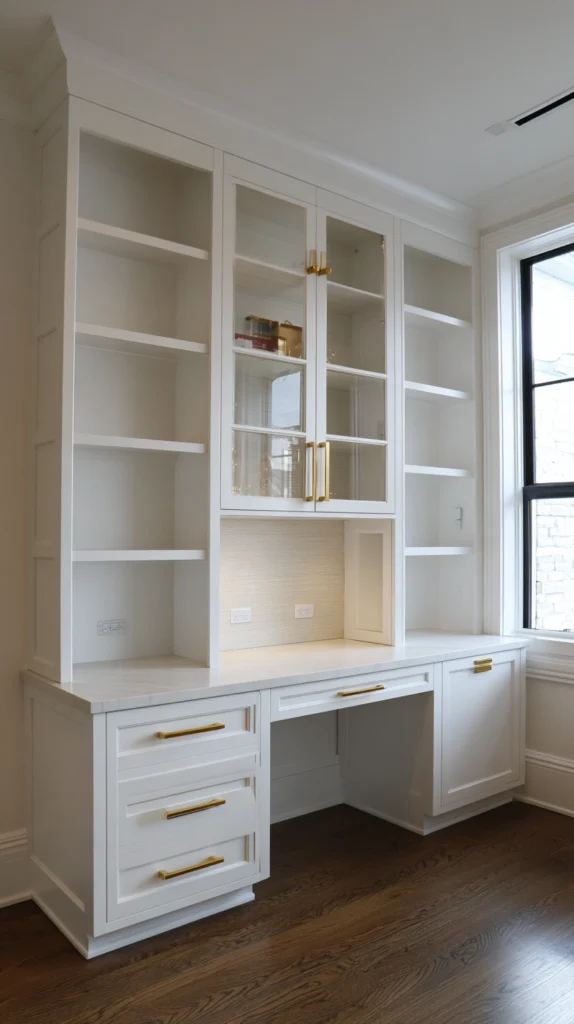
Budget: $30 – $200
A white home office given warm metallic hardware — brass drawer handles, a gold desk organiser, a warm copper pen holder, and aged brass lamp fittings — produces a workspace with the quiet material luxury of the old money aesthetic translated into a minimal contemporary context. The warm metal beside the flat white communicates that every detail was considered.
Brass drawer handles — $5 – $15 each. A small brass or gold desk organiser — $15 – $40. A warm copper pen holder — $8 – $25. An aged brass desk lamp base — $30 – $80. Total warm metallic hardware investment: $58 – $160 for a detail layer that transforms the standard white office into a specifically refined one.
Styling tip: Use aged rather than polished brass or gold throughout the white home office. Polished gold beside flat white reads as slightly commercial — the high reflectiveness of the metal and the flatness of the white producing a combination that can feel slightly sterile. Aged brass beside the same white reads as warm, considered, and specifically beautiful — the slight dulling of the patina moderating the contrast to a level that produces richness rather than harshness.
12. The White Office With Indoor Garden Wall
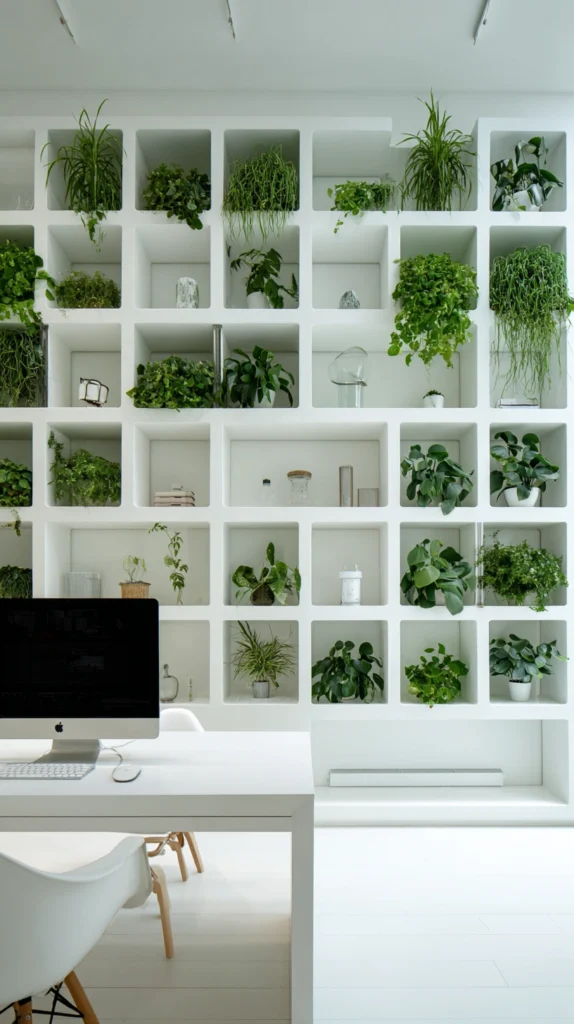
Budget: $80 – $400
A white home office given a small indoor garden element — a wall-mounted plant holder, a row of herb pots on a white shelf, or a single large floor plant in a white or terracotta pot in the corner — introduces the specific quality of living, breathing material into a workspace. Research consistently supports the benefit of plants in workspaces on focus, air quality, and the quality of extended concentration. A white office with plants is not merely more beautiful. It is more productive.
A wall-mounted plant shelf with three or four small plants — $30 – $80 in shelf and plant materials. A large floor plant in a white ceramic pot — $30 – $80. A row of herb pots on a white windowsill — $5 – $15 per pot plus the herb plants. Total indoor garden investment: $65 – $175 for the white office element that produces the most measurable benefit to the quality of work done within it.
Styling tip: Choose plants with simple, architectural leaf forms for the minimal white office — a monstera, a snake plant, a fiddle leaf fig — rather than delicate, fine-leaved species that can read as visually complex in a minimal scheme. A large, architecturally formed plant in a white or terracotta pot reads as a considered natural element. A collection of small, varied plants in mixed containers reads as a plant collection rather than a designed element.
13. The White Office Cable Management Solution
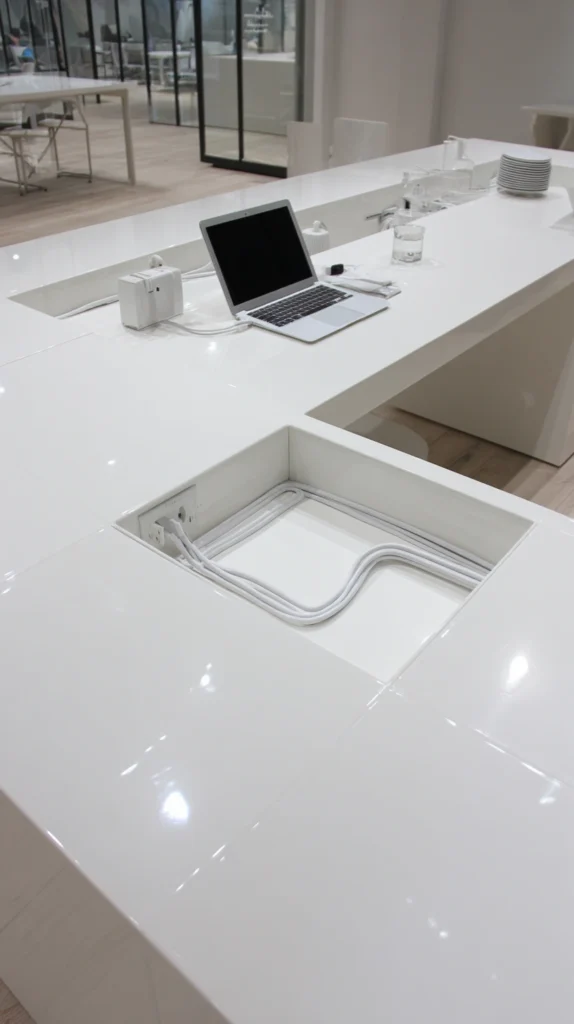
Budget: $20 – $100
A minimal white home office is immediately and completely undermined by visible cables. The cable management solution — cable trays in white mounted beneath the desk, cable boxes in white to conceal power strips, adhesive cable clips in white to route cables along the wall or desk edge — is the most practically important and the most consistently overlooked element of the white minimal workspace.
A white cable management tray mounted beneath the desk — $15 – $40. A white cable box for the power strip — $10 – $25. White adhesive cable clips — $5 – $15 per pack. A wireless keyboard and mouse — $30 – $100 — eliminating the two most visible cable sources entirely.
Styling tip: Address cable management before any styling or accessory decision is made in the white home office. A beautifully styled desk with visible cables is a desk that reads as approximately 40 percent less resolved than the same desk with concealed cables. Cable management is not a finishing detail. It is the condition that determines whether all other finishing details are read at their full quality.
14. The White Office With a Quality Chair
Budget: $200 – $2000
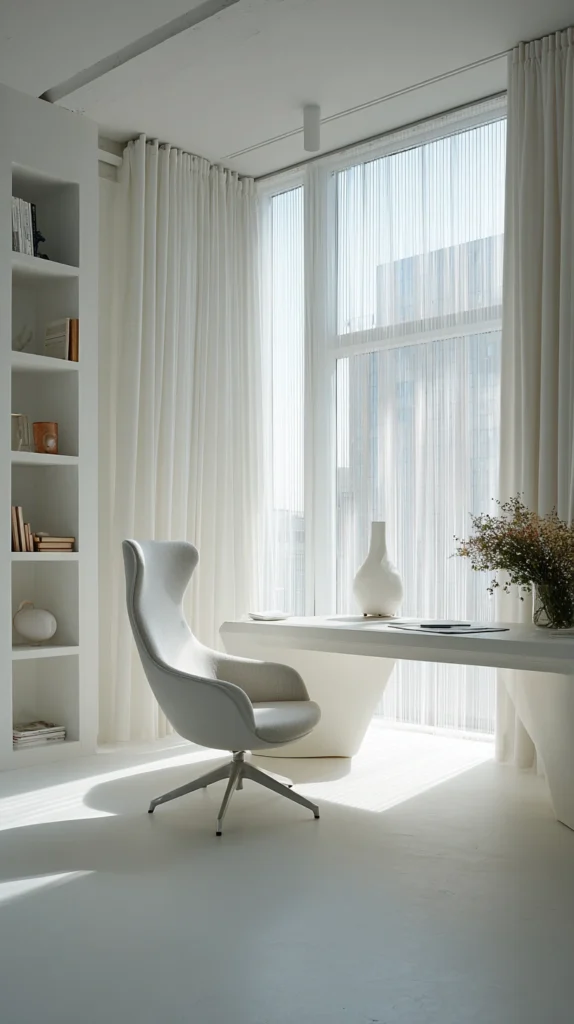
A quality desk chair — in a white, a warm cream, a light grey, or a natural timber — is the white home office’s most used and most physically important piece of furniture. An ergonomically resolved chair in a colour that belongs to the minimal white palette communicates that the workspace was designed for the quality of work done within it rather than simply for the appearance of the room from the door.
An ergonomic mesh chair in a white or light grey — $200 – $600. A saddle chair in a natural leather — $200 – $500. A timber kneeling chair — $100 – $300. A traditional task chair reupholstered in a warm cream or natural linen — $150 – $400 for the chair plus $80 – $200 for the reupholstery.
Styling tip: Choose a chair that is adjustable to the correct ergonomic position for the desk height rather than a chair that is aesthetically ideal but ergonomically approximate. The chair is the piece of office furniture with the most direct impact on physical health, concentration quality, and the sustainability of long working sessions. Aesthetic concessions to ergonomic requirements in a chair are justified. Ergonomic concessions to aesthetic preference are not.
15. The Fully Realised White Minimal Home Office
Budget: $500 – $4000
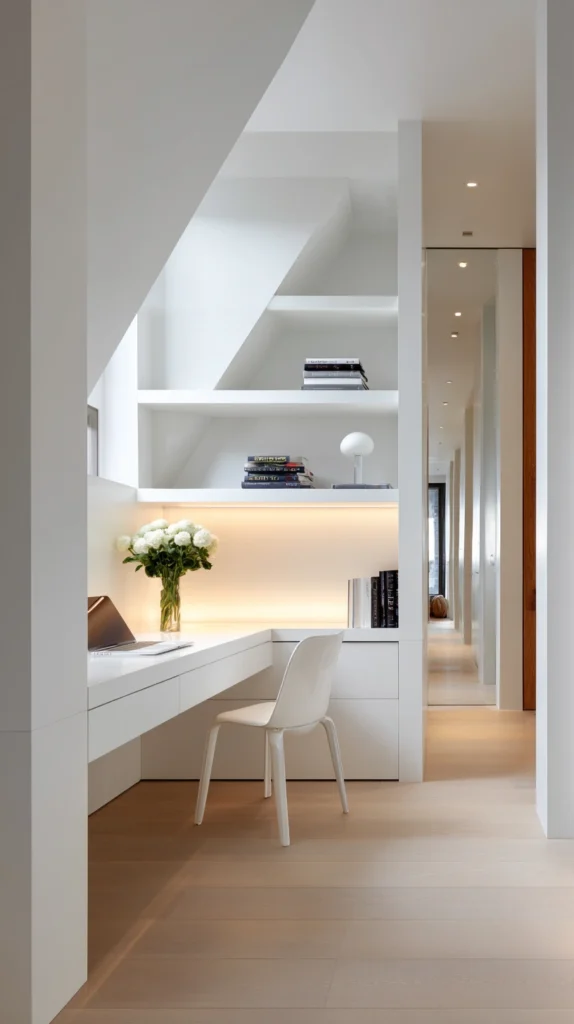
The fully realised white minimal home office — warm white walls in a flat finish with a subtle limewash or textured treatment on the feature wall, a natural timber floating desk with a warm white underside, white built-in shelving at the side walls with consistent air gaps above every displayed item, a sit-stand desk mechanism, aged brass hardware on every drawer and shelf, a single large architectural plant in a terracotta pot, a quality ergonomic chair in a warm cream or natural mesh, a warm 2700K lamp at the correct height and position for task lighting, all cables fully concealed, a small gallery of tonal black and white prints in natural timber frames, and no object on any surface that was not chosen for its quality and its specific contribution to the workspace — is a room of genuine and specifically earned clarity.
Textured wall treatment: $50 – $200. Natural timber floating desk: $150 – $500. Built-in shelving: $200 – $800. Sit-stand mechanism: $200 – $600. Aged brass hardware: $50 – $150. Plant and pot: $30 – $80. Ergonomic chair: $200 – $800. Warm task lamp: $40 – $120. Cable management: $30 – $80. Gallery wall: $40 – $160. Total fully realised white minimal office: $990 – $3490 for a workspace designed with the understanding that clarity of environment and clarity of thought are not separate qualities. They are the same quality, expressed in different registers.
Styling tip: After the office is fully assembled, remove one object from every surface and live with the reduced arrangement for a week before deciding whether it should return. Almost every minimal white home office contains at least one object per surface that was placed there from habit or from the assumption that a surface with fewer than three objects reads as incomplete. It does not. A white desk with a lamp, a plant, and a notebook reads as specifically and completely resolved. The same desk with those three objects plus a collection of items added from the assumption that surfaces require filling reads as a minimal desk that has been slightly confused about its intentions.
The white minimal home office is, in the end, a practice as much as a room. It requires the daily discipline of returning objects to their assigned places, of removing what has been placed temporarily and never moved, of maintaining the quality of a space that performs best when it is given the specific quality of clarity it was designed to produce.
A white minimal office maintained with genuine attention is a room that consistently delivers the quality of focused, clear, productive thought that most working environments consistently fail to provide.
Keep it clear. Keep it warm. Keep only what earns its place.
The work will follow.