15 Small Bathroom Fall Makeovers on a Budget
A small bathroom doesn’t need a renovation to feel different in fall. It needs a few targeted changes to the surfaces and objects that get looked at every day.
The challenge with a small bathroom is that everything is visible from everywhere. There’s no corner where something out of place can hide. That makes the space both harder and easier to update — harder because every choice shows, easier because a small number of changes covers the whole room.
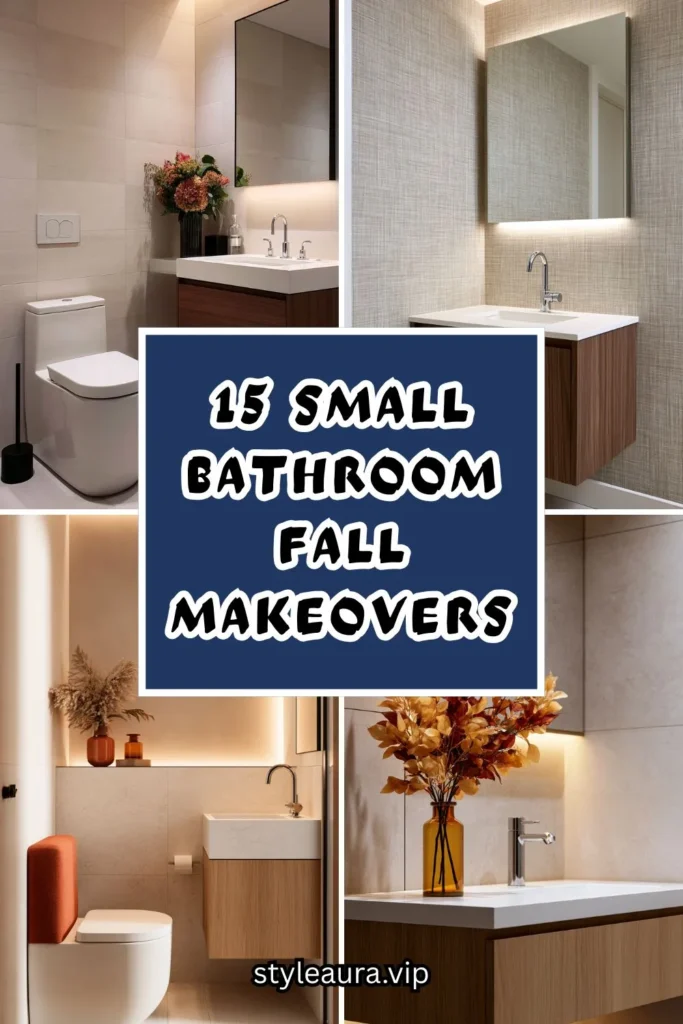
These fifteen ideas are built specifically around budget and small-space constraints. Each one includes what to buy or do, how much it costs, and why it works in a compact bathroom rather than a larger one.
1. Swap the Shower Curtain for a Fall-Toned Version
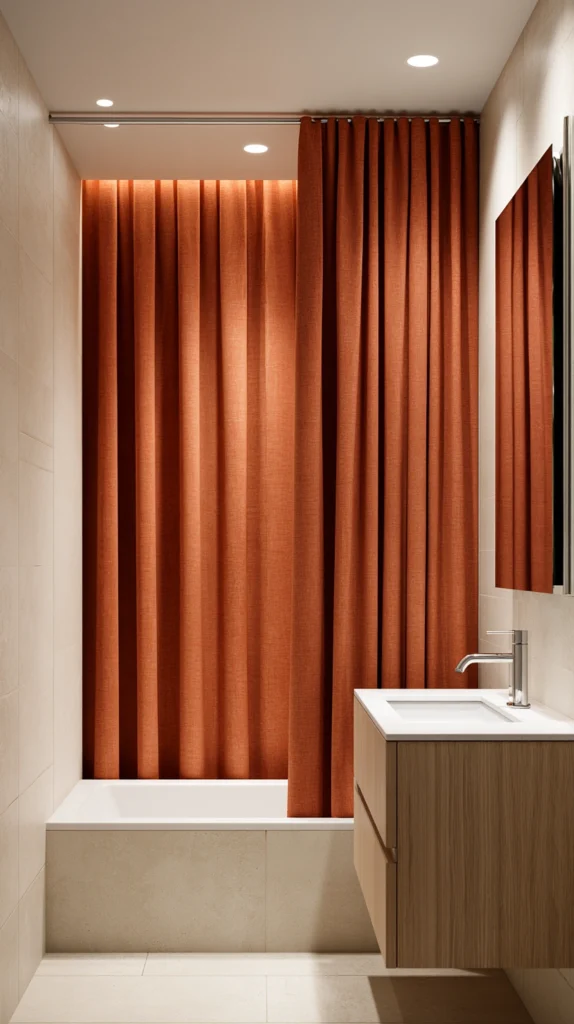
The shower curtain is the largest single piece of fabric in most small bathrooms. In a small space, the largest surface sets the dominant color and tone for the whole room.
Swapping to a fall-toned shower curtain — warm cream, rust, terracotta, deep olive, or a botanical print in autumn colors — changes the room’s atmosphere more completely than any other single purchase.
For small bathrooms specifically, avoid dark or heavily patterned curtains. Deep navy, black, or large busy prints close in a small space visually. The fall tones that work best in compact bathrooms are mid-range and warm — terracotta rather than burgundy, caramel rather than chocolate brown.
IKEA, Target, and Amazon all carry solid and subtly patterned shower curtains in fall tones for $12–$30. West Elm and Pottery Barn go up to $60–$80 for linen-look options with a more elevated finish.
Tip: Hang the curtain rod as close to the ceiling as possible rather than just above the tub. This makes the ceiling appear higher and the bathroom feel taller — particularly impactful in small bathrooms where the ceiling feels low.
Budget: $12–$35
2. Replace the Toilet Tank Cover with a Seasonal Textile
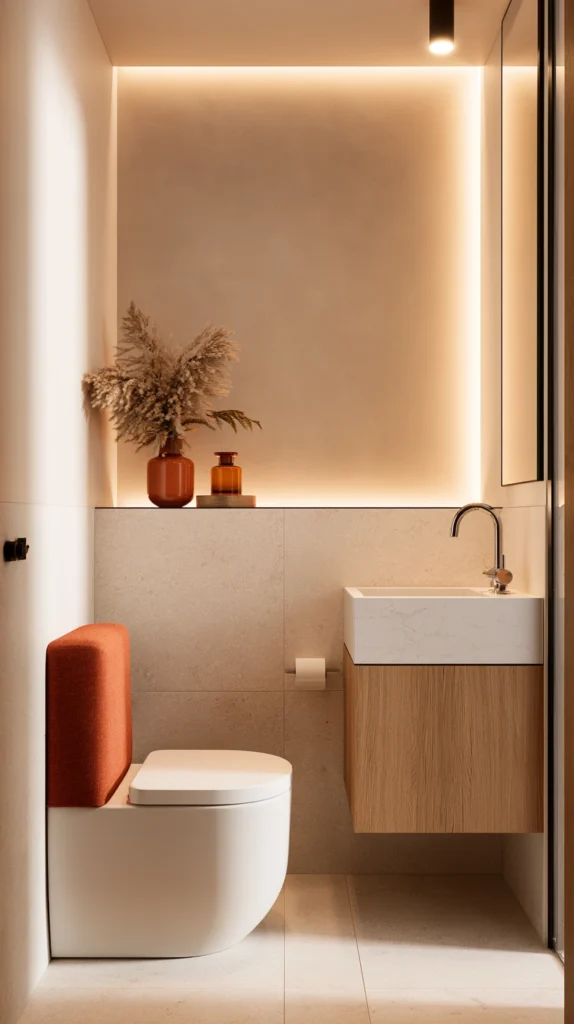
The toilet tank is a surface that almost nobody thinks to update. In a small bathroom, it’s a significant amount of visible horizontal space.
A small fall-toned hand towel or a piece of cut fabric draped over the tank top — folded neatly and pressed flat — introduces color and textile warmth at a height that’s clearly visible from the bathroom doorway.
Use a folded hand towel approximately 16×28 inches. In rust, terracotta, caramel, or warm cream, it adds the equivalent of a small accent piece to the bathroom without occupying any counter or shelf space.
Change it with the seasons, wash it with the bathroom linens, and replace it the same way. The total cost is whatever a hand towel costs.
Tip: Tuck the back edge of the towel slightly under the tank lid rather than leaving it sitting loose. This prevents the towel from sliding forward when the lid is lifted and keeps the front edge hanging cleanly over the tank face.
Budget: $5–$15
3. Update the Soap Dispenser and Dish to Fall Materials
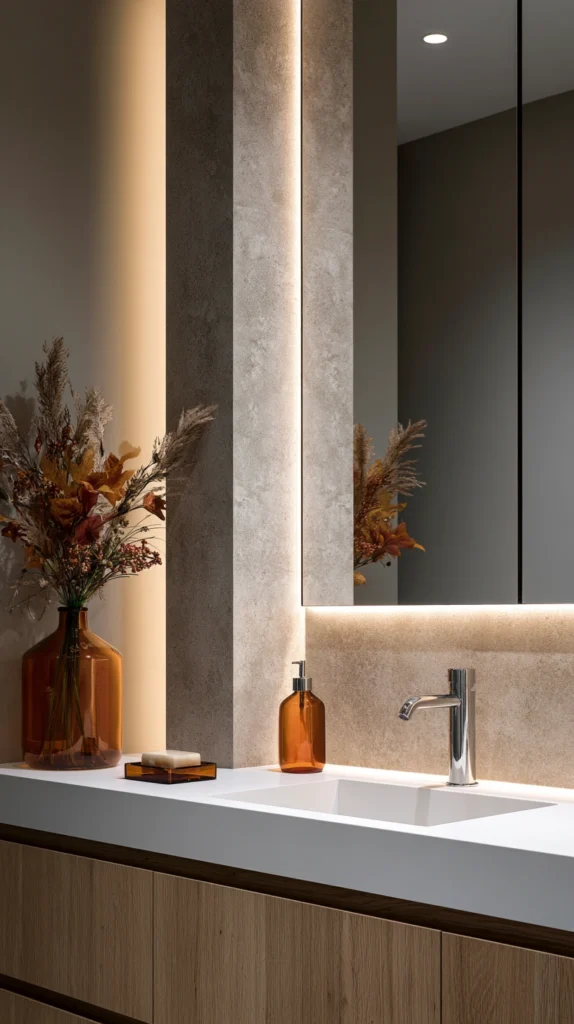
Soap dispensers and dishes sit on the vanity counter in direct sightline from the mirror. In a small bathroom, these small objects register more than they would in a larger space.
Swapping a plastic or chrome pump dispenser for one in matte ceramic, amber glass, or warm-toned resin costs $8–$20 and changes the counter’s visual temperature immediately. Pair with a soap dish in the same material family — ceramic in terracotta or cream, a small wooden tray, or a woven seagrass dish.
For fall specifically, amber glass dispensers filter the counter light in the same way amber candle glass does — they catch light and add warm orange-brown tones to the vanity area without any additional lighting change.
Amazon, TJ Maxx, HomeGoods, and Target all carry ceramic and amber glass soap dispensers in the $8–$22 range.
Tip: Fill a plain amber glass bottle (an empty olive oil bottle works perfectly) with liquid hand soap and add a standard pump top from a finished soap dispenser. The pump tops are interchangeable across most standard bottle neck sizes and the total cost is the price of the soap.
Budget: $8–$25
4. Add a Small Woven Basket for Counter Storage
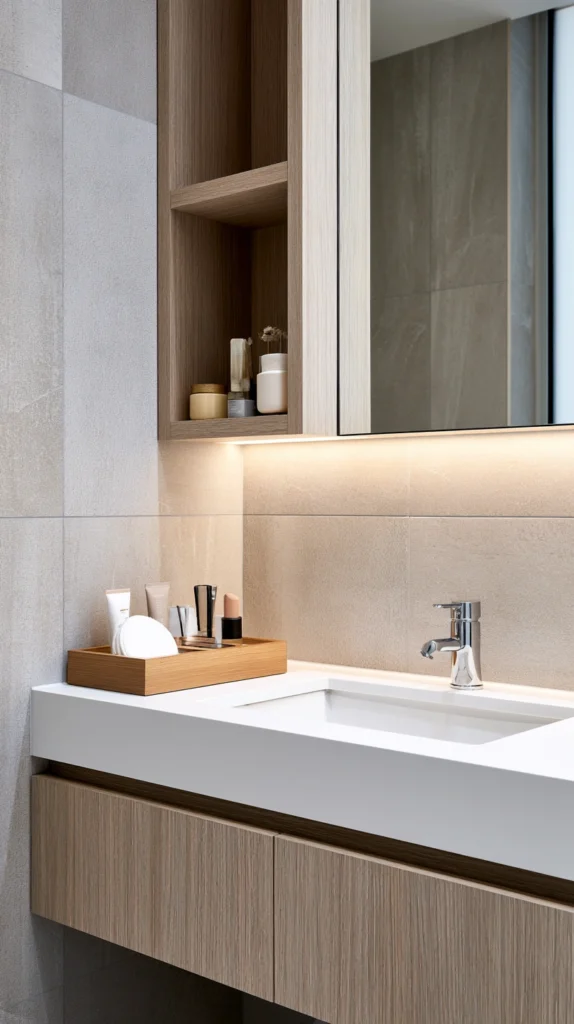
Counter clutter in a small bathroom is the fastest way to make it feel smaller and more chaotic. A small woven basket on the counter — holding cotton rounds, hair ties, lip balm, or whatever accumulates — contains the clutter while adding warm organic texture.
In fall, natural seagrass, jute, and rattan baskets connect to the season’s material palette in a way that plastic or acrylic organizers never do. They read as chosen rather than utilitarian.
For a vanity counter, use a basket no larger than 5×5 inches to avoid taking up more counter space than the items it’s organizing. A basket that’s too large becomes part of the clutter problem rather than the solution to it.
Small woven baskets in the right size run $4–$12 at craft stores, TJ Maxx, or Amazon.
Tip: Line the basket with a small piece of kraft paper or a cotton liner rather than leaving the woven interior exposed. This prevents small items from falling through the weave and makes the basket easier to wipe clean between uses.
Budget: $4–$15
5. Install Peel-and-Stick Wallpaper on One Visible Wall
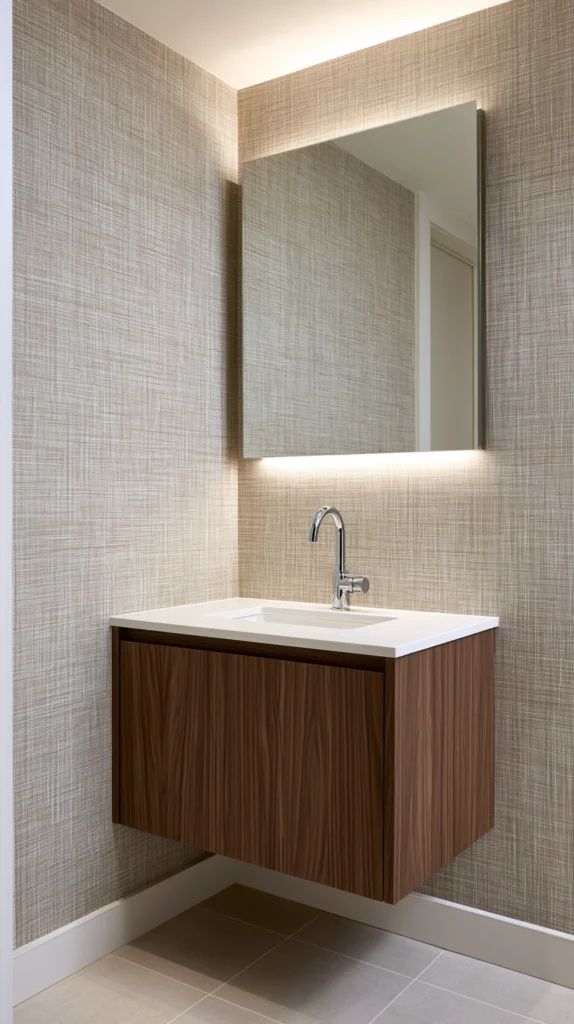
In a small bathroom, full wallpaper installation is a significant project. Peel-and-stick wallpaper on a single accent wall delivers the same visual change in an hour.
The most impactful wall in a small bathroom is the one directly opposite the door — the first surface visible on entry. That wall, covered in a warm fall print or a textured neutral, transforms how the whole room reads from outside and inside.
For small bathrooms, choose a small-repeat pattern or a textured solid rather than a large-scale print. Large patterns need scale to read properly — in a small bathroom they feel busy and disconnecting rather than elevated.
NuWallpaper and RoomMates both offer fall-appropriate options in warm botanicals, geometric textures, and linen-look solids for $25–$55 per roll. One roll typically covers a small bathroom accent wall.
Tip: Clean the wall with isopropyl alcohol and allow to fully dry before applying peel-and-stick paper. Even a light residue of bathroom cleaning products or steam condensation prevents the adhesive from bonding properly and causes edges to lift within weeks.
Budget: $25–$55
6. Swap Bath Mats for Fall-Toned Alternatives
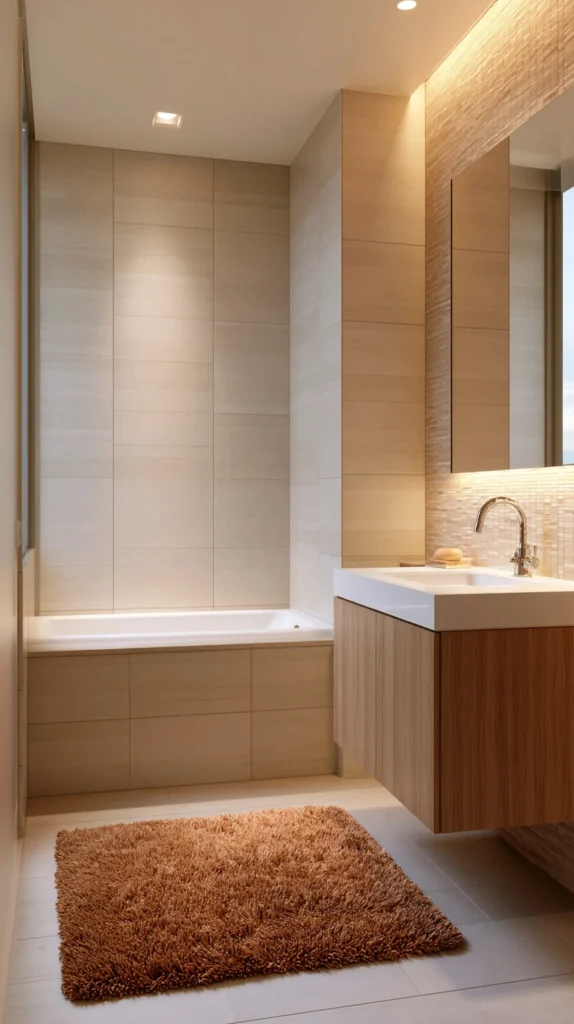
The bath mat is the largest piece of textile on the bathroom floor. In a small bathroom, the floor textile affects how the whole room feels to stand in — not just to look at.
A bath mat in rust, terracotta, cinnamon, or warm cream changes the floor plane’s color temperature and, with it, the room’s overall palette. In a white or neutral bathroom, a fall-toned bath mat is often the single most impactful low-cost change available.
For small bathrooms, a mat in the 17×24-inch or 20×30-inch range is proportional. Oversized bath mats (24×36 inches or larger) can overwhelm a compact floor plan and make the room feel smaller by covering too much of the floor surface.
Cotton chenille and cotton loop mats absorb moisture well and machine wash easily — practical priorities for a bath mat that sees daily use. Target, Amazon, and IKEA all carry fall-tone bath mats for $10–$25.
Tip: Use a non-slip pad under the bath mat rather than relying on the mat’s backing. Non-slip pads grip the floor surface more reliably than rubber-backed mats, prevent bunching and folding at the edges, and extend the life of the mat by reducing abrasion against the floor.
Budget: $10–$28
7. Replace the Mirror Frame or Add a Frame Around an Existing Mirror
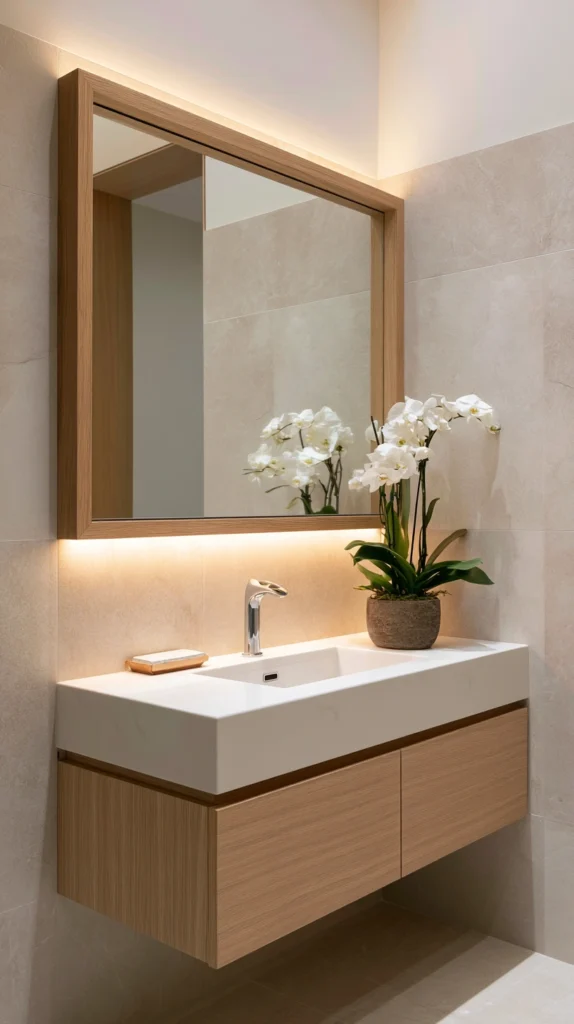
Most builder-grade bathroom mirrors are frameless — just a rectangle of glass mounted flush to the wall. Adding a frame changes the mirror from a functional fixture to a design element.
Peel-and-stick mirror frames are the budget-friendly approach. These are thin trim pieces — in wood-look, brushed gold, matte black, or aged bronze — that adhere directly to the existing mirror surface and create the appearance of a framed mirror without any drilling or installation.
For fall, an aged bronze or warm brass frame finish works directly with the season’s warm palette. A natural wood-look frame in a warm oak or walnut finish reads as organic and autumnal.
Peel-and-stick mirror frame kits run $20–$45 depending on mirror size and frame width. They’re available from Amazon, Wayfair, and specialty bathroom retailers.
Tip: Measure the mirror precisely before ordering — mirror frame kits are sized specifically and a frame ordered for a 24-inch mirror won’t fit cleanly on a 26-inch one. Measure width and height at three points each to account for any slight wall irregularities.
Budget: $20–$50
8. Introduce Fall Scent Through a Reed Diffuser
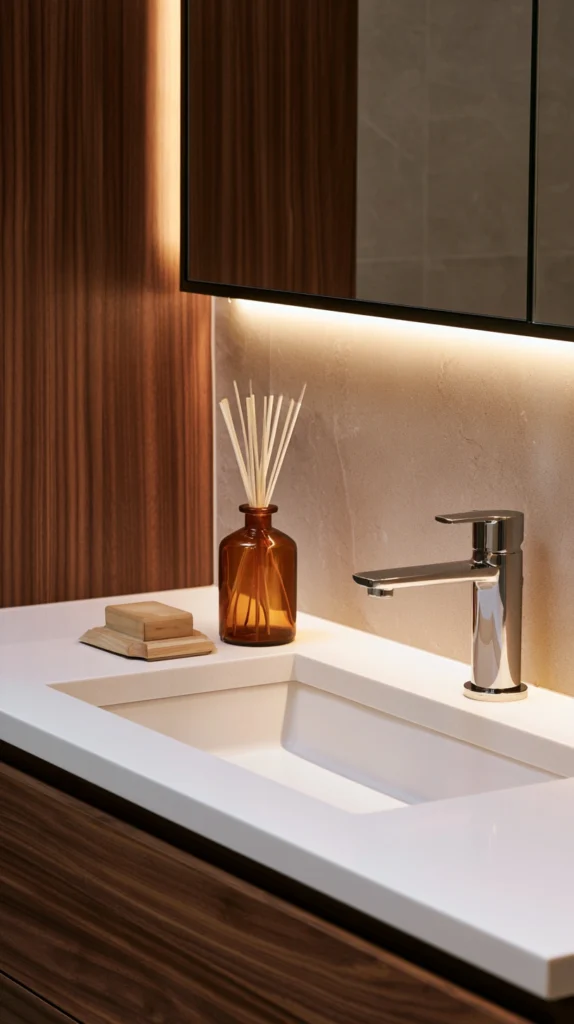
Scent in a small bathroom is amplified by the enclosed space. What would be a subtle background note in a living room becomes clearly present in a bathroom.
This amplification works for fall — a single reed diffuser in cedarwood, amber, or sandalwood fills a small bathroom with a warm, grounding scent that makes the space feel seasonal at a sensory level no visual change achieves.
It also works against you with the wrong scent. Heavy, sweet fall fragrances — pumpkin spice, apple cider — become overpowering in a small enclosed space within 20 minutes. Stick to dry, earthy, or woody fall scents in a bathroom context.
A reed diffuser with 4–6 reeds is the right scale for a small bathroom. Larger diffusers with 8–10 reeds produce too much scent per hour for an enclosed space. Capri Blue, Mrs. Meyer’s, and Amazon Basics all offer fall-adjacent scents in the $10–$25 range.
Tip: Place the reed diffuser away from the ventilation fan and the shower steam zone. Both of these dissipate scent rapidly and cause the diffuser to work harder and empty faster. A corner of the vanity counter or a small shelf away from both is the most efficient placement.
Budget: $10–$25
9. Hang a Small Fall-Toned Artwork or Print
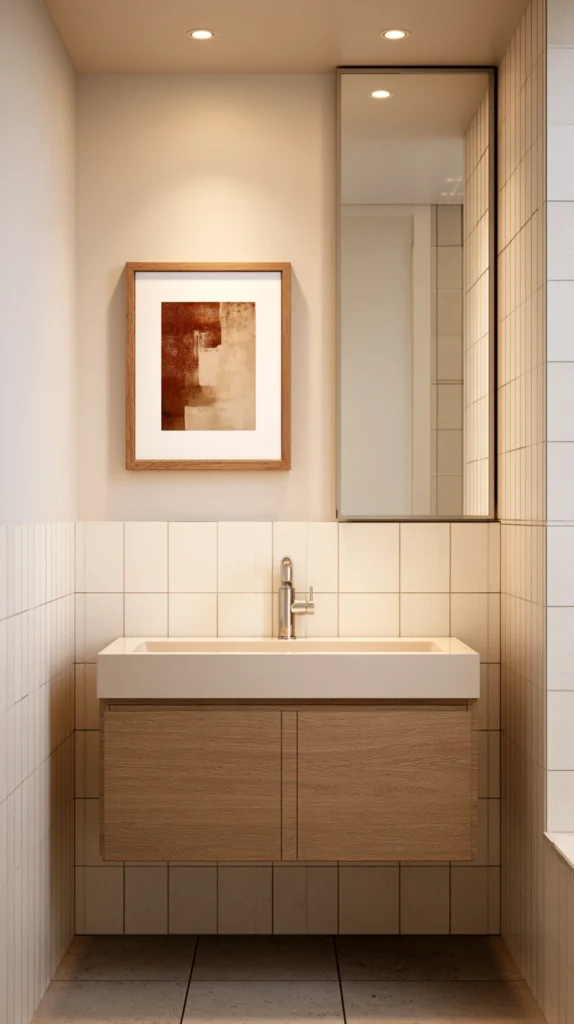
A bathroom wall in fall benefits from the same art logic as any other room — one piece, appropriately sized, at the right height changes how the space reads.
For a small bathroom, keep art compact. A 5×7-inch or 8×10-inch framed print is often proportional. Anything larger competes with the mirror and the shower curtain — the two dominant visual surfaces — rather than complementing them.
Fall-toned botanical prints, abstract prints in rust and ochre, or simple text prints in warm tones all work. The content matters less than the palette — any artwork that carries at least one warm fall tone connects to the seasonal update happening across the rest of the room.
Digital prints from Etsy cost $3–$10 for the file. A simple black or natural wood frame from IKEA’s RIBBA line runs $4–$10 depending on size. Total cost under $20.
Tip: Use a humidity-resistant print medium in a bathroom — laminated prints, canvas prints, or prints behind glass rather than exposed paper prints. Bathroom steam causes unprotected paper prints to warp and develop moisture damage within weeks of display.
Budget: $8–$25 including frame
10. Add Autumn Botanicals to a Small Bud Vase
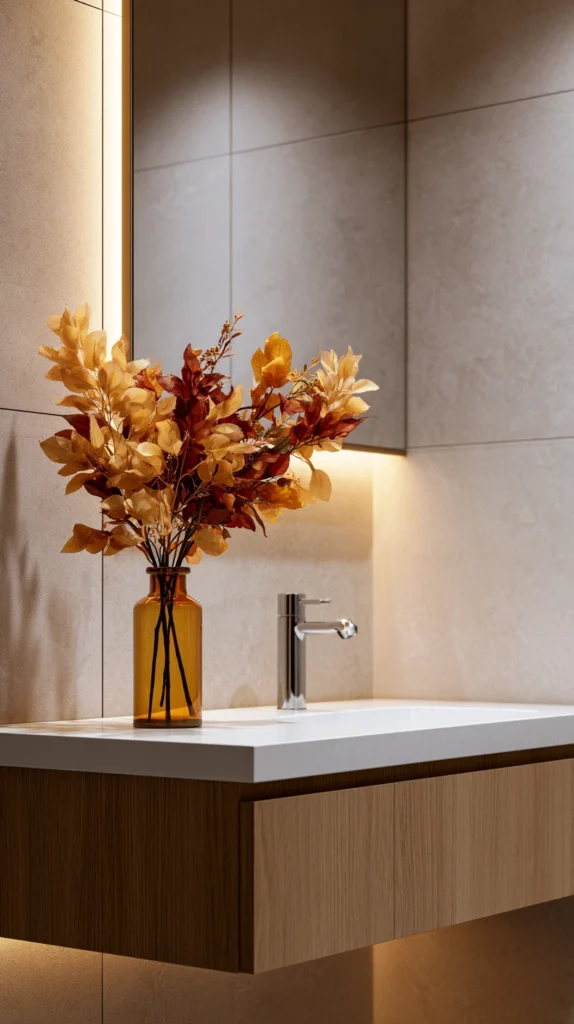
A single bud vase with one or two autumn stems on the vanity counter or toilet tank takes up almost no space and adds the only living element to most bathroom surfaces.
For fall, dried stems work better than fresh flowers in most bathrooms. The humidity from showers accelerates fresh flower decay significantly — a bunch of chrysanthemums that would last 10 days in a living room lasts 4–5 in a steamy bathroom.
Dried pampas grass, dried eucalyptus, dried cotton stems, dried orange slices on a wire, and preserved magnolia leaves all hold their appearance for weeks in a bathroom environment. They require no water and no maintenance beyond occasional dusting.
A single small bud vase — 4–6 inches tall — from a thrift store or TJ Maxx costs $2–$6. A small bundle of dried stems runs $6–$15 at craft stores or online.
Tip: Place the bud vase away from direct shower steam if possible — even dried botanicals absorb moisture over time in a high-humidity environment, which accelerates color fading and makes pampas grass droop. A shelf or countertop on the wall opposite the shower stays drier.
Budget: $8–$20 for vase and stems
11. Change the Towel Bar or Ring to a Warm-Toned Finish
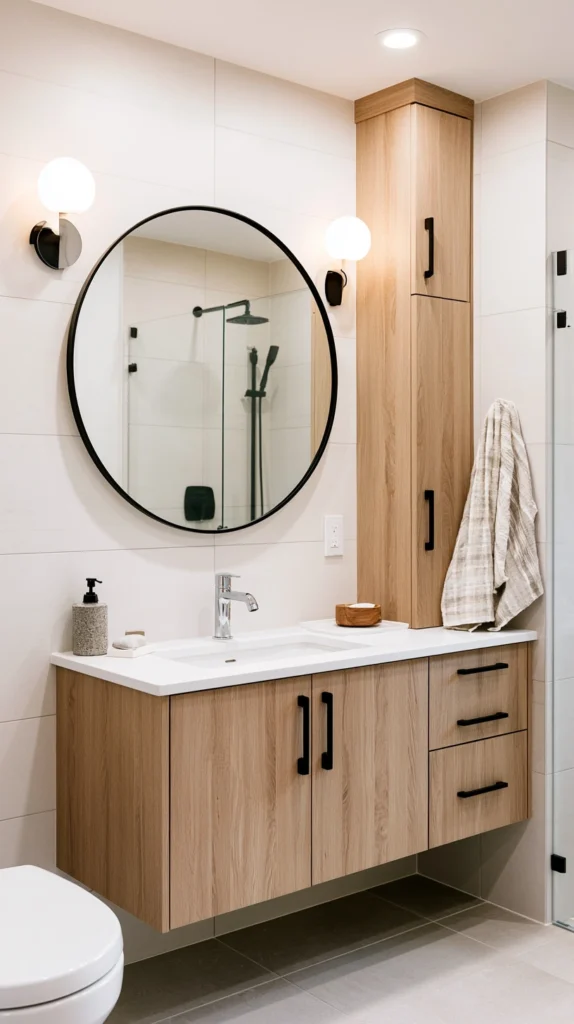
Chrome towel hardware reads as cool and modern. In a fall bathroom update, that cool tone works against the warm palette everywhere else.
Replacing a chrome towel bar or ring with matte black, oil-rubbed bronze, brushed gold, or aged brass hardware shifts the metal tone in the room to warm — and in a small bathroom, metal finishes appear on multiple surfaces (faucet, drain, cabinet pulls, towel bar) where they accumulate into a dominant tonal note.
Towel bars and rings are straightforward replacements using the existing screw holes in most cases. A matching set of towel bar plus ring runs $20–$50 in matte black or brushed gold finishes.
If the faucet is chrome and can’t be replaced, choose matte black hardware rather than brass — matte black is the most tone-neutral of the warm-metal alternatives and conflicts with chrome less visibly than brass does.
Tip: Replace all metal hardware at the same time rather than piece by piece. A bathroom with mixed finishes — one brass towel bar, one chrome ring, chrome faucet — looks inconsistent in a small space where all three are visible simultaneously.
Budget: $20–$55 for a bar and ring set
12. Use a Wooden Stool or Side Table as Extra Surface Space
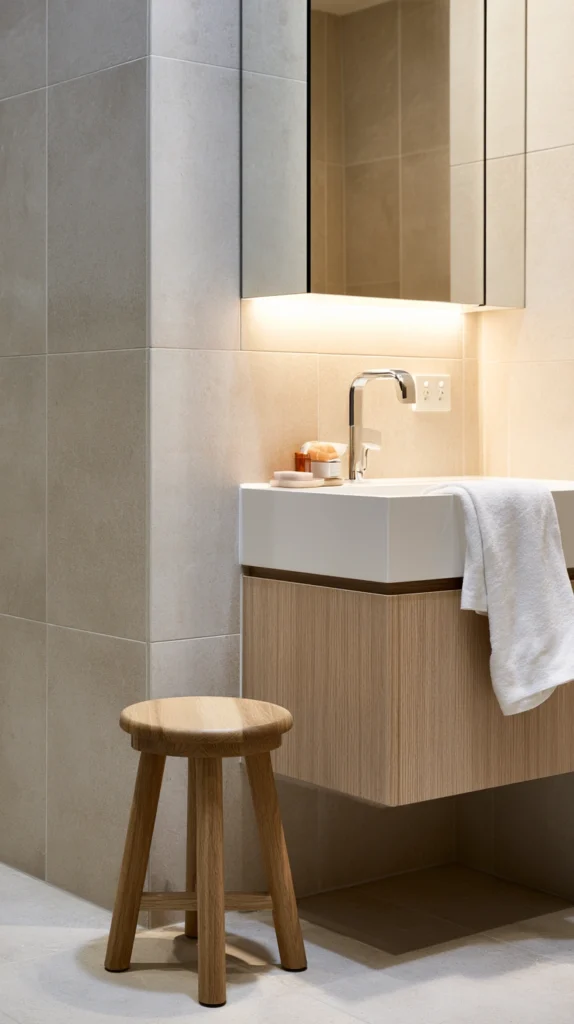
Small bathrooms often lack surface area for seasonal styling because every counter inch is occupied by daily essentials.
A small wooden stool or side table placed beside the tub or toilet creates a new surface without any installation. On that surface, a candle, a small plant, a decorative tray, or a book becomes a fall vignette that exists outside the functional zones of the bathroom.
For fall palette, natural birch, warm oak, or dark walnut stools all work. The wood material itself contributes warm organic texture that plastic or metal furniture alternatives don’t.
A simple round wooden stool in the 9–12-inch diameter range sits stably in most bathroom corners without blocking movement. IKEA’s FROSTA stool ($15) and similar basic options from Amazon run $12–$30.
Tip: Apply a coat of polyurethane sealant to any unfinished wood stool before using it in a bathroom. Bathroom humidity cycles cause unfinished wood to expand, contract, and eventually warp or crack. A single coat of clear sealant prevents moisture absorption and extends the stool’s life significantly.
Budget: $12–$30
13. Style the Windowsill as a Fall Micro-Vignette
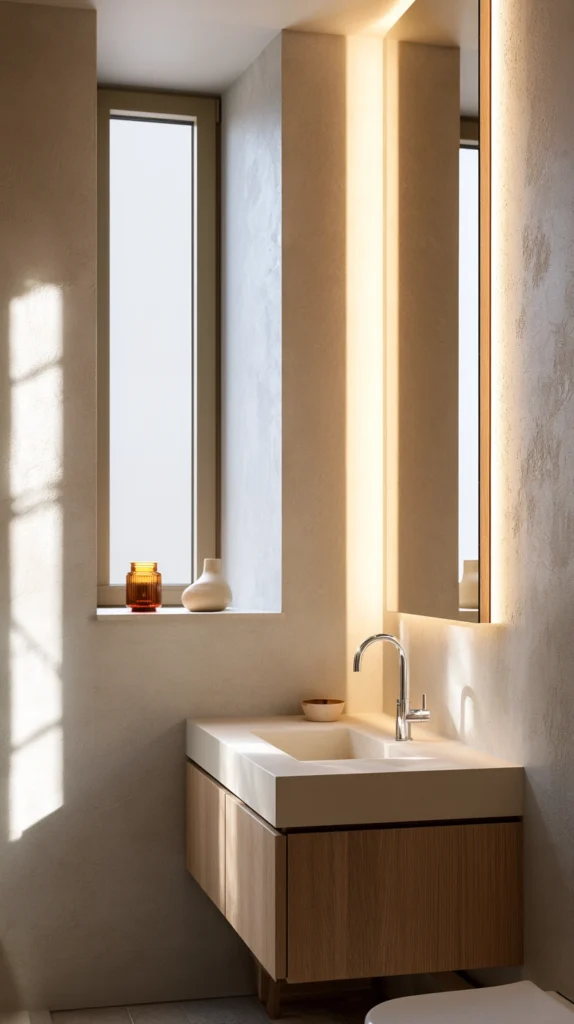
A bathroom windowsill is typically one of the most neglected surfaces in the room. In fall, it becomes one of the most effective.
The windowsill catches both natural light from outside and bathroom light from within. Objects placed on it are backlit during the day and front-lit at night — two different, equally flattering conditions for displaying fall objects.
A small arrangement of three objects — a miniature pumpkin, a small ceramic piece, and a tea light in an amber glass — takes up less than 12 inches of sill space and creates a seasonal focal point visible from the bathroom doorway.
Keep the total weight low and the arrangement away from the window latch. A windowsill that can’t be opened easily becomes a maintenance problem in a room that needs ventilation.
Tip: Use a small piece of non-slip shelf liner under objects on a windowsill. Condensation from temperature changes makes windowsill surfaces slippery — objects placed directly on a damp sill shift and can fall with the vibration of the window being opened.
Budget: $5–$15 for a set of three small objects
14. Replace the Toilet Paper Holder with a Warmer-Toned Version
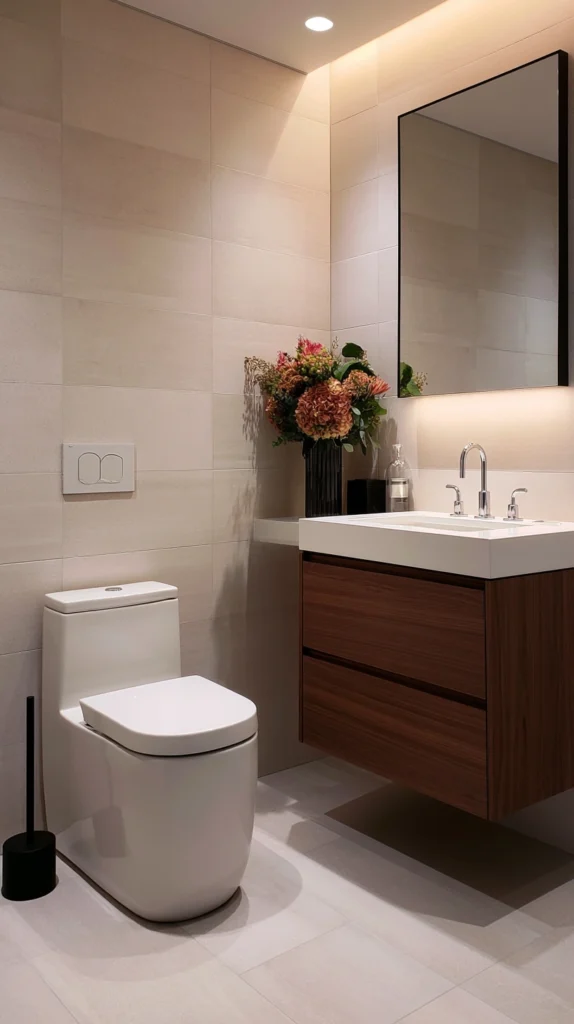
This is the most overlooked hardware change in any bathroom update list and consistently one of the most impactful for its cost.
A standard chrome spring-loaded toilet paper holder reads as purely functional — it contributes nothing to the room’s aesthetic. A toilet paper stand (the freestanding kind with a vertical pole and base) in matte black, brushed brass, or dark bronze reads as a design object while serving the same function.
Freestanding toilet paper stands require no installation — they stand beside the toilet on the floor. This makes them ideal for renters or anyone who doesn’t want to drill into tile or drywall for a wall-mounted replacement.
Freestanding stands in warm-toned finishes run $15–$35 at Amazon, Target, and HomeGoods.
Tip: Choose a stand with a base diameter of at least 7 inches for stability. Narrow-base stands tip easily when the paper roll is changed — a wider base sits securely on bathroom tile without rocking.
Budget: $15–$35
15. Combine Five Small Changes for a Complete Makeover Feel
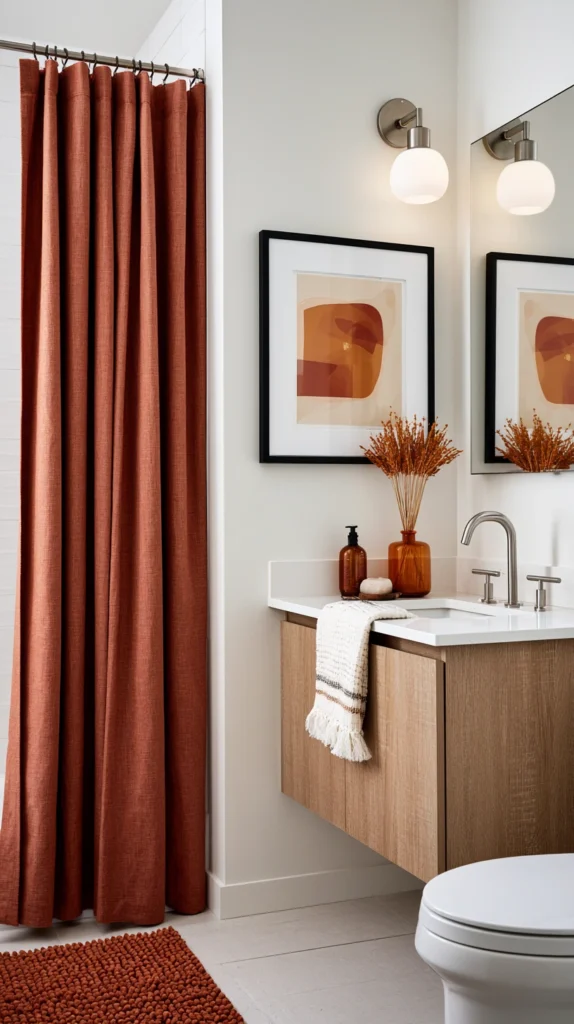
The final idea isn’t a single product — it’s a sequencing principle.
A small bathroom fall makeover on a budget works best when five specific changes are combined: one large textile change (shower curtain or bath mat), one scent element (reed diffuser), one counter update (soap dispenser or small basket), one wall element (print or peel-and-stick panel), and one natural or botanical element (bud vase with dried stems).
Each individual change costs under $25. Combined, they address five different sensory and visual zones of the bathroom — the floor, the air, the counter, the wall, and a living natural element — which is what creates the feeling of a makeover rather than a single update.
The total budget for all five changes runs $60–$120, which is less than most single bathroom accessories and a fraction of any physical renovation cost.
Tip: Make the five changes over two weeks rather than all at once. Introducing one or two changes, living with them for a few days, then adding the next allows you to assess whether the direction is working before committing to all five. It also spaces out the spending rather than requiring a single large purchase session.
Budget: $60–$120 for all five combined
Final Thoughts
A small bathroom responds to change faster than any other room in the house. There’s less surface area to cover, which means a small number of updates carries further.
The changes that consistently do the most work in a small space: the shower curtain (largest textile), the scent element (fills the whole room from one point), and the bath mat (changes the floor plane color). These three alone shift how the room feels before anything else is added.
Work from largest to smallest — curtain first, mat second, counter details third. Each change makes the next one clearer because the room’s direction becomes more defined with each addition.