13 She Shed Outdoor Decor Ideas for Autumn
Most she sheds get all their decorating attention on the inside — the cozy chair, the string lights overhead, the little shelf of favorite things — while the outside gets left exactly as it came from the hardware store or the kit it was built from. A plain door, bare siding, maybe a single potted plant that showed up at some point and never left.
That imbalance shows the moment fall arrives. The exterior is the first thing seen on the walk out to the shed, the backdrop for every photo taken of the space, and the part of the structure that has to hold up to actual weather rather than just be admired from a cozy chair inside. A she shed with a beautifully styled interior and a completely undecorated exterior is only half finished.
A she shed’s outdoor decor isn’t a smaller version of front porch styling, and it isn’t an afterthought to the interior. It’s its own small project, scaled to a single tiny structure rather than a full house, with its own threshold, its own roofline, and its own little patch of garden to work with. Get the outside right, and the walk from the back door to the shed becomes part of the retreat, not just the path to it.
Here are 13 ideas for decorating the outside of a she shed for fall.
Why a Fall She Shed Exterior Plays by Different Rules Than a Summer One
The rules are not the same for every season outside this particular structure:
Summer She Shed Exterior Advantages:
- Long daylight means the walk to and from the shed rarely happens in the dark
- Minimal styling needed, since the surrounding garden and warm weather do most of the visual work
- The door can be left open for airflow, blurring the line between the shed’s interior and exterior
The summer exterior comparison: the season does the decorating
Fall She Shed Exterior Advantages and Realities:
- The walk out to the shed increasingly happens after dark, making exterior lighting a genuine function rather than just atmosphere
- The structure’s exterior becomes the main visual feature once surrounding plants die back or lose their leaves
- The door stays closed more often, making the threshold itself, rather than an open doorway, the entry point that needs styling
The key insight:
- A summer she shed exterior rewards minimal touches, since the season fills in the rest
- A fall she shed exterior rewards real intention, since the structure increasingly has to stand on its own once the garden around it goes quiet
- These are different decorating problems, not the same shed with a pumpkin added by the door
The Exterior and Threshold Reality
The most important principle in she shed exterior decor:
The single-door threshold:
- Unlike a house, a she shed typically has just one door and often one small window, which means nearly all of the structure’s personality has to be communicated through a very small amount of exterior surface
- Every choice on this list carries more visual weight than the same choice would on a full-sized house, simply because there’s so little exterior surface to work with
- Know this — it means a she shed’s exterior decor benefits from being more deliberate per square foot than almost any other structure on the property
The “weatherproofed first” calculation:
- Anything placed outside a she shed faces direct, sustained weather exposure with none of a covered porch’s protection in many shed designs
- Choose materials rated for full outdoor exposure before considering style, since a beautiful but non-weatherproof object will need replacing within a single season
- Where a covered overhang or small porch exists, it becomes the obvious spot for anything slightly less weather-hardy
Most she shed exterior decor builds in layers, not all at once:
- The structural and threshold elements — door color, a small overhang, lighting — come first, since they’re the hardest to change later
- The seasonal plantings and movable decor — pumpkins, mums, a wreath — come next, layered onto the established structure
- The smallest finishing touches — a sign, a flag, a single lantern — come last, and are the easiest layer to refresh each season
1. The Door Wreath and Threshold Vignette (The She Shed’s Single Most Important Decision)
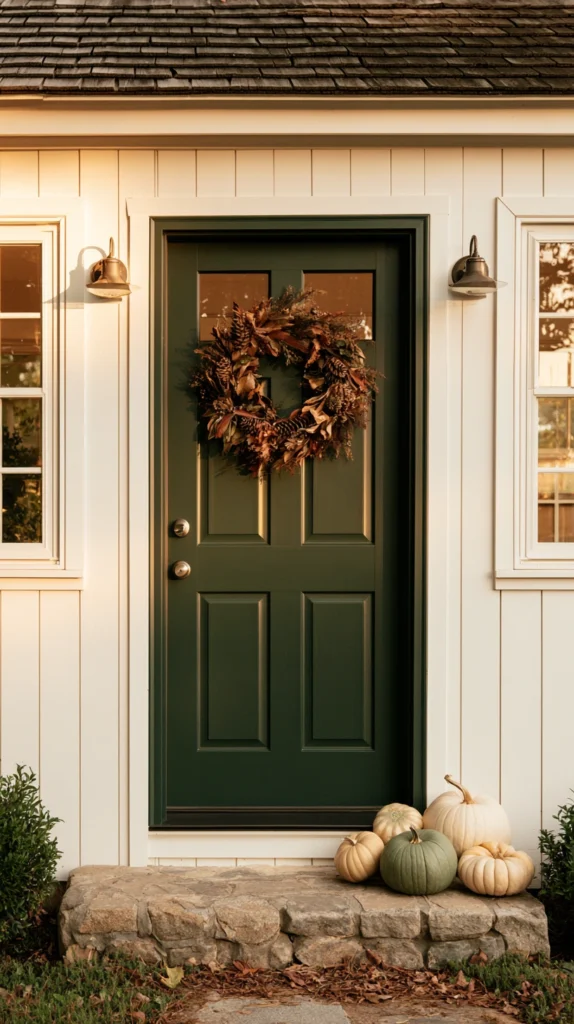
A wreath on the door, paired with a small grouping at the threshold — the combination that does for a she shed’s tiny entrance exactly what a wreath and pumpkin cluster does for a full front porch, just scaled down to fit.
Why this one spot carries outsized importance
- The forced-attention factor: with only one door and often no porch to distract from it, the she shed’s entrance is unavoidably the first and most concentrated thing anyone sees
- The scale advantage a small structure offers: because the whole exterior is compact, a wreath and a small grouping at the door can visually account for a much larger share of the structure’s total presence than the same combination would on a full house
- The quick seasonal refresh it allows: this is one of the easiest elements on the whole exterior to swap as fall progresses into winter, requiring no tools and very little time
The options
- A faux foliage wreath, mixing fall leaves, berries, and small pinecones, built to last the full season without fading
- A small wreath scaled specifically to a narrower shed door, rather than a full-size door wreath that might overwhelm a smaller frame
- A grouping of two or three mini pumpkins on the step or threshold, paired with the wreath above
- A grapevine base wreath, left partially bare for a more rustic, less dense look fitting a garden structure**
The practical execution
- Measure the door carefully before choosing a wreath size, since shed doors often run narrower than standard house doors and a full-size wreath can look oversized
- Use a wreath hanger or hook rather than a nail directly into the door, protecting the door’s finish
- Keep the threshold grouping small and low, since most she sheds don’t have the step depth of a full porch to work with
Cost breakdown
- Small wreath, scaled to a narrow door: $20–45
- Mini pumpkins for the threshold: $10–20
- Total: $30–65
The wreath on the she shed door: the smallest version of a porch’s biggest decorating decision, doing exactly the same job in a fraction of the space.
2. The Window Box Planter (Color at the One Window Most Sheds Have)
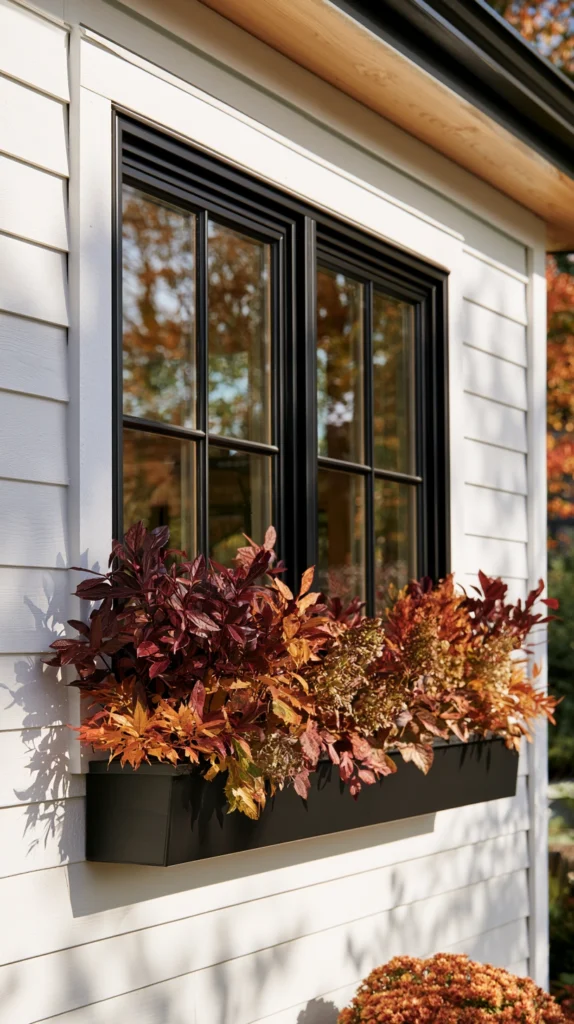
A single window box, mounted beneath the shed’s main window and filled with fall foliage and flowers — the addition that brings real color to the one other architectural feature most she sheds have besides the door.
Why a window box matters even on a structure this small
- The second focal point it creates: with the door already getting attention from Idea #1, a window box gives the shed’s other prominent feature its own deliberate styling moment
- The cottage character it reinforces: a flower-filled window box is one of the most universally recognized signals of a cozy, garden-adjacent structure, fitting naturally with the general spirit of a she shed
- The compact scale it works within easily: unlike a full house, where a window box is one of several exterior decorating decisions, on a she shed it becomes one of just two or three total moves, making it disproportionately impactful
The options
- A wooden window box, planted with mums, ornamental kale, and trailing ivy
- A galvanized metal window box, for a slightly more farmhouse-leaning material choice
- A box planted entirely in fall foliage, rather than flowers, for a lower-maintenance option as the season progresses
- A box with a seasonal swap built in, easily replanted again for winter once fall’s display fades**
The practical execution
- Mount securely into the shed’s siding or trim, confirming the brackets can support the box’s full weight once filled with wet soil
- Choose plants that can handle the box’s specific light exposure, since a window box’s sun exposure can differ meaningfully from the ground-level garden bed nearby
- Water consistently, since window boxes dry out faster than in-ground planting and a fall dry spell can affect them quickly
Cost breakdown
- Window box, with mounting brackets: $25–60
- Plants to fill it: $20–50
- Total: $45–110
3. The Roofline String Light Border (Defining the Shed’s Shape After Dark)
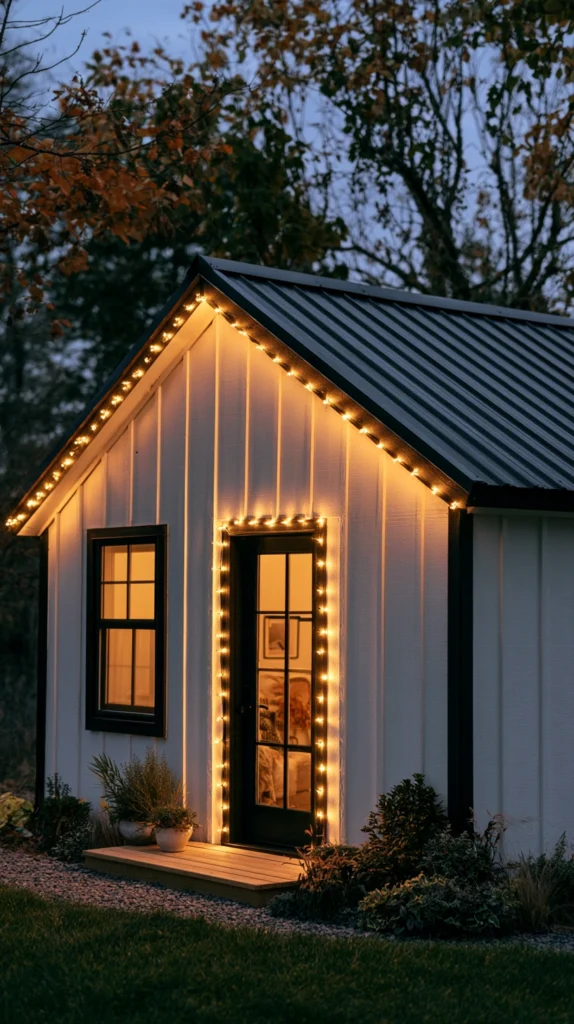
Warm white string lights run along the shed’s roofline or eave edge — the lighting treatment that gives the structure a clear, glowing outline once it’s the only thing visible in a dark backyard.
Why outlining the roof matters specifically for a small standalone structure
- The visibility problem it solves directly: unlike a house, which usually has some ambient light spilling from windows even after dark, a she shed with its door closed can become a near-invisible dark shape in the yard once the sun sets
- The architectural definition it provides: a lit roofline traces the shed’s actual silhouette, turning it into a recognizable, almost magical-looking structure rather than a vague shadow at the edge of the yard
- The fall-specific timing that makes this more relevant: as daylight shortens, the walk to the shed increasingly happens in the dark, making this exterior outline more functional and not just decorative
The options
- Warm white LED string lights, run along the full roofline or eave edge
- Battery or solar-powered string lights, for a shed without easy access to an outdoor outlet
- A double row, tracing both the roofline and the door frame for a more complete outline
- Icicle-style string lights, draping slightly below the roofline for more dimension than a single straight line**
The practical execution
- Use outdoor-rated, weatherproof lights and connections throughout, given the full direct exposure most she shed exteriors face
- Secure lights with clips rated for the shed’s specific roofing or siding material, rather than nails or staples that could damage the structure
- Test the full installation after dark before considering it finished, checking for any gaps in the outline that aren’t visible during a daytime check
Cost breakdown
- String light set, outdoor-rated: $20–50
- Mounting clips: $10–20
- Total: $30–70
4. The Small Stoop Seating (A Single Chair for Sitting Just Outside the Door)
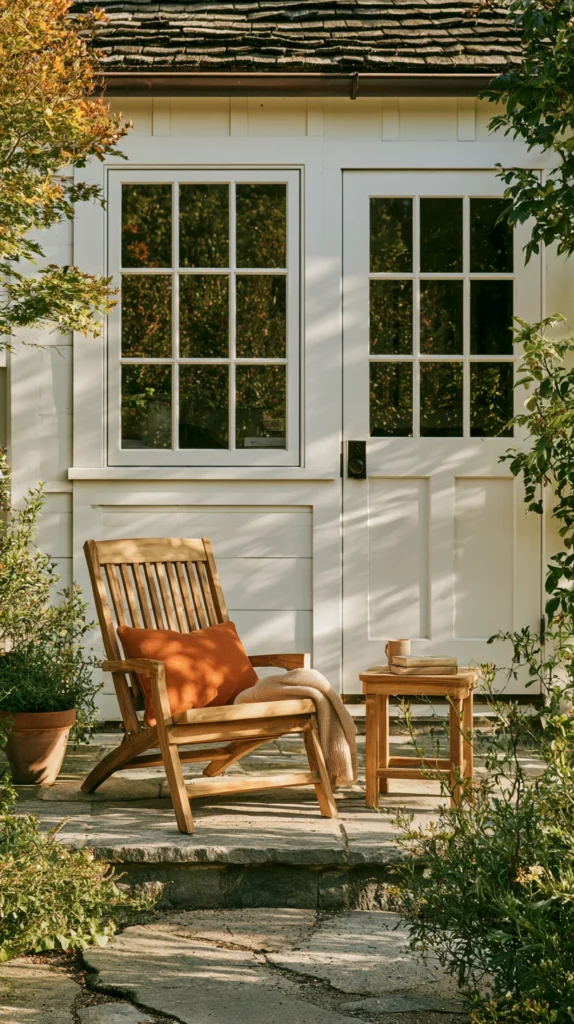
A single weatherproof chair or small bench, placed just outside the she shed’s door — the addition that creates a reason to pause outside the structure, not just pass through its threshold on the way in.
Why outdoor seating belongs even at a structure this size
- The transition spot it creates: a chair just outside the door gives a natural in-between space, somewhere to sit with a coffee before going inside or to linger for a few extra minutes once stepping back out
- The small-footprint scale that fits naturally: unlike a full porch seating area, a single chair or narrow bench fits the modest exterior space most she sheds actually have available
- The photo-moment value it adds: a styled chair just outside the door is consistently one of the more photographed details of a well-decorated she shed exterior, doing real work for how the whole structure reads
The options
- A single weatherproof bistro chair, scaled to fit a narrow stoop or path
- A small wooden bench, for slightly more substantial seating if space allows
- A folding chair, stored inside and brought out as needed, for the most space-efficient option
- A chair paired with a small side table, for setting down a drink or a book**
The practical execution
- Choose weather-resistant materials and finishes specifically, since this piece sits in full outdoor exposure with no porch roof for protection in most she shed layouts
- Position where it doesn’t block the door’s swing or the main walking path to the structure
- Add a seasonal cushion or throw, bringing it inside or storing it in a weatherproof container when not actively in use
Cost breakdown
- Small weatherproof chair: $40–100
- Side table, if added: $20–50
- Total: $40–150
5. The Potted Mum and Pumpkin Cluster (The She Shed’s Version of a Porch Display)
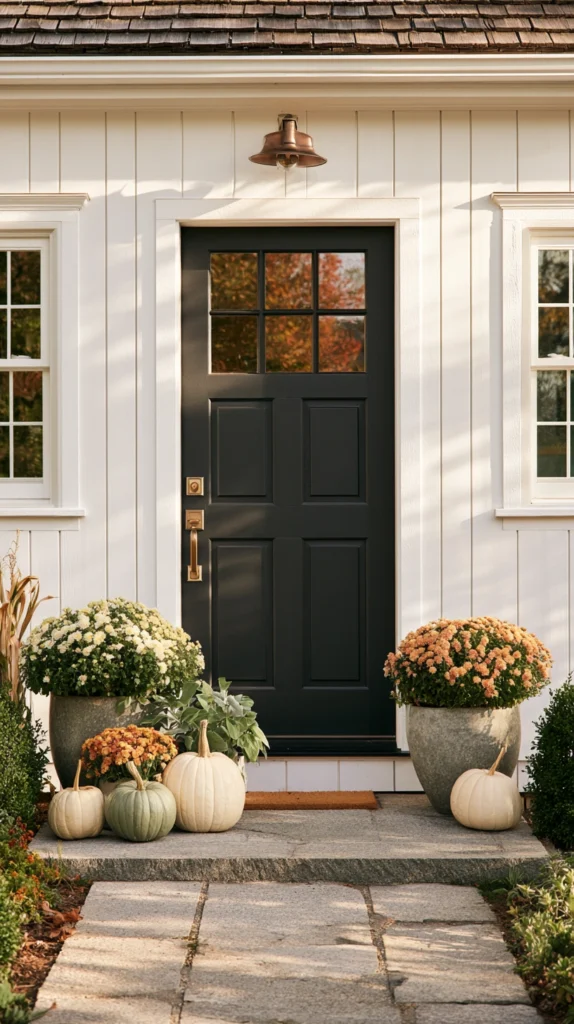
A small grouping of potted mums and a few graduated pumpkins, arranged just outside the door — the scaled-down version of the classic front porch fall display, sized specifically for a structure with a much smaller footprint to work with.
Why this idea works even without a full porch or steps
- The flexible placement it allows: unlike a porch display built around actual steps, this cluster can be arranged directly on the ground or a small landing pad, adapting to whatever modest space exists outside the door
- The color and texture it adds quickly: mums and pumpkins together deliver the same fast, reliable seasonal color combination that works on a full house, just in a smaller, more concentrated grouping
- The proven, low-risk choice it represents: this is one of the most universally recognized fall display combinations available, making it a safe, easy starting point for anyone newer to decorating a she shed’s exterior
The options
- Mums in two or three coordinating colors, clustered beside a small grouping of pumpkins
- A single larger pumpkin paired with a single substantial mum, for the simplest, lowest-maintenance version
- Mini pumpkins tucked directly into the mum pots themselves, combining both elements into fewer total objects
- A mix of real and faux pumpkins, extending the display’s usable life if the structure won’t be checked on as frequently as a main house’s porch**
The practical execution
- Position the cluster to one side of the door rather than directly in the walking path, given how little total threshold space most she sheds offer
- Water mums consistently, since potted plants in full sun exposure near a small structure can dry out faster than expected
- Replace any pumpkin that begins to soften, since a she shed often gets checked on less frequently than the main house, giving rot more time to spread unnoticed
Cost breakdown
- Mums, 2–3 pots: $20–45
- Pumpkins, a small cluster: $15–35
- Total: $35–80
6. The Pathway Lighting to the Shed (Making the Walk Out Part of the Experience)
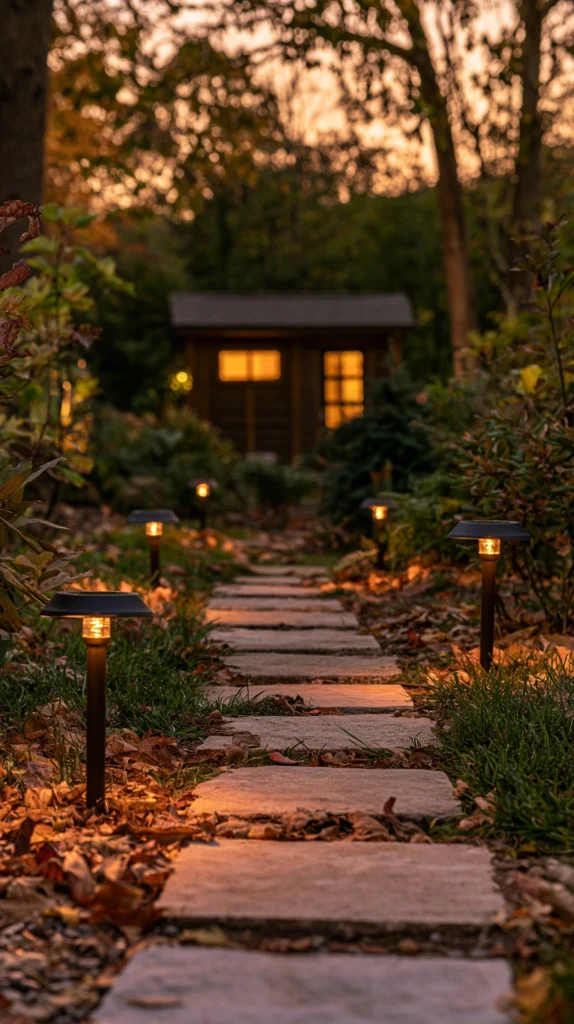
Small solar or low-voltage path lights, marking the route from the main house to the she shed — the lighting layer that turns the walk to the structure into a deliberate, lit experience rather than a dash through the dark.
Why the path deserves the same attention as the shed itself
- The safety case fall makes more pressing: an unlit path across a yard, especially one covered in fallen leaves, becomes a real tripping hazard once the sun sets early
- The anticipation it builds before arrival: a lit path leading specifically toward the she shed creates a sense of occasion, similar to how a lit path toward a backyard fire pit signals that a gathering is happening before anyone arrives at the actual destination
- The connective function it serves between two structures: this is the one idea on the list specifically responsible for visually and physically linking the she shed back to the main house, rather than treating the shed as a fully isolated feature
The options
- Solar-powered stake lights, requiring no wiring at all, the simplest installation for a path between two separate structures
- Low-voltage wired path lights, for the most reliable and consistent option if running a line is practical
- Lanterns set at intervals along the path, easy to move or remove seasonally
- A single continuous string light run alongside the path, rather than individual stake lights, for a different visual effect**
The practical execution
- Space lights close enough together that no stretch of the path between the two structures is left fully dark
- Clear fallen leaves from both the path and any solar panels regularly, since this affects both safety and a solar system’s charging ability
- Test the full path lighting after dark specifically, walking it the way it would actually be used on a typical evening
Cost breakdown
- Solar path lights, a set of 6–8: $30–70
- Total: $30–70
7. The Exterior Door Color Refresh (The Fastest Way to Change the Whole Structure’s Personality)
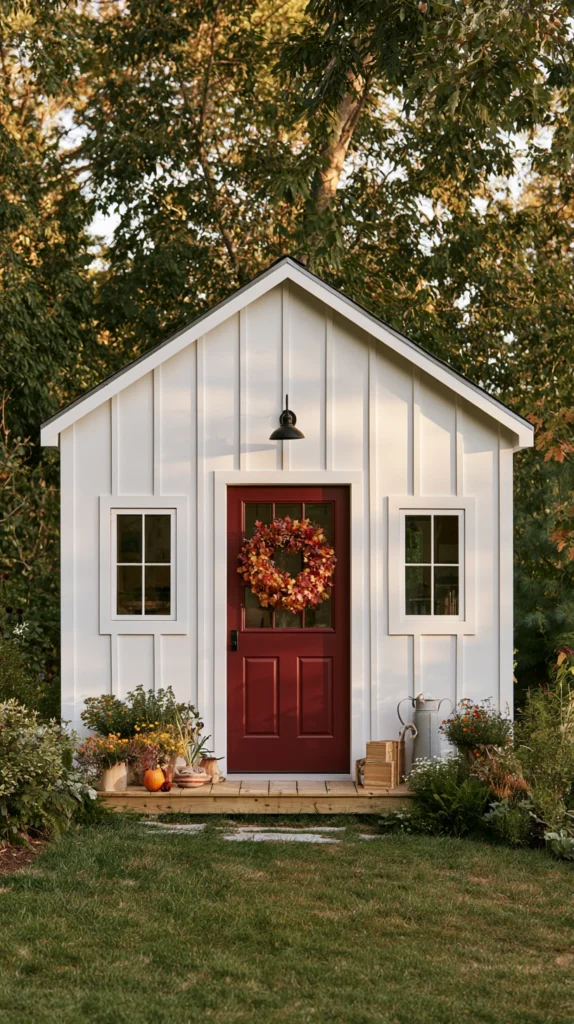
A fresh coat of paint on the shed’s door, in a deep, saturated color — the update that does more to change the structure’s overall character than almost any other single project on this list.
Why the door color matters this much on a structure this small
- The disproportionate visual weight a single door carries: on a full house, the door is one of many exterior features competing for attention; on a she shed, it’s very possibly the single largest colored surface on the entire structure
- The personality statement it allows: a bold door color is one of the most direct ways to signal that this particular structure belongs to someone with a specific point of view, distinct from the rest of the property’s more neutral exterior
- The relatively low cost and effort for the impact achieved: painting a single small door is one of the most affordable, fastest projects on this entire list relative to how much it changes the structure’s overall look
The options
- A deep forest green, classic and versatile against most siding colors
- A rich burgundy or wine tone, for a more dramatic, distinctly autumnal choice
- A deep navy or charcoal, for a more tailored, less overtly seasonal option that still reads as moody and considered
- A high-gloss finish, for more shine and reflection than a flat or satin option, particularly striking under the string lights from Idea #3**
The practical execution
- Choose an exterior-rated paint specifically formulated for full sun and weather exposure, given how directly a she shed door typically faces the elements
- Sand and prime the existing door surface properly before painting, particularly important if the door was previously stained or has a glossy factory finish
- Allow full cure time before regular use, since a freshly painted door handled too soon can show fingerprints or minor damage in the still-soft finish
Cost breakdown
- Exterior paint, sample or small can: $15–30
- Primer and supplies: $10–20
- Total: $25–50
8. The Hanging Lantern by the Door (A Second Light Source With Real Character)
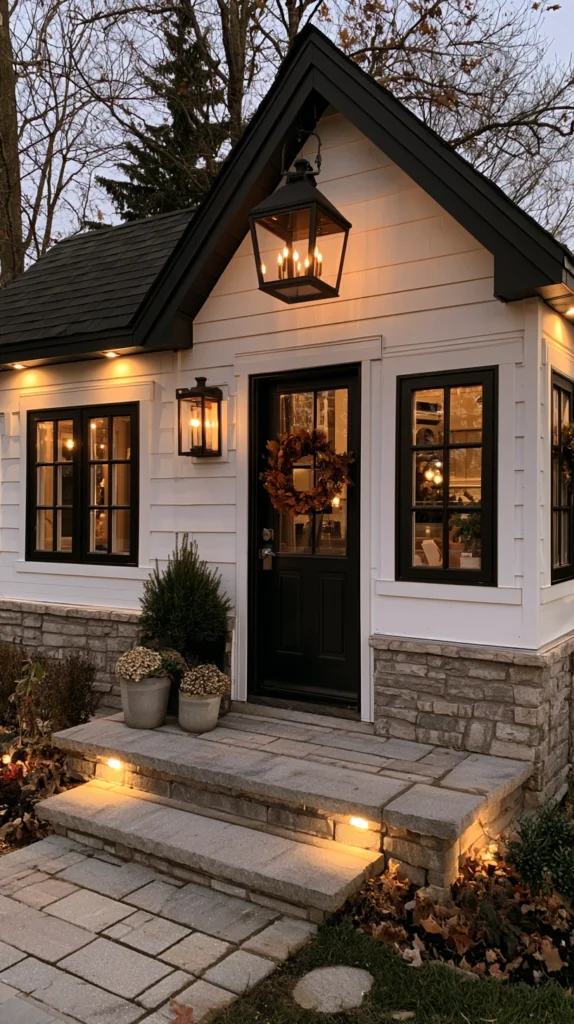
A single decorative lantern, hung beside the door or from a small hook near the entrance — the lighting addition that brings warmth and personality to the she shed’s threshold specifically, distinct from the broader roofline lighting in Idea #3.
Why a dedicated entrance lantern earns its own spot on this list
- The concentrated warmth it provides exactly where it’s needed: rather than the broader, more ambient roofline lighting, a single lantern by the door delivers focused light right at the point of entry, useful for finding a key or simply seeing the door clearly
- The material and style statement it makes: a lantern’s specific finish and shape, whether rustic metal or a more polished glass design, contributes meaningfully to the she shed’s overall character given how few other exterior objects there are to establish that tone
- The flame-like quality many options provide: a lantern, even an electric one, typically offers a warmer, more flickering quality of light than a simple bulb, reinforcing the cozy mood the she shed concept is generally built around
The options
- A battery or solar-powered LED lantern, with a flame-like flicker setting, requiring no wiring
- A genuine wired sconce styled as a lantern, for a more permanent installation if electrical access is available
- A hand-painted or galvanized metal lantern, for more textural interest than a simple glass option
- A lantern hung from a small bracket or hook, rather than mounted flush to the wall, for a bit more dimension**
The practical execution
- Choose a genuinely weatherproof option, since this fixture sits in full exposure with no porch overhang in most she shed designs
- Position at a height that provides real functional light for finding the door and the lock, not purely a decorative height
- Check batteries or solar charge periodically if going with a non-wired option, since this fixture is easy to forget about between uses of the shed itself
Cost breakdown
- Battery or solar-powered lantern: $20–45
- Wired sconce, with installation: $80–200
- Total: $20–200, depending on the option chosen
9. The Outdoor Entry Rug (Defining the Threshold Underfoot)
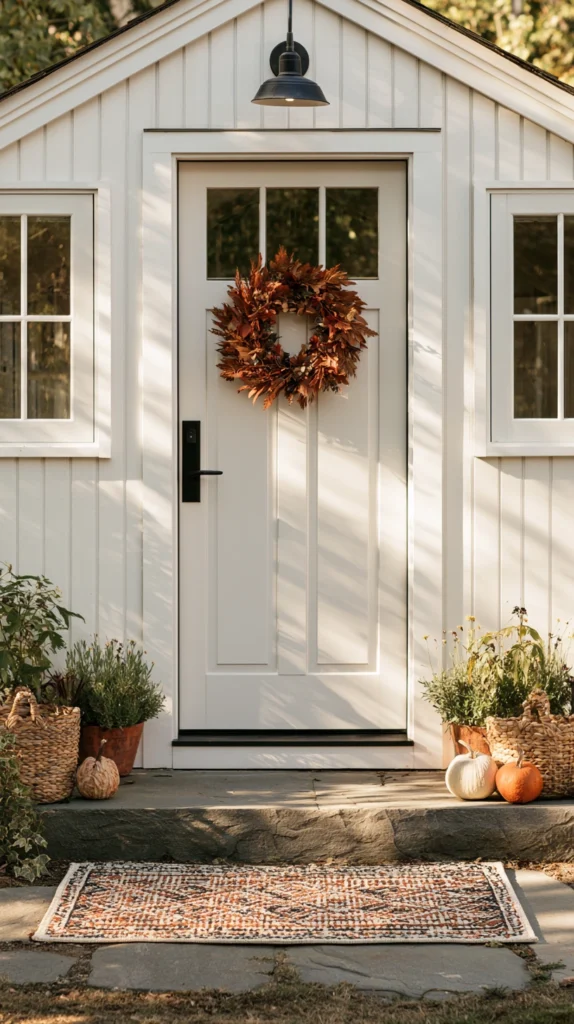
A small, weather-resistant rug placed directly outside the she shed’s door — the addition that marks the threshold and adds a layer of texture and color to the small patch of ground the door opens onto.
Why a rug matters even on bare ground or a tiny landing
- The boundary-marking function it provides: even without a true porch or step, a rug placed at the door creates a clear, deliberate sense of where the structure’s “entrance” begins, the same way a rug defines a room’s edges indoors
- The texture and color opportunity in an otherwise hard-surfaced spot: between the door, any nearby path, and bare ground, this small zone often lacks any soft material at all until a rug is added
- The low-cost, easy-to-style nature of the addition: this is one of the simplest, least expensive updates on the entire list, requiring no installation beyond simply setting it down in place
The options
- An outdoor-rated polypropylene rug, resistant to moisture and fading
- A coir doormat with a seasonal pattern or phrase, doing double duty as both rug and functional scraping mat
- A washable, smaller accent rug, for easy cleaning given the rug’s full outdoor exposure
- A round rug, for a softer shape contrast against the door’s straight, rectangular lines**
The practical execution
- Choose a genuinely outdoor-rated material, since an indoor rug placed outside will degrade quickly under direct sun and moisture exposure
- Size to the available space realistically, since most she shed entrances offer a fairly small footprint to work with
- Shake out and clean periodically, since fallen leaves and dirt accumulate quickly on a rug positioned directly outside a frequently used door
Cost breakdown
- Small outdoor rug: $20–45
- Total: $20–45
10. The Climbing Vine or Small Trellis (Greenery That Grows Into the Structure Itself)
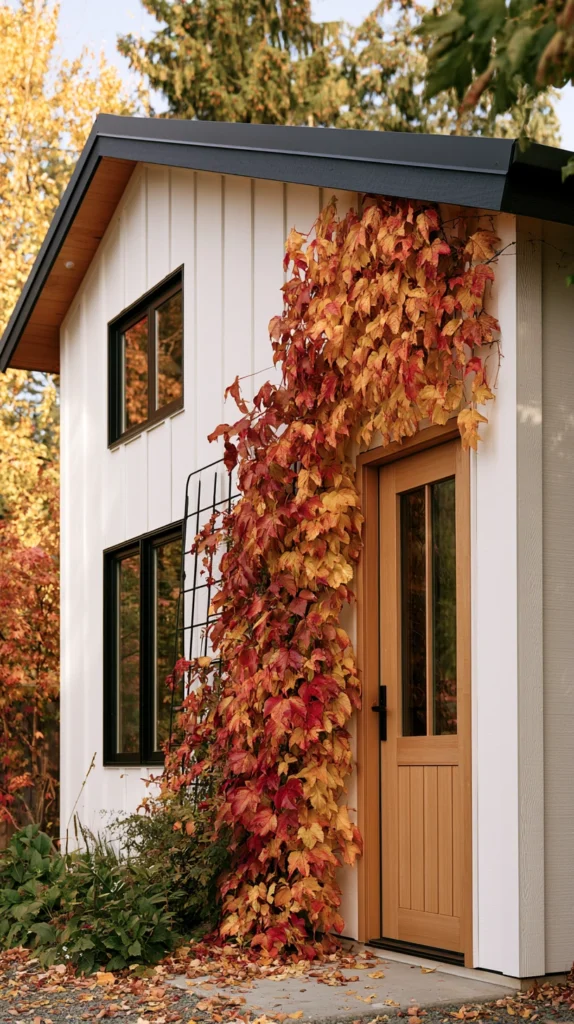
A trellis mounted against the she shed’s exterior wall, planted with a climbing vine — the addition that, over time, integrates the structure more fully into its surrounding garden rather than leaving it looking like a separate object placed on top of the landscape.
Why a climbing vine changes the relationship between structure and garden
- The gradual, living transformation it offers: unlike most ideas on this list, a planted vine continues to change and grow more impressive over multiple seasons, rather than delivering its full effect immediately
- The cottage, storybook quality it reinforces: a vine-covered structure is one of the most universally recognized visual signals of a charming, established garden building, fitting the general spirit many she sheds aim for
- The architectural softening it provides: a trellis and climbing vine break up the flat, hard lines of a small structure’s exterior wall, adding the same kind of organic texture covered elsewhere in cottage and garden styling
The options
- A wooden trellis, mounted directly to the exterior wall, planted with a fast-growing annual vine for quicker first-year coverage
- A metal trellis frame, for a more substantial, longer-lasting structure supporting a slower-growing perennial vine
- A climbing rose, for color and fragrance alongside the vine’s growth habit
- A trellis positioned beside, rather than directly on, the wall, protecting the siding itself from the vine’s direct contact**
The practical execution
- Choose a vine appropriate to the local climate and the trellis’s structural capacity, since some climbing plants become quite heavy as they mature
- Position the trellis a few inches off the wall itself where possible, allowing airflow behind the growing vine and reducing moisture buildup against the siding
- Train new growth along the trellis in its early seasons, since most climbing vines benefit from some initial guidance before climbing largely on their own
Cost breakdown
- Wooden or metal trellis: $30–80
- Climbing vine plant: $15–35
- Total: $45–115
11. The Small Outdoor Heater or Fire Bowl (Extending the She Shed’s Use Into Colder Evenings)
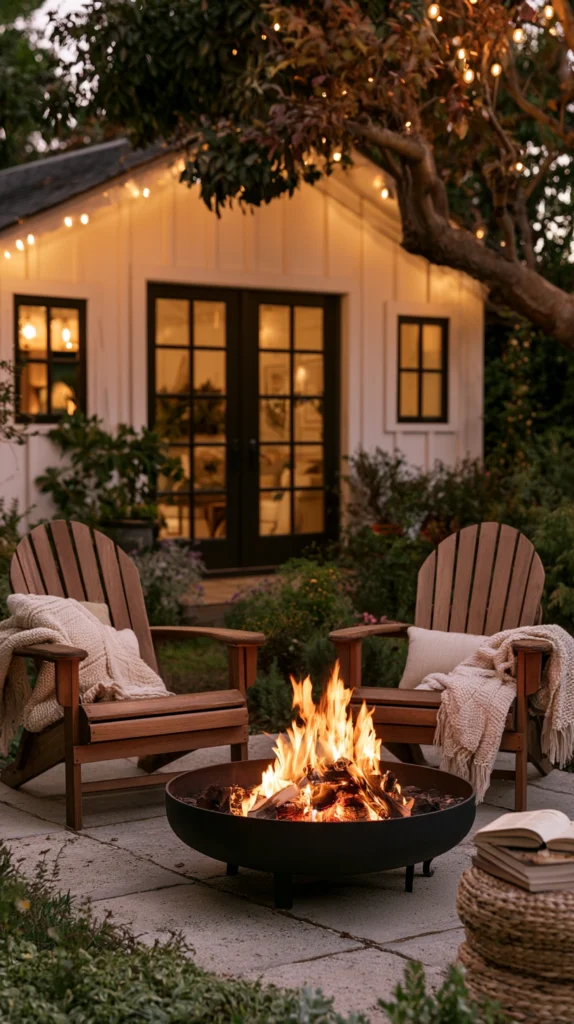
A small portable heater or a compact fire bowl, positioned just outside the door — the addition that extends how late into the fall season the she shed and its immediate exterior remain comfortable to actually use.
Why warmth right outside the door matters as the season progresses
- The seasonal-extension function it serves directly: a she shed’s appeal often depends partly on sitting just outside it for a few extra minutes, and a small heat source keeps that possible weeks longer into the colder part of fall than it would be otherwise
- The proportional scale it offers compared to a full backyard fire pit: a small heater or compact fire bowl fits the modest exterior space most she sheds have, without requiring the larger footprint a full backyard fire pit setup needs
- The ambiance it adds alongside its function: like the lantern in Idea #8, a small flame or glowing heater element contributes warmth and visual coziness simultaneously, not just temperature control
The options
- A small tabletop propane heater, compact enough for a tight exterior footprint
- A compact fire bowl, for a genuine small flame rather than an electric or propane heat source
- An electric infrared heater, mounted or positioned near the seating from Idea #4
- A simple chiminea, scaled to fit a smaller patio or landing area just outside the door**
The practical execution
- Check local ordinances and any seasonal burn restrictions before relying on an open-flame option this close to a wood structure
- Position with adequate clearance from the shed’s exterior wall and any nearby plantings, particularly important given how close this heat source sits to the building itself
- Pair with the seating from Idea #4, positioning the heat source within comfortable range of wherever someone would actually be sitting
Cost breakdown
- Small tabletop propane heater: $40–90
- Compact fire bowl: $50–120
- Total: $40–120
12. The Seasonal Sign or Flag (A Small Detail With a Big Personality Payoff)
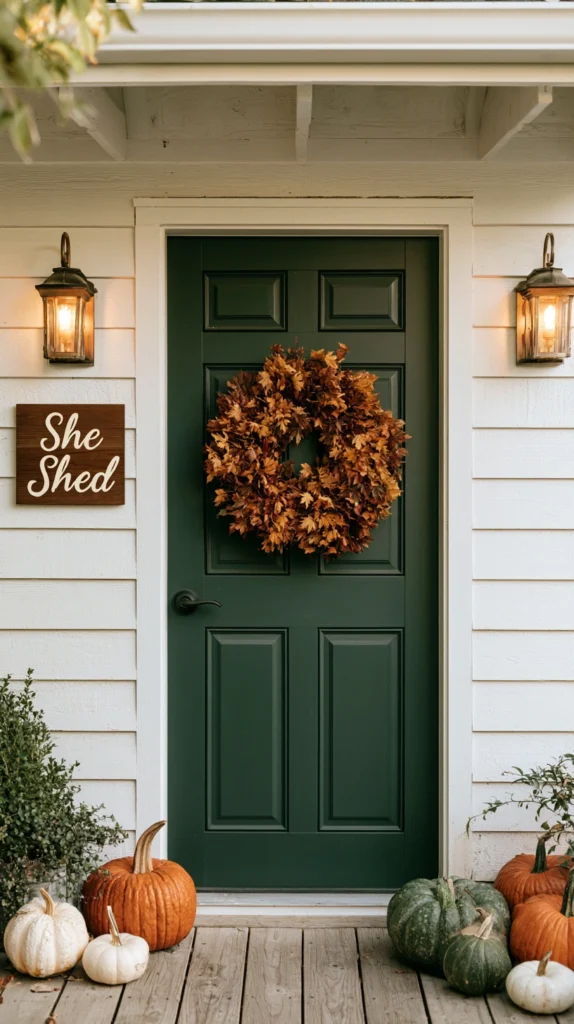
A small wooden sign, metal plaque, or seasonal flag, mounted beside the door or on a small post nearby — the detail that gives the she shed an explicit name, phrase, or seasonal greeting, reinforcing its identity as a distinct, personal space.
Why a sign earns its place among the more functional updates on this list
- The personality statement it makes most directly: more than almost any other idea here, a sign or flag explicitly communicates whose space this is and what it’s for, whether through a name, a phrase, or simply a seasonal greeting
- The low-footprint addition it represents: like a small sign used elsewhere in porch or kitchen styling, this object takes up minimal physical space while contributing real character to the structure’s overall presence
- The easy seasonal rotation it allows: a flag in particular can be swapped quickly as the season moves from early fall into Halloween, Thanksgiving, and beyond, keeping the structure’s exterior feeling current without any larger project involved
The options
- A small wooden sign with the shed’s name or a simple phrase, mounted directly beside the door
- A seasonal garden flag, on a small post near the entrance, easily swapped through the year
- A metal house-number-style plaque, repurposed with a personal phrase instead of an address
- A chalkboard sign, allowing the message to change as often as desired**
The practical execution
- Choose a material rated for the structure’s actual sun and weather exposure, since a sign mounted with no overhead protection fades and weathers faster than one positioned beneath even a small eave
- Keep the message short, since a longer phrase becomes difficult to read at the distance from which most signs are actually viewed
- Position at a height and location that doesn’t compete directly with the wreath from Idea #1 for the same visual space on a small door
Cost breakdown
- Small wooden or metal sign: $20–45
- Seasonal garden flag with post: $15–35
- Total: $15–45
13. The Surrounding Bed Foliage Refresh (Extending the Styling Into the Ground Around the Shed)
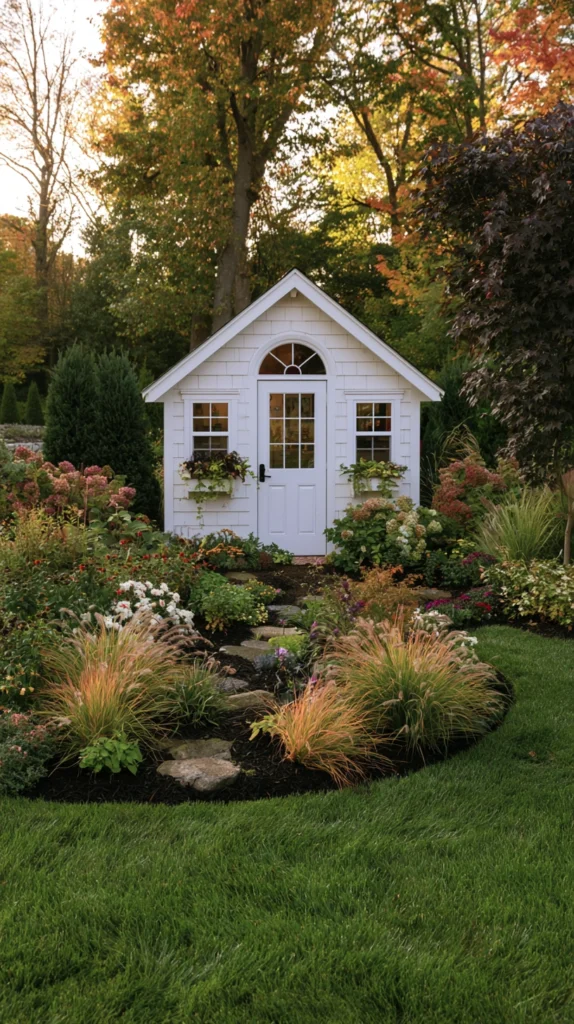
A small planting bed directly surrounding the she shed’s base, refreshed with fall-appropriate foliage, ornamental grasses, and mulch — the addition that grounds the structure visually into its surrounding garden rather than leaving it sitting on bare grass or gravel.
Why the ground around the structure deserves its own attention
- The grounding effect it provides: a planted bed at the shed’s base does for the structure what a rug does for a piece of furniture, visually anchoring it into its surroundings rather than leaving it looking dropped onto an empty patch of lawn
- The low-maintenance, long-season payoff of fall-appropriate plant choices: ornamental grasses and certain foliage plants hold their color and structure well into late fall, offering more sustained visual interest than a bed of flowers that fade after the first frost
- The finishing touch it provides for everything else on this list: a wreath, a window box, and a lit roofline all read as more complete and considered when the ground beneath them is equally cared for, rather than left as an afterthought
The options
- A bed of ornamental grasses, planted along the shed’s base for movement and texture through the season
- A mix of mums and asters, for color that holds through much of fall before the first hard frost
- A foliage-only bed, using deep burgundy or gold-toned plants for color without relying on blooms
- Fresh mulch alone, for the simplest, lowest-cost version of this idea, refreshing the bed’s appearance even without new plantings**
The practical execution
- Clear out any summer plants that have fully finished their season before adding fall replacements, rather than letting spent growth sit through the transition
- Choose plants suited to the specific light conditions at the shed’s base, which can differ from the rest of the yard depending on the structure’s shadow pattern
- Refresh mulch as part of this update regardless of whether new plants are added, since fresh mulch alone meaningfully improves how finished the bed looks
Cost breakdown
- Mums or asters, a small bed planting: $30–70
- Ornamental grasses, 2–3 plants: $25–60
- Mulch, a bag or two: $10–20
- Total: $40–150
The freshly mulched bed circling the she shed’s base: the quiet, ground-level finish that makes every other idea on this list look like it belongs exactly where it’s been placed.
The She Shed Exterior Roadmap
The work, sequenced:
Phase One (the structural and threshold decisions):
- The exterior door color refresh (#7)
- The window box planter (#2)
- The roofline string light border (#3)
Phase Two (the path and lighting layer):
- The pathway lighting to the shed (#6)
- The hanging lantern by the door (#8)
Phase Three (the seating and warmth):
- The small stoop seating (#4)
- The small outdoor heater or fire bowl (#11)
Phase Four (the finishing touches):
- The door wreath and threshold vignette (#1)
- The potted mum and pumpkin cluster (#5)
- The outdoor entry rug (#9)
- The climbing vine or small trellis (#10)
- The seasonal sign or flag (#12)
- The surrounding bed foliage refresh (#13)
Getting Started This Weekend
The immediate-impact she shed refresh:
One afternoon, three changes:
- Hang a wreath sized to the door and add a small pumpkin cluster at the threshold (Ideas #1 and #5)
- Set out an outdoor entry rug just outside the door (Idea #9)
- Add a hanging lantern beside the entrance (Idea #8)
Total cost: $70–155. Time: about thirty minutes. The structure will read as a finished, considered destination by the time the work is done, rather than a shed that happens to have a chair inside it.
The structural investment (the next big project):
The exterior door color refresh (Idea #7) is the single highest-impact project on this list relative to its cost and effort, given how much of the structure’s total visible surface a single door represents. Once it’s painted, every other idea on this list — the wreath, the lantern, the window box — has a more considered, intentional backdrop to work against.
What a fully decorated she shed exterior provides that an undecorated one can’t:
The arrival that starts before the door even opens:
- A wreath and threshold cluster announcing the season the moment the shed comes into view
- A lit path making the walk out from the house feel like part of the retreat, not just the route to it
- A bold door color signaling a structure with real personality, not just function
The comfort that extends the shed’s actual use later into the season:
- A small heater or fire bowl keeping the area just outside usable on a colder evening
- A single chair giving a reason to pause outside rather than rushing straight through the door
- A roofline lit warmly enough to make even a quick evening visit feel inviting rather than just functional
The integration that ties the structure into its surrounding garden:
- A planting bed grounding the shed into the landscape rather than leaving it looking placed on top of it
- A climbing vine softening the structure’s hardest lines over successive seasons
- A window box adding the same color and life to the shed that a porch planter adds to the main house
A she shed’s exterior was never meant to be the part nobody thinks about. It’s the first thing seen on the walk out, the backdrop to every photo, and increasingly, given fall’s early sunset, the only part of the structure visible from a distance once it’s dark. The wreath hung at the start of the season is still doing its job a month later. The lantern lit beside the door is the reason the walk out to the shed feels like part of the retreat, not just the path to where it actually begins.