14 Moody Green Home Office Ideas for a Focused Feel
There is a colour that does something specific to the quality of thought — that produces a quality of focused attention, of settled, grounded concentration, of the particular mental state in which difficult work becomes not merely possible but genuinely absorbing.
Moody green — forest green, deep sage, library green, hunter, bottle, or the particular near-black of a green so dark it reads as shadow rather than colour — is that colour in its most productive form. It encloses the workspace without oppressing it, it connects the working environment to the natural world without distracting from the work, and it communicates, from the moment the door is opened, that this room was built with genuine seriousness around the specific demands of concentrated effort.
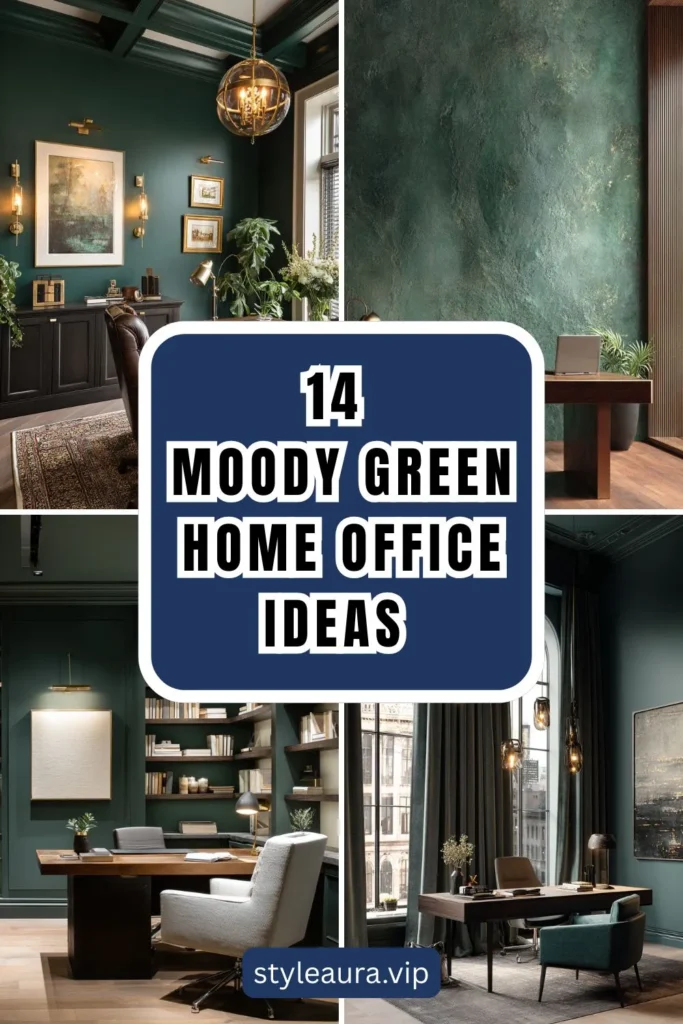
The moody green home office draws from the visual traditions of the Victorian library, the Edwardian study, the contemporary design language of architect-designed workspaces, and the specific understanding that dark, warm, enveloping environments produce a quality of focus that bright, open, neutral ones consistently fail to match. It is not a room for everyone. It is a room for the person who understands that the quality of the thinking environment is inseparable from the quality of the thinking itself.
The fourteen ideas below cover every element of the moody green home office — from the foundational colour decisions to the finishing details that make the space genuinely productive as well as genuinely beautiful.
1. The Deep Green Wall as the Office’s Foundation
Budget: $40 – $200
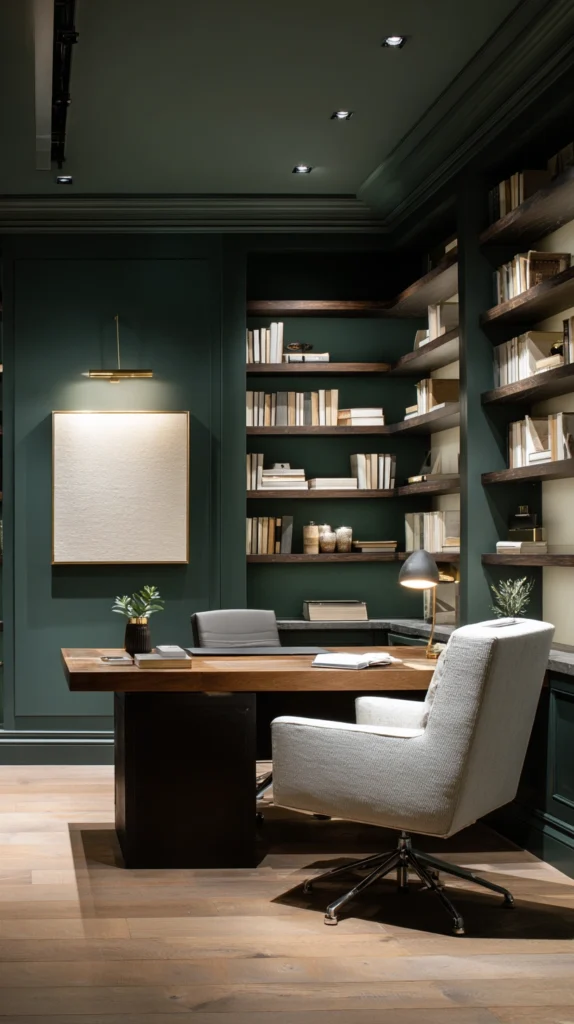
A moody green home office begins with a wall colour of genuine depth and genuine conviction — not a pale sage or a muted olive but a green of real presence and real authority. Forest green, hunter green, bottle green, or a dark emerald with a slight blue quality — these are greens that commit to depth and produce a room of specific gravitational pull that lighter alternatives cannot approach.
A quality deep green paint in a flat or eggshell finish costs $20 – $50 per litre. A full four-wall application requires three to four litres — $60 – $200 in quality paint. A ceiling in the same green or one shade lighter completes the enveloping quality that a moody green office requires. White or warm ivory woodwork in eggshell provides the contrast that gives the green its definition.
Decor tip: Choose a green with a yellow or blue undertone deliberately rather than by default. A yellow-undertoned forest green reads as warm, botanical, and specifically connected to the natural world — the colour of broad leaves and dense foliage. A blue-undertoned green reads as cooler, more specifically marine, and slightly more formal. For a focused working environment, the warm yellow-toned green produces the most specifically grounded and the most genuinely comfortable atmosphere for extended working hours.
2. The Forest Green Feature Wall and White Surround
Budget: $30 – $120
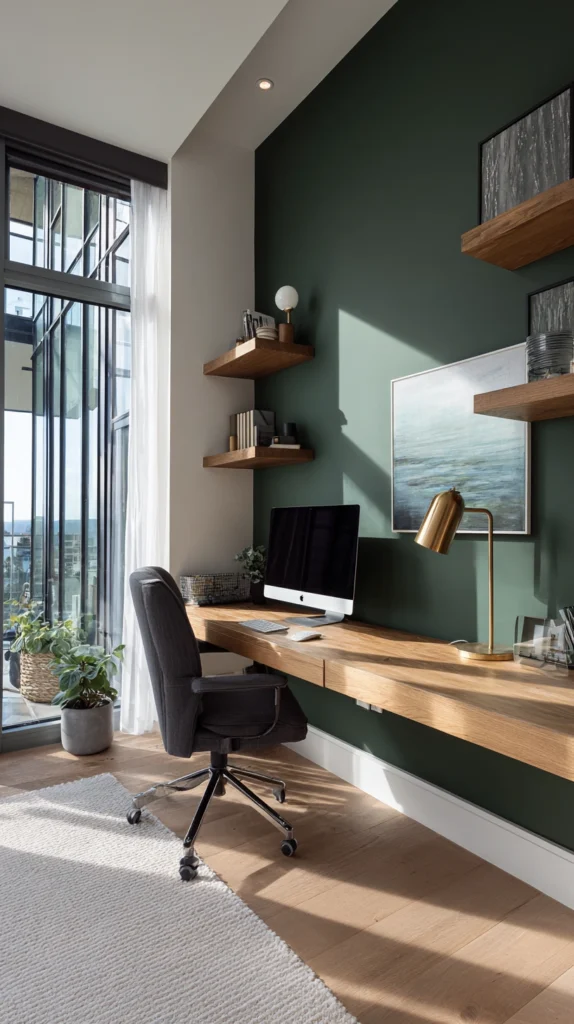
A single deep green feature wall — behind the desk, on the primary wall of the working position — with the remaining three walls in a warm white or a very pale warm grey, is the most accessible and the most immediately resolved version of the moody green office. The green provides the atmospheric depth and the focused envelopment. The white provides the light quality that prevents the dark colour from making the room read as small or oppressive.
A quality forest green paint costs $20 – $50 per litre. One to one and a half litres covers a standard feature wall. The remaining walls in a warm white with a slight yellow undertone — rather than a cool blue-white — provide the contrast that makes the green read as a considered colour decision rather than a single dark wall in an otherwise pale room.
Styling tip: Position the desk so that the green feature wall is directly behind it — the working chair positioned in front of the green, the computer screen in front of the chair. This arrangement produces the most focused and most atmospherically resolved working position in the moody green office — the dark wall behind the working position creating the sense of backed-against-something-solid that the most productive working environments consistently provide.
3. The Dark Green and Natural Timber Pairing
Budget: $100 – $1500
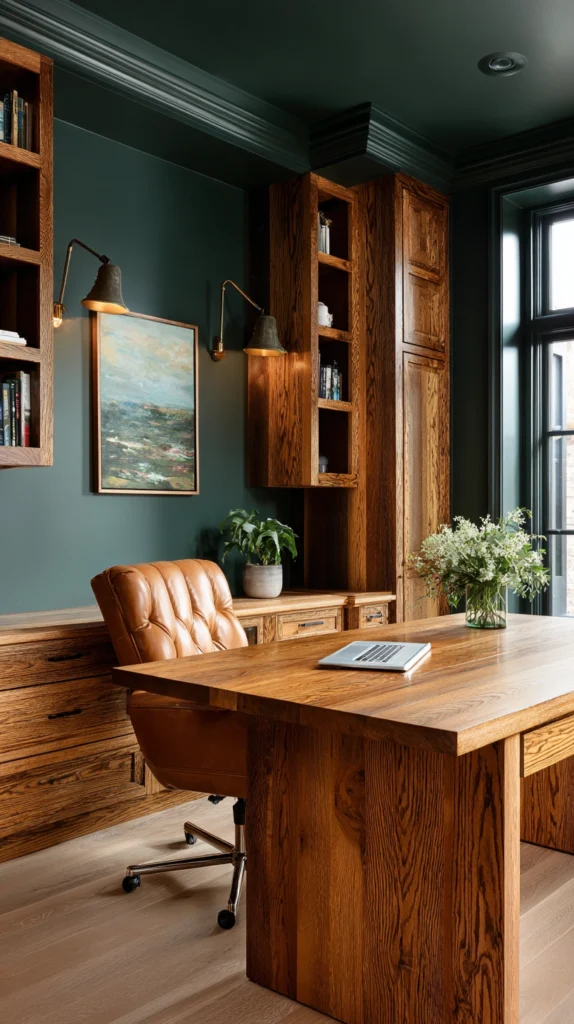
Deep green walls beside warm natural timber — a honey oak desk, pine shelving, or a warm beech bookcase — is one of the most specifically beautiful and the most materially resolved material combinations available in a home office context. The warm yellow of the timber and the cool depth of the dark green produce a contrast that reads as genuinely rich and genuinely designed — both materials making the other appear more specifically beautiful than it does in any other material relationship.
A natural oak or pine desk — $150 – $500. Warm timber shelving on green walls — $20 – $60 per shelf installed. A timber-framed mirror — $40 – $150. A natural timber desk accessory set — $30 – $80. A warm oak or pine bookcase — $100 – $400.
Decor tip: Choose timber pieces in a warm, golden-toned finish — honey oak, warm pine, light walnut — rather than a dark or ebonised timber beside dark green walls. Dark timber beside dark green walls produces a room where both materials compete for depth without either establishing a clear visual hierarchy. Warm golden timber beside dark green walls produces a contrast that makes both materials read at their most beautiful — the warm yellow of the wood illuminated by its relationship with the dark cool green behind it.
4. The Moody Green Library Wall
Budget: $400 – $4000
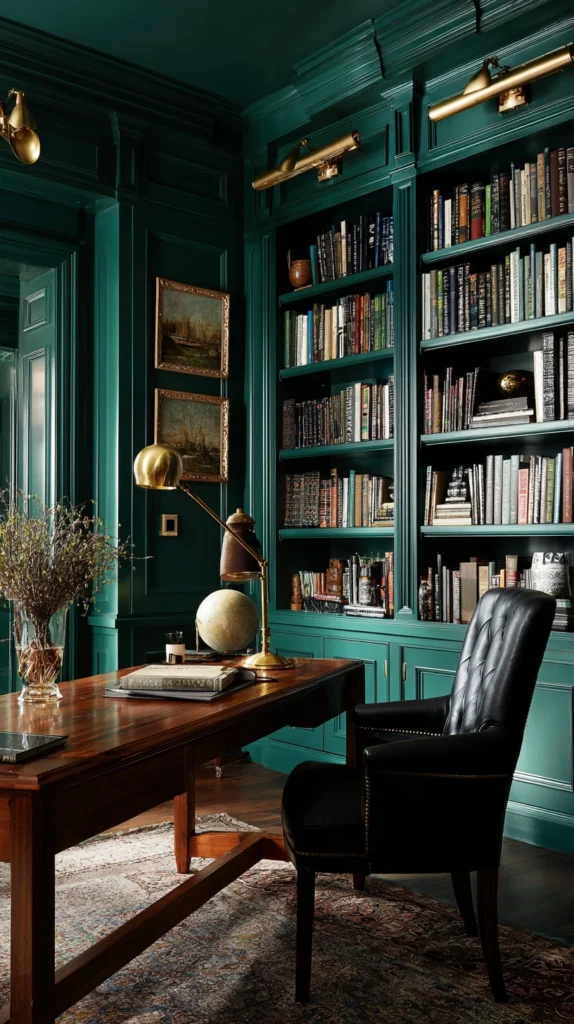
A floor-to-ceiling bookshelf painted in the same deep green as the office walls — books arranged on the shelves with no particular visual order beyond the personal logic of the room’s occupant — is the moody green home office’s most culturally communicative and most specifically atmospheric installation. A green library wall reads as exactly what it is — the working library of a person who takes their reading and their thinking with equal seriousness.
Dark green-painted MDF floor-to-ceiling shelving — $300 – $1000 in materials for a DIY build. Professional bespoke joinery in a stained or painted finish — $1000 – $4000 for a full wall. A library ladder on a brass or dark iron rail — $200 – $600 — is the most dramatically library-like addition available and the one that confirms, beyond any reasonable doubt, that this is a working library rather than a storage unit.
Styling tip: Paint the bookshelf in precisely the same green as the walls rather than in a slightly different or slightly darker shade. A bookshelf that matches the wall exactly reads as an architectural feature — the library built into the structure of the room. A bookshelf in a slightly different shade reads as a piece of furniture painted in an attempt to match the wall — which is a different quality impression regardless of how close the colour match appears.
5. The Green and Brass Material Story
Budget: $50 – $400
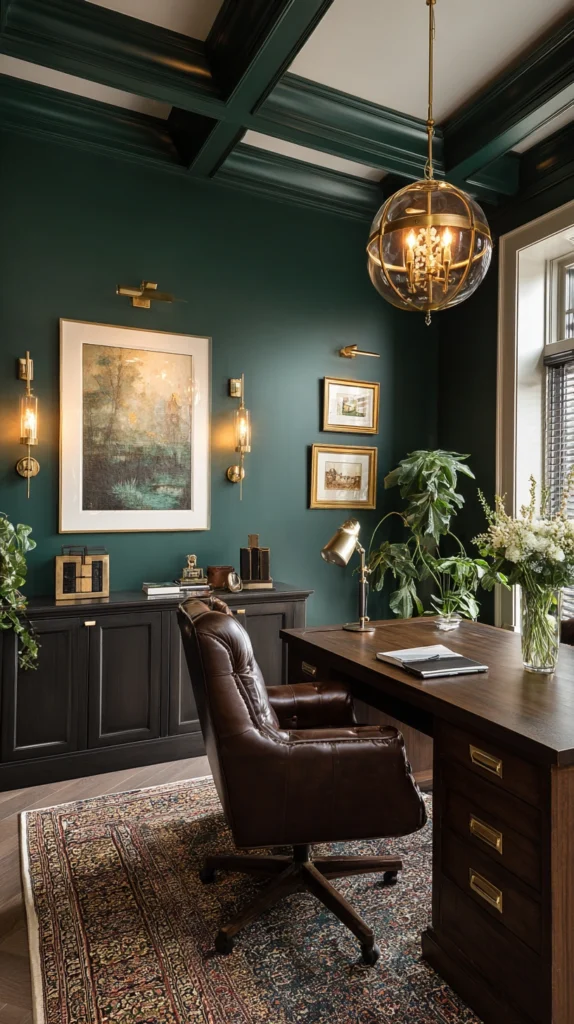
Deep green and aged brass — the cool depth of the dark green and the warm yellow of unlacquered metal — is the material combination that reads as the most specifically library-like and the most quietly executive in a moody green office context. Every brass element in the green office — the desk lamp, the drawer handles, the picture frames, the curtain rod — enriches the green’s depth by providing a warm complement that the cool green cannot generate within its own tonal range.
Aged brass desk lamp — $60 – $200. Brass drawer handles — $5 – $15 each. Brass picture frames — $10 – $30 each. A brass curtain rod — $25 – $60 per window. A brass pen holder or desk organiser — $15 – $40. Total green and brass investment: $115 – $345 for a material language that reads as consistently warm and consistently resolved across every detail in the room.
Decor tip: Use unlacquered rather than lacquered brass throughout the moody green office. Unlacquered brass develops a warm patina over time — each piece becoming slightly more beautiful and slightly more specifically individual with use. Lacquered brass maintains its initial bright finish indefinitely — which is less beautiful in the specific context of a room working toward the quality of a space that has accumulated its character over time rather than arriving complete from a single purchase session.
6. The Deep Green Painted Furniture
Budget: $30 – $400
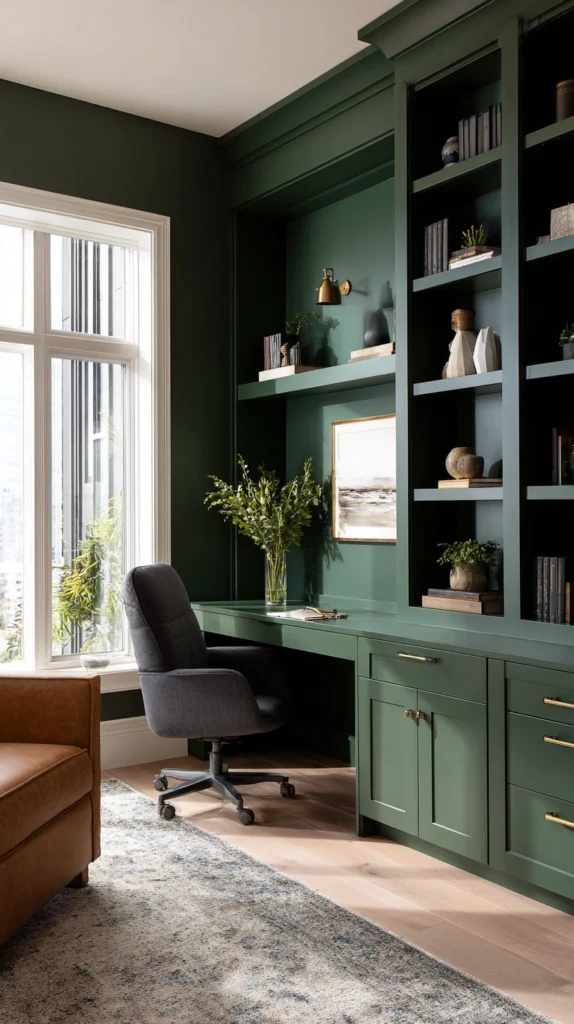
A piece of furniture painted in the same deep green as the office walls — a filing cabinet, a bookcase, a small side table, or a storage unit — creates the specific quality of a room where the boundaries between architecture and furniture are deliberately blurred. A green cabinet against a green wall reads as part of the wall’s surface rather than a separate object placed in front of it — producing a room of greater spatial coherence and greater visual depth than a room where the furniture exists in a contrasting or neutral colour.
A filing cabinet repainted in deep green chalk paint — $20 – $50 in paint materials. A secondhand bookcase repainted to match the office walls — $15 – $40 in paint. A small side table painted in the office green — $15 – $30 in paint. A storage unit painted in the office green — $20 – $50 in paint.
Styling tip: Sand all furniture surfaces lightly and apply a primer before painting in the office green — particularly on laminate or MDF pieces that do not accept paint as readily as natural timber. A well-prepared furniture surface holds paint evenly and produces a finish that reads as consistent and considered. An unprepared surface produces an uneven finish that reads as painted rather than finished — which is the distinction that determines whether the green furniture reads as a deliberate design decision or an afterthought.
7. The Moody Green and Dark Curtain Treatment
Budget: $100 – $500
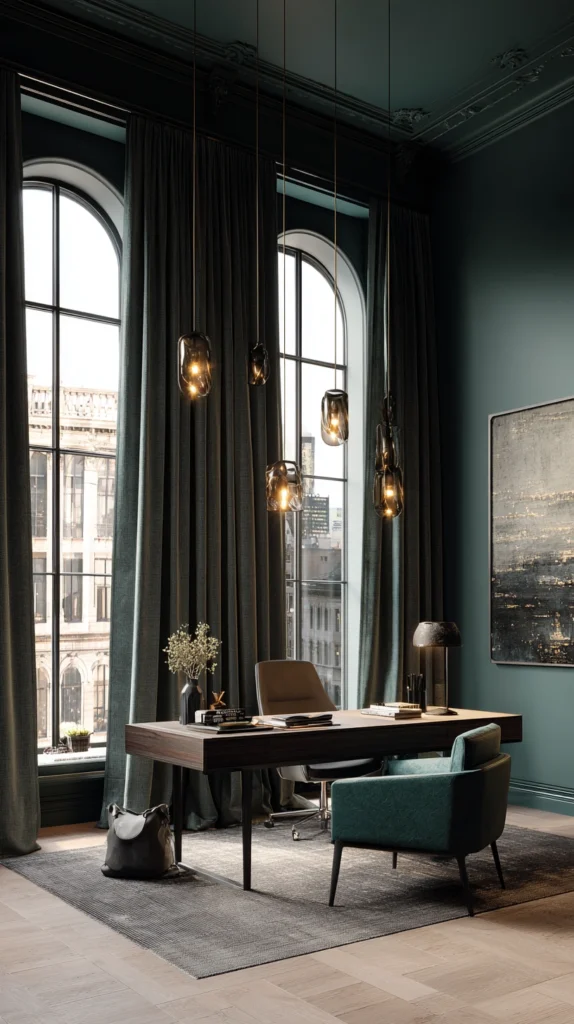
Heavy curtains in the moody green office — floor-to-ceiling panels in a dark linen, a velvet, or a quality woven fabric in the green palette or a complementary dark navy or charcoal — control the light entering the working space, insulate against external sound, and contribute the specific quality of material generosity and enclosure that a focused working environment consistently benefits from. A home office with heavy curtains drawn in the afternoon has a different quality of concentration available within it than one flooded with uncontrolled afternoon light.
Linen curtain panels in a dark green or complementary dark tone — $30 – $80 per panel. Two panels per window hung from ceiling-height rods — $60 – $160 per window. A blackout interlining — $10 – $30 per panel — adds weight to the drape and provides complete light control when the curtain is drawn. Brass or dark iron curtain rods — $25 – $60 per window.
Styling tip: Hang all moody green office curtains from ceiling-height rods rather than from rods positioned at the window lintel. Curtains hung from ceiling height make the ceiling appear higher, the window appear larger, and the room appear more specifically and more confidently designed. The same curtains hung at window height communicate that the curtains were hung at the practical rather than the architectural level — which is a different quality of commitment to the working environment’s atmosphere.
8. The Focused Task Lighting Scheme
Budget: $80 – $500
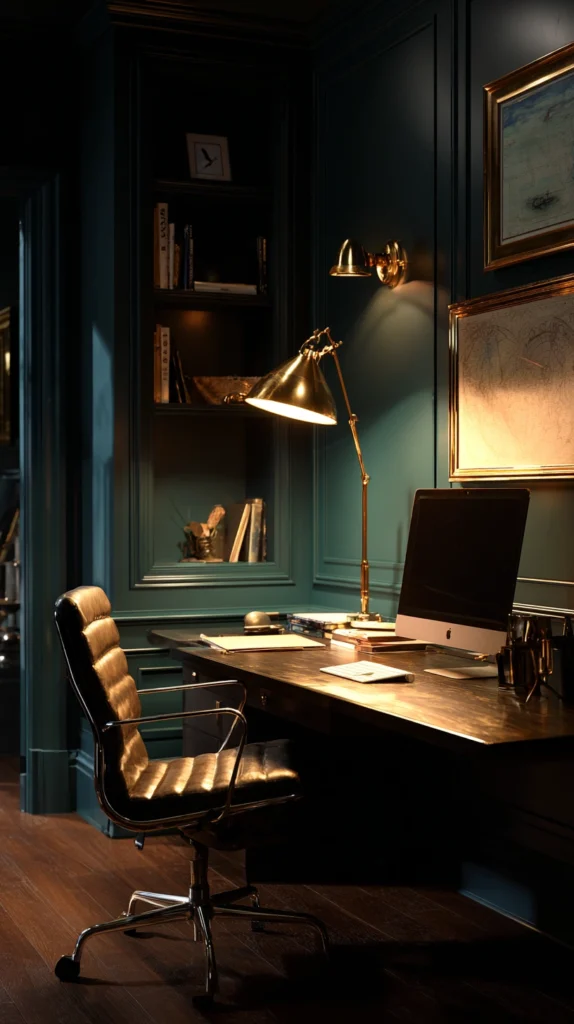
The moody green home office requires a lighting scheme designed for the specific quality of focus the room is built to produce — warm task lighting at the desk, ambient lighting at the room’s periphery, and no overhead fluorescent or cool white source anywhere in the workspace. The quality of light in a dark-walled room determines whether the darkness reads as oppressive or enveloping, and the difference between the two is entirely in the warmth and the positioning of the light sources.
A quality green glass bankers lamp or articulated brass desk lamp — $60 – $200. A floor lamp with a warm shade behind the desk chair — $60 – $150. A picture light above the primary wall art — $30 – $80. A warm LED strip behind the monitor for bias lighting — $15 – $30. Warm LED bulbs at 2700K throughout — $5 – $15 per pack.
Styling tip: Install a bias light — a warm LED strip mounted behind the monitor, directed at the wall behind the screen — as the most practically beneficial lighting addition to any moody green home office. A bias light reduces the visual fatigue produced by looking at a bright screen against a dark wall by elevating the ambient light level behind the monitor to a point where the contrast between screen and surround is no longer extreme. It costs under twenty pounds, installs in minutes, and produces a measurable improvement in the comfort and sustainability of extended screen-based work sessions.
9. The Moody Green and Black Detail Layer
Budget: $30 – $200
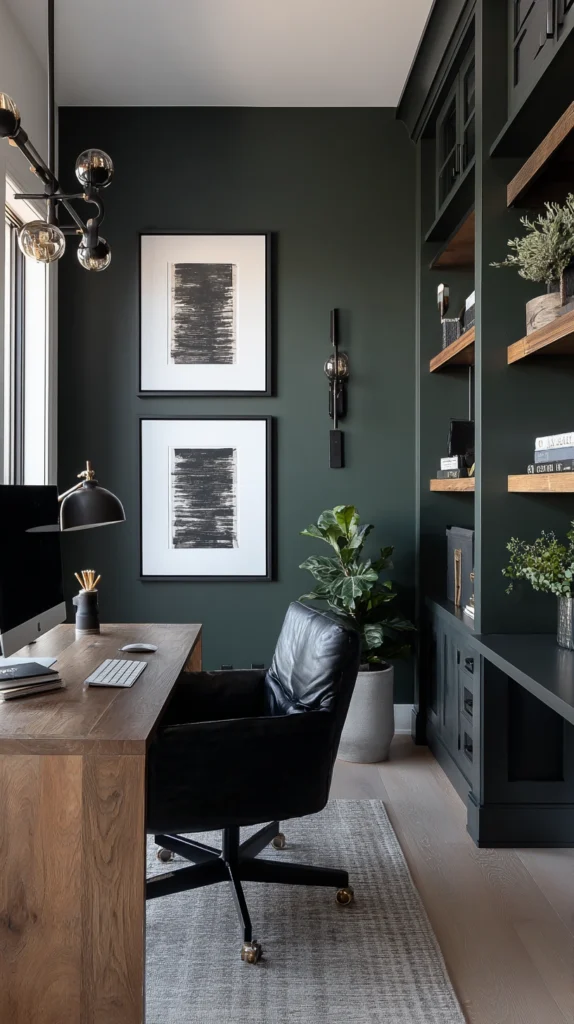
Deep green and matte black — the dark botanical richness of the green and the specific graphic authority of matte black — produce the most contemporary and the most specifically design-forward material combination available in a moody green office. Matte black frames, black desk accessories, and black architectural hardware beside deep green walls read as a room of deliberate, uncompromising aesthetic decision-making.
Matte black picture frames — $8 – $25 each. A matte black desk lamp — $40 – $100. Matte black drawer pulls — $4 – $12 each. A matte black monitor stand — $20 – $60. A matte black pen holder — $10 – $25. Total green and black investment: $82 – $222 for a material language of specific contemporary authority.
Styling tip: Use matte rather than gloss black throughout the moody green office. Gloss black beside dark green walls produces reflections that introduce visual noise into a room designed for visual calm. Matte black absorbs light in the same direction as the flat-finished dark green walls — both surfaces receiving and absorbing the room’s light rather than reflecting it — producing a room of consistent material quality and consistent visual depth.
10. The Moody Green Home Office With Plants
Budget: $30 – $200
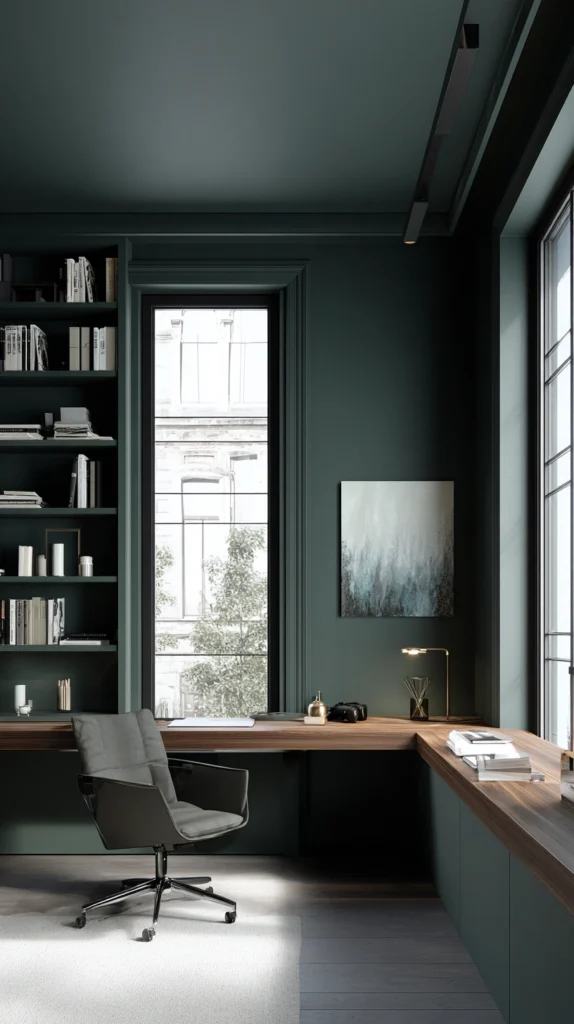
Large, genuinely healthy plants in a moody green office — a tall fiddle leaf fig in the corner, a trailing pothos on the shelf, a small rubber plant beside the monitor — produce the most direct and the most living connection between the room’s colour and the natural world from which that colour was derived. A green room with green plants is not a decorator’s trick. It is the honest completion of a colour’s argument — the painted green confirmed by the growing one.
A large fiddle leaf fig in a dark ceramic or terracotta pot — $40 – $100. A trailing pothos on a high shelf — $8 – $20. A small rubber plant or a snake plant beside the desk — $15 – $40. A fern in a dark ceramic — $10 – $25. Total plant layer: $73 – $185 for living material that improves the air quality and the quality of the working environment simultaneously.
Styling tip: Choose plants with large, architectural leaf forms for the moody green office — monstera, fiddle leaf fig, rubber plant — rather than small, fine-leaved species. Large-leaved plants in a dark green room read as genuinely botanical — a living confirmation of the room’s connection to the natural world. Small, fine-leaved plants in the same context can read as decorative accessories rather than genuine botanical presences.
11. The Textured Green Wall Finish
Budget: $40 – $400
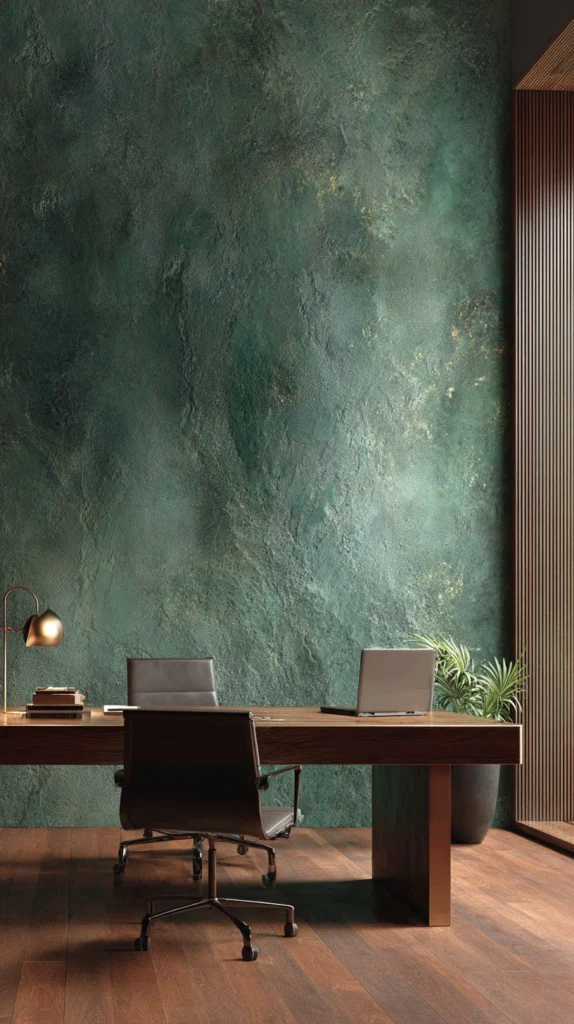
A moody green wall given a textured finish — a limewash application that produces a natural, slightly variegated surface, a Roman clay finish applied with a trowel, or a grasscloth wallpaper in a deep green tone — produces a working environment with genuine surface quality that a flat-painted wall does not provide. Textured dark surfaces absorb light differently from their flat-painted equivalents and produce a depth and a warmth that reward close looking.
A limewash paint in deep green — $25 – $60 per litre, producing a naturally varied, slightly aged surface. A Roman clay finish in a dark green tone — $30 – $80 in materials for a DIY approach. A deep green grasscloth wallpaper — $30 – $80 per roll, three to five rolls for a standard office. A Venetian plaster effect in a dark green tone — $40 – $100 in materials.
Styling tip: Apply the textured finish to the primary wall of the working position — the wall the desk chair faces or the wall directly behind the desk — rather than to all four walls simultaneously. A textured feature wall in a moody green office reads as the room’s primary atmospheric surface — the depth and the warmth of the texture contributing to the focused quality of the working environment. All four walls textured in a small office can read as slightly overwhelming. One textured wall in the same office reads as a specifically considered design decision.
12. The Moody Green Office With a Gallery Wall
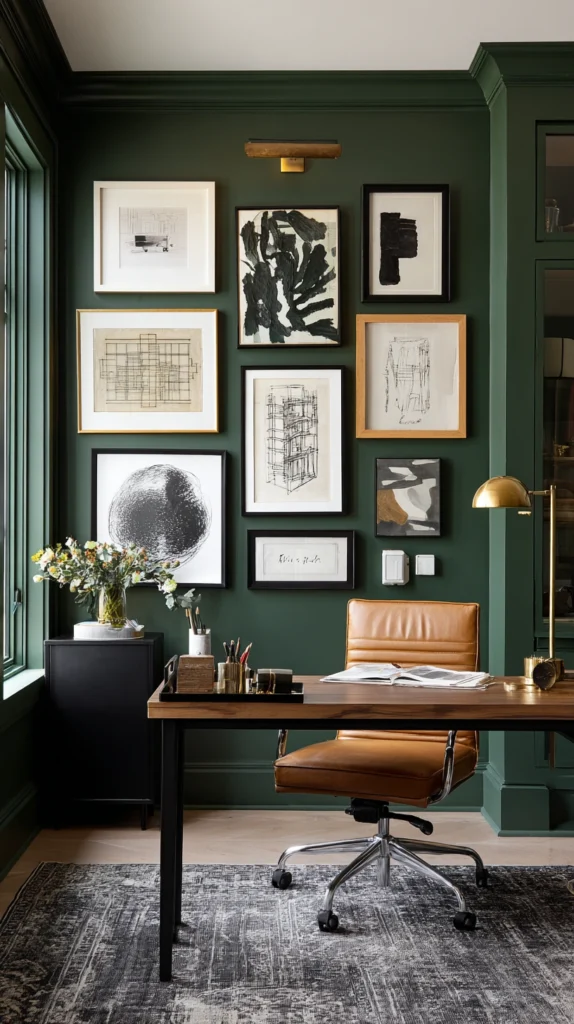
Budget: $60 – $400
A gallery wall in the moody green home office — dark or brass-framed prints of architectural drawings, botanical illustrations, antique maps, significant personal or professional images, and one or two pieces of original art — is the room’s most culturally communicative surface and the one that most directly communicates the depth and the breadth of the person who works within it. Art chosen for its quality and its personal significance rather than for its decorative contribution reads as a different category of object from art chosen to match a room’s colour palette.
Dark or brass frames — $5 – $30 each. A collection of eight to ten frames — $40 – $240 in total. Architectural drawings — found in public domain archives or commissioned for a significant building of personal relevance. Botanical illustrations in dark tones — free from the public domain. Antique map prints — $15 – $50 each. Total gallery wall investment: $55 – $290 for the working room’s most specifically personal surface.
Styling tip: Include at least one element of genuine personal significance in the moody green office gallery wall — something that communicates the specific person who occupies the room rather than the general aesthetic of the room itself. A gallery wall of exclusively purchased or downloaded prints reads as a designed surface. The same gallery with one genuinely personal element — a photograph of specific meaning, a drawing by a child, a document of professional achievement — reads as the wall of a specific person who happens also to have good taste.
13. The Moody Green Office Bookshelf Styling
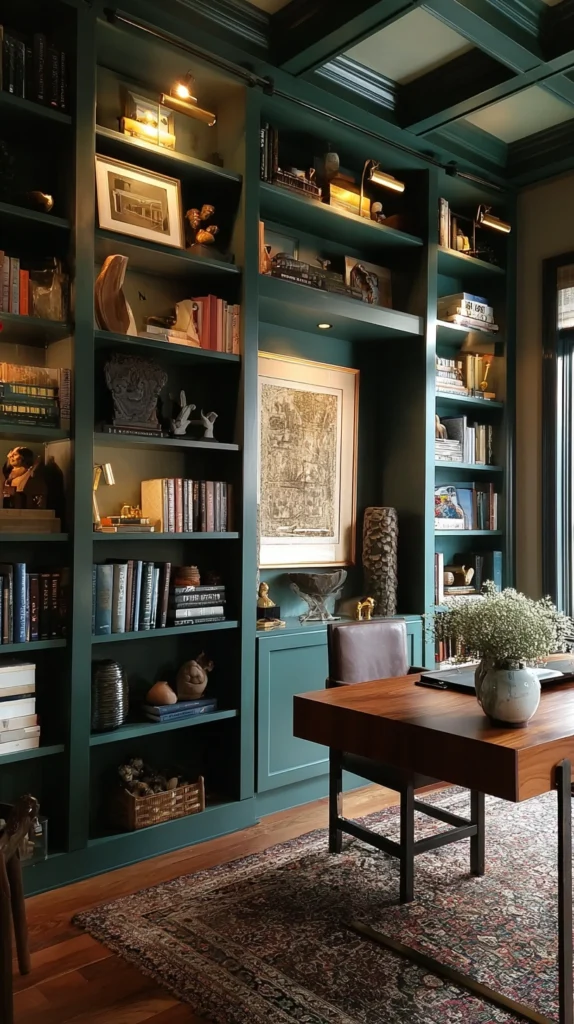
Budget: $20 – $150
Books on the moody green office shelves require no colour organisation, no arrangement by spine height, and no attempt to make the collection appear more curated than it is. The moody green office bookshelf should contain the books that have been read, arranged in the order that makes them most accessible to the person who reads them, interspersed with objects of genuine personal and professional significance. The bookshelf in this room is not a display surface. It is a working library.
Books already owned — free to reorganise. A small ceramic or stone object between book runs — $8 – $20 each. A small dark-toned plant on the shelf — a small fern or a succulent — $5 – $15. A framed photograph of specific personal significance on the shelf — free to place. A quality bookend in a dark material — $15 – $40 per pair.
Styling tip: Leave one section of the bookshelf intentionally clear — a single shelf with no books, only one or two objects of specific quality and specific significance. The clear shelf in a full bookshelf reads as a deliberate choice — a breathing space within the library that communicates confidence in the arrangement. A bookshelf with no clear space reads as full. The clear shelf is the detail that makes the bookshelf read as designed rather than accumulated.
14. The Fully Realised Moody Green Home Office
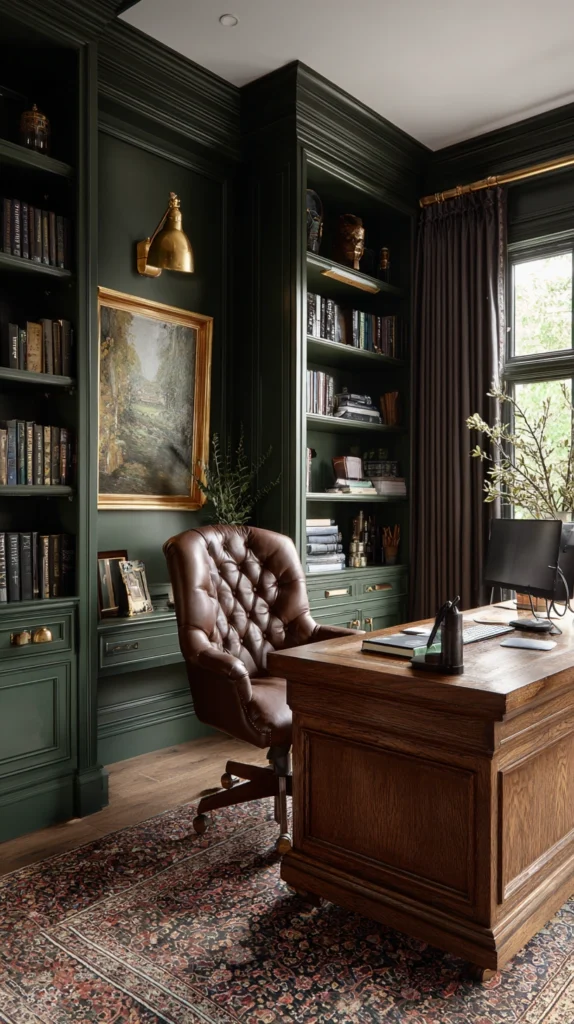
Budget: $500 – $6000
The fully realised moody green home office — deep forest green walls in a dead-flat finish with warm ivory woodwork, floor-to-ceiling bookshelves in the same green on the primary wall with a brass library ladder, a natural warm oak desk with a leather desk mat and a brass task lamp at the correct height, a quality leather or upholstered desk chair, a Persian rug with the chair’s front legs upon it, heavy dark linen curtains from ceiling height, a gallery wall of dark and brass-framed art and documents on the video call wall, large architectural plants in dark ceramic pots, a matte black monitor with bias lighting behind it, a quality audio system at ear height, and no object on any surface that was not chosen for its quality and its specific contribution to the quality of focus the room is designed to produce — is the home office that makes every working hour feel like the most productive working hour of the day.
Dark green paint: $60 – $200. Floor-to-ceiling bookshelves: $400 – $3000. Natural oak desk: $150 – $500. Leather chair: $300 – $1000. Persian rug: $200 – $1500. Curtains: $120 – $400. Brass lighting: $120 – $450. Gallery wall: $60 – $290. Plants: $73 – $185. Audio: $200 – $800. Accessories and hardware: $100 – $300. Total fully realised moody green home office: $1783 – $8625 — a range determined by the balance between new and antique sources and by the scale of the room being furnished.
Styling tip: Build the moody green home office around the desk’s working position first — establishing the task lighting, the chair height, the monitor position, and the desk surface organisation before any aesthetic decision is finalised — and then design every remaining element of the room in relationship to the quality of that working position. A beautiful room with an ergonomically and functionally incorrect desk position is a room that is specifically, daily, and consistently uncomfortable to work in. A room that begins with the correct working position and builds its beauty outward from that centre is both beautiful and genuinely productive. The desk position is the room’s foundation. Everything else is the building.
The moody green home office is the room that most directly confirms what the best working environments have always known — that the quality of the environment and the quality of the thinking done within it are not separate matters. They are the same matter, understood from different angles.
Choose the green that belongs to the room’s light. Layer it with warm timber, aged brass, and the books that matter. Give the desk the correct light and the chair the correct height.
And then close the door, sit down, and work — in the specific, settled, deeply focused quality of attention that a room built for exactly this purpose has always been able to produce.