15 Space Birthday Party Ideas for Little Astronomers
A space party has an advantage most kids’ party themes don’t: it comes with a built-in colour palette and light source that do a lot of the atmosphere-building automatically. Deep navy and black, scattered with silver stars and glowing accents, reads as genuinely immersive with comparatively little effort, since dark, twinkling, and mysterious is exactly what “outer space” already looks like without much interpretation needed.
The parties that make the most of this built-in advantage tend to lean into darkness and glow rather than fighting against it with bright daytime lighting, and they build in genuine hands-on activities — a helmet craft, a moon rock treat, a countdown launch — that let kids feel like they’re actually part of a mission rather than just standing in a decorated room. Here are 15 ways to build a space party with real launch-day energy.
Why Some Space Parties Feel Flat Instead of Immersive
The daylight-only problem:
Without embracing darkness and glow:
- A space party held in full bright daylight, with only printed rocket ship decorations providing the theme
- The result: misses the single most effective tool available for this specific theme — genuine darkness paired with glowing or twinkling light
With darkness and glow:
- String lights, glow-in-the-dark stars, and UV elements used deliberately, even if only for part of the celebration
- The result: the space genuinely feels like nighttime sky exploration, not just a room with rocket stickers
The passive-decoration-only problem:
- A beautifully decorated room with no hands-on activities, leaving kids to simply look at the space theme rather than participate in it
- The result: younger guests lose interest quickly without something active to do
The scattered-motif problem:
- Rockets, aliens, planets, astronauts, and constellations all used with equal weight and no clear organizing idea
- The result: reads as a general “outer space” grab bag rather than a considered mission-themed celebration
The Five Immersive Space Party Principles
Before choosing any individual idea below, these five principles help a space party read as a genuine mission rather than a room with stars taped to the wall:
Darkness and glow used deliberately:
- String lights, glow-in-the-dark elements, and a darkened room for at least part of the celebration
- The single most effective tool for making this theme feel genuinely immersive
A “mission” framing tying the activities together:
- A countdown, a launch moment, a shared sense of embarking on an adventure together
- Gives the party a narrative arc beyond simply decorated space
Hands-on activities over passive decoration:
- Craft stations, sensory activities, and a shared task like a countdown launch
- Keeps young guests actively engaged rather than just observing the theme
A cohesive deep-space colour palette:
- Navy, black, silver, and metallic accents, with a single bright accent colour (often a specific planet’s colour)
- Reads as more considered than a rainbow mix of every space-adjacent colour at once
Safety-conscious glow and light elements:
- Battery-operated and UV-safe products, particularly given the young guest age range
- Ensures the atmosphere-building lighting choices are appropriate for the specific party’s age group
1. A Galaxy Balloon Arch
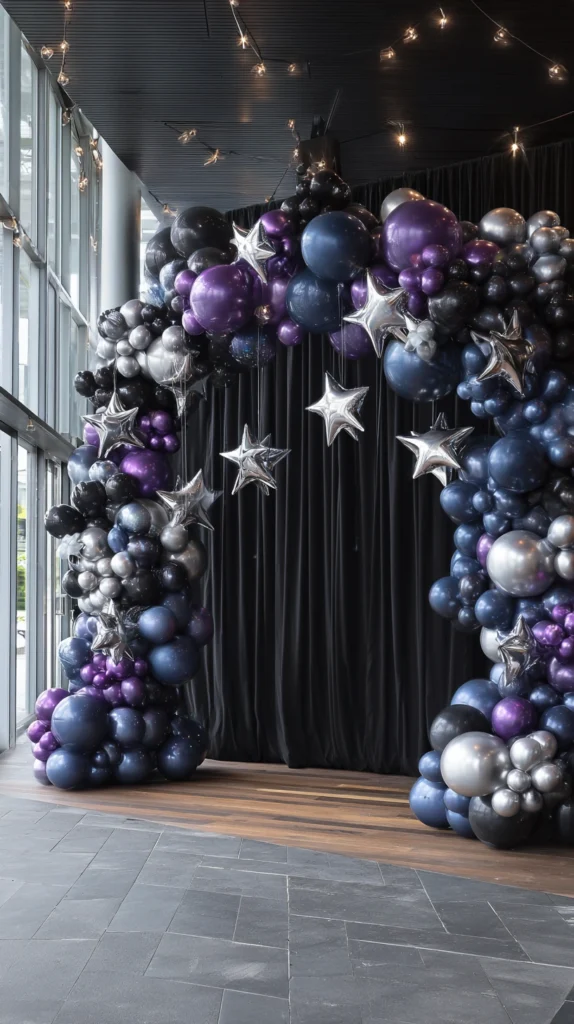
An organic balloon arch combining deep navy, black, silver, and purple balloons, with a few star-shaped balloons woven throughout, positioned at the party’s entrance or main photo area.
Why a galaxy-toned arch sets the tone immediately
An arch built specifically in deep space tones — rather than bright primary colours — signals the party’s genuine commitment to the theme from the very first thing guests see, rather than relying entirely on smaller individual decorations to establish the mood.
Assembly
- A mix of balloon sizes in navy, black, silver, and deep purple, with a few metallic star-shaped balloons woven in for texture
- Positioned against a plain wall or a simple stand, providing a clear entrance statement
Cost breakdown
- Balloon garland kit and helium: $60–120
- Star-shaped balloons: $15–25
- Total: $75–145
2. A Glow-in-the-Dark Star Ceiling
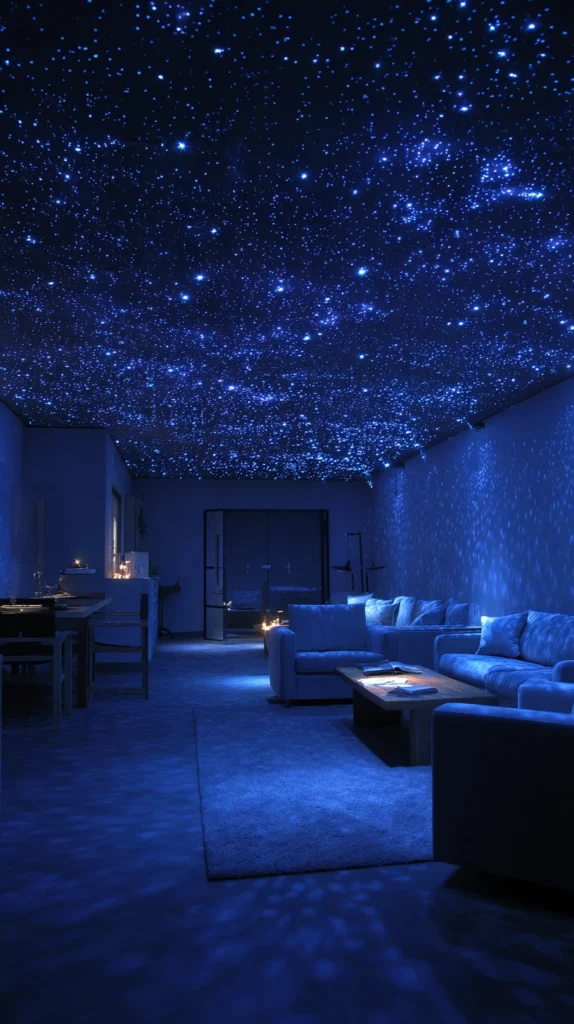
Glow-in-the-dark star stickers applied to the ceiling above the main party area, charged by light throughout the day and revealed once the room is darkened later in the celebration.
Why this delivers a genuine “reveal” moment
Rather than a static decoration visible the whole time, glow stars create an actual moment of transformation when the lights go down, giving the party a built-in surprise that reinforces the mission’s sense of adventure and discovery.
Application and timing
- Applied to the ceiling well before the party, allowing the stars to charge under normal room light throughout the day
- Revealed specifically by dimming the lights at a planned point in the party, such as right before the cake or a specific activity
Cost breakdown
- Glow-in-the-dark star stickers (large pack): $15–25
- Total: $15–25
3. A Rocket Ship Photo Backdrop
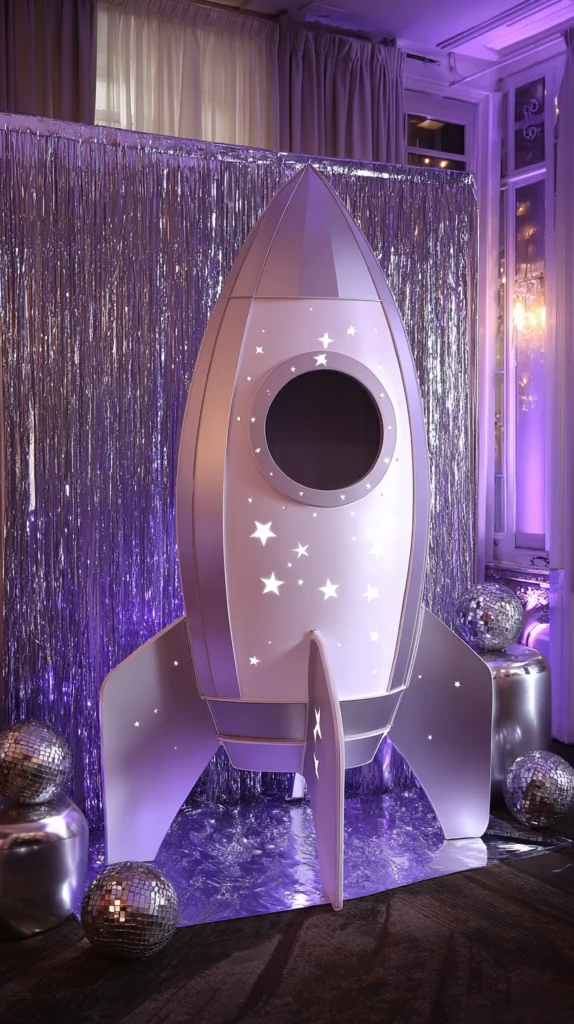
A large rocket ship silhouette or cutout, combined with a starry backdrop, providing a dedicated photo location where guests can pose as though launching into space.
Why a rocket-specific backdrop outperforms a generic starry one
A rocket silhouette gives guests something specific and active to interact with in photos — climbing aboard, peering out a window cutout — rather than simply standing in front of a passive star pattern, adding genuine play value to the photo station.
Construction
- A large cardboard or foam board rocket cutout, painted or covered in metallic paper, with a cutout window for guests to pose behind
- Positioned against a starry backdrop (fabric or a printed banner), with string lights woven around the edges
Cost breakdown
- Rocket cutout materials and backdrop: $40–80
- Total: $40–80
4. Hanging Planet Mobile Centerpieces
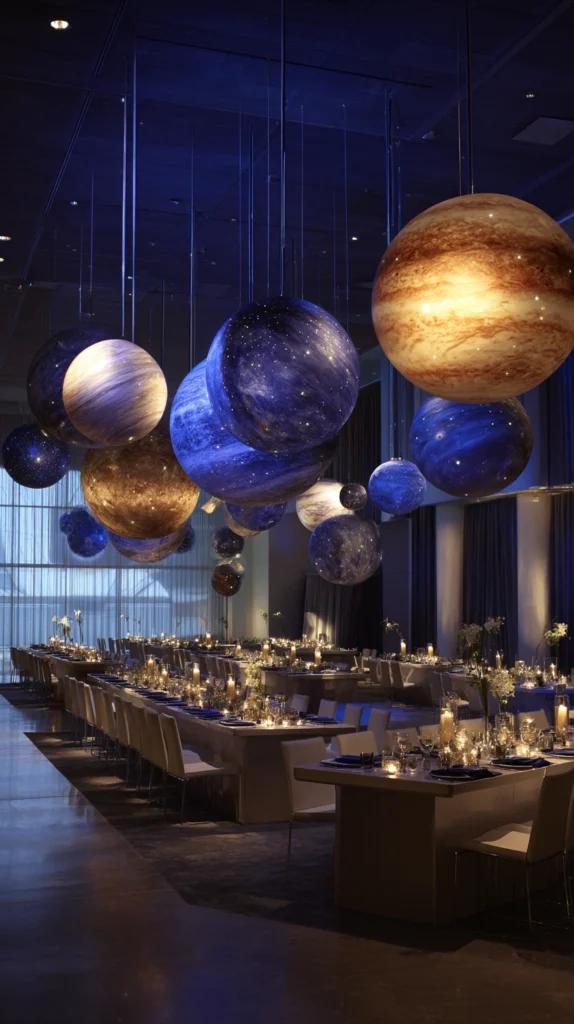
Papier-mâché or foam ball planets, painted to represent the solar system, suspended above the party table or entryway as a hanging centerpiece.
Why suspended planets add genuine dimension to the space
Rather than flat, printed planet decorations, three-dimensional hanging planets create real depth and a sense of actually moving through a scaled solar system, particularly effective when viewed from beneath as guests walk through the party space.
Assembly
- Foam balls painted to represent each planet’s actual colouring, suspended at varying heights on fishing line from the ceiling
- Positioned above the main table or the entrance, where guests will naturally look up and notice them
Cost breakdown
- Foam balls and paint: $25–45
- Total: $25–45
5. An Astronaut Helmet Craft Station
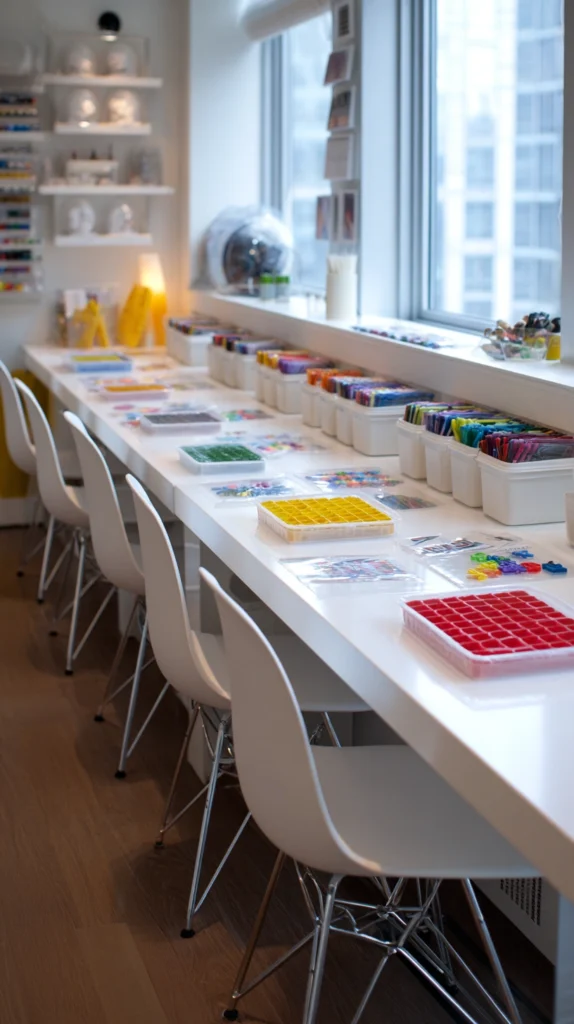
A station where guests decorate their own astronaut helmet, made from a plain bucket or bowl-shaped base with a clear plastic visor, using stickers, paint, or foam shapes.
Why a wearable craft gives every guest a piece of the mission
A helmet, unlike a smaller take-home craft, is worn immediately and throughout the rest of the party, turning every guest into a visible participant in the space theme rather than a passive observer of the decor around them.
Setup
- Pre-assembled helmet bases (available as a craft kit or built from a plastic bowl and clear visor material), with stickers, foam shapes, and paint pens for decoration
- A mirror station nearby for guests to see their finished helmet
Cost breakdown
- Helmet craft supplies (per guest): $5–9
- Total (8 guests): $40–72
6. Constellation Cookie Decorating
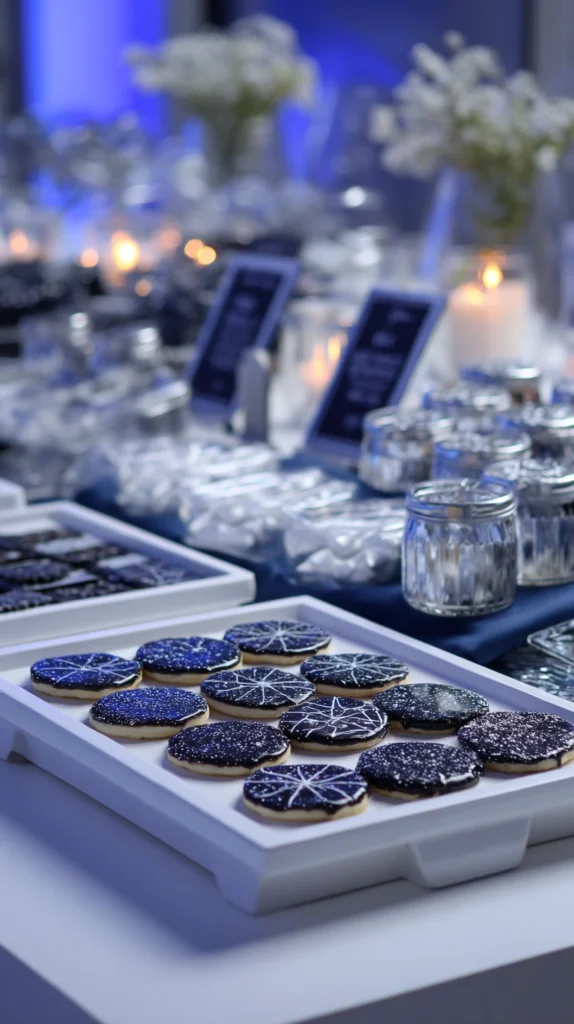
A cookie decorating station where guests connect small candy “stars” with icing to recreate real constellations on a round, dark-iced cookie base.
Why constellation cookies combine activity, education, and treat in one station
Beyond the hands-on decorating activity, tracing real constellation patterns gives young guests a small, genuine astronomy fact to engage with, adding an educational layer to what would otherwise be a purely decorative cookie station.
Setup
- Round sugar cookies with a dark blue or black icing base, pre-baked and iced before the party
- Small edible silver dragées or star-shaped sprinkles, with a simple constellation guide (the Big Dipper, Orion) for guests to trace
Cost breakdown
- Cookies and decorating supplies (per guest): $3–6
- Total (8 guests): $24–48
7. Moon Rock Treat Bags
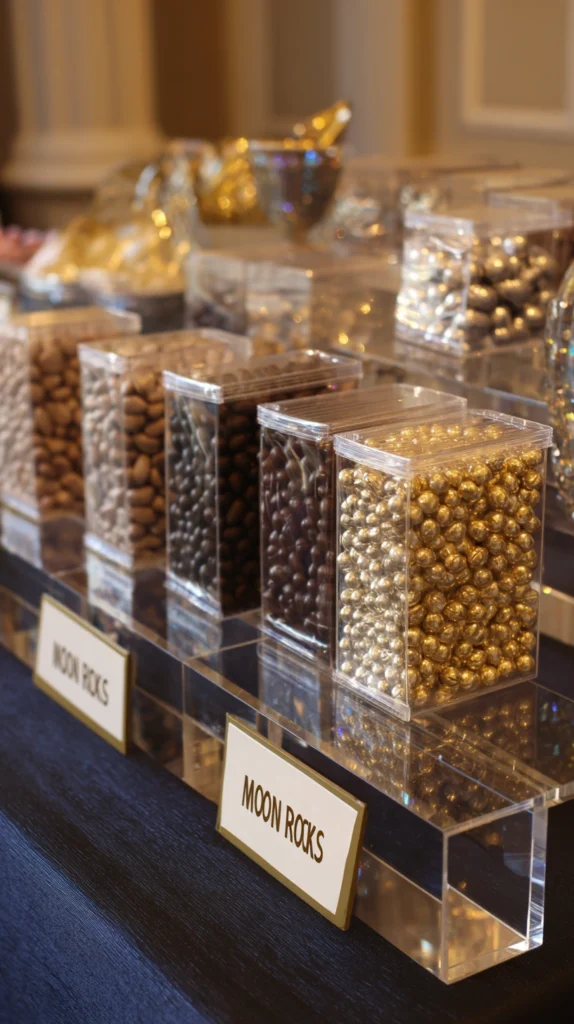
Small treat bags filled with chocolate-covered “moon rocks” — malted milk balls or chocolate-covered almonds dusted with edible silver shimmer — given as a party favor.
Why this specific treat reinforces the theme through food
A treat directly tied to the space theme, rather than a generic candy assortment, extends the mission narrative into the party’s favors, giving guests something both delicious and thematically consistent to take home.
Assembly
- Malted milk balls or chocolate-covered almonds, lightly dusted with edible silver shimmer dust for a moon rock appearance
- Packaged in small labeled bags or containers reading “Moon Rocks”
Cost breakdown
- Moon rock treats and packaging (per guest): $2–4
- Total (8 guests): $16–32
8. UV Blacklight Glow Elements
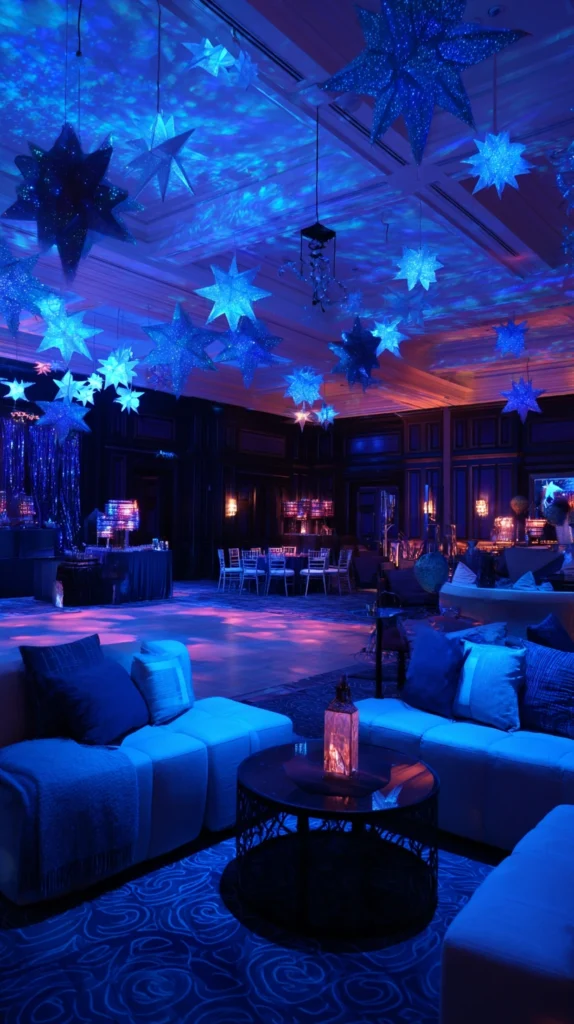
Blacklight-reactive paint, glow bracelets, or a UV light source used during a specific portion of the party, transforming the space into a genuinely glowing, otherworldly environment.
Why blacklight elements deliver the most dramatic transformation available
Nothing on this list creates as immediate and striking an atmospheric shift as switching on blacklights in a darkened room, instantly making white and UV-reactive elements throughout the space glow vividly, delivering a genuine “we’re in outer space now” moment.
Setup and safety
- Portable UV/blacklight bulbs, installed temporarily for a specific activity window rather than the entire party
- UV-reactive glow bracelets or face paint distributed to guests, safe and specifically designed for this kind of use
Cost breakdown
- Blacklight bulbs and UV-reactive supplies: $30–60
- Total: $30–60
9. A Star-Shaped Balloon Garland
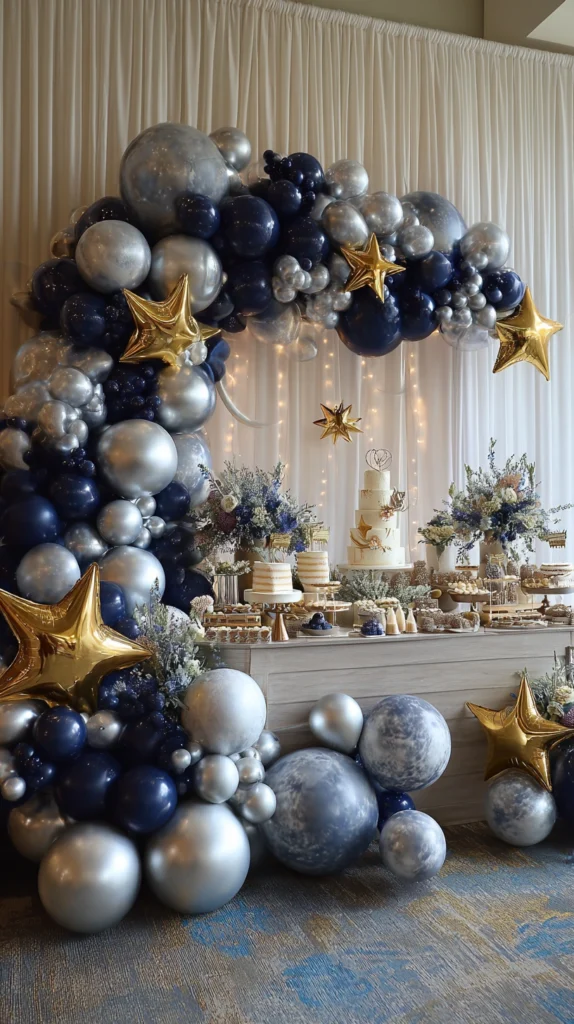
A garland built specifically from star-shaped balloons in silver and gold, rather than round balloons, draped along a table edge or staircase railing.
Why star-shaped balloons add variety beyond the entrance arch
Using a distinctly different balloon shape for a secondary garland location avoids simply repeating the entrance arch’s exact look throughout the party, extending the space theme with genuine visual variety rather than a single repeated element.
Assembly and placement
- Star-shaped foil balloons in silver and gold, strung together or clustered along a table edge, staircase railing, or window frame
- Combined with a few smaller round balloons in navy or black for additional depth
Cost breakdown
- Star-shaped balloon garland: $30–55
- Total: $30–55
10. A Countdown Launch Cake
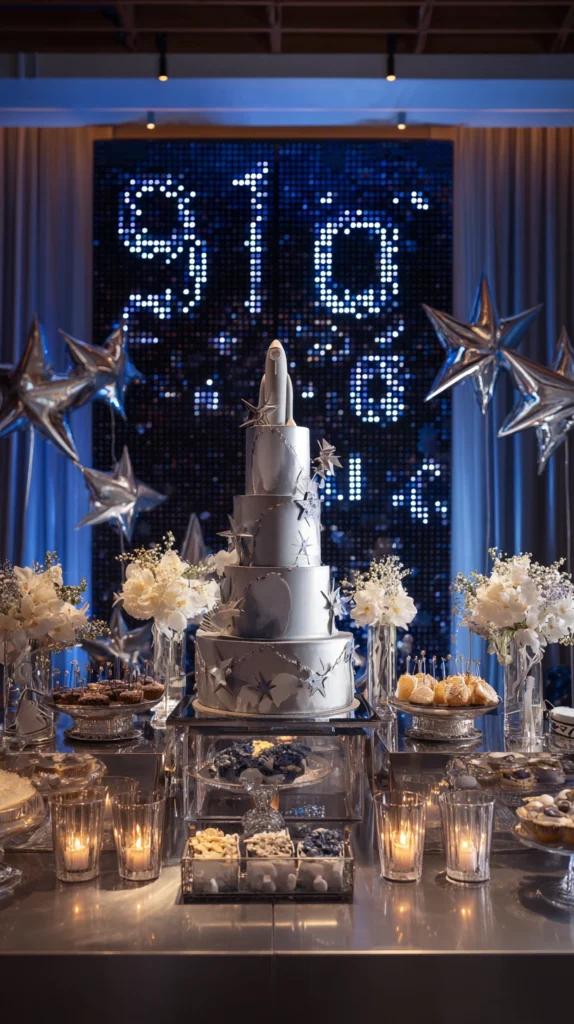
The birthday cake presented with a “launch countdown” moment — guests counting down from ten together before the candles are lit or a small confetti popper is triggered — turning the cake presentation into a shared mission activity.
Why a countdown moment adds genuine group participation to the cake
Rather than the standard “happy birthday” song alone, a launch countdown gives every guest something to actively do together, extending the mission narrative into the party’s most central, most anticipated moment.
Execution
- The cake decorated with a rocket or planet theme, positioned with candles ready
- The whole group counting down from ten together, with the candles lit or a confetti popper triggered on “liftoff”
Cost breakdown
- Cake styling supplies (in addition to base cake cost) and a confetti popper: $15–30
- Total: $15–30
11. A Telescope or Star-Viewing Station
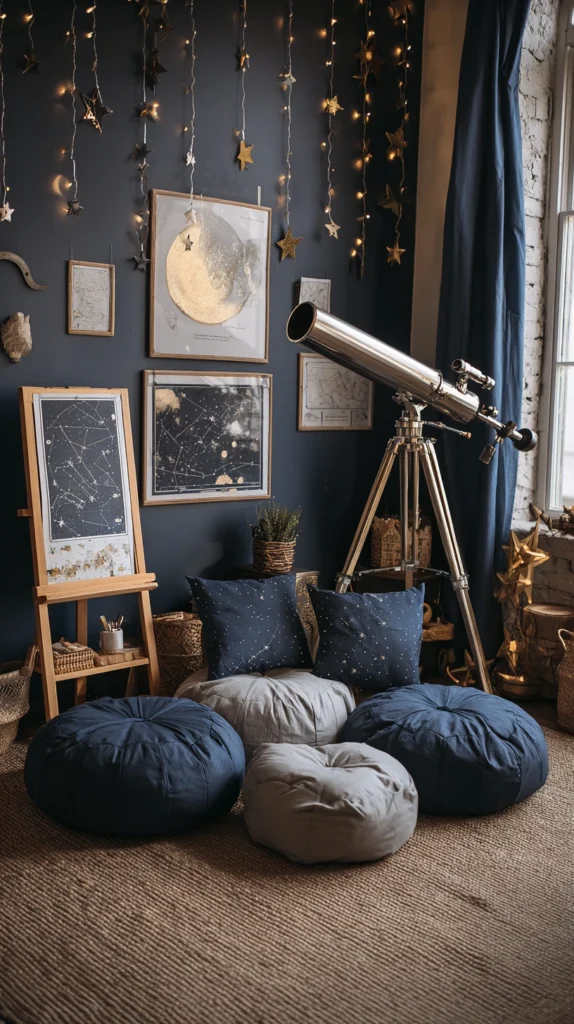
A simple telescope or a styled “observation station” with binoculars, star charts, and a cushioned viewing spot, offering a quieter activity alongside the more active craft and balloon elements.
Why a viewing station balances the party’s more energetic activities
Not every guest wants constant high-energy activity throughout an entire party, and a dedicated, quieter observation station — even a simple toy telescope with a star chart — gives the celebration some genuine pacing variety.
Setup
- A child-friendly toy telescope or binoculars, paired with a simple printed star chart or constellation guide
- A cushioned spot nearby, positioned to look “outward” even if the actual view is decorative rather than a real night sky
Cost breakdown
- Toy telescope or binoculars and star chart: $20–40
- Total: $20–40
12. A Space Suit Dress-Up Station
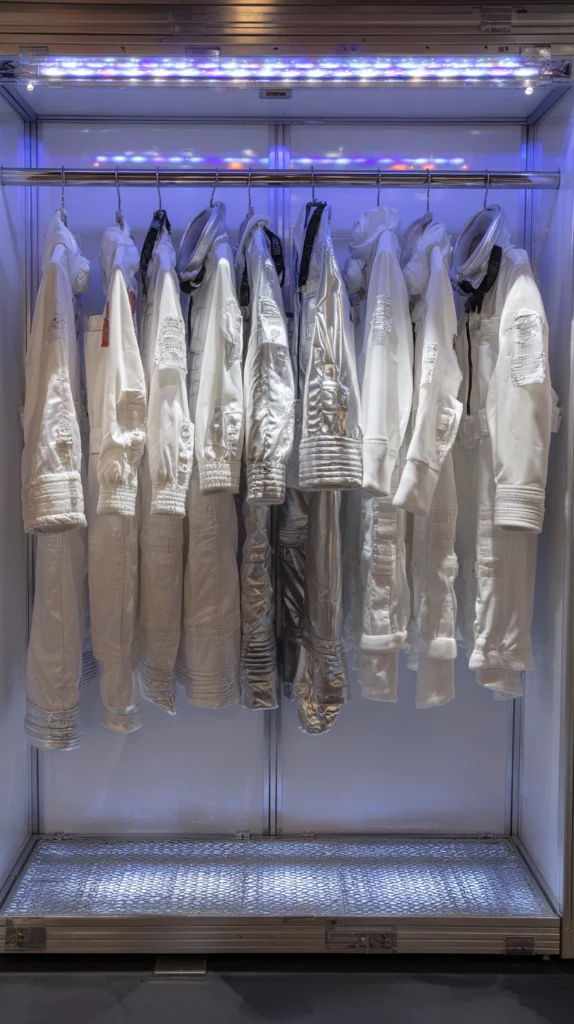
Simple silver or white jackets, paired with the astronaut helmets from Idea #5, allowing guests to fully dress the part for photos and activities.
Why full dress-up extends the helmet craft’s engagement further
Combining the finished helmet with a simple jacket or vest gives guests a complete costume rather than a single accessory, extending the sense of genuine mission participation into their overall appearance for the rest of the party.
Setup
- Simple silver or white jackets or ponchos, sized to fit over regular clothing, available at low cost from costume or craft suppliers
- Positioned near the helmet craft station, so the two activities flow naturally together
Cost breakdown
- Simple space suit jackets (per guest, if not making from the helmet craft alone): $6–12
- Total (8 guests): $48–96
13. A Galaxy Slime or Sensory Bin Activity
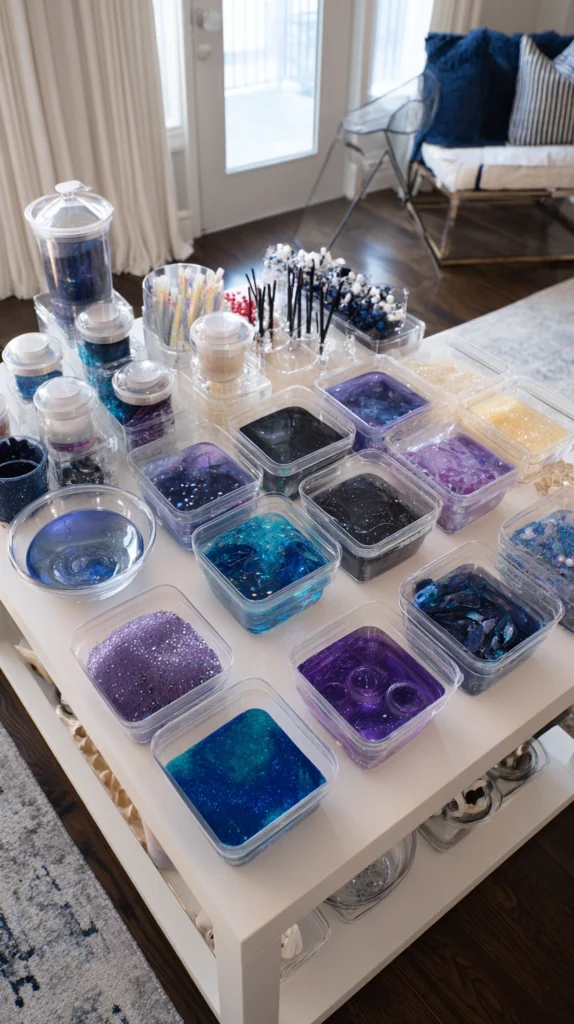
A sensory station where guests mix their own “galaxy slime” — a base slime tinted with deep blue and purple, mixed with fine glitter — or explore a sensory bin filled with space-themed small objects.
Why a sensory activity suits a mixed-age group of young guests particularly well
Sensory activities like slime-making are tactile and genuinely engaging across a fairly wide age range, offering an activity option for younger guests who might find the more structured craft stations less accessible.
Setup
- Pre-measured slime base and colouring, allowing guests to mix and customize their own batch with deep space tones and glitter
- Alternatively, a bin of dried rice or beans dyed dark blue, filled with small star and planet-shaped objects to find and sort
Cost breakdown
- Slime-making or sensory bin supplies (per guest): $3–6
- Total (8 guests): $24–48
14. Planet Hopscotch Floor Decals
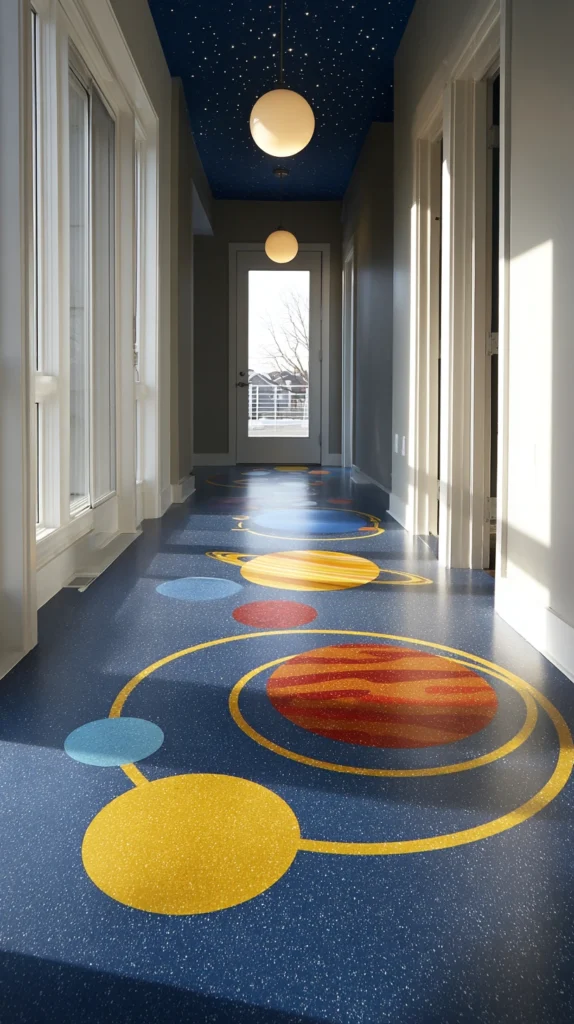
Floor decals or painted markers representing the solar system’s planets in order, arranged as a hopscotch-style path for guests to follow and learn planet order while playing.
Why this combines movement, play, and a genuine educational element
A planet-order hopscotch path gets guests physically moving, which balances the party’s quieter craft stations, while reinforcing actual solar system knowledge in a playful, low-pressure format.
Setup
- Removable floor decals or painted poster-board circles, arranged in the correct planetary order from the sun outward
- Positioned along a hallway or open floor area with enough length for the full sequence
Cost breakdown
- Floor decals or poster board materials: $15–30
- Total: $15–30
15. The Complete Space Birthday Party
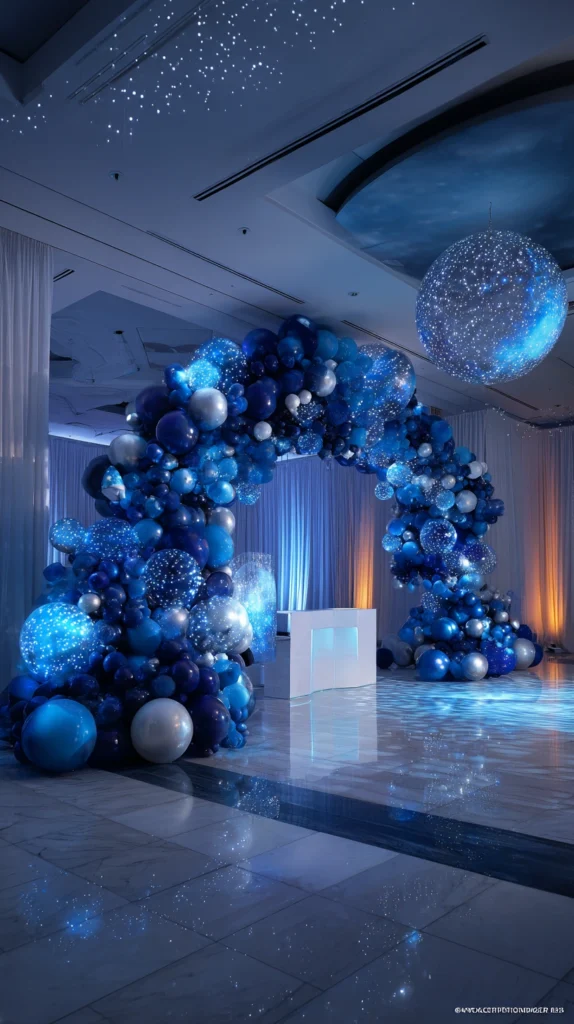
A party designed with every principle above applied together — the definitive version of a space celebration that reads as a genuine mission rather than a room with a few rocket decorations.
What separates the complete party from a nicely decorated room
A party with a beautiful balloon arch but full bright lighting throughout, no hands-on activities, and no shared mission moment still reads as a themed room rather than an immersive celebration. The complete version builds in darkness and glow, active participation, and a genuine narrative arc from launch to landing, so guests experience the theme rather than just observing it.
The elements of the complete party
The atmosphere:
- A galaxy balloon arch at the entrance (Idea #1)
- A glow-in-the-dark star ceiling reveal (Idea #2)
- UV blacklight elements for a dedicated glow segment (Idea #8)
- Hanging planet mobiles (Idea #4)
The photo and play areas:
- A rocket ship photo backdrop (Idea #3)
- A star-shaped balloon garland at a secondary location (Idea #9)
- Planet hopscotch floor decals (Idea #14)
The activity stations:
- An astronaut helmet craft paired with a space suit dress-up station (Idea #5 and #12)
- Constellation cookie decorating (Idea #6)
- Galaxy slime or a sensory bin (Idea #13)
- A telescope viewing station for quieter play (Idea #11)
The food and favors:
- A countdown launch cake moment (Idea #10)
- Moon rock treat bag favors (Idea #7)
The party as it unfolds:
Guests arrive through the galaxy balloon arch and immediately begin decorating their astronaut helmets, pulling on their silver jackets before moving to decorate constellation cookies. As the party reaches its centre point, the lights go down, revealing the glow-in-the-dark ceiling above and the blacklight elements around the room, and everyone counts down together for the cake’s “liftoff” moment. Guests leave with their finished helmets and a bag of moon rocks, having spent the whole party as active participants in the mission rather than simply admiring the decorations around them.
Cost breakdown for the complete party
Assuming a party of 8 guests:
- Balloon arch: $75–145
- Glow ceiling stars: $15–25
- Rocket backdrop: $40–80
- Planet mobiles: $25–45
- Helmet craft: $40–72
- Cookie decorating: $24–48
- Moon rock favors: $16–32
- Blacklight elements: $30–60
- Star garland: $30–55
- Cake styling: $15–30
- Telescope station: $20–40
- Space suit jackets: $48–96
- Slime activity: $24–48
- Floor decals: $15–30
Total: $417–806
Phased by priority if budget is limited:
Highest priority ($150–300):
- Balloon arch
- Helmet craft station
- Glow ceiling stars
Mid priority ($100–200):
- Rocket backdrop
- Cookie decorating
- Cake styling and moon rock favors
If budget allows ($150–300):
- Blacklight elements
- Space suit jackets
- Additional stations (telescope, slime, floor decals)
The complete space birthday party: not a decorated room, but a full mission guests actively take part in from launch through landing.
The Question Before Any Space Party Project
Before buying anything:
What’s the age range of the guest list, and how much can realistically be darkened for the glow elements?
If the answer is: a younger age range (4–6) — prioritise the sensory and craft stations over more complex activities like constellation tracing, and keep the blacklight segment brief and well-supervised.
If the answer is: an older age range (7–10) — the constellation cookies, telescope station, and planet hopscotch offer more educational engagement this age group tends to enjoy.
If the answer is: the venue can’t be meaningfully darkened — lean more heavily on the balloon arch, backdrop, and craft stations, since the glow-based elements depend on genuine darkness to deliver their full effect.
If the answer is: budget is the primary constraint — the balloon arch and helmet craft station together deliver strong visual impact and guest engagement for a relatively modest combined cost.
The party design follows the actual guest age range and venue constraints, not the most elaborate version available. A party matched well to its specific guests will read as more successful than an ambitious setup that doesn’t quite suit the group attending it.
Getting Started This Weekend
The immediate space party planning step:
Confirm whether the venue can be darkened for the glow segment, and plan the timing around it.
Determines how central the glow-in-the-dark and blacklight elements can realistically be to the party’s structure.
Order or gather helmet craft supplies, since this station benefits from advance preparation.
The party’s most central activity, worth confirming well ahead of the celebration date.
Plan the countdown launch cake moment and coordinate it with the rest of the party’s schedule.
Gives the celebration a clear narrative high point to build the rest of the timing around.
Choose 3–4 activity stations suited to the actual guest age range, rather than attempting every idea on this list.
Prevents overcommitting to more stations than the party’s actual timeframe and guest count can comfortably use.
The rest of the party: the elaboration of ongoing planning toward the celebration itself.
The countdown: the beginning. The space birthday party: what a themed room becomes once every guest is an active astronaut on a shared mission, not just a visitor to a decorated space.