13 Red Rose Wedding Decor Ideas for Passionate Romance
Red roses carry more built-in romantic association than almost any other single wedding flower, which is exactly what makes them both an easy choice and a slightly risky one.
Used without much further thought, they can read as a default, expected choice rather than a considered design decision. Used deliberately — varied in shade, paired with the right candlelight and materials — the same flower becomes the backbone of a genuinely dramatic, passionate wedding design rather than a generic romantic cliché.
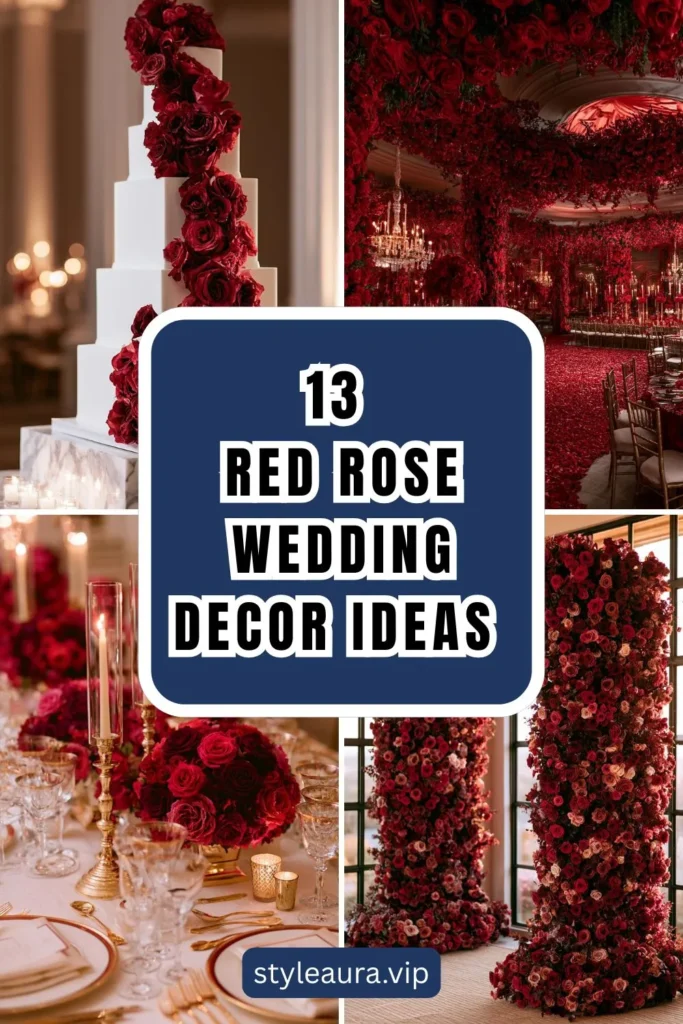
The weddings that get a red rose theme right tend to treat the flower the way any strong design element should be treated: with variation in shade and form, paired with materials (candlelight, dark linens, rich metallics) that reinforce rather than compete with its intensity, and applied with enough restraint in some areas to let the boldest moments — an arch, a full aisle, a wall installation — actually stand out.
Here are 13 ways to build a red rose wedding design with genuine romantic drama, from a single centerpiece choice to a fully realized ceremony and reception concept.
Why Some Red Rose Weddings Read Generic Instead of Romantic
The single-shade problem:
Without variation in shade and form:
- Every rose the exact same bright red, in the exact same tight bud form, throughout every arrangement
- The result: reads as a default, catalog-standard choice rather than a considered design decision
With variation:
- A mix of deep burgundy, classic red, and garden rose forms alongside more structured varieties
- The result: the same overall colour family reads richer and more intentional, rather than flat and uniform
The under-lit problem:
- Red roses displayed under bright, even venue lighting, which flattens their natural depth and richness
- The result: the flowers read as simply red rather than genuinely rich and romantic
The over-styled problem:
- Red roses combined with an excessive number of additional colours, textures, and embellishments
- The result: the flower’s own inherent romantic weight gets diluted by too many competing design elements
The Five Passionate Red Rose Principles
Before choosing any individual idea below, these five principles keep a red rose design reading genuinely romantic rather than generic:
Variation in shade within the red family:
- Deep burgundy, classic red, and a garnet or wine tone, layered together
- Prevents the flat, single-note look that a uniform colour application creates
Candlelight as the primary lighting companion:
- Warm, low, flickering light brings out red’s natural depth in a way bright venue lighting can’t
- One of the most reliable ways to make the same flowers read considerably more dramatic
Restraint in surrounding colour and detail:
- Black, cream, deep green, or gold as the supporting palette, rather than introducing several additional bright colours
- Lets the red roses carry the design’s emotional weight without competition
A mix of rose forms, not just one:
- Tight rosebuds, full-bloom garden roses, and spray roses together
- Textural variety within the same flower type adds richness the way varied fabric textures do in a room
At least one dramatic, full-commitment moment:
- A full floral arch, an aisle entirely lined in petals, or a floor-to-ceiling wall
- A single significant gesture reads more memorable than the same total flower volume spread thinly and evenly throughout the whole event
1. Layered Red Rose Centerpiece Clusters
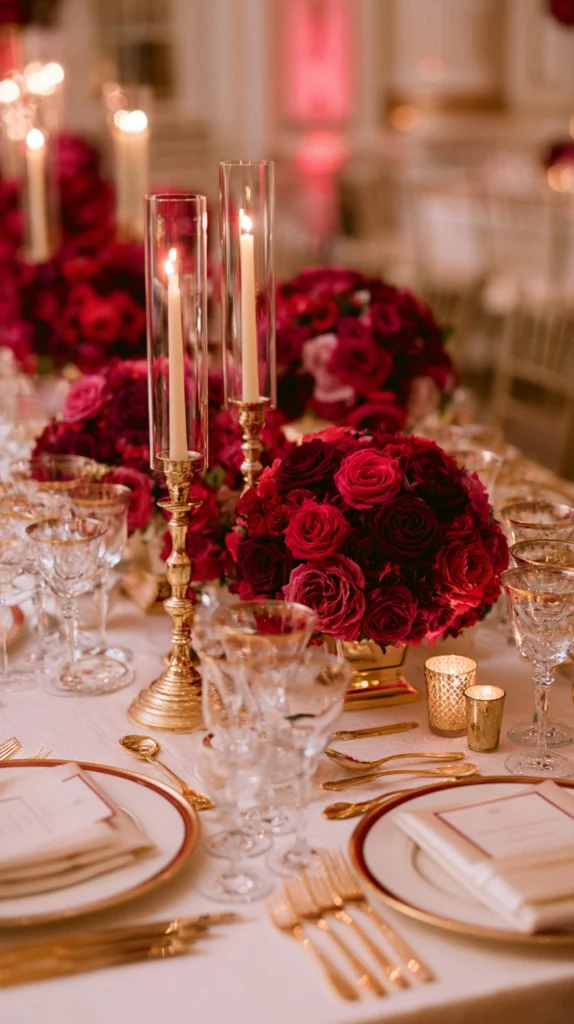
Reception table centerpieces built from clustered red roses in varied shades and forms, arranged low and dense rather than a single tall, sparse arrangement.
Why layering shade and form matters most at the centerpiece level
Centerpieces are viewed at close range for the entire duration of a meal, making shade and form variation particularly noticeable and impactful here compared to arrangements viewed only briefly, such as a ceremony backdrop.
Assembly and height
- Kept under 14 inches at the centre for a seated dinner, preserving sightlines across the table
- A mix of deep burgundy garden roses, classic red spray roses, and a few tight rosebuds, clustered densely rather than arranged with visible gaps
Cost breakdown
- Rose centerpiece (per table, florist-arranged): $60–140
- Total (per table): $60–140
2. A Red Rose Petal Aisle Runner
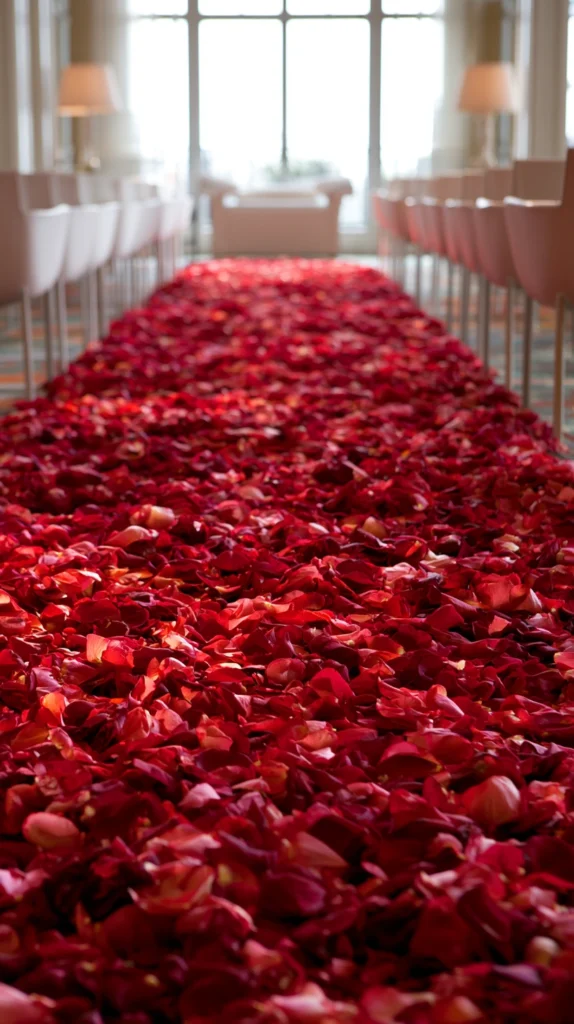
Fresh red rose petals scattered densely along the full length of the ceremony aisle, providing one of the most immediately dramatic and photograph-ready design elements available.
Why a full petal aisle delivers outsized impact for its relative simplicity
Unlike an arrangement requiring careful floral design, a petal aisle relies purely on volume and colour saturation, delivering a strong, immediate visual statement with comparatively straightforward execution, most commonly assembled by scattering petals shortly before the ceremony begins.
Execution notes
- Petals scattered in a dense, even layer rather than a thin scattering, since sparse coverage reads underwhelming rather than dramatic
- Coordinate timing with the venue, since petals are typically scattered in the final window before guests are seated, to avoid excessive foot traffic disturbing the layout beforehand
Cost breakdown
- Loose red rose petals (sufficient for a full aisle): $150–350, depending on aisle length
- Total: $150–350
3. A Red Rose Ceremony Arch
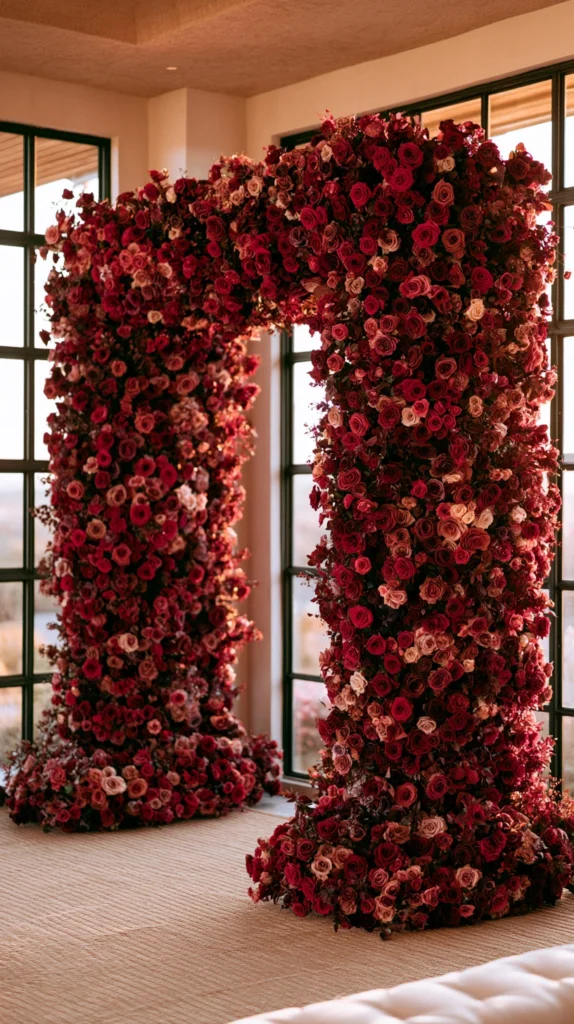
A floral arch or arbor, densely covered in red roses, serving as the ceremony’s primary focal backdrop and one of the most photographed elements of the entire event.
Why the arch is the natural location for the single most dramatic floral gesture
Positioned directly behind the couple during the ceremony itself, the arch is viewed by every guest for the ceremony’s full duration and features prominently in the majority of ceremony photographs, making it the highest-value single location for the most significant floral investment.
Design and construction
- A structural arch base (metal or wood), covered densely enough that the underlying structure is barely visible
- A mix of rose shades and forms, following the same variation principle as the centerpieces, to avoid a flat, single-toned appearance across such a large surface
Cost breakdown
- Fully covered floral arch (florist-designed and installed): $800–2,000
- Total: $800–2,000
4. Candlelit Reception Tables
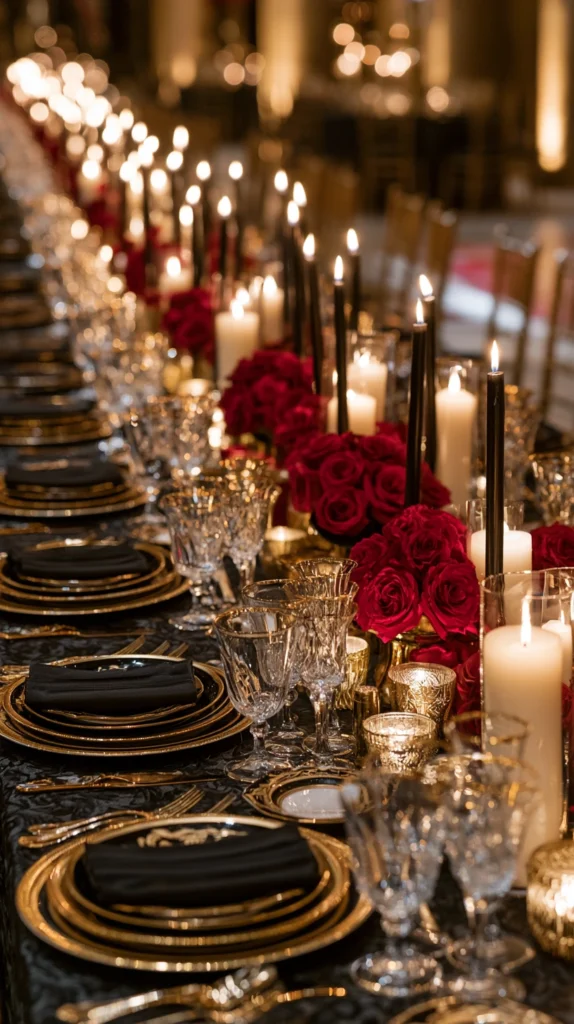
Reception tables lit primarily by taper and pillar candles clustered among the rose centerpieces, rather than relying on venue overhead lighting alone.
Why candlelight specifically brings out red roses’ full depth
Warm, low candlelight reveals the depth and richness in red’s darker shades — burgundy, wine, garnet — in a way bright, even overhead lighting flattens out. This single lighting choice does more to elevate the perceived richness of the same flowers than almost any additional floral element would.
Assembly
- A mix of taper candles at varying heights, clustered directly among the rose centerpieces rather than positioned separately
- Dripless tapers or enclosed hurricane holders, particularly important for a reception expected to run several hours
Cost breakdown
- Taper and pillar candles (per table): $20–40
- Total (per table): $20–40
5. Varied Bridal Bouquet Styles
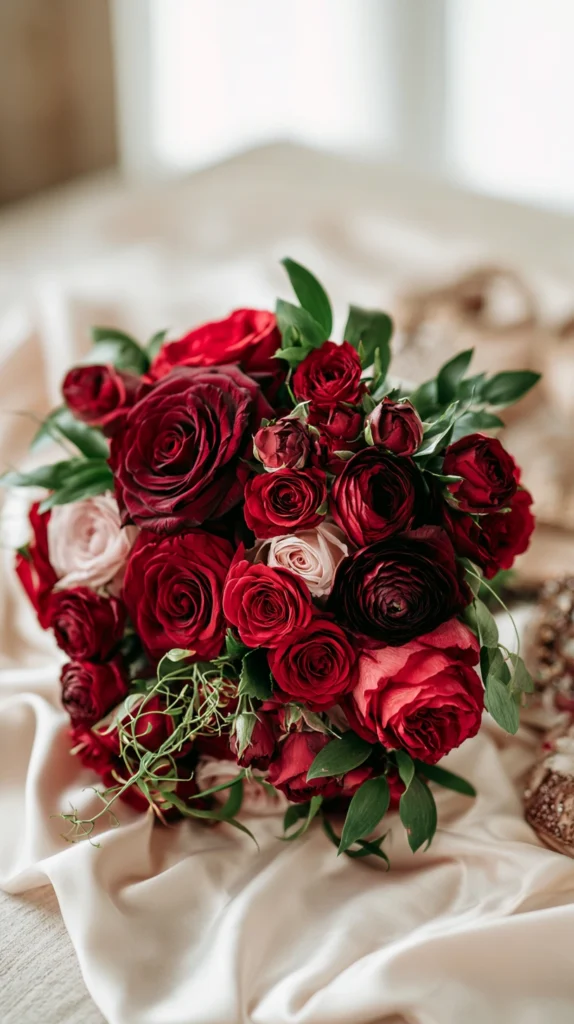
The bridal bouquet built with the same shade and form variation principle as the centerpieces — a mix of deep burgundy and classic red roses, in both tight bud and full-bloom garden forms.
Why the bouquet deserves the same variation attention as the larger arrangements
As one of the most photographed individual elements of the entire event, the bridal bouquet benefits significantly from the same richness and depth that shade and form variation provides elsewhere, rather than a single flat, uniform red that can look comparatively plain in close-up photography.
Style options
- A tightly clustered, rounded bouquet for a classically romantic silhouette
- A loose, cascading style incorporating trailing greenery alongside the varied roses, for a more dramatic, textural effect
Cost breakdown
- Bridal bouquet (florist-designed, varied roses): $150–320
- Total: $150–320
6. A Red Rose Wall or Photo Backdrop
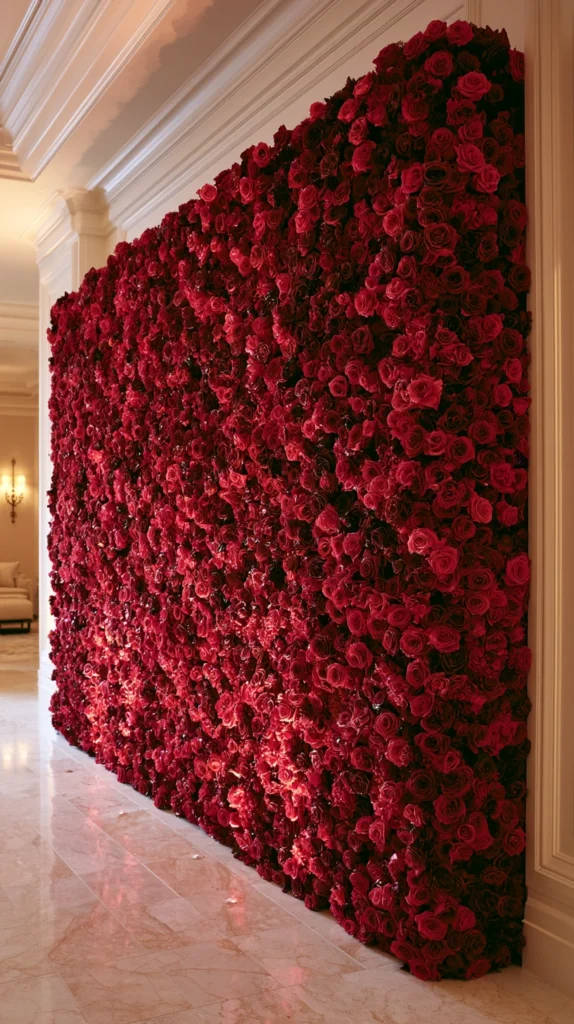
A full wall or large panel densely covered in red roses, used as a photo backdrop, reception focal point, or ceremony alternative to a traditional arch.
Why a full wall installation delivers a different kind of impact than an arch
Where an arch frames the ceremony itself, a full rose wall provides a dedicated, static photo location throughout the reception, giving guests a clear, dramatic backdrop for photos independent of the ceremony’s specific timing and location.
Construction and sizing
- Built on a rigid frame, with roses (often a mix of fresh and preserved, given the typical event duration) attached in a dense, gap-free pattern
- Sized to a standard photo backdrop scale, typically 8×8 to 10×10 feet, depending on the venue’s available space
Cost breakdown
- Full rose wall installation (florist-designed): $1,200–2,800
- Total: $1,200–2,800
7. A Rose and Candle Ceremony Backdrop
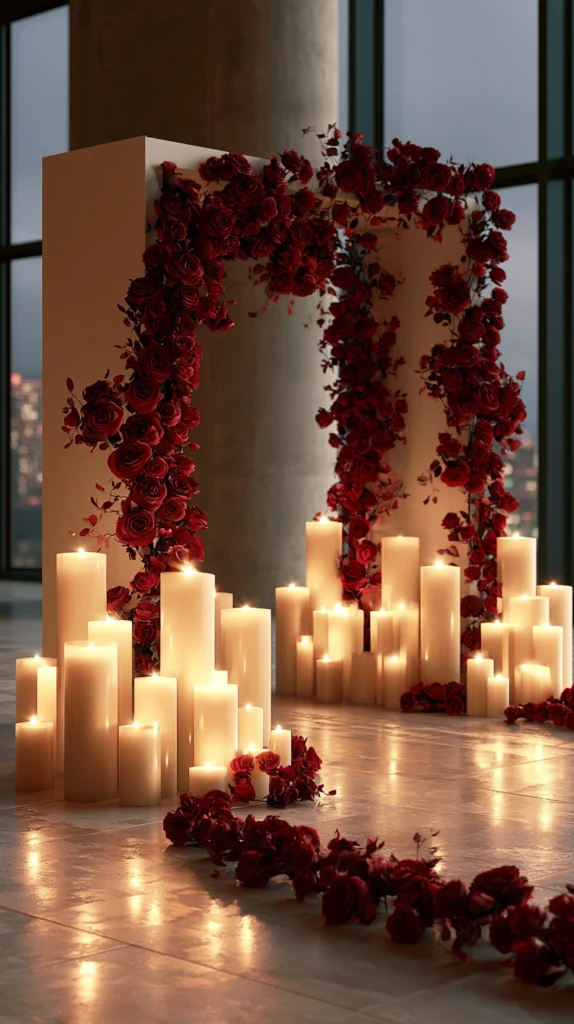
An alternative to a full floral arch: a simpler ceremony backdrop combining a smaller rose installation with clusters of pillar candles at varying heights, providing drama through the combination rather than floral volume alone.
Why this combination suits a lower floral budget without sacrificing drama
Not every wedding budget supports a fully covered floral arch. Combining a smaller, more contained rose arrangement with a substantial candle display delivers a comparable sense of romantic drama, relying on candlelight to do some of the visual work that additional flowers would otherwise need to provide.
Assembly
- A smaller floral installation (a garland along a simpler frame, rather than full coverage) paired with 15–20 pillar candles at varying heights flanking the ceremony space
- Positioned to catch the candlelight directly, reinforcing red’s depth the same way it does at the reception tables
Cost breakdown
- Smaller floral installation and candle cluster: $400–900
- Total: $400–900
8. Red Rose Boutonnieres and Corsages
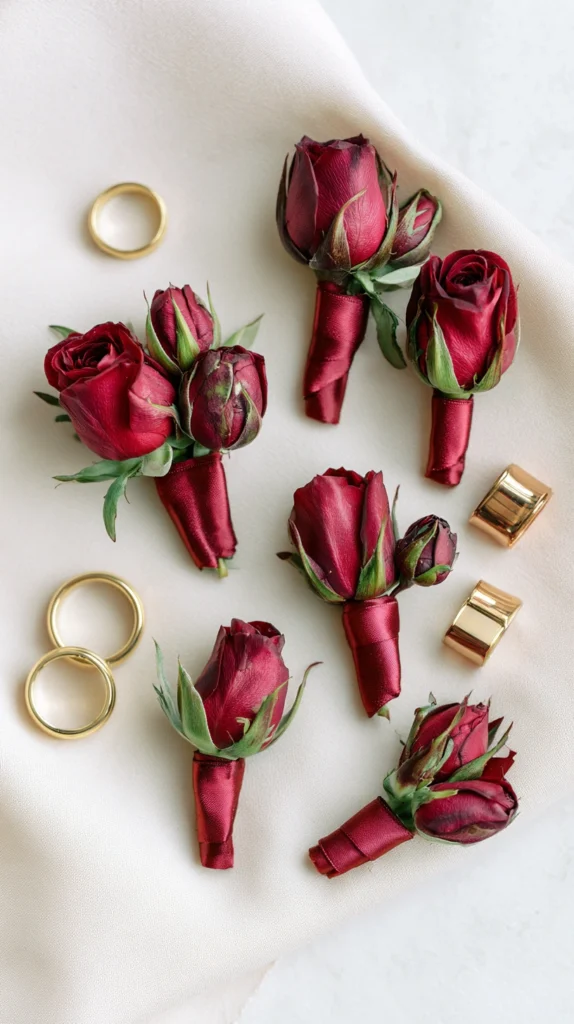
Boutonnieres and corsages built from small red rosebuds, coordinated in shade with the larger arrangements, extending the design to the wedding party and immediate family.
Why these smaller details matter for overall design consistency
Boutonnieres and corsages are worn throughout the entire event and appear in nearly every formal photograph, making their shade and style consistency with the larger floral design more noticeable than their small individual size might suggest.
Selection
- Small spray rosebuds, in a shade coordinated with the bridal bouquet and centerpieces, rather than a mismatched or generic filler flower
- A simple, clean wrap or pin style, letting the rose itself remain the visual focus
Cost breakdown
- Boutonnieres and corsages (per piece): $12–25
- Total (varies by wedding party size): $60–250
9. A Red Rose-Adorned Cake
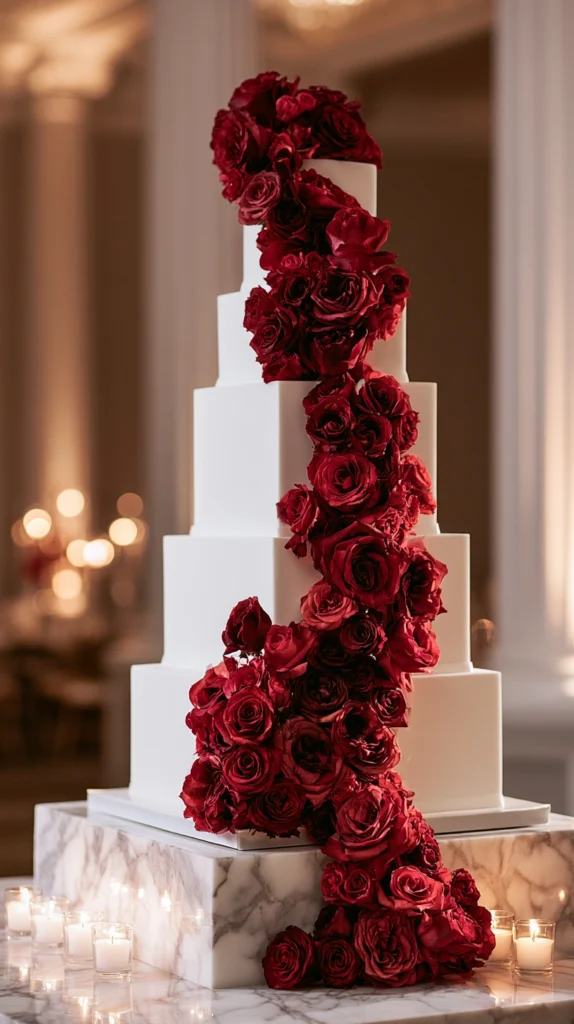
The wedding cake decorated with fresh or sugar-crafted red roses, extending the floral design to one of the reception’s most photographed individual elements.
Why the cake benefits from the same floral coordination as the rest of the event
The cake typically receives its own dedicated photography moment and is often displayed prominently throughout the reception, making it a natural extension of the overall floral design rather than a separately styled element disconnected from everything else.
Styling
- Fresh roses (food-safe, with stems wrapped and inserted rather than placed directly in the cake) cascading down one side, or a full ring around the base
- Sugar-crafted roses as a longer-lasting alternative, particularly for a cake displayed for an extended period before cutting
Cost breakdown
- Cake floral styling (fresh or sugar roses, added to base cake cost): $80–200
- Total: $80–200
10. Red Rose Petal Confetti
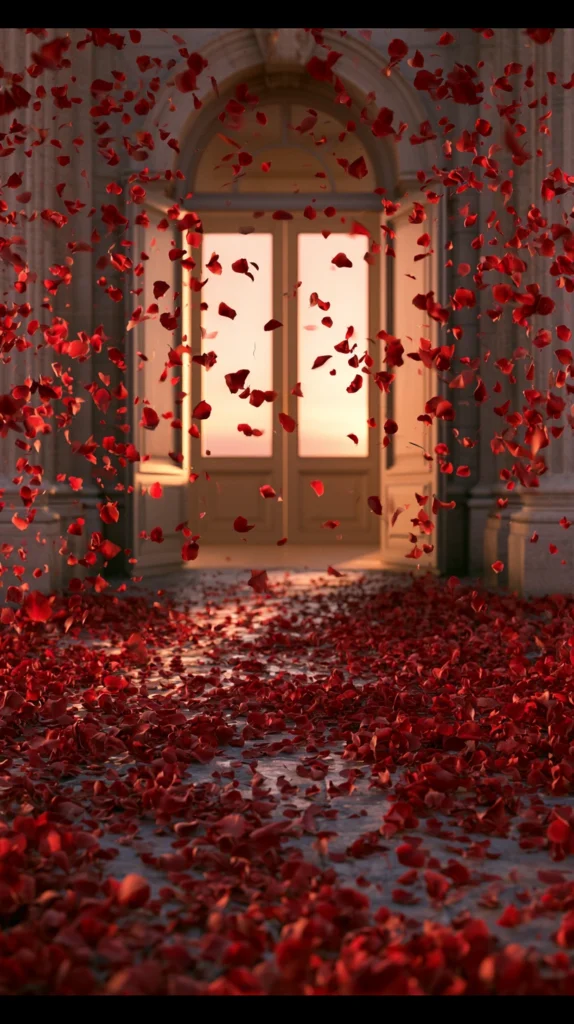
Dried or fresh red rose petals used as send-off confetti, tossed as the couple exits the ceremony or reception, providing a dramatic, photogenic final moment.
Why petal confetti photographs more dramatically than traditional alternatives
Rose petals, particularly in a rich red, create a striking visual effect when tossed and photographed in motion, offering a more elevated and coordinated alternative to generic paper confetti or rice, while tying directly back into the same floral material used throughout the rest of the event.
Preparation and use
- Dried petals hold their shape and colour well and are easier to distribute to guests in advance than fresh petals
- Distributed in small cones or bags at the ceremony’s conclusion, timed for the couple’s exit
Cost breakdown
- Dried rose petals for confetti (bulk): $60–120
- Total: $60–120
11. A Suspended Rose Installation
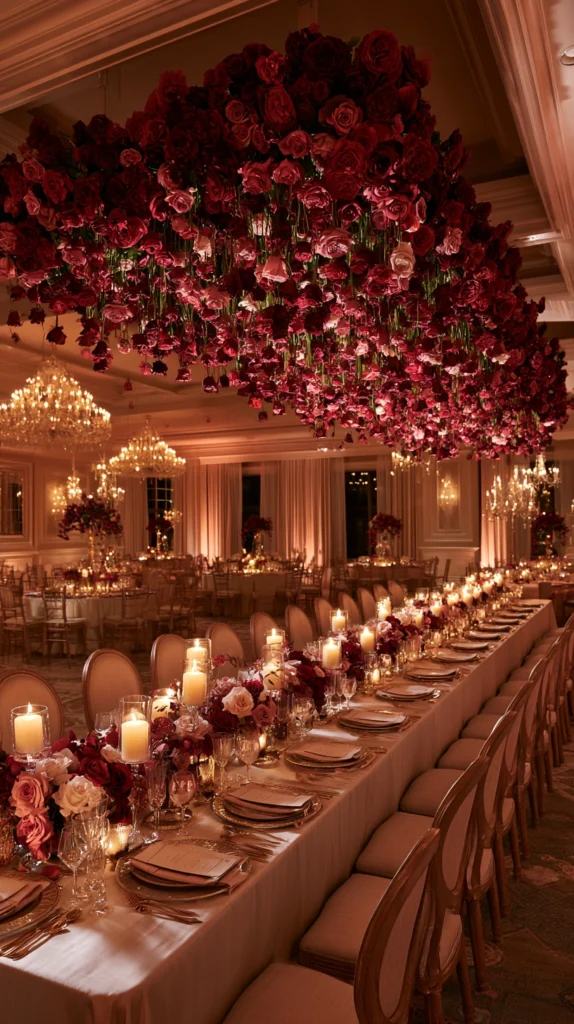
Roses suspended from the ceiling in a cluster or a flowing installation above the reception’s main table or dance floor, providing drama at a scale and vantage point none of the table-level arrangements achieve.
Why an overhead installation adds a dimension the table-level florals can’t
Suspended installations are viewed from below throughout the entire reception, providing a constant, ambient design presence that centerpieces — viewed primarily at the specific table they’re placed on — don’t achieve on the same scale.
Design and installation
- Roses attached to a suspended frame or wire structure, typically requiring the venue’s ceiling or rigging capacity to support the installation’s weight
- Positioned above the head table or dance floor, where it remains visible throughout the reception’s main events
Cost breakdown
- Suspended rose installation (florist-designed and installed, size-dependent): $1,000–2,500
- Total: $1,000–2,500
12. Dried Red Rose Wedding Favors
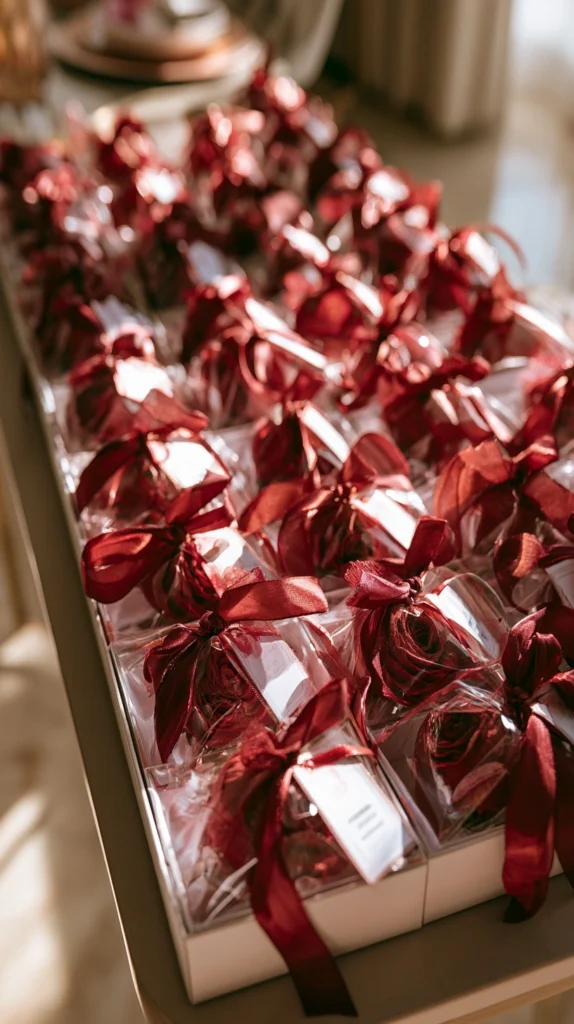
Small bundles or single stems of dried red roses, given to guests as a wedding favor, extending the floral theme into a keepsake guests take home.
Why dried roses make a more lasting favor than many alternatives
Unlike a consumable favor, a dried rose can be kept as a genuine keepsake, extending the wedding’s floral design and its romantic association well beyond the event itself, at a relatively low individual cost.
Preparation and presentation
- Roses from the actual event’s arrangements, professionally dried and preserved after the wedding, or pre-dried roses purchased specifically for this purpose
- Tied with a ribbon coordinating with the wedding’s overall colour palette, presented at each place setting or a dedicated favor table
Cost breakdown
- Dried rose favors (per guest): $3–8
- Total (varies by guest count): $150–800
13. The Complete Passionate Red Rose Wedding
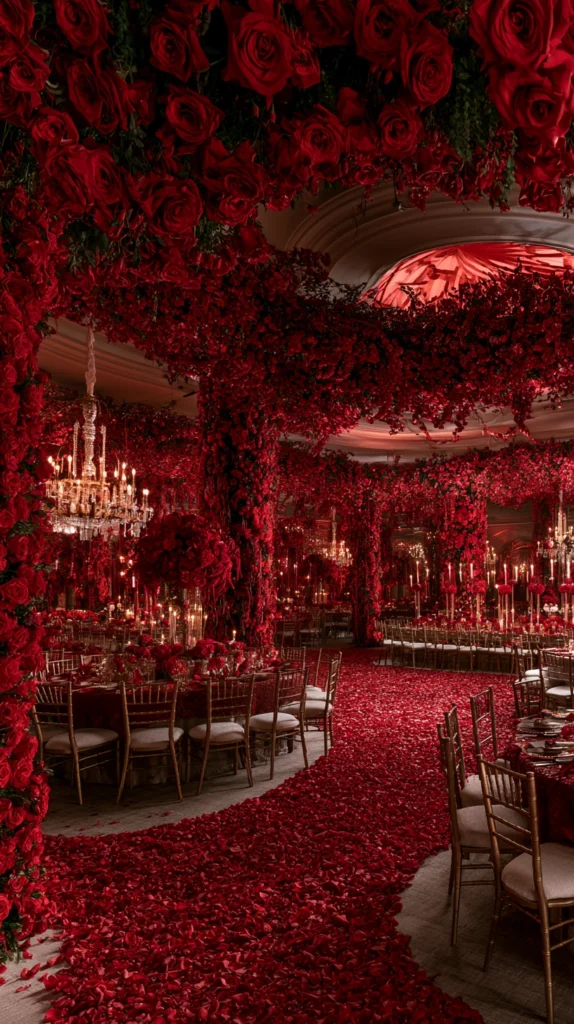
A wedding designed with every principle above applied together — the definitive version of a red rose theme that reads as genuinely dramatic and romantic rather than a generic default floral choice.
What separates the complete design from red roses used throughout without variation
A wedding with red roses at every table, in the bouquet, and on the cake, but all in the exact same shade and form, still risks reading flat despite the significant floral investment. The complete version builds in shade and form variation, candlelight, and at least one full-commitment dramatic moment, so the design reads as considered rather than simply “a lot of red roses.”
The elements of the complete design
The ceremony:
- A fully covered red rose arch (Idea #3)
- A dense rose petal aisle (Idea #2)
- Coordinated boutonnieres and corsages (Idea #8)
The reception:
- Layered, varied-shade centerpieces (Idea #1)
- Candlelit tables (Idea #4)
- A suspended rose installation above the head table or dance floor (Idea #11)
- A rose-adorned cake (Idea #9)
The bridal details:
- A varied bridal bouquet (Idea #5)
The photo and send-off moments:
- A red rose wall backdrop (Idea #6)
- Rose petal confetti at the send-off (Idea #10)
The lasting keepsake:
- Dried rose favors for guests (Idea #12)
The wedding on the day itself:
Guests walk a full petal aisle toward an arch entirely covered in varied red and burgundy roses, lit warmly by the venue’s natural light and later by candlelight at the tables. The suspended installation above the dance floor and the rose wall for photos both extend the same design well beyond the ceremony itself, while the varied shades throughout — never a single flat red — keep the whole design reading rich and considered rather than repetitive. Guests leave with a dried rose favor, a small keepsake of a day built around one flower used with genuine intention.
Cost breakdown for the complete design
Assuming a mid-sized wedding with 100–150 guests:
- Ceremony arch: $800–2,000
- Aisle petals: $150–350
- Boutonnieres and corsages: $60–250
- Centerpieces (10–15 tables): $600–2,100
- Candles (10–15 tables): $200–600
- Suspended installation: $1,000–2,500
- Cake styling: $80–200
- Bridal bouquet: $150–320
- Photo wall: $1,200–2,800
- Confetti: $60–120
- Favors: $300–800
Total: $4,600–12,040
Phased by priority if budget is limited:
Highest priority ($1,600–3,500):
- Ceremony arch
- Bridal bouquet
- Centerpieces
Mid priority ($1,000–2,500):
- Candles
- Boutonnieres and corsages
- Cake styling
If budget allows ($2,000–6,000):
- Suspended installation
- Photo wall
- Favors and confetti
The complete passionate red rose wedding: not a single flower used everywhere identically, but a full design built on shade variation, candlelight, and at least one genuinely dramatic, fully committed floral moment.
The Question Before Any Red Rose Wedding Design
Before booking a florist:
Where will guests spend the most time actually looking closely at the flowers?
If the answer is: the ceremony, briefly — invest most heavily in the arch and aisle, since these are viewed intensely but for a limited window of time.
If the answer is: the reception, for hours — prioritise the centerpieces and candlelight, since these are viewed continuously throughout the meal and matter more for the evening’s overall lasting impression.
If the answer is: photography is the top priority — the rose wall and a varied bridal bouquet will deliver the most valuable and lasting return, since these images get revisited long after the event itself.
If the answer is: budget is the primary constraint — the rose and candle ceremony backdrop, combined with well-varied centerpieces, delivers much of this theme’s romantic impact without requiring the most expensive single elements like a full arch or suspended installation.
The design follows where guests will actually spend the most attention, not the most dramatic single floral element available. A well-varied, candlelit reception table setting, viewed for hours, often delivers more lasting guest impression than a spectacular but briefly-viewed ceremony element.
Getting Started This Weekend
The immediate red rose wedding planning step:
Request sample arrangements from potential florists showing shade and form variation, not a single uniform red.
Confirms the florist understands and can execute the depth this theme depends on before any contract is signed.
Decide on the one “full commitment” dramatic moment the budget will prioritize.
An arch, a wall, or a suspended installation — choosing one clear priority avoids spreading the floral budget too thin across every element.
Plan the reception’s lighting around candles, confirming the venue allows them.
Essential for bringing out red’s full depth; many venues have specific candle policies worth confirming early in planning.
Coordinate boutonniere, corsage, and bouquet shades with the centerpiece plan.
Ensures consistency across every element guests will see in photographs throughout the day.
The rest of the design: the elaboration of ongoing planning with the chosen florist.
The rose: the beginning. The passionate red rose wedding: what one flower becomes once it’s given the shade variation, lighting, and dramatic commitment that turn a default choice into a genuine design statement.