15 Pacific Northwest Bathroom Ideas That Bring the Forest Indoors
In the Pacific Northwest the forest is never far away.
It pushes up to the edges of cities. It lines the highway. It grows through the cracks of abandoned lots and climbs the hillsides behind houses. Douglas firs so tall you have to tilt your head back to find the sky above them. Western red cedars with bark the colour of cinnamon. Sword ferns covering every shaded slope in dense, prehistoric green.

This landscape is what Pacific Northwest residents live inside and alongside every day. And it is, almost universally, the thing they love most about where they have chosen to live.
The Pacific Northwest bathroom idea that works is the one that brings some of that landscape inside. Not in a literal, decorative sense of hanging fern prints and calling it forest-inspired. But in the material sense. The sensory sense. The sense that the bathroom you step into at six in the morning feels like it belongs to the same world as the treeline outside your window.
These 15 ideas build that bathroom.
Why the Pacific Northwest Bathroom Is Its Own Distinct Aesthetic
Every region produces its own interior aesthetic eventually.
The conditions of place filter down through the materials available, the light quality, the climate, and the instinctive desires of the people who inhabit it into something identifiable and coherent.
The Pacific Northwest bathroom aesthetic has evolved from specific conditions. The grey, diffuse light that makes the region feel like it is always slightly in the early morning. The deep greens of the year-round wet forest. The dark volcanic rock and pale river stone of the landscape. The cedar and Douglas fir that have been building materials here for centuries. The pervasive moisture that makes every surface eventually softer and more organic.
A bathroom designed for these conditions uses them rather than fighting them. Dark, enveloping colour that looks magnificent in grey light rather than needing bright sun to activate it. Natural stone and wood that handle moisture beautifully rather than deteriorating from it. Plants that thrive in the ambient humidity of a bathroom rather than drying out and looking sad.
The Pacific Northwest bathroom is not trying to look like the forest. It is trying to feel like it.
1. Western Red Cedar Panelling on the Walls or Ceiling
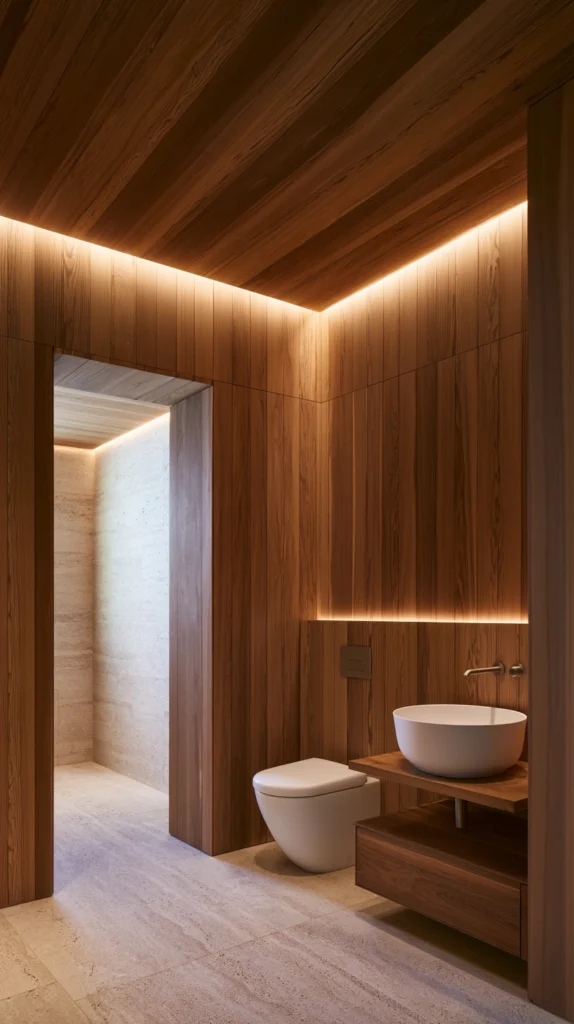
No material in the Pacific Northwest bathroom works harder or delivers more than Western red cedar.
The colour of the wood alone is extraordinary. A warm, reddish-brown that deepens with age and treatment. The grain pattern is straight and fine, broken by occasional knots that add character rather than distraction. The texture is smooth but not uniformly so. The wood has a physical presence that no painted or tiled surface can replicate.
Cedar is also exceptionally well-suited to bathroom environments. Its natural oils make it resistant to moisture, mould, and the temperature fluctuations that destroy less stable wood species. Scandinavian sauna culture has used cedar for exactly this reason for centuries. The Pacific Northwest has the same climate justification.
Tongue-and-groove cedar panelling on the ceiling of a bathroom is the most atmospheric and least expected application. The warmth of cedar overhead in a bathroom where everything else tends to be cool, tile, stone, plaster, creates an enclosing warmth that makes the room feel genuinely like a sanctuary.
On the walls, cedar panelling either full-height or as a lower half dado treatment adds organic warmth without any other design element needing to do significant work. The wood carries the room.
Finish with a clear penetrating oil rather than varnish or paint. The oiled surface keeps the wood’s natural colour and character while protecting it from moisture. Varnish creates a plastic film that both looks wrong and prevents the wood from breathing naturally.
Why cedar is the defining Pacific Northwest bathroom material:
- Naturally moisture and mould resistant without any chemical treatment
- The warm reddish-brown colour looks magnificent in grey Pacific Northwest light
- The scent of cedar, subtle but genuine, adds a sensory dimension no other material provides
- Ages beautifully, darkening and deepening in colour over years of use
- Connects the bathroom directly to the forests of the region in the most authentic possible way
- Works equally on walls and ceilings in full-height or dado applications
2. Dark Forest Green Walls With Natural Stone
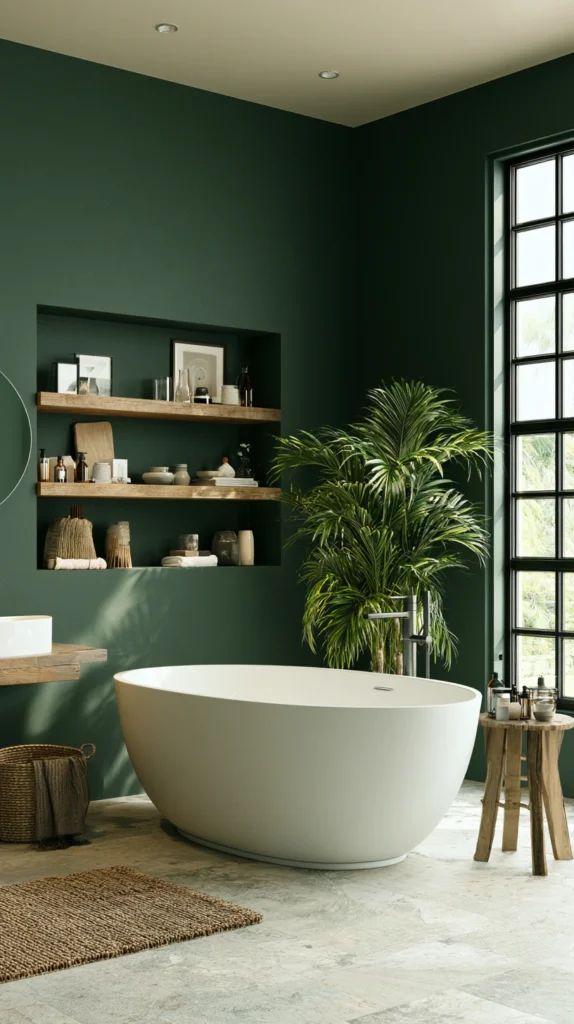
Deep forest green is the colour of the Pacific Northwest interior more naturally than any other.
It is the colour of the sword ferns on the forest floor. Of the moss on basalt boulders beside forest streams. Of the lichen on the bark of old growth Douglas firs. It is the colour that the landscape produces abundantly, in every shade from pale sage to near-black, across every surface that is not the grey sky above.
In a bathroom, dark forest green walls in a matte finish create the immediate sense of being enclosed by the forest. Not claustrophobically. The way the forest itself encloses you when you are in it. The sense of being held by something large and green and quietly alive.
Against forest green walls, natural stone in pale grey, cream, or warm tan creates exactly the right contrast. The organic variation in the stone surface, the slight colour differences across its face, the visible mineral structure, reads against the green the way exposed rock faces read against the forest around them.
A floor of pale grey river stone tile or large format limestone beside forest green walls is a bathroom that could exist at a luxury lodge in the Cascades. The combination is not designed to look like the forest. It feels like it.
3. A Rainfall Shower That Mimics the Pacific Northwest Sky
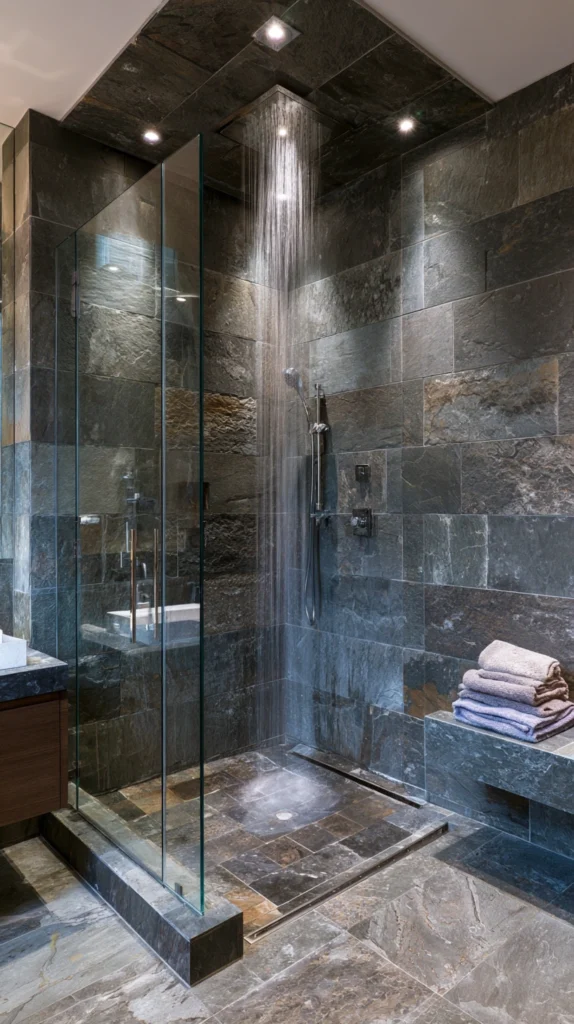
The Pacific Northwest relationship with rain is different from the relationship most people have with rain in drier climates.
Rain here is not occasional, not dramatic, not something to shelter from in shock until it passes. It is the constant background condition of life from October through May. It is what the landscape is shaped by and what the people who live in it have come to accept, even to appreciate, in the way that people accept and appreciate the defining characteristics of where they have chosen to be.
A rainfall shower head in a Pacific Northwest bathroom is not merely a luxury fitting. It is a deliberate reference to the thing that makes this region what it is. The wide, soft, continuous fall of water from above rather than the pressurised jet of a standard shower head. The experience of standing in the shower under a rainfall head with the eyes closed is as close as you can get to the specific pleasure of standing in the soft rain of an October morning in the Cascades.
Install a large format rainfall head, thirty centimetres square or larger, recessed into the ceiling rather than mounted on an arm. The ceiling-recessed head falls water straight down rather than at a slight angle. The experience is genuinely immersive rather than merely generous.
Surround the shower with dark tile or natural stone that darkens dramatically when wet, the way basalt darkens when the rain hits it, and the entire shower experience becomes a small and deliberate echo of the landscape outside.
4. River Rock Flooring in the Shower
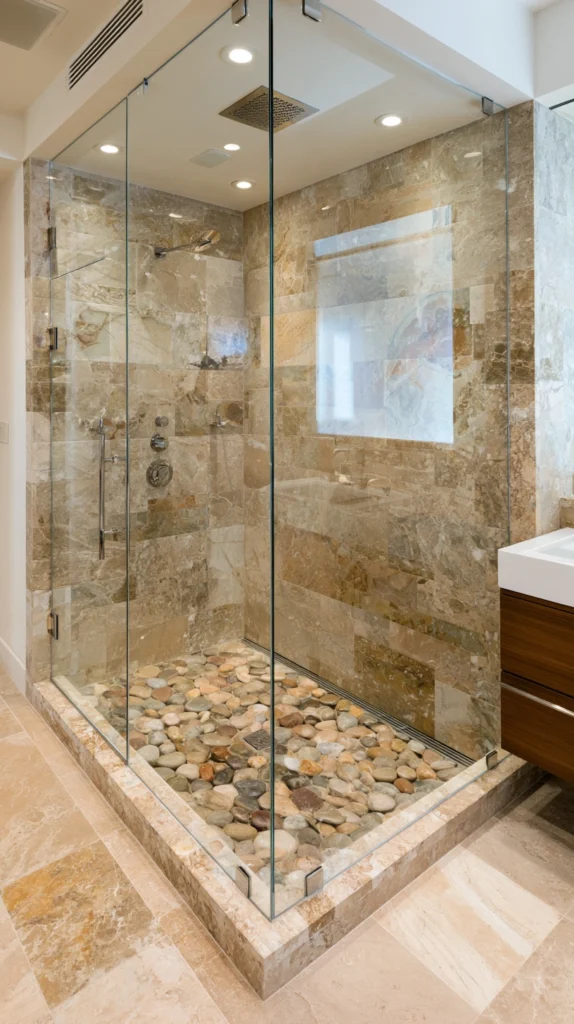
The Pacific Northwest landscape is full of river rock.
The rivers that come off the Cascades carry it down from the mountains and deposit it in beds of smooth, worn, naturally rounded stones of grey, cream, brown, and the occasional terracotta orange that comes from iron in the rock.
River rock tile in a shower floor brings that specific texture and material quality into the bathroom in the most direct way possible.
The texture of river rock underfoot in a shower is genuinely pleasurable in a way that smooth tile is not. The irregular surface provides natural massage as you shift weight across it. The slightly raised surface of each stone creates drainage channels between them that keep the floor clean and prevent the standing water that flat tile accumulates.
Visually, river rock tile creates a shower floor that looks like a section of streambed transplanted into the bathroom. The irregularity of the individual stone shapes, the variation in colour across the surface, the way each stone catches light slightly differently, creates visual complexity that no uniform tile can match.
This combination of genuine tactile pleasure, functional drainage, and visual complexity makes river rock one of the most rewarding floor choices in any shower designed for the Pacific Northwest aesthetic.
5. A Freestanding Soaking Tub in Natural Stone or Wood
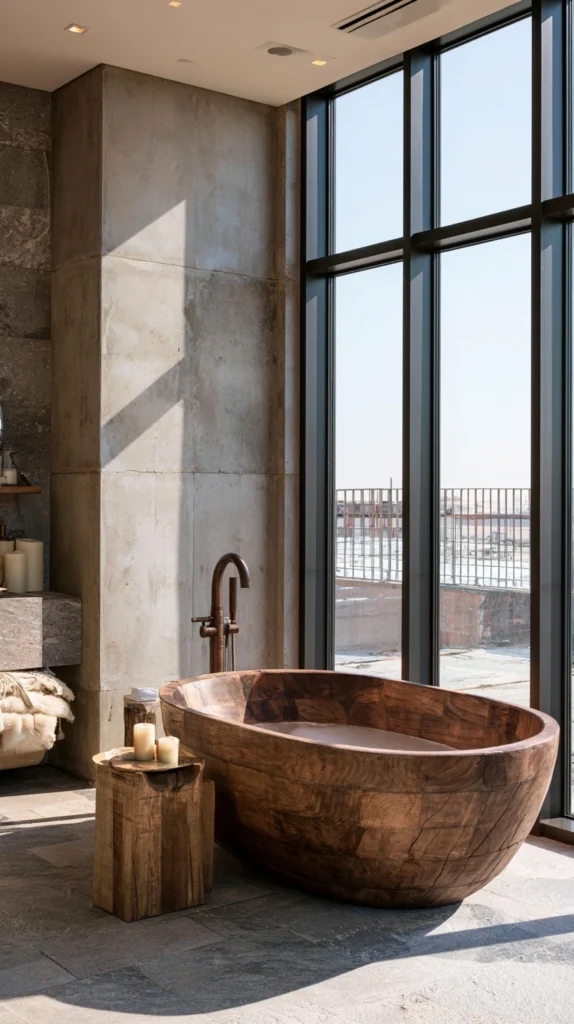
The soaking tub is the Pacific Northwest bathroom element that most directly references the outdoor bathing culture of Japan that has deeply influenced the region’s aesthetic.
The Japanese furo, a deep soaking tub designed for immersion rather than for washing, was brought to the Pacific Northwest by Japanese immigrants whose influence on the region’s culture, architecture, and food extends far beyond what is immediately apparent. The deep soak in hot water as a ritual of daily relaxation rather than functional cleansing is now woven into Pacific Northwest domestic culture in a way that it is not in most of the rest of North America.
A freestanding tub in natural stone, hand-carved from a single block of travertine, basalt, or granite, is the most visually spectacular expression of this soaking bath culture. The weight and permanence of natural stone communicates that this is not a bathroom accessory but a serious piece of architecture.
A freestanding wood tub in cedarwood, teak, or hinoki cypress in the Japanese tradition is the most directly connected to the cultural roots of the soaking bath. Hinoki cypress is the wood traditionally used for Japanese soaking tubs. Its natural oils make it water-resistant and it produces a subtle, extraordinarily beautiful scent when wet that is unlike any other wood.
Position the soaking tub where it has a view. Of a garden. Of trees. Of the sky. The soaking bath should connect the person in it to the world outside rather than presenting another wall to stare at.
6. Slate or Basalt Tile That References the Volcanic Landscape
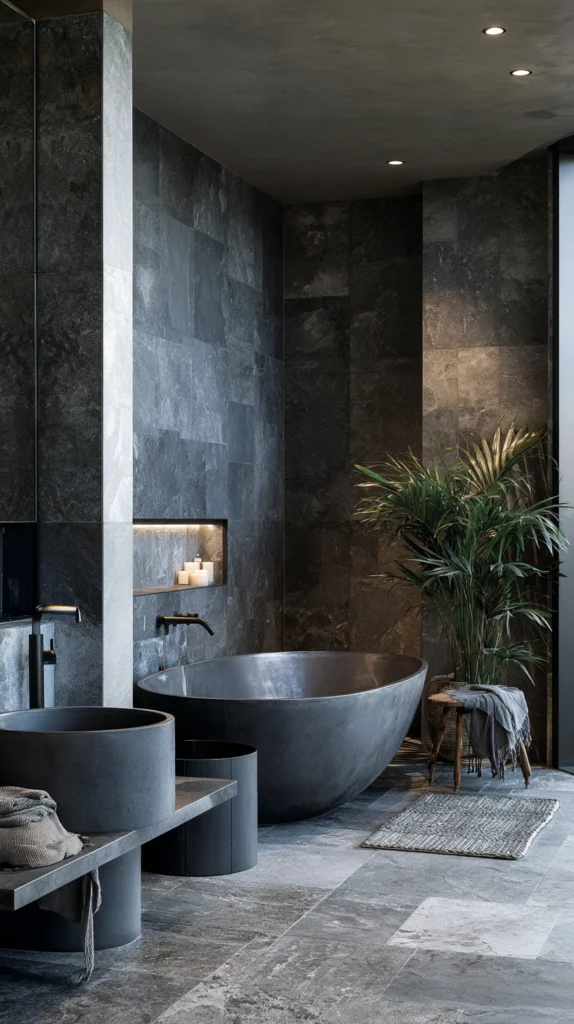
The Pacific Northwest sits on the Ring of Fire.
Volcanic activity shaped the entire landscape. The Cascades are a volcanic mountain range. Mount Rainier, Mount St Helens, Mount Hood, all of them active or recently active volcanoes whose eruptions have deposited the dark basalt and andesite that characterises the rock faces of the region.
Slate and basalt tile in a Pacific Northwest bathroom references this geological reality directly.
Dark slate in charcoal, deep grey, and near-black installed as floor tile or wall tile creates a surface that reads as fundamentally connected to the landscape. The split, slightly rough surface of slate has an honest, geological quality. The colour variation across its face, no two slates are exactly the same, creates visual complexity that manufactured tile cannot provide.
Basalt tiles, honed to a smooth surface from the same dark volcanic rock that forms the river gorges and coastal headlands of the region, add an even more direct connection to the specific geology of the Pacific Northwest. Wet basalt tile darkens dramatically and develops the glossy sheen of a river rock in a fast-moving stream.
The combination of dark volcanic stone tile with cedar wood accents, forest green paint, and abundant living plants creates the most fully realised Pacific Northwest bathroom possible.
7. An Abundant Indoor Plant Display
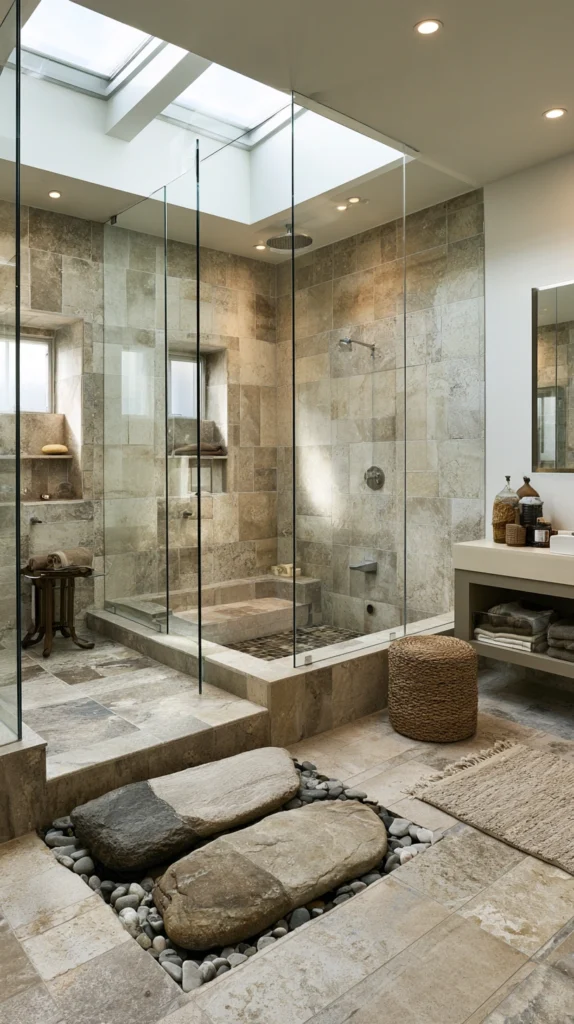
The Pacific Northwest indoor plant aesthetic is specific and earned.
It is not the carefully curated single specimen plant on a clean white windowsill. It is the bathroom that has become a greenhouse by accident and on purpose simultaneously. Plants crowding toward the light from every available surface. Ferns that have outgrown their pots. Trailing pothos that have escaped their shelf. Monstera leaves so large they frame the mirror.
This abundance is what the Pacific Northwest landscape demands of its indoor replication. The natural world outside is not sparse. It is overwhelming in its density and productivity. Every surface in a Pacific Northwest forest is covered in something living. The bathroom that brings the forest indoors should carry some of that same quality of botanical excess.
Choose plants that genuinely thrive in bathroom conditions. High humidity from the shower and bath, indirect light from a window that may be partially frosted, warmth. These conditions suit ferns of every species extraordinarily well. Boston ferns, bird’s nest ferns, maidenhair ferns, and sword ferns all develop their most beautiful fronds in bathroom humidity that would crisp them in a drier room.
Pothos trails beautifully from high shelves in bathroom light and humidity. Philodendrons develop their most generous leaf size in moist air. Orchids, particularly Phalaenopsis, flower more prolifically in a bathroom’s ambient humidity than in the drier air of any other room.
A hanging macramé planter in natural cotton or jute cord holding a fern over the soaking tub. A wooden shelf beside the shower holding a progression of plant sizes from a small succulent to a large fern. Plants at every height from the floor to the ceiling.
The bathroom garden is the Pacific Northwest bathroom at its most fully realised.
8. Unlacquered Brass Fixtures That Age Like the Forest
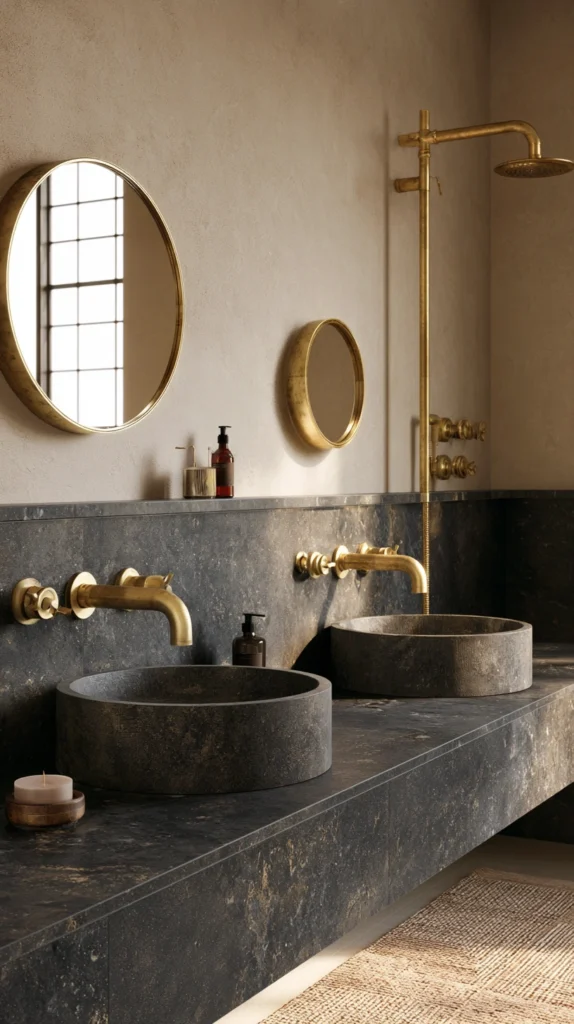
Unlacquered brass develops a living patina.
In the first months it is warm, polished gold. Over the first year it darkens and deepens. In the second and third year it develops the complex, varied tone of aged metal. By the fifth year it has become something genuinely beautiful, a dark, warm, almost organic surface that no factory finish could intentionally produce.
This aging quality makes unlacquered brass the most natural choice for a Pacific Northwest bathroom that values materials that get better rather than worse with time and use.
The forest teaches this lesson constantly. The cedar bark that deepens from bright orange-brown to almost black over decades. The stone that becomes smoother and more beautiful as water moves over it for centuries. The moss that fills and softens every surface it inhabits over years of slow growth.
Unlacquered brass fixtures, taps, shower controls, towel rails, mirror frames, and cabinet hardware all developing their patina at slightly different rates and in slightly different ways creates a bathroom where the fittings look genuinely lived-with rather than installed.
Pair unlacquered brass with dark stone, cedar wood, and deep green walls and the warm, aging metal sits in the combination like a piece of forest gold.
9. A Window or Skylight That Frames the Trees
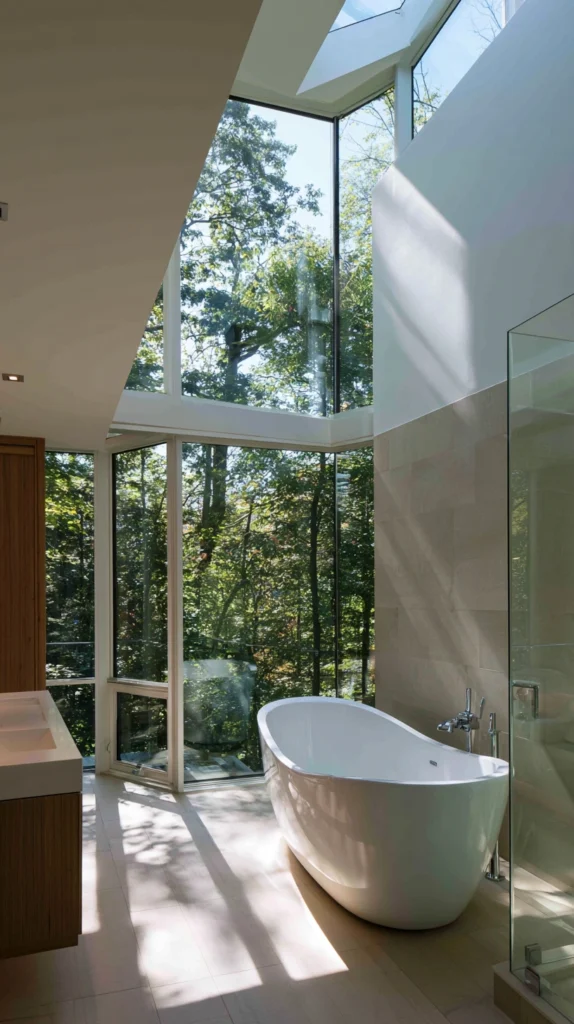
A Pacific Northwest bathroom with a view of actual trees is a Pacific Northwest bathroom that needs very little else to succeed.
The view does the work. The dark branches against the grey sky. The rain moving through the Douglas fir canopy. The light changing from green-filtered morning to blue-grey afternoon to the warm amber of a rare clear evening. The view changes hour by hour and season by season and is always more interesting than any designed surface.
Design the bathroom to maximise and frame that view rather than treating the window as a secondary consideration.
A window in the shower is the most immersive application. Standing in a hot shower looking directly at rain-soaked trees dissolves the boundary between interior and exterior in the most complete possible way. Privacy is managed through positioning, frosted lower panels, or screening planting rather than by blocking the view.
A skylight above the soaking tub turns the ceiling into a view of the sky above the treeline. The trees visible at the edges of the skylight frame. The rain audible on the glazing above. Lying in the soaking tub looking directly at the sky through the glass while rain falls on it is one of the genuinely extraordinary bathroom experiences available.
If neither is possible, a bathroom mirror positioned to reflect an external window and its tree view creates a secondary view that multiplies the visual connection to the outside.
10. A Steam Shower That Turns the Bathroom Into a Forest Sauna
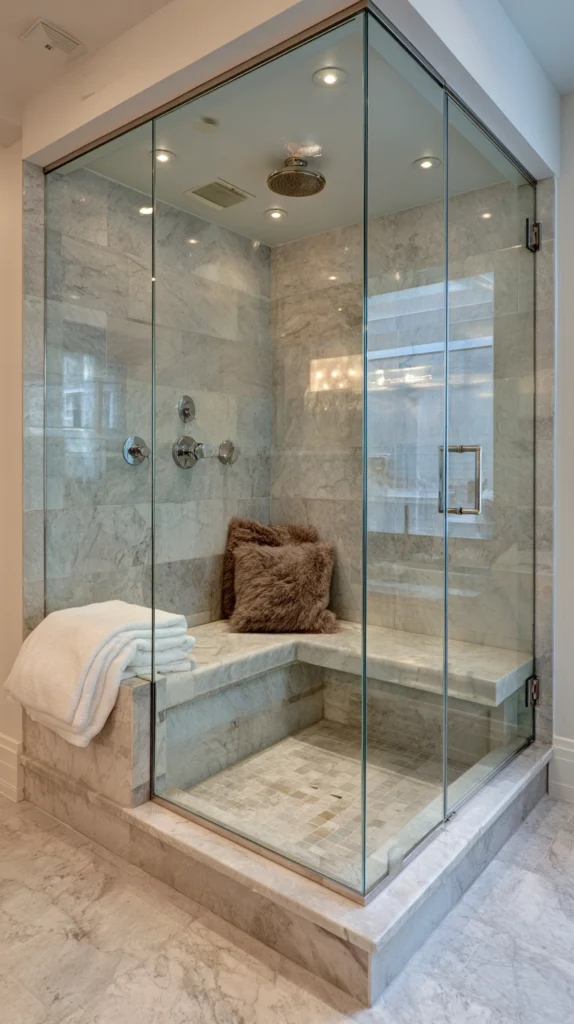
The Pacific Northwest sauna culture is real and growing.
The combination of Finnish sauna tradition, Japanese onsen culture, and the indigenous sweat lodge practices of the region’s First Nations people has produced a Pacific Northwest relationship with steam and heat bathing that goes beyond the bathroom shower as a daily functional exercise.
A steam shower unit in a Pacific Northwest bathroom creates a space that references this cultural depth while adding a daily luxury that changes the experience of the bathroom from functional to genuinely restorative.
The steam shower must be fully enclosed with a waterproof tile or stone interior that handles the sustained moisture of steam generation. Cedar is the most appropriate material for the ceiling and any wooden elements within the steam shower, precisely because its natural oils make it the traditional material for sauna construction.
Forest green or dark volcanic stone tile on the steam shower walls. Cedar ceiling and bench if space allows. A built-in steam generator. The shower head set to rainfall. The result is a small daily ritual of the kind that the best Pacific Northwest bathrooms make possible.
11. Wabi-Sabi Elements and Imperfect Natural Materials
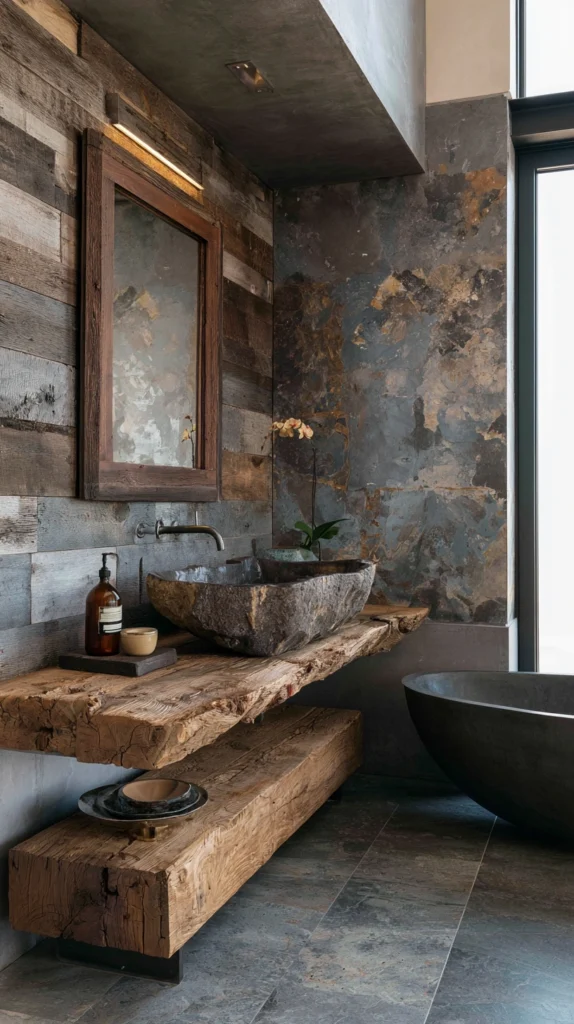
The Japanese concept of wabi-sabi, finding beauty in imperfection, impermanence, and the natural aging of materials, is deeply aligned with the Pacific Northwest aesthetic.
Both sensibilities reject the idea that the ideal surface is perfectly smooth, perfectly uniform, and permanently unchanging. Both find more interest and more beauty in the variation that natural materials inevitably contain and in the changes that time and use inevitably produce.
Wabi-sabi bathroom elements in a Pacific Northwest context look like this.
A handmade ceramic basin with slight asymmetry in its form and a glaze that pools more deeply in some places than others. Zellige tile with the irregularity and surface variation of the handmade Moroccan original rather than the machine-perfect uniformity of its factory reproduction.
A concrete floor that has been allowed to develop its micro-variations of tone and surface rather than being sealed to an artificial uniformity. Reclaimed timber that carries the marks of its previous use as evidence of history rather than defect.
These wabi-sabi elements make a Pacific Northwest bathroom feel genuinely aged and genuinely considered simultaneously. They look like they belong in a building that has been here for decades rather than one that was finished yesterday.
12. Organic and Sculptural Lighting
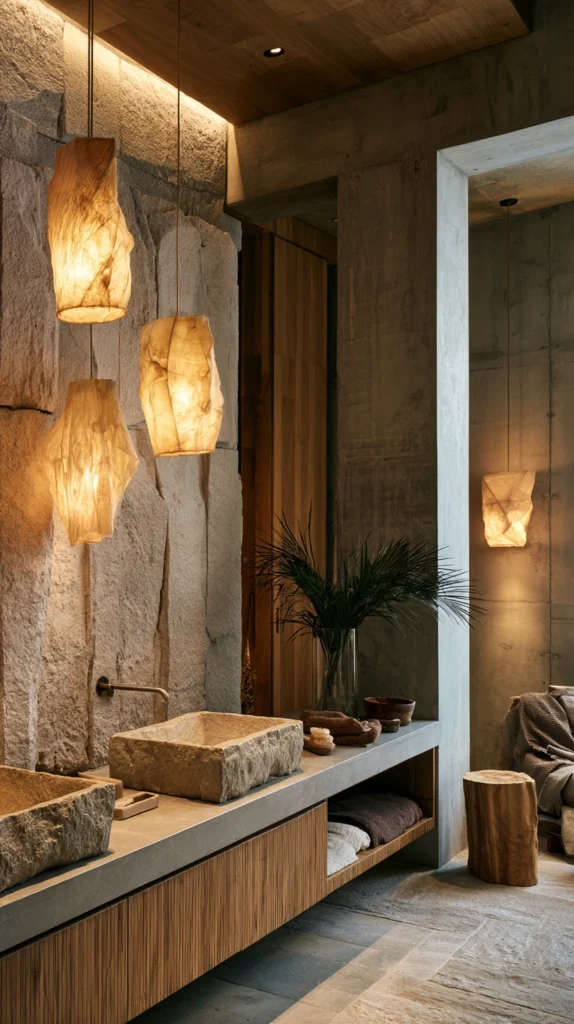
Lighting in a Pacific Northwest bathroom should feel like it grew there rather than like it was installed.
Industrial pendant lights in blackened steel. Woven rattan or bamboo shades that diffuse light through natural fibre and cast warm shadows on surrounding surfaces. Ceramic pendant shades in earthy, organic glazes. Sculptural wall sconces that look more like objects found in the forest than manufactured fixtures.
The light quality these fittings produce matters as much as their visual character. Warm-toned bulbs rated at 2700K maximum. The warm amber glow that is the indoor equivalent of afternoon sun filtered through Douglas fir canopy.
A cluster of pendant lights at varying heights above a freestanding tub. A single ceramic pendant over the vanity. Wall sconces on either side of a mirror that cast warm pools of light rather than flat illumination across the face. The lighting plan for a Pacific Northwest bathroom should produce a space that is never harshly lit and always warm.
The contrast between the darkness of the forest and the warmth of the light within the shelter it provides is the essential Pacific Northwest interior light quality. Dark surfaces everywhere with warm, considered light sources that make those dark surfaces glow rather than disappear.
13. A Reclaimed Wood Vanity With Live Edge Detail
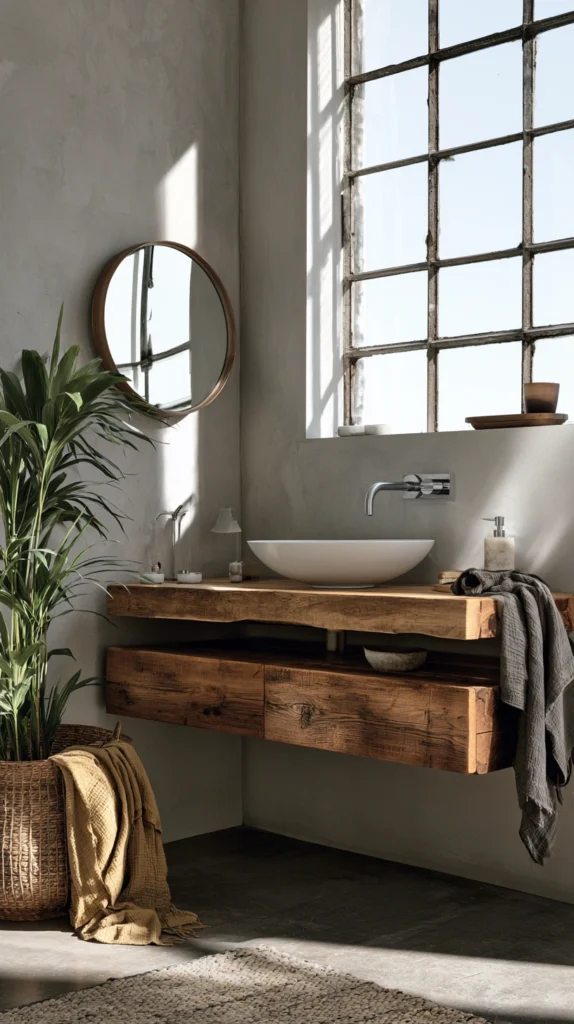
The bathroom vanity is the piece of furniture that most defines the visual character of the room.
In a Pacific Northwest bathroom the vanity should be made from wood that looks like it came from the forest that surrounds the region. Not smooth, painted MDF. Not factory-finished flat-pack. Solid timber with visible grain, with the memory of the tree it came from still present in its form.
A reclaimed timber vanity, a plank of old growth Douglas fir or walnut recovered from a demolished building, finished with a penetrating oil and fitted with a vessel basin on its surface, is one of the most beautiful single elements in any Pacific Northwest bathroom.
A live-edge vanity, where the natural edge of the tree is preserved on the outer face of the timber, brings the most direct connection to the living material of the forest. The irregular, organic line of the live edge against the geometric precision of the basin and the surrounding tile creates a tension that is entirely typical of Pacific Northwest design sensibility. The natural and the designed in productive coexistence.
Support the vanity on simple steel or unlacquered brass hairpin legs or wall-mount it as a floating surface. The floating vanity with a live-edge top, visible wall behind the clean line of the underside, is perhaps the single most iconic Pacific Northwest bathroom furniture piece.
14. A Moss Wall or Living Green Installation
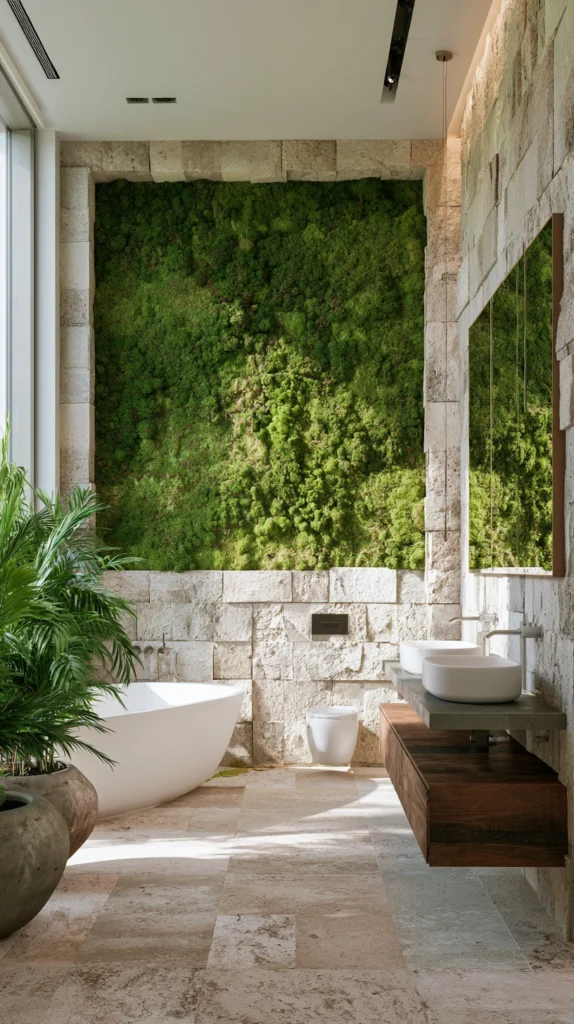
The moss wall is the Pacific Northwest bathroom element that makes the most direct possible statement about what the room is trying to achieve.
A preserved or living moss installation on one bathroom wall turns a surface from a display area into a living landscape. The moss itself is the dominant surface material. Its texture, its varying tones of green, and its slightly irregular, three-dimensional surface create a wall that has never been produced in a factory and could not be.
Preserved moss walls, using moss that has been preserved with glycerine so it maintains its colour and texture without requiring water or light, are the practical choice for most bathroom applications. They do not require maintenance beyond occasional misting to maintain their texture.
Living moss walls require consistent moisture, indirect light, and periodic attention. A bathroom with high ambient humidity from daily shower and bath use is actually well-suited to maintaining a living moss wall if the light conditions are adequate.
Frame the moss wall simply. Dark timber battens divide the surface into panels. A simple border of the same dark stone used elsewhere in the bathroom. The framing gives the moss installation architectural structure without imposing human order on what is fundamentally an organic, natural surface.
15. The Sound of Water as a Design Element
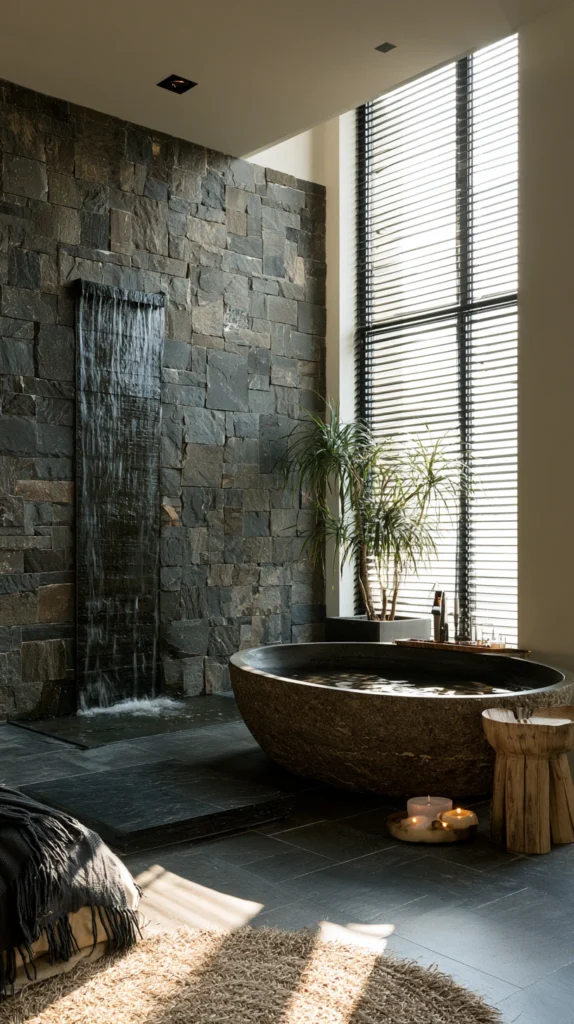
The Pacific Northwest is never far from the sound of water.
The rain on the roof. The creek at the bottom of the trail. The river is audible from the campsite. The specific sound of the Puget Sound lapping at its shores. Water is the sonic landscape of this region as much as the visual one.
A bathroom that incorporates the sound of water as a deliberate design element extends the Pacific Northwest sensory experience into the one sense that most bathroom design ignores entirely.
A small recirculating water feature mounted on the wall beside the soaking tub. Not a decorative fountain with artificial rock formations. A simple, minimal water wall of dark stone with water flowing in a thin sheet across its surface. The sound of water over stone at low volume. The specific, calming frequency of falling water.
This sound does several things simultaneously. It provides genuine acoustic privacy because voices do not carry over the soft, persistent sound of moving water. It creates a masking sound that makes the bathroom feel more private and separate from the rest of the house. And it provides the specific sonic quality of the Pacific Northwest landscape, the sound of water moving over and through rock, transposed into the domestic interior.
The water feature is the element that makes a Pacific Northwest bathroom fully sensory. Not just something you see. Something you hear. Something that places you in relationship with the landscape outside even when you are indoors.
How to Build a Pacific Northwest Bathroom From Scratch or By Renovation
The Pacific Northwest bathroom can be built at any scale of investment.
At the smallest scale, the addition of plants, a cedar shelf, and dark paint changes the character of an existing bathroom toward the aesthetic without any structural work.
At a medium scale, retiling in dark slate or basalt, replacing fixtures with unlacquered brass, and adding cedar panelling to one wall creates a bathroom that is genuinely in the Pacific Northwest tradition.
At the full scale, a custom build with a cedar ceiling, soaking tub, steam shower, river rock floor, living moss wall, and recirculating water feature is the full expression of the aesthetic.
Start with the palette. Dark green, dark stone, warm wood, and unlacquered brass are the four elements that establish the Pacific Northwest bathroom identity before any other decision is made. These four can be introduced in small amounts in any existing bathroom and the character begins to shift immediately.
Then add plants. More than feels comfortable. The abundance is the point.
Let the materials age. The patina on the brass. The weathering of the cedar. The softening of the stone. The Pacific Northwest bathroom that has been lived in for five years is more beautiful than the one that was just installed.
Common Mistakes in Pacific Northwest Bathroom Design
Using painted wood instead of oiled or stained. Paint seals wood and eventually peels in a bathroom environment regardless of how carefully it is applied. Natural oil or clear penetrating finish maintains the wood’s appearance and moisture resistance indefinitely.
Choosing plants that cannot handle bathroom conditions. Cactus and succulents prefer dry conditions that bathrooms do not provide. Choose ferns, pothos, philodendrons, and humidity-loving species that genuinely thrive rather than slowly decline.
Over-polishing and over-sealing natural materials. Slate sealed to a high gloss loses the quality that makes it worth using. Stone sealed too heavily cannot breathe and develops the wrong surface character. Finish natural materials minimally and let them age naturally.
Using cool white lighting. Cool white light in a dark Pacific Northwest bathroom makes every surface look cold and institutional. Every bulb in this bathroom should be warm, 2700K maximum, and every fixture should be dimmable.
Neglecting ventilation. A bathroom with cedar walls, moss installations, and abundant plants requires excellent ventilation to remain healthy. Without proper extraction the moisture that feeds the plants and keeps the moss green also feeds mould in the wall cavities. Install the best extractor fan available and use it consistently.
Making it too dark without adequate light sources. Dark walls and dark materials require more light sources than a pale bathroom to feel comfortable rather than oppressive. Layer multiple warm light sources throughout the room before committing to any dark material palette.
Quick Summary
- Western red cedar panelling on walls or ceiling brings the defining Pacific Northwest material directly into the bathroom
- Deep forest green walls in matte finish enclose the bathroom in the colour most dominant in the regional landscape
- A large format rainfall shower head recessed into the ceiling creates the immersive experience of the Pacific Northwest rain
- River rock tile in the shower floor references the specific stone material of the region’s streams and rivers directly
- A freestanding soaking tub in natural stone or cedarwood connects to the Japanese soaking bath culture woven into regional domestic life
- Slate or basalt tile connects the bathroom to the volcanic geology that defines the Pacific Northwest landscape
- Abundant plants at every height in humidity-loving species creates the botanical density of the forest rather than a curated display
- Unlacquered brass fixtures that age and develop patina over years reference the forest’s lesson that things get better with time
- A window or skylight framing actual trees dissolves the boundary between the bathroom and the landscape more effectively than any decoration
- A steam shower with cedar and dark stone creates a daily sauna ritual connected to the region’s deep steam bathing culture
- Wabi-sabi elements including handmade ceramics, zellige tile, and reclaimed timber find beauty in natural imperfection
- Organic sculptural lighting in blackened steel, rattan, or ceramic with warm 2700K bulbs creates forest-filtered light quality
- A reclaimed wood or live-edge vanity brings the visual memory of the tree from which it came into the most prominent bathroom furniture piece
- A preserved or living moss wall turns one bathroom surface into a piece of living landscape rather than a display surface
- A recirculating water feature introduces the specific sonic quality of the Pacific Northwest landscape into the bathroom’s sensory experience
- Start with the palette of dark green, dark stone, warm wood, and unlacquered brass before any other decision is made
- Let all materials age naturally rather than sealing or maintaining them to perpetual newness
The Pacific Northwest bathroom does not try to look like the forest.
It tries to feel like being in it.
The specific enclosure of tall trees. The warmth of cedar in the rain. The sound of water over stone. The smell of moss on a damp morning. The dark basalt cliff face beside a mountain stream.
These are the sensory realities of this landscape. The bathroom that captures even a fraction of them becomes something genuinely different from a bathroom that was simply designed to be clean and functional.
Design for the forest outside your window.
It is there every morning waiting.