14 Farmhouse Fall Living Room Inspiration Ideas
Farmhouse style in fall is one of the most natural pairings in interior design. The materials that define the farmhouse aesthetic — raw wood, linen, cotton, galvanized metal, aged finishes, woven textures — are the same materials that autumn light flatters most.
The challenge is avoiding the version of farmhouse fall that tips into cliché. Burlap everywhere, “gather” signs on every wall, and orange everything reads as a season kit rather than a considered interior.

The farmhouse fall living room that works is more restrained. It uses the core materials of the style — wood, linen, neutral textiles — and introduces fall through color depth, natural objects, and warmth of light rather than themed decorative objects.
These fourteen ideas cover furniture arrangement, textiles, lighting, color, natural elements, and the specific farmhouse details that make fall feel like a genuine seasonal expression of the style rather than an overlay on top of it.
1. Layer Neutral Linen Slipcovers with Fall Throw Blankets
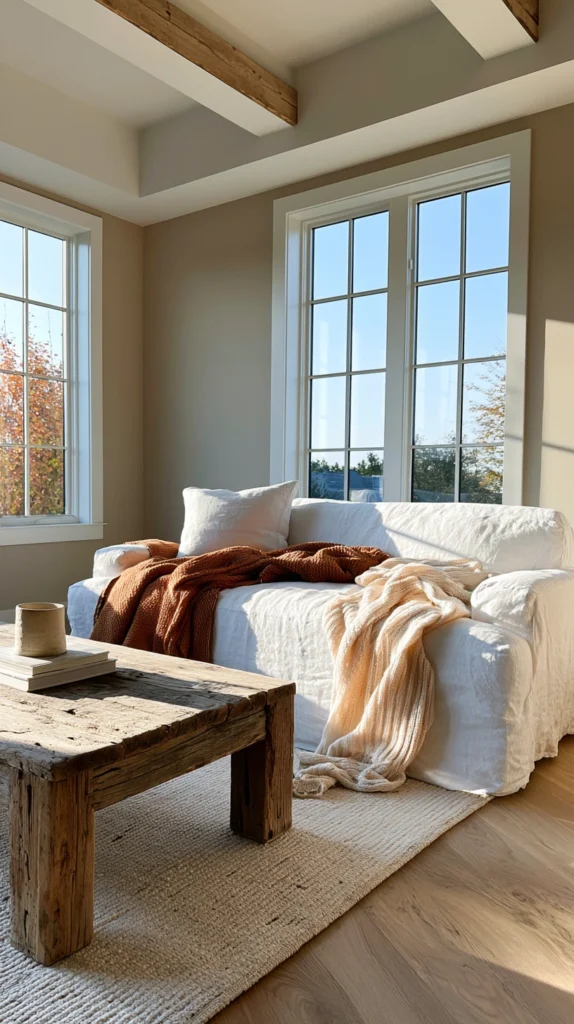
The farmhouse sofa in fall doesn’t need to change. What changes is what’s draped over it.
A linen or cotton slipcover in natural, undyed cream or warm white is the ideal farmhouse sofa base. It reads as relaxed and lived-in — which is the quality farmhouse style is built on — and it provides a neutral field against which fall textiles layer without competition.
Over that base, add two or three throw blankets in graduated fall tones. A chunky knit in caramel, a woven cotton throw in rust, and a thinner waffle-weave in warm cream creates layered depth on the sofa that reads as genuinely autumnal without a single piece of fall-themed decor.
Drape the throws at different points — one over the back, one over the arm, one folded on the seat — rather than stacking them. Stacked throws look stored. Draped throws look used.
Tip: Choose throws in the same fiber family as the slipcover — linen or cotton rather than synthetic microfiber. Natural fiber throws layer with each other and with linen slipcovers in a way that synthetic materials don’t — they breathe, soften with washing, and develop the worn-in quality that farmhouse style depends on.
Budget: $35–$90 for two to three throws
2. Use a Reclaimed Wood Coffee Table as the Room’s Anchor
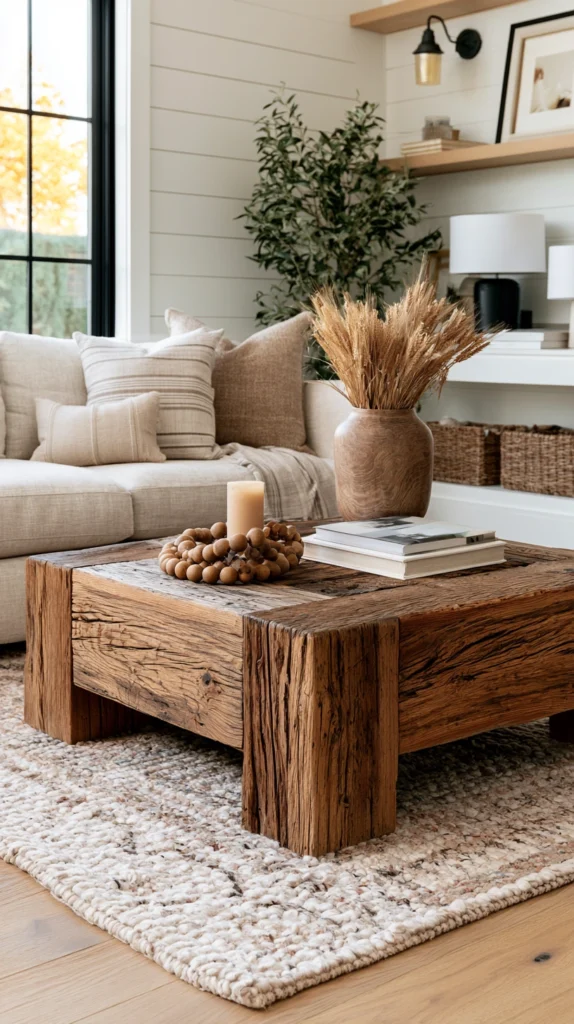
In a farmhouse fall living room, the coffee table is the surface that holds the season most visibly. Every natural object, every candle, every botanical arrangement sits on it.
A reclaimed wood coffee table — one with visible grain variation, knots, and color inconsistency — suits this role better than a smooth, uniform surface. The character in the wood becomes part of the fall arrangement rather than just the surface beneath it.
If the existing coffee table is smooth or painted, a thick piece of live-edge wood or a reclaimed lumber slab placed on top creates the same effect temporarily and can be removed or relocated afterward.
For fall styling on a reclaimed wood surface, keep the arrangement simple. The wood itself is already doing visual work — it doesn’t need to compete with a heavily styled tray arrangement. Two or three objects at varied heights, a candle, and one natural element is enough.
Tip: Apply a coat of furniture wax rather than polyurethane to a reclaimed wood table used for fall display. Wax protects the surface from candle wax drips and seasonal object residue while preserving the matte, aged appearance that polyurethane glosses over.
Budget: $0 if reusing existing furniture
3. Bring in Dried Cotton Stems and Wheat Stalks
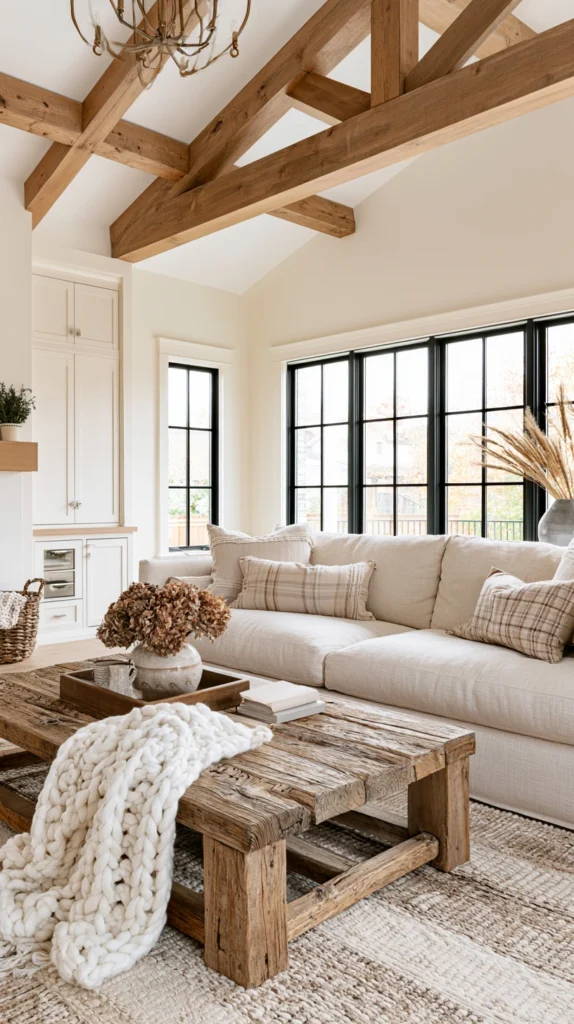
Dried cotton stems and wheat stalks are the most specifically farmhouse fall botanical elements available. Both connect directly to agricultural heritage — the material language that farmhouse style is rooted in.
A bundle of dried cotton stems in a galvanized metal bucket or a stoneware crock reads as a genuine farmhouse fall element rather than a store-bought seasonal prop. The fluffy white cotton bolls against a warm fall interior provide contrast without introducing a color that fights the palette.
Dried wheat stalks bundled and placed in a tall vessel beside the fireplace or in a corner of the room add height and movement — they sway slightly in air currents and catch low autumn light differently than rigid objects do.
Both are available at craft stores and online in their natural form for $8–$20 per bundle. Use them without a vessel if the bundle is large enough — a tied bundle of wheat stalks leaning against a wall corner is a complete arrangement on its own.
Tip: Spray dried cotton stems and wheat with a light coat of hairspray once arranged. This holds loose fibers and prevents shedding onto furniture and floors — a practical step that significantly reduces the maintenance of having dried botanicals in a living space.
Budget: $8–$25 for dried botanical bundles
4. Replace Bright Bulbs with Edison Filament Lights
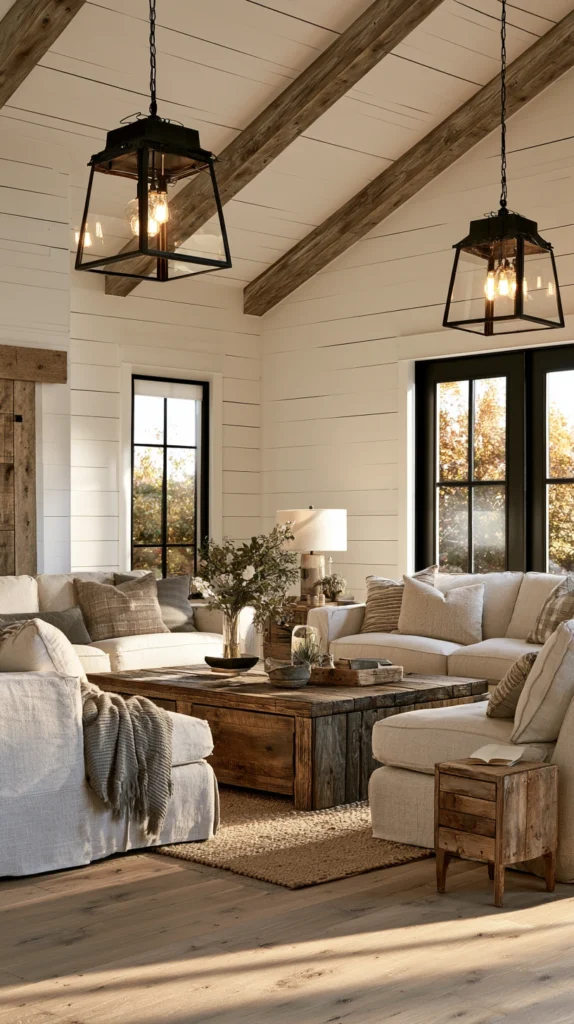
Edison filament bulbs — the kind with visible glowing filaments in an amber or clear glass bulb — produce light at around 2200K, which is closer to firelight than any other standard bulb type.
In a farmhouse living room in fall, this color temperature is exactly right. The warm amber light flatters exposed wood, linen textiles, and natural objects in a way that standard warm white LEDs (2700K) do — just more so.
Replace the bulbs in one or two key fixtures rather than the whole room. The overhead fixture and a table lamp or two are sufficient to shift the room’s light temperature. Keep one slightly brighter, cooler bulb in a reading lamp for functional task lighting.
Edison filament LED bulbs in E26 standard base run $8–$20 for a two-pack. They’re available at hardware stores, home improvement stores, and Amazon.
Tip: Use Edison bulbs specifically in fixtures where the bulb is visible — pendant lights, exposed socket lamps, or fixtures with clear glass shades. In fixtures with opaque or fabric shades the amber quality of the filament is filtered out before it reaches the room and the effect is lost.
Budget: $8–$20
5. Add a Galvanized Metal Tub or Bucket as a Firewood Holder
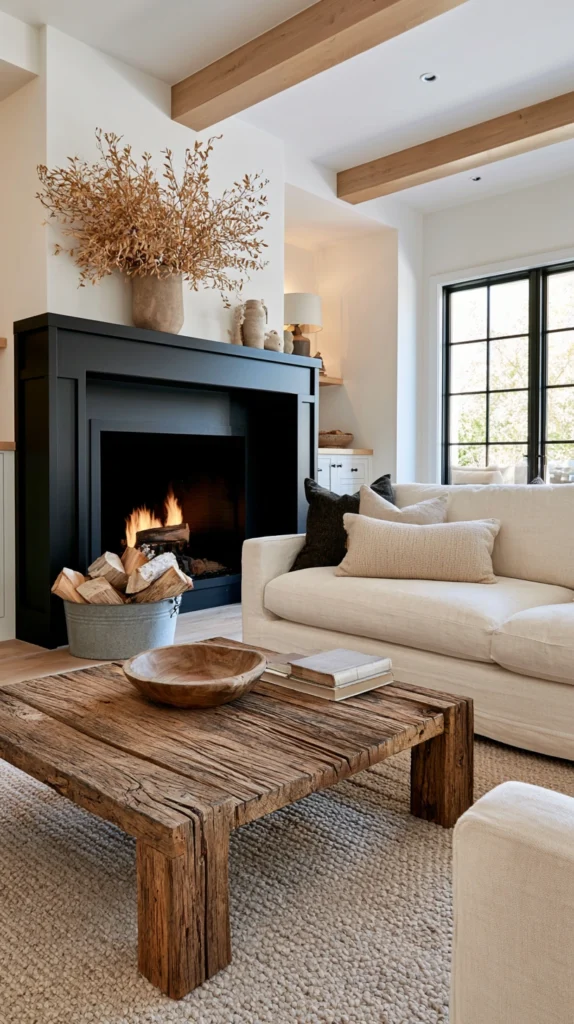
A galvanized metal washtub or bucket used to hold firewood or decorative logs beside a fireplace or wood stove is one of the most distinctly farmhouse fall elements in a living room.
The galvanized metal patina — that slightly grey-silver, industrial surface — provides a cool contrast that makes the warm wood tones of stacked logs appear warmer by comparison. It’s a material contrast that reads as authentic to the farmhouse aesthetic in a way that painted wood or wicker holders don’t.
For rooms without a working fireplace, use the galvanized tub to hold a collection of natural fall objects instead: a large pinecone arrangement, a bundle of dried stems, a few smooth river stones, and one or two LED pillar candles. The tub functions as a floor-level vignette.
Galvanized metal washtubs and buckets are available at farm supply stores, antique stores, and online in the $15–$45 range.
Tip: Line the interior of a galvanized tub used for logs with a sheet of kraft paper or a piece of landscape fabric before loading. This prevents bark and wood debris from falling through any seams at the tub base and makes cleanup significantly easier.
Budget: $15–$45
6. Use Plaid Wool or Flannel Pillow Covers on the Sofa
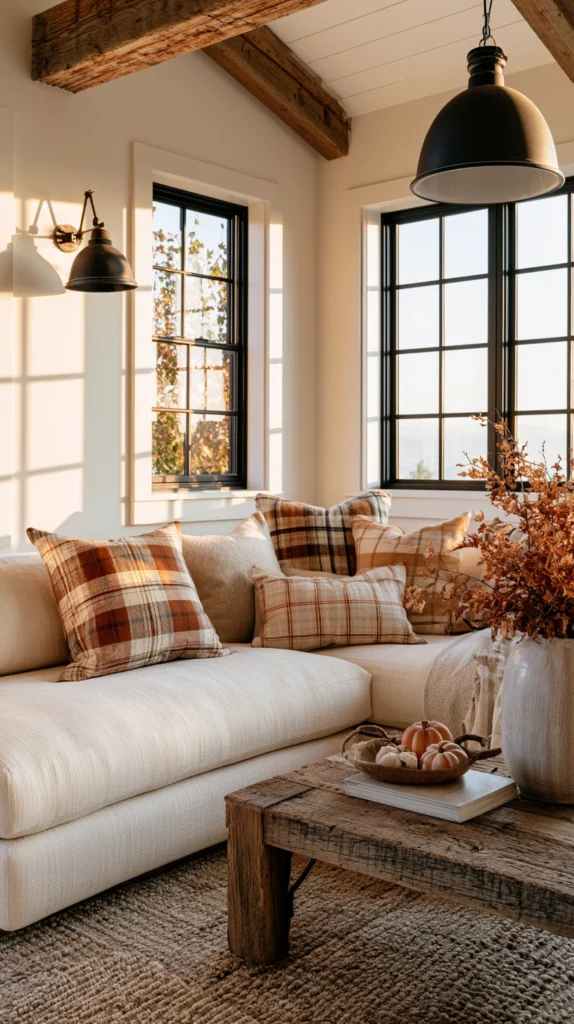
Plaid is the most specifically autumn pattern available to a farmhouse living room — and it connects to the farmhouse aesthetic through its associations with rural, practical clothing and working textiles.
For fall, choose plaid pillow covers in colors drawn from the farmhouse fall palette: rust and cream, caramel and brown, ochre and olive, or burgundy and tan. Avoid bright primary plaids — red and black or red and green — which read as Christmas rather than autumn.
Use two plaid pillows maximum on a sofa alongside solid pillows in coordinating colors. More than two plaid pillows in the same space compete with each other rather than contributing to a cohesive arrangement.
Plaid flannel and plaid wool pillow covers in fall tones run $12–$25 each at Target, H&M Home, and Amazon.
Tip: Mix plaid scale — one large-scale plaid and one small-scale plaid in the same color family reads as collected rather than matched. Two identical plaids side by side reads as a set purchase, which undermines the “gathered over time” quality that farmhouse style relies on.
Budget: $24–$50 for two covers
7. Place a Worn Wooden Bench at the Base of the Seating Area
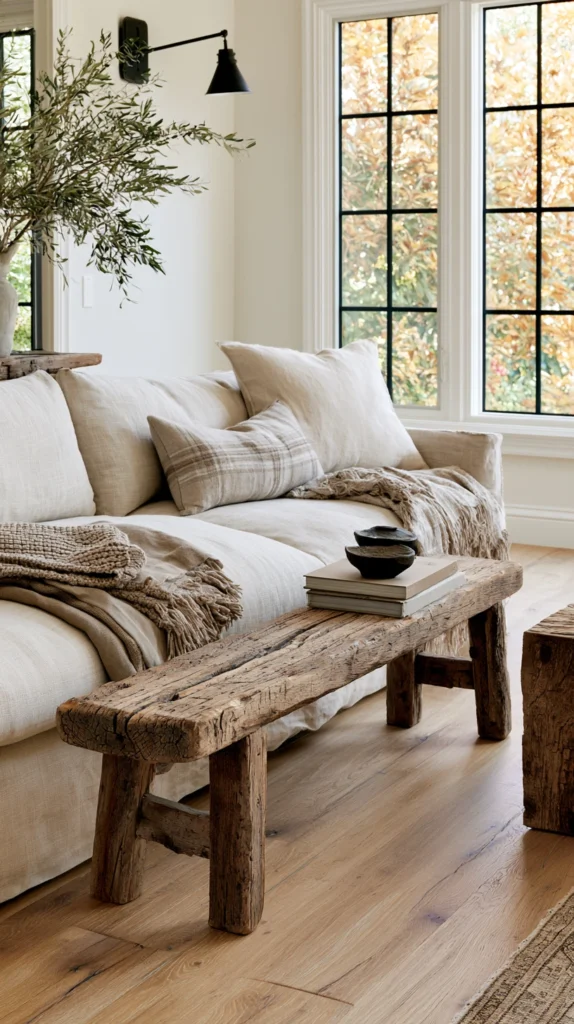
A wooden bench — distressed, painted in a chippy farmhouse color like muted sage or worn white, or left in natural raw wood — placed at the base of the sofa or along one wall serves multiple fall functions simultaneously.
It holds seasonal textiles — a folded blanket, a stack of throw pillows — within easy reach without requiring a separate storage piece. It acts as a secondary surface for fall objects — a small lantern, a pumpkin, a dried botanical — at a height between the coffee table and the sofa seat. And it extends the seating area for a room used for fall gatherings.
For farmhouse style, the bench should look like it has history — found rather than purchased new. Thrift stores and Facebook Marketplace regularly turn up wooden benches with exactly the worn, painted surface that farmhouse style uses most effectively.
A thrifted or secondhand wooden bench runs $15–$60. New farmhouse-style benches from IKEA and Target run $35–$80.
Tip: Add hairpin legs to a piece of raw lumber for an instant farmhouse bench. A 6-foot length of 2×10 lumber ($8–$12 at a home improvement store) plus four hairpin legs ($20–$30 for a set) creates a bench for under $45 that looks intentionally made rather than purchased.
Budget: $15–$80
8. Create a Fireplace Mantel Display with Natural Fall Elements
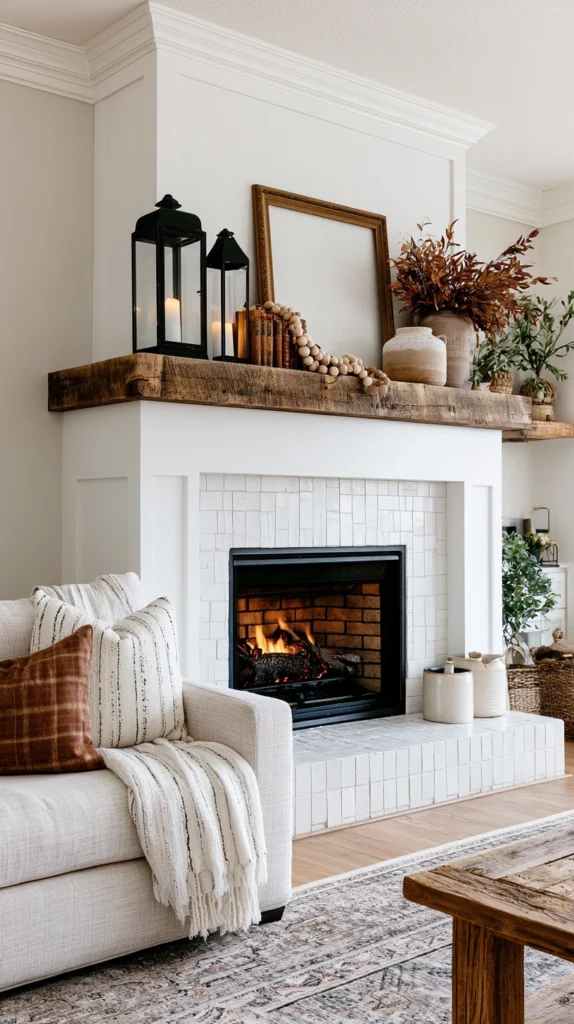
The fireplace mantel is the focal point of the farmhouse living room. In fall, it should work harder than any other display surface in the room.
A well-styled farmhouse fall mantel uses four types of elements: a large anchor object at center (a reclaimed wood sign, a large mirror with an aged frame, a cluster of tall candles), botanical elements on either side (dried cotton stems, eucalyptus, pampas grass in simple vessels), natural objects at the base level (small pumpkins, pinecones, river stones), and one warm light source (a lantern, a cluster of candles, or a string of warm Edison lights).
Keep the arrangement asymmetrical. A perfectly symmetrical mantel looks formal and staged. A farmhouse fall mantel should look as if the objects accumulated naturally over the course of the season.
Tip: Step back and look at the mantel from the sofa — the natural viewing position — before finalizing any arrangement. Adjustments that are obvious from across the room are invisible when standing directly in front of the mantel.
Budget: $20–$60 for objects not already owned
9. Layer Multiple Rugs for Warmth and Texture
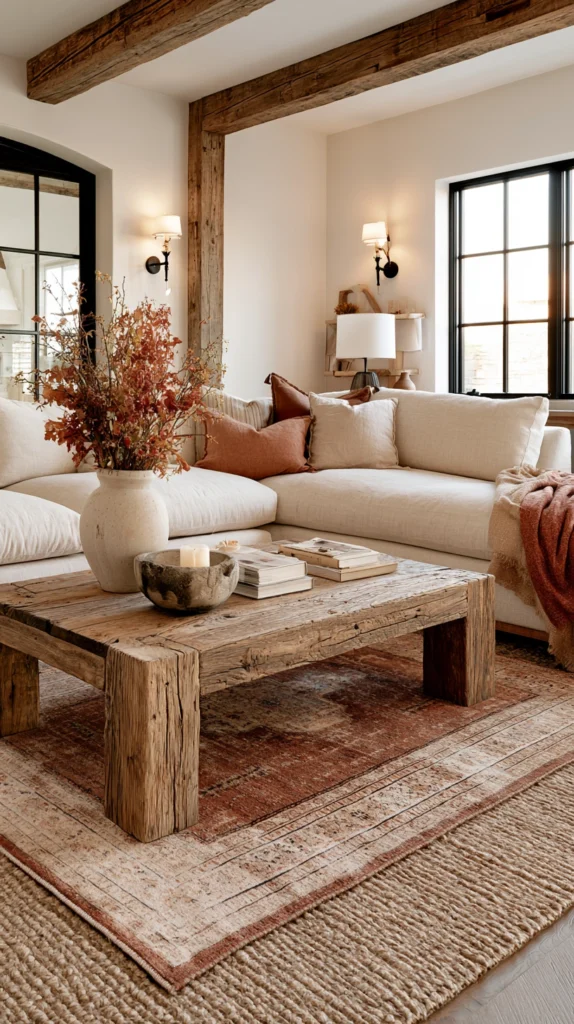
In a farmhouse living room, layered rugs are both a practical cold-weather solution and an aesthetic technique.
A large natural fiber rug — jute, sisal, or seagrass — as a base layer provides the neutral, textural ground that farmhouse style uses as its foundation. Over that, a smaller printed or woven rug in fall tones: a vintage-style Persian in rust and cream, a simple cotton dhurrie in terracotta and ivory, or a small braided rag rug in autumn colors.
The layered approach in a small farmhouse living room makes the floor appear larger rather than more covered — the natural fiber base reads as an extension of the floor, while the upper rug defines the seating zone.
For fall palette, the upper rug should carry at least one warm tone — rust, caramel, burnt orange, or deep olive — that connects to the textiles and objects in the rest of the room.
A 5×8 jute base rug runs $40–$90. A smaller 3×5 accent rug runs $25–$60.
Tip: Use a rug pad between the two layers rather than just between the lower rug and the floor. A pad between layers prevents the upper rug from sliding on the natural fiber surface of the lower rug — natural fiber rugs have almost no grip against another textile surface.
Budget: $65–$150 for both layers
10. Display Heirloom or Vintage Kitchen Objects on Open Shelving
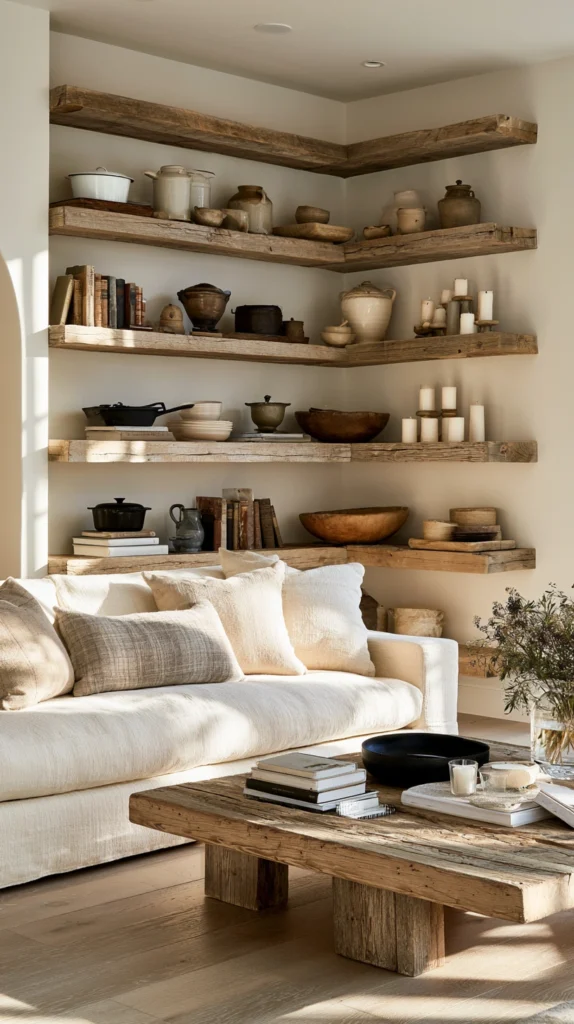
Open shelving in a farmhouse living room — or in an open-plan living and dining space — provides a surface for objects that contribute to the fall atmosphere without requiring dedicated seasonal decor purchases.
Vintage stoneware crocks, enamelware pitchers, cast iron pieces, wooden bowls, and old glass jars are farmhouse objects that already exist in the aesthetic vocabulary of the style. In fall, grouping them on a shelf with the addition of a dried botanical or two and a warm-toned candle makes them seasonal without requiring any new purchases.
The material warmth of these objects — aged wood, cream stoneware, dark cast iron — sits directly in the fall color palette. They don’t need to be repositioned as seasonal decor because their inherent qualities are already autumnal.
Tip: Group objects on open shelving in the same three-height rule used for coffee table arrangements — one tall element, one medium, one low — rather than lining them up at the same height across the shelf. Height variation creates the visual movement that makes a shelf arrangement look styled.
Budget: $0 using existing objects
11. Hang a Wreath of Dried Fall Materials on the Interior Wall
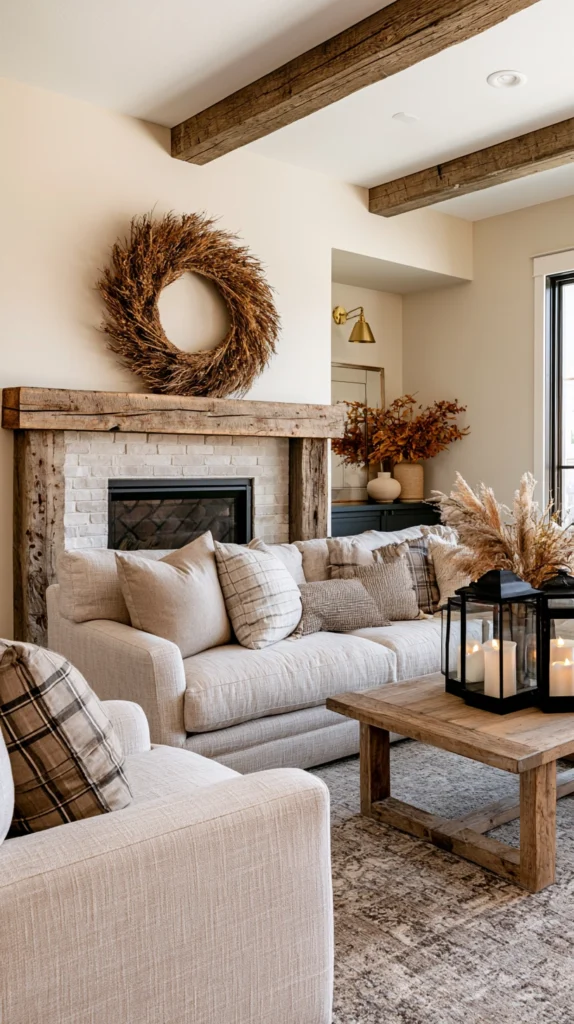
Wreaths in fall are typically a front-door element. Moving one indoors — onto a living room wall, above the fireplace, or on the wall opposite the entrance — introduces the wreath form to the interior in a way that reads as unexpected and deliberate.
For farmhouse fall, choose wreaths made from natural, undyed materials: dried eucalyptus, preserved olive branches, dried cotton stems woven into a wreath form, or a simple grapevine wreath base with dried botanicals tucked in. Avoid wreaths with synthetic elements — plastic berries, dyed ribbon in bright colors — which read as discount seasonal decor rather than considered farmhouse styling.
A dried eucalyptus or grapevine wreath hangs best on a simple nail or a large wooden bracket — no special picture hooks or wreath hangers needed for the interior wall.
Natural material wreaths run $20–$60 at craft stores and online. A DIY version made from a $4–$6 grapevine wreath base and $10–$15 in dried botanicals costs under $25.
Tip: Hang interior fall wreaths at eye level rather than at the height you’d hang framed art. A wreath at eye level creates a focal point that reads as a design decision. A wreath hung at ceiling height looks like a door wreath moved indoors without thinking about the new context.
Budget: $20–$60
12. Use Stoneware and Ceramic Vessels Throughout the Room
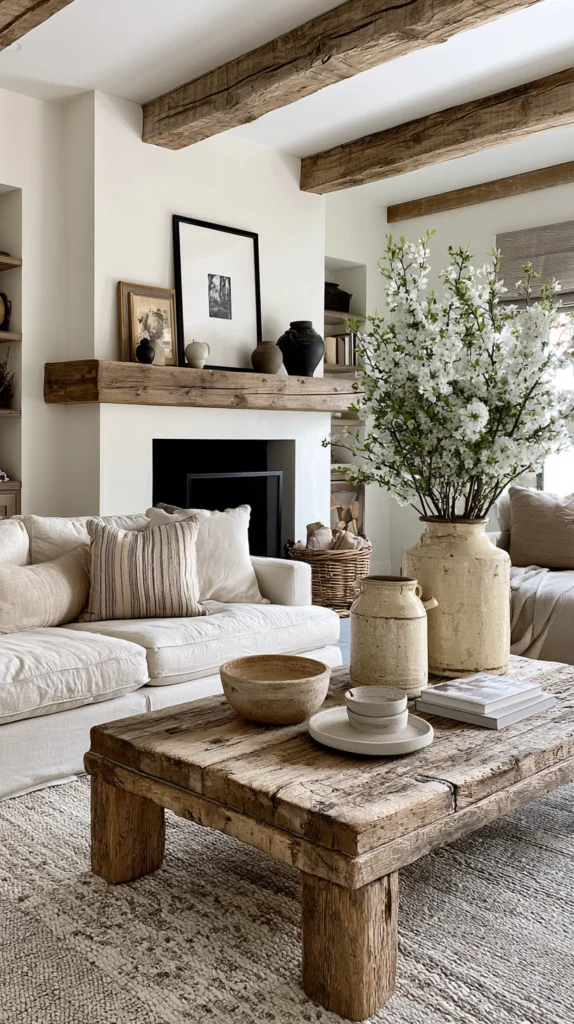
Stoneware and ceramic vessels — the kind associated with farmhouse kitchens — translate directly into fall living room styling as the right material for holding fall objects.
A large stoneware crock holding dried cotton stems beside the fireplace. A matte ceramic bowl on the coffee table filled with pinecones and acorns. A simple cream-glazed jug on the bookshelf holding dried wheat. Each one uses a farmhouse material in a living room context, connecting the space to the aesthetic without requiring dedicated living room decor.
The color range of natural stoneware — cream, warm grey, tan, salt-glaze speckle — sits directly in the fall neutral palette. These vessels look seasonal in fall without looking out of place in any other month.
Stoneware crocks and ceramic vessels are available at antique stores, thrift stores, and online in the $5–$30 range depending on size and condition.
Tip: Mix stoneware with wood and linen in the same arrangement rather than grouping ceramic pieces together. Stoneware next to a reclaimed wood surface next to a linen textile creates the material contrast that makes each element look its best — like materials grouped together flatten the visual difference between them.
Budget: $5–$30 per vessel
13. Bring in the Scent of Fall Through a Simmering Pot
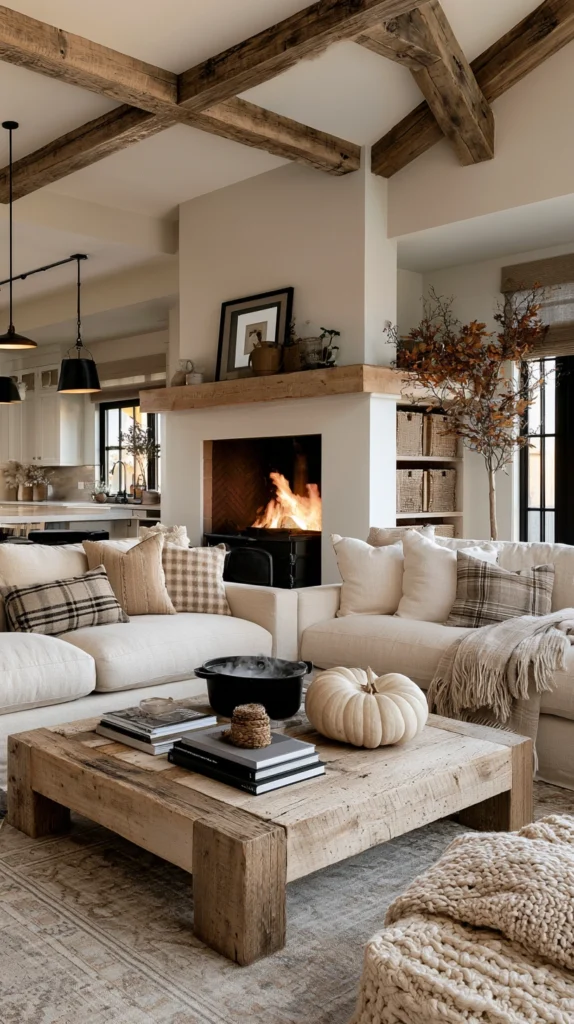
In a farmhouse living room, a simmering pot on a wood stove or in an adjacent kitchen is the most natural and authentic fall scent element possible. It requires no candle, no diffuser, and no synthetic fragrance.
Combine in a small saucepan: two cinnamon sticks, three cloves, one sliced orange, a sprig of rosemary, and two cups of water. Simmer on the lowest heat setting. Refill water as needed. The scent fills the connected living space within 20 minutes and continues as long as the pot simmers.
This is the farmhouse equivalent of an expensive fall candle — and the scent is noticeably more natural and complex than any synthetic fragrance alternative because it’s made from actual spices, citrus, and herbs rather than fragrance oils.
The total cost per use is under $3. The materials can be repurposed across three to four simmering sessions before losing their potency.
Tip: Never leave a simmering pot unattended. The water level drops faster than expected and a dry pot on a hot burner is a fire and safety risk. Set a timer for 30-minute checks if you’re moving between rooms.
Budget: $2–$5 per simmering session
14. Incorporate Aged Lanterns at Multiple Heights
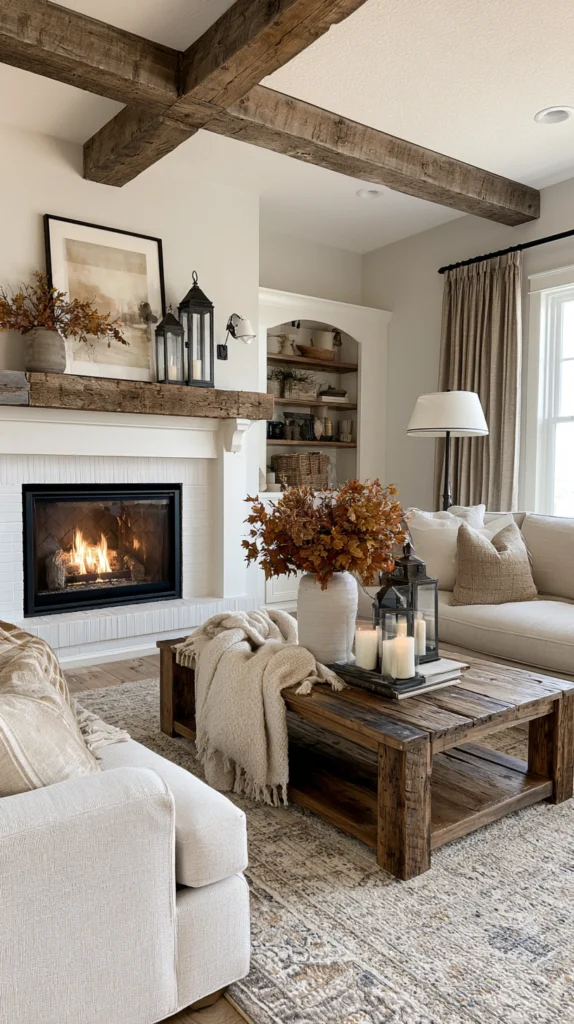
Lanterns in a farmhouse fall living room serve a different function from lanterns in a modern or transitional space. In farmhouse style, they read as functional objects with history — the kind of thing that would have been used for actual light before electricity — which gives them a material authenticity that purely decorative objects lack.
For fall, use three lanterns at three different heights: one large floor lantern (12–16 inches) placed beside the fireplace or in a corner, one medium shelf or table lantern (8–10 inches) on the coffee table or a side table, and one small lantern (5–6 inches) on the mantel or a bookshelf. Each should be in the same finish — matte black, aged bronze, or oil-rubbed bronze — so they read as a collection rather than mismatched pieces.
Fill each with an LED pillar candle in a cream or beeswax tone. The lantern glass diffuses the LED light into a soft, realistic glow that works effectively in fall evening light.
Aged metal lanterns in the sizes described run $12–$40 each at HomeGoods, TJ Maxx, Target, and At Home.
Tip: Open the lantern door and add one or two small natural elements around the base of the LED candle inside — a pinecone, a cinnamon stick, a few dried cranberries. Visible through the lantern glass, these details make the arrangement look considered rather than assembled from a single product purchase.
Budget: $40–$100 for a three-lantern collection
Final Thoughts
Farmhouse fall works when the room feels lived in rather than decorated.
The objects that do this best are the ones with material authenticity — reclaimed wood, natural stoneware, dried botanicals, galvanized metal, linen and cotton textiles. These don’t announce themselves as fall decor. They exist within the farmhouse aesthetic year-round and become seasonal through their arrangement, their pairings, and the warm light that surrounds them in autumn.
Start with the largest textile change — a throw on the sofa or a layered rug — and the lighting change. Warm light transforms everything else in the room before a single fall object is added. Build from there with natural elements, ceramics, and botanicals until the room feels like fall arrived rather than fall was installed.