Water Meets Wall: 15 Backyard Waterfall Wall Ideas for a Sleek Statement Feature
There is a particular quality that a wall waterfall brings to an outdoor space that a naturalistic rock cascade or a pond feature does not — a quality of deliberate architectural intention, of water used not to suggest a landscape but to define one.
A waterfall wall is the outdoor feature that states most clearly that the garden was designed rather than grown, that every element within it was chosen and placed with precision rather than allowed to accumulate organically. It is the feature that most directly imports the design language of the best hotel lobbies, the finest resort pools, and the most considered contemporary architecture into the domestic backyard.
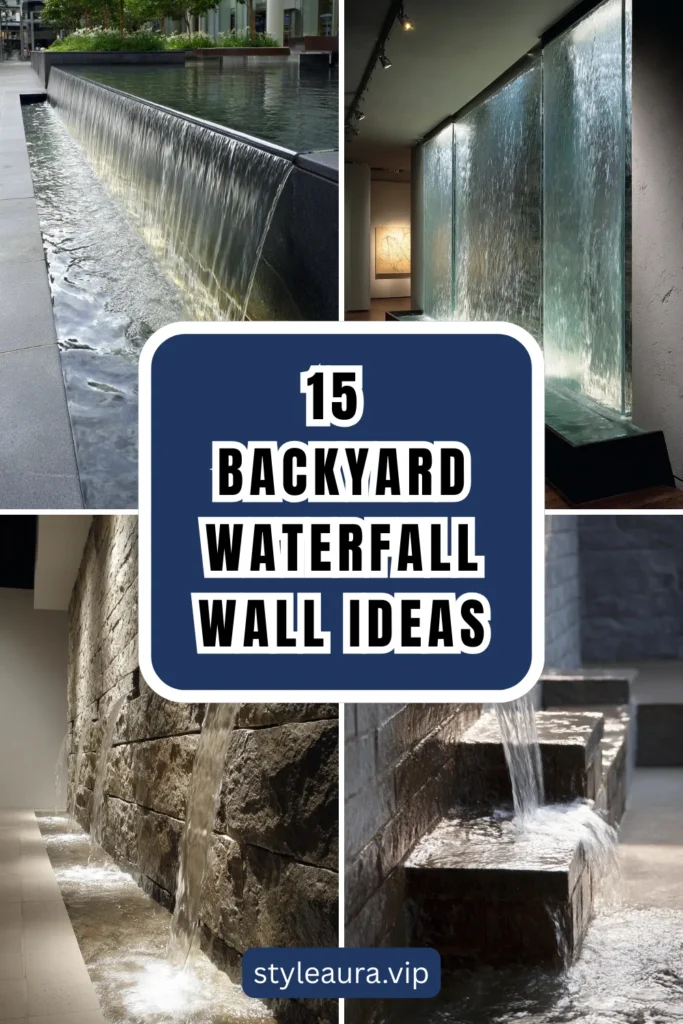
Done well, a waterfall wall is not merely a decorative element. It is a structural decision, a sound decision, and an atmospheric decision simultaneously — the water falling in a controlled sheet or a series of precise streams, the sound filling the outdoor space with a consistent, enveloping ambience, and the visual presence of the falling water transforming the wall behind it from a static boundary into a dynamic and genuinely extraordinary surface.
The fifteen ideas below cover every material, every style, and every budget for a backyard waterfall wall — from a single rendered panel with a narrow slot to a full resort-style feature wall with integrated lighting and a pool below.
1. The Rendered Concrete Sheet Waterfall
Budget: $500 – $3000
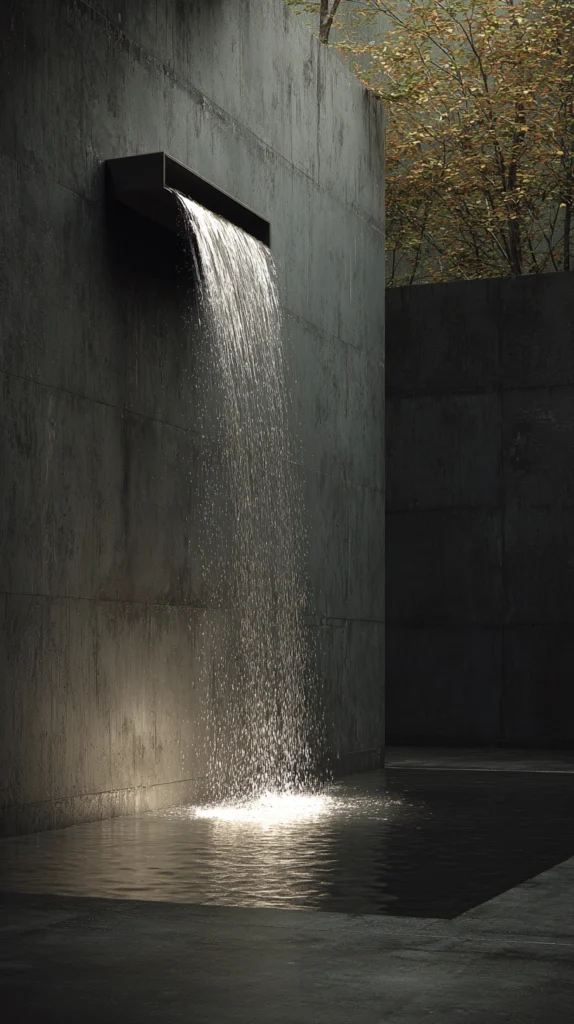
A rendered concrete wall — smooth, flat, painted in a dark charcoal or a warm stone colour — with a water delivery channel at the top and a collection basin at the base, producing a wide, even sheet of water across the full face of the rendered surface, is the most affordable and the most versatile waterfall wall format available. The render and block construction can be any width, any height, and any colour, and the finished surface reads as genuinely architectural regardless of the builder’s budget.
Concrete block construction for a standard small waterfall wall — $150 – $600 in materials. Sand and cement render with waterproof additive — $40 – $100. A stainless steel delivery channel at the top — $50 – $150. A collection basin at the base — rendered block or precast concrete — $100 – $300. A submersible pump — $80 – $200. Total material cost: $420 – $1350 plus professional construction labour of $300 – $800.
Styling tip: Paint the rendered wall surface in a dark colour — deep charcoal, slate grey, or a warm dark brown — rather than a pale or neutral tone. A dark rendered wall behind a sheet of falling water produces the most dramatic and the most visually striking result because the contrast between the dark surface and the white aeration of the falling water is at its maximum. A pale wall behind the same water sheet reduces this contrast and reduces the visual drama of the feature proportionally.
2. The Corten Steel Blade Wall
Budget: $800 – $5000
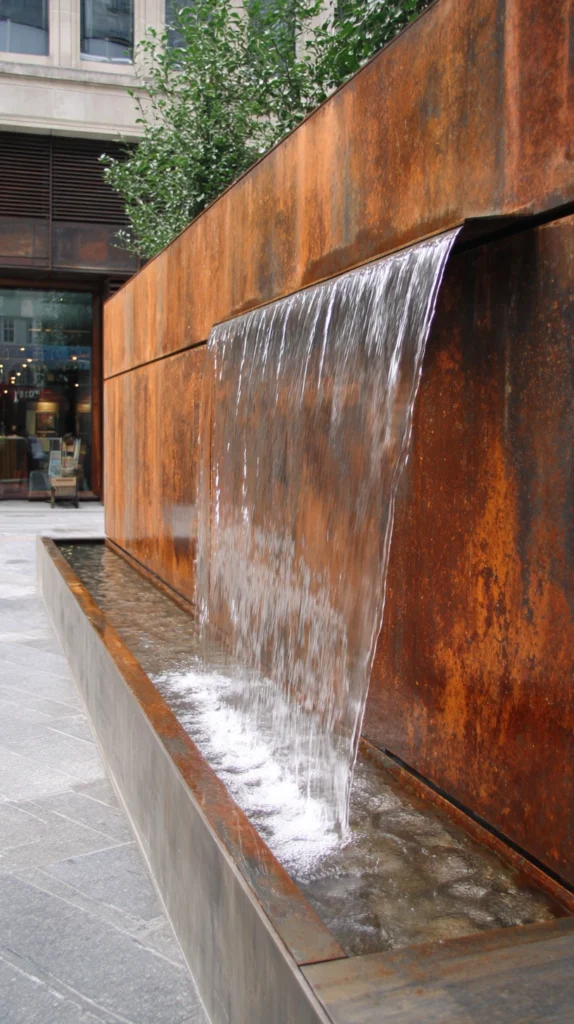
A corten steel waterfall wall — a wide, flat panel of weathering steel from which water flows in an even, glassy curtain from a delivery channel at the top into a basin or pool below — combines the warm, iron-rust patina of the most specifically contemporary garden material with the architectural precision of a designed water delivery system. The corten steel develops its protective rust patina over the first outdoor season and then stabilises permanently — requiring no painting, no sealing, and no maintenance beyond the water system itself.
A fabricated corten steel panel in a standard garden width — $400 – $1500 depending on dimensions. A stainless steel or copper delivery channel at the panel top — $50 – $200. A collection basin in matching corten or concrete below the panel — $200 – $600. A submersible pump with appropriate flow rate — $100 – $300. Professional installation including the water system plumbing — $400 – $1000. Total investment: $1150 – $3600.
Styling tip: Position the corten steel wall panel against a backdrop of dark planting — tall black-leaved grasses, a dark bamboo screen, or a clipped dark hedge — rather than against a pale rendered wall or a light fence. The warm orange-brown of the corten reads most powerfully against a dark background. Against a pale background, the tonal contrast is insufficient for the material to read with its full dramatic authority.
3. The Natural Stone Feature Wall
Budget: $1000 – $8000
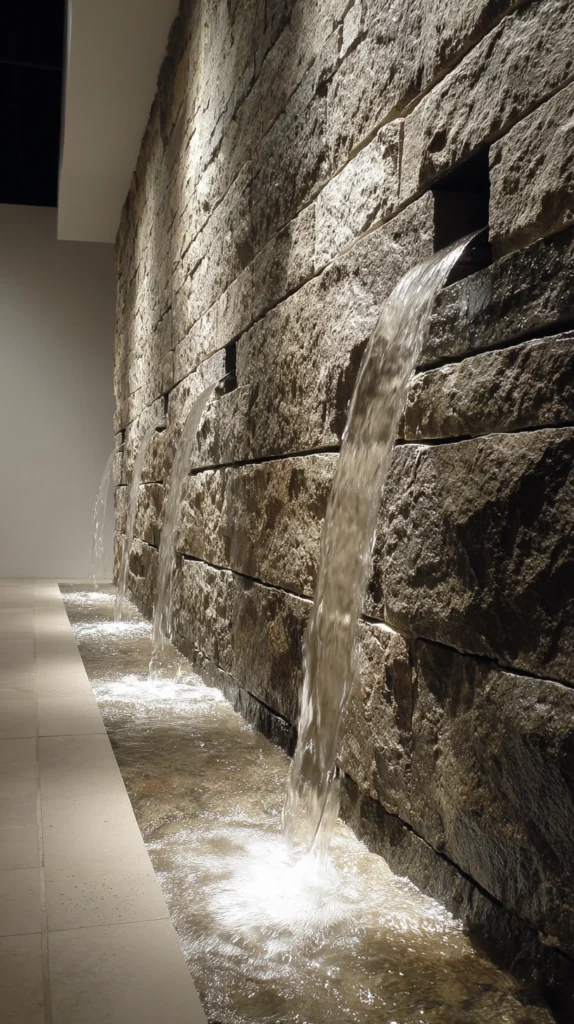
A natural stone waterfall wall — irregular stone pieces set in a flat or slightly projecting arrangement on a backing wall, with water delivered from a channel at the top and flowing down through the natural channels and gaps in the stone face before reaching the collection basin below — is the most materially beautiful and the most specifically timeless waterfall wall format available. Natural stone improves with time — developing moss, weathering to a deeper colour, and reading as increasingly integral to the garden landscape.
Natural stone for a standard waterfall wall — $50 – $200 per square metre in stone materials. A backing wall in concrete block — $100 – $400 in materials. A delivery channel at the top — $50 – $150. A collection pool or basin — $200 – $800. Professional stone setting and water system installation — $500 – $2000. Total investment: $900 – $3550 in materials plus professional labour.
Styling tip: Choose stone for the waterfall wall from the same geological family as any existing stone in the garden — the same sandstone, the same limestone, the same dark basalt. A waterfall wall in a stone that matches the garden’s existing hard landscaping reads as integral to the garden’s material identity. A waterfall wall in a stone imported from a different geological context reads as a feature that arrived from somewhere else — which undermines the sense of belonging that a permanent garden installation should produce.
4. The Glass Water Wall
Budget: $2000 – $15000
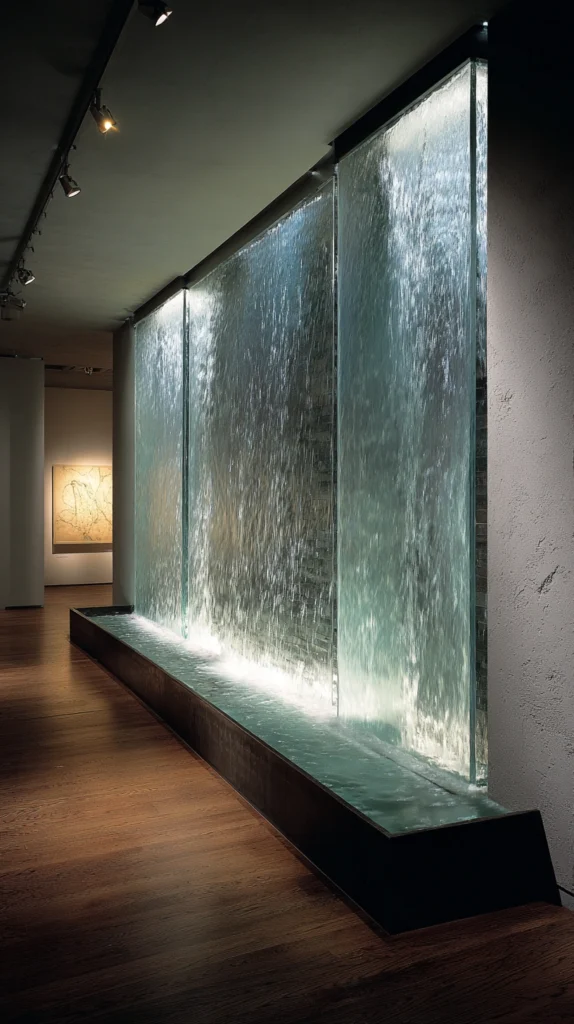
A glass waterfall wall — a panel of toughened glass or a glass and steel frame through which water flows in a perfectly even sheet, the glass itself barely visible behind the falling water — is the most specifically contemporary and the most architecturally refined waterfall wall available for a backyard setting. At night, with underwater lighting in the collection pool below, a glass water wall produces a luminous, gently animated effect that is genuinely extraordinary.
A toughened glass panel in a standard garden width — $500 – $2000 for the glass alone. A stainless steel frame to hold the glass — $300 – $800. A water delivery channel at the glass top — $100 – $300. A collection pool or basin below — $500 – $2000. A pump and plumbing system — $150 – $500. Underwater LED lighting — $100 – $400. Professional installation — $800 – $2000. Total investment: $2450 – $8000.
Styling tip: Specify the glass panel in a grey-tinted or bronze-tinted option rather than completely clear glass for an outdoor application. A tinted glass panel reduces the reflective glare that untinted glass can produce in bright sunlight, making the falling water sheet more visible against the glass surface. Untinted clear glass in direct sunlight reflects the sky and the surrounding garden rather than revealing the water falling across it — which is the reverse of the intended visual effect.
5. The Stainless Steel Blade Waterfall
Budget: $1000 – $6000
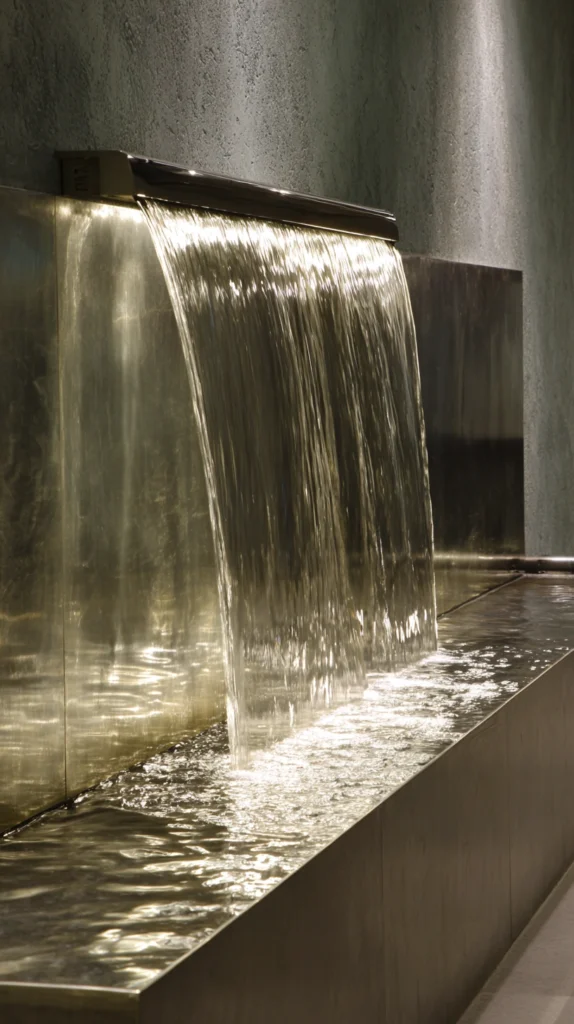
A stainless steel blade waterfall — a precision-fabricated horizontal blade of brushed or polished stainless steel mounted on a wall, from which water flows in a thin, glassy sheet over the blade’s leading edge into a collection pool below — is the backyard waterfall wall at its most specifically architectural and its most precisely engineered. The quality of the water sheet produced by a correctly specified and correctly installed stainless steel blade is genuinely beautiful — perfectly even, perfectly flat, and perfectly reflective of the light conditions around it.
A fabricated stainless steel blade in a standard garden width — $300 – $1000 depending on dimensions and steel grade. A backing wall to mount the blade — existing at no cost if already present. A water delivery manifold behind the blade ensuring even water distribution — $100 – $300. A collection pool or basin — $300 – $1000. A pump and plumbing — $100 – $400. Professional installation — $400 – $1200. Total investment: $1200 – $3900.
Styling tip: Specify the stainless steel blade in a brushed rather than a polished finish for an outdoor application. A polished stainless steel blade produces mirror reflections of the surrounding garden, the sky, and the viewer — which is beautiful in certain conditions and distracting in others, depending on the sun angle. A brushed finish produces a directional sheen that catches the light without generating the full mirror effect — maintaining the blade’s visual presence without the potential for glare.
6. The Timber Slat Waterfall Wall
Budget: $500 – $3000
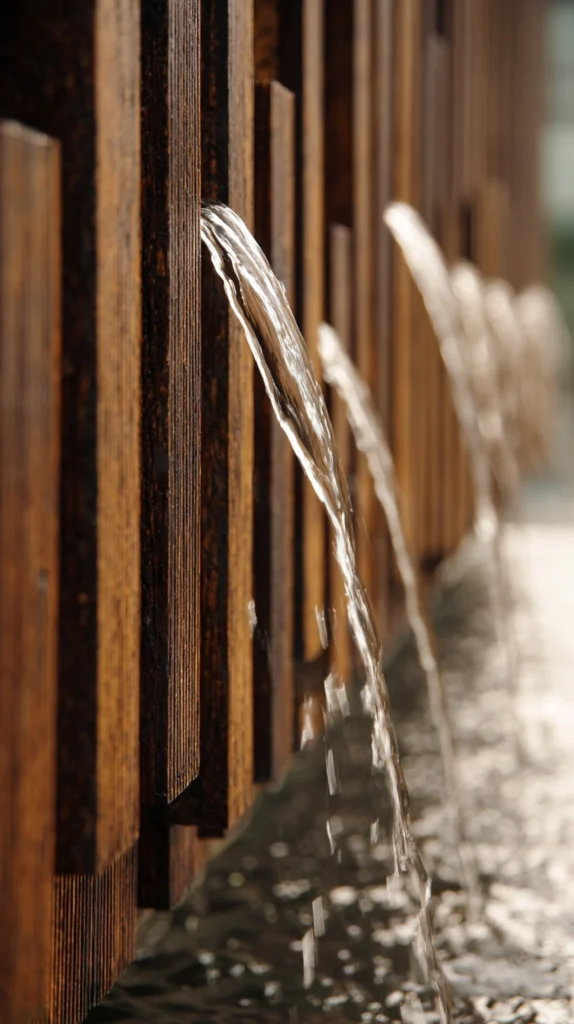
A timber slat waterfall wall — vertical or horizontal hardwood slats on a backing frame, with water delivered to the top of the slat arrangement and flowing between and over the individual slats in a series of parallel streams — is the warmest and the most materially organic of all the waterfall wall formats. The combination of water and natural timber, with the particular sound of water on wood and the way the wet timber darkens and gleams, is one of the most specifically beautiful material combinations available in outdoor water feature design.
Hardwood timber slats in teak, ipe, or iroko — $30 – $80 per linear metre in slat material. A backing frame in treated timber or aluminium — $100 – $300. A delivery channel at the top — $50 – $150. A collection basin — $100 – $400. A pump and plumbing — $80 – $250. Professional installation — $300 – $800. Total investment: $660 – $1980 for a timber waterfall wall of genuine material warmth.
Styling tip: Space the timber slats at a consistent gap of two to three centimetres — consistent both in the width of the gap between slats and in the depth to which each slat projects from the backing surface. A consistent spacing produces a waterfall wall where the water streams appear at regular, precise intervals across the full width of the feature. Inconsistent spacing produces a wall where the water streams are uneven — some wider, some narrower — which reads as imprecise rather than designed.
7. The Brick or Blockwork Stepped Waterfall Wall
Budget: $400 – $2500
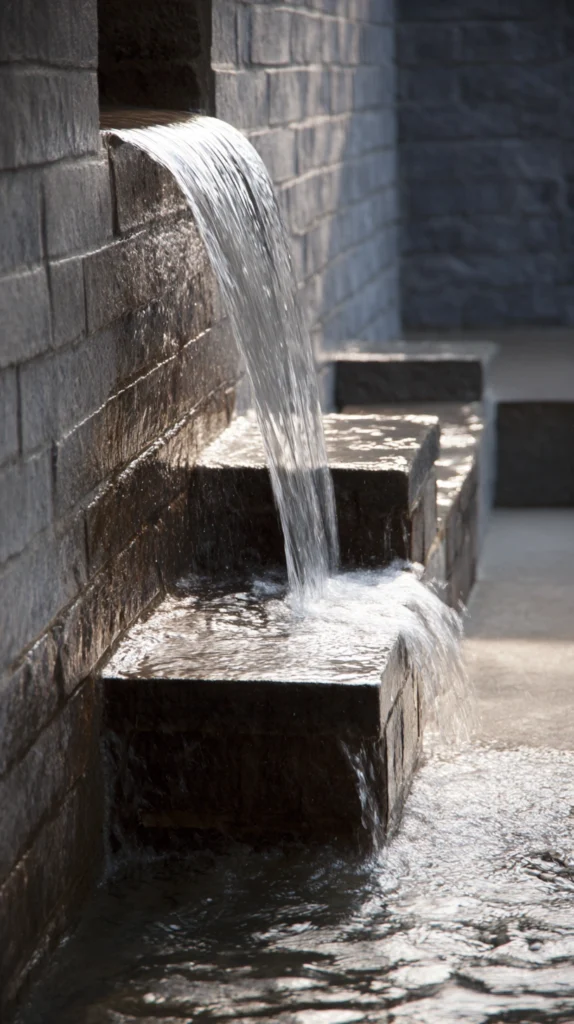
A stepped waterfall wall in brick or concrete block — two or three stepped horizontal projections at different heights on a backing wall, each step allowing water to flow from one level to the next in a series of small controlled falls — produces a waterfall wall that combines the naturalistic quality of a stepped cascade with the architectural precision of a constructed masonry wall. It is achievable by any competent DIY builder and requires no specialist fabrication.
Brick or concrete blocks for the steps — $50 – $150 in materials. A backing wall — existing at no cost if already present or $100 – $400 to construct. Render for the step faces — $30 – $80. A delivery channel at the top step — $30 – $80. A collection basin at the base — $80 – $300. A pump and plumbing — $60 – $200. Total material cost: $350 – $1210 for a DIY build of genuine quality.
Building tip: Chamfer the leading edge of each rendered step — creating a sharp, clean arris rather than a rounded or irregular edge — so that the water separates cleanly from each step surface as it falls rather than clinging to the face and running down the step’s vertical surface. A chamfered step edge produces a clean, visible water arc at each level. A rounded step edge produces a water stream that clings to the masonry face — which reads as a wet wall rather than a waterfall.
8. The Mosaic Tile Waterfall Wall
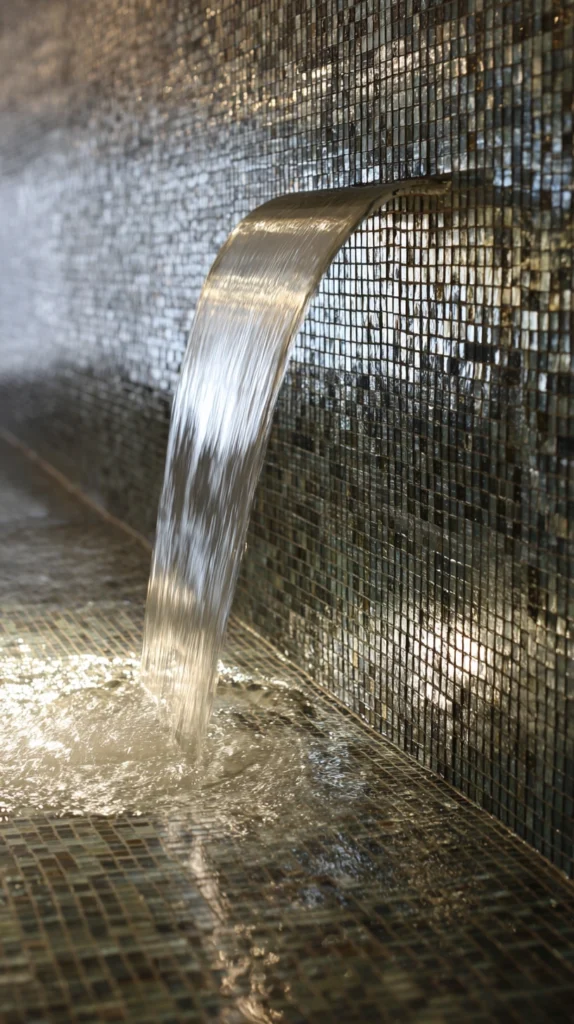
Budget: $600 – $4000
A mosaic tile waterfall wall — a backing wall faced with small ceramic or glass mosaic tiles in the water’s pathway, a wider water sheet covering the full tiled face, the colour and texture of the mosaic visible through the falling water — is the most colourful and the most visually complex waterfall wall format available. The tiles reflect light through the water in a way that untiled surfaces do not, producing a gently animated quality in the wet surface that changes with the light conditions throughout the day.
Ceramic or glass mosaic tiles for the water face — $20 – $80 per square metre in tile materials. Waterproof tile adhesive and grout — $30 – $80. A delivery channel at the top — $50 – $150. A collection basin at the base — $150 – $500. A pump and plumbing — $80 – $250. Professional tiling and installation — $400 – $1200. Total investment: $730 – $2260 for a mosaic waterfall wall of considerable visual richness.
Styling tip: Choose mosaic tiles in a single colour family — all blues and greens, or all greys and silvers, or all warm earth tones — rather than a multi-colour design for the waterfall wall surface. A single-colour mosaic behind falling water reads as a material decision — the colour adding richness to the water without competing with it. A multi-colour mosaic behind the same water reads as a pattern obscured by water — neither the pattern nor the water performing at its best.
9. The Freestanding Feature Wall With Integrated Pool
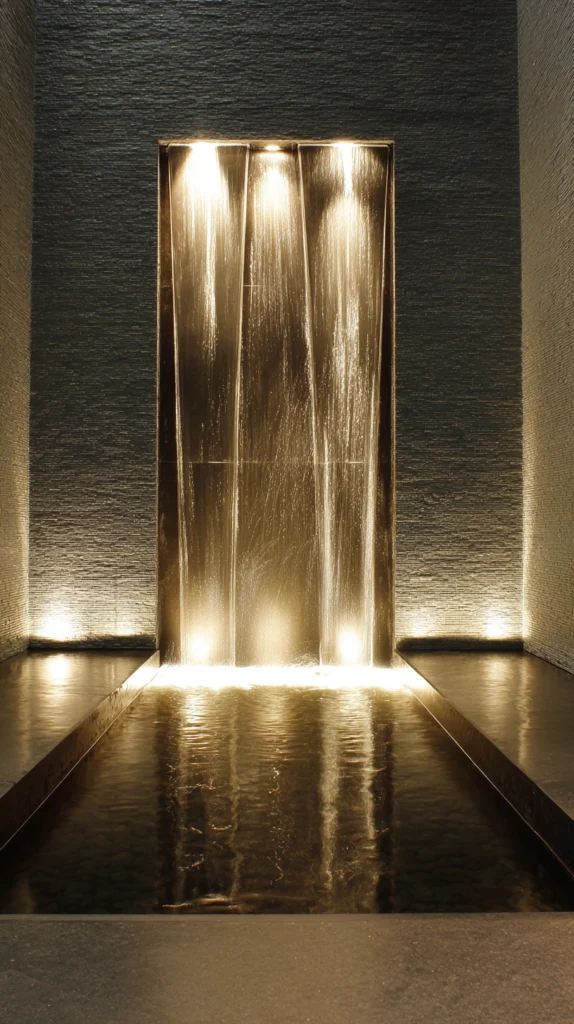
Budget: $2000 – $12000
A freestanding waterfall wall — a wall structure that stands independently rather than against an existing boundary, with water flowing on one or both faces and a pool integrated at the base of the structure — is the most dramatically three-dimensional and the most specifically resort-like waterfall wall format available for a backyard setting. A freestanding wall with water on both faces divides the garden space and adds water to both zones of the divided garden simultaneously.
A freestanding rendered concrete wall — $500 – $2000 in materials. Water delivery channels on one or both faces — $100 – $300. An integrated pool at the base — $500 – $2000. Coping stones around the pool edge — $100 – $400. A pump and plumbing system — $150 – $500. Underwater LED lighting — $100 – $400. Professional construction — $600 – $2000. Total investment: $2050 – $7600.
Styling tip: Plant tall, structural plants at both ends of the freestanding waterfall wall — standard bay trees, columnar hornbeams, or clipped box cones — to anchor the freestanding structure visually within the garden space. A freestanding wall without flanking planting reads as a structure placed in the garden. The same wall flanked by tall plants at each end reads as an architectural feature that the garden was organised around — which is the quality that makes a freestanding waterfall wall genuinely impressive rather than merely present.
10. The Copper Pipe Waterfall Wall
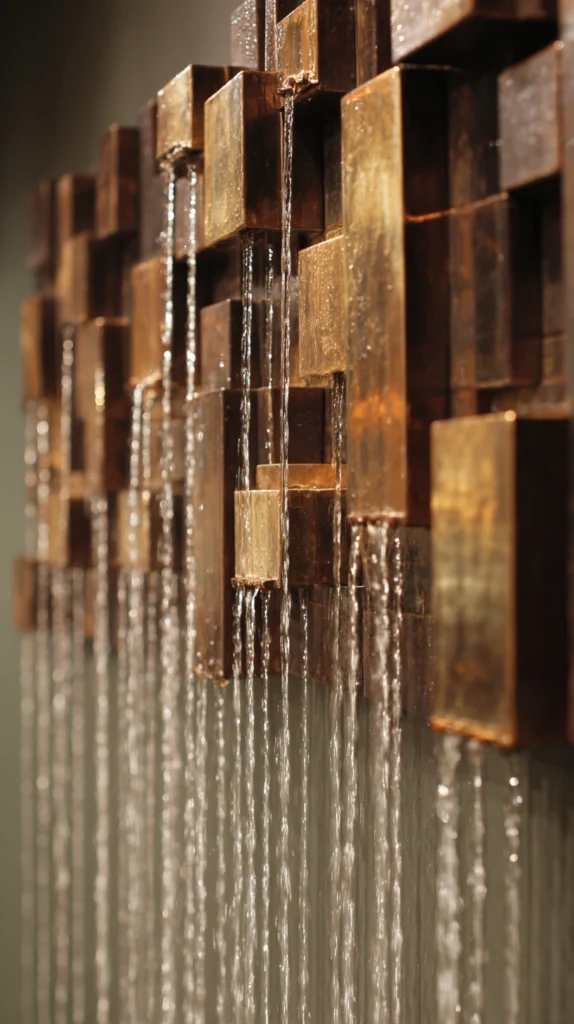
Budget: $200 – $1000
A copper pipe waterfall wall — a series of copper pipes of varying lengths arranged vertically on a backing surface, each pipe delivering water from an internal manifold at the top in a series of parallel streams that fall at different heights and produce a delicate, musical sound as they reach the collection basin below — is the most specifically handmade and the most musically interesting of all the waterfall wall formats. The copper develops a green-grey patina over time that is genuinely beautiful and distinctly specific.
Copper pipe in varying diameters — $5 – $20 per metre length. A copper manifold to distribute water evenly to each pipe — $30 – $80 to fabricate. A backing wall or frame — existing at no cost or $50 – $200 to construct. A collection basin — $50 – $200. A pump and plumbing — $60 – $200. Total material cost: $145 – $700 for a waterfall wall of genuine handmade character.
Styling tip: Vary the length of the copper pipes intentionally — creating a specific pattern of heights across the wall rather than a random variation — so that the water streams fall at heights that relate to each other in a deliberate compositional arrangement. An intentional height pattern reads as a design decision. A random variation reads as imprecision. The same material at the same cost produces either quality depending entirely on the care taken in planning the pipe heights before cutting.
11. The Bamboo Grid Waterfall Wall
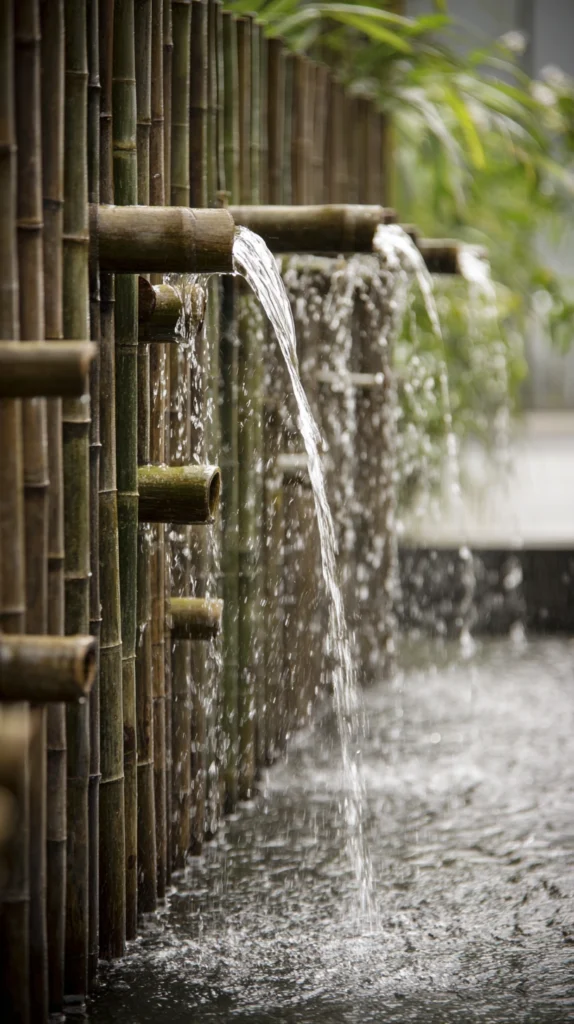
Budget: $100 – $500
A bamboo grid waterfall wall — a grid of horizontal and vertical bamboo poles creating a regular pattern, with water delivered to the top of the grid and flowing over and between the bamboo surfaces in a series of small falls before reaching the collection basin below — is the most specifically natural and the most economically achievable of all the waterfall wall formats that produce a genuine sheet or distributed waterfall effect.
Bamboo poles in varying diameters — $20 – $60 for a sufficient quantity. Bamboo binding wire or copper clips to assemble the grid — $10 – $20. A water delivery channel at the grid top — $20 – $50. A backing frame to mount the bamboo grid — $30 – $80. A collection basin — $40 – $120. A pump and plumbing — $40 – $100. Total material cost: $160 – $430 for a waterfall wall of natural material warmth.
Building tip: Seal all bamboo surfaces with two coats of an exterior clear sealant before assembling the grid — the sealant preventing the bamboo from splitting as it repeatedly wets and dries through the outdoor seasons. Unsealed bamboo in continuous contact with flowing water splits and deteriorates within one to two seasons. Correctly sealed bamboo maintains its structural integrity and its natural appearance for four to five seasons before requiring resealing.
12. The Rammed Earth or Gabion Waterfall Wall
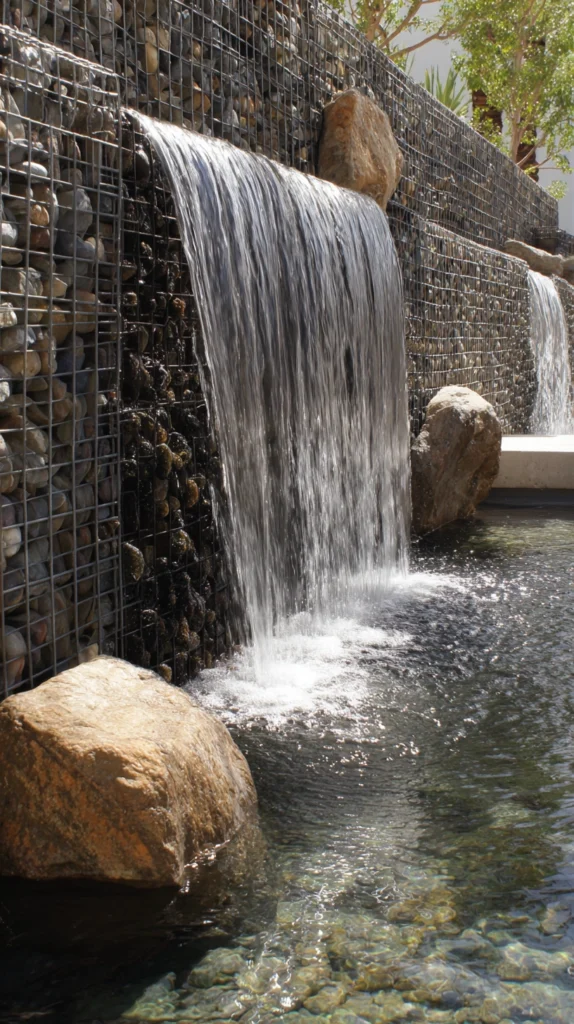
Budget: $500 – $4000
A gabion waterfall wall — a wire mesh cage structure filled with rounded river stones or granite cobbles, with water flowing from a delivery channel at the top and passing through the spaces between the stones before emerging at the face and falling into the collection basin below — is the most tactile and the most specifically geological waterfall wall format available. The water’s path through the stones before it emerges at the face produces a softer, more diffuse flow than a standard surface waterfall — and a sound that is specifically intimate and specifically beautiful.
Gabion cage units in a standard wall height — $30 – $80 each, three to five units for a standard wall width. Rounded river cobbles to fill the cages — $50 – $150 per cage. A delivery channel at the wall top — $50 – $150. A collection basin at the base — $150 – $500. A pump and plumbing — $80 – $250. Professional installation — $200 – $600. Total investment: $510 – $1730 plus installation.
Styling tip: Fill the gabion cages with stones of a consistent size — all approximately the same diameter — rather than a mixed size fill. Consistent stone size produces a gabion face with a regular, designed quality — the stones reading as a deliberate material choice. Mixed size stone produces a face that reads as filled with whatever was available — which is a different quality impression regardless of the individual beauty of the stones themselves.
13. The Living Moss and Fern Waterfall Wall
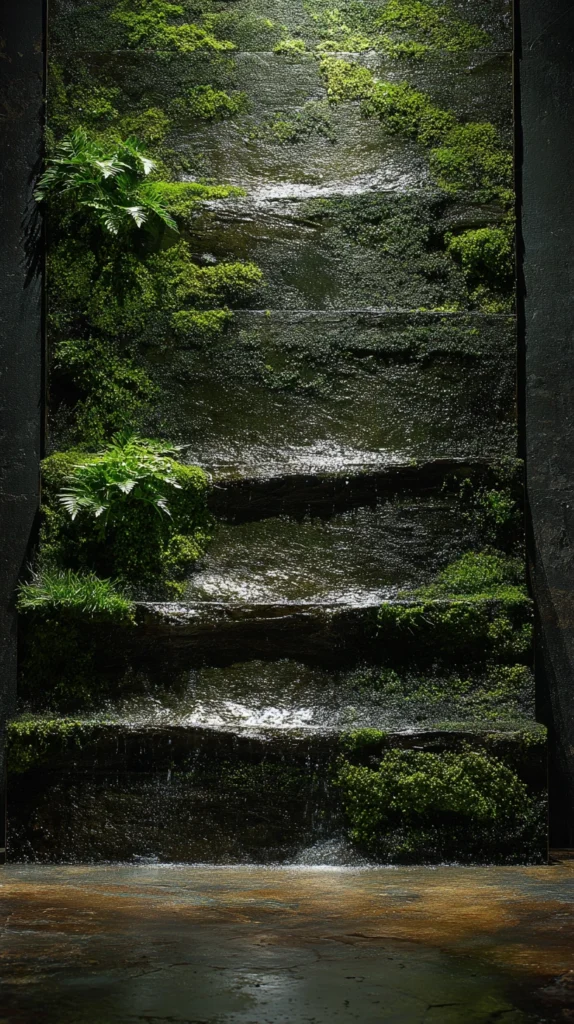
Budget: $200 – $1500
A living waterfall wall — a backing structure planted with moisture-loving mosses, ferns, and creeping plants, kept constantly moist by a water delivery system that trickles water continuously across the planted surface — is the most ecological and the most specifically beautiful waterfall wall format over time. In its first season it reads as a planted wall with water running through it. In its third season, with the mosses and ferns fully established, it reads as a wall that has grown beside a stream for a decade.
A backing structure of wire mesh or a modular planting panel — $50 – $200. Moisture-loving planting — mosses, maidenhair fern, selaginella, and creeping fig — $8 – $20 per plant, fifteen to twenty plants. A water delivery system — drip irrigation tube or a simple pipe with multiple small outlets — $30 – $80. A collection basin at the base — $50 – $200. A pump and plumbing — $60 – $200. Total material cost: $198 – $700 for a living wall that improves every season.
Styling tip: Allow the living moss and fern wall to establish for one full growing season before assessing its aesthetic quality — resisting the urge to add additional planting or modify the water delivery system in the first weeks after installation. A newly planted living wall looks sparse and unconvincing. The same wall in its second season — with the mosses spreading, the ferns unfurling, and the water darkening the surface to a deep, rich green — looks like a feature that has been growing there for years. Patience is the most important building material in a living wall installation.
14. The Infinity Edge Pool Waterfall Wall
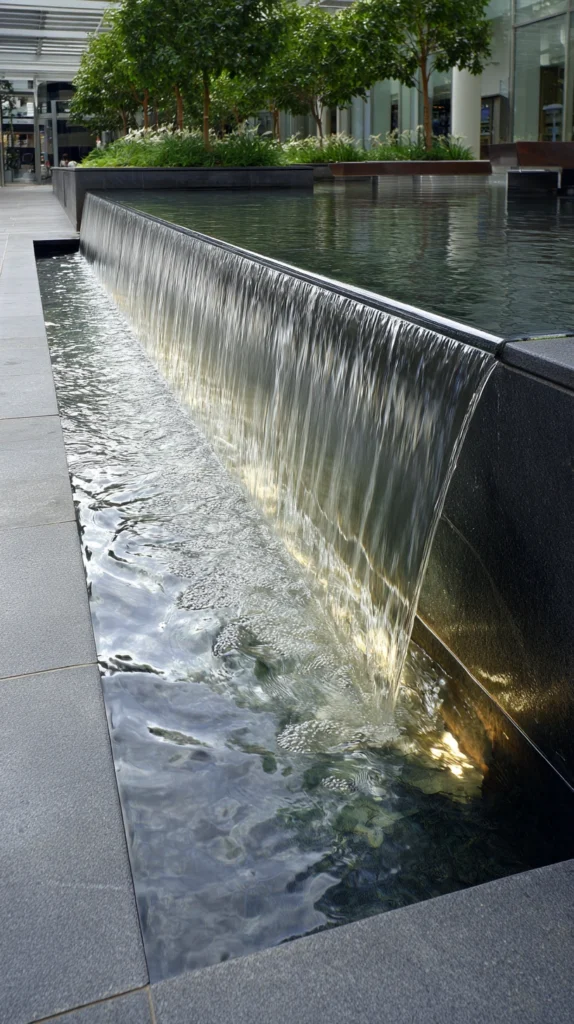
Budget: $5000 – $30000
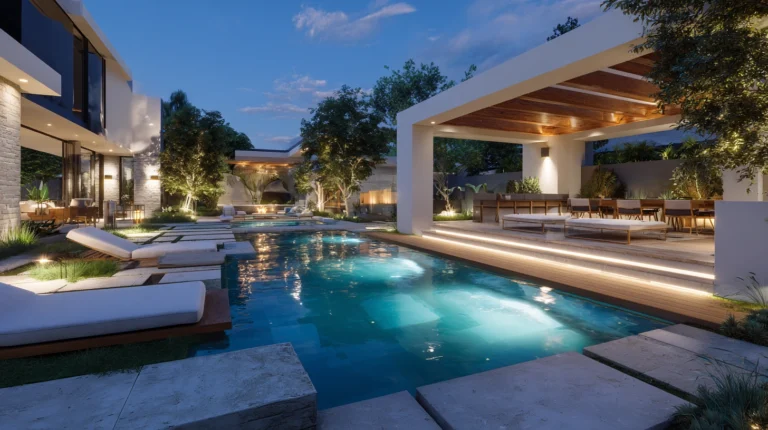
An infinity edge pool waterfall wall — a swimming pool or water feature with one edge at water surface level, the water overflowing in a continuous sheet into a catch basin below and recirculated back to the pool, producing the visual impression of water extending to the horizon while generating a continuous, even waterfall on the pool’s overflow face — is the backyard waterfall wall at its most ambitious, most resort-like, and most architecturally complete. It is not a water feature added to a garden. It is a garden built around a water feature.
An infinity edge pool — $20000 – $60000 for the pool construction. The overflow edge detail and catch basin — $3000 – $8000 additional to the pool construction cost. Underwater and perimeter lighting — $2000 – $8000. Surrounding paving and planting — $2000 – $10000. Total investment: $27000 – $86000 for the most architecturally complete and the most genuinely resort-like backyard water feature available.
Styling tip: Engage a landscape architect rather than only a pool contractor as the primary designer of an infinity edge pool waterfall installation. A pool contractor designs an excellent pool. A landscape architect designs the relationship between the pool edge, the overflow wall, the catch basin, the surrounding paving, the planting, and the spatial organisation of the entire outdoor space — producing an installation that reads as a single, designed outdoor environment rather than a pool placed in a garden. The landscape architect’s fee is the investment that produces the quality difference between those two outcomes.
15. The Fully Designed Waterfall Wall Feature
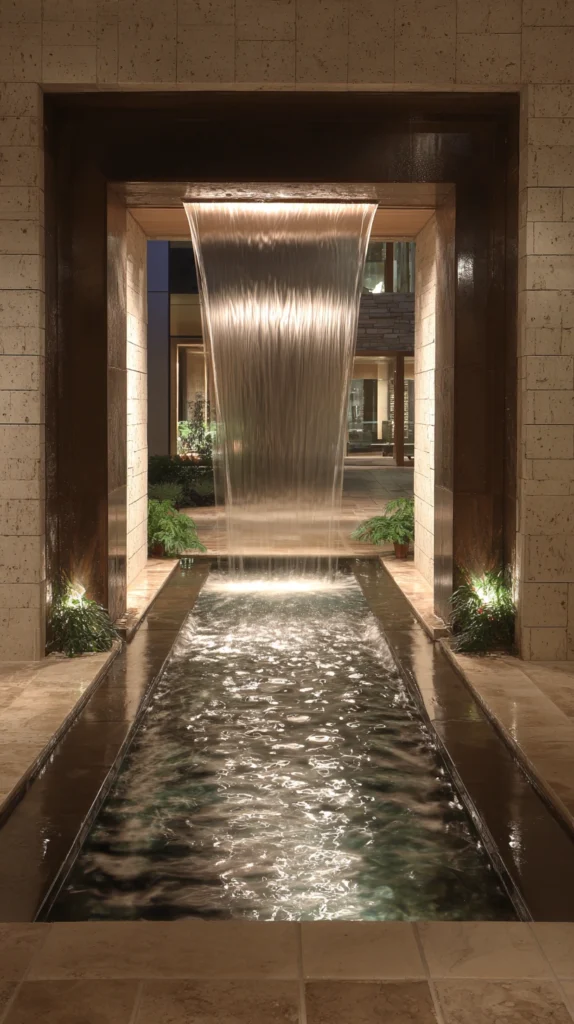
Budget: $2000 – $20000
The fully designed backyard waterfall wall — a corten steel or rendered concrete wall panel of generous width, a precisely engineered water delivery channel ensuring perfectly even distribution across the full wall width, a collection pool with dark interior tile producing a mirror surface at the base, underwater LED lighting creating an evening glow through the falling water, flanking planting of structural species anchoring the wall within the garden, and the wall positioned on the garden’s primary sight line from the house — is a garden feature that transforms the outdoor space from a pleasant garden into a genuinely extraordinary one.
Wall panel and delivery channel: $500 – $2000. Collection pool construction: $500 – $2000. Dark interior pool tiling: $200 – $800. Underwater LED lighting: $200 – $600. Pump and plumbing: $150 – $500. Flanking planting: $200 – $600. Professional design and installation: $500 – $2000. Total investment: $2250 – $8500 for a waterfall wall of genuine design authority.
Styling tip: Commission the water delivery channel as a single precision-fabricated element from a metalwork specialist rather than constructing it from assembled plumbing components. A precision-fabricated delivery channel — whether in stainless steel, copper, or a folded aluminium profile — distributes water perfectly evenly across the full wall width from the first day of operation. An assembled plumbing component delivery system requires adjustment, balancing, and often repeated modification to achieve even distribution. The fabricated channel is the investment that produces the perfectly even water sheet that makes a designed waterfall wall genuinely beautiful — and the difference between an even water sheet and an uneven one is the difference between the water feature of a luxury resort and the water feature of a garden that almost achieved that quality.
A backyard waterfall wall is the garden feature that makes the clearest possible statement about the quality of the outdoor space it inhabits. It says, without ambiguity, that the garden was designed — that water was chosen as a material, that architecture was chosen as a language, and that the outdoor space was given the same level of considered intention that the best interior rooms receive.
Choose the material that belongs to the garden’s existing aesthetic. Build the collection basin correctly and build it to a depth that allows the pump to recirculate the water without running dry in warm weather. Light it from below after dark.
And then stand in the garden at dusk when the water is running and the lights are coming on and the sound of the falling water is the only sound that matters, and understand that a garden with a waterfall wall is a different kind of garden from the one it was before — not more decorated, but more specifically itself.