14 Black Bedroom Ideas That Create a Cozy Luxury Retreat
Black bedrooms scare people.
The assumption is always the same. Too dark. Too cold. Too dramatic for a room where you need to sleep rather than perform. Too risky to commit to in a space you have to wake up in every morning for the next several years.
Every single one of these assumptions is wrong.
A black bedroom done well is not dramatic. It is the most restful room in the house. Not because black is an inherently restful colour, but because a black bedroom done well creates the conditions that sleep genuinely requires. Darkness. Enclosure. The sense of being held by the room rather than exposed to it. The visual quiet that comes from a room where the walls recede completely, and the eye has nowhere demanding to travel.
The hotels that understand sleep best have been using dark bedrooms for years. The boutique hotels where you sleep better than you sleep anywhere. The design hotels where the room itself seems engineered for rest. They are almost always dark.
This is not a coincidence.
Here are 14 ideas that bring that quality home.
Why Black Creates Better Sleep Conditions Than Any Other Wall Colour
The science is straightforward once you know where to look.
Light, including reflected light from brightly coloured walls, suppresses melatonin production. White and pale walls reflect more of the ambient light in a room than dark walls. The bedroom with pale walls is a room that works against your biology in the hours you most need it to cooperate.
Dark walls absorb light rather than reflecting it. In a black bedroom, even a small amount of ambient light, a street lamp through a gap in the curtains, the standby light on a charger, has a fraction of the visual impact it would have in a pale room. The dark walls contain the light rather than amplifying it.

Beyond the biology, a black bedroom creates the psychological sense of enclosure that the evolutionary psychology of sleep prefers. Humans are not designed to sleep in open, exposed spaces. We are designed to seek enclosed, sheltered spaces for rest. A black bedroom with dark walls on every side creates this sense of shelter more effectively than any pale room can. The walls are not there in the way that pale walls are there. They recede, and the bed becomes the entire world.
1. All Four Walls, the Ceiling, and the Trim in the Same Black
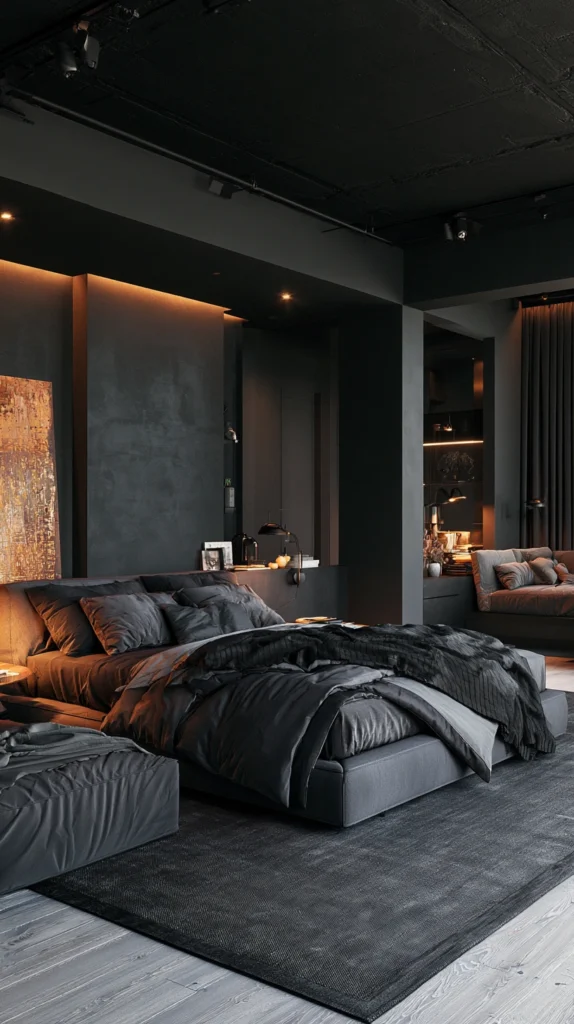
The most common mistake in a dark bedroom is the single dark accent wall.
One black wall and three white walls are not a black bedroom. It is a white bedroom with one dark wall. The contrast between the dark wall and the pale walls emphasises the darkness of the dark wall rather than using the darkness to create enclosure. The room feels half-committed to an idea rather than fully committed to it.
Painting all four walls, the ceiling, and the trim in the same black, or in the same family of very dark tones, creates a completely different experience. The room becomes an envelope. The walls disappear. The bed and the objects in the room float in darkness rather than being displayed against a coloured surface.
This is the single most important decision in creating a black bedroom that genuinely works. Partial commitment produces a room that looks like someone started a black bedroom and lost their nerve. Full commitment produces a room that guests stop in the doorway to appreciate before stepping inside.
The paint finish matters enormously. Matte or dead-flat finish on every surface. Matte black absorbs light and feels warm and enveloping. Eggshell or satin black reflects light and feels hard and cold. The same black paint in a matte finish versus a satin finish creates entirely different rooms.
Why full commitment to black throughout is the essential first decision:
- Four walls in the same dark tone create an enclosure that a single accent wall cannot achieve
- The ceiling painted in the same dark tone removes the visual interruption that a white ceiling creates
- Matte finish throughout absorbs light and feels warm rather than reflecting it and feeling cold
- The trim in the same colour creates a seamless envelope where walls, ceiling, and woodwork read as one surface
- Objects in the room float rather than being displayed against a background
- The room reads as a designed decision rather than a decorating experiment
2. Warm Brass and Gold Hardware That Glows Against the Dark

The hardware choice in a black bedroom has a larger visual impact than it would have in a pale room.
In a pale room the door handle, the light switches, the mirror frame, the drawer pulls, are details that register at close range. In a black room every piece of hardware glows against the dark background like a lit element. They are visible across the room. They provide the warm points of interest that the dark walls cannot.
Warm brass and gold are the hardware finishes that work best against deep black. The warm, orange-toned warmth of unlacquered brass developing its patina. The consistent warmth of satin or brushed brass. The richer, deeper tone of antique gold. All of these warm metallic tones set against black create a combination of extraordinary richness.
The key word is warm. Chrome and polished nickel are too cool against black. They add a clinical, hard quality that undermines the warmth and enclosure that the black bedroom is trying to create. Matte black hardware on black walls disappears entirely. Warm brass glows and contributes every time it catches light.
Apply the hardware principle consistently. Every door handle in the room. Every light switch plate. The mirror frame. The pendant light fittings. The curtain pole and rings. The drawer pulls and wardrobe handles. Consistent warm brass throughout creates a composed, considered room. Mixed hardware finishes in a black room create visual inconsistency that is more apparent than it would be in a lighter room.
3. A Bed That Demands the Space
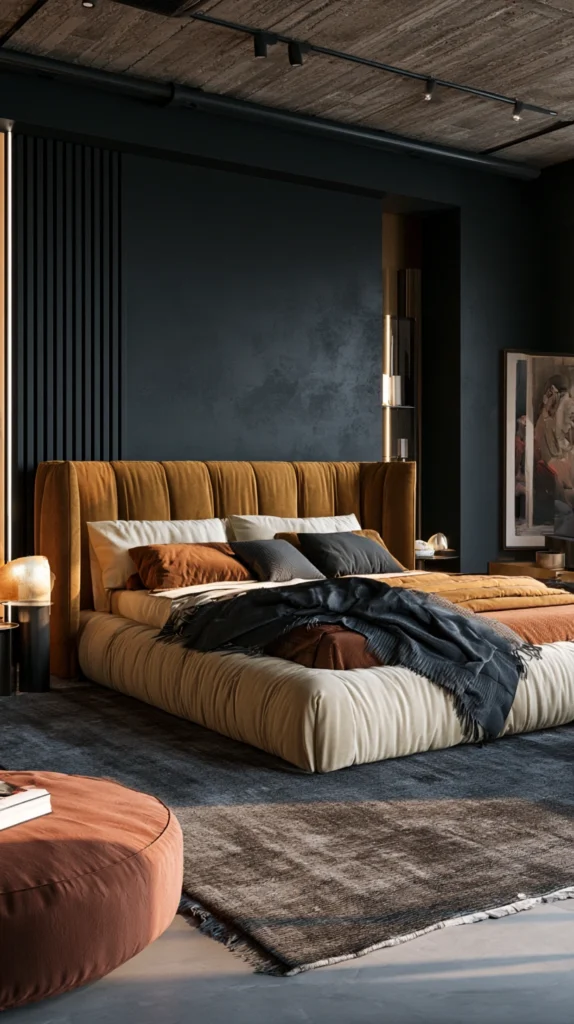
In a black bedroom the bed is the only thing fully visible.
Everything else recedes. The walls disappear. The ceiling disappears. The floor is mostly covered. The bed is the single prominent element in the room and it should be chosen accordingly.
A bed that would be merely adequate in a pale room becomes inadequate in a black room where it is the primary visual object. The bed needs to be generous in its proportions, interesting in its form, and beautiful in its material to carry the visual weight the black bedroom places on it.
An upholstered bed in a warm tone does several things simultaneously in a black bedroom. It provides the prominent, beautiful object the room requires. It introduces a warm colour that contrasts with and warms the surrounding darkness. And the upholstered surface creates a textural warmth that the black walls cannot provide.
The upholstery colour for a black bedroom should lean warm. Cream and oatmeal linen. Warm bouclé in a natural or caramel tone. Deep velvet in a cognac or caramel that adds warmth rather than competing with the darkness. Dusty pink velvet that provides a surprising and beautiful warmth against deep black.
The headboard specifically should be generously proportioned. In a room where the walls are dark and the bed is the visual destination, a headboard of modest height and width looks undersized. A headboard that reaches toward the ceiling, or at least significantly above the pillows, creates the vertical presence the room needs.
4. Layered White and Cream Bedding for Maximum Contrast
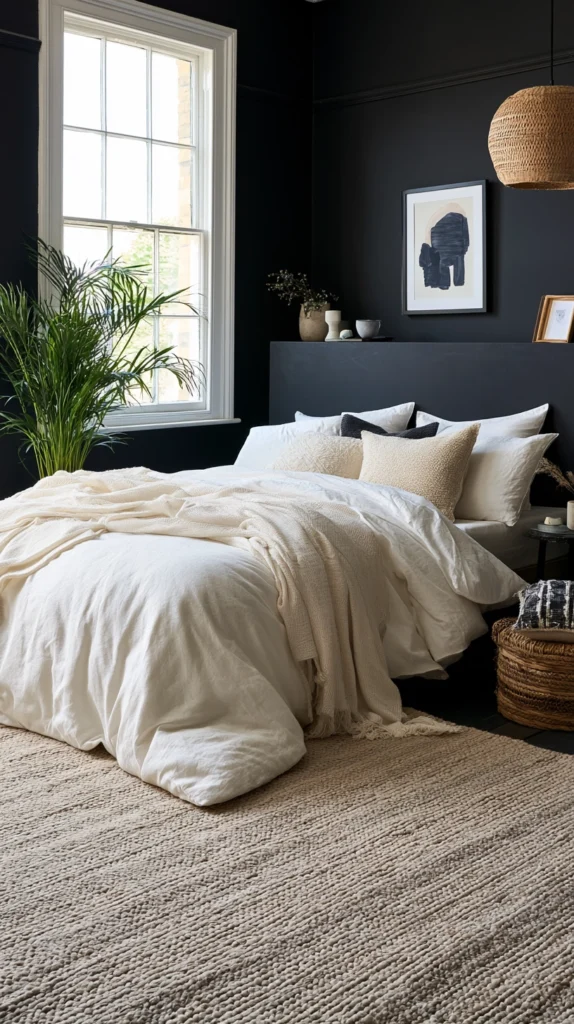
The bedding in a black bedroom is the room’s primary statement of contrast and warmth.
The darkness of the walls needs the relief of the bedding to create balance rather than overwhelm. White and cream bedding against black walls is one of the most beautiful and most photographed combinations in contemporary bedroom design. The contrast is complete and immediate. The white reads as luminous against the dark.
But it is the layering of the white and cream bedding that creates warmth rather than merely contrast.
A white linen fitted sheet. A cream linen duvet cover with the slightest texture in the weave. A white cotton blanket folded across the foot of the bed. A cream knit throw draped over one side. Pillows in white, cream, and natural linen mixed in different sizes. A single accent cushion in a warm tone, caramel leather, dusty terracotta, cognac velvet, that adds the colour note the all-white layering does not provide.
This layering communicates warmth even before anyone touches the bed. The eye reads the accumulated softness of multiple layers and the brain translates it as warmth. The black room with a lavishly layered white bed is one of the most inviting bedroom compositions available.
5. Warm Amber Lighting That Makes the Darkness Glow
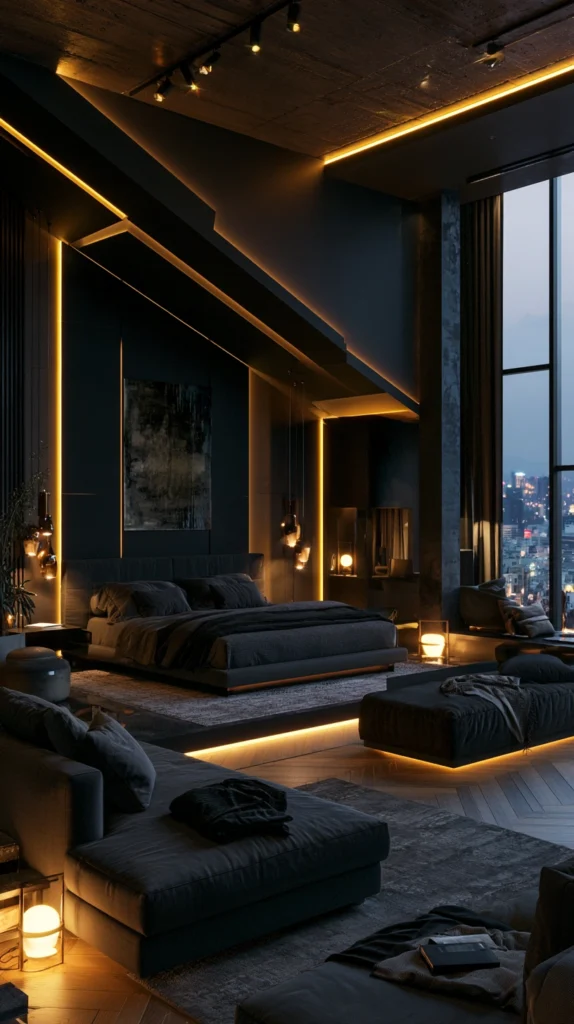
The lighting in a black bedroom is more important than the lighting in any other bedroom.
In a pale bedroom poor lighting is unfortunate. In a black bedroom poor lighting is catastrophic. The wrong light in a black room makes it feel cold, oppressive, and genuinely unpleasant. The right light makes it feel like the most beautiful and most restful room in the house.
The right light is warm. Not slightly warm. Extremely warm. The warmest available LED bulb temperature, 2200K, creates light the colour of candlelight. In a black room, this candlelight-coloured light creates warmth that the dark walls cannot generate from reflected ambient light because they are absorbing rather than reflecting.
Multiple small light sources rather than a single overhead fitting. A pendant light on either side of the bed in place of bedside table lamps creates warm pools of light at exactly the right height and position for reading and ambient illumination. A floor lamp in one corner of the room creates a pool of warmth in that corner that makes the room feel inhabited rather than simply lit. A small table lamp on the dresser. LED strip lighting behind the headboard or beneath the bed frame, creating a warm halo effect.
None of these individual light sources should be bright. The total light level in a black bedroom at the evening operating level should be genuinely low. The warmth of the colour temperature compensates for the lower lumen output. The room should feel like it is lit by a combination of candles and very warm lamps at different heights, which is almost exactly what it should be lit by.
6. Dark Wood Furniture That Disappears Into the Walls
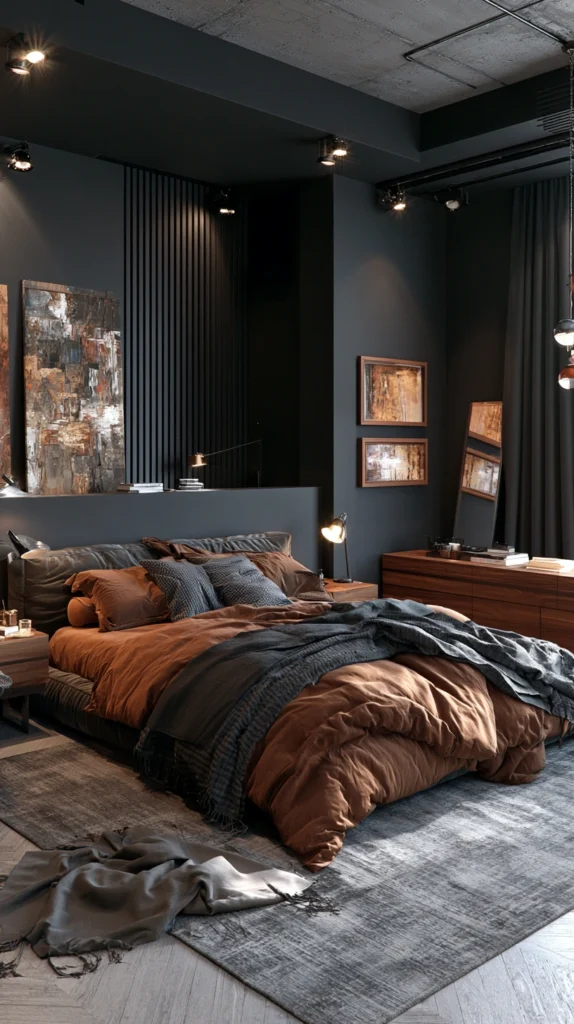
The furniture choice in a black bedroom creates either a seamless, immersive experience or a series of competing planes.
Dark furniture in a black room merges with the dark walls in a way that eliminates the furniture as a visual presence. The bed remains visible because of the bedding. But a dark bedside table, a dark low dresser, a dark wardrobe with minimal door detail, all recede into the surrounding darkness and the room feels more spacious rather than more furnished.
This counterintuitive effect, that dark furniture in a dark room creates a more spacious feeling than contrasting furniture, works because the eye reads multiple tones as multiple planes and multiple planes as multiple surfaces. When the furniture is a similar dark tone to the walls, the eye reads them as one continuous dark field and the bed, the bedding, and the hardware float within it rather than being displayed against a composed background of multiple dark and light planes.
Walnut is the dark wood that works best in a black bedroom. Its warm reddish-brown tone is dark enough to recede toward the black walls while warm enough to prevent the room from feeling cold. Ebonised oak provides an almost-black that fully disappears into dark walls. Painted furniture in the same black as the walls creates the most seamless possible integration.
7. A Faux Fur or Sheepskin Throw That Adds Animal Warmth
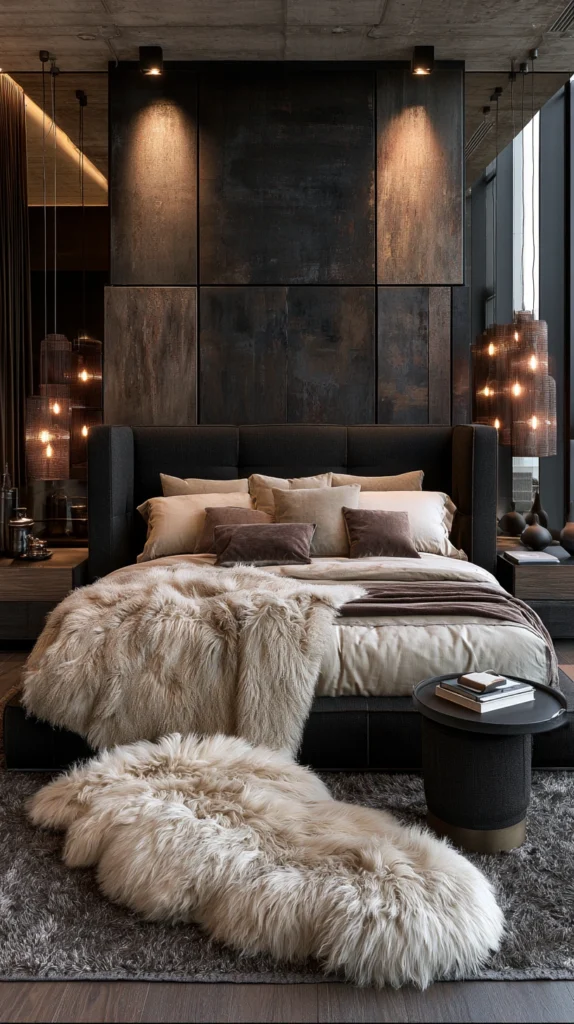
The faux fur throw is the single most powerful gesture toward warmth in a black bedroom.
Its effect is disproportionate to its size. Draped across the foot of the bed or layered over one corner of the bedding, a generous faux fur throw in cream, ivory, or warm grey communicates warmth in a way that no other textile quite matches. The eye reads fur as warm. Genuinely, instinctively, immediately.
In a black bedroom where the challenge is creating warmth within darkness, the faux fur throw does more work per centimetre than any other accessory. It makes the bed look like somewhere you would lie down and not move from for several hours. It makes the dark room feel like a shelter from the cold rather than an exposure to it.
Quality faux fur that genuinely resembles real fur in its thickness, depth, and soft movement is significantly more effective than thin, plasticky alternatives that read as synthetic from across the room. The investment in quality faux fur for a black bedroom is one of the highest-impact accessory investments available in any bedroom context.
8. Mirrors That Multiply the Warmth
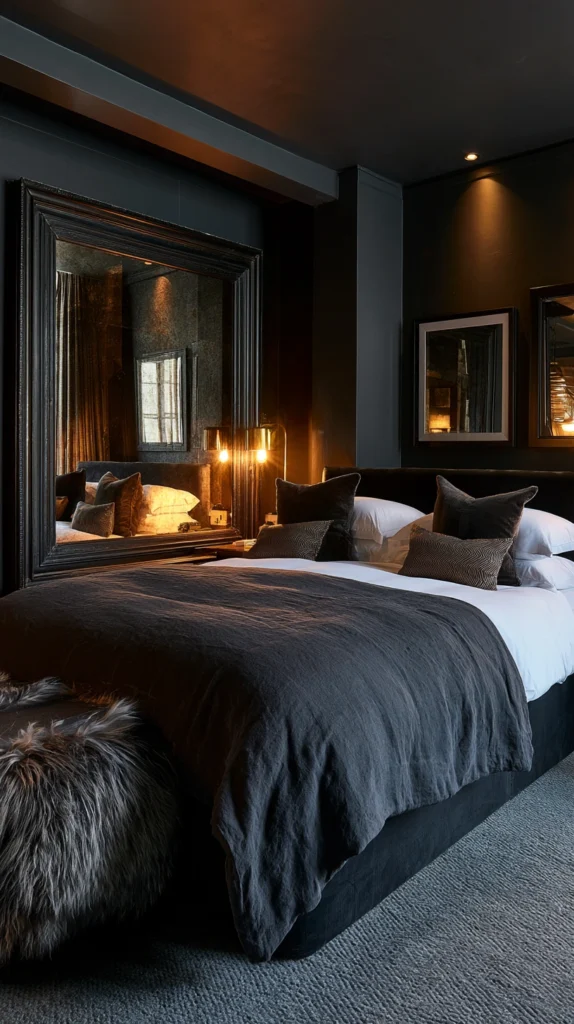
The mirror in a black bedroom serves a different primary function from the mirror in a pale bedroom.
In a pale bedroom the mirror adds light. It reflects the ambient light and the natural daylight, making the room appear brighter and larger.
In a black bedroom the mirror adds warmth. It reflects the warm amber light of the lamps and the glow of the bedding and the bed. It doubles the visual warmth of the room rather than the visual brightness. The mirror in a black bedroom shows you a room with two warm lamp glows, two pale beds floating in darkness, two reflections of the brass hardware catching light. The room appears more richly furnished than it actually is.
Position mirrors to reflect the warm light sources rather than the windows. A mirror reflecting an east-facing window in the morning brings cool, blue-toned morning light into a room that benefits from warm tones. The same mirror reflecting a warm bedside lamp in the evening creates an additional warm pool of light on the opposite wall.
An ornate, dark-framed mirror that blends into the wall behind it adds depth without adding a prominent pale rectangle to the dark room. An antique mirror with a slightly foxed surface reflects light in a less precise, more atmospheric way than a sharp modern mirror. Both are more appropriate in a black bedroom than the bright, clear glass of a standard contemporary mirror.
9. Velvet Curtains That Fall Floor to Ceiling
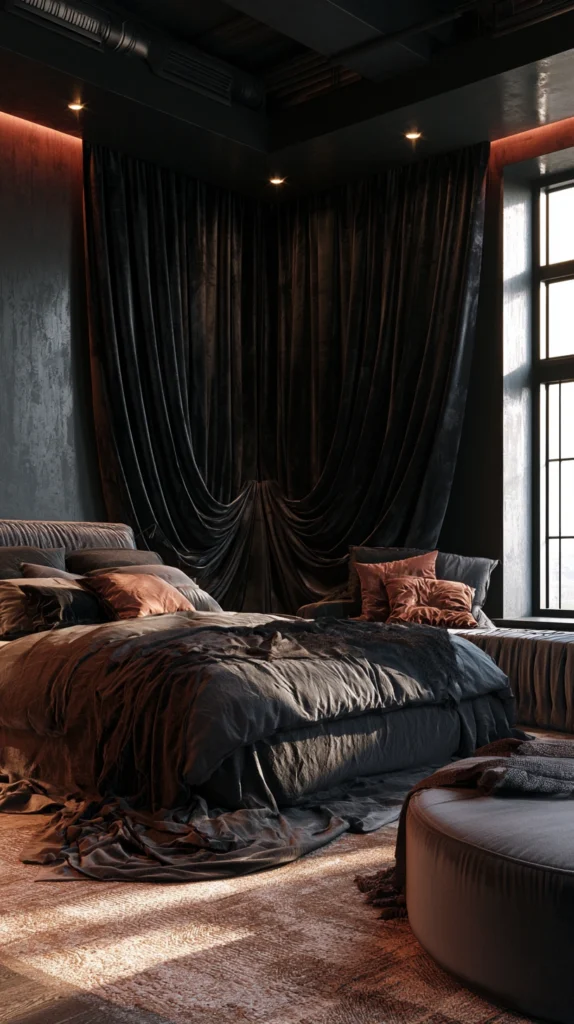
Curtains in a black bedroom should fall from ceiling to floor in a generous, slightly puddling drop of the heaviest available fabric.
Velvet is the fabric that achieves the most in a black bedroom context. Its pile absorbs and reflects light simultaneously, depending on the angle of view. It creates genuine warmth in its visual weight and its physical texture. It provides excellent light blocking and sound insulation as functional benefits beyond its visual contribution.
The curtain colour in a black bedroom can go one of two directions with equal success. Curtains in the same deep black as the walls create a completely seamless envelope. The curtains and walls read as one continuous dark surface and the window disappears when the curtains are drawn. The room becomes entirely contained.
Curtains in a contrasting warm tone, deep emerald, forest green, midnight navy, deep burgundy, introduce a colour element into the room that enriches the dark palette without breaking the enveloping quality of the black walls. The warm-toned velvet curtains against black walls create the kind of jewel-box richness that makes a room genuinely spectacular rather than merely dramatic.
The practical specification for curtains in any bedroom is full blackout. In a black bedroom where light control is already a design priority, blackout curtains are non-negotiable. The combination of dark walls and blackout curtains creates a sleep environment where light intrusion is as close to zero as any room can achieve outside a sleep clinic.
10. A Gallery Wall in Warm Dark Frames
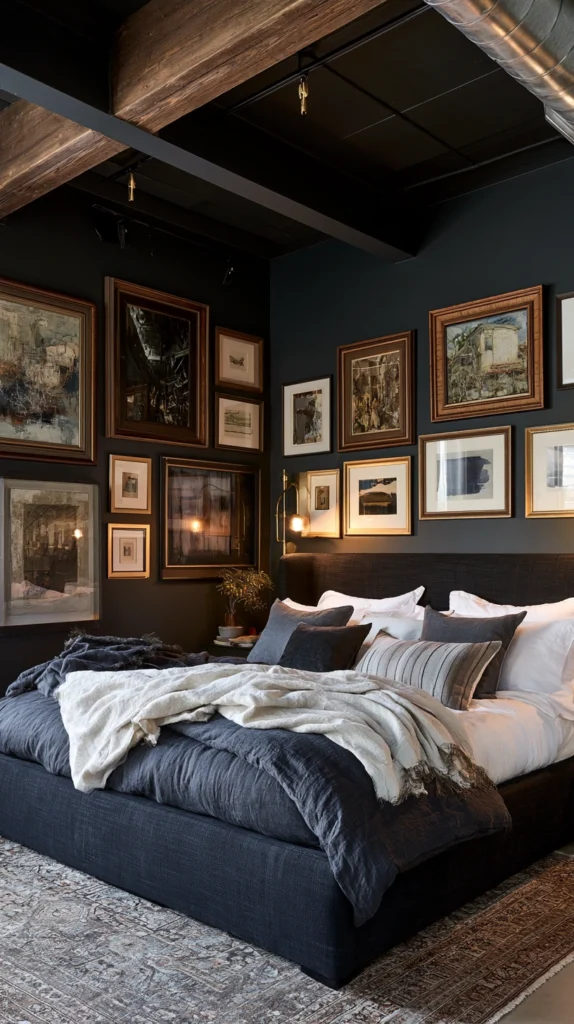
Artwork in a black bedroom needs specific consideration.
The pale-walled bedroom displays artwork against a neutral background and the artwork is the visual event. In a black bedroom the dark wall is already visually present and the artwork needs to contribute to and complement that presence rather than competing with it.
A gallery wall of artwork in dark, warm frames, the frames close in tone to the wall colour rather than contrasting with it, creates an installation where the art is visible and present without the frames interrupting the dark envelope of the room. The art floats at a slightly different depth than the wall surface. The frames disappear into the wall. The images exist independently.
Choose artwork with warm tones rather than cool ones for a black bedroom. Photographs with golden light. Paintings with warm palettes. Abstract works where the colour relationship is between warm and neutral rather than between cool and pale. The warm content of the artwork echoes the warm hardware and the warm bedding and contributes to the overall warmth of the room rather than introducing cool tones that would feel disconnected.
Black and white photography in black frames on a black wall is the most seamless gallery wall possible. The frames disappear. The photographs exist in the dark wall like windows into light-filled scenes. The contrast between the photographic content and the surrounding dark is extraordinary.
11. A Scented Candle or Diffuser That Completes the Sensory Experience
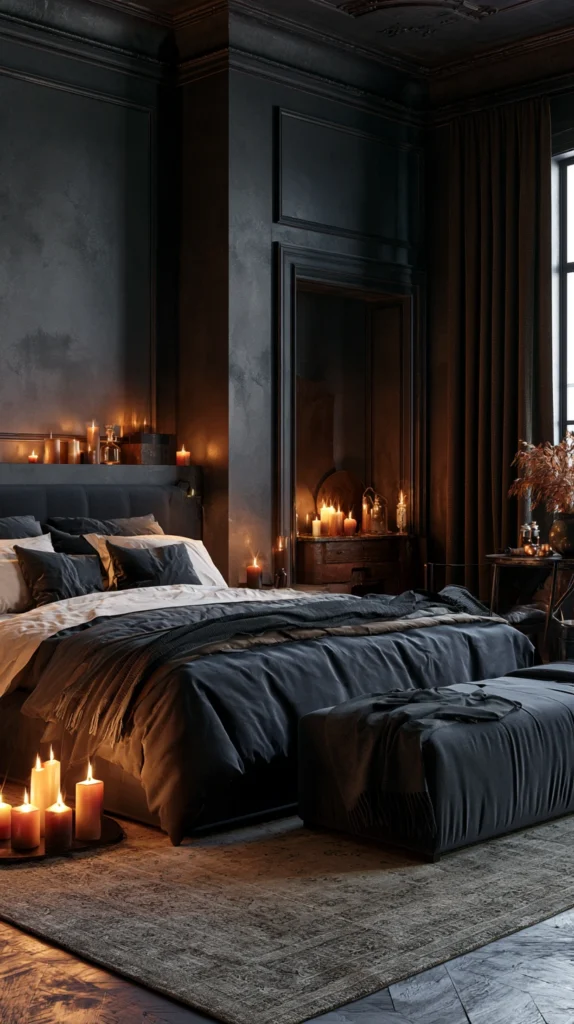
The black bedroom designed for rest and luxury should engage every sense.
The visual elements, the dark enveloping walls, the warm light, the layered bedding, handle the visual dimension of the sensory experience. Scent handles the rest in a way that no visual element can replicate.
The right scent in a black bedroom amplifies the sense of luxury and retreat that the design creates. A deep, warm, woody fragrance. Sandalwood. Cedar. Amber. Vetiver. The scents associated with dark, resinous woods and warm, protected spaces, rather than the floral and citrus scents that suit lighter, more open interiors.
A single quality scented candle on the bedside table, lit in the evening when the lamps are on and the room is at its most beautiful, completes the sensory experience of the black bedroom in a way that no amount of additional visual design can equal.
The scent carries the memory of the room. Guests who stay in a black bedroom with a specific scent associate that scent with the room and with the quality of sleep they experienced in it. They may not consciously register the connection, but the memory is there.
12. Plants That Bring Life Into the Darkness
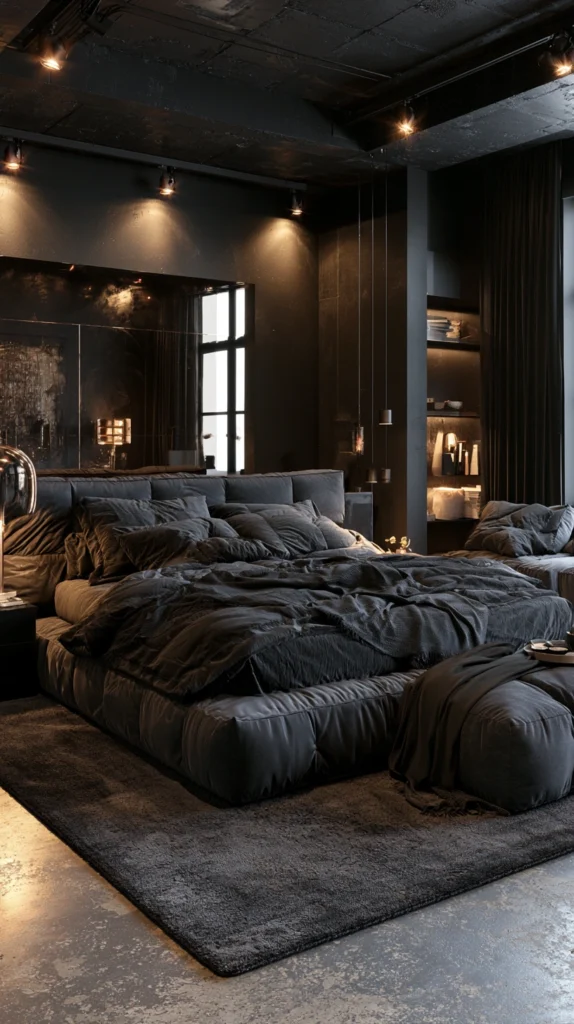
A black bedroom without plants can feel beautiful but static. Like a stage set between performances rather than a room where life happens.
Plants in a black bedroom are the living element that prevents the room from feeling inert. They bring actual life, actual growth, actual oxygen into the most designed of environments and the result is a room that feels inhabited and vital rather than merely composed.
The visual effect of plants against black walls is extraordinary. The green of leaves against dark backgrounds is vivid in a way that the same green against pale walls is not. The contrast is maximum and the leaves appear almost luminous. A large monstera in the corner of a black bedroom with a warm lamp directed at it from below creates a shadow play on the wall that no painted or hung element can replicate.
Choose plants that tolerate bedroom conditions. Low light if the room has a north-facing window or heavy curtains. Irregular watering if the bedroom is used primarily for sleep rather than regular activity. Pothos and philodendrons handle both conditions with equanimity. A ZZ plant handles very low light and irregular watering better than almost any other houseplant.
The plants should be large enough to register as presences in the room rather than accessories on a surface. A small succulent on a bedside table is a decoration. A large plant in the corner is a companion. The black bedroom benefits from the latter.
13. A Dark Rug That Grounds the Bed and Adds Texture
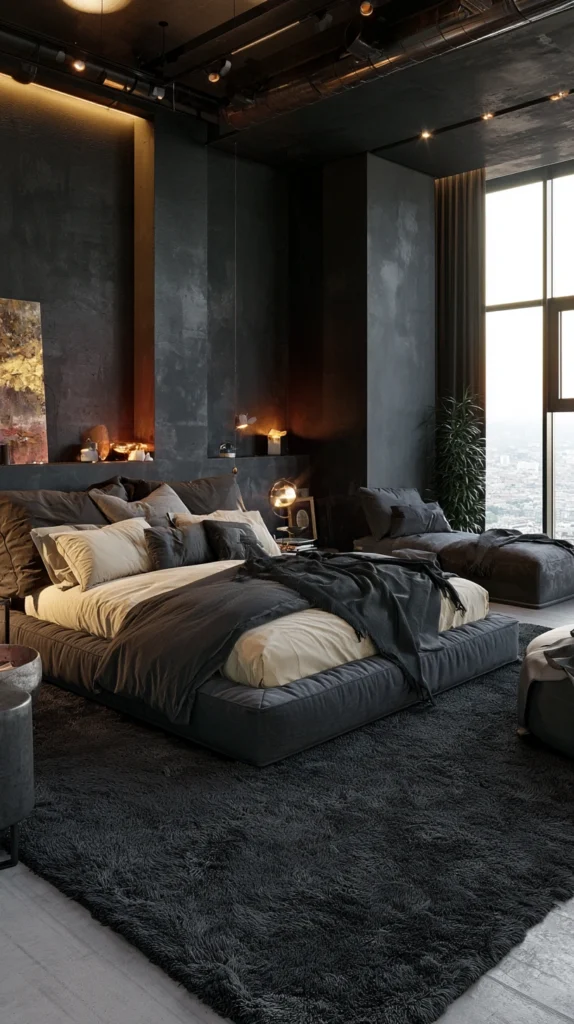
The floor of a black bedroom should participate in the dark envelope rather than interrupting it.
Pale flooring in a black bedroom creates a visual contrast between the dark walls and ceiling and the pale floor that undermines the enveloping quality of the room. The eye tracks from dark to pale and back to dark and the room reads as having a different floor from its walls rather than as a continuous dark space.
A dark rug in deep charcoal, near-black, or a very deep warm tone placed under and around the bed grounds the sleeping area and extends the dark palette down to the floor level. The rug does not need to be the same tone as the walls. A deep navy, a rich forest green, a warm dark brown, all of these extend the dark palette without requiring a perfect colour match to the walls.
The texture of the rug contributes warmth that the visual darkness of the room does not always provide. A thick pile rug with a visible shag texture. A woven wool rug with a complex, rich surface. A sheepskin rug on the floor beside the bed that is encountered first in bare feet each morning. The tactile warmth of the floor texture is part of the bedroom experience even if it is never consciously registered.
14. A Reading Nook or Chair That Makes the Room More Than a Bed
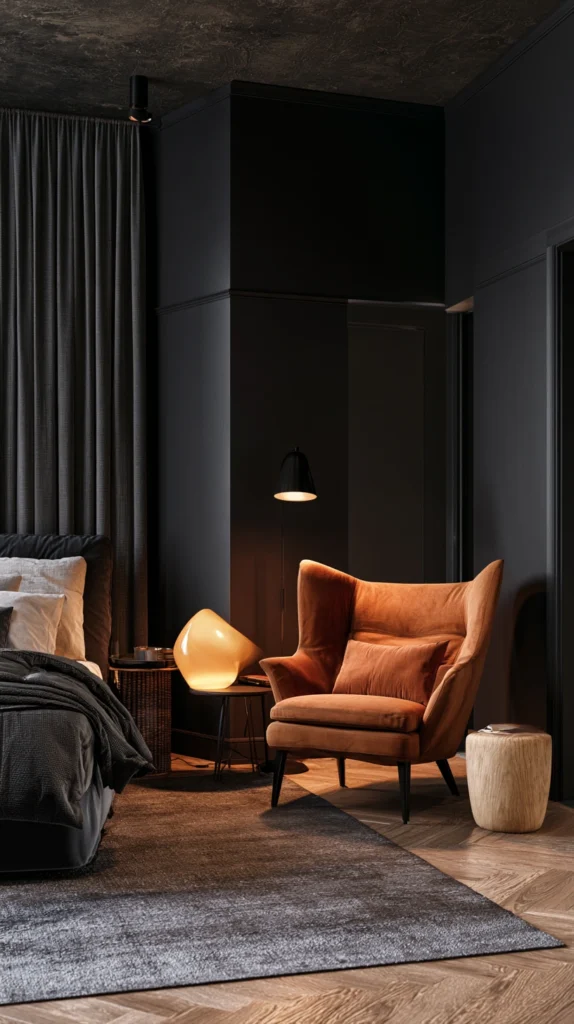
The bedroom that contains only a bed is the bedroom with one purpose.
The bedroom that contains a chair, a reading lamp, and a small side table beside the chair is a room with two purposes and a room that feels more genuinely like a retreat.
In a black bedroom the reading chair positioned in a corner with a warm floor lamp behind it and beside it creates a pool of warmth and activity that makes the room feel lived in and used in the way that only a sleeping space is not. The chair is where the evening hour before sleep happens. The book is read there. The journal is written there. The cup of tea is consumed there before the light goes off.
A low-slung armchair in a warm, textured upholstery. Bouclé. Worn leather. Heavy linen in a warm tone. The chair should be comfortable enough for extended sitting without being so comfortable that it is in competition with the bed for sleep induction.
A floor lamp beside the chair in the same warm amber temperature as the rest of the room’s lighting. A small side table for the book, the tea, the phone. These three elements, chair, lamp, table, create the room within a room that makes a black bedroom genuinely a retreat rather than simply a beautifully decorated sleeping space.
How to Choose the Right Black for Your Bedroom
Not all blacks are the same and the specific black chosen for a bedroom makes a significant difference to the finished result.
Pure blacks with no undertone at all can feel cold and industrial in a room designed for warmth. The blacks that work best in bedrooms are blacks with warm undertones. A black with brown or red undertones warms the room in a way that a pure cool black does not. A very dark charcoal with warm undertones provides the depth of black with a quality of warmth that pure black sometimes lacks.
Farrow and Ball Railings is a very dark navy-black that reads as near-black in most lighting conditions while having the warmth that a pure black lacks. Off-Black from the same range is slightly warmer still. Hague Blue at its darkest has the depth of black with the organisational warmth of navy. Little Greene’s Obsidian is one of the warmest near-blacks available.
Test the chosen black in the actual room in the actual light conditions of the room before committing to the full paint order. A black that reads as perfectly warm in daylight may read as cold in the lamplight that the bedroom primarily uses in the evening. A black that seems almost purple in daylight may become exactly right in warm amber lamplight.
Common Mistakes in Black Bedroom Design
Using cool white lighting. The single most common error. Cool white light in a black room creates an alienating, clinical experience rather than the enveloping warmth the room is designed to provide. Every bulb must be warm. No exceptions.
Painting only one wall. As discussed at length. The black accent wall is not the black bedroom. Full commitment is the only commitment that creates the enveloping quality the design requires.
Using white curtains against black walls. A white curtain panel in a black room is a bright rectangle that draws the eye immediately and interrupts the dark envelope. The curtains should be dark or very warm in tone.
Choosing shiny or satin paint finishes. The reflection of ambient light from shiny surfaces in a black room is cold and unflattering. Matte on every surface.
Not planning the lighting infrastructure before painting. A black room cannot tolerate exposed cable runs, poorly positioned fixtures, or the improvised lighting additions that work in a pale room. Plan and install every light fitting before the final paint goes on.
Under-investing in the bedding. In a room where the bedding is the primary visual event, thin, flat, cheap bedding communicates exactly its own qualities. The bedding budget in a black bedroom should be the room’s largest single accessory investment.
Forgetting about morning. The black bedroom that is spectacular in the evening may be unwelcoming in the morning if it provides no access to natural light. The right curtain treatment for a black bedroom is blackout through the night and fully drawn back during the day to let in whatever natural light is available.
Quick Summary
- Paint all four walls, ceiling, and trim in the same matte black for the complete envelope that a single accent wall cannot create
- Warm brass and gold hardware glows against the dark walls as the room’s primary points of metallic warmth
- An upholstered bed in a warm tone is the primary visual object in the room and must be beautiful enough to carry that weight alone
- Layered white and cream linen bedding provides the contrasting warmth that the dark room requires, and the brain reads as deeply inviting
- 2200K warm amber lighting from multiple small sources at different heights creates the glow that makes darkness feel warm rather than cold
- Dark wood furniture that recedes toward the wall tone creates a more spacious, immersive room than contrasting furniture would
- A quality faux fur throw on the bed communicates warmth with a disproportionate impact relative to its size
- Mirrors positioned to reflect warm light sources double the warmth of the room rather than its brightness
- Velvet curtains in black or a warm jewel tone falling from ceiling to floor with full blackout lining complete the envelope and the sleep environment
- A gallery wall in dark warm frames creates art that floats within the wall rather than interrupting the dark surface
- A warm, woody scented candle lit in the evening completes the sensory luxury of the room beyond its visual design
- Large plants in the corners of a black bedroom bring life, contrast, and shadow play that the most designed static elements cannot
- A dark rug under the bed extends the dark palette to floor level and provides the tactile warmth of texture underfoot
- A reading chair with a warm floor lamp creates the room within the room that makes the bedroom a genuine retreat rather than only a sleeping space
- Choose blacks with warm undertones rather than pure cool black and always test in the actual room under actual lighting conditions
- Every bulb must be warm, the finish must be matte, and the curtains must never be white
The black bedroom is not a risk.
It is the most committed version of what a bedroom is supposed to do.
Hold you. Shelter you. Make the act of being in bed feel like the best place in the world to be.
Dark walls. Warm light. Deep bedding.
Stop being scared of it.
You will sleep better than you ever have.