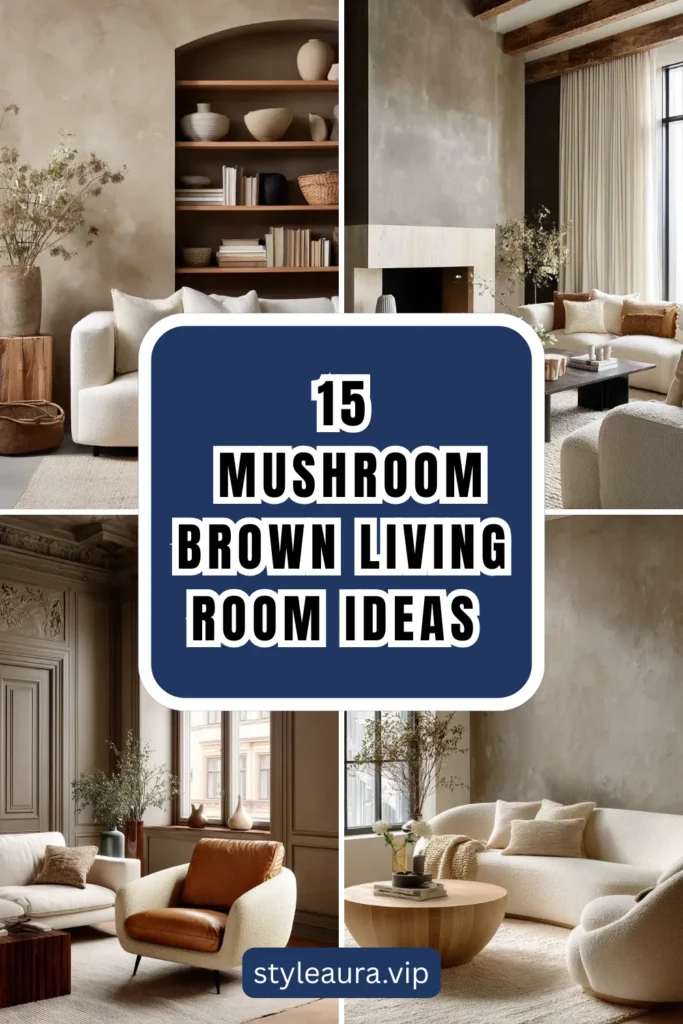
15 Mushroom Brown Living Room Ideas for Quiet Luxury
There is a colour that sits between brown and grey and beige and belongs entirely to none of them — a colour with the warmth of earth and the restraint of stone and the specific quality of a room that does not need to announce itself to communicate that it was considered. Mushroom brown is that colour.
It is the colour of the inside of a walnut shell, of undyed linen left in afternoon light, of the specific grey-brown of a stone floor in a French farmhouse that has been walked on for two hundred years. It communicates luxury not through richness or saturation but through the specific quality of a tone so carefully calibrated that it reads as natural rather than chosen — and yet could only have been chosen.
The fifteen ideas below cover every element of the mushroom brown living room — from the foundational wall decision to the finishing textile and object details that produce the specific quality of quiet luxury that no louder colour can replicate.
1. The Mushroom Brown Wall Foundation
Budget: $40 – $200
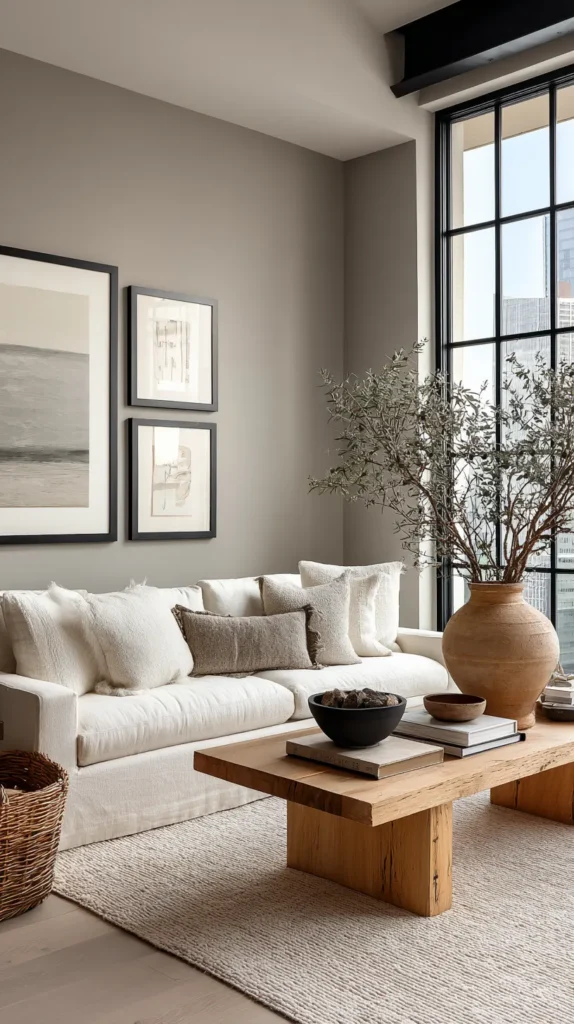
The mushroom brown living room begins with a wall colour of genuine subtlety — not a brown that reads immediately as brown, not a beige that reads immediately as beige, but the specific grey-brown-taupe of a tone that shifts in different light throughout the day.
In morning light it reads cooler, almost grey. In the warm light of the evening lamp it deepens toward a rich, earthy brown. This quality of colour that changes with the light is the defining characteristic of a true mushroom brown and the quality that makes the room feel alive rather than simply painted.
A quality flat or eggshell paint in a mushroom brown tone — $20 – $50 per litre. A standard living room requires three to four litres for full coverage — $60 – $200.
Decor tip: Test the mushroom brown paint sample on the largest wall in the room and observe it at three different times — morning light, midday, and evening lamp light — before committing. A colour that reads as the correct mushroom brown in all three conditions is the correct colour. A colour that reads as too grey in one condition or too beige in another has not found the balance that mushroom brown requires.
2. The Limewash or Textured Wall Finish
Budget: $80 – $400
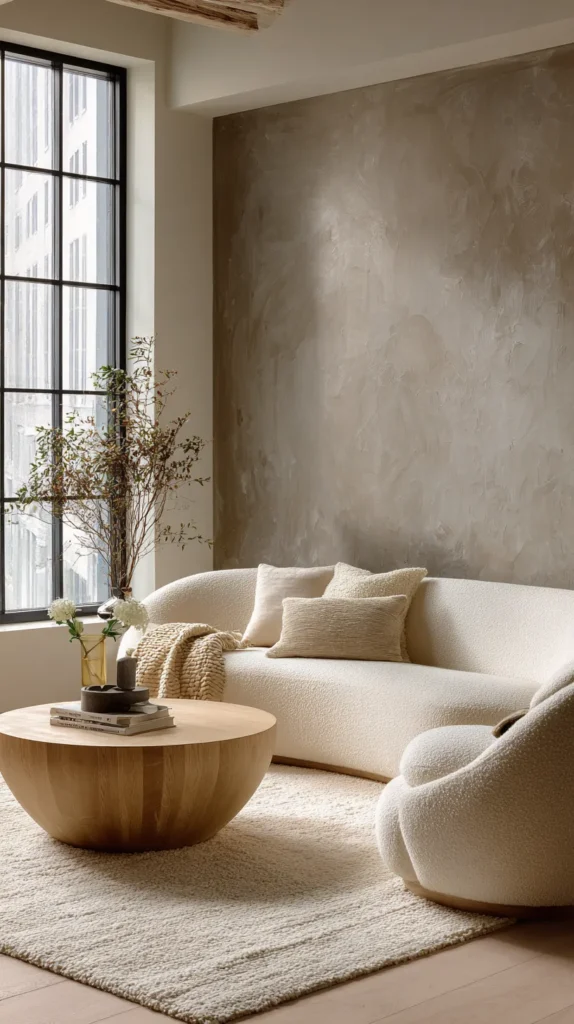
A mushroom brown applied in a limewash or textured plaster finish rather than a standard emulsion gives the living room wall its most specifically luxurious surface quality — the soft, slightly variegated texture of a limewash finish producing the specific quality of depth and movement that a flat paint, however beautiful its colour, cannot replicate.
Limewash paint in a mushroom brown tone — $30 – $80 per litre, requiring slightly more than standard paint for the technique’s characteristic layered application. A Venetian plaster or tadelakt finish in mushroom brown — $40 – $100 per square metre professionally applied.
A standard living room in limewash paint — $90 – $320 in materials. The limewash wall communicates quiet luxury at the most foundational level — the wall itself becoming a surface of material interest rather than simply a backdrop.
Decor tip: Apply limewash in the traditional crossed-brush technique — two coats applied in opposing diagonal directions — rather than in straight horizontal or vertical strokes. The crossed application produces the characteristic soft variation of tone that communicates genuine limewash; straight strokes produce a streaked effect that communicates a paint technique rather than a wall finish.
3. The Linen Sofa in a Warm Neutral
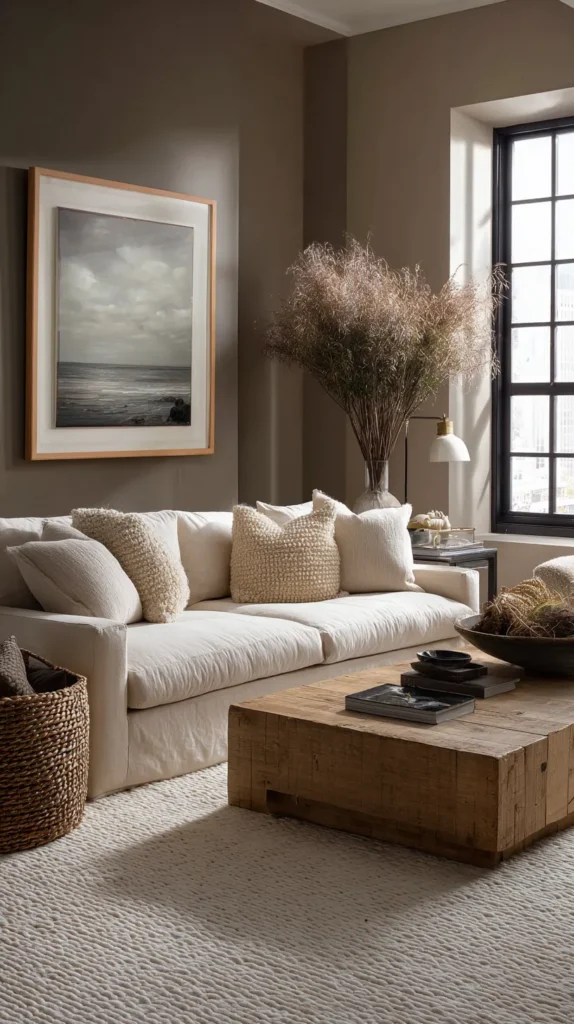
Budget: $400 – $2,500
A sofa in natural linen or a linen-blend fabric — in a tone one shade lighter or one shade deeper than the mushroom brown wall — is the mushroom brown living room’s most significant single investment and the piece that most completely communicates the quiet luxury of the tonal, considered neutral interior.
Linen upholstery has the specific quality of texture visible at close range and tonal depth visible from across the room — the slight variation of the woven surface catching light in a way that a plain weave or a velvet cannot.
A linen-upholstered sofa in a warm neutral tone — $600 – $2,000. A linen-blend version at a more accessible price point — $400 – $1,200. A loose linen slipcover on an existing sofa — $150 – $400.
Styling tip: Choose a sofa in a linen tone that is either warmer or cooler than the wall by one perceptible step — a warmer cream linen against a cooler mushroom wall, or a slightly deeper taupe linen against a warmer mushroom wall. The slight tonal difference between the sofa and the wall communicates a considered relationship between the two; a sofa in the exact same tone as the wall communicates a room that disappears.
4. The Layered Neutral Textile Story
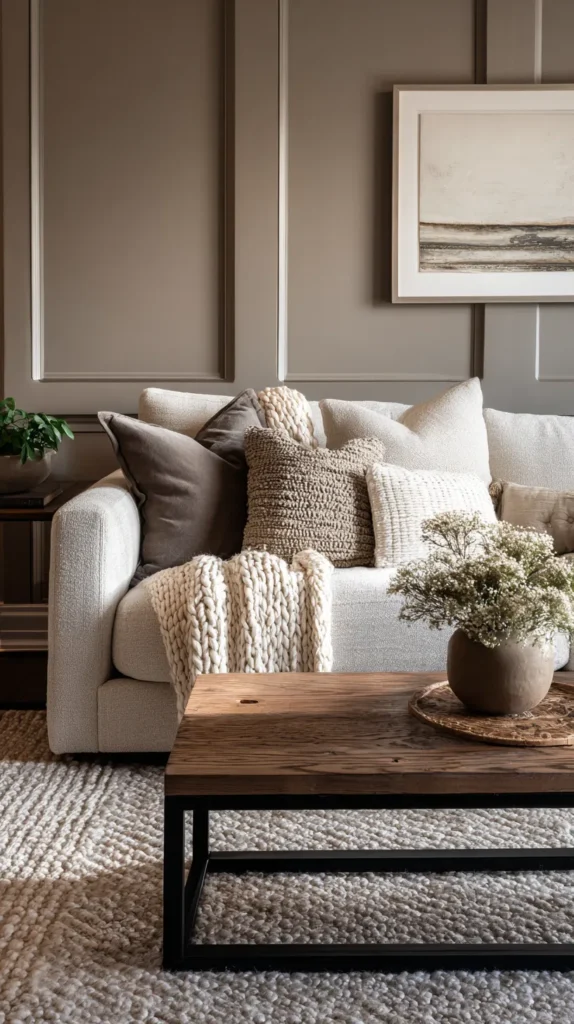
Budget: $100 – $600
Cushions and throws in a range of textures within the same tonal family — a boucle cushion in warm cream, a velvet cushion in deep mushroom, a chunky knit throw in oatmeal, a fine wool blanket in a warm grey-brown — give the mushroom brown living room its most sensory and most immediately tactile layer.
The quiet luxury of the tonal neutral interior is experienced through touch as much as through sight, and the layered textile story communicates the richness of the room’s material consideration at the most accessible price point available.
Boucle cushion covers — $20 – $50 each. Velvet cushion covers — $15 – $40 each. A chunky knit throw — $40 – $120. A fine wool blanket in a warm neutral — $60 – $200.
Styling tip: Vary the texture of every cushion and throw while keeping all tones within the same warm neutral family — cream, oatmeal, taupe, warm grey, and mushroom brown, with no colour that sits outside this range. A sofa with five cushions in five different textures but the same tonal family reads as quietly luxurious. The same five cushions in five different colours reads as a cushion collection rather than a considered textile story.
5. The Warm Timber Floor or Furniture
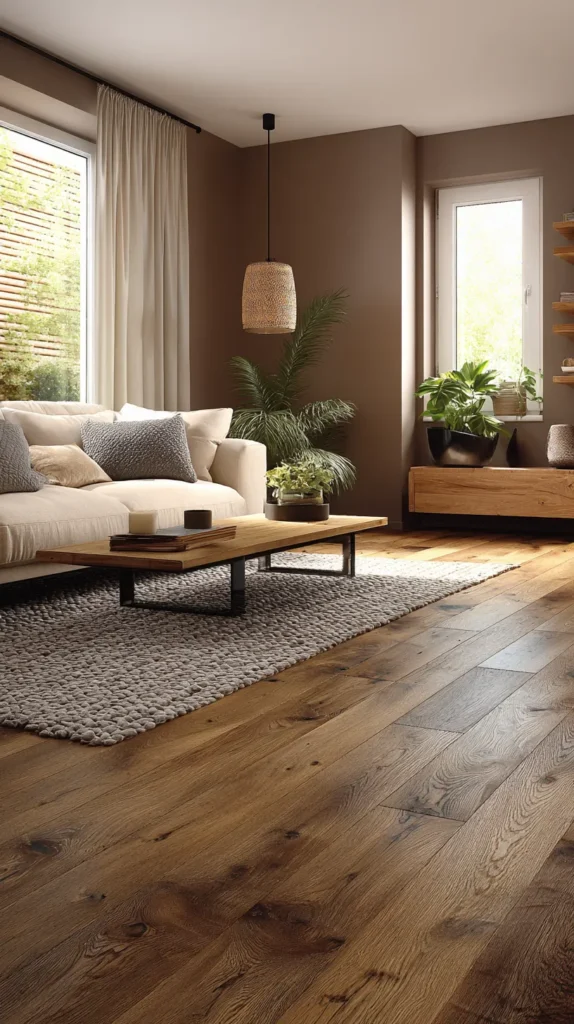
Budget: $100 – $2,000
Warm timber — in the furniture, the floor, or both — is mushroom brown’s most naturally complementary material and the element that prevents the tonal neutral interior from reading as cold or clinical.
A walnut coffee table, an oak console, a timber-framed sofa, or a warm engineered oak floor beneath the mushroom brown room communicates the specific quality of natural material warmth that the colour itself is reaching toward — the timber and the mushroom wall together producing an atmosphere of organic, grounded, genuinely warm luxury.
A walnut or oak coffee table — $150 – $600. A timber-framed sofa or armchair — $400 – $1,500. Engineered oak flooring in a warm medium tone — $40 – $80 per square metre installed.
Styling tip: Choose timber in a warm, medium tone rather than a pale Scandinavian blonde or a very dark espresso for the mushroom brown room — both extremes move away from the colour’s natural warmth. A walnut or a medium oak in a warm honey tone sits within the same material world as mushroom brown and deepens its quality; a very pale or very dark timber sits outside it and pulls the room in a different direction.
6. The Statement Armchair in Texture or Contrast
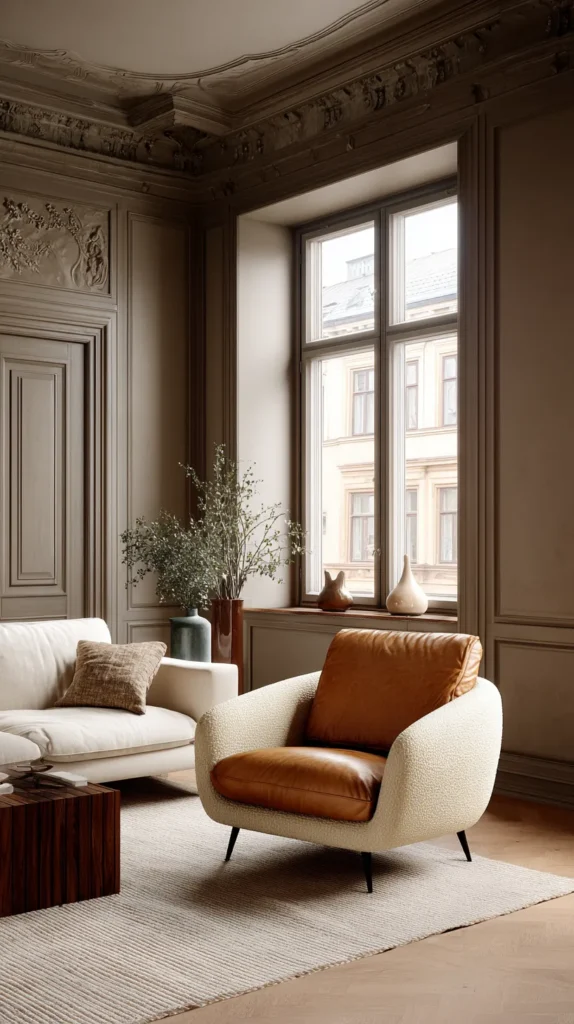
Budget: $200 – $1,200
A single armchair in a material or tone that offers a considered contrast to the room’s overall mushroom palette — a deep chocolate velvet, a warm terracotta boucle, a caramel leather — gives the mushroom brown living room its single moment of material emphasis and the specific quality of a room that was composed rather than accumulated.
The contrast armchair is the quiet luxury interior’s equivalent of the accent wall — the single element that gives the eye somewhere specific to land within a composition of considerable restraint.
A velvet armchair in a deep warm tone — $300 – $900. A boucle armchair in terracotta or caramel — $250 – $800. A leather armchair in a warm caramel or cognac — $400 – $1,200.
Styling tip: Position the contrast armchair diagonally opposite the room’s primary light source — a window or a floor lamp — so that the material catches the light from an angle that communicates its specific surface quality. A velvet armchair in flat overhead light loses the characteristic sheen that makes it read as velvet; the same chair at an angle to a warm side light communicates its material quality at its most fully resolved.
7. The Mushroom Brown Linen Curtains
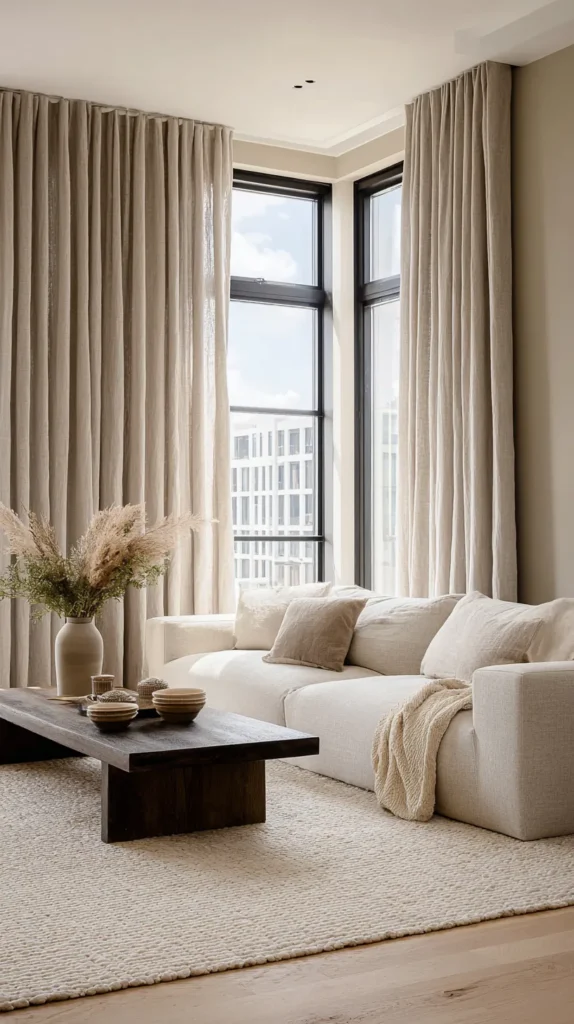
Budget: $80 – $400
Floor-to-ceiling curtains in a natural linen or a linen-look fabric in mushroom brown or a tone one step lighter — hung from the ceiling rather than from the window head, pooling slightly at the floor — give the mushroom brown living room its most expansive and most architecturally significant textile element.
Curtains at ceiling height make the room’s walls appear taller, the windows appear larger, and the light entering through the fabric appear warmer — the linen’s natural weave diffusing the light rather than blocking it and producing the specific quality of filtered warmth that the mushroom brown room is built around.
Linen curtain panels at 280 – 300 centimetre drop — $40 – $120 each. Two panels per window — $80 – $240 per window. A quality curtain rail at ceiling height — $30 – $80 per window.
Styling tip: Allow the curtains to pool 5 – 8 centimetres at the floor rather than cutting them to the exact floor length — the slight pool communicates the generous, unhurried quality of a curtain that was specified for elegance rather than economy, and the pooled linen has a specific quality of relaxed luxury that the precisely cut hem does not.
8. The Mushroom and Stone Fireplace Surround
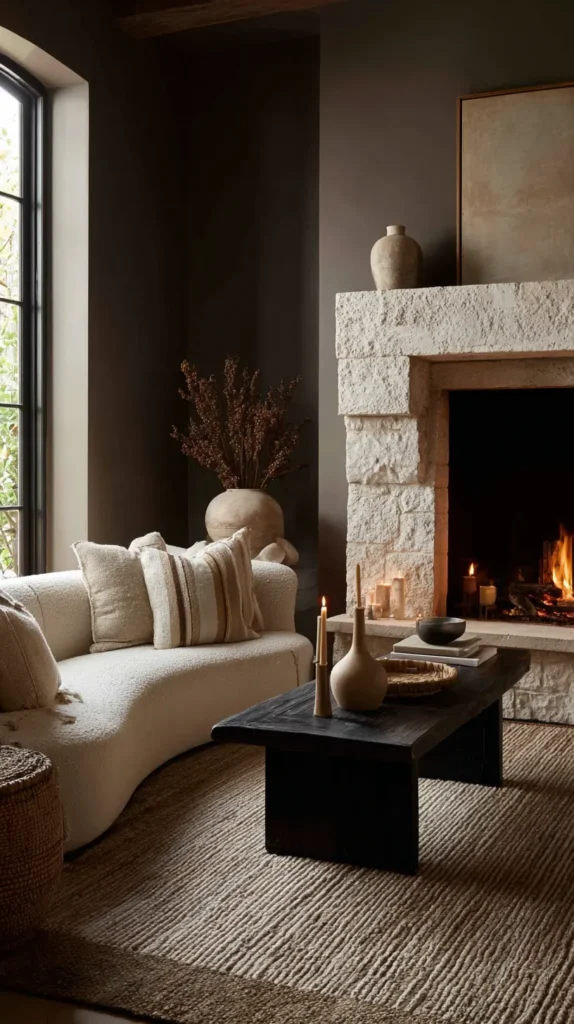
Budget: $200 – $2,000
A fireplace surround in natural stone — limestone, travertine, or a pale sandstone — or in a painted finish in a tone slightly lighter than the mushroom brown wall, gives the living room its primary architectural focal point in a material that sits entirely within the colour’s natural world.
Stone and mushroom brown share the same origin — both are colours of the earth, of the geological and the organic — and a stone surround in a mushroom brown room communicates the quality of a room where every material decision was made in relationship to every other.
A reclaimed limestone or sandstone fireplace surround — $300 – $1,200 from an architectural salvage source. A new stone surround — $400 – $2,000. A painted timber surround in a mushroom or stone tone — $200 – $600.
Styling tip: Style the mantel with no more than three objects in a considered asymmetric arrangement — a tall, slim vase at one end, a small sculptural ceramic at the other, and a low object or a single candle between them. The mantel in a quiet luxury interior is the surface that communicates restraint most specifically, and the restraint communicates more than any number of carefully chosen objects arranged in abundance.
9. The Warm Brass and Aged Metal Accents
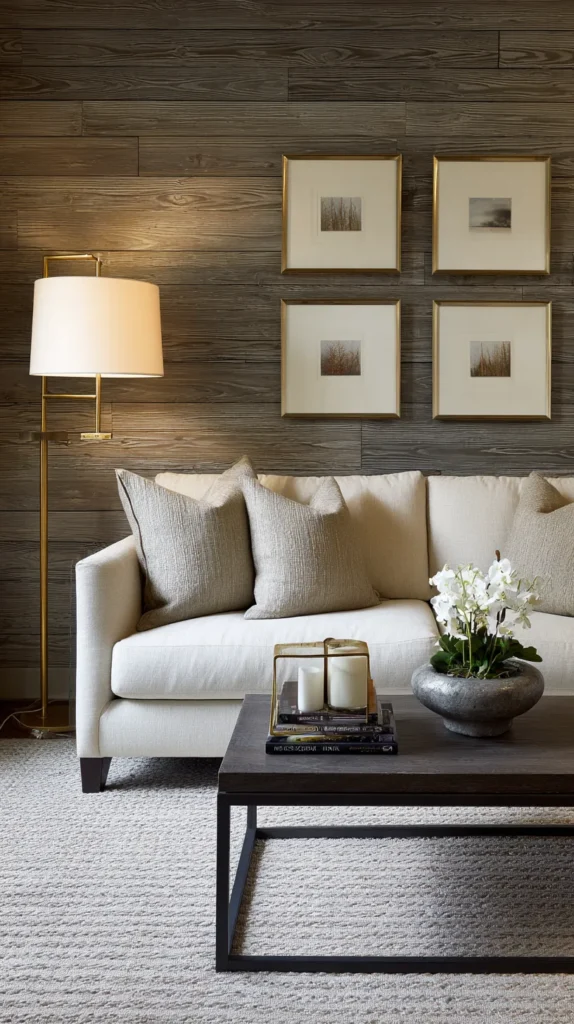
Budget: $50 – $400
Warm brass, aged gold, and burnished bronze — in the lamp base, the picture frame, the coffee table leg, the curtain ring, the small tray on the console — are mushroom brown’s most specifically complementary metallic accents and the material that prevents the neutral palette from reading as flat.
Brass in a mushroom brown room communicates the warm, aged quality of a room that has accumulated its objects over time — the patina of the metal reading as the patina of the room.
A brass floor lamp or table lamp — $60 – $200. Brass picture frames — $15 – $50 each. A brass tray on the coffee table — $20 – $60. Small brass or bronze decorative objects — $10 – $40 each.
Styling tip: Choose aged or unlacquered brass rather than polished bright brass for the mushroom brown room — the aged brass has a warmth and a slight irregularity of tone that relates to the mushroom wall’s own quality of natural variation. Polished bright brass in the same context can read as too sharp and too new, which works against the quiet, settled quality the room is reaching for.
10. The Organic and Natural Object Display
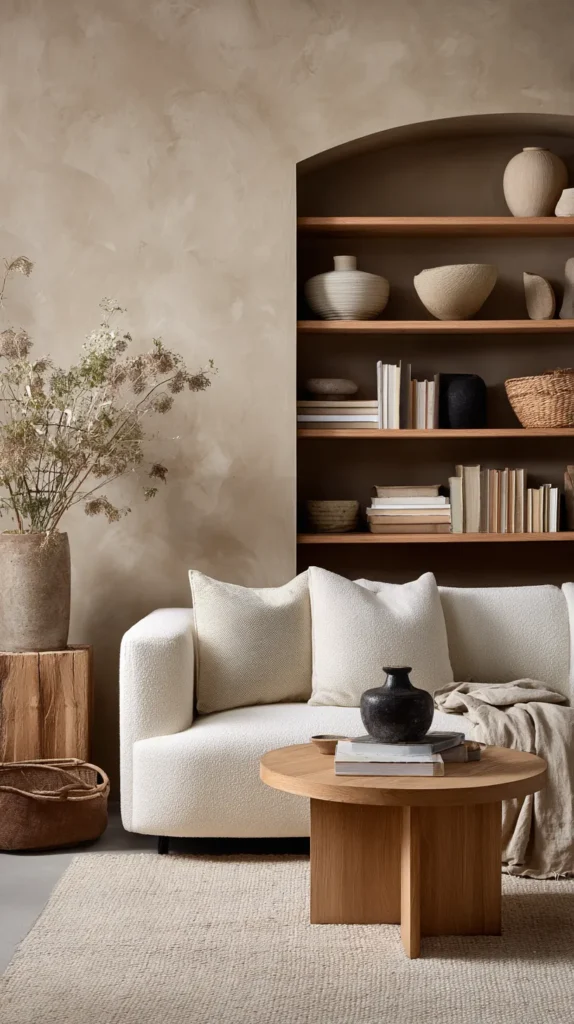
Budget: $30 – $200
Organic and natural objects — a bowl of smooth river stones, a branch of dried botanicals, a piece of driftwood on the mantel, a collection of seed pods in a ceramic bowl, a stack of books with linen-toned covers — give the mushroom brown living room its most specifically material and most textually honest decorating layer.
These are the objects that communicate that the room’s relationship to the natural world is genuine rather than stylistic — that the mushroom brown wall was chosen because it belongs to the same material family as the stone and the dried botanical and the undyed linen, and that the room was assembled with this family in mind.
A bunch of dried pampas grass or eucalyptus — $15 – $40. A ceramic bowl for natural objects — $20 – $60. A piece of driftwood or a sculptural branch — $0 – $30. A collection of smooth stones — $0 – $20.
Styling tip: Display organic objects in groupings of odd numbers — three dried stems in a single vase, five stones in a low bowl, one significant branch on the mantel — rather than in symmetrical pairs. The odd-numbered grouping reads as gathered; the symmetrical pair reads as placed, which is a distinction that matters specifically in a room whose entire aesthetic depends on the quality of the naturally accumulated.
11. The Boucle or Textured Rug
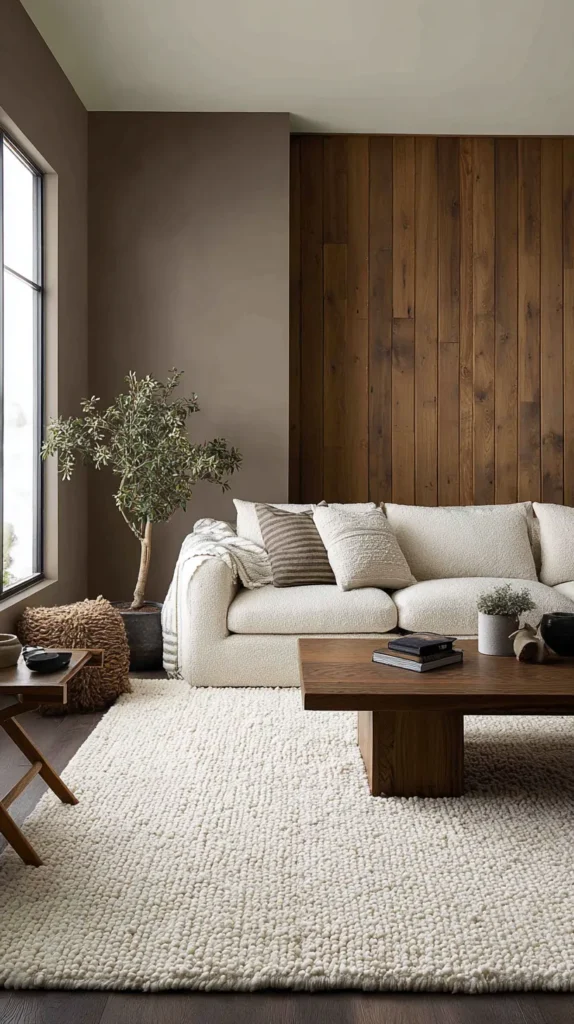
Budget: $100 – $600
A large rug in a warm, textured neutral — a boucle, a chunky flatweave, a high-pile wool in cream or oatmeal or warm greige — grounds the mushroom brown living room’s seating arrangement and gives the floor its own layer of material warmth.
The rug in the quiet luxury interior is not a pattern or a colour statement; it is a texture statement — the surface underfoot communicating the same quality of considered material richness as the linen sofa and the limewash wall above it.
A boucle or textured wool rug at 160 by 230 centimetres — $150 – $500. A large jute or sisal rug in a warm natural tone — $100 – $300. A high-pile cream or oatmeal rug — $120 – $400.
Styling tip: Size the rug so that at least the front legs of every seating piece rest on it — a rug that is too small for the seating arrangement reads as a mat placed in front of the sofa. A rug that anchors the full seating group reads as the room’s floor plane, which is the architectural quality that makes the seating arrangement read as a composed interior rather than furniture arranged in a room.
12. The Mushroom Brown Bookshelf Styling
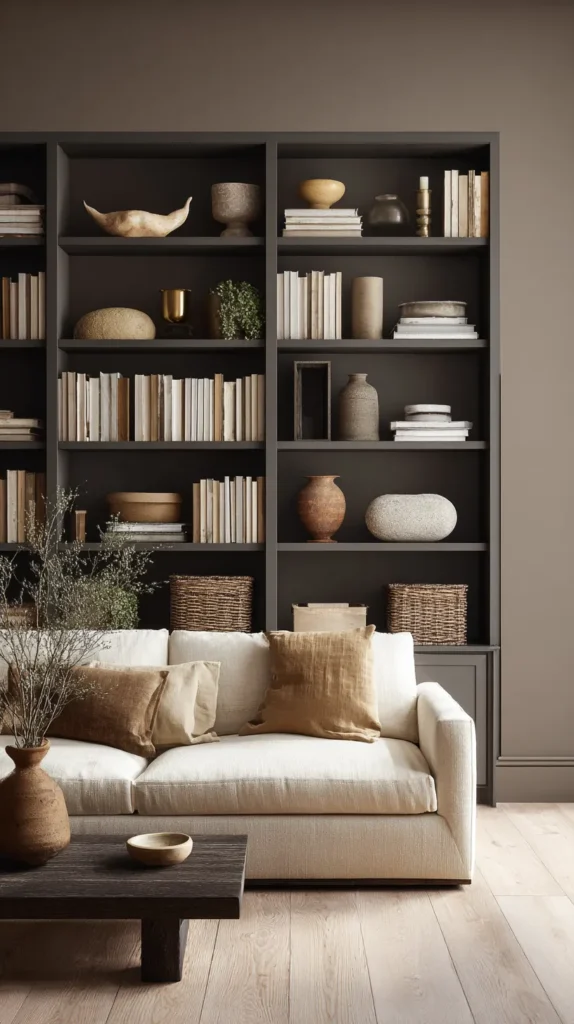
Budget: $0 – $150
A bookshelf styled in the mushroom brown living room’s tonal palette — books with linen, cream, and warm brown spines arranged by tone rather than by author, interspersed with small ceramic objects in warm neutrals, a dried botanical or two, and a single brass object — communicates the quiet luxury interior at its most specifically considered display surface.
The bookshelf in the mushroom brown room is not a library and not a colour-coded display; it is a tonal composition that extends the room’s palette into the vertical plane and gives the wall its most materially varied and most intellectually specific surface.
Books already owned — free to rearrange by spine tone. Small ceramic objects in warm neutrals — $10 – $30 each. A dried botanical for the shelf — $8 – $20. A small brass or bronze object — $10 – $40.
Styling tip: Remove the dust jackets from any hardback books on the shelf before arranging them — the naked hardback reveals the book’s cloth or board binding in a tone that is almost always more sympathetic to a neutral palette than the designed dust jacket, and a shelf of cloth-bound books without jackets communicates a specific quality of understated literary elegance that the jacketed version cannot.
13. The Warm Ambient Lighting Layer
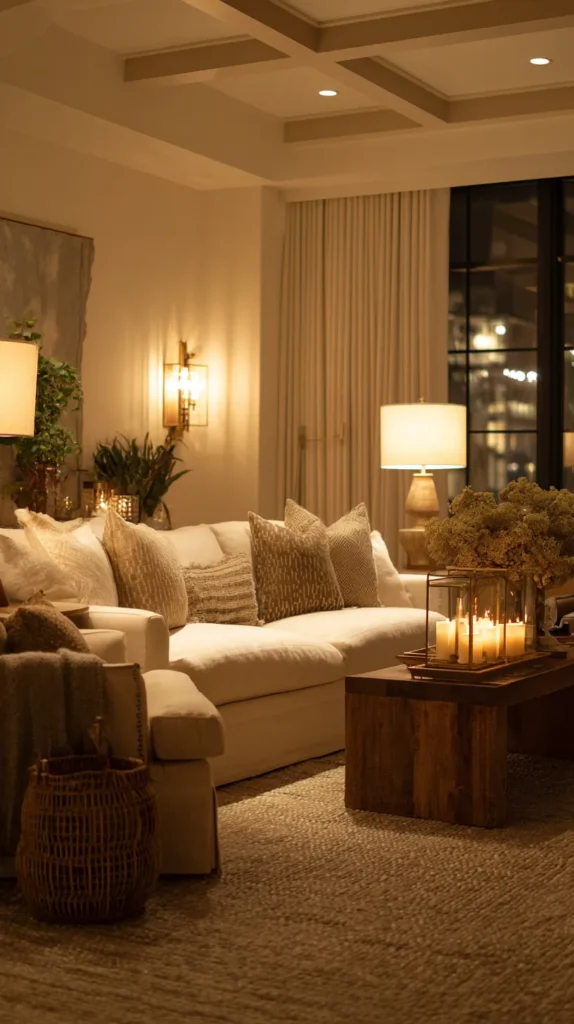
Budget: $80 – $500
The mushroom brown living room’s lighting — a floor lamp with a linen or paper shade beside the sofa, a table lamp on the console in a warm brass base, candles on the coffee table and the mantel, and warm 2700K bulbs throughout — produces the specific quality of warm, low, layered light that the colour requires to perform at its best.
Mushroom brown in cool overhead light reads as flat and slightly drab; the same colour in warm, layered, low-level light reads as rich, deep, and specifically beautiful. The lighting is not an afterthought in the mushroom brown room — it is the condition that the colour was chosen for.
A floor lamp with a linen or paper shade in a warm brass base — $80 – $250. A table lamp in a warm brass or ceramic base — $60 – $180. Candles in neutral ceramic holders — $8 – $25 each. Warm 2700K LED bulbs — $5 – $15 per pack.
Styling tip: Remove every cool-toned overhead bulb from the mushroom brown living room and replace with warm 2700K equivalents before assessing the room’s final colour. A mushroom brown assessed under cool overhead light will appear to need adjustment; the same room under warm 2700K light will reveal the colour’s full depth and warmth. The bulb temperature is the single most cost-effective improvement available to any neutral interior.
14. The Ceramic and Stone Object Collection
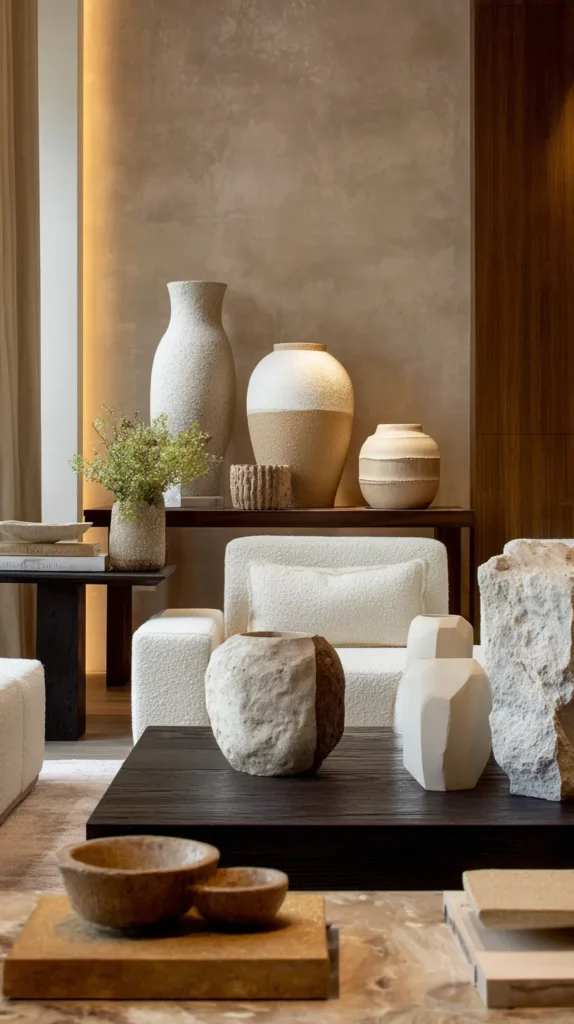
Budget: $40 – $300
A small collection of ceramics and stone objects — a hand-thrown stoneware vase in a warm grey glaze, a smooth limestone sphere on the coffee table, a rough-textured ceramic bowl in an earthy brown, a small unglazed terracotta pot — gives the mushroom brown living room its most material and most tactilely specific object layer.
These are the objects that communicate the room’s relationship to natural material at the closest range — the objects that are picked up, handled, and experienced through the hand as well as through the eye.
A hand-thrown stoneware vase in a neutral glaze — $30 – $80. A smooth stone sphere or a geological specimen — $15 – $50. A rough-textured ceramic bowl — $20 – $60. A small unglazed terracotta pot — $5 – $20.
Styling tip: Choose ceramics with visible evidence of the hand in their making — a slight irregularity of form, a variation of glaze, the mark of the potter’s finger in the clay — rather than perfectly uniform machine-made versions. The hand-made ceramic in a room of quiet luxury communicates the specific quality of the object that was made rather than manufactured, and this quality relates directly to the room’s overall atmosphere of the naturally considered rather than the perfectly styled.
15. The Fully Realised Mushroom Brown Living Room
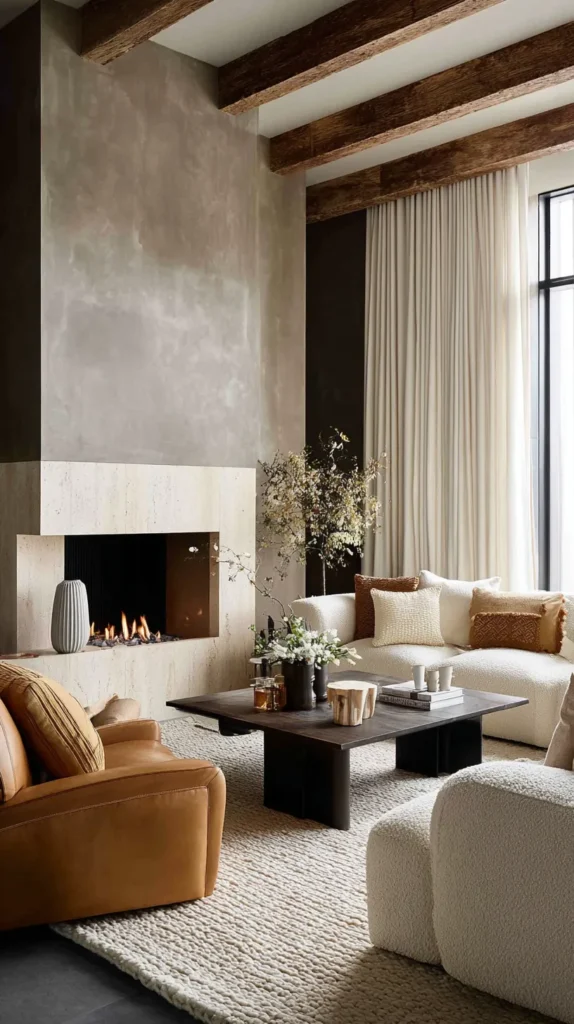
Budget: $800 – $6,000
The fully realised mushroom brown living room — limewash walls in a true mushroom brown that deepens from cool grey in morning light to warm earth in the evening lamp, floor-to-ceiling linen curtains pooling at the floor, a natural linen sofa layered with boucle and velvet cushions in cream and deep taupe, a walnut coffee table on a textured oatmeal wool rug, a contrast armchair in caramel leather or terracotta boucle, a limestone fireplace surround styled with three objects in asymmetric restraint, warm brass lamps at two heights with 2700K bulbs, a bookshelf of cloth-bound books and warm ceramics, organic dried botanicals and smooth stone objects distributed throughout, and the specific quality of a room that communicates, from every surface and every object simultaneously, that luxury is not abundance but precision.
Limewash walls: $90 – $320. Linen sofa: $400 – $2,000. Curtains: $160 – $480. Textiles: $100 – $600. Timber furniture: $150 – $600. Contrast armchair: $250 – $900. Rug: $100 – $500. Fireplace surround: $200 – $2,000. Lighting: $80 – $500. Objects and ceramics: $40 – $300. Total fully realised mushroom brown living room: $1,570 – $8,200 for a room that communicates quiet luxury at every surface and in every light condition throughout the day.
Styling tip: Spend one evening in the fully realised mushroom brown living room with every overhead light turned off and only the floor lamp, the table lamp, and a candle or two providing illumination — and observe the room in this condition before making any further adjustments. The mushroom brown living room was designed for this light, and it is in this light that every decision made throughout the room will either resolve into the quiet, warm, genuinely luxurious atmosphere the colour was reaching for, or reveal the single element that is preventing it from doing so.
The room that works in this light works entirely. The one that does not has one decision left to make.
The mushroom brown living room communicates something that no saturated or vivid colour can — the specific quality of a room so precisely calibrated to the natural world’s own palette that it reads not as decorated but as discovered. Not as chosen but as inevitable.
That quality of inevitability is the quiet luxury. And it was there, in the colour, all along — waiting for a room considered enough to deserve it.