13 Mixed Wood Tone Decorating Ideas That Actually Work Beautifully
The mismatched wood changed how my house looked more than any matching furniture set ever did. Not the coordinated bedroom suite. Not the single wood tone carried through every room. Not the careful matching of every new piece to what already existed.
The mixing.
Because letting different wood tones sit in the same room did something strict matching never managed. Before it: a house where every piece of furniture had to match the floor, the floor had to match the trim, and any new purchase required checking against an existing wood tone before it could be considered. After it: a house with walnut beside oak beside a weathered grey reclaimed piece, each one allowed to be what it was, the room richer for the variety rather than weakened by it.
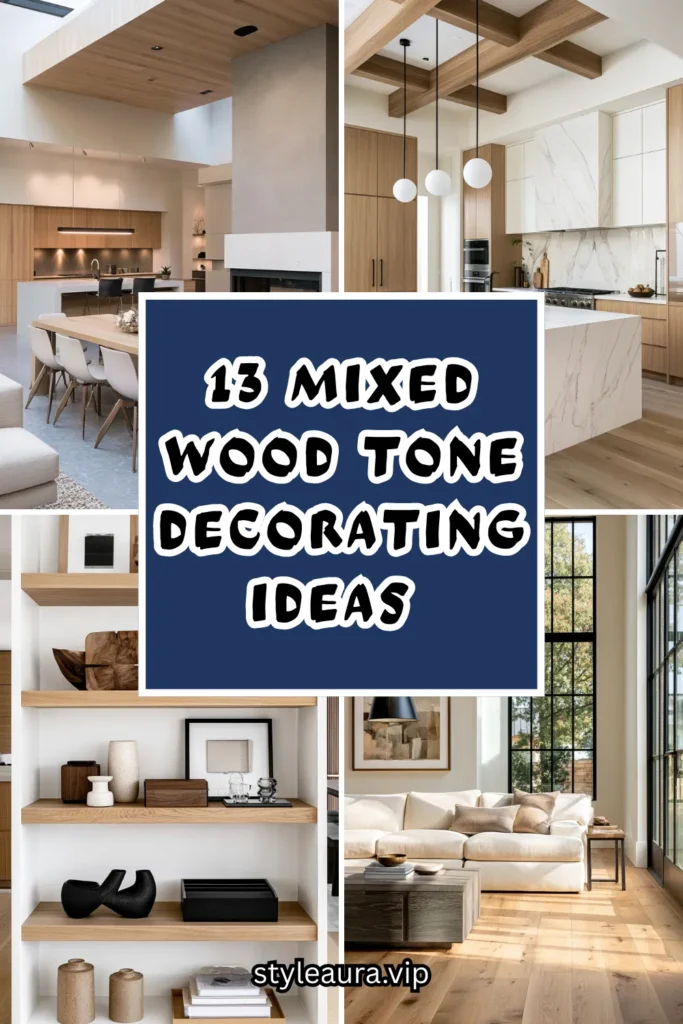
Mixed wood tones are not a design mistake tolerated because matching everything is impractical. They are an actual design principle, and rooms built around thoughtfully mixed wood consistently read as more collected, more layered, and more interesting than rooms where every wood surface matches precisely. The house: no longer constrained by a single wood tone rule, but freed to include whatever piece actually belongs there.
Here are 13 mixed wood tone decorating ideas that actually work beautifully — from the simplest two-tone pairing to the most fully mixed room — built on that understanding.
Why Mixing Wood Tones Works Better Than Matching Them
The natural variation principle
Real wood, even within a single tree, contains natural variation in color and grain. A room that insists on one uniform wood tone throughout is already working against what wood actually looks like in its natural state.
The collected-over-time signal
Without mixed wood:
Every piece of furniture purchased to match an existing tone, the room reading as a single coordinated set bought all at once.
The room: correct, but slightly flat, missing the sense of a home built up over years.
With mixed wood:
Different pieces in different tones, gathered at different times for different reasons, the room reading as genuinely collected rather than uniformly furnished.
The room: richer, and more honestly reflective of how most homes actually come together.
The undertone rule
The single most important technical principle in mixing wood tones successfully is matching undertones, not matching exact color. A warm honey oak and a warm reddish cherry share a warm undertone and mix well, even though their colors differ considerably; a cool grey-toned wood mixed carelessly with a warm orange-toned wood is far more likely to clash.
The anchor and accent approach
Most successful mixed-wood rooms have one dominant wood tone — usually the floor — functioning as a neutral backdrop, with furniture in varying tones layered on top of it. The floor rarely needs to match the furniture directly; it simply needs to not fight with it.
The Five Techniques for Mixing Wood Tones Successfully
Before combining any pieces:
Match undertones, not exact shades
Identify whether a wood is warm (yellow, orange, red) or cool (grey, ash) toned before pairing it with anything else.
The single most important technical principle on this list.
Prevents the majority of genuine wood-mixing mistakes before they happen.
Use the 60-30-10 distribution
One dominant wood tone at roughly 60 percent of the room’s wood surfaces, a secondary tone at 30 percent, and an accent tone at 10 percent.
Prevents any single mixed room from looking evenly, confusingly split.
Borrowed directly from general color theory and applied specifically to wood.
Let the floor be the constant
Treat the floor as the room’s wood-tone anchor, rarely changed, with furniture layered on top in varying tones.
Simplifies the mixing decision considerably.
Works because floors are typically the largest, most permanent wood surface in any room.
Repeat each tone at least twice
Any wood tone introduced into a room should appear in at least two places, not just once.
Prevents an isolated piece from reading as a mistake rather than a deliberate choice.
The technique most responsible for a mixed room reading as intentional.
Use a connecting neutral
A black, white, or metal element appearing near multiple different wood tones, giving the eye a resting point between them.
Softens the transition between contrasting wood tones.
Often achieved through hardware, lighting, or a painted piece of furniture.
1. The Warm-and-Cool Two-Tone Foundation
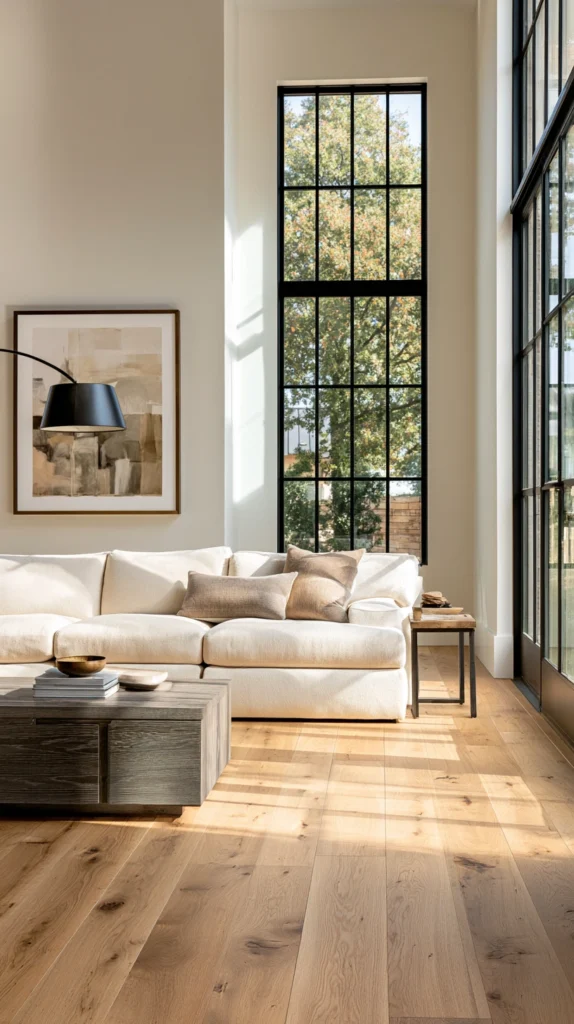
A room built around exactly two wood tones — one warm, one cool — used deliberately rather than accidentally, as the simplest and most controlled entry point into mixing.
Why starting with just two tones reduces the risk of a mismatched room
Mixing many different wood tones at once is considerably harder to execute well than mixing just two, deliberately chosen and consistently repeated throughout the room.
The warm tone
A honey oak, warm walnut, or golden pine, established as the room’s primary wood presence, often through the floor or a large furniture piece like a dining table.
The cool tone
A grey-washed oak, ash, or a driftwood-finished wood, introduced as the secondary tone through a smaller number of pieces — perhaps a console table and a set of picture frames.
The distribution
The warm tone dominant, appearing in the largest and most numerous pieces; the cool tone used more sparingly, in smaller accent furniture or objects.
The connecting element
Black metal hardware or matte black light fixtures, appearing near both wood tones, providing a visual bridge between the warm and cool halves of the palette.
The room suitability
Particularly effective in a living or dining room with one large anchor piece — a table or a media console — in the warm tone, and smaller supporting pieces in the cool tone.
Cost breakdown: No new furniture required if working with existing pieces Cool-toned accent pieces (if adding): $100–400 Total: $0–400
2. The Floor-as-Neutral Foundation
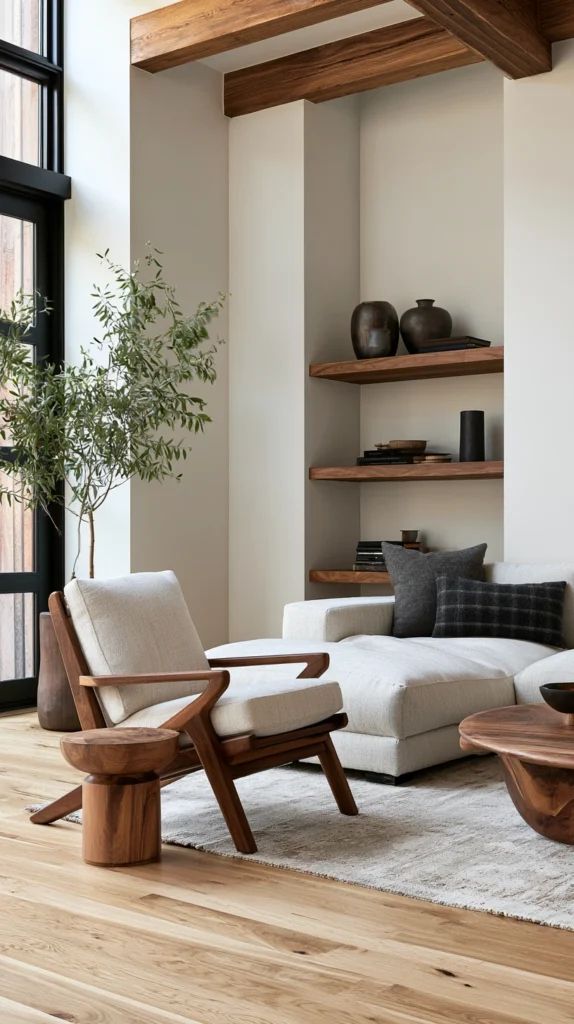
The existing floor treated as a fixed, neutral backdrop, with furniture and decor in an entirely different wood tone layered confidently on top, rather than attempting to match new furniture to the floor.
Why the floor rarely needs to match the furniture directly
A floor is walked on, not held or touched closely; the eye reads it as a backdrop far more than as a piece of furniture demanding coordination. This gives considerably more freedom in furniture wood choice than most people assume.
The floor’s role
Whatever wood tone the floor already is — often a mid-tone oak in many homes — simply left as the room’s constant, unchanging backdrop.
The furniture freedom
Furniture chosen for its own merit and undertone compatibility, rather than for matching the floor precisely, since the floor’s role as backdrop means an exact match is unnecessary.
The undertone check
The only real requirement: confirming the furniture’s undertone (warm or cool) does not directly clash with the floor’s own undertone, even if the specific shades differ considerably.
The rug bridge
An area rug in a tone that sits between the floor and the furniture, softening any perceived gap between the two and grounding the furniture within the room.
The confidence this approach provides
Removes the common but unnecessary anxiety around matching new furniture purchases to existing flooring, opening up considerably more furniture options than a strict-match approach allows.
Cost breakdown: No cost — a shift in approach rather than a purchase Area rug, if desired: $100–300 Total: $0–300
3. The Reclaimed Wood Accent Wall
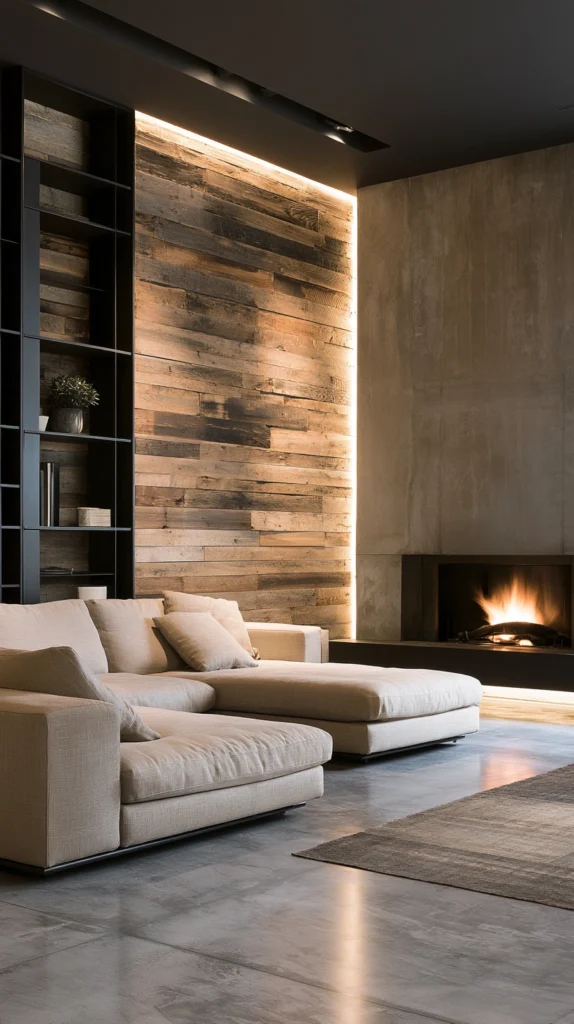
A single wall finished in reclaimed or salvaged wood, in a tone distinctly different from the room’s existing furniture and flooring, functioning as an intentional focal point rather than an attempt to match the rest of the room.
Why a reclaimed wall works precisely because it does not match
Reclaimed wood carries genuine variation within a single installation — different boards, different ages, different original finishes — making it inherently a mixed-tone surface even before it is placed alongside any other furniture in the room.
The wood sourcing
Salvaged barn wood, reclaimed shipping pallets, or a purpose-milled reclaimed wood product, chosen for genuine age and character rather than a uniform, new-looking finish.
The wall selection
A single accent wall, typically behind a bed, a sofa, or a fireplace, rather than attempting the treatment across an entire room.
The variation within the wall itself
The natural mix of tones within the reclaimed wood — some boards lighter, some darker, some with visible old paint or nail holes — already demonstrates the mixed-tone principle within one single surface.
The furniture relationship
Furniture in front of the wall chosen for undertone compatibility with the wall’s dominant tone, rather than an exact match to any single board within it.
The overall effect
A wall that reads as a genuine focal point precisely because of its internal variation, rather than requiring the rest of the room to match it directly.
Cost breakdown: Reclaimed wood wall (materials): $300–800 Installation (if hiring out): $400–1,000 Total: $300–1,800
4. The Layered Bookshelf Mixed-Wood Display
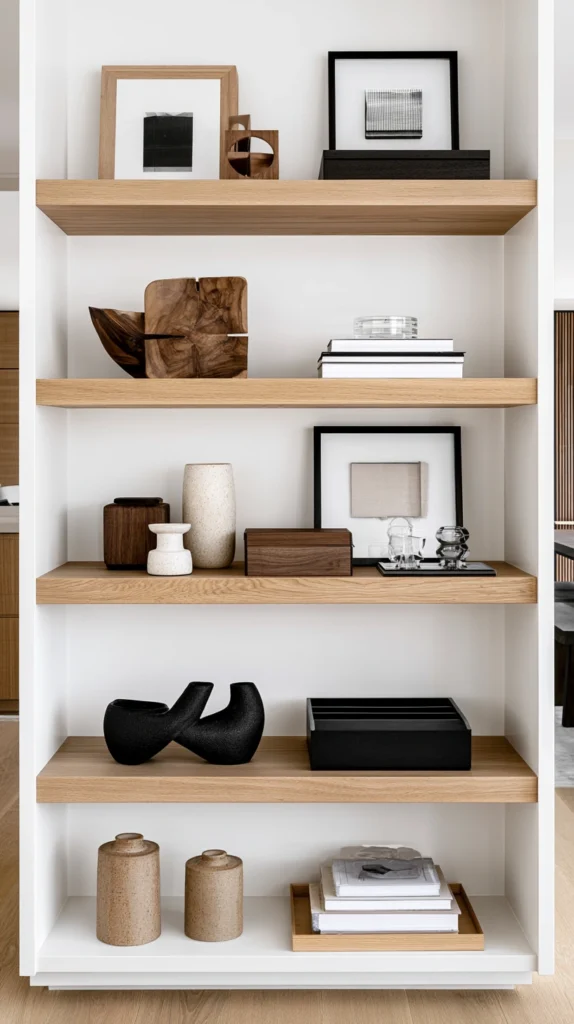
Open shelving styled with objects in multiple wood tones — a wood bowl, a picture frame, a small sculpture — deliberately mixed rather than matched, demonstrating the principle at a small, low-risk scale.
Why shelf styling is the lowest-risk place to practice mixing wood tones
A shelf holds small, individually replaceable objects, making it a far lower-stakes place to experiment with wood-tone mixing than a major furniture purchase, while still meaningfully demonstrating the effect.
The object selection
A wood bowl in one tone, a set of picture frames in another, a small carved object in a third, gathered rather than matched, echoing the same collected quality valued in mixed-wood furniture.
The repetition principle
Each wood tone appearing at least twice across the shelving, even in this small-scale application, to avoid any single tone reading as an isolated mistake.
The non-wood breaks
Ceramic, glass, or metal objects interspersed between the wood pieces, giving the eye a rest between different wood tones and preventing the display from feeling like an uncoordinated wood-tone test.
The height variation
The wood objects arranged with the same varied-height principle used in any well-styled vignette, rather than lined up uniformly.
The learning opportunity
This small-scale practice often builds the confidence needed to apply the same mixing principle to larger furniture decisions elsewhere in the home.
Cost breakdown: Wood objects (existing or secondhand, 3–4): $20–60 Total: $20–60
5. The Dining Table and Chair Contrast
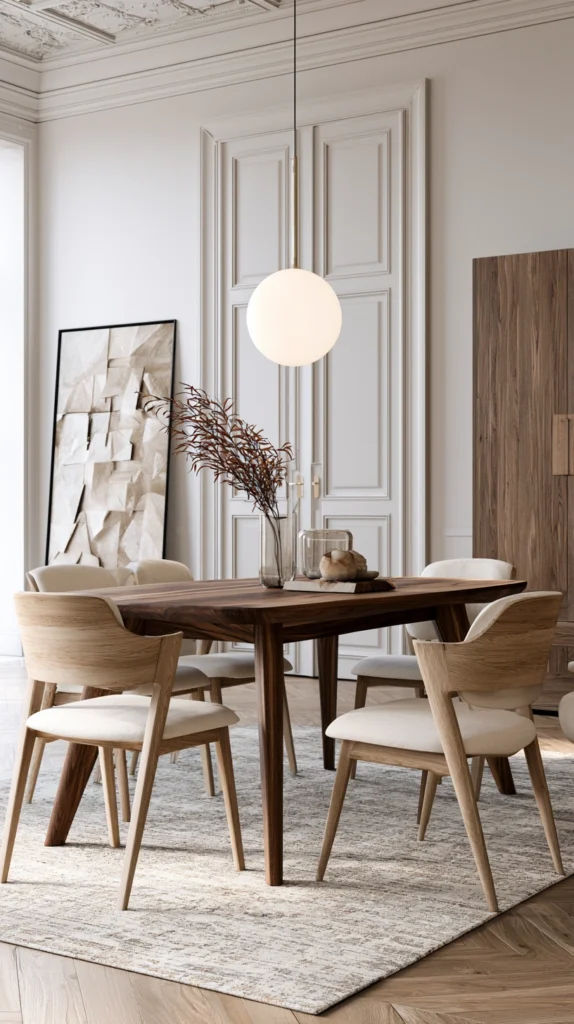
A dining table in one wood tone, paired deliberately with chairs in a different, complementary tone, rather than a matched dining set purchased as a single unit.
Why table-and-chair contrast is one of the most common and most effective mixed-wood applications
A matched dining set, however well made, often reads as a single purchased unit rather than a considered, collected room. Deliberately mismatched chairs and table immediately signal a more personal, gathered design approach.
The table
A substantial table in a rich, warm wood tone — walnut or a deep stained oak — functioning as the room’s anchor piece.
The chairs
Chairs in a lighter or differently toned wood — a pale oak, a whitewashed finish, or even a painted chair frame with wood seat details — providing contrast against the darker table.
The undertone check
Both the table and chairs sharing the same warm or cool undertone family, even while differing considerably in overall depth of color, remains the key technical requirement for this pairing to succeed.
The upholstery bridge
Chair cushions or upholstery in a fabric that draws color from both the table and chair wood tones, visually connecting the two contrasting woods through a third element.
The head chair variation
A pair of slightly different, more substantial chairs at the table’s two head positions, in yet another wood tone or finish, adding one more layer of intentional variation within the same table setting.
Cost breakdown: No new furniture required if working with existing mismatched pieces Chairs (if purchasing, secondhand): $150–500 Total: $0–500
6. The Console Table and Mirror Frame Pairing
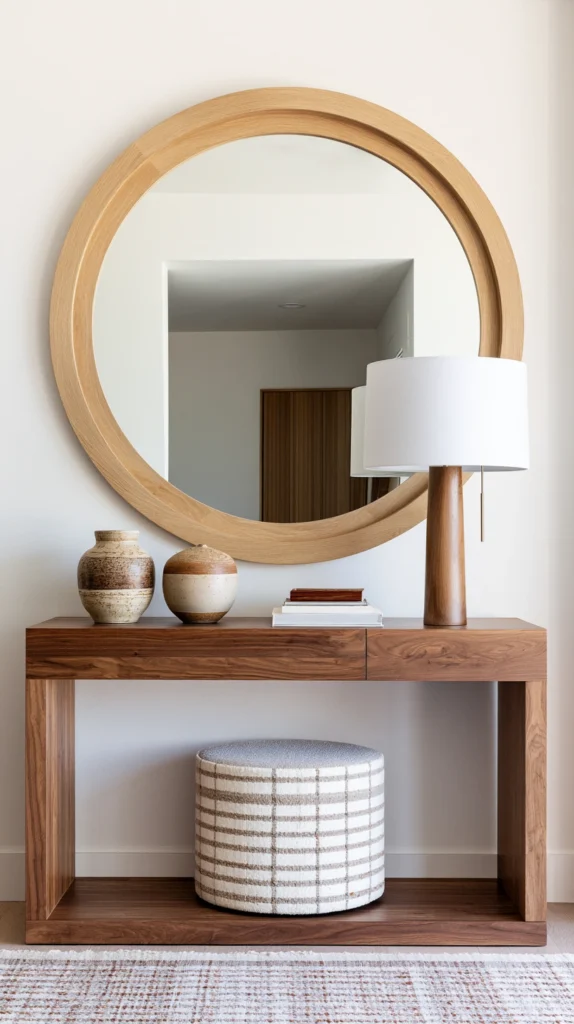
A console table in one wood tone positioned beneath a mirror or artwork framed in a distinctly different wood tone, using the pairing as a focal vignette rather than leaving the two elements to coincidentally clash.
Why this specific pairing is one of the easiest mixed-wood combinations to execute well
A console and the art or mirror above it are viewed together as one visual unit regardless of whether their wood tones match, making this an ideal, contained place to practice a confident, deliberate mismatch.
The console
An existing or secondhand console table in a warm or cool wood tone, serving as the vignette’s base.
The mirror or frame
A mirror or a piece of art in a frame of a different, complementary wood tone, chosen for undertone compatibility with the console below it.
The connecting styling objects
A lamp, a small vase, or a stack of books placed on the console, in a material (ceramic, brass, glass) that bridges rather than competes with either wood tone.
The proportion
The mirror or art sized appropriately relative to the console beneath it, typically two-thirds to three-quarters of the console’s width, for a balanced vignette regardless of the wood tone contrast.
The repeated tone elsewhere
Each of the two wood tones used in this vignette echoed at least once more elsewhere in the room, maintaining the repetition principle even for this smaller, contained pairing.
Cost breakdown: Console table (existing or secondhand): $0–150 Mirror or framed art (existing or new): $0–150 Total: $0–300
7. The Kitchen Island as the Intentional Outlier
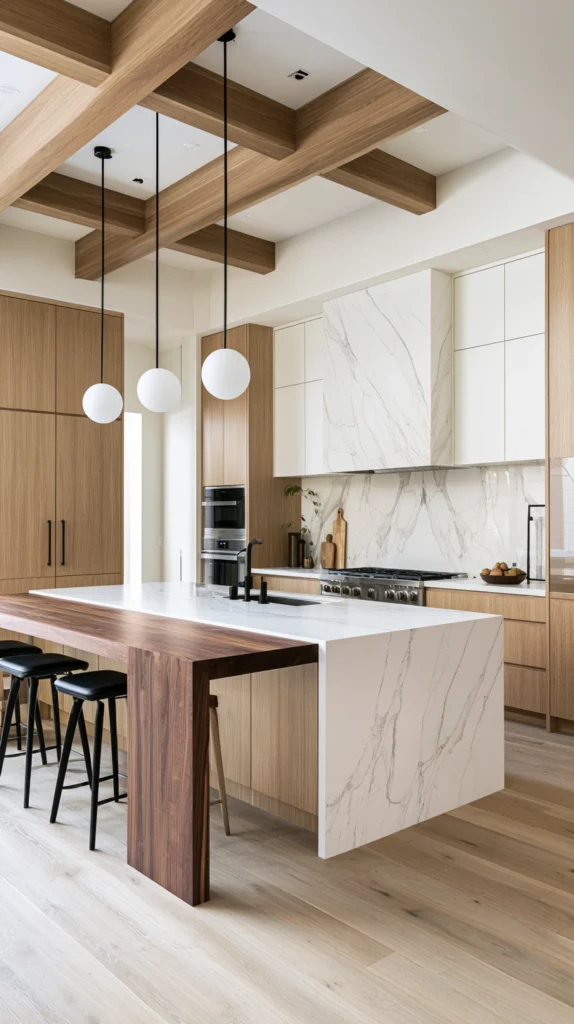
A kitchen island finished in a distinctly different wood tone from the surrounding cabinetry, functioning as a deliberate design statement rather than a mismatched mistake.
Why an intentionally different island tone has become an established, expected design move
This particular application of wood-tone mixing is now common enough in kitchen design specifically that it reads as a considered choice rather than an oversight, provided it is committed to fully rather than applied half-heartedly.
The island tone
A rich walnut or dark stained wood, contrasted against lighter surrounding cabinetry, or the reverse — a pale island amid darker perimeter cabinets — depending on the kitchen’s overall palette.
The commitment level
The full island, including any visible end panels, finished consistently in the contrasting tone, rather than a partial treatment that reads as unfinished or accidental.
The hardware consistency
The same hardware finish used across both the island and the surrounding cabinetry, providing a connecting thread despite the wood tone difference.
The countertop relationship
A single consistent countertop material and color across both the island and the perimeter cabinets, preventing the wood-tone contrast from being compounded by an additional surface-material contrast.
The proportion
The island typically remaining a minority presence relative to the kitchen’s overall cabinetry, functioning as the accent tone within the 60-30-10 distribution principle rather than competing evenly with the surrounding cabinets.
Cost breakdown: Island refinish or replacement in contrasting tone: $2,000–6,000 Total: $2,000–6,000
8. The Layered Flooring Transition
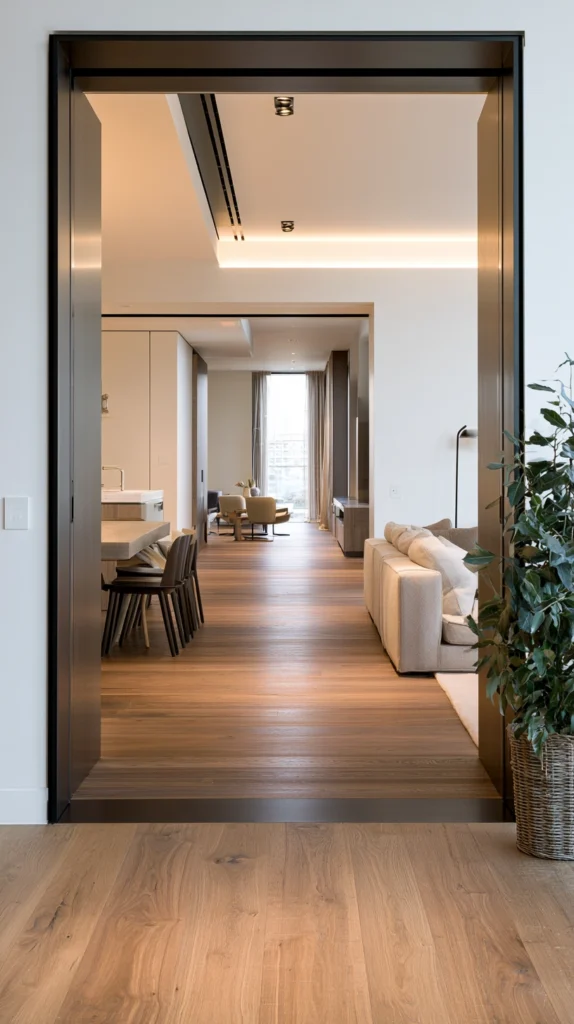
Two different wood flooring tones used in adjoining but distinct rooms or zones, rather than one uniform flooring tone carried throughout the entire home.
Why zone-specific flooring tones can work better than one uniform choice throughout
A home with genuinely distinct functional zones — a more formal living area versus a casual family room, for instance — can use different flooring tones to reinforce that functional distinction, rather than forcing one single tone to serve every room equally well.
The zone division
A natural architectural break — a doorway, a change in ceiling height, a hallway — serving as the transition point between the two flooring tones, rather than an arbitrary line within one continuous open space.
The tone relationship
The two flooring tones sharing a common undertone family, even while differing in depth, maintaining the same technical requirement relevant to any wood-tone pairing.
The transition detail
A metal transition strip or a change in board direction at the exact meeting point between the two floors, providing a clean, deliberate boundary rather than an abrupt, unplanned one.
The furniture coordination
Furniture within each zone chosen to complement its specific flooring tone, rather than one single furniture palette expected to work equally well across both floor tones.
The overall home flow
Best executed with no more than two or three total flooring tones across an entire home, since more than that risks the floors themselves feeling disjointed rather than intentionally zoned.
Cost breakdown: Second flooring tone for a zone (materials): $600–2,000 Transition strip: $20–50 Total: $620–2,050
9. The Layered Bedroom Nightstand Mismatch
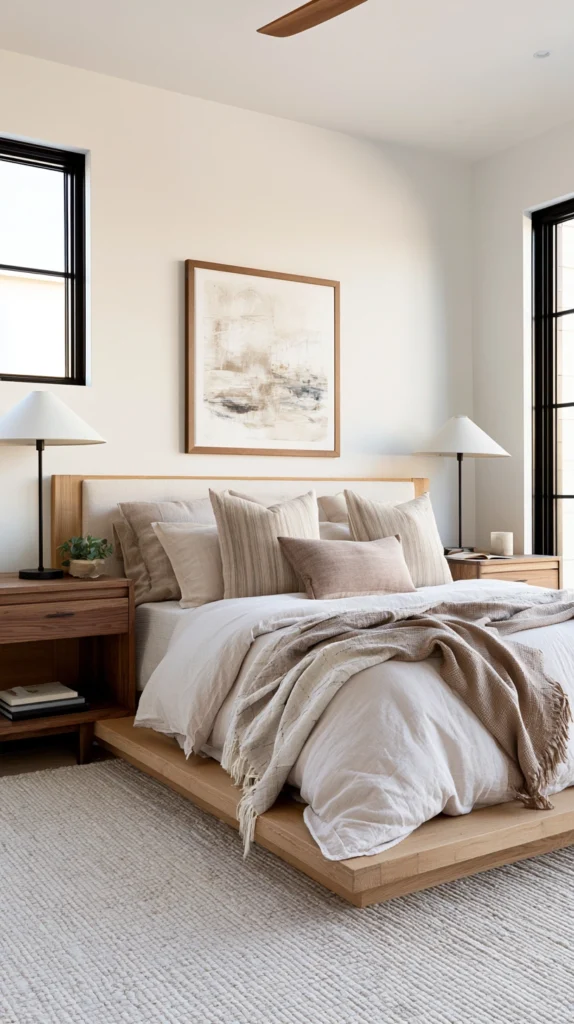
A bed frame in one wood tone, paired with two different nightstands — either two different tones from each other, or both different from the bed frame — for a genuinely collected bedroom look.
Why bedroom nightstands are a particularly forgiving place to practice mismatching
Unlike a dining set, viewed as a single cohesive unit from one vantage point, bedroom nightstands are typically viewed one at a time, from either side of the bed, making an intentional mismatch between them read as considered rather than jarring.
The bed frame
A wood or upholstered bed frame in a single established tone, functioning as the room’s dominant wood presence.
The nightstands
Two nightstands in different wood tones from each other, sourced individually rather than as a matched pair, for the collected-over-time quality this approach depends on.
The lamp coordination
Matching or coordinating lamps on both nightstands, providing visual consistency across the two otherwise different pieces despite their differing wood tones.
The undertone consistency
Both nightstands and the bed frame sharing a compatible warm or cool undertone, even while varying in specific shade and finish.
The dresser relationship
A third wood tone on a dresser or wardrobe elsewhere in the room, repeating at least one of the nightstand tones to maintain the repetition principle across the full room.
Cost breakdown: Nightstands (2, secondhand or existing): $0–200 Total: $0–200
10. The Staircase Wood Tone Layering
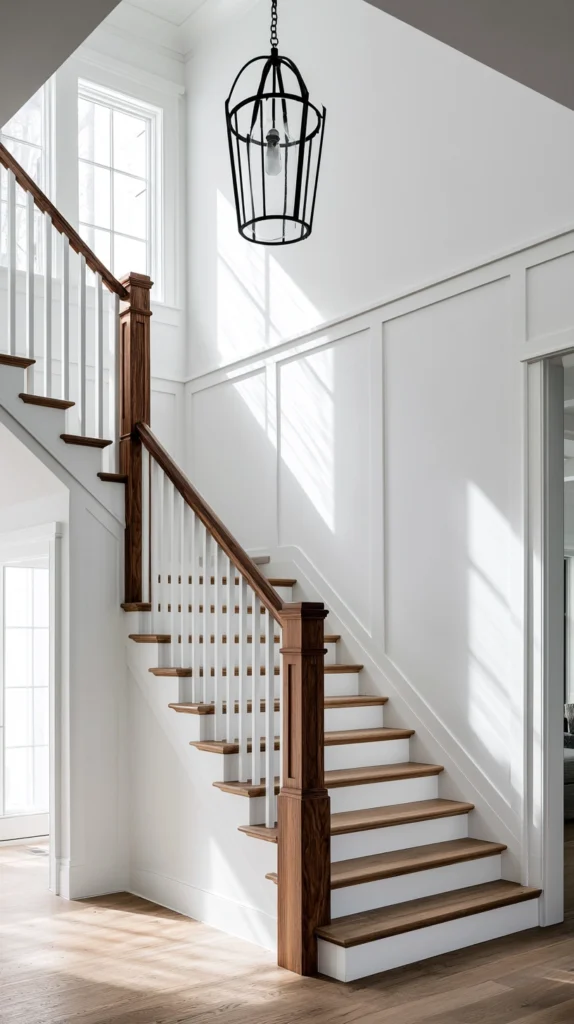
A staircase with treads in one wood tone, handrail in another, and balusters in a painted or third wood finish, using the structure’s natural component division as an opportunity for intentional mixing.
Why a staircase’s multiple components suit this kind of layering naturally
A staircase is rarely built from a single continuous piece of wood — treads, handrail, and balusters are already separate components, making a deliberately varied finish across them a natural extension of the structure’s existing construction logic rather than an artificial addition.
The treads
A durable, wear-resistant wood tone for the treads themselves, prioritizing practical durability given how much foot traffic this component receives.
The handrail
A different, often richer or more polished wood tone for the handrail, since this component is touched constantly and benefits from a smooth, considered finish distinct from the treads.
The balusters
Painted white or black, rather than a third wood tone, providing the connecting neutral element between the tread and handrail woods, a common and highly effective execution of this specific layering.
The undertone check
The tread and handrail wood tones sharing a compatible undertone, even while differing in exact shade, maintaining the core technical principle across this more architecturally complex mixing application.
The overall effect
A staircase that reads as more detailed and more considered than a uniformly finished single-tone stair, without requiring any of the exotic or unusual wood-tone combinations less structural applications might risk.
Cost breakdown: Refinishing treads and handrail in two tones: $400–1,200 Repainting balusters: $150–350 Total: $550–1,550
11. The Gallery Wall With Mixed Wood Frames
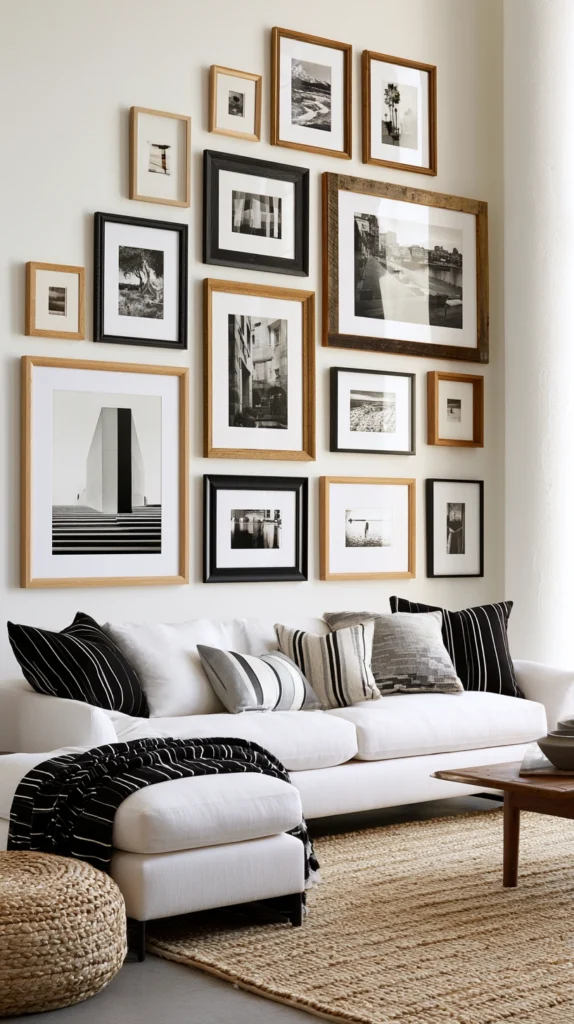
A gallery wall combining frames in several distinctly different wood tones and finishes, rather than a matched frame set, for a genuinely collected, accumulated-over-time display.
Why mixed frames outperform a matched set for this specific application
A gallery wall of identical frames reads as a single purchased kit; a gallery wall of genuinely varied wood frames reads as a collection gathered across different times, places, and occasions, which is the more compelling and more honest visual story for most households.
The frame sourcing
Frames gathered from different sources over time — some from a current purchase, some inherited, some found secondhand — rather than all bought together as a coordinated set.
The variety
At least three distinct wood tones represented across the full gallery arrangement, from a pale natural wood to a rich dark walnut, with perhaps one painted or metal frame included as a connecting neutral.
The arrangement density
Frames spaced closely together, in the same dense, salon-style arrangement principle used for any maximalist gallery wall, since density helps the varied frames read as one cohesive collection rather than scattered individual pieces.
The undertone awareness
Even with genuine variety, keeping the overall collection within a broadly warm or broadly cool family, avoiding one single frame with a dramatically clashing undertone that would disrupt the otherwise successful mix.
The art content variety
The art or photography within the frames similarly varied in subject and style, reinforcing the same accumulated, collected quality the mixed frames themselves establish.
Cost breakdown: Frames (secondhand and existing, 8–12): $40–120 Total: $40–120
12. The Open-Concept Zone Furniture Distinction
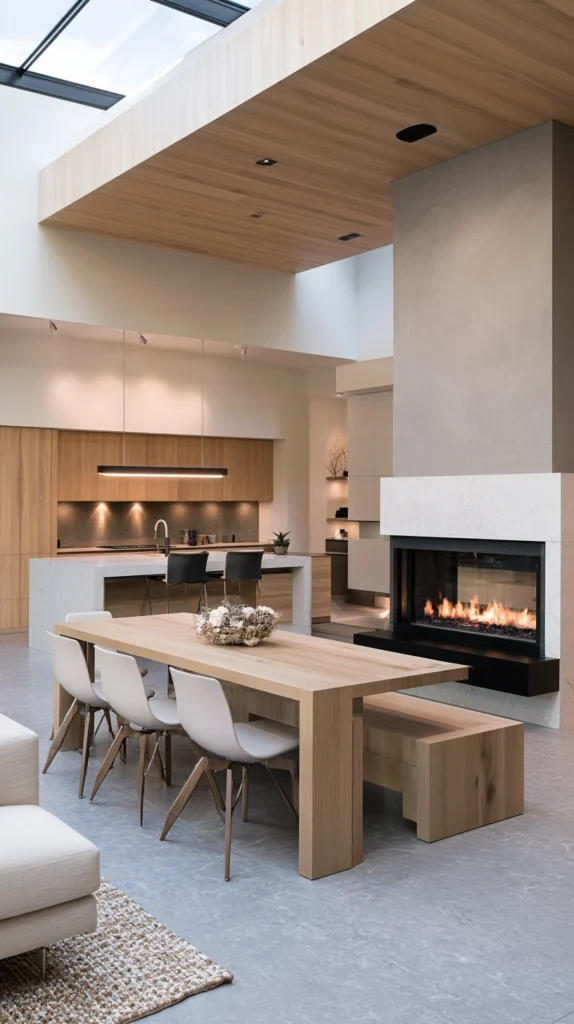
In an open-concept home, furniture in the kitchen, dining, and living zones each using a distinct wood tone, reinforcing the functional zoning within one continuous open space.
Why distinct wood tones help define zones without physical walls
In a home without walls separating the kitchen, dining, and living areas, wood tone becomes one of the few available tools to visually signal where one zone ends and the next begins.
The kitchen zone
Cabinetry and any kitchen-adjacent furniture in its own established wood tone, typically the zone’s largest and most fixed wood presence.
The dining zone
A table and chairs in a distinctly different tone from the kitchen cabinetry, marking a clear visual transition even without any wall or change in flooring to reinforce it.
The living zone
Media consoles, coffee tables, and any wood-framed seating in a third tone, completing the three-zone distinction across the single open space.
The connecting thread
A consistent metal finish — all brass, or all matte black — used across hardware and lighting in every zone, providing the connecting element that keeps the three distinct wood tones from feeling like three disconnected rooms.
The floor’s role
The floor, if uniform throughout the open space, functioning as the one consistent element unifying all three zones despite their differing furniture wood tones.
Cost breakdown: No new furniture required if zones already have naturally differing wood tones Coordinating hardware or lighting (if needed): $100–300 Total: $0–300
13. The Complete Mixed Wood Tone Home (The Fully Layered Approach)
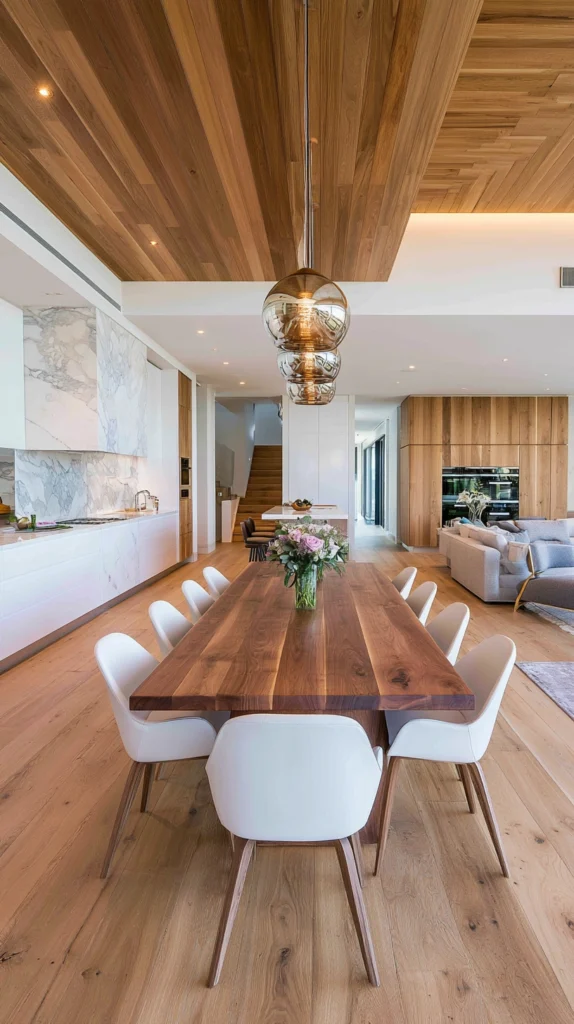
A complete design philosophy carried through multiple rooms — a consistent floor as backdrop, deliberately varied furniture tones, a connecting metal finish, and the repetition principle applied throughout — treating wood tone mixing as a whole-home design language rather than a single room’s experiment.
What separates the complete approach from a single mixed-tone room
A single successfully mixed room: a good design choice. A complete mixed-wood-tone home: a consistent design philosophy, applied with the same principles — undertone matching, the 60-30-10 distribution, repetition, and a connecting neutral — in every room, so the whole house reads as intentionally collected rather than randomly assembled.
The elements of the complete mixed wood tone home
The floor
A consistent wood tone throughout connected living spaces, functioning as the unchanging backdrop every room’s furniture is layered onto.
The dominant furniture tone
One wood tone established as each room’s primary furniture presence, following the 60 percent principle.
The secondary and accent tones
A second tone at roughly 30 percent and a third accent tone at roughly 10 percent, present in every major room rather than only one.
The connecting metal
A single consistent hardware and lighting finish carried through every room, providing the unifying thread across all the varied wood tones.
The repetition
Each wood tone appearing at least twice within any given room, and often echoed in an adjoining room as well, preventing any single piece from reading as an isolated mistake.
The undertone discipline
Every wood tone introduced anywhere in the home checked against a consistent warm or cool undertone family, maintained as a whole-home rule rather than a room-by-room guess.
The complete design in action
Walking through a fully mixed-wood home:
The entryway: A reclaimed wood console in a rich, dark tone, its brass hardware echoing the same finish found throughout the rest of the house.
The kitchen: A warm oak floor, cabinetry in a slightly deeper tone, and an island finished in a deliberately contrasting walnut.
The living room: The same oak floor continuing, a media console in yet another compatible tone, framed art on the walls in a genuinely mixed collection of wood finishes.
The bedroom: The bed frame in one tone, two different nightstands in two more, all sharing the same warm undertone family established from the very first room.
The complete mixed wood tone home: not a house where every room happened to end up with different furniture, but a house built deliberately on the principle that variety, handled with the right technical discipline, reads as more considered than uniformity ever could.
Cost breakdown for the complete approach: Assuming a starting point of an already-furnished home: Coordinating hardware and lighting (whole home): $300–900 Selective new furniture pieces to introduce intentional variety: $200–800 Reclaimed wood accent wall (one room): $300–1,800 Total: $800–3,500
Phased over time:
Phase one: Auditing existing furniture for undertone compatibility, identifying any genuinely clashing pieces Establishing a consistent hardware and lighting finish
Phase two: Introducing one new mixed-tone element per room — a console, a set of frames, a nightstand pairing
Phase three: A larger statement piece, such as a reclaimed wood wall or a contrasting kitchen island, once the underlying principles are established with confidence
The complete mixed wood tone home: not a renovation, but a shift in how every future furniture decision gets made, room by room, over time.
The Question Before Any Wood Tone Mixing Decision
Before combining any two wood pieces:
What is the primary reason for wanting to mix wood tones in this space?
If the answer is: an existing piece does not match anything else and needs a plan — start with the undertone check and the floor-as-neutral approach.
If the answer is: wanting the whole home to feel more collected and less matched — the complete mixed wood tone home applied gradually, room by room.
If the answer is: testing the concept in one low-risk place first — the shelf styling or the console-and-mirror pairing.
If the answer is: a specific room, like the kitchen or dining room, needs more visual interest — the kitchen island contrast or the dining table and chair pairing.
The design follows the existing furniture and the household’s actual comfort with visual variety, more than any single formula. Every idea on this list applies the same underlying principles — undertone matching, repetition, a connecting neutral — at a different scale. The question is which scale suits this particular room and this household’s confidence with the approach.
The single mismatched nightstand pair, undertone-checked and left as is: still demonstrates that mixing works. The complete home, built on the principle deliberately: a house that reads as gathered and considered in every single room.
That considered quality: the whole point of mixing wood tones instead of forcing everything to match.
Getting Started This Weekend
The immediate wood tone mixing solution:
Identify the undertone of the room’s existing dominant wood — usually the floor.
Warm or cool — the single fact every subsequent decision depends on.
Find one piece already in the house that does not match, and check its undertone against the floor.
If they share the same warm or cool family, it likely already works better than assumed.
Add one small object in a genuinely different wood tone to test the mix.
A single bowl, frame, or small piece, rather than a full furniture purchase, as a low-risk first experiment.
Add a black or brass object nearby to bridge the two tones.
The rest of the design: the elaboration of this moment.
The mismatch: the beginning. The mixed wood tone home: what gets built, deliberately, around it.