15 Japandi Home Office Ideas for a Serene Workspace
There is a design philosophy that arrived at the precise intersection of two of the world’s most thoughtful aesthetic traditions and found, in that intersection, something more complete than either tradition produces alone.
Japandi — the meeting of Japanese wabi-sabi and Scandinavian hygge, of Eastern restraint and Nordic warmth, of the philosophy of impermanence and the philosophy of earned comfort — produces interiors of a specific, unhurried serenity that no single tradition generates independently. In a workspace, this serenity is not merely aesthetic.

It is functional — the quality of visual calm that Japandi produces being precisely the quality that sustained, deep, genuinely productive work requires.
The Japandi home office is a workspace of deliberate reduction rather than deliberate decoration — a room where every object earns its presence, where natural materials are chosen for their honesty rather than their impressiveness, and where the quality of the light and the quality of the silence are considered as carefully as the quality of the desk surface or the bookshelf arrangement.
It is the workspace for the person who understands that less, chosen well and maintained with genuine attention, produces more of the quality that matters than more, chosen quickly and accumulated without principle.
The fifteen ideas below cover every element of the Japandi home office — from foundational material decisions to the finishing details that produce genuine serenity rather than merely its appearance.
1. The Neutral Foundation Palette
Budget: $30 – $150
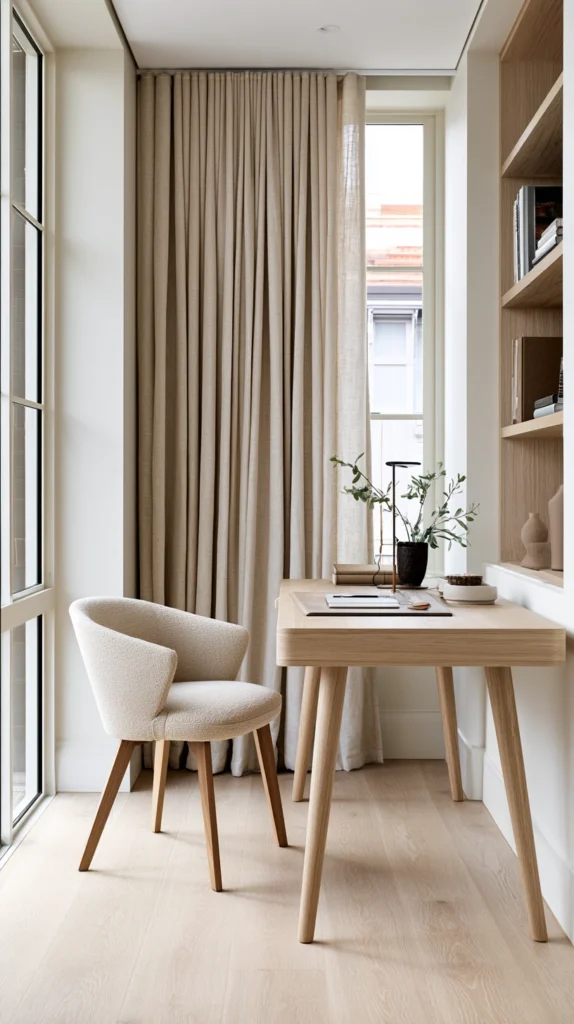
The Japandi home office palette is built from the specific neutrals of natural materials in their most honest state — warm white with a slight yellow undertone, the grey-beige of undyed linen, the warm tan of unfinished timber, the pale ash of natural stone, and the very occasional note of deep charcoal or muted sage. These are colours without urgency, without the need to impress, and precisely for this reason they produce an environment of specific, earned calm.
A quality warm white or very pale warm grey paint in a flat finish — $20 – $50 per litre. A standard office requires two to three litres — $40 – $150. The ceiling in the same warm white rather than a bright brilliant white — the slight warmth of the tone preventing the ceiling from reading as cold or institutional.
Decor tip: Choose all paint from the warm rather than the cool side of the neutral spectrum. A warm white with a very slight yellow undertone beside natural timber reads as genuinely warm and specifically organic. The same white with a blue or grey undertone beside the same timber can read as slightly cold — undermining the specific quality of material warmth that the Japandi palette is built to produce. The undertone is the most important decision in the Japandi palette and the one most easily made incorrectly from a paint card under artificial shop lighting.
2. The Low Natural Timber Desk
Budget: $150 – $1000
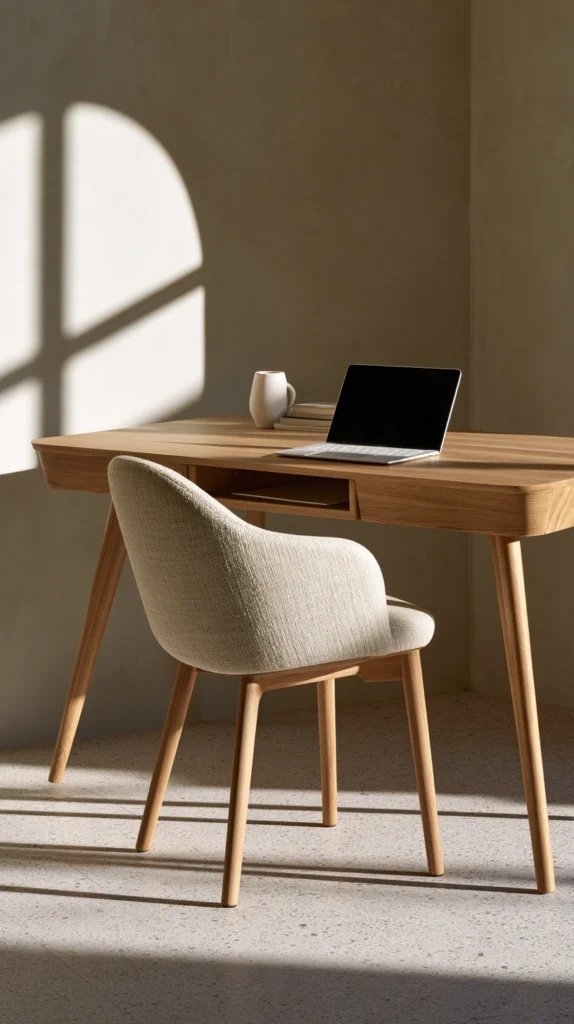
A low, clean-lined desk in a natural or lightly oiled timber — the surface simple and unadorned, the legs tapered or straight in a Scandinavian or Japanese form, the overall proportion communicating restraint and genuine craft — is the Japandi home office’s most essential piece and the one that determines the quality of every hour spent working within the room. The desk should be beautiful as an object, honest in its materials, and ergonomically correct in its height.
A solid oak or ash desk in a clean Scandinavian form — $200 – $600. A solid timber desk in a Japanese-influenced low form — $300 – $800. A DIY desk in a solid timber with simple tapered legs — $80 – $200 in materials. A vintage timber desk of appropriate proportions and materials — $100 – $400 from a secondhand dealer.
Styling tip: Oil or wax the desk surface with a natural oil — linseed, tung, or Danish oil — rather than varnishing or lacquering it. A natural oil finish deepens the timber’s colour, reveals its grain, and produces a surface that can be maintained with periodic re-oiling as the surface wears. A lacquered surface is more durable but less honest — it seals the timber from the interaction with its environment that gives natural oil-finished timber its specific quality of improving with use and time.
3. The Wabi-Sabi Ceramic Desk Objects
Budget: $20 – $150
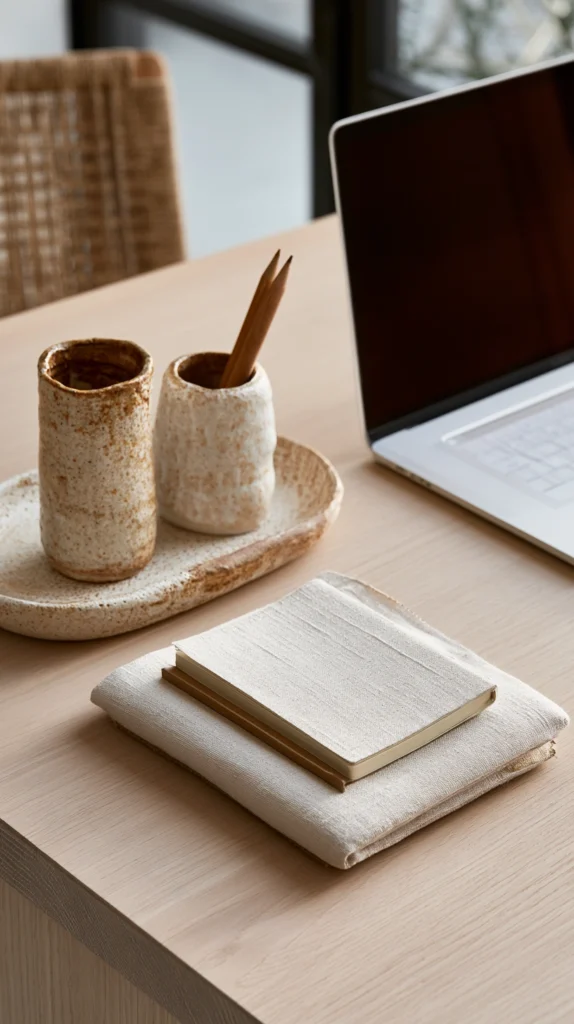
Ceramic objects on the Japandi desk — a hand-thrown pencil holder with the slight irregularity of a wheel-thrown form, a small ceramic tray for small items, a ceramic water vessel beside the computer, a single dried botanical in a ceramic bud vase — introduce the specific quality of wabi-sabi into the working surface. These are objects that are beautiful precisely because they are slightly imperfect — the fingerprints of their maker present in their form.
A hand-thrown ceramic pencil holder — $15 – $40 from an independent ceramic maker. A small ceramic tray — $10 – $30. A ceramic bud vase for a single dried botanical — $8 – $25. A ceramic water cup — $8 – $20. Total ceramic desk investment: $41 – $115 for a desk surface that communicates the wabi-sabi principle at the level of the smallest daily-used objects.
Styling tip: Choose ceramics with a visible hand-made quality — slight irregularity in the form, a glaze that pooled slightly at the base, or a surface that shows the marks of the throwing process — rather than perfectly uniform machine-made ceramics in the same natural tones. The distinction between a hand-thrown and a machine-made ceramic is immediately apparent on close examination and communicates the Japandi aesthetic’s commitment to the specific beauty of the made-by-hand rather than the produced-by-machine.
4. The Shoji-Inspired Room Divider
Budget: $80 – $500
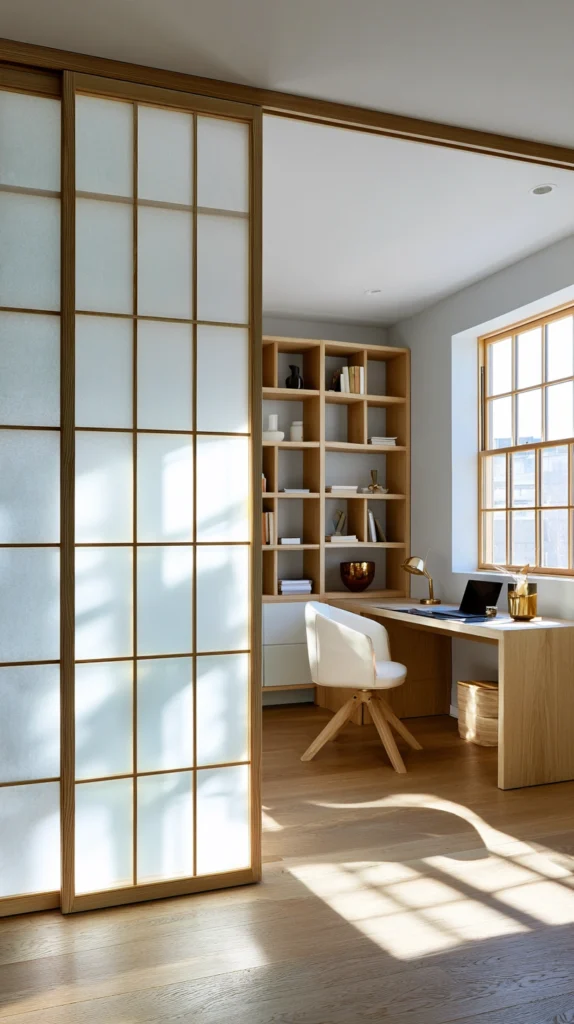
A shoji-inspired room divider — a simple timber frame with translucent paper or frosted acrylic panels — used to separate the Japandi home office from the rest of the domestic space creates the specific sense of a defined, contained workspace that the Japanese understanding of dedicated space requires. The translucent panels filter light rather than blocking it, creating the particular quality of diffused, soft illumination that shoji screens have always produced.
A purchased shoji screen in a natural timber frame — $80 – $300. A DIY shoji screen in a timber frame with translucent paper — $40 – $120 in materials. A sliding version on a floor-mounted track — $150 – $500 for a standard office width. The shoji screen serves simultaneously as a spatial divider, a light filter, and a specifically Japanese visual element.
Styling tip: Position the shoji screen between the workspace and the primary natural light source — a window or a glass door — rather than between the workspace and the room it is being divided from. A shoji screen between the desk and the light source produces the specific diffused, shadowless quality of illumination that the Japanese paper screen was designed to create. The same screen between two dark surfaces produces a spatial division without the specific lighting quality that makes the shoji screen specifically valuable.
5. The Natural Material Flooring and Rug
Budget: $80 – $600
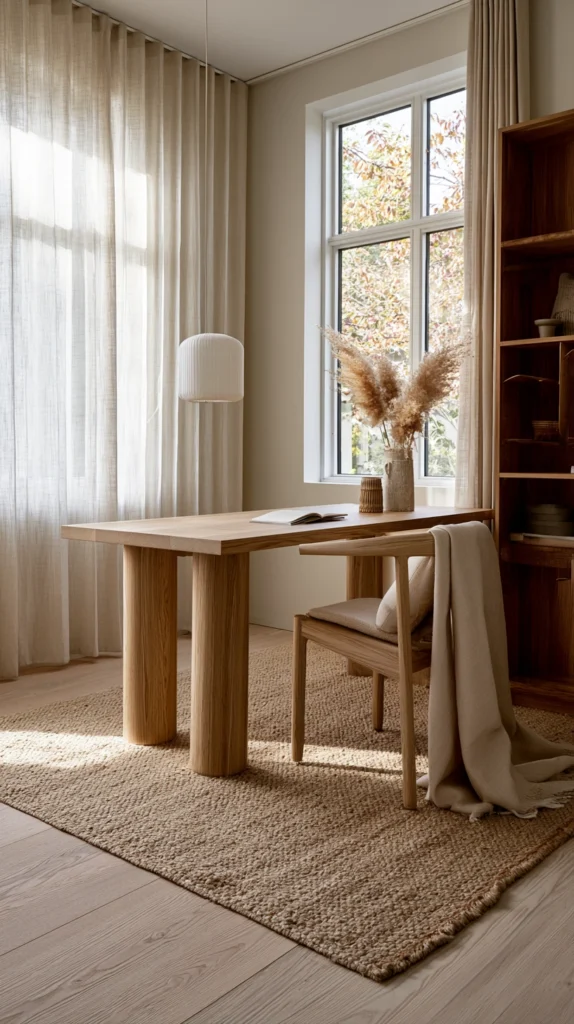
Natural flooring in the Japandi home office — pale timber boards in an ash or a light oak, a concrete floor with a warm aggregate, or a tatami-inspired seagrass or rush matting — provides the room’s most fundamental material layer and the one that most directly communicates the specific quality of natural, unprocessed materials that the Japandi aesthetic requires at floor level. A natural jute or sisal rug defines the working zone within the larger floor.
Pale ash or oak engineered flooring — $40 – $100 per square metre in materials. A seagrass or rush matting in a natural tone — $20 – $50 per square metre. A large natural jute or sisal rug to define the working zone — $80 – $300 for a standard office size. A woven wool rug in a warm grey or a natural undyed tone — $100 – $400.
Styling tip: Choose the Japandi office rug in a single, undyed or minimally dyed natural tone rather than in a pattern or a contrasting colour. A rug in an undyed jute, a warm natural sisal, or a pale grey wool defines the working zone without introducing any colour or pattern that competes with the palette’s specific restraint. A patterned rug in the same space introduces visual complexity at floor level that works against the quality of visual calm the Japandi office is designed to produce.
6. The Dedicated Meditation or Rest Corner
Budget: $100 – $500
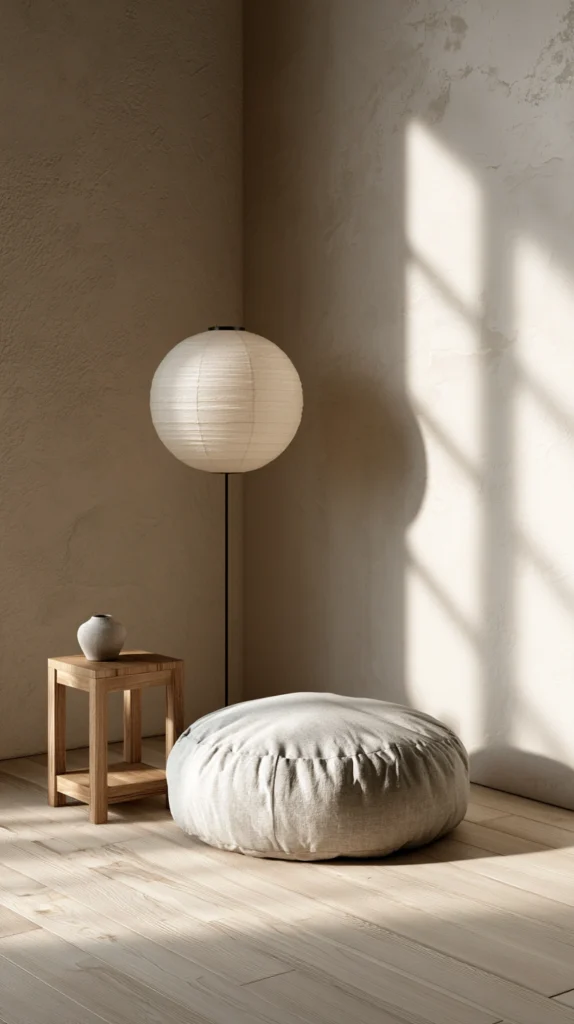
A dedicated rest or meditation corner within the Japandi home office — a floor cushion or a simple low seat in a natural material, positioned beside a small low table holding a ceramic cup and a single object of contemplative significance, with a warm lamp above and a plant beside — acknowledges the Japanese understanding that the quality of work is inseparable from the quality of the rest that surrounds it. The rest corner communicates that the office was designed for the full rhythm of a working day rather than for continuous, uninterrupted output.
A large floor cushion in natural linen — $40 – $120. A low timber side table — $30 – $80. A warm lamp on a floor stand or mounted low on the wall — $40 – $120. A small plant in a ceramic or rattan pot — $15 – $40. Total rest corner investment: $125 – $360 for the workspace element most directly connected to the quality of the work produced at the desk beside it.
Styling tip: Place the rest corner in a position that receives natural light from a different direction than the desk — so that moving from the desk to the rest corner involves a genuine change of light quality as well as a change of posture. The change of light quality reinforces the psychological transition from the focused working state to the resting state and makes the rest corner genuinely restorative rather than simply a place to sit away from the desk.
7. The Minimalist Floating Shelf in Natural Timber
Budget: $40 – $250
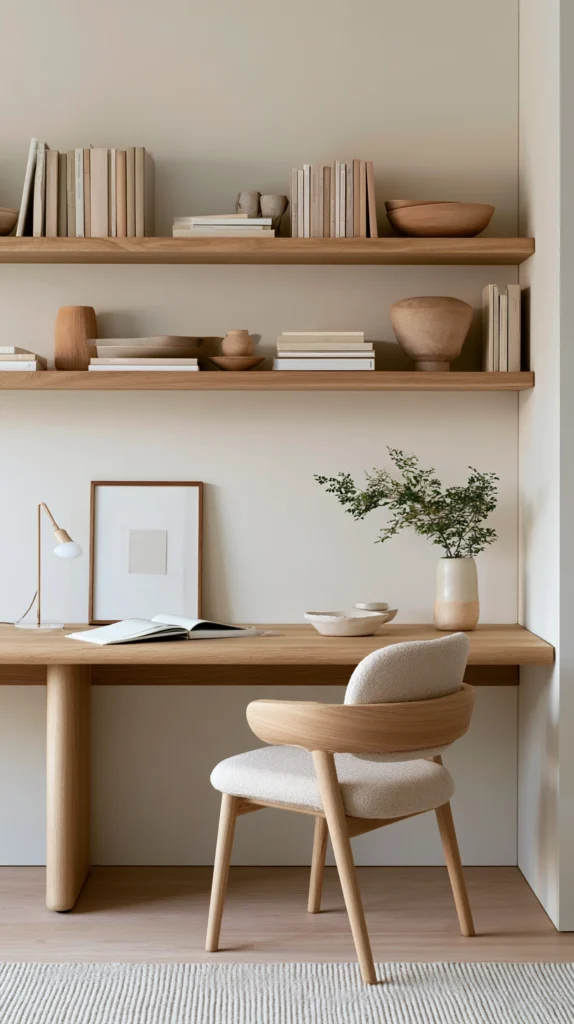
Floating shelves in a natural timber — a single shelf or two at most, holding a very small number of specifically chosen books and objects — provide the Japandi home office with its most restrained and the most carefully edited display surface. The Japandi shelf holds fewer things than the shelf of any other aesthetic and is more beautiful for the restraint.
Natural oak or ash floating shelves — $20 – $60 each installed. One or two shelves, each holding no more than five to seven items — books standing upright, a ceramic object, a single dried botanical, and breathing space between each item. The shelf’s restraint is the display principle.
Styling tip: Edit the floating shelf to contain only items currently relevant to the work being done in the office — the books consulted in the current project, the object that belongs to the current season, the single botanical that was chosen this week. A shelf edited to current relevance reads as alive and engaged with the present moment. A shelf holding every book and every object accumulated since the shelf was installed reads as storage — which is the opposite of the specifically present and specifically considered quality that the Japandi shelf requires.
8. The Paper Organisation System
Budget: $20 – $100
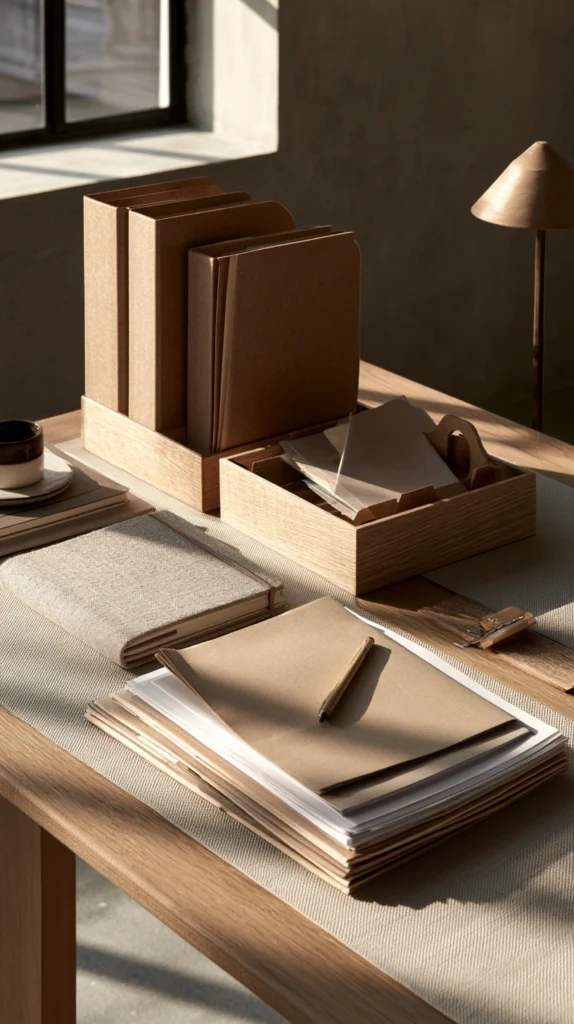
A visible paper organisation system — documents held in natural linen or kraft paper file folders, labelled in a clean and consistent handwriting, stacked in a simple timber or ceramic tray, with a single notebook open beside the desk lamp — communicates the Japandi principle of an ordered, considered working environment in which every document has a specific place and the working surface remains as clear as the task at any given moment requires.
Kraft paper or natural linen file folders — $5 – $15 for a pack. A simple timber or ceramic desk tray — $15 – $40. A quality notebook with a simple, undyed linen or natural paper cover — $10 – $30. A single mechanical pencil or a simple wooden pencil — $2 – $8.
Styling tip: Limit the visible paper system to documents currently in active use — maximum one folder per active project — and file completed work away from the desk surface immediately on completion. The Japandi desk surface should contain only what is needed for the current working session. Everything else, however beautiful its folder or its tray, introduces visual complexity that the quality of focused work does not require and the quality of the working environment does not benefit from.
9. The Japandi Lighting Design
Budget: $60 – $400
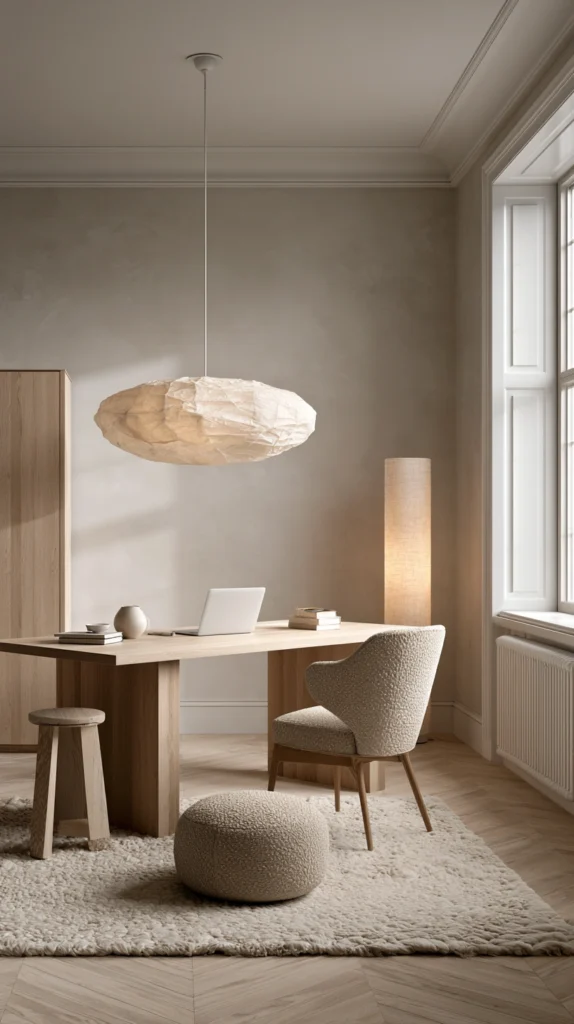
The Japandi home office requires a lighting design of specific deliberateness — a pendant in a natural material directly above the desk, a floor lamp in a simple form with a warm shade in the rest corner, and warm natural light filtered through shoji or sheer linen curtains during the day. No overhead fluorescent source anywhere in the workspace. No cool white light at any hour of the working day.
A washi paper pendant above the desk — $30 – $100. A rattan or bamboo pendant in a natural form — $25 – $80. A simple floor lamp with a linen shade for the rest corner — $40 – $120. Warm LED bulbs at 2700K throughout — $5 – $15 per pack. Sheer linen curtains to filter natural light — $30 – $80 per panel.
Styling tip: Position the pendant above the desk so that it hangs at approximately 60 to 70 centimetres above the desk surface — low enough to provide a sense of intimate, focused illumination directly at the working height but high enough to avoid producing glare on the screen or the paper beneath it. A pendant hung too high diffuses its light too broadly. One hung too low produces glare. The 60 to 70 centimetre height produces the specific quality of warm, focused, intimate task light that the Japandi working environment requires.
10. The Single Specimen Plant
Budget: $15 – $80
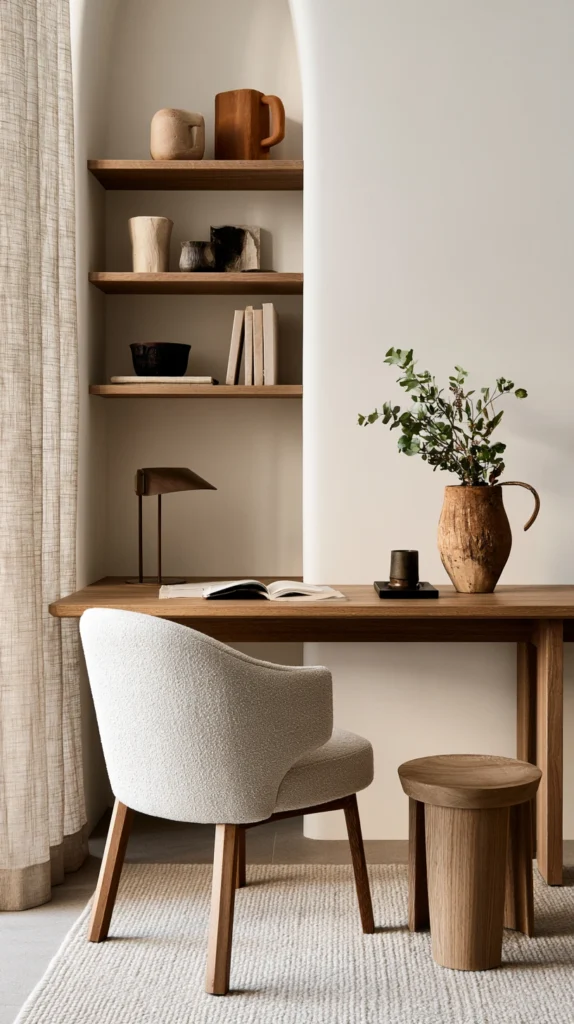
A single, carefully chosen plant — one architectural specimen in a simple ceramic or terracotta pot, positioned in the Japandi office at the location of most consistent natural light — is the workspace’s only living decorating element and the one that most directly and most honestly communicates the Japandi aesthetic’s connection to the natural world. One plant, genuinely healthy and genuinely cared for, communicates more than twelve plants distributed without principle.
A large snake plant in a simple white or terracotta ceramic — $15 – $40. A single fiddle leaf fig in a natural stone or ceramic pot — $40 – $80. A bonsai tree on a simple timber stand — $30 – $100 from a specialist bonsai supplier. A single architectural cactus in a handmade ceramic — $15 – $40.
Styling tip: Choose a plant that is genuinely appropriate to the light conditions available in the specific office location — a low-light species for a north-facing room, a sun-tolerant species for a south-facing one — rather than a plant chosen for its aesthetic quality alone. A plant in the wrong light conditions gradually declines regardless of care, and a declining plant in a Japandi workspace contradicts the principle of genuine natural health that the single specimen plant is present to embody.
11. The Japandi Desk Accessory Restraint
Budget: $30 – $150
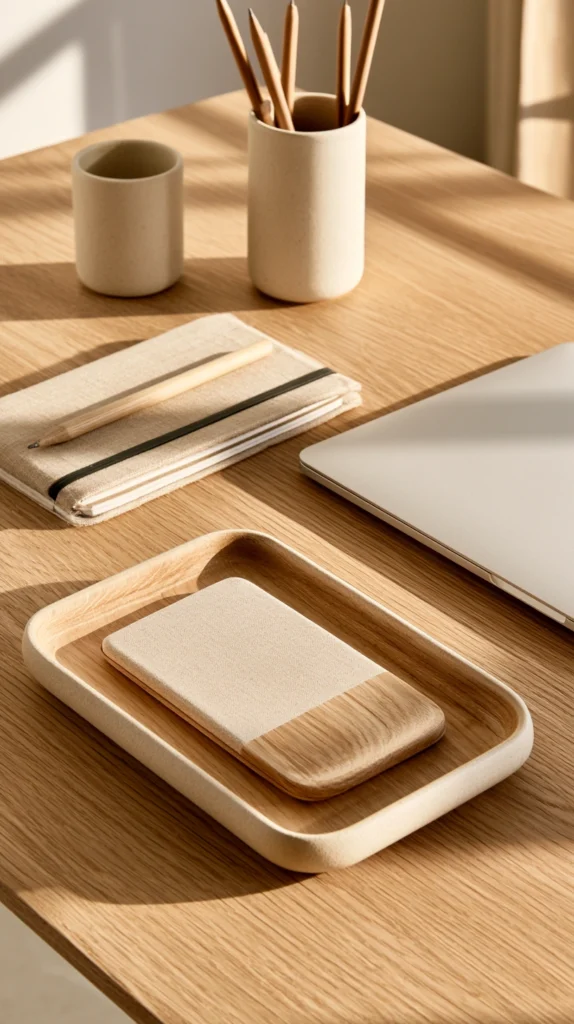
The Japandi desk surface holds fewer objects than any other aesthetic’s desk — a single ceramic pencil holder, one notebook, one lamp, and the working device. Nothing else. The restraint is not poverty. It is the specific, deliberate quality of a working surface designed for the full quality of focused thought rather than for the display of the person’s possessions.
A single hand-thrown ceramic pencil holder — $15 – $40. A quality undyed linen or leather notebook cover — $15 – $50. A small ceramic tray for the few items that must be on the desk — $10 – $30. A single dried botanical in a ceramic bud vase — $5 – $20. Total desk accessory investment: $45 – $140 — deliberately limited in quantity and specifically chosen in quality.
Styling tip: Before placing any object on the Japandi desk surface, ask whether the specific object contributes to the quality of the work done at the desk or to the quality of the environment in which the work is done. If the answer to both questions is no, the object belongs in a drawer, a shelf, or a different room. The Japandi desk surface is not a surface for objects that are merely pleasing or merely convenient. It is a surface for objects that earn their presence through genuine functional or genuine aesthetic contribution.
12. The Natural Sound Environment
Budget: $20 – $200
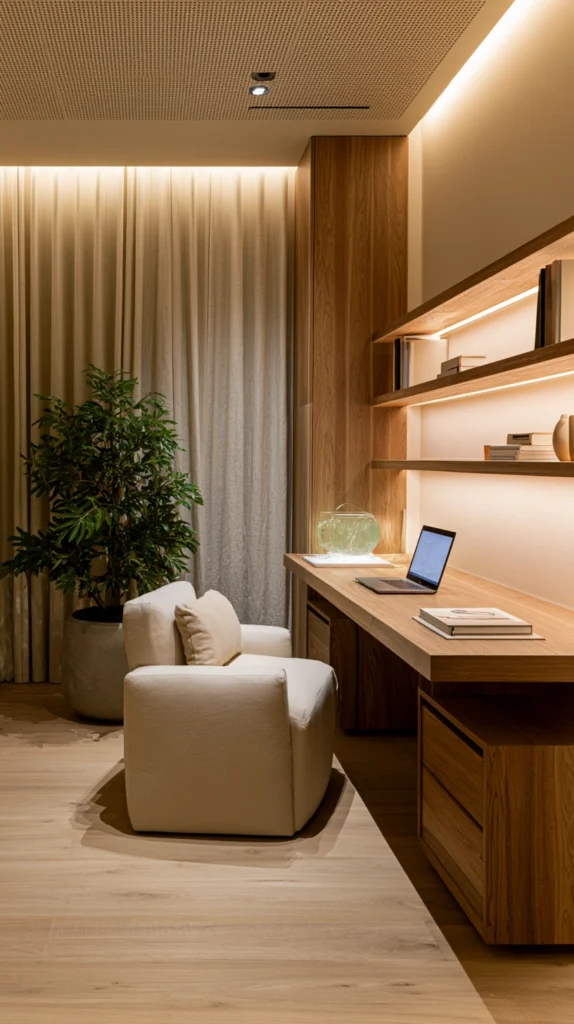
Sound is as important as light in the Japandi home office — the specific quality of auditory calm that the working environment produces being as determinative of the quality of concentrated work as the visual environment. A small tabletop water feature producing a gentle, continuous sound, a quality set of natural sound-blocking curtains, and a quality pair of over-ear headphones for sessions requiring complete silence constitute the Japandi office’s complete approach to the working sound environment.
A small tabletop water feature — $20 – $60. Heavy linen curtains providing sound insulation from external sources — $30 – $80 per panel. A quality pair of over-ear headphones — $80 – $300 from a quality audio brand. Total sound environment investment: $130 – $440 for a working environment that was designed for auditory quality as well as visual quality.
Styling tip: Position the tabletop water feature at the edge of the working zone — not directly on the desk surface where its sound is immediate and potentially distracting, but at a distance of two to three metres where its continuous sound provides a gentle ambient backdrop without demanding attention. The water sound should be the room’s ambient sound rather than its primary auditory focus.
13. The Japandi Cable Concealment
Budget: $15 – $80
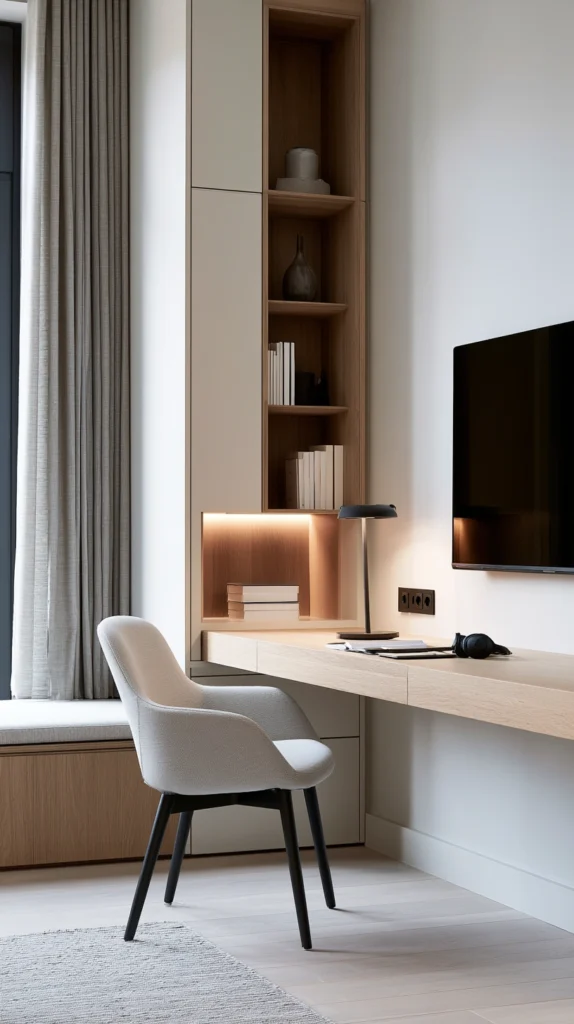
Cable concealment in the Japandi home office is not a finishing detail. It is a foundational requirement of the aesthetic’s defining quality — the quality of visual calm that a working environment free from visual noise produces. A Japandi office with visible cables is not a Japandi office. It is a workspace with Japandi-influenced furniture that has not yet addressed the most visually disruptive element of any contemporary working environment.
A natural timber cable management box — $20 – $50 to conceal the power strip beneath the desk. Fabric cable sleeves in a neutral linen tone — $5 – $15 per metre. A wireless keyboard, mouse, and charging pad — $40 – $150 to eliminate the most visible cable sources. Cable clips in a natural tone — $3 – $8 per pack.
Styling tip: Address cable management before any furniture placement, any accessory selection, and any aesthetic decision in the Japandi home office. A perfectly arranged Japandi workspace with visible cables reads as a workspace that understood the Japandi aesthetic everywhere except in the most immediately disruptive visual detail. The cable management is the discipline that allows every other decision to be seen and assessed in the quality of visual calm it was designed to produce.
14. The Changing Seasonal Display
Budget: $5 – $60 per season
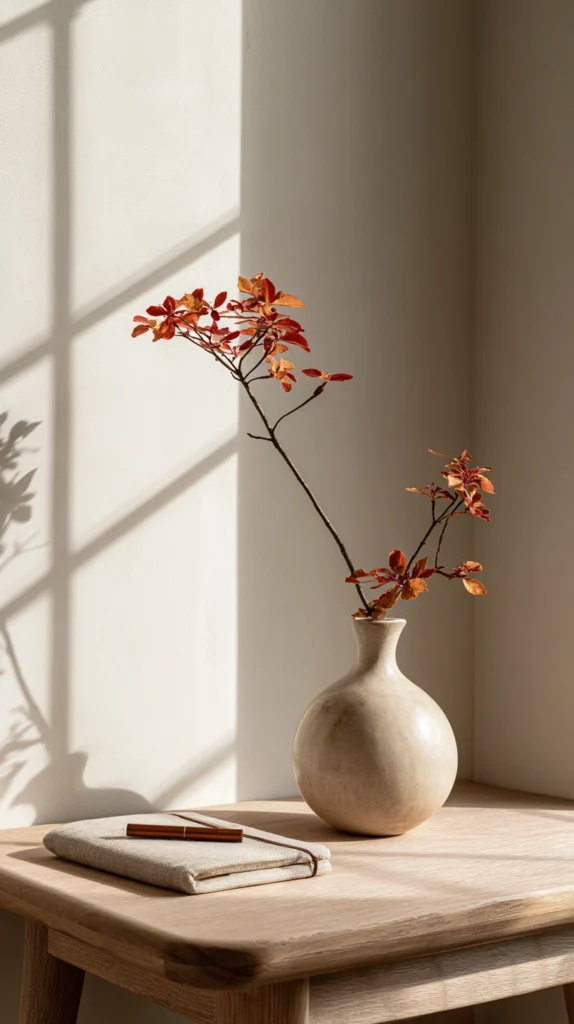
A small seasonal display — a single shelf section or a small corner of the desk surface that changes with the season — is the Japandi home office’s most directly connected expression of the Japanese concept of mono no aware — the beauty of impermanence, of things that are beautiful precisely because they will not last. A dried autumn leaf, a single spring blossom in a ceramic vase, a small stone gathered on a summer walk, or a pine cone from a winter forest communicates the specific quality of present attention that the Japandi aesthetic considers the foundation of all genuine beauty.
A single seasonal botanical — free if gathered personally from the natural environment. A small ceramic vase or a simple vessel to hold it — already present from the ceramic desk objects. A smooth stone, a dried seed head, or a small piece of bark — free from any walk in any season.
Styling tip: Change the seasonal display with genuine intention rather than casual habit — taking a few minutes to remove the previous season’s element, to consider what the new season offers, and to place the new element with the specific quality of attention that the display deserves. A seasonal display changed with genuine attention communicates the quality of present awareness that the Japandi office is designed to cultivate. One changed casually communicates that it was changed because the previous display had been there long enough, which is a different and less specifically beautiful relationship with the passage of time.
15. The Fully Realised Japandi Home Office
Budget: $600 – $4000
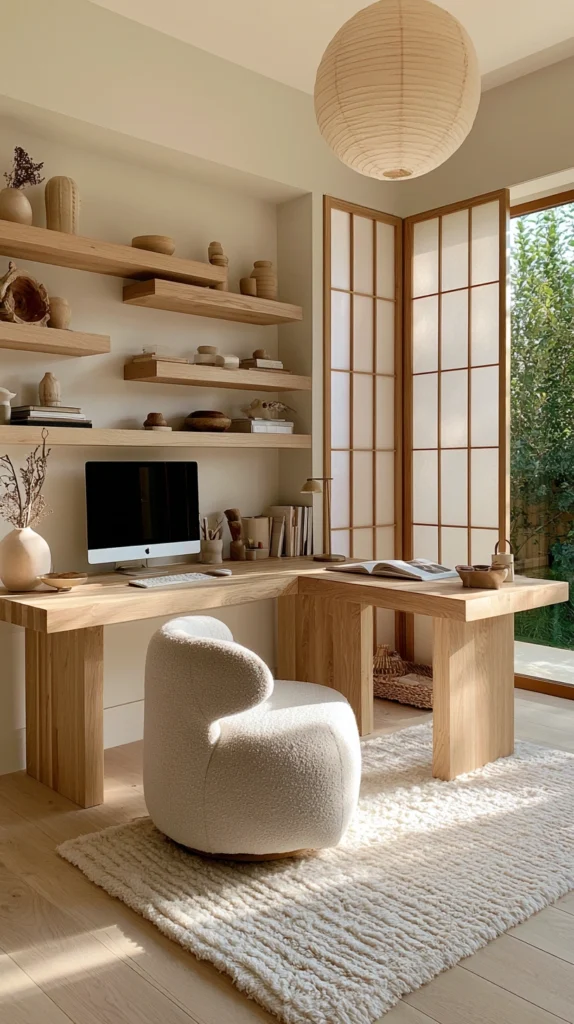
The fully realised Japandi home office — warm white walls in a dead-flat finish, natural ash or pale oak flooring with a large natural jute rug defining the working zone, a solid oiled oak desk with a single hand-thrown ceramic pencil holder and one quality notebook on its surface, a Japandi desk chair in a natural timber with a simple linen seat pad, a washi paper pendant hanging at 65 centimetres above the desk surface on a warm LED, one floating timber shelf holding five books and a single ceramic object, a shoji screen filtering the primary natural light source, a rest corner with a linen floor cushion and a low timber side table, a single architectural plant in a handmade ceramic pot, a tabletop water feature at the room’s edge, all cables completely concealed, a natural linen pinboard for current project materials, a seasonal botanical display on the corner of the desk, and no object on any surface that was not chosen for its quality, its honesty, and its specific contribution to the quality of the working environment — is a workspace of genuine and specifically earned serenity.
Paint: $40 – $150. Oiled timber desk: $150 – $600. Chair: $150 – $500. Flooring and rug: $150 – $600. Shoji screen: $80 – $300. Pendant and floor lamp: $70 – $220. Floating shelf: $20 – $60. Ceramic objects: $40 – $115. Rest corner: $125 – $360. Plant and ceramic pot: $30 – $80. Water feature: $20 – $60. Cable management: $60 – $150. Seasonal display: $5 – $30. Total fully realised Japandi home office: $940 – $3225 for a workspace designed from a single coherent principle — that the quality of the working environment and the quality of the work produced within it are not separable matters, and that both deserve the same quality of genuine, unhurried, and specifically considered attention.
Styling tip: Sit at the Japandi desk with no device open, no task in progress, and no intention to begin working — for five minutes, on the day the office is complete, before any work is done within it. Observe the quality of the light on the desk surface. Notice the sound of the water feature. Feel the quality of the chair and the desk height. Look at the single plant and the single ceramic and the single shelf. This five-minute period of deliberate observation before the first working session is a specifically Japandi practice — the practice of arriving in a space before using it, of noticing what was made before adding to it with the activity of work. A workspace arrived in before it is used becomes a workspace the person inhabits rather than merely occupies. That is the quality the Japandi office is designed to produce, and the five-minute arrival practice is the shortest path to experiencing it fully.
The Japandi home office is, in the end, a proposal about the relationship between the quality of the environment and the quality of the attention available within it — the proposal that a space of genuine restraint, genuine natural material honesty, and genuine visual calm produces a quality of focused, settled, and specifically creative attention that no more abundant or more decorated alternative can approach.
Reduce deliberately. Choose honestly. Maintain genuine attention.
Serenity is not something added to the room. It is what remains when everything unnecessary has been removed — and that, in the Japandi tradition, has always been the specific definition of beauty.