14 Jungle Nursery Ideas for a Wild Baby Room
There is something instinctively right about bringing the jungle into a baby’s first room. The colours are warm and alive, the shapes are organic and endlessly interesting, and the overall atmosphere communicates a world of growth, abundance, and gentle wildness that suits a new person beginning their life surrounded by living things.
A jungle nursery done with genuine thought and real materials — rather than a set of cartoon animal wall stickers from a catalogue — is one of the most beautiful and most enduring nursery aesthetics available. It grows with the child rather than dating quickly, and it creates a room that parents genuinely love spending time in at every hour of the day and night.
The fourteen ideas below cover every element of the jungle nursery from the walls to the finishing details.
1. The Jungle Green Wall Palette
Budget: $30 – $150
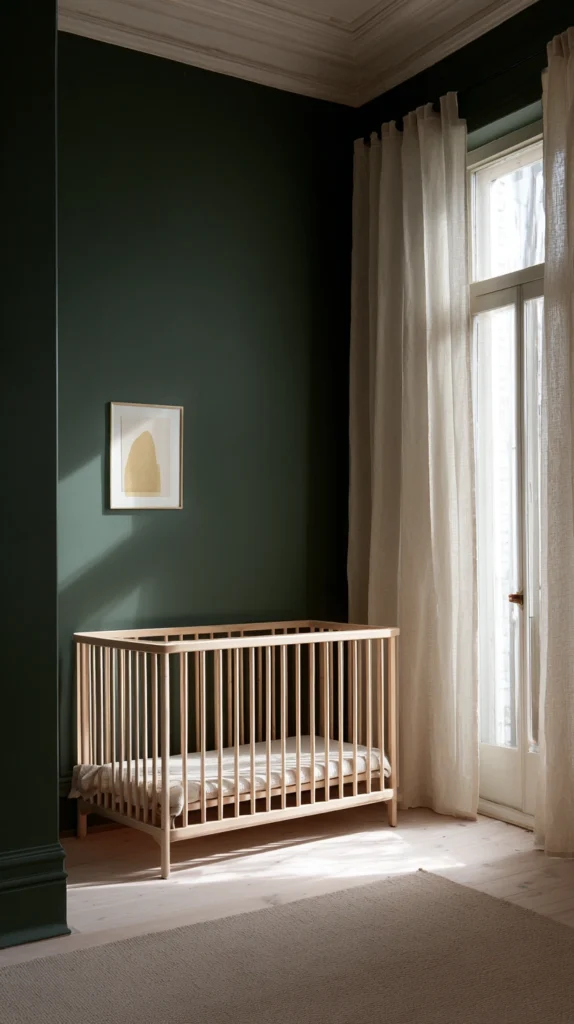
The jungle nursery’s foundational colour decision is the wall — and the wall colour that works consistently in a nursery used at every hour is a deep, warm jungle green rather than a bright or cool one. Deep sage, moss green, or a warm forest tone reads as lush and enveloping without the clinical quality of a bright paint.
A quality deep green paint in a flat or eggshell finish costs $20 – $50 per litre. A standard nursery requires two to three litres for two coats on all four walls. A single feature wall behind the cot in a deeper jungle green — with the remaining walls in a warm white or pale sage — is the more accessible introduction to the palette.
Decor tip: Choose a green with a yellow or brown undertone rather than a blue one for a jungle nursery application. A green with warmth in it reads as living and organic under artificial nursery light. A green with a blue undertone can read as cold and slightly clinical at 3am under a warm nightlight — which is the opposite of the atmosphere a jungle nursery is working toward.
2. The Tropical Leaf Wallpaper Feature Wall
Budget: $40 – $300
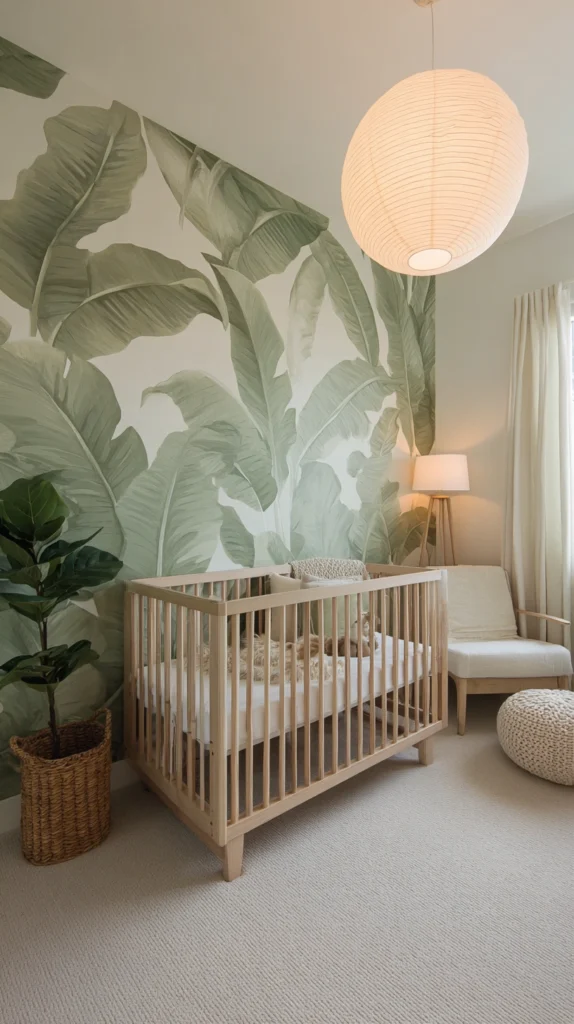
A large-scale tropical leaf wallpaper on the feature wall behind the cot — bold monstera leaves, banana palms, and trailing ferns in deep greens on a warm white or pale background — is the jungle nursery’s most impactful single decorating decision and the one that communicates the theme most immediately and most beautifully.
A quality botanical wallpaper in a large-scale tropical print costs $15 – $50 per roll. A standard nursery feature wall requires two to three rolls depending on the pattern repeat. Paste-the-wall varieties — the most DIY-friendly format — cost the same as standard wallpaper and require no soaking time before application.
Decor tip: Choose a wallpaper with a white or cream background rather than a dark one for a nursery application. A dark-background tropical wallpaper is beautiful in a living room or a hallway but can make a nursery feel enclosed and heavy at the scale required for a full feature wall. A light-background tropical print achieves the lush botanical effect while maintaining the room’s sense of airiness and light.
3. The Jungle Animal Mobile Above the Cot
Budget: $20 – $120
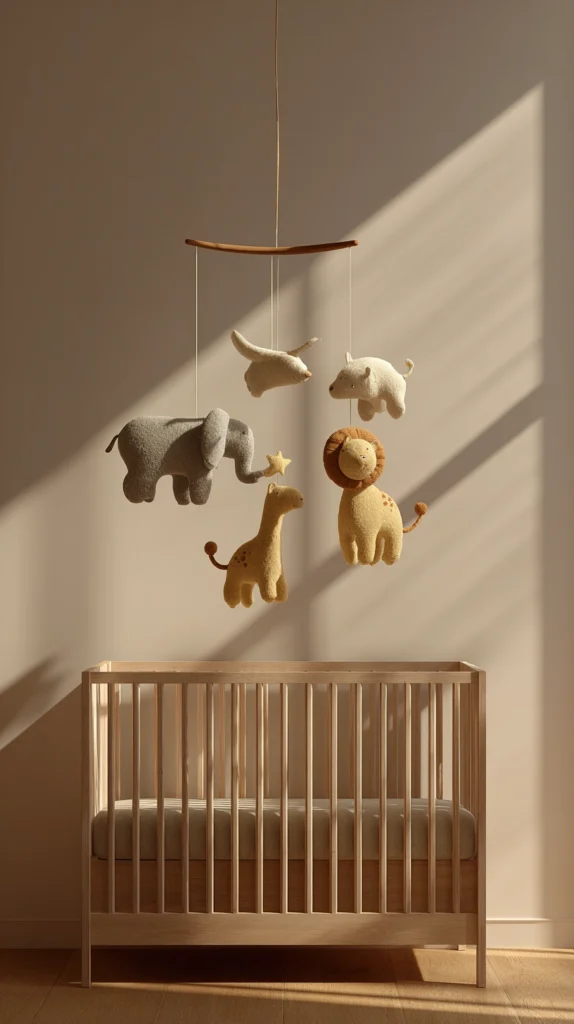
A mobile above the cot — felt or wooden jungle animals in lion, giraffe, elephant, toucan, and monkey shapes, suspended from a natural timber or brass arm — provides the visual stimulation a newborn benefits from during awake periods and the decorative moment the cot position requires from the room’s wider aesthetic.
A handmade felt jungle animal mobile costs $25 – $80 from independent craft makers. A wooden version in natural, laser-cut shapes — $30 – $100. A DIY felt mobile made from a simple pattern, a wooden embroidery hoop, and basic hand-sewing skills costs $10 – $20 in materials and produces a result as beautiful as any purchased alternative.
Decor tip: Hang the mobile at a height that places the animals approximately 20 to 30 centimetres above the cot mattress surface — close enough for the newborn to focus on without being within reach of a developing grasp. A mobile hung too high provides no visual benefit for the infant. A mobile within reaching distance becomes a safety concern as the baby develops.
4. The Indoor Plant Jungle Corner
Budget: $30 – $150
A corner of the jungle nursery given over to a genuine collection of living plants — a large monstera in a terracotta pot, a trailing pothos on a high shelf, a small rubber plant beside the nursing chair, and a collection of ferns on the windowsill — makes the jungle theme genuinely real rather than merely illustrated.
A large monstera deliciosa costs $20 – $60 depending on maturity. A golden pothos — one of the most air-purifying and most forgiving indoor plants available — runs $8 – $20. A rubber plant in a terracotta pot — $15 – $40. The total plant investment for a generous jungle corner sits at $43 – $120 for living material that actively improves the air quality of the room.
Decor tip: Position all floor-level plants in corners that will remain inaccessible once the baby begins to crawl — behind furniture, in corners blocked by the cot or the nursing chair. A plant beautiful at floor level in the newborn months becomes a soil-scattering hazard at seven months. Anticipate the crawling radius before positioning any floor plant and move them to higher surfaces before the mobile stage arrives.
5. The Jungle Themed Cot Bedding
Budget: $40 – $200
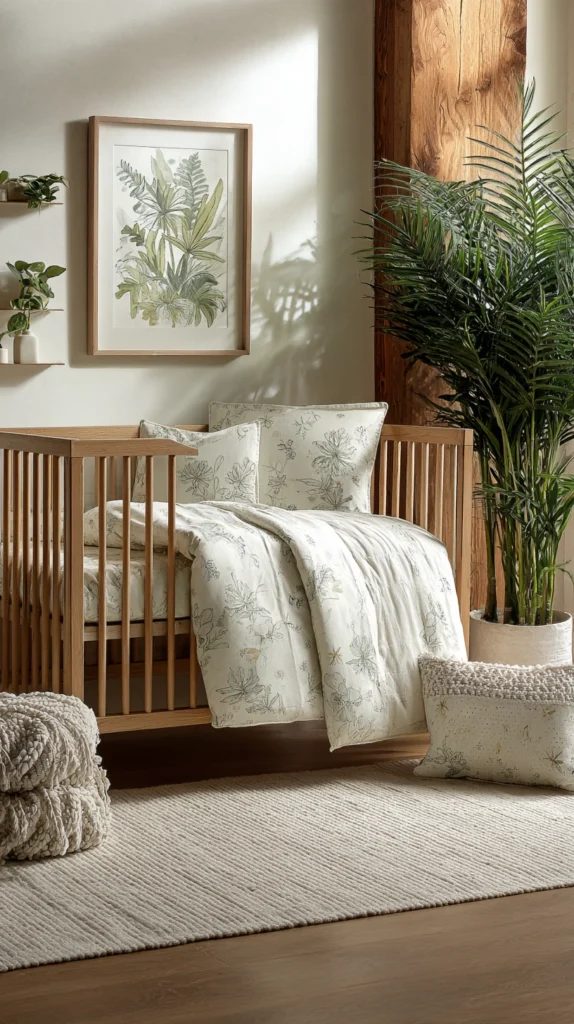
The cot bedding in a jungle nursery — the fitted sheet, the flat sheet, and the cellular blanket — should carry the botanical theme to the sleeping surface in the most intimate and most frequently seen textile in the room. A botanical leaf print in warm greens and cream, or a simple animal spot print in the jungle palette, brings the theme to the cot without overwhelming it.
Organic cotton fitted cot sheets in a botanical leaf print cost $20 – $50 each. A matching muslin flat sheet — $15 – $35. A cellular blanket in a warm jungle green — $20 – $50. All three in natural fibres rather than synthetic alternatives — the temperature regulation of natural cotton in a cot environment is significantly better than any polyester equivalent.
Decor tip: Choose bedding with a small or medium-scale print rather than a very large botanical repeat for the cot surface. A large-scale leaf print on a small cot sheet produces a pattern that is cut off at every edge and reads as incomplete. A small or medium-scale repeat shows the full pattern within the sheet dimensions and reads as a considered choice rather than a scaled-down version of something designed for a larger surface.
6. The Rattan and Natural Material Furniture
Budget: $80 – $600
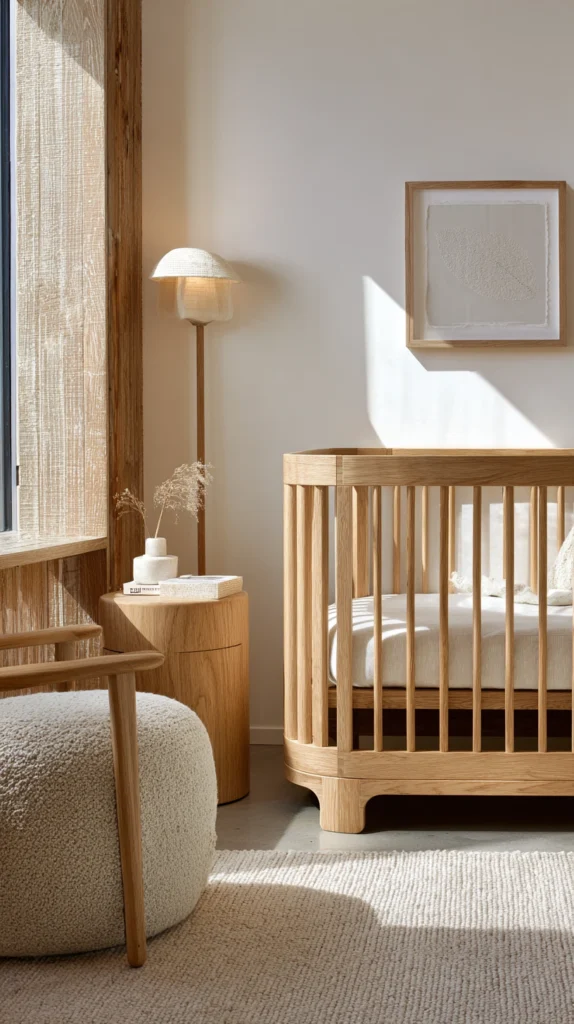
Rattan and natural woven furniture in the jungle nursery — a rattan bassinet, a wicker side table, a woven seagrass storage basket, a rattan pendant lampshade — carries the warm, organic material language of the jungle theme into the practical furniture of the room without requiring any additional decoration.
A rattan bassinet or Moses basket on a stand costs $80 – $250. A wicker side table beside the nursing chair — $30 – $80. A rattan pendant lampshade — $25 – $80 — filters the light to a warm, dappled quality that suits the jungle atmosphere and the practical requirements of a nursery used at every hour.
Decor tip: Mix rattan and natural woven pieces with white-painted timber furniture rather than combining all natural materials at the same warmth level. A nursery where every piece is in a natural woven or raw material finish can read as dense and heavy. One or two white-painted pieces — a white cot, white shelves — within a predominantly natural material room provides the lightness that keeps the jungle theme from feeling like a thicket.
7. The Jungle Mural Feature Wall
Budget: $80 – $800
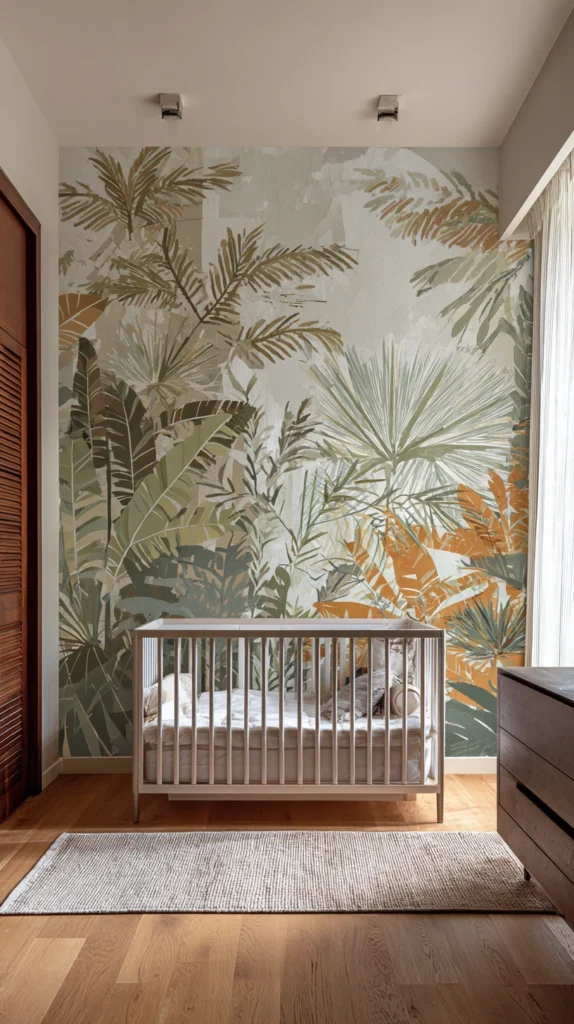
A hand-painted jungle mural on the feature wall behind the cot — towering palms, broad monstera leaves, peering animals, and climbing vines rendered in the warm greens and terracottas of the jungle palette — is the jungle nursery’s most ambitious and most spectacular decorating decision. A well-executed mural transforms the room into a genuinely immersive environment.
A local mural artist charges $150 – $600 for a standard nursery feature wall depending on complexity and detail level. A DIY mural using exterior-quality interior paint — stencilled leaves in varying sizes, painted freehand with basic brushes — costs $30 – $80 in materials and produces a result that is personal and characterful regardless of the painter’s level of technical skill.
Decor tip: Sketch the mural composition on paper — even roughly — before any paint touches the wall. A mural begun without a composition plan tends to fill the wall unevenly, with too many elements crowded into one area and too much empty space in another. A rough sketch that maps the major plant forms, the animal positions, and the overall balance of the composition takes twenty minutes and prevents hours of repainting.
8. The Canopy of Fabric Leaves Above the Cot
Budget: $20 – $100
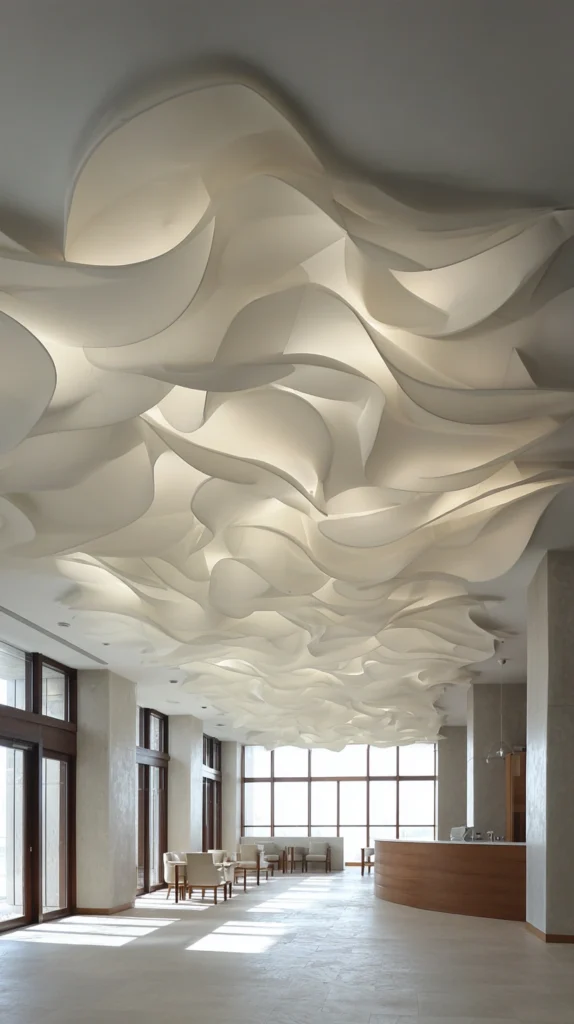
A ceiling canopy above the cot constructed from fabric or paper leaf shapes — large green felt or paper leaves suspended from the ceiling at varying heights on clear fishing line, creating the impression of a jungle canopy overhead — gives the infant a genuinely beautiful and endlessly interesting surface to look at during awake periods.
Large felt leaf shapes — cut from green felt fabric at $3 – $8 per metre — cost almost nothing in materials for a generous canopy. Clear fishing line — $3 – $8 per reel — suspends each leaf at a different height. Adhesive ceiling hooks — $5 – $10 for a pack — hold the fishing line without ceiling damage.
Decor tip: Vary the size of the leaf shapes dramatically — some very large, some medium, some small — rather than cutting all leaves to the same template. A canopy of uniform leaves reads as a repeated pattern. A canopy of varied leaf sizes reads as a genuine canopy — organic, layered, and genuinely suggestive of a forest ceiling rather than a craft project.
9. The Jungle Animal Soft Toy Collection
Budget: $30 – $200
A curated collection of soft jungle animal toys — a lion, a giraffe, an elephant, a toucan, and a small monkey — displayed on the nursery shelf or in the cot corner before the baby arrives, brings the animal world of the jungle theme to the room’s most tactile and most personally meaningful decorative layer.
Quality soft jungle animal toys cost $8 – $30 each depending on size and brand. A collection of five animals — one per shelf position or arranged as a group in the cot corner — sits at $40 – $150 in total. Handmade soft toys from independent makers are consistently more beautiful and more characterful than mass-produced equivalents and cost comparably to high-street alternatives.
Decor tip: Display the soft toy collection on the nursery shelf at a height visible from the nursing chair rather than only from above. A parent spending significant time in the nursing chair in the early months benefits from having something warm and beautiful to look at during the long and sometimes difficult hours of night feeding — and a shelf of well-chosen jungle animals at eye height from the nursing chair provides exactly this.
10. The Warm Timber Ceiling Beam Detail
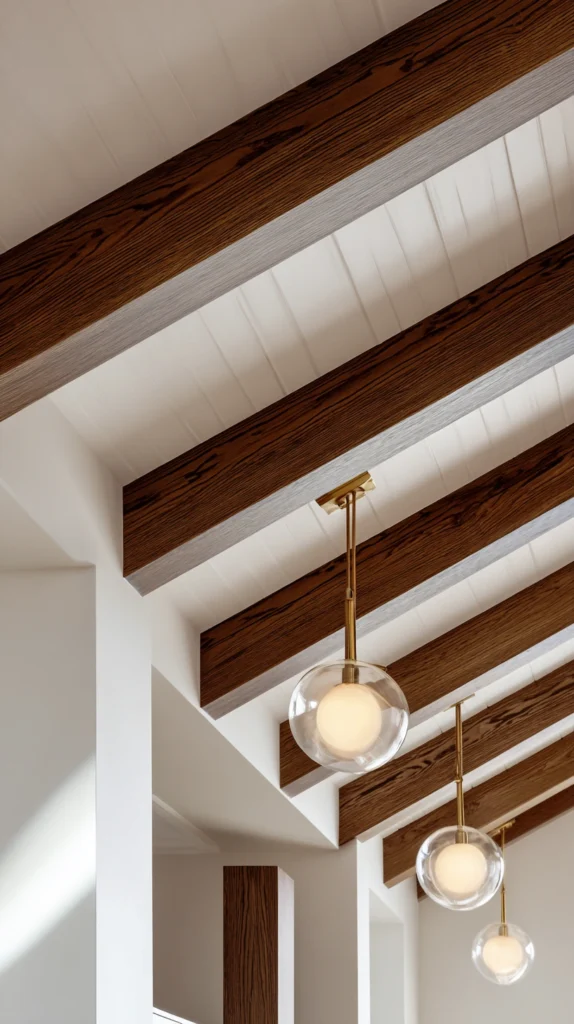
Budget: $50 – $400
Decorative timber ceiling beams in a warm dark stain — applied to the nursery ceiling as lightweight polyurethane casing rather than structural timber — are the jungle nursery’s most unexpected and most architecturally distinctive feature. They suggest the timber structure of a treehouse or a jungle lodge and give the ceiling a warmth and visual interest that a plain white ceiling never achieves.
Lightweight polyurethane decorative beam casings cost $30 – $60 per metre. Two or three beams across a standard nursery ceiling — $180 – $360 in total — create the overhead timber effect at a fraction of the weight and installation complexity of genuine timber. A dark walnut or warm oak stain — applied before installation — produces the deep, warm tone the jungle aesthetic requires.
Decor tip: Run the decorative beams parallel to the room’s longest wall rather than across the width of the room. Beams running the length of the room draw the eye along the ceiling and make the room feel longer and more spacious. Beams running across the width make the ceiling feel lower — an effect that is appropriate in some rooms and counterproductive in a nursery where a sense of airiness benefits both the infant and the parent.
11. The Earth-Tone and Jungle Green Textile Layer
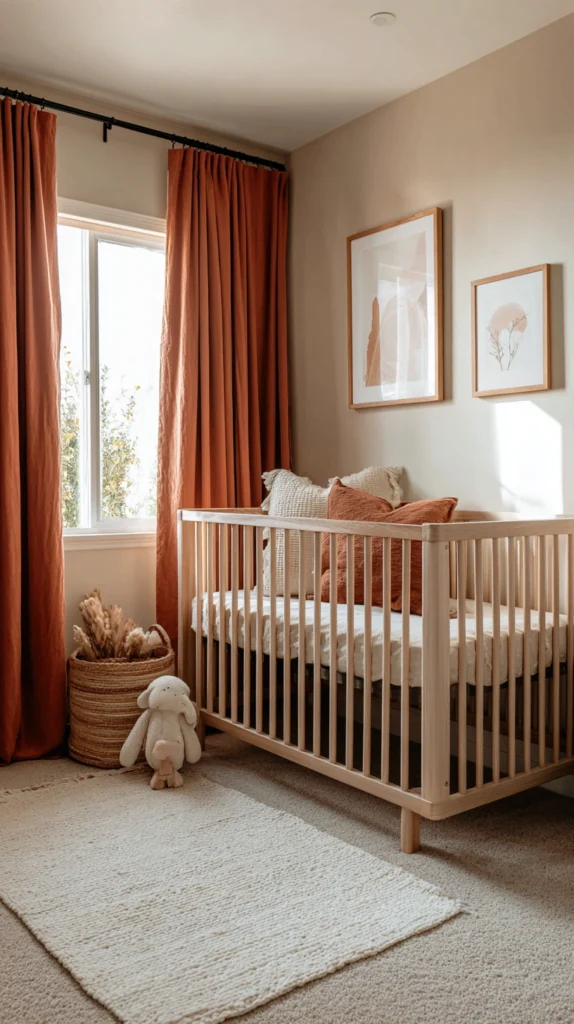
Budget: $40 – $200
The textile layer of the jungle nursery — the nursing chair cushion, the window curtain, the floor rug, and the throw blanket — should be built in the warm earth tones and jungle greens that give the theme its material depth. Terracotta, warm ochre, deep sage, and undyed natural linen all belong to the jungle palette and all contribute to the room’s warmth at the tactile level.
A linen cushion for the nursing chair in a warm terracotta — $25 – $60. A cotton curtain panel in a warm sage or botanical print — $25 – $60 per panel. A jute or cotton rug in a warm natural tone — $40 – $100. A muslin throw in a jungle green — $20 – $50. The total textile investment for a fully layered jungle nursery sits at $110 – $270.
Decor tip: Include at least one textile in an animal print — a giraffe-spot cushion, a zebra-stripe blanket, a leopard-print storage basket — within the jungle nursery’s textile collection. A single animal print used sparingly within an otherwise botanical textile story adds a playful, genuinely jungle-appropriate note. Multiple animal prints at the same scale produce a pattern competition that the botanical elements of the room cannot resolve.
12. The Jungle Nursery Shelf Display
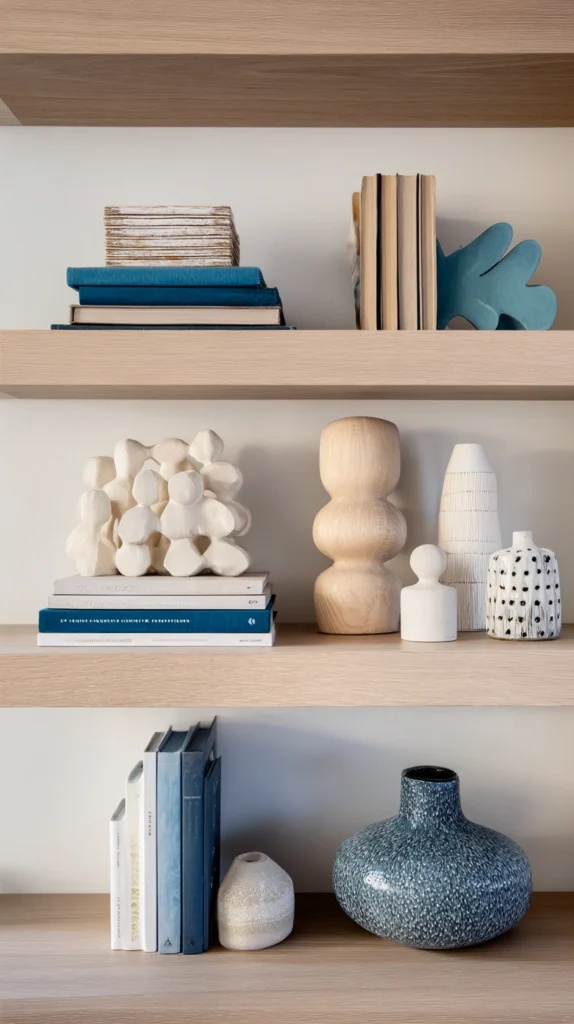
Budget: $30 – $200
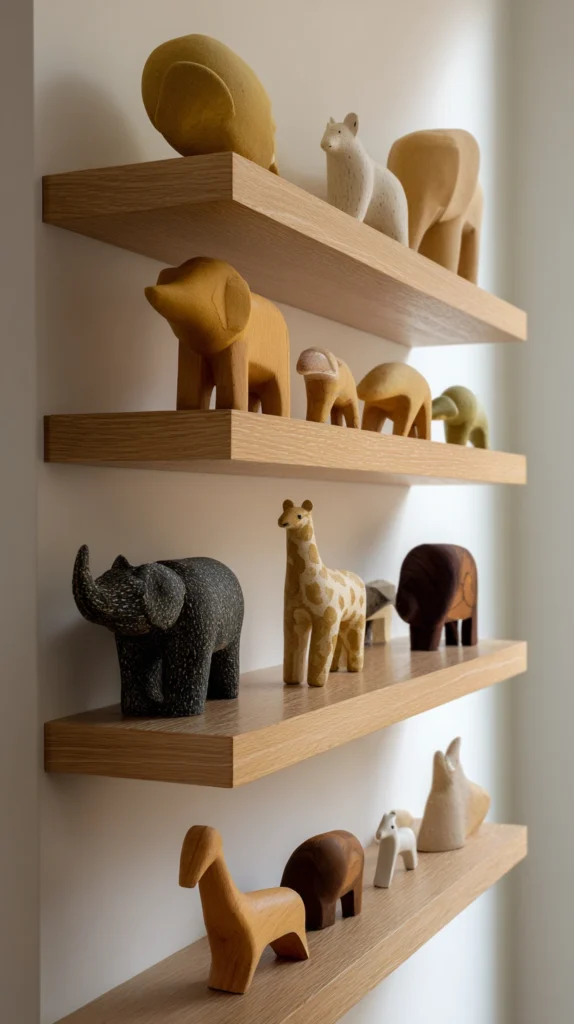
Open timber shelves in the jungle nursery — styled with a combination of jungle animal soft toys, terracotta plant pots, stacked board books with complementary spines, and small handmade ceramic objects — give the room its most personal and most visually varied surface and create the layered, collected quality that distinguishes a designed nursery from a purchased one.
Floating timber shelves in a natural or warm-stained finish cost $20 – $60 each installed. A pair of shelves — one at adult display height and one lower for board books — costs $40 – $120 in timber and fixings. The objects on the shelves — toys, plants, ceramics, books — cost $30 – $80 in total for a fully styled shelf pair.
Decor tip: Style the nursery shelves in the weeks before the baby arrives rather than in the weeks after. A shelf styled during the nesting period — when the motivation and the creative energy for these decisions are at their highest — is consistently more considered and more beautiful than one styled in the fragmented time available during the newborn weeks. Install, style, and leave them ready to be the room’s most welcoming feature from the first day.
13. The Jungle Themed Changing Station
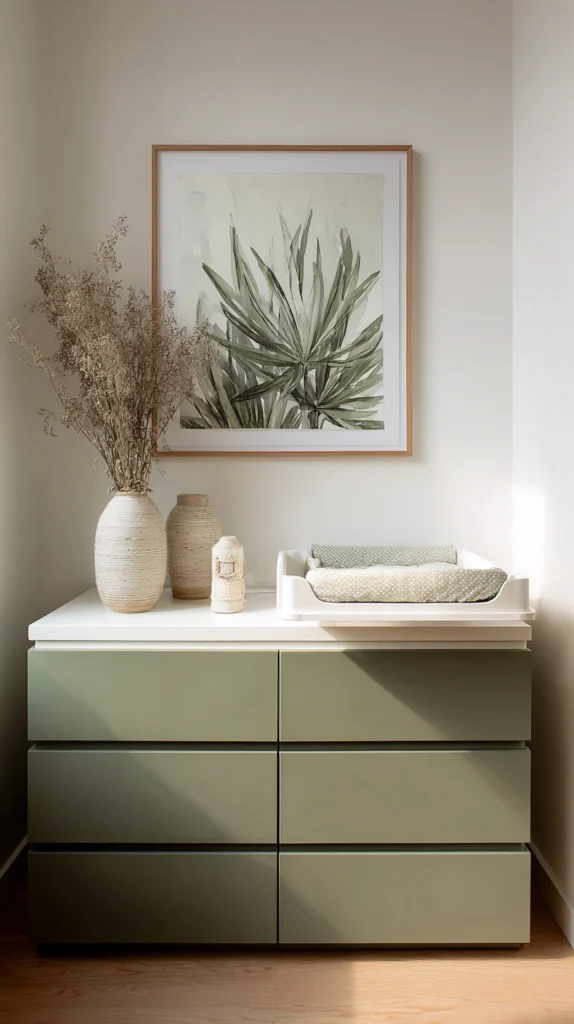
Budget: $50 – $300
A changing station designed with the same jungle aesthetic intention as the rest of the nursery — a natural timber dresser with a changing topper, a wicker basket of nappies within reach, a terracotta pot of cotton balls on the shelf above, and a jungle animal print pinned at the infant’s sightline — is the room’s most used surface and deserves the same level of consideration as any other.
A natural timber dresser with a changing topper costs $100 – $300 for the dresser and $20 – $50 for the topper. A wicker basket for nappies and wipes — $15 – $30 — replaces the standard plastic nappy caddy with something that belongs in the jungle aesthetic. A single botanical print or a jungle animal illustration at the infant’s sightline above the changing surface — $5 – $15 framed — gives the baby something worth looking at during every nappy change.
Decor tip: Position a small piece of jungle wall art directly in the infant’s sightline above the changing topper at the height the baby looks when lying flat. A baby who has something genuinely interesting to look at during a nappy change is a considerably more cooperative participant in the process than a baby staring at a blank ceiling — a practical observation that every parent of a wriggling infant will confirm.
14. The Jungle Nursery Lighting Scheme
Budget: $30 – $200
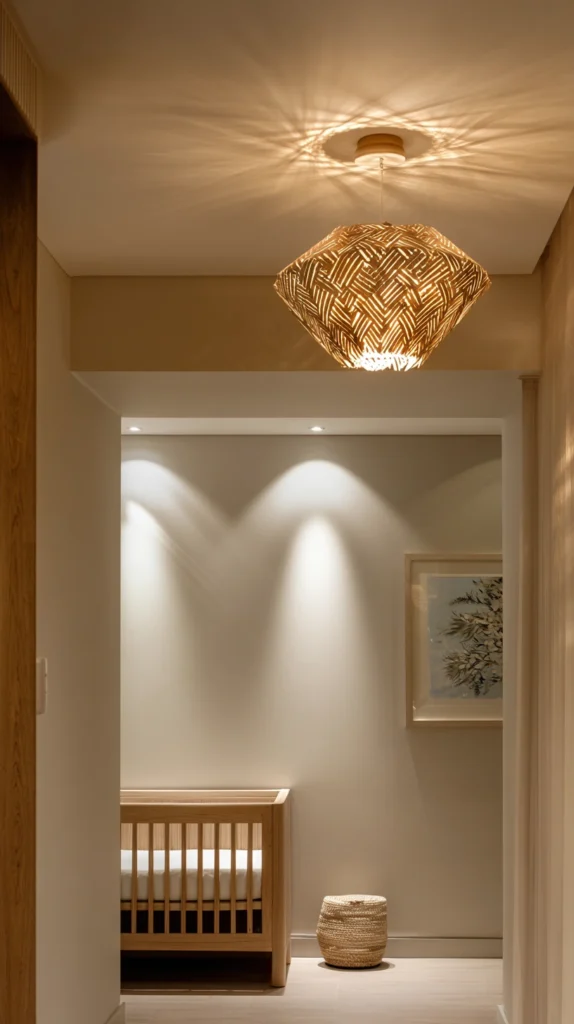
The lighting of the jungle nursery — the most practically important and most consistently under considered element of any nursery preparation — determines the atmosphere of the room at the hours when it matters most. A warm nightlight, a dimmable overhead pendant, and the warm filtered light of a rattan shade combine to produce a jungle nursery that feels warm and alive at every hour.
A rattan or woven pendant lampshade — $25 – $80 — filters the overhead light to a warm, dappled quality that suggests light through a jungle canopy and suits the theme more directly than any other shade format. A warm green or animal-shaped ceramic nightlight — $15 – $40 — provides the gentle illumination needed for night feeds. A dimmer switch on the main light — $15 – $30 installed — is the single most practical nursery lighting investment available.
Decor tip: Fit warm LED bulbs at 2700K in every fitting in the jungle nursery rather than standard cool white LEDs. Warm LEDs enhance the greens and terracottas of the jungle palette and produce a room that reads as lush and warm at every hour. Cool white LEDs in the same jungle nursery produce a clinical, slightly blue-toned light that works against every warm colour and natural material decision the room contains — and that is most noticeably wrong at the hours, specifically the middle of the night, when the lighting matters most.
Whatever combination of these fourteen ideas finds its way into the nursery, the principle beneath all of them is the same: a jungle nursery should feel genuinely alive — warm, green, growing, and full of the particular energy of a natural world that is always in the process of becoming something more.
It is a room that improves with every plant that grows a new leaf, every board book added to the shelf, and every morning that the light comes through the botanical curtains and falls across the cot where the baby is waking up to another day in the most beautiful room in the house.
Make it warm. Make it green. Make it genuinely wild in the best possible way.