14 Baby Blue Bathroom Ideas for a Spa-Like Refresh
There is a particular quality of light that exists only at the edge of shallow water on a bright day — the place where the sea or the pool meets the sand or the tile and the colour becomes something almost weightless, almost without pigment, the palest possible blue that still reads unmistakably as blue.
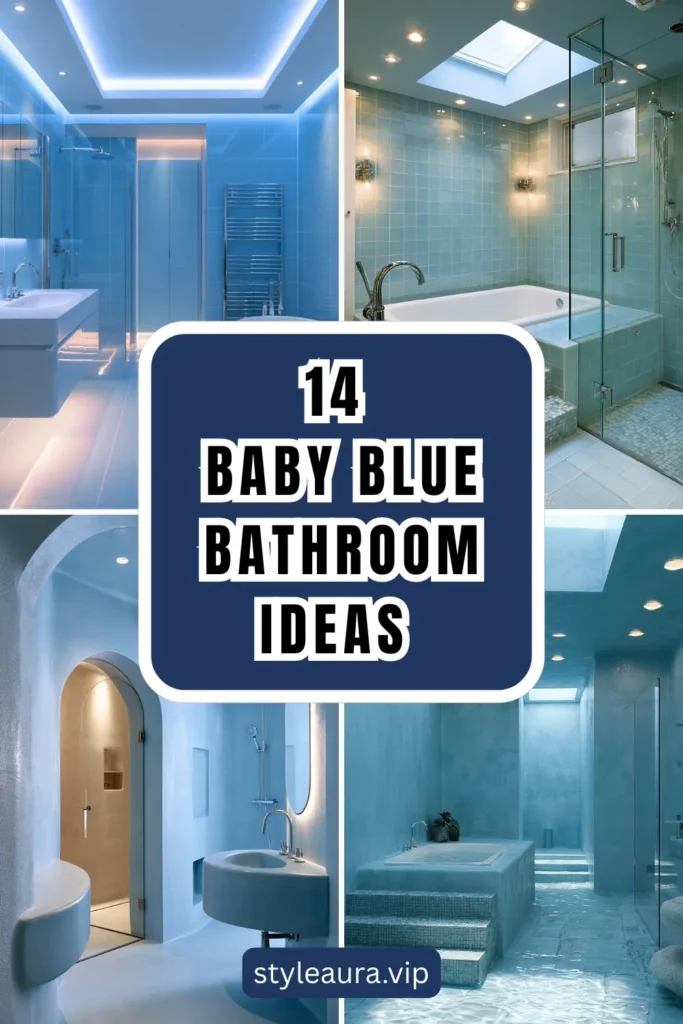
That specific quality of light is what the best baby blue bathrooms are reaching for — not a colour applied to a wall but a quality of atmosphere borrowed from the edge of water and brought indoors.
The fourteen ideas below approach the baby blue bathroom from entirely different angles than a standard treatment — focusing on texture, architecture, and the specific sensory experience of the bathing ritual rather than simply colour and tile.
1. The Baby Blue Plaster Wall
Budget: $80 – $500
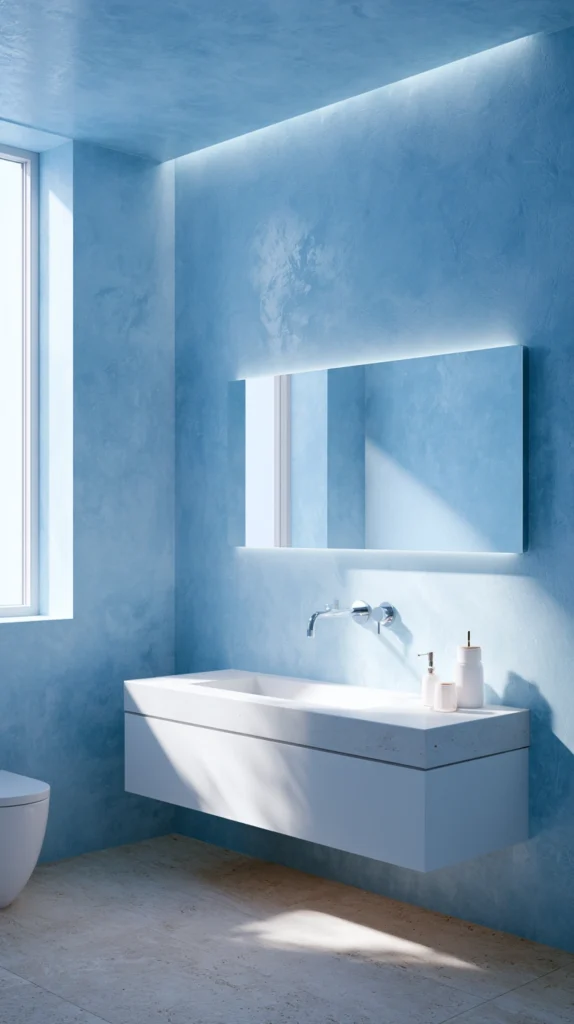
A Venetian or tadelakt plaster wall in baby blue — a polished, waterproof plaster finish traditionally used in Moroccan hammams, applied in a pale aquatic blue and burnished to a soft sheen — gives the bathroom a wall surface of genuine depth, genuine luminosity, and genuine spa pedigree.
Tadelakt is specifically designed for wet environments and improves with exposure to water and steam.
A tadelakt or Venetian plaster application — $40 – $80 per square metre in materials for a DIY approach, $80 – $150 per square metre professionally applied. A standard bathroom of eight to twelve square metres of wall — $320 – $1800 professionally, $160 – $960 as a DIY project.
Styling tip: Burnish the plaster with a soap-based sealant rather than a synthetic sealer — the traditional soap finish reacts with the lime plaster to produce a soft, water-resistant surface that deepens in colour and develops a richer sheen with every use. A synthetic sealer protects the surface but prevents this development — the plaster remaining at its initial colour and sheen rather than improving with age the way tadelakt is specifically designed to do.
2. The Sunken or Recessed Bath
Budget: $1,000 – $8,000
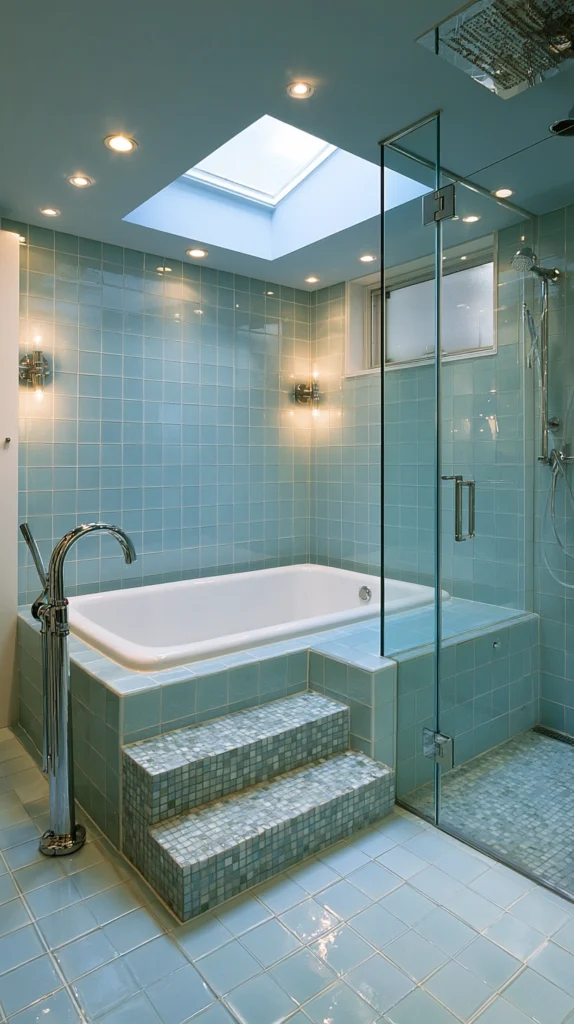
A sunken bath — the tub recessed into the floor structure so that the rim sits at or near floor level, surrounded by baby blue tiled steps or a tiled platform — is the bathroom’s most architecturally dramatic and the most genuinely spa-resort feature.
Stepping down into a bath rather than climbing into one fundamentally changes the bathing ritual’s physical and psychological quality.
Structural work to recess the bath into the floor — $800 – $3000 depending on the existing floor structure. A bath suitable for sunken installation — $200 – $1500. Baby blue tiling for the surrounding steps and platform — $200 – $600 in materials.
Styling tip: Tile the steps down to the sunken bath in the same baby blue as the bath surround, but in a contrasting tile format — a small mosaic on the steps against a larger format tile on the surround — so that the steps are tactilely distinguishable underfoot even when wet. This is both a safety consideration and a material detail that adds texture and visual interest to the most physically interacted-with surface in the room.
3. The Baby Blue Wet Room
Budget: $1,000 – $6,000
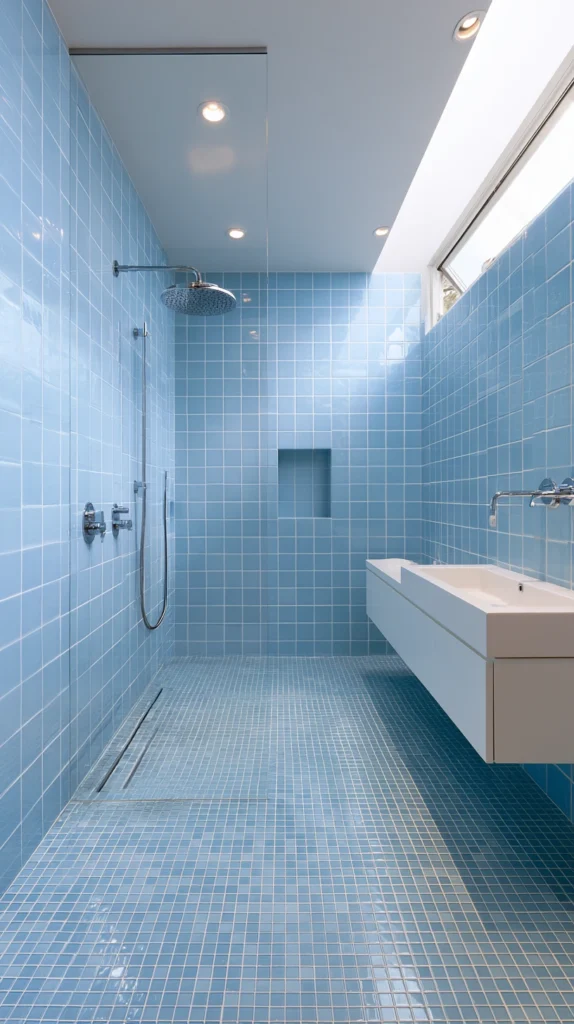
A fully tiled wet room in baby blue — no shower tray, no enclosure, the entire floor gently sloped to a central or edge drain, walls and floor in continuous baby blue tiling — produces a bathroom of complete material continuity and a specifically minimal, spa-like bathing experience.
The absence of a shower enclosure removes a visual and physical barrier, making a small bathroom feel significantly larger.
Waterproofing the full wet room — $300 – $800 in materials. Baby blue tiles for floor and walls — $20 – $50 per square metre. A linear floor drain — $80 – $250. Professional installation including the critical floor fall — $2000 – $4000 in labour.
Styling tip: Use the smallest format tile available for the sloped wet room floor — a small mosaic format follows the subtle gradient toward the drain far more cleanly than a large format tile, which requires extensive cutting and can produce visible lippage on a sloped surface. The floor’s small-format tile can differ subtly from the wall’s larger format while remaining within the same baby blue tone — providing a material distinction between floor and wall planes within a single colour.
4. The Baby Blue Bathroom With Skylight
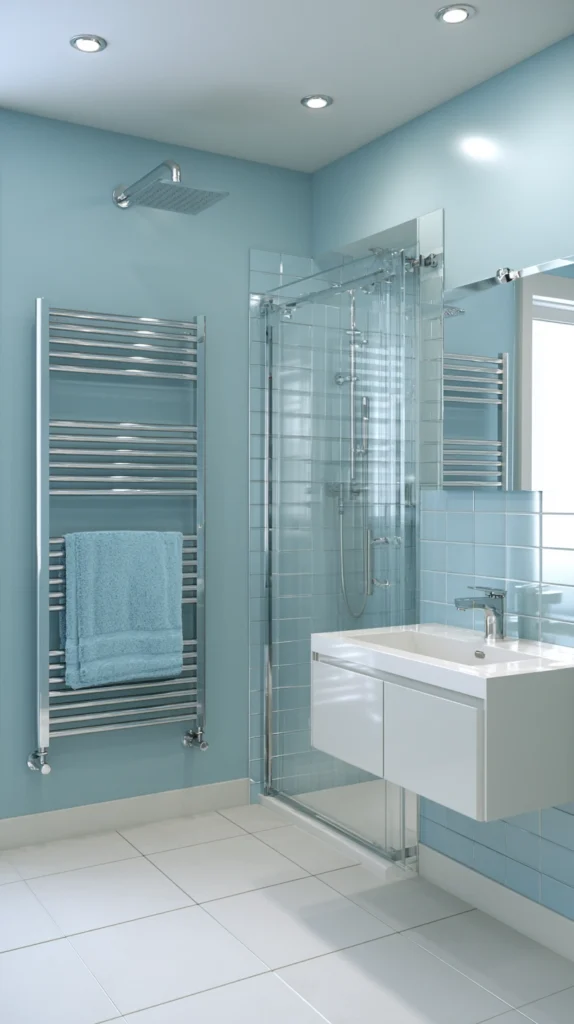
Budget: $200 – $2,000
A skylight or roof window above the bath or shower in a baby blue bathroom transforms the relationship between the room and natural light — baby blue walls lit from directly above read as luminous in a way that side-lit walls cannot replicate, the colour appearing to glow rather than simply to be illuminated.
A skylight above a bath also allows bathing under open sky — clouds, stars, or rain on the glass — which is one of the most genuinely luxurious bathroom experiences available.
A fixed skylight — $200 – $600 plus professional installation. An opening roof window with rain sensor — $400 – $1200 plus installation. Installation including any necessary structural and roofing work — $500 – $2000 depending on roof type and existing structure.
Styling tip: Position the skylight directly above the bath rather than above the vanity or the toilet zone. The bath is the bathroom’s primary location for unhurried time, and the experience of natural light — or stars, or rain — directly overhead during a bath is the specific experience that justifies the investment. The same skylight above the vanity provides good task light but none of the spa-like experiential quality.
5. The Baby Blue and Chrome Industrial-Spa Hybrid
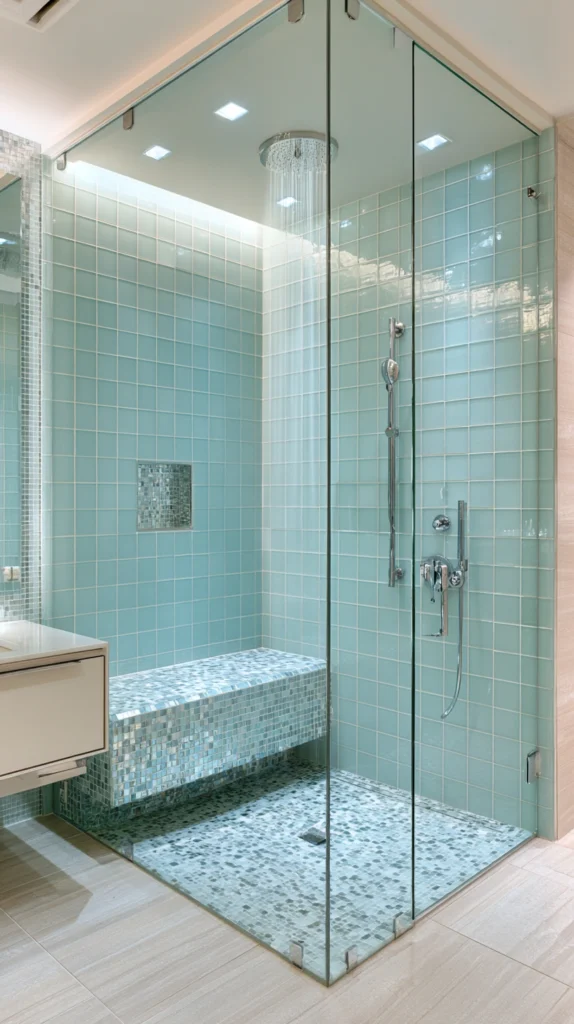
Budget: $200 – $1,200
Baby blue walls with industrial-style chrome and exposed plumbing — a chrome exposed shower system, an industrial-style chrome ladder towel rail, exposed chrome pipework as a deliberate feature, and simple white sanitaryware — produce a bathroom that combines the softness of baby blue with the precision of an industrial material palette.
The combination reads as a converted space — a warehouse or workshop bathroom with genuine spa sensibility.
An exposed chrome thermostatic shower system — $150 – $400. A chrome ladder-style heated towel rail — $80 – $250. Exposed chrome pipework as a design feature — $50 – $150 for visible runs. Simple white sanitaryware — $200 – $600.
Styling tip: Keep all chrome elements in a consistent polished finish rather than mixing polished and brushed chrome. The industrial-spa hybrid depends on the chrome reading as a single, consistent material decision — every pipe, every rail, and every fitting sharing the same reflective quality. Mixed chrome finishes in this context read as mismatched fittings rather than a considered industrial material palette.
6. The Baby Blue Bathroom With Integrated Bench
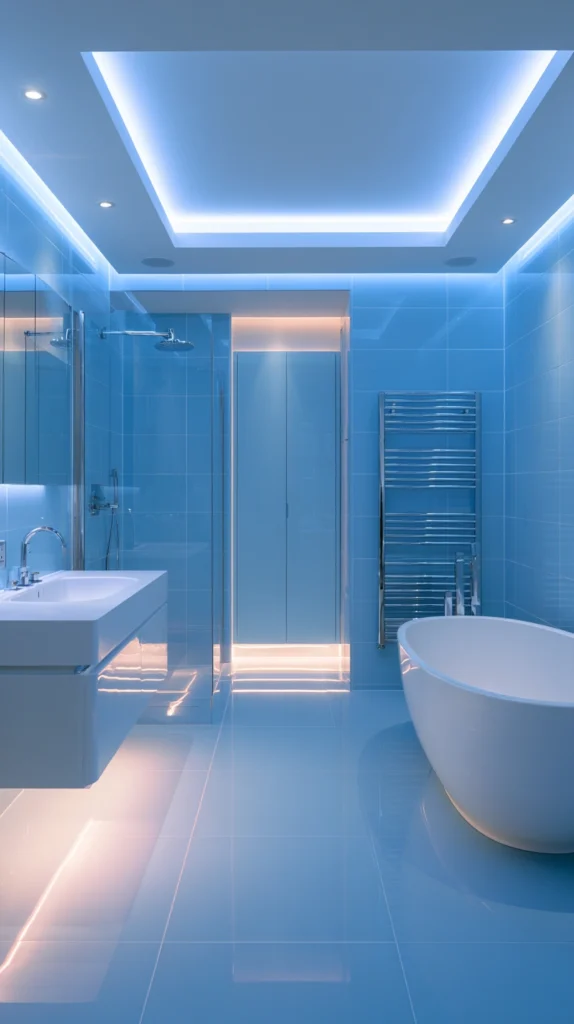
Budget: $200 – $1,500
A built-in tiled bench — within the shower enclosure, beside the bath, or as a freestanding element in a larger bathroom — tiled in the same baby blue as the surrounding surfaces, gives the bathroom a genuinely spa-functional element.
A shower bench allows sitting during a shower; a bench beside the bath provides a surface for towels, books, or a drink; either communicates that the bathroom was designed for unhurried use.
A built-in shower bench — $150 – $500 in construction materials plus tiling. A freestanding tiled bench beside the bath — $200 – $600. Tiling to match the surrounding baby blue — $20 – $50 per square metre for the bench surfaces.
Styling tip: Tile the bench surface in a slightly different baby blue tone or a different tile format from the surrounding walls — a small mosaic on a bench surrounded by larger format wall tiles, for example — so that the bench reads as a distinct functional element rather than disappearing into the wall surface. The subtle material distinction helps the bench register visually as a place to sit rather than as a continuation of the wall.
7. The Baby Blue Bathroom With Underfloor Heating
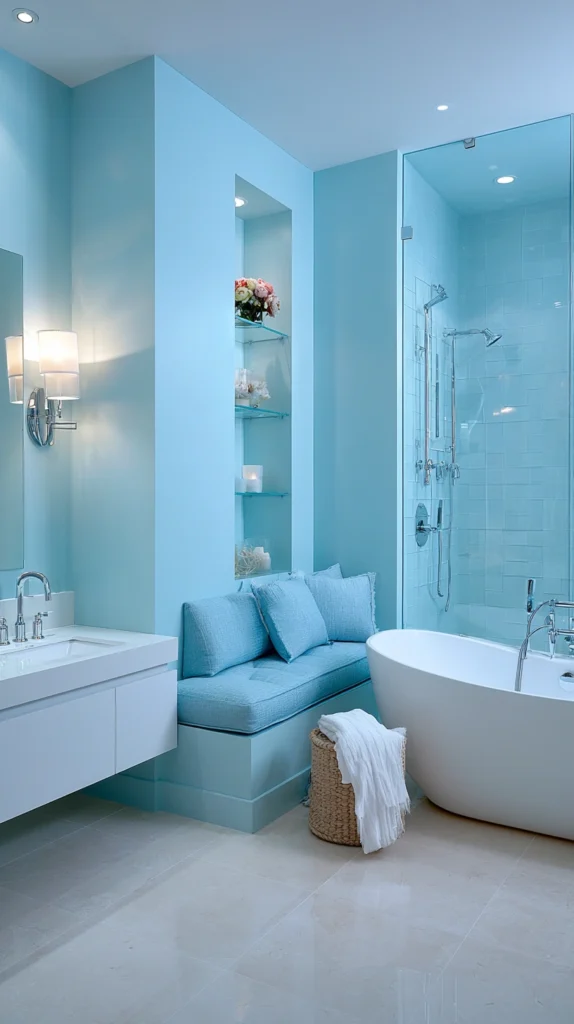
Budget: $300 – $1,200
Underfloor heating beneath a baby blue tiled floor is the bathroom investment that most directly affects the daily physical experience of the room without affecting its appearance at all.
A baby blue bathroom with a warm floor underfoot produces the specific bodily comfort that the spa experience depends on — the visual coolness of the palette balanced by the physical warmth of the floor.
An electric underfloor heating mat system — $150 – $500 in materials for a standard bathroom floor. A programmable thermostat — $50 – $150. Professional installation — $200 – $600 including the tiling work that must accompany it.
Styling tip: Set the underfloor heating on a timer that brings the floor to temperature thirty minutes before the bathroom’s typical morning and evening use times rather than maintaining a constant temperature throughout the day. A floor that is warm specifically when needed is both more energy-efficient and more specifically luxurious — the warmth registering as a considered comfort rather than a background constant that becomes unnoticed.
8. The Baby Blue Bathroom With a Reading Nook
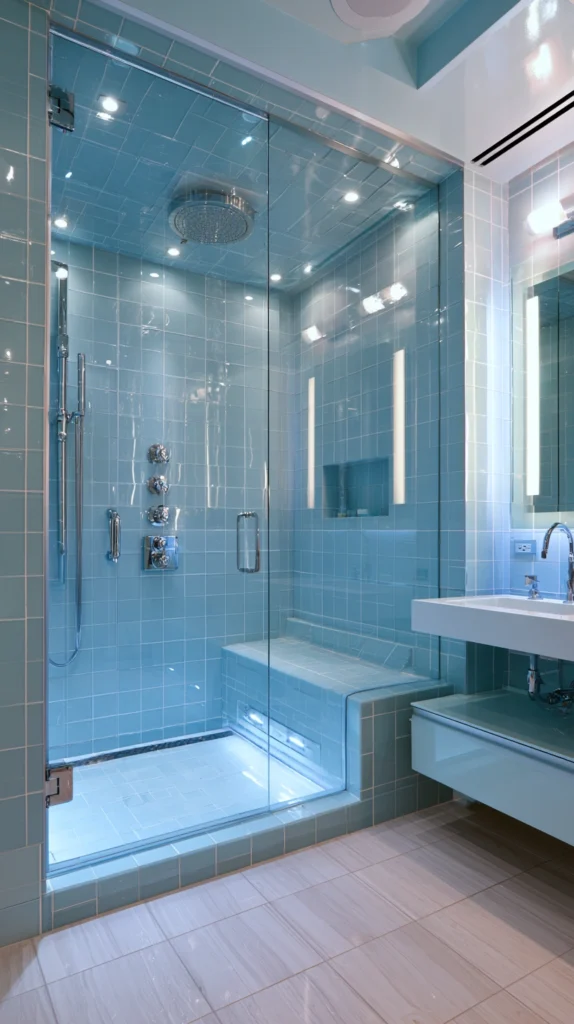
Budget: $100 – $600
In a generously sized bathroom, a small reading nook — a built-in or freestanding bench seat beside the bath, with a small shelf for a book and a cup of tea, a wall-mounted reading light, and a small stack of waterproof-cover books — extends the spa concept beyond bathing into genuine relaxation.
The baby blue bathroom becomes a room for unhurried time rather than a room for hygiene tasks performed quickly.
A built-in bench with storage beneath — $100 – $400. A wall-mounted brass or chrome reading light — $30 – $80. A small wall shelf — $15 – $40.
Styling tip: Position the reading nook away from direct splash zones — beside the bath but not within reach of the shower, and at a sufficient distance from the bath that books and cushions remain dry during normal bathing. The nook should feel like a genuinely separate zone within the bathroom rather than an extension of the wet area, even in a room where every surface is ultimately water-resistant.
9. The Baby Blue Bathroom With Smart Steam Shower
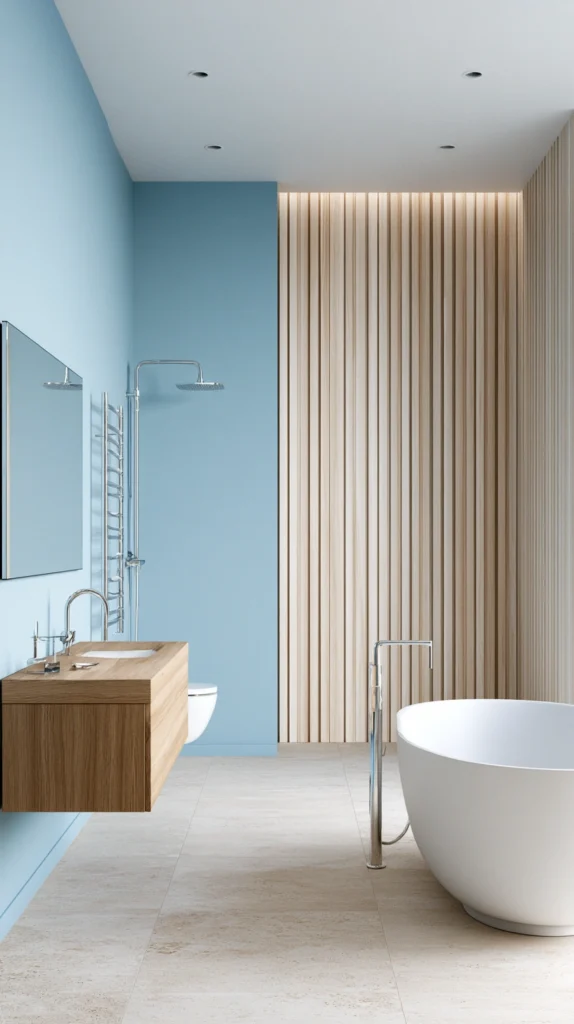
Budget: $1,000 – $5,000
A steam shower — a sealed shower enclosure with a steam generator providing a genuine sauna-like steam experience — in a baby blue bathroom produces the most directly spa-equivalent feature available to a domestic bathroom.
Steam showers provide genuine therapeutic benefits and transform the daily shower from a hygiene task into a wellness ritual.
A steam shower enclosure with integrated generator — $1500 – $4000. A retrofit steam generator for an existing sealed shower enclosure — $800 – $2000 plus installation. Baby blue tiling within the steam enclosure — $100 – $300 in materials.
Styling tip: Specify a steam shower with a built-in aromatherapy dispenser if available, or install a simple essential oil diffuser tray within the enclosure. Eucalyptus, lavender, or a citrus blend introduced into the steam transforms the experience from a hot, humid shower into a genuinely aromatherapeutic one — the combination of baby blue surfaces, warm steam, and fragrance producing the most completely sensory spa experience available within a domestic bathroom.
10. The Baby Blue and Pale Wood Sauna-Adjacent Aesthetic
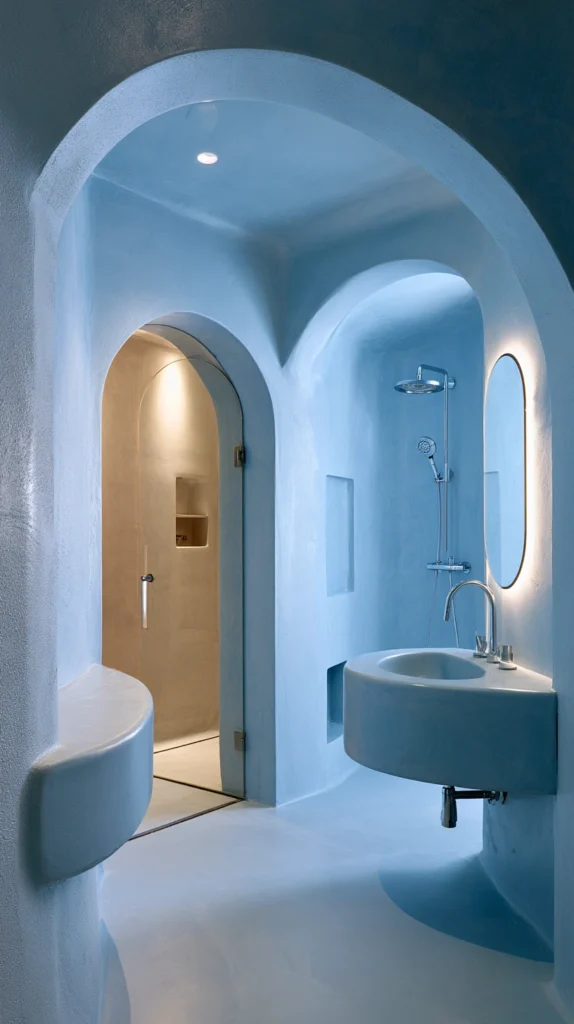
Budget: $150 – $1,000
Baby blue walls beside pale, unfinished or lightly oiled timber — a pale ash or cedar bath surround, slatted pale timber wall sections, a timber bath mat, and timber-framed accessories — references the Scandinavian sauna and spa tradition, where pale timber and pale blue-grey tones combine to produce an atmosphere of clean, cool, genuinely restorative simplicity.
Pale cedar or ash slatted wall panels — $40 – $120 per square metre in materials. A pale timber bath surround — $100 – $400. A cedar bath mat — $30 – $80. Timber-framed mirror and accessories — $40 – $150.
Styling tip: Choose cedar specifically for any timber element in direct or frequent contact with water — cedar’s natural oils provide inherent water and rot resistance that other pale timbers lack. Cedar develops a silvery-grey patina over time that beautifully complements baby blue without requiring ongoing sealant maintenance.
11. The Baby Blue Bathroom With Curved Architecture
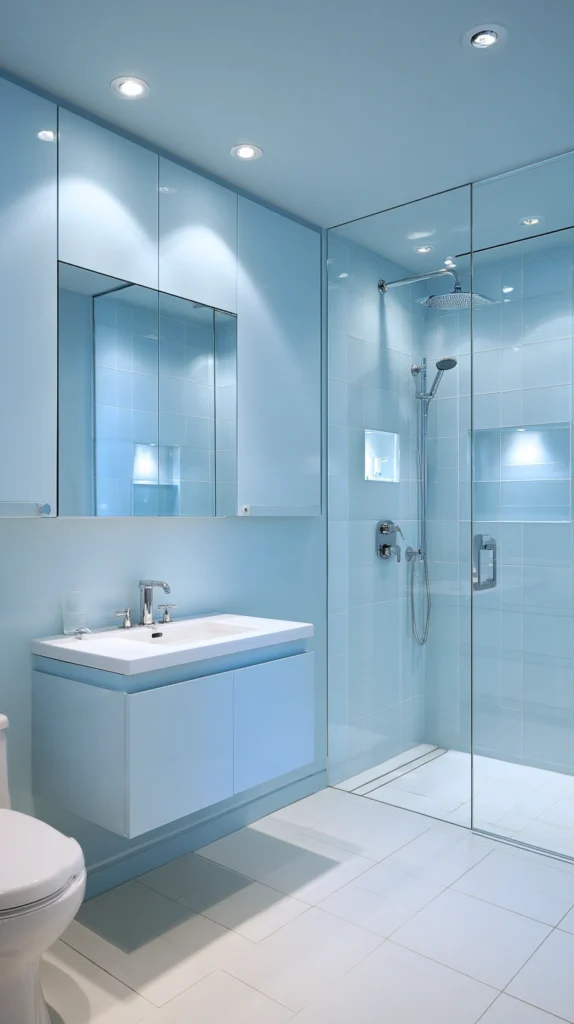
Budget: $300 – $3,000
Curved architectural elements — a curved shower enclosure wall, an arched niche for toiletries, a rounded vanity, or curved tiling at internal corners — in a baby blue bathroom produce a softness and a flow that rectilinear bathrooms cannot achieve.
Curves in baby blue tile or plaster catch light continuously across their surface rather than at sharp angular breaks, producing the specific quality of light-on-water that the colour is reaching toward.
A curved shower enclosure — $400 – $1500 for a curved glass panel system. An arched niche built into a stud wall — $150 – $400 in construction materials. Curved bullnose tile trim at corners — $5 – $15 per linear metre. A rounded vanity unit — $200 – $800.
Styling tip: Introduce curves at the points of most frequent physical contact — the corner the hand brushes when entering the shower, the edge of the vanity against the hip — rather than as a purely visual gesture on a wall that is never touched. Curves that are physically encountered communicate the softness of the design through touch as well as sight, which is a more completely sensory experience than visual curvature alone.
12. The Baby Blue Bathroom With Hidden Storage
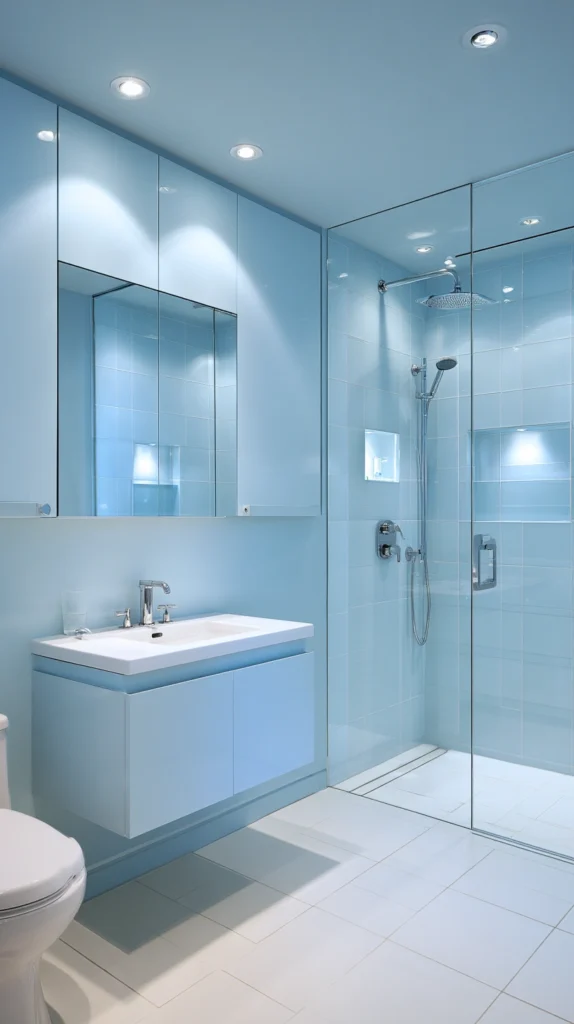
Budget: $100 – $800
A baby blue bathroom where all storage is concealed — recessed mirrored cabinets, built-in niches with discreet doors, and a vanity with full-height integrated storage — maintains the spa-like visual calm of the baby blue palette by removing the visual clutter of everyday bathroom items from sight.
A genuinely spa-like bathroom shows almost nothing except the materials and the fittings themselves.
A recessed mirrored cabinet — $80 – $250. Built-in wall niches with concealed doors — $100 – $400 in construction. A full-height vanity with concealed storage — $200 – $700.
Styling tip: Allow exactly one or two genuinely beautiful objects to remain visible on the open surfaces — a single ceramic soap dish, one folded towel, a single plant — while everything else disappears into concealed storage. A bathroom with absolutely nothing visible can read as sterile rather than calm. One or two carefully chosen visible objects against an otherwise concealed-storage bathroom communicate that the calm is a deliberate design choice rather than an empty room.
13. The Baby Blue Bathroom Scent and Sound Layer
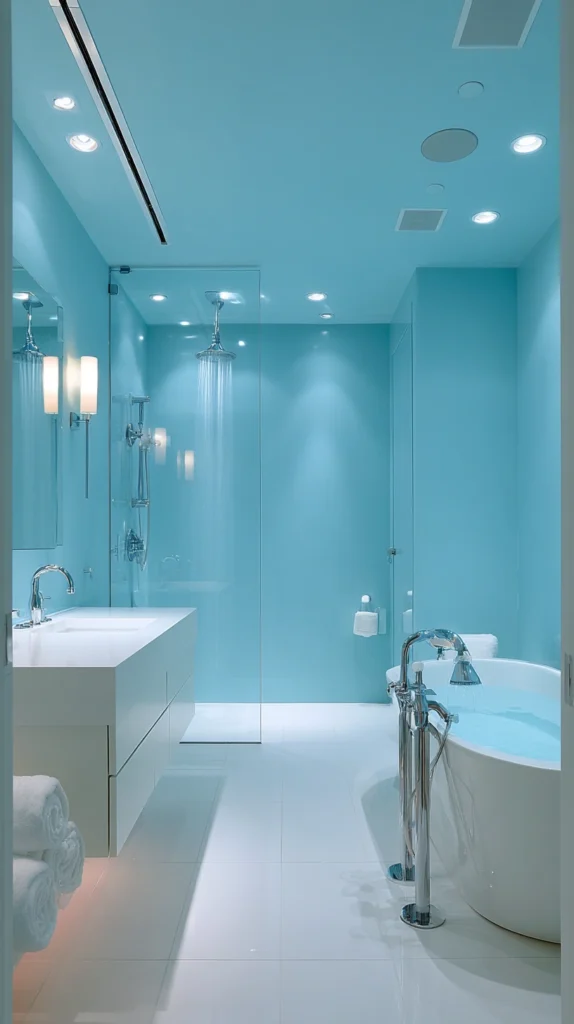
Budget: $30 – $200
A baby blue bathroom’s sensory dimension beyond the visual — a built-in or portable speaker for quiet music or recorded water sounds, an essential oil diffuser running continuously on a low setting, and a candle reserved specifically for bath time — completes the spa atmosphere at the senses that the colour and the tile alone cannot address.
A small waterproof bathroom speaker — $30 – $80. An essential oil diffuser — $25 – $60. A quality candle reserved for bath use — $15 – $40. Total sensory layer investment: $70 – $180 for a bathroom that engages sound and scent as deliberately as it engages sight.
Styling tip: Reserve a specific candle scent exclusively for bath time rather than using it throughout the home. A scent encountered only during baths becomes associated, through repetition, specifically with the experience of bathing — so that lighting the candle becomes part of the ritual that signals the transition into bath time, the scent itself eventually capable of producing a sense of calm before the bath has even been run.
14. The Fully Realised Spa-Architecture Baby Blue Bathroom
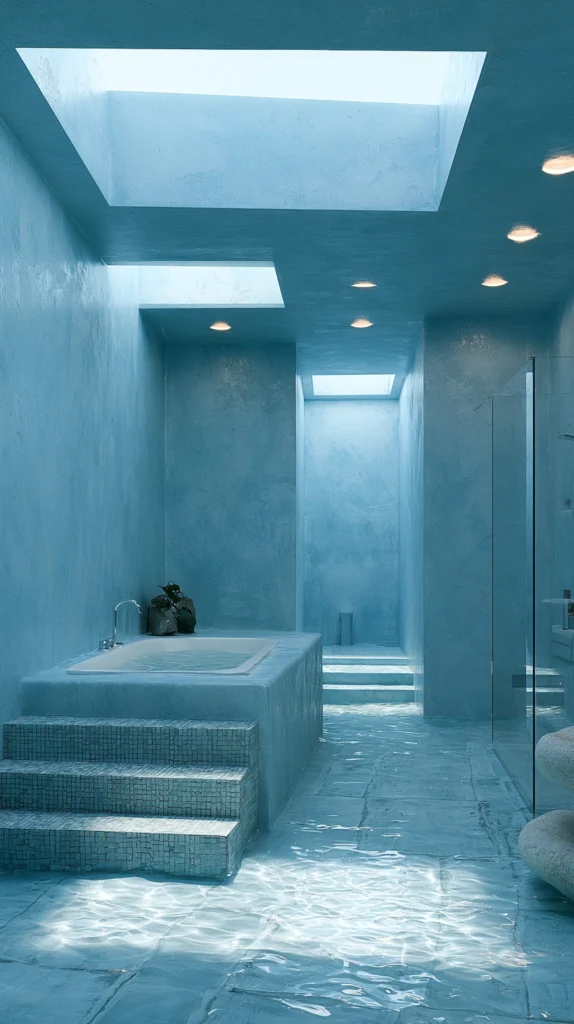
Budget: $2,000 – $15,000
The fully realised spa-architecture baby blue bathroom — tadelakt plaster walls in baby blue with a soft burnished sheen, a sunken bath accessed by mosaic-tiled steps, a skylight directly above the bath, underfloor heating throughout, a built-in bench within a baby blue wet room shower zone with a steam generator and aromatherapy dispenser, pale cedar slatted wall sections and a cedar bath mat, curved bullnose tile detailing at every corner, fully concealed storage with one or two visible objects of genuine beauty, a small reading nook with a wall-mounted brass light, and a continuous low layer of water-sound audio and essential oil fragrance.
This is a bathroom that functions as a genuine domestic spa rather than as a beautifully decorated room for hygiene tasks.
Tadelakt plaster: $320 – $1800. Sunken bath: $1200 – $5100. Skylight: $500 – $2000. Underfloor heating: $400 – $1250. Steam shower and bench: $1600 – $4500. Cedar elements: $170 – $600. Curved detailing: $550 – $2700. Hidden storage: $380 – $1350. Reading nook: $145 – $520. Sensory layer: $70 – $180. Total fully realised spa-architecture bathroom: $5,335 – $20,000 — a significant investment that produces a bathroom functioning as genuine domestic wellness infrastructure rather than simply a beautifully coloured room.
Styling tip: Use the fully realised spa bathroom with the same intentionality that a visit to an actual spa would involve — setting aside genuine, undisturbed time rather than treating the space as a faster version of an ordinary bathroom routine.
A spa-architecture bathroom used in five minutes between other tasks delivers almost none of the value of its investment. The same bathroom used for thirty unhurried minutes, with the steam running, the candle lit, and no phone in the room, delivers the complete experience the architecture was designed to support.
The room can provide the conditions for calm. Only time can provide the calm itself.
The baby blue spa bathroom, approached architecturally rather than merely decoratively, is not a bathroom that looks like a spa. It is a bathroom that functions like one — where the sunken bath, the steam, the warm floor, the concealed storage, and the pale aquatic plaster work together as genuine wellness infrastructure rather than as a styled backdrop for the ordinary business of getting clean.
Build the architecture first. The colour will follow naturally — because baby blue, more than almost any other colour, is simply what genuine calm looks like when it’s given a wall to live on.