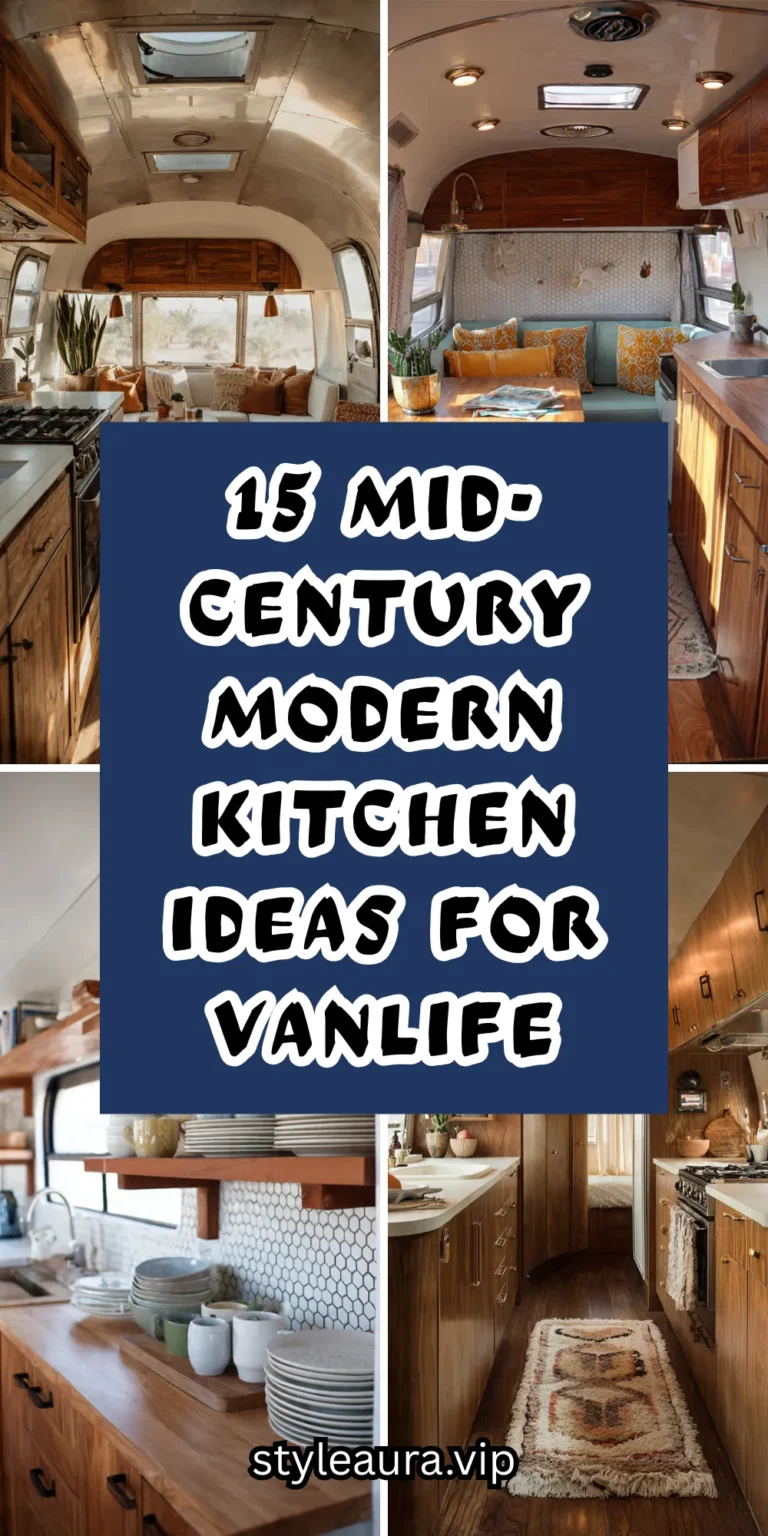
14 Tuscany-Inspired Kitchen Ideas for a Mediterranean Feel
The terracotta floor changed how my kitchen felt underfoot more than any other single choice I made in that room. Not the new range. Not the marble counters. Not the pendant lights or the open shelving or the repainted cabinets.
The floor.
Because terracotta did something none of the other renovations managed. Before it: a kitchen that looked current but generic, the kind of room that could belong to any house built in the last decade. After it: a kitchen that felt like it had been there for a hundred years, warm underfoot even in winter, the whole room settling into something older and slower than before.
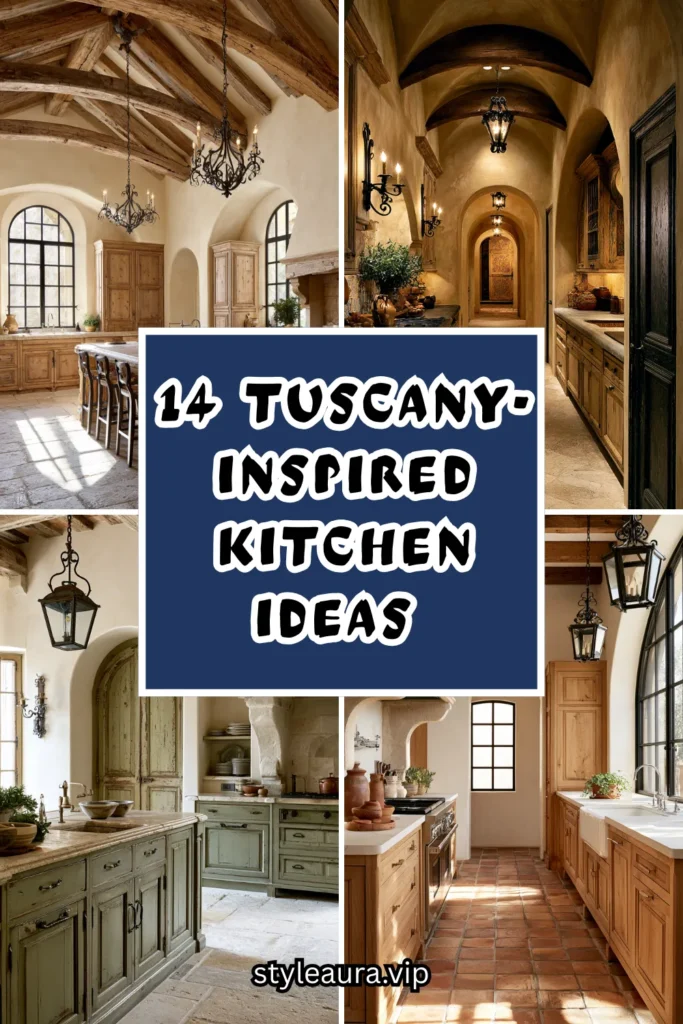
A Tuscan-inspired kitchen is not a theme applied on top of a modern room. It is a return to the materials an actual Italian farmhouse kitchen has always used — terracotta, stone, aged wood, wrought iron, hand-painted tile — chosen because they age beautifully rather than because they photograph well. The kitchen: no longer trying to look new, but trying to look like it has always belonged there.
Here are 14 Tuscany-inspired kitchen ideas for a Mediterranean feel — from the simplest terracotta accent to the most fully committed room — built on that understanding.
Why Tuscan Design Ages Better Than Most Kitchen Trends
The material honesty principle
Tuscan design relies almost entirely on materials that improve with wear — terracotta that deepens in color, wood that develops grain and patina, wrought iron that darkens with age. A Tuscan kitchen is rarely at its best on day one; it is built to look better after years of use, not before.
The warmth equation
Without warm materials:
A kitchen in cool tile, stainless steel, and glossy laminate, efficient but visually cold.
The room: modern, but without any sense of history or place.
With warm materials:
Terracotta, limestone, and aged wood absorb and hold warmth, both visually and, in the case of terracotta floor tile, quite literally underfoot.
The room: reading as gathered rather than installed.
The imperfection allowance
Unlike a precisely finished contemporary kitchen, Tuscan design embraces visible grout lines, uneven tile coloring, hand-applied plaster texture, and furniture with genuine wear. The kitchen does not need to be flawless to succeed; it often works better because it is not.
The climate logic
Many of the aesthetic’s defining choices — thick plaster walls, stone floors, deep-set windows — originated as practical responses to a hot Mediterranean climate, keeping interiors cool. The look and the function were never separate; the aesthetic is a byproduct of genuinely sound design.
The Five Ways to Bring In Tuscan Style
Before choosing any design:
Flooring (the full commitment)
Terracotta or stone tile across the full kitchen floor.
The most transformative and hardest-to-reverse option.
Sets the tone every other element responds to.
Walls and plaster
Textured Venetian or lime-washed plaster, in a warm ochre or cream.
Adds depth and imperfection that flat paint cannot replicate.
A meaningful but reversible renovation choice.
Cabinetry and wood
Aged or distressed wood cabinetry, often in warm tones rather than white or grey.
Concentrates the aesthetic into furniture-scale choices.
Suits a partial kitchen update rather than a full gut renovation.
Tile and pattern
Hand-painted ceramic tile as a backsplash or accent, in traditional Italian motifs.
The most immediately recognizable single visual signifier.
Works even in an otherwise contemporary kitchen as a single feature.
Furniture and objects
A farmhouse table, wrought iron fixtures, olive oil vessels, and dried herb bundles.
The most flexible and lowest-cost entry point.
Builds gradually, piece by piece, over time.
1. The Terracotta Tile Floor
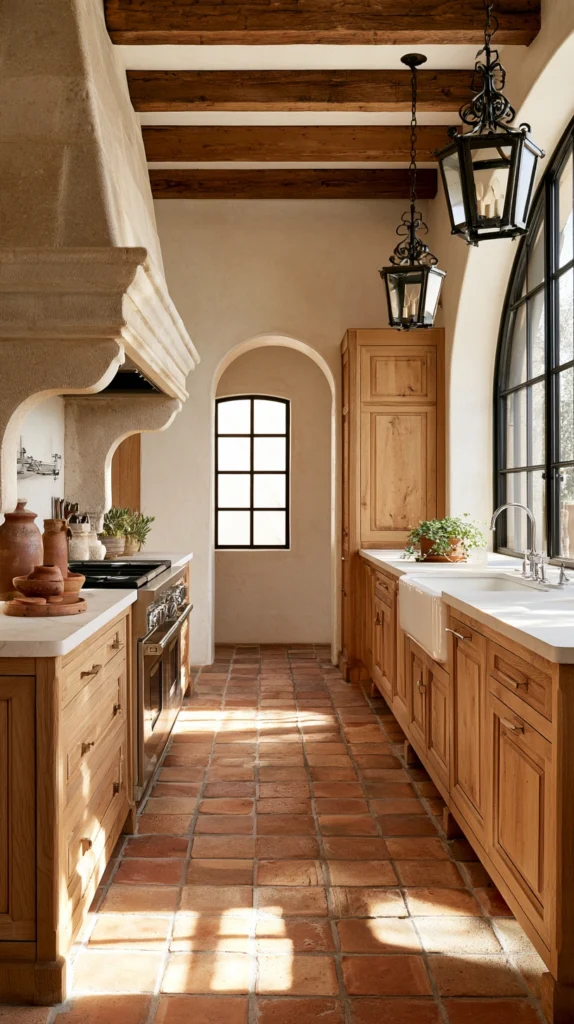
Full or partial terracotta tile flooring, in the classic warm orange-red tone, replacing a cooler modern floor material.
Why terracotta is the aesthetic’s essential foundation
More than any wall color or cabinet style, the floor sets the tone for the entire room, and no other flooring material is as immediately and specifically associated with Tuscan interiors.
The tile
Handmade or hand-finished terracotta, which carries natural variation in color and surface texture that machine-made reproduction tile cannot fully replicate.
The size and shape
Larger format squares, often 12 to 16 inches, laid in a simple grid pattern rather than a busy geometric arrangement, letting the material’s natural variation carry the visual interest.
The sealing
Terracotta requires sealing, both initially and periodically thereafter, to protect the porous material from staining and water damage in an active kitchen.
The grout
A warm, sand-toned grout rather than stark white or grey, so the grout lines recede into the overall warm palette rather than creating a stark grid pattern.
The underfoot experience
Genuinely warmer to the touch than tile or stone in cooler tones, both due to the color’s psychological warmth and terracotta’s actual thermal properties.
Cost breakdown: Terracotta tile (full kitchen floor): $800–2,500 Sealant: $50–100 Installation (if hiring out): $600–1,500 Total: $1,450–4,100
2. The Venetian Plaster Accent Wall
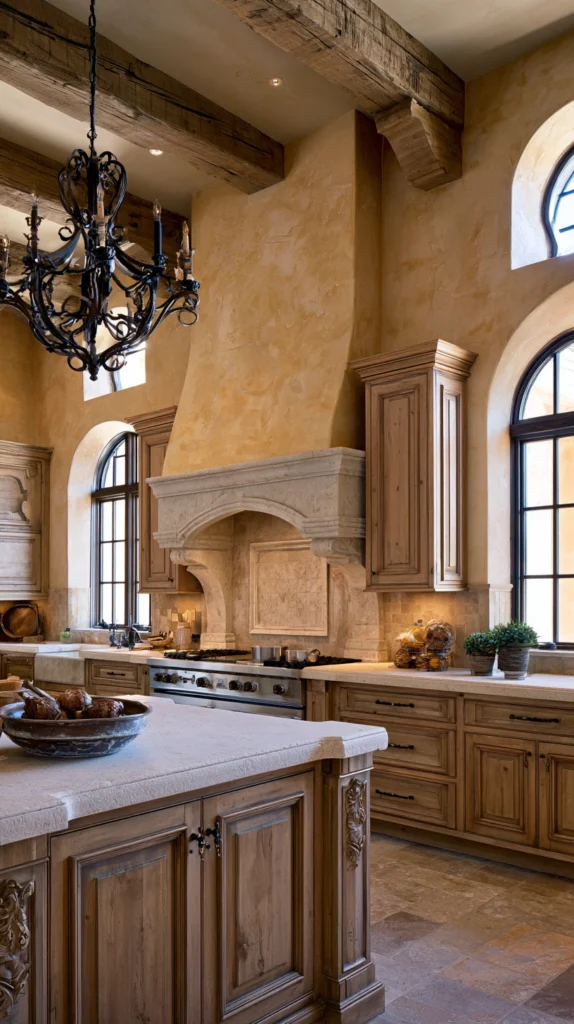
A single kitchen wall finished in textured Venetian or lime-washed plaster, in a warm ochre, terracotta, or cream tone, rather than flat painted drywall.
Why plaster texture matters more than color alone
Venetian plaster’s layered, hand-applied texture catches light differently across its surface, creating visual depth flat paint cannot replicate, regardless of how well the color itself is chosen.
The application
Applied in thin layers with a trowel, building up subtle texture and variation, typically requiring some skill or professional installation for a convincing result.
The color
Warm ochre, burnt sienna, or a soft cream, drawn from the same earthy palette as the terracotta floor and aged wood elsewhere in the room.
The wall selection
A single feature wall, often behind the range or the sink, rather than the full room, both for cost reasons and because the textured finish reads most effectively in a contained, framed application.
The lighting
Warm, angled light — a wall sconce or under-cabinet lighting washing across the surface — enhances the plaster’s texture more than flat overhead lighting would.
The lime-washed alternative
A lime wash finish, which is more accessible as a DIY project than true Venetian plaster while still delivering meaningful texture and a similar aged, matte quality.
Cost breakdown: Venetian plaster or lime wash (one wall): $150–400 Professional application (if hiring out): $300–800 Total: $150–1,200 depending on approach
3. The Hand-Painted Ceramic Tile Backsplash
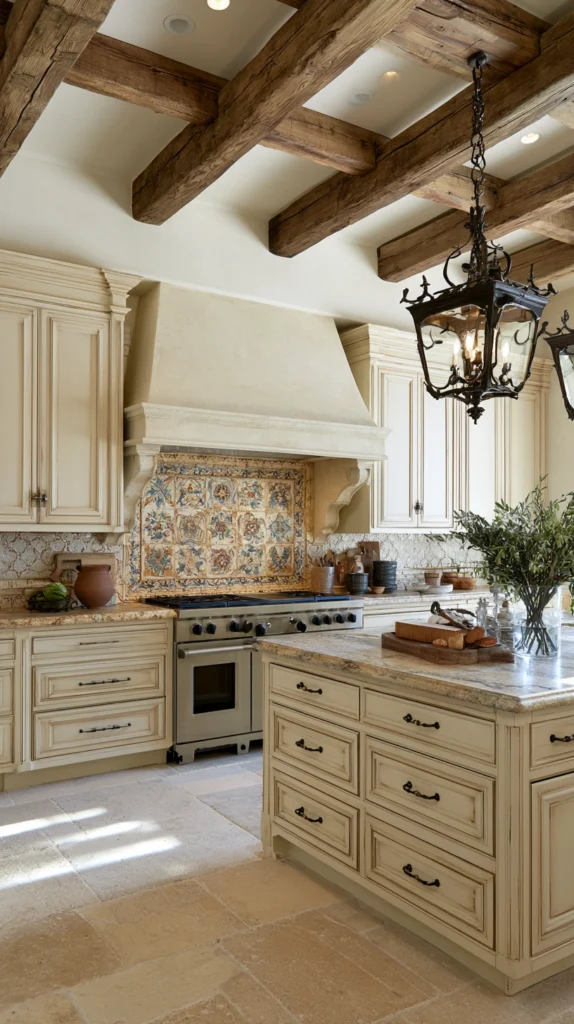
A backsplash of hand-painted ceramic tile in a traditional Italian motif — florals, geometric patterns, or a scenic scene — as the kitchen’s single boldest decorative element.
Why hand-painted tile is the aesthetic’s most recognizable signifier
More than any other single object, patterned Italian ceramic tile signals this specific design tradition, carrying centuries of regional craft history within a small, contained area of the kitchen.
The tile sourcing
Genuine hand-painted tile from Italian workshops, or well-made reproduction tile for a lower cost, both delivering the visual effect with different budget and authenticity implications.
The placement
Behind the range as a focal backsplash, or as a decorative border within a simpler field tile elsewhere in the kitchen, rather than covering every surface in pattern.
The pattern selection
Traditional motifs — lemons, olive branches, geometric Deruta-style patterns — chosen to complement rather than clash with the kitchen’s other Tuscan elements.
The surrounding tile
A simple, solid-colored field tile surrounding the patterned focal area, letting the hand-painted tile stand out clearly rather than competing with an equally busy surrounding pattern.
The grout
A grout tone that complements the tile’s background color, avoiding a stark contrast that would fight with the pattern’s own detail.
Cost breakdown: Hand-painted tile (focal area): $200–600 Field tile (surrounding area): $80–200 Installation: $200–500 Total: $480–1,300
4. The Exposed Wood Beam Ceiling
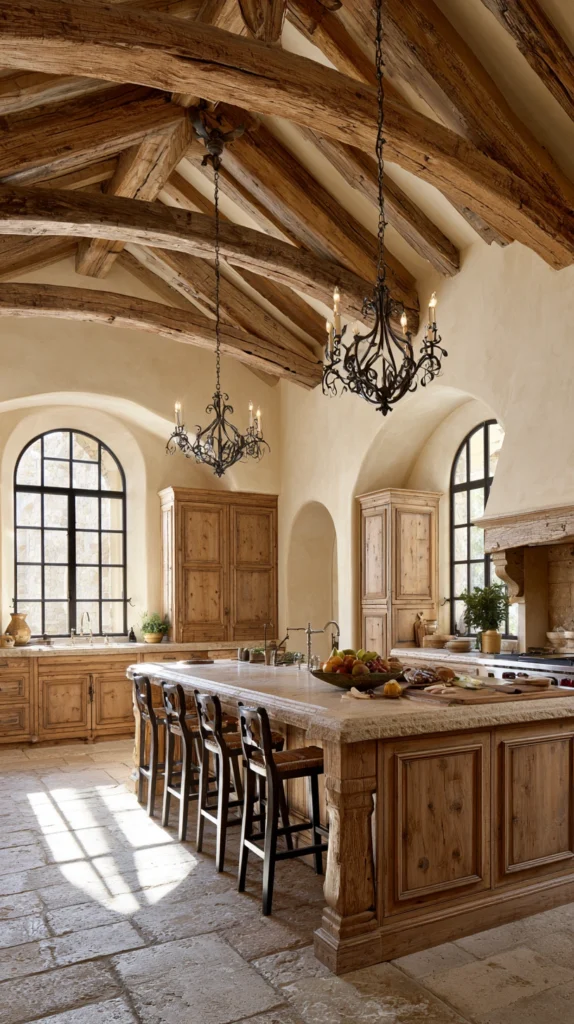
Reclaimed or new wood beams spanning the kitchen ceiling, introducing the rustic, farmhouse architectural detail associated with an authentic Tuscan interior.
Why beams do more for the room’s character than almost any other single addition
A blank ceiling reads as contemporary by default. Exposed beams immediately shift a room’s architectural language toward something older and more agrarian, regardless of what else is happening in the kitchen below.
The beam material
Reclaimed wood beams for the most authentic result, carrying genuine age, tool marks, and patina that new wood cannot replicate; new wood, stained and distressed, as a more accessible and lower-cost alternative.
The spacing
Two to four beams spanning the kitchen’s width, spaced evenly and sized proportionally to the room, since undersized beams can read as decorative trim rather than genuine structural elements.
The finish
Left in a natural or lightly stained warm brown tone, rather than painted, to preserve the wood’s grain and texture as a visible material rather than a flat colored surface.
The lighting integration
Small wrought iron or bronze fixtures mounted directly to or hung from the beams, using the architectural detail as a natural point for lighting.
The ceiling height
Best suited to kitchens with adequate ceiling height, since beams in an already-low room can make the space feel more cramped rather than more characterful.
Cost breakdown: Reclaimed wood beams (3–4): $400–1,000 Or faux/new wood beams: $200–500 Installation hardware: $50–100 Total: $250–1,100
5. The Wrought Iron Light Fixtures
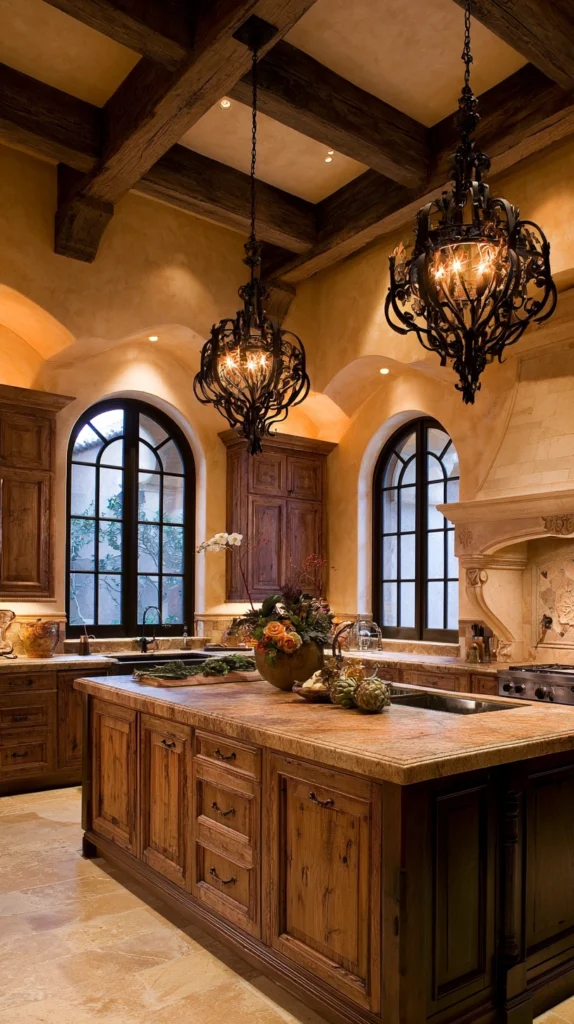
Wrought iron chandeliers, pendant lights, and sconces throughout the kitchen, replacing brushed nickel or chrome fixtures with the metal most closely associated with the aesthetic.
Why wrought iron suits this palette more than other metals
Iron’s dark, matte, slightly rough quality pairs naturally with terracotta, aged wood, and plaster in a way that brighter, more reflective metals like chrome or polished brass do not.
The chandelier
A wrought iron chandelier, often with a scrolled or candelabra-inspired design, hung above a farmhouse table or a kitchen island as the room’s central lighting statement.
The pendants
Simpler wrought iron pendant fixtures over a work surface or sink, providing task lighting while continuing the material theme.
The sconces
Small wall-mounted iron sconces flanking a range hood or a piece of art, adding a layer of warm, low light beyond the room’s primary overhead sources.
The bulb choice
Warm, low-wattage bulbs throughout, since the aesthetic depends on soft, ambient light rather than the bright, even illumination more common in contemporary kitchens.
The finish
A matte black or dark bronze finish, occasionally with a slightly distressed or hand-forged appearance, rather than a glossy or polished black.
Cost breakdown: Wrought iron chandelier: $150–400 Pendant lights (2–3): $100–250 Sconces (2): $60–150 Total: $310–800
6. The Farmhouse Table With Mismatched Chairs
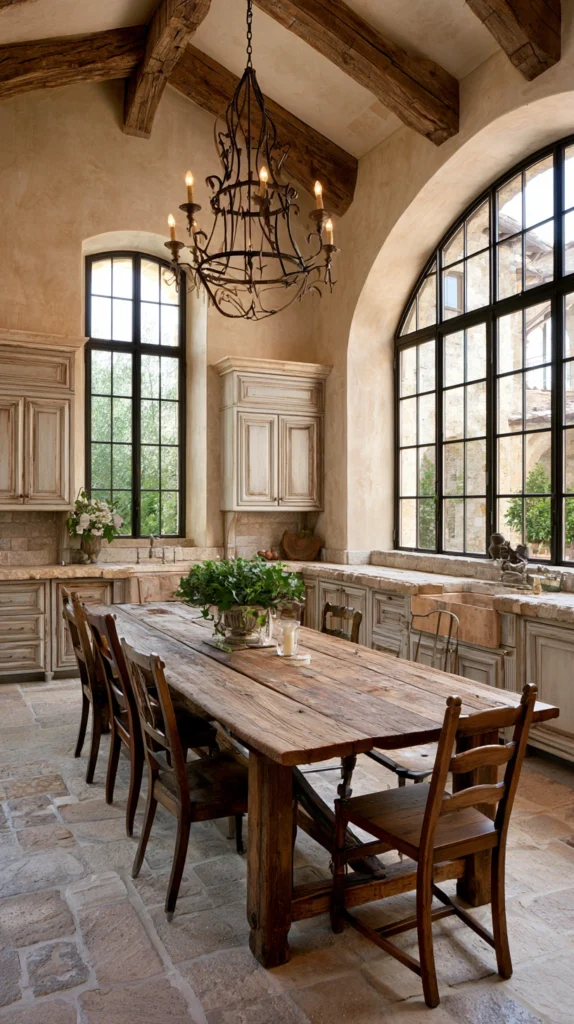
A substantial wood farmhouse table, paired with a collection of gathered rather than matched chairs, serving as the kitchen’s central gathering point.
Why the table is as important as any built-in element
An Italian farmhouse kitchen has always centered on a long communal table where cooking, eating, and gathering all happen in the same space — the table is not incidental furniture but the room’s actual heart.
The table
A solid wood table with visible grain and some age or intentional distressing, long enough to comfortably seat six to eight.
The chairs
Ladder-back or rush-seated wood chairs, gathered individually rather than purchased as a matching set, for the collected-over-generations character central to the look.
The finish variation
Different wood tones or finishes across the chairs, unified by a shared silhouette or material family rather than an exact color match.
The everyday use
Left set for actual daily use — a bowl of fruit, a stack of linen napkins — rather than styled purely for occasional formal use.
The bench option
A single wood bench along one side of the table, adding informal, flexible seating and a slightly different silhouette among the surrounding chairs.
Cost breakdown: Farmhouse table: $300–900 Mismatched chairs (6–8, secondhand): $120–400 Total: $420–1,300
7. The Olive Oil and Wine Display
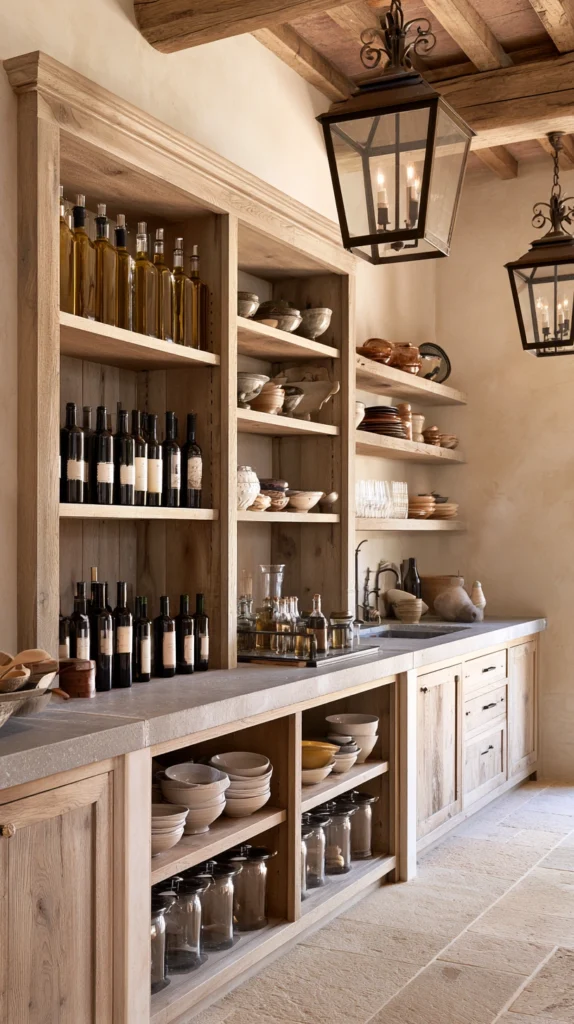
A dedicated corner or open shelf displaying olive oil in glass or ceramic vessels, wine bottles, and related Mediterranean pantry staples as both function and decor.
Why this display connects the kitchen directly to its culinary origins
Unlike purely decorative objects, a genuine display of olive oil and wine ties the room’s look directly to the food culture the aesthetic is built around.
The olive oil vessels
Large glass or ceramic cruets and jugs, some decanted from bulk purchases, displayed on open shelving or a counter near the stove for genuine daily use.
The wine storage
A simple wood or iron wine rack, holding a modest collection rather than an elaborate cellar-style display, kept visually consistent with the kitchen’s warm, rustic material palette.
The accompanying pantry items
Dried pasta in glass jars, sun-dried tomatoes, and bundled bay leaves or rosemary, extending the display into a broader sense of a working Mediterranean pantry.
The placement
Near the stove or prep area, reinforcing that these are genuinely used ingredients rather than a purely decorative still life.
The vessel sourcing
Flea markets, Italian import shops, or secondhand sources for glass and ceramic vessels with real age or character, rather than uniformly new, matched containers.
Cost breakdown: Olive oil vessels and jugs: $30–70 Wine rack: $40–100 Pantry display jars: $20–40 Total: $90–210
8. The Arched Doorway or Niche
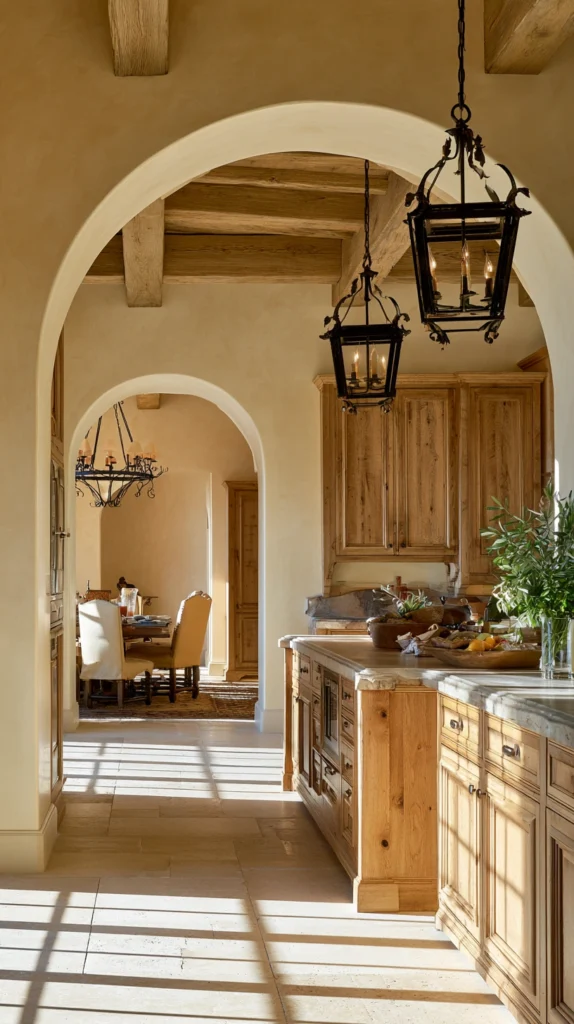
An arched opening between the kitchen and an adjoining room, or a small arched niche built into a wall for display or storage, introducing the curved architectural detail common to Tuscan interiors.
Why an arch does more architectural work than a straight-edged opening
A curved opening immediately reads as older and more European than a standard rectangular doorway, softening the room’s overall geometry in a way flat walls and square openings cannot.
The doorway arch
Converting an existing rectangular doorway into an arched opening, typically requiring some framing and drywall or plaster work depending on the wall’s structural type.
The niche option
A smaller arched recess built into a single wall, sized for a small display of ceramics, cookbooks, or a single decorative object, requiring significantly less structural work than a full doorway conversion.
The finish
Plastered or painted to match the surrounding wall, with the arch’s curve itself providing the visual interest rather than a contrasting color or material.
The lighting
A small light fixture within a niche, or a wash of light across an archway from a nearby fixture, highlighting the curved detail rather than leaving it in shadow.
The scale consideration
Arches suit rooms with adequate ceiling height and wall thickness — a shallow or low wall may not accommodate a convincing arched detail without looking forced.
Cost breakdown: Arched niche (small, single wall): $200–500 Or arched doorway conversion: $800–2,500 Total: $200–2,500 depending on scope
9. The Distressed and Aged Cabinetry
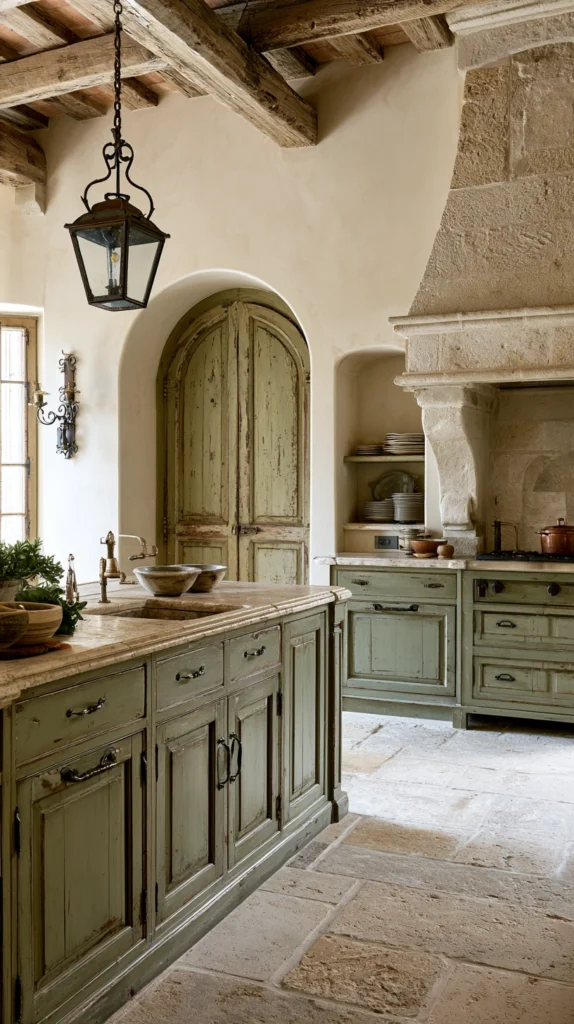
Kitchen cabinets finished with a deliberately distressed or aged treatment — visible brush strokes, worn edges, a warm glaze — rather than a smooth, uniformly painted contemporary finish.
Why distressed cabinetry suits this aesthetic specifically
Perfectly smooth, uniform cabinetry reads as new and contemporary, working against an aesthetic built entirely on the appearance of age and gradual, honest wear.
The base color
Warm, earthy tones — olive green, terracotta, cream, or a deep mustard — rather than the cooler greys and stark whites common in contemporary kitchen cabinetry.
The distressing technique
A glaze applied and partially wiped away to settle into recessed panel details, or edges lightly sanded to reveal a different undercoat color beneath, simulating decades of natural wear.
The hardware
Wrought iron or aged bronze pulls and hinges, continuing the material theme rather than introducing a contrasting brushed nickel or chrome finish.
The panel style
Raised or recessed panel doors with visible molding detail, rather than flat, minimalist slab-front cabinetry more common in contemporary kitchens.
The DIY approach
Existing cabinetry repainted and distressed as a lower-cost alternative to full replacement, achievable with careful technique even without professional refinishing.
Cost breakdown: Cabinet repaint and distressing (existing cabinets): $300–800 Or new distressed cabinetry: $4,000–12,000 New hardware: $100–300 Total: $400–12,300 depending on scope
10. The Copper Pot Display
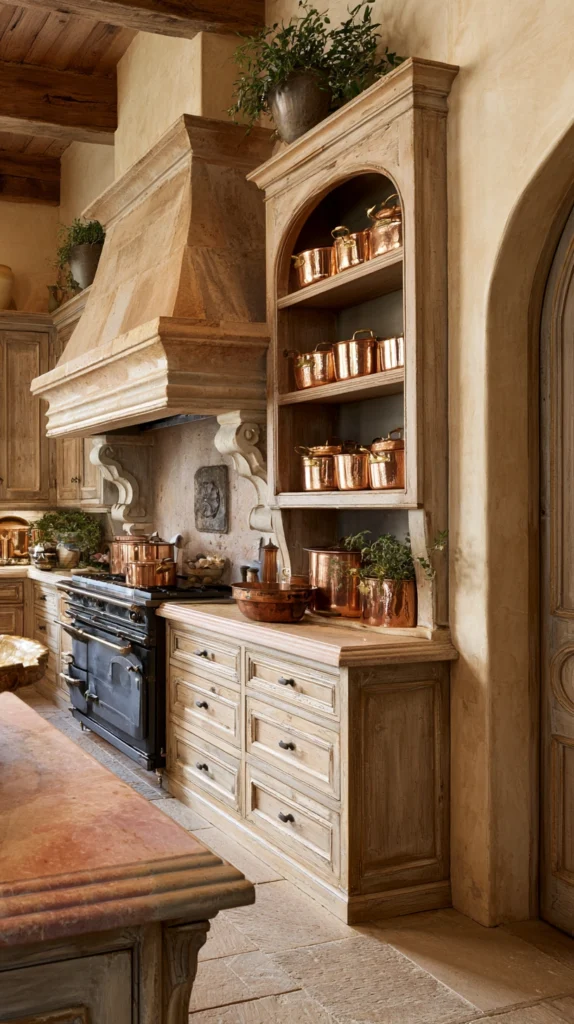
Copper pots and pans hung from an iron rack or displayed on open shelving, adding warm, reflective color that complements the terracotta and wood throughout the room.
Why copper is a natural material fit for this palette
Copper’s warm reddish-gold tone sits directly within the same color family as terracotta and aged wood, making it one of the more effortless material additions to the overall scheme.
The rack
A wrought iron pot rack, mounted from the ceiling above an island or on the wall near the stove, continuing the material theme established by the room’s lighting fixtures.
The cookware
Copper pots and pans, whether a matched set or gathered individually over time, hung with the interior or exterior facing outward depending on personal preference.
The patina
Copper develops a natural patina with age and use, which many households allow to develop naturally rather than polishing regularly, consistent with the aesthetic’s broader embrace of visible wear.
The mixed display
A few dried herb bundles or a single strand of garlic hung alongside the copper pieces, breaking up a purely metallic display with softer, more organic texture.
The functional use
Cookware genuinely used for cooking rather than purely decorative, taken down and rehung as part of the kitchen’s actual working rhythm.
Cost breakdown: Pot rack (wrought iron): $50–150 Copper cookware (secondhand or new): $60–250 Total: $110–400
11. The Deep-Set Window With Herb Sill
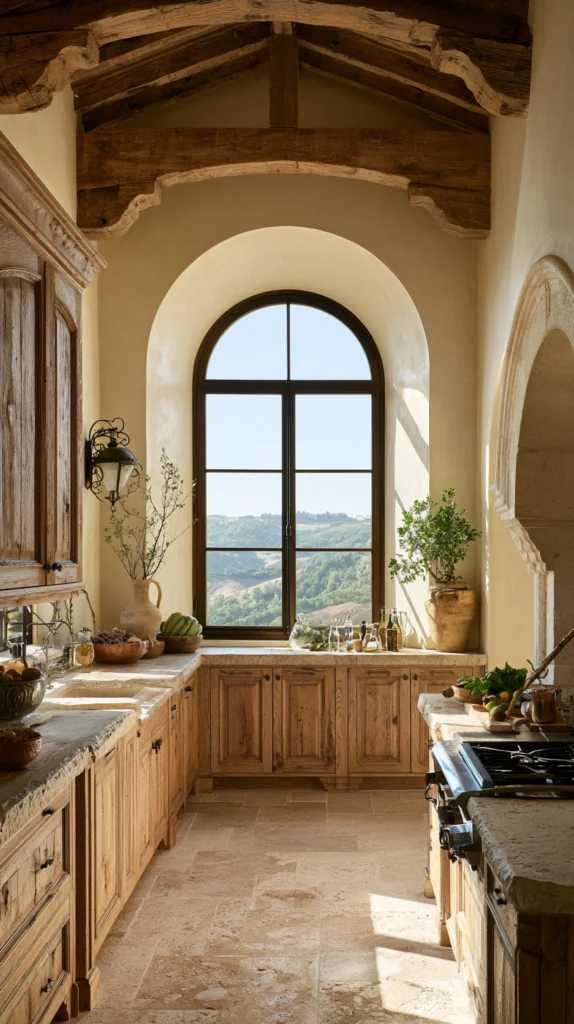
A window with deep-set molding or trim, styled with a row of potted herbs on the sill, echoing the thick-walled construction typical of Mediterranean stone architecture.
Why deep window trim matters for the aesthetic’s architectural authenticity
Genuine Tuscan farmhouses were built with thick stone or plaster walls, creating naturally deep windowsills — a detail worth replicating even in a home without actual thick walls, through trim depth alone.
The trim
Wide, substantial window casing and a deep sill, built out from a standard window frame if the wall itself is not naturally thick.
The finish
Painted or plastered to match the surrounding wall, rather than a contrasting bright white trim, so the depth reads as architectural rather than decorative.
The herb pots
Terracotta pots holding rosemary, basil, and oregano, chosen both for their culinary use and their material harmony with the room’s broader terracotta and warm-wood palette.
The light
The sunniest available kitchen window, since herbs require genuine direct light regardless of how well the surrounding trim suits the aesthetic.
The connection to cooking
Herbs positioned close enough to the stove or prep area for genuine daily use, tying the decorative detail back to the kitchen’s actual function.
Cost breakdown: Deep window trim (if adding): $150–400 Terracotta pots (4–5): $20–40 Herb starts: $15–30 Total: $185–470
12. The Stone or Brick Range Hood Surround
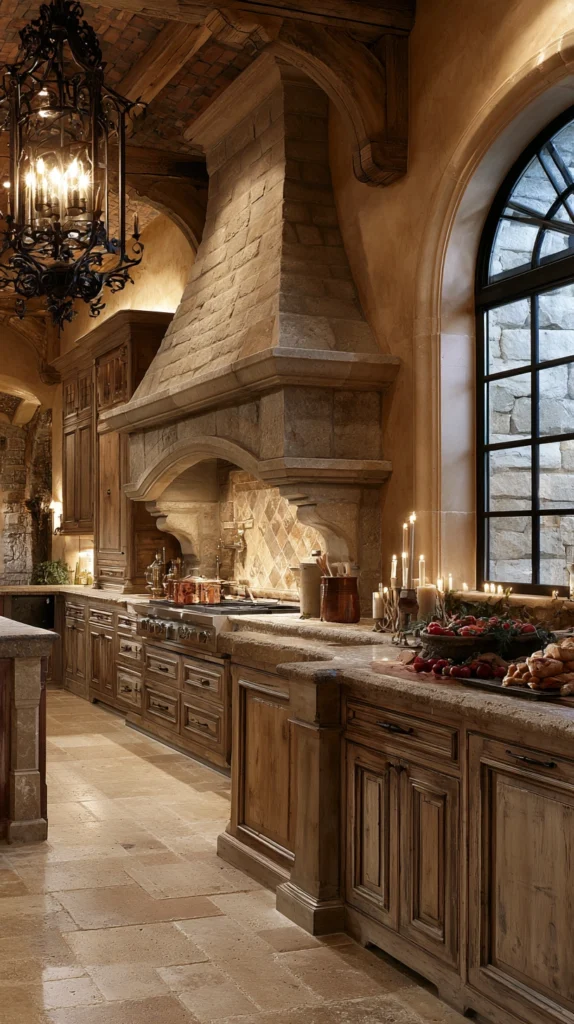
A range hood surrounded in stone, brick, or heavily textured plaster, transforming what is often a purely functional stainless steel element into one of the kitchen’s central architectural features.
Why the range hood deserves this level of attention
The stove and its surrounding hood naturally draw the eye as the kitchen’s functional center. A stone or brick surround turns that natural focal point into a genuine architectural statement, rather than leaving it as an unremarkable metal box.
The material
Natural stone, brick, or a heavily textured plaster finish, built up around a standard hood insert to create the appearance of a substantial, built-in chimney-style structure.
The shape
A tapered or stepped form, wider at the base and narrowing toward the ceiling, echoing traditional chimney breast construction rather than a flat, uniform rectangular surround.
The mantel detail
A small stone or wood shelf or ledge at the base of the hood surround, styled with a small vignette — a few ceramic vessels, dried herbs — similar to a fireplace mantel.
The structural consideration
A hood surround of this scale requires proper support and ventilation planning, typically best handled by a contractor familiar with both the structural and mechanical requirements involved.
The finish coordination
Matched or complementary to the terracotta floor and plaster walls elsewhere in the kitchen, so the hood surround reads as part of the same material story rather than an isolated feature.
Cost breakdown: Stone or brick veneer surround: $800–2,500 Professional construction and venting: $1,000–3,000 Total: $1,800–5,500
13. The Dried Herb and Chili Pepper Bundles
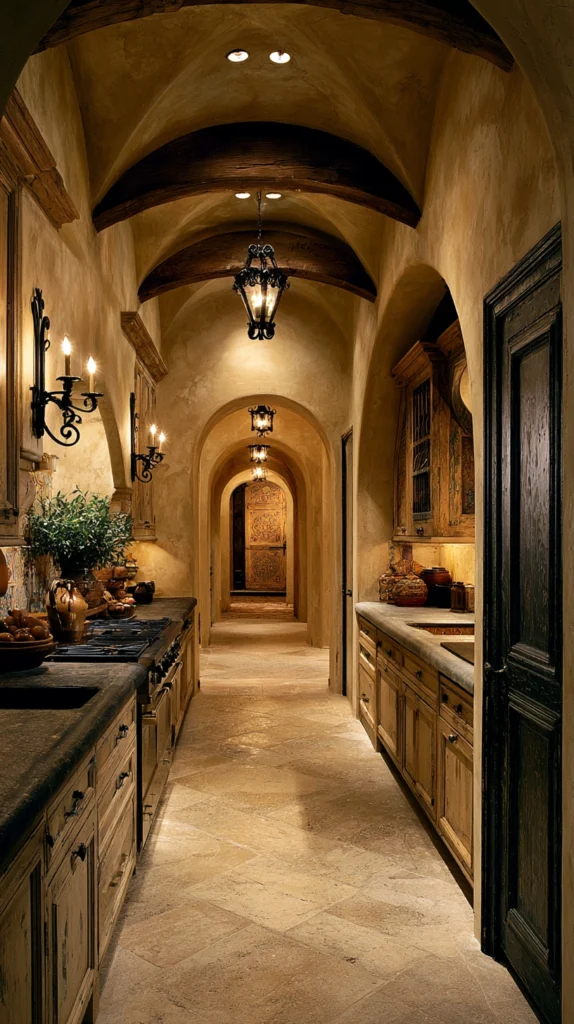
Bundles of dried herbs and strings of dried chili peppers hung throughout the kitchen, adding the traditional Mediterranean preservation display alongside genuine culinary function.
Why this detail connects most directly to real Italian kitchen tradition
Drying herbs and peppers for winter use is a genuinely old practice, not a decorative invention, giving this element the same authentic, function-first origin as the terracotta floor or the olive oil display.
The herbs
Rosemary, oregano, bay leaf, and sage, tied in small bundles and hung upside down near the window or over the stove to dry properly.
The chili peppers
A traditional peperoncino ristra, a string of dried red chili peppers, hung as both a preservation method and one of the aesthetic’s most recognizable visual motifs.
The hanging location
A warm, dry spot with some airflow, avoiding direct steam from the stove, which slows the drying process and can introduce mold risk.
The rotation
Older, fully dried bundles moved to a shelf or basket for storage and use, replaced by fresh bundles hung to dry in their place.
The seasonal quality
Refreshed at the change of seasons, tying the display to the actual rhythm of a working kitchen’s herb garden and pantry rather than remaining static year-round.
Cost breakdown: Herb bundles (grown or purchased): $0–15 Dried chili peppers for ristra: $8–15 Twine: $3–8 Total: $11–38
14. The Complete Tuscan Kitchen (The Fully Committed Room)
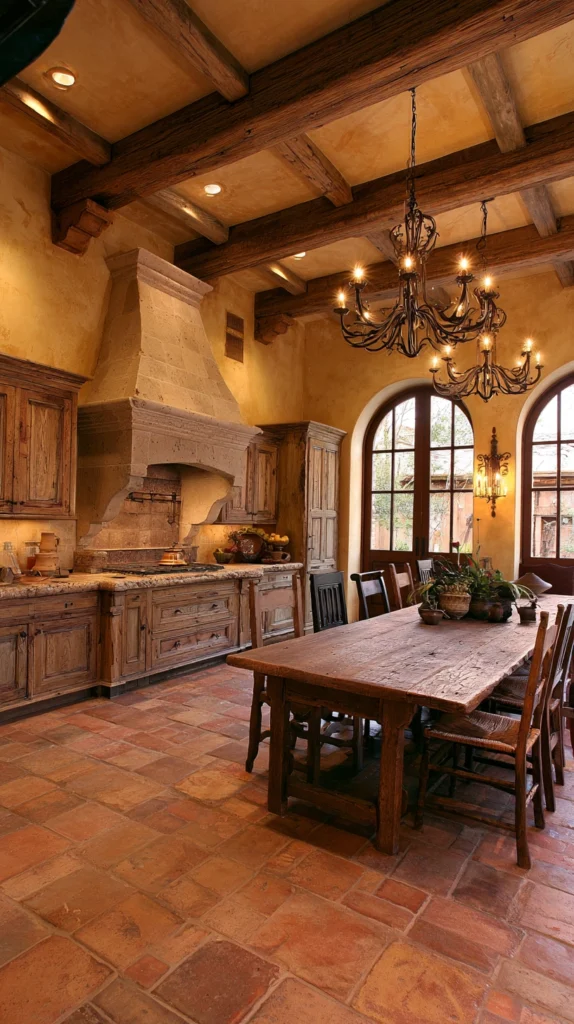
A complete Tuscan kitchen combining several of the approaches above — terracotta flooring, plastered walls, wood beams, wrought iron fixtures, and a genuinely used farmhouse table — designed as one cohesive, aged-in-place room.
What separates the complete kitchen from a single terracotta accent
A single terracotta tile backsplash: an accent. A complete Tuscan kitchen: an atmosphere, where every material choice — floor, wall, ceiling, and furniture — was made in response to the same warm, rustic, Mediterranean palette.
The elements of the complete Tuscan kitchen
The floor
Terracotta tile across the full kitchen, sealed and warm underfoot.
The walls
Textured plaster in a warm ochre or cream, at minimum on a single feature wall.
The ceiling
Exposed wood beams, spanning the room and anchoring the space’s architectural character overhead.
The cabinetry
Distressed or aged-finish cabinets in a warm earthy tone, fitted with wrought iron hardware.
The lighting
A wrought iron chandelier over the table, paired with pendant and sconce lighting throughout in warm, low bulbs.
The gathering point
A substantial farmhouse table with mismatched chairs, genuinely used for daily meals.
The finishing objects
Copper cookware, olive oil vessels, dried herb bundles, and a hand-painted tile backsplash, layered together as the room’s collected character.
The complete design in action
A Sunday afternoon in October:
Noon: Sauce simmering on the stove beneath the stone hood surround, the whole kitchen smelling of rosemary and garlic.
12:30pm: The farmhouse table set with mismatched plates, a jug of olive oil already at its center.
1pm: Sunlight through the deep-set window catching the terracotta floor, the room glowing the way it has likely glowed for generations in the tradition it borrows from.
The complete Tuscan kitchen: not a kitchen decorated to resemble an Italian farmhouse, but a kitchen built from the same honest, warm materials that farmhouse kitchen has always used.
Cost breakdown for the complete room: Assuming a starting point of a plain contemporary kitchen: Terracotta floor: $1,450–4,100 Plastered accent wall: $150–1,200 Exposed wood beams: $250–1,100 Cabinetry refinish or replacement: $400–12,300 Wrought iron lighting: $310–800 Farmhouse table and chairs: $420–1,300 Finishing objects (copper, oil vessels, herbs): $210–650 Total: $3,190–21,450
Phased over two or three seasons:
Season one ($400–900): Wrought iron lighting swap Farmhouse table styling Dried herb bundles and olive oil display
Season two ($600–2,500): Terracotta floor in one zone or the full kitchen A plastered accent wall
Season three ($700–14,000): Cabinetry refinish or full replacement Exposed beams A stone range hood surround
The Tuscan kitchen: not a weekend project but a warm, aged atmosphere built with intention over time.
The Question Before Any Tuscan Kitchen Design
Before choosing a floor, a wall treatment, a piece of furniture:
What is the primary reason for wanting this atmosphere in the kitchen?
If the answer is: full transformation — the terracotta floor paired with plastered walls and beams is the answer.
If the answer is: testing the aesthetic first — the wrought iron lighting swap or the farmhouse table styling.
If the answer is: warmth without any renovation — the dried herb bundles, olive oil display, and copper cookware.
If the answer is: the simplest possible — one hand-painted tile detail, one terracotta pot, one corner of the kitchen reconsidered.
The design follows the level of commitment available. Every Tuscan idea on this list serves that same warmth at a different scale. The question is which scale is right for this kitchen and this household.
The single dried rosemary bundle in the right spot: still better than no warmth at all. The full kitchen, done with intention: a room that feels like it has belonged to the house for generations.
That sense of belonging: the whole point of the aesthetic.
Getting Started This Weekend
The immediate Tuscan kitchen solution:
Tie one bundle of herbs and hang it near the stove.
Not a full renovation. Not a shopping trip. Whatever is already growing, tied and hung today.
Swap one light fixture for a wrought iron option.
A single change that immediately shifts the room’s material language.
Set out olive oil in a proper glass or ceramic vessel instead of the plastic bottle.
Small, immediate, and genuinely used every time the stove is on.
Add one terracotta pot of rosemary to the sunniest windowsill.
The rest of the design: the elaboration of this moment.
The material: the beginning. The Tuscan kitchen: what grows and gathers around it.