14 Natural Rock Waterfall Ideas for a Serene Outdoor Space
There is a quality of water that falls over stone that no other water feature format produces — a quality specific to the irregular surface of natural rock, the way the water finds its own path through channels and across ledges that were not engineered but simply exist, and the sound that results from water meeting an unpredictable surface in its most honest and least controlled form.
A natural rock waterfall does not sound like a fountain. It does not sound like a sheet waterfall or a blade feature. It sounds like a place — a specific, particular place that belongs to the landscape it inhabits and that produces, in anyone near it, the specific quality of calm that only genuinely natural things reliably deliver.
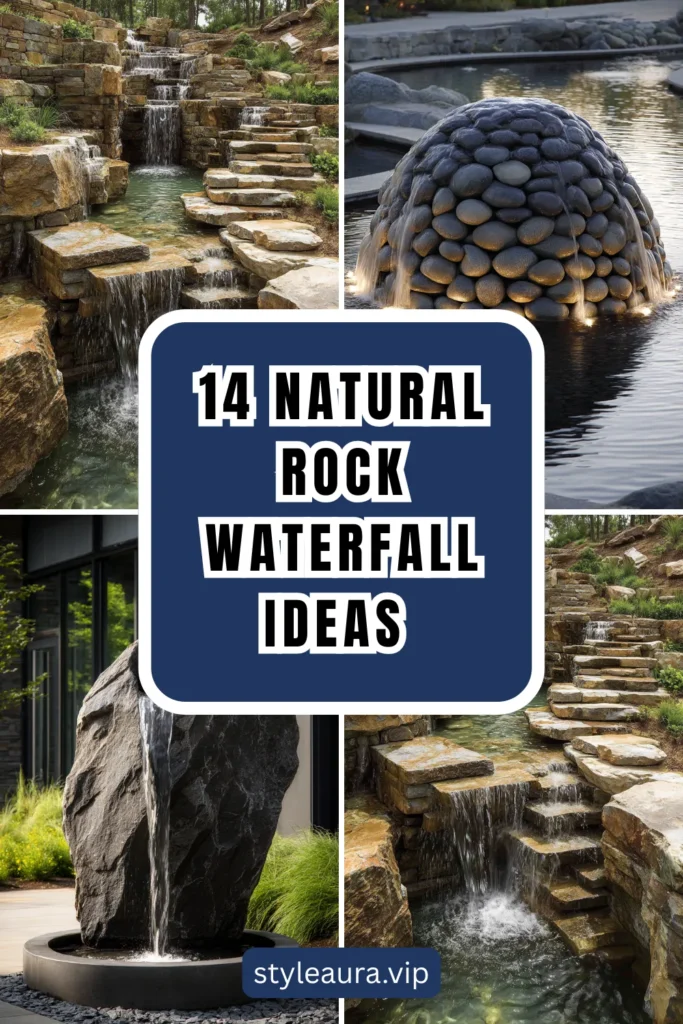
The natural rock waterfall in a garden is the feature that most convincingly imports the quality of the natural world into a domestic setting — not as a replica of nature but as a genuine use of natural material in a way that respects the material’s character and allows it to do what it does best.
The stone is real. The water is real. The result, when built with genuine care and genuine understanding of how these materials want to relate to each other, is genuinely extraordinary.
The fourteen ideas below cover every scale, every style, and every budget for a natural rock waterfall — from a single large boulder with a spout to a full cascade and pond system.
1. The Single Boulder Waterfall
Budget: $300 – $2000
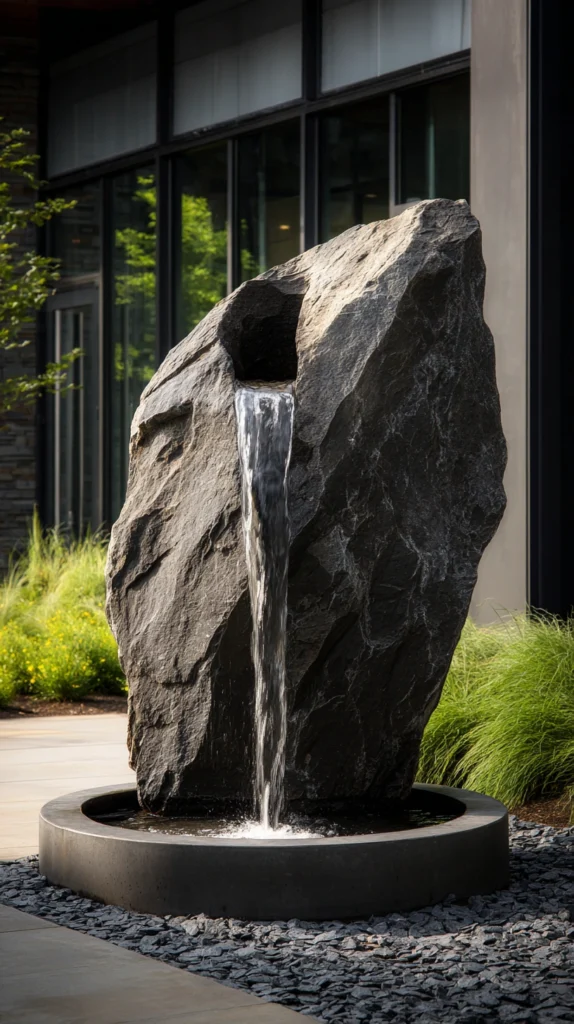
A single large boulder — granite, sandstone, or basalt — drilled through its centre with a core drill, water pumped up through the central bore and emerging at the summit to flow down the natural contours of the stone’s surface before reaching the pebble reservoir below, is the most minimal and the most specifically elegant natural rock waterfall available. The boulder is the feature. The water reveals what the boulder already is — the particular character of its surface, its colour deepening as it wets, its natural channels and irregularities directing the flow in ways that no human hand determined.
A large natural boulder of suitable size — $80 – $400 depending on size, stone type, and sourcing. Core drilling through the boulder — $50 – $150 as a professional service or $20 – $60 in diamond core bit hire and cutting time. A pebble reservoir kit with pump — $80 – $200. Smooth river pebbles — $15 – $30 per bag. Total investment: $225 – $780 for a feature of remarkable simplicity and genuine natural authority.
Styling tip: Choose a boulder with a flat base and a slightly domed or irregular top — the flat base providing stable placement in the reservoir and the irregular top producing the most interesting and varied water flow down the stone’s natural surface. A perfectly spherical boulder produces a uniform flow in all directions. An irregular boulder produces a flow that finds its own dominant path — following the stone’s natural grain and surface character — which is the quality that makes a single boulder waterfall genuinely interesting to observe.
2. The Flat Stone Stepping Cascade
Budget: $400 – $3000
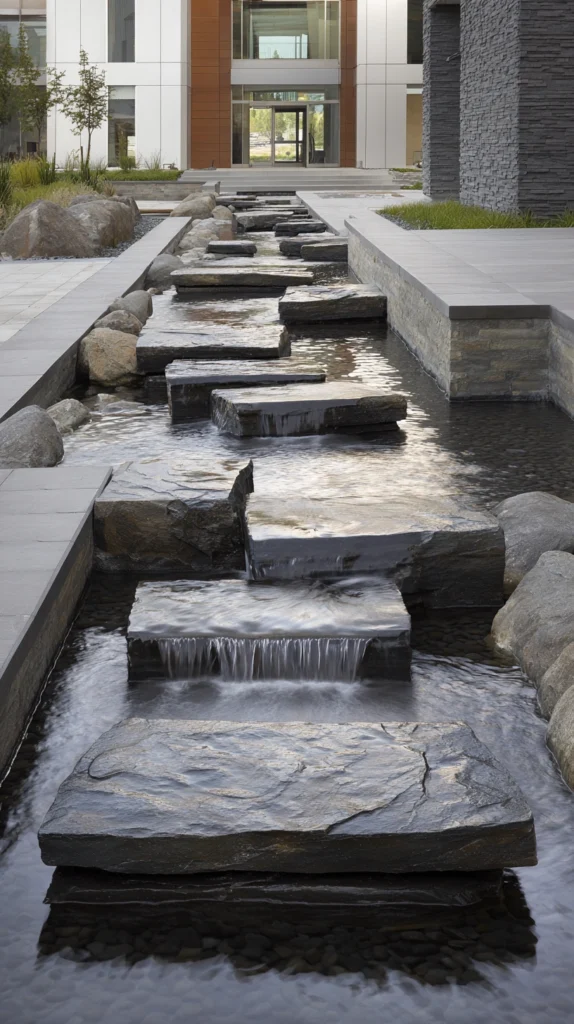
A cascade of flat natural stones — slate, limestone, or sandstone pieces arranged at graduated heights across a shallow stream bed, water flowing from the highest stone to the lowest in a series of thin, glassy falls — produces the most specifically beautiful natural rock waterfall available at a modest investment. The flat stone cascade is the domestic equivalent of a natural streambed — the stones arranged not in a pattern but in the way that a streambed organises itself through the action of water over time.
Flat natural stone pieces in varying sizes — $30 – $80 per piece, five to eight pieces required. A flexible rubber liner for the stream bed — $40 – $100. Smooth pebbles and gravel to fill between the stepping stones — $20 – $50 per bag. A submersible pump with sufficient flow rate — $60 – $200. Marginal planting at the stream edges — $8 – $20 per plant. Total material cost: $248 – $850 for a stepping cascade of considerable natural quality.
Styling tip: Arrange the flat stepping stones so that adjacent stones overlap slightly rather than sitting at the same height or with gaps between them — the upper stone projecting over the lower one by three to five centimetres. This overlapping arrangement produces a flow where the water passes from stone to stone in a continuous, connected sheet rather than dropping vertically from one isolated stone to the next. A connected stone cascade reads as natural. An isolated stone arrangement reads as a collection of individual stones with water on them.
3. The Rock Pool and Cascade System
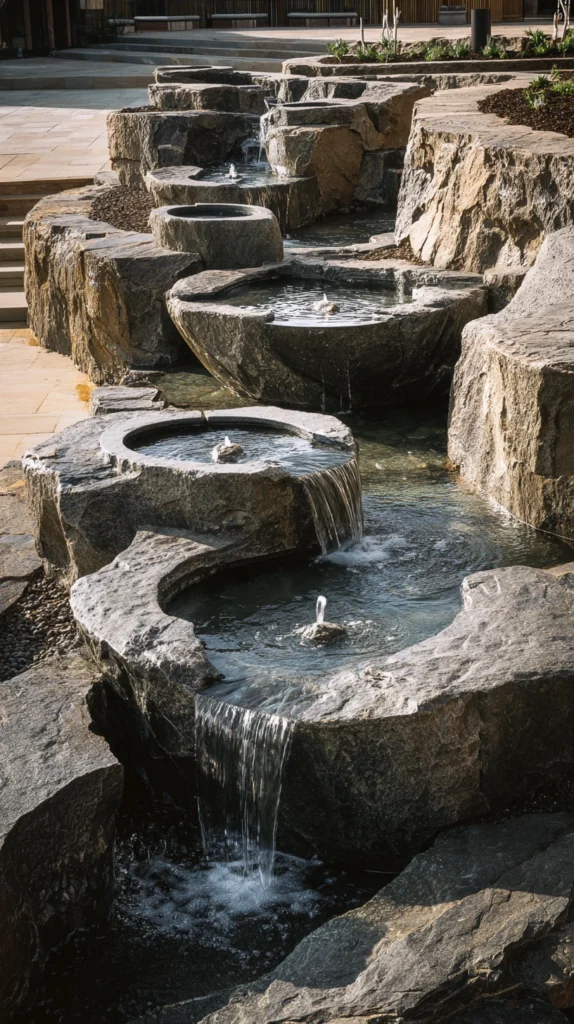
Budget: $800 – $8000
A rock pool and cascade system — a series of natural stone pools at different heights, each connected to the next by a small natural fall, with a pump at the lowest pool delivering water back to the highest and the water flowing through the entire system in a continuous circuit — is the most complete and the most spatially generous natural rock waterfall format available for a domestic garden. Each pool within the system has its own character, its own planting, and its own ecological community of insects, birds, and aquatic life.
Natural boulders and flat stones for the pool walls and fall surfaces — $200 – $800 in stone materials. Flexible liner for each pool — $50 – $150 per pool, two to three pools required. A pump with sufficient lift for the total system height — $100 – $400. Pipe to connect pool to pool and pump to source — $20 – $60. Aquatic and marginal planting — $8 – $20 per plant, fifteen to twenty plants. Total material cost: $478 – $2130 plus professional installation of $500 – $2000 if required.
Styling tip: Make each pool within the cascade system a different size and a different depth — one pool deeper and more reflective, one shallower and more planted, one narrower and more active at its waterfall — so that each zone of the system has its own distinct character. A cascade system where every pool is the same size and depth reads as a repeated unit. A cascade where every pool is individual reads as a landscape — which is the quality that makes a multi-pool system genuinely extraordinary rather than merely complex.
4. The Dry Stone Wall Waterfall
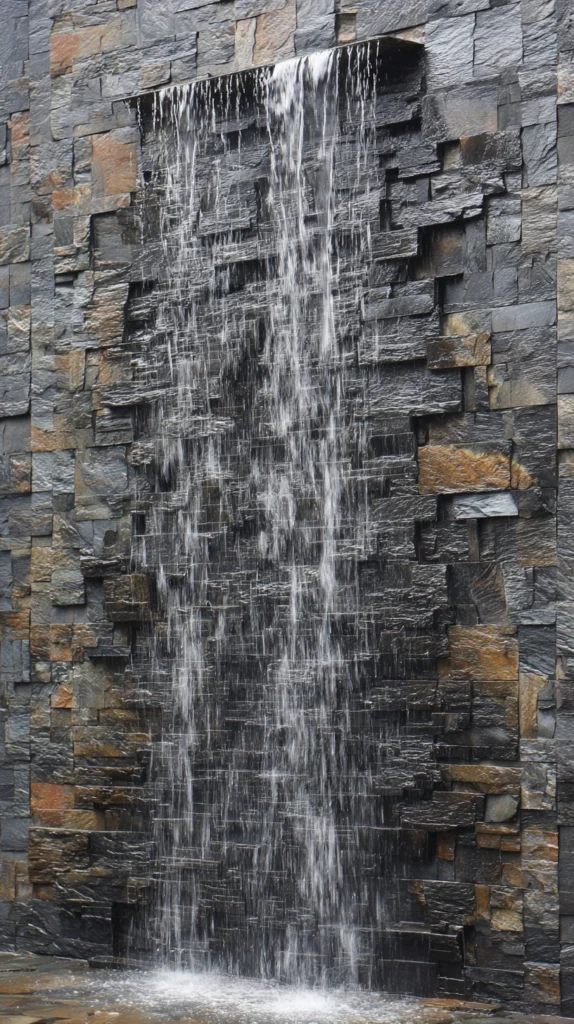
Budget: $600 – $4000
A dry stone wall waterfall — a section of dry-stacked natural stone wall with water delivered to the top and allowed to seep and flow through the natural gaps and channels in the stone arrangement, producing a distributed, multi-stream waterfall across the full face of the wall — combines the visual quality of traditional dry stone walling with the atmospheric and sonic qualities of a waterfall feature. The water’s path through the stone gaps produces a sound and a visual quality entirely specific to this format.
Natural stone for a standard dry stone wall section — $80 – $200 per linear metre in stone materials. A water delivery channel at the wall top — $50 – $150. A collection basin at the wall base — $150 – $500. A pump and plumbing — $80 – $250. Professional dry stone walling — $200 – $500 per linear metre in labour. Total investment: $560 – $1600 per linear metre of dry stone waterfall wall.
Styling tip: Plant the gaps and crevices of the dry stone waterfall wall with moisture-tolerant creeping plants — thyme, stonecrop, and small ferns — that colonise the stone face and soften the transition between the wall and the surrounding garden. A dry stone wall waterfall with established planting in its crevices reads as a feature that has been part of the garden for years. A bare dry stone wall waterfall reads as a new installation. The planting is the element that produces the quality of settledness that makes natural stone features genuinely extraordinary.
5. The River Stone Mound Feature
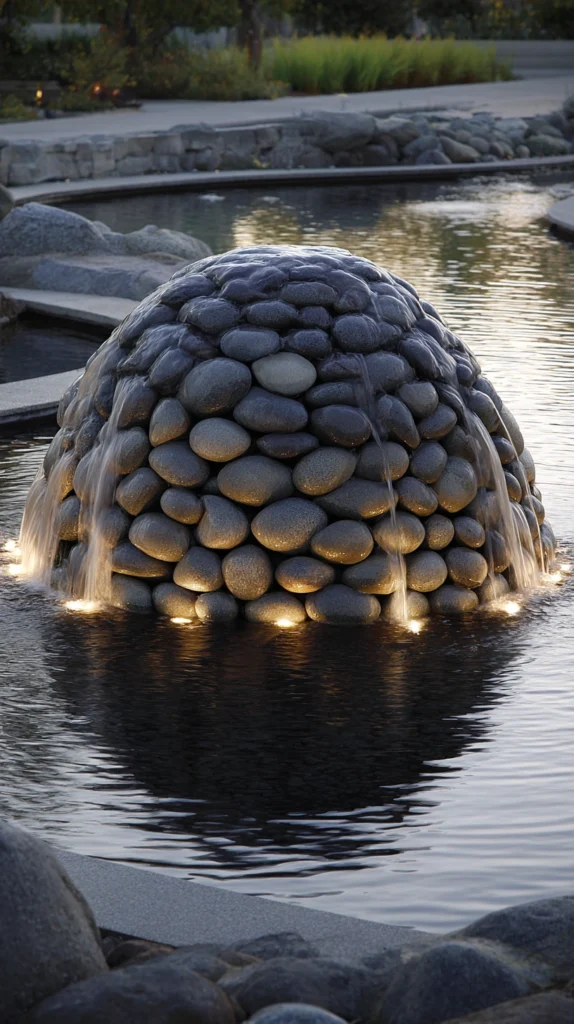
Budget: $200 – $1000
A river stone mound — a dome of smooth, rounded river stones arranged over a buried reservoir and pump, water emerging from the summit of the mound and flowing down through the river stones in all directions before being collected by the reservoir below — is the most compact and the most self-contained natural rock waterfall available. The rounded stones, the absence of any manufactured element visible from above, and the gentle bubbling quality of the water produce a feature that reads as almost entirely natural even at close viewing range.
Smooth river stones in varying sizes — $30 – $60 per bag, three to five bags required. A plastic reservoir box — $30 – $80. A pump vault to protect the pump — $15 – $30. A submersible pump — $40 – $100. A pump grate to support the stones above the reservoir — $10 – $25. Flexible pipe from pump to summit — $5 – $15. Total material cost: $130 – $310 for a self-contained natural stone feature.
Styling tip: Use three different sizes of river stone within the mound — large stones at the base, medium stones in the middle zone, and small stones at the summit — arranged so that the stone size decreases from the ground to the top. This size graduation mirrors the natural process by which water sorts stones in a riverbed — depositing larger stones first and smaller stones above — and produces a mound that reads as a genuine geological formation rather than a pile of purchased stones.
6. The Slate Slab Waterfall
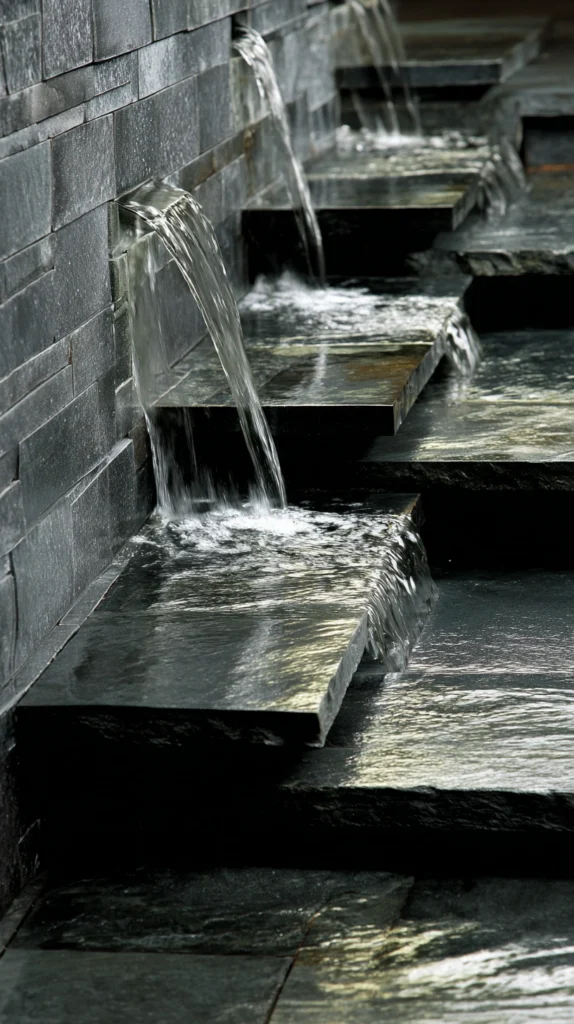
Budget: $300 – $2000
A slate slab waterfall — large, flat pieces of natural slate arranged in a stepped formation, each slab slightly wider than the one above it, water flowing from the top slab across the cool, dark surface of each piece before falling to the next — produces the most specifically graphic and the most architecturally considered of all the natural rock waterfall formats. Slate’s particular quality — its dark colour, its flat surface, and the way water makes it gleam rather than merely darken — is more dramatically beautiful when wet than almost any other natural stone.
Large flat slate pieces — $40 – $120 per piece, four to six pieces required. A pond liner beneath the installation — $30 – $80. A collection pool or basin — $100 – $400. A submersible pump — $60 – $200. Pipe and plumbing — $10 – $30. Professional installation — $300 – $600. Total investment: $540 – $1430 for a slate waterfall of considerable visual authority.
Styling tip: Tilt each slate slab very slightly — two to three degrees — toward the front face of the installation so that the water flows forward across the slab surface and falls cleanly over the leading edge rather than running back. A correctly tilted slate slab produces a clean, visible water sheet across its full surface. An untilted slab allows water to find its own path — which may be across the surface, or sideways, or toward the back — producing an irregular and aesthetically unresolved flow.
7. The Granite Boulder Stream
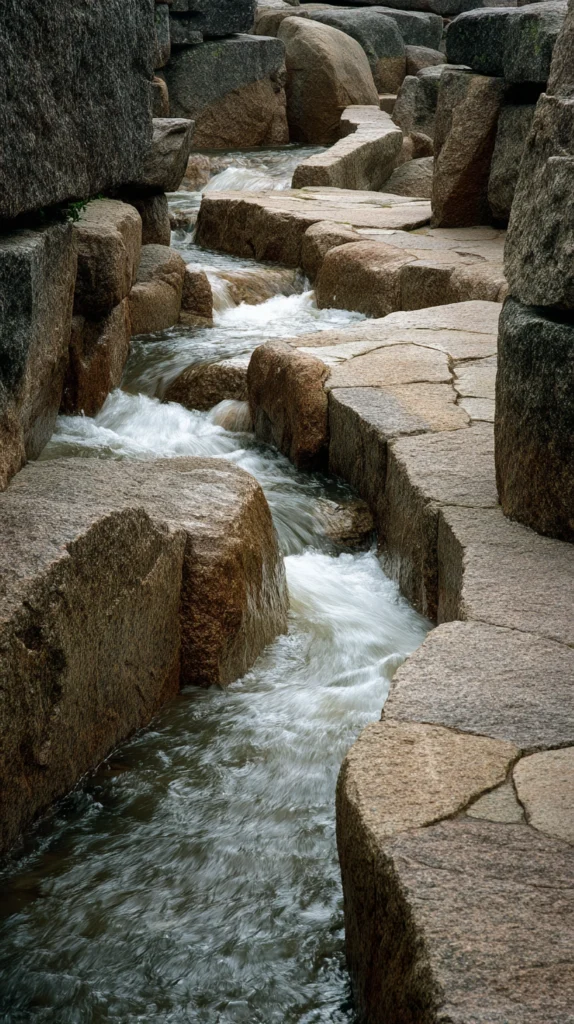
Budget: $1000 – $10000
A granite boulder stream — large, irregular granite boulders arranged along the course of a stream bed, water emerging at the uphill end from a pump and flowing between and over the boulders down to a pool at the stream’s lower end — produces the most genuinely landscape-scale natural rock waterfall available for a domestic garden. Granite’s particular quality — its weight, its crystalline surface, and the permanence it communicates — makes a granite boulder stream the garden feature most convincingly borrowed from the natural landscape rather than imported from a garden centre.
Granite boulders in varying sizes — $100 – $400 each, five to ten boulders required. A flexible stream liner — $50 – $200 depending on stream length. A pool at the stream’s base — $200 – $800. A pump with sufficient lift for the stream’s full length — $100 – $400. Planting along the stream margins — $8 – $20 per plant, fifteen to twenty-five plants. Total material cost: $658 – $3200 plus professional installation of $500 – $3000.
Styling tip: Position the largest boulders at the bends in the stream course — so that the water appears to flow around significant obstacles rather than in a straight line from source to pool. A stream with large boulders at its bends reads as a natural watercourse shaped by the immovable objects it has encountered. A stream with boulders distributed at equal intervals regardless of the stream’s direction reads as an arrangement of purchased stones — the difference being entirely in the understanding of how a natural stream organises itself around obstacles.
8. The Moss Rock Grotto Feature
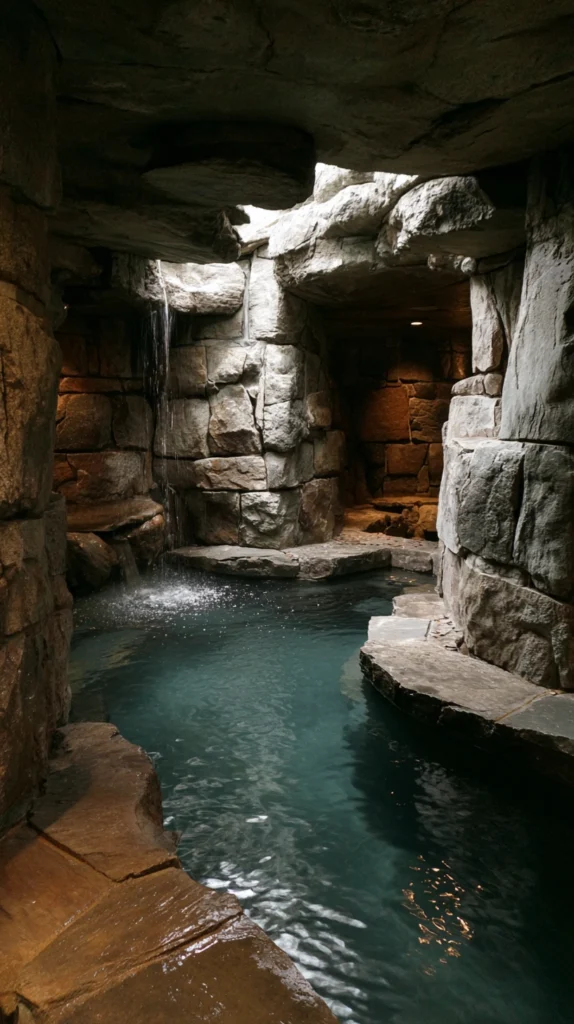
Budget: $500 – $5000
A moss rock grotto — a small, cave-like arrangement of large natural stones with water trickling from the highest point through the rock face into a small pool at the base, the stone surfaces deliberately kept moist to encourage moss and lichen growth, and shade planting surrounding the grotto creating a sense of cool, damp enclosure — is the natural rock waterfall feature most specifically associated with the quality of genuinely ancient, genuinely natural places.
Large irregular rocks for the grotto structure — $150 – $600 in stone. A pond liner for the collection pool — $30 – $80. A small pump — $40 – $120. A drip pipe system to keep the rock face permanently moist — $20 – $60. Shade planting — ferns, mosses, hostas — $8 – $20 per plant. Total material cost: $248 – $880 for a grotto feature that improves dramatically in its first two seasons as the moss establishes.
Styling tip: Position the moss rock grotto in the shadiest part of the garden — beneath a tree canopy, against a north-facing wall, or in the corner that receives the least direct sun — because moss and lichen require consistently moist, shaded conditions to establish and spread. A grotto in full sun dries between water pump cycles, preventing moss establishment and producing a bare rock feature rather than the green, living surface that makes the grotto format specifically beautiful. Shade is not a compromise in this application. It is a requirement.
9. The Rocky Rill and Pool
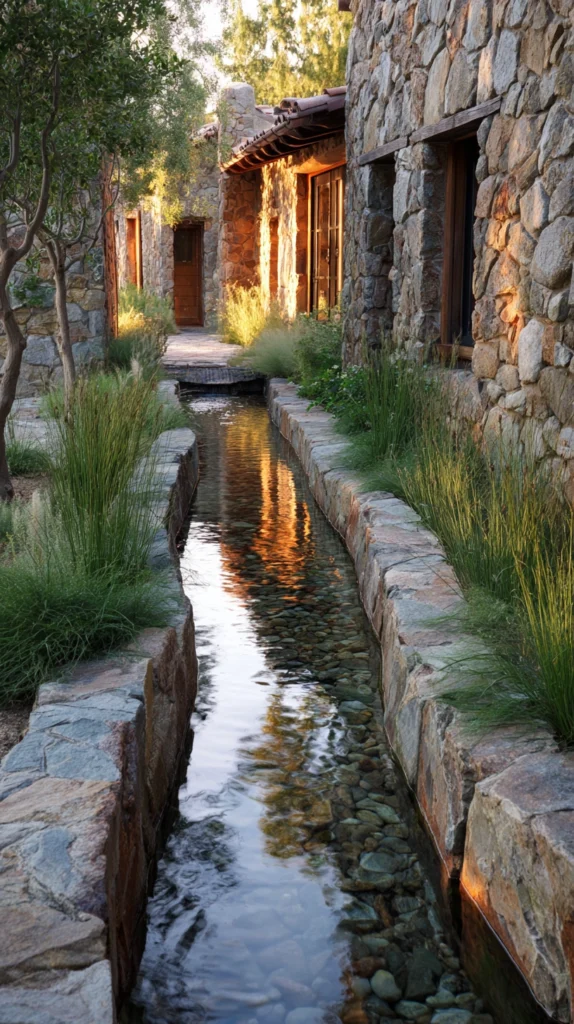
Budget: $600 – $4000
A rocky rill and pool — a narrow watercourse of natural stone pieces forming the rill’s sides and base, the water flowing in a visible, active stream from its source point to a pool at the garden’s lower end — produces the most dynamic and the most continually interesting of all the natural rock waterfall formats because the water is visible along its entire path rather than only at the point of its fall. The rill creates a journey for the water — and for the eye that follows it.
Natural stone for the rill sides and base — $50 – $150 per linear metre. A flexible liner beneath the stone rill — $15 – $40 per linear metre. A source pool at the rill’s upper end — $100 – $400. A destination pool at the lower end — $200 – $600. A pump from the lower to the upper pool — $80 – $300. Marginal planting along the rill — $8 – $20 per plant. Total investment for a three-metre rill: $543 – $2030.
Styling tip: Vary the width of the rocky rill along its course — narrower in the straight sections where the water moves faster, slightly wider at the bends where the water slows and pools briefly before continuing. A rill of consistent width reads as a channel. A rill of variable width reads as a natural watercourse — the width responding to the topography and the direction of flow in the way that a genuine stream organises itself through a landscape.
10. The Natural Rock Retaining Wall Waterfall
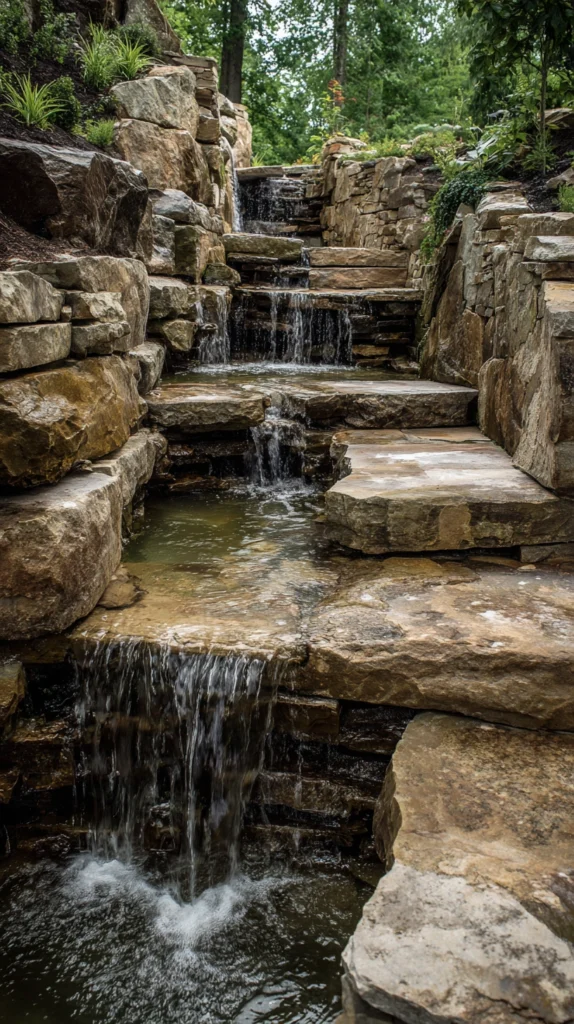
Budget: $800 – $6000
A natural rock retaining wall built into a sloped garden — the wall creating a level change in the garden’s topography — with water delivered to the top of the retaining wall and flowing through the gaps and over the face of the natural stone construction into a pool or a planted area at the wall’s base, turns a structural garden necessity into a waterfall feature simultaneously. The retaining wall earns double its construction cost by providing both the level change the garden requires and the waterfall the garden desires.
Natural stone for the retaining wall — $80 – $200 per linear metre in stone. Construction of the retaining wall — $200 – $500 per linear metre in professional labour. A water delivery channel at the wall top — $50 – $200. A collection pool or planted basin at the base — $200 – $600. A pump and plumbing — $80 – $300. Total investment for a three-metre retaining wall waterfall: $1060 – $3600.
Styling tip: Build the natural stone retaining wall with a deliberate batter — a slight rearward lean of approximately 10 degrees from vertical — rather than constructing it perfectly upright. A battered retaining wall reads as more stable, more permanent, and more specifically connected to the tradition of dry stone construction than an upright one. The 10-degree batter also produces a water flow that clings to the wall face as it falls rather than projecting forward — which is the correct behaviour for a retaining wall waterfall where the water should be visible against the stone surface rather than away from it.
11. The Natural Rock Bog and Seep Feature
Budget: $200 – $1500
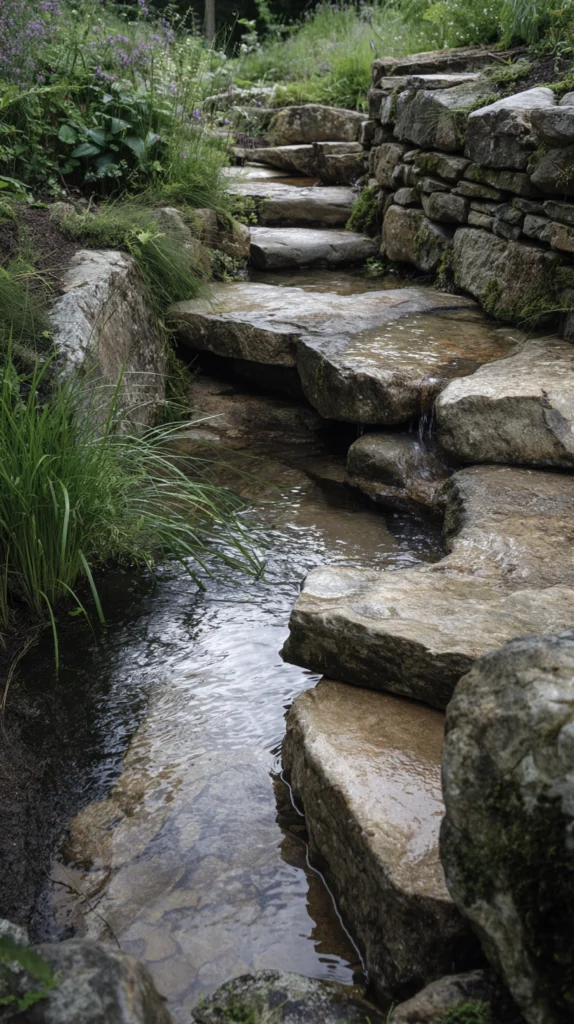
A natural rock bog and seep feature — large stones arranged in a slight depression, a slow drip or seep of water from a hidden pipe behind the uppermost stone producing a permanently wet, mossy rock surface from which the water slowly migrates downward through the stone arrangement into a bog garden planting below — is the most subtle and the most ecologically generous natural rock waterfall format. It is not a feature noticed immediately. It is a feature discovered, which is a more rewarding form of encounter.
Large irregular rocks for the seep arrangement — $60 – $200 in stone. A drip pipe system — $20 – $60. A bog garden area at the base — a flexible liner in a shallow depression — $30 – $80. A small pump and reservoir — $40 – $120. Moisture-loving plants for the bog area — $8 – $20 per plant, ten to fifteen plants. Total material cost: $198 – $600 for a feature of considerable ecological and aesthetic subtlety.
Styling tip: Allow the seep feature to operate continuously at a very low flow rate rather than running it intermittently on a timer. A continuous low flow keeps the rock surfaces permanently moist — encouraging moss establishment and maintaining the consistently wet appearance that makes the seep feature convincing. An intermittent flow allows the rocks to dry between cycles — preventing moss growth and producing a feature that alternates between a wet and a dry appearance, neither of which is as specifically beautiful as the continuously moist surface.
12. The Rock Garden Waterfall
Budget: $500 – $4000
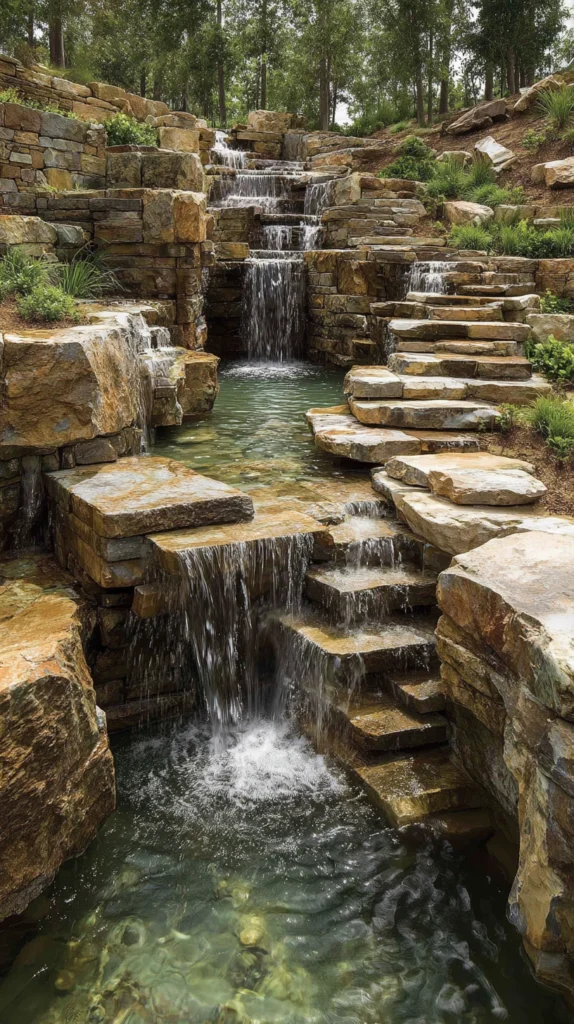
A rock garden waterfall — a raised rock garden with a waterfall element integrated into its upper section, water cascading from the highest planting level to the lowest before reaching a small pool at the base of the rock garden’s front face — combines the botanical richness of a planted rock garden with the atmospheric and sonic quality of a waterfall, producing a feature that serves both functions without either compromising the other.
Natural rocks for the rock garden construction — $100 – $400 in stone. A raised rock garden base — constructed from the natural stone with a rubble core — $200 – $600 in materials. Alpine and rock garden planting — $5 – $15 per plant, twenty to thirty plants. A waterfall integration at the upper section — pump, pipe, and delivery stone — $100 – $300. A small pool at the base — $100 – $400. Total investment: $505 – $1700 for a combined rock garden and waterfall feature.
Styling tip: Plant the rock garden’s waterfall section with moisture-loving species — ferns, mosses, and creeping plants — while planting the drier upper and outer sections with alpine species suited to the drier conditions of the raised rock garden. The plant selection communicates the moisture conditions of each zone and produces a planting scheme that reinforces the natural logic of the feature — the moisture-lovers beside the water, the alpines away from it — exactly as they would organise themselves in a natural rock landscape.
13. The Lakeside Cobble Cascade
Budget: $300 – $2500
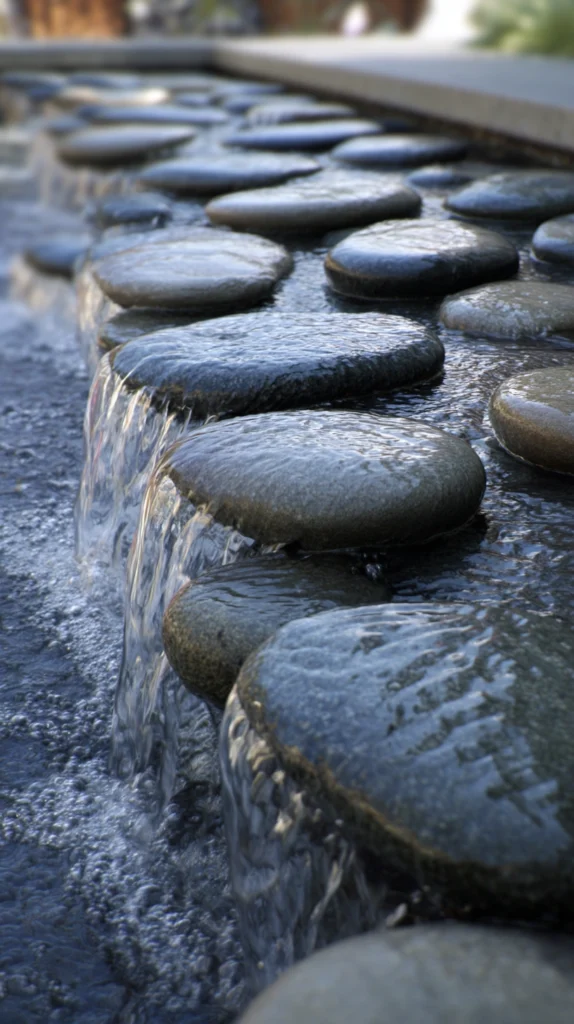
A cobble cascade — smooth, rounded cobblestones of a consistent size arranged in a stepped formation, water flowing from stone to stone in a series of small, rounded falls — produces the most specifically tactile and the most materially honest of all the natural rock waterfall formats. The rounded cobble surface produces a water sound that is distinctly different from the sound produced by flat slate or rough granite — rounder, softer, more specifically like the sound of a small natural stream over a rounded bed.
Smooth natural cobblestones in a consistent size — $20 – $50 per bag, five to eight bags required. A flexible liner beneath the cobble installation — $40 – $100. A collection pool at the base — $80 – $300. A submersible pump — $50 – $150. Pipe and plumbing — $10 – $30. Total material cost: $200 – $630 for a cobble cascade of considerable natural warmth.
Styling tip: Choose cobblestones in a consistent geological origin rather than mixing stone types within the same cascade — all smooth flint, or all rounded granite, or all pale quartz. A cascade of cobblestones in a single geological family produces a feature with visual coherence — the consistent colour and texture creating a unified surface that the water animates. A cascade of mixed stone types produces a visually busy surface where the stone variety competes with the water for the viewer’s attention.
14. The Full Natural Rock Waterfall and Wildlife Pond System
Budget: $1500 – $15000
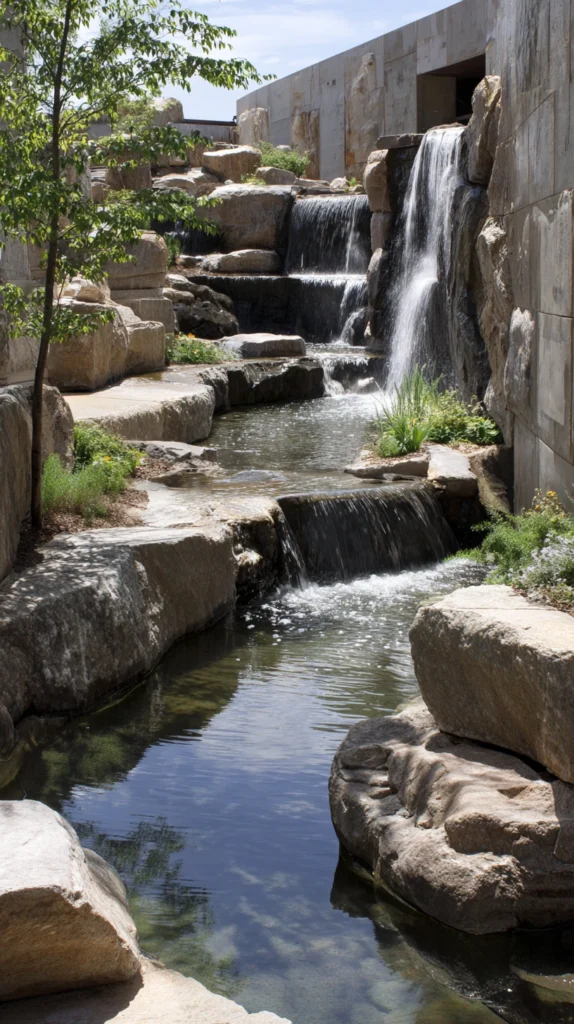
The full natural rock waterfall and wildlife pond system — large natural boulders forming a cascade at one end of a wildlife pond, flat stepping stones creating the cascade’s surface structure, a planted stream connecting the overflow of a higher source pool to the main pond, marginal and aquatic planting throughout all the water margins, a beach of smooth pebbles at the pond’s far end providing wildlife access, and the entire system recirculated by a pump concealed within the largest boulder at the pond’s inflow — is the most ecologically complete and the most genuinely extraordinary natural garden feature available at a residential scale.
Natural boulders for the cascade — $300 – $1000 in stone. Flat stepping stones — $150 – $500. A wildlife pond with flexible liner — $100 – $400. A planted stream between source and main pond — $200 – $600. A pebble beach at the pond edge — $50 – $150. A pump and plumbing system — $150 – $500. Aquatic and marginal planting throughout — $8 – $20 per plant, twenty to thirty plants. Total material cost: $1150 – $3550 plus professional installation of $800 – $3000 if required.
Styling tip: Design the full system so that the waterfall’s sound is audible from the garden’s primary seating area — but position the seating area at a distance of four to six metres from the cascade rather than directly beside it. At four to six metres, the cascade sound is the garden’s dominant ambient sound without being so immediate that it prevents comfortable conversation. Directly beside the cascade, the sound is overwhelming. At ten metres, the sound is pleasant but secondary. The four-to-six-metre distance is the position from which a natural rock waterfall sounds most like the natural place it is imitating.
Whatever combination of these fourteen ideas finds its way into the garden, the principle beneath all of them is the same one that has governed the relationship between stone and water in the natural landscape for as long as both have existed: the stone determines the water’s character, and the water reveals the stone’s.
Choose stone that belongs to the garden’s landscape — that comes from the same geological world as the ground beneath the garden itself. Build the water feature in relationship to the garden’s existing levels, planting, and spatial organisation rather than as an object placed within it. Give it a year to settle, to develop its moss and its marginal planting, to become genuinely part of the place.
And then sit beside it on a still morning when the water has been running overnight and the stone surfaces are dark and glistening and the sound of the water over the rock is the only sound that the garden contains, and understand that a natural rock waterfall is not merely a beautiful addition to a garden.
It is the thing that makes the garden feel, for the first time, like a place that has always been there.