15 Hallway Lighting Ideas That Make a Narrow Space Feel Grand
The hallway changed from the house’s most forgettable stretch to one of its most complimented the moment I stopped treating its lighting as an afterthought. Not the wider renovation. Not knocking down a wall. Not any change to the hallway’s actual physical dimensions at all.
The light.
Because how a narrow space is lit does more to change how large it feels than almost any structural decision. Before it: a single flush-mount ceiling fixture, flat and even, doing nothing but making the corridor’s narrowness more obvious. After it: light at multiple heights, warm and layered, the same narrow hallway suddenly reading as considered rather than merely functional, wide-feeling rather than cramped.
Hallway lighting is not an afterthought solved with a single overhead fixture once the rest of the house is finished. It is one of the most reliable tools available for making a narrow space feel intentional rather than leftover. A hallway lit with real thought reads as grand regardless of its actual square footage; a hallway lit with a single bare bulb reads as an afterthought regardless of how nice the rooms on either side of it are.
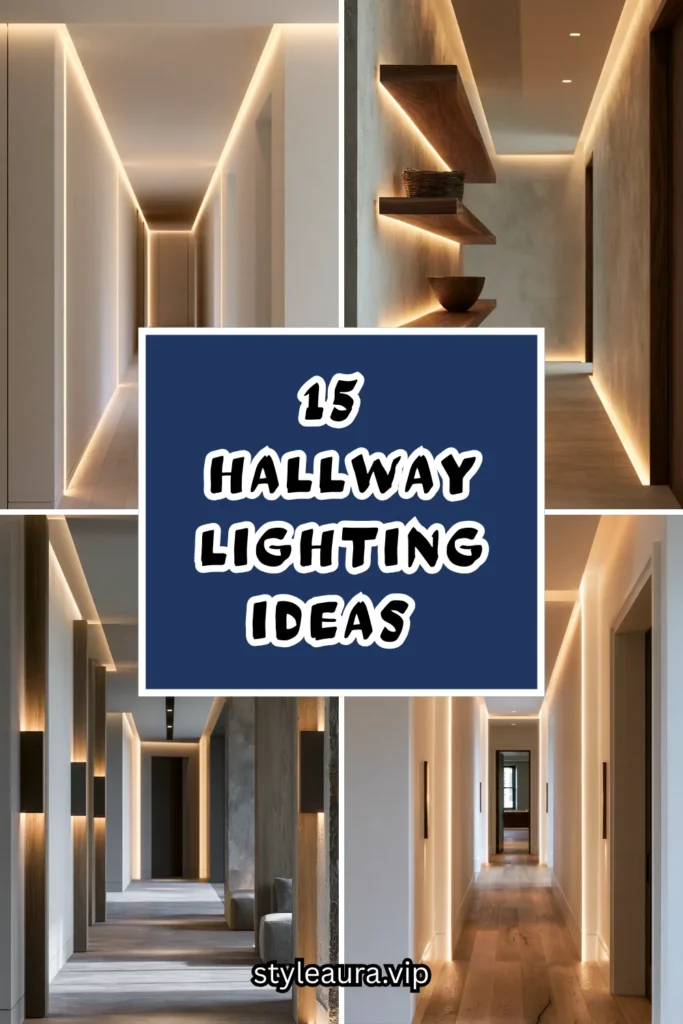
Here are 15 hallway lighting ideas that make a narrow space feel grand — from the simplest sconce pair to the most fully lit corridor — built on that understanding.
Why Lighting Does More for a Narrow Hallway Than Any Other Single Change
The single-source problem
Without a layered approach:
One flush-mount ceiling fixture, positioned at the hallway’s midpoint, providing flat, even light and nothing else.
The hallway: functional, but visually reading exactly as narrow and undecorated as it actually is.
With a layered approach:
Multiple light sources at varying heights — wall sconces, picture lights, a runner of small fixtures — creating shadow, warmth, and visual rhythm along the corridor’s length.
The hallway: reading as considered and intentional, its narrowness less visually dominant than the layered light drawing the eye instead.
The rhythm principle
A hallway is, by definition, a space experienced in motion — walked through rather than sat in. Lighting placed at regular intervals along its length creates a visual rhythm that echoes and enhances that walking movement, rather than a single static fixture that does nothing to acknowledge the space’s linear nature.
The height perception case
Wall-mounted and low-hanging fixtures draw the eye horizontally along a hallway’s length rather than emphasizing its ceiling height, a detail that matters more in a narrow corridor than in almost any other room, where drawing attention to width the room does not have works directly against the goal.
The warm light imperative
A narrow hallway lit with cool, stark light emphasizes its utilitarian, transitional nature. Warm light, closer to candlelight in tone, immediately shifts the same space toward something closer to a grand home’s gallery corridor.
The Five Hallway Lighting Techniques
Before choosing any single fixture:
Wall sconces at intervals
Fixtures mounted directly on the wall, spaced evenly along the hallway’s length.
The single most transformative technique for a narrow corridor.
Adds genuine width perception by drawing the eye horizontally.
A statement runner of pendants
A series of small matching pendant lights, hung in a line down the hallway’s center.
Suits a hallway with adequate ceiling height.
Creates a distinctive rhythm and visual interest overhead.
Picture and art lighting
Small lights positioned above framed art or photography along the hallway walls.
Combines functional illumination with a genuine gallery-like display.
Particularly effective in a hallway used to showcase family photos or art.
Recessed and cove lighting
Lighting built into the ceiling or a cove detail, providing a soft, indirect wash of light.
The most architecturally integrated, least visually obtrusive option.
Suits a hallway aiming for a clean, minimal aesthetic.
A grand single statement fixture
One dramatic chandelier or pendant at the hallway’s center or entry point.
Works best in a hallway with a distinct focal point, such as a foyer transition or a staircase landing.
Provides a single, memorable moment rather than distributed light throughout.
1. The Evenly Spaced Wall Sconce Row
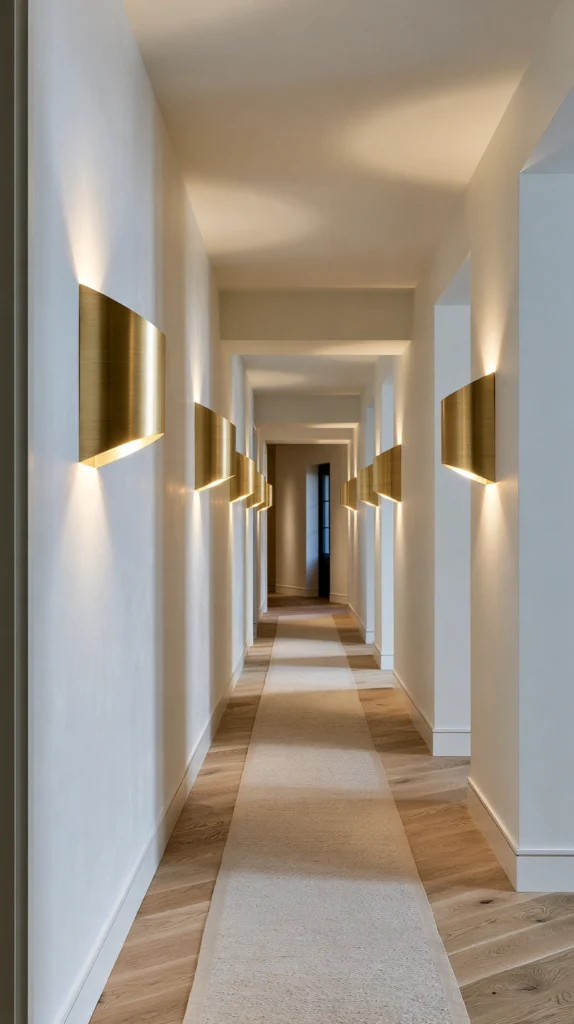
A row of matching wall sconces, mounted at regular intervals along one or both walls of the hallway, replacing a single central ceiling fixture entirely.
Why evenly spaced sconces are the single most effective hallway lighting technique
Sconces mounted along the wall’s length draw the eye horizontally down the corridor, visually extending its perceived length while adding warmth at a height flattering to the human eye — a combination no single ceiling fixture achieves.
The spacing
Typically every 6 to 8 feet, adjusted based on the hallway’s specific length, ensuring the fixtures create a genuine rhythm rather than either crowding together or leaving overly long gaps of darkness between them.
The mounting height
Roughly 60 to 66 inches from the floor, positioning the light at a height that illuminates the walls and any art hung on them without glaring directly into a passing person’s eyeline.
The fixture style
A simple, elegant sconce design, in brass, aged bronze, or a matching finish to the home’s other hardware, avoiding an overly ornate style that could feel busy repeated so many times along one corridor.
The single-wall option
Sconces on just one wall, rather than both, for a narrower hallway where fixtures on both sides might feel crowded, still providing meaningful rhythm and warmth without overwhelming the limited width.
The dimmer
A dimmer switch controlling the full sconce row, allowing the hallway’s brightness to be adjusted for daytime function versus evening ambiance.
Cost breakdown: Wall sconces (4–6, matching): $200–500 Dimmer switch installation: $60–150 Total: $260–650
2. The Pendant Light Runner
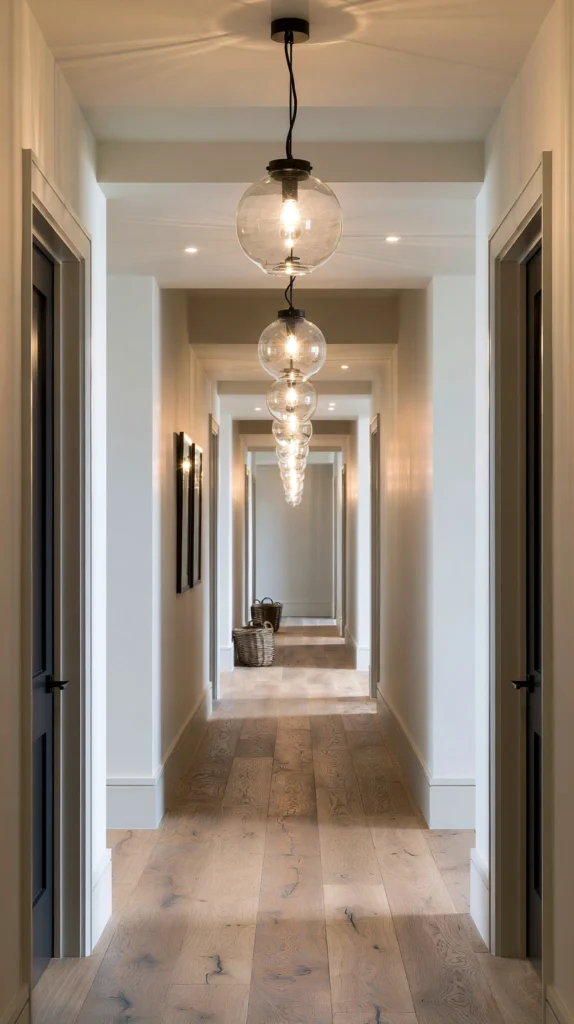
A series of small, matching pendant lights hung in a single line down the hallway’s ceiling center, creating a distinctive overhead rhythm rather than one isolated fixture.
Why a runner of pendants suits a hallway with adequate ceiling height
Multiple small pendants, evenly spaced, create the same rhythmic, elongating visual effect sconces achieve, but from overhead rather than the walls — a strong option specifically where wall space is needed for art or storage instead.
The pendant style
Small glass, brass, or fabric-shaded pendants, chosen in a scale proportional to the hallway’s width, since an oversized pendant would overwhelm a genuinely narrow corridor.
The spacing
Evenly spaced along the hallway’s center line, at intervals similar to the wall sconce spacing principle, creating a clear visual rhythm when viewed from either end of the corridor.
The hanging height
Low enough to create genuine visual presence, but high enough to clear the head of the tallest household member comfortably — typically 7 feet or higher from the floor in a hallway with standard ceiling height.
The ceiling height requirement
Best suited to a hallway with at least 8 feet of ceiling height, since a lower ceiling may not comfortably accommodate a hanging pendant without it feeling cramped or posing a bump-into risk.
The overall effect
A hallway with a genuine architectural moment overhead, the repeated pendant rhythm drawing the eye down the corridor’s length in a way a single central fixture never could.
Cost breakdown: Small pendant lights (4–6, matching): $150–400 Electrical work for multiple fixtures (if needed): $200–500 Total: $350–900
3. The Gallery Picture Light Display
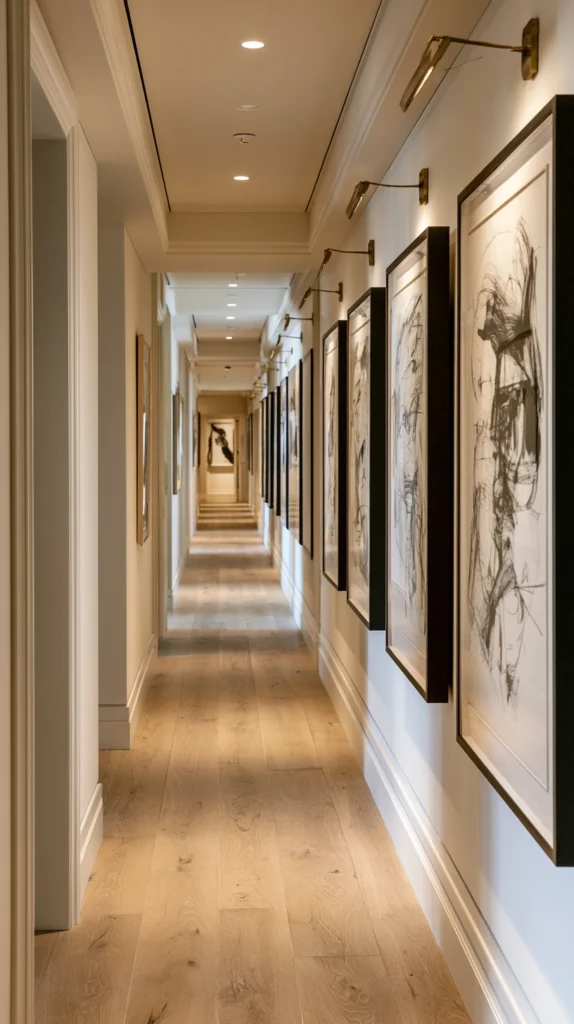
Small, adjustable picture lights mounted above a row of framed art or family photographs along the hallway, combining genuine illumination with a curated gallery display.
Why picture lighting does double duty in a narrow hallway specifically
A hallway is one of the most natural places in any home for a gallery wall, since it is walked past rather than lived in — picture lights both illuminate that display and provide the hallway’s primary functional light source simultaneously.
The picture lights
Small, adjustable brass or bronze fixtures, mounted directly above each piece of framed art, angled to wash light evenly down across the frame.
The art arrangement
A consistent horizontal line of framed pieces — family photos, art prints, or a mixed collection — spaced evenly to match the rhythm the picture lights themselves create.
The frame consistency
Matching or complementary frames throughout the row, providing visual cohesion that echoes the same lighting rhythm, rather than a haphazard mix that would compete with the considered lighting placement.
The supplemental light
A secondary, softer overhead or wall-based light source for basic functional illumination when the picture lights alone are not sufficient for simply walking through the space safely.
The overall effect
A hallway that reads as a genuine small gallery, the lighting reinforcing rather than competing with the art display, elevating what might otherwise be an overlooked function into the hallway’s defining feature.
Cost breakdown: Picture lights (4–6): $120–300 Frames and art (if adding): $80–200 Total: $200–500
4. The Recessed Cove Lighting Wash
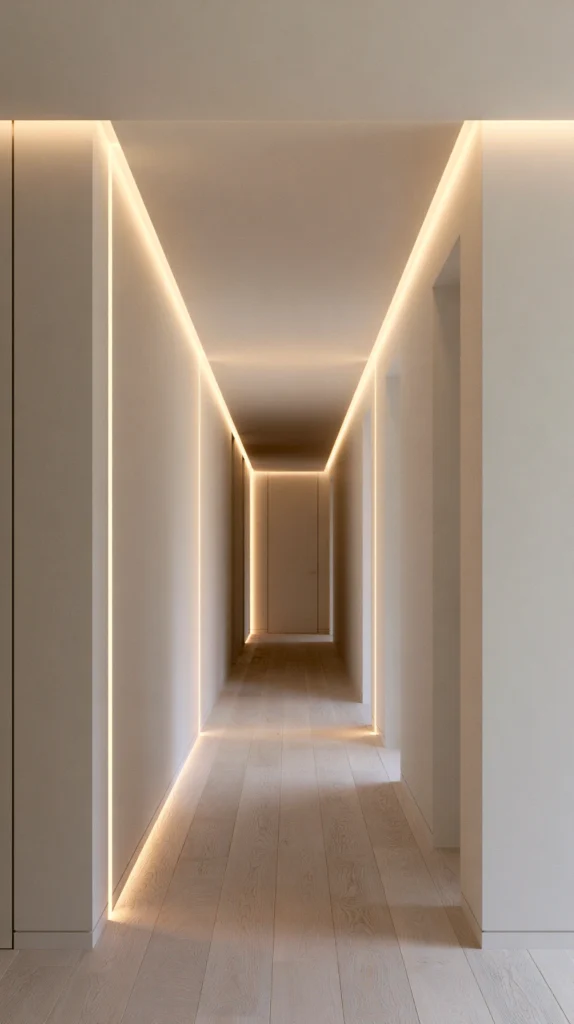
A continuous recessed lighting channel built into the ceiling’s edge or a cove detail, providing an indirect, soft wash of light along the hallway’s full length without any visible fixture at all.
Why cove lighting suits a hallway aiming for a clean, minimal aesthetic
Unlike sconces or pendants, cove lighting has no visible fixture at all — the light itself becomes the only visual element, a strong choice for a hallway meant to feel architecturally seamless rather than decorated.
The construction
A recessed channel built into the ceiling perimeter or a dropped cove detail, housing an LED strip that washes light upward or downward along the ceiling and upper wall.
The light direction
Upward-facing cove lighting washing the ceiling itself with a soft glow, or downward-facing lighting washing the upper wall, depending on the specific architectural detail and desired effect.
The color temperature
A warm LED strip, rated 2700K to 3000K, avoiding the cooler, more clinical light temperature sometimes associated with recessed LED lighting in a commercial or overly modern context.
The construction requirement
Typically requires a ceiling renovation or new construction to install properly, making this a higher-commitment option than a simple fixture swap, best planned during a broader hallway or home renovation.
The overall effect
A hallway lit by what appears to be ambient light alone, no visible fixture drawing attention to itself, creating a genuinely architectural, almost gallery-museum quality along the corridor.
Cost breakdown: Cove construction and LED strip: $400–1,000 Professional installation: $300–800 Total: $700–1,800
5. The Statement Chandelier at the Entry Point
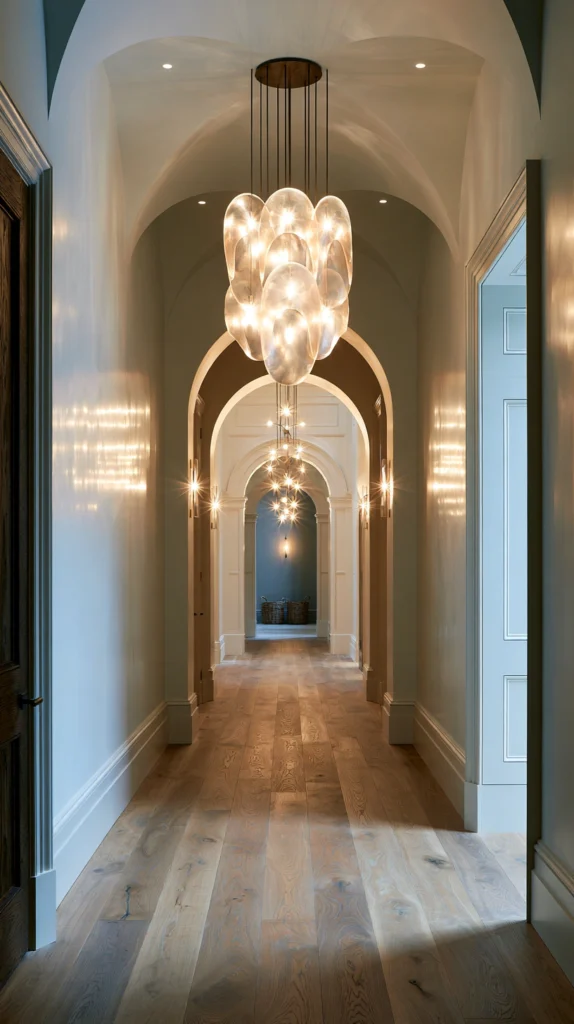
A single dramatic chandelier or oversized pendant positioned at the hallway’s entry point — often where it meets a foyer or staircase — providing one grand focal moment rather than distributed lighting throughout.
Why a single statement fixture can work even in a narrow space
A hallway does not always need distributed lighting along its full length if it has one clear entry or focal point — a single dramatic fixture positioned exactly there can define the entire corridor’s character from that one spot.
The fixture
A chandelier or an oversized pendant, scaled appropriately to the specific entry point’s ceiling height and width, chosen as the hallway’s singular dramatic gesture.
The placement
Positioned precisely at the hallway’s entry, transition point, or beneath any change in ceiling height, functioning as an architectural marker as much as a light source.
The supplemental lighting
Simpler, more understated fixtures — small sconces or recessed lights — used along the remainder of the hallway’s length, ensuring the statement chandelier remains the singular dramatic focal point rather than competing with equally bold fixtures elsewhere.
The scale consideration
Sized to the specific ceiling height available, since an oversized chandelier in a hallway with a standard 8-foot ceiling can read as cramped rather than grand if the proportions are not carefully checked.
The overall effect
A hallway that reads as genuinely grand at its most visible, most photographed point, even if the rest of the corridor’s lighting remains comparatively simple and understated.
Cost breakdown: Statement chandelier or oversized pendant: $200–600 Electrical work (if relocating a fixture): $150–400 Total: $350–1,000
6. The Warm Dimmable LED Strip Under Shelving
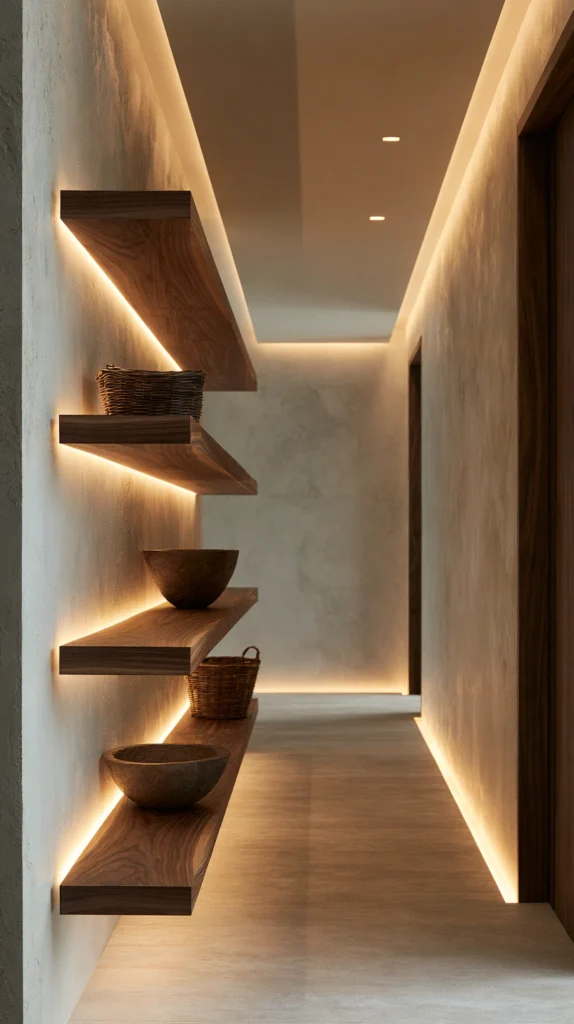
LED strip lighting installed beneath a run of hallway shelving or a console table, providing a soft, low-level glow that adds warmth and depth without requiring any additional overhead fixtures.
Why under-shelf lighting adds warmth at an unexpected height
Most hallway lighting comes from the ceiling or the wall at eye level. A low, under-shelf glow adds a third lighting plane, creating layered depth that a single-height lighting scheme cannot replicate.
The LED strip
A warm-toned, dimmable LED strip, adhered beneath any shelving, a console table’s underside, or a runner of built-in cubbies along the hallway.
The placement
Positioned to wash light downward onto the floor or wall beneath, rather than glaring directly outward at eye level.
The dimmer integration
A separate dimmer or smart control for the LED strip, allowing it to function as a soft night-light-style ambiance separate from the hallway’s primary overhead or wall lighting.
The furniture requirement
Best suited to a hallway with an existing console table, shelving run, or built-in bench, since the strip needs a surface to be mounted beneath for the effect to register properly.
The overall effect
A hallway with a soft, ambient glow at a low height, adding genuine depth and warmth particularly valuable for nighttime use without needing the brighter, more functional overhead lighting switched on.
Cost breakdown: LED strip lighting: $25–60 Dimmer or smart control: $20–50 Total: $45–110
7. The Brass Wall Sconce and Mirror Pairing
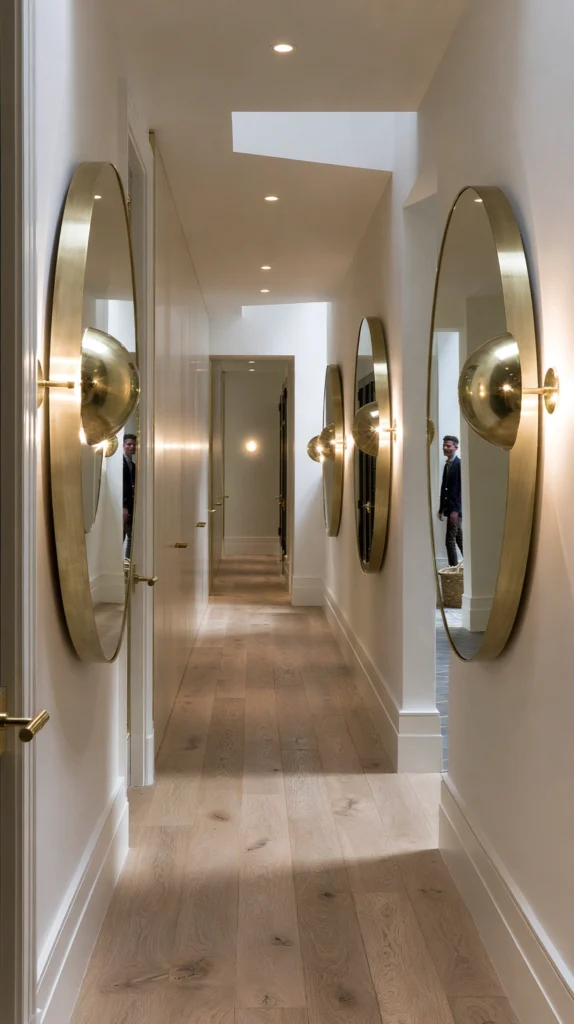
Wall sconces mounted directly beside or above a series of mirrors along the hallway, using the mirrors to reflect and effectively double the light’s visual presence.
Why mirrors amplify a hallway lighting scheme’s effectiveness
A mirror positioned near a light source reflects both the light itself and the hallway’s own depth, creating a genuine sense of expanded width and brightness that lighting alone, without the mirror, does not achieve.
The mirror placement
One or several mirrors hung along the hallway’s length, each paired with an adjacent or flanking sconce, positioned so the sconce’s light reflects visibly in the mirror’s surface.
The sconce style
Brass or aged bronze sconces, mounted either directly beside each mirror or centered above it, depending on the specific mirror’s shape and size.
The width illusion
The combined effect of the reflected light and the mirror’s own reflected depth can make a narrow hallway appear considerably wider than its actual measured dimensions, one of the most effective optical techniques available for this specific spatial challenge.
The mirror shape
A series of matching round or arched mirrors, rather than one oversized rectangular mirror, maintaining the same rhythmic repetition principle used in the sconce and pendant runner approaches.
The overall effect
A hallway that reads as genuinely more spacious and considerably brighter than its lighting fixture count alone would suggest, the mirrors doing double visual work alongside the sconces themselves.
Cost breakdown: Wall sconces (3–4): $150–350 Mirrors (3–4, matching): $60–180 Total: $210–530
8. The Skylight or Transom Window Light Well
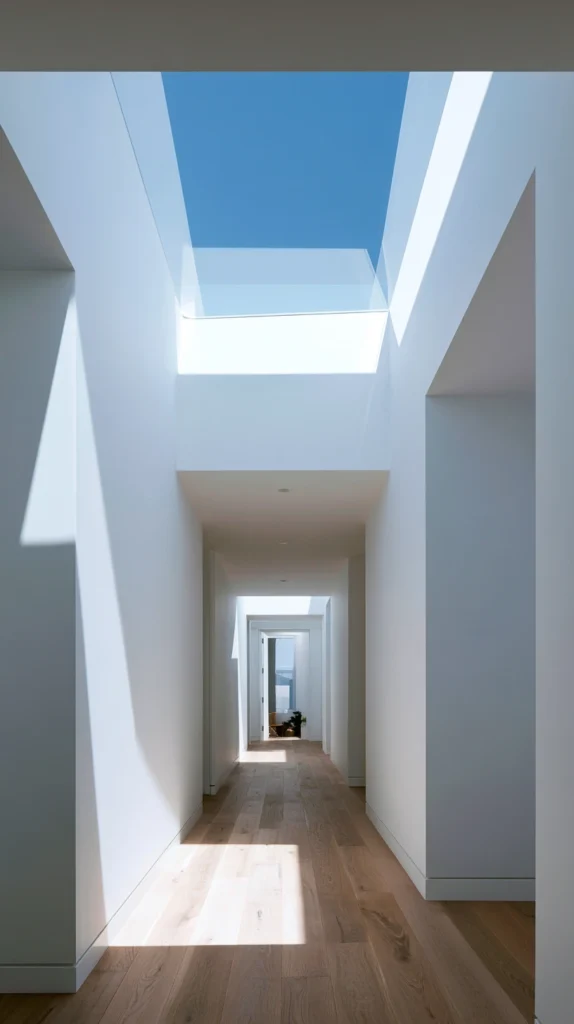
Where structurally possible, a skylight or transom window added above the hallway, introducing genuine natural light into a space that typically relies entirely on artificial lighting.
Why natural light changes a hallway’s character more than any artificial fixture can
Most hallways, positioned deep within a home’s floor plan, receive no natural light at all. Introducing even a small amount fundamentally changes the space’s quality in a way no artificial fixture, however well chosen, fully replicates.
The skylight option
A skylight installed directly above the hallway, if the roof structure above allows, bringing genuine daylight down into an otherwise entirely artificially lit corridor.
The transom option
A small transom window installed above an interior doorway leading from the hallway into an adjacent room with its own natural light source, borrowing light from that room without requiring any exterior roof or wall work.
The structural requirement
Both options require genuine construction work and, in the case of a skylight, careful waterproofing and structural planning — best undertaken as part of a broader renovation rather than a standalone weekend project.
The daytime versus evening use
Providing genuine benefit during daylight hours, while the hallway’s artificial lighting scheme remains equally important for its evening and nighttime function.
The overall effect
A hallway that feels fundamentally different during the day than nearly any artificially lit corridor can, the natural light adding a dimension of genuine architectural quality beyond what any fixture alone provides.
Cost breakdown: Skylight installation: $1,500–4,000 Or transom window installation: $600–1,500 Total: $600–4,000 depending on approach
9. The Layered Task and Ambient Combination
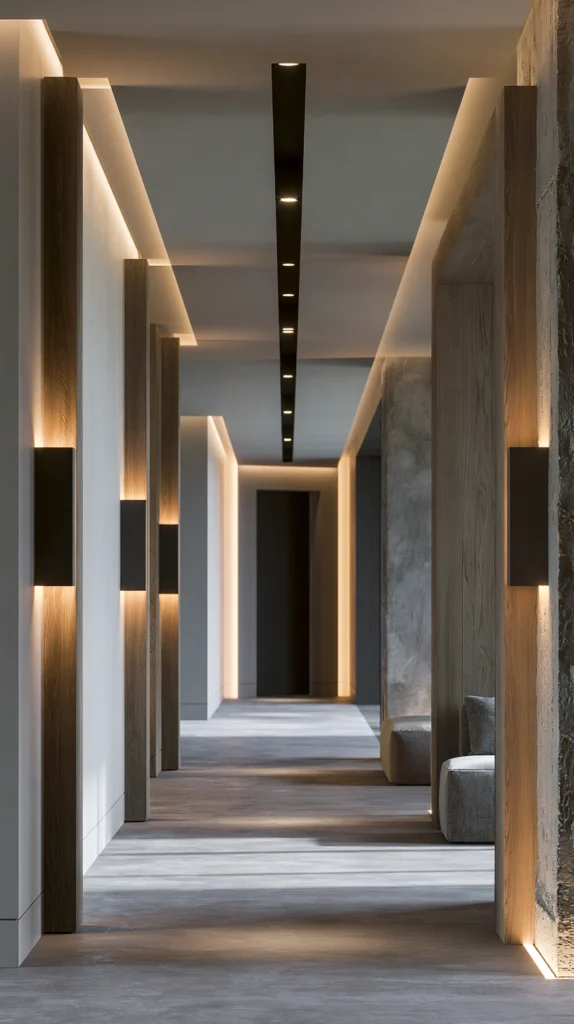
A hallway lit with two distinct lighting layers — a brighter, more functional overhead source and a softer, warmer ambient layer — allowing the space to shift character between daytime function and evening atmosphere.
Why two distinct layers serve a hallway’s two different real uses
A hallway functions differently during the day, when it needs genuine, functional brightness for quick passage, than in the evening, when a softer, warmer ambiance better suits a home’s overall winding-down mood.
The task layer
Brighter overhead lighting — recessed cans or a simple flush mount — providing genuinely functional illumination for daytime use, quick trips through the hallway, or any task requiring clear visibility.
The ambient layer
Warmer, softer wall sconces or a low-level LED strip, providing the evening’s primary light source, dimmer and more atmospheric than the daytime task lighting.
The separate controls
Each layer on its own switch or dimmer, allowing the household to choose which layer, or combination, suits the specific time of day and mood.
The transition use
Both layers together at a lower combined brightness during a transitional evening period, gradually shifting to the ambient layer alone as the household settles in for the night.
The overall effect
A hallway that adapts genuinely to different times of day and different needs, rather than offering only one fixed brightness level regardless of context.
Cost breakdown: Overhead task lighting: $80–200 Ambient wall sconces or LED strip: $150–350 Separate switches or dimmers: $80–200 Total: $310–750
10. The Runner Rug and Downlight Pairing
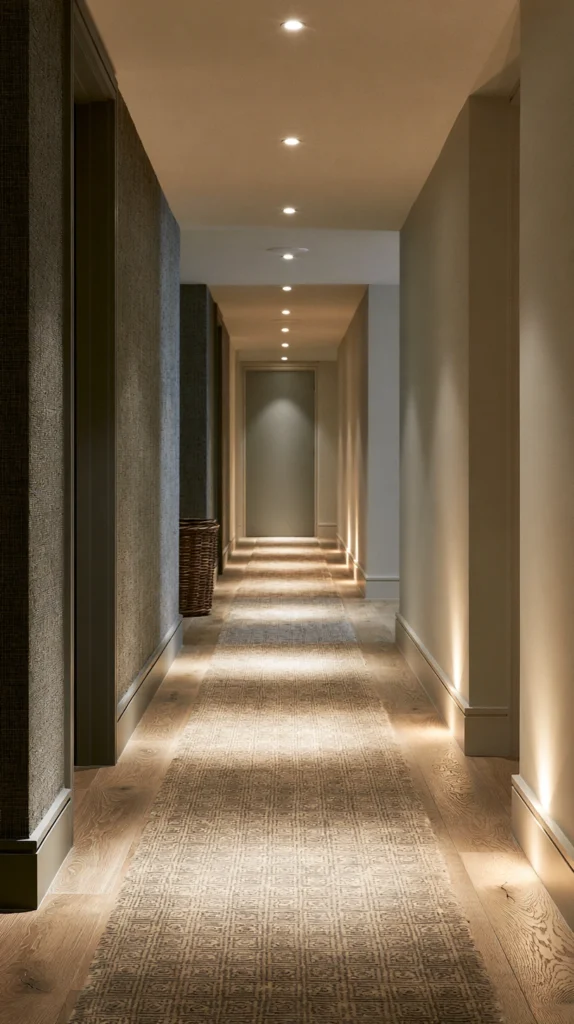
A patterned runner rug paired with downward-facing wall or ceiling lights specifically positioned to highlight its pattern and color, using light to draw attention to the floor as much as the walls.
Why lighting the floor changes a hallway’s perceived proportions
Most hallway lighting focuses attention on the walls or ceiling. Deliberately lighting the floor and the runner atop it draws the eye downward and along the hallway’s length, reinforcing its linear character in a way overhead-only lighting does not.
The runner
A patterned or richly colored runner rug, spanning the hallway’s full length, chosen for a pattern or color that benefits from being clearly visible under good lighting.
The downlighting
Wall-mounted or recessed fixtures angled to wash light downward onto the runner, rather than only illuminating eye-level or overhead space.
The color rendering
A warm bulb with good color rendering, ensuring the runner’s pattern and color read accurately and richly under the hallway’s artificial light rather than appearing washed out or flat.
The rhythm consideration
Downlights spaced to correspond with the runner’s own pattern repeats where possible, reinforcing the same rhythmic principle used throughout other hallway lighting techniques.
The overall effect
A hallway where the floor itself becomes part of the lighting design’s intention, rather than an overlooked surface beneath lighting focused entirely on the walls and ceiling.
Cost breakdown: Runner rug: $100–300 Downlighting fixtures (if adding): $150–350 Total: $250–650
11. The Backlit Architectural Niche
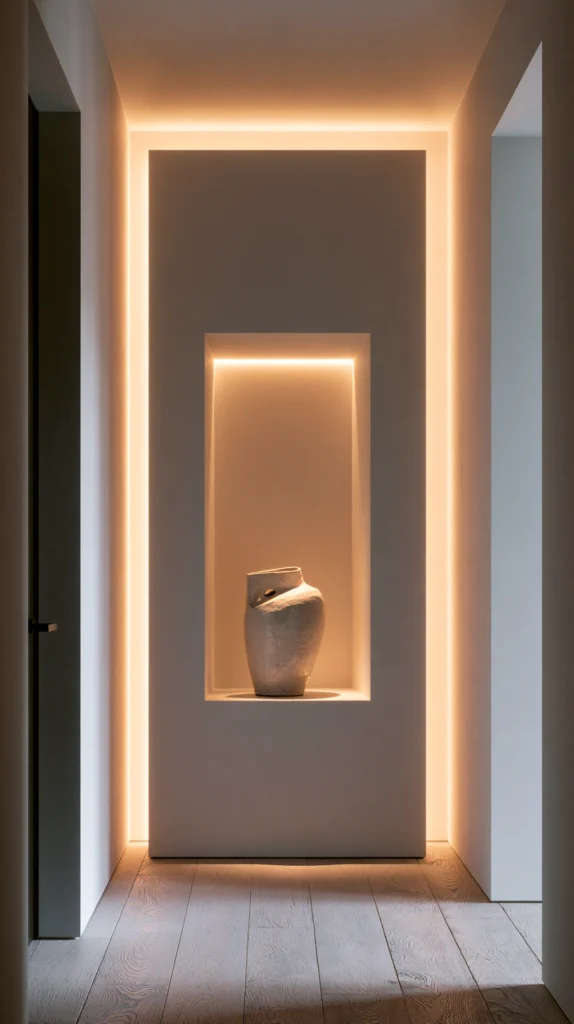
A small architectural niche or recessed shelf built into the hallway wall, lit from within to display a single object — a vase, a small sculpture, a piece of art — as a glowing focal point along the corridor.
Why a lit niche creates a genuine destination point within a narrow space
A hallway without any single focal point can feel like pure transition, nothing but a means to another room. A backlit niche gives the eye somewhere to land, a small destination within the corridor itself rather than only a path through it.
The niche construction
A shallow recessed shelf built into the wall, sized to hold a single object rather than a full display, requiring some wall depth and construction work to create.
The lighting
A small LED strip or puck light installed within the niche, illuminating the displayed object from behind or above, creating a soft glow that draws the eye without overwhelming the rest of the hallway’s lighting scheme.
The displayed object
A single considered piece — a ceramic vase, a small sculpture, a piece of art — chosen with the same restraint given to any minimalist styled vignette.
The placement
Positioned at a natural pause point in the hallway, such as partway along its length or just before a turn, giving the eye a moment of visual interest at a specific point in the walking journey.
The overall effect
A hallway with a genuine architectural feature and lighting moment, elevating what might otherwise be an entirely featureless corridor into a space with its own small, memorable detail.
Cost breakdown: Niche construction: $200–600 LED lighting for niche: $30–70 Total: $230–670
12. The Warm Uplighting Along the Baseboard
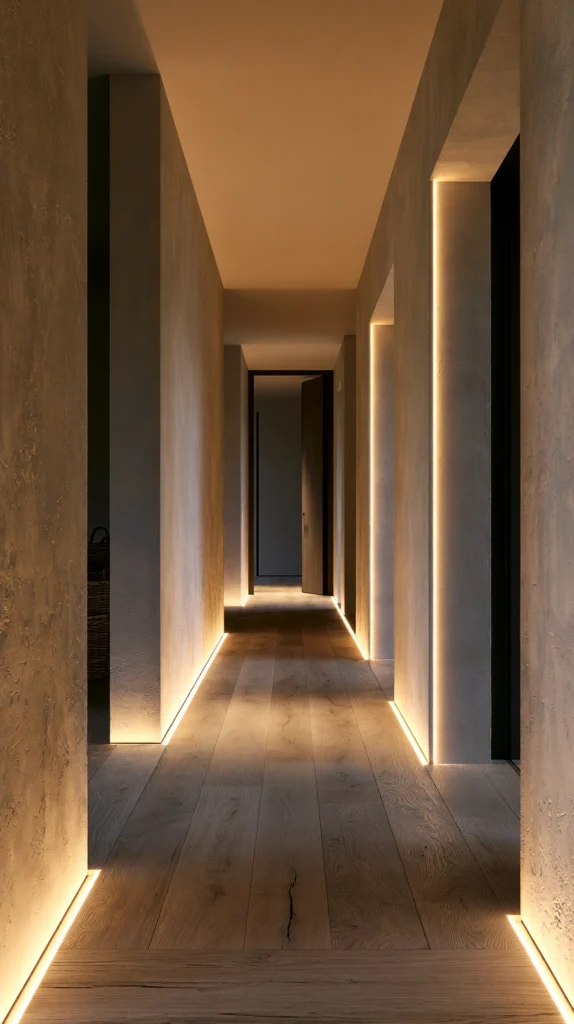
Low-profile LED strip lighting installed along the hallway’s baseboard, washing warm light upward along the wall, creating a soft glow effect distinct from any overhead or eye-level lighting.
Why baseboard uplighting adds a dramatic, unexpected lighting layer
Nearly all conventional lighting comes from above eye level. Light washing upward from the floor creates a distinctly different, more dramatic shadow and highlight pattern along the wall, adding genuine visual interest a hallway’s typical downward-only lighting does not provide.
The LED strip
A low-profile, warm-toned LED strip, installed along the baseboard’s top edge or in a small recessed channel, running the hallway’s full length or in sections.
The wall texture interaction
Particularly effective against a textured wall — brick, wood paneling, or plaster — since the upward-washing light emphasizes surface texture and shadow in a way flat, even lighting does not.
The dimmer control
A dedicated dimmer or smart control, allowing the uplighting to function as a subtle accent layer rather than the hallway’s primary functional light source.
The evening emphasis
Particularly effective as an evening or nighttime lighting layer, providing enough soft illumination for safe passage without the brighter, more clinical quality of full overhead lighting.
The overall effect
A hallway with a genuinely dramatic, unexpected lighting detail, the upward wash of light against the wall creating a mood and visual interest distinct from any of the other more conventional lighting techniques on this list.
Cost breakdown: Baseboard LED strip: $30–70 Dimmer or smart control: $20–50 Total: $50–120
13. The Arched Doorway Light Wash
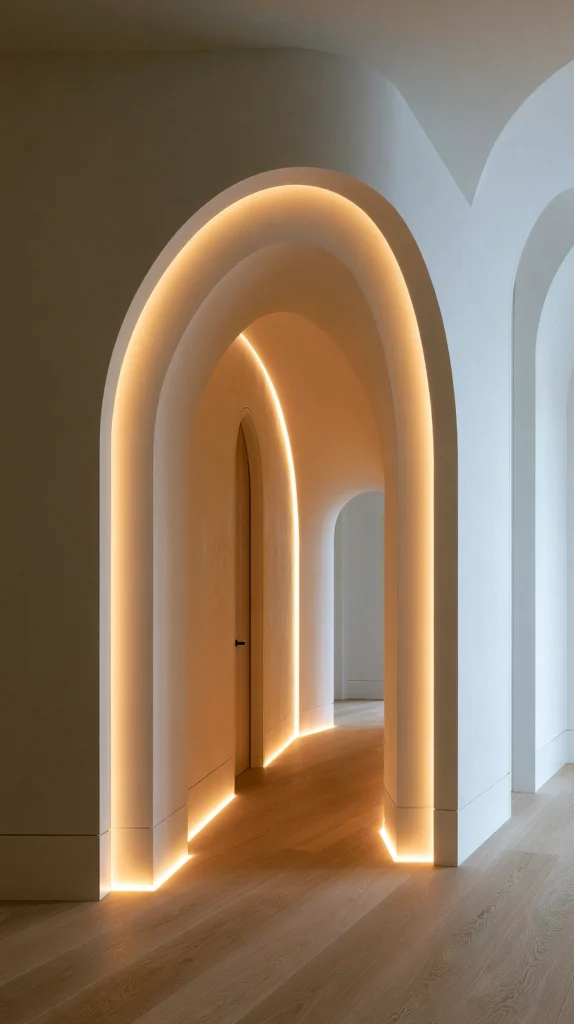
Lighting specifically positioned to highlight an arched doorway or transition point within the hallway, using light to emphasize the architectural detail rather than treating it as incidental.
Why highlighting an architectural detail with light elevates the whole hallway
A hallway with even one architectural detail — an arch, a change in ceiling height, a decorative molding — benefits significantly from lighting that specifically calls attention to it, rather than lighting that treats the whole corridor uniformly and misses the opportunity entirely.
The detail identification
An existing arch, transom, or decorative molding within the hallway, assessed for whether it currently receives any specific lighting attention or is simply lit incidentally by the hallway’s general fixtures.
The lighting technique
A small uplight or wall wash fixture positioned to specifically illuminate the arch’s curve or the molding’s detail, creating shadow and highlight that emphasizes the architectural feature’s form.
The placement
Mounted discreetly, often at floor or low-wall level, angled upward toward the specific detail rather than as a general ambient light source for the broader hallway.
The color temperature
A warm bulb, enhancing rather than starkly exposing the architectural detail, similar to the warm light principle relevant throughout every other technique on this list.
The overall effect
A hallway where its single most interesting architectural feature receives the attention it deserves, rather than blending into the corridor’s overall uniform lighting.
Cost breakdown: Small uplight or wash fixture: $40–90 Total: $40–90
14. The Smart Lighting Motion-Activated System
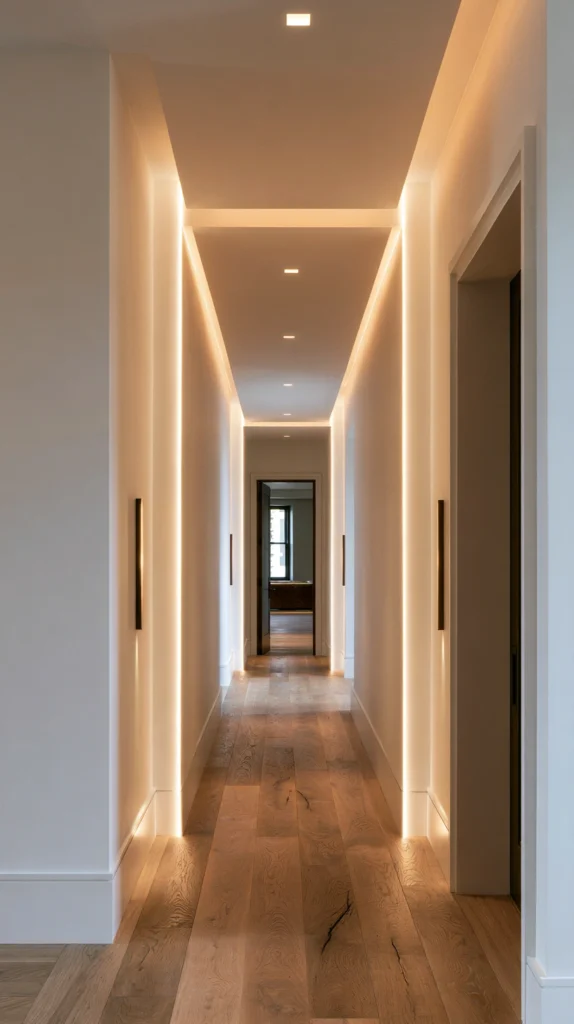
A smart lighting system throughout the hallway, activated by motion sensors and programmed for specific brightness and color temperature depending on the time of day.
Why smart control adds genuine function beyond the purely aesthetic techniques above
A hallway is frequently walked through with hands full, at night without wanting to fumble for a switch, or briefly enough that manually adjusting lighting feels like unnecessary friction. Motion-activated smart lighting removes that friction entirely.
The motion sensors
Small sensors positioned at each end of the hallway, triggering the lighting automatically as someone enters the space, without requiring a manual switch at all.
The smart bulbs
Smart bulbs within the hallway’s existing fixtures, programmed to shift color temperature and brightness automatically based on time of day — brighter and cooler during daytime hours, warmer and dimmer in the evening.
The nighttime setting
A specific low-brightness, warm-toned nighttime setting, activating automatically during late-night hours, providing just enough light for safe passage without a jarring full-brightness activation.
The integration
Connected to a broader smart home system if one exists, allowing the hallway’s lighting behavior to be adjusted or scheduled alongside other home lighting and automation.
The overall effect
A hallway that functions intelligently and automatically, its lighting adapting to actual use patterns and time of day without requiring any manual adjustment from the household.
Cost breakdown: Motion sensors (2): $30–70 Smart bulbs (4–6): $80–200 Total: $110–270
15. The Complete Grand Hallway Lighting Scheme (The Fully Layered Corridor)
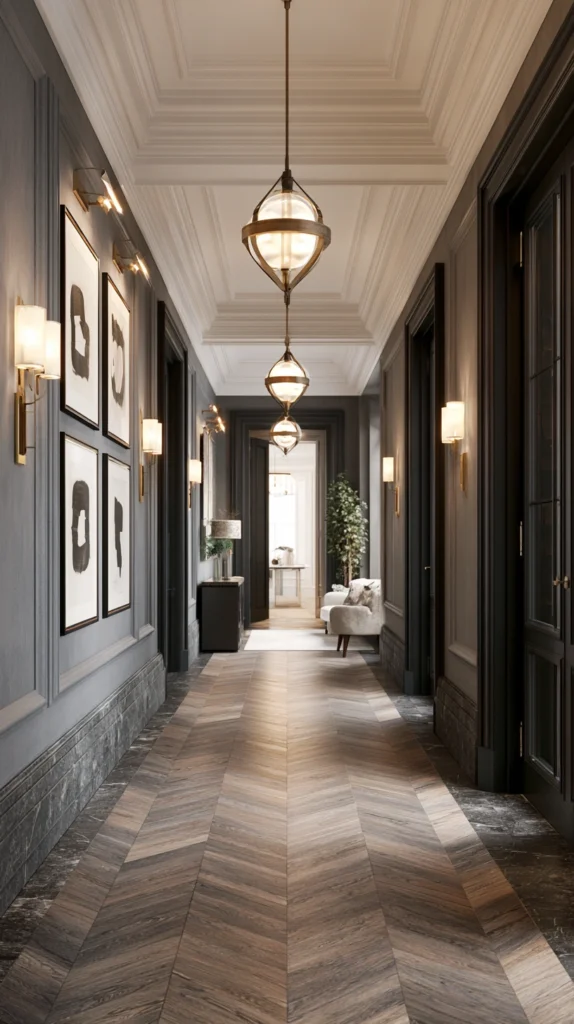
A complete hallway lighting design combining several of the approaches above — wall sconces, picture lighting, an ambient low layer, and a single statement moment — treating the corridor as a genuinely designed space rather than a single fixture’s afterthought.
What separates the complete scheme from a single fixture swap
A single sconce added to an otherwise bare hallway: an improvement. A complete lighting scheme: multiple genuine layers working together — task, ambient, accent, and a focal statement — transforming the entire corridor’s perceived scale and character rather than making one isolated area slightly nicer.
The elements of the complete grand hallway lighting scheme
The primary layer
Wall sconces spaced evenly along the hallway’s length, providing the corridor’s main source of warm, rhythmic light.
The accent layer
Picture lights above a gallery of art or family photographs, doubling as both illumination and display.
The ambient layer
A soft LED strip beneath shelving or along the baseboard, providing a low, warm evening glow independent of the primary sconces.
The statement moment
A single dramatic chandelier or pendant at the hallway’s entry point or a key transition, giving the corridor one genuinely memorable focal point.
The control system
Dimmers or smart controls on every layer, allowing the hallway’s full lighting scheme to adjust from bright daytime function to soft evening ambiance.
The mirror amplification
A mirror or two positioned to reflect the sconces’ light, adding perceived width and brightness beyond what the fixtures alone provide.
The complete design in action
An evening walk down the hallway:
Entry: The statement chandelier glowing softly overhead, immediately signaling this is no ordinary corridor.
Midway: Wall sconces casting warm light along both walls, picture lights illuminating a row of family photographs, a mirror doubling the effect of both.
Along the baseboard: A soft ambient glow, barely noticed consciously but adding real depth to the overall scene.
The far end: The hallway opening into the next room, the whole journey lit with genuine warmth and rhythm rather than a single flat overhead bulb.
The complete grand hallway lighting scheme: not a corridor lit as an afterthought once the real rooms were finished, but a space designed with the same intention as anywhere else in the home, its narrowness no longer the first thing anyone notices about it.
Cost breakdown for the complete scheme: Assuming a starting point of a single bare overhead fixture: Wall sconces: $260–650 Picture lighting and art: $200–500 Ambient LED layer: $45–110 Statement chandelier: $350–1,000 Mirrors: $60–180 Dimmers and smart controls: $110–270 Total: $1,025–2,710
Phased over two or three projects:
Project one: Wall sconces and a dimmer, the foundational layer every other addition builds on
Project two: Picture lighting and a gallery arrangement, or the statement chandelier at the entry
Project three: The ambient LED layer and mirror additions, completing the full layered scheme
The complete grand hallway lighting scheme: not a single fixture upgrade, but a genuinely designed corridor that changes how the whole house feels to walk through.
The Question Before Any Hallway Lighting Decision
Before choosing a single fixture:
What is the primary reason this hallway currently feels narrow or forgettable?
If the answer is: it is lit by one flat, central fixture and nothing else — start with the wall sconce row, the single most transformative change available.
If the answer is: there is a gallery wall or family photos that deserve better light — the picture light display.
If the answer is: the hallway has no natural light at all — the skylight or transom window addition, where structurally possible.
If the answer is: it needs one memorable, grand moment rather than distributed light — the statement chandelier at the entry point.
The design follows what the hallway is specifically missing, more than any single universal fixture choice. Every idea on this list solves a different piece of what makes a narrow corridor feel like an afterthought. The question is which piece matters most in this particular hallway.
The single row of wall sconces replacing one flat overhead fixture: still changes how the entire corridor feels to walk through. The complete lighting scheme, layered with intention: a hallway that reads as genuinely grand, regardless of its actual measured width.
That perceived grandeur: the whole point of taking hallway lighting seriously.
Getting Started This Weekend
The immediate hallway lighting solution:
Turn off the existing overhead fixture and stand in the hallway in the dark.
Notice exactly how flat and single-source the current lighting actually is before changing anything.
Add one warm lamp or plug-in sconce at the hallway’s midpoint.
A low-cost, no-electrical-work test of how a second light source at a different height changes the space’s feeling.
Swap any bright white or cool bulb for a warm one, rated 2700K or below.
The single fastest, cheapest change available, requiring nothing more than a bulb swap.
Hang one mirror to see how it reflects and amplifies whatever light already exists.
The rest of the design: the elaboration of this moment.
The sconce: the beginning. The grand hallway: what gets lit, layer by layer, along its length.