15 Exposed Brick Wall Decor Ideas That Feel Modern, Not Industrial
The exposed brick wall almost got painted over before I found the right way to decorate around it. Not because the brick itself was wrong. Because everything I initially put in front of it — black metal shelving, edison bulbs, distressed leather — pushed the room toward a coffee-shop industrial look I never actually wanted.
The correction.
Because the brick was never the problem. What I surrounded it with was. Once I swapped the black metal for brass, the distressed leather for soft linen, and the exposed bulbs for warm, shaded lamps, the same wall read as elegant rather than industrial, refined rather than raw. The brick: unchanged. Everything else: reconsidered.

Exposed brick is not inherently an industrial material. It reads industrial only when paired with the specific decor language — black metal, raw wood, visible hardware — most commonly used alongside it. Paired instead with soft textiles, warm metals, and considered furniture, the same brick wall reads as elegant, even romantic. The wall: no longer dictating a single aesthetic direction, but a backdrop flexible enough for whatever style actually suits the room.
Here are 15 exposed brick wall decor ideas that feel modern, not industrial — from the simplest lighting swap to the most fully considered room — built on that understanding.
Why Exposed Brick Defaults to Industrial and How to Avoid It
The association problem
Exposed brick became strongly associated with industrial loft conversions in the 1990s and 2000s, and much of the decor advice built around it since has simply repeated that same visual formula — black metal, raw edison bulbs, distressed leather — regardless of what a specific room or household actually wants.
The material contrast principle
Without a considered approach:
Brick paired with more raw, unfinished materials — black metal, raw wood, exposed hardware.
The room: doubling down on an industrial, warehouse feeling, regardless of whether that was the actual goal.
With a considered approach:
Brick paired with softer, warmer, more refined materials — brass, velvet, linen, polished wood.
The room: using the brick’s texture as one element within a considered, elegant palette, rather than the room’s entire defining statement.
The color temperature case
Brick itself carries a warm, reddish undertone. Pairing it with warm metals (brass, gold) and warm-toned furniture generally reads as more cohesive and elegant than pairing it with cool metals (chrome, cool grey) more commonly associated with an industrial look.
The lighting distinction
Bare, exposed bulbs read industrial almost regardless of everything else in the room. Warm, shaded, layered lighting immediately shifts the same brick wall toward a softer, more elegant register, making lighting one of the single highest-impact decisions in this entire decorating direction.
The Five Techniques for a Modern, Non-Industrial Brick Room
Before decorating around any brick wall:
Warm metal pairing
Brass, gold, and aged bronze hardware and fixtures, rather than black or chrome.
The single most effective technique for shifting a brick room’s overall tone.
Low-cost and easy to apply through lighting and hardware alone.
Soft textile layering
Velvet, linen, and wool textiles, offsetting the brick’s hard, rough texture.
Directly counters the industrial association through material contrast.
Applied through upholstery, curtains, and cushions.
Considered, finished furniture
Polished or lightly distressed furniture, rather than raw, reclaimed, or heavily distressed pieces.
Shifts the room’s overall formality upward.
The furniture choice most responsible for a room’s perceived style category.
A painted or limewashed brick option
Brick painted white, cream, or a soft color, retaining texture while removing the raw red-brown industrial association.
A more dramatic but highly effective option.
Suits a household wanting brick’s texture without its typical color association.
Curated, minimal styling
Fewer objects, chosen for quality and coherence, rather than the dense collected-object look common in industrial styling.
Reinforces an elevated, editorial feel over a raw, lived-in warehouse aesthetic.
Works with any of the above techniques.
1. The Brass and Brick Pairing
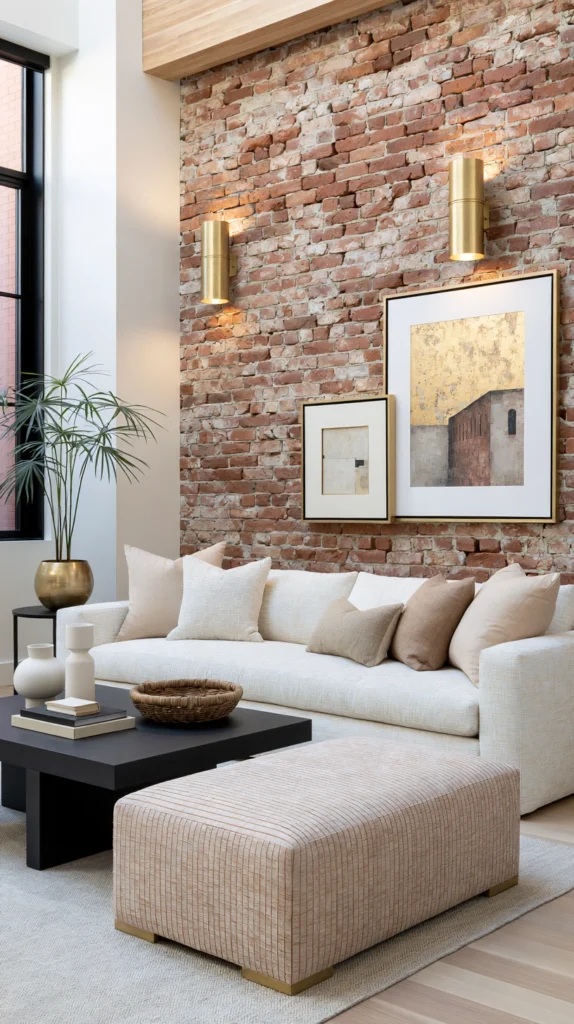
Every metal element in the room — light fixtures, hardware, picture frames — chosen in brass or aged gold, replacing the black metal most commonly paired with exposed brick.
Why brass is the single highest-impact change available
Black metal is the material most responsible for pushing an exposed brick room toward an industrial read. Brass, by contrast, is warm, reflects light softly, and immediately shifts the room’s overall register toward elegant rather than raw.
The lighting fixtures
Brass sconces, a brass chandelier, or brass table lamps, replacing any black metal or exposed-bulb fixtures currently in the room.
The hardware
Cabinet pulls, door handles, and curtain rods in a consistent brass or aged gold finish throughout the space.
The frames
Any art or mirrors framed in brass or gold rather than black or raw wood, extending the warm metal theme to the walls themselves.
The brick relationship
Brass’s warm tone directly complements brick’s own reddish undertone, creating a genuinely harmonious pairing rather than the cooler contrast black metal creates against the same brick.
The overall effect
A room that reads as considered and warm rather than raw and utilitarian, achieved primarily through a single consistent metal choice rather than any change to the brick itself.
Cost breakdown: Brass light fixtures (2–3): $150–400 Brass hardware and frames: $60–150 Total: $210–550
2. The Velvet Upholstery Contrast
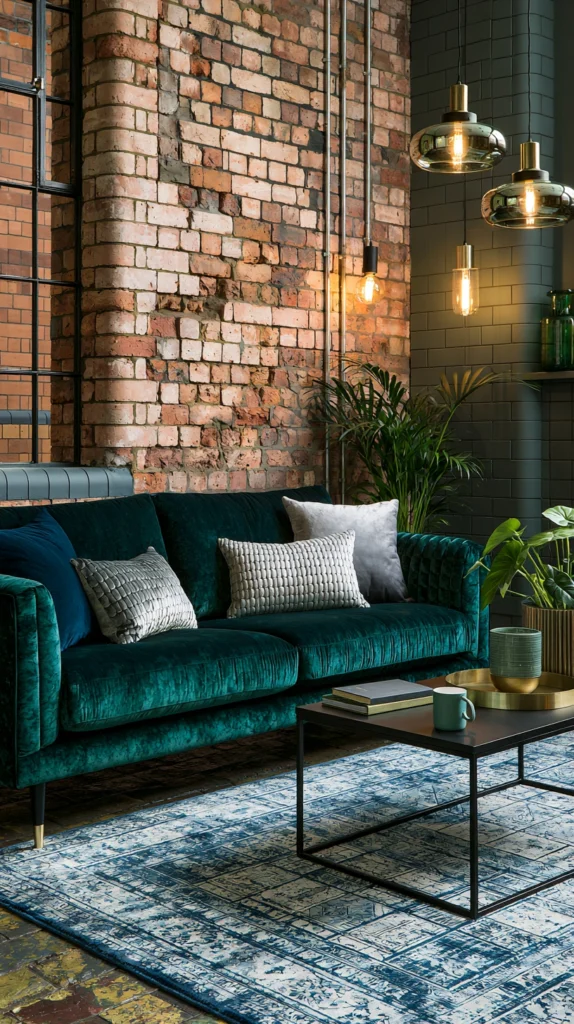
A substantial piece of furniture — a sofa, an armchair, a headboard — upholstered in rich velvet, positioned directly against the brick wall for a deliberate hard-soft material contrast.
Why velvet against brick reads as elevated rather than industrial
Velvet is one of the most luxurious, refined fabric choices available, and its plush texture directly counters brick’s rough, hard surface — the combination reads as a deliberate, considered juxtaposition rather than an accidental clash.
The furniture piece
A velvet sofa, a tufted armchair, or a velvet headboard, in a rich jewel tone — emerald, sapphire, or deep burgundy — positioned to sit directly against or very near the brick.
The color relationship
A deep, saturated velvet color reading as more sophisticated against brick’s warm red-brown tone than a paler or more casual fabric choice would.
The texture juxtaposition
The plush, light-catching velvet directly beside the matte, rough brick creating genuine visual and tactile interest through contrast, rather than the more uniform hard-surface palette an industrial room typically relies on.
The supporting textiles
Additional velvet or silk cushions, and a soft wool throw, extending the plush textile theme beyond the single anchor piece.
The overall effect
A room that reads as a considered, almost eclectic pairing of raw architecture and refined furnishing, rather than a uniformly hard-surfaced industrial space.
Cost breakdown: Velvet sofa or armchair: $400–1,200 Supporting cushions and throw: $60–130 Total: $460–1,330
3. The Limewashed or Painted Brick Treatment
The brick itself painted or limewashed in white, cream, or a soft neutral, retaining the wall’s genuine texture while removing the raw red-brown color most associated with an industrial look.
Why changing the brick’s color changes its entire association
Much of exposed brick’s industrial association comes specifically from its natural warm red-brown color, strongly tied to warehouse and loft conversion imagery. A painted or limewashed brick wall retains all of the material’s genuine texture while shifting its color into a completely different, softer register.
The limewash option
A traditional limewash treatment, applied directly to the brick, allowing some of the underlying brick color and texture to show through a soft, cloudy white or cream finish rather than fully obscuring it.
The full paint option
A more opaque paint finish, fully covering the brick’s natural color while the mortar lines and surface texture remain entirely visible and tactile.
The color selection
Warm white, soft cream, or a pale dove grey, chosen to complement rather than fight with the room’s broader palette, rather than a stark, cool white that could tip the look toward a different, colder aesthetic.
The texture preservation
The brick’s full surface texture — every irregular edge, every mortar line — remaining completely visible and touchable, the treatment changing only the color, not the material’s inherent dimensional quality.
The reversibility consideration
Limewash is generally considered more reversible than a fully opaque paint, worth weighing if there is any future possibility of wanting to expose the brick’s natural color again.
Cost breakdown: Limewash or paint (one wall): $40–90 Application supplies: $20–40 Total: $60–130
4. The Linen and Natural Fiber Layering
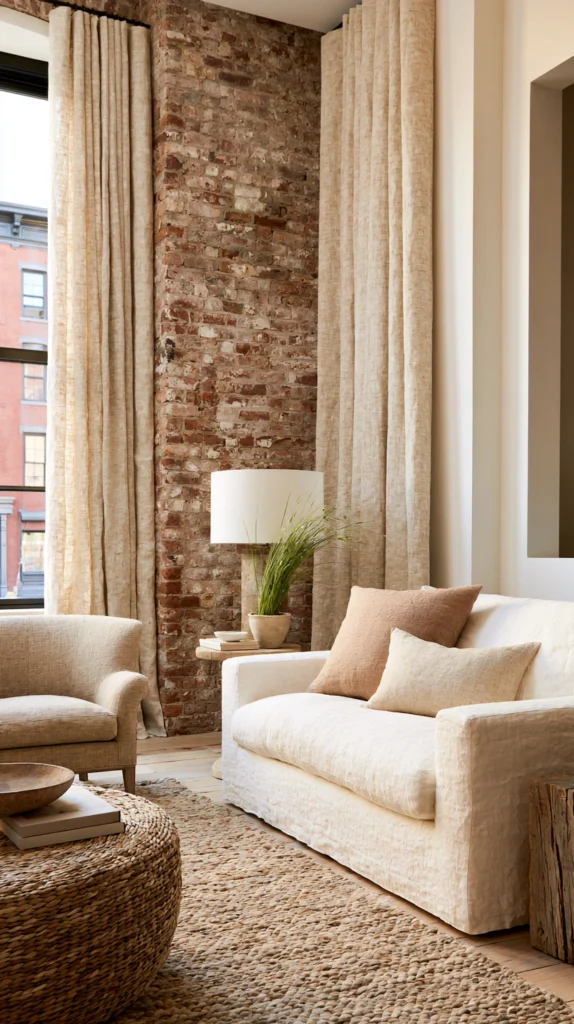
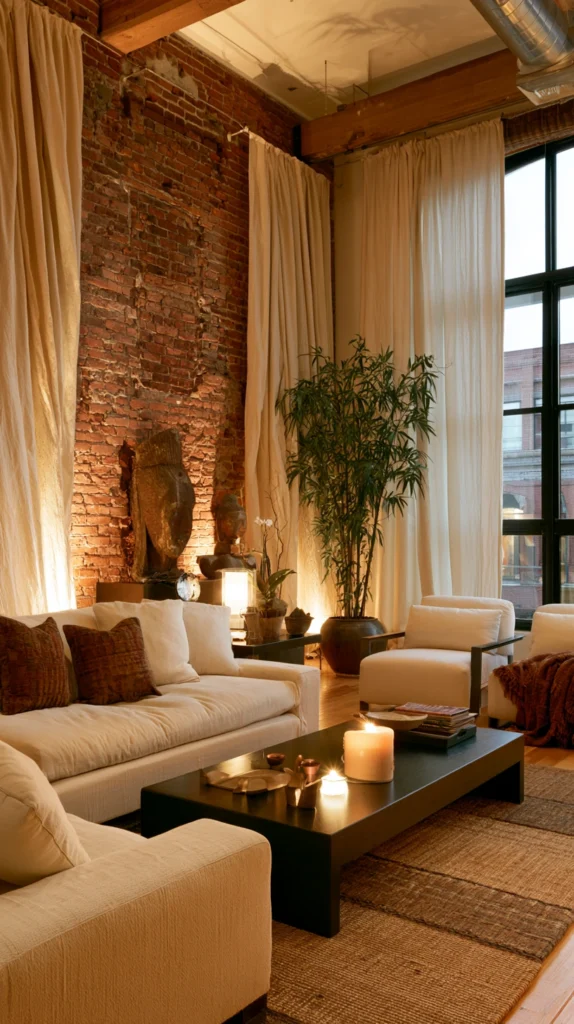
Linen curtains, a jute or wool rug, and natural fiber textiles throughout the room, offsetting brick’s rough texture with a softer, more organic material palette than the leather and raw wood typical of industrial styling.
Why linen and natural fibers suit brick better than leather does
Leather, heavily distressed wood, and raw metal are the textures most commonly paired with brick in an industrial context. Linen and natural woven fibers offer a similarly organic, textural quality while reading as considerably softer and more elegant.
The curtains
Floor-length linen curtains, in a warm neutral tone, softening the room’s overall hard-surface palette and providing genuine fabric volume against the brick’s rigidity.
The rug
A jute, wool, or a similarly natural-fiber rug, grounding the room in another organic texture that complements rather than competes with the brick.
The upholstery
Furniture upholstered in linen or a linen-blend fabric, rather than leather, continuing the softer natural-fiber theme throughout the room’s larger pieces.
The color palette
Warm neutrals — cream, oatmeal, soft taupe — throughout the textile layer, allowing the brick’s own warm tone to anchor the room’s color story rather than introducing a competing cooler palette.
The overall effect
A room that reads as calm, textural, and considered, the brick functioning as one warm, natural material among several others rather than standing in stark, cold contrast to leather and metal.
Cost breakdown: Linen curtains: $60–150 Natural fiber rug: $80–200 Linen upholstery (if reupholstering): $200–500 Total: $340–850
5. The Gallery Wall of Fine Art
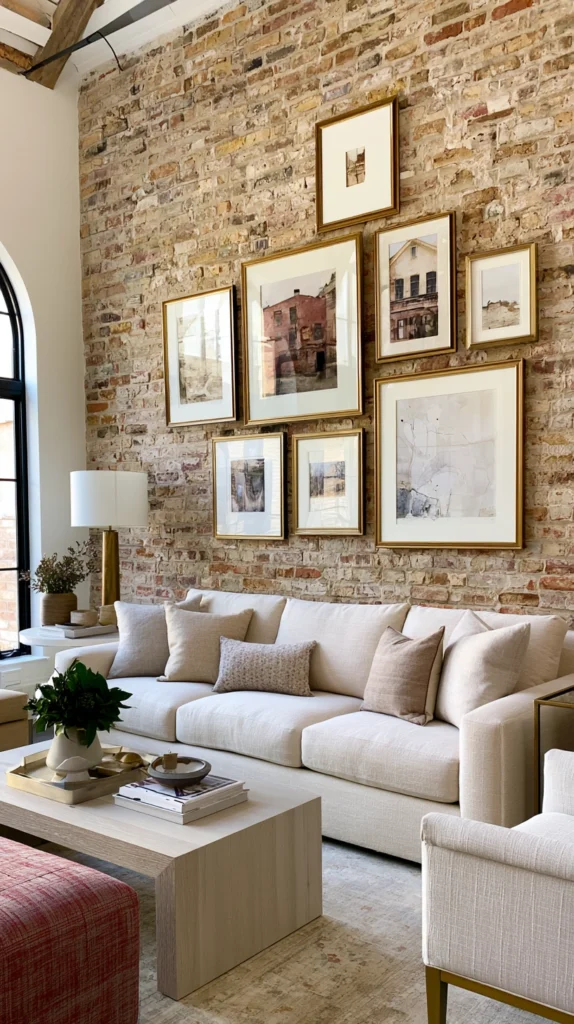
A curated gallery arrangement of fine art — original paintings, high-quality prints, or classical-style pieces — hung directly on the brick, using the wall as a genuine gallery backdrop rather than covering it with industrial-style signage or metal.
Why fine art elevates a brick wall more than typical industrial decor
Industrial-styled brick rooms are frequently decorated with vintage signage, exposed metal shelving, or utilitarian objects. Genuine fine art immediately shifts the association toward a gallery or a considered private collection, regardless of the wall material behind it.
The art selection
Original paintings, high-quality reproductions, or classical and traditional subject matter, chosen with the same curatorial care given to art hung against any other wall material.
The frame choice
Gold, brass, or elegant dark wood frames, avoiding raw or reclaimed wood frames that would reinforce rather than counter the industrial association.
The arrangement
A considered gallery arrangement — evenly spaced, thoughtfully composed — rather than the more haphazard, densely cluttered arrangement typical of industrial-styled decor.
The lighting
Picture lights mounted above key pieces, in brass or a similarly warm finish, both functionally illuminating the art and reinforcing the room’s overall warm metal palette.
The overall effect
A wall that reads as a genuine art display, the brick serving as a textured, neutral backdrop for the art itself rather than the room’s dominant visual statement.
Cost breakdown: Art (original or quality prints, 3–4 pieces): $100–400 Frames: $60–150 Picture lights (2): $60–120 Total: $220–670
6. The Warm, Layered Lighting Overhaul
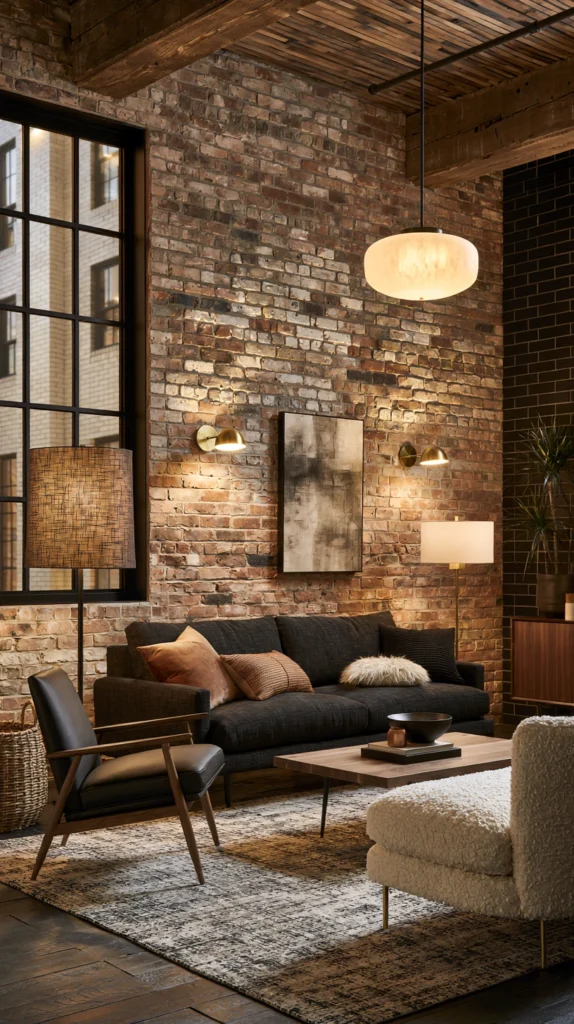
Every light source in the room reconsidered — replacing bare bulbs and track lighting with warm, shaded fixtures at multiple heights, directly countering the harsh, exposed lighting typical of industrial brick rooms.
Why lighting alone can shift a brick room’s entire character
Bare edison bulbs and exposed fixtures are perhaps the single most recognizable signifier of industrial styling, arguably even more so than the brick itself. Replacing them with warm, shaded, layered light sources may be the single most effective change available.
The overhead fixture
A fabric or frosted glass shade, replacing any exposed bulb pendant, softening the light source itself rather than leaving the bulb visible.
The lamps
Table and floor lamps with fabric shades, positioned at multiple points around the room, providing the layered lighting any elegant room depends on regardless of wall material.
The bulb temperature
Warm bulbs, rated 2700K or below, replacing the cooler, starker light typical of exposed industrial fixtures.
The dimmer
A dimmer switch on the primary overhead fixture, allowing the room’s brightness to be adjusted for mood rather than remaining at one fixed, often harsh, industrial-style brightness level.
The overall effect
A room where the brick is illuminated softly and warmly from multiple angles, rather than starkly lit by a single harsh, exposed source — the lighting choice alone shifting the room’s entire emotional register.
Cost breakdown: Shaded overhead fixture: $80–200 Table and floor lamps (2–3): $100–250 Dimmer switch installation: $30–80 Total: $210–530
7. The Antique and Vintage Furniture Mix
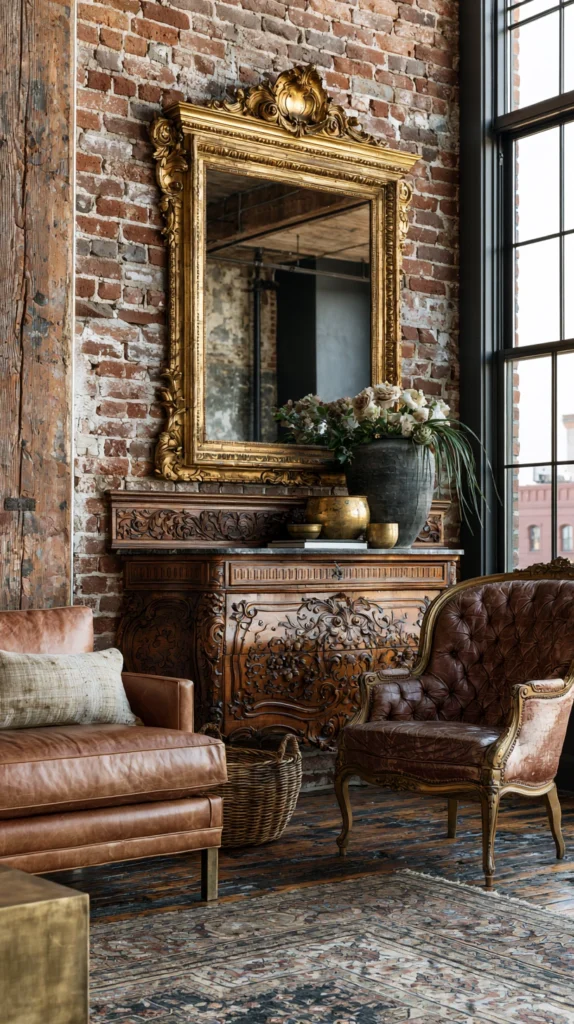
Genuinely antique or vintage furniture — an ornate mirror, a carved wood side table, an upholstered vintage chair — placed against the brick, drawing on a much older design tradition than the industrial aesthetic’s more recent, mid-century-and-later origins.
Why genuine antiques counter the industrial association effectively
Industrial styling typically draws on relatively recent design history — mid-century onward. Genuinely antique furniture references a much older design tradition, immediately shifting the room’s implied timeline and, with it, its overall character.
The furniture selection
A carved wood console, an antique upholstered chair, or an ornate gilt mirror, sourced from an antique shop, estate sale, or inherited from family, rather than a piece specifically manufactured to look industrial or reclaimed.
The placement
Positioned directly against or very near the brick, allowing the deliberate contrast between the wall’s rougher, more utilitarian texture and the furniture’s ornate, refined detailing to read clearly.
The condition
Well-maintained or lightly restored antiques, rather than heavily distressed pieces, since genuine wear on an antique piece reads differently than the deliberately distressed finish common in industrial-style reproduction furniture.
The color and material
Rich wood tones, gilt detailing, and traditional upholstery fabrics, all reinforcing a more classical, elegant register than the raw, unfinished materials typical of industrial decor.
The overall effect
A room that reads as a genuinely eclectic, collected space — old architecture meeting older furniture — rather than a uniformly recent, single-era industrial aesthetic.
Cost breakdown: Antique furniture piece (secondhand): $100–500 Total: $100–500
8. The Curated Minimalist Approach
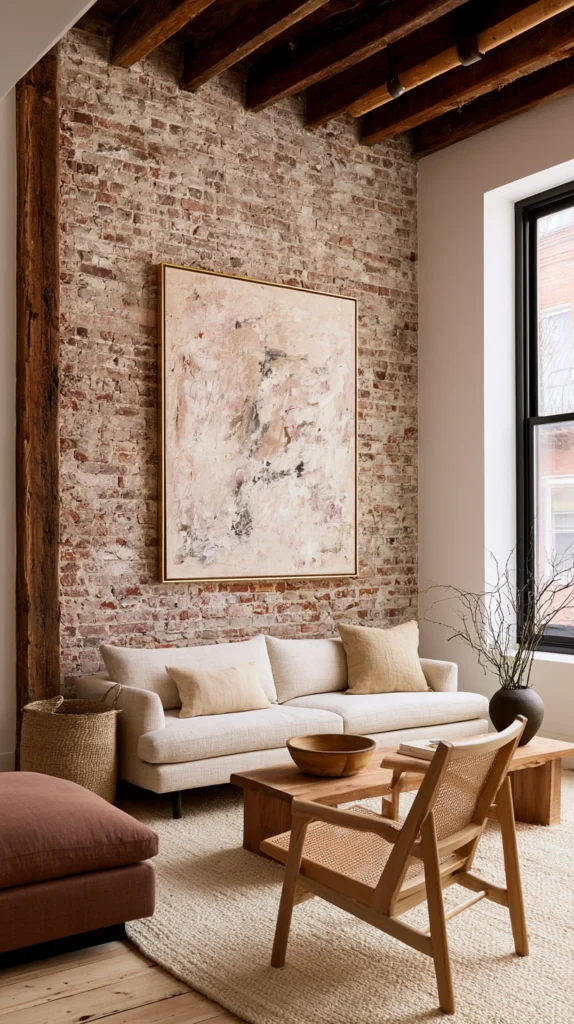
A brick wall left largely bare, or styled with only one or two carefully chosen objects, rather than the dense, cluttered collection of shelving and objects typical of industrial styling.
Why restraint itself is a technique for avoiding the industrial look
Industrial styling frequently relies on visual density — layered shelving, multiple hanging objects, collected ephemera. A minimalist approach, using restraint rather than density, immediately signals a different, more editorial design sensibility.
The wall treatment
The brick left entirely bare on at least one significant section, allowed to be the room’s sole textural statement without competing decoration layered in front of it.
The single object
One substantial piece — a single large artwork, one sculptural object, a single elegant mirror — rather than a gallery wall or shelving system, placed with generous surrounding negative space.
The furniture restraint
Fewer pieces overall, each one chosen for quality and presence rather than filling the room with the dense collected-object furniture arrangement common in industrial interiors.
The color discipline
A tightly controlled, neutral color palette throughout, letting the brick’s own texture and the single styled object carry the room’s visual interest without competing color or pattern.
The overall effect
A room that reads as genuinely considered and editorial, the restraint itself signaling intentionality rather than the accumulated, lived-in density typical of an industrial loft aesthetic.
Cost breakdown: Single statement art or object: $80–300 Total: $80–300
9. The Soft Pastel or Jewel-Tone Palette
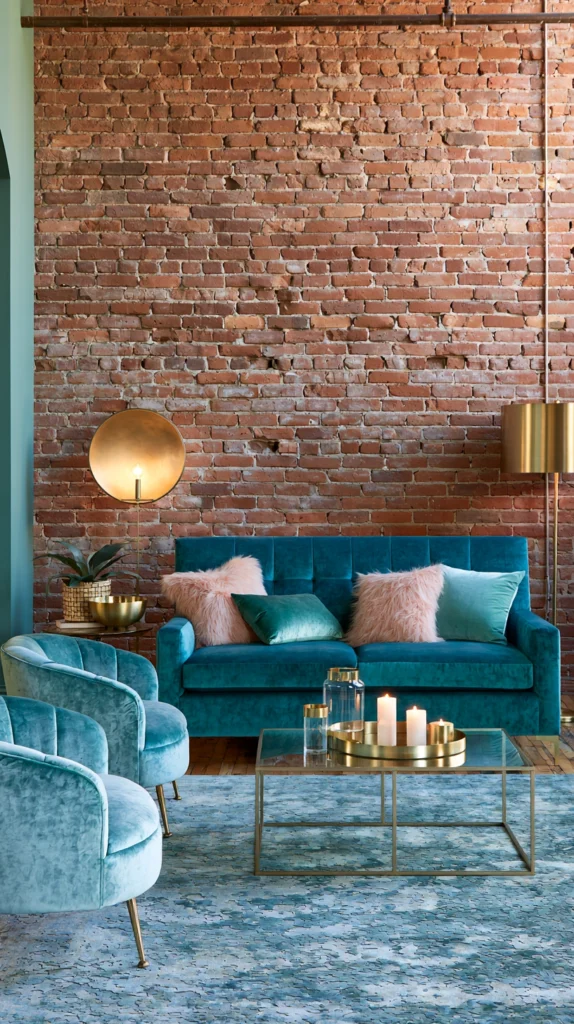
A room’s furniture, textiles, and accents built around a soft pastel or rich jewel-toned color palette, directly countering the muted grey, black, and raw wood palette typical of industrial brick styling.
Why color choice does more work than most people assume against brick
Industrial styling typically relies on a muted, neutral, often monochromatic palette — greys, blacks, and browns. Introducing genuine color, whether soft pastels or rich jewel tones, immediately shifts a brick room away from that specific, recognizable industrial formula.
The pastel option
Soft blush, sage, or powder blue furnishings and textiles, creating a gentle, almost romantic contrast against brick’s warm, rougher texture.
The jewel-tone option
Emerald, sapphire, or amethyst upholstery and accents, providing a richer, more dramatic counterpoint to the same brick backdrop.
The brick relationship
Both pastel and jewel-tone palettes create genuine color contrast against brick’s warm, muted red-brown, a relationship the typical grey-and-black industrial palette specifically avoids.
The application
Color introduced through major upholstery pieces, curtains, and a rug, rather than a full wall repaint, allowing the brick to remain the room’s neutral textural backdrop while the furnishings carry the color.
The overall effect
A room that reads as considerably more feminine, romantic, or richly elegant depending on the specific palette chosen, a significant departure from industrial styling’s typically muted, masculine-leaning color story.
Cost breakdown: Colored upholstery and textiles: $200–600 Total: $200–600
10. The Polished Stone and Marble Accent
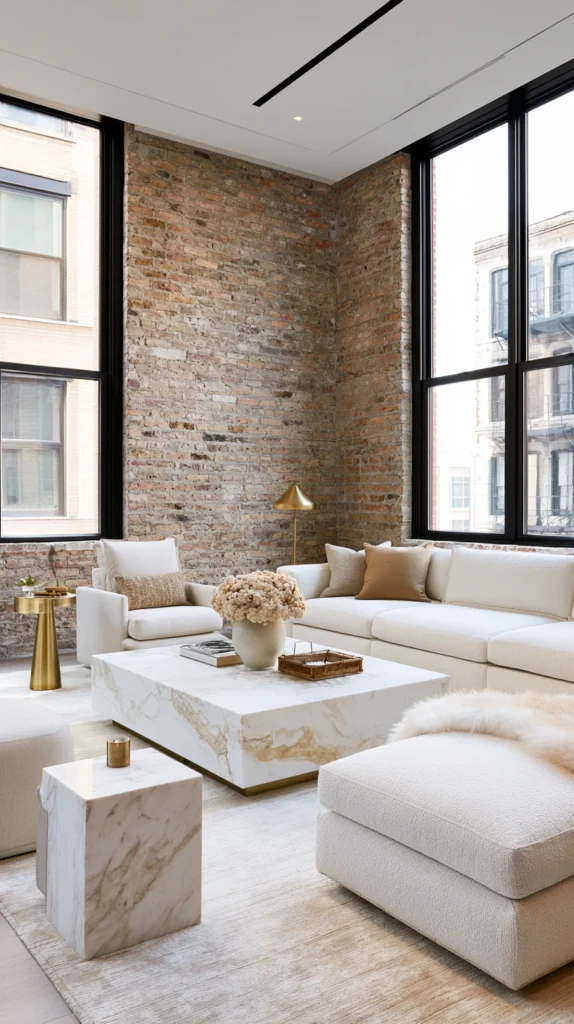
A marble side table, a stone-topped console, or marble accessories introduced into the room, pairing brick’s rougher texture with a smooth, cool, luxurious counterpoint.
Why marble against brick reads as elevated rather than mismatched
Marble’s smooth, cool, reflective surface directly contrasts brick’s rough, warm, matte texture, and this specific kind of material tension — one hard surface against another, but with opposite textural qualities — reads as a sophisticated design choice rather than a clash.
The furniture piece
A marble-topped console table, a small marble side table, or a marble coffee table, positioned against or near the brick wall.
The accessories
Smaller marble objects — a tray, bookends, a small vase — layered onto shelving or a console for additional textural contrast at a smaller scale.
The color pairing
White or grey-veined marble against brick’s warm red-brown tone, creating clear visual contrast, or a warmer-toned marble (such as a honey-hued variety) for a more subtly blended palette.
The metal coordination
Brass or gold hardware on any marble furniture piece, continuing the warm metal theme established elsewhere in the room and tying the marble back into the same elevated palette.
The overall effect
A pairing that reads as genuinely luxurious, the cool smoothness of marble providing a compelling counterpoint to brick’s warm roughness rather than either material dominating the room alone.
Cost breakdown: Marble console or side table: $150–500 Marble accessories: $30–80 Total: $180–580
11. The Botanical and Greenery Layering
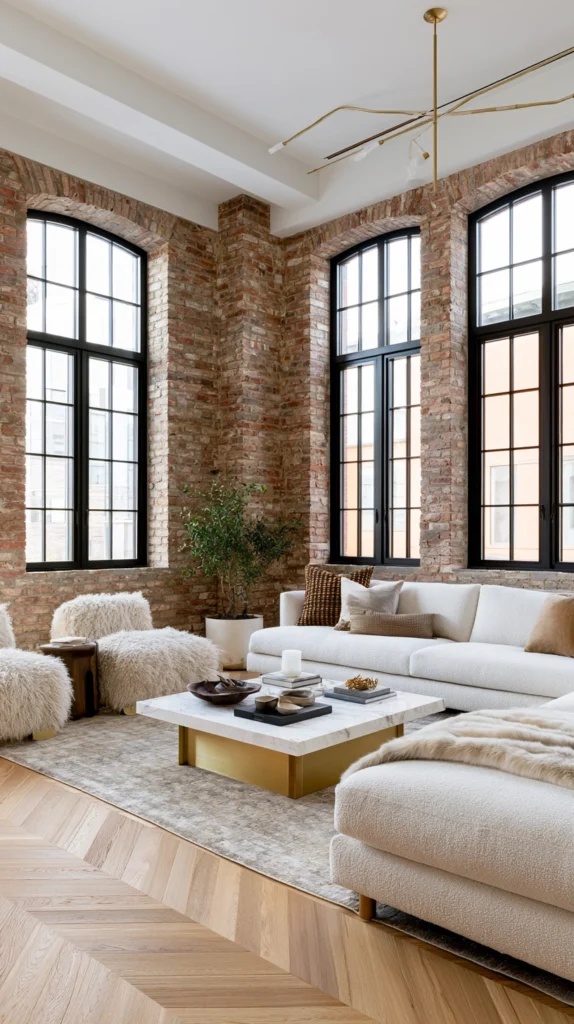
Substantial live plants — a large fiddle-leaf fig, trailing pothos, or a grouping of smaller plants — placed against the brick, softening its hard edges with genuine living texture.
Why greenery is one of the most reliable ways to soften any hard-surfaced room
Living plants introduce organic, irregular shapes and genuine softness that no hard material, however elegant, can replicate, directly countering the harder, more rigid overall feeling brick alone can create.
The plant selection
Large floor plants — fiddle-leaf fig, bird of paradise, or a substantial palm — providing real scale and presence against the brick’s own significant visual weight.
The trailing accents
Pothos or ivy in hanging planters or on high shelving, allowing greenery to cascade downward against the brick’s texture for additional softening.
The planter choice
Ceramic, brass, or woven planters, avoiding the plain plastic nursery pots that would undercut the room’s otherwise elevated material choices.
The placement density
Enough plants to genuinely soften the room’s overall hard-surface ratio, rather than a single token plant that reads as an afterthought against a large expanse of brick.
The overall effect
A room that feels alive and organic despite its architectural hard surfaces, the greenery providing a living, ever-changing counterpoint to the brick’s static texture.
Cost breakdown: Large floor plants (2): $60–150 Trailing plants and hanging planters: $30–70 Ceramic or brass planters: $40–100 Total: $130–320
12. The Herringbone or Patterned Wood Floor Pairing
A herringbone or chevron-patterned wood floor installed or highlighted in the same room as the exposed brick, introducing a second, more refined pattern and texture that elevates the overall material palette.
Why floor pattern matters as much as wall treatment in shifting a room’s register
Industrial-styled rooms frequently pair brick with plain, utilitarian concrete or simple plank flooring. A more elaborate, patterned wood floor introduces a level of craft and formality that immediately shifts the room’s overall association.
The flooring pattern
A herringbone or chevron parquet pattern, in a warm or medium wood tone, providing genuine visual complexity underfoot.
The wood tone relationship
A wood tone that complements brick’s own warm undertone, maintaining the same undertone-matching principle relevant to any mixed-material room.
The existing floor option
If replacing the full floor is not practical, a large area rug printed or woven with a similar herringbone pattern can suggest the same effect at a fraction of the cost and effort.
The furniture relationship
Furniture legs and finishes chosen to complement both the floor’s wood tone and the brick’s warm color, tying the whole room’s material palette together.
The overall effect
A floor with genuine pattern and craft reads as considerably more formal and considered than a plain industrial floor, shifting the entire room’s register even before any furniture or styling decision is made.
Cost breakdown: Herringbone wood flooring (full room): $2,000–6,000 Or a herringbone-pattern area rug: $150–400 Total: $150–6,000 depending on approach
13. The Sheer and Layered Curtain Treatment
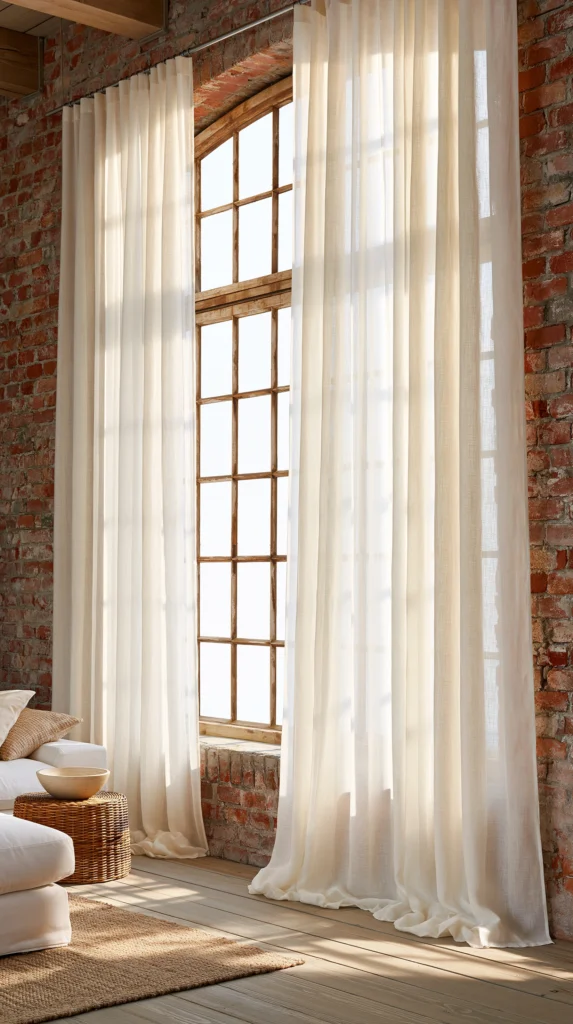
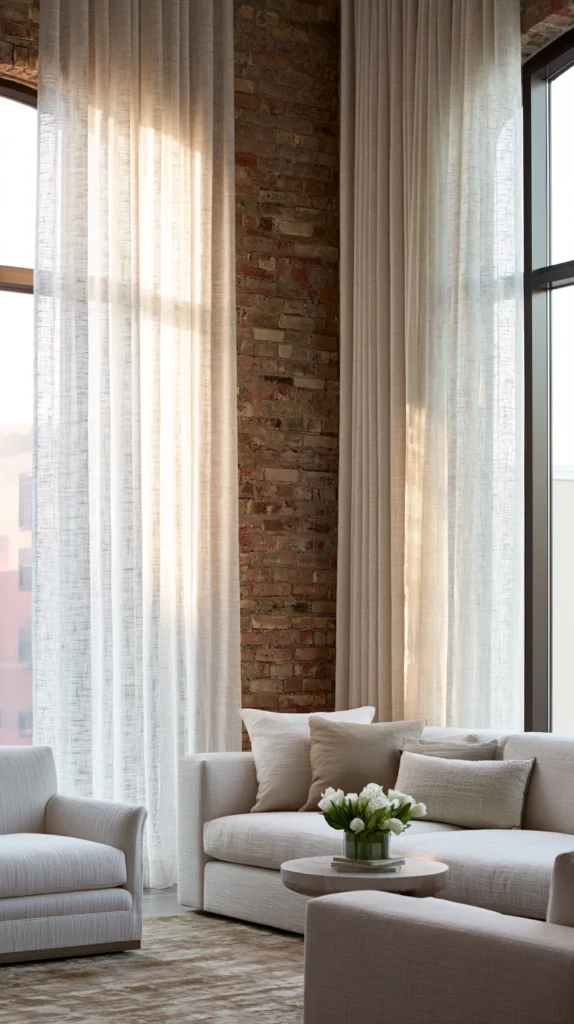
Floor-length sheer curtains layered with a heavier drape, softening the light entering the room and adding genuine fabric volume against the brick’s rigid texture.
Why curtain treatment matters more in a brick room than a typical drywall room
Brick’s hard, unyielding surface benefits disproportionately from a genuinely soft counterpoint elsewhere in the room, and windows — often left bare or minimally covered in industrial styling — are an underused opportunity for that softness.
The sheer layer
A lightweight sheer curtain, filtering and softening natural light as it enters the room, adding a first layer of gentle fabric texture.
The heavier layer
A heavier drape in linen or a soft velvet, layered behind or in front of the sheer, providing both genuine light control and additional fabric volume.
The hanging height
Hung from ceiling height rather than just above the window frame, maximizing the fabric’s visual presence and softening effect relative to the brick’s hard vertical lines.
The color coordination
Warm neutrals or a color drawn from elsewhere in the room’s palette, avoiding stark white which can read as clinical against brick’s warmer tone.
The overall effect
Windows that contribute genuine softness and light-filtering warmth to the room, addressing an often-overlooked opportunity in a typical brick-walled industrial space where windows are frequently left bare.
Cost breakdown: Sheer curtains: $30–70 Heavier drape layer: $60–150 Curtain rod: $25–50 Total: $115–270
14. The Warm Wood Built-In Shelving
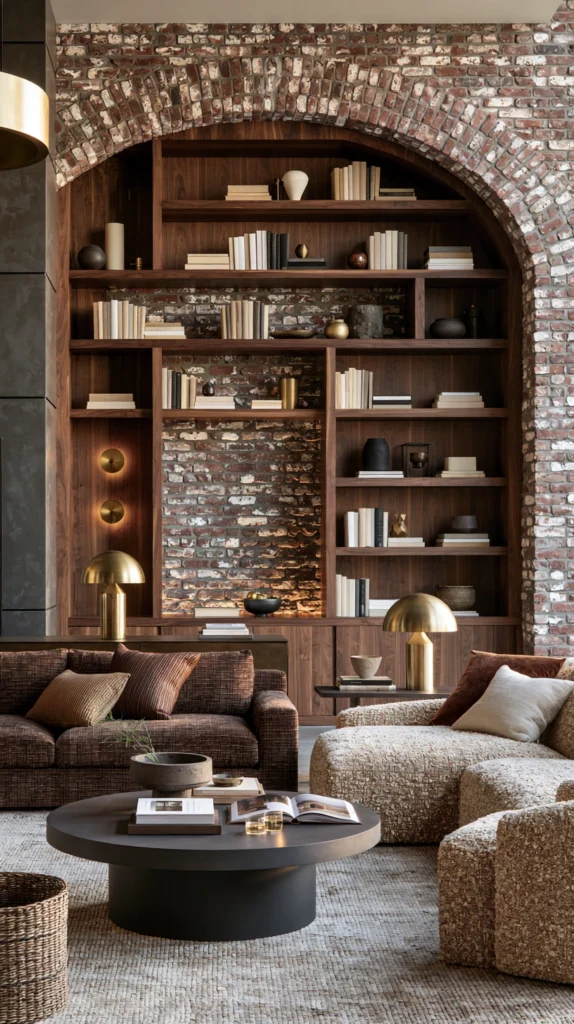
Custom built-in shelving in a warm, finished wood — rather than raw reclaimed lumber or black metal — installed against or beside the brick, providing storage and display in a material that elevates rather than reinforces the industrial association.
Why finished wood shelving reads differently than raw or metal shelving
Open metal shelving, often black and deliberately utilitarian-looking, is one of the most common decor choices paired with exposed brick and one of the most responsible for its industrial association. Finished, built-in wood shelving shifts the same functional need into a considerably more elegant register.
The wood finish
A rich walnut or a warm stained oak, finished smoothly rather than left raw or distressed, providing genuine craftsmanship and polish.
The construction
Custom-built or carefully selected freestanding units, with clean lines and quality joinery, rather than the exposed pipe-and-plank shelving typical of industrial styling.
The styling
Curated objects — books, ceramics, a few carefully chosen decorative pieces — arranged with the same restraint and intention given to any elegantly styled shelving, rather than densely packed utilitarian storage.
The hardware
Any visible hardware in brass or a similarly warm finish, continuing the room’s overall warm metal theme.
The overall effect
Functional storage that reads as a genuine piece of furniture and craftsmanship, rather than the exposed, utilitarian shelving that typically reinforces a brick room’s industrial character.
Cost breakdown: Custom or quality freestanding wood shelving: $400–1,200 Styling objects: $40–100 Total: $440–1,300
15. The Complete Elegant Brick Room (The Fully Realized Non-Industrial Space)
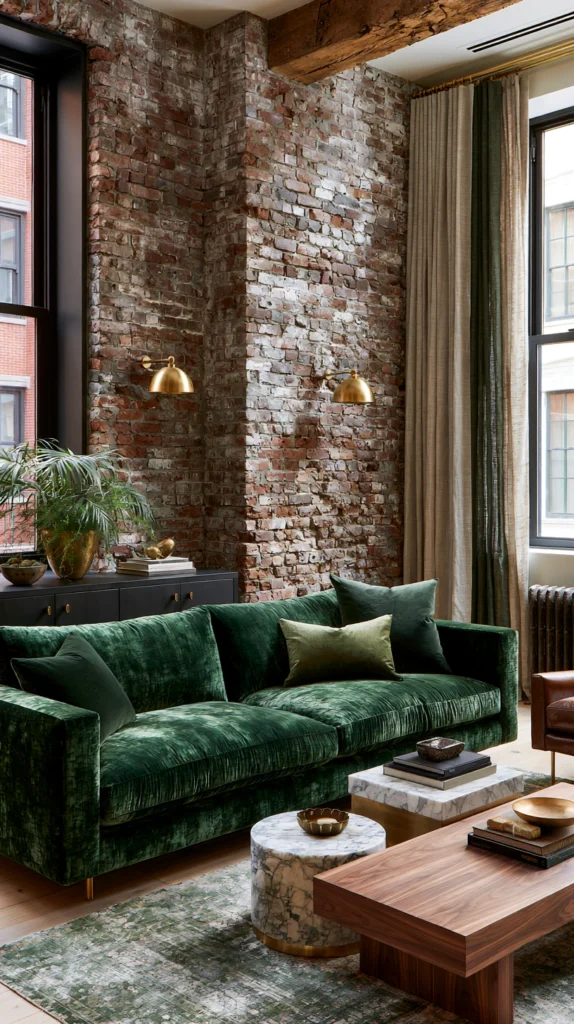
A complete room combining several of the approaches above — warm metals, soft textiles, considered furniture, and layered lighting — treating the brick as one warm, textural element within a genuinely elegant, cohesive room rather than the space’s sole defining, industrial-leaning feature.
What separates the complete elegant brick room from a single technique applied in isolation
A single brass lamp in an otherwise industrial room: a small improvement. A complete elegant brick room: every material decision — metal, textile, furniture, lighting, and color — working together to place the brick within a genuinely different, more refined design language entirely.
The elements of the complete elegant brick room
The metal palette
Brass or aged gold consistently across every fixture, hardware piece, and frame in the room.
The textile layer
Velvet or linen upholstery, layered curtains, and a natural fiber or patterned rug, softening the brick’s texture throughout.
The furniture
Antique, vintage, or well-finished contemporary furniture, avoiding raw, reclaimed, or heavily distressed pieces.
The lighting
Warm, layered, shaded fixtures at multiple heights, replacing any bare bulbs or harsh overhead lighting.
The color
A considered palette — whether soft pastels, rich jewel tones, or warm neutrals — rather than the muted grey-and-black typical of industrial styling.
The styling restraint
Fewer, better objects, curated with intention rather than densely layered for a lived-in warehouse effect.
The complete design in action
A living room built on this principle:
The brick wall: Left in its natural warm tone, or softly limewashed, serving as the room’s textural backdrop.
The seating: A velvet sofa in deep emerald, paired with an antique carved side table.
The lighting: Brass sconces flanking the brick, a shaded floor lamp in the corner, every bulb warm and soft.
The finishing layer: A single substantial piece of art in a gold frame, a marble side table, and a large trailing plant softening one corner.
The complete elegant brick room: not a warehouse conversion softened around the edges, but a genuinely elegant room that happens to have a textured brick wall, rather than a room defined entirely by it.
Cost breakdown for the complete room: Assuming a starting point of a plain industrial-styled brick room: Brass lighting and hardware: $210–530 Velvet or linen furniture: $460–1,330 Curtains and rug: $255–620 Art and marble accents: $280–950 Plants: $130–320 Total: $1,335–3,750
Phased over two or three seasons:
Season one ($400–900): The lighting overhaul Brass hardware swap A single velvet or linen upholstered piece
Season two ($400–1,200): Curtains and rug Art and framing Plants
Season three ($300–1,600): An antique or vintage furniture addition Marble accents Built-in shelving if the room calls for additional storage
The complete elegant brick room: not a renovation of the brick itself, but a complete reconsideration of everything placed around it.
The Question Before Any Brick Wall Decorating Decision
Before choosing a single object, fixture, or piece of furniture:
What is the primary quality currently pushing this room toward an industrial look?
If the answer is: the lighting is harsh, bare, or exposed — start with the warm, layered lighting overhaul, likely the single highest-impact change available.
If the answer is: every metal finish in the room is black or chrome — the brass and brick pairing.
If the answer is: the furniture is raw, distressed, or heavily reclaimed-looking — the velvet upholstery contrast or the antique furniture mix.
If the answer is: the brick’s color itself feels too raw or warehouse-like — the limewashed or painted brick treatment.
The design follows what is specifically pushing the room toward an industrial read, more than any single universal fix. Every idea on this list counters a different piece of that association. The question is which specific element is doing the most work to keep this particular room feeling industrial rather than elegant.
The single brass lamp swap in an otherwise unchanged room: still shifts the space’s overall feeling meaningfully. The complete room, reconsidered across metal, textile, furniture, and light: a genuinely elegant space that simply happens to have a textured brick wall.
That reconsideration: the whole point of decorating around brick rather than letting it dictate the room’s entire direction.
Getting Started This Weekend
The immediate elegant brick room solution:
Swap one black metal fixture for a brass one.
The single fastest, lowest-cost change most responsible for shifting the room’s overall tone.
Add one substantial soft textile element — a velvet cushion, a linen throw.
Immediate, visible material contrast against the brick’s hard texture.
Replace any bare or exposed bulb with a warm, shaded fixture.
The second-highest-impact lighting change, addressing the specific detail most associated with an industrial look.
Bring in one large plant to soften a corner of the room.
The rest of the design: the elaboration of this moment.
The swap: the beginning. The elegant brick room: what gets built, warmly, around it.