14 DIY Backyard Waterfall Ideas You Can Build on a Budget
There is a particular satisfaction that belongs specifically to a water feature built by hand. Not the satisfaction of a purchase arrived and assembled, but the deeper and more specific pleasure of sitting beside something that moves and sounds and catches light and knowing, with complete certainty, that it exists because you decided it should and then made it happen.
A DIY backyard waterfall is one of the most genuinely rewarding weekend projects available to any homeowner — not because it is easy, but because the difficulty is appropriately scaled to the reward, and the reward is the sound of water in a garden that had none before.
None of the fourteen ideas below require specialist skills beyond what a competent weekend builder already possesses. They all require patience, a willingness to do the job correctly rather than quickly, and the understanding that a water feature built well on a modest budget is indistinguishable in its quality of atmosphere from one built expensively by a professional. The water does not know who installed the pump. It falls the same way regardless.
The fourteen ideas below cover every scale and every skill level, with honest material costs and practical building advice for each.
1. The Stacked Stone Pot Fountain
Budget: $50 – $150
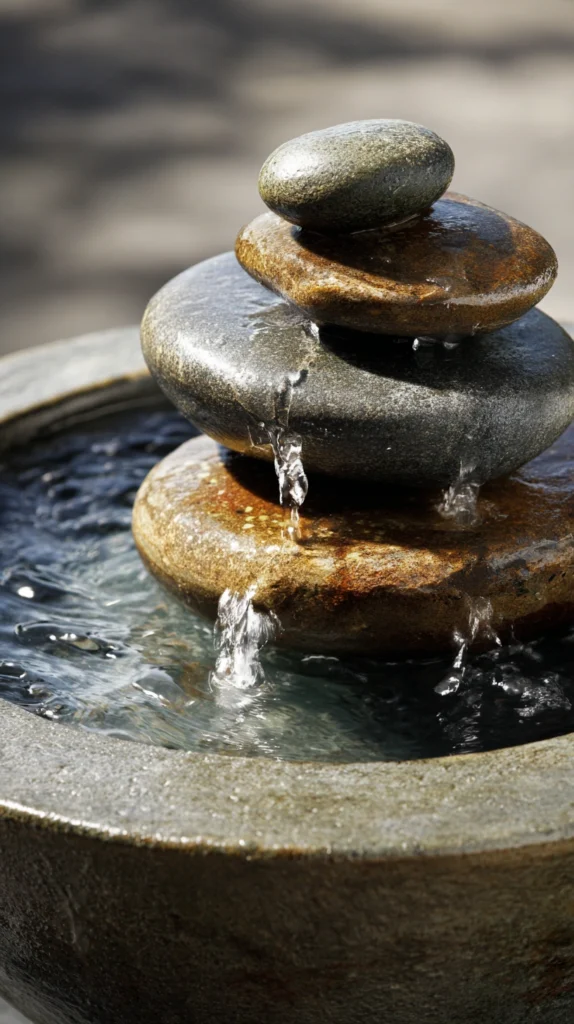
A stacked stone pot fountain — a large drilled terracotta or ceramic pot on a raised base, with a submersible pump inside and smooth river stones filling the pot to just below the rim — produces a bubble fountain that wells gently from the stone surface and disappears into the pot’s interior before being recirculated. It requires no excavation, no liner, and no concrete. It requires a drill, a pump, and an afternoon.
A large terracotta or ceramic pot with a drainage hole — $20 – $50. A small submersible fountain pump — $20 – $40. Smooth river stones — $10 – $25 per bag. Clear flexible pipe from pump to surface — $5 – $10. A plastic mesh disc to hold the stones above the pump — $3 – $8. Total material cost: $58 – $133 for a self-contained bubbling fountain.
Building tip: Thread the pump’s electrical cable out through the pot’s existing drainage hole before placing the pump inside — so that the cable exits through the base rather than over the rim. A cable exiting over the rim of the pot is visible and looks unfinished. A cable exiting through the drainage hole is completely concealed by the surrounding garden or paving, producing a fountain that appears to operate without any visible electrical connection.
2. The Pallet Wood Waterfall Wall
Budget: $30 – $120
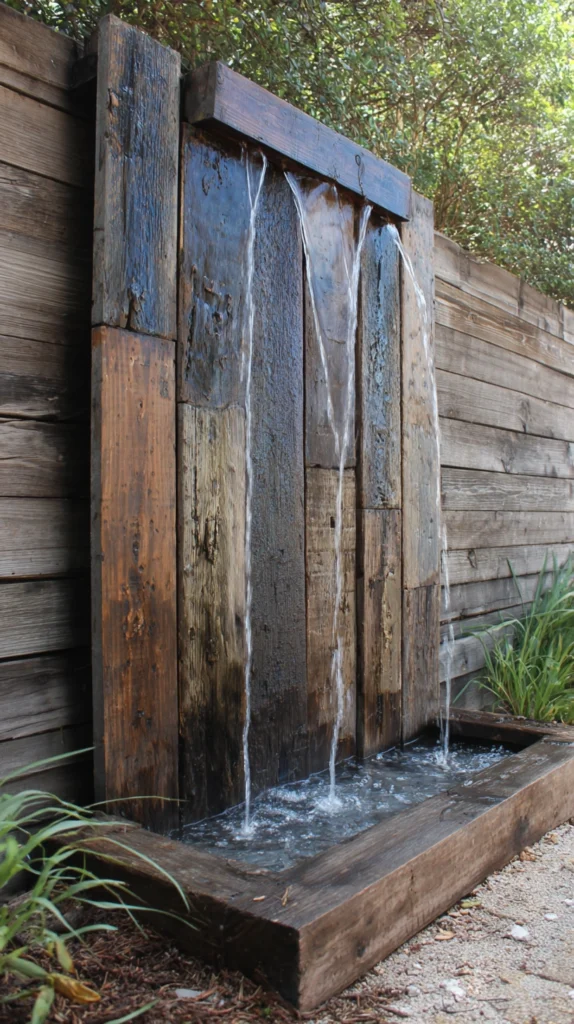
A waterfall wall built from reclaimed timber pallets — stacked vertically against a fence or a wall, with a small pump at the base delivering water to the top of the stack through a pipe running behind the pallets, the water flowing down through the timber’s natural gaps and channels into a collection trough at the base — is the most specifically DIY-spirit water feature on this list and the one with the highest reclaimed material content and the lowest material cost.
Reclaimed timber pallets — free if sourced from local businesses, garden centres, or online community platforms. A small submersible pump — $20 – $40. Clear flexible pipe — $5 – $10. A collection trough at the base — a length of timber framing lined with pond liner or a recycled plastic container — $10 – $30. Waterproof wood sealant for the pallets — $10 – $25. Total material cost: $45 – $105 for a reclaimed waterfall wall.
Building tip: Seal all timber pallet surfaces with two coats of a water-resistant exterior wood sealant before assembling the waterfall — paying particular attention to the cut ends of the timber, which absorb moisture most rapidly. Unsealed pallet timber in contact with water deteriorates within one season. Correctly sealed timber lasts four to five seasons before requiring resealing — making the upfront sealing investment the single most important step in extending the feature’s useful life.
3. The Liner Pond and Rock Cascade
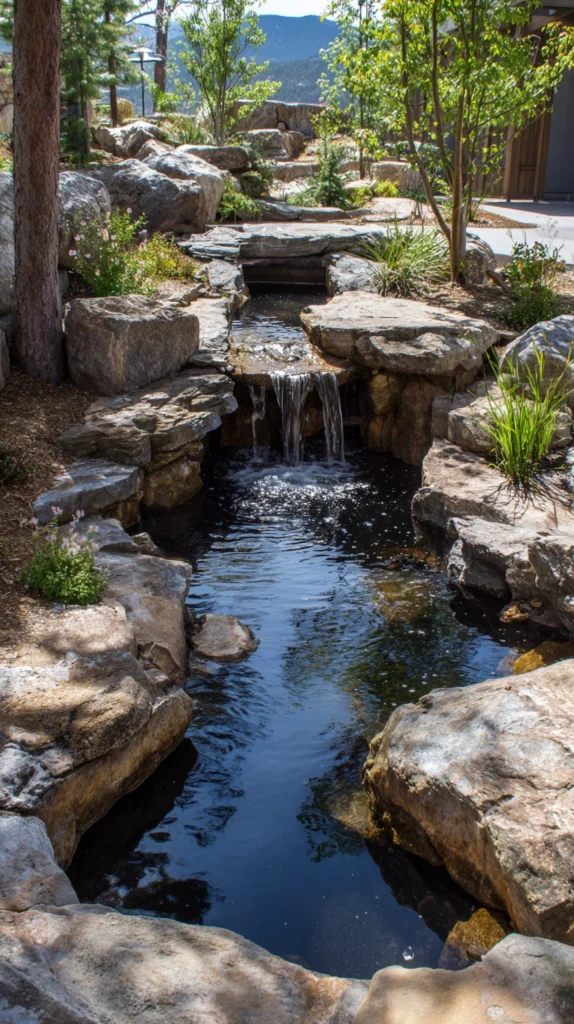
Budget: $150 – $500
A liner pond and rock cascade — a flexible pond liner installed in a shallow excavation, surrounded by natural rocks and stones arranged at the pond edge and at a slight elevation at one end to form a small cascade, with a submersible pump delivering water from the pond to the top of the rock arrangement — is the most classically satisfying DIY backyard waterfall project and the one that produces the most convincingly naturalistic result at an accessible budget.
A flexible rubber pond liner in a standard small pond size — $30 – $80. Underlay to protect the liner beneath — $15 – $30. A submersible pump with sufficient lift for the cascade height — $30 – $80. Natural rocks and flat stones — $50 – $150 from a local landscape supplier. Marginal aquatic plants for the pond edge — $8 – $20 each, five to eight plants. Total material cost: $133 – $360 for a naturalistic pond and cascade.
Building tip: Excavate the pond five centimetres deeper than the intended finished water depth on all sides to allow for the underlay, the liner, and a layer of sand beneath the liner — the sand layer protecting the liner from sharp stones in the subsoil. A liner installed on unprotected subsoil punctures at sharp stone contact points within the first season. A liner installed on a sand and underlay base lasts twenty or more years without puncturing under normal garden conditions.
4. The Bamboo Spout DIY Build
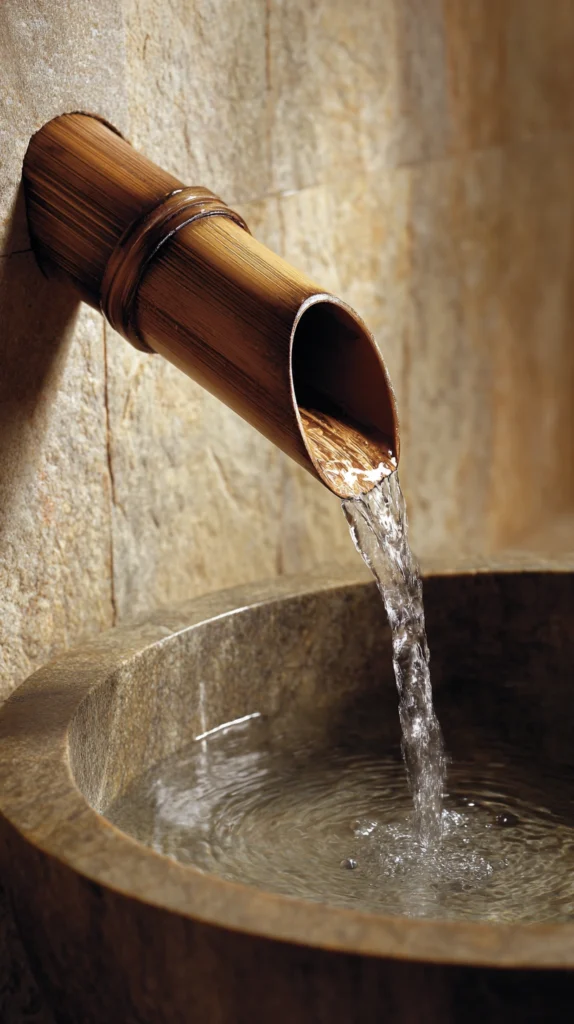
Budget: $30 – $100
A bamboo spout waterfall — a length of natural bamboo cane mounted at an angle above a stone basin, water delivered through the bamboo from a pump hidden in the basin below — is the most achievable and the most specifically elegant DIY water feature build available. The materials cost almost nothing, the assembly takes an afternoon, and the result is a water feature of genuine character that improves in appearance as the bamboo develops its outdoor patina.
A length of bamboo — $5 – $15 from a garden supplier or cut from an existing garden bamboo. A copper pipe insert to carry water through the bamboo — $5 – $15. A stone or ceramic basin — $20 – $60. A small submersible pump — $20 – $40. Clear flexible pipe from pump to bamboo inlet — $5 – $15. Mounting brackets or forked sticks to hold the bamboo at the correct angle — $0 – $10. Total material cost: $55 – $155 for a build of genuine Japanese garden character.
Building tip: Cut the bamboo at a 45-degree angle at the delivery end rather than straight across — so that the water exits at a downward angle and falls in a clean, directed arc rather than dribbling down the bamboo’s outer surface. The angled cut is the single most important detail in the bamboo spout’s construction and costs nothing beyond the attention to make it correctly.
5. The Concrete Block Raised Trough Waterfall
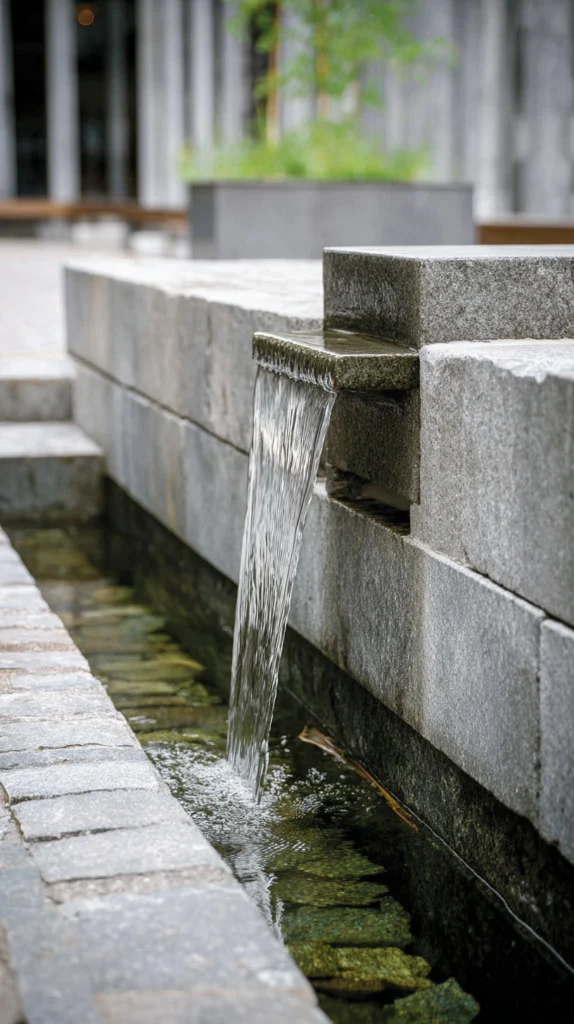
Budget: $100 – $400
A raised trough waterfall — a narrow, rectangular trough built from concrete blocks and rendered smooth on the exterior, elevated 40 centimetres above the surrounding paving, its water overflowing one edge into a narrow catch channel below — is a DIY build that produces a professional and architectural-quality result from materials available at any builders’ merchant for under £200.
Concrete blocks — $20 – $60 for a standard small trough. Sand and cement render — $15 – $30. Waterproof render additive — $8 – $20. A catch channel — rendered concrete block or a recycled plastic gutter — $10 – $30. A submersible pump — $30 – $80. Flexible pipe — $5 – $10. Total material cost: $88 – $230 for a rendered concrete trough of genuine architectural quality.
Building tip: Apply two coats of a bituminous waterproofing paint to the interior of the rendered trough before filling with water — even if the render has been mixed with a waterproof additive. Render alone is porous enough to allow slow seepage through the block and render construction over time. A bituminous interior coat applied after rendering produces a completely watertight interior and prevents the gradual water loss that renders the pump ineffective within a season of installation.
6. The Millstone Fountain DIY Build
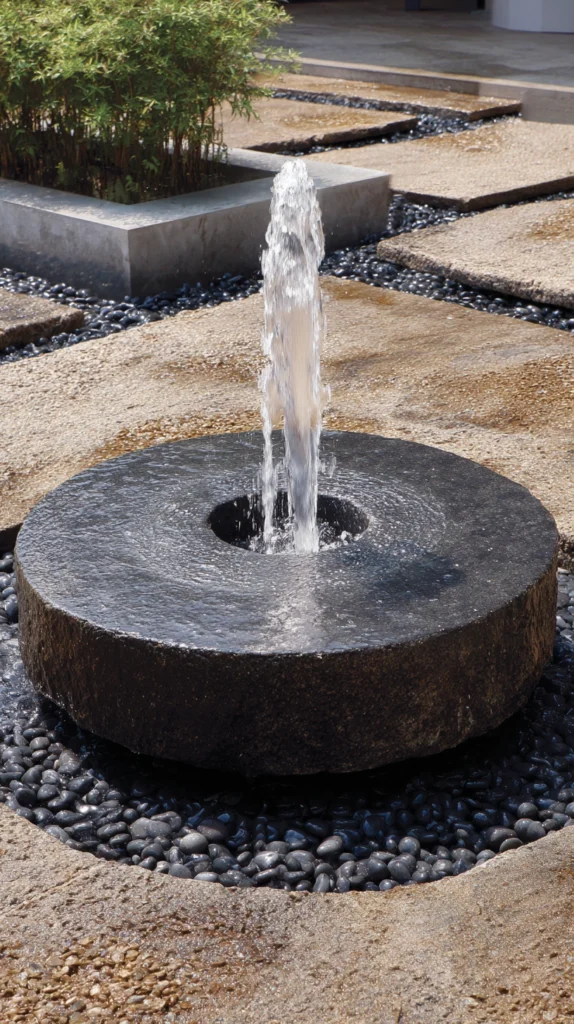
Budget: $100 – $400
A millstone fountain — a circular stone disc with a hole drilled through its centre, placed over a pebble reservoir that conceals the pump and the reservoir, water bubbling through the central hole and flowing across the stone surface before falling into the pebble reservoir below — is a build that produces a completely professional result from a weekend of work and a modest material budget.
A genuine millstone from a reclamation yard — $80 – $300 depending on size. An alternative: a circular paving slab with a central hole drilled using a diamond core drill — $15 – $40 for the slab plus tool hire. A plastic reservoir box — $20 – $50. A pump vault to protect the pump within the reservoir — $15 – $30. A submersible pump — $25 – $60. Smooth river pebbles — $15 – $30 per bag. Total material cost: $90 – $320.
Building tip: Use a diamond core drill rather than a standard masonry drill to create the central hole in a millstone or a stone paving slab — a standard masonry bit produces a rough, irregular hole that does not allow the water to emerge as a clean central column. A diamond core drill produces a clean, circular hole of consistent diameter that centres the water precisely and produces the controlled, symmetrical bubble that makes the millstone fountain beautiful rather than merely functional.
7. The Upcycled Galvanised Trough Waterfall
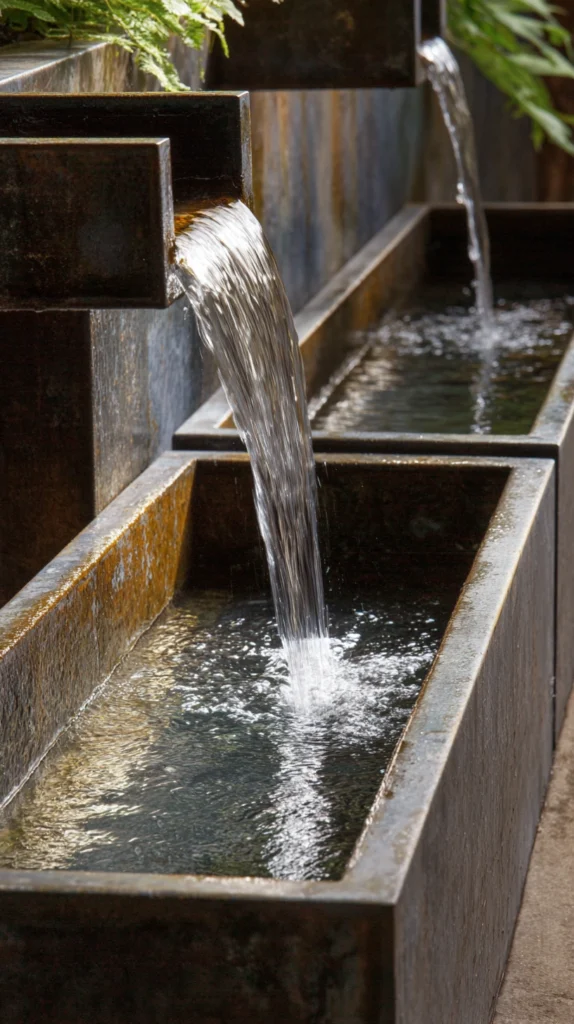
Budget: $60 – $200
An old galvanised metal trough — a livestock watering trough, a metal planter, or a salvaged industrial container — fitted with a small pump and positioned at a slight elevation so that its water overflows one end into a second, lower trough or a pebble basin below, produces a waterfall of industrial character and genuine material warmth. Galvanised metal weathers to a warm grey-silver patina that is specifically beautiful in an outdoor context.
A galvanised metal trough — free if salvaged, or $30 – $80 from a farm supply or garden supplier. A small submersible pump — $25 – $60. A lower receiving trough or pebble basin — $20 – $60. Flexible pipe from lower trough pump to upper trough inlet — $5 – $10. Total material cost: $50 – $160 for a waterfall of considerable material character.
Building tip: Drill a series of small drainage holes along the bottom edge of the upper galvanised trough at the overflow end — so that the water exits as a series of small streams along the trough’s bottom edge rather than as a single overflow at the rim. The bottom-edge drainage produces a more natural-looking and more visually interesting waterfall than a standard rim overflow, and it ensures that the trough drains completely and cleanly rather than retaining a shallow puddle at the base.
8. The Garden Hose Waterfall on a Rocky Bank
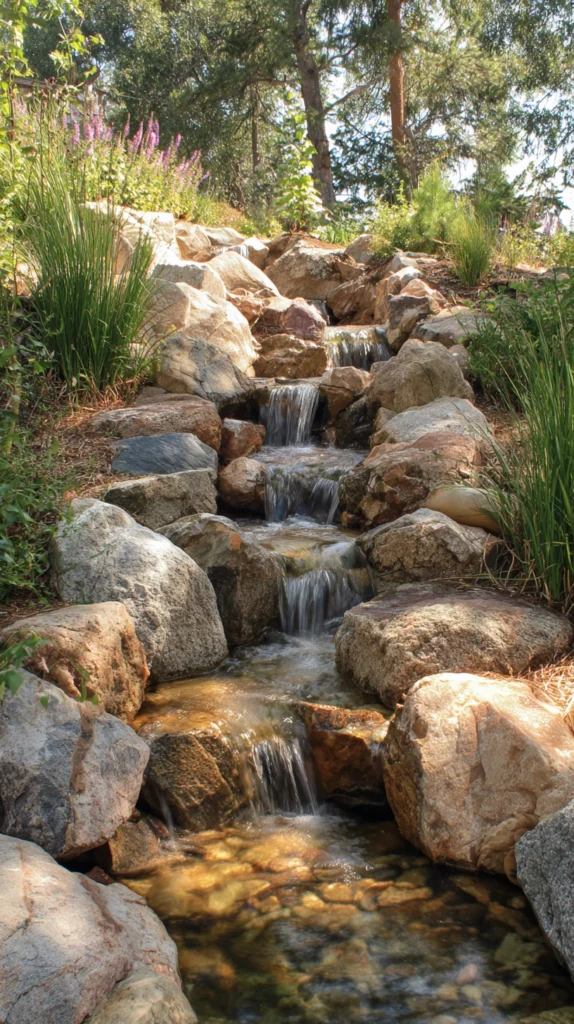
Budget: $50 – $200
A garden hose waterfall on a rocky bank — rocks or large stones arranged on a sloped garden area, a garden hose buried beneath them and emerging at the highest stone, connected to an outdoor tap or a pump to deliver water that flows down through the natural channels in the stone arrangement — is the simplest and the most immediately achievable DIY backyard waterfall available. No liner, no specialist equipment, no concrete. Stones, a hose, and a water source.
Rocks and large stones — free if sourced from the garden or neighbouring landscape, or $30 – $100 from a local landscape supplier. A length of garden hose — free if already owned or $10 – $30. A connector to attach the hose to an outdoor tap or a pump — $5 – $15. A small pump if tap pressure is insufficient — $25 – $60. Total material cost: $0 – $205 depending on what is already available.
Building tip: Bury the supply hose at least 10 centimetres beneath the stone surface before arranging the final layer of rocks — so that the hose is completely invisible from all viewing positions. A hose visible beneath the stones reads as a garden hose beneath some rocks. A hose buried beneath the stones reads as a natural spring emerging from a rocky bank — the quality difference between a DIY feature and a genuinely convincing landscape element.
9. The Wooden Barrel Waterfall Pond
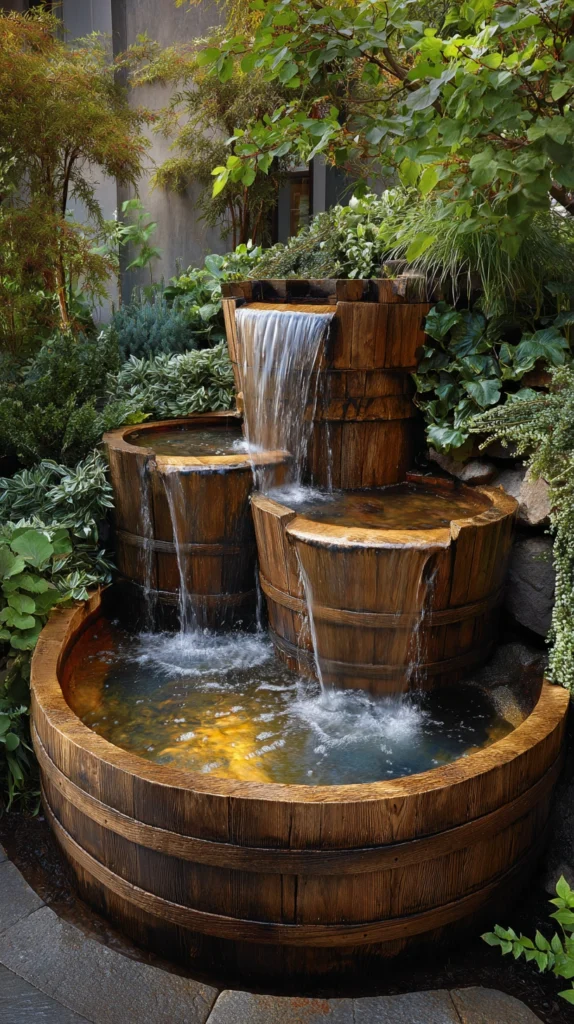
Budget: $80 – $300
A half wooden barrel — a whisky or wine barrel cut in half and sealed for water retention — filled with water, fitted with a small pump, and positioned to allow water to overflow one side into a second, lower barrel or a pebble basin produces a waterfall of considerable warmth and genuine material character. The barrel’s timber weathers beautifully outdoors and its circular form reads as charming and considered in almost any garden context.
A half barrel — $30 – $80 from a garden centre. A second half barrel or pebble basin — $20 – $60. Waterproof barrel sealant — $10 – $20 if the barrel is not already watertight. A small submersible pump — $25 – $60. Flexible pipe — $5 – $10. One or two aquatic plants for the upper barrel — $8 – $20 each. Total material cost: $78 – $250 for a barrel waterfall of genuine rustic charm.
Building tip: Elevate the upper barrel on a sturdy timber platform or a concrete block base rather than placing it directly on the ground — so that the water fall from the upper barrel to the lower is at least 20 centimetres. A 20-centimetre fall produces a visible water arc and an audible splash. Less than 10 centimetres of height difference produces a trickle that reads as a leak rather than a waterfall. The height of the fall is more important to the feature’s character than its width or volume.
10. The Concrete Stepping Stone Cascade
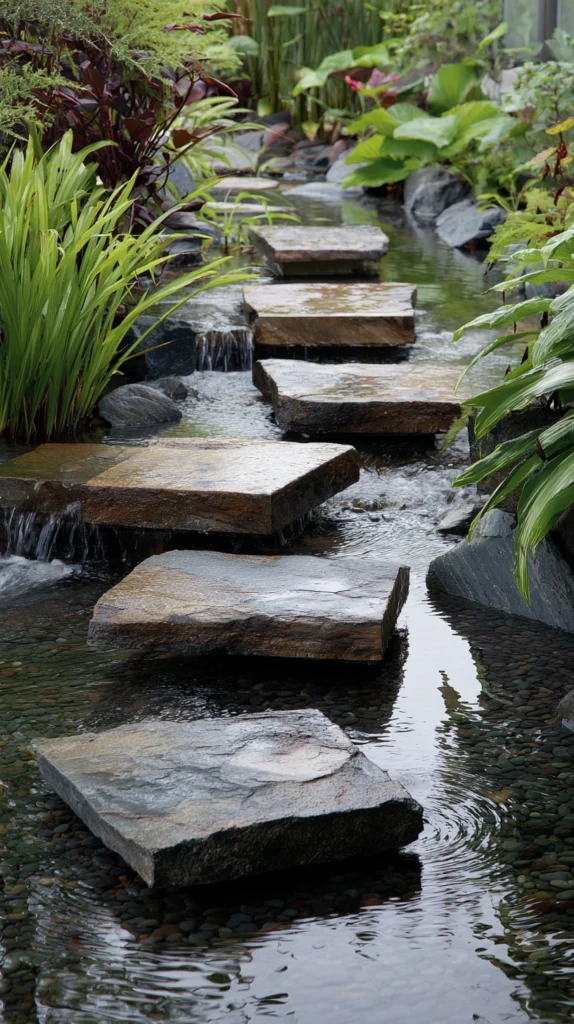
Budget: $60 – $250
A stepping stone cascade — flat concrete or natural stone stepping stones arranged at slightly different heights across a shallow stream bed lined with butyl rubber liner, with a pump at the base delivering water to the head stone and water flowing from stone to stone into the final pool — is the most naturalistic and the most visually generous DIY waterfall available at this budget level, particularly in a garden with a gentle natural or constructed slope.
Flat concrete stepping stone pavers — $3 – $8 each, five to eight required. Butyl rubber liner for the stream bed — $15 – $40. Smooth pebbles to fill between the stepping stones — $20 – $40 per bag. A submersible pump — $30 – $80. Flexible pipe from pump to head stone — $5 – $15. Total material cost: $63 – $215 for a stepping stone cascade of considerable naturalistic quality.
Building tip: Bed each stepping stone on a small amount of render or waterproof adhesive rather than placing it loose on the liner — so that the stone cannot shift position when the water flows over it or when an adult stands on it. A stepping stone waterfall where the stones shift underfoot is both aesthetically unsatisfying and practically dangerous. A stepping stone waterfall where each stone is firmly bedded in position reads as professionally constructed regardless of the builder’s skill level.
11. The Cinder Block and Render Waterfall Wall
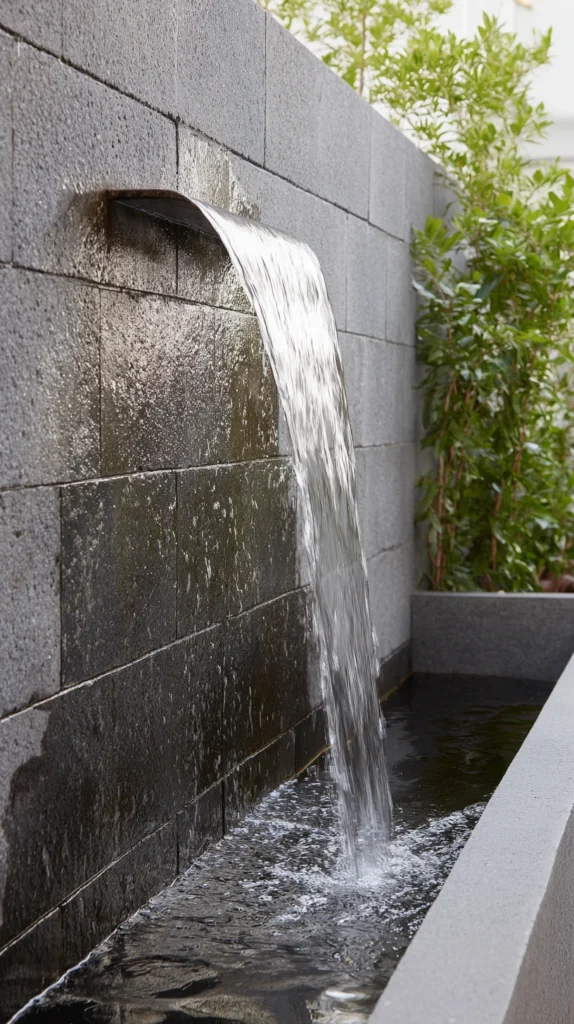
Budget: $80 – $300
A waterfall wall built from cinder blocks — stacked to the desired height, rendered smooth on the water-facing surface, with a delivery channel at the top and a collection basin at the base — is the most versatile and the most scalable DIY waterfall build available. The cinder block construction can be any height, any width, and any shape that the budget and the available space allow, and the rendered surface can be painted, tiled, or left in a natural render finish to suit the garden’s aesthetic.
Cinder blocks — $2 – $5 each, ten to fifteen required for a standard small wall. Sand and cement for the render — $15 – $30. Waterproof render additive — $8 – $20. A delivery channel at the wall top — a length of PVC gutter fixed horizontally — $5 – $15. A collection basin at the base — rendered block or recycled container — $15 – $40. A submersible pump — $30 – $80. Total material cost: $73 – $235.
Building tip: Chamfer the top edge of the render surface at the overflow point — creating a sharp, clean edge rather than a rounded or irregular one — so that the water separates cleanly from the wall surface as it falls rather than clinging to the render and running down the wall face. A chamfered edge is created with a straight piece of timber pressed firmly into the still-wet render at the overflow point and drawn along its length while the render is still plastic. It takes thirty seconds and produces the difference between a waterfall and a wall that is wet.
12. The Buried IBC Tote Reservoir System
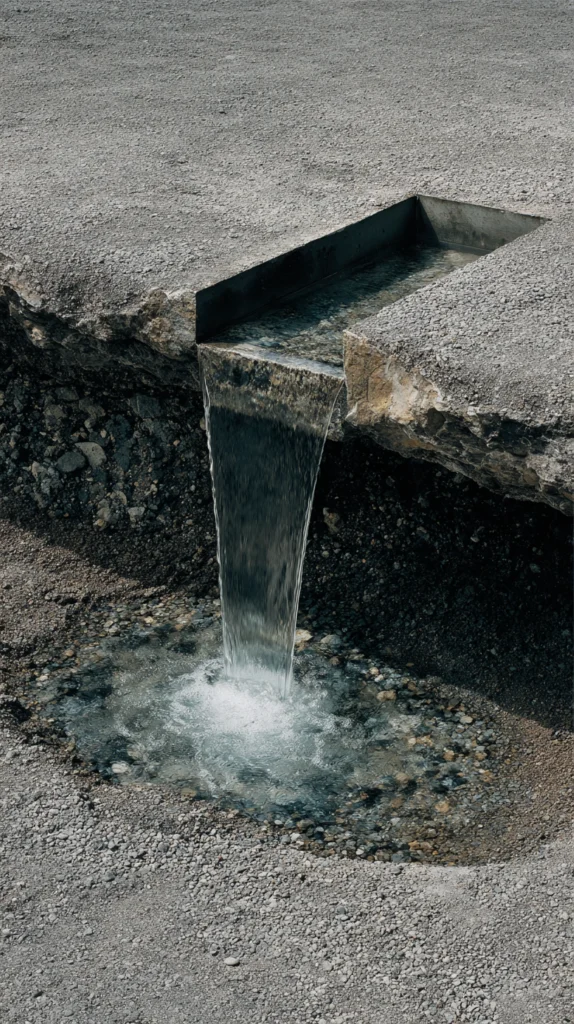
Budget: $100 – $350
An IBC tote — a large industrial intermediate bulk container, available cheaply from food industry suppliers and online platforms — buried in the garden and fitted with a submersible pump provides a large-volume underground reservoir for a waterfall system of any scale. The buried tote is invisible from above, holds sufficient water for a waterfall of meaningful flow rate, and can support any waterfall structure built above it.
A secondhand IBC tote — $50 – $100 from a food industry supplier or online marketplace. A submersible pump appropriate for the waterfall’s flow requirements — $40 – $150. Flexible pipe from the pump to the waterfall’s head — $5 – $20. A decorative grate or pebble surface above the buried tote — $15 – $40. Excavation by hand or hired mini-digger — $0 – $100 depending on approach. Total material cost: $110 – $410 for a professional-scale reservoir at a DIY budget.
Building tip: Install a gate valve on the pump outlet pipe before connecting it to the waterfall’s delivery system — so that the pump flow rate can be adjusted after installation without accessing the buried tote. A pump at full flow often produces more water movement than the waterfall’s stone or render arrangement can contain elegantly. A gate valve allows the flow to be reduced to the level at which the water moves beautifully over every surface in the system without splashing beyond the intended catchment area.
13. The Self-Contained Solar Fountain Waterfall
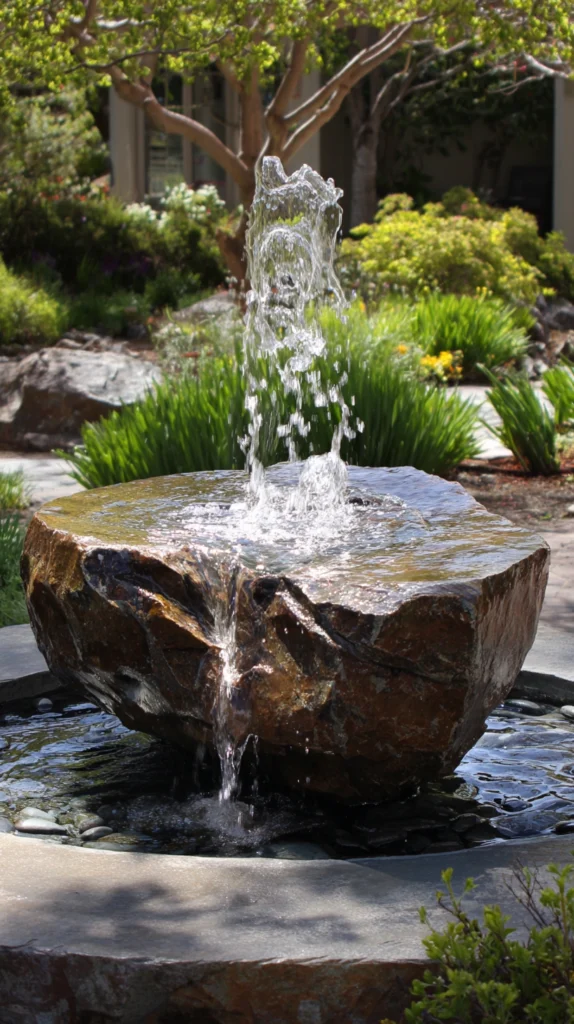
Budget: $30 – $150
A solar-powered fountain pump — connected to a small panel that sits in direct sunlight beside the water feature — provides a completely electricity-free waterfall solution that requires no cable laying, no outdoor socket, and no ongoing running cost. In a sunny garden, a quality solar pump produces sufficient flow for a small fountain or a gentle waterfall throughout the daylight hours.
A solar fountain pump with a separate panel — $20 – $60 for a quality unit. A stone, ceramic, or terracotta basin for the water — $20 – $60. Smooth pebbles or decorative stones — $10 – $30. A simple stone or ceramic delivery element above the basin — $10 – $40. Total material cost: $60 – $190 for a completely self-contained, zero-running-cost water feature.
Building tip: Position the solar panel for maximum direct sun exposure throughout the middle of the day — between 10am and 3pm — rather than optimising for morning or evening sun. A panel in good midday sun produces the pump’s full rated flow rate and provides the most water movement during the hours when the garden is most used. A panel in morning-only or evening-only sun produces strong flow at the least useful hours and minimal flow during the middle of the day when the garden’s occupants are present.
14. The Full DIY Naturalistic Waterfall and Pond System
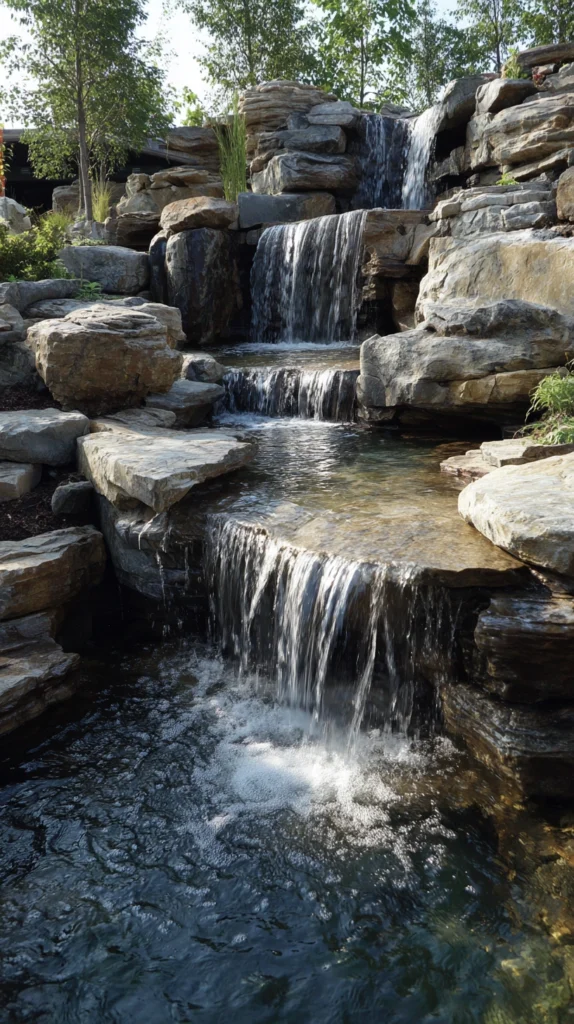
Budget: $200 – $800
The full DIY naturalistic waterfall and pond system — a flexible liner pond excavated at the base of a gentle slope or a constructed rock bank, natural stones arranged at graduated heights from the pond edge to the top of the bank, a submersible pump at the pond’s deepest point delivering water to the head stone, water flowing from stone to stone through the rock arrangement into the pond below, and marginal planting at the pond edge and between the stones — is the most ambitious and the most genuinely rewarding DIY backyard waterfall project on this list.
Flexible rubber pond liner for the pond base — $40 – $100. Underlay — $20 – $40. Natural stones and boulders — $80 – $200 from a local landscape supplier. A submersible pump with sufficient lift for the waterfall height — $40 – $120. Flexible pipe — $5 – $20. Aquatic and marginal plants — $8 – $20 each, eight to twelve plants. Total material cost: $193 – $500 for a naturalistic pond and waterfall system of genuine landscape quality.
Building tip: Build the rock arrangement of the naturalistic waterfall in stages — positioning the lowest stones first and filling the gaps with smaller stones and aquatic planting before moving to the next level — so that the planting is established within the rock structure from the beginning rather than added afterward. Planting between the rocks from the lowest level upward produces a waterfall feature where the plants appear to have grown through the rock arrangement naturally. Planting added to the surface of a completed rock arrangement produces a waterfall with plants placed beside it — a less convincing and less naturalistic outcome.
Whatever combination of these fourteen ideas finds its way into the backyard, the principle beneath all of them is the same one that makes any DIY water feature genuinely successful rather than merely functional: take the time to do the hidden work correctly — the liner installation, the pipe burial, the sealant application, the pump positioning — because the hidden work is what determines whether the feature works beautifully for decades or requires attention and repair within the first season.
The stones and the water and the sound are the reward. The liner and the pump and the pipe are the investment that makes the reward permanent.
Do the hidden work carefully. The water does not know it is hidden. But the garden knows. And in five years, when the moss has grown on the stones and the marginal plants have filled every gap and the feature sounds as though it has always been there, you will know exactly why it was worth every careful hour.