Draped in Drama: 15 Boudoir Style Bedroom Ideas for Romantic Interiors
There is a room that exists specifically for pleasure — not the pleasure of productivity or the pleasure of organisation, but the deeper and more necessary pleasure of being somewhere entirely beautiful, entirely private, and entirely devoted to the comfort and the sensory experience of the person within it. The boudoir is that room.
It is the bedroom elevated to the level of a personal sanctuary, dressed with the particular combination of luxury, drama, and intimate beauty that makes every ordinary moment within it feel slightly extraordinary.
The boudoir aesthetic is not about excess for its own sake. It is about intention — the decision to treat the private spaces of the home with the same level of care and beauty that public rooms receive, and to create a bedroom that communicates, from the moment the door is closed, that rest and pleasure are serious pursuits worthy of serious design.
The fifteen ideas below cover every element of the boudoir bedroom — from the foundational colour decisions to the finishing details that make the difference between a beautifully decorated room and a genuinely romantic one.
1. The Deep, Dramatic Wall Colour
Budget: $40 – $200
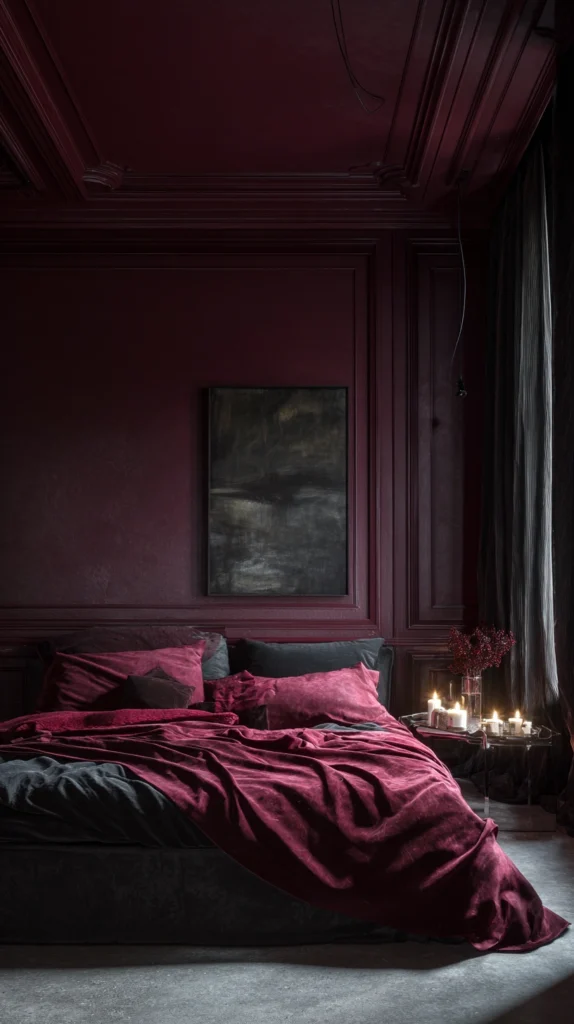
The boudoir bedroom begins with a wall colour that makes a decision — deep plum, midnight navy, rich burgundy, forest black-green, or a dark dusty rose that reads as faded velvet in lamplight. These are not colours that hedge or compromise. They commit entirely to the creation of an enveloping, atmospheric space, and they deliver that atmosphere from the moment the light is dimmed and the room reveals its evening character.
A quality deep-toned paint in a flat or dead-matt finish costs $20 – $50 per litre. A full four-wall application requires three to four litres — $60 – $200 in quality paint. The ceiling taken in the same colour or one shade deeper produces the full cocoon effect that the boudoir aesthetic requires. A ceiling in the same dark tone as the walls is one of the most dramatic and most transformative decisions available to any bedroom.
Decor tip: Apply all dark boudoir wall colours in a dead-flat or chalk finish rather than any sheen. A flat finish on a deep colour absorbs light rather than reflecting it and produces a surface that reads as velvety, deep, and genuinely atmospheric. The same colour in an eggshell or satin finish produces a slight sheen that undermines the softness the boudoir aesthetic requires and can read as slightly plastic in certain light conditions.
2. The Floor-to-Ceiling Velvet Curtains
Budget: $100 – $800
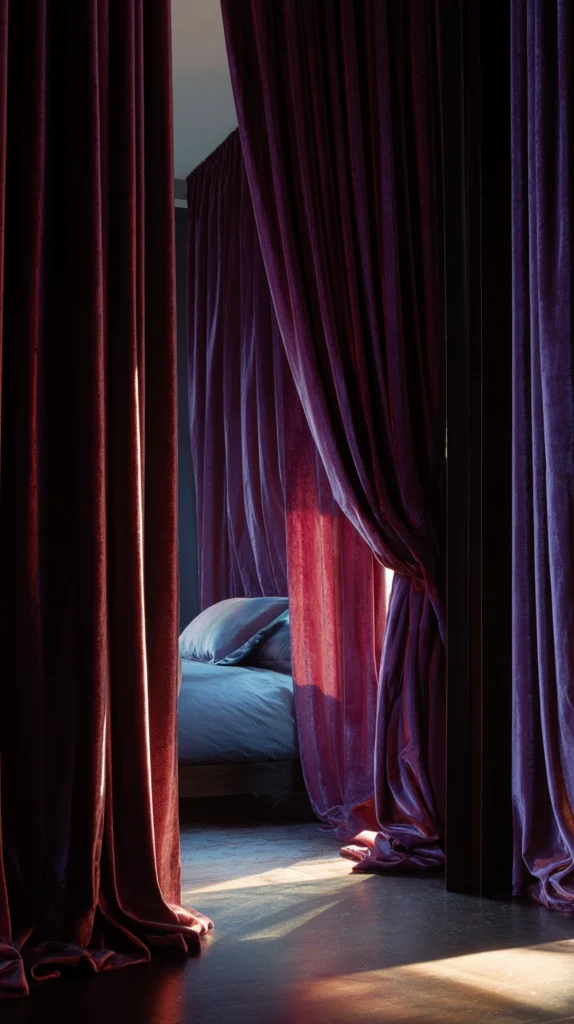
Floor-to-ceiling velvet curtains — in a deep jewel tone or a matching dark that echoes the wall colour — are the boudoir bedroom’s most theatrical and most practically effective textile element. They control the light, insulate against sound, warm the room in every sense of the word, and produce a quality of enclosure that no other window treatment achieves. Drawn closed, a room with deep velvet curtains becomes a world entirely its own.
Velvet curtain panels in a jewel tone — deep plum, midnight blue, or bottle green — cost $60 – $200 per panel. Two panels per window — hung from ceiling-height rods with generous fullness in the fabric — sit at $120 – $400 per window. The velvet should pool slightly on the floor — a break of three to five centimetres — rather than cutting precisely at the floor level. The slight excess communicates generosity and luxury in a way that a precisely cut hemline does not.
Decor tip: Line the velvet curtains with a blackout interlining rather than a standard curtain lining. The interlining adds weight to the curtain — producing a more generous, more dramatic hang — and provides complete darkness during the day. A boudoir bedroom that can be made completely dark at any hour is a bedroom that belongs entirely to its occupant’s schedule rather than to the sun’s.
3. The Upholstered Bed Frame
Budget: $300 – $3000
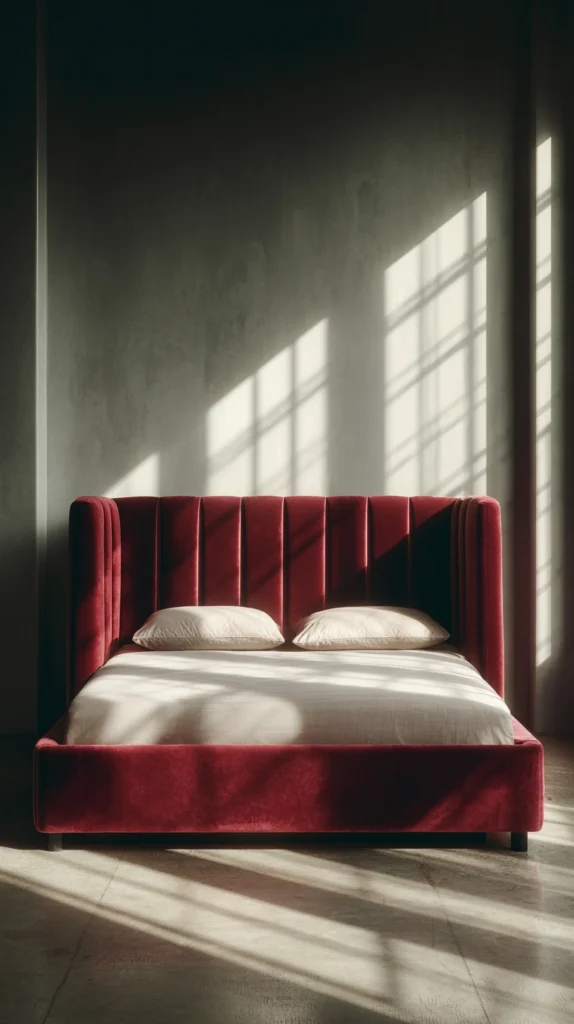
A fully upholstered bed frame — headboard, footboard, and side rails all covered in velvet, silk-effect fabric, or a textured bouclé — is the boudoir bedroom’s central piece and the one that communicates the room’s aesthetic identity most immediately. An upholstered bed is the room’s centrepiece, its throne, and its primary decorating decision all in one.
A fully upholstered bed frame in a deep velvet — tufted or plain — costs $400 – $1500 in a standard king size. A channel-tufted version — the most classically boudoir format, with vertical channels of stitching across the headboard — runs $500 – $2000. A bespoke upholstered frame in a chosen fabric — $1000 – $3000 — allows the exact colour, the exact tufting pattern, and the exact proportion to be specified for the specific room.
Decor tip: Choose a bed frame upholstery that is one shade deeper than the wall colour rather than an exact match or a contrasting tone. A headboard slightly deeper than the wall behind it reads as an object that has depth and substance within the room — it stands forward from the wall rather than disappearing into it. An exact colour match makes the headboard invisible. A contrasting colour makes it a statement that competes with the room’s broader palette.
4. The Layered Bedding in Luxurious Fabrics
Budget: $100 – $800
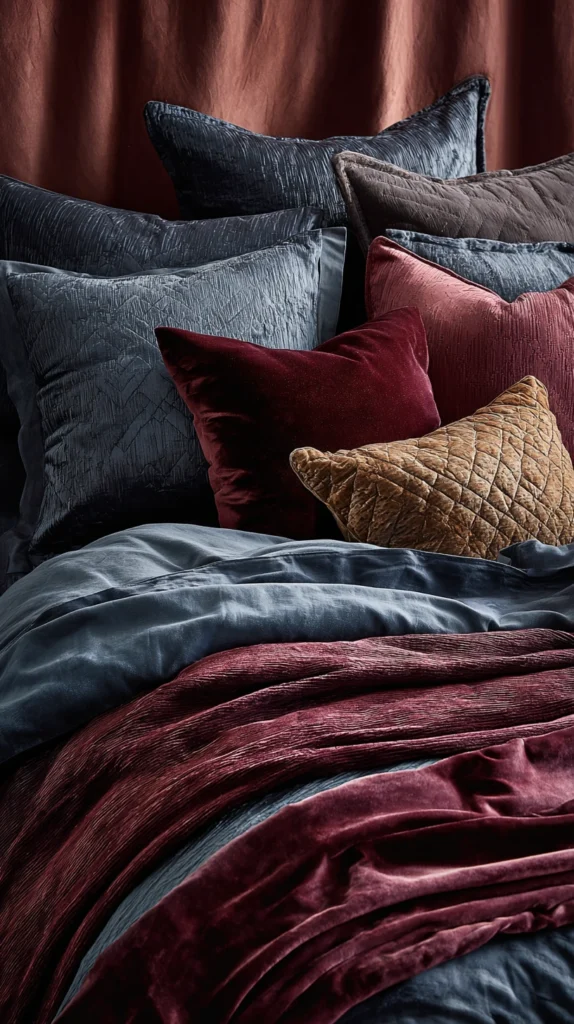
Boudoir bedding is layered rather than simple — a base of crisp cotton or silk-effect sheets, a duvet covered in a fabric that contributes to the room’s palette, two or three decorative cushions in complementary textures, a throw in a contrasting but harmonious material, and at least one bolster cushion that reads as specifically French in its proportions and its placement.
A silk-effect satin duvet cover in a deep or jewel-toned colour costs $60 – $200. A set of matching pillowcases — $30 – $80. A velvet or faux-fur throw at the foot of the bed — $50 – $150. A bolster cushion in a complementary fabric — $30 – $80. Two or three decorative cushions in varying textures — $25 – $60 each. The full bedding layer communicates abundance and sensory richness at the most intimate surface in the room.
Decor tip: Combine at least three different fabric textures within the bedding layer — smooth satin, deep velvet, and a woven or embroidered textile — in the same colour family. Three textures in the same tonal palette read as a considered, layered arrangement. Three identical fabrics in the same colour read as a matching set. The texture variation is what produces the particular richness that boudoir bedding requires.
5. The Vanity Table and Mirror
Budget: $100 – $1000
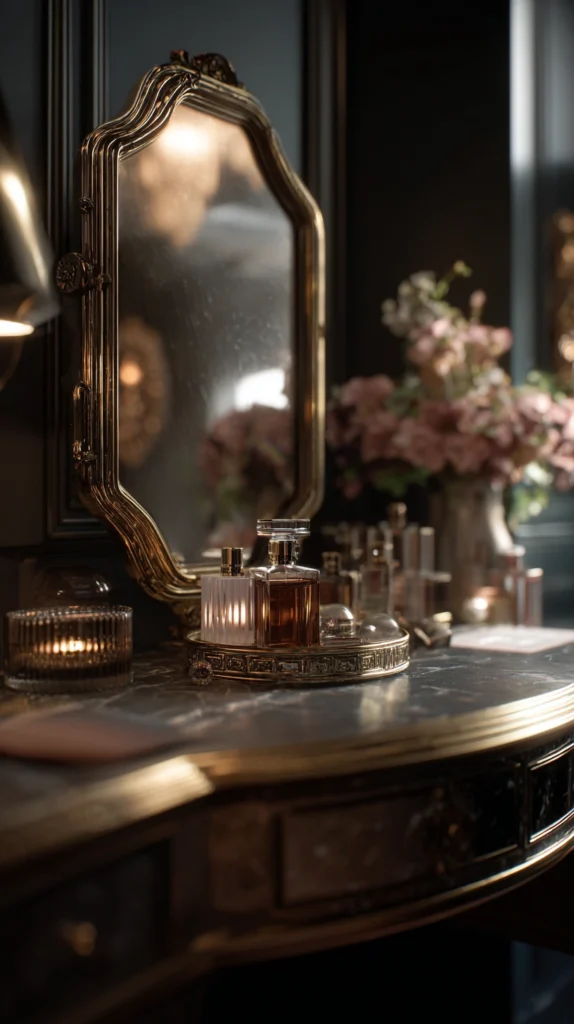
A dedicated vanity table — with an ornate or architectural mirror, a small upholstered stool, good directional lighting at face height, and a surface dressed with perfume bottles, jewellery, and beauty objects as decorative items rather than stored ones — is the boudoir bedroom’s most defining functional element. It gives the morning and evening routine a dedicated, beautiful space and communicates that the private rituals of the person who lives there are worth designing around.
A vintage or vintage-style vanity table in a dark or gilded finish costs $150 – $500. A simple dressing table with a triptych or large ornate mirror — $100 – $400. A small upholstered stool — $60 – $150. Hollywood-style mirror lighting at face height — $40 – $120. The total vanity station investment sits at $350 – $1170 for a piece of the bedroom that is used twice daily and deserves to be genuinely beautiful.
Decor tip: Dress the vanity surface with three layers of objects — perfume bottles at the back at the tallest height, medium-height accessories in the middle, and small flat objects and a single flower or botanical at the front. The layered arrangement reads as a tableau rather than a collection of stored items, and the distinction between the two is what elevates a functional vanity to the decorative standard the boudoir aesthetic requires.
6. The Statement Chandelier or Pendant
Budget: $80 – $2000
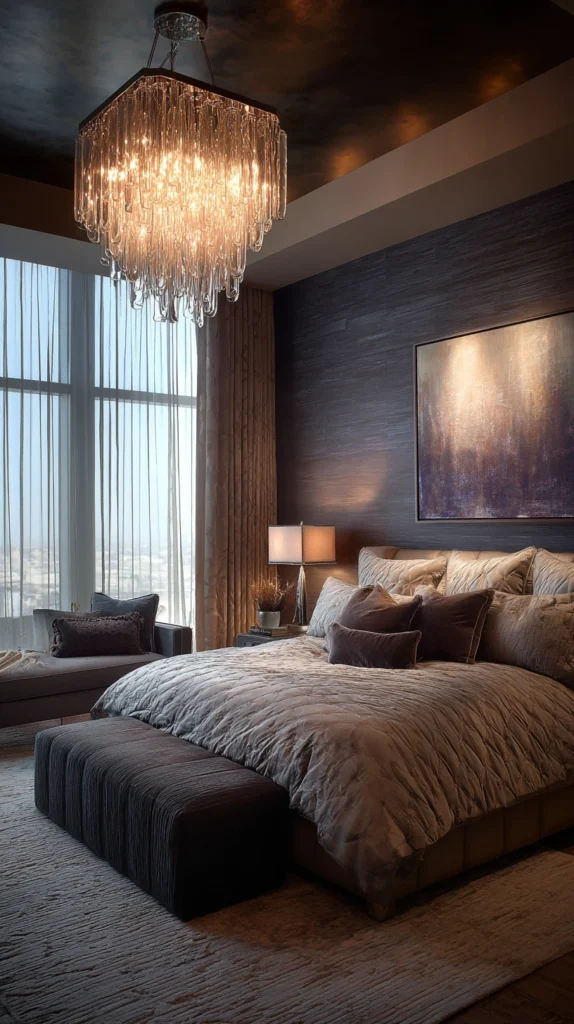
A chandelier or statement pendant above the bed — in crystal, in dark iron with warm filament bulbs, in a draped silk shade, or in a sculptural rattan form — is the boudoir bedroom’s most immediately dramatic decorative element and the one that sets the room’s aesthetic register before any other surface has been considered. A bedroom with a chandelier above the bed communicates its intentions immediately and completely.
A crystal chandelier in a standard bedroom size costs $100 – $500. A dark iron chandelier with candle-style bulbs — $80 – $300. A silk or velvet-shaded statement pendant — $100 – $400. A sculptural rattan chandelier in a large format — $80 – $250. All four work within the boudoir aesthetic — the choice between them is determined by the room’s specific colour palette and the warmth or drama of the effect required.
Decor tip: Install the bedroom chandelier on a dimmer switch rather than a standard circuit. A chandelier at full brightness above a boudoir bedroom produces a quality of light that is too even and too bright for the atmospheric, intimate effect the room is designed to create. The same chandelier at 20 to 30 percent brightness produces a warm, glowing overhead presence that contributes to the room’s atmosphere rather than simply illuminating it.
7. The Canopied or Draped Bed
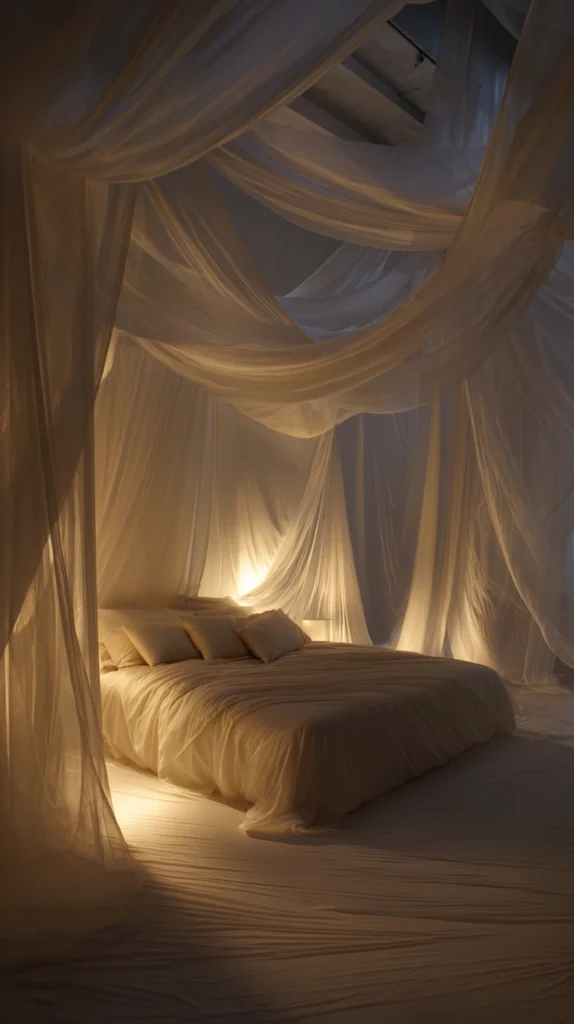
Budget: $50 – $500
A bed given a fabric canopy — lengths of sheer silk, velvet, or gauze gathered at a central ceiling point and falling on both sides and behind the headboard — is the boudoir bedroom’s most overtly romantic and most immediately theatrical element. A canopied bed is the bedroom’s closest approximation to being inside a jewel box, and the quality of enclosure and shelter it produces is unlike anything an uncanopied bed can offer.
A ceiling canopy ring costs $10 – $30. Sheer silk or velvet fabric in the room’s palette — $5 – $20 per metre, requiring eight to twelve metres for a generous canopy — costs $40 – $240 in fabric. A four-poster bed frame on which fabric is draped rather than gathered from a ceiling point — $400 – $2000 — is the most architecturally resolved version of the canopied bed and the one that requires no ceiling hardware.
Decor tip: Choose a canopy fabric that is slightly translucent — a sheer silk, a chiffon, or a voile — rather than a fully opaque material. A translucent canopy creates the impression of being within a softly lit tent while maintaining visual connection with the room beyond the drapes. An opaque canopy creates a more enclosed, darker effect that suits some room proportions and not others — rooms with low ceilings in particular benefit from the lighter quality of a translucent fabric.
8. The Mirrored Furniture Pieces
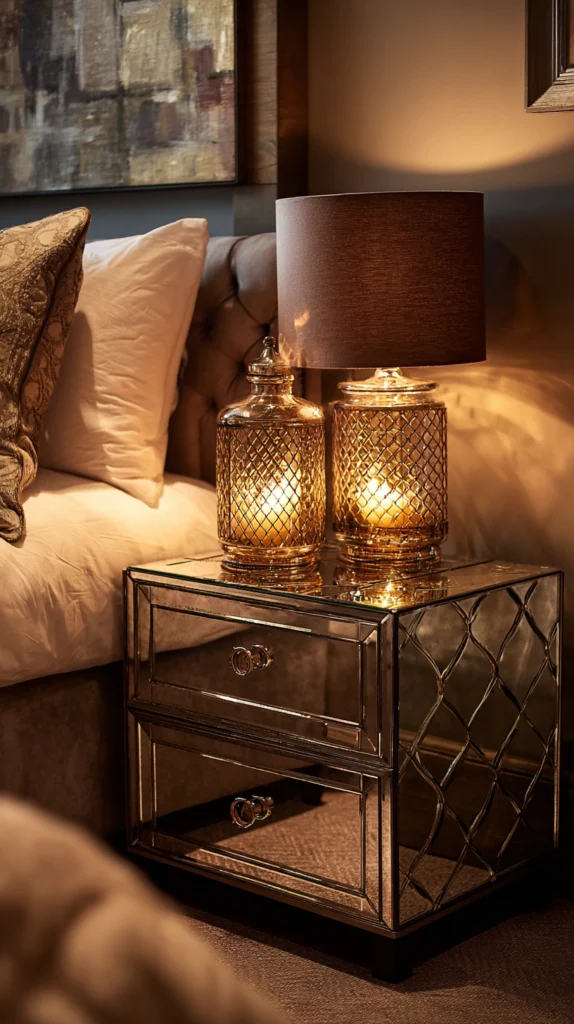
Budget: $100 – $2000
Mirrored furniture — a mirrored bedside table, a mirrored chest of drawers, a mirrored vanity — is the boudoir bedroom’s most glamorous material choice and the one most specifically associated with the aesthetic’s French Art Deco origins. Mirrors in a boudoir bedroom multiply the candlelight, the jewel tones of the textiles, and the warm glow of the lampshades in a way that no other furniture material approaches.
A mirrored bedside table costs $80 – $300 each. A mirrored chest of drawers — $200 – $800. A mirrored vanity with an integrated mirror — $150 – $600. Mirrored furniture placed beside or opposite the primary light source in the room — the window, the chandelier, or the bedside lamp cluster — produces a multiplication of warm light that makes the room feel considerably more luminous than its light sources alone would suggest.
Decor tip: Position mirrored furniture pieces so that they reflect something worth seeing — a beautiful lamp, the draped curtain, the bed’s canopy, or a floral arrangement — rather than reflecting the viewer directly or reflecting a less beautiful element of the room. A mirrored surface that reflects the room’s best feature doubles that feature’s visual presence. One that reflects the wardrobe door or the back of a door doubles something less worth seeing.
9. The Perfume and Beauty Display
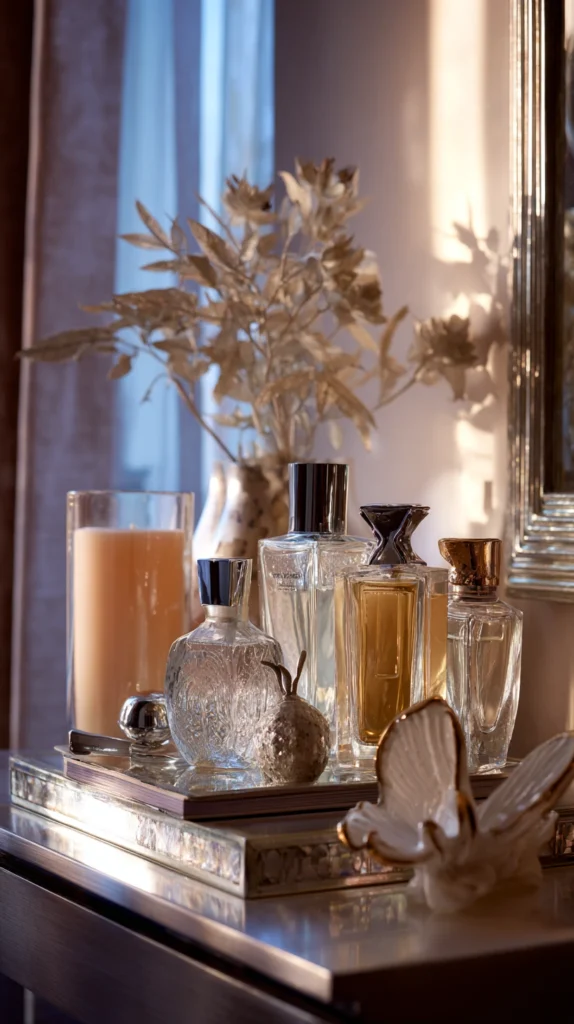
Budget: $20 – $200
A perfume and beauty display — a mirrored tray on the vanity or the bedside table holding perfume bottles in varying heights, a small vase of fresh or dried flowers, a candle in a crystal or ceramic holder, and two or three jewellery pieces displayed as objects rather than stored as accessories — is the boudoir bedroom’s most personal and most intimate decorating layer. It communicates that the private objects of daily beauty are worth displaying as the beautiful things they are.
A mirrored or marble tray — $15 – $50. Three to five perfume bottles already owned — free to relocate. A small crystal or ceramic candle holder — $10 – $25. A small vase with three stems of something seasonal — $5 – $15. The total display investment: $30 – $90 for a surface that changes character completely when the candle is lit in the evening.
Decor tip: Arrange the perfume bottles in a graduated height sequence from tallest at the back to shortest at the front — and angle them very slightly toward the viewer rather than placing them flat against the tray back. Bottles angled slightly forward catch the light on their labels and their glass surfaces and read as presented rather than stored — a distinction that is immediately visible and immediately felt when the arrangement is assessed from a seated or standing position at the vanity.
10. The Vintage and Antique Textile Mix
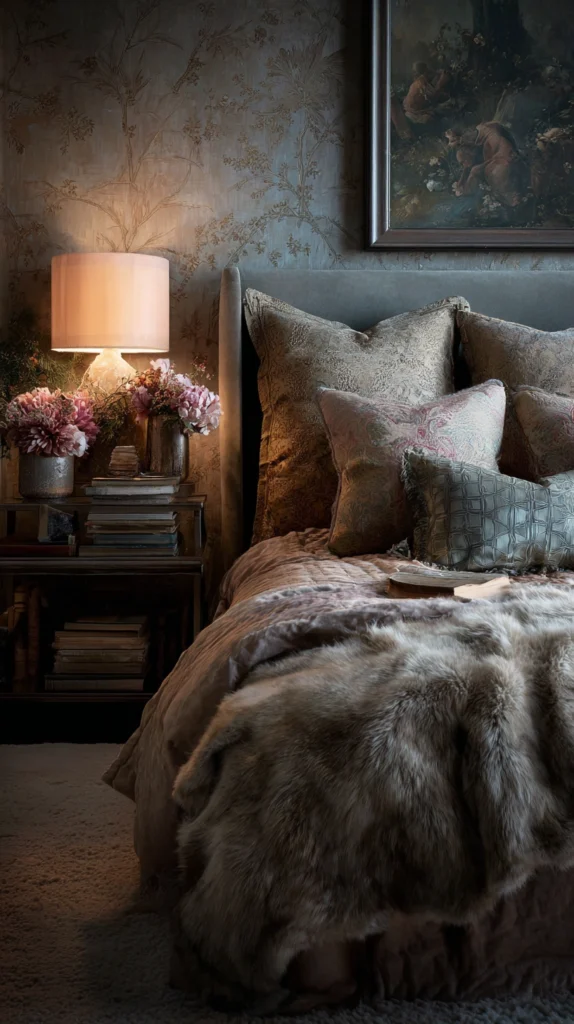
Budget: $40 – $400
The boudoir bedroom accumulates its most distinctive character through vintage and antique textiles — a Victorian embroidered cushion beside a contemporary velvet throw, a silk kimono hung on the back of the door, a lace-trimmed pillow among the decorative cushion arrangement, a vintage tapestry on the wall. These are the objects that communicate a personal history and a specific aesthetic sensibility in a way that new purchases at any price point cannot replicate.
A vintage embroidered cushion from a market or estate sale — $10 – $40. A secondhand silk or embroidered kimono — $20 – $80 — hung on a decorative hook behind the door. A piece of antique lace used as a pillow cover or a throw overlay — $15 – $50. A small vintage tapestry — $30 – $150. The vintage textile layer costs modestly and contributes disproportionately to the room’s sense of accumulated personal beauty.
Decor tip: Mix the vintage textiles with one or two genuinely contemporary pieces so that the room reads as curated rather than preserved. A bedroom of exclusively vintage textiles can read as a museum of domestic history. The same vintage textiles mixed with new velvet, new silk, and a contemporary throw read as a personal collection assembled across time — which is the correct character of the boudoir, where the present and the beautiful past coexist without either apologising for the other.
11. The Romantic Floral Arrangement
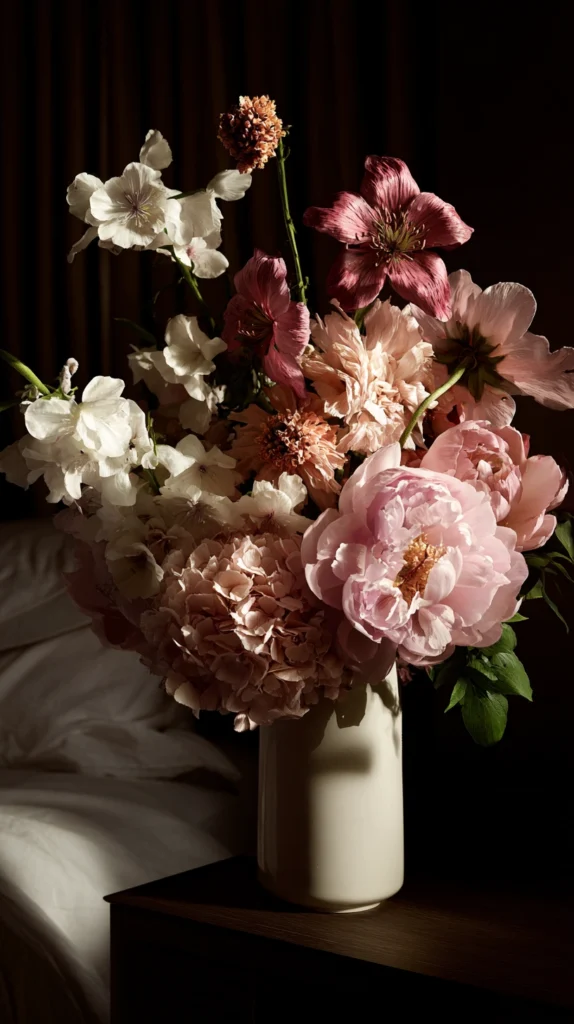
Budget: $15 – $80 per arrangement
Fresh flowers in the boudoir bedroom — generous, fragrant, and placed in a beautiful vessel — are the most living and the most consistently impactful decorating element available at any weekly price point. A large arrangement of roses, peonies, ranunculus, or sweet peas in a crystal, dark ceramic, or gilded vase communicates sensory abundance in the most direct way available and changes the room’s character simply by being present and being alive.
A generous bunch of seasonal flowers from a market or florist — $10 – $40 depending on variety and season. A crystal or dark ceramic vase — $15 – $50. A small bud vase beside the bed with a single stem — $8 – $20 for the vase plus $2 – $5 for the stem. The weekly flower investment for a boudoir bedroom sits at $12 – $45 per week — the most cost-effective and the most immediately sensory decorating decision available on a recurring basis.
Decor tip: Choose flowers with a fragrance as well as a form for the boudoir bedroom — roses, sweet peas, hyacinth, gardenia, or jasmine — rather than selecting on visual impact alone. The boudoir is a room of sensory experience rather than purely visual beauty, and a bedroom that smells extraordinary as well as looking extraordinary achieves the full range of atmosphere the aesthetic is working toward. The scent of fresh flowers in a warm, candlelit room is irreplaceable by any diffuser, candle, or spray equivalent.
12. The Gallery of Ornate Frames
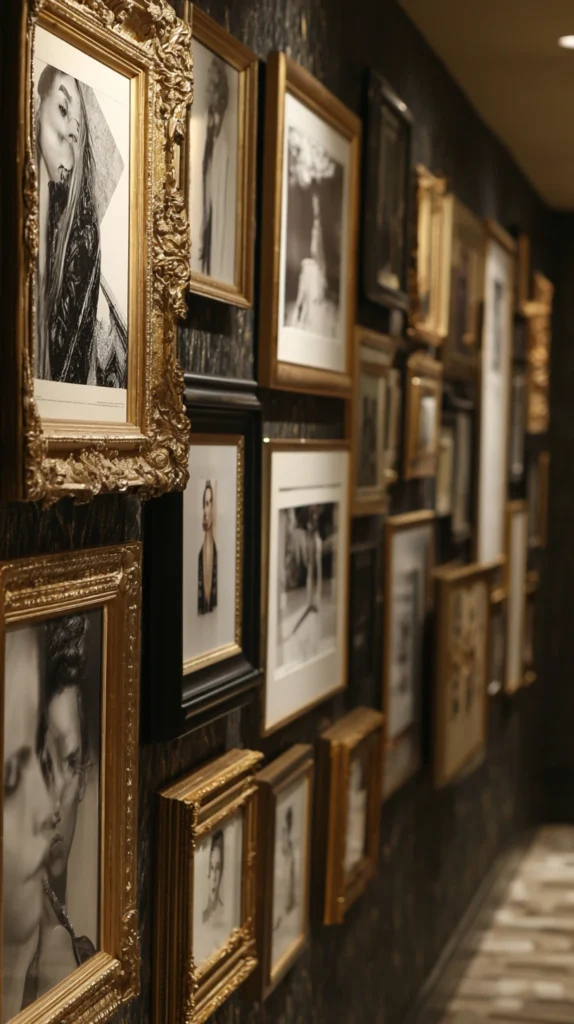
Budget: $50 – $400
A gallery wall in the boudoir bedroom — ornate gilded or dark frames in varying sizes, holding botanical prints, fashion illustrations, personal photographs in black and white, abstract works in the room’s palette, and one or two antique reproduction prints — is the most culturally layered and the most personally expressive surface available to the romantic bedroom. The frames are as important as the contents within them.
Ornate gilded frames from antique markets and charity shops — $5 – $30 each. A collection of eight to twelve frames in varying sizes — $40 – $260 in total. Prints and images to fill them — $0 – $100 depending on whether public domain downloads, personal photographs, or purchased prints are used. A gallery of ornate frames creates the impression of a room accumulated over a long and beautiful life regardless of how recently it was assembled.
Decor tip: Mix genuinely antique or vintage frames — found at markets for very little — with new ones in a complementary finish rather than buying an entirely new matching set. A gallery where every frame is from the same retail source reads as recently purchased. A gallery where some frames are genuinely old, some are new, and all share a warm gold or dark finish reads as collected — which is the specific quality of accumulation that the boudoir bedroom is designed to communicate.
13. The Candlelight and Lamp Cluster
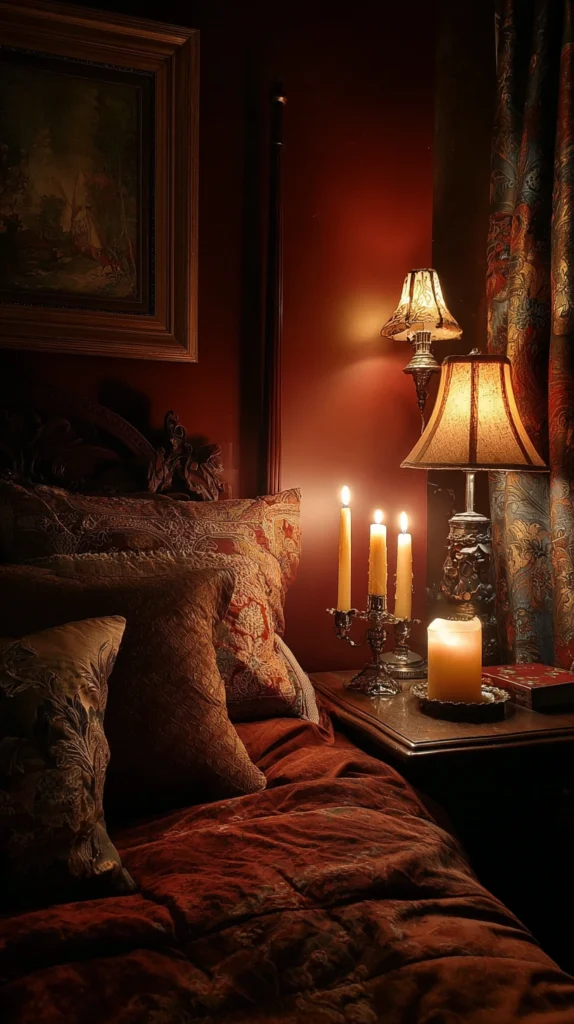
Budget: $40 – $300
Candles in the boudoir bedroom are not occasional or decorative. They are the room’s primary evening light source — the layer beneath the dimmed chandelier that produces the specific quality of warm, flickering light that no electric alternative replicates. A cluster of pillar candles at varying heights on the bedside table, a candelabra on the vanity, and a pair of taper candles on the mantelpiece collectively produce the light quality that the room’s entire aesthetic is built to work within.
Pillar candles in a warm ivory or beeswax — $8 – $20 each. A cluster of three on a mirrored or dark tray — $24 – $60 in candles plus $10 – $30 for the tray. A small candelabra — $20 – $60. Taper candles in a complementary dark tone — $10 – $25 for a set. A crystal or ornate candle holder — $10 – $40. Total candlelight investment: $74 – $215 for the room’s most atmospherically important and most regularly enjoyed decorating element.
Decor tip: Use beeswax or soy candles rather than paraffin in the boudoir bedroom. Beeswax and soy burn cleaner than paraffin — producing less soot and less of the slightly synthetic fragrance that paraffin candles release even when unscented. A boudoir bedroom in which genuine beeswax candles have been burning for an hour smells of warm honey rather than artificial fragrance, and that scent is as much a part of the room’s atmosphere as the light the candles produce.
14. The Dressing Robe as Decorative Object
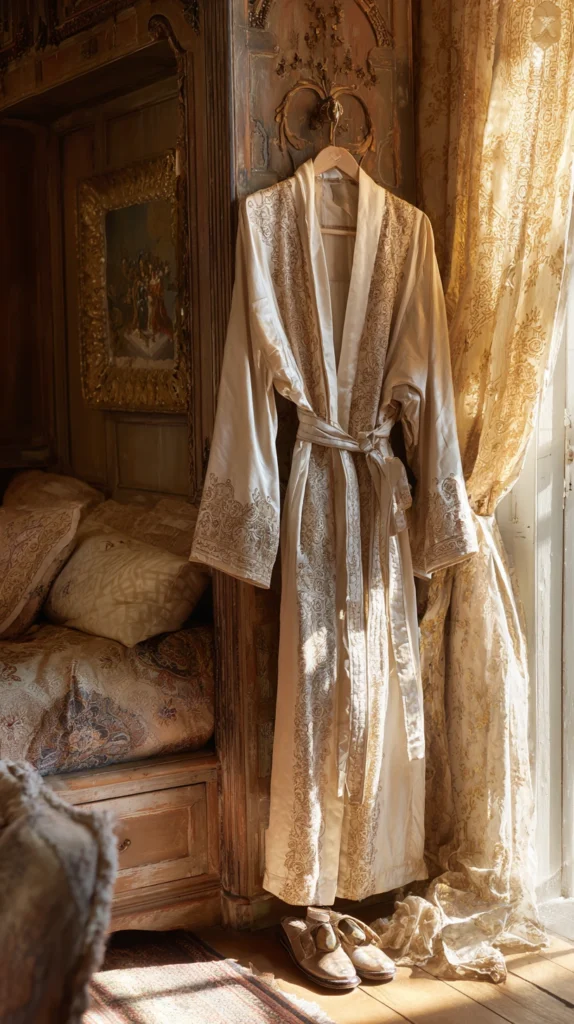
Budget: $40 – $300
A beautiful dressing robe — in a silk, a velvet, or a heavy cotton in the room’s palette — hung on an ornate hook or a decorative coat stand beside the wardrobe rather than stored invisibly inside it, is the boudoir bedroom’s most intimate and most specifically characterful decorating detail. It communicates that the private objects of a personal life are worth celebrating rather than concealing, and that the room belongs to someone who takes pleasure seriously.
A silk or satin dressing robe in a jewel tone — $60 – $200. A velvet robe in the room’s palette — $80 – $250. An ornate hook or a decorative coat stand to display it — $20 – $80. The robe hung in the room rather than stored in the wardrobe costs nothing beyond the purchase of the robe itself and the hook or stand that holds it — and its presence as a displayed object rather than a stored one is what makes it a decorating decision rather than simply a piece of clothing.
Decor tip: Choose a robe in a colour that is deliberately and visibly part of the room’s palette rather than in a neutral that disappears against the wall behind it. A deep plum robe in a plum and gold boudoir is a participant in the room’s colour story. The same robe in a standard white or pale grey is a practical object hung in a room — a subtle but significant distinction in a bedroom where every visible element is intended to contribute to the overall atmosphere.
15. The Fully Committed Boudoir Bedroom
Budget: $800 – $8000
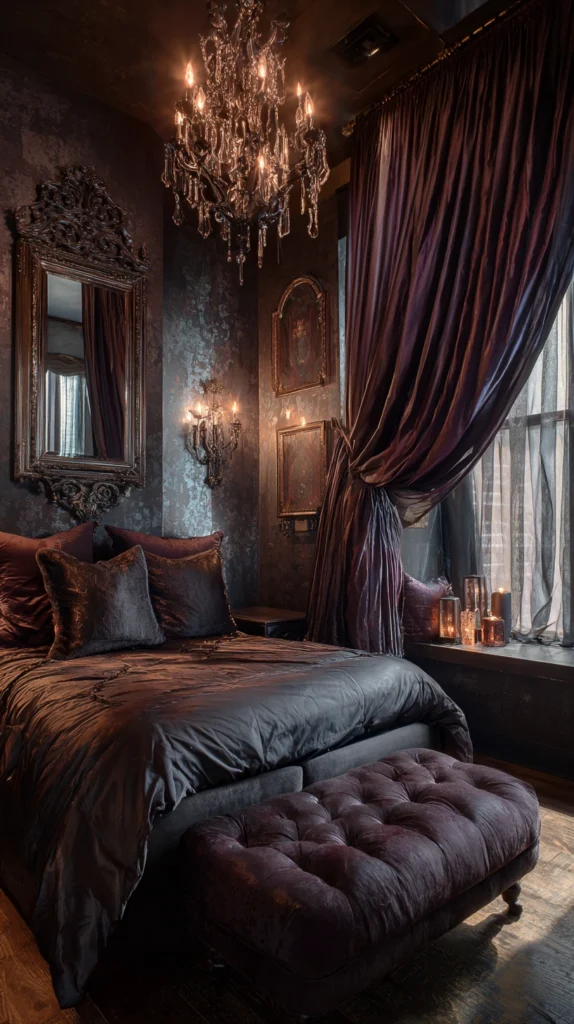
The fully committed boudoir bedroom — deep dramatic walls in a dead-flat finish, floor-to-ceiling velvet curtains pooling on the floor, a channel-tufted upholstered bed in a slightly deeper tone than the walls, layered bedding in satin and velvet with a bolster and decorative cushions, a crystal chandelier on a dimmer, a fabric canopy gathered from the ceiling above the bed, a mirrored bedside table and chest of drawers, a perfume display on a mirrored tray, a vintage gallery wall of ornate frames, a candelabra and pillar candle cluster on every surface, a weekly fresh flower arrangement in a crystal vase, a silk robe on an ornate hook, and a vanity table with Hollywood lighting — is a room that makes every ordinary moment within it feel quietly extraordinary.
Paint: $60 – $200. Curtains: $240 – $800. Bed frame: $300 – $2000. Bedding: $235 – $590. Chandelier: $80 – $500. Canopy: $50 – $270. Mirrored furniture: $280 – $1100. Vanity: $350 – $1170. Gallery wall: $50 – $360. Candles and lighting: $74 – $215. Flowers: $15 – $40 weekly. Robe and hook: $60 – $280. Total fully committed boudoir bedroom: $1774 – $7525 — the cost of a room built for the serious pursuit of beauty and rest.
Decor tip: Complete the boudoir bedroom at dusk rather than in daylight for the final assessment of the scheme. The boudoir is a room of evening and lamplight — its palette, its textiles, and its lighting are all calibrated for the warm artificial light of the hours after sunset. A room assessed only in daylight is a room half-assessed. The same room seen in the light of a dimmed chandelier, a cluster of pillar candles, and two warm bedside lamps is the room as it was designed to be experienced — and that is the assessment that matters most.
The boudoir bedroom is not a style to be achieved and then left unchanged. It is a room that deepens over time — with each new flower arrangement, each additional candle, each antique frame found at a market and added to the gallery wall, each vintage textile that arrives and finds its place within the existing scheme.
It improves with inhabitation. It rewards the daily attention of someone who takes their private spaces seriously. And it produces, evening after evening, the particular quality of being somewhere entirely beautiful and entirely private that is one of the most underrated pleasures available to a person who has taken the trouble to create it.
Invest in the foundations — the wall colour, the curtains, the bed. Then build the layers slowly, with pleasure, and without hurrying toward a finished version that does not exist. The boudoir is never finished. It is always coming.