14 Small Backyard Waterfall Ideas That Make a Big Impact
There is a persistent and entirely incorrect belief that a water feature requires space to be meaningful — that the modest backyard, the narrow courtyard, the small urban garden cannot contain a waterfall that produces a genuine quality of atmosphere rather than merely a decorative gesture.
The opposite is true. In a small space, moving water is proportionally more transformative than it is in a large one. The sound fills the space more completely. The visual presence of the feature is more immediate. The relationship between the water and the person sitting near it is more intimate and more specifically personal.
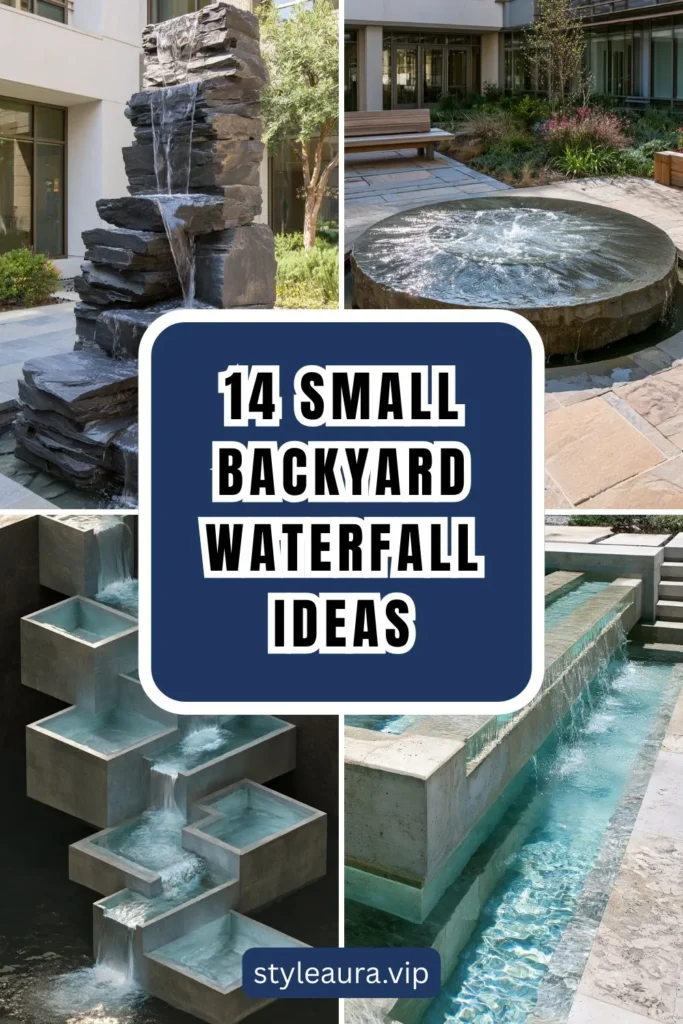
A small backyard waterfall done with genuine thought — chosen for the specific character of the space, built with materials that belong to the garden rather than arriving from a catalogue, and positioned in direct relationship to the primary seating area — transforms a modest outdoor space into something that feels genuinely designed and genuinely restorative. The small garden does not need less ambition in its water feature. It needs more precision.
The fourteen ideas below cover every approach to the small backyard waterfall — from a single pot on a terrace to a compact naturalistic cascade in a narrow garden bed.
1. The Single Pot Fountain
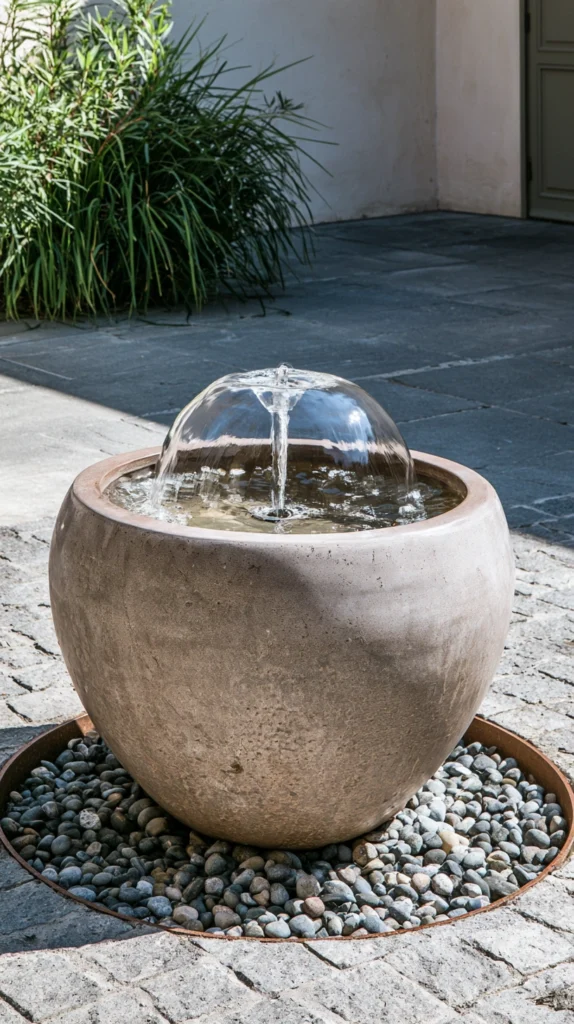
Budget: $50 – $250
A large glazed or terracotta pot — a submersible pump inside, water rising through a pipe to bubble gently from the pot’s opening before overflowing across the exterior and falling into a pebble-filled reservoir below — is the most compact, the most affordable, and the most immediately achievable small garden waterfall available. It requires no excavation, no liner, no planning, and no specialist skills. It requires only the pot, the pump, the reservoir, and an outdoor power source.
A large glazed pot — $30 – $80. A small submersible fountain pump — $20 – $50. A pebble reservoir kit — $40 – $80. Smooth river pebbles for the reservoir surface — $15 – $30. An outdoor electrical connection — $0 if an existing outdoor socket is available. Total investment: $105 – $240 for a self-contained, fully recirculating water feature that can be installed in an afternoon.
Styling tip: Choose a pot with a narrow neck rather than a wide opening so that the water emerges as a controlled, glassy dome from the centre rather than spreading broadly across a wide opening. A narrow-necked pot produces a precisely focused overflow that follows the contours of the ceramic with elegance. A wide-necked pot produces a broader, more dispersed water movement that reads as less controlled and less specifically beautiful.
2. The Wall-Mounted Copper Spout
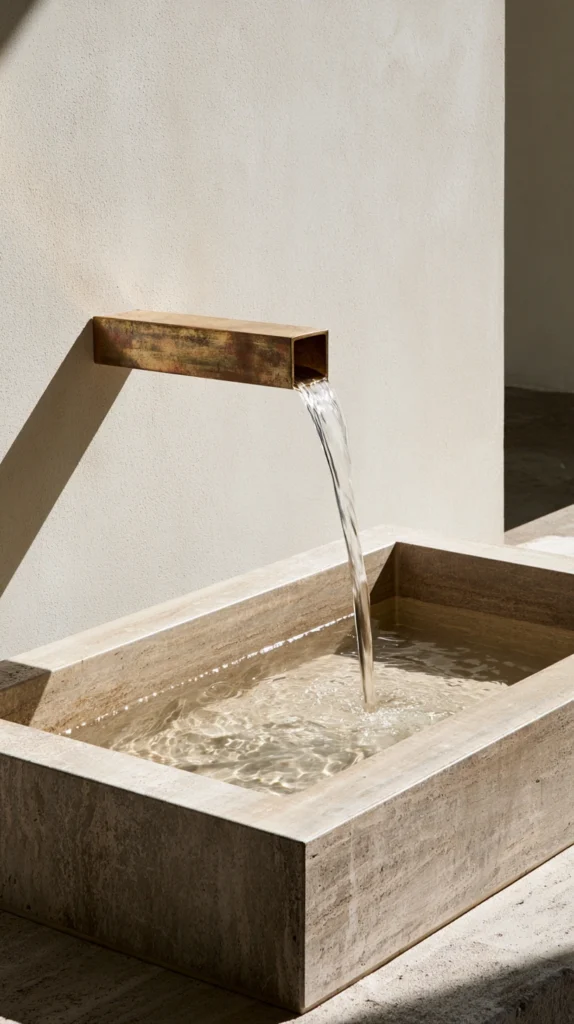
Budget: $80 – $500
A single copper or brass wall spout — mounted on a garden wall or a fence post, delivering a controlled arc of water into a small stone or ceramic basin below — is the most formally composed and the most architecturally appropriate small garden waterfall for a courtyard, a walled garden, or any small space with a defined vertical surface. The copper develops a green-grey patina over time that reads as genuinely beautiful and genuinely aged — the water feature improving in appearance with every passing season.
A copper or brass wall spout — $30 – $80. A garden wall or fence post as the mounting surface — existing at no additional cost. A small stone, terracotta, or ceramic basin — $30 – $100. A submersible pump to recirculate from the basin back to the spout — $25 – $60. Clear pipe connecting the pump to the spout — $5 – $15. Total investment: $90 – $255 for a formal water feature of considerable character in a minimal footprint.
Styling tip: Position the wall spout at a height where the arc of falling water is visible from the primary seated position in the garden — so that the movement of the water and its arrival in the basin below can be seen as well as heard. A spout mounted too high produces a water arc that is visible only when standing directly in front of it. One mounted at seated eye height — approximately 1.2 metres from the ground — produces a water arc that is a genuinely active visual element from the garden’s most used position.
3. The Stacked Slate Waterfall
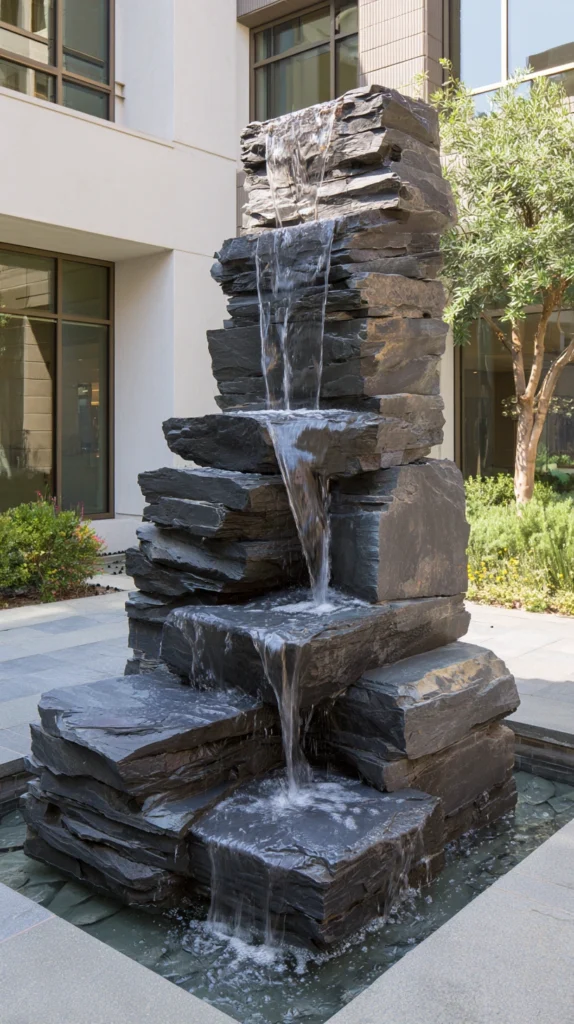
Budget: $150 – $800
A stack of flat slate pieces arranged at graduated heights — water pumped to the summit and flowing down through the gaps between the stacked plates in a series of thin, precise falls — is the most contemporary and the most architecturally compact waterfall available for a small garden. The dark planes of the slate and the thin sheets of water between them produce a feature that reads simultaneously as geological and as precisely designed without consuming more than approximately 60 by 60 centimetres of garden floor space.
Flat slate pieces in varying sizes — $40 – $100 per bag. A small reservoir basin and pump — $60 – $150. Waterproof adhesive or mortar to secure the stack — $15 – $30. Surrounding pebbles — $15 – $30 per bag. Total investment: $130 – $310 for a feature that fits in a corner, against a wall, or within a narrow planting bed.
Styling tip: Tilt each slate layer two to three degrees backward so that water flows forward over the leading edge rather than running back between the plates. A correctly tilted slate stack produces clean, defined falls at each plate edge — each tier of water visible as a distinct, glassy sheet. An untilted stack allows water to find its own path, which produces an irregular and unpredictable flow that undermines the precise, architectural quality the stacked slate format is designed to create.
4. The Miniature Rock Cascade
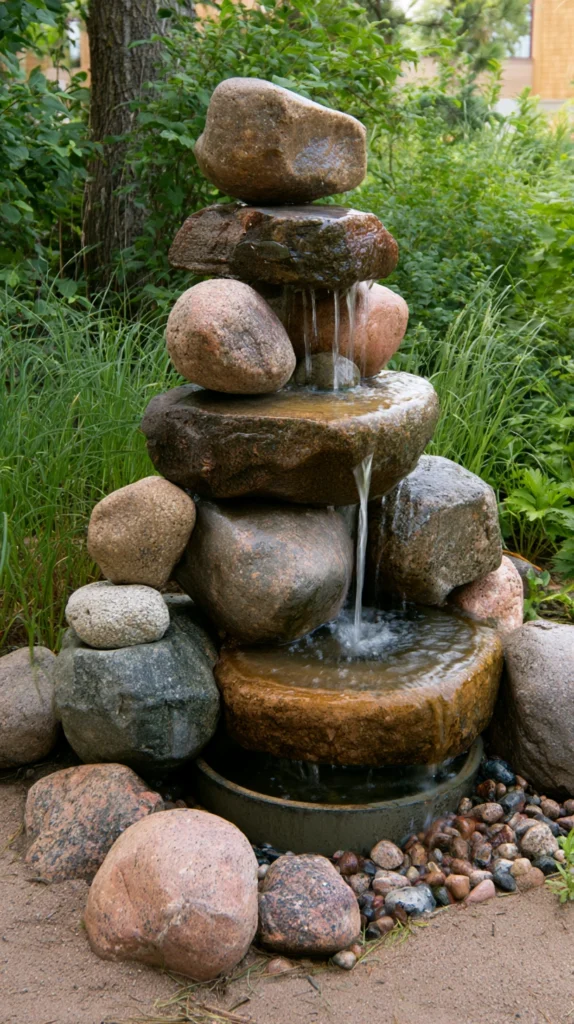
Budget: $200 – $1500
A miniature rock cascade — three or four smooth natural stones or slate pieces arranged at slightly different heights in a shallow planting bed, with water pumped from a small reservoir to the highest stone and flowing from stone to stone into a small pool below — produces the naturalistic beauty of a full rock waterfall in a fraction of the space. In a narrow border or a garden corner, a well-assembled miniature cascade reads as a genuinely natural feature rather than a small version of something that should be larger.
Three to four medium-sized smooth natural stones — $20 – $60 per stone. A flexible liner for the small pool at the base — $20 – $50. A small submersible pump — $30 – $80. Marginal planting around the pool edge — ferns, mosses, creeping jenny — $8 – $20 per plant. Total investment: $150 – $450 for a naturalistic cascade in a garden bed no wider than one metre.
Styling tip: Choose stones for the miniature cascade from the same geological family as any existing stone in the garden — the same sandstone, the same limestone, the same dark basalt. Stones that match the existing garden’s hard landscaping read as belonging to the garden. Stones from a different geological family read as placed — a subtle quality difference that is immediately and instinctively perceived even by garden visitors who cannot articulate why one arrangement convinces and the other does not.
5. The Raised Trough Overflow
Budget: $200 – $1500
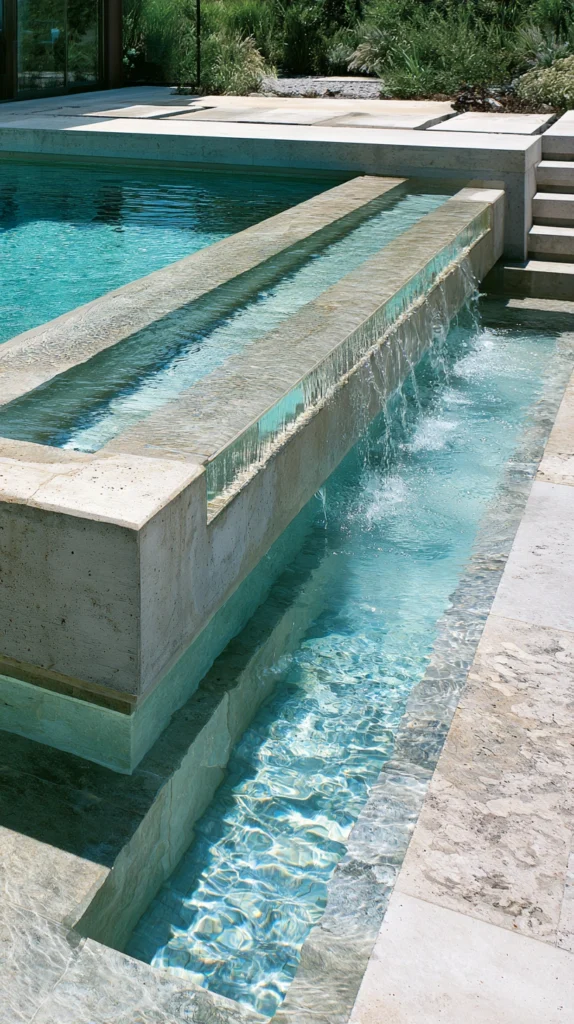
A raised trough — a narrow, rectangular water-filled container in stone, concrete, render, or timber with a waterproof liner, elevated 30 to 60 centimetres above the surrounding paving, its water overflowing one edge in a continuous sheet into a catch channel below — is the most formally elegant and the most space-efficient waterfall format available for a small contemporary garden. The narrow trough footprint makes it appropriate for even the smallest terrace, and the overflow edge produces a waterfall of genuine visual quality.
A stone or rendered concrete raised trough — $200 – $800 professionally constructed. A timber trough with a waterproof liner — $100 – $300 as a DIY project using sleepers or hardwood timber. A catch channel or basin below the overflow edge — $50 – $200 in additional materials. A small recirculating pump — $40 – $100. Total investment: $390 – $1400 for a formal water feature of considerable architectural authority in a small space.
Styling tip: Keep the water level in the raised trough as high as possible — within one centimetre of the overflow edge on the fall side and within two to three centimetres on the remaining sides. A trough filled to near-capacity reads as a mirror — reflecting the sky and the surrounding planting. A trough filled to half its capacity reads as a container with water in it. The water level is the single most important maintenance decision for any formal water feature and the one most consistently neglected after installation.
6. The Bamboo Fence Spout
Budget: $60 – $300
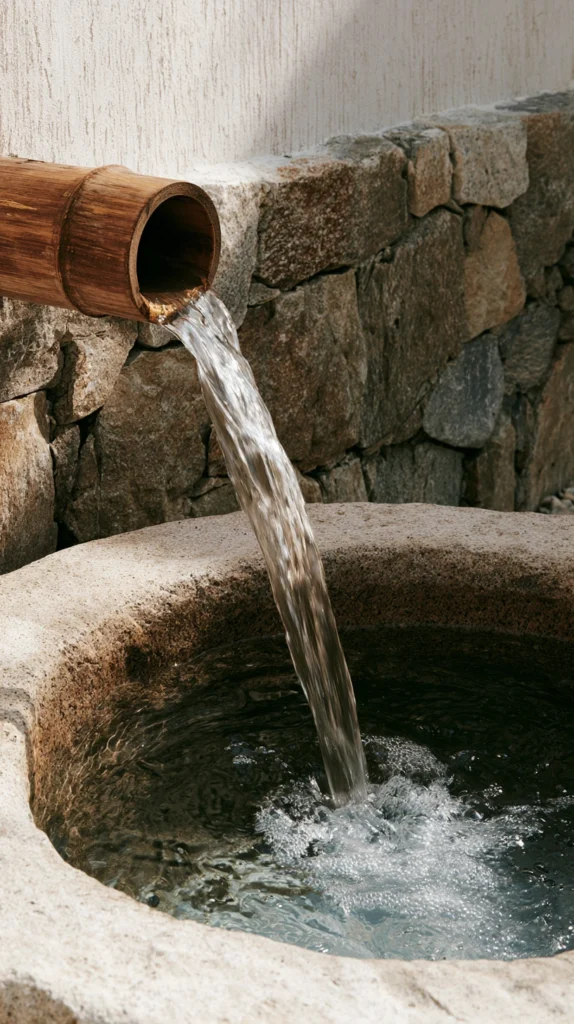
A bamboo spout mounted on a fence or a wall — a length of bamboo delivering water in a controlled pour through a notch cut in the bamboo’s side into a ceramic or stone basin below — is the most specifically Japanese and the most materially honest of all the small garden waterfall formats. The natural bamboo, the controlled pour, and the sound of water on stone produce a combination of sensory qualities that no manufactured water feature can replicate at this price point.
A length of bamboo — $5 – $20 from a garden or craft supplier. A copper pipe insert for the water delivery — $5 – $15. A ceramic or stone basin — $30 – $100. A small submersible pump — $25 – $60. Clear pipe from the pump to the bamboo inlet — $5 – $15. Total investment: $70 – $210 for a water feature of specific charm and genuine material honesty.
Styling tip: Replace the bamboo spout element every one to two seasons as the natural bamboo weathers and begins to split. A fresh bamboo spout is pale and clean. A weathered bamboo spout after two seasons outdoors is grey, slightly cracked, and no longer watertight at the notch. The replacement cost is pennies and the installation takes twenty minutes — and a fresh bamboo spout communicates care and attention in a way that a weathered and splitting one does not.
7. The Compact Rill With a Fall
Budget: $300 – $2000
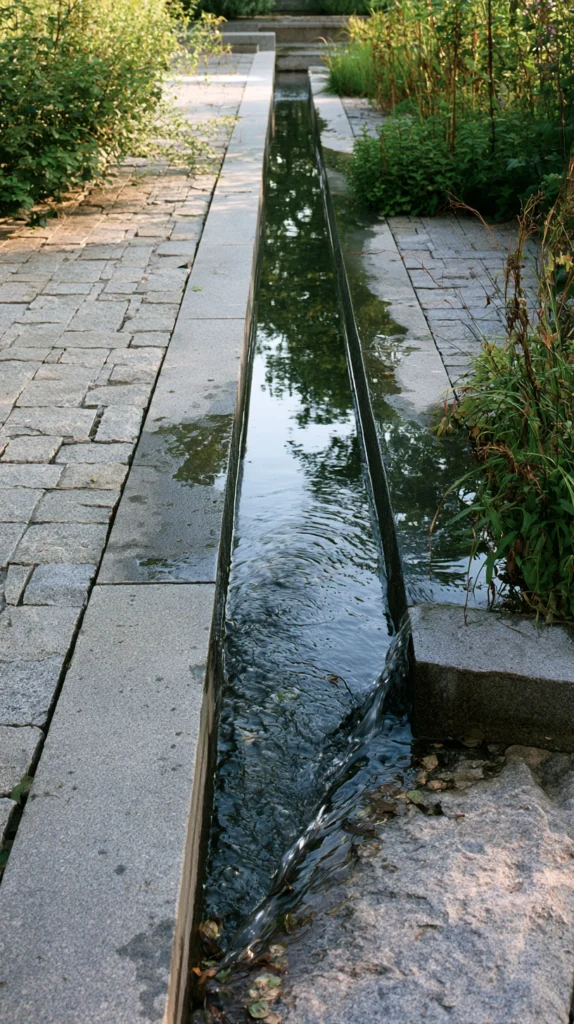
A narrow rill — a precise water channel, 15 to 20 centimetres wide, running two to three metres along the edge of a terrace, patio, or garden path — that terminates in a small fall into a basin at one end, produces a water feature of considerable visual elegance in a minimal floor space. The rill defines the edge of the outdoor space, produces a gentle continuous sound along its full length, and delivers a small but genuine waterfall at its terminus.
A narrow rill in a smooth rendered finish — $200 – $600 per linear metre professionally constructed. A two-metre rill with a basin at one end — $400 – $1200 in total. A small recirculating pump — $60 – $150. Total investment: $460 – $1350 for a water feature that occupies only the width of a standard house brick along its full length.
Styling tip: Align the rill with the primary sight line of the garden — running away from the house along the garden’s central axis rather than across it or diagonally. A rill on the garden’s central axis draws the eye along the garden’s full length, making the space feel longer and more deliberately organised. A rill running across the width of a small garden makes the space feel narrower by drawing the eye to the garden’s shorter dimension.
8. The Millstone in a Small Courtyard
Budget: $150 – $1000
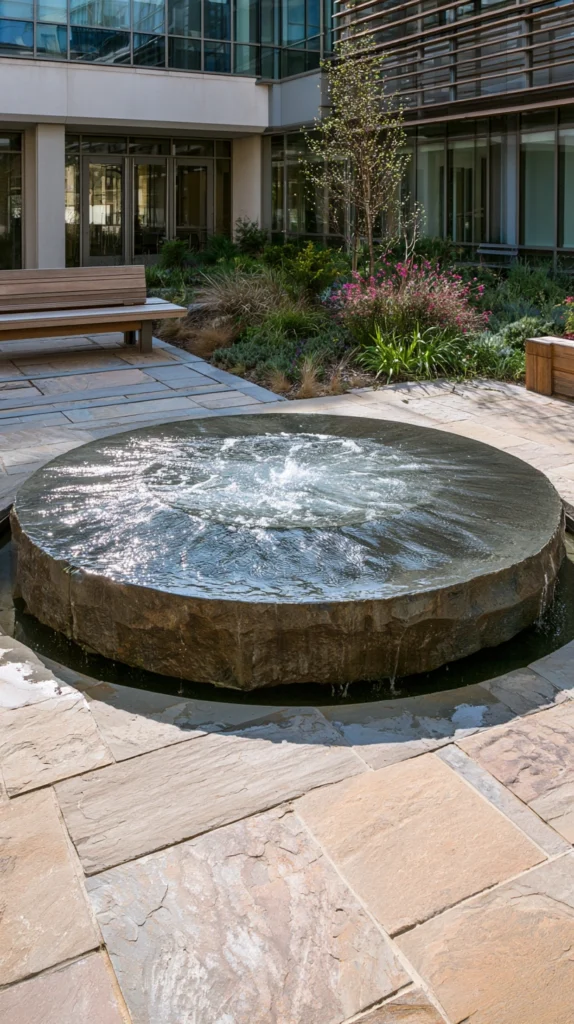
A millstone water feature — a circular stone disc through which water wells from the centre and flows across the surface in all directions before falling over the edge into a pebble reservoir below — is the ideal water feature for a small courtyard or a paved urban garden because it occupies only the diameter of the stone itself, requires no pond or open water, and produces a continuous, gentle sound that fills the bounded space of a walled courtyard with genuine resonance.
A genuine millstone from a reclamation yard — $150 – $400. A purpose-made stone or reconstituted stone disc — $80 – $250. A pebble reservoir kit with pump — $60 – $150. Smooth pebbles for the reservoir surface — $15 – $30 per bag. Total investment: $305 – $830 for a courtyard centrepiece that works as a visual focal point when the water is off and as an atmospheric sound source when it is on.
Styling tip: Position the millstone water feature as the courtyard’s visual centrepiece — at the intersection of its two primary sight lines or at the centre of its main paved area — rather than in a corner. A millstone in the centre of a small courtyard reads as the space’s organising element. The same millstone in a corner reads as an addition to a space that was designed around something else. Small spaces benefit from decisive centring of their primary feature.
9. The Planted Bog Garden Trickle
Budget: $100 – $600
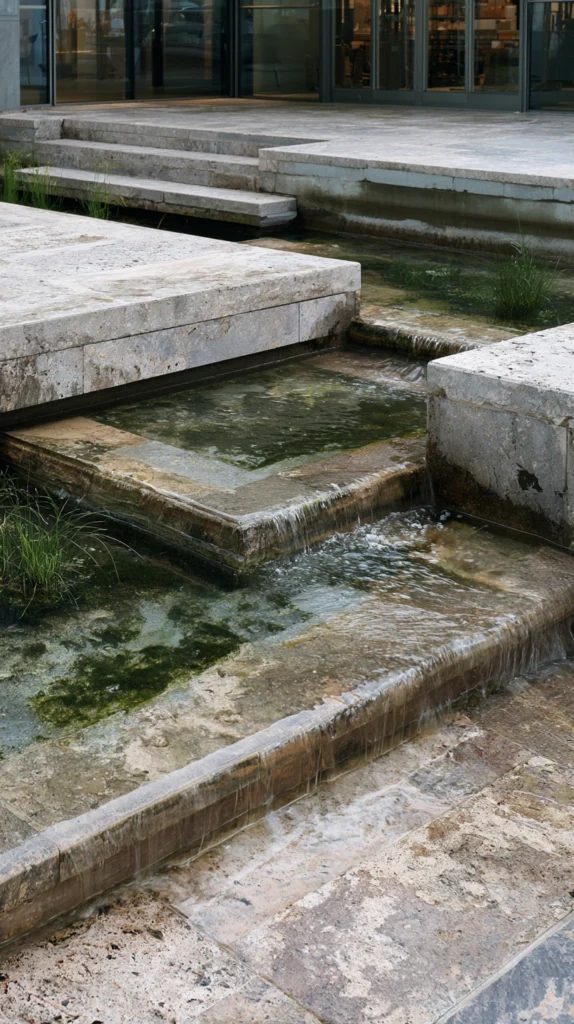
A bog garden trickle — a shallow, permanently wet garden area planted with moisture-loving species, fed by a small pump that delivers a gentle trickle of water from a slightly raised stone at one end — produces the most naturalistic and the most ecologically generous water feature available for a small garden. It is not a waterfall in the dramatic sense. It is water moving through a planted landscape in the quietest and the most specifically natural way available.
A shallow bog garden basin — a flexible liner in a shallow depression 20 centimetres deep — $30 – $80 in liner. A small pump and inlet pipe — $30 – $80. A raised inlet stone at the water’s source — $10 – $30. Moisture-loving planting — ferns, hostas, iris, marsh marigold — $8 – $20 per plant, ten to fifteen plants for a standard small bog garden. Total investment: $148 – $490 for a garden feature that improves ecologically with every passing season.
Styling tip: Allow the bog garden planting to mature for one full growing season before assessing whether the water feature is working aesthetically. A newly planted bog garden in its first spring looks sparse and unconvincing. The same garden in its second summer — with established ferns unfurling, iris in flower, and creeping jenny spreading across the water surface — looks like a genuinely natural wet garden that has been in the landscape for years.
10. The Terrace Edge Blade Waterfall
Budget: $300 – $2000
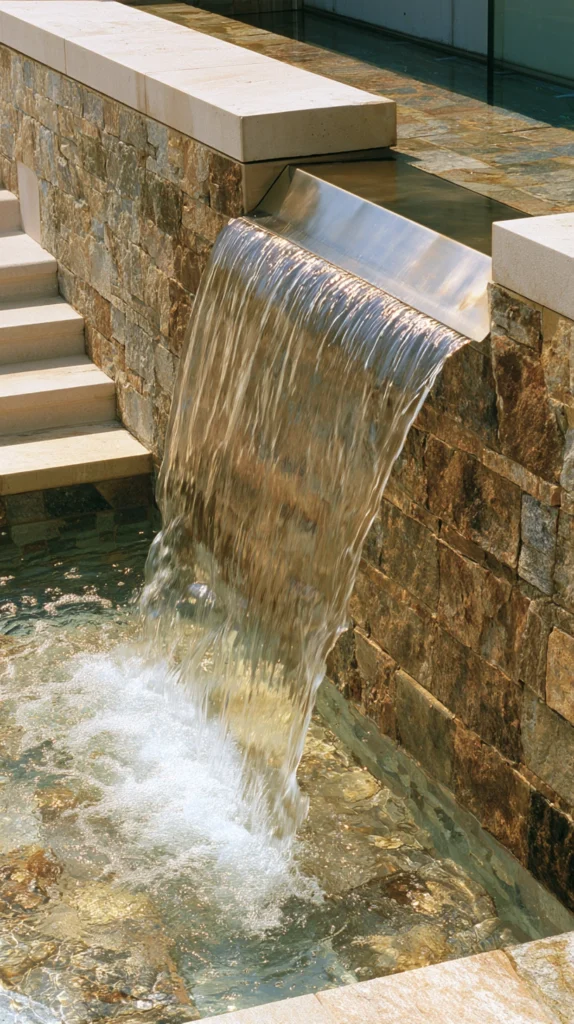
A blade waterfall at the edge of a raised terrace — a thin stainless steel or stone blade from which water flows in a perfectly even sheet over the terrace edge into a narrow catch basin below — is the most specifically contemporary and the most architecturally precise small garden waterfall available. In a small outdoor space with clean lines and deliberate geometry, a terrace edge blade waterfall reads as an architectural detail rather than a garden ornament.
A stainless steel blade waterfall panel in a standard width — $200 – $600 for the fabricated element. A narrow catch basin below the blade — $80 – $300 in concrete or stone. A small recirculating pump — $60 – $150. Professional installation including the blade mounting and the pump plumbing — $200 – $500. Total investment: $540 – $1550 for a water feature that reads as integral to the terrace’s architecture.
Styling tip: Light the blade waterfall with a small underwater LED in the catch basin below — positioned to shine upward through the falling sheet of water. The underwater light produces a luminous quality in the falling water sheet that overhead or side lighting cannot replicate — the water appearing to glow from within as the light refracts through it. In a small outdoor space, the lit blade waterfall after dark is one of the most specifically beautiful domestic water feature effects available.
11. The Container Water Staircase
Budget: $80 – $400
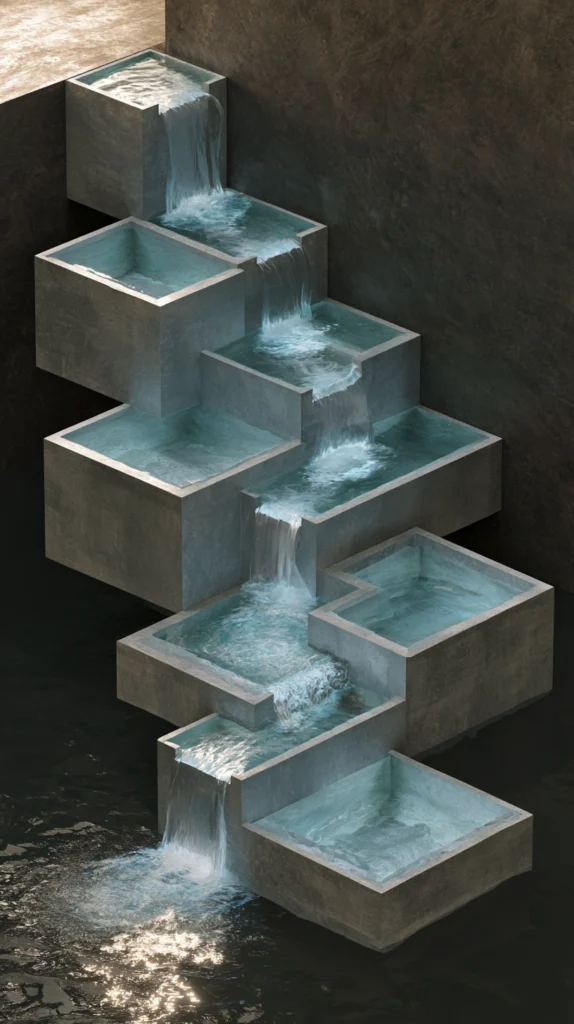
A container water staircase — three or four containers of decreasing size arranged at graduating heights, water overflowing from the highest to the lowest in a cascade of small falls — is the most improvised and the most creatively flexible small garden waterfall available. The containers can be ceramic pots, terracotta dishes, stone bowls, or metal trays — whatever material suits the garden’s aesthetic and the gardener’s existing resources.
Three to four containers in varying sizes — $15 – $50 each. A small submersible pump in the lowest container — $25 – $60. Clear pipe from the pump to the highest container — $5 – $15. Waterproof sealant for any containers that are not fully watertight — $5 – $15. Total investment: $80 – $225 for a water feature that can be assembled in two hours with no specialist skills and reconfigured seasonally.
Styling tip: Choose containers for the staircase from the same material family — all terracotta, all ceramic in a complementary glaze range, or all in the same stone — rather than mixing materials across the cascade. A container staircase in matched materials reads as a designed installation. The same cascade in mismatched materials reads as improvised — which can be charming in a bohemian context but undermines the specific water feature quality of the arrangement.
12. The Wildlife Trickle Pond
Budget: $80 – $400
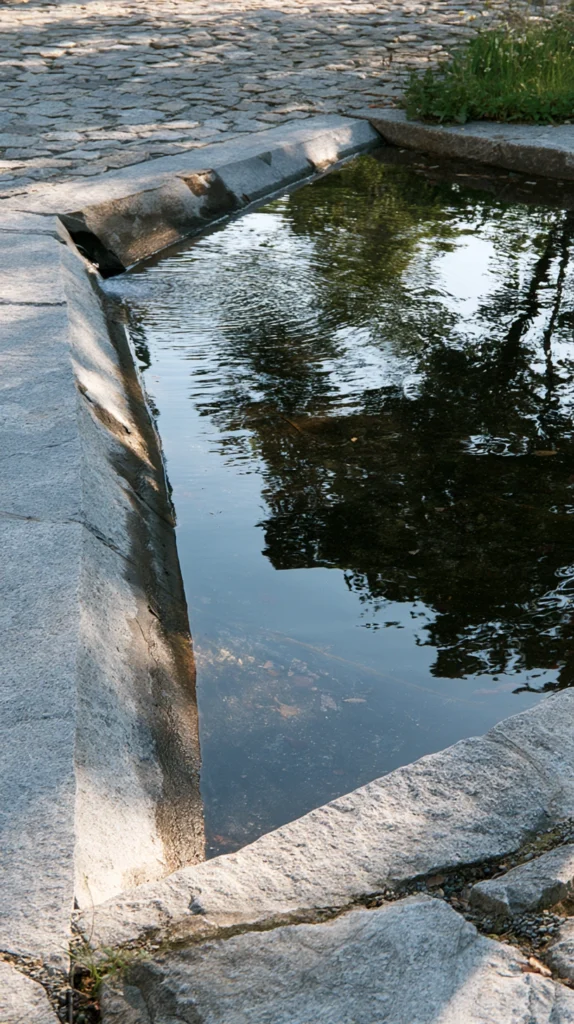
A wildlife trickle pond — a small, shallow pond with a gently sloping beach of pebbles, a single stone at one end from which water trickles from a small pump into the pond surface, and marginal planting around the edges — is the small garden water feature that delivers the greatest ecological return per pound spent. A wildlife pond with moving water, however modest, becomes a drinking, bathing, and breeding resource for birds, hedgehogs, bees, and dragonflies within weeks of installation.
A small wildlife pond using a flexible liner — $20 – $60 for the liner. A small pump and inlet stone — $30 – $80. A pebble beach at one end of the pond — $10 – $20 in pebbles. Marginal planting — marsh marigold, water mint, and creeping jenny — $8 – $20 per plant, five to eight plants for a small pond. Total investment: $88 – $260 for a water feature that becomes measurably more beautiful and more ecologically valuable with every passing month.
Styling tip: Install the wildlife pond in the sunniest available position in the small garden rather than in shade — even in a small urban garden where shade from surrounding buildings is significant. A wildlife pond in full or partial sun supports more aquatic plant life, more insect life, and more visiting bird species than the same pond in full shade. Shade produces a clear, still pond that looks beautiful and supports relatively little life. Sun produces a productive, sometimes slightly green pond that looks less polished and supports considerably more of it.
13. The Narrow Garden Slot Waterfall
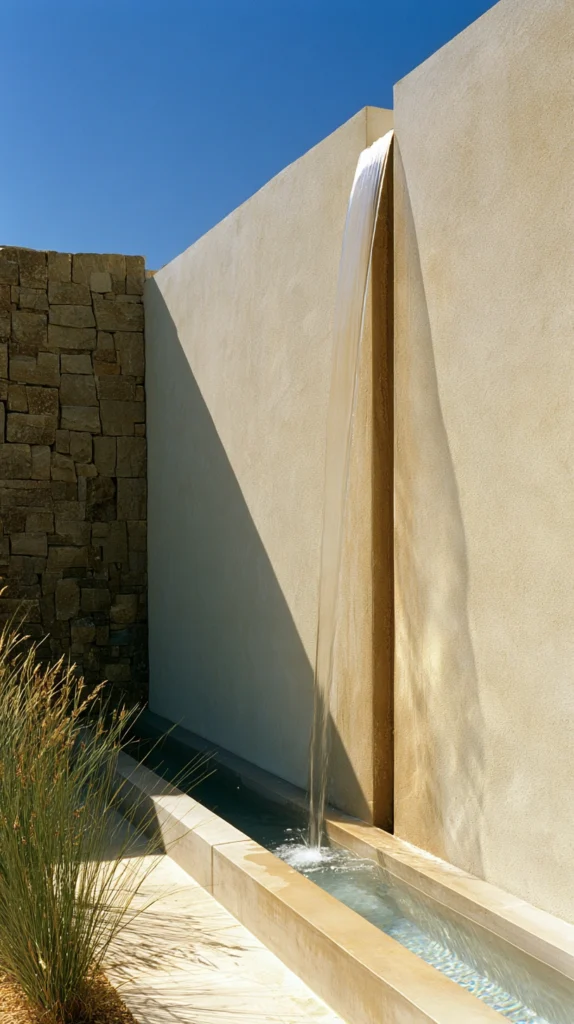
Budget: $500 – $3000
A slot waterfall — a narrow, vertical opening in a rendered wall or a stone surface through which water emerges and falls in a thin, glassy sheet into a floor-level channel or basin — is the most architecturally integrated and the most spatially efficient waterfall available for a narrow garden, a side passage, or any small outdoor space where the waterfall must occupy no floor space at all. The slot is the wall. The water is the feature. The floor space remains entirely available for the garden or the person within it.
A slot waterfall integrated into a rendered garden wall — $500 – $2000 professionally constructed. A freestanding rendered wall panel with an integrated slot — $300 – $1000 as a modular garden structure. A narrow floor channel or basin below the slot — $100 – $400 in concrete or stone. A pump and plumbing behind the wall — $80 – $200. Total investment: $480 – $2600 for a water feature with zero floor space consumption.
Styling tip: Specify the slot in the wall at a width of two to three centimetres for the most elegant water delivery. A narrower slot produces a thinner, more glassy sheet of water. A wider slot produces a broader, more turbulent flow that reads as less precisely controlled. The two-centimetre slot delivers a water sheet that is wide enough to be clearly visible and thin enough to maintain its flat, glassy quality all the way to the basin below.
14. The Fully Designed Small Waterfall Garden
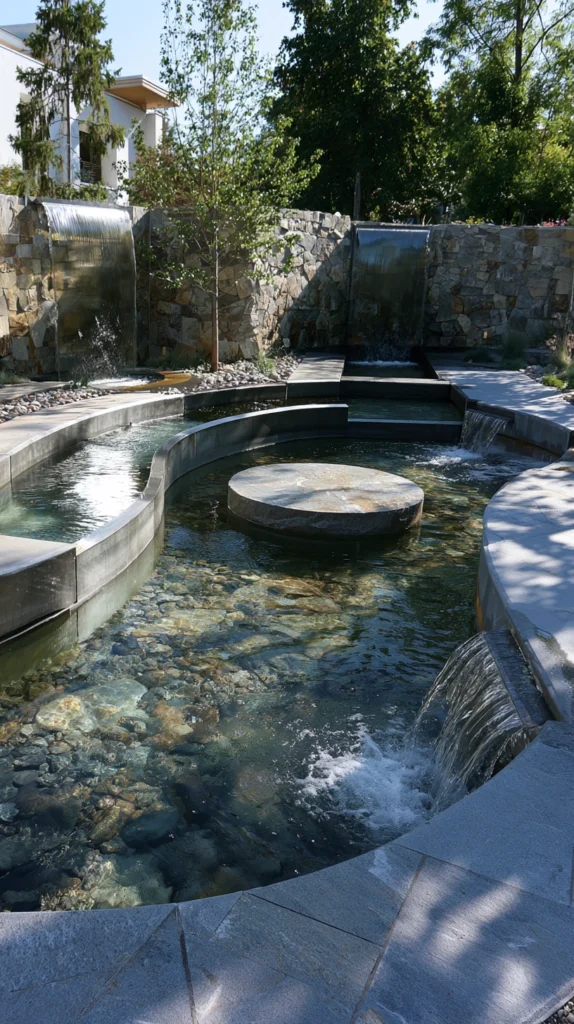
Budget: $500 – $5000
The fully designed small waterfall garden — a raised trough overflow at the garden’s boundary wall, a narrow rill running along the garden’s primary axis from the trough to a millstone feature at the centre, a wildlife trickle pond in the sunniest corner with marginal planting, a wall-mounted copper spout beside the seating area delivering water into a terracotta basin, and the sound of moving water audible from every point in the garden — is a small backyard that has been designed around water as its primary material rather than as an addition to an existing design.
Raised trough overflow: $400 – $1000. Narrow rill: $400 – $800. Wildlife trickle pond: $100 – $300. Wall-mounted spout and basin: $90 – $255. Millstone centre feature: $300 – $800. Connecting plumbing and pump system: $200 – $500. Marginal and associated planting: $150 – $400. Total fully designed small waterfall garden: $1640 – $4055 — the cost of a small garden that has been genuinely transformed by the considered and consistent use of a single material at multiple scales throughout the space.
Styling tip: Design the small waterfall garden so that moving water is audible from the primary seating area regardless of which specific water feature is the visual focus at that position. Sound is the water garden’s most powerful atmospheric tool in a small space — more powerful than visual presence because it operates continuously and peripherally rather than only when the eye is directed toward the source. A small garden in which water can always be heard is a small garden that always feels like a retreat, regardless of what else is happening within it.
Whatever combination of these fourteen ideas finds its way into the small backyard, the principle beneath all of them is the same one that makes any small garden water feature genuinely transformative rather than merely decorative: the sound of the water should be audible from the seat that is most used, the water should be visible from the house as well as from the garden, and the feature should be made from materials that belong to the specific garden rather than arriving from the generic catalogue of garden water feature options.
A small backyard waterfall does not need to be large to be genuinely impactful. It needs to be precisely placed, carefully specified, and given the time to become part of the garden rather than an addition to it.
Give it the correct position. Give it the correct material. Give it twelve months to settle.
And then sit in the garden on a warm evening when the water is running and the birds have found it and the sound of the street has receded to somewhere entirely irrelevant, and understand that the impact of moving water in a small space is not smaller than the impact in a large one.
It is larger. Because the space is smaller. Because the water fills it completely.