14 California Backyard Ideas That Blur the Line Between Inside and Outside Beautifully
California has spent the better part of a century perfecting the art of the indoor-outdoor home — the house that does not treat the garden as a separate territory to be visited occasionally but as a continuous extension of the living space, as natural and as immediate an environment as any interior room and often, during the eight or nine months of the year when the California climate makes outdoor living genuinely comfortable, more central to daily life than the rooms behind the glass.
The Case Study houses of the 1950s pioneered it architecturally. The beach houses of Malibu and the canyon homes of Topanga perfected it informally.
The wine country estates of Napa and Sonoma gave it a certain agricultural romance. The courtyard homes of Santa Barbara enclosed it in the Spanish Colonial tradition. Each regional expression is different in its specific character but identical in its essential commitment — the commitment to a life lived as fluidly between inside and outside as the weather and the architecture will allow.
The California backyard that genuinely blurs the line between interior and exterior is not simply a backyard with good furniture and a sliding door. It is a space designed with the same material intelligence, the same spatial intention, and the same quality of finish applied to the interior rooms it connects to.
A space that feels like a room, reads like a room, and functions like a room, with the additional quality of open sky above and living landscape around it. These fourteen ideas demonstrate exactly how to achieve that quality in a residential backyard at a range of scales and budgets.
1. Install Full-Width Sliding or Folding Glass Doors
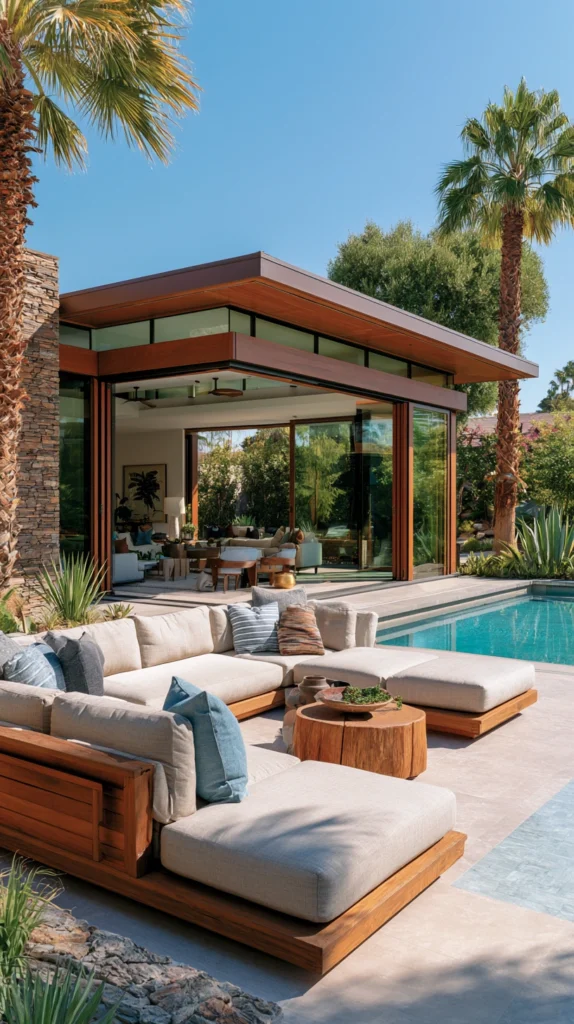
The architectural intervention that most completely and most immediately blurs the indoor-outdoor line is the replacement of a standard rear wall with full-width sliding or folding glass doors that open the entire back face of the living room, kitchen, or dining room to the outdoor space beyond — eliminating the boundary between interior and exterior so completely that the two spaces read and function as a single continuous room when the doors are fully open.
The folding glass door system — its panels stacking neatly to one side when fully open — creates a wall opening of genuine generosity that allows furniture, conversation, sightlines, and the natural movement of people to flow between the indoor and outdoor spaces without any interruption or threshold awareness.
The sliding system — two or more large panels sliding behind each other — creates a similarly generous opening at a lower installation cost and with simpler hardware maintenance requirements over time. Both systems transform the relationship between the house and its garden more completely than any other single intervention, and both represent the foundational architectural decision on which every subsequent indoor-outdoor design choice rests.
2. Continue the Interior Flooring Material Outdoors
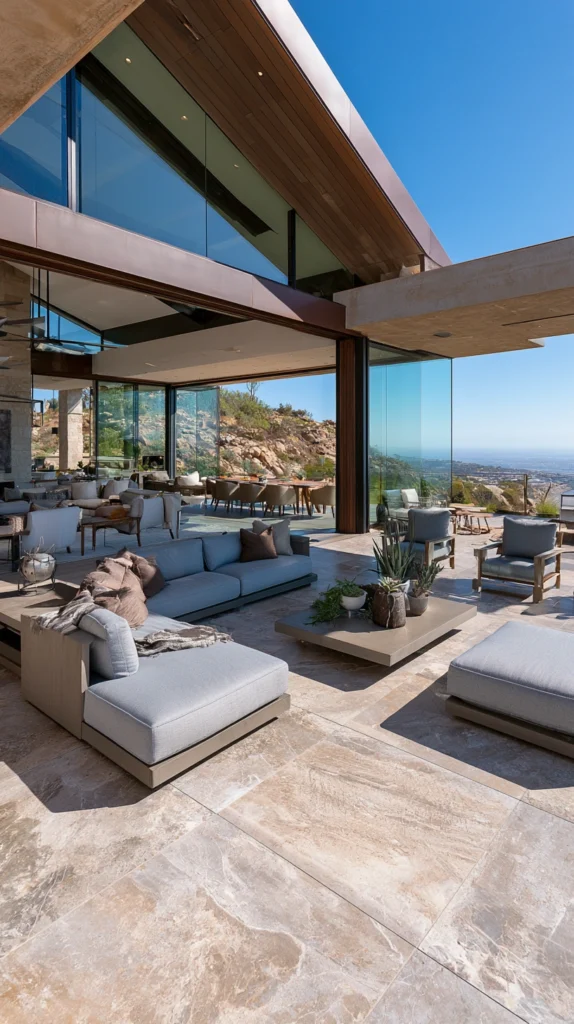
The material continuity between interior floor and exterior floor — the same stone, the same timber species, the same porcelain tile running without interruption from the living room through the open glass doors and across the patio surface .
It is the design detail that does more than any other single element to create the perception of a single continuous space rather than two adjacent but separate ones. When the eye looks from the interior toward the exterior through open glass doors and sees the same material underfoot in both spaces, the brain registers an unbroken room rather than a room with a garden beyond it — the spatial reading is of continuity and unity rather than transition and boundary.
Use a large-format porcelain tile specified for both interior and exterior use, a natural stone available in both indoor-calibrated and outdoor-textured finishes, or a hardwood species rated for covered outdoor use in the California climate, and lay both surfaces at the same level with a minimal threshold detail that does not interrupt the visual flow between them.
3. Design the Outdoor Living Room With Interior-Quality Furniture
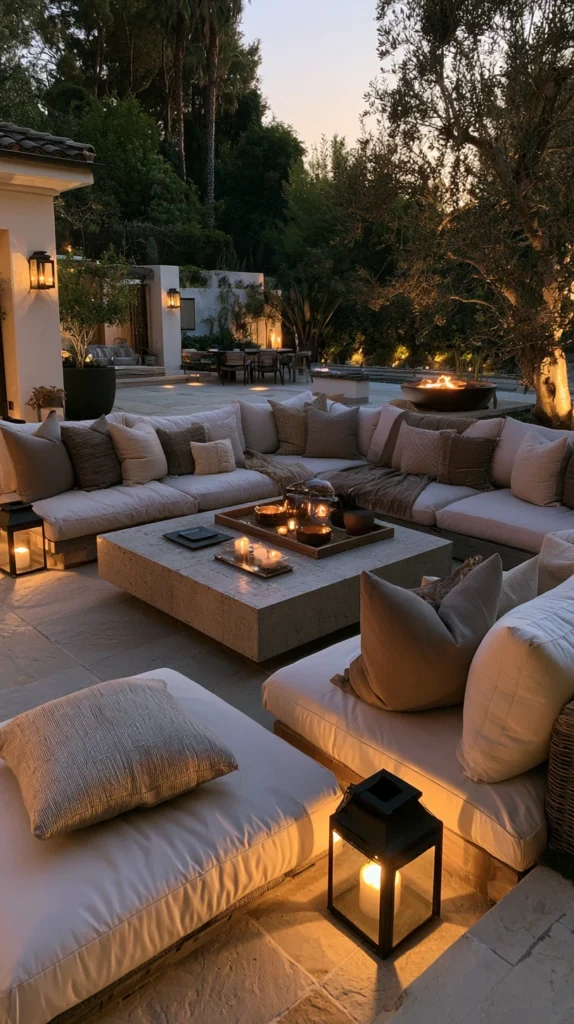
The outdoor living room that genuinely blurs the indoor-outdoor line is furnished with the quality, the comfort, and the material sophistication of an interior living room — deep sofas with thick cushions in high-quality outdoor fabrics, a coffee table in natural stone or reclaimed timber of genuine weight and substance, side tables, a rug, lamps on outdoor power outlets — rather than the lightweight, weather-resistant but visually compromised furniture that most outdoor spaces default to when comfort and durability feel like competing priorities.
Quality outdoor fabric technology — Sunbrella, Perennials, and the other high-performance outdoor textile brands — now produces fabrics of sufficient softness, visual richness, and colour depth to be genuinely indistinguishable from interior upholstery fabric in all but direct tactile comparison, and the outdoor living room furnished in these fabrics with generously cushioned.
Properly proportioned seating reads as an interior room transported outdoors rather than a garden furnished with outdoor furniture. Invest in the furniture quality that the space deserves, protect it with a covered structure above, and the outdoor living room becomes genuinely year-round in the California climate.
4. Install a Covered Outdoor Room With a Solid Roof
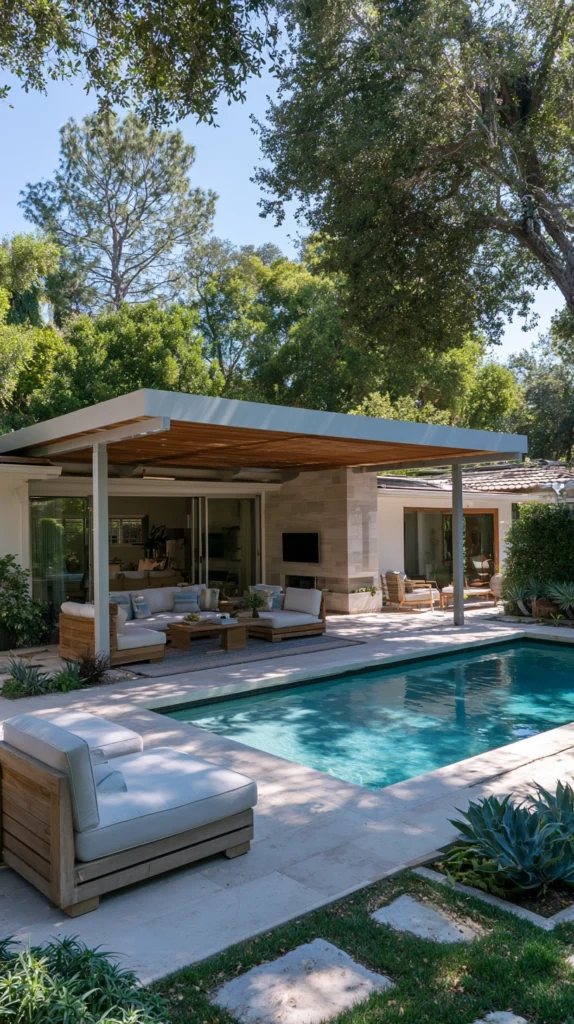
A covered outdoor structure with a solid roof — whether an attached pergola with a weatherproof polycarbonate or timber deck roof, a full room extension with a structural ceiling, or a detached pavilion with a proper architectural roof — creates the outdoor room that is genuinely usable in every California weather condition, protected from the occasional rain of the winter months and the intense midday sun of the summer while remaining open on its garden-facing sides to the air, the landscape, and the quality of outdoor light that makes the California outdoors so compelling.
The solid roof is the detail that converts an outdoor area into an outdoor room — the psychological shift from feeling exposed to feeling sheltered changes the quality of occupation completely, from occasional fair-weather use to genuine daily habitation.
Extend the interior ceiling height and material into the covered outdoor room — the same ceiling finish, the same paint colour, the same lighting specification — to create the strongest possible visual and material continuity between the interior and the covered outdoor space.
5. Create a Kitchen That Opens to and Serves Both Spaces
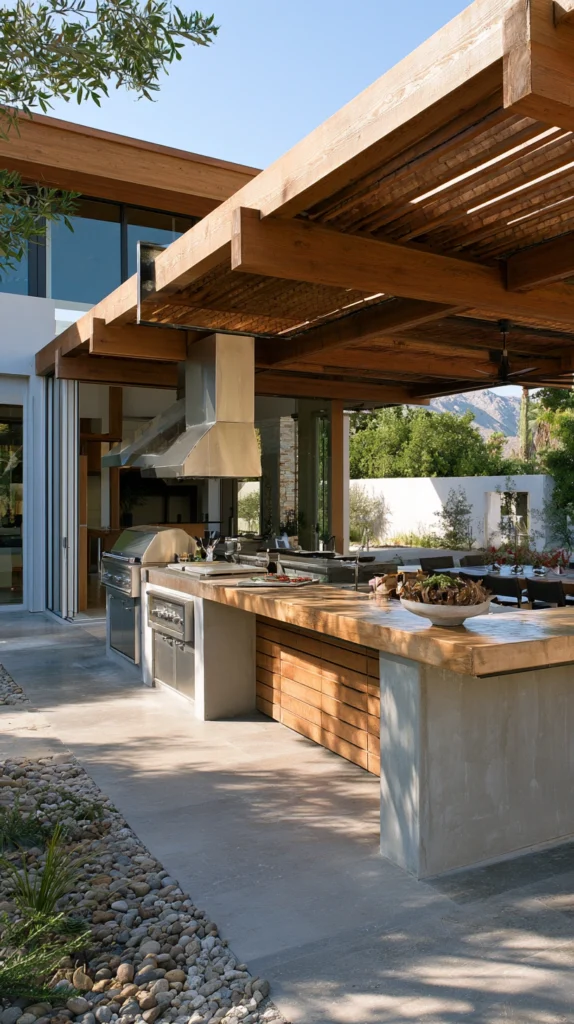
The kitchen positioned at the interior-exterior boundary — with a wide pass-through window or counter opening onto the outdoor living and dining area, an outdoor kitchen counter positioned immediately outside the opening to extend the preparation surface, and the visual and functional connection between indoor cooking and outdoor eating managed as a single continuous food and social experience — is the California indoor-outdoor home at its most genuinely functional and most genuinely pleasurable.
The pass-through window above a kitchen counter that opens onto an outdoor bar or serving surface is one of the most useful and most characterful architectural details available to a California home renovation.
It connects the cook to the garden gathering, allows food and drinks to be passed between spaces without requiring anyone to navigate a door, and creates the informal, flowing quality of social life that California outdoor entertaining at its best naturally produces. Keep the counter height and material consistent between the interior kitchen surface and the exterior serving counter for the visual continuity that reinforces the connected-space reading.
6. Plant the Garden as an Extension of the Interior Colour Palette
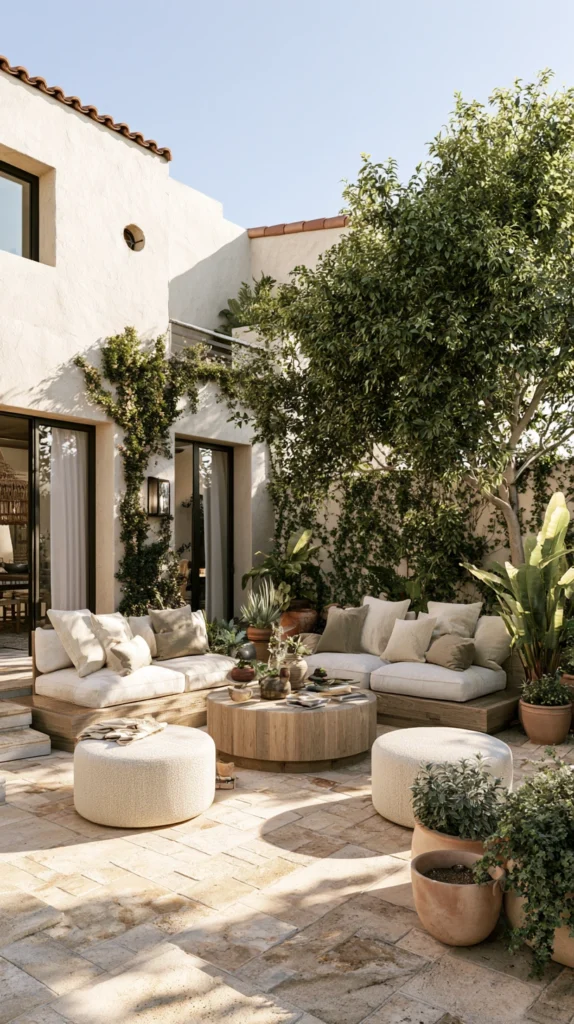
The planting in a California indoor-outdoor backyard should be chosen in deliberate relationship to the interior colour palette — the plants seen through the open glass doors becoming the living wall art of the interior room, their colours, textures, and seasonal changes contributing to the room’s visual character as directly and as continuously as any artwork or surface treatment within the space.
A living room decorated in warm whites, natural linens, and terracotta accents connects most beautifully to a garden planted in warm-toned grasses, silver-grey Mediterranean shrubs, and the deep green of native oaks and sages that connect the garden to the California landscape.
A kitchen in white oak and pale stone looks out most beautifully on a clean, architectural garden of agaves, succulents, and geometric planting that mirrors the kitchen’s material precision in living form. The garden viewed from the interior is a living element of the interior room’s design — design it accordingly.
7. Install Consistent Lighting Across Indoor and Outdoor Spaces
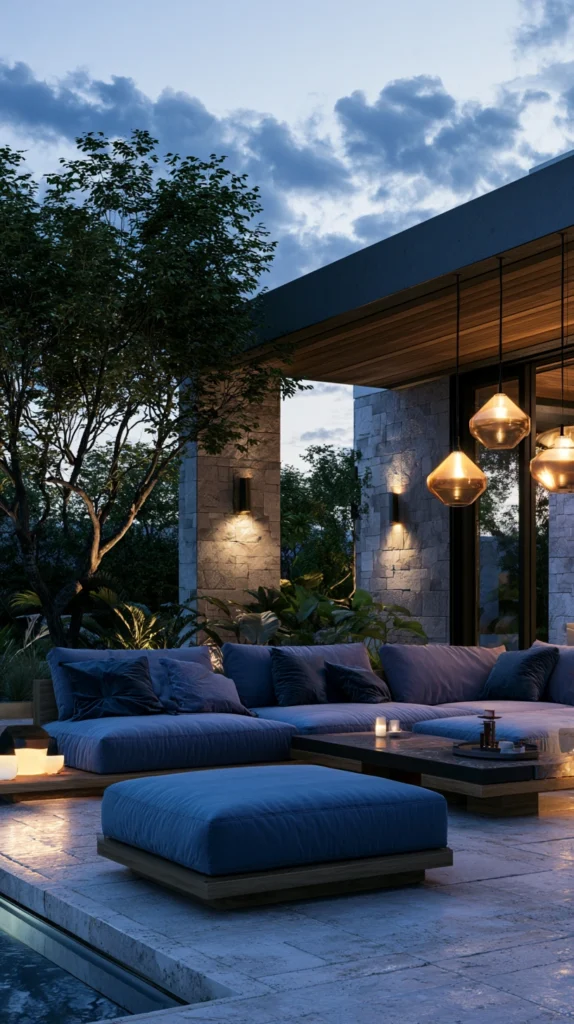
A lighting scheme that uses the same colour temperature, the same fixture family, and the same dimmer-controlled circuits on both sides of the glass wall — the indoor pendant and the outdoor pendant in the same finish, the interior wall sconce and the exterior wall light at the same height and in the same profile, the indoor and outdoor spaces dimming together to the same warm amber quality as the evening progresses — creates a visual continuity after dark that reinforces the single-space reading as powerfully as the floor material continuity does during the day.
The outdoor space that is lit at a different colour temperature or a different brightness level from the interior room it connects to will always read as a separate, adjacent space rather than a continuous one — the lighting discontinuity creates the boundary that the architecture has worked to eliminate. Specify indoor and outdoor lighting from the same fixture range, use the same bulb temperature throughout — 2700K maximum — and control both circuits from the same dimmer panel for effortless management of the unified lighting environment through the evening.
8. Use the Same Paint or Plaster Finish on Interior and Exterior Walls
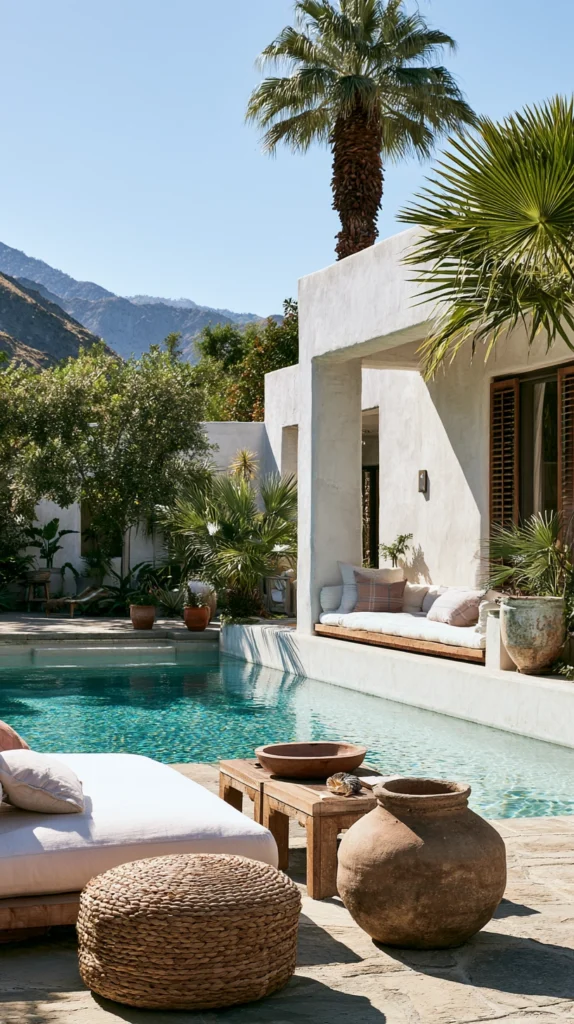
The painted or plastered wall surface that continues from the interior through an open glass door and onto the exterior wall of the house — the same colour, the same finish, the same material language on both sides of the architectural threshold — creates a material continuity that reinforces the indoor-outdoor connection at the level of the wall surface itself, complementing the floor continuity and the furniture quality continuity to create a space that is comprehensively unified in every material dimension.
A limewash finish in a warm white on the interior living room wall that continues around the corner and onto the exterior rendered wall of the house creates the strongest possible visual connection between the two spaces — the texture, the slight variation of the applied surface, and the warm tone are identical on both sides of the door. A simple exterior paint in the exact interior wall colour achieves a similar effect at a lower cost and with broader material applicability to different exterior wall constructions.
9. Add an Outdoor Fireplace or Fire Feature Visible From Inside
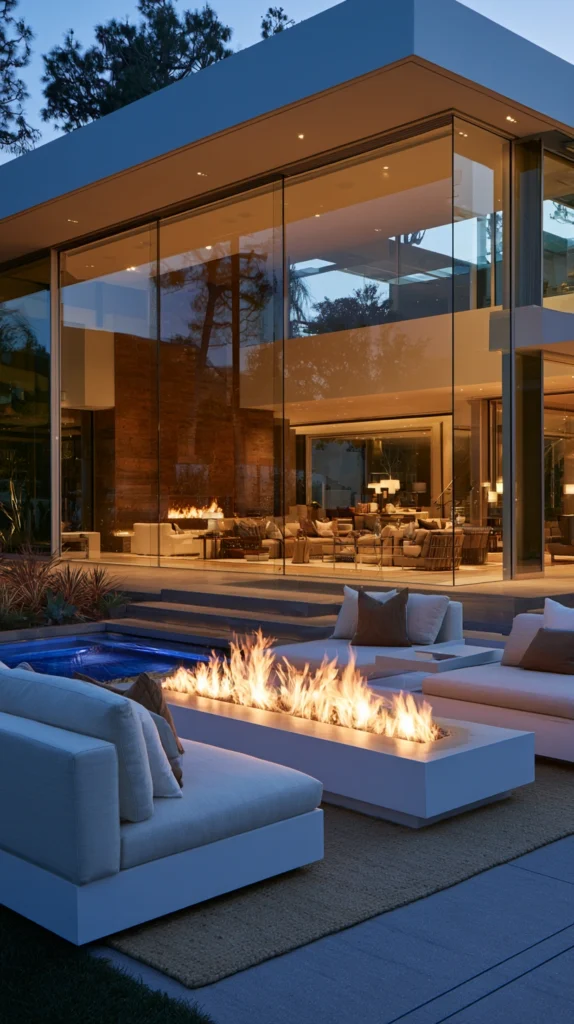
An outdoor fireplace or fire feature positioned in direct sightline from the interior living room — visible through the open or glass-walled boundary between inside and outside, its flame providing warmth and visual interest to both spaces simultaneously — is the element that most powerfully animates the indoor-outdoor connection after dark, when the quality of the visual and experiential relationship between the two spaces is primarily determined by the quality of the light sources active within each.
The outdoor fireplace seen from the interior sofa through open glass doors — its flame moving, its warm light playing across the patio surface, the faces around it, and the garden beyond — transforms the interior room’s visual environment as completely as an interior fireplace does, with the additional quality of framing a living landscape view rather than simply the reflective surface of an interior mantelpiece.
Build the outdoor fireplace in a material that reads from both inside and outside — natural stone, warm render, or Corten steel — and position the interior seating to face it directly.
10. Install an Outdoor Shower Adjacent to the Pool
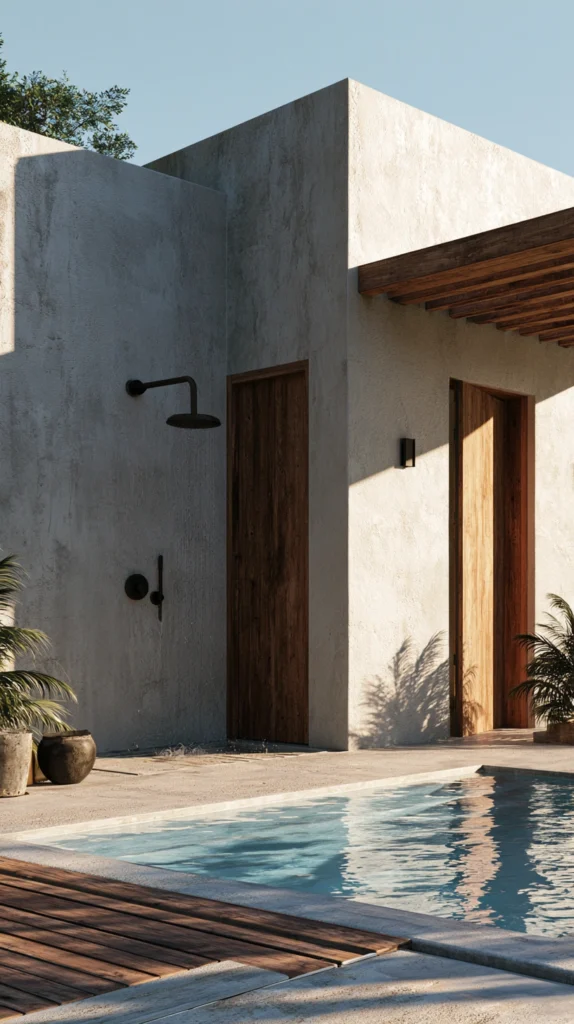
An outdoor shower positioned between the pool and the house — accessible from the pool deck without requiring re-entry to the main house, visible and audible from the indoor living space through open glass doors as a living element of the outdoor environment — is one of the most quintessentially California indoor-outdoor details available to a residential property, a feature that assumes the daily movement between pool and house that the California climate makes so natural and so easy.
The outdoor shower built from natural materials — a timber screen, a stone or concrete base, a quality rainfall head — reads as a genuine architectural feature of the outdoor room rather than a utility installation, and its positioning between pool and house creates a natural transition zone that bridges the wet pool environment and the dry interior living space.
Surround with a single beautiful plant — a mature agave, a clump of tall bamboo, a specimen tree — that provides privacy and a point of botanical interest without requiring the elaborate privacy screening that a less confidently planted shower surround typically needs.
11. Design the Pool as the Garden’s Interior Courtyard
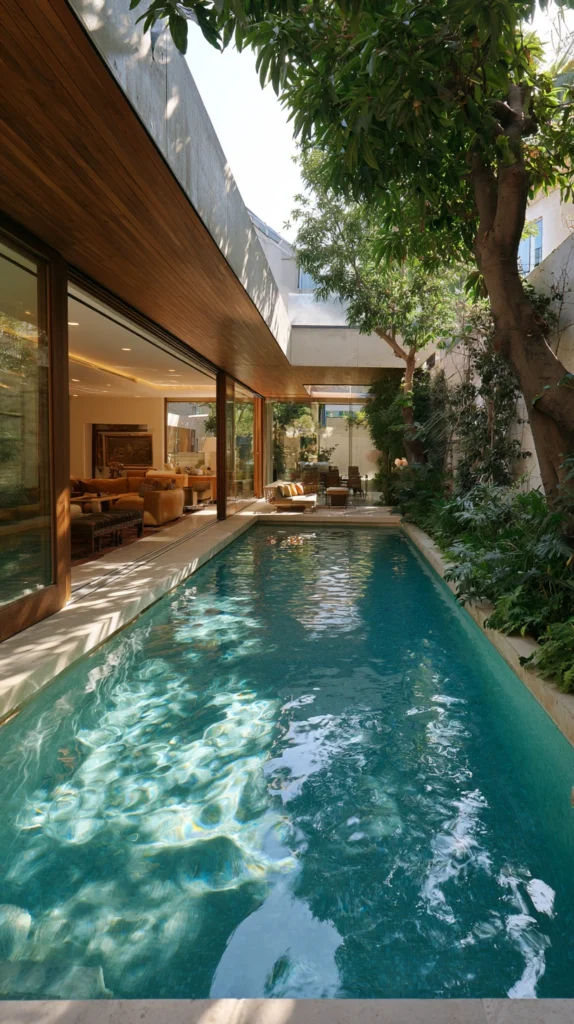
A pool positioned immediately adjacent to the house — its edge coming within a metre or two of the building’s rear wall, its water surface visible from the interior living spaces through the glass wall, its reflections playing across the interior ceiling on sunny days .
It is the California backyard element that most completely and most continuously integrates the outdoor space into the interior experience, making the pool not a destination at the far end of the garden but a constant visual and environmental presence within the house.
The pool as interior courtyard — enclosed on two or three sides by the house’s walls and on the remaining side by the garden beyond — creates the specific quality of the California Case Study house pool: intimate, architecturally integrated, more like a water room than an outdoor swimming pool, its surface reflecting the sky and the surrounding building in a continuous changing composition that makes the interior spaces around it genuinely richer in their visual and atmospheric quality throughout the day.
12. Bring Interior-Quality Art and Objects Outdoors
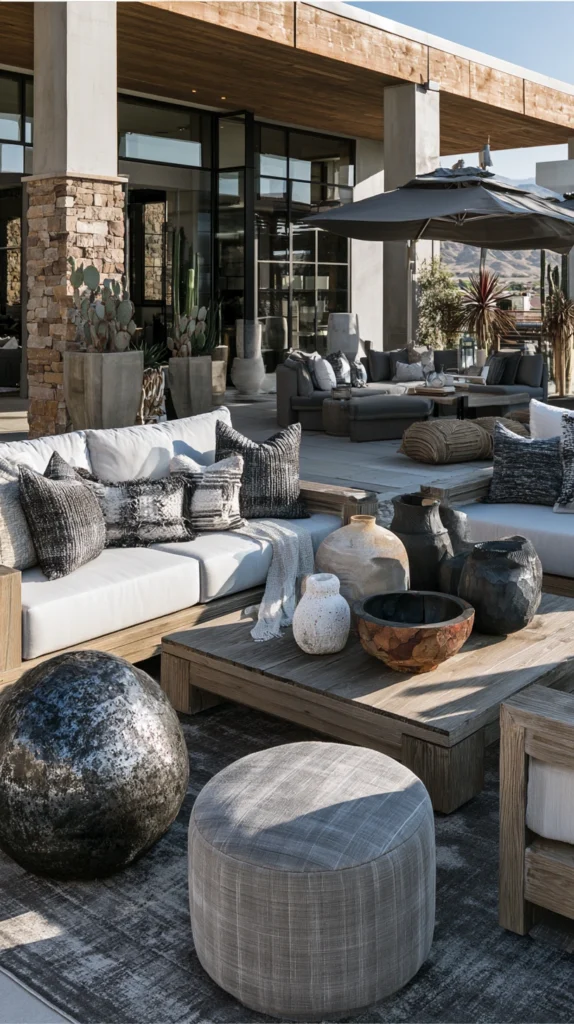
The outdoor space that genuinely reads as a room rather than a garden contains objects — art, sculpture, ceramics, textiles — of sufficient quality and sufficient intentionality to communicate that it was designed rather than furnished, and that the design applied to it was held to the same standard as the interior rooms it connects to.
A large outdoor sculpture positioned in the garden is visible from the interior living room as a composed view from the sofa. A ceramic object on the outdoor dining table of the same quality and the same material language as the ceramics on the interior dining table.
A framed outdoor-rated print on the exterior wall of the covered outdoor room in the same style and the same hanging height as the art on the interior walls around it. These details — individually modest, collectively significant — are what distinguish a designed indoor-outdoor space from an outdoor space that happens to be attached to a well-designed house.
13. Create Consistent Acoustic Quality Across Both Spaces
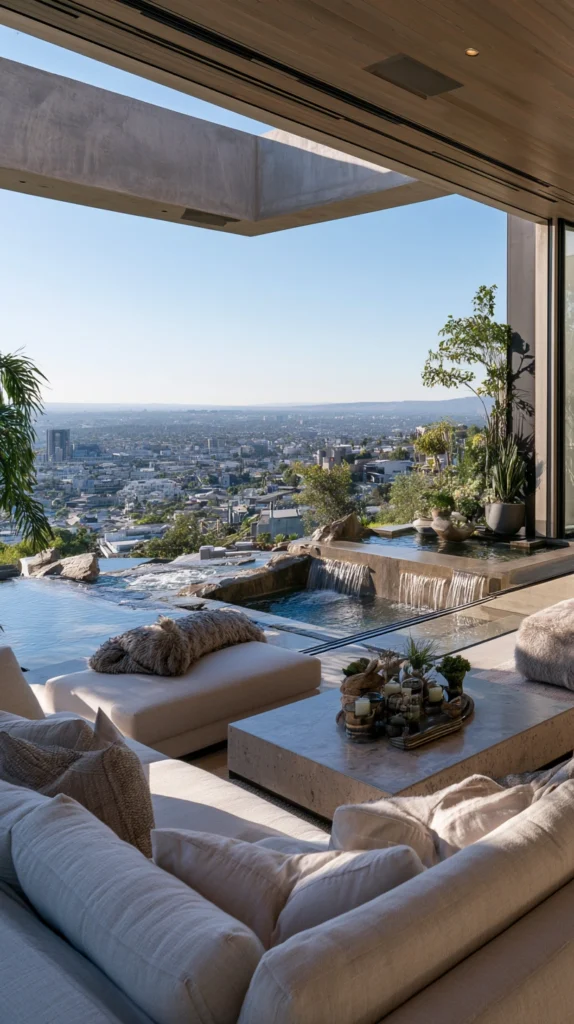
The indoor-outdoor home that is genuinely continuous in its living quality has consistent acoustic character on both sides of the glass wall — not the jarring transition from the controlled acoustic environment of the interior to the open, unmanaged sound environment of the exterior that most homes produce when the back door is opened, but a graduated, managed progression from the slightly more reverberant interior to the more open exterior that feels like a continuous acoustic environment rather than two competing ones.
A quality outdoor speaker system — its sound quality, its volume level, and its music source consistent with the interior audio system — ensures that the music playing in the living room continues at an appropriate level in the outdoor space rather than cutting off at the glass wall.
Water features that provide a consistent ambient sound layer through the outdoor space, acoustic screening planting that reduces intrusive exterior noise, and the overhead structure of a covered outdoor room that provides some acoustic containment: together, these elements create an outdoor acoustic environment that feels genuinely comfortable for conversation and for extended occupation.
14. Design the Garden for Every Hour, Not Just Golden Hour
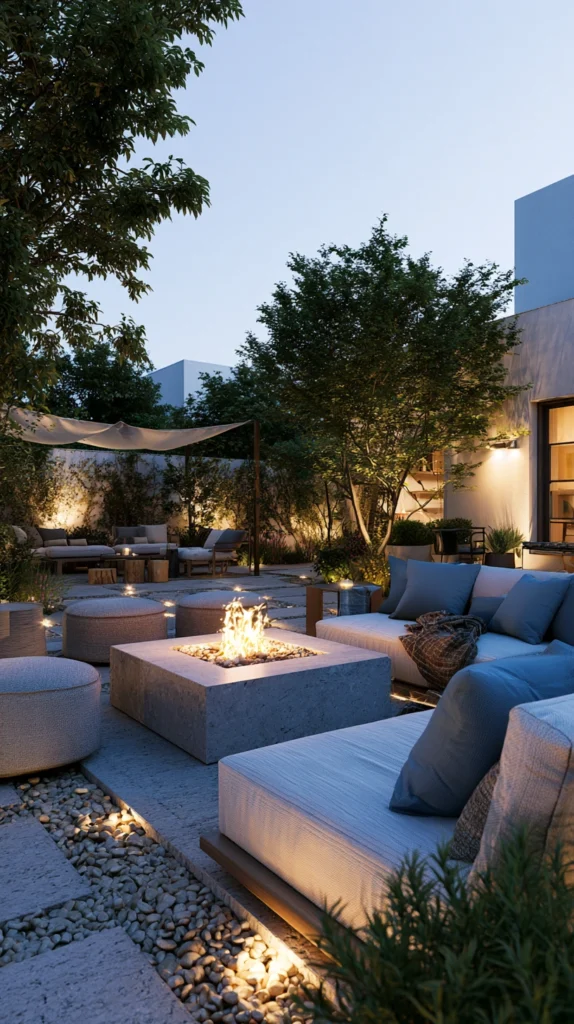
The California backyard that genuinely blurs the indoor-outdoor line does so not just at sunset or during a summer evening gathering but across every hour of the day and every season of the year .
The morning coffee taken on the patio is as natural and as habitual as the evening gathering around the fire pit, the winter afternoon reading in the covered outdoor room is as comfortable and as appealing as the summer lunch at the outdoor dining table, because the space has been designed for genuine daily occupation rather than for the occasional special occasion that most outdoor spaces are implicitly designed to serve.
Plant for year-round interest — evergreen structure, winter-flowering varieties, spring bulbs beneath summer perennials, autumn grasses and seedheads that carry into winter. Furnish for year-round comfort — a covered seating area with outdoor heaters for the cooler months, shade structures and misting for the hottest summer days.
Light for year-round atmosphere — a lighting scheme that makes the outdoor space as beautiful and as inviting at six in the evening in January as at eight in the evening in July. The outdoor room that is genuinely usable and genuinely beautiful across all twelve months is the one that most completely fulfils the California indoor-outdoor promise.
Final Thoughts: Designing the Boundary Out of Existence
The California backyard that genuinely blurs the line between inside and outside is not the product of a single dramatic architectural gesture — it is the cumulative result of dozens of consistent design decisions, each one made with the explicit goal of eliminating the boundary rather than managing it, of creating continuity rather than connection, of designing one generous, fluid space rather than two adjacent ones with a door between them.
Start with the architectural opening — the glass wall, the folding door, the full-width threshold and build every subsequent decision in the same spirit of continuity: the floor that continues through the door, the furniture that holds the same quality standard on both sides of it, the lighting that maintains the same warmth and the same character from the sofa to the garden.
The California backyard that achieves this continuity most completely is the one that makes the back door irrelevant — not because it is never closed, but because when it is open, nobody can quite remember where the house ends and the garden begins.