Sage and Cream Bedroom Ideas for a Calm Palette
There is a bedroom palette that asks nothing of the person within it — no stimulation, no drama, no colour that arrives demanding to be noticed and addressed. Sage and cream is that palette. It is the combination of the most restful green available and the warmest, most generous near-white, and together they produce a bedroom of a specific, unhurried calm that more saturated or more contrasting palettes cannot approach.

Sage carries the quality of the natural world — of grey-green herbs, of lichen on stone, of the particular colour of an olive leaf in afternoon light. Cream carries the quality of natural materials at their most honest — of unbleached linen, of beeswax, of plaster that has dried slowly and is all the more beautiful for the time it took.
The two colours belong together in the way that the herb garden belongs to the farmhouse beside it — not because anyone planned the relationship but because they have always existed in the same world and have simply been confirmed, rather than invented, by every designer who has placed them beside each other and observed the result.
The fifteen ideas below cover every approach to the sage and cream bedroom — from a single painted wall to a fully committed room scheme of quiet, considered beauty.
1. The Sage Feature Wall and Cream Surround
Budget: $30 – $120
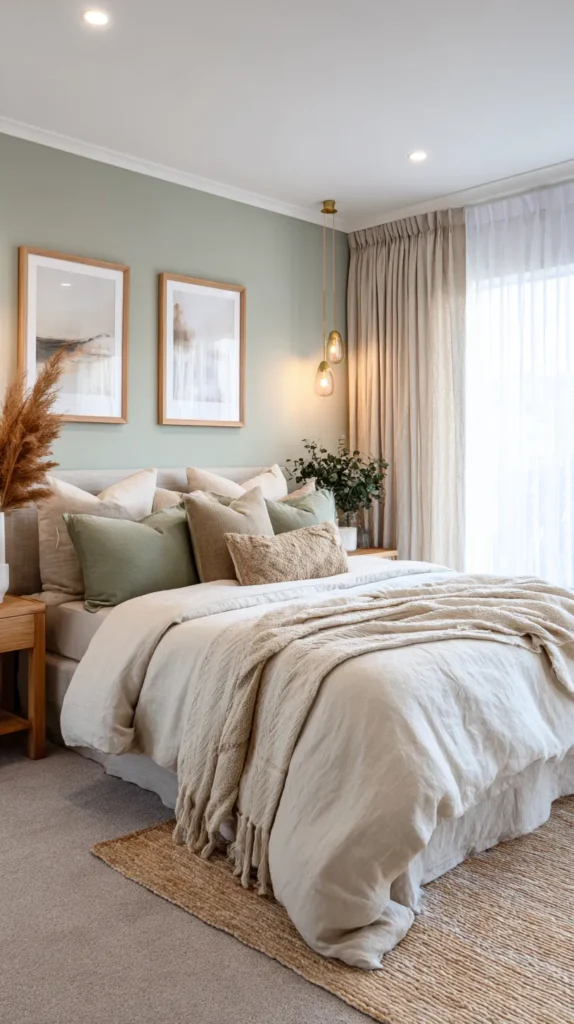
A single sage feature wall — behind the bed, on the chimney breast, or on the room’s most architecturally significant surface — with cream on the remaining three walls is the sage and cream bedroom’s most accessible entry point and the one that produces the most immediately resolved and the most specifically beautiful result for the least material investment. The sage wall anchors the room in the natural world. The cream surround keeps it light, warm, and genuinely airy.
A quality sage paint in a flat or eggshell finish costs $20 – $50 per litre. One to one and a half litres covers a standard feature wall in two coats. The remaining walls in a warm cream — with a yellow undertone rather than a cool blue-white — prevent the sage from reading as isolated by providing a warm and organic surround rather than a stark contrast.
Decor tip: Choose a sage with a grey undertone rather than a yellow or blue one for a bedroom feature wall. A grey-toned sage reads as specifically calm and specifically connected to the muted, restful quality of the natural world — lichen, herb, stone, and olive rather than grass, moss, or sea. A yellow-toned sage beside cream can read as slightly warm and slightly complex. A blue-toned sage beside cream can read as cool and slightly recessive. The grey undertone is what makes sage specifically restful.
2. The All-Sage Bedroom
Budget: $60 – $300
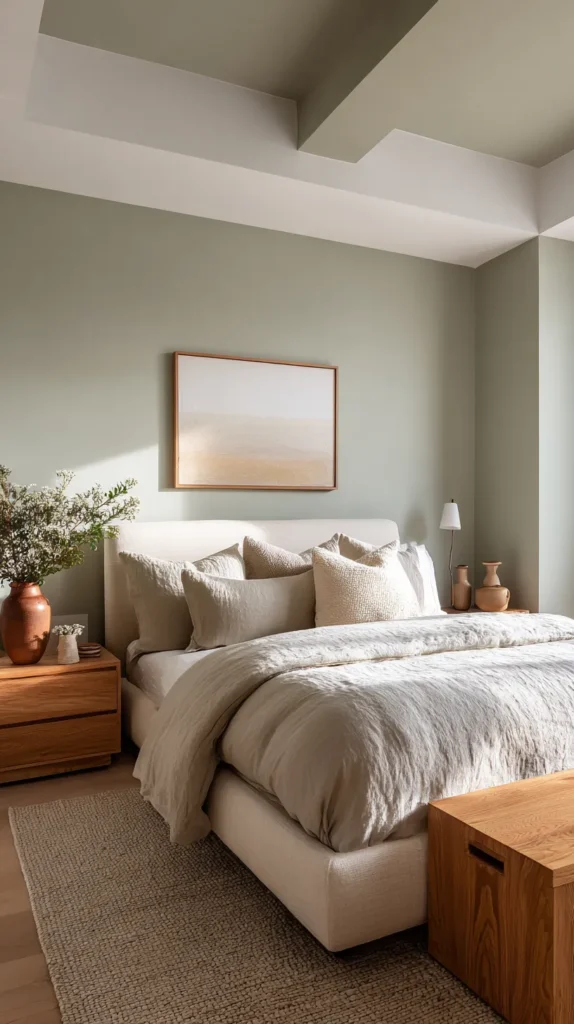
A bedroom painted in sage on all four walls — ceiling one shade lighter in a warm pale grey-green, woodwork in a warm ivory — is the most committed and the most atmospherically complete version of the sage bedroom. It produces a sleeping environment of remarkable calm — a room that reads as genuinely connected to the natural world in its colour character and that provides the quality of visual rest that a sleeping environment most specifically requires. Waking in a sage room is a different quality of morning from waking in any other.
A standard bedroom requires three to four litres for two coats — $60 – $200 in quality paint. A ceiling one shade lighter — a warm, slightly grey-green white — maintains the palette overhead while preventing the room from reading as enclosed or heavy. Warm ivory woodwork in eggshell — $15 – $30 per litre — provides the contrast that gives the sage walls their definition.
Decor tip: Use a flat or dead-matt finish on sage bedroom walls rather than any sheen. A flat finish on sage produces a matte, softly enveloping surface that reads as specifically botanical and specifically calm. The same colour in an eggshell or satin finish can read as slightly plasticky under the warm artificial light that a bedroom uses most — which works against the organic, natural quality that makes sage specifically beautiful and specifically restful.
3. The Sage and Cream Linen Bedding
Budget: $80 – $300
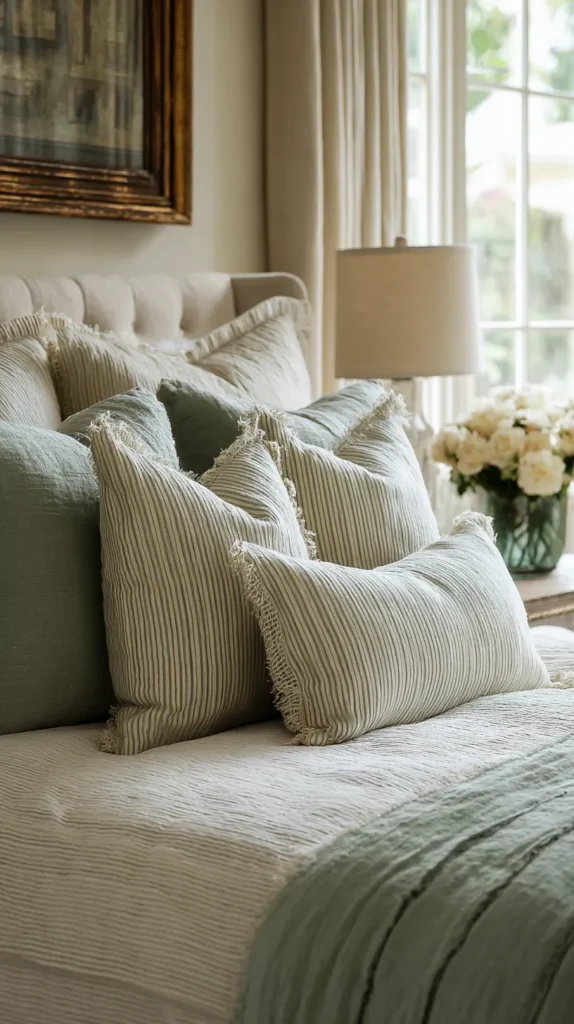
Bedding in the sage and cream bedroom — cream and natural linen in the base layers, a sage green linen duvet cover or a sage cotton throw, and a progression from the deepest sage at the coverlet to the palest cream at the pillows — produces a bed that reads as genuinely botanical and genuinely calm. The layered linen arrangement is the sage and cream bedroom’s most intimate and most tactile design expression — the colours confirmed at the level of the surface the body is in closest contact with.
A sage linen duvet cover — $60 – $150 for a king size. Natural cream linen pillowcases — $25 – $60 for a set of four. A sage cotton throw folded at the foot of the bed — $30 – $80. A cream waffle-weave coverlet — $50 – $120. A sage or cream European square cushion in a textured linen — $25 – $50 each.
Styling tip: Layer the sage and cream bedding so that the sage deepens toward the foot of the bed and the cream lightens toward the pillows — the darkest sage element at the foot, a mid-sage throw in the middle, cream coverlet above, and pale cream pillowcases at the top. This foot-to-head lightening produces a bed that reads as deliberately layered and specifically designed rather than a collection of sage and cream pieces assembled without a gradient principle. The gradient also makes the bed feel more welcoming — the pale cream at the pillow end inviting rather than demanding.
4. The Natural Timber and Sage Combination
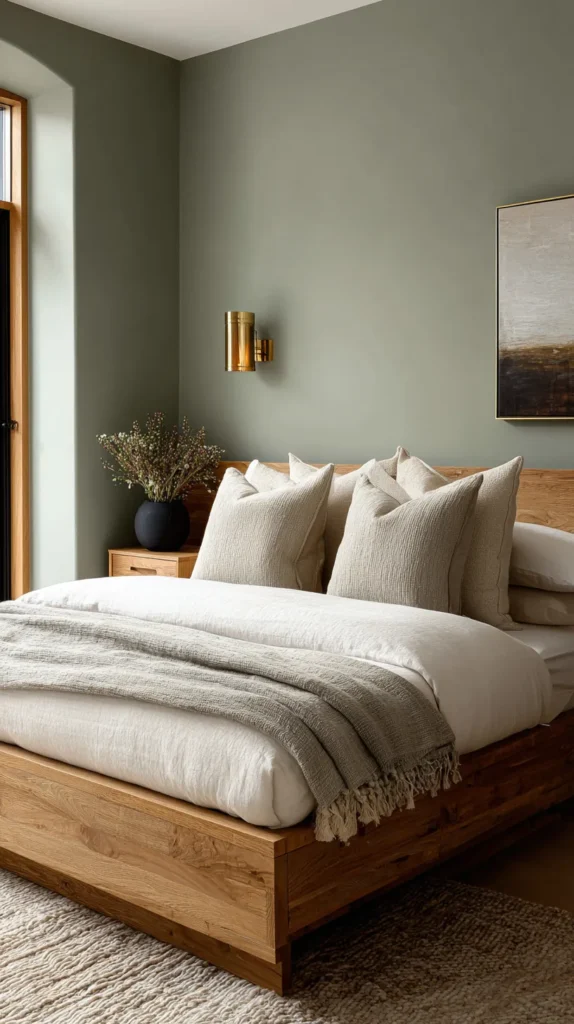
Budget: $100 – $1500
Warm natural timber — in honey oak, warm pine, or a golden-toned beech — beside sage walls is one of the most specifically beautiful material combinations available in a bedroom. The warm yellow of the timber and the muted grey-green of the sage sit in the same organic, natural colour family and their combination produces a bedroom that reads as genuinely rooted in the material world of growing things — wood and herb and stone.
A natural oak or pine bedside table — $60 – $200 each side. A warm timber wardrobe — $300 – $800. A timber-framed mirror — $40 – $150. A timber floating shelf — $20 – $60 installed. A warm oak or pine bed frame — $200 – $600. The natural timber distributed across the sage bedroom costs $620 – $1810 for a complete material story that reads as honest and warm rather than simply decorated.
Decor tip: Choose timber pieces in a warm, golden-toned finish rather than a pale, bleached Scandinavian tone for a sage bedroom. Bleached or very pale timber beside sage walls can produce a room that reads as cool and slightly bare — the paleness of the wood adding to the cool quality of the grey-green rather than mediating between it and the cream. Warm golden timber beside the same sage reads as warm, grounded, and specifically beautiful — each material making the other appear more specifically itself.
5. The Sage and Cream with Terracotta Accent
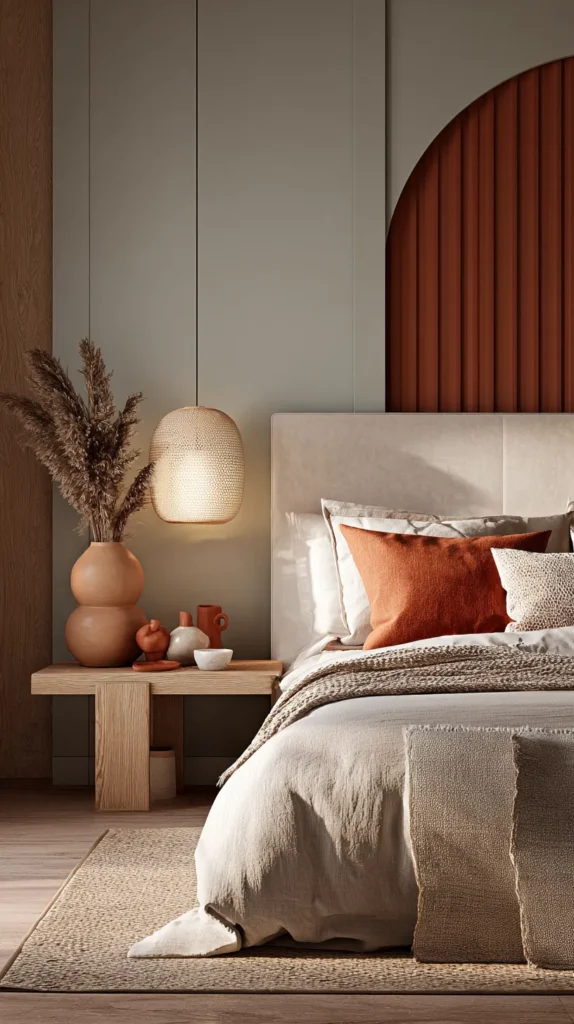
Budget: $40 – $200
Sage and cream with a terracotta accent — the grey-green and the warm near-white of the base palette given a warm clay note through accessories, plant pots, a single cushion, or a small ceramic object — is the bedroom palette that most directly references the natural world in its full botanical dimension. Sage, cream, and terracotta are the colours of the herb garden — the grey-green leaves, the pale dried flower, and the unglazed clay pot. Together they produce a bedroom of genuine organic warmth.
Terracotta plant pots with greenery — $5 – $20 each. A terracotta-toned linen cushion — $20 – $50. A small terracotta ceramic on the bedside table — $8 – $25. A terracotta candle in a ceramic holder — $10 – $30. The terracotta accent layer costs $43 – $125 in total for a decorating addition that transforms the sage and cream palette from a two-colour calm scheme into a three-tone botanical one.
Styling tip: Keep the terracotta accent modest — one or two elements rather than a comprehensive third colour throughout the room. The sage and cream bedroom’s defining quality is its specific calm, and that calm is produced in part by the palette’s restraint. A terracotta accent that appears in one or two considered positions reinforces the palette’s botanical character without disrupting its calm. A terracotta accent that appears throughout the room begins to compete with the sage and cream for the palette’s tonal identity.
6. The Sage Green Headboard
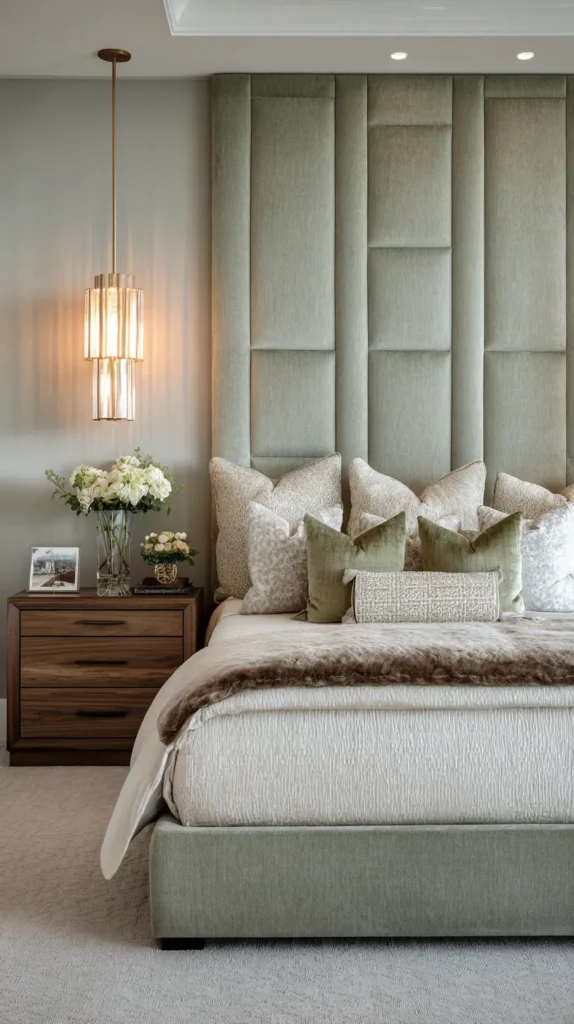
Budget: $200 – $1500
A sage green upholstered headboard — in a velvet, a linen, or a textured bouclé — is the sage and cream bedroom’s most architecturally significant single piece and the one that anchors the room’s colour palette at its most prominent and most immediately visible surface. A sage headboard against cream walls reads as a considered design decision — the colour brought to the room’s central piece rather than confined to a single painted wall.
A sage green linen upholstered headboard — $200 – $600 in a standard king size. A sage velvet version — $300 – $900. A sage bouclé headboard — $400 – $1200. A bespoke version in a chosen sage fabric — $600 – $1500. The headboard fabric should have a texture — velvet pile, bouclé loop, or a woven linen — that catches the light and produces a surface that rewards close looking rather than reading as flat and uniform.
Styling tip: Choose a headboard height that reaches at least two-thirds of the way to the ceiling — ideally floor to ceiling — for the most specifically architectural and the most specifically designed result. A low headboard in sage velvet is a beautiful piece of furniture. A tall or floor-to-ceiling headboard in the same fabric is an architectural statement that transforms the bedroom wall into the room’s primary decorating moment — the sage colour carried to the full height of the wall’s most significant surface.
7. The Linen Curtains in Sage or Cream
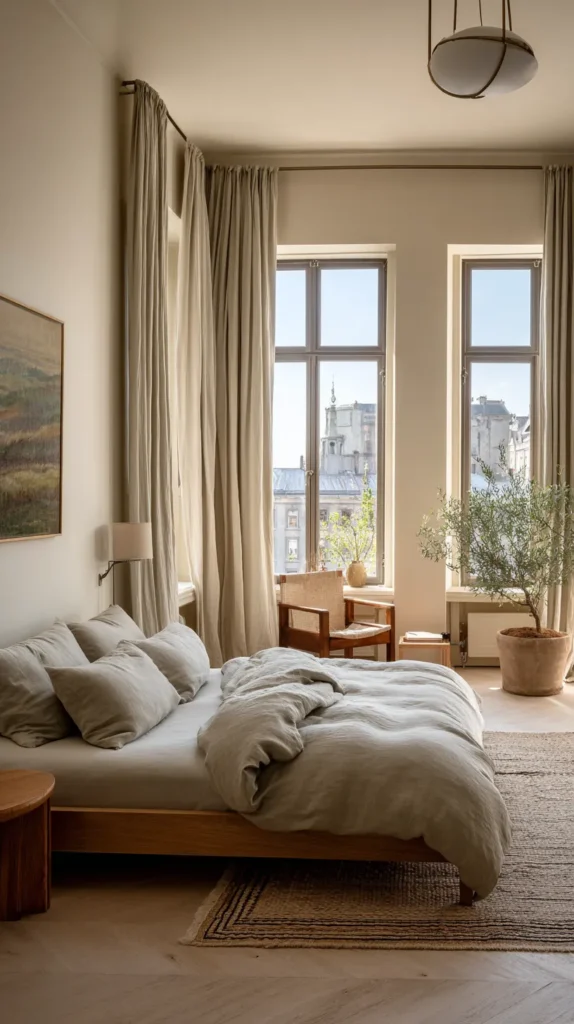
Budget: $60 – $300
Floor-to-ceiling linen curtains in the sage and cream bedroom — in a natural, unbleached linen for a cream application, or a sage-toned linen for the green application — are the room’s most generous and most materially warm window treatment. Natural linen curtains in a sage or cream bedroom communicate the quality of the palette through the specific material that most naturally belongs to both colours — linen being the fabric most specifically connected to the organic, unhurried world that sage and cream are working toward.
Natural cream linen curtain panels — $30 – $80 each. Sage linen curtain panels — $35 – $90 each. Two panels per window hung from ceiling-height rods — $60 – $180 per window. Ceiling-height curtain rods — $25 – $60 per window. The linen curtains should be hung at ceiling height and allowed to pool very slightly on the floor — two to three centimetres — to communicate the generous, unhurried quality of the sage and cream palette at the room’s most vertically significant surface.
Styling tip: Choose a curtain lining in a warm white or pale cream rather than a standard bright white lining fabric. The lining is visible when the curtains are backlit by daylight — a bright white lining behind sage or cream curtains can produce a slightly harsh quality that natural cream lining does not. A warm cream lining behind both sage and cream curtains maintains the palette’s warmth even when the curtains are at their most translucent.
8. The Sage and Cream Gallery Wall
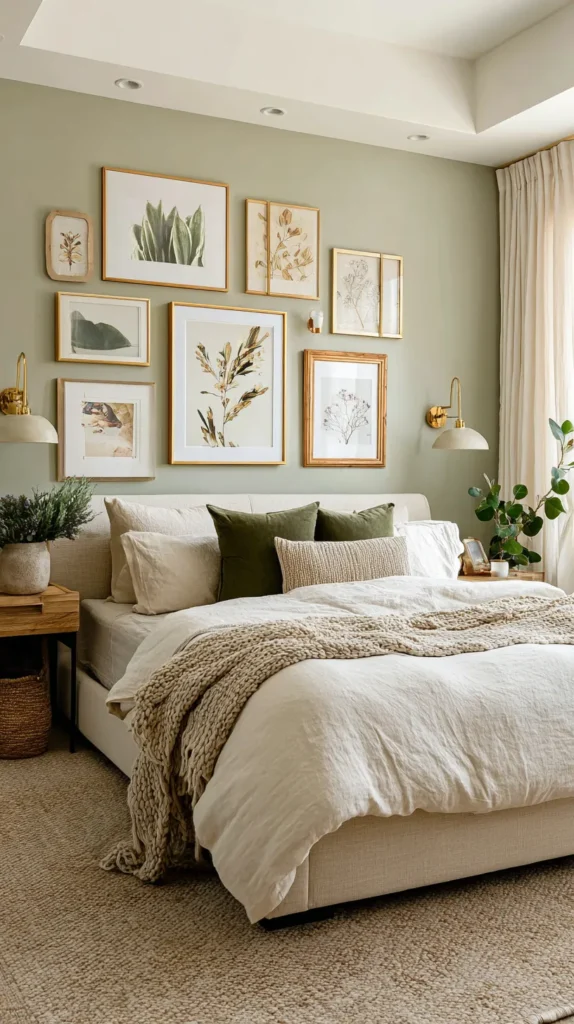
Budget: $40 – $250
A gallery wall in the sage and cream bedroom — frames in natural timber, warm gold, or aged brass holding botanical prints in sage and cream tones, watercolour paintings in the palette’s specific colours, pressed fern and herb illustrations, and one or two personal photographs printed in a warm-toned film style — is the room’s most personally expressive and most specifically botanical surface. A sage and cream gallery wall communicates a genuine relationship with the natural world and a genuine investment in the curation of beautiful things.
Natural timber or gold frames — $5 – $25 each. A collection of eight to ten frames in varying sizes — $40 – $200 in total. Botanical prints in sage and cream tones — downloaded free from public domain botanical archives. Pressed fern or herb illustrations — free from public domain or $10 – $25 from independent printmakers. Personal photographs in a warm-toned film style — printed at home or through a photo service.
Styling tip: Include at least one print in the sage and cream gallery wall that contains both palette colours simultaneously — a botanical illustration with sage green leaves and cream-white flowers, or a watercolour with sage foliage and a cream background — so that the gallery wall reads as a unified colour story rather than a collection of individually palette-appropriate pieces. The single print that contains both colours is the gallery wall’s visual anchor and the element that makes the arrangement read as a designed composition.
9. The Botanical and Plant Layer
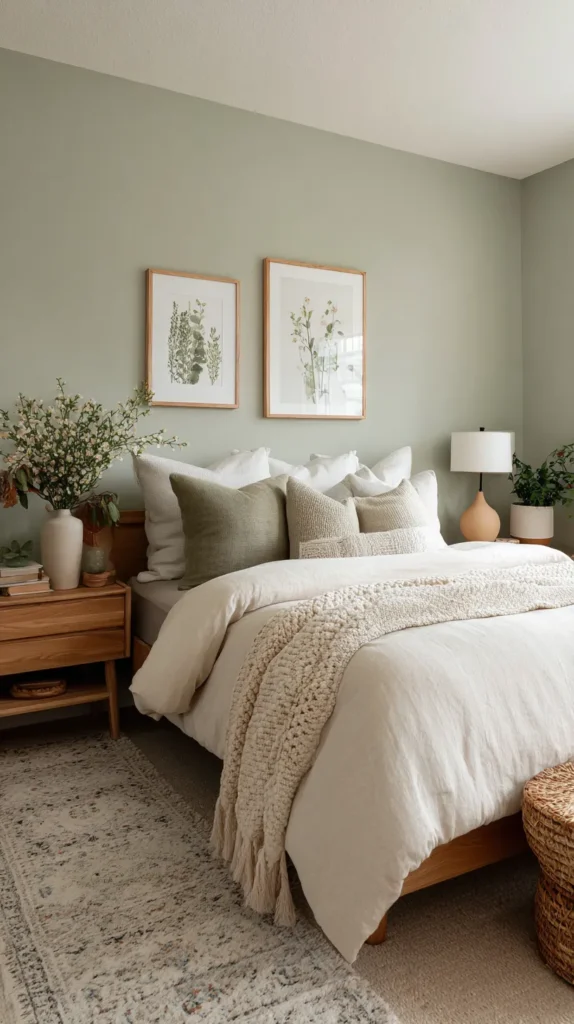
Budget: $30 – $200
A botanical layer — genuinely healthy plants in terracotta or cream ceramic pots distributed throughout the sage and cream bedroom — is the room’s most specifically natural and the most living expression of the palette’s botanical premise. Plants in a sage bedroom are not merely decorative accessories. They are the material confirmation of the colour’s origin — the actual botanical world from which the colour of sage was derived.
A large trailing plant — a pothos, an ivy, or a heartleaf philodendron — in a terracotta pot — $15 – $40. A small fern beside the bedside table — $8 – $20. A clipping of fresh sage or rosemary in a small ceramic vase — $2 – $5 weekly from a garden or a market. A large statement plant — a monstera or a fiddle leaf fig — in the room’s corner — $30 – $80. Total plant layer investment: $55 – $145 for the living material that most directly and most honestly confirms the sage and cream palette’s connection to the natural world.
Styling tip: Use ceramic pots in cream, terracotta, or a warm grey-green rather than the standard nursery black plastic pot. A healthy plant in a black plastic pot is a plant. The same plant in a cream or terracotta ceramic pot is a plant that is part of the room’s considered decorating palette — the pot’s material and colour contributing to the sage and cream story at the level of every object in the room rather than only at the level of the plant’s foliage.
10. The Sage and Cream Reading Corner
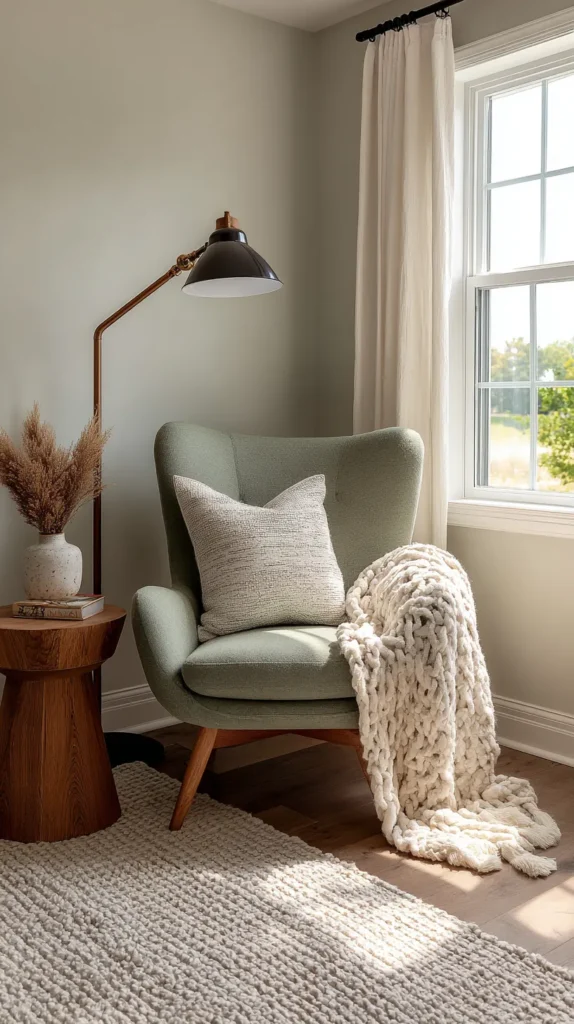
Budget: $200 – $1000
A reading corner in the sage and cream bedroom — a natural linen or sage velvet armchair in the room’s warmest and best-lit corner, a floor lamp with a warm cream shade at the correct reading height, a small natural timber side table for a cup of tea, a woven basket of books on the floor beside the chair, and a cream or sage throw draped over the arm — is the room’s most specifically tranquil and most genuinely habitable zone. The sage and cream palette is one of the most specifically appropriate palettes for a reading corner because its combination of visual calm and botanical warmth produces the quality of gentle, unhurried focus that reading requires.
A natural linen or sage velvet armchair — $150 – $500. A floor lamp with a warm cream shade — $40 – $120. A small natural timber side table — $30 – $80. A woven basket for books — $15 – $40. A cream or sage throw — $30 – $80. Total reading corner investment: $265 – $820 for the bedroom’s most used and most genuinely restful zone.
Styling tip: Position the sage and cream reading corner so that the chair faces the room’s best natural light source — a window, a skylight, or a glass door — rather than facing the wall or the back of the room. A reading corner that faces natural light is a reading corner that is used in the morning and the afternoon as well as the evening. One that faces a wall is a reading corner that relies entirely on the floor lamp and is used primarily in the evening — which limits the full daily use that a well-positioned reading chair in a beautiful room deserves.
11. The Sage and Cream with Warm White Lighting
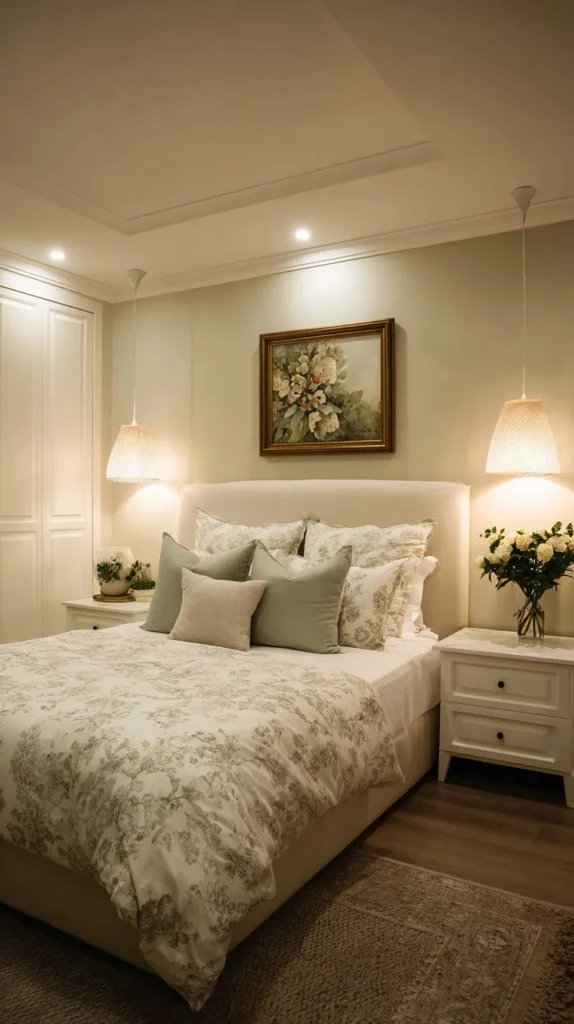
Budget: $60 – $400
The sage and cream bedroom’s lighting scheme — warm white bulbs at 2700K in every fixture, a rattan or linen pendant above or beside the bed, bedside lamps with cream shades, and fairy lights or warm LED strips for the evening ambient layer — is as important to the room’s calm quality as any painted or material surface. Sage and cream are colours that perform specifically well in warm artificial light — the sage deepening to a warm, slightly mossy tone and the cream glowing with the particular warmth of beeswax or amber. Both colours are damaged by cool light, which flattens and cools them simultaneously.
Rattan or linen pendant — $25 – $80. Bedside lamps with cream shades — $40 – $100 each. Warm LED bulbs at 2700K — $5 – $15 per pack. A dimmer switch for the main fixture — $15 – $30 installed. Warm fairy lights for the evening ambient layer — $10 – $25 per reel.
Styling tip: Replace every bulb in the sage and cream bedroom with a warm LED at 2700K before any other lighting decision is made. The colour temperature of the light source determines how sage and cream read in the evening — the hours during which the bedroom is most used and during which the palette’s quality is most important. Warm LEDs make sage read as deeply, warmly botanical and cream read as genuinely warm and luminous. Cool LEDs in the same room make both colours appear simultaneously greyer and flatter — which is the single most avoidable aesthetic failure in any warm-palette bedroom.
12. The Sage and Cream Minimalist Scheme
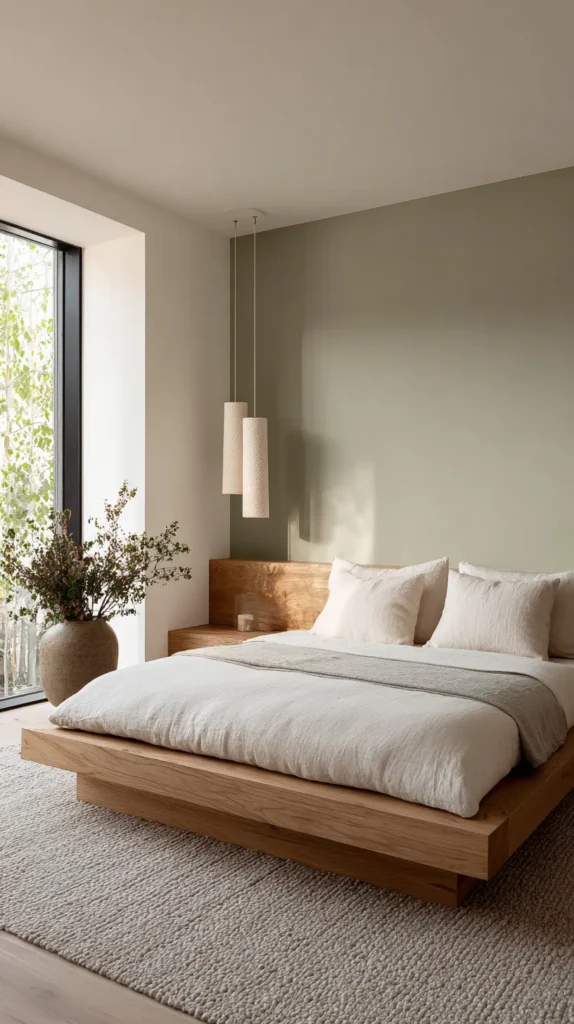
Budget: $100 – $1000
A sage and cream minimalist bedroom — one wall in sage, the remaining surfaces in cream, a single natural timber bed frame, white linen bedding, a rattan pendant overhead, one large plant in a terracotta pot, and nothing else — is the bedroom that achieves the maximum quality of calm from the minimum number of decisions. The minimalist version of the sage and cream bedroom demonstrates more clearly than any maximalist version what makes the palette specifically beautiful: it does not require much. It requires the right things, chosen for their quality, placed with care, and left to do their work without interference.
Sage paint for the feature wall — $20 – $80. A natural timber bed frame — $200 – $500. White linen bedding — $80 – $200. A rattan pendant — $25 – $80. A large plant in a terracotta pot — $30 – $80. Total minimalist sage and cream investment: $355 – $940 for a bedroom of profound and specifically resolved calm.
Styling tip: Resist the impulse to add more to the minimalist sage and cream bedroom once it has been assembled and assessed. The quality of this palette in its simplest form is significant and immediate, and the most common mistake made with a beautifully calm room is the addition of elements that dilute the calm rather than enhancing it. Assess the room for one week before adding anything. Most of what was considered in that week will be confirmed as unnecessary by the observation that the room was already complete without it.
13. The Sage and Cream Layered Texture Story
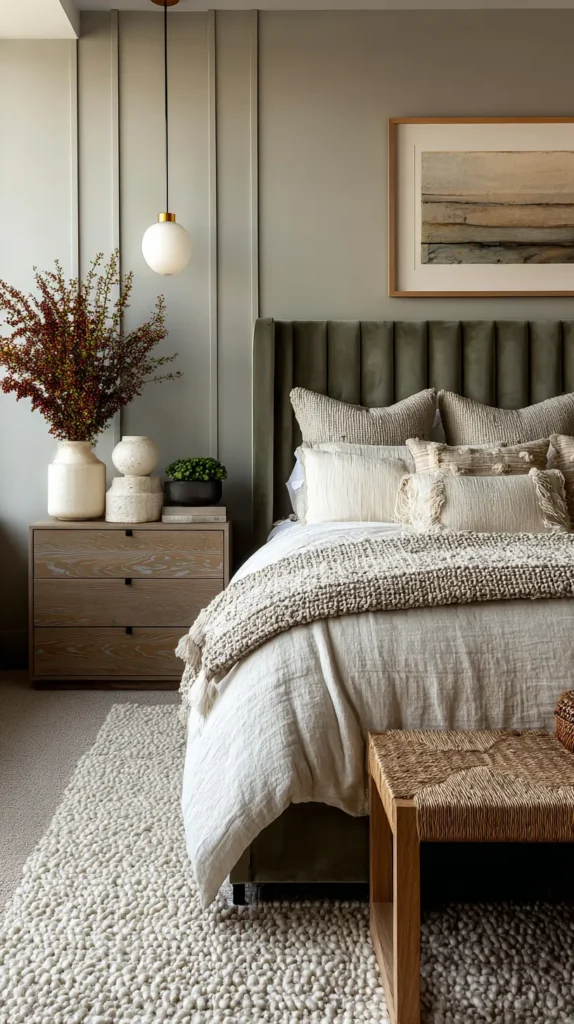
Budget: $100 – $500
A sage and cream bedroom built on texture rather than colour variation — all surfaces in the same muted sage and warm cream palette but in a variety of materials that each absorbs and reflects light differently — is the most sophisticated and the most materially rich version of the scheme. A sage velvet headboard beside cream linen bedding beside a natural timber beside a woven rattan beside a smooth ceramic beside a rough terracotta is a room of a single colour story told in multiple material voices.
A sage velvet headboard or cushion — $200 – $600 or $25 – $60. Cream linen bedding — $80 – $200. A natural timber piece — already present or $60 – $200. A rattan object — a pendant, a basket, or a mirror frame — $15 – $60. A smooth white ceramic lamp or vase — $15 – $50. A rough terracotta pot — $5 – $20. Total texture story investment: $200 – $590 for the most materially varied and the most visually rich version of the sage and cream palette.
Styling tip: Arrange the textured materials in the sage and cream bedroom so that smooth and rough surfaces alternate rather than grouping all smooth materials on one side of the room and all rough materials on the other. A smooth ceramic lamp beside a rough terracotta pot beside a velvet cushion beside a woven rattan basket produces a room where every surface relationship is interesting. The same materials grouped by smoothness produce a room that reads as two separate zones rather than one considered whole.
14. The Sage and Cream Seasonal Bedroom
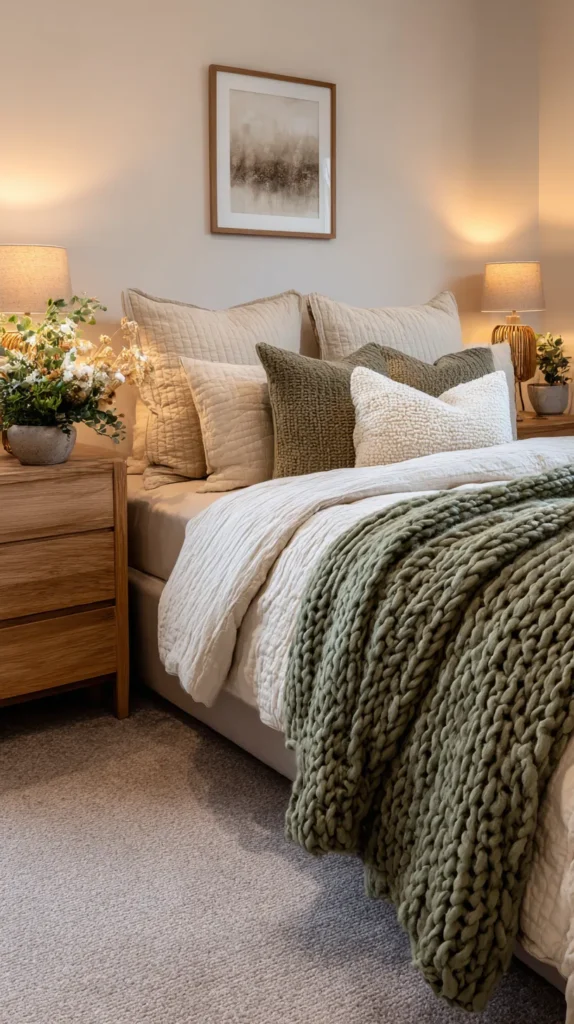
Budget: $30 – $150
A sage and cream bedroom refreshed seasonally — a linen-weight sage throw replaced by a heavier wool version in the same tone for autumn, fresh botanical prints replaced by dried botanical displays for winter, a cotton coverlet replaced by a heavier quilted version for the colder months — is the bedroom that maintains the quality of its palette throughout the year while responding to the seasonal world with the same attentiveness that gave the palette its botanical origins. The sage and cream bedroom is one of the most specifically season-responsive palettes available because both of its constituent colours are directly connected to the natural world that changes with the seasons.
A heavy wool sage throw for autumn — $50 – $150. Dried botanical display for winter — $20 – $60. A heavier quilted coverlet in cream for winter — $60 – $150. A fresh botanical display for spring — $10 – $30 in fresh flowers or living plants. Total seasonal refresh investment: $140 – $390 for a bedroom that acknowledges the seasonal world rather than maintaining a fixed aesthetic regardless of the quality of light and temperature outside its windows.
Styling tip: Make the seasonal refresh of the sage and cream bedroom an intentional act rather than a casual update — setting aside an afternoon at the beginning of each season to reassess the room, replace what has served its season, and introduce what belongs to the season beginning. A bedroom refreshed with genuine seasonal intention reads as a room that is genuinely inhabited and genuinely attended to — the most important quality of a bedroom that is not merely a place to sleep but a place to be.
15. The Fully Committed Sage and Cream Bedroom

Budget: $400 – $3000
The fully committed sage and cream bedroom — sage walls in a dead-flat finish, ceiling one shade lighter in a warm pale grey-green, warm ivory woodwork, a sage velvet or linen headboard at ceiling height, layered sage and cream linen bedding with a wool throw at the foot, floor-to-ceiling natural linen curtains on ceiling-height rods pooling slightly on the floor, warm natural timber bedside tables with aged brass lamps and warm LED bulbs, a botanical gallery wall in natural timber frames, a large plant in a terracotta pot in the corner, a sage velvet reading chair with a cream throw in the best-lit corner, a rattan pendant above the bed, terracotta accent ceramics on the bedside table, and no cool material or cool light source anywhere in the room — is the bedroom that most completely and most honestly expresses the specific, unhurried calm that sage and cream can produce when they are trusted entirely and implemented consistently.
Paint: $60 – $200. Headboard: $200 – $900. Bedding: $135 – $450. Curtains: $120 – $360. Timber bedside tables and brass lamps: $200 – $700. Gallery wall: $40 – $200. Plants and pots: $55 – $145. Reading chair and throw: $180 – $580. Rattan pendant: $25 – $80. Terracotta accessories: $20 – $60. Total fully committed sage and cream bedroom: $1035 – $3675 for a room of profound and specifically resolved botanical calm.
Decor tip: Assess the fully committed sage and cream bedroom in the specific light condition for which it performs best — early morning with soft natural light entering through the linen curtains, or in the evening with the warm LED lamps at their lowest dimmer setting and no other light source present. Sage and cream are colours of gentle, warm, specifically natural light, and they reveal their full quality only in the light that belongs to them. In the harsh bright light of a midday sun through uncurtained windows, they read as pleasant. In the soft warm light of a gentle morning or a dimmed evening, they read as genuinely beautiful — the particular calm they produce available in its fullest form only in the conditions they were designed to inhabit.
Sage and cream is the bedroom palette that asks, above all, for patience — the patience to choose the correct shade of each colour, to source the natural materials that belong beside them, to wait for the warm light that reveals them fully, and to resist the temptation to add more when the room already has everything it needs.
It is a palette that rewards that patience generously and consistently, in every season and in every quality of light, with the specific quality of calm that the best bedrooms have always produced and that the best sleepers have always instinctively sought.
Choose it carefully. Implement it consistently. And then rest in it, in every sense of the word.