15 Old Money Aesthetic Bedroom Ideas for Quiet Luxury
There is a kind of luxury that does not announce itself. It does not arrive in logos or price tags or the conspicuous newness of things just unboxed.
It arrives, instead, in the particular quality of a linen pillowcase that has been washed two hundred times and become more beautiful with every wash, in the specific patina of a brass lamp base that has been handled for decades, in the weight of a wool blanket that was expensive when it was purchased and has since become priceless through the accumulation of use and association.

This is old money luxury — the luxury not of acquisition but of inheritance, of things that were chosen well and kept long and improved with time.
The old money aesthetic bedroom is the room that understands this quality completely. It is a room of good bones and better textiles, of dark timber and aged brass and the particular warmth of a room that has been beautiful for a very long time.
It is not a room assembled from a mood board or a Pinterest collection. It is a room that tells a story — a story of taste developed over generations, of objects chosen for their quality rather than their novelty, of a room that knows precisely what it is and has no interest whatsoever in explaining itself.
The fifteen ideas below cover every element of the old money aesthetic bedroom — from the foundational material decisions to the finishing details that communicate genuine, understated luxury.
1. The Neutral and Warm Palette of Quiet Confidence
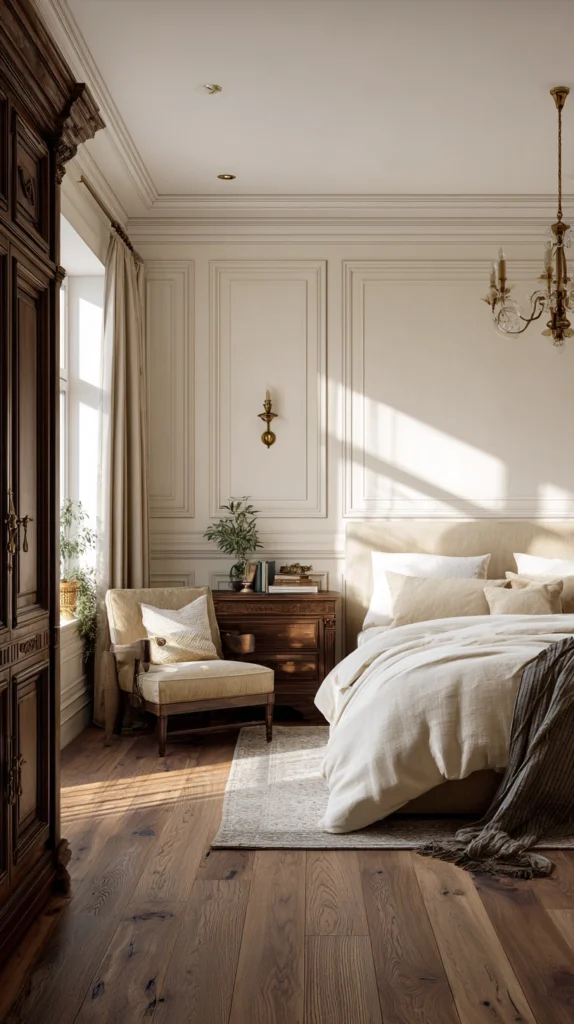
Budget: $40 – $200
The old money bedroom palette does not require dramatic colour. It requires the particular quality of colour that belongs to things made from natural materials and allowed to age — the warm ivory of aged linen, the particular cream of a plastered wall that has never been repainted with a bright white, the warm taupe of horsehair and natural wool, the dark warm brown of aged timber, the faded sage of a garden room that has been absorbing light for decades.
These are colours without urgency, without the need to impress, and precisely for that reason they impress more than any bolder alternative.
A quality warm ivory or aged white paint in an eggshell finish costs $20 – $50 per litre. A standard bedroom requires two to three litres — $40 – $150. The ceiling in the same warm white — not a bright brilliant white but an aged, slightly cream-inflected one — maintains the palette’s consistency overhead.
Decor tip: Choose all paint colours for the old money bedroom from the same paint brand’s heritage or archive collection rather than from the standard contemporary range. Heritage paint collections — available from specialist paint houses — are formulated with a lower percentage of white pigment and a higher percentage of coloured pigments, producing a colour depth and a warmth that standard paint cannot replicate. The difference is immediately apparent and the additional cost is modest relative to the quality improvement.
2. The Dark Timber Four-Poster or Carved Bed Frame
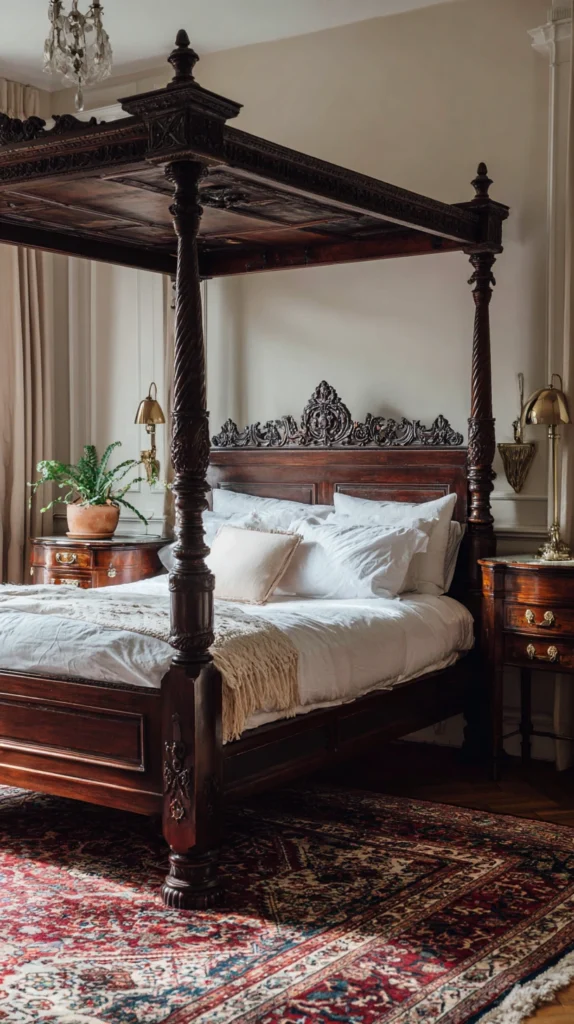
Budget: $600 – $5000
A dark timber bed frame — in a mahogany, a dark walnut, or a well-aged oak, either a full four-poster with or without fabric drapes or a carved and substantial bedhead — is the old money bedroom’s most architecturally significant single piece and the one that communicates the room’s aesthetic identity most immediately. Dark timber in a bedroom is not a decorating trend. It is the aesthetic baseline of the great country house bedroom and the private room of every building of genuine quality from the past four centuries.
A solid dark timber four-poster in mahogany or dark walnut costs $800 – $3000 from specialist furniture makers. A secondhand or antique version — always the more beautiful and the more specifically old money choice — runs $600 – $5000 from antique furniture dealers, with price determined by period, craftsmanship, and provenance. A carved dark timber bedhead without posts — $400 – $1500 — is the more practical version for a room without the ceiling height to carry a full poster frame.
Styling tip: Source the bed frame from an antique dealer or an estate sale rather than from a new furniture retailer whenever possible. An antique dark timber bed frame has already developed the patina, the warmth, and the specific quality of aged wood that a new piece will take decades to approach. The antique piece also communicates the old money aesthetic with an authenticity that the best reproduction cannot replicate — genuinely old wood is the material most specifically connected to the quality of time and inheritance that the aesthetic is built upon.
3. The Layered Linen and Wool Bedding
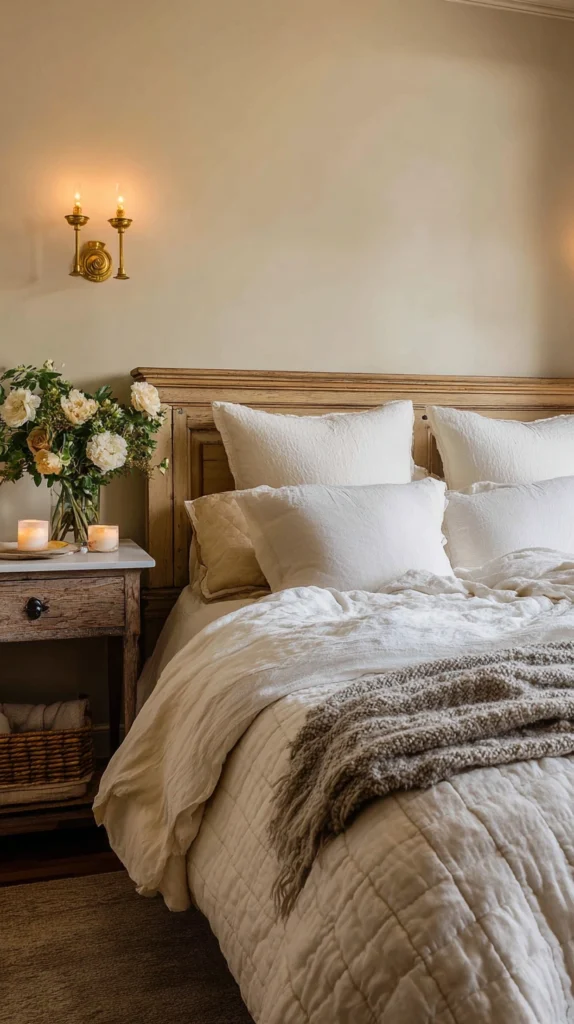
Budget: $200 – $1000
Old money bedding is not new. Or rather — it is not trying to look new. The old money bedroom’s bedding is layered in white and cream linen, in a wool blanket folded at the foot of the bed, in pillowcases that are pressed but not stiff, in a coverlet that has been washed and washed again and is all the more beautiful for it. The specific quality of well-maintained, well-loved natural fibre bedding is the most intimate expression of the old money aesthetic and the one most directly produced through investment in genuine materials rather than in appearance.
A quality white linen duvet cover in a 200-thread-count or above — $80 – $200 for a king size. Oxford-style pillowcases with a plain hem — $30 – $80 for a set of four. A wool or cashmere blanket folded at the foot — $100 – $400. A white cotton coverlet with a simple quilted or waffle pattern — $60 – $150. Total bedding investment: $270 – $830 for a bed dressed in genuine natural materials.
Styling tip: Wash all new linen bedding at least five times before the first use on the old money bedroom bed — the repeated washing softening the linen fibres and producing the slightly tumbled, slightly relaxed quality of genuinely broken-in natural linen. New linen on a first use is stiff and slightly formal. The same linen after ten washes drapes naturally, breathes freely, and looks as though it has been slept in beautifully for years — which is precisely the quality the old money bedding arrangement is working toward.
4. The Antique Bedside Table and Lamp
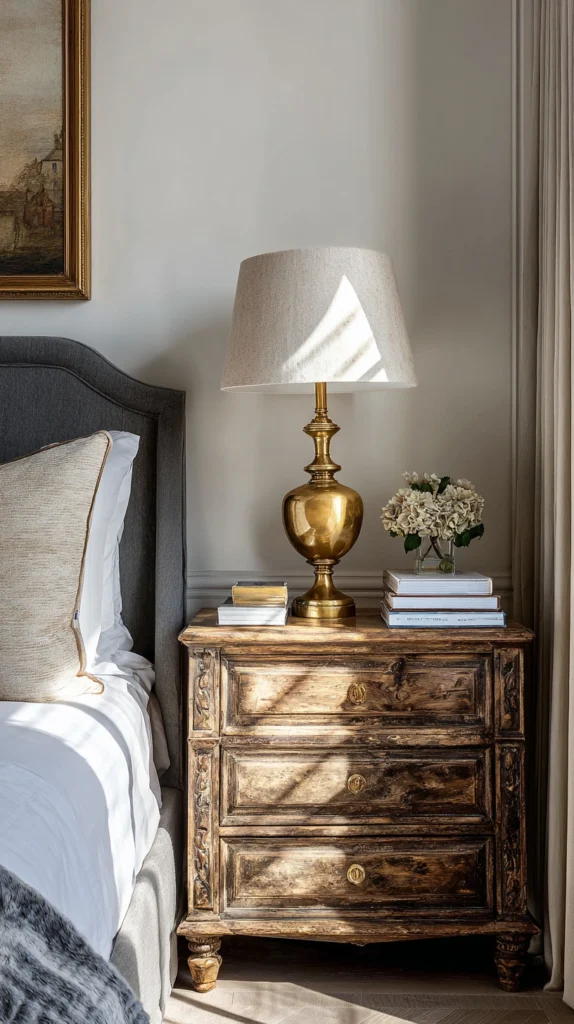
Budget: $100 – $1000
Antique bedside tables — in a dark timber, a faded painted finish, or a marquetry-topped version with a single drawer — are the old money bedroom’s most practically used and most intimately encountered pieces of furniture. They should be chosen for their quality and their character rather than for their perfect coordination with the rest of the room’s furniture. Old money rooms contain furniture that was accumulated over time — pieces from different periods and different sources that share a quality rather than a style.
A pair of antique bedside tables from a dealer or an estate sale — $100 – $600 for the pair depending on period and condition. A brass table lamp with a linen or silk drum shade — $60 – $200 each. A warm-toned bulb at 2700K — $5 – $10 each. A small stack of two or three books on one bedside table — free from the existing library — completing the arrangement with the specific quality of a room that is genuinely read in rather than merely slept in.
Styling tip: Choose bedside lamps in an aged brass or a darkened bronze rather than polished chrome or bright gold. Aged brass lamp bases beside dark timber bedside tables is the most specifically old money material pairing available in a bedroom — the warm metal and the dark wood belonging to the same tradition of quality domestic objects that were made to last and that have lasted. Polished chrome in the same position reads as contemporary. Aged brass reads as inherited.
5. The Oil Painting or Fine Art Print
Budget: $50 – $5000
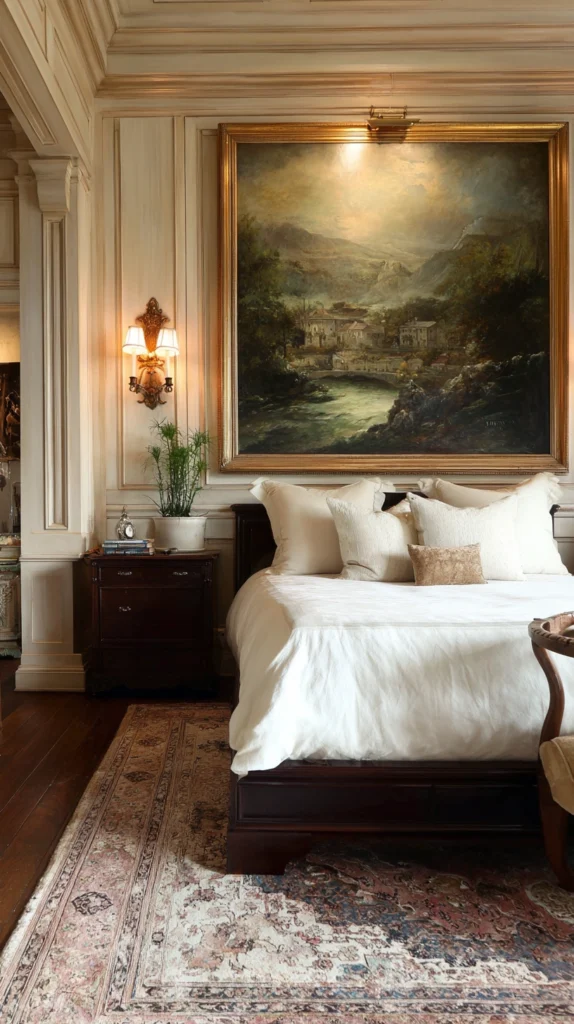
Art in the old money bedroom — a genuine oil painting in a heavy gilt frame, a botanical illustration from the eighteenth or nineteenth century in a carved timber frame, a dark landscape in the tradition of the great country house corridor, or a portrait miniature on the bedside table — is the room’s most culturally communicative element. Old money rooms contain art not because art is a decorating element but because the people who inhabited them collected it over generations and it has become inseparable from the rooms it has always occupied.
A genuine oil painting from a dealer or an estate sale — $200 – $5000 depending on period, quality, and subject. A high-quality print of a public domain old master or botanical illustration in a heavy gilt frame — $50 – $200 including the frame. A botanical illustration print from the eighteenth or nineteenth century public domain archive — free to download and $20 – $60 to frame at a local framer. Total art investment: $70 – $260 for a printed equivalent, $200 – $5000 for the genuine article.
Styling tip: Hang the old money bedroom’s primary artwork at a height that places its centre at seated eye level — approximately 140 to 150 centimetres from the floor — rather than at the standard standing eye level of approximately 160 centimetres. Art hung at seated eye level is the correct height for a room in which much of the time is spent in a chair, on the bed, or in other seated or semi-reclined positions. It reads as placed for the benefit of the person in the room rather than for the benefit of a person standing to assess the room from the door.
6. The Persian or Turkish Rug
Budget: $100 – $3000
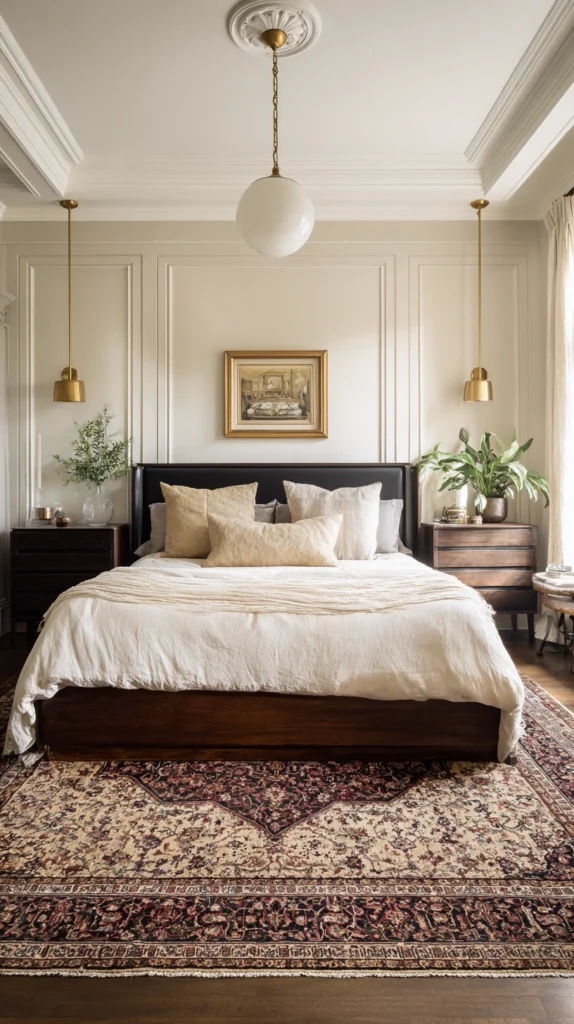
A Persian or Turkish rug — in the warm reds, deep blues, and aged golds of the great carpet weaving traditions of the Middle East and Central Asia — is the old money bedroom’s most materially significant and most atmospherically impactful floor covering. It is the element that transforms a room from a well-decorated bedroom into a room with genuine history — or the convincing appearance of one — and it produces a quality of warmth and visual richness at floor level that no alternative floor covering approaches.
A genuine antique Persian or Turkish rug — $500 – $3000 depending on size, age, and condition — from a specialist rug dealer. A quality reproduction in the traditional patterns — $100 – $600 for a bedroom-sized piece. A secondhand vintage rug from an online platform or a market — $150 – $500 for a piece that reads as genuinely aged. The rug should be large enough for all four legs of the bed to sit on its surface — the standard for a bedroom rug placement in any room of genuine quality.
Styling tip: Place all four legs of the bed on the rug rather than positioning the rug at the foot of the bed only. A rug under the full bed is a rug that defines the bedroom’s sleeping zone as a complete and architecturally resolved space. A rug at the foot only is a rug that was placed because someone knew a rug was needed and found the correct position too expensive. The old money bedroom makes the correct decision regardless of the cost.
7. The Timber-Panelled or Fabric-Lined Wall
Budget: $200 – $3000
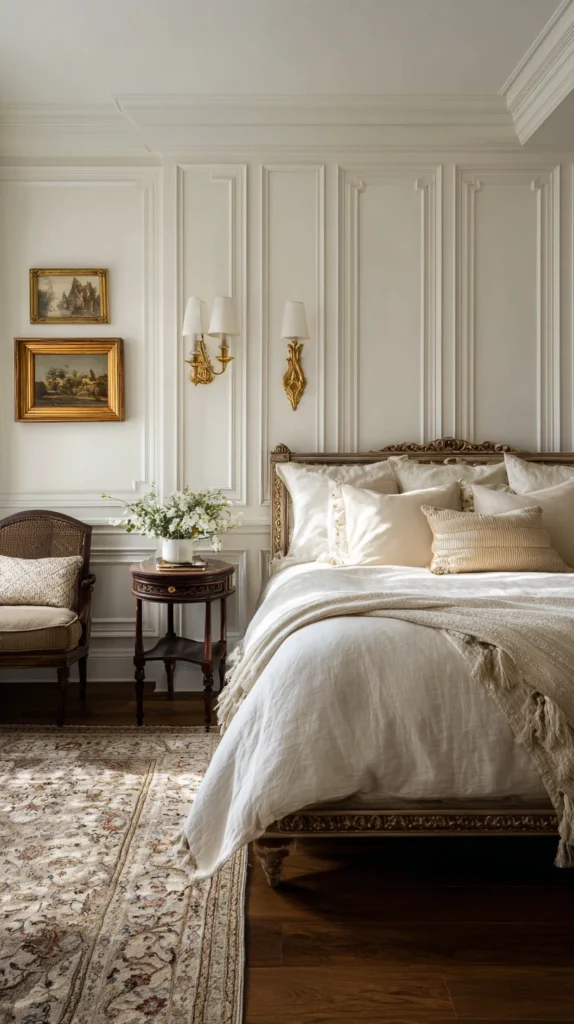
A timber-panelled wall — painted in the same warm white as the other surfaces or in a dark, library-green tone — or a fabric-lined wall in a woven or embroidered textile, is the old money bedroom’s most architecturally ambitious and most specifically grand single decorating decision. Panelling communicates, with more directness than any other surface treatment, that the room was built to last and that the people who built it expected it to be beautiful for longer than their own lifetimes.
Timber panelling in MDF with a painted finish — $200 – $600 in materials for a standard bedroom wall. Genuine timber board and batten panelling — $400 – $1500 in materials. A fabric-lined feature wall using a traditional woven or a toile de Jouy textile — $100 – $400 in fabric plus $50 – $150 in installation materials. A painted wood panel effect in a careful trompe l’oeil — $30 – $80 in paint — is the most affordable version and, when executed carefully, produces a result that reads as architectural.
Styling tip: Paint timber panelling in an eggshell rather than a flat or a satin finish — the eggshell producing a surface that is slightly more durable than flat paint and slightly less reflective than satin, which is the correct quality for a surface that will be touched as well as looked at. The specific sheen level of the panelling finish determines whether it reads as architectural millwork or as paint applied to a wall. Eggshell is the finish that reads as architectural.
8. The Monogrammed Linen and Personal Textile
Budget: $30 – $200
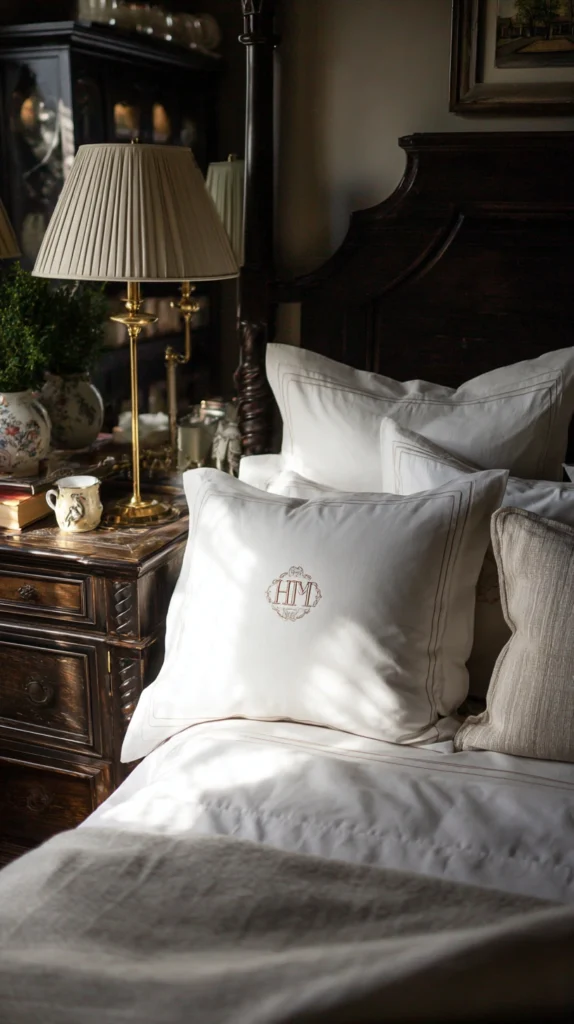
Monogrammed linen — pillowcases, a folded hand towel on the bedside table, or a cotton bathrobe on the back of the door, bearing the occupant’s initials embroidered in a simple, classical font — is one of the most specifically old money details available in a bedroom. The monogram communicates that the linen was commissioned rather than purchased off the shelf, that it was made for this specific person and expected to be used by that person for a very long time. It is the domestic equivalent of a family crest — intimate, specific, and entirely personal.
A monogrammed pillowcase from an embroidery service — $30 – $80 each. A monogrammed hand towel — $15 – $40. A monogrammed bathrobe — $60 – $150. DIY embroidered initials on an existing cotton pillowcase — $5 – $15 in embroidery thread and a transfer pen. The monogram font should be classical — a serif embroidery script or a simple roman capital — rather than a novelty or handwritten style.
Styling tip: Choose the monogram font in a scale that is visible but not dominant — the initials large enough to be read from a normal viewing distance but not so large that they become the primary design element of the textile they are embroidered on. An old money monogram is a mark of ownership, not a declaration. The correct scale is one that communicates its meaning quietly to the person who is looking for it and is invisible to the person who is not.
9. The Fireplace and Mantelpiece
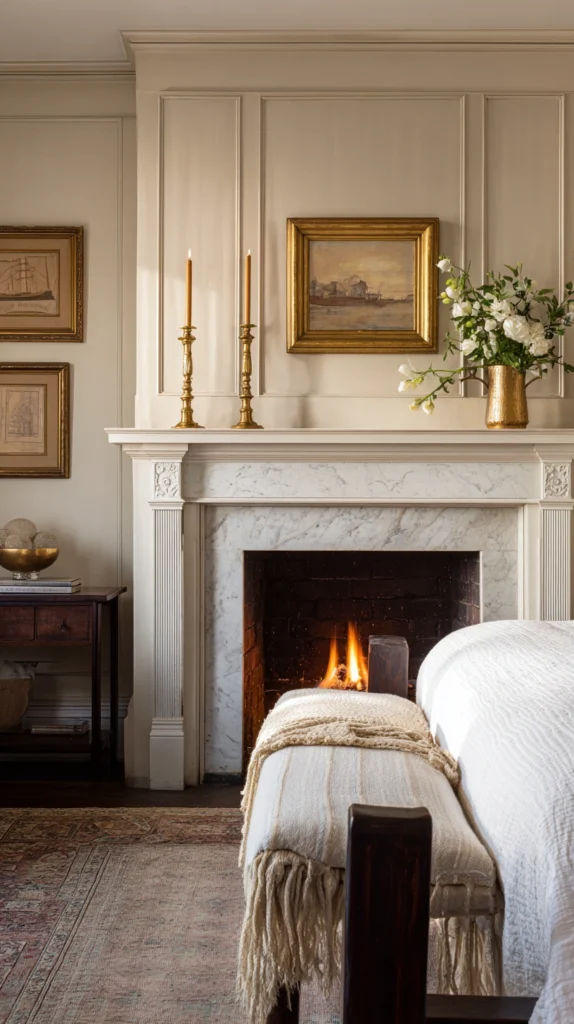
Budget: $0 – $3000
A fireplace in the old money bedroom — a working hearth, or an original fireplace restored to working order, or a decorative period mantelpiece with a cast iron surround — is the room’s most specifically architectural and the most specifically old money structural element. No other single feature communicates the history and the quality of a domestic space with more directness than a genuine bedroom fireplace. If the room already has one, it is the most important feature in it. If it does not, restoring or installing one is the most transformative single investment available.
Restoration of an existing blocked fireplace — $200 – $1000 for a professional chimney inspection, liner, and opening. Installation of a period mantelpiece from an architectural salvage dealer — $200 – $800 for the mantelpiece plus $100 – $400 for installation. A decorative cast iron insert — $100 – $300. A bioethanol fire for a non-working fireplace — $150 – $500 — providing a genuine flame without a chimney requirement.
Styling tip: Dress the old money bedroom mantelpiece with a specific, carefully chosen arrangement of objects — a central clock or a framed family photograph, two candlesticks of equal height on either side, and two or three smaller objects of genuine interest distributed between them — rather than a general display of objects that happen to be decorative. A mantelpiece dressed with a specific, symmetric, considered arrangement reads as a room that was designed by someone who understood the architecture of a mantelpiece display. One dressed with whatever fitted reads as a surface used for storage.
10. The Library Corner and Book Collection
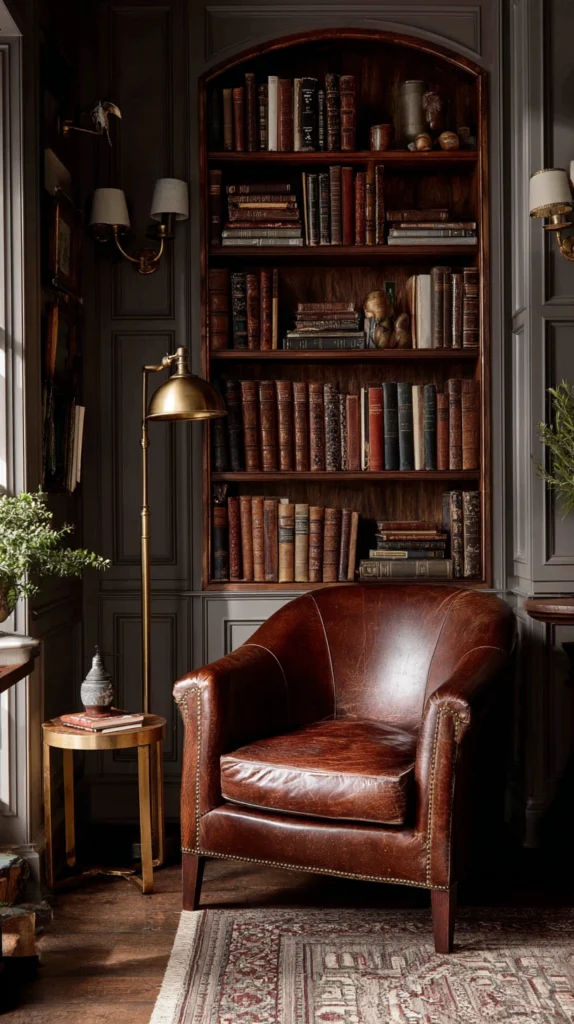
Budget: $0 – $500
A library corner in the old money bedroom — a deep armchair in a worn leather or a faded linen, a floor lamp at the correct reading height, a small side table for a glass of something, and a bookshelf containing books that have genuinely been read, with no visible attempt to organise them by spine colour or any other purely decorative principle — is the room’s most specifically intellectual and the most specifically old money domestic zone.
Old money rooms contain books because their occupants read. The library corner communicates this with more honesty and more authority than any purely decorative bookshelf arrangement.
A worn leather or faded linen armchair — $100 – $500 from a secondhand furniture dealer. A floor lamp with a warm shade — $40 – $120. A small side table — $30 – $80. Books already owned and genuinely read — free to relocate. A small timber bookshelf — $60 – $200 if an additional shelf is required.
Styling tip: Arrange the books in the old money bedroom bookshelf by subject matter and by the owner’s personal relationship with them — the books most frequently returned to on the eye-level shelf, the reference volumes above, the sentimental or inherited volumes on the lower shelf — rather than by colour, size, or any other purely visual principle. A bookshelf organised by personal use reads as a working library. One organised by appearance reads as a display of books purchased for their spines. The old money bedroom contains the former.
11. The Heavy Curtain and Pelmet
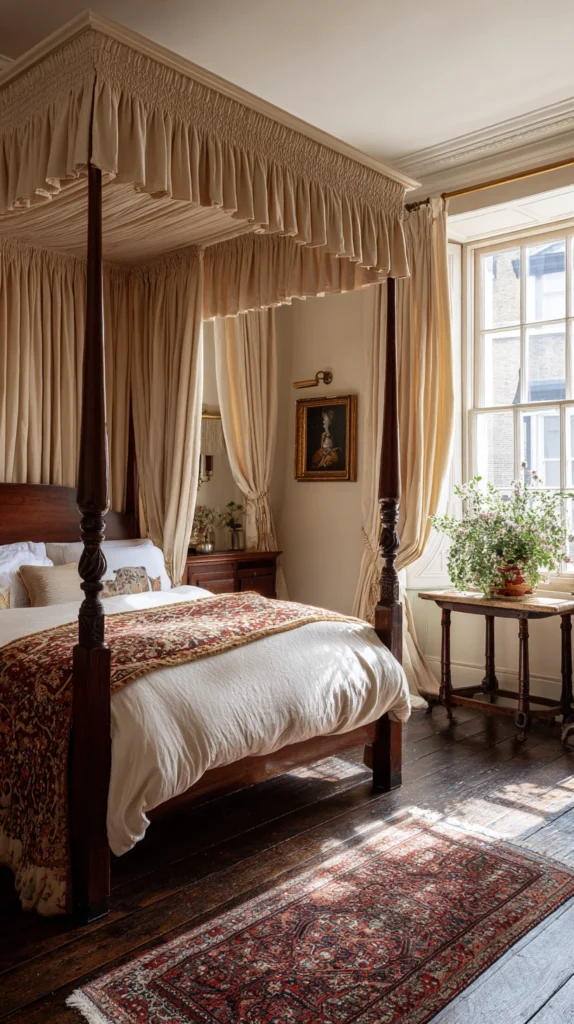
Budget: $200 – $2000
Heavy curtains in the old money bedroom — floor-to-ceiling panels in a quality woven fabric, a wool or linen or a traditional chintz, hung from a pelmet or a curtain pole at ceiling height and puddling slightly on the floor — are the room’s most materially generous and the most specifically traditional window treatment.
The pelmet — a horizontal box structure above the curtain that conceals the curtain heading and the track — is the most specifically period detail of the two elements and the one that most directly communicates that the room’s windows were dressed with genuine care and genuine material investment.
Curtain fabric in a quality woven or printed linen — $15 – $60 per metre, with a full pair of floor-to-ceiling curtains requiring eight to twelve metres — $120 – $720 in fabric. A pelmet in a painted timber with a covered fabric face — $100 – $400 in materials. Professional curtain making — $200 – $600 for a full pair with a quality heading. Total window treatment investment: $420 – $1720 for curtains that read as genuinely considered and genuinely generous.
Styling tip: Line all old money bedroom curtains with a blackout interlining rather than a standard lining — the interlining adding substantial weight to the curtain that causes it to hang with the particular heaviness and the particular depth of fold that distinguishes an expensively made curtain from an affordably made one. The weight of the curtain is the first quality indicator that an experienced eye assesses when entering a room, and the interlining is the component that produces the correct weight.
12. The Aged Brass and Silver Accessories
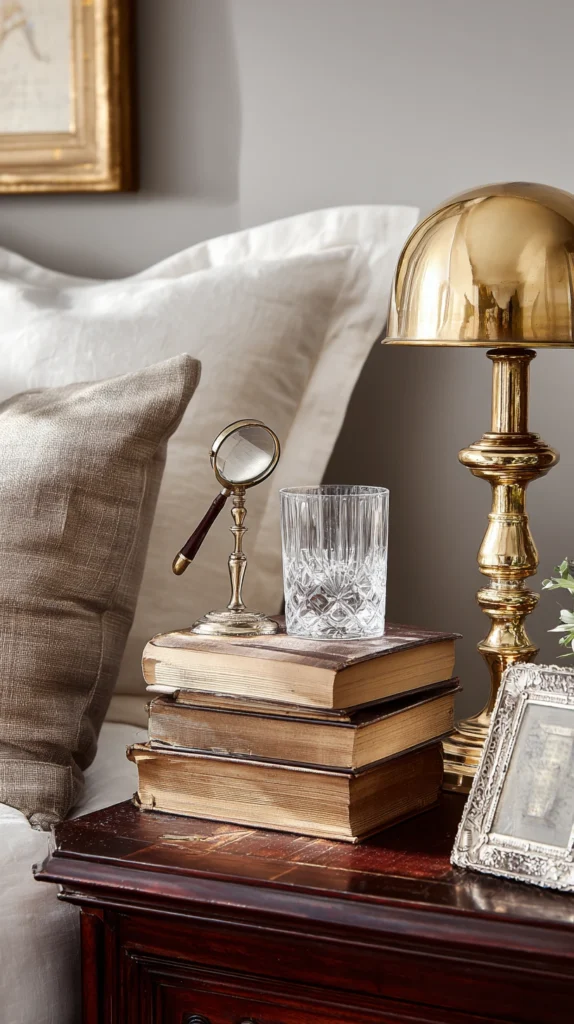
Budget: $40 – $300
Accessories in the old money bedroom — a small silver-topped box on the bedside table, a brass magnifying glass beside the reading chair, a silver photograph frame on the chest of drawers, a brass inkwell repurposed as a pen holder on the desk, and the specific quality of objects that were made to serve a function and have served it for a very long time — are the room’s most intimately communicative details. They are not decorative accessories. They are personal objects that also happen to be beautiful.
A silver-topped trinket box — $20 – $60 from an antique market. A brass magnifying glass — $15 – $40. A silver or silver-plate photograph frame — $15 – $50. A brass inkwell — $10 – $30. A small crystal carafe and glass on the bedside table — $20 – $50. Total accessories investment: $80 – $230 for the room’s most intimate and most specifically personal object layer.
Styling tip: Arrange the old money bedroom’s accessories in specific, purposeful positions rather than distributed across surfaces without consideration of their function or their relationship to each other. A magnifying glass beside the reading lamp, a carafe of water within reach of the bed, a photograph of significance in the position of most frequent viewing — accessories placed with reference to their use produce a room that reads as genuinely inhabited rather than staged. The arrangement that looks most natural is the arrangement in which every object knows exactly where it belongs.
13. The Campaign Chest or Antique Trunk
Budget: $100 – $1000
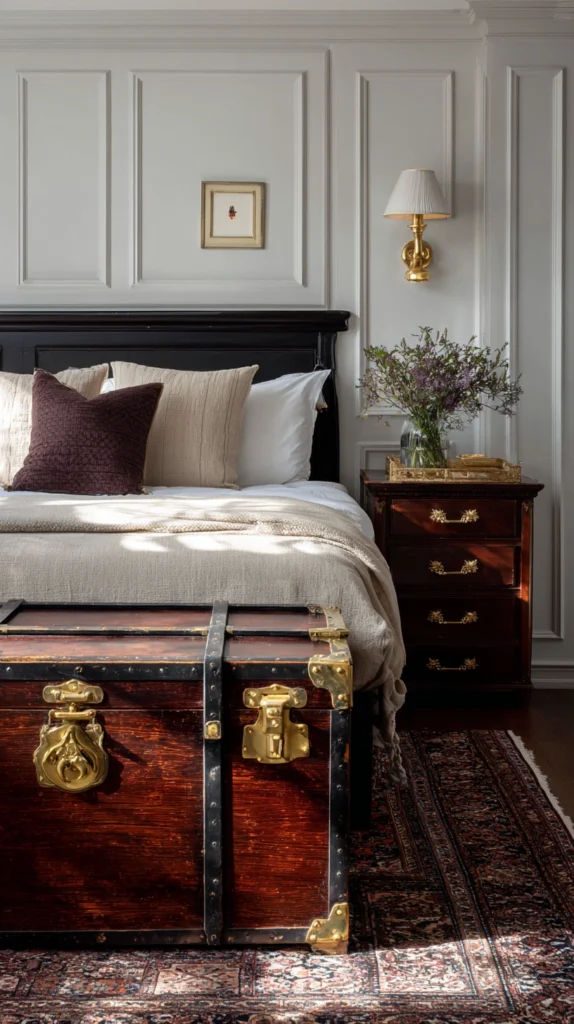
A campaign chest — the portable, brass-hinged, deployable chest of a military officer on campaign, now one of the most specifically old money and the most formally handsome storage pieces available for a bedroom — or an antique leather or canvas trunk at the foot of the bed, provides both meaningful storage and the specific quality of an object with a history that a standard chest of drawers cannot approach. Campaign furniture is old money furniture in its most honest and most specifically masculine expression: functional, well-made, and improved by every mile it has travelled.
A genuine campaign chest from an antique dealer — $300 – $1000 depending on period and condition. A reproduction in the campaign style — $150 – $400. An antique leather trunk — $100 – $400 from a dealer or an estate sale. Either placed at the foot of the old money bedroom bed — or at the side as a bedside table — communicates the aesthetic’s central value: that an object made well and used long is more beautiful than any new purchase.
Styling tip: Place the campaign chest or antique trunk at the foot of the bed rather than against a wall — where it serves as both a storage piece and a structural part of the bed composition. At the foot of the bed, the trunk reads as integral to the sleeping zone’s design. Against the wall, it reads as a storage piece placed in the room. Position determines whether the trunk is furniture or architecture.
14. The Dressing Room Corner
Budget: $100 – $1000
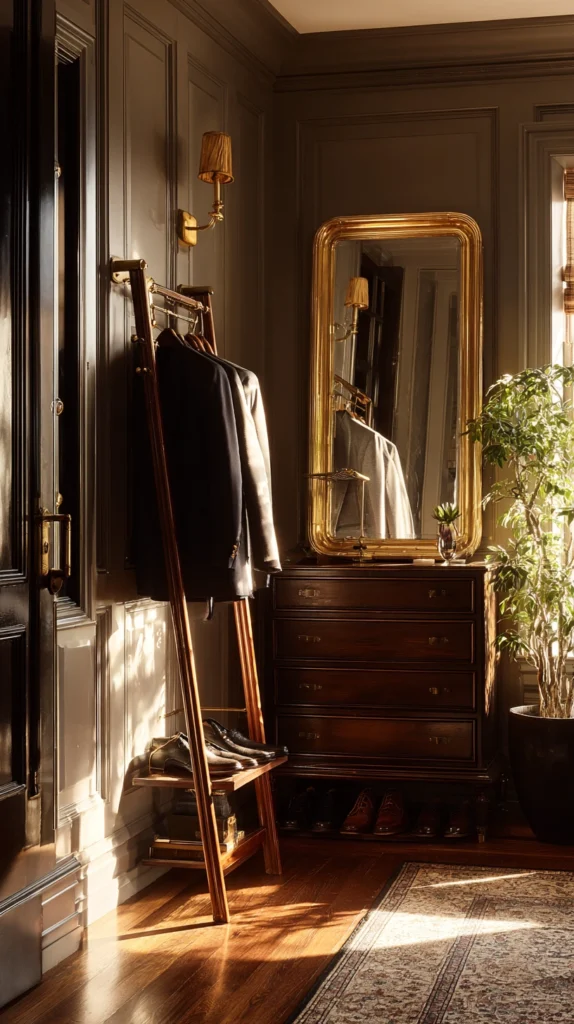
A dressing corner within the old money bedroom — a timber valet stand holding the following day’s clothes, a shoe rack or a small shoe cabinet of quality timber or leather, a free-standing mirror with a simple timber or brass frame, and a wooden clothes brush hung from a hook beside the valet — is the room’s most specifically old money functional zone. It communicates that dressing is a considered activity rather than a rushed one, and that the objects used in the process of dressing are worth dedicating a specific and specifically beautiful corner of the room to.
A timber valet stand — $80 – $250. A quality wooden clothes brush — $15 – $40. A free-standing mirror with a timber or brass frame — $60 – $200. A small shoe rack or shoe cabinet in dark timber — $40 – $150. A brass coat hook for the clothes brush — $8 – $20. Total dressing corner investment: $203 – $660 for the room’s most specifically traditional and most specifically useful functional zone.
Styling tip: Use the valet stand genuinely rather than as a display piece — hanging the following day’s clothes on it each evening so that the morning’s dressing is already organised and the bedroom begins each day with a deliberate and considered arrangement rather than with the improvised chaos of clothes chosen at speed. A valet stand used as it was designed to be used produces a room that reads as inhabited by someone who has a genuine relationship with their possessions and the rituals of their use.
15. The Fully Realised Old Money Aesthetic Bedroom
Budget: $1000 – $15000
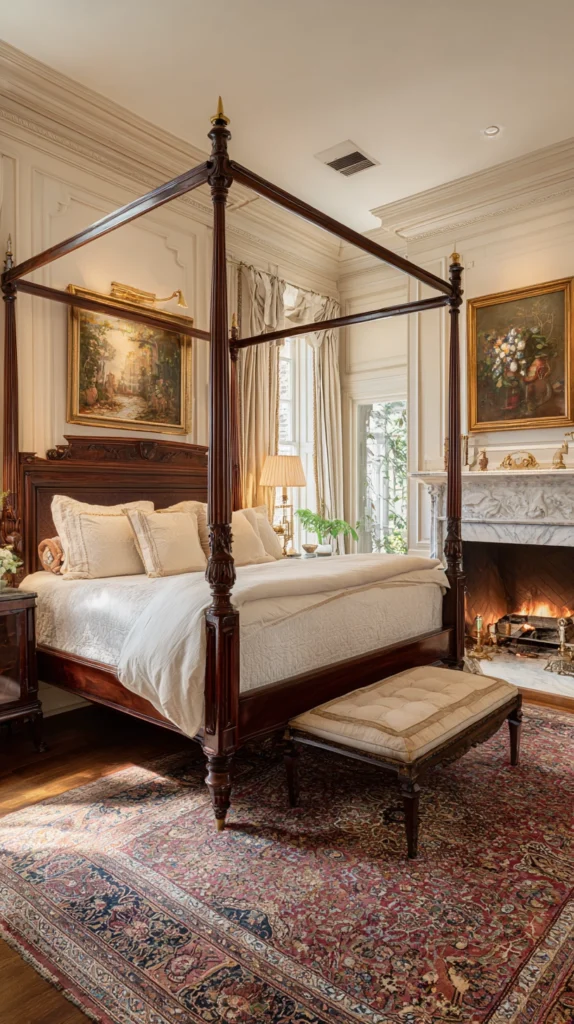
The fully realised old money aesthetic bedroom — warm ivory walls in an eggshell finish, dark timber four-poster in antique mahogany, layered white linen bedding with a wool blanket at the foot, a Persian rug with all four bed legs upon it, antique bedside tables with aged brass lamps and warm-toned bulbs, an oil painting or a botanical print in a heavy gilt frame above the bed or on the primary wall, timber panelling on the chimney breast wall with a restored fireplace and a carefully dressed mantelpiece, a library corner with a worn leather chair and a genuine reading floor lamp, heavy curtains in a quality woven linen with a painted pelmet above, monogrammed pillowcases pressed and placed correctly, a campaign chest at the foot of the bed, a dressing corner with a valet stand and a free-standing mirror, and a collection of genuinely personal silver and brass accessories on every surface — is a room that tells a story of taste accumulated over time and of a relationship with objects that is both material and deeply personal.
Paint: $40 – $200. Bed frame: $600 – $5000. Bedding: $270 – $830. Rug: $150 – $1500. Bedside tables and lamps: $260 – $1200. Art: $70 – $5000. Panelling or wall treatment: $200 – $1500. Fireplace: $0 – $1500. Curtains: $420 – $1720. Library corner: $230 – $900. Campaign chest: $100 – $1000. Monogrammed linen: $45 – $200. Dressing corner: $203 – $660. Accessories: $80 – $230. Total fully realised old money bedroom: $2668 – $21440 — the range is wide because the most important quality of the old money bedroom is that its best pieces should be sourced over time, from antique dealers and estate sales, as genuinely good things become available.
Decor tip: Build the old money aesthetic bedroom incrementally — over months or years, adding pieces as genuinely good examples become available — rather than assembling it all at once from available retail sources. The old money bedroom is not assembled in an afternoon. It is accumulated over a lifetime. A bedroom assembled all at once from the same retail sources has a coordinated, recently purchased quality that contradicts the fundamental premise of the old money aesthetic. A bedroom assembled over time, with each piece chosen for its specific quality rather than its catalogue availability, develops the particular character of a room that has been lived in and loved — which is the only character worth having.
The old money aesthetic bedroom is not, in the end, about money — old or otherwise. It is about the specific quality of attention that the best rooms have always required and always rewarded: the attention that asks of every object whether it is genuinely beautiful, genuinely well-made, and genuinely worth keeping for longer than the next trend cycle.
Objects that answer yes to all three questions earn their place. Objects that do not have no business in a room built on the principle that quality, time, and genuine personal meaning are the only currencies that produce genuine luxury.
Choose slowly. Choose well. Keep everything you choose for as long as it serves you beautifully.
That is the old money bedroom. That is all it has ever been.