13 Fall Kitchen Organization Hacks That Look Pretty
There is a particular kind of kitchen chaos that arrives every autumn and that no amount of summer organization quite prepares for — the sudden influx of squash and apples from the farmers market, the baking equipment pulled out of storage for the first time since last year, the spice jars multiplying as cinnamon and nutmeg and clove all come back into weekly use, the soup ingredients and the slow cooker and the extra mugs for cider all needing somewhere to live.
The kitchens that handle this well are not the ones with the most storage. They are the ones where the organization itself was made to look intentional rather than merely functional — where the produce basket that solves a real clutter problem is also, by the way it was chosen and arranged, a genuinely attractive object. The thirteen hacks below are organized around that same principle: solve the seasonal storage problem, and make the solution something worth looking at.
1. The Tiered Produce Basket for Squash and Apples
Budget: $25 – $80
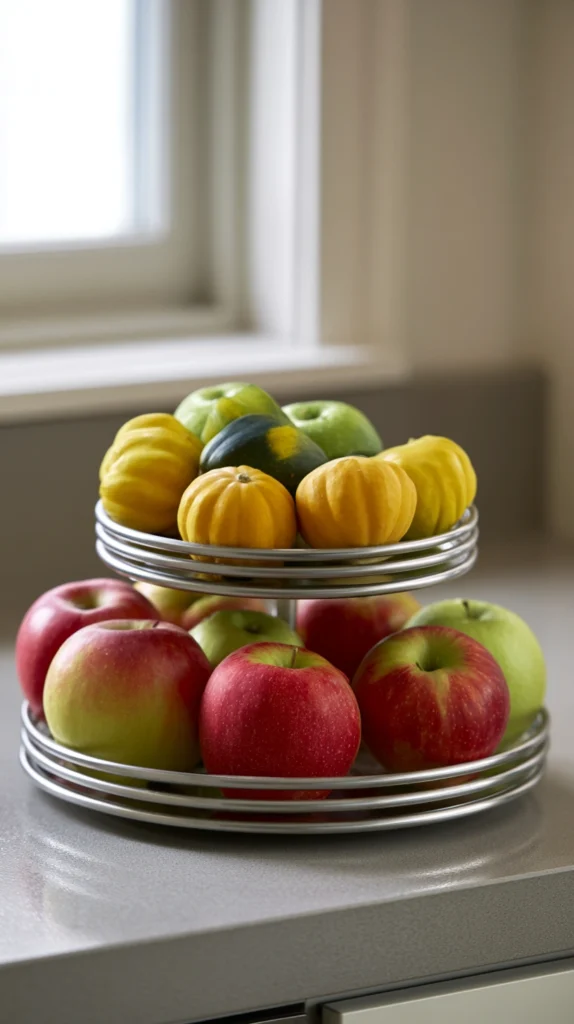
A tiered wire or wicker fruit stand — the kind typically used for everyday produce — repurposed for the season’s specific harvest of small squash, pumpkins, and apples, lifts the autumn produce off the counter surface entirely and organizes it by size across two or three tiers rather than allowing it to spread sideways and consume the limited counter space.
The tiered stand solves the genuine seasonal problem of a counter overwhelmed by incoming produce while giving the kitchen a single, attractive vertical object in place of a sprawling and increasingly disordered pile.
A wire tiered fruit stand — $20 – $50. A wicker version with a more rustic finish — $25 – $70.
Organizing tip: Place the heaviest, largest squash on the bottom tier and the lightest, smallest items — apples, small gourds — on the top, both for stability and because the visual weight of a tiered display reads more naturally when it narrows as it rises. A stand top-loaded with the largest pumpkin looks precarious; one that tapers upward looks composed.
2. The Labelled Mason Jar Spice Wall
Budget: $30 – $90
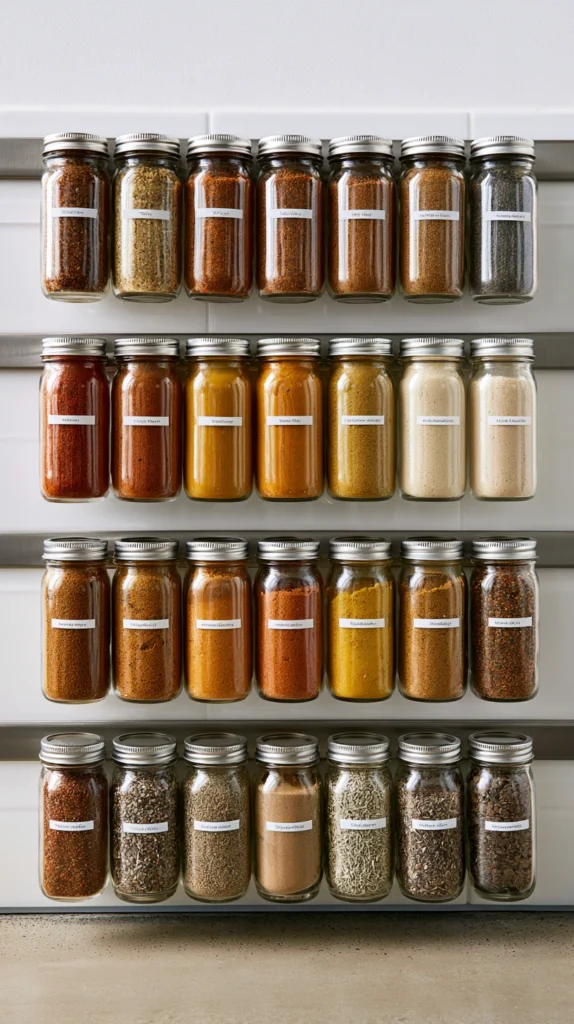
A wall-mounted magnetic strip or a simple shelf holding a row of small Mason jars, each filled and labelled with the specific spices that come into heavy seasonal use — cinnamon, nutmeg, clove, allspice, ginger — keeps every autumn baking spice visible, labelled, and within reach of the stove rather than buried in a cluttered cabinet drawer.
The labelled jar wall solves the real organizational problem of needing several spices in quick succession during a single baking session, while the uniform jars and consistent hand-lettered labels give the wall a visual coherence that the mismatched original spice containers never had.
Small glass Mason jars — $1 – $3 each. A magnetic spice strip or small floating shelf — $15 – $40. Chalkboard labels or a label maker — $5 – $15.
Organizing tip: Decant every spice into a jar of the exact same size and shape, regardless of how much of each spice is actually used — visual consistency across the row is what makes the wall read as a designed system rather than a cabinet emptied onto a shelf, and the uniformity matters more to the finished look than the relative quantities of cinnamon versus clove.
3. The Vintage Crate Pantry Divider
Budget: $20 – $70
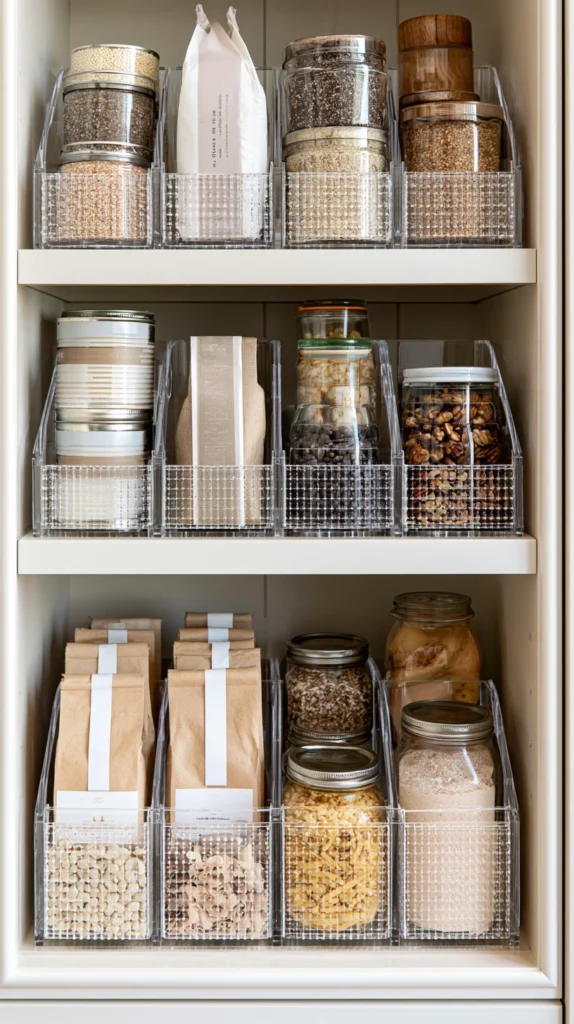
A small vintage or reproduction wooden crate, placed inside a deep pantry shelf or cabinet, used to corral the season’s canned pumpkin, baking mixes, and extra spice stock into a single defined zone, prevents the autumn pantry overflow from spreading across every available shelf and gives the additional seasonal stock a specific, contained home.
The crate divider solves the real problem of pantry items multiplying every November without a system to contain them, while the natural timber of the crate looks considerably more intentional inside an open or glass-fronted cabinet than the cardboard packaging it replaces.
A small wooden crate sized to the pantry shelf depth — $15 – $40. A label or tag for the crate’s contents — $3 – $8.
Organizing tip: Turn any printed packaging — the canned pumpkin label, the boxed mix — to face inward or downward where possible inside the crate, or transfer loose dry goods into the jars from idea two above. A crate filled with consistent, label-faced-away packaging photographs and reads as considerably tidier than the same crate filled with mismatched, brand-forward boxes and cans.
4. The Hanging Basket for Root Vegetables
Budget: $20 – $60
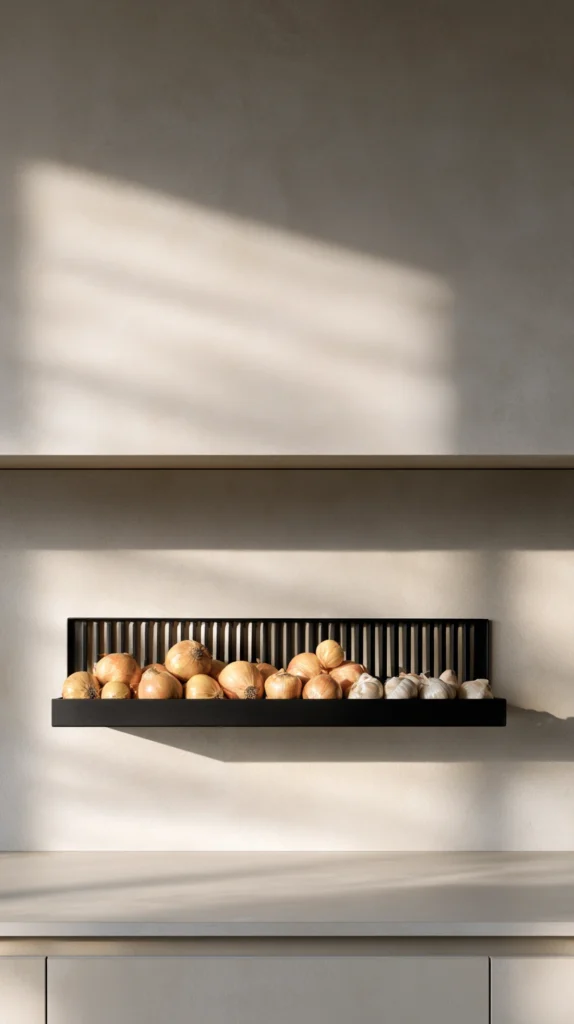
A hanging wire or rope basket, suspended from a hook beneath an upper cabinet or from a ceiling beam, holding the season’s onions, garlic, and any root vegetables that benefit from ventilation rather than refrigeration, keeps these items off the counter and out of a crowded vegetable drawer simultaneously.
The hanging basket solves a genuine storage and freshness problem — root vegetables and onions last considerably longer with airflow than sealed in a drawer — while the suspended basket itself, particularly in a woven or wire form, adds a textural, slightly rustic decorative element to the kitchen that a closed drawer never could.
A hanging wire or rope vegetable basket — $15 – $45. A ceiling hook or under-cabinet hook — $3 – $10.
Organizing tip: Position the hanging basket away from direct sunlight and away from the stove’s heat — both accelerate spoilage in stored onions and root vegetables — and choose a spot where the basket’s height clears the head of the tallest household member who regularly works in that part of the kitchen, since a beautifully organized basket that gets bumped daily will not stay beautifully organized for long.
5. The Repurposed Apple Crate Lid Tray
Budget: $10 – $35
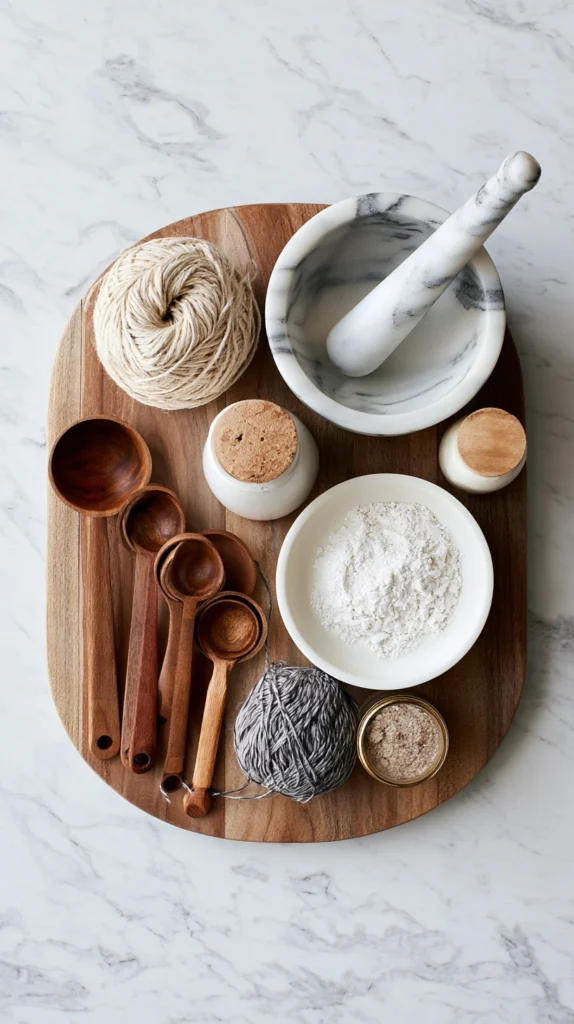
The flat lid or side panel of a wooden produce crate, used as a small tray on the counter to corral the loose, frequently-reached-for items of autumn cooking — a few cinnamon sticks, a small paring knife, a pumpkin peeler, a roll of kitchen twine for trussing — keeps these small tools contained in a single, visually unified zone rather than scattered across the counter.
The crate lid tray solves the small but constant problem of loose utensils and odds and ends accumulating during a long cooking session, while the reclaimed timber surface gives even a random collection of small tools the appearance of a deliberately curated workstation.
A reclaimed crate lid or thin timber board — $5 – $20, often free from a produce crate already being broken down. Felt or cork backing to protect the counter — $3 – $10.
Organizing tip: Limit the tray to no more than five or six objects at any time — a crowded tray defeats its own purpose and begins to look like clutter contained on a board rather than clutter eliminated. The tray should hold only what is genuinely in use for the current task, refreshed as the cooking session changes.
6. The Cake Stand Repurposed for Cinnamon Roll Ingredients
Budget: $15 – $50
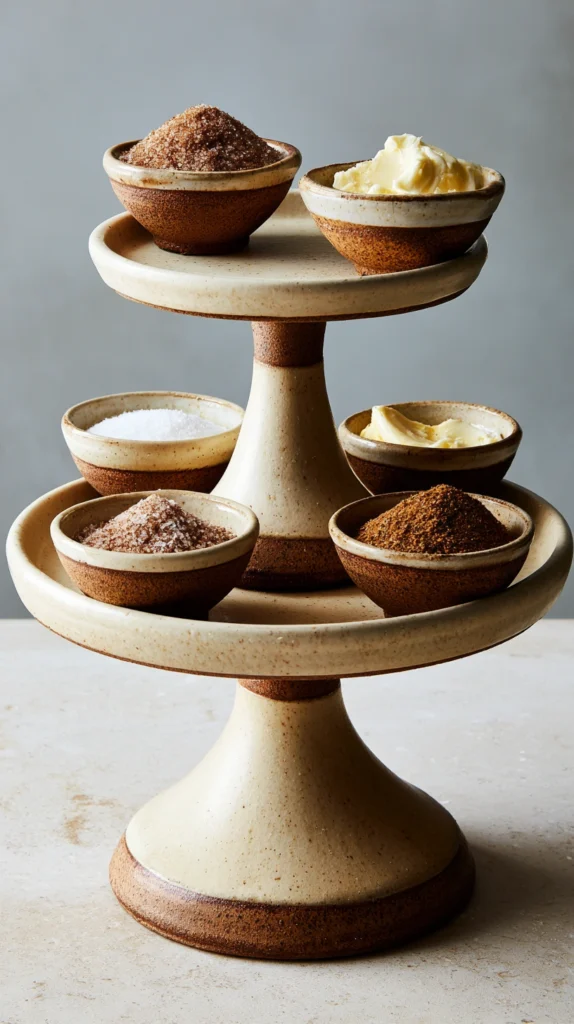
A tiered glass or ceramic cake stand, not used for cake at all but for organizing the small bowls and ingredients of a regular autumn baking ritual — a bowl of cinnamon sugar on one tier, a small dish of softened butter on another, a few whole cinnamon sticks for garnish on top — turns a baking mise en place into a styled display rather than a cluttered counter of mismatched bowls.
This hack solves the practical problem of needing several small quantities of ingredients within reach during baking while occupying a fraction of the counter footprint that the same bowls would take up spread out individually, and the cake stand’s inherent elegance elevates even the most utilitarian ingredient prep into something worth photographing.
A tiered cake stand, glass or ceramic — already owned, or $15 – $45. Small matching prep bowls — $3 – $10 each.
Organizing tip: Use small bowls in a single matching set for everything placed on the stand — mismatched bowls undercut the cake stand’s inherent visual order, while a uniform set of two or three small bowls in the same material and colour makes the entire arrangement read as considered rather than improvised.
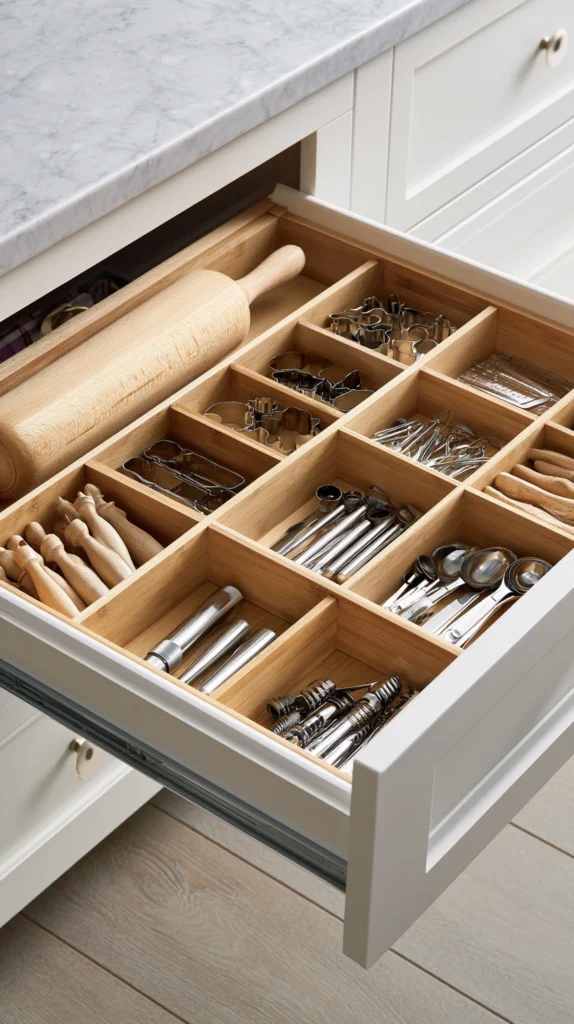
7. The Drawer Divider for Seasonal Baking Tools
Budget: $15 – $50
A simple bamboo or acrylic drawer divider insert, installed in the drawer nearest the oven specifically to separate the season’s most-used baking tools — pastry cutters, a rolling pin, pie weights, a pumpkin carving set if doubling as a baking drawer — keeps these tools from the usual autumn tangle of overlapping, hard-to-find equipment.
The drawer divider solves the recurring frustration of needing a specific tool during active baking and being unable to locate it quickly, while a well-organized drawer, even unseen by guests, contributes to the sense of an entire kitchen that has been thoughtfully prepared for the season rather than merely surviving it.
A bamboo or acrylic adjustable drawer divider — $12 – $40. Small additional inserts for very small tools — $3 – $10.
Organizing tip: Group tools in the drawer by the specific task they serve rather than by tool type — all pie-making tools in one section, all general baking tools in another — since this is the organizing logic that matches how the tools are actually reached for during a single cooking session, rather than an abstract categorization that looks tidy but slows down actual use.
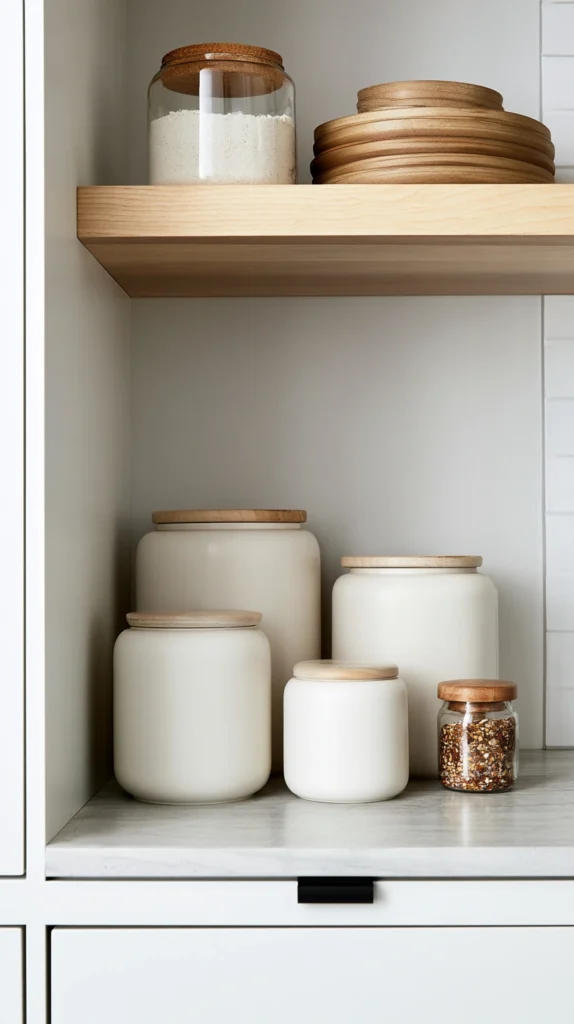
8. The Open Shelf Canister Set for Flour, Sugar, and Spice Blends
Budget: $40 – $150
A matching set of ceramic or glass canisters on open kitchen shelving, holding the increased quantities of flour and sugar that autumn baking demands alongside a jar of pre-mixed pumpkin spice blend made in batches at the start of the season, replaces the bags and boxes that typically clutter a baking-heavy kitchen with a uniform, visually calm display.
This hack solves the storage problem created by the sheer increase in baking volume that arrives every autumn, while the matching canister set transforms what would otherwise be a shelf of brand packaging into a coherent, intentional-looking display.
A matching canister set in ceramic or glass — $35 – $120. A small additional jar for a homemade spice blend — $5 – $20.
Organizing tip: Decant only the quantity of flour and sugar that will realistically be used within a few weeks into the open canisters, and keep the bulk supply sealed in its original packaging inside the pantry — open canisters extend shelf life less effectively than sealed bags for long-term storage, so the visible canister should function as the working supply rather than the entire stock.
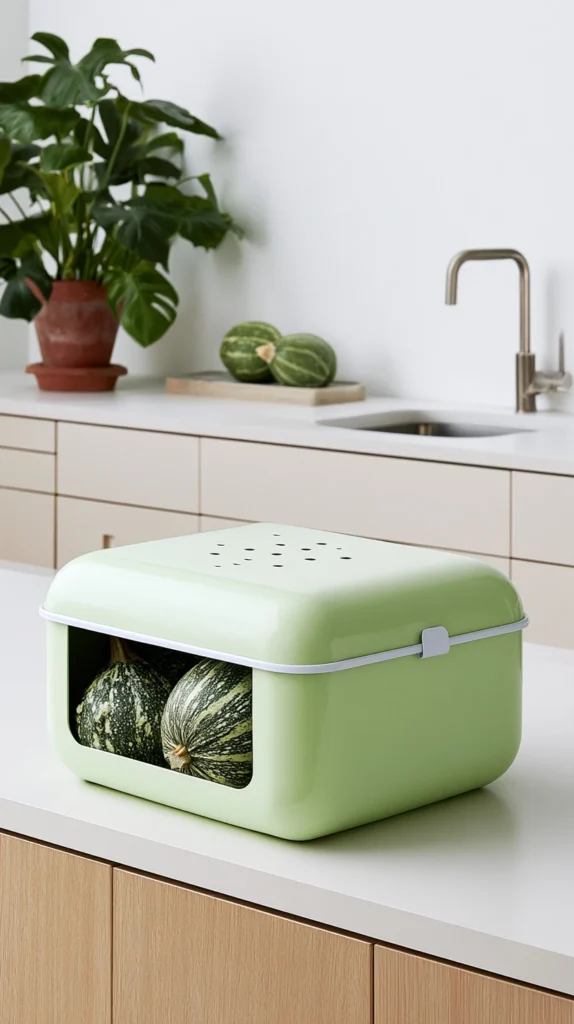
9. The Repurposed Bread Box for Squash Storage
Budget: $20 – $70
A vintage or reproduction enamel bread box, used not for bread but for storing two or three winter squash out of direct light and away from the counter’s visual clutter, solves the specific seasonal problem of squash that need cool, dark, ventilated storage but that most kitchens have no dedicated space for.
The bread box hack borrows a piece of kitchenalia with an established decorative pedigree and gives it a new seasonal function — the squash hidden from view but the box itself, in a warm enamel colour, remaining an attractive countertop or shelf object throughout.
A vintage enamel bread box — $20 – $50 from a secondhand source. A new reproduction version — $30 – $70.
Organizing tip: Choose a bread box in a colour that relates to the kitchen’s existing palette rather than the most decorative option available — a bread box that matches or complements the room’s cabinetry or wall colour reads as a permanent fixture of the kitchen, while one in an unrelated colour reads as a seasonal prop temporarily introduced for the squash it is hiding.
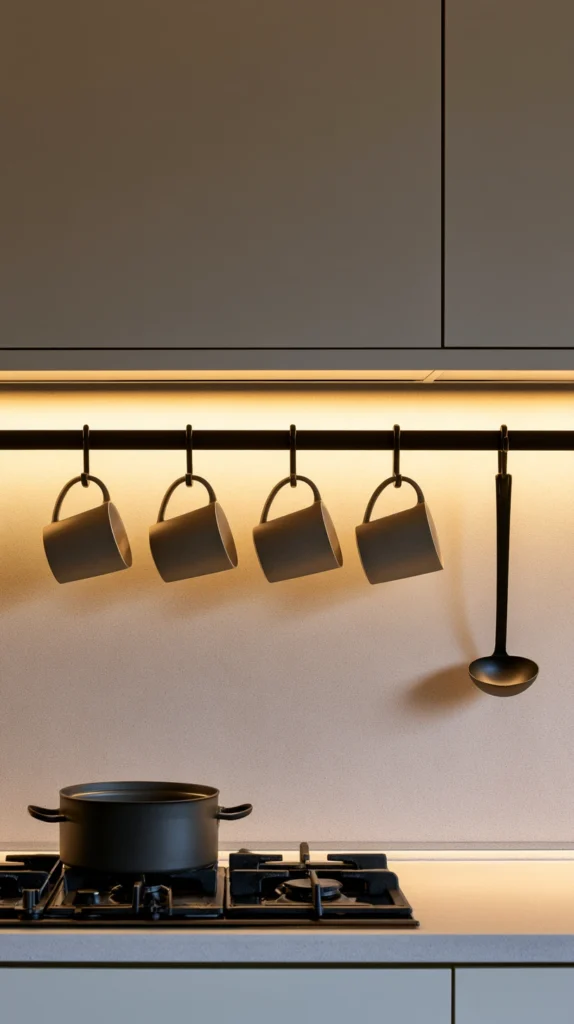
10. The Hooks and Rail for Hanging Mugs and Ladles
Budget: $20 – $60
A simple wall-mounted rail with a row of hooks, installed near the stove specifically to hold the season’s increased rotation of mugs for cider and cocoa, along with the ladle used for soup and mulled drinks, frees up significant cabinet space that would otherwise be consumed by mugs cycling in and out of daily use.
The hanging rail solves the real seasonal problem of mug cabinets becoming disproportionately full as hot drink consumption increases, while a row of hung mugs and a single suspended ladle has the specific decorative quality of a well-used, well-loved kitchen tool display.
A wall-mounted rail with hooks — $15 – $45. Additional S-hooks for the ladle and any other hanging tools — $3 – $10.
Organizing tip: Hang mugs by their handles facing the same direction along the full length of the rail rather than at random angles — the uniform orientation is a small detail that makes the difference between a rail that reads as organized and one that reads as a random collection of mugs that happen to be hanging from hooks.
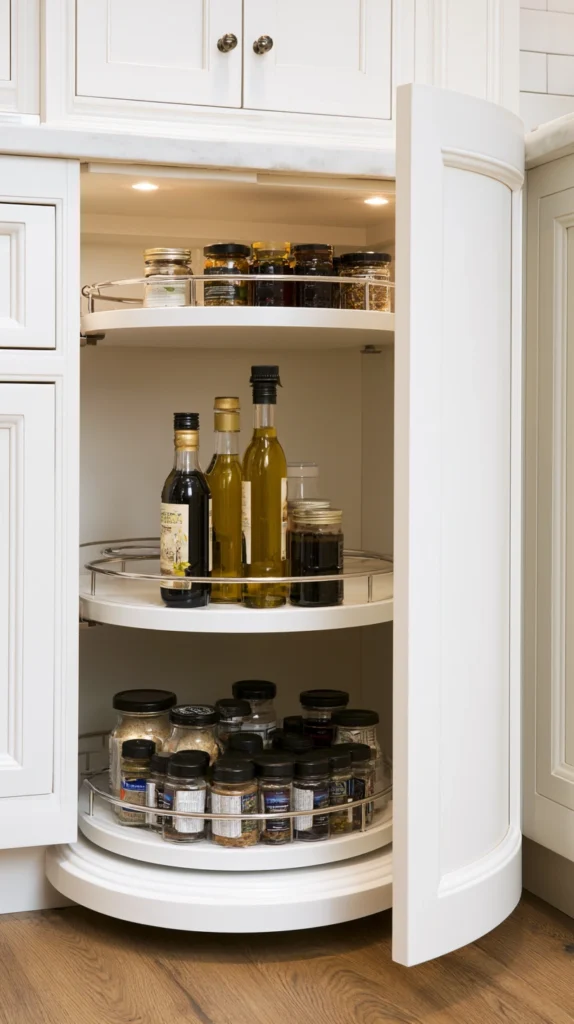
11. The Lazy Susan for the Spice and Oil Cabinet
Budget: $10 – $35
A simple rotating lazy Susan, placed inside the cabinet nearest the stove to hold the season’s expanded collection of oils, vinegars, and less frequently used spice jars, solves the specific autumn problem of a cabinet whose contents have multiplied beyond what a static shelf can present without items getting lost or pushed to the back.
The rotating tray turns a deep, awkward cabinet space into one where every item is reachable with a simple turn, and the circular uniformity of the tray itself, even hidden behind a cabinet door, contributes to the sense of a kitchen where every storage decision was made with intention.
A turntable or lazy Susan sized to the cabinet shelf — $10 – $30. A two-tier version for deeper cabinets — $20 – $35.
Organizing tip: Place the items used most frequently — the oil for roasting, the most-reached-for spice — at the front edge of the turntable nearest the door, and rotate the tray as needed rather than reaching across it; this is a small habit change that determines whether the lazy Susan actually saves time or simply becomes another surface to dig through.
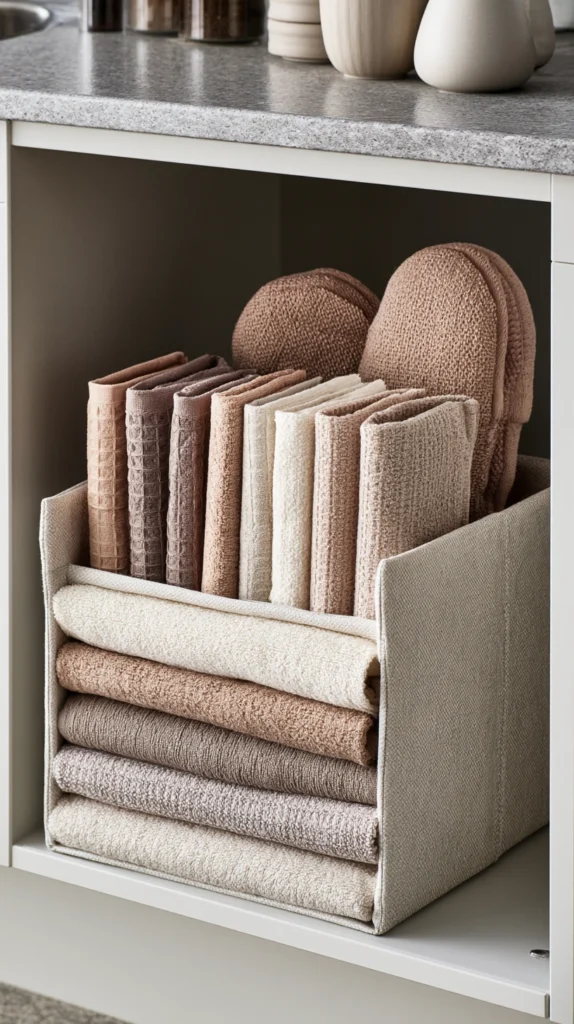
12. The Linen Bin for Kitchen Towels and Oven Mitts
Budget: $20 – $60
A woven or linen-lined basket, placed on the counter or a nearby open shelf, holding a rotating supply of kitchen towels, oven mitts, and pot holders in the season’s warm autumn tones, replaces the drawer of mismatched and often damp textiles with a single, accessible, visually warm storage solution.
The towel bin solves the practical problem of needing a clean towel or mitt within arm’s reach during active autumn cooking, while a basket of folded, colour-coordinated linens has a softness and warmth that an open drawer of crumpled textiles cannot provide.
A woven or linen-lined storage basket — $15 – $45. A rotating set of three to four kitchen towels and a pair of oven mitts in autumn tones — $20 – $50.
Organizing tip: Fold each towel in thirds rather than in half before placing it in the basket — the narrower, taller fold allows more towels to stand upright in the basket simultaneously, which both increases the usable storage and produces a more visually considered, slightly fanned arrangement than a stack of flat-folded towels lying on top of each other.
13. The Fully Organized Pretty Fall Kitchen
Budget: $250 – $850
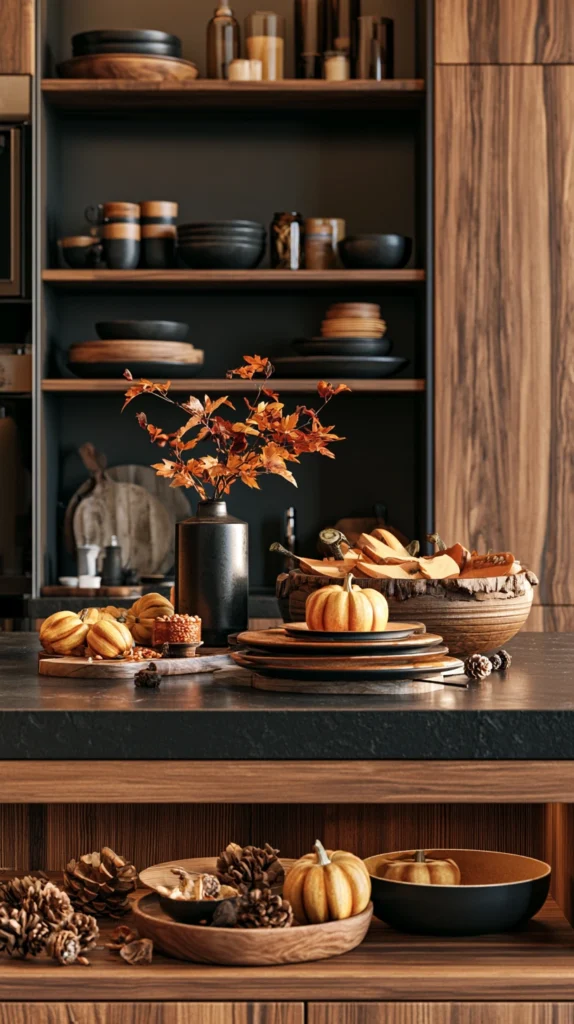
The fully organized pretty fall kitchen — a tiered produce stand of squash and apples beside the stove, a labelled Mason jar spice wall within reach of the oven, a vintage crate dividing the pantry’s seasonal overflow, a hanging basket of onions and root vegetables suspended from a hook, a small crate-lid tray corralling loose baking tools on the counter, a tiered cake stand organizing the cinnamon roll mise en place, a divided drawer of pastry tools, a matching canister set of flour, sugar, and homemade spice blend on open shelving, an enamel bread box quietly storing squash out of the light, a mug and ladle rail beside the stove, a lazy Susan organizing the oil and spice cabinet, and a linen bin of warm-toned towels and mitts within reach of every burner.
This is a kitchen where every seasonal storage problem has been solved by an object considered enough to also function as the room’s decoration.
Tiered produce stand: $25 – $80. Spice jar wall: $30 – $90. Crate divider: $20 – $70. Hanging basket: $20 – $60. Crate lid tray: $10 – $35. Cake stand setup: $15 – $50. Drawer divider: $15 – $50. Canister set: $40 – $150. Bread box: $20 – $70. Mug rail: $20 – $60. Lazy Susan: $10 – $35. Towel bin: $20 – $60. Total fully organized pretty fall kitchen: $245 – $810 for a kitchen where the autumn cooking season’s genuine storage demands have been met by solutions worth looking at as well as using.
Organizing tip: Reassess every hack at the end of the season rather than leaving the systems in place unchanged through winter — the squash storage, the increased mug rotation, and the spice jar additions are autumn-specific solutions to an autumn-specific volume of cooking, and a kitchen organization system that flexes with the season it was built for will continue to look intentional rather than outdated once the produce and the rituals that justified it have moved on.
The fall kitchen organization hack that looks pretty is not a contradiction in terms. It is simply the recognition that the object solving a real seasonal problem — the basket, the jar, the crate, the rail — was always going to be visible in the kitchen regardless, and that choosing it with the same care given to any other kitchen decoration means the room never has to choose between being organized and being beautiful.
It can, with the right thirteen objects, simply be both.