15 Lemon Table Decor Ideas to Brighten Any Event
There is a particular quality that lemons bring to a table that no other decorative element replicates with quite the same efficiency. The colour is immediate — that specific saturated yellow that reads as sunshine even in a shaded room — the shape is sculptural without being precious, the scent is clean and appetite-sharpening, and the entire object costs less than a pound and lasts a week without any intervention.
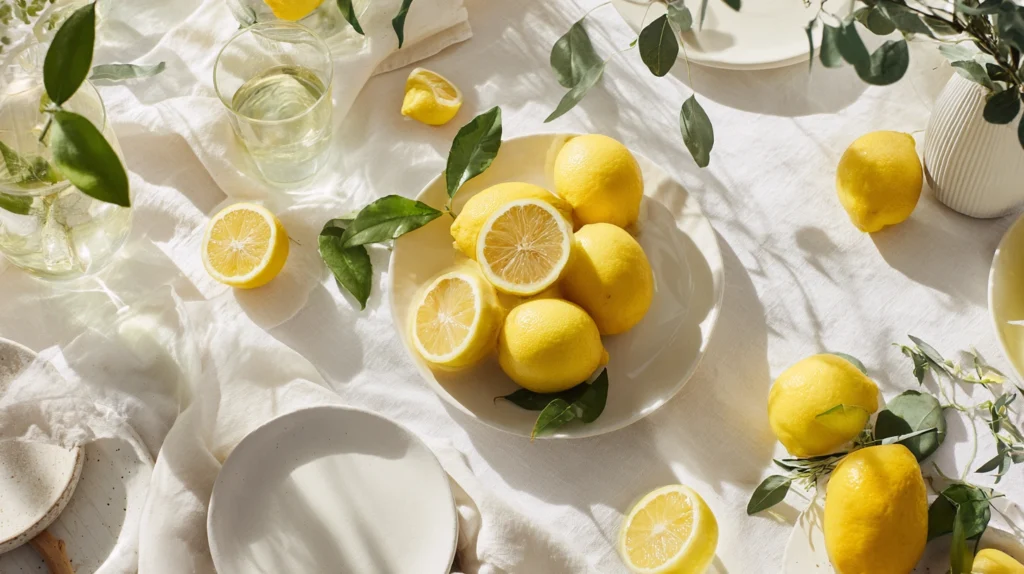
A lemon on a table is doing more decorative work per unit of cost and effort than almost anything else that could be placed there, and a table built around lemons as its central visual motif is one of the most joyful, most summery, and most effortlessly achieved tablescapes available at any budget level.
The fifteen ideas below cover every format and every scale of lemon table decor — from a single centrepiece to a fully dressed event table — and each one is designed to work in a real space with real lemons rather than a styled shoot with perfect props and unlimited time. Each idea covers what you will need, what it will cost, and a practical tip to make it genuinely beautiful rather than merely yellow.
1. The Lemon and Greenery Centrepiece Bowl
Budget: $15 – $60
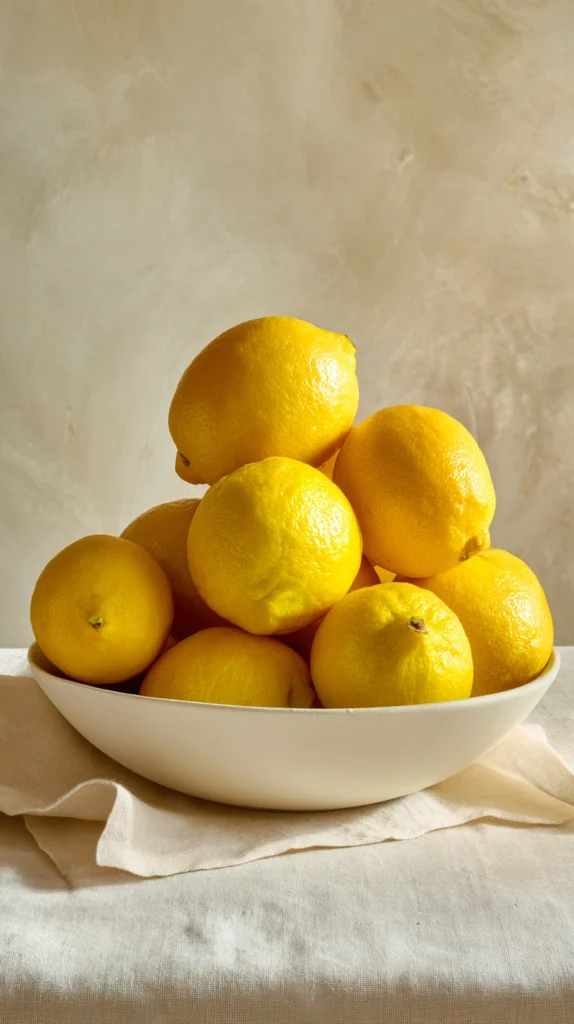
A shallow ceramic or terracotta bowl filled with whole lemons — stacked generously, with sprigs of fresh rosemary, bay leaves, or eucalyptus tucked between them — is the simplest and most reliable lemon centrepiece available. It requires no floristry skill, no special equipment, and no preparation beyond washing the lemons and cutting the herb sprigs. The result is a table centrepiece that looks abundant, smells extraordinary, and costs less than a single bunch of flowers from a florist.
A shallow ceramic or terracotta bowl costs $8 – $25. Eight to twelve lemons fill a standard centrepiece bowl for $3 – $6. Fresh rosemary or bay leaf sprigs from the garden or a supermarket add $2 – $5. The total centrepiece investment sits at $13 – $36 — and the lemons, once the event is over, go directly into the kitchen and are used in the following week’s cooking. There is no centrepiece with a better post-event utility rate.
Styling tip: Use lemons at two different stages of ripeness if possible — some fully yellow and some still with a slight green blush at the tip. The slight colour variation within the bowl produces a more naturalistic, more abundant quality than a bowl of uniformly identical lemons, and the contrast between the deep yellow and the pale green is more visually interesting than a single tone throughout.
2. The Lemon Slice Floating Candle Bowl
Budget: $20 – $80
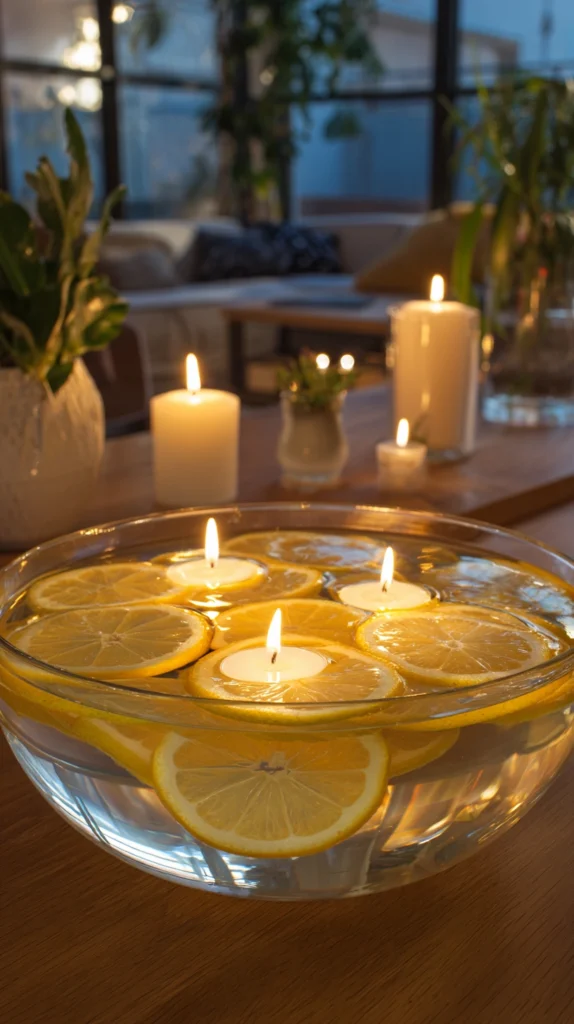
A large glass bowl or vase filled with water, floating candles, and sliced lemon rounds — the yellow discs floating alongside the candle flames, their cross-sections visible through the glass — is one of the most photographed lemon table decor ideas for good reason. The combination of candlelight, water, and citrus colour is genuinely beautiful, particularly in the evening when the candle flames reflect off the water surface and illuminate the lemon slices from below.
A large clear glass bowl or low vase costs $10 – $30. Floating candles in white or ivory — $5 – $15 for a pack of ten — sit on the water surface above the lemon slices. Four to five lemons sliced into rounds provide enough material to fill the bowl visually for $2 – $4. Fresh herb sprigs — rosemary, thyme, or mint — floating alongside the lemon slices add green contrast for $2 – $5. Total investment sits at $19 – $54 for a centrepiece that changes character completely between day and evening as the candles are lit.
Styling tip: Cut lemon slices to a consistent thickness of approximately 5 to 7 millimetres before adding them to the bowl. Slices cut too thin disintegrate in the water within a few hours and cloud the bowl. Slices cut too thick sink rather than floating, which removes their visual contribution entirely. A consistent medium thickness floats reliably, holds its form for the full duration of the event, and shows the cross-section of the lemon clearly through the glass.
3. The Potted Lemon Tree Centrepiece
Budget: $40 – $200
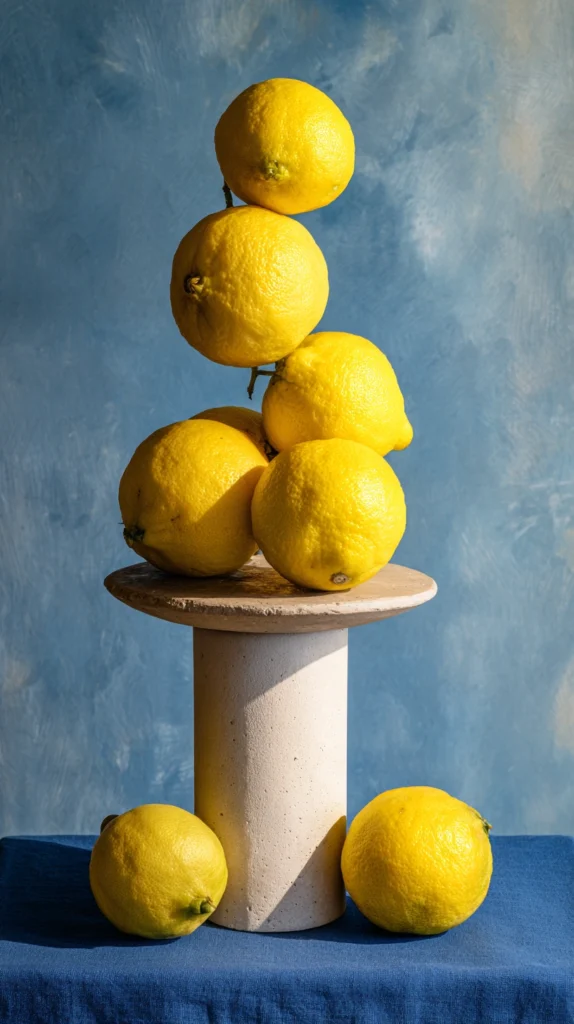
A small potted lemon tree — the kind available from garden centres in late spring and summer with a few fruits already visible on the branches — placed as a centrepiece is the lemon table decoration that provides the most complete sensory experience: the colour of the fruit, the scent of the leaves, the sculptural quality of the small tree form, and the particular generosity of a living thing placed in the middle of a gathering. It is also, unlike a cut flower arrangement, a gift that continues after the event — taken home by the host or given to a guest.
A small potted lemon tree in a terracotta or ceramic pot costs $30 – $80 from a garden centre. A decorative outer pot in a material that suits the table — rattan, painted terracotta, or glazed ceramic — costs $10 – $30 and is slipped over the nursery pot without disturbing the roots. A ring of fresh moss around the base of the tree — $5 – $10 from a florist — covers the soil surface and gives the potted display a finished, considered quality that bare soil does not.
Styling tip: Choose a lemon tree that has both mature yellow fruit and small green developing fruit on the branches simultaneously. A tree carrying fruit at multiple stages of development has a more dynamic, more naturalistic quality than one carrying uniformly ripe fruit, and the combination of yellow and green within the same plant provides the colour contrast that a single-stage tree cannot offer.
4. The Lemon and White Flower Table Runner
Budget: $30 – $150
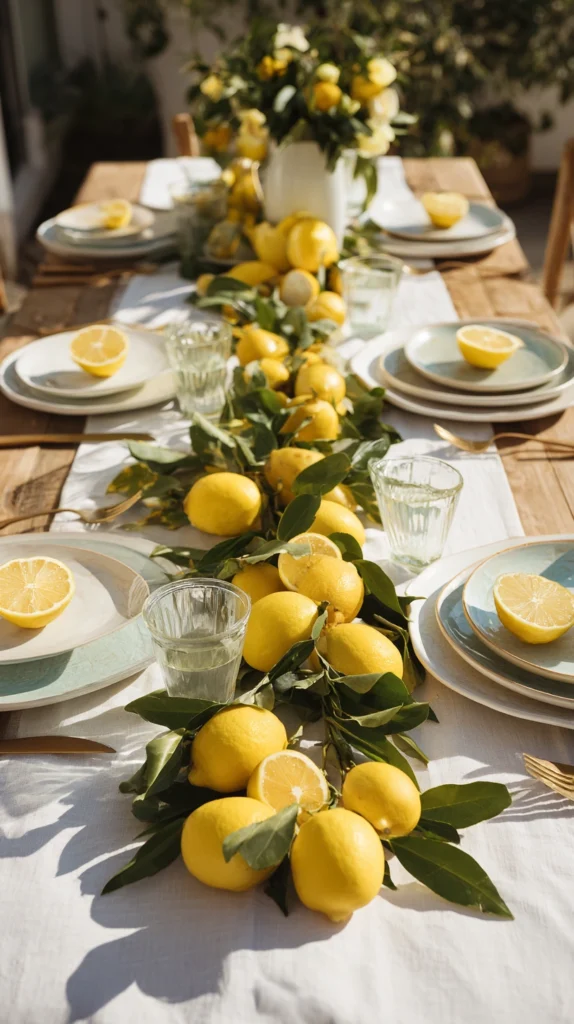
A table runner composed of whole lemons, white flowers — ranunculus, daisy, chamomile, or white sweet pea — and trailing greenery arranged directly on the table surface in a loose, abundant line from one end to the other is the most celebratory and the most generously scaled lemon table decor available. It covers the table with a continuous installation of colour and fragrance rather than concentrating the decoration at a single central point, and it produces an effect that looks professionally arranged while requiring nothing more than an understanding of how to alternate colour, texture, and height along a line.
Fifteen to twenty lemons for a standard dining table runner cost $5 – $10. A bunch of white flowers — ranunculus or daisy — runs $8 – $20 from a supermarket or market. Fresh greenery — eucalyptus, fern, or ivy — adds $5 – $15. Small glass bud vases placed within the runner to hold the flower stems in water — $5 – $15 for a set of three to five — keep the flowers fresh throughout a long event. Total runner investment sits at $23 – $60 for a table installation that covers the full surface and photographs from every angle.
Styling tip: Build the table runner from the centre outward rather than from one end to the other. Starting at the centre ensures that the arrangement is symmetrical along the table’s length and that the visual weight is distributed evenly from the host’s perspective. Starting from one end and working toward the other tends to produce a runner that becomes denser and more generous at one end and sparser at the other — an asymmetry that is immediately visible and difficult to correct once the objects are in place.
5. The Lemon Place Setting Detail
Budget: $5 – $30
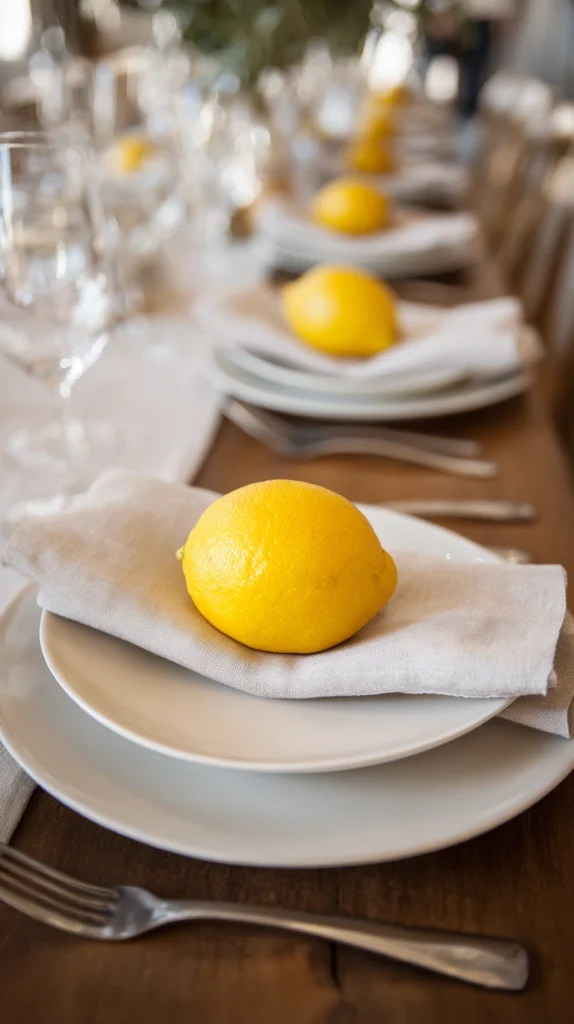
A single lemon placed on each guest’s plate — or tucked into a folded napkin, or nestled beside a name card — is the lemon table idea with the highest impact-to-cost ratio on this list. It costs almost nothing, requires no preparation, takes thirty seconds per place setting to execute, and communicates that the table was thought about at the individual guest level rather than only at the collective surface level. A place setting detail is always more noticed and more appreciated than a centrepiece because it arrives in the personal space of each guest rather than the shared space of the table.
One lemon per place setting costs approximately $0.30 – $0.60 per guest — less than $10 for a table of twelve. A small sprig of rosemary or a single herb leaf tucked alongside the lemon adds $0.10 – $0.20 per setting. A small handwritten name card propped against the lemon — $0.05 – $0.15 per card in paper and ink cost — turns the lemon into a place card holder. Total per-setting cost for the lemon, the herb, and the name card sits at approximately $0.45 – $0.95 — the most cost-effective individual table styling element available at any event.
Styling tip: Choose lemons of a consistent size for place setting use — approximately 6 to 7 centimetres in diameter is the ideal size for a plate decoration. Lemons that are too large overwhelm the plate setting and leave insufficient room for the cutlery arrangement. Lemons that are too small read as an afterthought rather than a deliberate detail. A consistent size across all place settings communicates uniformity and intention in a way that a random selection of market lemons does not always provide.
6. The Lemon and Candle Cluster
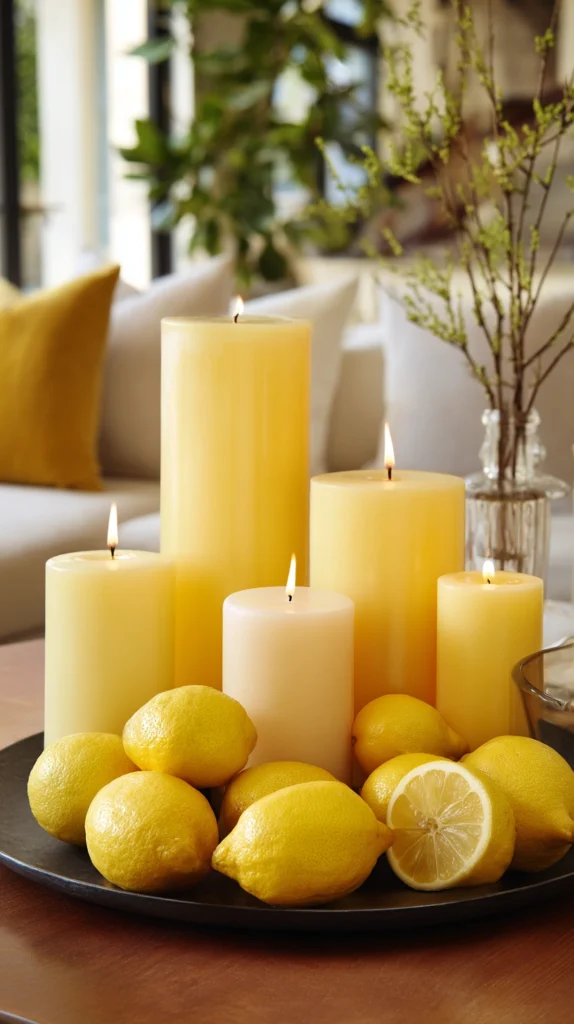
Budget: $20 – $80
A cluster of lemons grouped with pillar candles at varying heights — the lemons and the candles alternating at the centre of the table, the candles on small ceramic or wooden risers to vary their height — produces a table centrepiece that is warm in the evening when lit and graphic and sunny in the daytime when the candles are unlit. The yellow of the lemons and the warm cream of the unlit candles occupy the same colour temperature, which means the arrangement reads as coherent in both conditions rather than needing the candles to be lit to work.
Pillar candles in cream or ivory at two or three heights cost $10 – $30 for a centrepiece quantity. Small wooden discs or ceramic tiles as riser platforms add $5 – $15. Eight to ten lemons grouped around and between the candles cost $4 – $8. A ring of fresh bay leaves or rosemary around the base of the cluster — cut from the garden or a supermarket for $2 – $5 — grounds the arrangement and prevents the lemons and candles from appearing to float disconnectedly on the table surface. Total investment sits at $21 – $58 for a centrepiece that works through the full arc of the event from bright afternoon to candlelit evening.
Styling tip: Use an odd number of candles within the lemon and candle cluster rather than an even number. A cluster of three candles reads as a composed group. A cluster of two or four reads as a symmetrical pair or set — which is a more formal and less organic arrangement than the lemon aesthetic calls for. The odd number, combined with the irregular shapes of the lemons around the candles, produces a centrepiece that reads as naturally assembled rather than precisely positioned.
7. The Lemon Wreath Table Ring
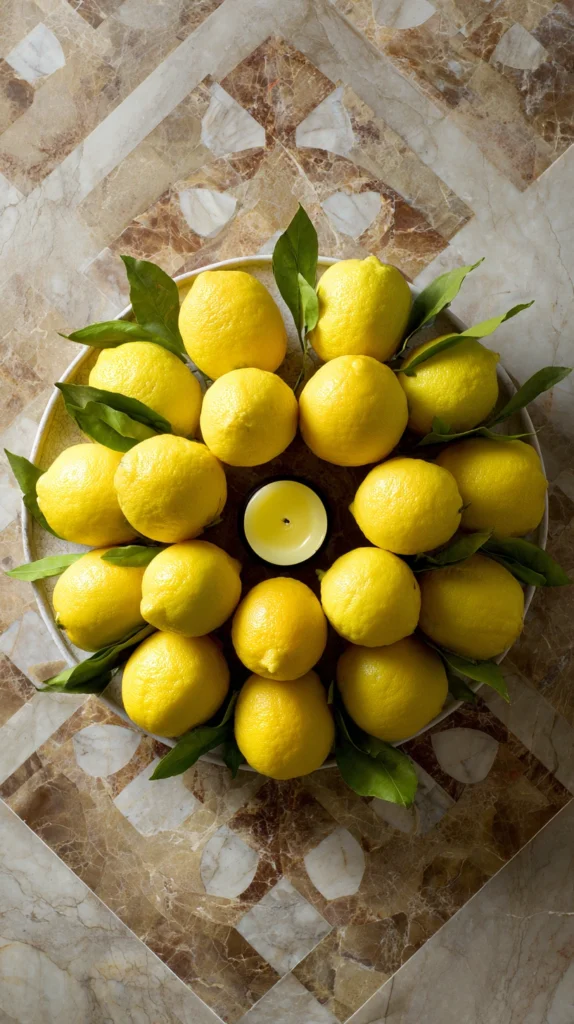
Budget: $25 – $100
A circular wreath of lemons, fresh greenery, and herbs laid flat on the table as a ring — with a candle or a small vase at the centre — is the horizontal version of the hanging wreath and one of the most elegant lemon table arrangements available. The circular form is naturally centred, naturally balanced, and naturally scaled to a round or square table. It requires a wire wreath frame and approximately an hour to construct, and it produces a table decoration that looks significantly more laboured and more expensive than either the time or the materials justify.
A wire wreath frame in a standard table size costs $5 – $15. Floral wire to attach the elements — $3 – $8 for a reel. Twelve to fifteen small lemons fill the ring for $5 – $8. Fresh eucalyptus, bay, and rosemary to fill the greenery sections cost $8 – $20 from a florist or garden. A pillar candle or a small vase placed at the centre of the ring — $10 – $25 — provides the focal point that the circular form frames. Total wreath ring investment sits at $31 – $76 for a table centrepiece that is genuinely handmade and genuinely beautiful.
Styling tip: Soak the greenery stems in water for two hours before constructing the wreath to hydrate them and extend their fresh appearance through a long event. Dry greenery used directly from the florist or garden begins to wilt and discolour within four to six hours in a warm room. Hydrated greenery maintains its colour and firmness for twelve to sixteen hours — sufficient for the duration of most events and the storage time before them.
8. The Lemon Cocktail and Drinks Garnish Display
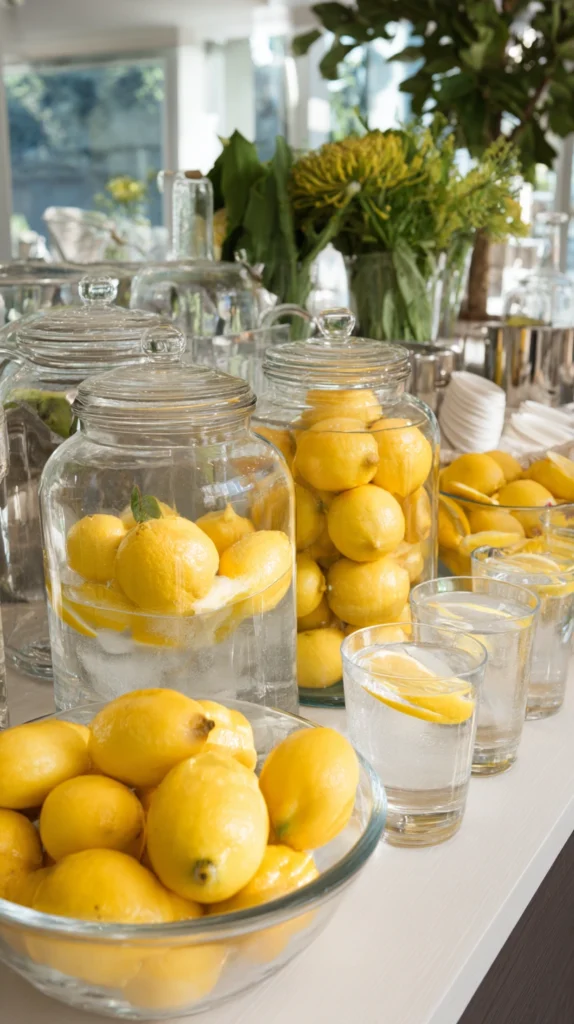
Budget: $15 – $60
A drinks station dressed with lemons — whole lemons in a glass jar, sliced lemon rounds in a ceramic bowl of ice, lemon wedges in a small dish beside the glasses, and a bundle of lemon verbena or lemon thyme from the garden tied with twine and laid across the display — extends the lemon table decor from the dining surface to the bar area and creates a coherent visual language across the entire event space. The lemons at the drinks station are also functional — they are there to be used in the drinks — which gives the decoration a purpose beyond the visual.
A glass jar of whole lemons — $3 – $6 in lemons plus a jar that is already in the kitchen — is the anchor of the display. A small ceramic bowl for sliced rounds and wedges costs $5 – $15. A bundle of lemon verbena or lemon thyme — $3 – $8 — adds fragrance and green contrast. A handwritten drinks menu card referencing the lemon element — a lemon verbena elderflower spritz, a lemon and mint mocktail — costs nothing to write and ties the visual display to the drinks being served.
Styling tip: Replace the lemon slices and wedges at the drinks station halfway through a long event. Cut lemon exposed to air for more than two to three hours oxidises at the cut surface, developing a dull, slightly browned edge that is visually unappealing beside the bright yellow of the whole lemons in the jar. Fresh cut replacements mid-event maintain the vibrancy of the display throughout and take three minutes to prepare.
9. The Lemon and Linen Napkin Fold
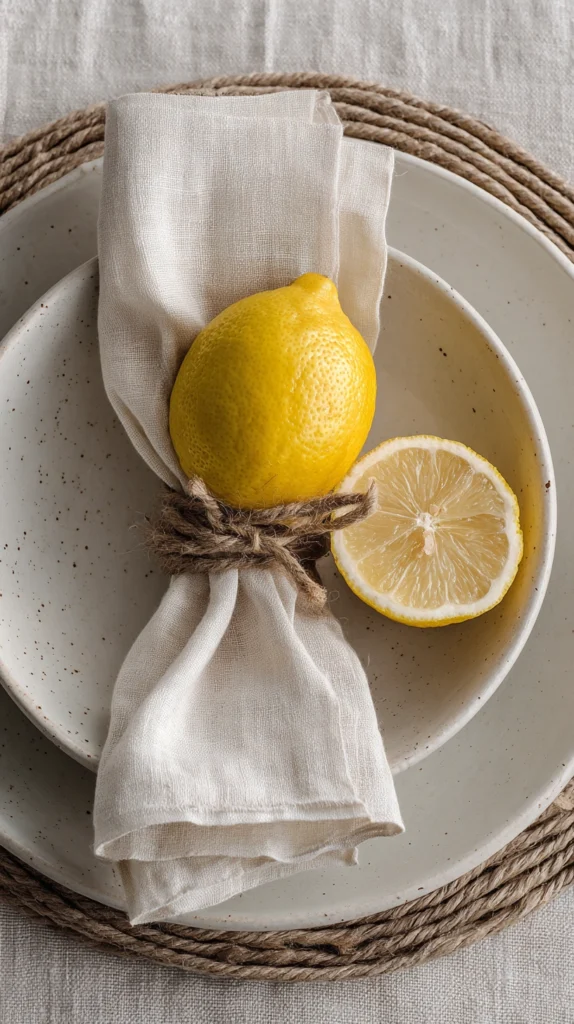
Budget: $10 – $50
A linen napkin folded into a simple pocket or a bishop’s hat and placed on each plate with a small lemon and a sprig of fresh herb tucked into the fold — or tied around the napkin with a length of natural twine — is the place setting detail that elevates the entire table without touching any other element. The combination of the white or natural linen, the yellow lemon, and the green herb in a single tied bundle at each place is a small, complete composition that communicates that the table was assembled with care rather than set with habit.
Linen napkins in white or natural — $3 – $8 each — are the foundation. One small lemon per setting costs $0.30 – $0.60. A 15-centimetre length of natural jute twine per setting — $0.05 – $0.10 — ties the lemon and herb to the napkin. A sprig of fresh rosemary or thyme — $0.10 – $0.20 per setting — completes the bundle. The total per-setting cost for a napkin, lemon, herb, and twine bundle sits at approximately $3.45 – $8.90 — and the linen napkin is washed and used again at the next event.
Styling tip: Cut the twine to a consistent length before beginning the napkin bundles rather than cutting each piece individually as you go. Bundles tied with twine of the same length produce bows of the same size and proportions across the table. Bundles tied with twine cut to different lengths produce bows of varying size and fullness — an inconsistency that is immediately apparent when the table is viewed as a whole rather than setting by setting.
10. The Lemon and Herb Terrarium or Glass Cloche Display
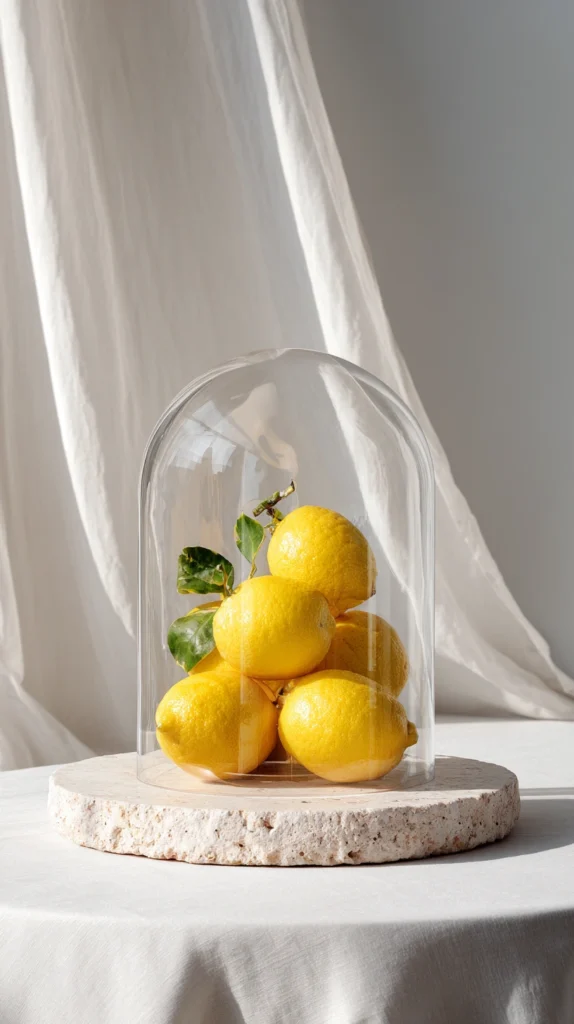
Budget: $30 – $120
A glass cloche or a large bell jar placed over a small arrangement of lemons, fresh herbs, and moss creates a contained, botanical display that reads as sophisticated and designed in a way that an open bowl arrangement does not quite achieve. The glass containment makes the arrangement feel intentional and curated — as though what is inside the cloche was selected specifically for placement there — and the magnifying and distorting effect of the curved glass adds a visual interest to even the simplest arrangement of objects.
A glass cloche in a standard table centrepiece size costs $15 – $40. Three to five small lemons — or a single lemon with a few sprigs of fresh herb and a handful of moss — fill the interior for $3 – $10. A small ceramic base or a slate tile on which to place the cloche costs $5 – $20. Two or three smaller cloches of varying heights used as a group across the table centre — $30 – $80 for a set of three — produce a more dynamic arrangement than a single large cloche and allow different combinations of lemons, herbs, and moss within each one.
Styling tip: Remove the glass cloche for thirty minutes before and during food service if the display is positioned near the food. A sealed cloche traps the fragrance of the lemons and herbs inside it, concentrating the scent significantly — which is pleasant in a cool room before food arrives and potentially overpowering once hot dishes are placed nearby. Removing the cloche during service releases the fragrance gradually rather than all at once and prevents the lemon scent from competing with the food aromas on the table.
11. The Lemon Garland Overhead or Mantel Drape
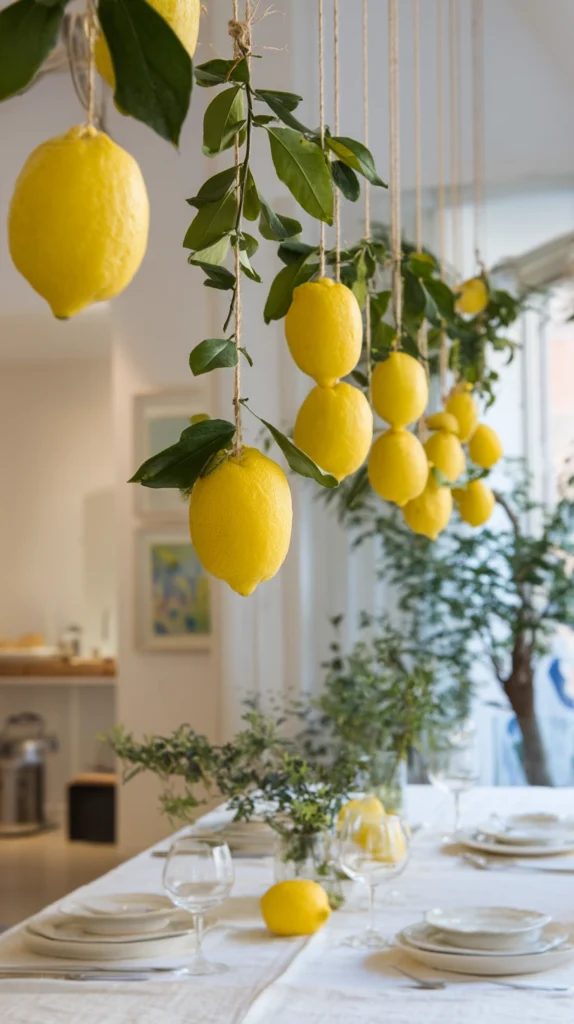
Budget: $20 – $80
A garland of whole lemons strung on a length of jute twine — alternating with fresh bay leaves, rosemary sprigs, and occasional white flowers — drapes beautifully across a mantelpiece, along the edge of a buffet table, or suspended overhead above a dessert or drinks station. The string of yellow lemons against a white wall or a linen tablecloth is one of the most graphic and most immediately summery decorative elements available at any price point, and the construction requires only a needle, jute twine, and enough lemons to span the intended length.
Jute twine on a reel costs $5 – $10. A large darning needle — $2 – $5 — threads the twine through each lemon at its widest point. Twelve to fifteen lemons for a standard mantelpiece garland cost $5 – $8. Fresh bay leaves threaded alternately between the lemons add $3 – $8. White flowers — daisies or small ranunculus — wired onto the garland between the lemons add $5 – $15. Total garland investment sits at $20 – $46 for a decoration that spans a full mantelpiece and produces a strong visual impact from across the room.
Styling tip: Thread the twine through the lemon horizontally — entering through one side and exiting through the other at the equator of the fruit — rather than through the tips. A lemon threaded at the equator hangs level and shows its broadest face toward the viewer. A lemon threaded tip to tip hangs at an angle and shows a narrower profile. The equator threading produces a garland where every lemon faces forward consistently and the yellow surface area visible from the front is maximised.
12. The Lemon and Blue Ceramic Table Setting
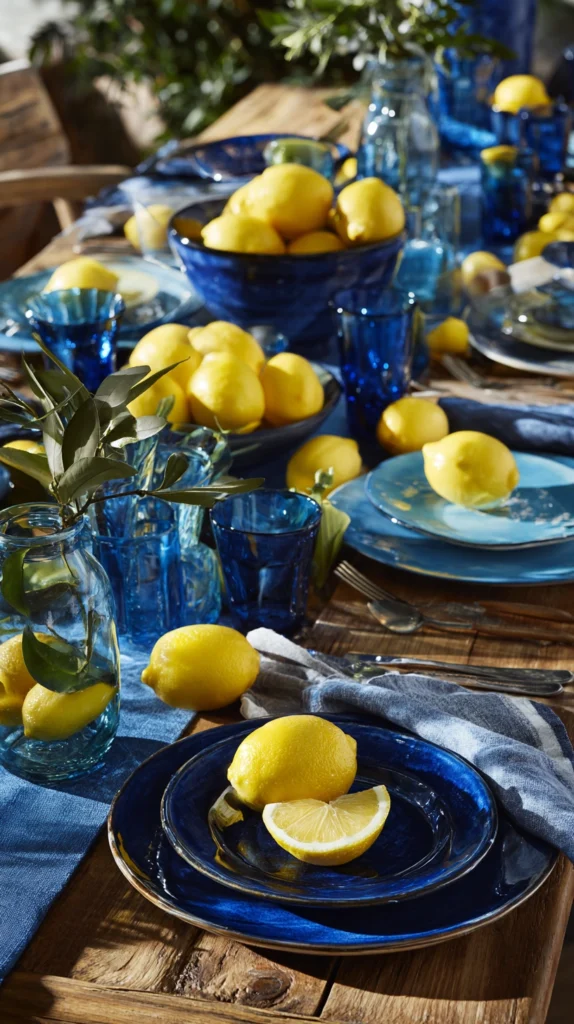
Budget: $40 – $200
The colour combination of lemon yellow and Mediterranean blue — blue and white ceramic plates, blue linen napkins, and whole lemons as the table’s botanical element — is one of the most satisfying and most historically resonant table palettes available. It draws from the colour world of the Mediterranean coast, where lemons grow against white walls above blue water, and it produces a table that feels simultaneously relaxed and sophisticated, summery and timeless. The blue and yellow combination in particular — complementary colours on opposite sides of the colour wheel — produces a visual vibration that makes both colours appear more saturated than either would in a different pairing.
Blue and white ceramic plates in a mismatched Mediterranean style cost $5 – $20 each — mixing patterns from different sets adds richness rather than inconsistency in this context. Blue linen napkins run $5 – $10 each. Whole lemons as the centrepiece and place setting element cost $5 – $10 for a full table. Blue glass vessels for the drinking glasses — $5 – $15 each — complete the blue and yellow palette at the table level.
Styling tip: Choose a single shade of blue and hold it consistently across every textile and ceramic element of the table rather than mixing multiple blue tones. Navy, cobalt, cornflower, and duck egg blue all occupy different emotional registers and produce different colour relationships with the lemon yellow when placed beside it. A consistent single blue — whatever tone is chosen — produces a table where the yellow of the lemons pops cleanly against a unified background rather than competing with a range of blues.
13. The Lemon Dessert and Cake Table Display
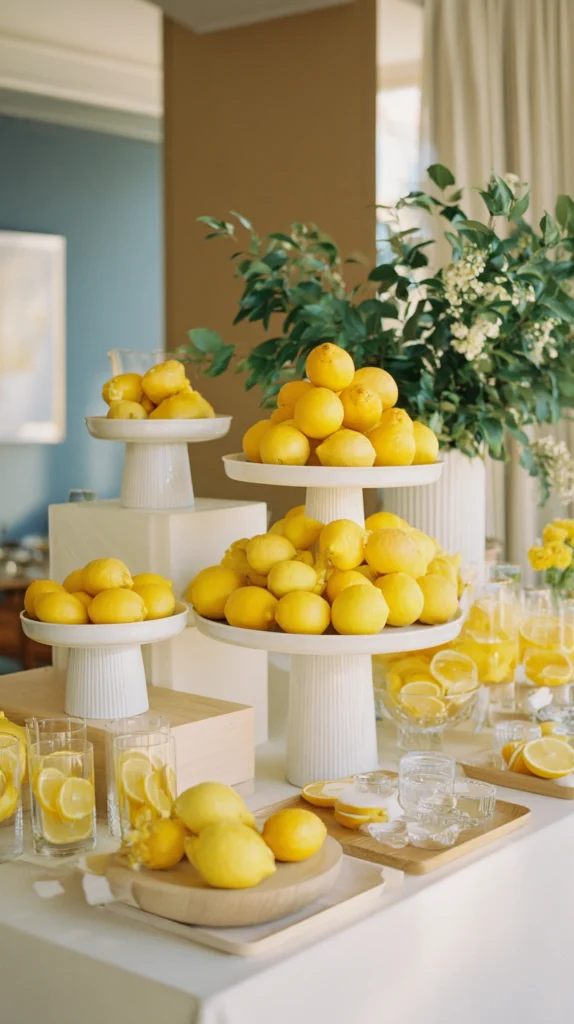
Budget: $30 – $150
A dessert or cake table dressed with lemons — whole lemons stacked on cake stands of varying heights, lemon halves scattered across the table surface, lemon curd in small open jars as table decoration and condiment simultaneously, and a centrepiece cake decorated with a preserved lemon slice or a sprig of lemon blossom — turns the dessert table into a thematically coherent display where the food and the decoration occupy the same visual language. The lemons that decorate the table are the lemons that flavoured the food on it, which is a form of decorative honesty that staged props can never achieve.
Cake stands at varying heights — $10 – $30 each — create the vertical variation that a flat dessert table lacks. Whole lemons as filler between the cake stands cost $5 – $10. Small glass jars of lemon curd — home-made or purchased — cost $3 – $8 each and serve as both decoration and dessert accompaniment. A ring of fresh greenery around the base of the centrepiece cake — eucalyptus or bay — costs $5 – $10 and ties the cake to the lemon and green palette of the wider table.
Styling tip: Place the tallest element of the dessert table — the centrepiece cake or the tallest cake stand — slightly off-centre rather than precisely at the midpoint of the table. A centrepiece placed exactly at the geometric centre produces a display that is symmetrical and static. A centrepiece placed slightly to one side creates a visual tension that makes the eye move across the whole table rather than settling immediately on the centre — which is the quality that makes a dessert table feel dynamic and abundant rather than simply organised.
14. The Lemon and Wildflower Meadow Runner
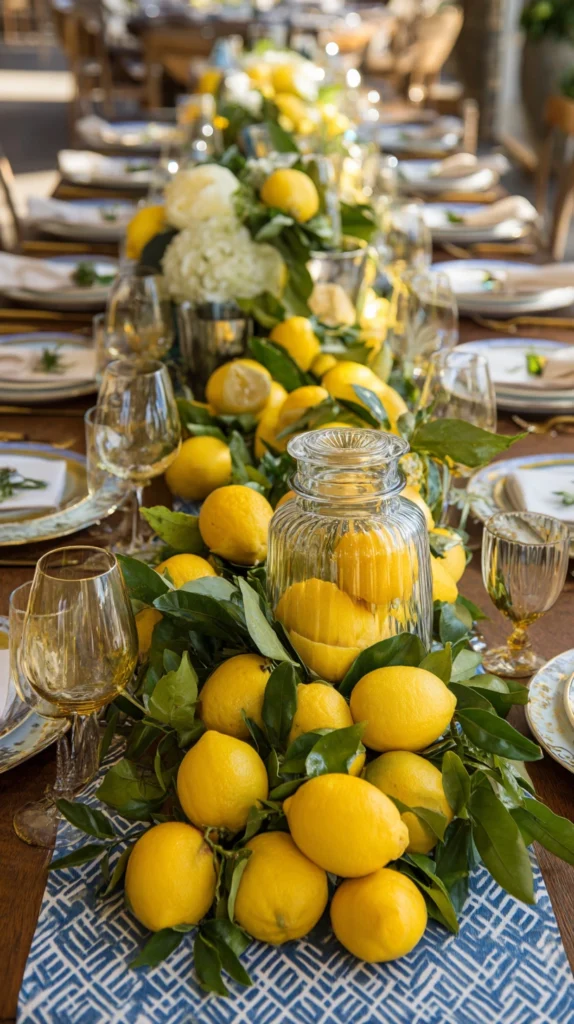
Budget: $25 – $100
A table runner built from wildflowers — cornflowers, chamomile, ox-eye daisies, and meadow grasses — combined with whole and halved lemons laid directly on the table surface is the most naturalistic and the most seasonally specific lemon table arrangement available. It draws from the wild rather than the garden, and the combination of the precise, manufactured quality of the lemon beside the loose, irregular quality of the wildflower produces a tension that is both visually interesting and deeply summery.
A bunch of mixed wildflowers from a market or florist costs $8 – $20. Ten to twelve lemons for the runner — some whole, some halved to show the cross-section — cost $4 – $8. Small glass bottles or jam jars to hold flowers in water within the runner — $5 – $10 for a set — keep the wildflowers fresh through the event. A few handfuls of loose petals scattered between the arranged elements add the final layer of meadow abundance for the cost of a single bunch of flowers that can be pulled apart for the purpose.
Styling tip: Halve some of the lemons for the wildflower runner and leave others whole. The halved lemons — cut side up, showing the star pattern of the flesh and the segments — add a different visual element from the whole fruit and introduce the interior colour and texture of the lemon as a decorative detail. The combination of the domed yellow exterior of whole lemons and the flat, star-patterned cross-section of halved ones gives the runner a visual variety that whole lemons alone cannot provide.
15. The Lemon Scented Candle and Fresh Lemon Pairing
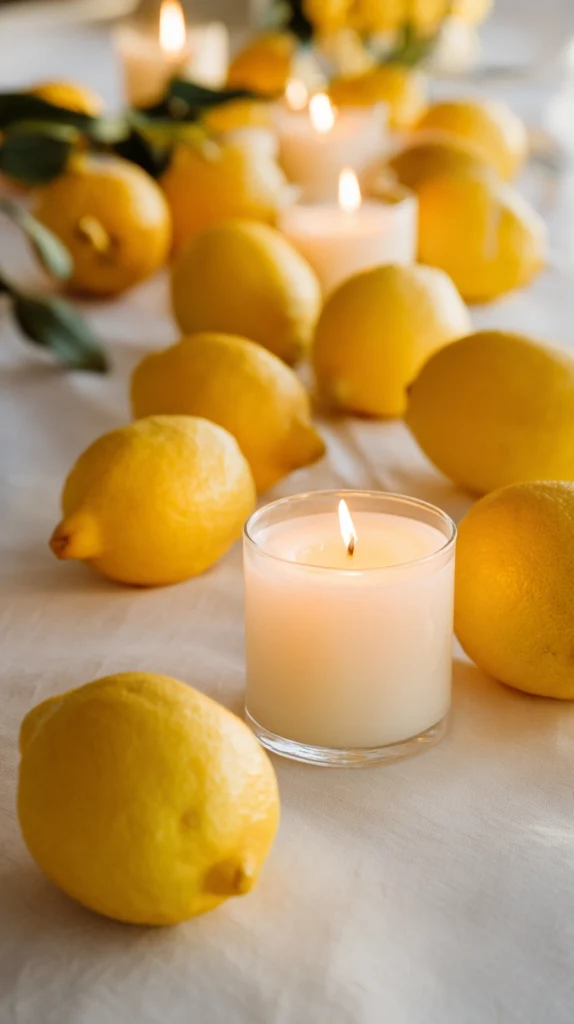
Budget: $25 – $100
The final lemon table idea is the one that operates on the most elemental level — pairing the visual of fresh lemons on the table with the scent of lemon from a dedicated candle or diffuser, so that the table communicates lemon through two senses simultaneously rather than one. A scent that corresponds directly to the visual decoration it accompanies produces a sensory coherence that is immediately registered and immediately pleasurable — the smell confirms what the eye sees, and the confirmation produces a completeness that either sense alone cannot achieve.
A lemon or citrus scented candle in a ceramic or glass vessel costs $15 – $40. A small lemon verbena or citrus reed diffuser beside the candle adds $15 – $30 for a layered scent approach. Fresh lemons arranged around the candle — their own natural oils evaporating slowly into the warm air produced by the candle flame beside them — reinforce the scent at almost no additional cost. The total pairing investment sits at $25 – $75 for a table that smells as summery as it looks.
Styling tip: Position the scented candle at the point on the table closest to where guests are seated rather than at the geometric centre of the arrangement. Scent disperses outward from its source and is most concentrated nearest the flame. A candle placed at the centre of a long table provides scent primarily to the guests at the centre and very little to those at the ends. Two smaller candles placed at the third-points of a long table — rather than one large candle at the centre — distribute the scent evenly to every guest seated at the table.
Whatever combination of these fifteen ideas makes it to the final event table, the principle that holds all of them together is the same one that makes lemons such a reliable and beloved decorating tool in the first place: they are honest objects, drawn from the natural world, that communicate the season directly and without pretension.
A lemon on a table does not try to be more than it is. It is yellow and round and fragrant and it belongs to summer in a way that manufactured decorations have to work very hard to achieve. Use it generously, use it simply, and trust it to do what it has always done on tables across the Mediterranean world and everywhere else summer arrives with enough warmth to ripen fruit — make the occasion feel like exactly the right time of year to be gathered around a table with people worth sitting with.