14 Genius Entryway Hacks for Cramped NYC Apartments
The entryway of a New York City apartment is one of the most challenging and most frequently neglected spaces in domestic design. It is typically a narrow strip of floor between the front door and the first room of the apartment — barely wide enough to turn around in, lacking any dedicated storage, and subjected to the accumulated daily chaos of shoes, bags, coats, keys, mail, and everything else that a busy New York life deposits at the threshold of the home every single day. In most NYC apartments the entryway is not a room — it is a problem.
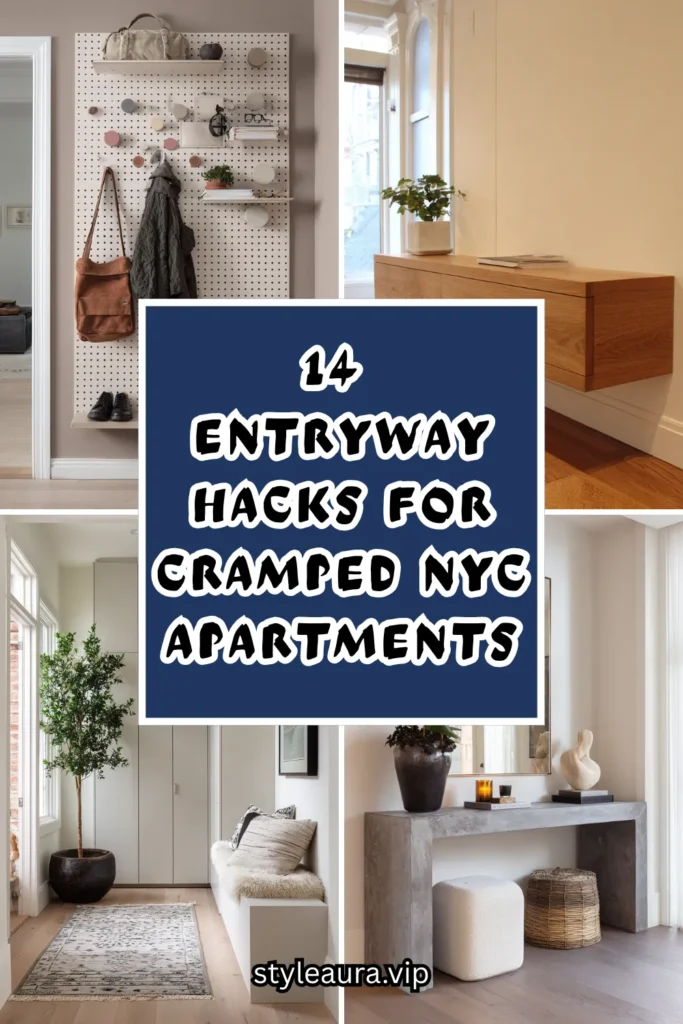
The genius of a well-designed NYC entryway hack is that it treats that problem as a design opportunity and discovers that the most constrained spaces, approached with genuine creative intelligence, are capable of becoming the most cleverly and most beautifully resolved spaces in the entire apartment.
The entryway sets the tone for every room that follows. It is the first space encountered on entering the home and the last encountered on leaving — the space that creates the first and the most lasting impression of the domestic environment beyond it. An entryway that functions well, looks genuinely beautiful, and handles the daily chaos of a New York life with genuine organizational intelligence communicates something immediately about the quality of the entire apartment behind it.
Here are 14 genius entryway hacks for cramped NYC apartments.
1. Floor-to-Ceiling Slim Storage Cabinet
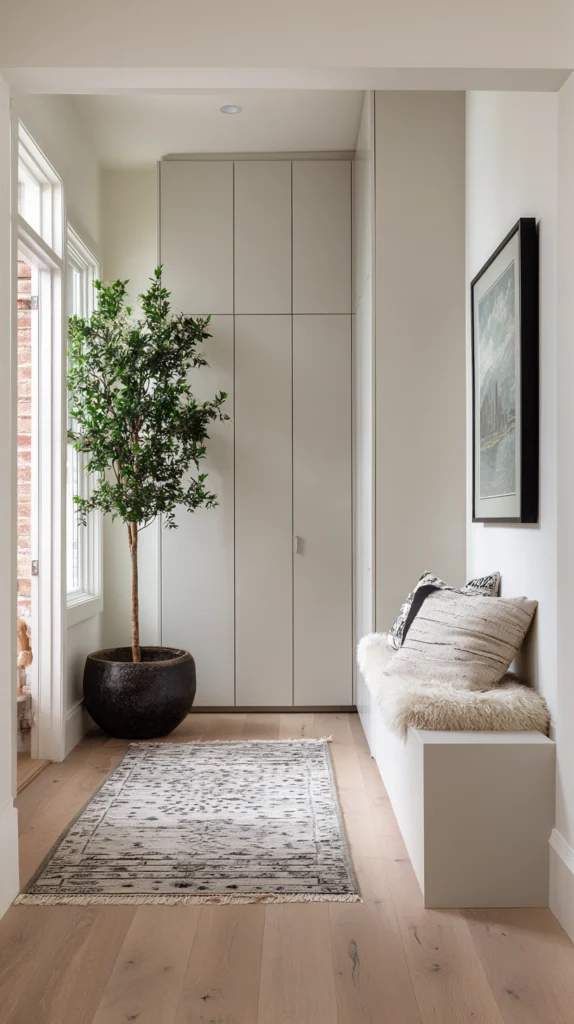
A slim, floor-to-ceiling storage cabinet — a custom or fitted unit of no more than 30 centimetres in depth occupying the full height of the entryway wall — creates the maximum possible storage capacity within the minimum possible floor footprint.
The full-height cabinet uses every available centimetre of the entryway wall from floor to ceiling — a spatial efficiency that standard furniture, which typically reaches only to 180 centimetres, cannot match. Interior shelving, hooks, and drawers within the cabinet accommodate shoes, coats, bags, mail, keys, and every other category of entryway object in a completely contained, completely organized, and completely concealed installation.
Pro Tip: Install the slim entryway cabinet with push-to-open door mechanisms rather than conventional handles for a cabinet that presents a completely flat, completely uninterrupted surface to the entryway — the absence of protruding handles creating a visual cleanliness and a spatial generosity in the narrow entryway that handle-equipped alternatives cannot achieve. A handleless floor-to-ceiling cabinet in a narrow NYC entryway appears almost architectural rather than functional — the clean flat surface reading as a wall rather than furniture.
2. Mirrored Wall Panel
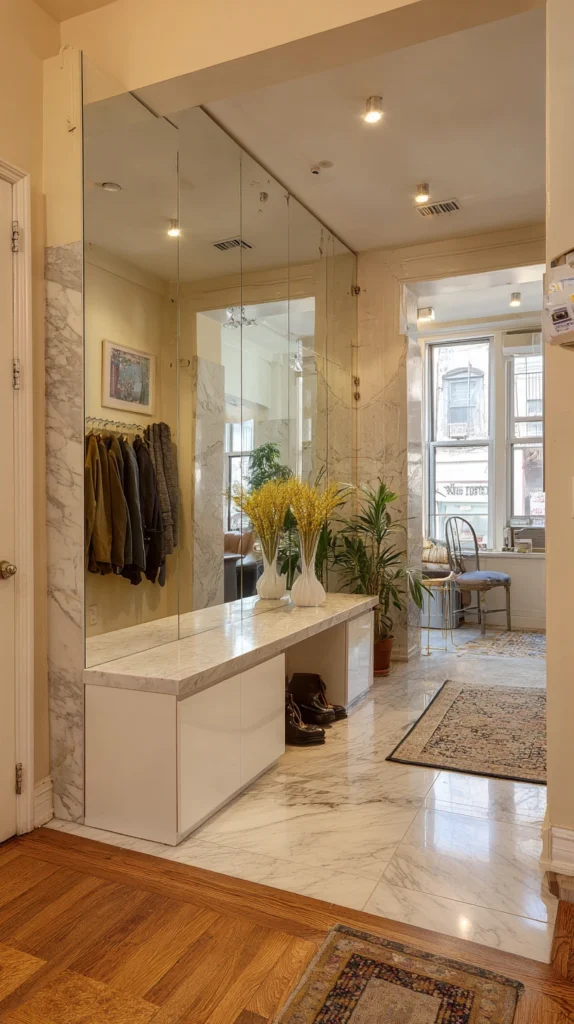
A full-height mirrored panel — either a single large mirror occupying the majority of one entryway wall or a floor-to-ceiling mirror fixed directly to the wall surface — creates the most immediately impactful spatial transformation available in any cramped NYC entryway. Mirror doubles the perceived depth of the entryway, reflects the available natural light from the adjoining rooms, and creates the quality of spatial generosity that the physically constrained entryway cannot provide through architectural means alone. The full-height mirror also provides the genuinely practical function of a last-look mirror before leaving the apartment — combining spatial expansion with daily functional value.
Pro Tip: Position the entryway mirror on the wall facing the front door rather than the wall beside it for the maximum spatial expansion effect. A mirror facing the door reflects the full depth of the entryway back toward itself — creating the impression of a space twice the actual depth of the entry. A mirror beside the door reflects only the adjacent wall — creating a less convincing and less spatially generous illusion of expanded space.
3. Over-the-Door Organizer
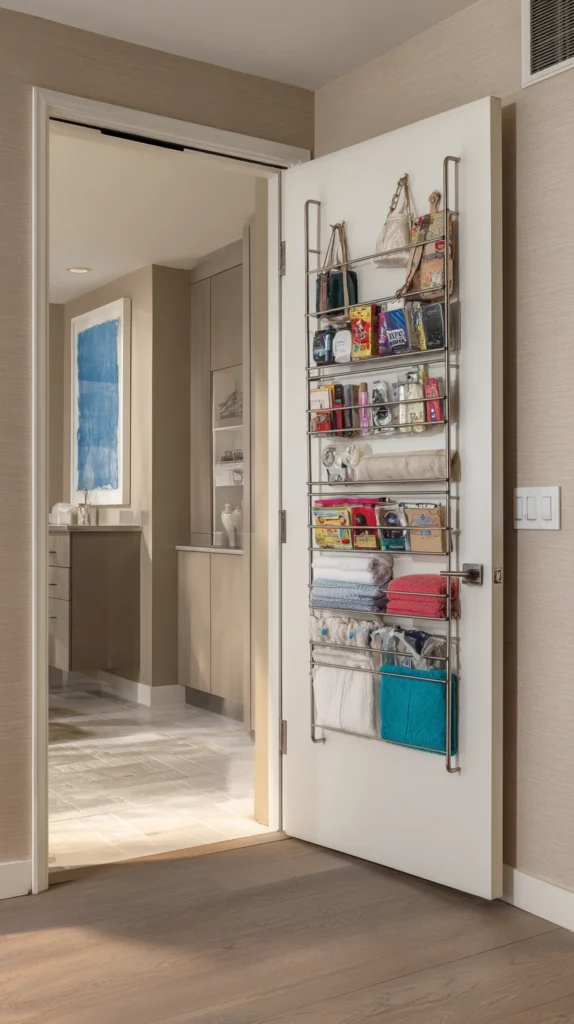
A premium over-the-door organizer — a well-designed, attractive system of hooks, pockets, and shelving that hangs over the interior face of the front door — transforms completely unused door space into productive organizational capacity without occupying any floor area, any wall area, or any ceiling area of the entryway. The interior face of the front door is the most consistently underused surface in any NYC apartment entryway — a surface of considerable usable area that hangs permanently at the entry threshold without contributing anything to the organization or the beauty of the space until an over-door system is installed.
Pro Tip: Choose an over-the-door organizer in a material and finish that complements the front door material and color — a brushed brass organizer on a dark painted door, a natural timber and leather organizer on a natural timber door, or a matte black metal organizer on a white door. A well-chosen over-door organizer that complements the door creates an entryway feature of genuine considered design. A poorly chosen over-door organizer in a discordant material creates a functional addition of negligible aesthetic quality.
4. Floating Bench with Hidden Storage
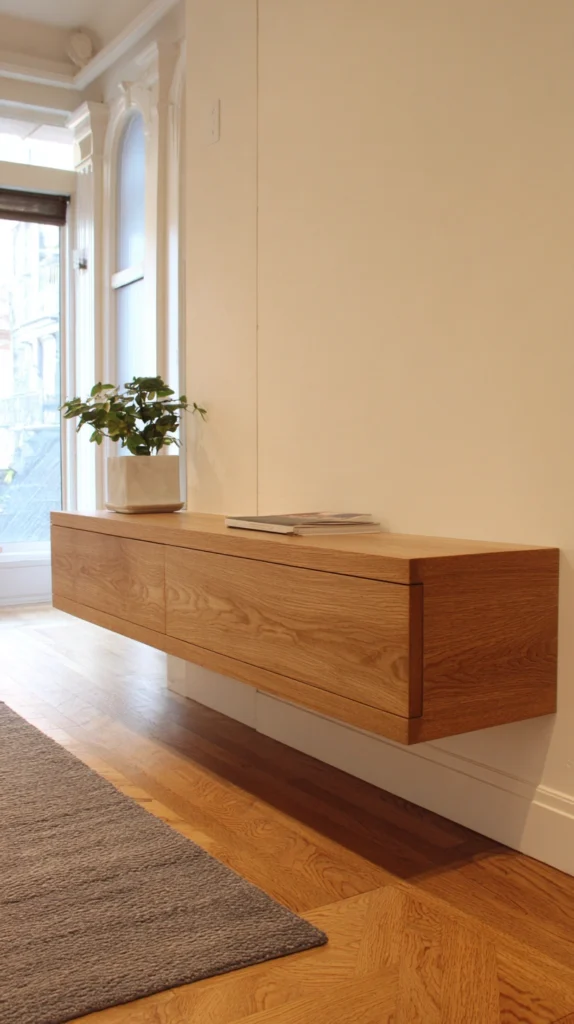
A floating wall-mounted bench — a bench seat of 35 to 40 centimetres in depth mounted directly to the entryway wall at a comfortable sitting height, with storage integrated beneath the seat in the form of pull-out drawers or open cubbies — creates a seating, storage, and shoe organization solution that occupies zero floor space beyond its own footprint and contributes a quality of genuine considered furniture design to the entryway. The floating mount creates visual floor space beneath the bench — making the entryway appear larger by revealing the continuous floor surface.
Pro Tip: Mount the floating entryway bench at a height of 45 centimetres from the floor — the standard comfortable seat height — rather than at the lower heights that many entryway bench designs specify. A bench at 45 centimetres allows comfortable seated shoe-putting-on without the uncomfortable crouching position that lower benches create — making the entryway bench a genuinely functional daily feature rather than a decorative gesture that is too uncomfortable to use for its primary intended purpose.
5. Command Hook Gallery
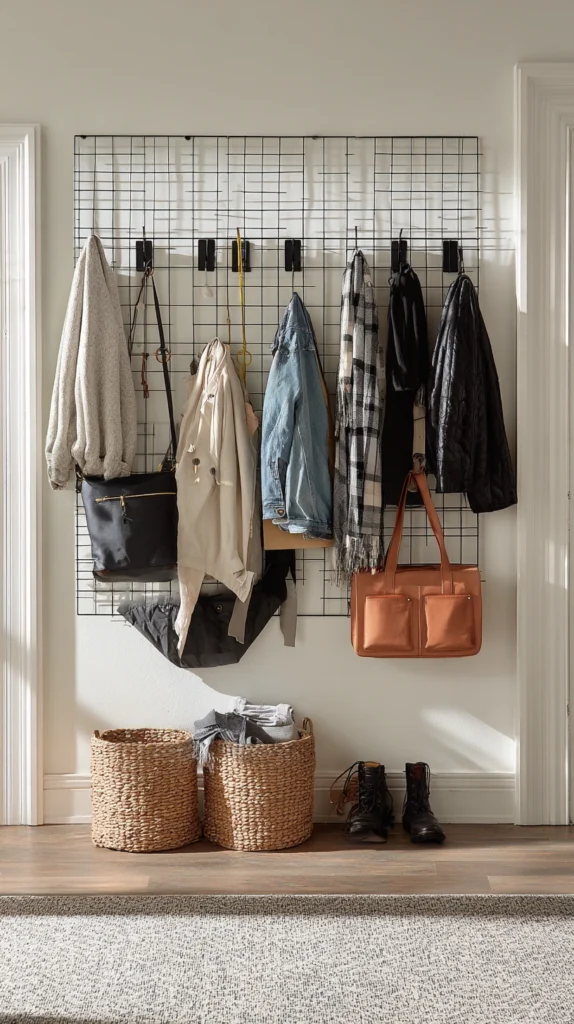
A carefully arranged gallery of premium command hooks — hooks of different sizes and designs arranged in a considered composition on the entryway wall — creates a coat, bag, hat, and umbrella storage system of zero installation complexity and considerable organizational capacity. Command hook galleries require no drilling, no wall anchoring, and no professional installation — a critical practical consideration in a NYC rental apartment where wall modifications are typically prohibited and where the deposit cost of unauthorized drilling can significantly exceed the value of any storage system installed.
Pro Tip: Choose command hooks in a consistent finish — all matte black, all brushed brass, or all satin nickel — and arrange them in a deliberate, considered pattern rather than a random scatter for a command hook gallery of genuine design quality. A random scatter of mismatched hooks on an entryway wall creates a functional but visually chaotic hook installation. A considered arrangement of consistent, premium-finish hooks creates an entryway feature that reads as deliberately designed rather than improvised from whatever was available.
6. Vertical Bike Storage
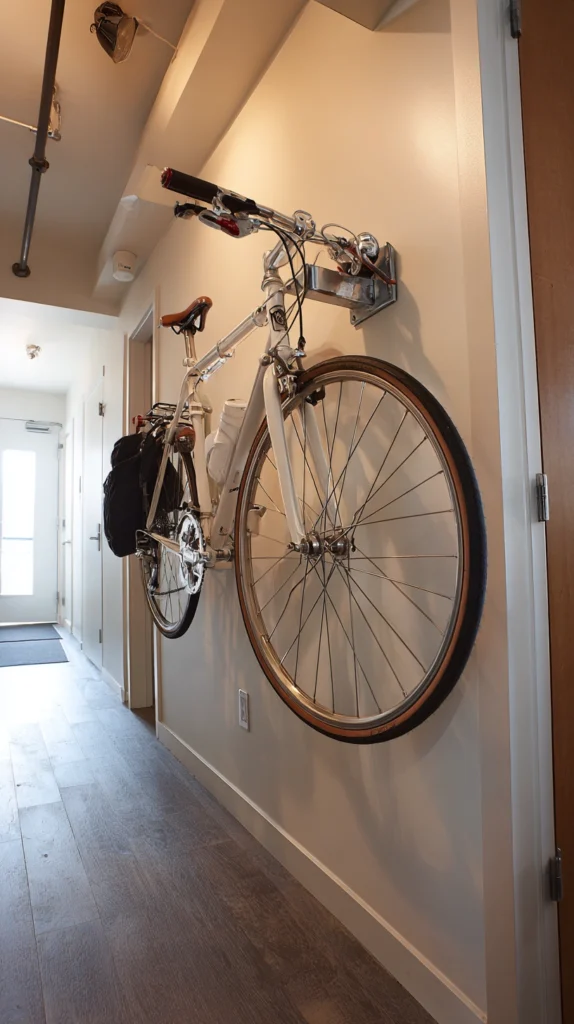
A vertical bike storage system — a wall-mounted hook that holds a bicycle vertically against the entryway wall by the front wheel, removing the bike completely from the floor footprint — creates the most significant single spatial improvement available in any NYC entryway where a bicycle occupies floor space. A bicycle stored horizontally on the floor of a narrow NYC entryway consumes essentially the entire usable floor area of the space — making every other entryway function genuinely difficult. The same bicycle stored vertically against the wall occupies a footprint of approximately 30 centimetres — transforming the entryway from a bicycle obstacle course into a functional entry space.
Pro Tip: Install the vertical bike wall hook at a height that positions the bicycle tire at least 5 centimetres above the floor surface when the bike is hanging — preventing the tire from marking the floor and creating adequate clearance for floor cleaning beneath the hanging bicycle. The specific hanging height depends on the wheel diameter of the individual bicycle — measure the hanging height for the specific bike before drilling the wall mounting rather than estimating a standard height that may position the tire at or below the floor surface.
7. Pegboard Entryway Organization Wall
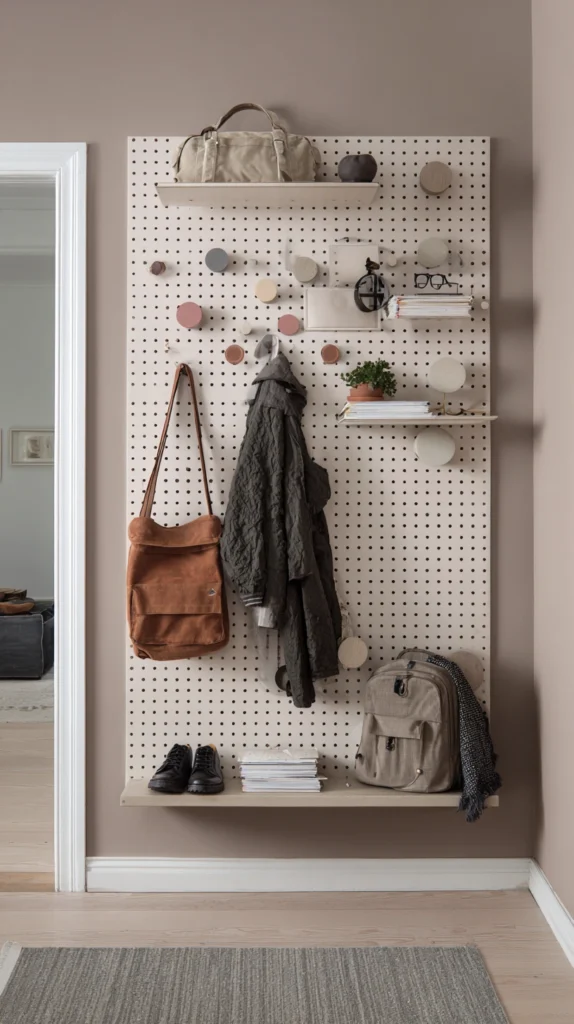
A pegboard panel — a sheet of standard or premium pegboard fixed to the entryway wall and fitted with a combination of hooks, shelves, bins, and organizers — creates a fully customizable organizational system of extraordinary capacity and genuine visual character. Pegboard is the most flexible and most spatially efficient organizational system available — the ability to reposition hooks and accessories at any grid position allowing the system to adapt to changing storage needs without any additional installation or modification.
Pro Tip: Paint the pegboard panel in a color that coordinates with the wider apartment color palette — rather than leaving it in its standard utilitarian brown — before installing the hooks and accessories. A painted pegboard in a deep forest green, warm charcoal, or rich navy becomes a genuine entryway design feature rather than a utilitarian storage board. The painted background transforms the pegboard from a functional installation into a considered decorative and organizational element of genuine visual quality.
8. Slim Console Table with Baskets Below
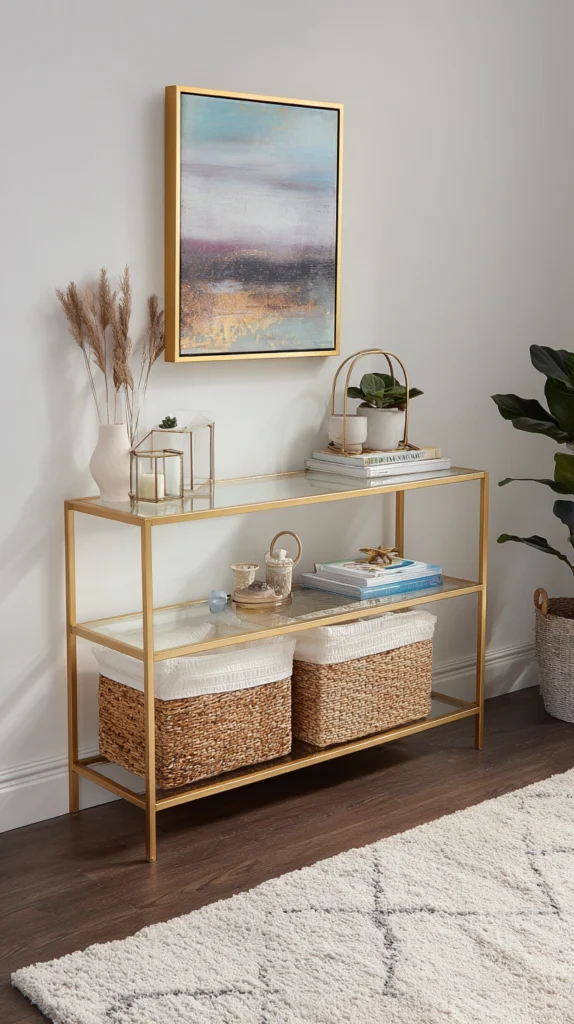
A genuinely slim console table — a table of 20 to 25 centimetres in depth that provides a surface for keys, mail, and small items while consuming the minimum possible floor area — with woven baskets stored beneath creates an entryway of considerable organizational intelligence and genuine furniture warmth.
The baskets beneath the console provide shoe storage, bag storage, and the contained organization of the miscellaneous items that accumulate at the apartment entry — each basket a dedicated, contained zone of organizational clarity within the overall entryway system.
Pro Tip: Choose a console table with slender legs rather than a solid base for an entryway table that appears significantly lighter and significantly less space-consuming than its actual dimensions. A console table on slender legs reveals the floor beneath — creating a visual lightness and a quality of spatial generosity. A console table on a solid base conceals the floor completely — creating a visual heaviness that makes the narrow entryway feel more constrained and more physically enclosed than the same space with a leggy, open-based alternative.
9. Magnetic Key and Mail Station
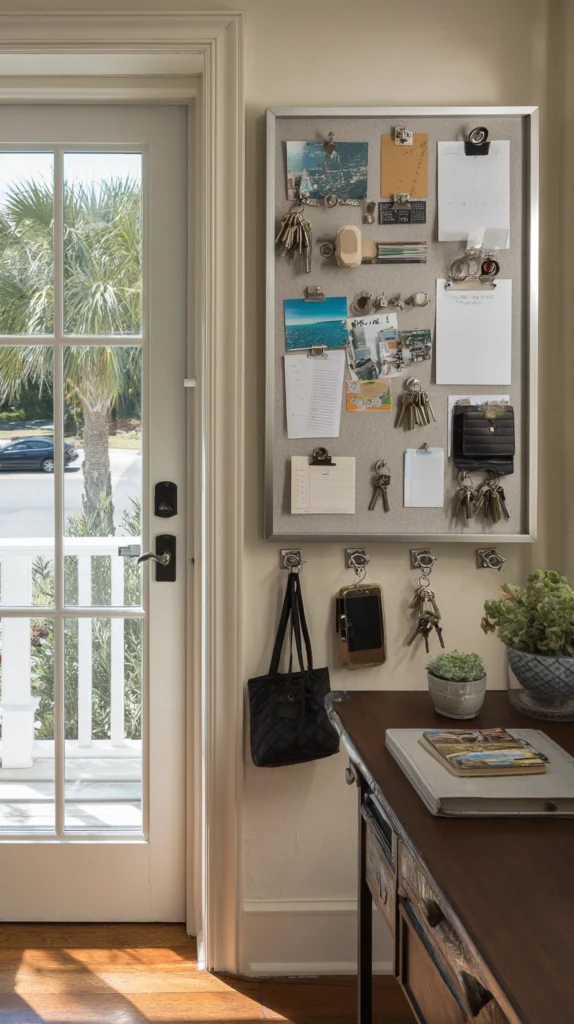
A wall-mounted magnetic board or a small magnetic panel mounted immediately beside the front door creates a dedicated key, mail, and small item organization station of zero floor footprint and considerable daily organizational value. Magnetic boards can hold keys on magnetic hooks, hold mail under magnetic clips, display delivery reminders and important notes, and keep the accumulated daily debris of a New York life organized in a single, defined, immediately accessible location beside the door where it is needed most.
Pro Tip: Conceal the magnetic key and mail station within a shallow recessed frame — a simple timber box of 5 centimetres depth mounted to the wall with the magnetic board installed within it — for a station that appears as a considered, finished architectural element rather than a functional board affixed to the wall surface. A framed magnetic station reads as a designed feature. An unframed magnetic board reads as a functional addition of no architectural quality.
10. Shoe Rack Built Into the Baseboard
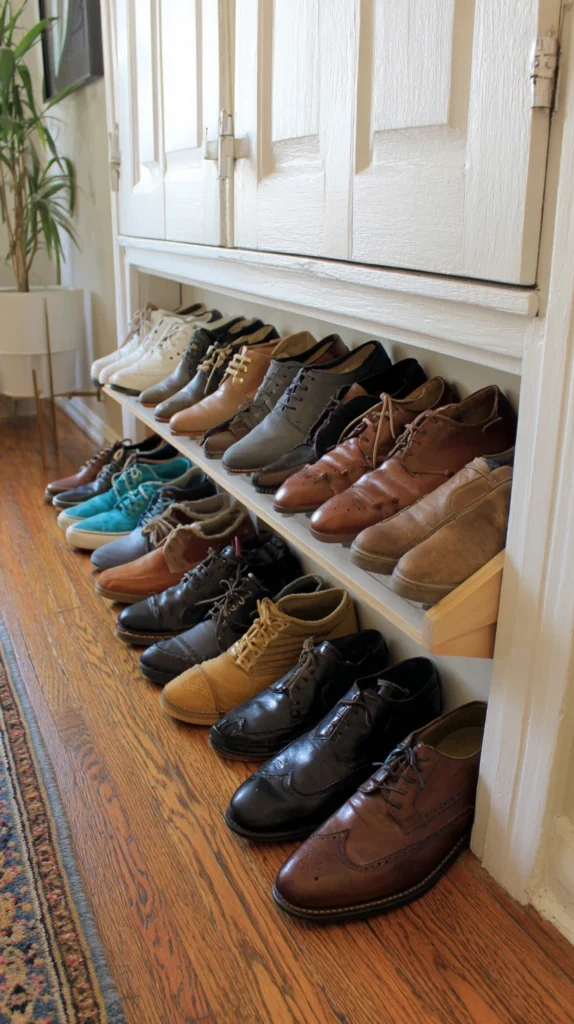
A slim shoe rack built directly into the baseboard zone of the entryway wall — a recessed or applied shoe storage system of 15 to 20 centimetres in depth installed at floor level that stores shoes horizontally within the baseboard height zone — creates shoe storage of remarkable spatial efficiency using the architectural zone of the wall that is typically occupied only by the baseboard molding. Shoes stored within the baseboard zone occupy no additional visual height on the entryway wall and create no furniture presence above floor level.
Pro Tip: Install the baseboard shoe rack with a tilt-out or pull-out mechanism rather than an open-front alternative for a shoe storage system that conceals the shoes completely when not in use and presents a clean finished surface to the entryway at all times. Open-front baseboard shoe storage, however spatially efficient, presents the shoes as a permanent visual feature of the entryway. Tilt-out or pull-out baseboard storage presents a clean architectural surface — the shoes accessible but invisible until the moment they are specifically needed.
11. Wallpaper or Bold Paint as Instant Character
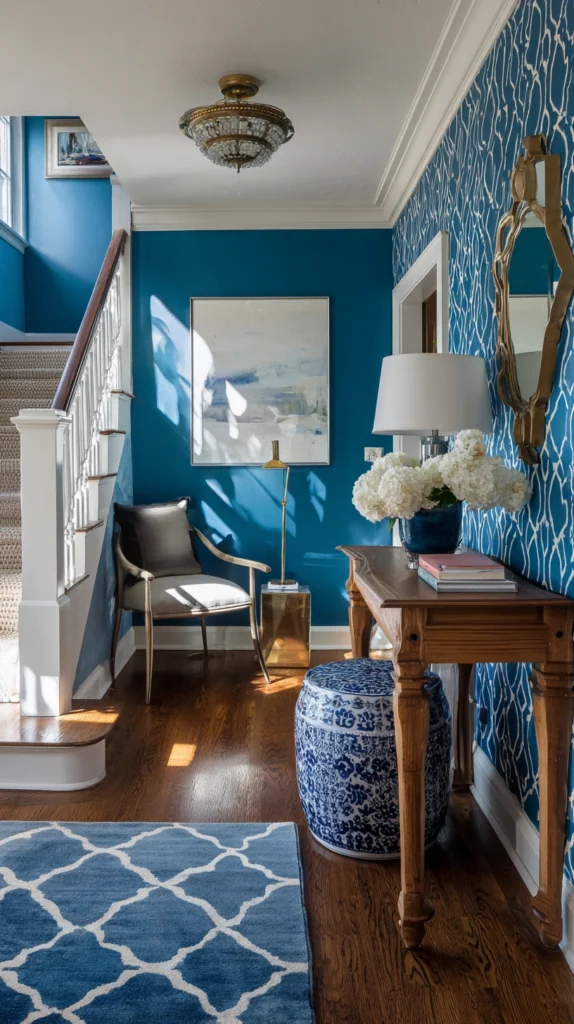
A bold wallpaper pattern or a strong paint color applied to the entryway walls — a large-scale botanical print, a geometric pattern, a deep jewel-toned paint color, or a textured grasscloth wallpaper — creates an entryway of immediate visual impact and genuine design confidence that requires no furniture, no storage, and no additional investment beyond the wall treatment itself.
The small size of a NYC entryway is an advantage in this specific application — the limited wall area making a bold wall treatment both affordable and immediately impactful in a way that the same treatment in a larger room would require significantly greater investment to achieve.
Pro Tip: Choose a wallpaper or paint color for the NYC entryway that creates a genuine preview of the wider apartment aesthetic — a color or pattern that relates directly to the palette and the character of the rooms visible beyond the entryway.
An entryway wall treatment that previews the wider apartment creates a sense of deliberate, unified design throughout the complete apartment. An entryway wall treatment that is unrelated to the wider apartment creates a disconnected introduction that sets false expectations for the rooms that follow.
12. Hanging Pendant Light for Vertical Drama
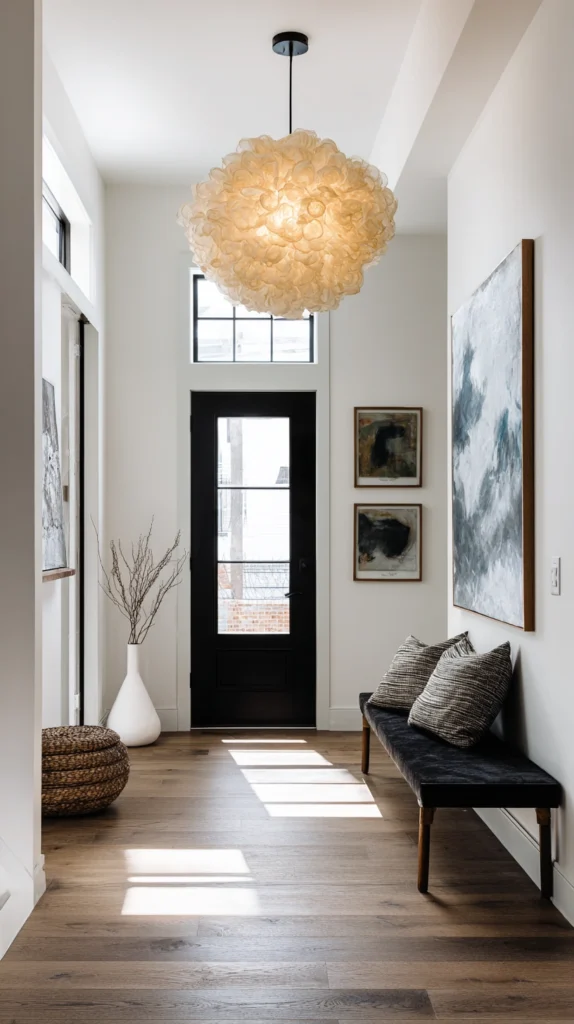
A single statement pendant light hung centered above the entryway — a sculptural rattan pendant, a small geometric brass fixture, or a simple glass globe — creates a vertical design element of considerable visual impact that draws the eye upward and makes the entryway appear significantly taller and significantly more generous than its actual dimensions.
Overhead lighting in a cramped NYC entryway is frequently the last design consideration and the most neglected — the ceiling zone of the narrow entryway left empty while every horizontal surface is engaged with storage and organization.
Pro Tip: Choose a pendant light of a diameter no greater than one third of the narrowest entryway dimension for a pendant that provides overhead drama without creating a physical obstruction within the already-constrained space. A pendant that is correctly proportioned to the entryway dimensions creates a considered, elegant overhead feature. An oversized pendant in a narrow entryway creates a physical and visual obstruction that makes an already constrained space feel genuinely uncomfortable.
13. Fold-Away Drop Zone Desk
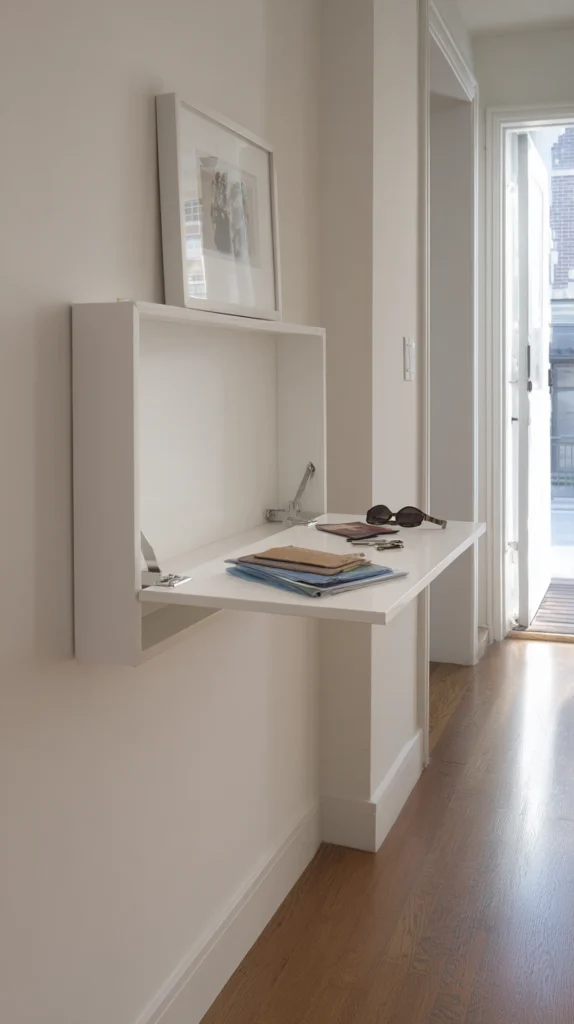
A fold-away wall-mounted desk — a slim panel that folds flat against the entryway wall when not in use and opens to a horizontal surface of 45 to 60 centimetres in depth when needed — creates a package-signing surface, a mail-sorting station, and a small work surface of genuine practical value within the entryway zone without any permanent floor footprint. The fold-away desk occupies only the depth of the wall-mounted bracket system — approximately 5 centimetres — when folded and creates a complete, functional horizontal surface when open.
Pro Tip: Mount the fold-away entryway desk at a standing height of 90 to 95 centimetres — the standard comfortable standing work surface height — rather than at a seated desk height. An entryway fold-away desk is used standing rather than seated — for the thirty seconds of mail-sorting, package-signing, or key-depositing that a NYC entryway requires — and a standing height surface is the most genuinely functional and the most practically appropriate for the specific entryway use case.
14. Scent and a Single Plant as Finishing Touches
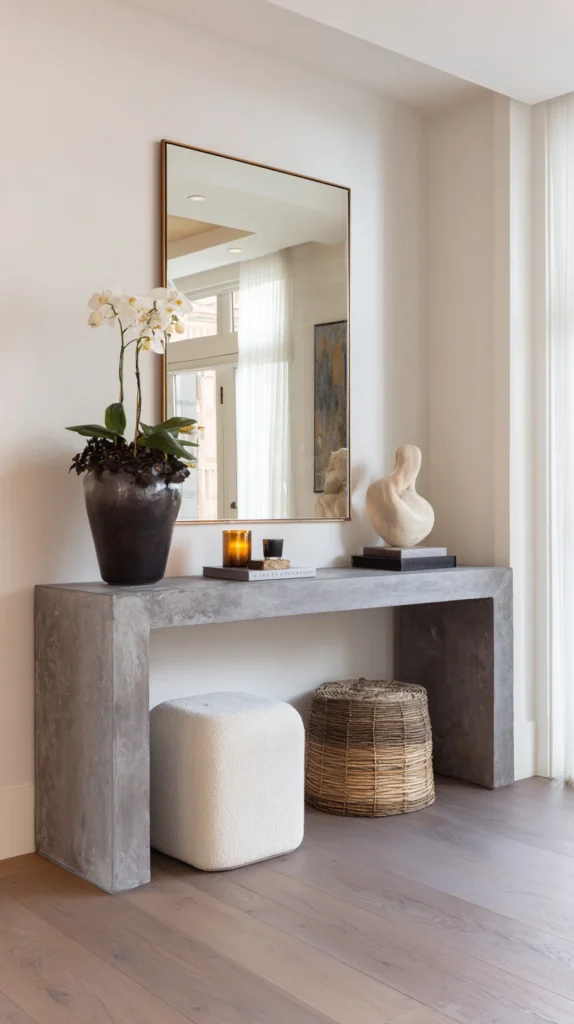
A single small plant — a compact trailing pothos, a small succulent in a warm terracotta pot, or a single stem of eucalyptus in a slim ceramic vase — and a consistent, beautiful home fragrance — a quality reed diffuser, a single scented candle, or a natural room spray used exclusively in the entryway — transform a functionally resolved NYC entryway into a genuinely welcoming domestic threshold of complete sensory warmth.
The plant provides the living natural element that communicates genuine care. The fragrance provides the immediate sensory signal of genuine home and genuine welcome that the visual elements of even the most beautifully designed entryway alone cannot create.
Pro Tip: Choose the entryway plant for its tolerance of low light conditions — the entryway of most NYC apartments receives minimal direct natural light — and its compact growth habit that maintains the limited space of the entry without expanding to consume it. Pothos, ZZ plants, and cast iron plants all thrive in low light conditions and maintain a compact, manageable form that suits the spatial realities of a cramped NYC entryway perfectly.
The Entryway Deserves Genuine Attention
The cramped NYC entryway that is genuinely resolved — that handles the daily organizational chaos of a New York life with genuine intelligence, that looks genuinely beautiful within its severe spatial constraints, and that welcomes its occupant home every single day with a quality of warmth and order that the apartment behind it rewards — is one of the most significant domestic design achievements available in the most challenging real estate environment in the world.
Approach it with genuine creative ambition. Solve it with genuine organizational intelligence. And discover that the most constrained spaces, treated with genuine design confidence, consistently become the most cleverly and the most beautifully resolved spaces in the entire apartment.