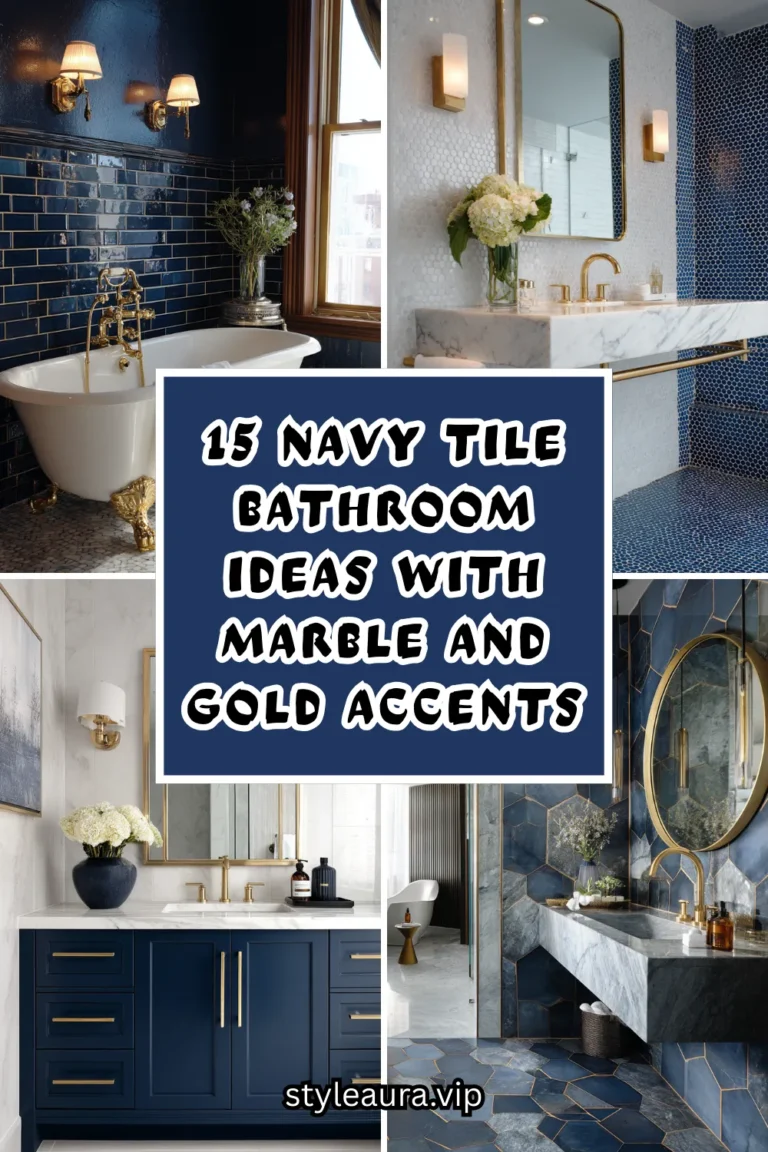
15 Blue Accent Bathroom Ideas for Subtle Color and Character
There is a way of using colour that requires more discipline than painting an entire room in it — the art of the accent, where blue appears not as the bathroom’s defining feature but as a considered note within a predominantly neutral space.
A blue accent bathroom is white tile or warm plaster or pale stone, given character through a single tiled wall, a painted vanity, a collection of ceramics, or a window’s worth of glass — enough blue to give the room a personality, never so much that the room becomes about the colour rather than about the person using it.

This is the bathroom for someone who wants character without commitment, who likes blue but isn’t ready to live inside it, or who simply understands that restraint, applied well, often produces more sophistication than abundance.
The fifteen ideas below cover every way blue can enter a bathroom as an accent rather than a statement.
1. The Blue Tiled Niche
Budget: $30 – $150
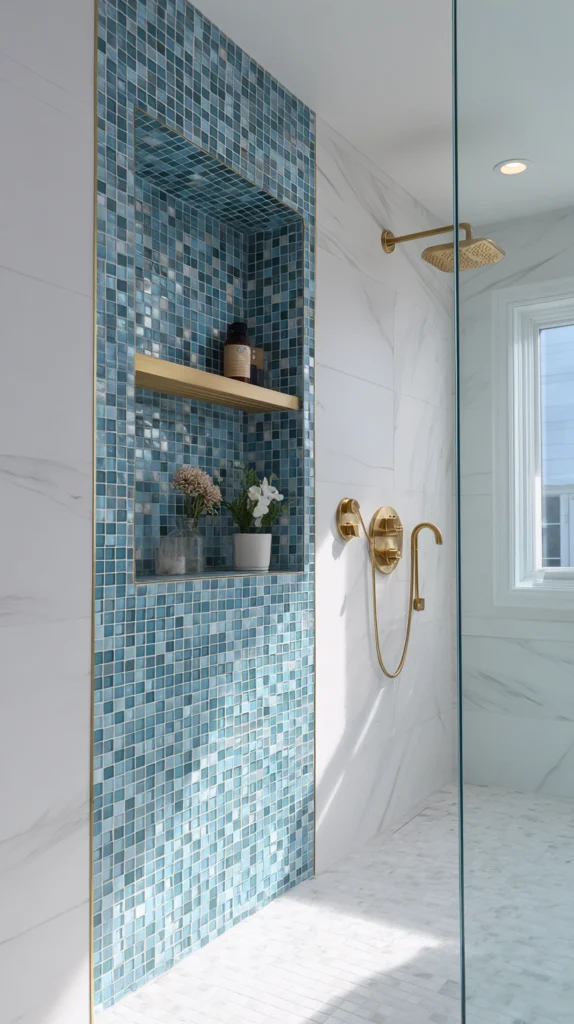
A recessed shower niche — the small built-in shelf for shampoo and soap — tiled in a small-format blue mosaic while the surrounding shower walls remain in plain white or pale grey, gives the bathroom a single concentrated point of colour exactly where the eye naturally rests during a shower.
The niche becomes a tiny jewel box within an otherwise neutral room.
Blue mosaic tile for a standard niche — $15 – $40 in materials for the small surface area involved. Grout in white or pale grey — $5 – $10. The niche itself, if not already present, requires construction within the stud wall — $50 – $150 if built during a renovation.
Styling tip: Choose a blue mosaic with some tonal variation — several shades of blue within the same tile sheet — rather than a single flat colour. In a small concentrated space like a niche, tonal variation reads as a deliberate jewel-like detail. A single flat blue in the same small space can read as a leftover offcut rather than an intentional feature.
2. The Blue Painted Vanity
Budget: $40 – $400
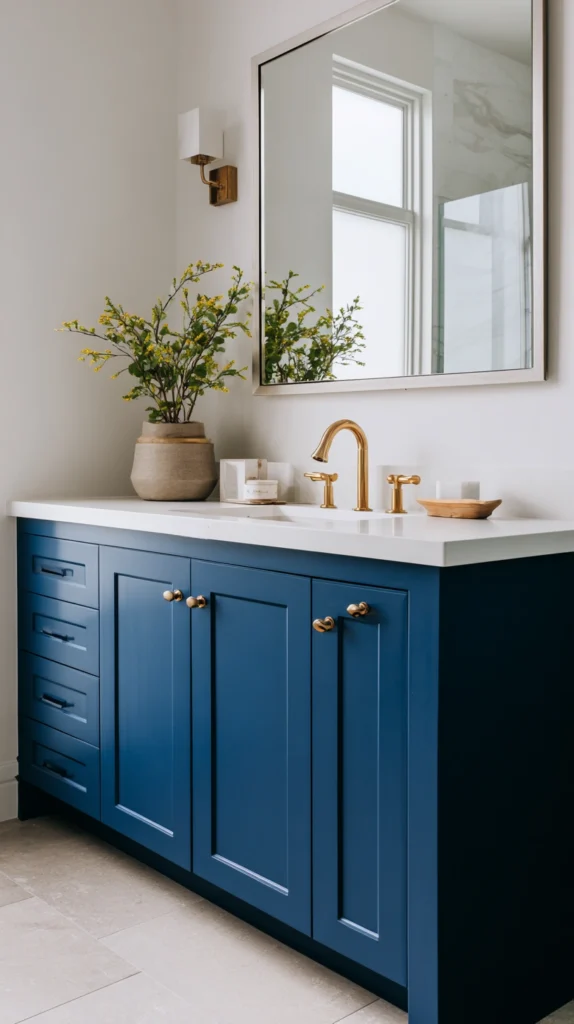
A vanity cabinet painted in a confident blue — navy, cobalt, or a deep teal — while the walls remain white or pale, gives the bathroom its single largest accent and its most immediately noticeable colour decision.
A blue vanity against white walls and white sanitaryware reads as a furniture choice rather than a wall treatment, which feels more intentional and more easily updated.
Chalk paint or a specialist cabinet paint in a deep blue — $20 – $50 for a standard vanity. An existing white vanity repainted — $25 – $60 in paint and preparation materials. A new vanity in a factory-finished blue — $200 – $400.
Styling tip: Keep the vanity’s hardware — handles, taps — in a single warm or cool metal finish that complements the chosen blue, and replace any mismatched existing hardware as part of the repaint. New hardware is one of the most cost-effective ways to make a painted vanity read as a complete, considered piece rather than a furniture item that has simply been painted a different colour.
3. The Blue and White Striped Towel Collection
Budget: $30 – $100
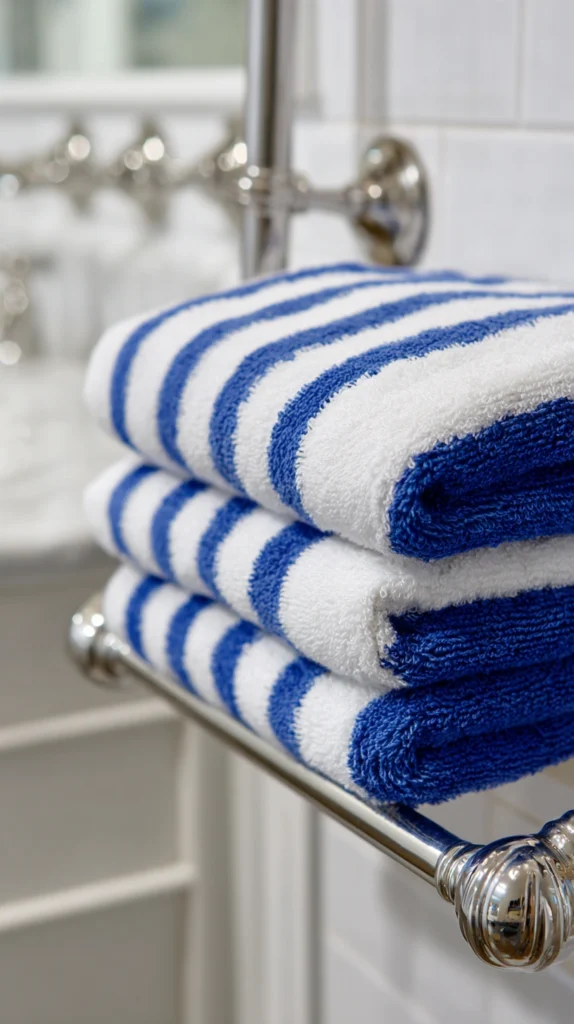
A collection of towels in blue and white stripes — folded and displayed on an open shelf or a ladder rail — introduces colour through the most easily changed and least permanent element in the bathroom.
Striped towels bring a maritime, classic character to an otherwise all-white bathroom without touching a single wall or fixture.
Blue and white striped towels in cotton — $15 – $35 each. A set of two bath towels and two hand towels — $60 – $140. A ladder-style towel rail for display — $30 – $80 if not already present.
Styling tip: Fold the towels so that the striped pattern is visible from the bathroom’s main entry point — a towel folded with the stripe running horizontally and displayed face-out on a shelf shows more pattern than one rolled or folded with the stripe hidden in the fold. The towels are doing the work of colour here, so make sure that work is visible.
4. The Single Blue Tiled Wall
Budget: $150 – $800
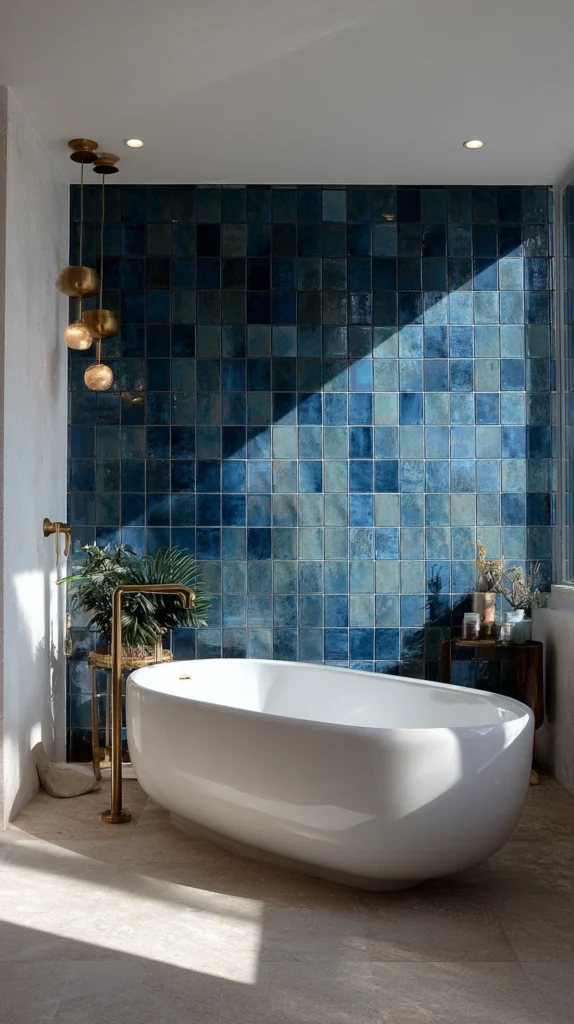
One wall — typically the wall behind the bath or the wall opposite the door — tiled in blue while the remaining walls stay in plain white tile or painted plaster, gives the bathroom a single confident feature without the cost or commitment of tiling the whole room.
This is the bathroom equivalent of a feature wall, and it works because the eye has somewhere to land.
Blue tiles for one wall — $20 – $50 per square metre, with a standard bathroom wall requiring three to six square metres — $60 – $300 in tile materials. Professional tiling for a single wall — $150 – $500 in labour.
Styling tip: Choose the wall behind the bath or the wall most visible from the doorway as the blue feature wall — the wall that receives the most consistent, sustained view rather than a wall that is only glimpsed in passing. A feature wall that is rarely seen head-on doesn’t deliver the visual return its cost justifies.
5. The Blue Glass Shower Screen or Door
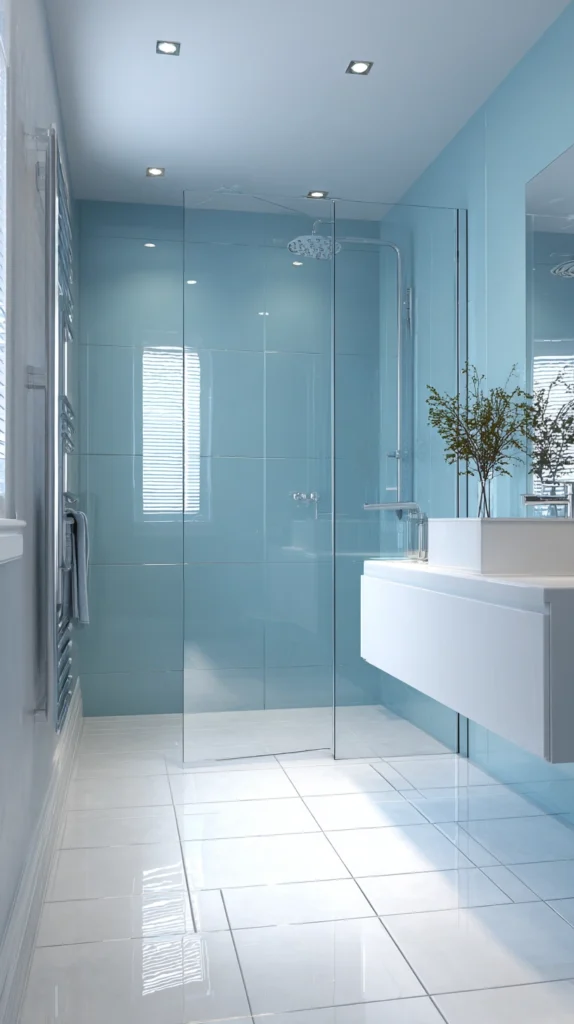
Budget: $100 – $600
A shower screen or door in tinted blue glass — rather than clear glass — introduces a subtle wash of colour across the entire shower enclosure without requiring any tile, paint, or fixture change.
The blue tint is most visible when the bathroom’s natural or artificial light passes through it, creating a soft glow that shifts throughout the day.
A tinted blue glass shower screen — $200 – $600 depending on size, typically a premium of $50 – $150 over an equivalent clear glass screen. A smaller blue glass panel as a splash guard — $100 – $250.
Styling tip: Pair a blue-tinted glass screen with white or very pale tile rather than patterned tile — the tint itself provides the visual interest, and a busy tile pattern behind tinted glass can become muddled or hard to read through the colour shift.
6. The Blue Ceramic Sink
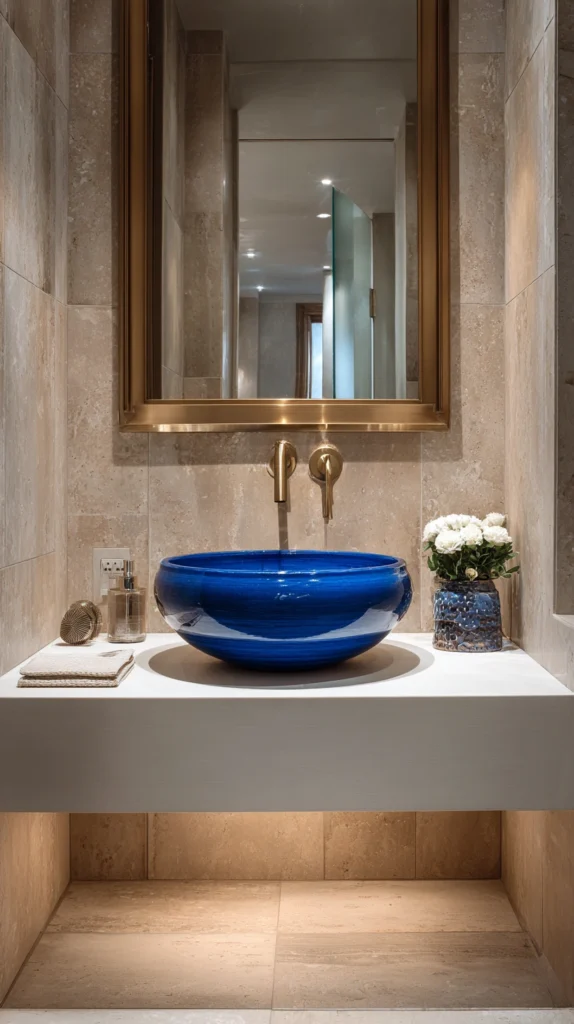
Budget: $150 – $800
A countertop or vessel sink in a deep blue ceramic — set into a white or natural stone countertop — gives the bathroom a single, sculptural point of colour at the most frequently used fixture in the room.
A blue sink against white surroundings reads as a deliberate design object, almost like a piece of art that happens to be functional.
A blue ceramic vessel sink — $150 – $500. A blue ceramic undermount or drop-in sink — $200 – $600. Coordinating tap in a complementary finish — $80 – $250.
Styling tip: Choose a sink in a glossy glazed finish rather than matte for this application — the glaze catches and reflects light, making the blue sink read as a jewel-like object rather than simply a coloured fixture. A matte finish in the same blue can read as flatter and less deliberately ornamental.
7. The Blue and Brass Hardware Story
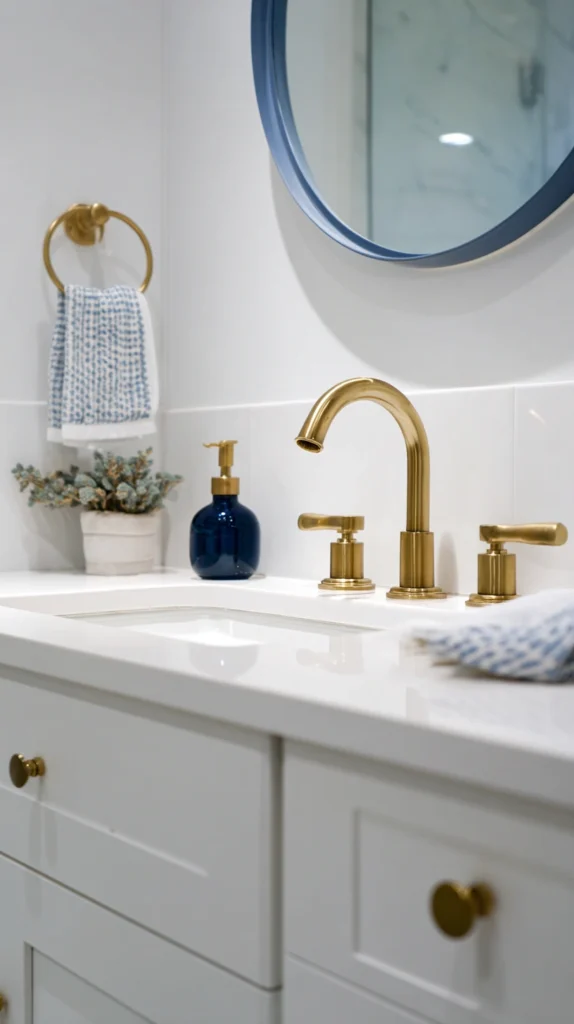
Budget: $40 – $250
Small blue accents — a blue ceramic soap dish, blue-glazed drawer pulls on an otherwise white vanity, a blue-rimmed mirror, and brass taps and towel rail — distributed throughout an otherwise white bathroom give the room a consistent thread of colour at a scale so modest it could easily be changed or removed.
A collection of small blue accents is still immediately noticeable while remaining one of the least permanent decorating decisions available.
Blue ceramic soap dish and accessories — $10 – $30 each. Blue-glazed ceramic drawer pulls — $5 – $15 each. A blue-rimmed mirror — $30 – $100. Aged brass taps and towel rail — $80 – $250.
Styling tip: Repeat the exact same shade of blue across all the small accent objects — the soap dish, the drawer pulls, and the mirror rim should all be the same blue, not three different blues that happen to be in the same family. A single repeated shade reads as a considered colour thread. Multiple similar-but-different blues read as an unplanned accumulation.
8. The Blue Botanical Wallpaper in a Powder Room
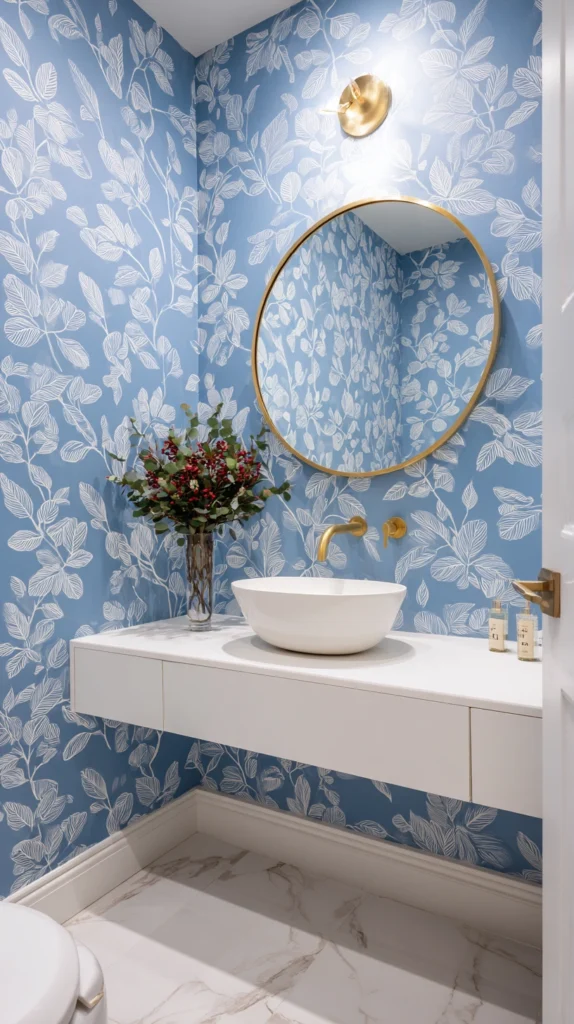
Budget: $40 – $250
In a small powder room or guest WC, a wallpaper with a blue botanical pattern on a white or cream ground — applied to all four walls of a genuinely small space — delivers a concentrated dose of pattern and colour in a room where the smaller scale makes a bolder choice feel manageable rather than overwhelming.
Powder rooms are where many people feel most comfortable taking a risk.
A blue botanical wallpaper — $15 – $50 per roll, with a small powder room requiring two to four rolls — $30 – $200. Professional hanging — $30 – $60 per roll if required.
Styling tip: A small windowless powder room is the ideal location for a bolder blue wallpaper precisely because it’s used briefly and by guests rather than by the household daily — it can hold a pattern or colour intensity that might feel like too much in a primary bathroom used every morning.
9. The Blue Roman Blind or Curtain
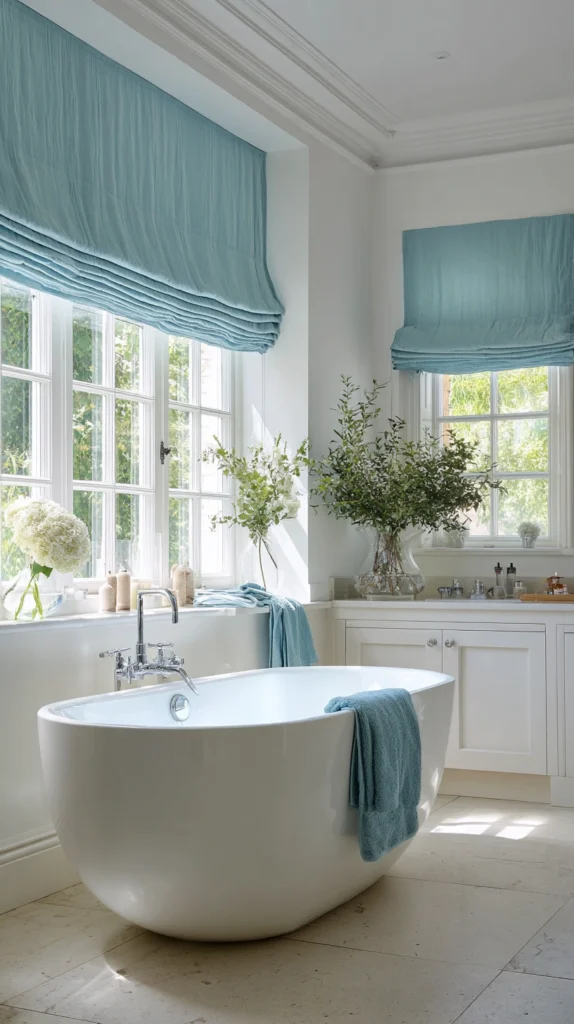
Budget: $30 – $120
A simple Roman blind or curtain in a blue linen or cotton — on the bathroom window — introduces colour through the softest and most easily updated element in the room.
A blue window treatment against white tile and white walls provides a single confident note of colour exactly where natural light enters, making the colour glow gently when the sun is behind it.
A blue linen or cotton Roman blind — $30 – $80 depending on window size. Blue curtain panels — $20 – $60 per panel.
Styling tip: Choose a moisture-resistant or easy-clean fabric specifically formulated for bathroom use, particularly for windows near the shower or bath. Standard decorative fabrics can develop mildew in a consistently humid bathroom environment, while bathroom-rated fabrics resist this while still offering the full range of blue tones.
10. The Blue and White Hexagon Floor with White Walls
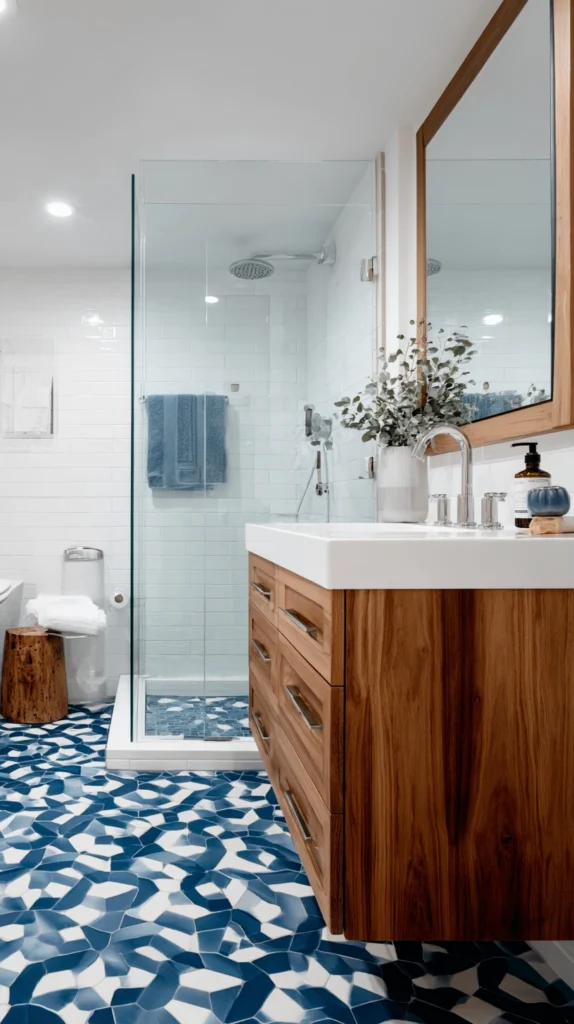
Budget: $200 – $1,200
A floor in blue and white hexagonal tiles — arranged in a pattern, whether a simple alternating scheme or a more complex flower-shaped arrangement — while every wall remains plain white, gives the bathroom its accent at floor level, where it’s encountered underfoot and glimpsed from the doorway rather than dominating the visual field at eye level.
Blue and white hexagonal tiles — $25 – $70 per square metre. A standard bathroom floor of three to five square metres — $75 – $350 in tile materials. Professional installation — $150 – $400.
Styling tip: A floor-level accent works particularly well in bathrooms with limited wall space for tiling — small bathrooms with multiple doors, windows, and fixtures interrupting the walls but a relatively uninterrupted floor area. Let the floor carry the pattern when the walls can’t.
11. The Blue Framed Mirror
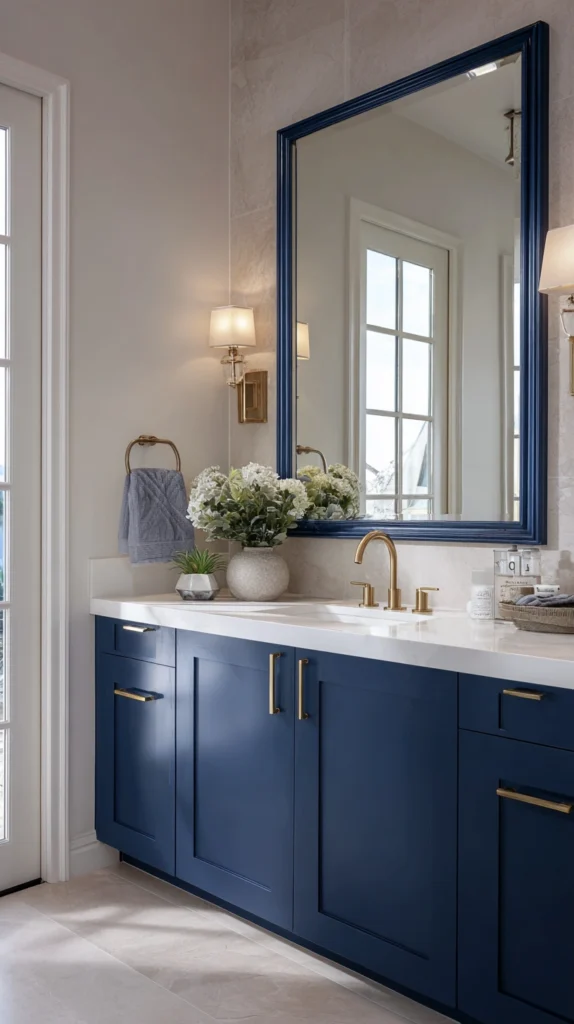
Budget: $30 – $200
A large mirror in a blue-painted or blue-lacquered frame — positioned above a white vanity against white or pale walls — gives the bathroom a single substantial object of colour at exactly the height and position where it’s seen multiple times daily.
A blue-framed mirror is also one of the easiest accent elements to change later, requiring no installation beyond hanging.
A blue-painted timber-framed mirror — $30 – $120. A blue lacquered mirror — $60 – $200. An existing mirror frame repainted in blue — $10 – $25 in paint.
Styling tip: Choose a mirror frame in a blue that’s slightly deeper or more saturated than any other blue accent in the room — the mirror frame, viewed up close every day, can carry a richer tone than a tiled wall or a floor seen from a greater distance, where paler tones tend to read better.
12. The Blue Glass Vessel Collection
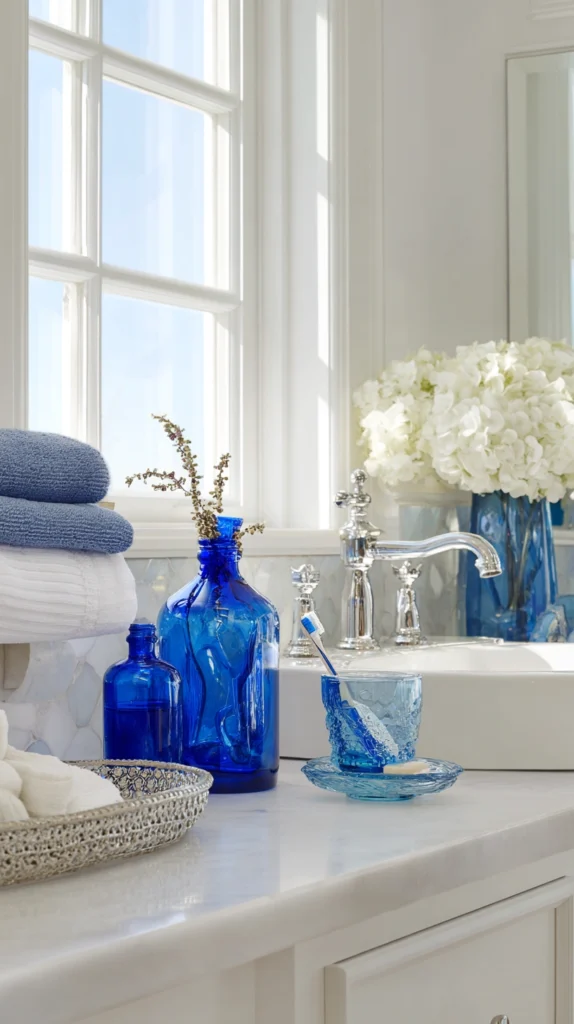
Budget: $15 – $80
A small collection of blue glass — vintage apothecary bottles, a simple glass tumbler for toothbrushes, a small glass dish for jewellery removed before washing — displayed on an open shelf or windowsill, introduces colour through genuinely useful small objects rather than purely decorative ones.
Blue glass catches light beautifully, particularly on a windowsill where daylight passes through it.
Vintage blue glass bottles — $5 – $20 each from secondhand sources. A blue glass tumbler — $8 – $20. A small blue glass dish — $8 – $15.
Styling tip: Position the blue glass collection on a windowsill or directly in front of a light source rather than against a wall — blue glass is at its most beautiful when light passes through it, and a collection in a dark corner loses most of its visual impact.
13. The Blue Painted Ceiling
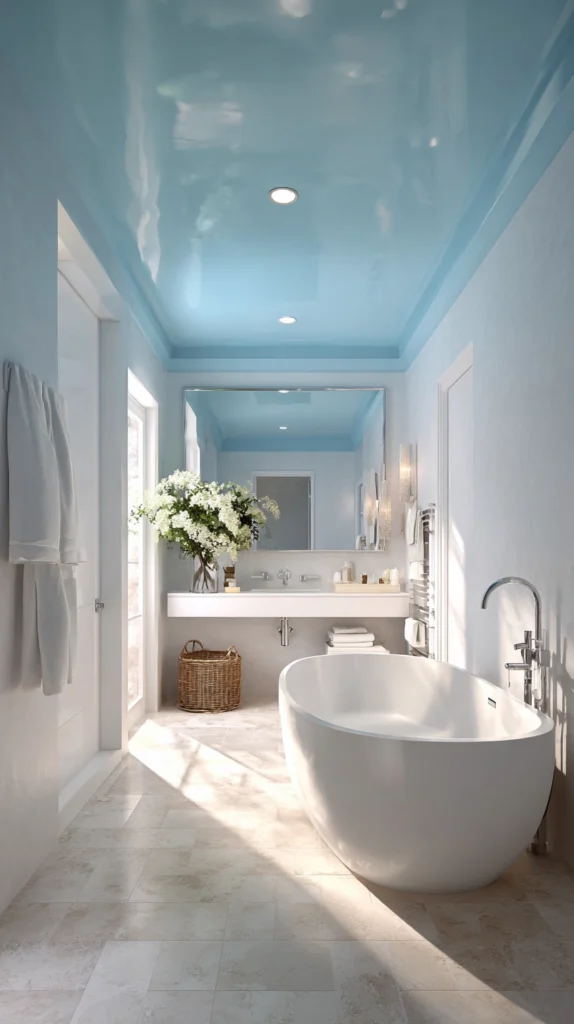
Budget: $20 – $80
A bathroom ceiling painted in a soft, pale blue while the walls remain white — an unexpected placement for colour that produces a gentle, sky-like effect overhead.
Looking up in the bath or shower to a pale blue ceiling rather than a flat white one introduces a subtle, calming detail that most visitors won’t immediately identify but will feel.
One litre of pale blue ceiling paint — $15 – $35. The application requires one to two coats for a standard bathroom ceiling.
Styling tip: Use a flat or matte finish rather than a standard ceiling paint sheen for the blue ceiling — the matte quality reads as genuinely sky-like rather than simply as a painted surface, and avoids unwanted reflections from overhead lighting.
14. The Blue Grout Detail
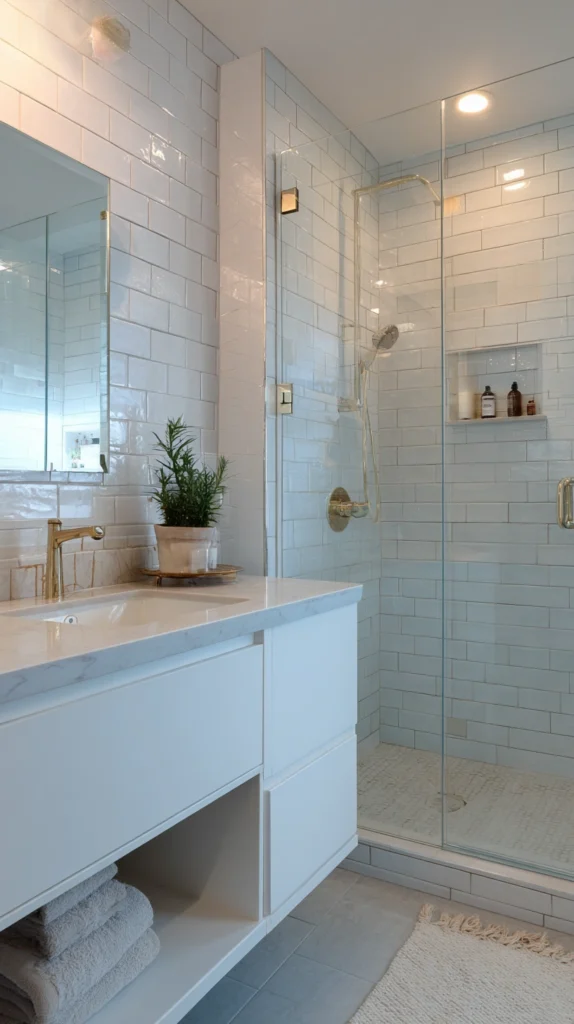
Budget: $20 – $100
White or pale grey tiles with blue grout — rather than the conventional white or grey grout — gives an entirely white-tiled bathroom a subtle grid of colour that’s only fully visible up close.
From across the room the bathroom reads as white; on closer inspection, every tile joint carries a thread of blue.
Coloured grout in blue — $15 – $40 for a standard bathroom’s worth of grout. If retiling isn’t planned, regrouting an existing white-tiled bathroom costs $100 – $300 in labour if done professionally, or a weekend DIY project with grout removal tools.
Styling tip: Choose a blue grout in a muted, dusty tone rather than a bright or saturated blue — a subtle blue grout reads as an intentional, sophisticated detail. A bright blue grout against white tile can read as a mistake rather than a deliberate choice, simply because the convention of coloured grout is unfamiliar enough that subtlety helps signal intent.
15. The Fully Realised Blue Accent Bathroom
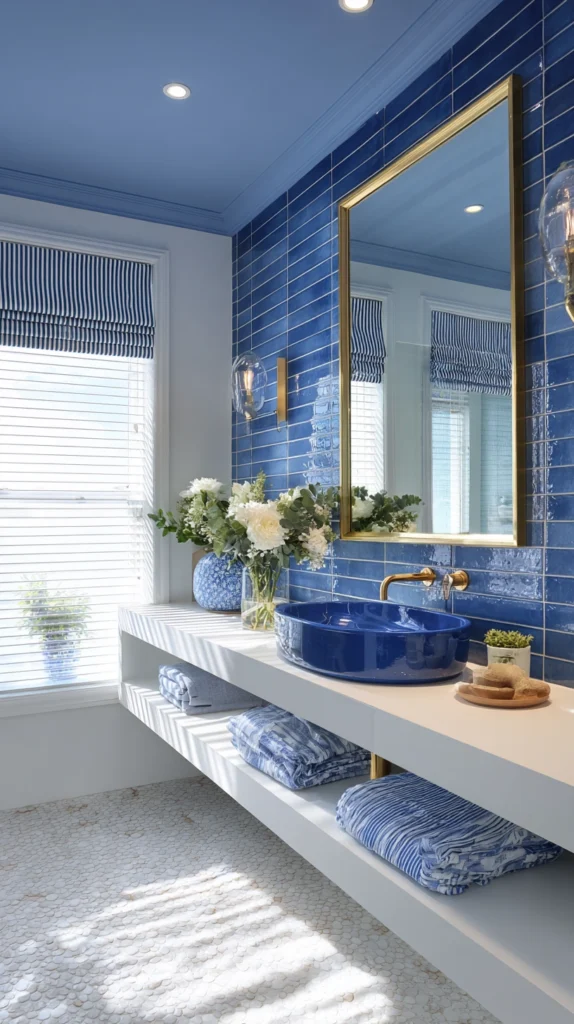
Budget: $400 – $3,000
The fully realised blue accent bathroom — predominantly white tile with one wall in blue, a blue ceramic vessel sink on a white vanity with blue-glazed drawer pulls and brass taps, a blue-framed mirror above, blue and white striped towels on a brass ladder rail, a small blue glass collection on the windowsill, a blue linen Roman blind, a pale blue ceiling overhead, and blue grout in the white floor tiles.
This uses every accent strategy at a measured intensity, so that blue appears throughout the room without ever becoming the room’s subject.
Feature wall tiling: $210 – $800. Blue sink: $150 – $500. Vanity hardware: $45 – $145. Framed mirror: $30 – $200. Towels: $60 – $140. Glass collection: $21 – $55. Roman blind: $30 – $80. Ceiling paint: $20 – $80. Blue grout: $20 – $100. Total fully realised blue accent bathroom: $586 – $2,100.
Styling tip: When combining several blue accents in one bathroom, repeat the same shade of blue across at least two or three of the larger elements — the tiled wall and the towels, or the sink and the grout — while allowing one or two smaller accents to introduce a slightly different but related blue. Too many different blues at equal visual weight reads as indecision. One consistent blue with a couple of related variations reads as a considered palette with room to breathe.
A blue accent bathroom asks for less than a fully blue one and often delivers more — because every blue element, surrounded by white and given room to be seen on its own terms, carries more visual weight than the same colour would if it covered every surface.
Restraint, here, is not the absence of a decision. It’s the decision.
Choose your blue. Choose where it appears. And then let the white do what white does best — make the blue look exactly as considered as it is.