15 Backyard Waterfall Ideas That Turn Your Garden Into a Peaceful Retreat
There is a particular quality that a garden acquires the moment water begins to move within it. The birds arrive differently. The temperature at the garden’s edge drops by a degree or two. The sound of the street — the cars, the neighbours, the ambient noise of a life lived in proximity to others — recedes to a distance from which it becomes genuinely irrelevant.
A backyard waterfall does not merely decorate the garden. It changes the character of every hour spent near it and makes the garden a place of genuine retreat rather than simply a place of pleasant outdoor space.
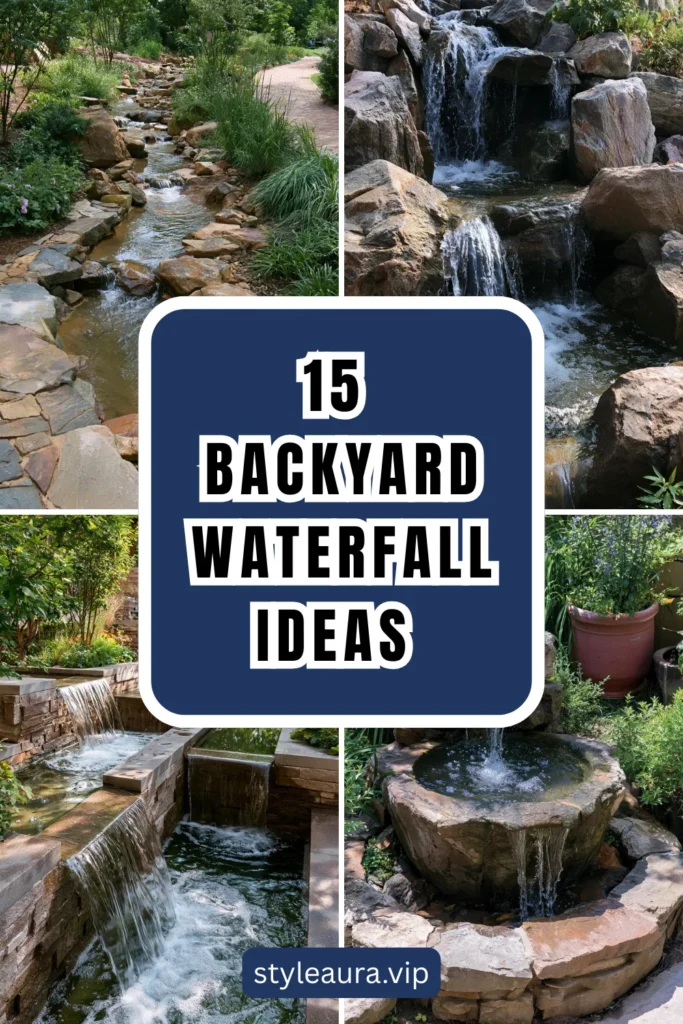
The waterfall that achieves this is not necessarily the most expensive or the most ambitious. It is the one that is positioned correctly, designed in relationship to the garden around it, built with materials that belong to the landscape rather than arriving from a catalogue, and given the time to settle and soften and become genuinely part of the place it was installed to improve. A year-old waterfall with moss beginning to appear on the stone and a thriving marginal planting at its base is more beautiful than a new installation of twice the cost.
The fifteen ideas below cover every scale, every style, and every budget for a backyard waterfall — from a single spout into a planted basin to a full naturalistic cascade.
1. The Simple Pebble Fountain
Budget: $80 – $400
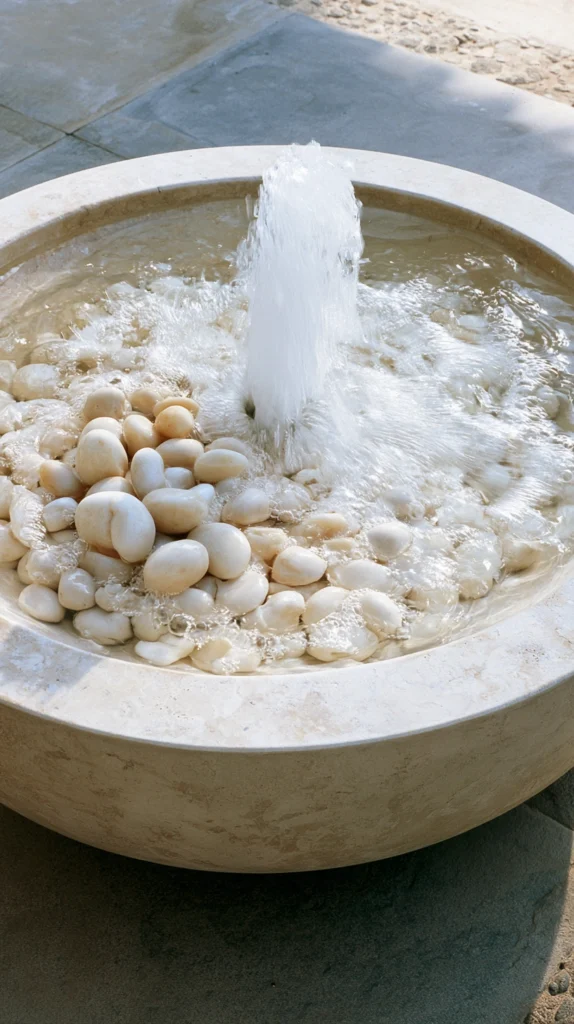
A pebble fountain — a submersible pump in a buried reservoir, water rising through a pipe to emerge and bubble across a surface of smooth river pebbles before draining back into the reservoir below — is the most compact, the most maintenance-free, and the most beginner-accessible waterfall format available. It requires no pond, no liner beyond the reservoir itself, and no open water — making it appropriate for gardens with young children and for spaces too small for a traditional water feature.
A pebble fountain kit — including the reservoir, the pump, the pipe, and the pebble grate — costs $80 – $200 from garden water feature suppliers. A bag of smooth river pebbles — $15 – $30. A decorative centrepiece element — a drilled rock, a ceramic pot, or a millstone through which the water emerges — adds $30 – $100. Total investment: $125 – $330 for a self-contained, fully recirculating water feature.
Styling tip: Place the pebble fountain at a distance from the main seating area where it can be heard clearly but not so close that the sound becomes overwhelming. The ideal listening distance for a small bubbling fountain is three to five metres — close enough to be the garden’s primary ambient sound and far enough that conversation does not compete with it. Test the distance by running the pump temporarily before finalising the installation position.
2. The Planted Waterfall Bank
Budget: $500 – $5000
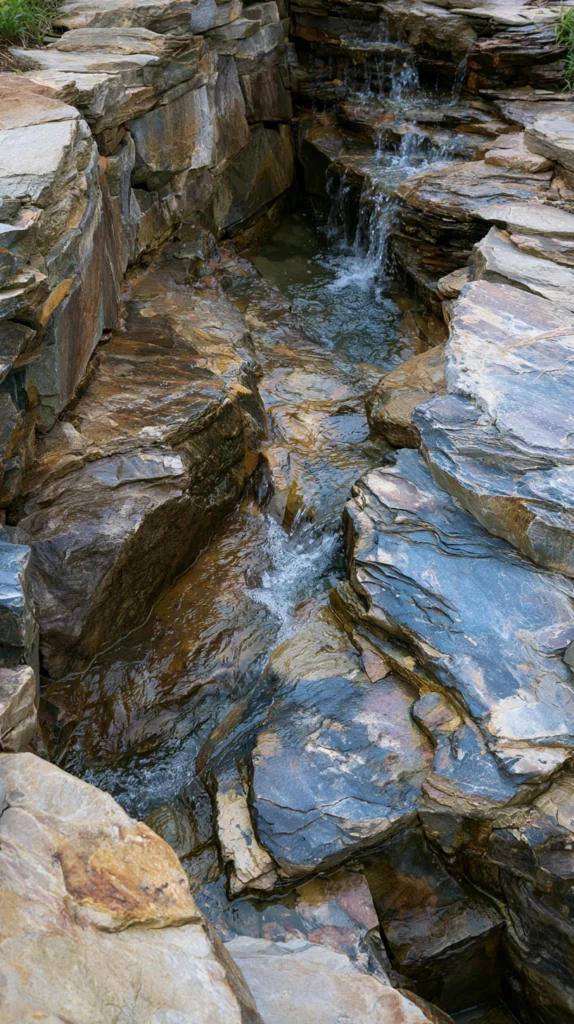
A planted waterfall bank — a sloped garden area planted with moisture-loving species through which water trickles from an upper pool to a lower one, the water barely visible beneath the planting — is the most naturalistic and the most specifically beautiful waterfall format for a garden that prioritises ecological connection over architectural statement. The waterfall is not the feature. The planting is the feature. The water is what keeps it alive and what produces the gentle sound.
A simple gravity-fed water system on a naturally sloped bank — pump and pipe — costs $150 – $400 in materials. Moisture-loving planting — ferns, hostas, astilbe, iris, and creeping jenny — costs $10 – $30 per plant, with fifteen to twenty plants sufficient for a standard bank. The bank itself — formed from existing garden topography or created with imported soil — costs nothing if the slope already exists or $200 – $800 if it must be constructed.
Styling tip: Plant the waterfall bank in layers — tall moisture-loving plants at the top and back, medium specimens in the middle zone, and low ground cover at the base and edges where the water meets the surrounding garden. A bank planted in graduated layers reads as a genuine landscape feature. A bank planted uniformly at one height reads as a planting area with water running through it — a small but significant distinction in terms of the overall visual quality of the installation.
3. The Wall-Mounted Spout and Trough
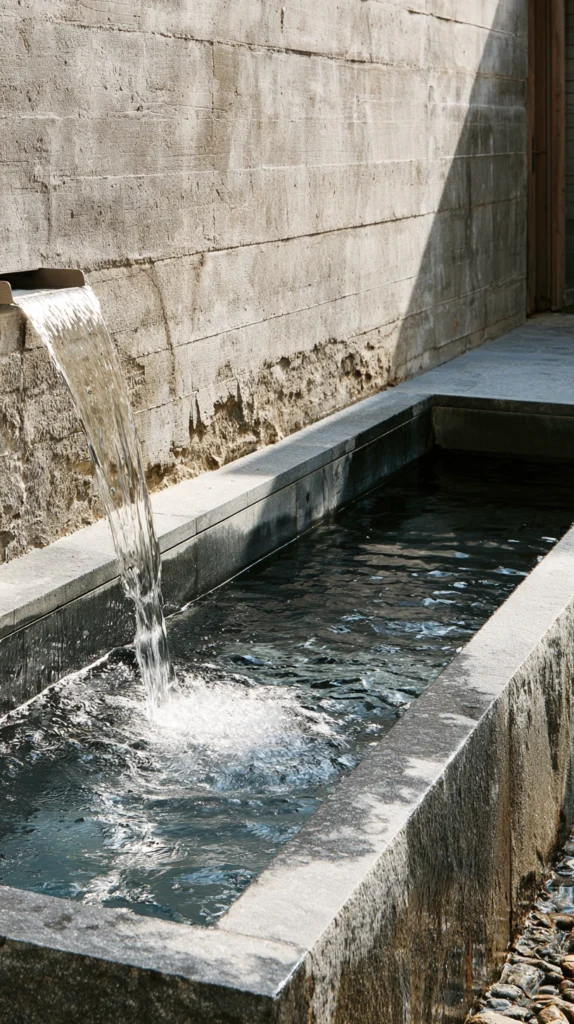
Budget: $200 – $2000
A wall-mounted spout — a lion’s head, a simple pipe, or a geometric copper outlet — delivering water in a controlled arc from a wall surface into a stone or concrete trough below, is the most formally composed and the most architecturally referenced backyard waterfall format. It suits walled gardens, courtyard spaces, and gardens with a Mediterranean or formal character and produces a sound that is both specific and constant — the particular sound of water hitting still water in a stone basin.
A cast stone or copper wall spout — $30 – $120. A rendered or stone garden wall as the mounting surface — existing at no additional cost if already present. A stone, concrete, or terracotta trough — $50 – $300 depending on size and material. A submersible pump and pipe to recirculate from the trough back to the spout — $60 – $200. Total investment: $140 – $620 for a formal water feature of considerable character.
Styling tip: Plant the trough with a single aquatic or marginal plant — a dwarf water lily, a small iris, or an aquatic mint — rather than leaving the water surface entirely bare. A trough with one considered plant reads as a water garden. An empty trough reads as a stone basin with water in it. The distinction is produced by a single plant that costs under ten pounds and transforms the character of the installation entirely.
4. The Naturalistic Rock Waterfall
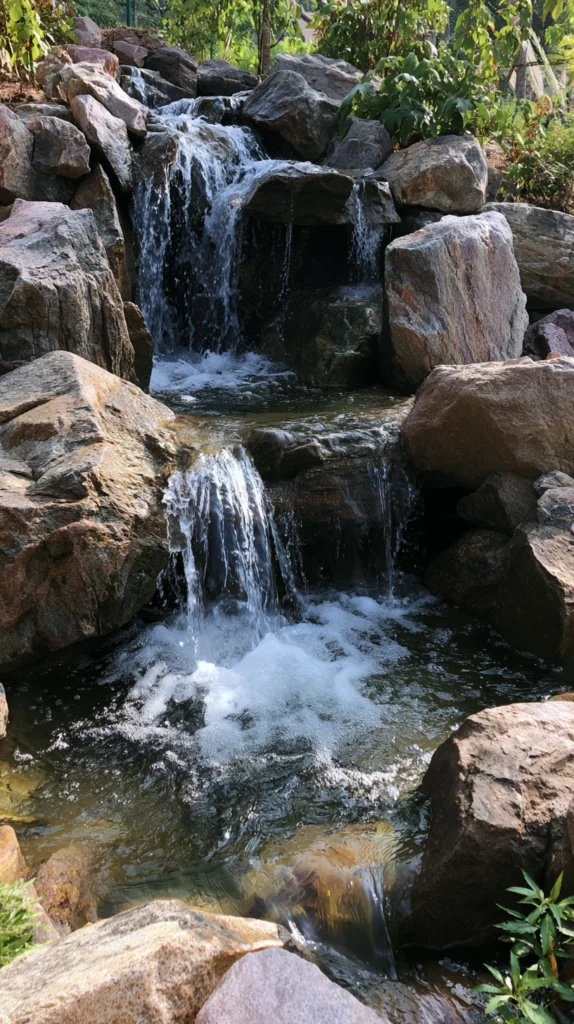
Budget: $1000 – $12000
A naturalistic rock waterfall — large irregular stones arranged at graduated heights, water pumped to the summit and allowed to find its own path through the channels and ledges of the rock arrangement into a pond below — is the backyard waterfall that most convincingly suggests the presence of a genuine natural feature. When built with the right stone sourced from the right local landscape and planted convincingly at its margins, it reads as something that the garden grew around rather than something that arrived in a truck.
Large natural boulders in a locally sourced stone — $80 – $300 each depending on size. A flexible pond liner for the pool at the base — $50 – $200 depending on size. A submersible pump with sufficient lift for the height of the waterfall — $100 – $400. Professional design and installation of a naturalistic rock waterfall — $2000 – $12000 depending on scale. DIY installation using a bought kit and sourced stone — $1000 – $4000 in materials.
Styling tip: Source stone for the naturalistic waterfall from the same geological region as the garden’s existing hard landscaping — the same sandstone, the same limestone, the same granite. Stone that matches the existing landscape reads as belonging to it. Stone imported from a different geological region reads as placed — a subtle but immediately perceived quality difference that separates a convincing naturalistic feature from one that looks like a purchased installation.
5. The Raised Pool Cascade
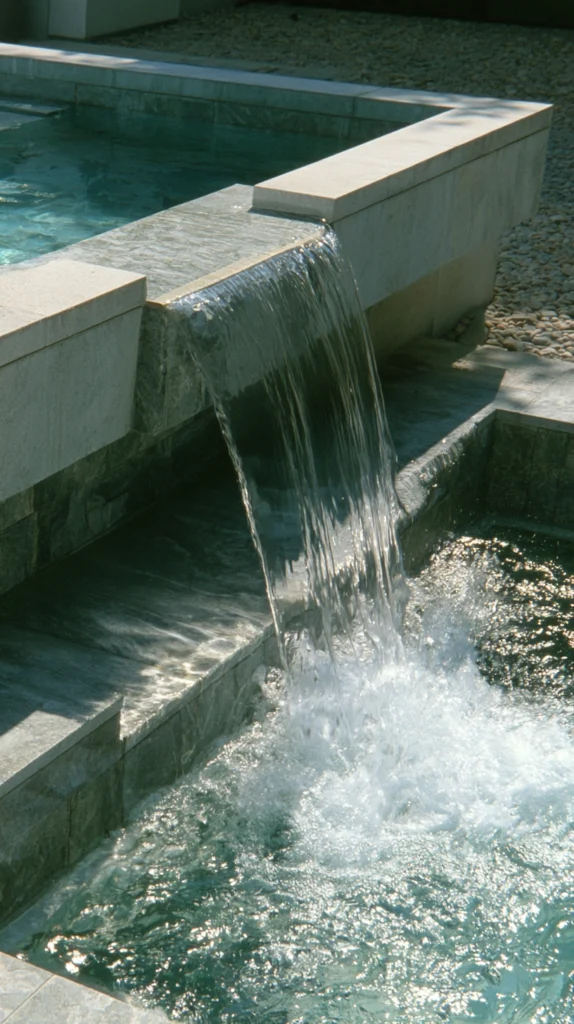
Budget: $1500 – $10000
A raised pool — a pool or water feature elevated 30 to 60 centimetres above the surrounding paving, its water overflowing a single designed edge into a lower channel or basin — produces a waterfall that is integrated into the water feature’s own structure rather than attached to it as a separate element. The overflow is the waterfall. The pool is the pump housing. The simplicity of the relationship between the two produces a feature of genuine architectural elegance.
A raised pool in a rendered concrete finish — $1500 – $5000 for a standard garden scale. A raised timber pool — railway sleeper construction with a waterproof liner — $500 – $2000 as a DIY project. A raised natural stone pool — $3000 – $10000 professionally built. The overflow edge can be a single lip directing the fall to one side or a full perimeter overflow producing a sheet fall on all sides — the full perimeter version being significantly more dramatic and significantly more expensive.
Styling tip: Finish the interior of the raised pool in a dark render or dark mosaic tile rather than a pale or standard blue finish. A dark pool interior reflects the sky, the surrounding planting, and the movement of clouds rather than producing an opaque coloured surface — which makes the pool appear deeper, more interesting, and more specifically beautiful than a pale interior allows. The reflected sky in a dark pool is one of the most specifically magical qualities a garden water feature can produce.
6. The Bamboo Deer Scarer
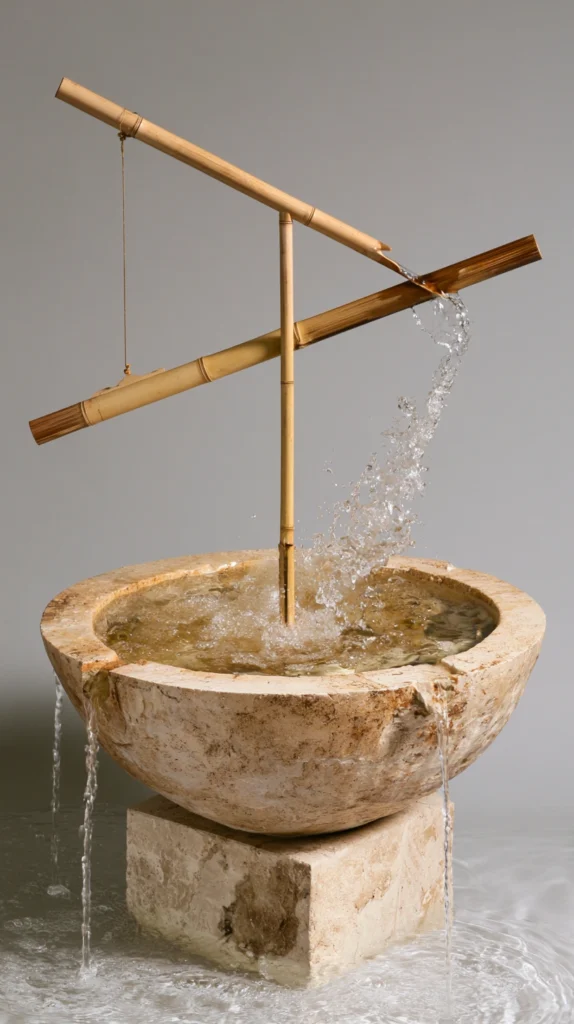
Budget: $50 – $300
A shishi-odoshi — the traditional Japanese deer scarer — is a length of bamboo pivoting on a central axle above a basin, filling with water until the weight tips the bamboo forward to deliver the water to the basin below, then returning to the upright position with a distinctive knock against a stone. The rhythmic, irregular sound of the shishi-odoshi is one of the most meditative and most specifically Japanese garden sounds available — slow, unpredictable, and productive of an immediate stillness in anyone near it.
A purchased shishi-odoshi kit — bamboo, axle, and stone base — costs $80 – $200 from Japanese garden suppliers. A DIY version made from bamboo, copper pipe, and a stone basin — $30 – $100 in materials. A submersible pump to supply the bamboo inlet pipe — $40 – $80. A stone or ceramic basin — $30 – $100. Total investment: $100 – $300 for the backyard waterfall with the most specifically meditative sound on this list.
Styling tip: Surround the shishi-odoshi with the planting of a Japanese garden — moss, fern, black bamboo, and raked gravel — so that the sound of the water and the knock of the bamboo on stone exists within a visual context that communicates the same aesthetic world as the water feature itself. A shishi-odoshi surrounded by mixed border planting produces a beautiful sound in an incongruous visual context. The same feature in a Japanese garden planting scheme produces a complete and coherent sensory environment.
7. The Stream and Waterfall Feature
Budget: $1000 – $8000
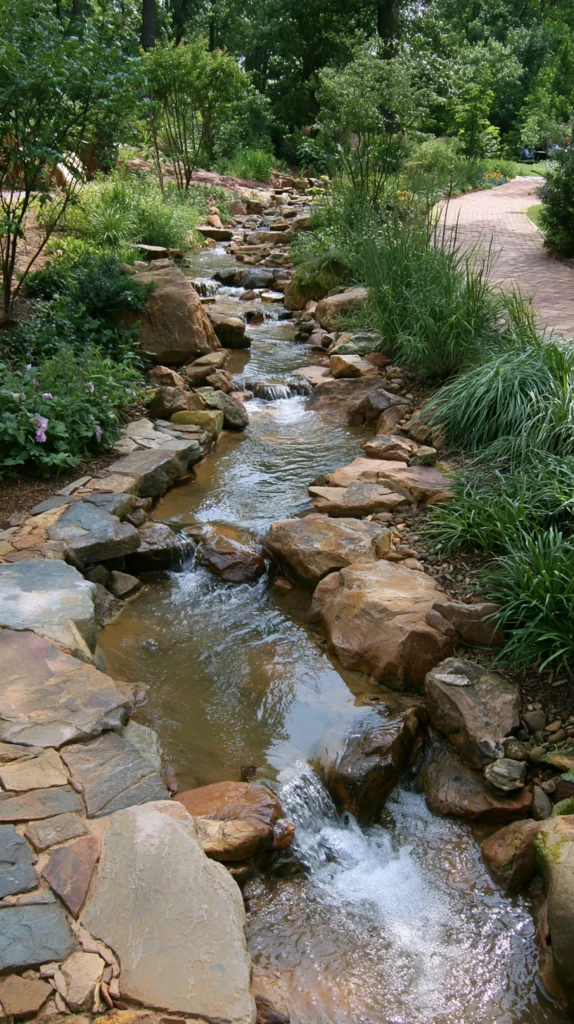
A garden stream — a narrow, winding watercourse running through the garden from an upper source to a lower pool, with one or two small falls where the stream drops over flat stones — is the most dynamically beautiful and the most spatially extensive waterfall format available for a domestic garden. A stream creates a linear water feature that changes character at every point along its length and produces a sound that varies from a trickle in the shallow sections to a gentle rush at the falls.
A garden stream with liner and pump for a 5-metre run — $500 – $2000 in materials. Flat stone ledges for the small falls — $200 – $600 in stone. Marginal and moisture-loving planting along the stream banks — $200 – $600 in plants. Professional design and installation — $2000 – $8000 for a naturally styled stream with planted margins and two to three small falls.
Styling tip: Design the garden stream with a visible source — a boulder or a planted mound from which the water appears to emerge — and a visible destination — a pool or a basin where the water collects before being recirculated. A stream with a clear beginning and a clear ending reads as a natural watercourse that the garden contains. A stream that begins and ends without visual logic reads as a channel of water without a story — and the story is what makes a garden stream genuinely beautiful.
8. The Millstone Water Feature
Budget: $200 – $1500
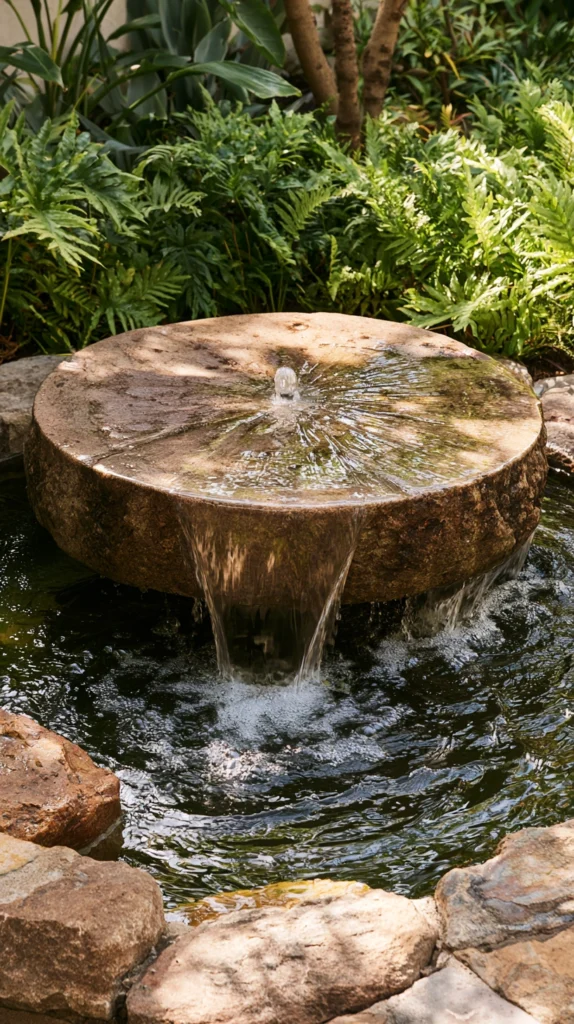
A millstone water feature — a large circular stone disc through which water wells from the centre and flows across the surface before falling over the edge into a pebble reservoir below — is among the most compact and the most charming waterfall formats available for a small garden. It is self-contained, requires no pond or open water, and produces the gentle, low sound of water flowing over stone in a way that suits the quietest and the most intimate garden spaces.
A genuine millstone from a reclamation yard — $200 – $500 depending on size and condition. A purpose-made granite or reconstituted stone disc — $100 – $300. A pebble reservoir kit with pump and cover — $80 – $200. Smooth river pebbles for the reservoir surface — $20 – $40 per bag. Total investment: $400 – $1040 for a feature that requires no excavation and fits any garden.
Styling tip: Position the millstone water feature where the stone surface will receive dappled rather than direct sunlight. Dappled sunlight on the moving water across a millstone surface produces a gently shifting light pattern that direct sunlight cannot replicate — the shadows of surrounding leaves playing on the moving water and producing an animated quality that makes the feature genuinely dynamic rather than simply flowing. Full sun produces glare. Dappled sun produces light.
9. The Wildlife Pond Waterfall
Budget: $300 – $3000
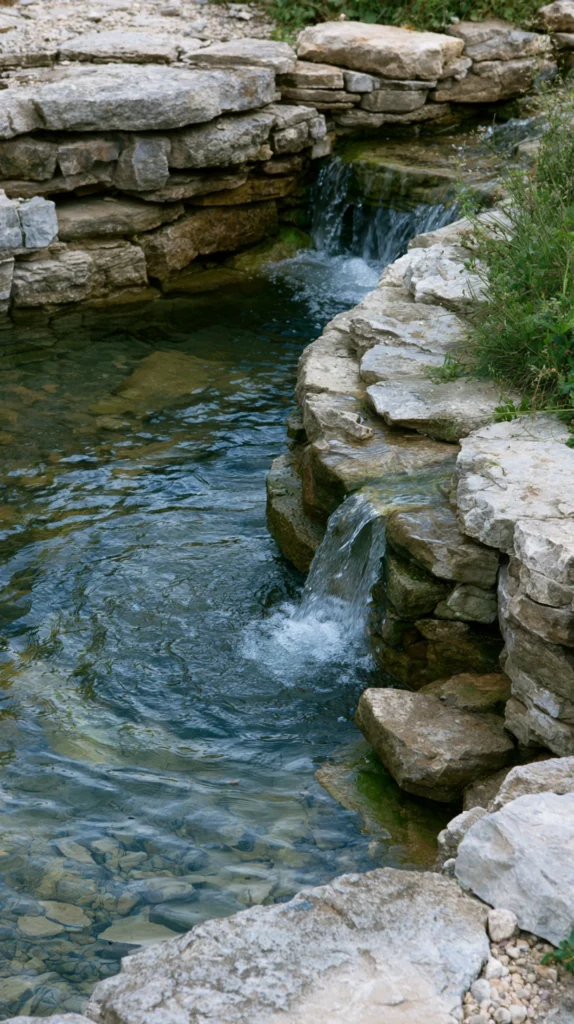
A wildlife pond with a shallow waterfall inlet — a small cascade at one end of a naturalistic pond, providing oxygenation, a continuous water movement that discourages stagnation, and an accessible drinking and bathing point for garden birds and small mammals — is the backyard waterfall that delivers the most ecological benefit alongside its aesthetic and sonic qualities. A waterfall that attracts wildlife is a waterfall that changes the garden’s entire ecological character.
A wildlife pond with a flexible liner — $100 – $400 depending on size. A small inlet cascade of natural flat stone — $100 – $300 in stone materials. A low-power pump to circulate water to the cascade inlet — $50 – $150. Marginal and aquatic planting — $10 – $30 per plant, fifteen to twenty plants for a standard wildlife pond. Total investment: $360 – $1280 for a garden feature that improves ecologically with every passing season.
Styling tip: Install a beach — a gently sloping section of the pond edge covered in small pebbles — at the opposite end of the pond from the cascade inlet. The beach gives birds, hedgehogs, and other garden wildlife a safe, accessible entry point to the pond for drinking and bathing. A pond with a beach and a waterfall inlet at opposite ends creates a gentle water circulation that benefits every living thing that uses it — from the diving beetles to the blackbirds.
10. The Pondless Waterfall
Budget: $400 – $5000
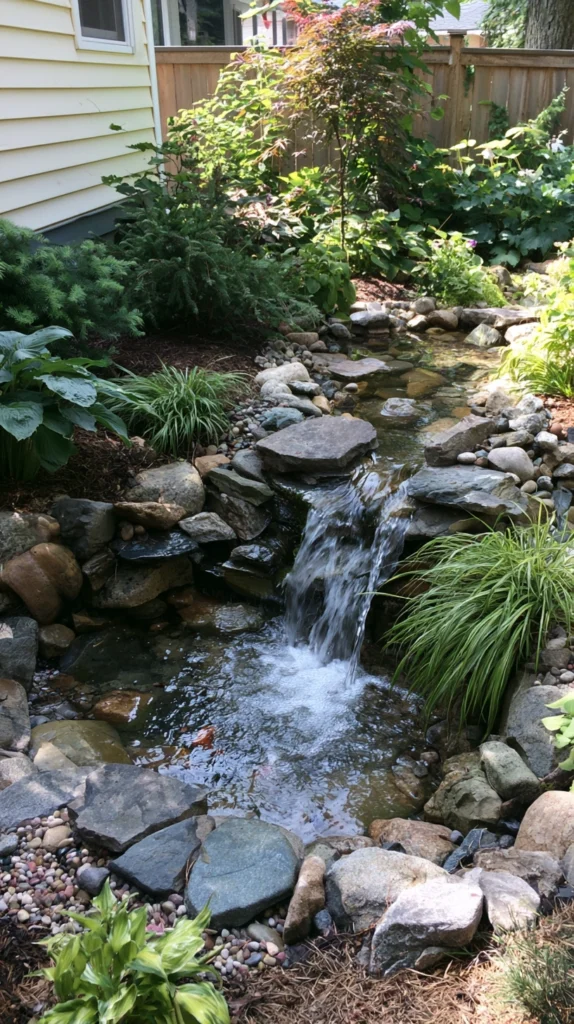
A pondless waterfall — a waterfall or cascade that flows into a reservoir of decorative aggregate rather than an open pond, the water recirculated from beneath the surface and delivered back to the top of the waterfall — is the most practically safe and the most easily maintained waterfall format available for a garden with young children or with limited maintenance time. It provides all the visual and sonic qualities of a full waterfall and pond system without the open water.
A pondless waterfall kit — reservoir basin, pump vault, pump, liner, and delivery pipe — costs $200 – $600 for a residential scale. Natural stone for the waterfall structure — $200 – $800 depending on type and quantity. Professional installation — $500 – $2000 for a standard garden scale. DIY installation — a full weekend project with a comprehensive kit and a competent approach.
Styling tip: Cover the pondless reservoir surface with large, flat fieldstones rather than a uniform aggregate surface — so that the reservoir area reads as a natural dry stream bed in the periods when the feature is not running, rather than as a gravel pit. Large flat stones of irregular size create a surface with genuine visual interest that a uniform aggregate cannot produce.
11. The Container Waterfall Garden
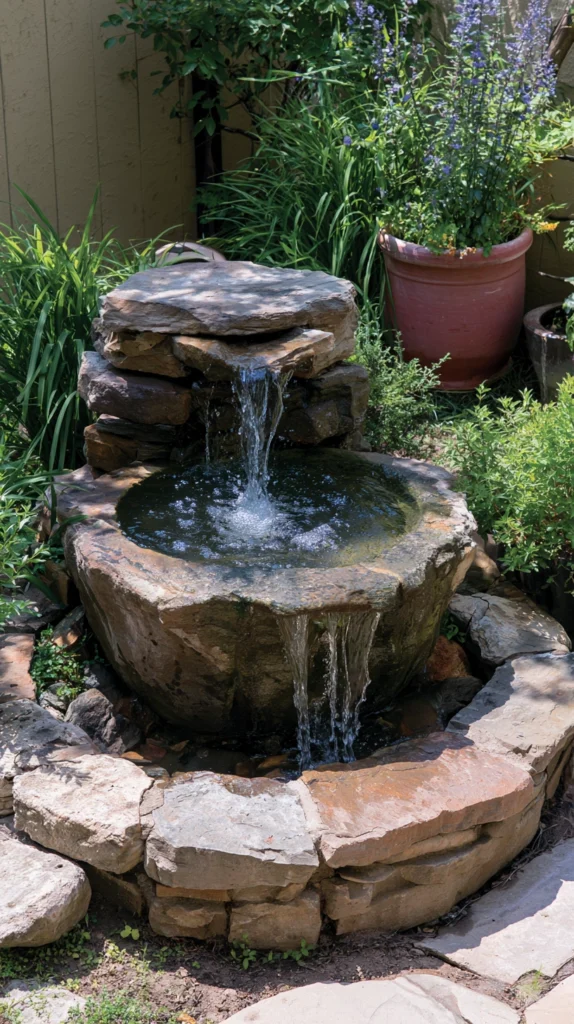
Budget: $50 – $300
A container waterfall garden — a large ceramic, terracotta, or glazed pot with a small fountain pump inside, the water emerging from the pot’s lip or from a small spout mounted on the side, falling into a second container or a surrounding pebble basin below — is the most flexible and the most relocatable waterfall format available. It requires no ground work, no liner, no excavation, and can be moved when the garden changes.
A large glazed or terracotta pot — $30 – $100. A small fountain pump — $20 – $60. A second container or surrounding pebble basin — $20 – $50. An outdoor electrical connection for the pump — $0 if an existing outdoor socket is available. Total investment: $70 – $210 for a self-contained waterfall that can be repositioned with the seasons and the changing light of the garden year.
Styling tip: Choose a pot with a narrow neck rather than a wide opening for the primary container waterfall — the narrow neck slows the water to a gentle overflow rather than a wide spread, producing a more controlled and more elegant flow across the ceramic surface. A wide-necked pot produces a broad, splashy overflow. A narrow-necked pot produces a thin, glassy sheet that follows the contours of the ceramic with precision and considerably more visual delicacy.
12. The Slate Stack Waterfall
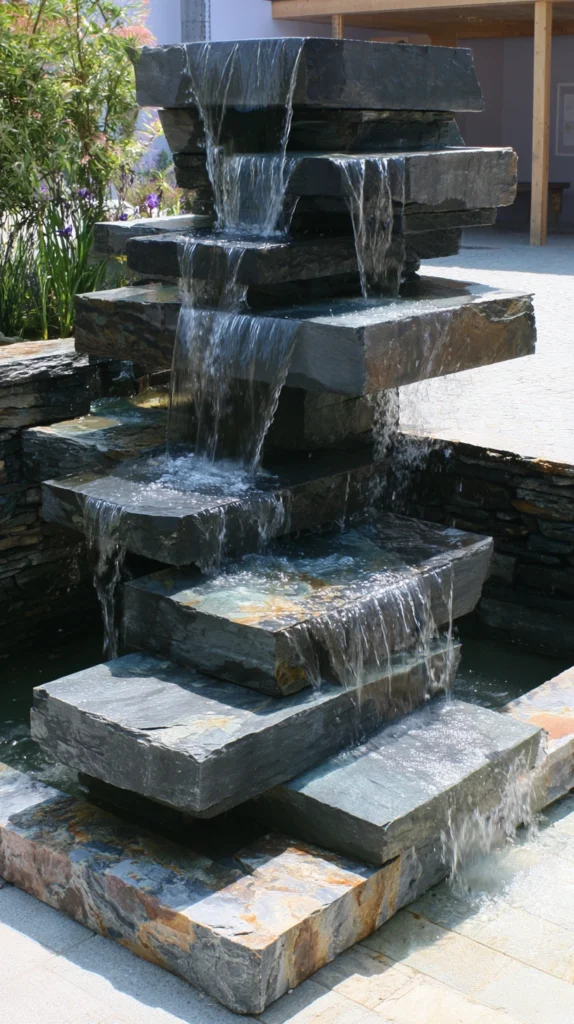
Budget: $200 – $1500
A slate stack waterfall — flat slate pieces stacked at graduated heights, water pumped to the summit and flowing down through the gaps between the stacked plates in a series of small falls — is the most contemporary and the most specifically architectural of all the natural stone waterfall formats. The clean, dark planes of the slate and the thin sheets of water between them produce a feature that reads simultaneously as geological and as precisely designed.
Flat slate pieces in varying sizes — $50 – $150 per bag. A reservoir basin and pump — $100 – $250. Waterproof adhesive or mortar to secure the stack — $20 – $40. Surrounding gravel or pebbles — $20 – $40 per bag. Total investment: $190 – $480 for a feature that is both beautiful and entirely achievable as a DIY project in a single weekend.
Styling tip: Tilt each slate layer very slightly backward — by two to three degrees — so that the water flows forward over the leading edge of each slate rather than running back into the gap between the plates. A correctly tilted stack produces clean, defined falls at each plate edge. An untilted stack allows water to find the path of least resistance — which may be forward, or sideways, or back — producing an irregular and aesthetically unresolved flow pattern.
13. The Formal Canal Waterfall
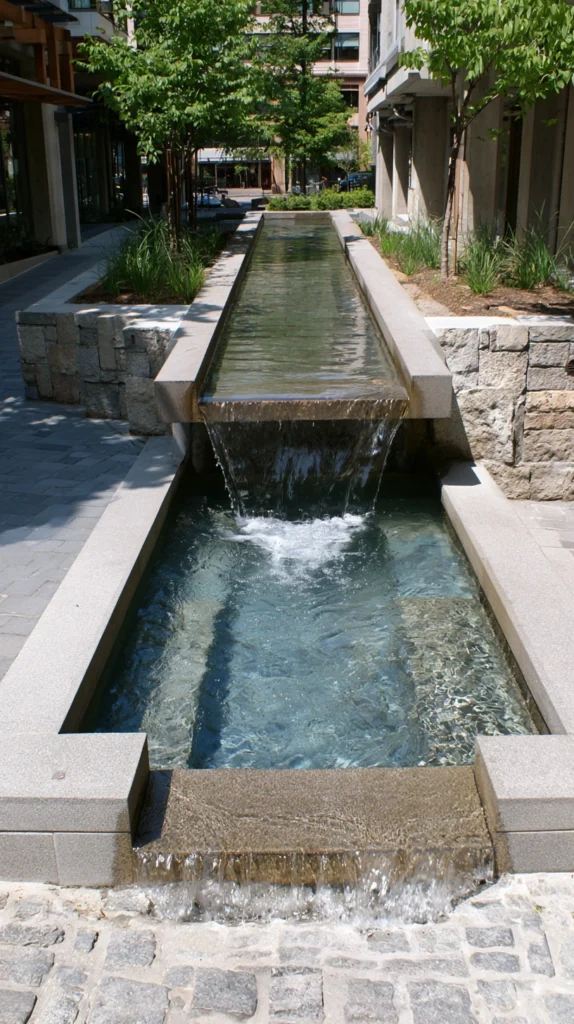
Budget: $1000 – $8000
A formal canal waterfall — a straight, precisely edged channel of water at one level delivering a sheet fall over a weir edge into a lower canal or pool — is the most classically architectural and the most specifically formal backyard water feature available. In a garden of deliberate geometry, clipped hedging, and stone or brick hard landscaping, a formal canal with a weir fall is not a garden ornament. It is the garden’s structural spine.
A formal canal in engineering brick or stone — $1000 – $5000 for a standard garden scale. A weir edge in polished stone or stainless steel — $200 – $600. A pump and plumbing to recirculate from the lower pool to the upper canal — $150 – $500. Professional construction — adds $1000 – $3000 to the material cost for a straightforward installation.
Styling tip: Keep the water level in the formal canal as high as possible — within one to two centimetres of the top edge of the canal wall. A canal filled to within two centimetres of its edge reads as a mirror — reflecting the sky, the surrounding garden, and the architecture of the space. A canal filled to five centimetres below the edge reads as a channel with water in it. The water level is the single most important aesthetic decision in the formal canal’s maintenance.
14. The Dry Garden Waterfall
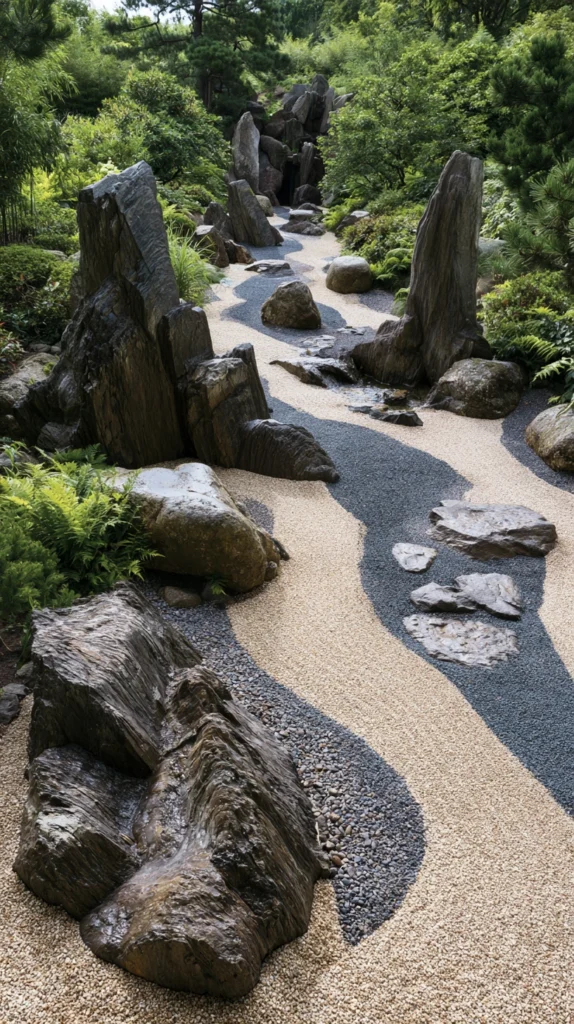
Budget: $100 – $1000
A dry garden waterfall — raked gravel or smooth pebbles arranged to suggest the flow of water through the garden without any actual water, with larger stones positioned as if they were boulders in a natural stream — is the Zen garden’s primary design element and the backyard waterfall for the gardener who wants the contemplative quality of a water feature without the maintenance, the wildlife, or the sound. A well-made dry waterfall is an invitation to imagine water where none exists.
Raked gravel in a light grey or warm cream — $20 – $50 per bag, three to five bags for a standard dry stream. Large feature stones to place at the stream’s bends and edges — $50 – $200 in stone materials. Flat slate or stepping stone pieces — $30 – $100. Low maintenance planting at the stream’s margins — ornamental grasses, moss, and sedums — $10 – $25 per plant.
Styling tip: Rake the gravel in the dry waterfall with a pattern that suggests the movement of water — parallel lines in the straight sections that fan outward at the bends, circular patterns around the large stones that suggest the eddying of water past an obstacle. A raked dry stream communicates the idea of water with considerable power. An unraked dry stream communicates the idea of gravel. The raking is the work that produces the meaning.
15. The Full Garden Waterfall Retreat
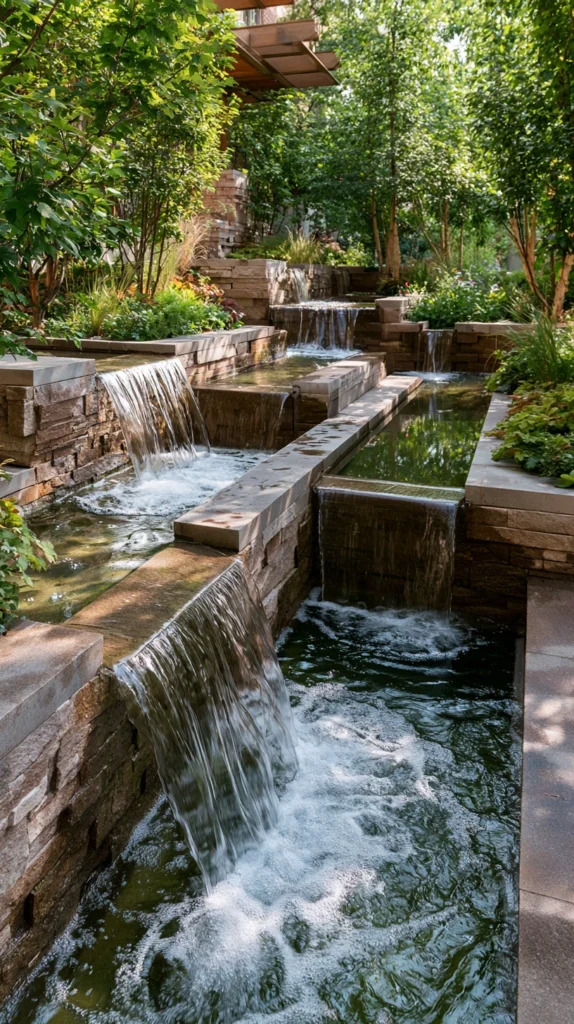
Budget: $3000 – $30000
A full garden waterfall retreat — a naturalistic rock cascade at one end of a wildlife pond, a planted stream running through the garden from the cascade to a second pond, a formal canal connecting the second pond to a raised pool with an overflow weir, a bamboo spout providing the sound element beside the main seating area, and moisture-loving planting throughout all the margins — is not a backyard water feature. It is a water landscape.
Naturalistic rock cascade: $2000 – $10000. Planted stream: $1000 – $5000. Wildlife pond: $500 – $3000. Formal canal: $1000 – $5000. Raised pool: $1500 – $5000. Bamboo spout element: $100 – $300. Planting throughout: $500 – $2000. Total full garden waterfall retreat: $6600 – $30300 — the cost of a garden that has been designed around water as its primary material rather than as an addition to an existing design.
Styling tip: Engage a water garden specialist rather than a general landscaper as the primary designer and installer of a full garden waterfall retreat. A water garden specialist understands the hydraulics of recirculating systems, the ecology of planted pond systems, the maintenance requirements of multiple connected water features, and the design principles that make a complex water landscape read as a unified environment rather than a series of individual features placed in the same garden. The specialist fee is the investment that makes the difference between a water landscape that works — hydraulically, ecologically, and aesthetically — and one that works in two of those three dimensions.
Whatever combination of these fifteen ideas finds its way into the backyard, the principle beneath all of them is the same one that makes any water feature genuinely transformative rather than simply decorative: the water should move in a way that sounds right in the specific garden, be visible from the specific seat that is most frequently occupied in the garden, be surrounded by planting that belongs to the same natural world as the water itself, and be given time — measured in seasons rather than weeks — to become part of the place rather than an addition to it.
Water in a garden does not simply add a feature. It adds a quality — of sound, of light, of ecological life, of the particular ambient humidity that makes an outdoor space feel different from every outdoor space without it.
Give it the garden it deserves. Give it the stone and the planting and the time. And then sit in the place where the sound of it is exactly right and let the rest of the world recede to wherever it goes when a garden is doing its job completely.