14 Outdoor Fall Tablescape Ideas for Backyard Dinners
Most outdoor dinner tables get set the same way regardless of season: a tablecloth, some plates, whatever flowers happened to be near the checkout at the grocery store. It works fine when the goal is simply getting people fed outside, and nobody’s expecting the table to do anything more than hold the food.
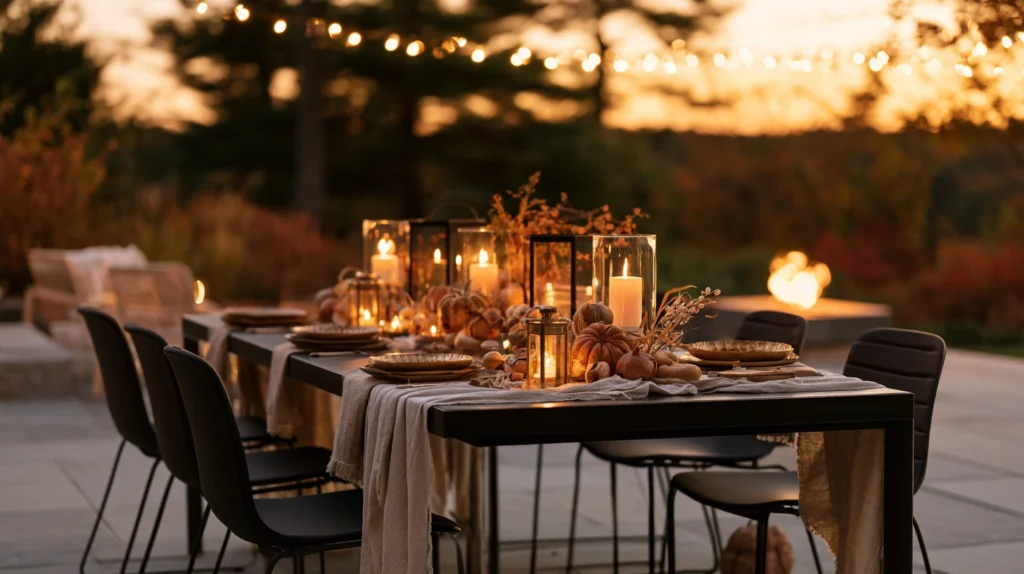
A fall backyard dinner asks more of its table than that. When the sun goes down by six and the temperature starts to drop before dessert is even served, a flat, underdressed table stops doing its share of the hosting work. A well-laid tablescape for a fall outdoor dinner isn’t just about how the table looks in the late afternoon — it’s about how it feels to sit at in low, fading light, how it holds warmth, and how the combination of objects on it makes the meal feel like something worth sitting through the cooling air for.
An outdoor fall tablescape isn’t a summer table with autumn-colored flowers swapped in. It’s a different design problem, solved by layers of texture, height, and warm light rather than a single bouquet and a coordinated napkin fold. Get the layers right, and the table becomes the reason people stay outside rather than the first thing they abandon when the temperature drops.
Here are 14 ideas for building a fall outdoor tablescape that does real atmospheric work at a backyard dinner.
Why Fall Outdoor Tablescapes Play by Different Rules Than Summer
The rules are not the same for every season at an outdoor table:
Summer Outdoor Table Advantages:
- Long daylight means the table never needs to carry the room’s light on its own
- Mild temperatures mean a single layer of tablecloth and plate is enough
- Simple, fresh flowers and greenery match the season’s mood without much additional effort
The summer table comparison: the season does most of the work
Fall Outdoor Table Advantages and Realities:
- Fading daylight during dinner means candles and warm light are a necessity rather than a decorative touch
- Temperature drops mean the table needs to signal warmth, not just food, to keep people seated
- The season’s specific palette — rust, deep green, aged gold — offers more texture and depth than summer’s bright, simple tones
The key insight:
- A summer outdoor table rewards simple, fresh, and minimal styling
- A fall outdoor table rewards layering — warmth, light, and material texture — since the season no longer supplies those things automatically
- These are different table design problems, not the same setup with leaves swapped in for flowers
The Light and Warmth Reality
The most important planning consideration for a fall outdoor tablescape:
The golden-hour-to-dark transition:
- A fall outdoor dinner often begins in the day’s last warm light and ends in full dark, sometimes within the same two-hour meal
- Any table design that works only in daylight is half a tablescape for a fall dinner
- Know this — it governs every candle, lantern, and warm-toned color choice on this list
The “warmth signaling” calculation:
- A table that looks visually warm before the temperature drops helps guests psychologically settle in for a longer sit
- Warm tones, textured materials, and soft candlelight all communicate comfort before the actual air temperature requires anyone to acknowledge it
- Work toward a table that looks just as appealing at 7pm in the dark as it did at 5pm in the last of the afternoon light
Most outdoor fall tablescapes are built in layers, not assembled all at once:
- The base layer — cloth, runner, or bare wood with a place setting — gets established first
- The centerpiece and height layer comes next, giving the table a visual architecture to arrange around
- The warmth and light layer — candles, lanterns, and small accents — comes last, and is often what determines whether the whole composition actually works after dark
1. The Candlelit Centerpiece Cluster (Warm Light as the Table’s Main Feature)
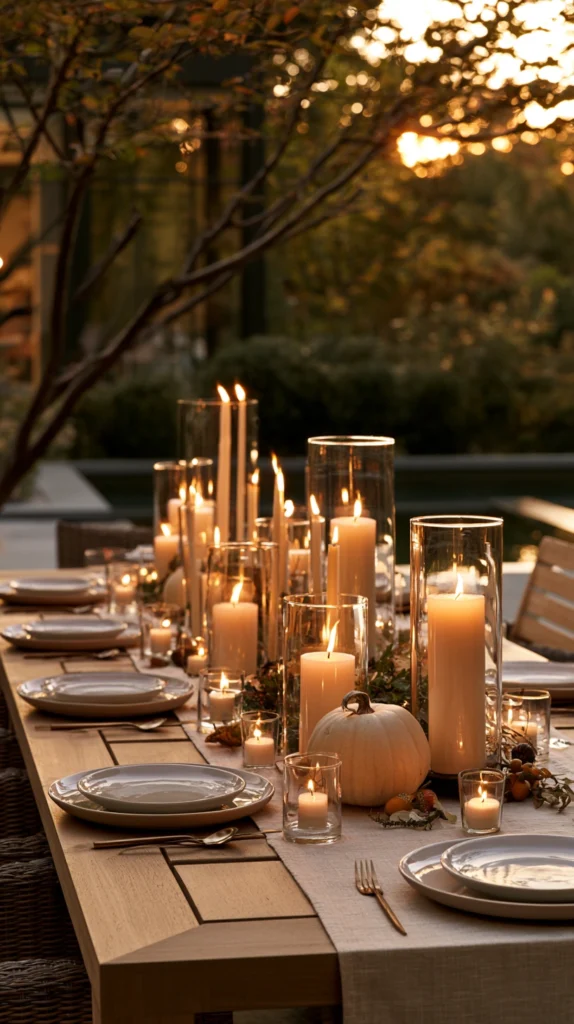
A grouping of candles in varying heights — pillars, tapers, and votives — clustered down the center of the table and mixed with low foliage or seasonal objects, doing the double work of decoration and lighting simultaneously.
Why candles belong at the center of a fall outdoor table specifically
- The functional light they provide during the meal’s later hours: unlike a summer dinner that ends in daylight, a fall dinner often finishes in full dark, and candles positioned at the table’s center give the meal its own dedicated, intimate light source rather than relying on ambient yard lighting
- The warmth they communicate visually before the air temperature requires any acknowledgment: a table already lit with candles at dusk looks inviting in a way a dark table can’t match, encouraging people to stay seated through a dropping temperature they might otherwise use as an excuse to go inside
- The height variation a cluster naturally creates: varying candle heights do for a fall table what a layered flower arrangement does for a summer one, giving the eye multiple vertical points to move between rather than a flat, single-level display
The options
- A mix of pillar candles, taper candles in short holders, and scattered votive glasses, layered at varied heights down the table’s length
- Candles grouped with small pumpkins, gourds, and foliage tucked between them, so the light sources and the seasonal decor are part of a single integrated cluster rather than two separate elements
- Hurricane glass holders around each candle, managing wind that can extinguish exposed flames at an outdoor table
- Flameless LED candles mixed with a few real ones, for a more wind-resistant overall cluster with the same visual warmth
The practical execution
- Use hurricane glasses or lantern-style holders for any real candles, since an outdoor flame unprotected from wind makes the centerpiece a constant distraction rather than a settled atmospheric element
- Test the cluster’s total height against seated sightlines before the guests arrive, since a centerpiece too tall to see across defeats its own social purpose
- Light candles shortly before guests are seated, both for full effect and for safety
Cost breakdown
- A full candle cluster with varied heights: $30–70
- Hurricane holders for the cluster: $20–50
- Total: $50–120
The candlelit cluster glowing through the first hour of darkness: the centerpiece that does more for the table’s evening atmosphere than any other single element on this list.
2. The Linen or Textured Tablecloth Layer (The Base That Sets Everything Else’s Tone)
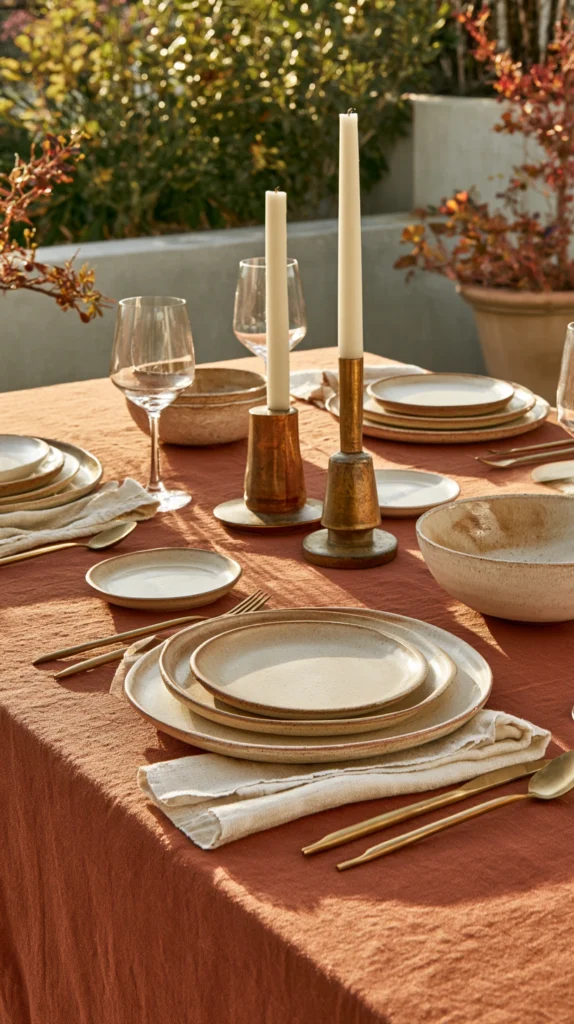
A tablecloth in a fall-appropriate material and tone — linen, burlap, or a thick cotton in deep rust, olive, or cream — the base layer whose color and texture sets the tone for every object placed on top of it.
Why the tablecloth choice matters more at a fall table than in summer
- The color-anchoring function it serves: a fall tablescape’s palette — deep rust, muted olive, aged cream — depends on the tablecloth establishing that palette clearly before any other element is added, since nothing else has as much coverage
- The texture it introduces against outdoor materials: linen or burlap against a wood table, stone patio, or grass-edge garden reads as far more intentional than a plain white poly cloth, matching the season’s general preference for natural, imperfect materials
- The warmth it signals before anyone touches the food: a table dressed in a warm-toned, slightly textural cloth communicates the same season-appropriate comfort as a blanket draped over a chair at the lounge area
The options
- Natural linen in an undyed or warm cream tone, the most versatile and season-agnostic base
- A rust or terracotta cloth, leaning directly into fall’s most recognizable palette
- A burlap runner over a bare wood table, for a more rustic, harvest-market look
- A plaid or checkered cloth in fall tones, for pattern rather than a solid base color
The practical execution
- Weight tablecloth corners with clips or small stones in any outdoor setting with even a light breeze, since a cloth that lifts repeatedly through the meal becomes a distraction
- Choose a cloth long enough to drape 8–10 inches over the table’s edges, since a cloth sized only to the exact tabletop reads as significantly less finished than one with a proper hang
- Iron or steam wrinkles out before setting the table, since outdoor tablescaping often involves carrying items outside in a hurry that would benefit from more careful preparation
Cost breakdown
- Linen tablecloth: $30–70
- Burlap runner: $10–25
- Total: $10–70
3. The Natural Foliage Runner (A Centerpiece Made From the Garden Itself)
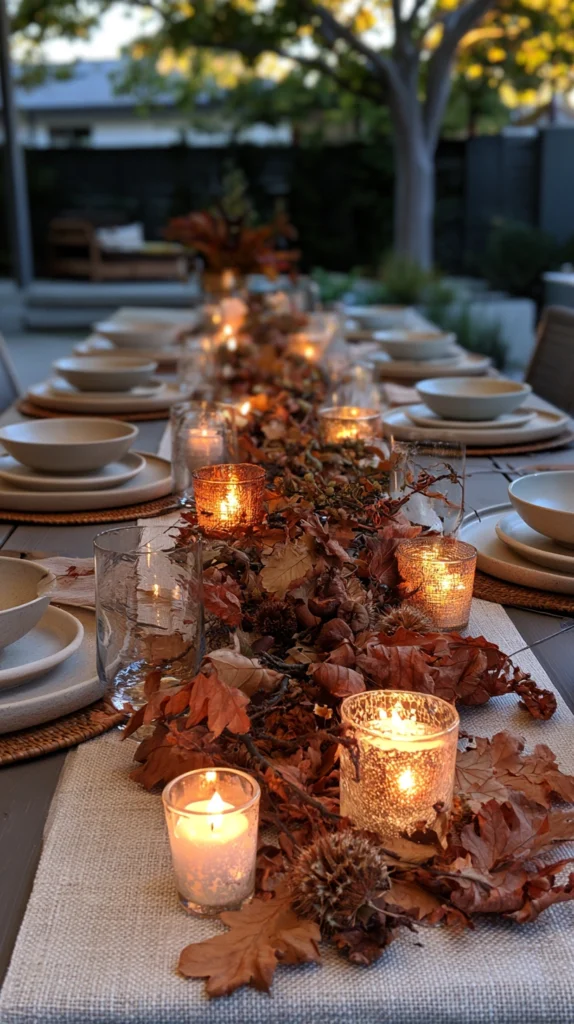
A loose arrangement of branches, leaves, vines, or dried grasses, laid directly down the center of the table as a continuous runner rather than contained in a vase — a centerpiece that looks foraged and found rather than purchased and arranged.
Why a foliage runner reads differently from a floral arrangement
- The scattered, abundant quality it creates across the full table length: unlike a single arrangement contained in one vase, a continuous foliage runner covers the table’s entire center, making the whole composition feel more like a harvest laid out than a decoration placed upon a surface
- The cost efficiency of using what’s actually in the garden: a foliage runner can be assembled from clipped branches, gathered leaves, and a few stems of whatever is growing or drying in the yard, making it one of the least expensive ideas on this list per visual impact
- The textural variety fall foliage naturally provides: turning leaves in multiple colors, dried seed pods, and bare branches together create more variation than most purchased floral arrangements can achieve in season
The options
- Clipped branches with autumn leaves still attached, laid loosely down the center
- A mix of dried grasses, seed pods, and small gourds, scattered along the runner’s length
- Eucalyptus or olive branches combined with seasonal berries, for a more composed, florist-adjacent version of the same concept
- Real foliage supplemented with a few small candles nestled within it, combining this idea directly with Idea #1
The practical execution
- Lay the foliage runner first before adding any other table element, since it’s the widest, most space-occupying layer and everything else gets placed in relation to it
- Mist real foliage with water before the event and again between courses, since cut branches lose moisture quickly and begin to look wilted before a long outdoor dinner is over
- Clip everything the morning of the event rather than the day before, for the freshest possible appearance through the evening
Cost breakdown
- Foliage from the garden: $0
- Supplemental branches or eucalyptus: $10–25
- Total: $0–25 — the lowest-cost centerpiece on this entire list
4. The Heirloom Pumpkin and Gourd Centerpiece (Volume and Variety in the Season’s Most Recognizable Material)
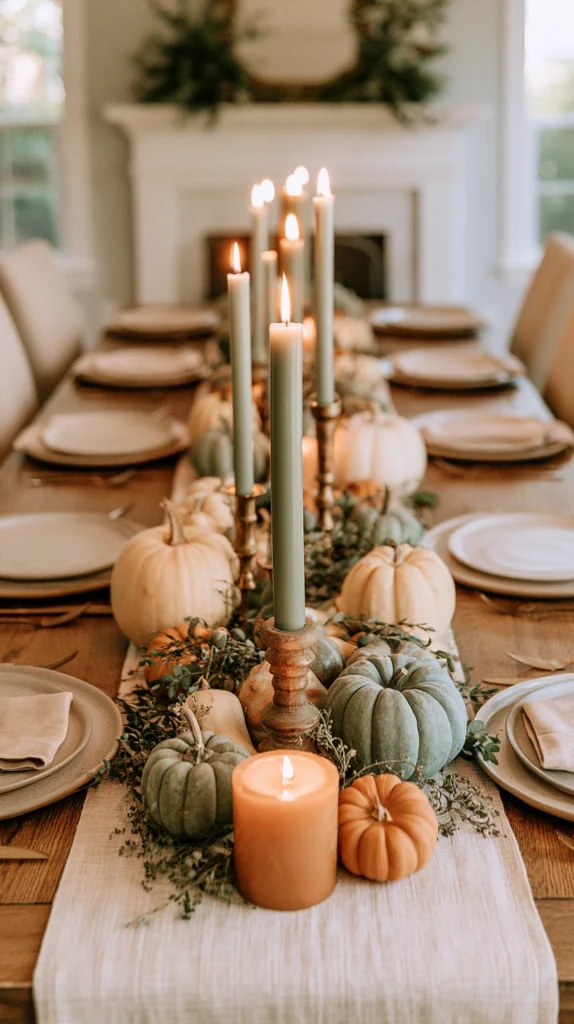
A grouping of varied heirloom pumpkins and gourds arranged along the center of the table — not carved, not hollowed, simply displayed as objects for their own color, shape, and texture.
Why unharvested pumpkins make stronger tabletop objects than most decorating objects
- The seasonal authenticity no purchased object fully replicates: a pumpkin on a dinner table in October reads as being specifically and correctly of this moment in a way a generic autumn-colored bowl doesn’t
- The shape and color variety heirloom varieties offer beyond standard orange: Cinderella pumpkins in deep red-orange, Jarrahdale in dusty blue-gray, and Fairytale varieties in tan and cream together create a naturally varied palette that most purchased floral arrangements would struggle to match
- The long display life that outlasts a cut flower arrangement: unlike fresh flowers, unharvested pumpkins and gourds hold their appearance throughout the event and well beyond it, with no wilting or maintenance required
The options
- A cluster of heirloom varieties in mixed sizes and colors, grouped near the table’s center or spaced at intervals along a long table
- Mini pumpkins tucked into the foliage runner from Idea #3, integrating both ideas into a single continuous centerpiece
- A single large Cinderella or Fairytale pumpkin as an anchor, surrounded by smaller gourds and candles
- Pumpkins mixed with fall produce — small bunches of grapes, figs, pears — for a more overtly harvest-table reference
The practical execution
- Choose pumpkins with flat, stable bases rather than ones that rock when set on the table
- Vary the height of the grouping by setting some pumpkins on a small board or book raised beneath the tablecloth, creating subtle height variation without a formal stand
- Leave heirloom pumpkins uncleaned of their natural field dust for a more authentic, foraged quality rather than washing them to a uniform shine
Cost breakdown
- Heirloom pumpkins and gourds, a table grouping: $30–80
- Total: $30–80
5. The Mixed Metal and Earthenware Place Setting (Materials That Match the Season’s Palette)
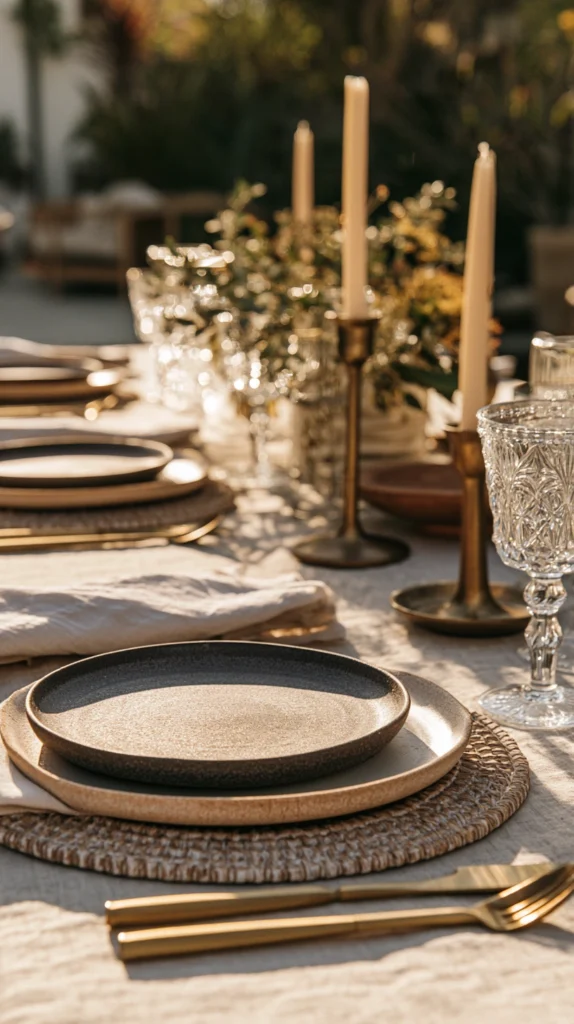
A place setting combining earthenware plates in a muted fall tone with warm metal flatware and a linen napkin — the surface-area styling choice that covers more visible real estate than almost any other single decision on the whole table.
Why the place setting’s material choices matter as much as the centerpiece
- The per-seat repetition that amplifies the effect: unlike a single centerpiece seen once at a table’s center, a place setting’s material and color choices repeat at every seat, multiplying their effect across the whole table’s visual area
- The contrast opportunity fall’s palette specifically offers: warm metal flatware in brass or antique gold against earthenware in rust, cream, or deep green creates material contrast the summer’s bright whites and silvers don’t suggest as naturally
- The texture layer available at the place setting level: a linen napkin, an earthenware plate, and a tarnished-looking metal charger together contribute a tactile richness to the immediate dining experience that a standard white plate and polished fork simply don’t
The options
- Earthenware plates in rust, cream, or deep olive, with a visible hand-finished quality
- Brass or antique gold flatware, for warmth against the earthenware’s matte surfaces
- A simple linen napkin, left loosely folded rather than elaborately shaped, folded around a small sprig of foliage or a cinnamon stick
- A charger plate beneath each setting, in a dark metal or natural wood slice, adding an additional layer beneath the main plate
The practical execution
- Stack the full place setting layered on top of each other — charger, plate, napkin — before guests arrive, so the table reads as finished rather than assembled mid-event
- Choose earthenware sizes genuinely appropriate to the menu being served, since an oversized charger arrangement looked at but rarely used can overwhelm a smaller, more casual fall dinner’s actual function
- Protect paper menus or place cards under a small stone or gourd when using them at an outdoor table, since they’re particularly vulnerable to the breeze that picks up as evening temperatures drop
Cost breakdown
- Earthenware plates, set of 4–6: $40–120
- Brass or antique-look flatware, set of 4–6: $30–80
- Linen napkins, a set: $20–40
- Total: $90–240
6. The Wooden Charger or Slice Base (A Natural Material Under Every Setting)
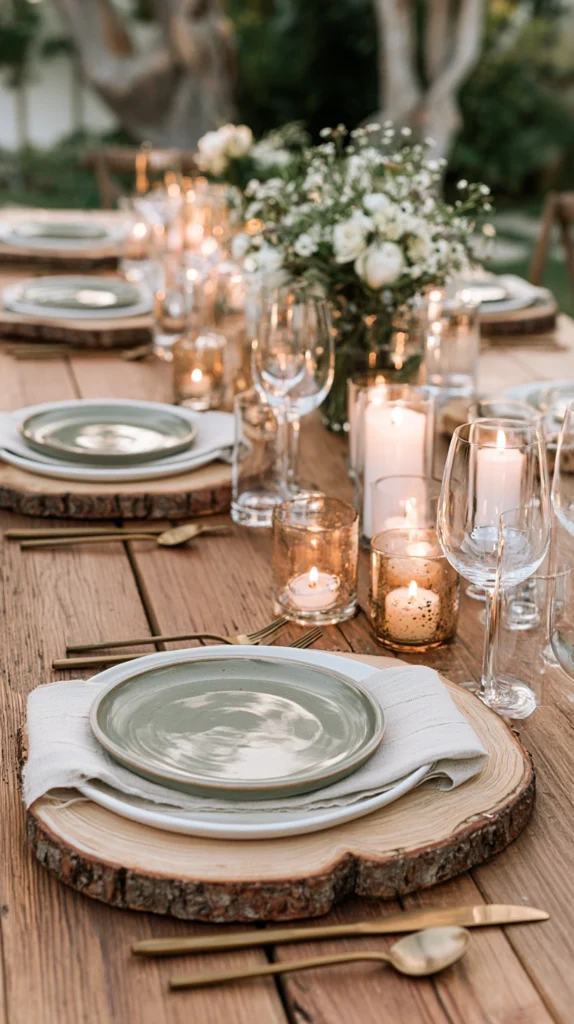
A slice of wood, a small wooden board, or a natural wood charger beneath each place setting — the individual element that brings one of fall’s most resonant materials directly into every guest’s immediate space at the table.
Why wood under a plate changes the whole table’s material character
- The warmth a natural material introduces at close range: unlike a purchased charger in polished metal or lacquered ceramic, a wood slice or board carries the specific warmth and variation of a natural material, visible in its grain and edge at the scale a seated dinner guest actually sees it
- The texture contrast it creates against the tablecloth and earthenware on top: wood grain beneath a matte earthenware plate against a linen cloth creates layered texture at the most intimate, close-up level of the tablescape, the level a guest actually experiences during the meal
- The flexible source and low cost relative to traditional chargers: wood slices sourced from a tree service or bought inexpensively can serve as natural chargers, making this one of the more budget-friendly ideas per place setting
The options
- Raw wood slices, with bark intact, for the most naturalistic, foraged version
- Sanded and oiled wood rounds, for a cleaner, more polished version of the same material
- Small wood boards or cheese boards, repurposed as chargers for a more everyday and practical version
- Stained or painted wood rounds, in a dark walnut or ebony finish, for a slightly more formal take
The practical execution
- Sand any rough edges on raw wood slices that might catch on a tablecloth or scratch a guest’s hand during normal table use
- Apply a food-safe oil or finish to any wood that will be in direct contact with food, napkins, or glasses
- Size each round or board to extend at least an inch beyond the dinner plate’s rim, for the same proportion that guides a standard charger choice
Cost breakdown
- Wood slices or rounds, each: $3–10
- A full set of 6–8: $20–60
- Total: $20–60
7. The Lantern Trail Down the Table’s Center (Low Light at Multiple Points)
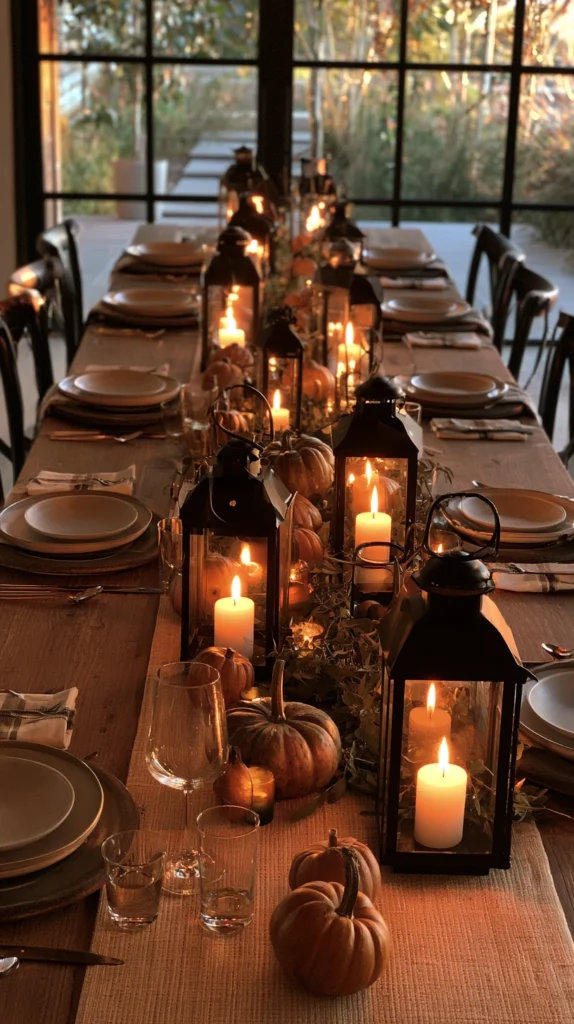
A series of small lanterns, spaced at intervals down the center of the table, creating a dotted trail of warm, low light the full length of the dining surface — the lighting idea that supplements the candle cluster from Idea #1 rather than replacing it.
Why multiple small light sources work better than a single concentrated one
- The distributed warmth a trail provides versus the concentrated warmth of a cluster: a single candle grouping creates warmth and light in one spot on the table, while a lantern trail brings warm light to every seated position rather than only those nearest the centerpiece
- The visual rhythm it creates down the table’s full length: repeated lanterns at intervals establish the same kind of visual rhythm that repeated place settings do, giving the whole table a sense of intentional pacing rather than a single gesture in the middle
- The wind-resistance lanterns specifically provide over exposed candles: outdoor dining’s most persistent challenge for candlelight is wind, and a lantern’s enclosed flame handles that challenge far more reliably than an unprotected taper or pillar candle
The options
- Battery-powered lanterns with a flame-like LED, the most reliable for a full outdoor dinner
- Small glass lanterns with enclosed candles, for real flame in a protected housing
- Varied lantern sizes, mixing slightly taller and shorter pieces for height variation even at the trail’s ground level
- Lanterns integrated with the foliage runner from Idea #3, nestled among branches and gourds rather than standing alone on a bare tablecloth
The practical execution
- Test battery-powered lanterns ahead of time to confirm battery life exceeds the expected dinner duration, since discovering a dead lantern mid-meal undermines the effect
- Space lanterns far enough apart that they create rhythm rather than a continuous wall of light that blocks sightlines across the table
- Position the trail slightly off-center if it’s competing for space with the foliage runner, since a lantern trail and a foliage runner together on a narrow table can leave little room for actual dishes
Cost breakdown
- Small lanterns, a set of 4–6 for a full table trail: $40–100
- Total: $40–100
8. The Seasonal Napkin Detail (A Small, Personal Touch at Each Setting)
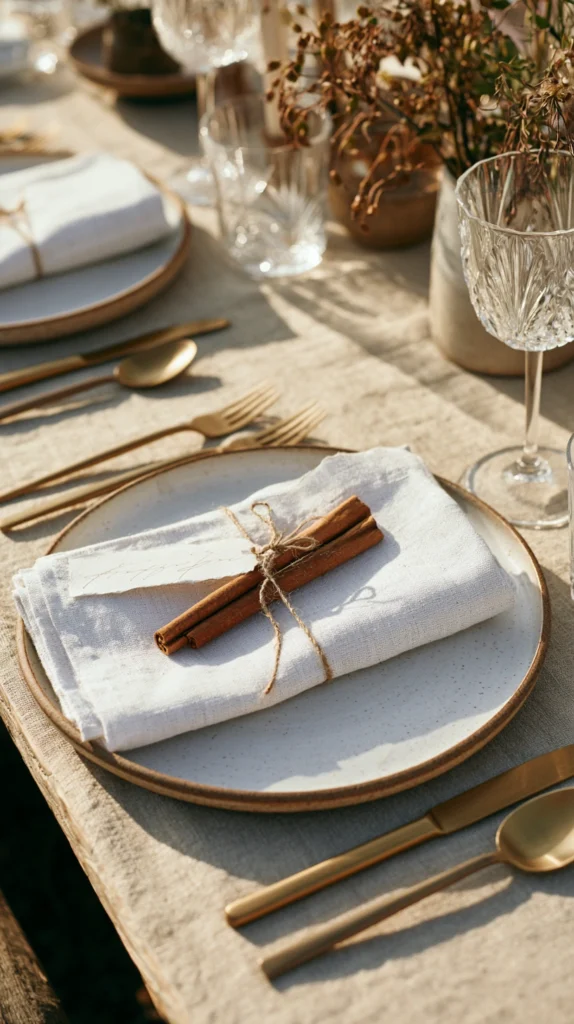
A sprig of rosemary, a cinnamon stick, a small sprig of berries, or a personalized name card tucked into each napkin fold — the individual detail that marks each seat as having been considered separately rather than as an undifferentiated position at the table.
Why a napkin detail carries more weight than its size suggests
- The personal acknowledgment it makes at each seat: a small, considered addition to the napkin signals that each guest was thought about individually, a distinction the rest of the table’s more generalized styling can’t make on its own
- The scent dimension some choices add to the table’s overall sensory experience: a rosemary sprig or a cinnamon stick adds fragrance at close range, engaging a sense the rest of the tablescape can’t reach without moving closer
- The photography focal point it creates: for anyone documenting the table before dinner begins, an individual place setting with a small napkin detail gives the composition a specific foreground subject rather than a purely aerial overview
The options
- A small sprig of fresh rosemary, bound tightly and tucked into or laid across a folded linen napkin
- A cinnamon stick, laid across the napkin or tied to it with simple twine
- A single small leaf, pressed and placed flat against the napkin’s fold
- A handwritten place card or name card, tucked into the napkin fold as the personalization element itself
The practical execution
- Add the napkin detail last, after the rest of the place setting is already assembled, since small sprigs and name cards are the most likely elements to shift or fall during the earlier, more active table-setting process
- Secure any name card against wind with a small stone or gourd nearby, given how consistently breezy outdoor settings are as temperatures drop in the evening
- Choose fragrant options — rosemary, cinnamon — specifically for outdoor tables, since fragrance diffuses faster outdoors than indoors and a subtle touch helps the scent register at close proximity
Cost breakdown
- Rosemary or fresh sprig, per guest: $0–1 (typically available from a kitchen garden)
- Cinnamon sticks, a pack: $4–8
- Total: $0–15 for a full table
9. The Elevated Centerpiece Stand or Cake Stand Riser (Height Where the Table Needs It)
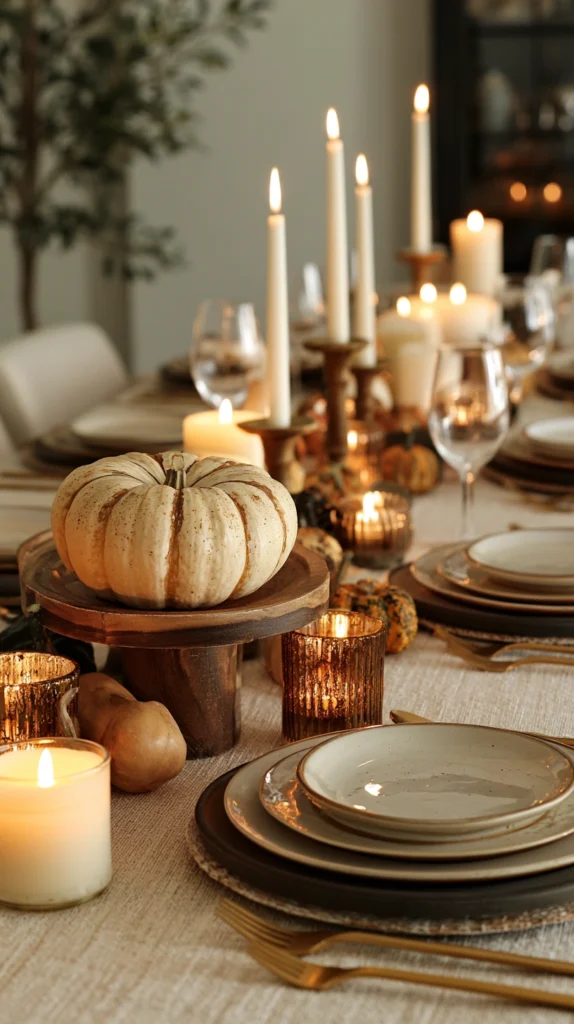
A cake stand, wooden crate, or small decorative riser used to elevate one element of the centerpiece — a single large pumpkin, a candle cluster, or a low floral arrangement — giving the table a genuine architectural high point.
Why height variation matters at a table as much as it does anywhere else
- The visual hierarchy a single tall element creates among shorter ones: a table where every element sits at the same height reads as flat, regardless of how well-chosen each individual piece is, while a single elevated element gives the composition a clear center of gravity
- The architectural quality a riser adds to what might otherwise look like objects simply set on a table: placing a pumpkin on a cake stand or a candle cluster on a small wooden crate transforms those items from things laid out into things displayed, a distinction that registers quickly from across the table
- The flexible, reusable nature of the riser itself: a cake stand or wooden crate used to elevate a fall centerpiece is the same object that could serve the same function at a different table for a different season, making this a low-cost investment relative to its ongoing utility
The options
- A cake stand beneath a single large heirloom pumpkin, elevating the season’s most recognizable object to a genuine centerpiece height
- A small wooden crate or box, used to raise a candle cluster above the foliage runner surrounding it
- A stack of books wrapped in plain paper, giving height under a floral arrangement at no additional cost
- A pedestal or column rental, for a more formal outdoor dinner where the centerpiece scale warrants a more substantial riser
The practical execution
- Confirm any riser is stable on an outdoor surface, particularly on uneven garden ground or decking boards that aren’t perfectly flat
- Size the raised element to be visually significant at the riser’s height, since a small object elevated on a tall stand reads as precarious rather than dramatic
- Position the riser slightly off the table’s exact center rather than dead center, which can read as too studied, letting the rest of the runner or cluster arrangement balance it visually
Cost breakdown
- Cake stand, reused from the kitchen: $0
- Cake stand purchased for this purpose: $15–35
- Small decorative wooden crate: $10–25
- Total: $0–35
10. The Harvest Produce Integration (Food as Decoration Before It Becomes Dinner)
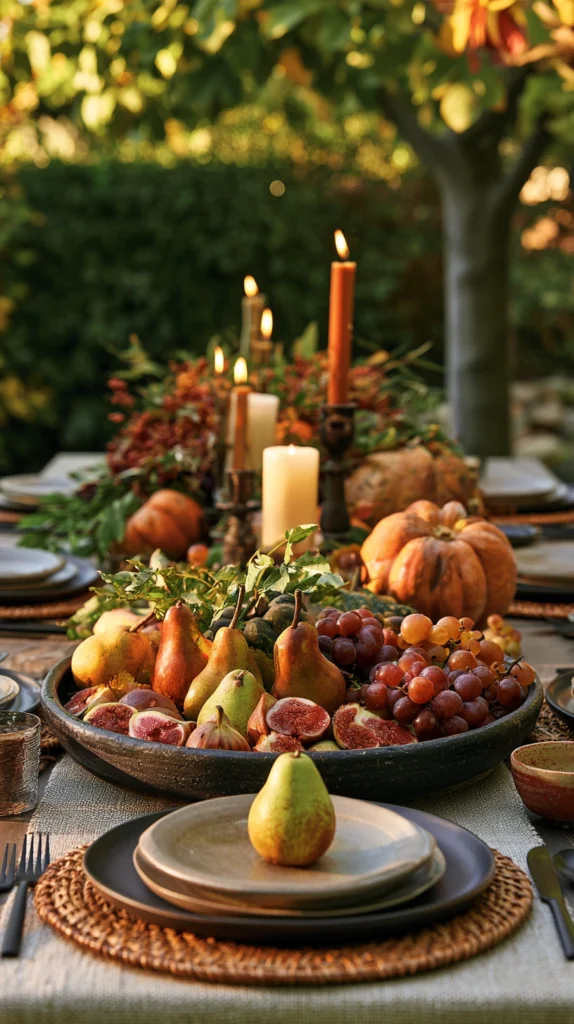
Seasonal produce — bunches of grapes, figs, pears, small squash — arranged among the table’s decorative elements as both visual texture and a preview of the meal, blurring the line between decoration and food.
Why produce earns a place in a fall outdoor tablescape specifically
- The harvest-table reference it makes directly: using actual food as part of the table’s display draws on one of fall’s oldest and most recognizable imagery, connecting a backyard dinner to the season’s deeper agricultural themes
- The texture and color variety fall produce offers alongside pumpkins and foliage: a cluster of dark purple grapes, a pile of small golden pears, or a few split figs introduce color notes and organic shapes none of the season’s purely decorative objects quite replicate
- The conversation it generates among guests: produce displayed on a table before dinner raises natural questions about the meal and creates an immediate, seasonal focal point that purely decorative objects don’t as reliably provoke
The options
- Clusters of wine grapes, laid among the foliage runner from Idea #3
- Small pears or figs, grouped near the candle cluster from Idea #1
- Mini squash or delicata squash, scattered like gourds among the pumpkins from Idea #4
- A full harvest basket, positioned at the table’s end as a single abundant display from which produce trails outward
The practical execution
- Choose produce that holds its appearance for the event’s full duration without cutting or handling, since sliced or bruised fruit deteriorates quickly and undercuts the display’s otherwise fresh quality
- Add produce last, after the structural centerpiece elements are in place, tucking it into gaps in the arrangement rather than placing it as a foundation layer
- Indicate to guests which produce is part of the display and which is food for the table, since an ambiguous arrangement at a harvest table can create uncertainty guests shouldn’t have to navigate
Cost breakdown
- Seasonal produce for display: $15–35
- Total: $15–35
11. The Overhead Draped Greenery or Garland (Decorating the Space Above the Table)
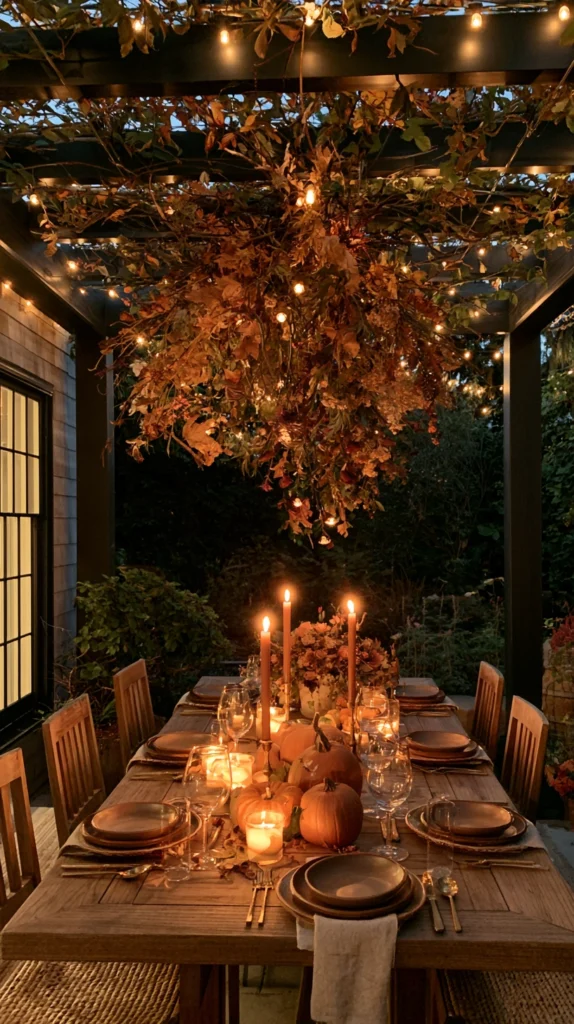
A garland of greenery, foliage, or dried flowers, draped or hung over the table from a pergola, branches, or a simple suspended frame — the addition that extends the tablescape’s design from the table surface into the space above it.
Why overhead decoration changes the entire gathered experience at a fall dinner
- The sense of enclosure it creates above the table: like a canopy over a porch seating area, an overhead garland defines the table’s vertical space, making the gathering feel contained and intimate rather than open and exposed under an evening sky
- The photographic backdrop it provides looking up or looking toward the table from a distance: most tables are styled only for a horizontal view across the setting, while a garland above adds a layered perspective visible in photos taken from the table’s side or from across the garden
- The seasonal material it brings at a scale unavailable on the table surface itself: a full garland of eucalyptus, fall foliage, and small gourds brings the season’s botanical abundance overhead in a way that even the most generous foliage runner at table level can’t replicate
The options
- A eucalyptus and olive branch garland, the most widely available and versatile overhead greenery
- A mixed fall foliage garland, incorporating turning leaves, dried berries, and small stems
- A dried flower garland, for a more textural, longer-lasting option than fresh cut greenery
- A fruit and foliage garland, combining small apples, figs, or citrus with greenery for a more overtly harvest-themed overhead installation
The practical execution
- Confirm the overhead structure can support the garland’s actual weight, particularly for a fresh greenery garland that is considerably heavier than a purely decorative fabric one
- Secure the garland at multiple points along its length rather than at its ends only, since an unsupported center sag undercuts the composed look of a deliberate installation
- Account for the garland’s height above seated heads, leaving enough clearance for guests to sit and move without brushing against it
Cost breakdown
- Eucalyptus garland, a generous length: $25–60
- Mixed foliage garland: $20–50
- Total: $20–60
12. The Seasonal Drink Station as a Table Extension (A Side Setup That Reads as Part of the Tablescape)
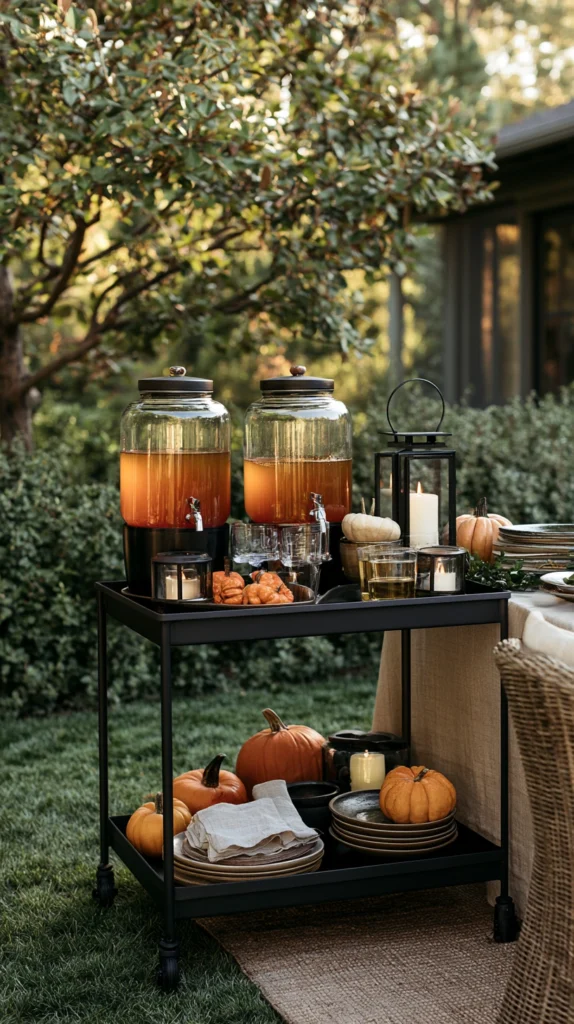
A styled drink station — a small bar cart, a wood-crate display, or a simple side table — positioned close enough to the main table that it reads as part of the overall dinner setup rather than a completely separate service area.
Why the drink station belongs in the tablescape’s design, not outside it
- The visual continuity it provides when styled with the same palette: a drink station using the same earthenware pitchers, the same linen napkins, and the same candle warmth as the main table reads as one unified setup rather than two separate decisions
- The fall-specific flavor opportunity it offers adjacent to the dinner: a station with mulled cider, warm spiced wine, or a fall cocktail mix adds a sensory dimension to the gathering specifically suited to the season, communicating fall as clearly through taste as the centerpiece does through sight
- The guest-flow function it serves without fragmenting the dinner: a nearby drink station lets guests replenish during dinner without leaving the table entirely, keeping the gathering more cohesive than if drinks were set up at a significant distance
The options
- A small wood crate setup, holding pitchers of cider and stacked glasses, close behind or beside the main table
- A bar cart styled with fall-toned linens and a small lantern, for a more complete, self-contained drink station aesthetic
- A large insulated carafe on a small side table, kept alongside the dinner table for easy access without requiring a dedicated cart
- A galvanized tub filled with ice and bottles, leaned against the main table structure for the most informal, harvest-party version of this idea
The practical execution
- Match at least one material from the drink station to the main table — the same linen, the same earthenware vessel style — to tie the two visually together
- Keep the drink station low-profile enough not to compete with the main table’s centerpiece as the visual anchor of the outdoor setup
- Restock before guests arrive fully, since an obviously depleted drink station at the start of dinner undermines the abundance the rest of the tablescape is communicating
Cost breakdown
- Insulated carafe and pitcher setup: $30–70
- Cider and seasonal drink supplies: $30–60
- Total: $60–130
13. The Name and Place Card System (Seating That Was Thought About in Advance)
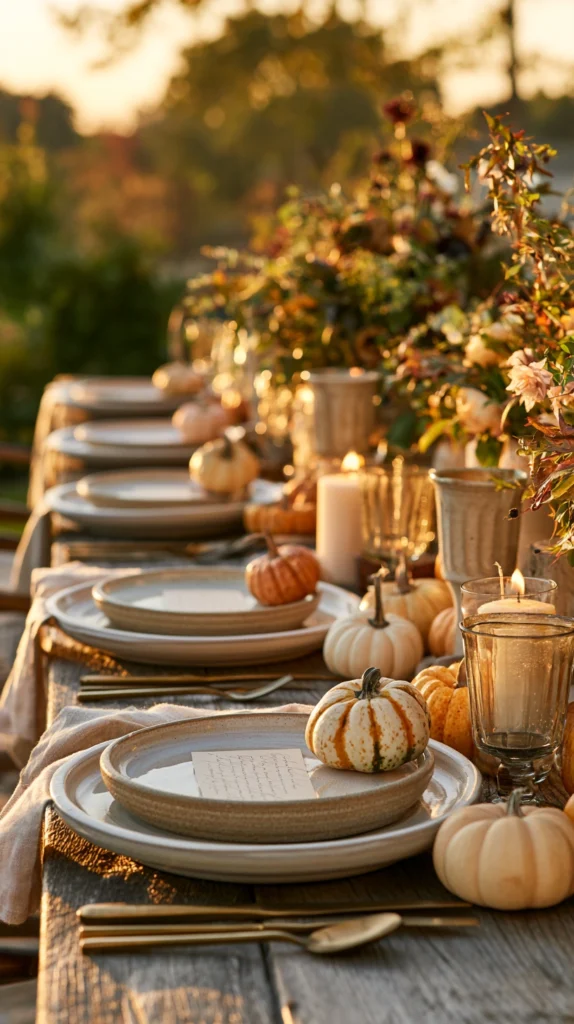
Handwritten or printed name cards, positioned at each seat with enough visual weight to hold their own against the rest of the table’s layered styling — the small individual detail that signals the gathering was planned all the way down to who sits where.
Why a place card system earns a spot on this list alongside much larger ideas
- The intentionality it communicates about the gathering’s overall level of care: a name card visible at each seat tells guests the seating arrangement was considered before they arrived, a specific, concrete form of hospitality distinct from simply leaving them to sort themselves out
- The practical function it serves at a longer table where guests might not know their way around the group: placing guests thoughtfully can ease conversation, manage social dynamics, and make a large dinner feel warmer than a free-for-all seating arrangement sometimes does
- The small styling anchor it provides at each seat: a beautiful name card lying against a napkin on an earthenware plate is a small but complete vignette at every single seat, multiplying the table’s polished appearance by the number of settings
The options
- Handwritten cards on plain cardstock, for a simple, personal touch
- Cards incorporating a natural element — a leaf, a small sprig, a pressed flower — attached to or wrapped around the name card itself
- A small gourd or mini pumpkin with the guest’s name written directly on it, combining the place card with an element from Idea #4
- A folded card tent, standing upright at each place setting rather than lying flat
The practical execution
- Use a medium-weight cardstock for outdoor name cards, since lighter paper wilts or blows away far more easily than a sturdier alternative
- Weight any flat name card under a small gourd or stone rather than propping it against a glass, which can fall easily as dishes are passed around the table
- Write names in a clear, legible script sized to be read from a standing position, since guests typically look for their seat while still standing before the meal begins
Cost breakdown
- Cardstock and materials: $10–20
- Total: $10–20
14. The Post-Dinner Fire Feature Transition (Moving the Gathering Off the Table and Toward the Warmth)
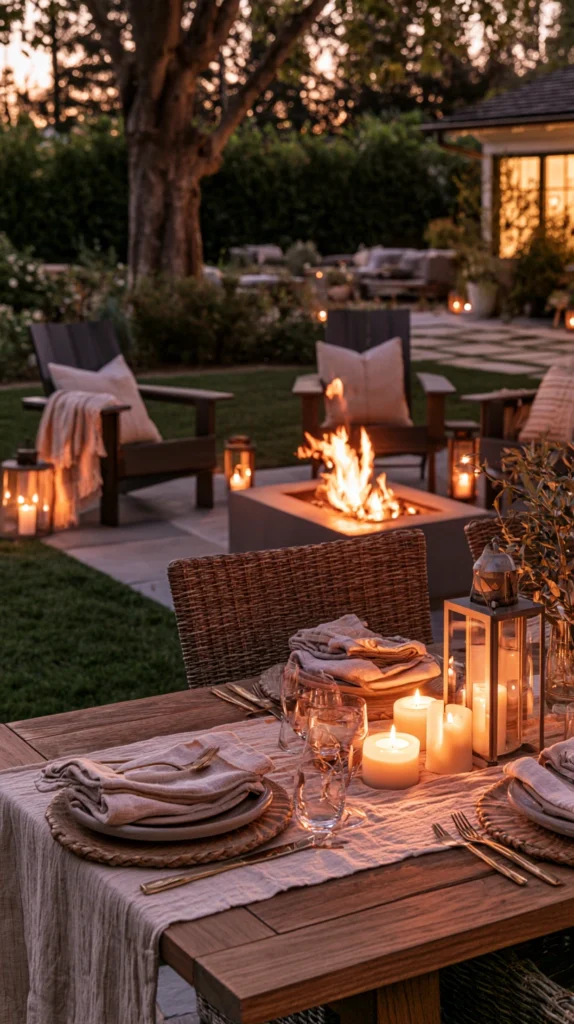
A fire pit, fire bowl, or small chiminea positioned to receive the gathering once dinner ends — the planned transition that gives the party somewhere to go rather than ending the moment the plates are cleared.
Why planning the post-dinner transition as part of the tablescape matters
- The full-evening-arc it completes: a dinner that ends at a table with no plan for what happens next often breaks up the moment the meal concludes, while one that has an obvious and inviting next destination tends to extend the gathering naturally
- The warmth function that becomes increasingly necessary as the evening progresses: fall evenings cool significantly as hours pass, and a fire feature positioned and ready draws the group toward genuine warmth exactly when the table’s candles and styling alone are no longer enough to keep people comfortably outside
- The visual relationship between the dining table and the fire feature, when both are styled cohesively: a dinner table with warm, fall-toned lighting and a fire bowl positioned nearby reads as a single, planned outdoor environment rather than two separate setups that happen to share a garden
The options
- A portable fire pit, positioned 10–15 feet from the dinner table, with a small ring of chairs already in place
- A fire table, which can double as a serving surface during dinner and a fire feature afterward without requiring the group to move significantly
- A chiminea, for a smaller, more contained fire that suits a more intimate dinner group
- A few floor lanterns or candle stakes, for a more low-key fire-adjacent transition in a setting where an open flame isn’t appropriate
The practical execution
- Set up the fire feature and its surrounding seating before guests arrive, so the transition feels natural and ready rather than improvised at the end of the meal
- Bring the blanket station from Idea #8 in the garden party article into proximity with the fire feature seating, so warmth is available the moment the group moves
- Have the fire or lanterns lit and ready as guests begin to finish their meals, so the transition can happen without delay that lets the momentum of the gathering drop
Cost breakdown
- Portable fire pit: $80–250
- Fire bowl or chiminea: $60–150
- Total: $60–250
The fire lit beside the cleared table as the last course finishes: the last detail of the evening’s planning, doing its most important work in the hour when everything else has already done its part.
The Fall Outdoor Tablescape Roadmap
The work, sequenced:
Phase One (the base layer, settled first):
- The linen or textured tablecloth (#2)
- The mixed metal and earthenware place setting (#5)
- The wooden charger or slice base (#6)
Phase Two (the centerpiece and height layer):
- The natural foliage runner (#3)
- The heirloom pumpkin and gourd centerpiece (#4)
- The elevated centerpiece stand or riser (#9)
- The harvest produce integration (#10)
Phase Three (the light and warmth layer):
- The candlelit centerpiece cluster (#1)
- The lantern trail down the table’s center (#7)
- The overhead draped greenery or garland (#11)
Phase Four (the finishing and transition elements):
- The seasonal napkin detail (#8)
- The name and place card system (#13)
- The seasonal drink station as table extension (#12)
- The post-dinner fire feature transition (#14)
Getting Started This Weekend
The immediate-impact tablescape assembly:
One afternoon, one table, three layers:
- Lay a linen tablecloth and arrange earthenware place settings (Ideas #2 and #5)
- Build a foliage runner with a few heirloom pumpkins tucked into it (Ideas #3 and #4)
- Light a cluster of candles in hurricane holders down the center (Idea #1)
Total cost: $100–200. Time: about an hour. The table will already read as a completed, atmospheric fall setting before a single guest arrives.
The structural investment (the next big project):
The post-dinner fire feature transition (Idea #14) is the single investment that extends the evening’s actual duration most directly. Once the dinner table and the fire feature are set up to work together as a sequence, the gathering has both a beginning and an invitation to continue rather than a natural endpoint the moment the meal is over.
What a well-built fall outdoor tablescape provides that a generic outdoor table can’t:
The atmosphere that keeps people at the table through falling temperatures:
- A candle and lantern layer providing light and warmth before anyone asks for them
- A cloth and place setting in materials that communicate the season’s comfort before a fork is lifted
- A centerpiece that reads just as warmly at 8pm in the dark as it did at 5pm in the last of the afternoon light
The seasonal specificity that makes the gathering feel like it belongs to this exact time of year:
- A foliage runner made from the garden’s own material rather than something purchased out of season
- Heirloom pumpkins and harvest produce that could only be on a table in October rather than at any time of year
- A fire feature waiting to receive the group as the night cools, doing the one thing the table itself can’t do anymore
The layered intention that turns a backyard dinner into a genuine occasion:
- Name cards at each seat signaling a gathering planned all the way down to who sits where
- A napkin detail that registers as a small personal touch in a moment of unhurried attention
- A drink station styled in the same palette as the table, so the evening reads as a single designed environment rather than several separate good decisions happening to share a garden
A fall outdoor tablescape was never supposed to be a summer table with different flowers. The table that earns its place on a cooling evening is the one that anticipated the darkness, planned for the chill, and set out enough warmth in its candles and materials that nobody standing around it needed to acknowledge out loud that the season had changed. The foliage runner laid out in the afternoon is still doing its job at nine o’clock at night. The fire lit as the plates were cleared was part of the plan from the beginning.