15 Hobbitcore Kitchen Decor Ideas for Cottage Lovers
Most kitchen renovations start from the same handful of references — a white shaker kitchen, a sleek modern galley, a farmhouse with clean lines and a single accent color. Open a few inspiration boards and the same restrained palette shows up again and again.
That approach skips over an aesthetic that has quietly become one of the most-searched kitchen styles around: a kitchen built from warm wood, curved openings, hanging herbs, and shelves that look gathered over decades rather than ordered from a catalog. Hobbitcore isn’t a trend that asks for restraint. It asks for abundance, texture, and a room that feels like it grew rather than was installed.
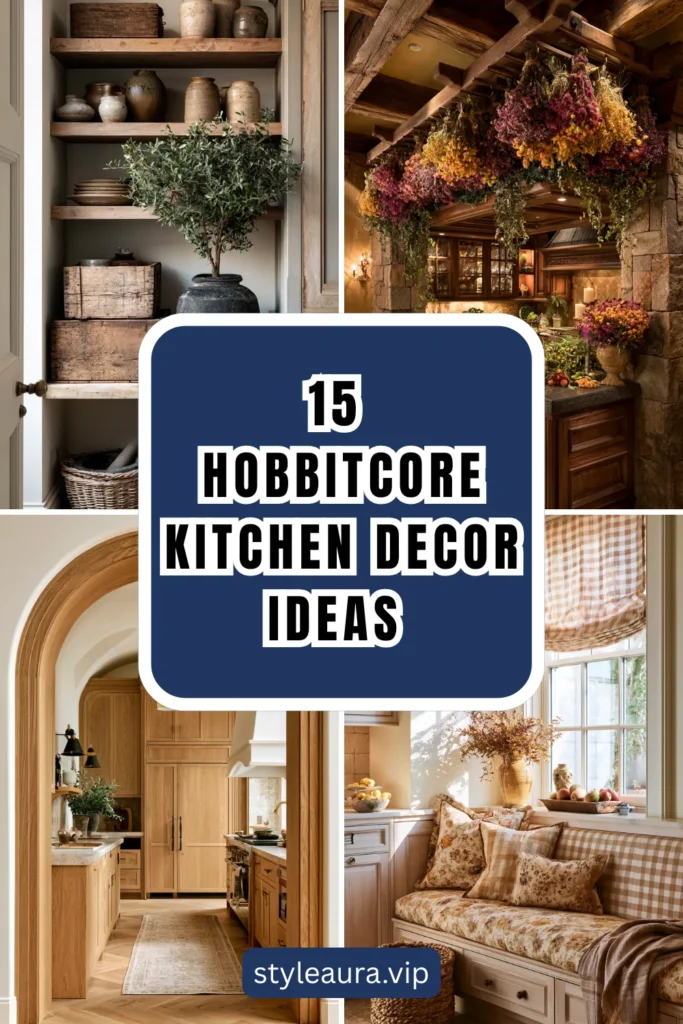
A hobbitcore kitchen is not simply a rustic kitchen with the lights turned down. It has its own materials, its own storage logic, and its own sense of what a finished room looks like — one where a slightly mismatched plate or a jar of dried beans on a shelf isn’t a flaw to be corrected but the whole point.
Here are 15 ideas for bringing that warmth, abundance, and cottage charm into a kitchen of any size.
Why Hobbitcore Plays by Different Rules Than Modern Farmhouse
The rules are not the same for every cottage-adjacent style:
Modern Farmhouse Advantages:
- Clean lines and a tightly controlled, mostly white or neutral palette
- Highly photographable, with very little visual clutter
- Easy to keep cohesive, since the color palette does most of the work
The farmhouse comparison: restraint as the organizing principle
Hobbitcore Advantages:
- Abundance and texture in every corner of the room
- Warmth that comes from materials — wood, copper, stone — rather than from a single paint color
- Forgiving of imperfection: patina, mismatch, and visible wear all read as intentional
The key insight:
- Modern farmhouse design rewards subtraction
- Hobbitcore rewards layering and accumulation
- These are different aesthetic philosophies, not the same kitchen in different colors
The Materials Reality
The most important material decision in a hobbitcore kitchen:
The wood tone:
- Warm-toned wood — oak, pine, reclaimed timber — rather than cool-toned or gray-washed wood
- Visible grain and some natural variation, rather than a perfectly uniform finish
- Know this: it governs almost every other material decision made in the room
The “natural over manufactured” calculation:
- Natural materials — wood, stone, copper, ceramic, linen — over laminate, plastic, and chrome wherever the budget allows
- A single manufactured surface in a room full of natural materials is enough to break the whole effect
- Where a manufactured material is unavoidable, choosing one with texture or a matte finish softens the contrast
Most hobbitcore kitchens build in layers, not all at once:
- Structural elements — beams, doorways, a stone accent — come first, since they’re hardest to change later
- Storage and furniture come next, since they set the room’s working logic
- The smallest finishing touches — dried herbs, candles, jars on a shelf — come last, and are the layer most easily added or swapped at any point
1. The Round-Top Doorway (The Aesthetic’s Signature Shape)
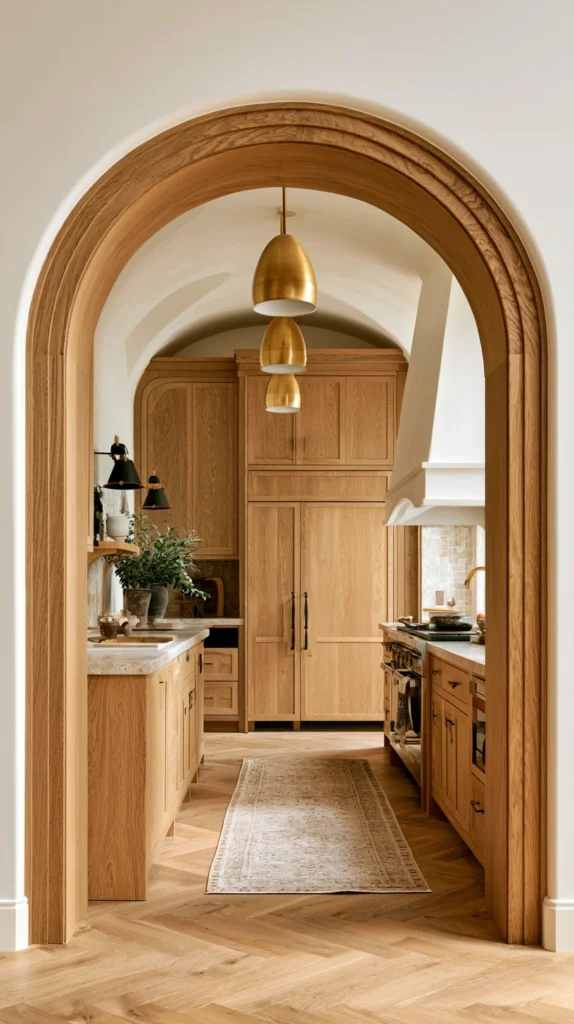
A curved or arched doorway leading into or out of the kitchen — the single architectural detail most responsible for announcing the style before anyone notices a single object in the room.
Why this shape matters more than any other single choice
- The shape-recognition effect: a curved opening reads as this style almost instantly, the way a sharp white edge reads as modern minimalist
- The softening function: curved openings remove the hard corners that make a kitchen feel clinical, replacing them with something that feels carved rather than built
- The whole-house signal: one curved doorway often sets the expectation for every room it leads into
The options
- Full arch doorway — a continuous curve from floor to the top of the opening, the most dramatic version
- Half-round top — a rounded top on an otherwise standard rectangular doorway, easier to retrofit
- Curved trim only — adding curved millwork around an existing rectangular opening without structural changes
- A rounded interior window or pass-through — a smaller-scale version of the same shape, useful between a kitchen and pantry
The practical execution
- A true arch requires structural framing changes, best handled during a larger renovation rather than as a standalone project
- Curved trim added to an existing doorway is the lowest-cost way to suggest the shape without touching the wall opening itself
- Paint or stain the curved trim a shade darker than the surrounding wall so the shape reads clearly from a distance
Cost breakdown
- Curved trim retrofit on an existing doorway: $150–400
- Custom-built arch doorway, materials and labor: $800–2,500
- Total: $150–2,500, depending on whether it’s decorative trim or a structural change
The curved doorway: the one detail that tells a guest what kind of kitchen they’re walking into before they’ve seen a single shelf.
2. The Exposed Wood Beams (Architecture You Live Under)
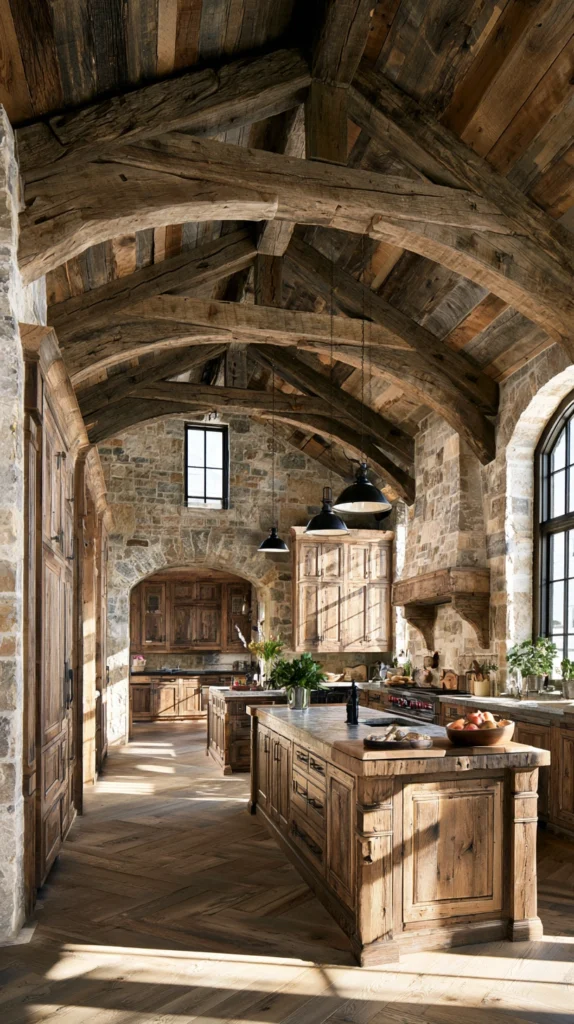
Structural or decorative beams left visible across the kitchen ceiling — the overhead detail that gives a room a sense of having been built rather than installed.
Why the ceiling deserves its own design decision
- The ceiling-as-feature effect: most kitchens treat the ceiling as blank space; this style treats it as one more surface worth designing
- The scale and warmth trade: lower, beamed ceilings read as cozy rather than cramped, the opposite of how a low ceiling reads in a modern kitchen
- The age-signaling detail: visible structure, real or faux, suggests a house that’s been lived in rather than recently built
The options
- Reclaimed structural beams — real wood, often salvaged, with visible age and grain
- Faux beams (lightweight polyurethane or hollow box beams) — the look of structure without the load-bearing requirement
- A beamed ceiling with exposed joists — revealing what’s already there rather than adding new material
- A single statement beam over an island or sink, rather than a full ceiling treatment
The practical execution
- Faux beams are the practical choice for most kitchens, since they install without an engineering review
- Stain beams a tone darker than the surrounding ceiling and walls so they read as structure, not as trim
- Run beams perpendicular to the room’s longest dimension to make a narrow kitchen feel wider
Cost breakdown
- Faux beam kit, per beam, materials only: $40–120
- A full ceiling of faux beams, installed: $800–2,500
- Reclaimed real wood beams, structural: $1,500–5,000+
- Total: $40–5,000+, depending on scope
3. The Deep Farmhouse Sink (The Kitchen’s Working Centerpiece)
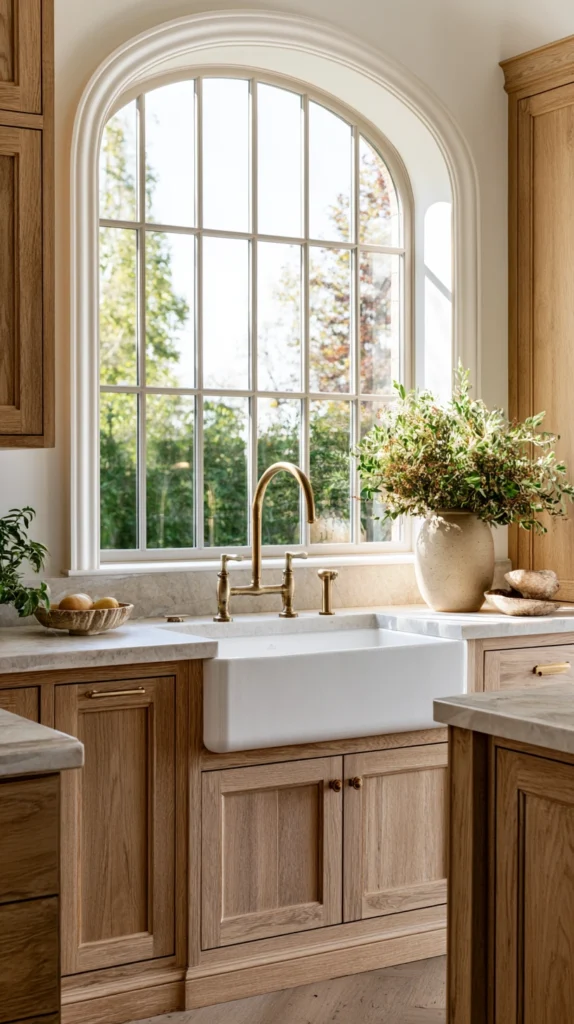
An oversized apron-front sink, usually in white or cream ceramic — the fixture that does more to anchor this style than any single decorative object.
Why the sink carries more visual weight than its function suggests
- The function-first heritage: a deep sink built for washing produce, soaking pots, and rinsing the occasional muddy vegetable matches the aesthetic’s emphasis on a kitchen that’s actually used hard
- The visual weight: a large, substantial sink reads as old and considered, the opposite of a shallow stainless undermount sink
- The material contrast: ceramic against wood cabinetry and stone counters is one of the defining material pairings of the whole style
The options
- Fireclay apron-front sink — the classic choice, durable and slightly textured rather than glossy
- Cast iron with an enamel finish — heavier, holds heat and cold differently than fireclay, available in more color options
- A double-basin version — one side for washing, one for rinsing or drying, closer to historical farmhouse use
- A reclaimed or vintage sink, sourced secondhand for genuine age rather than a new finish made to look old
The practical execution
- Apron-front sinks need cabinetry built specifically to accommodate the exposed front panel, not a drop-in replacement for most existing setups
- Fireclay and cast iron are both heavy; confirm the supporting cabinet and counter can handle the weight
- Pair with a gooseneck or bridge-style faucet for the period-appropriate look the sink is built to support
Cost breakdown
- Fireclay apron sink: $400–900
- Cast iron apron sink: $600–1,400
- Cabinetry modification or replacement to fit the sink: $500–2,000
- Total: $400–3,300, depending on whether existing cabinetry can be adapted
4. The Open Shelving and Mismatched Crockery (Storage as Display)
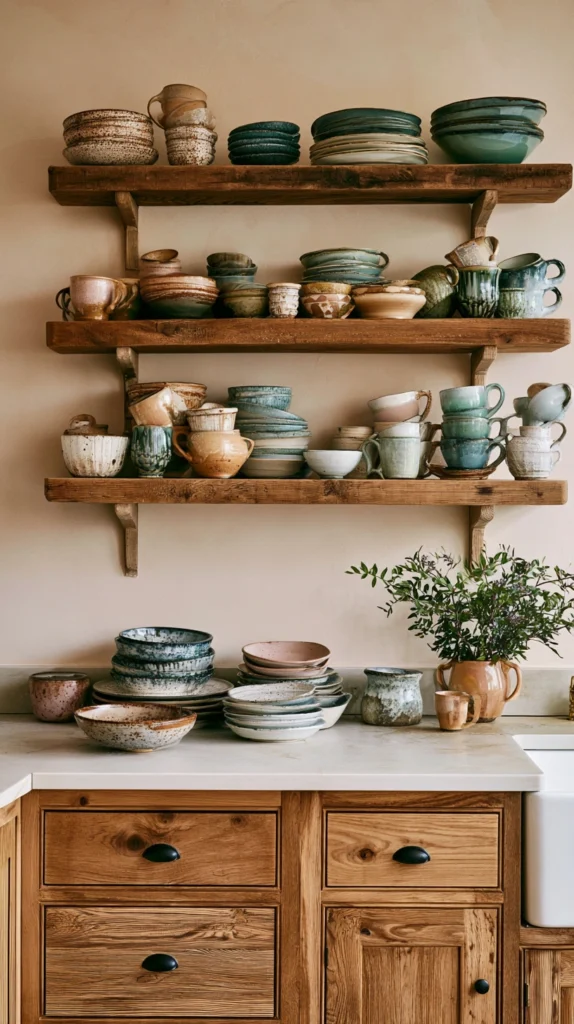
Open wood shelves holding a deliberately mismatched collection of plates, bowls, and mugs — the storage solution that doubles as the kitchen’s most personal decoration.
Why mismatched storage works harder than a matching set
- The collected-over-time effect: mismatched pieces read as gathered across years, not purchased as a set, which is central to this style’s sense of accumulated history
- The display-while-storing logic: everyday dishware becomes decoration without requiring a single dedicated display object
- The texture and color variety: a shelf of uniform white plates looks tidy; a shelf of varied glazes, colors, and shapes looks alive
The options
- Floating wood shelves — the simplest installation, with minimal visible hardware
- Shelves with a corbel or bracket support — more substantial, period-appropriate look
- A plate rack — shelving designed specifically to display plates upright rather than stacked
- A mix of open shelving and a glass-front cabinet or two, balancing full display with some protection from dust
The practical execution
- Group pieces by color family or general shape rather than by matching set, so the mismatch reads as curated rather than random
- Leave slightly uneven stacking and spacing — too much symmetry undercuts the lived-in effect
- Mount shelves at a height that keeps frequently used pieces within easy reach, with decorative-only pieces higher up
Cost breakdown
- Floating wood shelves, per shelf, materials: $30–80
- A full wall of shelving, installed: $200–600
- Mismatched crockery, sourced secondhand over time: $5–25 per piece
- Total: $200–900 for the shelving, with crockery cost spread out over time
5. The Hanging Herb and Dried Flower Rack (The Ceiling Becomes a Garden)
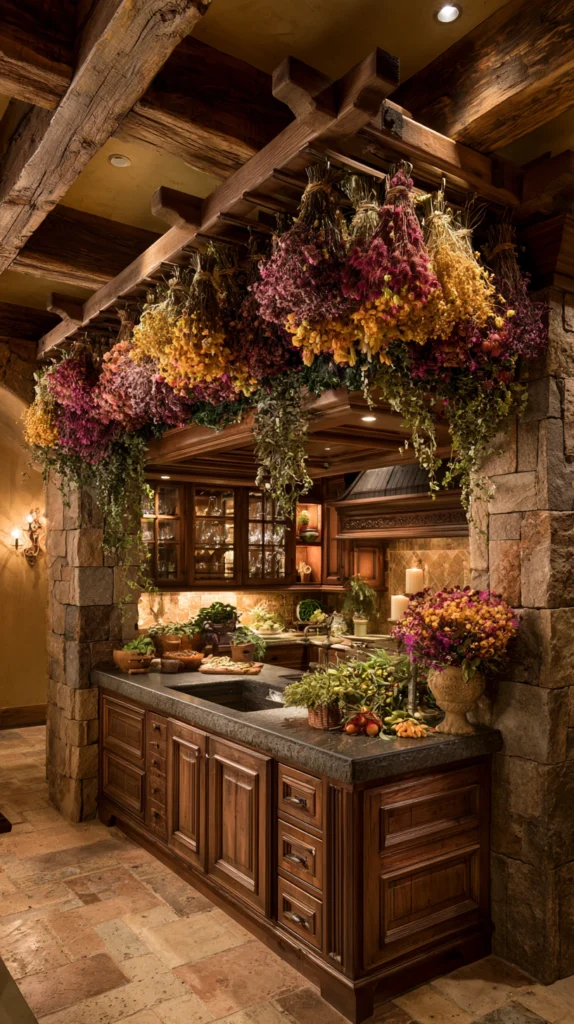
Bundles of dried herbs and flowers hung upside down from a rack or beam — the detail that brings the garden indoors and gives the ceiling a use beyond a single light fixture.
Why drying herbs overhead does more than store them
- The function-meets-decoration overlap: drying herbs for cooking was always a practical kitchen task; displaying the bundles as decor simply leaves the practical step visible
- The seasonal abundance signal: a kitchen with herbs and flowers hanging overhead reads as connected to a garden, real or implied
- The scent layer: dried herbs add a subtle fragrance no painted decoration can offer
The options
- A wall-mounted drying rack with hooks — the most functional version, designed to actually dry fresh bundles
- A hanging rack suspended from a beam, holding both drying and fully dried bundles
- Individual hooks along a beam or shelf edge, for a more scattered, gathered-over-time look
- Dried flower bundles mixed with herbs, adding color variation alongside the greens and browns of dried herbs alone
The practical execution
- Hang bundles stem-up, away from direct heat sources like the stovetop or oven, which can scorch them or cause uneven drying
- Rotate in fresh bundles seasonally — dried herbs lose both scent and color after several months
- Keep the rack within reach of a step stool if it’s mounted high, since some of what’s hanging may still be intended for cooking
Cost breakdown
- Wall-mounted drying rack: $20–50
- Suspended ceiling rack: $30–80
- Dried herb and flower bundles, sourced or grown: $5–15 per bundle
- Total: $20–150
6. The Copper Pots on Display (Cookware That Earns Its Wall Space)
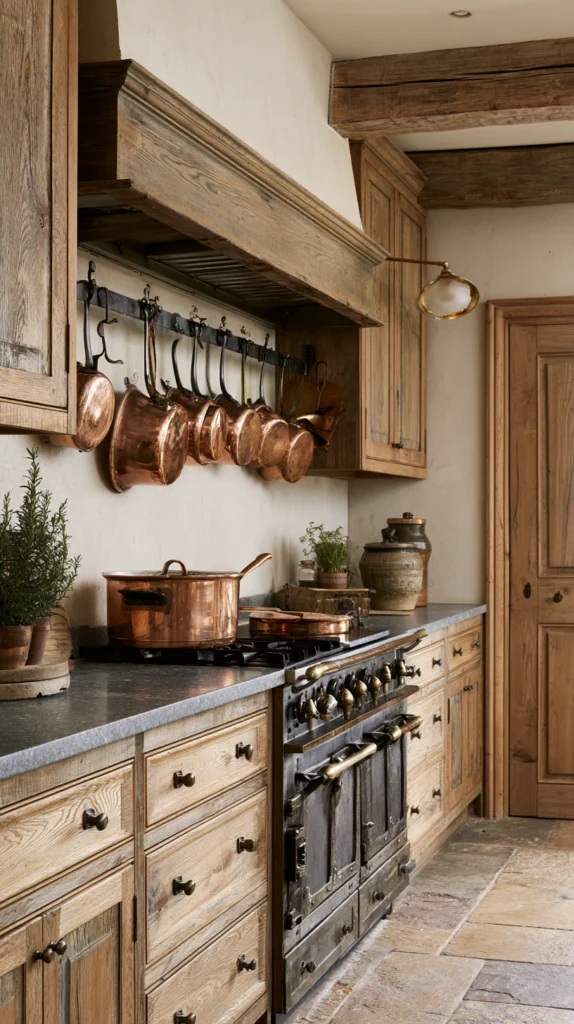
A collection of copper pots and pans hung on a rack or rail rather than stored in a cabinet — the metal that does more for warmth in a kitchen than almost any paint color could.
Why copper does more work than other cookware
- The warm-metal effect: copper’s color sits closer to firelight than to the cool gray of stainless steel, reinforcing the whole room’s warmth
- The function-as-decoration logic: like the herb rack, this idea takes something already in daily use and simply makes it visible
- The patina story: copper develops a richer, more varied surface over years of use, which fits the aesthetic’s preference for things that show their age
The options
- A wall-mounted pot rack with hooks, the most common display method
- A ceiling-mounted hanging rack, useful over an island where wall space isn’t available
- A rail with S-hooks, the simplest and least expensive installation
- A mix of copper and cast iron, since the two metals share a similar warmth and weight
The practical execution
- Hang the largest, most visually substantial pieces lowest and most centrally, filling in smaller pans around them
- Leave a true cooking-grade copper pot unlacquered if it’s actually used, since lacquer prevents the even heat distribution copper is prized for
- Polish occasionally rather than constantly — a little tarnish reads as authentic, not neglected
Cost breakdown
- Single copper pot or pan: $40–150
- A small starter collection (3–4 pieces): $150–500
- Wall-mounted rack or rail: $30–100
- Total: $180–600 for a modest display collection
7. The Stone or Brick Accent (Texture With Real Weight)
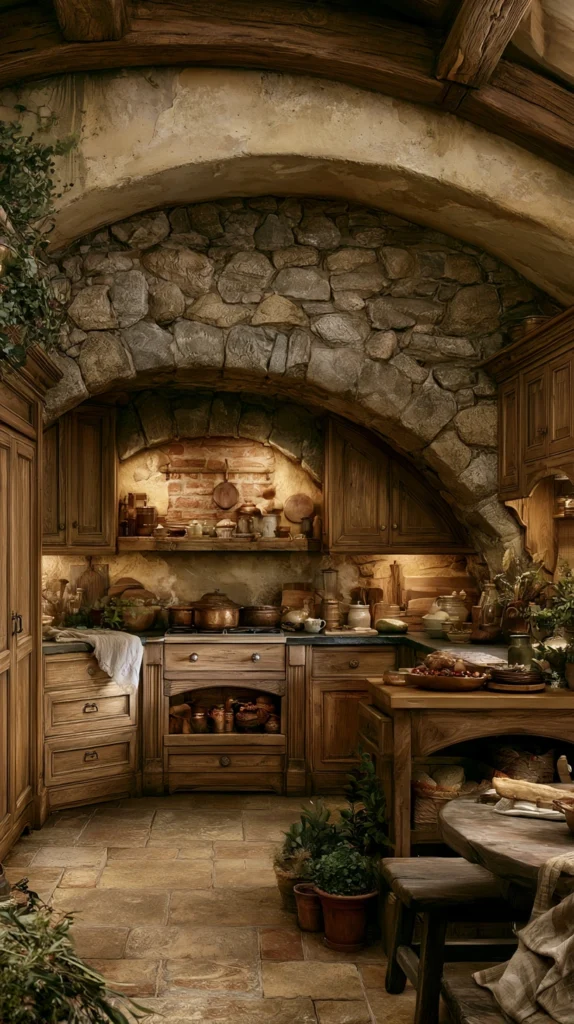
A section of exposed stone or brick — on a wall, around the stove, or as a backsplash — the material that gives a kitchen a sense of having grown up out of the ground rather than been installed on top of it.
Why stone and brick read differently than tile
- The material honesty principle: stone and brick read as structural and permanent in a way tile or paint, no matter how well done, can’t fully imitate
- The texture contrast: a rough stone surface against smooth wood cabinetry or a soft textile creates the layered texture central to the whole aesthetic
- The thermal-mass association: stone around a stove or hearth area carries an implied sense of warmth and heat retention, whether or not it’s actually doing that job
The options
- A full stone accent wall, the most dramatic and most structurally involved option
- A brick backsplash behind the range, a smaller-scale, more achievable version of the same idea
- Stone veneer panels, a lighter-weight, easier-to-install alternative to full masonry
- Exposed original brick or stone, in older homes where it already exists behind drywall and simply needs uncovering
The practical execution
- Veneer panels are the realistic choice for most kitchens, since full masonry often requires structural support the existing wall wasn’t built for
- Seal natural stone in a kitchen environment to protect against grease and moisture, especially near the cooking area
- Keep the stone or brick section contained to one wall or focal area — used everywhere, it loses the sense of being a deliberate accent
Cost breakdown
- Stone veneer panels, materials per square foot: $8–25
- Brick backsplash, materials and installation: $400–1,200
- Full stone accent wall, materials and installation: $1,500–4,000
- Total: $400–4,000, depending on scope
8. The Walk-In Pantry or Larder (A Room Devoted to Food Itself)
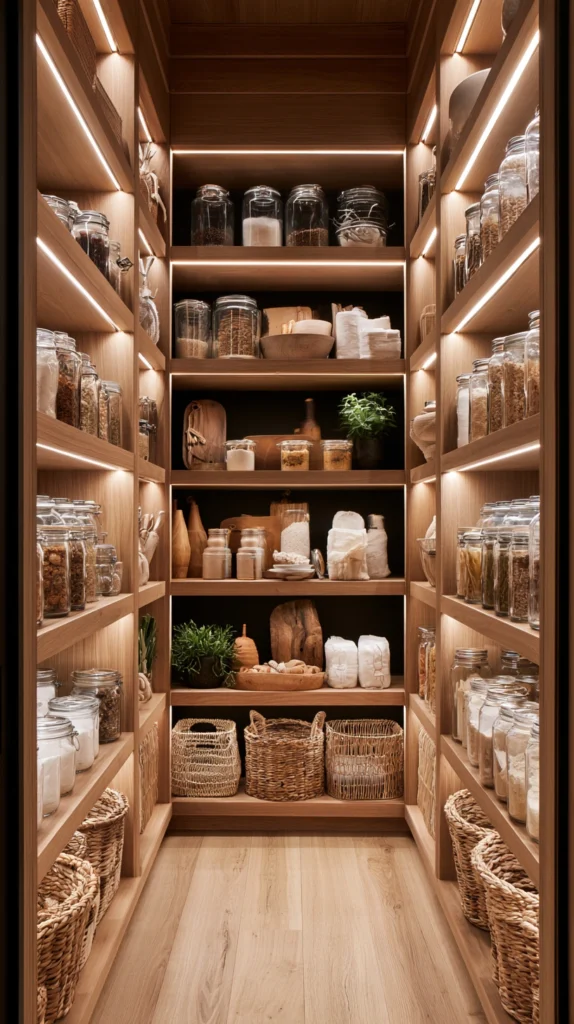
A dedicated pantry room, even a small one, with open shelving for visible food storage — the space that turns a kitchen’s storage needs into one more room with its own character.
Why a separate pantry matters to the whole aesthetic
- The abundance display: a stocked pantry, visible through an open door or curtain rather than hidden behind a flat panel, is one of the clearest visual signals of the style’s emphasis on plenty
- The function it restores: a true larder or pantry takes overflow storage out of the main kitchen, letting the visible cabinetry stay less crowded
- The historical reference: older homes often had a separate food storage room before refrigeration made it less necessary, and reviving that room taps directly into the lived-in, old-house feeling
The options
- A full walk-in pantry, requiring its own floor space and door
- A converted closet pantry, a smaller-scale version using existing square footage
- An open pantry alcove, without a door, displaying shelving as part of the kitchen itself
- A pantry with a curtain instead of a door, softer and more in keeping with the textile-heavy side of the style
The practical execution
- Use open wood shelving rather than enclosed cabinetry to keep contents visible and part of the room’s overall texture
- Store staples in matching glass or ceramic containers for a more cohesive look than a shelf of mixed cardboard boxes
- Add a small light source inside the pantry, since most converted spaces weren’t originally wired for one
Cost breakdown
- Converting an existing closet into a pantry: $300–1,000
- A new walk-in pantry, built during renovation: $2,000–8,000+
- Glass or ceramic storage containers, a full set: $80–200
- Total: $300–8,000+, depending on whether new construction is involved
9. The Woven Baskets (Storage With Warmth Built In)
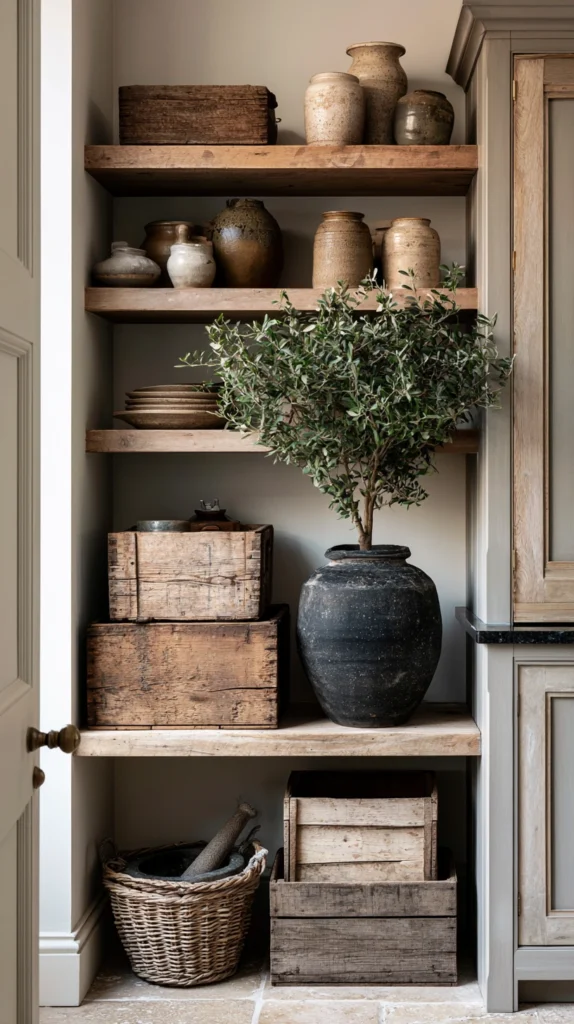
Woven baskets used for produce, bread, linens, or general overflow storage — the lowest-cost, most flexible texture in the entire kitchen.
Why a basket does more than its low price suggests
- The texture-without-commitment value: a basket adds natural material and visual warmth without requiring any installation or renovation
- The function it actually serves: baskets are genuinely useful for root vegetables, bread, and other items that do better with airflow than in a sealed container
- The mix-and-match forgiveness: unlike crockery, baskets in slightly different weaves, sizes, and shades still read as cohesive rather than mismatched
The options
- Open-weave produce baskets, ideal for root vegetables, onions, and bread that needs airflow
- Lidded storage baskets, for linens or items that need to stay covered
- Hanging baskets, suspended from a beam or rack, freeing up counter and floor space
- A graduated set of nesting baskets, useful for organizing a pantry shelf by size
The practical execution
- Reserve baskets for items that benefit from breathability — bread, produce, dried goods — rather than anything that needs to stay airtight
- Line baskets holding loose items, like grains or small produce, with a cloth liner to make emptying and cleaning easier
- Vary basket size and shape slightly across a collection rather than buying one uniform set, to keep the gathered-over-time effect
Cost breakdown
- Small individual basket: $10–25
- A starter collection (4–6 baskets, mixed sizes): $60–150
- Hanging basket rack or hardware: $20–50
- Total: $60–200
10. The Mismatched Wood Furniture (Patina Over Uniformity)
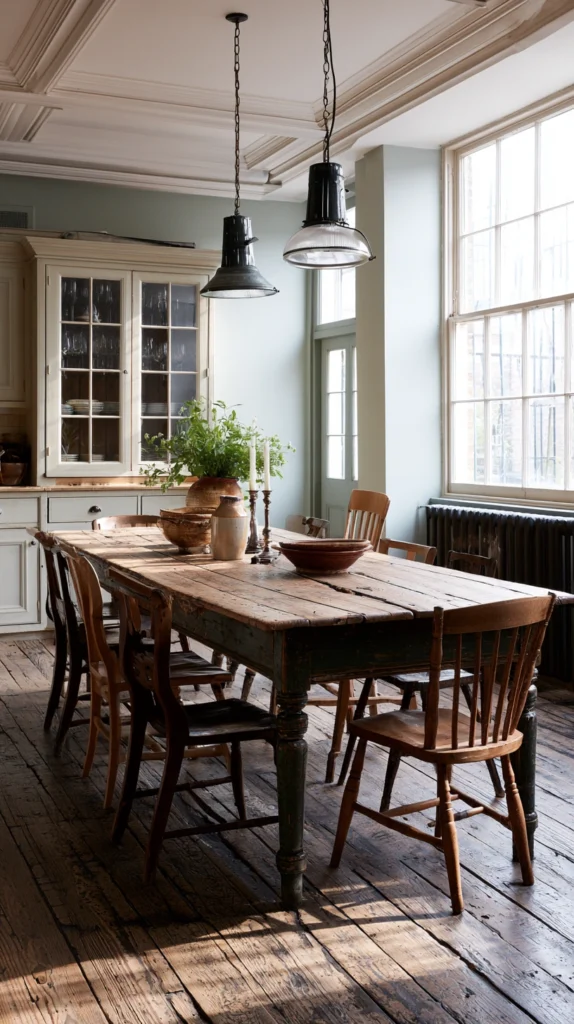
A kitchen table, chairs, or stools that don’t match each other or the cabinetry — the furniture choice that signals a room assembled over time rather than ordered as a matching set.
Why furniture that doesn’t match still looks finished
- The collected-history signal: furniture that doesn’t match reads as inherited, found, or accumulated, central to the aesthetic’s sense of a home built up over years
- The character-over-consistency value: a chair with a worn arm or a slightly different wood tone than the table it sits at adds visual interest a matching set can’t provide
- The budget-friendly side effect: mismatched furniture, especially sourced secondhand, is often considerably less expensive than a coordinated new set
The options
- A single substantial wood table, paired with chairs of varying styles and finishes
- A bench on one side of the table and chairs on the other, adding asymmetry to the seating itself
- Stools at a kitchen counter or island, mismatched in height or finish for a more casual feel
- A mix of painted and natural-finish wood pieces, rather than every piece in the same stain
The practical execution
- Anchor a mismatched set with one consistent element — the same seat height, or a shared wood tone across at least half the pieces — so the room reads as eclectic rather than disorganized
- Source secondhand and at estate sales for genuine age and patina rather than buying new pieces distressed to look old
- Leave visible wear, like a worn armrest or faded finish, rather than refinishing every piece to a uniform shine
Cost breakdown
- Secondhand chairs, each: $20–80
- A substantial used wood table: $150–600
- A full mismatched table-and-seating set: $300–1,200
- Total: $300–1,200, often less than a single new matching dining set
11. The Window Herb Garden (A Living Windowsill)
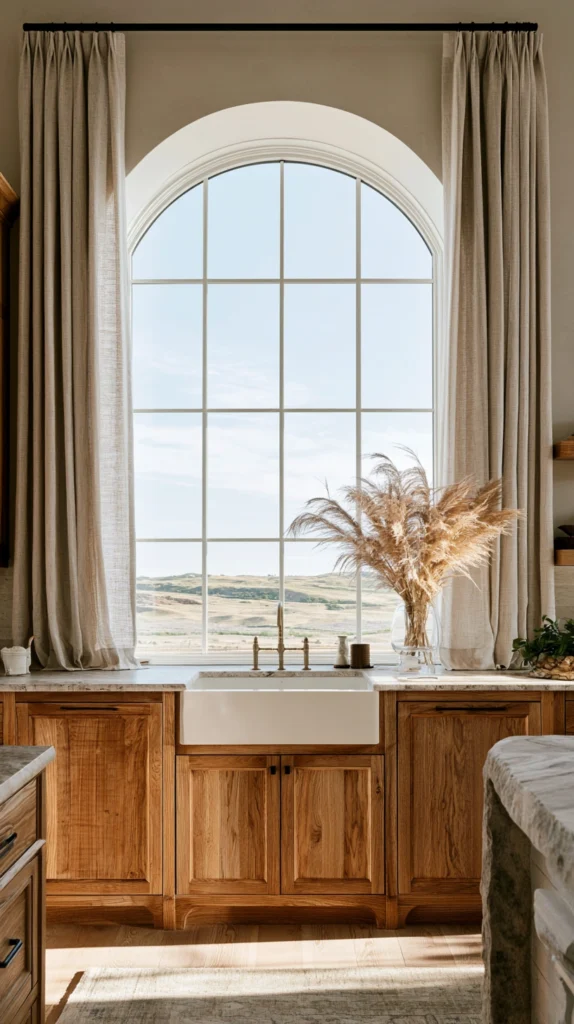
A row of potted herbs growing on the kitchen windowsill — the smallest living element on this list, and one of the most directly tied to the connection between kitchen and garden.
Why a living windowsill matters to the whole room
- The garden-to-table link: an aesthetic built around abundance and self-sufficiency is reinforced by herbs a cook can actually reach for mid-recipe
- The year-round greenery: unlike a garden outside, a windowsill herb garden stays green through every season, including the ones when nothing else outdoors is growing
- The low-footprint living element: this is one of the only ideas on the list that introduces a living, changing object without requiring floor space
The options
- Basil, thyme, and rosemary in matching terracotta pots, the most traditional and reliable combination
- A single long planter box rather than individual pots, for a more unified look along a windowsill
- Hanging herb pots, suspended in front of the window rather than sitting on the sill, for kitchens with limited counter space there
- A mix of culinary and ornamental herbs, for variety in both scent and appearance
The practical execution
- Choose herbs that tolerate the specific light the window actually provides — south-facing windows support more variety than north-facing ones
- Use pots with drainage and a small saucer underneath to protect the windowsill from water damage
- Rotate pots occasionally so growth stays even rather than leaning toward the light source
Cost breakdown
- Terracotta pots, each: $3–10
- Herb plants or starts, each: $4–8
- A planter box with drainage: $20–40
- Total: $25–80 for a full windowsill garden
12. The Candlelight and Lantern Layer (No Harsh Overhead Allowed)
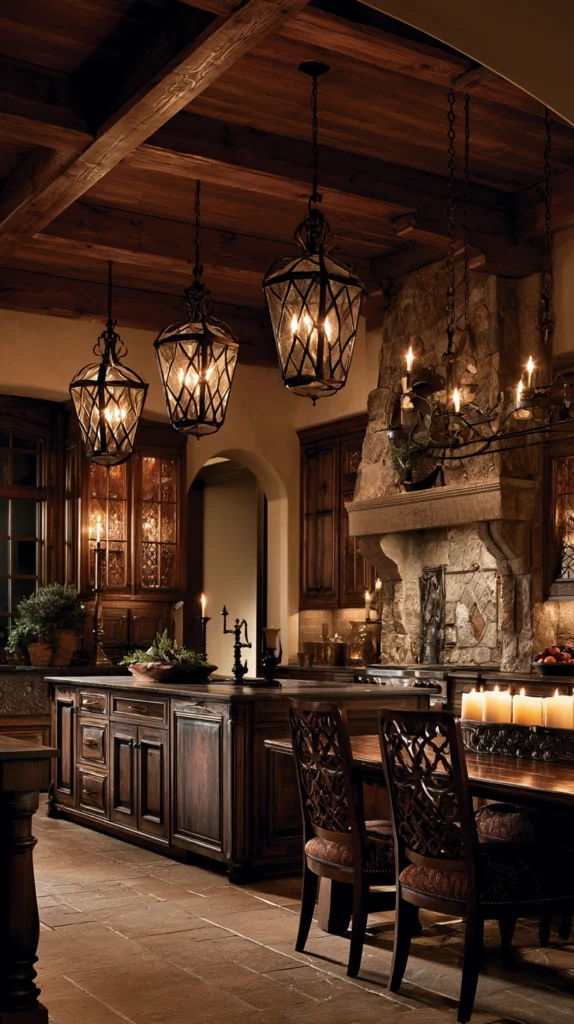
Candles and lantern-style fixtures used in place of, or alongside, a single bright overhead light — the lighting approach that does more to set the mood than any single decorative object.
Why the wrong lighting undoes everything else on this list
- The harsh-overhead problem: even, cool-toned overhead light is the fastest way to undercut every other choice on this list; warm, uneven, lower light is the fastest way to reinforce them
- The flicker and shadow effect: candlelight and lantern-style fixtures cast moving shadows that flat modern lighting simply doesn’t produce
- The historical continuity: this lighting style draws directly from a kitchen lit before electricity, even when the actual light source is electric
The options
- Real candles in simple holders, placed on the table or counter
- Lantern-style pendant fixtures, hung from a beam in place of a flush-mount ceiling light
- Flameless candles with a warm, slightly flickering LED, for safety near cooking areas
- Wall sconces styled as lanterns or oil lamps, even when wired for standard bulbs
The practical execution
- Use warm 2700K bulbs in any electric fixture styled as a lantern, so the color temperature matches the candlelight it’s meant to evoke
- Keep real flame sources away from the stovetop and any draft created by a range hood fan
- Layer several smaller light sources around the room rather than relying on one large fixture, since the look depends on uneven, pooled light rather than even illumination
Cost breakdown
- Lantern-style pendant fixture: $80–250
- Wall sconces styled as lanterns, per pair: $60–180
- Candles and holders: $20–50
- Total: $160–480 for a full lighting layer
13. The Inglenook or Hearth Nook (A Seat Built Into the Warmth)
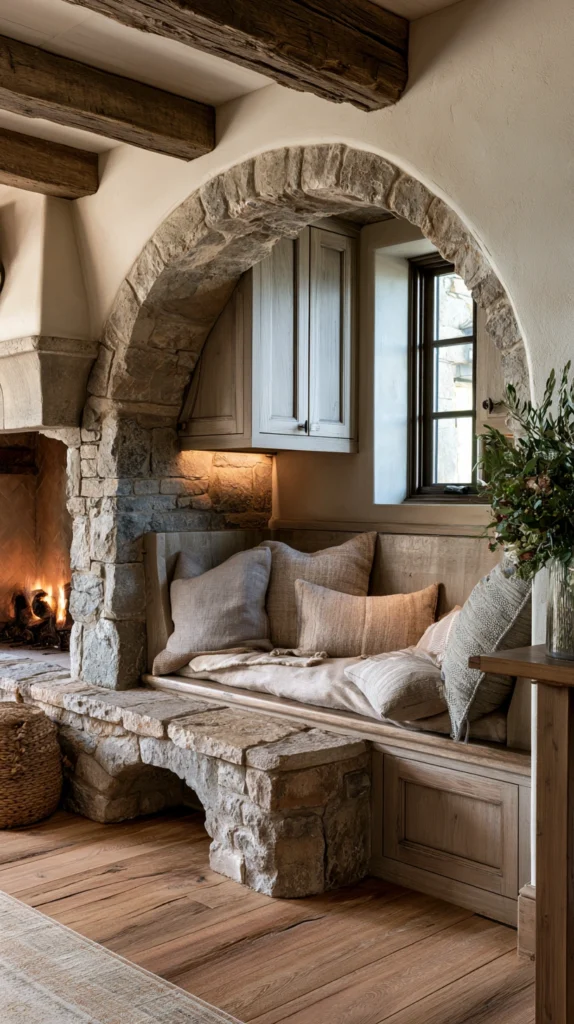
A small built-in seating nook near a stove, fireplace, or warm corner of the kitchen — the architectural feature that gives the room a place to sit that isn’t the main table.
Why a nook adds more than extra seating
- The gathering-around-warmth principle: a seat positioned near the kitchen’s heat source taps into one of the oldest functions a kitchen ever served, long before it was simply where food got cooked
- The built-in character: a nook that’s part of the architecture, rather than freestanding furniture, reinforces the sense that the kitchen was built specifically for this kind of living
- The small-space solution: a nook can provide genuine extra seating in a kitchen too small for a full second table
The options
- A built-in bench with cushions, set into an alcove or against a chimney breast
- A small banquette, paired with a freestanding table for an informal eating spot
- Built-in shelving flanking the nook, for books or display objects within reach of the seat
- A simple bench without a back, the lowest-cost version, still providing a spot to sit near the warmth
The practical execution
- Position the nook close enough to a heat source to feel the benefit, with enough clearance from the stove itself to stay safe
- Add cushions and a throw in a textured, natural fabric (see Idea #14) to soften a built-in bench’s hard surfaces
- Built-in benches benefit from storage underneath — a lift-top seat or drawers make the space earn its footprint
Cost breakdown
- A simple built-in bench, materials and basic carpentry: $300–800
- Cushions and a throw for the nook: $60–150
- A full custom inglenook with shelving, professionally built: $1,500–4,000+
- Total: $300–4,000+, depending on scope
14. The Checked and Floral Textiles (Softness in Every Corner)
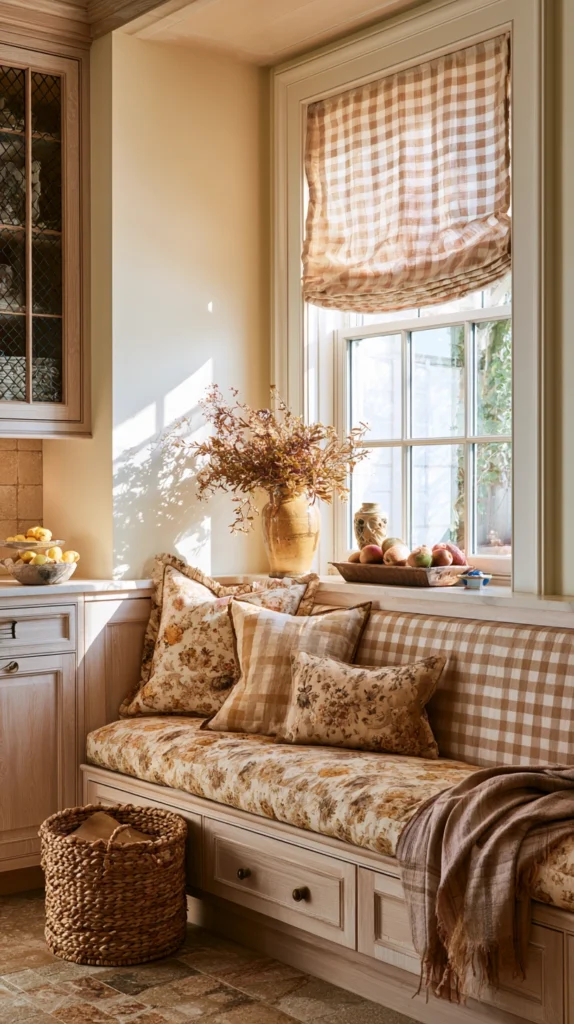
Curtains, tablecloths, tea towels, and chair cushions in checked or small floral patterns — the textile layer that softens every hard surface this style accumulates.
Why textiles matter more here than in most kitchens
- The softening counterbalance: a room full of wood, stone, and metal needs fabric to keep it from feeling like a workshop rather than a kitchen
- The pattern-mixing opportunity: small checks and florals in similar color families can be mixed across curtains, towels, and cushions without looking chaotic, in a way large bold patterns can’t
- The easy-to-update layer: textiles are the cheapest, fastest way to refresh the room’s feel without touching anything structural
The options
- Gingham or small-check curtains, a classic pairing with wood cabinetry
- A floral or check tablecloth, swapped seasonally or kept as a year-round base layer
- Linen or cotton tea towels, displayed as much as used, often hung from an oven handle or a hook
- Cushions for chairs, benches, or the inglenook, tying the textile layer across multiple pieces of furniture
The practical execution
- Choose natural fibers — linen, cotton — over synthetic blends, both for authenticity and because they age and soften with use rather than looking worn out
- Limit the palette to two or three colors across all textiles in the room, even while mixing several patterns, to keep the layering cohesive
- Wash and use textiles regularly rather than treating them as precious — visible, gentle wear fits the aesthetic better than pristine fabric
Cost breakdown
- Curtains, a pair: $30–80
- Tablecloth: $20–50
- Tea towels, a set of 4–6: $20–40
- Chair or bench cushions, per piece: $15–35
- Total: $85–250 for a full textile refresh
15. The Preserve and Jar Display (The Pantry as Decoration)

Glass jars of preserves, pickles, dried beans, and grains displayed on open shelves or a windowsill — the finishing touch that turns ordinary food storage into the kitchen’s most colorful decoration.
Why a shelf of jars works as decor and as dinner
- The abundance-as-beauty principle: rows of preserved produce in clear glass are both genuinely useful and visually striking, doing double duty without requiring a separate decorative object
- The color the rest of the room lacks: a kitchen built mostly from wood, stone, and neutral textiles often needs jars of deep reds, golds, and greens to introduce real color
- The seasonal storytelling: a shelf of jars naturally changes through the year as preserves get made, used, and remade, giving the display a sense of time passing that static decor can’t provide
The options
- Mason jars of preserves or pickles, the most classic version, whether homemade or simply transferred from store-bought containers
- Apothecary-style jars for dry goods, holding grains, beans, or pasta in clear glass rather than original packaging
- A mix of jar sizes and shapes, avoiding a uniform matching set in favor of a gathered, varied look
- Labeled jars, using simple handwritten or printed labels for both function and a cohesive visual detail across the collection
The practical execution
- Decant dry goods into glass as they’re used up, rather than all at once, so the collection builds gradually and authentically
- Keep anything light-sensitive, like oils or certain preserves, away from direct sun exposure on an open shelf, even though the display value is highest in good light
- Group jars by color or contents rather than by size, so the shelf reads as an intentional gradient rather than random pantry overflow
Cost breakdown
- Mason jars, a dozen: $15–25
- Apothecary-style glass storage jars, each: $8–20
- Labels and a marker or label maker: $10–25
- Total: $35–150 for a full shelf of jar storage
The shelf of preserves catching afternoon light: the one piece of decor in the kitchen that’s also, eventually, dinner.
The Hobbitcore Kitchen Roadmap
The work, sequenced:
Phase One (the architecture):
- The round-top doorway (#1)
- The exposed wood beams (#2)
- The stone or brick accent (#7)
- The inglenook or hearth nook (#13)
Phase Two (the fixtures and storage rooms):
- The deep farmhouse sink (#3)
- The walk-in pantry or larder (#8)
- The candlelight and lantern layer (#12)
Phase Three (the storage and display):
- The open shelving and mismatched crockery (#4)
- The woven baskets (#9)
- The copper pots on display (#6)
- The preserve and jar display (#15)
Phase Four (the finishing layers):
- The hanging herb and dried flower rack (#5)
- The mismatched wood furniture (#10)
- The window herb garden (#11)
- The checked and floral textiles (#14)
Getting Started This Weekend
The immediate-impact kitchen refresh:
One weekend, three changes:
- Add a trio of potted herbs to the windowsill (Idea #11)
- Swap in checked curtains and a few mismatched mugs or plates from a secondhand shop (Ideas #4 and #14)
- Light a few candles or swap in warm bulbs for the evening (Idea #12)
Total cost: $80–160. Time: an afternoon. The kitchen will feel warmer by dinner, without a single structural change.
The structural investment (the next big project):
The deep farmhouse sink (Idea #3) or the walk-in pantry (Idea #8) are the two biggest single investments on this list, and either one reorganizes how the rest of the kitchen functions around it. Once one of them is in place, the open shelving, the baskets, and the jars all have a working centerpiece to arrange themselves around.
What a finished hobbitcore kitchen provides that a showroom kitchen can’t:
The sense that the room grew rather than was installed:
- Furniture that doesn’t match, because it was gathered rather than ordered
- A shelf of crockery that tells a small story about where each piece came from
- Architecture — a curved doorway, an exposed beam — that feels carved rather than built
The warmth that comes from materials, not paint:
- Copper and wood that carry their own color without help from a paint can
- Candlelight that no flat overhead fixture can replicate
- Stone or brick that holds a sense of permanence no tile fully manages
The connection between kitchen and garden, however small the garden actually is:
- Herbs drying overhead and herbs growing on the sill, often at the same time
- Jars of preserves that mark the passing of a season on an open shelf
- Baskets built for produce that’s actually meant to be eaten, not just displayed
A hobbitcore kitchen is not a style applied on top of an existing room. It’s a different set of priorities entirely — texture over polish, abundance over restraint, a room that looks like it’s been cooked in and gathered around for years rather than photographed once and left alone. Every mismatched plate added to the shelf makes the next one look more at home. Every jar refilled on a Sunday afternoon is one more small sign that the kitchen is still being lived in, not just decorated.