13 Fall Kitchen Lighting Ideas for a Warm Glow
Most kitchens run on whatever lighting came with the house — a flush-mount overhead fixture, maybe a pendant or two over the island, bulbs chosen for brightness rather than warmth. It works well enough in July, when the sun is still up at dinner and the kitchen barely needs help.
That setup falls apart the moment the season turns. By October, the sun is gone before the pans are even out, and the same lighting that felt perfectly fine in summer suddenly reads as flat, cold, and a little uninviting.
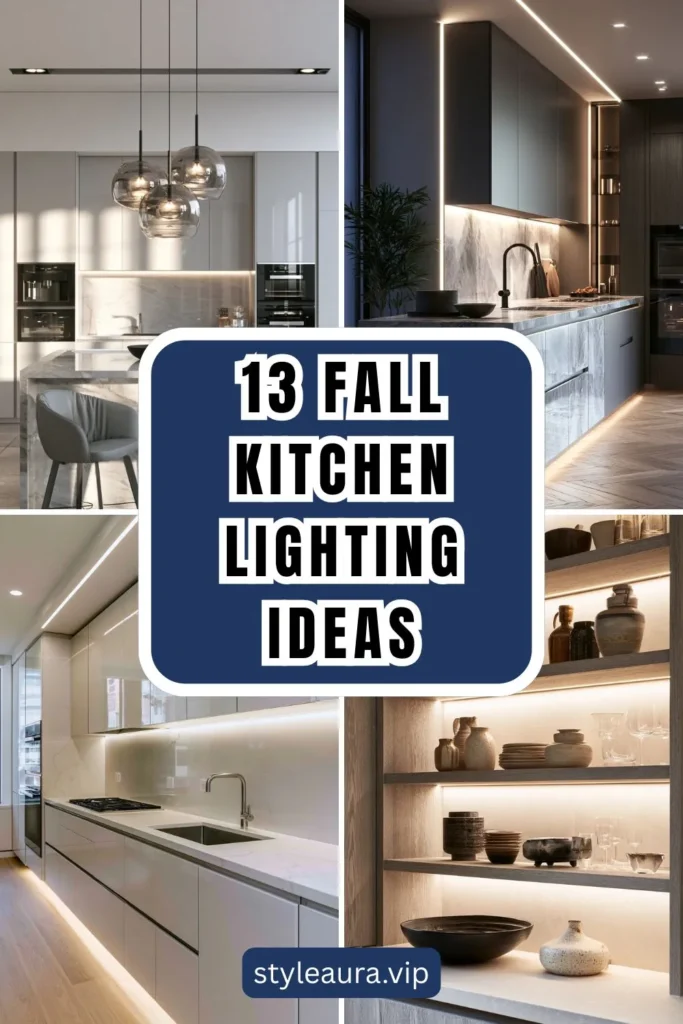
A kitchen’s lighting is not a fixed decision made once when the house was built. It is a layered system that has to do more work, for more hours, once the days shorten — and the warmest, most welcoming kitchens are the ones where that system was actually planned for the season rather than left to a single overhead bulb.
Here are 13 ideas for giving a kitchen the kind of warm glow that makes it the room everyone wants to be in once it’s dark by six.
Why Fall Calls for a Different Kind of Kitchen Light
The light a kitchen needs is not the same every season:
Summer Kitchen Light:
- Long daylight hours, with natural light doing most of the work well into the evening
- Bright, cool-toned task light feels appropriate when everything outside is bright too
- Artificial lighting is almost an afterthought, covering only the darkest hour or two of use
The summer kitchen comparison: daylight does the heavy lifting
Fall Kitchen Light:
- Daylight ends hours before the kitchen stops being used
- Warmer color temperatures match both the season and the kind of cooking that happens in it
- The kitchen becomes the room people gather in once it’s dark — lighting has to carry the room for longer
The key insight:
- Most summer kitchen lighting is supplemental
- Most fall kitchen lighting is the primary light source for the majority of the day
- These are different lighting jobs, not the same fixtures simply switched on earlier
The Layering Reality
The most important number in fall kitchen lighting:
The color temperature:
- Measured in Kelvin, with lower numbers reading warmer and higher numbers reading cooler
- 2700–3000K: warm, inviting, close to candlelight or incandescent
- 4000K and above: crisp and clinical, better suited to a garage or office than a fall kitchen
- Know this number — it governs every bulb purchase on this list
The “three layers” calculation:
- Ambient light (the main overhead source) sets the room’s baseline
- Task light (under-cabinet, range hood, island pendants) covers the actual work of cooking
- Accent light (in-cabinet, open shelving, candles) adds depth and warmth without doing any of the heavy lifting
- A kitchen lit by only one of these layers always feels unfinished, no matter how bright that single layer is
Most fall lighting upgrades happen in stages, not all at once:
- The bulb swap comes first — the cheapest layer, and the one that touches every fixture already in place
- Task lighting comes next, closing the gaps left by ambient light alone
- Statement fixtures and the smallest finishing touches come last, once the functional layers are already working
1. The Pendant Cluster Over the Island (The Kitchen’s New Centerpiece)
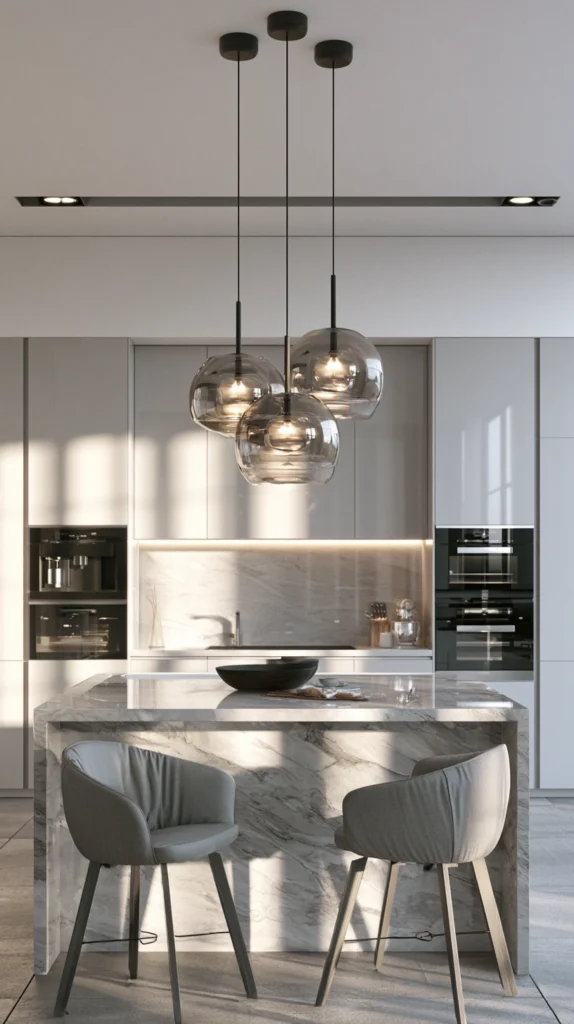
Three or more matching pendants hung in a row above the island — the single lighting change most likely to make a kitchen look intentionally designed rather than simply lit.
Why a pendant cluster matters more than its size suggests
- The focal point effect: a kitchen island already draws the eye, and pendants above it give that attention somewhere finished to land
- The function it actually solves: islands often sit below the room’s main ambient light, leaving the counter underlit for prep work
- The fall timing: as daylight shortens, the island light becomes the kitchen’s primary work light for more hours of the day
The types
- Glass globe pendants — diffuse light evenly, with less glare directly underneath
- Linear pendant or single bar fixture — one continuous fixture instead of separate pendants, suited to long islands
- Metal dome pendants — direct light downward more than glass, better for focused task work
- Mixed-finish pendants — two alternating finishes hung in sequence for visual interest over a long run
The placement and sizing
- Hang so the bottom of each pendant sits 30–36 inches above the island countertop
- Space three pendants evenly, with the center pendant aligned to the island’s midpoint
- The combined width of the pendants should cover roughly one-third to one-half of the island’s total length
Cost breakdown
- Budget pendant set (3, big-box): $90–180
- Mid-range pendant set: $250–500
- Designer or mixed-metal pendants: $400–900
- Total: $90–900
The island lit properly: the difference between a kitchen that photographs well and one that’s actually pleasant to cook in after dark.
2. The Warm Bulb Swap (The Cheapest, Highest-Impact Change Available)
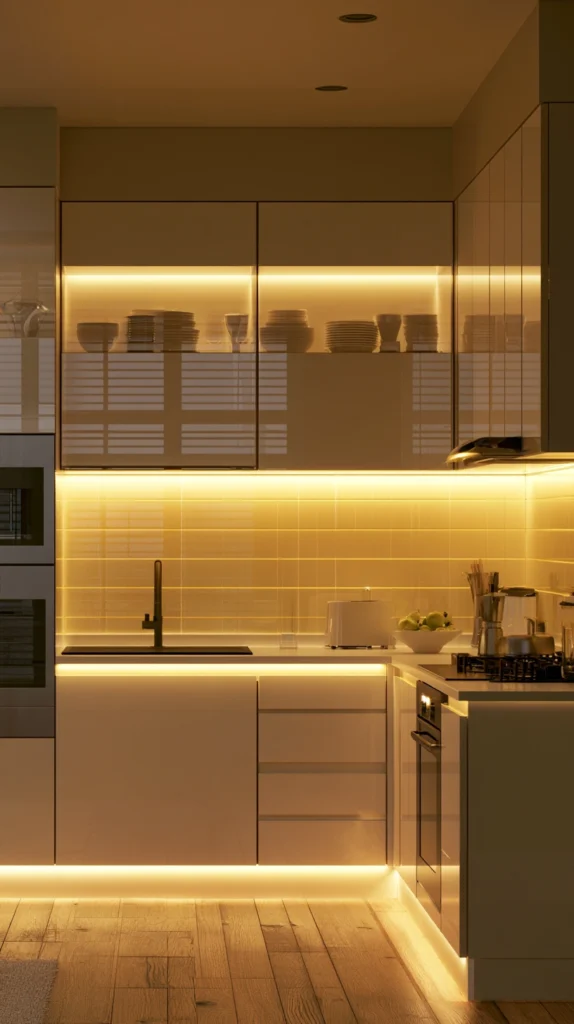
Replacing cool white bulbs with warm white ones throughout the kitchen — the fastest, least expensive way to change how the entire room feels.
Why this is the highest-leverage idea on the list
- The color temperature effect: bulbs above roughly 4000K read as clinical; bulbs at 2700–3000K read as warm and inviting
- The fall-specific case: a kitchen that feels bright and energizing in July often feels harsh once the season — and the light outside — turns colder
- The no-new-fixture upgrade: this is the only idea here that requires no new hardware at all
The options
- 2700K bulbs — the warmest standard option, closest to candlelight or incandescent
- 3000K bulbs — slightly cooler than 2700K, still warm but a touch crisper for task areas
- Dimmable LED bulbs — pair this swap with Idea #3 for the biggest combined effect
- A CRI rating above 90 — bulbs with a higher color rendering index make food and skin tones look more natural under warm light
The practical execution
- Match temperature across every fixture in the room — mixing 2700K and 4000K bulbs in the same space looks unfinished
- Check bulb base and dimmer compatibility before buying in bulk
- Replace the most-used fixtures first — overhead and under-cabinet — before tackling decorative fixtures
Cost breakdown
- Warm LED bulbs, per bulb: $3–8
- A full kitchen re-lamp (8–12 bulbs): $30–90
- Total: $30–90 — the lowest-cost, highest-impact idea on this entire list
3. The Dimmer Switch (Control Over Mood, Not Just Brightness)
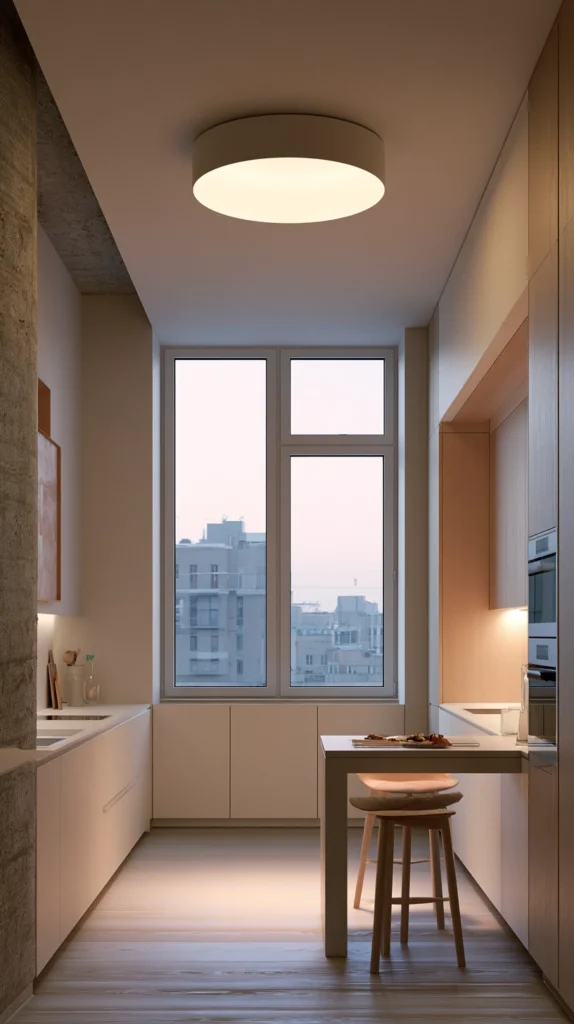
A dimmer installed on the kitchen’s main overhead circuit — the upgrade that turns one fixture into several different rooms depending on the time of day.
Why a dimmer matters more in fall than in summer
- The single-brightness problem: a kitchen lit the same way at 7am and 7pm asks one fixture to do two very different jobs
- The gathering-season case: fall and winter bring more time spent in the kitchen after dark, both cooking and entertaining, and both benefit from lower, warmer light than daytime prep work needs
- The low cost relative to impact: a dimmer changes the feel of a room more than almost any decorative purchase on this list
The options
- Standard rotary or slide dimmer — the simplest, least expensive option
- Smart dimmer switch — app or voice-controlled, often paired with Idea #12
- Three-way dimmer — for kitchens with light switches at two entry points
- Dimmer-compatible LED bulbs — required; not every LED dims smoothly, and the wrong pairing causes flickering
The practical execution
- Confirm the bulbs in the fixture are explicitly listed as dimmable before installing a dimmer switch
- An electrician is the safer choice for anyone not comfortable working inside an electrical panel or switch box
- Set a few preset brightness levels — full task light, half for dinner, low for evening — rather than relearning the dial every time
Cost breakdown
- Standard dimmer switch: $15–35
- Smart dimmer switch: $40–80
- Professional installation, if needed: $75–150
- Total: $15–230
4. The Under-Cabinet Task Light (The Workhorse Layer)
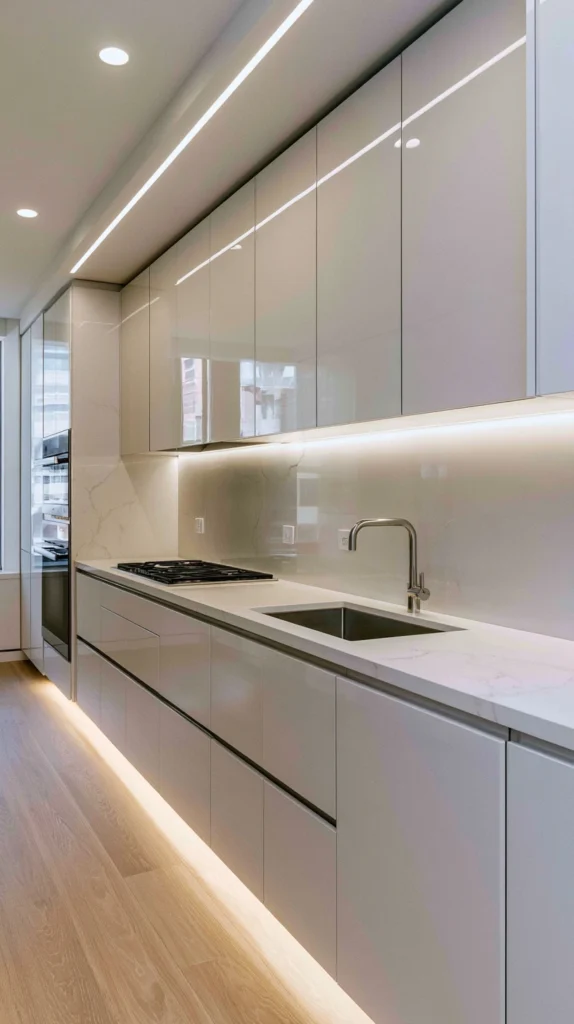
A strip of LED lighting installed beneath the upper cabinets — the layer that does the most actual work of any light in the kitchen and is noticed the least.
Why under-cabinet light carries more weight than it gets credit for
- The shadow problem it solves: overhead light alone casts the cook’s own shadow directly onto the counter, exactly where the work happens
- The task-light case: chopping, reading a recipe, and measuring ingredients all need direct, shadow-free light at counter height
- The fall-specific value: with less daylight coming through the windows, the counter depends on artificial task light for more of the day
The options
- LED light strip (tape light) — the most common option, flexible, fits any cabinet length
- Puck lights — individual fixtures spaced along the cabinet, slightly more focused pools of light
- Linear LED bar fixtures — a single rigid fixture per cabinet run, the most uniform light output
- Plug-in versions — for kitchens where running new wiring isn’t an option
The practical execution
- Mount as close to the front edge of the cabinet as possible, to light the counter rather than the backsplash
- Match the color temperature to the rest of the room’s bulbs (see Idea #2) for consistency
- Hardwired installations need a junction box; plug-in versions can run off a nearby outlet with a cord channel
Cost breakdown
- Plug-in LED strip kit: $20–50
- Hardwired LED strip, per run, materials only: $40–100
- Professional installation, full kitchen: $150–400
- Total: $20–500, depending on the installation method
5. The Statement Chandelier Over the Table (Drama for the Eating Nook)
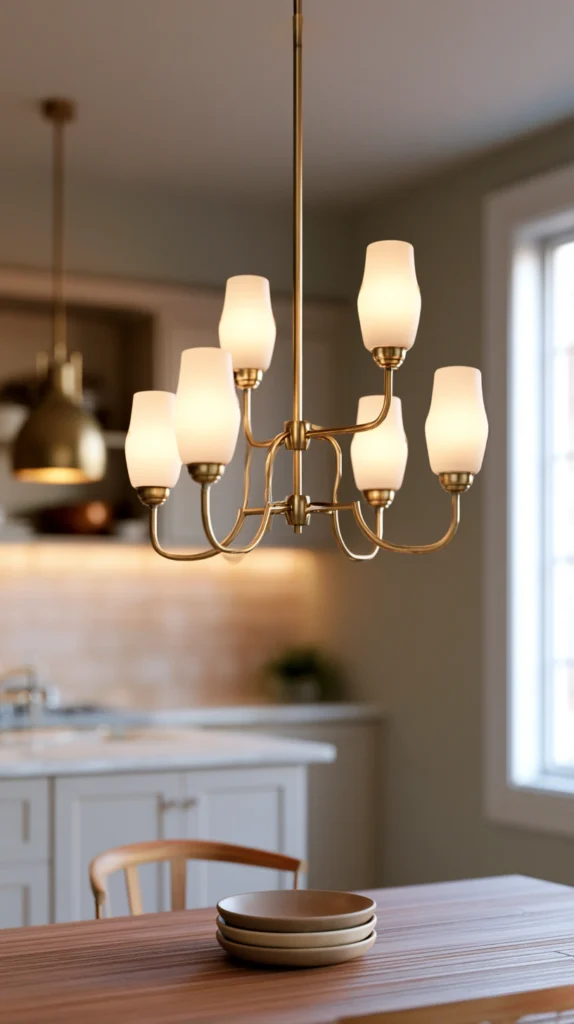
A chandelier or multi-arm fixture hung over a kitchen table or breakfast nook — the piece that turns a functional eating spot into the room’s most photographed corner.
Why the eating nook deserves its own fixture
- The underlit gap: kitchen tables and breakfast nooks are often the most underlit spot in the room, relying only on ambient light spilling over from elsewhere
- The seasonal entertaining case: fall and winter holidays mean more meals eaten at this table after dark, for longer stretches
- The personality opportunity: a chandelier is one of the few kitchen fixtures that can carry real style without competing with cabinetry or counters
The options
- Wagon-wheel or ring chandelier — a classic shape that works over round and rectangular tables alike
- Linear, multi-arm fixture — better proportioned for a long rectangular table
- Drum or shaded chandelier — softer, more diffused light than an open-bulb fixture
- Mixed material (wood, woven, metal) — adds texture that pairs naturally with fall styling
The practical execution
- Hang so the bottom of the fixture sits 30–34 inches above the tabletop
- Size the fixture to roughly half to two-thirds the width of the table it hangs over
- Confirm the fixture is on its own switch, ideally dimmable, separate from the kitchen’s main overhead light
Cost breakdown
- Budget chandelier: $80–180
- Mid-range statement fixture: $250–500
- Designer or oversized fixture: $400–1,000+
- Total: $80–1,000+
6. The Wall Sconces (Architectural Warmth Without Using Counter Space)
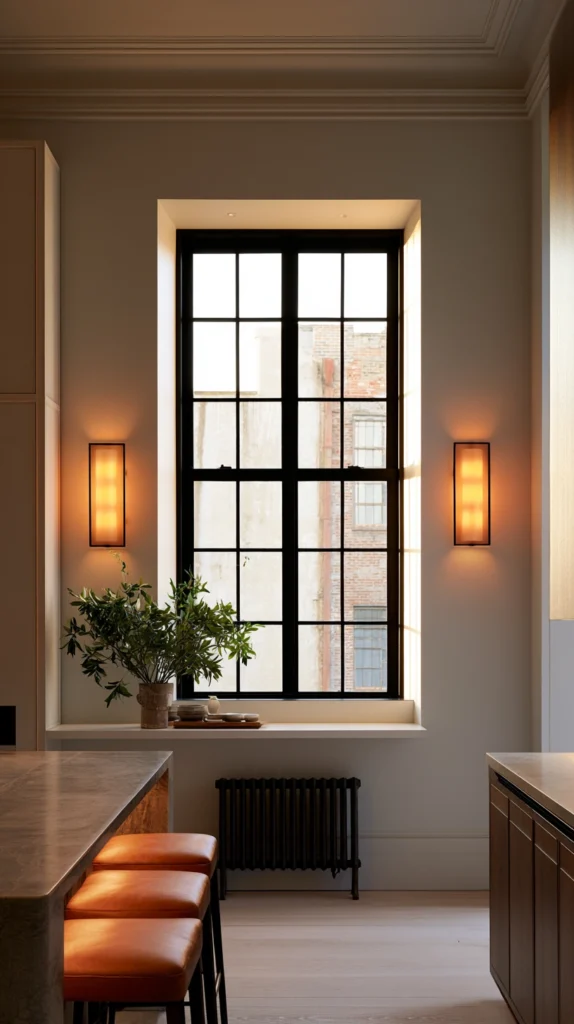
A pair of wall-mounted sconces, often flanking a window above the sink or a stretch of open wall — the fixture that adds warmth without taking up a single inch of counter or cabinet space.
Why sconces solve a problem other fixtures can’t
- The space-efficient layer: sconces add a full lighting layer using only wall space, valuable in a room where every other surface is already claimed
- The architectural framing: a pair of sconces flanking a window or range creates a sense of symmetry that a single central fixture can’t
- The accent-light role: sconces are rarely a kitchen’s primary light source, which means they can run dimmer and warmer than the rest of the room without leaving anything underlit
The options
- Glass globe sconces — soft, diffused light, a classic choice flanking a kitchen window
- Swing-arm sconces — adjustable direction, useful when light needs to be aimed rather than fixed
- Picture-light style sconces — narrow and directional, often used above open shelving
- Brass or matte black sconces — finish driven by the rest of the kitchen’s hardware
The practical execution
- Mount at roughly 66–72 inches from the floor, above standard sightlines but still close enough to feel architectural
- Space a pair symmetrically around the feature they’re framing — a window, a range, or a piece of art
- Wire to a separate switch or dimmer from the main overhead light, so the sconces can run alone in the evening
Cost breakdown
- Budget sconce pair: $40–90
- Mid-range sconce pair: $100–250
- Professional installation, if new wiring is needed: $150–350
- Total: $40–600
7. The In-Cabinet Glow (Glass-Front Cabinets at Night)
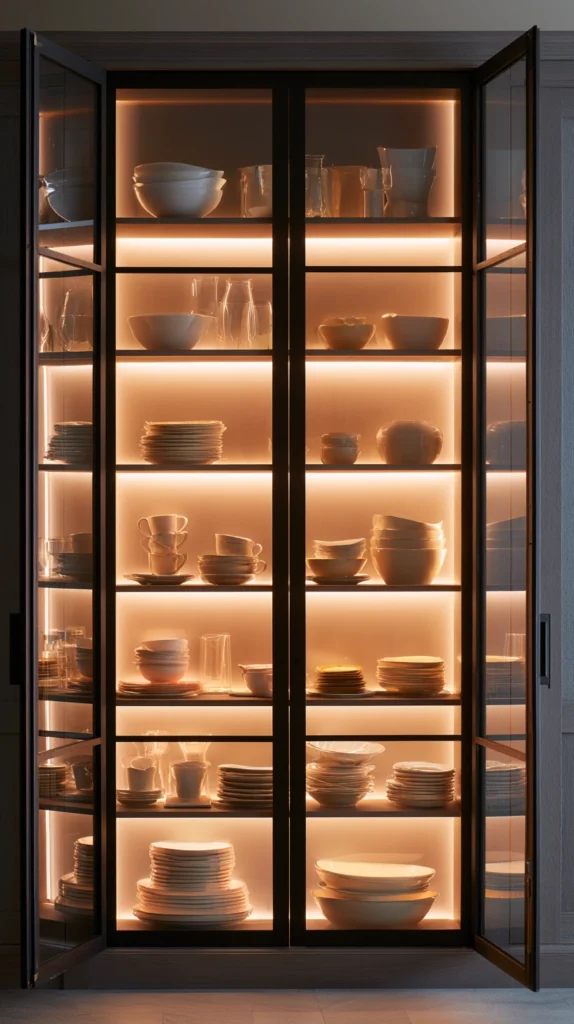
Small LED lights installed inside glass-front or open cabinets — the layer that turns dishware and glassware into something closer to a lit display case after dark.
Why a lit cabinet does more than light a cabinet
- The after-dark transformation: a glass-front cabinet that looks like simple storage in daylight becomes a genuine focal point once it’s lit from inside at night
- The low running cost: in-cabinet lights are small and low-wattage, inexpensive to run continuously through the darker fall and winter evenings
- The collected-object payoff: this idea rewards whatever’s already inside the cabinet — everyday dishware suddenly reads as curated
The options
- LED puck lights — small, battery or wired, the simplest option for individual shelves
- LED tape light — runs along the top or back edge of each shelf for even illumination
- Battery-powered, motion-activated lights — no wiring required, switch on when the cabinet door opens
- Hardwired cabinet lighting — the most seamless option, installed alongside new cabinetry or during a renovation
The practical execution
- Position lights at the top of each shelf, angled to wash light downward rather than glare straight out
- Match color temperature to the rest of the kitchen for consistency
- Battery-powered options need batteries checked seasonally — fall is a natural time to do this alongside other seasonal resets
Cost breakdown
- Battery-powered puck light set: $20–40
- LED tape light kit, per cabinet: $15–35
- Hardwired installation, professional: $100–300
- Total: $20–300
8. The Open Shelving Accent Light (Highlighting What’s Already Out)
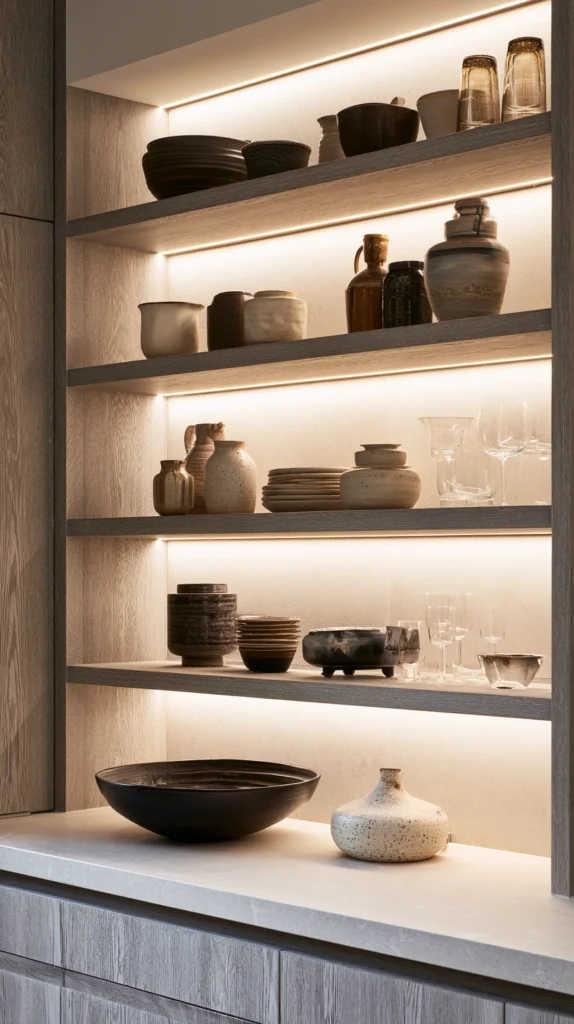
A small directional light or LED strip aimed at open shelving — the idea built for kitchens that display rather than hide their everyday dishware and cookware.
Why open shelving needs its own light
- The display logic: open shelving is already a styling decision; lighting it finishes that decision instead of leaving it half-made
- The texture and shadow benefit: directional accent light creates the kind of shadow and depth that flat overhead light flattens out
- The fall styling tie-in: open shelves are an easy place to add seasonal touches, and accent light makes those small additions actually register
The options
- Picture lights mounted above the shelf — a narrow, directional beam, similar to gallery lighting
- LED strip under each shelf — washes light onto the shelf below, illuminating what’s displayed there
- Track lighting with adjustable heads — more flexible, good for shelving that gets restyled often
- Battery-powered clip lights — the lowest-commitment option, easy to reposition or remove
The practical execution
- Aim the light source at the objects, not at eye level, to avoid glare for anyone standing nearby
- Keep the light warm-toned to match the ceramics and wood tones typical of open shelf styling
- Leave it dimmable or on its own switch, since this layer is meant to be optional, not load-bearing
Cost breakdown
- Battery-powered clip lights: $15–30
- LED strip, per shelf run: $15–35
- Track lighting with adjustable heads: $80–200
- Total: $15–200
9. The Range Hood Light Upgrade (The Most-Used Work Zone Finally Lit Properly)
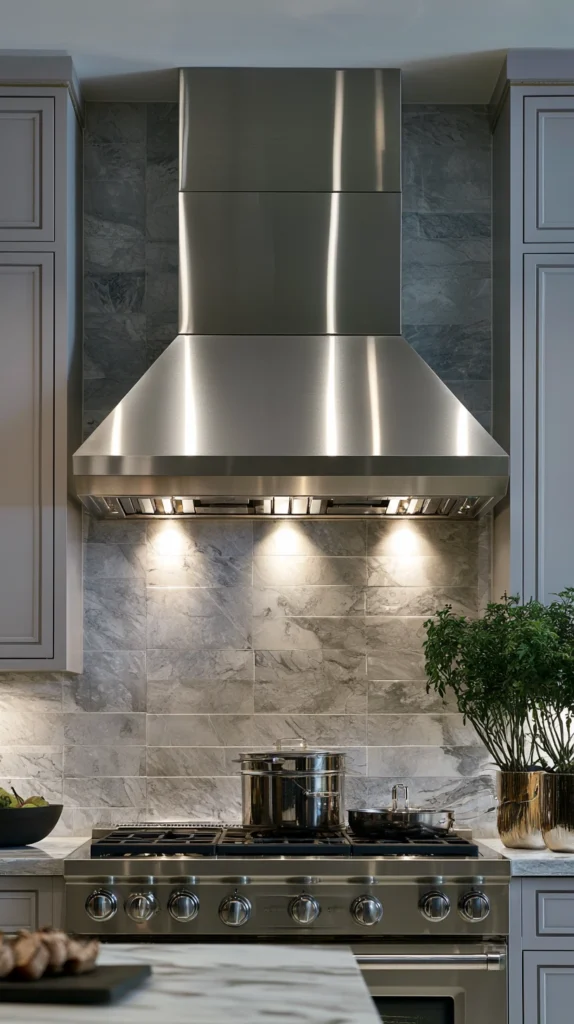
Replacing a dim or single-bulb range hood light with a brighter, warmer LED version — the upgrade aimed at the one surface in the kitchen used every single day, often with the worst lighting in the room.
Why the stovetop is the most overlooked task zone
- The neglected fixture: range hood lighting is frequently the oldest, dimmest light in the kitchen, original to the appliance and never upgraded
- The safety case: good light directly over the stove matters for both visibility and safety while cooking
- The fall cooking case: longer stretches of stovetop cooking — soups, sauces, baking prep — make this the most-used light in the house for months at a time
The options
- LED replacement bulbs for an existing hood fixture, the simplest swap
- A hood with integrated LED strip lighting, for anyone replacing the hood itself rather than just the bulb
- Dimmable hood lights, useful for late-evening cooking when full brightness isn’t needed
- A night-light setting, available on some hoods, for low-level light without the full fixture on
The practical execution
- Check the hood’s maximum wattage rating before installing a brighter bulb
- Match the bulb’s color temperature to the rest of the kitchen (Idea #2)
- If replacing the entire hood, confirm the new unit’s lighting is on a separate switch from the fan
Cost breakdown
- Replacement LED bulb(s) for an existing hood: $8–20
- New hood with integrated lighting: $150–500
- Professional installation, new hood: $150–400
- Total: $8–900, depending on whether it’s a bulb swap or a full hood replacement
10. The Toe-Kick Glow (Ambient Light at Floor Level)
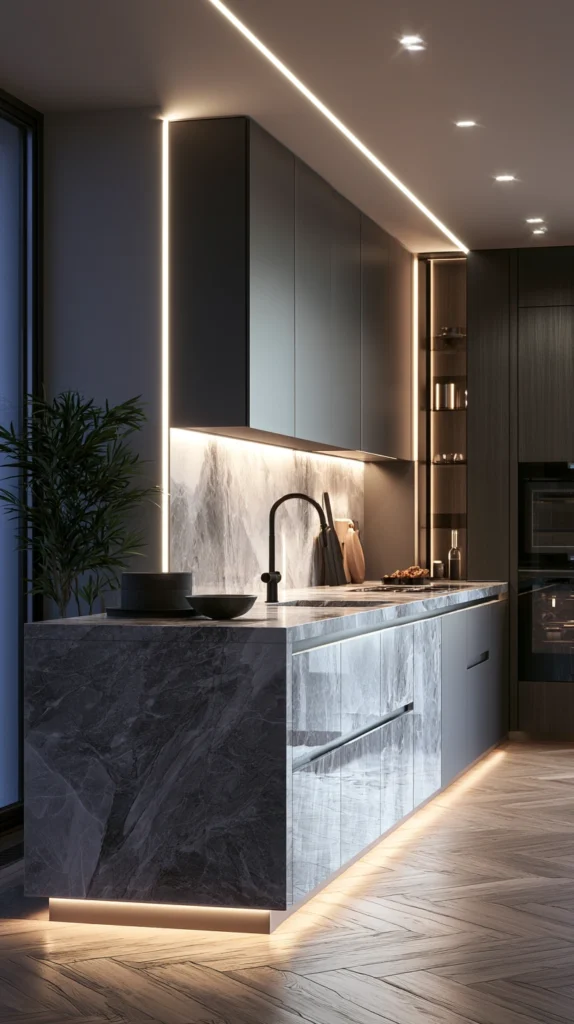
A thin strip of LED light installed along the toe-kick beneath the lower cabinets — the layer most kitchens don’t have, and most people notice within the first few seconds of seeing it.
Why floor-level light matters more than its size suggests
- The unexpected-warmth effect: floor-level light is rare enough in most kitchens that it reads as a deliberate, higher-end design choice
- The night-light function: a low-level toe-kick glow means a midnight glass of water doesn’t require flipping on the kitchen’s full overhead light
- The fall ambiance case: low, warm light at floor level adds exactly the kind of cozy, layered glow that overhead light alone can’t create
The options
- LED tape light — the same product used under upper cabinets, applied to the toe-kick instead
- Motion-activated strips — turn on automatically when someone walks into the kitchen at night
- Dimmable toe-kick light, wired to the same switch as the under-cabinet task light for one combined control
- Battery-powered toe-kick lights, for kitchens where running new wiring isn’t practical
The practical execution
- Recess the light slightly behind the toe-kick’s edge so only its glow is visible, not the fixture itself
- Use a warm color temperature — this light is about ambiance, not task visibility
- Motion sensors should have adjustable sensitivity and timeout settings to avoid triggering constantly during normal kitchen use
Cost breakdown
- Battery-powered toe-kick light kit: $20–40
- Hardwired LED tape light, materials: $30–70
- Professional installation: $100–250
- Total: $20–320
11. The Candle and Lantern Layer (The Lowest-Tech Warmth in the Room)
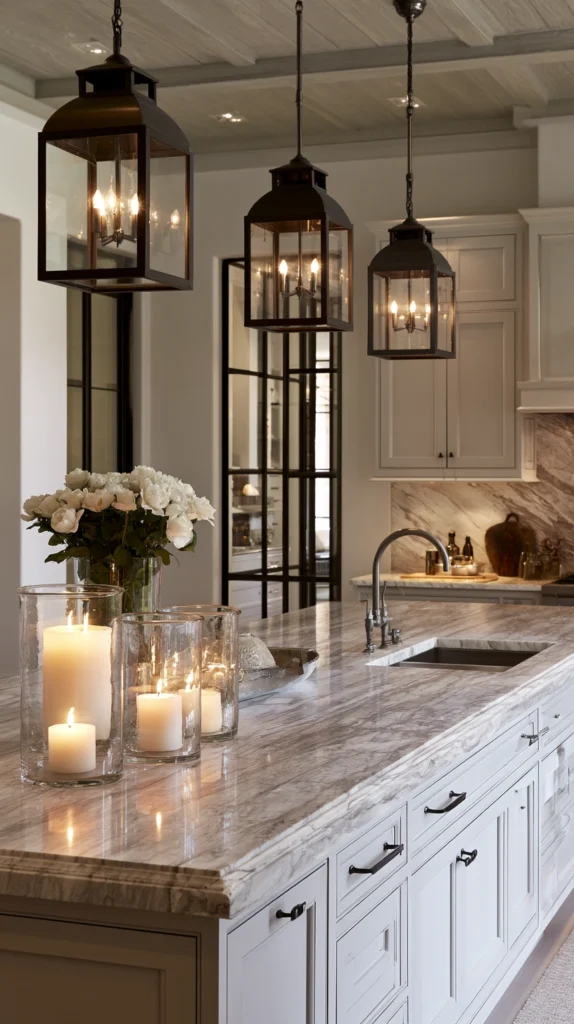
Candles or small lanterns placed on the counter, table, or open shelving — the only light source on this list that requires no electrician, no bulb, and no switch.
Why candlelight still earns a place next to all this wiring
- The flicker effect: nothing else on this list moves and shifts the way an actual flame does, adding a kind of warmth no LED fully replicates
- The lowest barrier to entry: this idea can be added the same day it’s thought of, with no installation step at all
- The fall-specific timing: candlelight pairs with the season more directly than almost any other idea on this list, particularly around gatherings and meals
The options
- Pillar candles in varying heights, grouped for a layered look on a counter or table
- Lanterns with flameless LED candles — the look of candlelight without an open flame near cooking surfaces
- Taper candles in simple holders — a more formal option for the table from Idea #5
- Tealights in small glass votives, scattered along open shelving or a windowsill
The practical execution
- Keep open flames away from the stovetop, paper goods, and anywhere that could catch a draft from the range hood fan
- Flameless candles are the safer choice for anywhere near active cooking
- If scented, choose something the kitchen can handle alongside cooking smells, or stick to unscented near food prep areas
Cost breakdown
- Set of pillar or taper candles: $15–35
- Flameless LED candles: $20–45
- Lanterns or votive holders: $20–50
- Total: $15–130
12. The Smart Bulb Scene (One Switch, Several Moods)
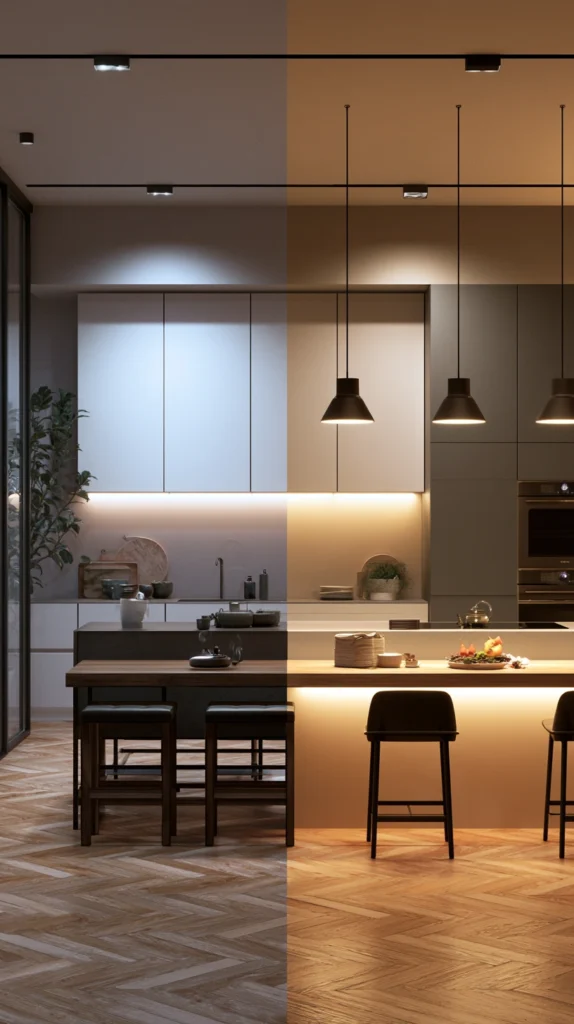
Smart bulbs programmed into a few saved lighting scenes — the upgrade that turns the kitchen’s existing fixtures into several different rooms without installing anything new.
Why a scene matters more than a single setting
- The multi-use kitchen problem: one kitchen serves breakfast prep, homework at the counter, dinner, and late-night gatherings, and very few of those moments want the same light
- The no-new-fixture case: smart bulbs work in the sockets already in the kitchen, layering control on top of what’s already installed rather than adding more hardware
- The fall scheduling case: as sunset moves earlier, a scheduled evening scene can shift the kitchen’s light automatically rather than relying on someone to remember to dim it
The options
- Smart bulbs, screwed directly into existing fixtures, controlled via app or voice
- Smart switches, for fixtures where changing every bulb isn’t practical
- Tunable white bulbs — adjustable not just in brightness but in color temperature, warmer in the evening and cooler during morning prep
- Scheduled scenes, set once and left running automatically through the season
The practical execution
- Start with two or three scenes — cooking, dinner, evening — rather than overcomplicating the system
- Confirm the home’s wifi reaches the kitchen reliably before committing to a full smart bulb rollout
- Keep a manual switch or backup option available in case of a wifi outage
Cost breakdown
- Smart bulb, per bulb: $10–25
- Smart switch: $25–50
- A full kitchen smart lighting setup (8–10 bulbs or a mix of bulbs and switches): $120–300
- Total: $120–300 for a full kitchen, less if upgrading select fixtures only
13. The Counter Lamp (The Softest Light in the Room)
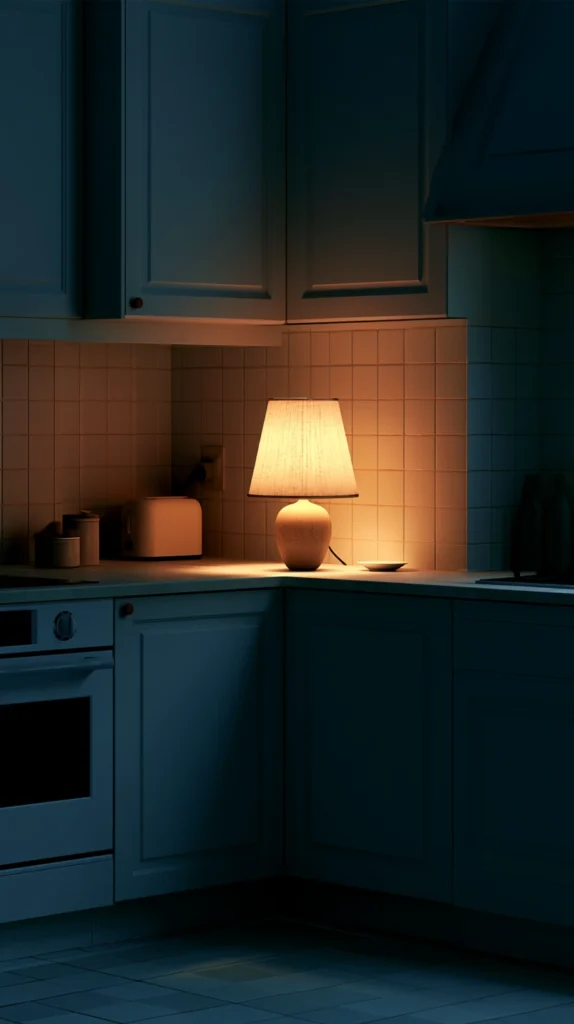
A small table lamp placed on an open stretch of counter or a kitchen desk nook — the least expected light source in the kitchen, and often the warmest one in the room.
Why a lamp earns a spot among all these mounted fixtures
- The non-overhead option: every other light on this list is mounted somewhere; a lamp is the one source that can simply be set down and moved
- The softest available light: a small shaded lamp produces a quality of light no overhead or under-cabinet fixture can match
- The fall evening case: once the rest of the kitchen’s task lighting is off for the night, a single lamp left on is often the only light needed for a late snack or a quiet moment in the room
The options
- A small buffet or accent lamp, scaled to fit a counter without crowding workspace
- A lamp with a fabric shade — softer, more diffused light than a bare bulb or metal shade
- A cordless rechargeable lamp — no outlet required, can sit anywhere on the counter
- A lamp matched to the dining or living room’s lighting style, tying the kitchen visually to the rest of the house
The practical execution
- Choose a base heavy enough not to tip easily on a counter that sees regular activity
- Keep the cord, if corded, routed along the backsplash rather than across the counter
- Pair with a warm, low-wattage bulb — this lamp’s job is ambiance, not task light
Cost breakdown
- Small accent lamp: $25–60
- Cordless rechargeable lamp: $40–90
- Total: $25–90
The counter lamp left on after everything else is switched off: the last warm light in the kitchen, and often the one that makes the room feel finished rather than simply lit.
The Fall Kitchen Lighting Roadmap
The work, sequenced:
Phase One (the fixtures):
- The pendant cluster over the island (#1)
- The statement chandelier over the table (#5)
- The wall sconces (#6)
- The range hood light upgrade (#9)
Phase Two (the control layer):
- The warm bulb swap (#2) — do this first, before judging any other fixture
- The dimmer switch (#3)
- The smart bulb scene (#12)
Phase Three (the task layers):
- The under-cabinet task light (#4)
- The toe-kick glow (#10)
- The in-cabinet glow (#7)
- The open shelving accent light (#8)
Phase Four (the finishing touches):
- The candle and lantern layer (#11)
- The counter lamp (#13)
Getting Started This Weekend
The immediate-impact lighting refresh:
One afternoon, three changes:
- Swap every kitchen bulb to a warm 2700–3000K version (Idea #2)
- Add a candle grouping to the counter or table (Idea #11)
- Set a small lamp on an open stretch of counter (Idea #13)
Total cost: $70–150. Time: about an hour. The kitchen will feel different by dinner, without a single new fixture installed.
The structural lighting investment (the next big purchase):
The pendant cluster over the island (Idea #1) is the single most visible upgrade on this list. Once it’s hung at the right height and scale, it does more to anchor the room than any other fixture — everything else, from the dimmer to the candles, simply layers warmth around it.
What a well-lit fall kitchen provides that no other season’s lighting can:
The light that matches how the room is actually being used:
- A dimmer that drops the room from task-bright to dinner-soft in one motion
- A scene that shifts automatically as sunset creeps earlier through the season
- Task lighting that keeps prep work easy long after daylight is gone
The warmth that announces itself before anyone tastes what’s cooking:
- A bulb temperature that reads as inviting the moment someone walks in
- Candlelight that no LED fully replicates
- A glowing cabinet or shelf that turns everyday dishware into something worth noticing
The connection to the rest of the house:
- A chandelier over the table that ties the kitchen to the formality of the dining room
- A counter lamp that echoes the lighting style used everywhere else
- A toe-kick glow that means no one needs the full overhead light just to cross the room at night
A kitchen’s lighting is not a single fixture chosen once and left alone. It is a system that has to do more work as the days get shorter, and the kitchens that feel warmest in November are rarely the ones with the most expensive fixtures — they’re the ones where every layer, from the bulb to the candle, was actually considered. The pendant hung at the right height is still doing its job in February. The lamp switched on after everything else is off is still the last light in the house before bed.