14 Cozy Daybed Ideas That Instantly Elevate Any Space
There is a piece of furniture that the home consistently underestimates and the body consistently knows it needs.
Not quite a sofa, not quite a bed, not quite a chaise, but something more specific and more generous than any of them — a surface wide enough to lie across fully, soft enough to make the distinction between resting and sleeping genuinely pleasurable, and styled beautifully enough to justify its presence in a room even when no one is using it.

A daybed, done well, is the piece that makes every room it inhabits feel more considered, more comfortable, and more honestly designed around the real needs of real people who occasionally need to do nothing with genuine commitment.
The cosy daybed is a specific version of this piece — one where the warmth of the textiles, the depth of the cushions, and the sense of enveloping softness combine to produce a corner of the home that is genuinely irresistible at the end of a long afternoon. It is not merely a seat. It is a destination.
The fourteen ideas below cover every approach to the cosy daybed — from a single cushioned frame in a bedroom corner to a fully styled reading retreat with a dedicated lamp and a woven basket of books.
1. The Layered Linen and Velvet Daybed
Budget: $300 – $1500
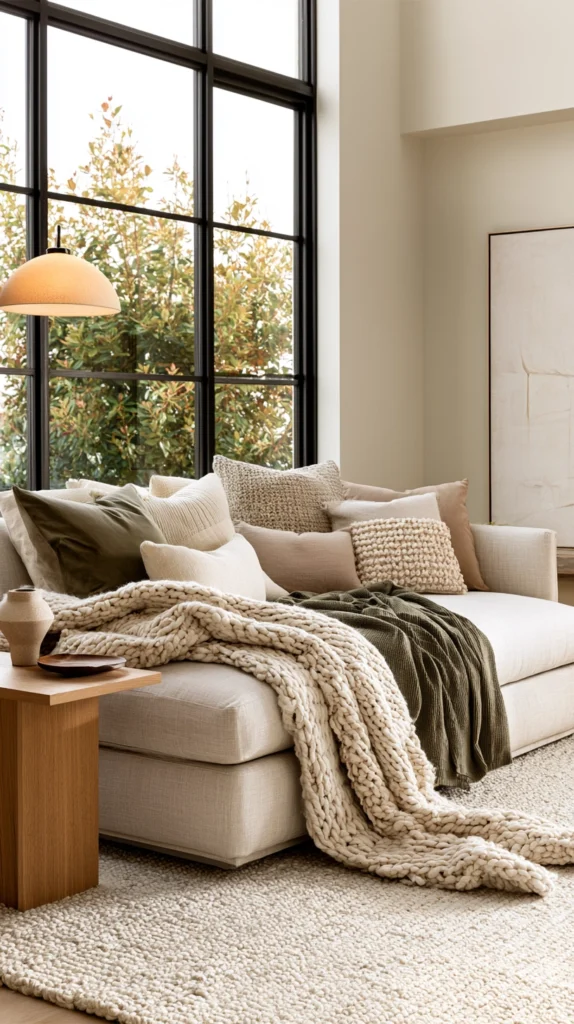
A linen-upholstered daybed frame dressed with a velvet throw and multiple cushions in varying textures — smooth linen, deep velvet, woven cotton, and a chunky knit — is the cosy daybed in its most texturally generous and most immediately beautiful form. The combination of the linen base and the velvet throw is one of the most specifically warm material pairings available, each fabric absorbing light differently and producing a surface that looks more layered and more intentional from a distance than any single-material arrangement.
A linen daybed frame costs $300 – $900. A velvet throw in a complementary deep tone — $40 – $120. Four to six cushions in varying sizes and textures — $20 – $60 each. A chunky knit cushion or blanket — $30 – $80. Total layered linen and velvet daybed investment: $470 – $1400 for a piece that reads as genuinely luxurious at every viewing distance and from every angle.
Styling tip: Arrange the daybed cushions in decreasing size from the back to the front — the largest bolster or square cushion at the back, medium cushions in the middle layer, and a small accent cushion or a rolled throw at the front. This front-to-back size graduation produces a daybed that reads as deliberately arranged rather than casually cushioned, and the depth of the layered arrangement communicates the specific quality of a surface that is genuinely prepared for someone to sink into.
2. The Reading Nook Daybed With Canopy
Budget: $200 – $1200
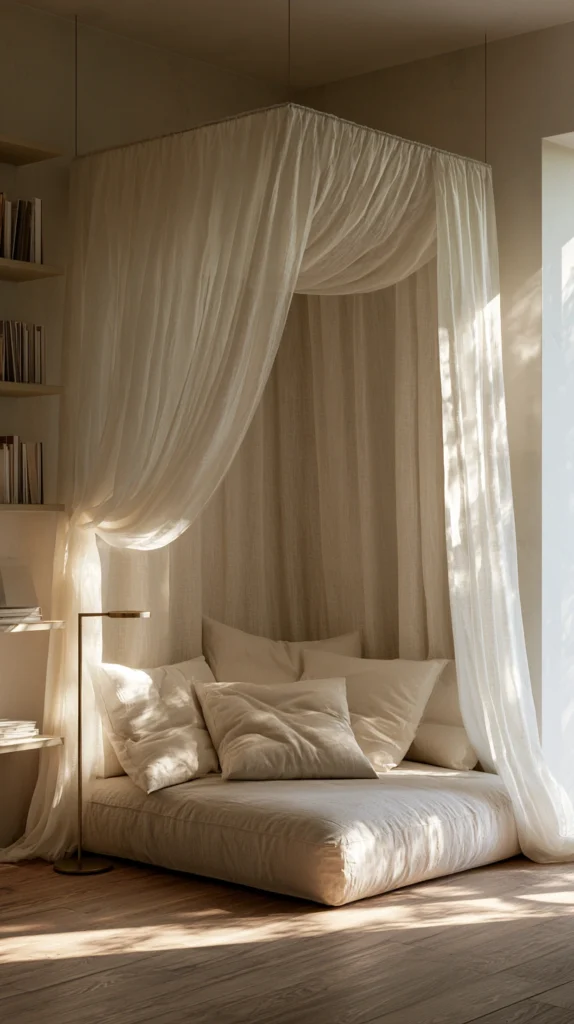
A daybed positioned in a quiet corner with a fabric canopy gathered from the ceiling above — sheer linen or cotton muslin falling on two or three sides, filtering the light and creating a sense of gentle enclosure — is the cosy daybed at its most specifically intimate and its most deliberately separated from the rest of the room. The canopy does not need to be elaborate. A few metres of sheer fabric attached to a ceiling hook and allowed to fall naturally on either side of the daybed is sufficient to transform an open-plan corner into something that feels genuinely private.
A daybed frame — $200 – $600. A ceiling canopy ring — $10 – $25. Sheer muslin or linen fabric — $3 – $8 per metre, eight to twelve metres required — $24 – $96 in total. A warm-toned cushion arrangement — $80 – $200. Fairy lights woven through the canopy fabric — $10 – $25. Total canopy daybed investment: $324 – $946 for a room corner that is the most desired seat in the house.
Styling tip: Choose a canopy fabric that is at least slightly translucent — a cotton voile, a linen gauze, or a fine muslin — rather than a fully opaque material. A translucent canopy creates the sense of enclosure without complete visual separation from the room — the occupant feels sheltered rather than isolated, and the light that filters through the fabric takes on the warmth of whatever colour the fabric carries. An opaque canopy produces a genuinely private space that suits some contexts and feels claustrophobic in others.
3. The Boho Daybed With Floor Cushions
Budget: $150 – $800
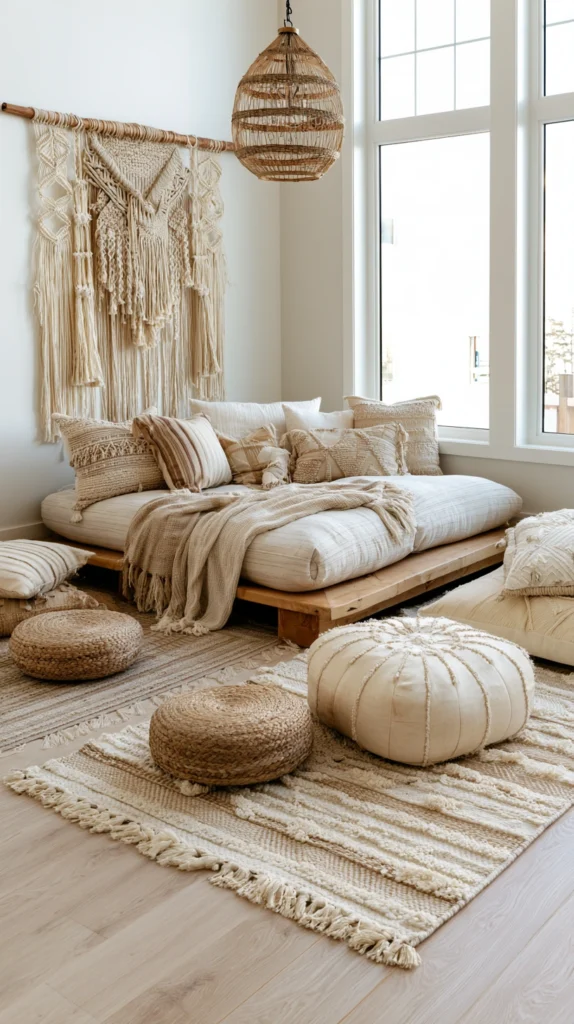
A low, wide daybed or a floor-level platform supplemented with large floor cushions and poufs arranged around its base — creating a ground-level seating and resting zone that is as wide as the daybed and the cushions combined — is the most generously scaled and the most socially inclusive version of the cosy daybed. It accommodates more than one person, encourages the specific quality of relaxation that low seating produces, and creates a room corner of considerable textural and visual warmth.
A low daybed frame or platform — $100 – $300. Large floor cushions in earthy or jewel tones — $30 – $80 each, three to four required. A kilim or flatweave rug beneath the arrangement — $50 – $150. A macramé or woven wall hanging above the daybed — $40 – $120. Throws and small cushions for additional layering — $20 – $60 each. Total boho daybed investment: $290 – $830 for a room corner that is as beautiful as it is comfortable.
Styling tip: Layer the rug beneath the boho daybed arrangement in two pieces — a large jute or seagrass base rug and a smaller kilim or vintage-style rug on top — so that the floor beneath the daybed zone reads as a defined, textured, and considered surface. A single rug beneath a floor-level daybed arrangement provides definition. Two layered rugs provide the sense of an accumulated, lived-in warmth that is the boho aesthetic’s most convincing quality.
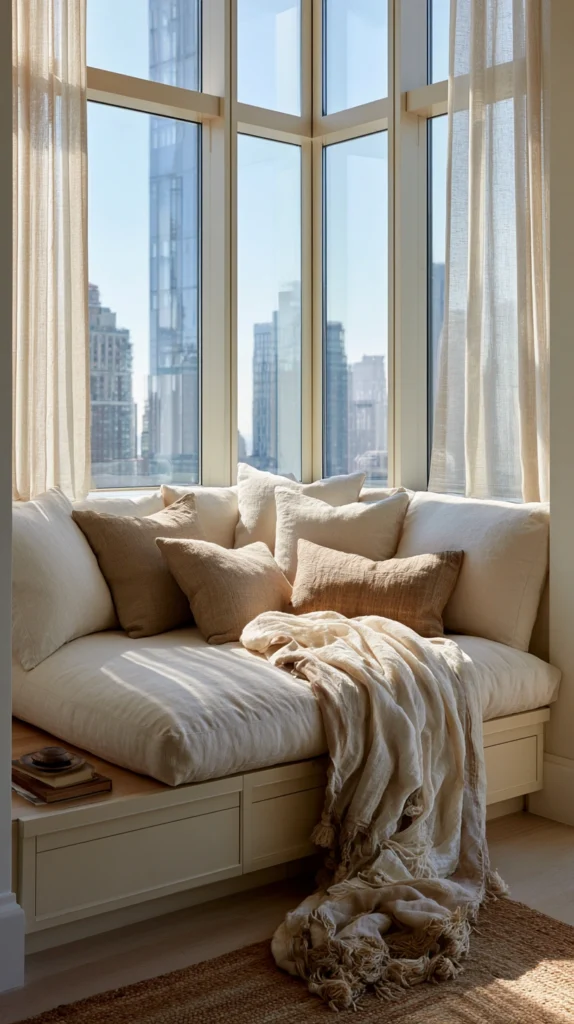
4. The Window Seat Daybed
Budget: $400 – $3000
A daybed built into or positioned beneath a window — where the natural light falls across the cushion surface and the view from the horizontal position includes the garden, the street, or the sky — is the cosy daybed at its most specifically pleasurable. There is a quality of afternoon that belongs exclusively to lying on a cushioned surface beneath a window with adequate natural light and something worth watching beyond the glass that no other interior position replicates.
A custom-built window seat daybed with storage drawers — $800 – $3000 professionally constructed. A standard daybed positioned against a window wall — $400 – $1000. A fitted cushion across a window alcove — $200 – $500 from an upholstery specialist. A set of coordinating cushions — $80 – $200. Sheer curtain panels on either side of the window that frame rather than obscure the light — $25 – $60 per panel.
Styling tip: Position the window daybed so that the occupant’s head is toward the room rather than toward the window — lying with the head toward the wall below the window and the feet toward the room. This position allows the occupant to look up through the window at the sky rather than having the window light directly in the eyes, and it produces the most comfortable and the most specifically beautiful quality of lying-down reading that the window daybed can offer.
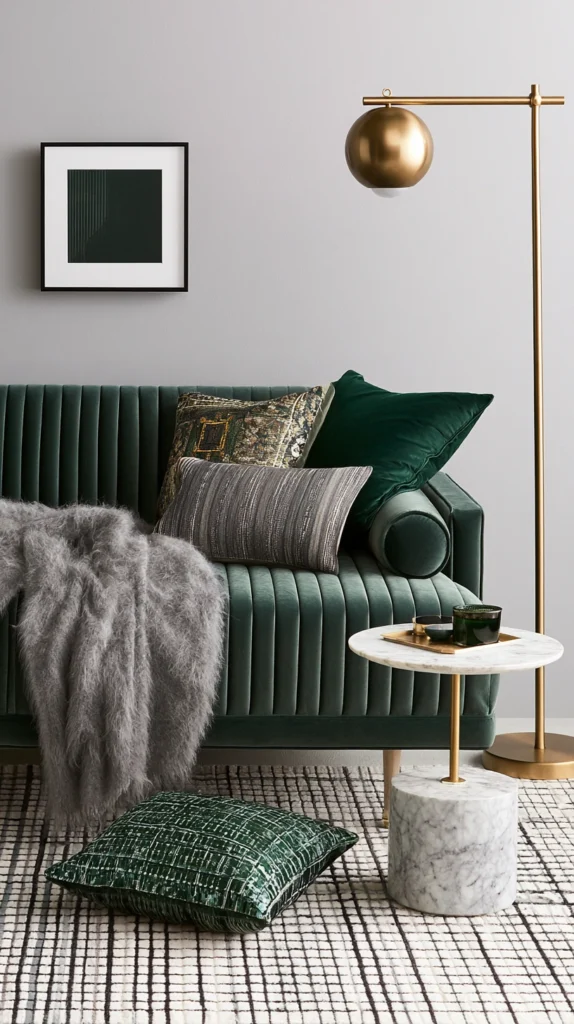
5. The Velvet Tufted Cosy Daybed
Budget: $400 – $2000
A velvet tufted daybed — channel-tufted or button-tufted in a deep jewel tone, a warm dusty rose, or a forest green — is the cosy daybed that communicates the most immediately about the room’s commitment to warmth and genuine comfort. Velvet is the most specifically luxurious of the standard upholstery fabrics and tufting is the most specifically considered of the upholstery techniques, and their combination in a daybed produces a piece of furniture that reads as genuinely special rather than merely comfortable.
A velvet channel-tufted daybed costs $400 – $1200. A button-tufted version — $500 – $1500. A cashmere or mohair throw draped across one end — $80 – $300. A silk or embroidered accent cushion — $30 – $80. A small side table with a warm lamp beside the daybed — $30 – $80 for the table, $40 – $100 for the lamp. Total velvet tufted daybed investment: $580 – $1980 for the room’s most specifically luxurious resting surface.
Styling tip: Choose the velvet daybed colour in direct relationship to the room’s wall colour — either two to three shades deeper than the wall for a tonal relationship, or a direct complementary colour for a contrasting one. A velvet daybed that shares its colour family with the room’s walls reads as designed. One that introduces an entirely unrelated colour reads as placed — which is a subtle but important distinction in the quality of the room’s overall aesthetic coherence.
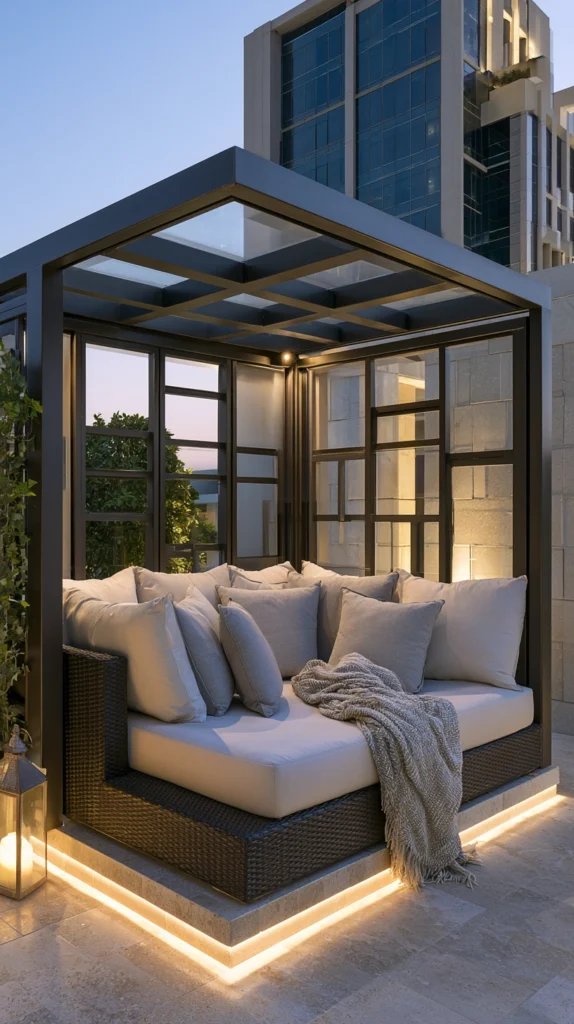
6. The Outdoor Cosy Daybed
Budget: $300 – $1500
An outdoor daybed — a weather-resistant frame with thick, quick-dry cushions, a canopy above providing shade, and a selection of outdoor cushions and a cotton throw for the cooler hours of the afternoon — brings the quality of the cosy indoor daybed to the garden or the terrace and makes the specific pleasure of lying down outside in good weather a genuinely comfortable and a genuinely styled experience.
A synthetic rattan outdoor daybed with cushion — $300 – $800. A canopied version — $400 – $1200. All-weather cushions in a fade-resistant outdoor fabric — $100 – $300 if not included. An outdoor cotton throw — $40 – $80. Two to three outdoor cushions — $30 – $60 each. A shade sail above the daybed position — $40 – $100. Total outdoor cosy daybed investment: $510 – $1540 for a garden or terrace destination that is used on every warm day.
Styling tip: Keep a woven basket beside the outdoor daybed permanently stocked with sunscreen, a pair of sunglasses, a lightweight blanket for the cooler hours, and a small book — so that the daybed is genuinely ready for use at any moment without requiring a trip back into the house. An outdoor daybed that is permanently equipped for use is used consistently. One that requires preparation before each use is used occasionally.
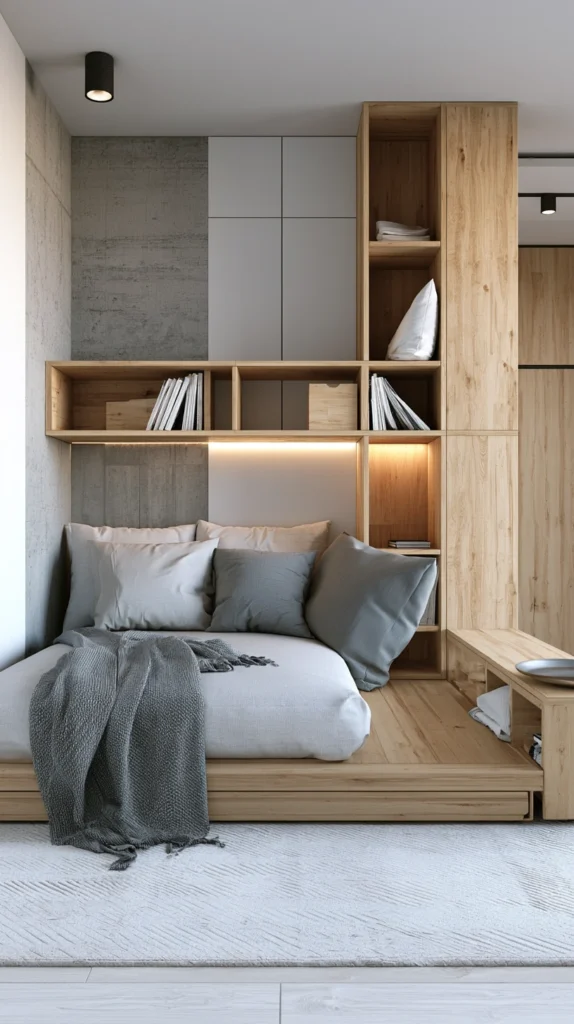
7. The Studio Apartment Daybed
Budget: $200 – $1000
In a studio apartment or a single-room living space, a daybed performs the most specifically useful function available to any piece of furniture — it is simultaneously the sofa for daytime use and the guest bed for overnight visitors, and it does both without requiring any additional furniture or any significant floor space beyond its own footprint. A well-chosen studio daybed also provides the visual separation between the sleeping zone and the living zone that a studio apartment consistently needs.
A daybed with a trundle — $400 – $1000 — converts from a single sleeping surface to a double for guests. A daybed without trundle but with storage drawers — $300 – $800 — provides the guest sleeping function on the main surface and the storage function in the base. A compact minimalist daybed in a pale upholstery — $200 – $500 — is the smallest and the lightest version appropriate for the smallest studio spaces.
Styling tip: Dress the studio apartment daybed in the day mode — as a sofa — with cushions arranged for sitting rather than sleeping, a throw draped for visual warmth rather than practical warmth, and the sleeping surface partially hidden by the arrangement. The transition from sofa mode to sleeping mode should take fewer than five minutes — and a daybed that can be converted quickly and completely is the studio apartment’s most specifically practical furniture piece.
8. The Children’s Cosy Reading Daybed
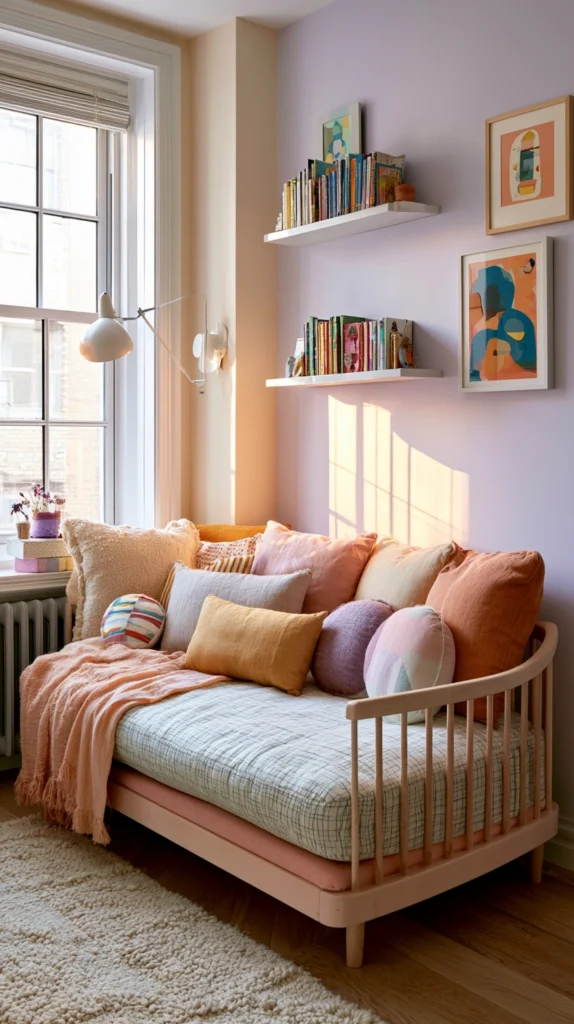
Budget: $150 – $700
A daybed in a children’s bedroom or a playroom — positioned as a dedicated reading and resting surface rather than a secondary sleeping solution — gives the child’s room a specific comfort destination that the main bed, being primarily a sleeping surface, cannot fully provide. A child who has a comfortable place to read in their room reads more often, rests more willingly, and has a stronger sense of ownership of the room’s different zones.
A simple timber or painted metal daybed for a child’s room — $150 – $400. A thick mattress topper — $40 – $80 — for genuine reading comfort. Three to four cushions in the child’s chosen colours — $15 – $40 each. A lightweight cotton throw — $20 – $50. A small woven basket for books beside the daybed — $15 – $30. A wall-mounted reading light above the daybed — $20 – $50. Total children’s reading daybed: $260 – $650.
Styling tip: Involve the child in choosing the daybed’s cushion covers and throw — allowing them to select from a curated range rather than from the unlimited options of a homeware website. A curated selection produces a choice the child feels genuinely ownership of. An unlimited selection produces decision paralysis and often results in a choice the child is less committed to after the fact. The curation is the parent’s creative contribution. The final choice belongs to the child.
9. The Sunroom or Conservatory Daybed
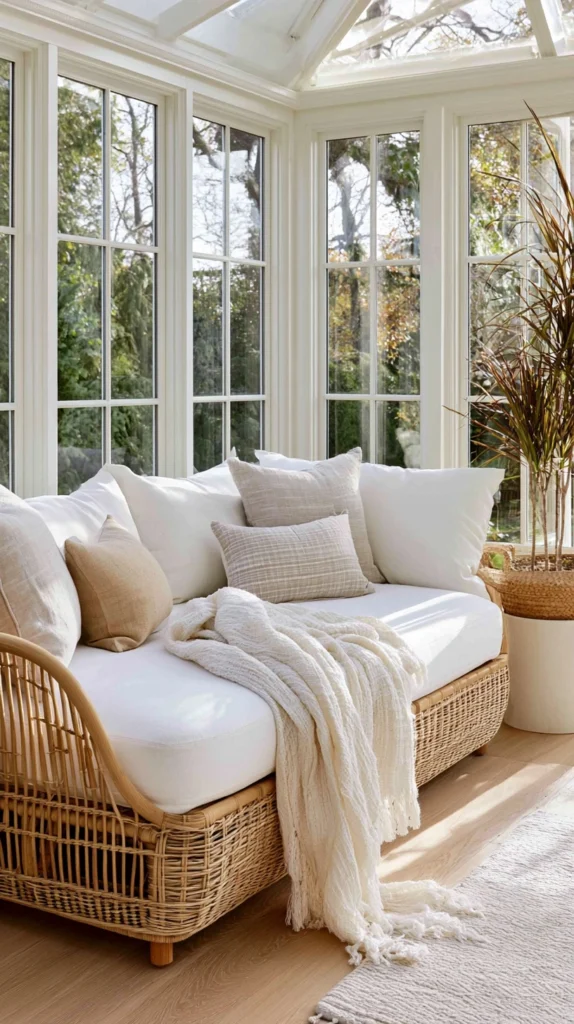
Budget: $300 – $1500
A daybed in a sunroom or conservatory — the room that is most naturally suited to horizontal afternoon occupation — is the cosy daybed at its most contextually appropriate and its most specifically pleasurable. A glass-walled room with a daybed and good afternoon light is one of the most genuinely enjoyable domestic environments available in a temperate climate, combining the warmth and the light of the outdoors with the comfort and the shelter of the indoors.
A rattan or timber daybed for a sunroom — $300 – $800. An all-weather or water-resistant cushion — $100 – $250. A lightweight cotton or linen throw — $30 – $80. A trailing plant positioned to partially shade one end of the daybed during the hottest afternoon hours — $15 – $40 for the plant, $10 – $25 for the pot. Total sunroom daybed investment: $455 – $1195 for the home’s most specifically sun-filled resting destination.
Styling tip: Position the sunroom daybed to receive the afternoon light from the side rather than directly overhead or directly in the face. Side-lit afternoon light on a daybed surface is warm, directional, and flattering — the light crossing the cushion surface and producing shadows that communicate texture and depth. Overhead light flattens the cushion surface. Direct light in the face makes the position uncomfortable within twenty minutes regardless of how beautifully the daybed is styled.
10. The Bedroom Reading Retreat Daybed
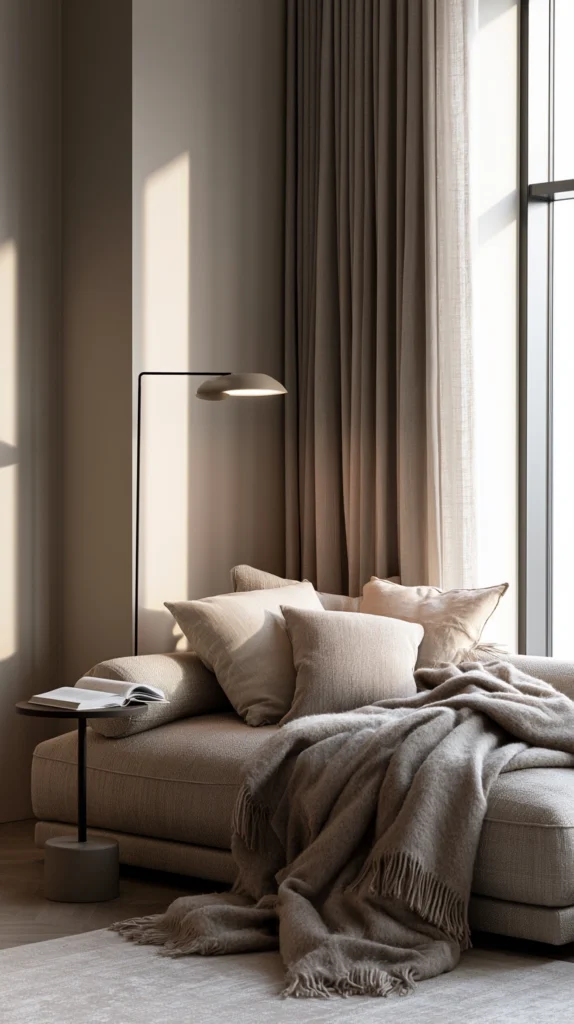
Budget: $400 – $1500
A daybed in the bedroom corner — positioned as a dedicated reading and resting zone entirely separate from the main bed — gives the bedroom a second destination and transforms it from a room with a single purpose into a genuinely multifunctional space. A bedroom with a daybed in the reading corner is a room the occupant chooses to spend time in during the day rather than only at night — which is the definition of a bedroom that has been genuinely designed rather than merely furnished.
A comfortable daybed with a slightly reclining back or a generous bolster — $400 – $1000. A floor lamp positioned at the correct reading height — $60 – $150. A small side table for a cup of tea and a stack of books — $30 – $80. Two or three cushions arranged for reading support — $20 – $50 each. A cashmere or merino throw — $80 – $200. Total bedroom reading daybed: $610 – $1530.
Styling tip: Choose the bedroom daybed’s position by sitting temporarily in each candidate location at the time of day the reading will most frequently occur and assessing the quality of the natural light, the view within the room, and the sense of distance from the main bed — a physical separation of at least two metres between the sleeping zone and the reading zone produces a genuinely distinct second destination. Less than two metres produces a corner that reads as an extension of the bed zone rather than an independent destination.
11. The Moroccan-Inspired Daybed

Budget: $200 – $1000
A low, wide platform in a warm timber or painted in terracotta or deep teal — covered with bolsters and floor cushions in richly patterned Moroccan-influenced textiles, lanterns on either side, and a low carved side table at one end — is the cosy daybed at its most culturally specific and its most transportingly warm. It communicates a quality of afternoon that belongs to another latitude entirely and produces a corner of the home that feels genuinely removed from its domestic context.
A low timber platform — $100 – $300. Floor cushions and bolsters in patterned outdoor-or indoor-grade fabric — $30 – $80 each, four to six required. A kilim or flat-weave rug beneath the platform — $50 – $150. Lanterns on either side — $15 – $40 each. A low carved or rattan side table — $30 – $80. Total Moroccan daybed investment: $270 – $830 for a room corner that transports its occupant.
Styling tip: Use the Moroccan daybed’s textile palette to communicate warmth rather than simply pattern — choosing cushion fabrics in deep terracotta, warm saffron, aged burgundy, and the particular deep teal of Moroccan tilework rather than the brighter, more saturated colours of commercially produced Moroccan-inspired accessories. Muted, slightly aged versions of these tones produce a corner that reads as genuinely considered. Saturated, highly commercial versions of the same palette read as themed.
12. The Scandi Minimalist Cosy Daybed
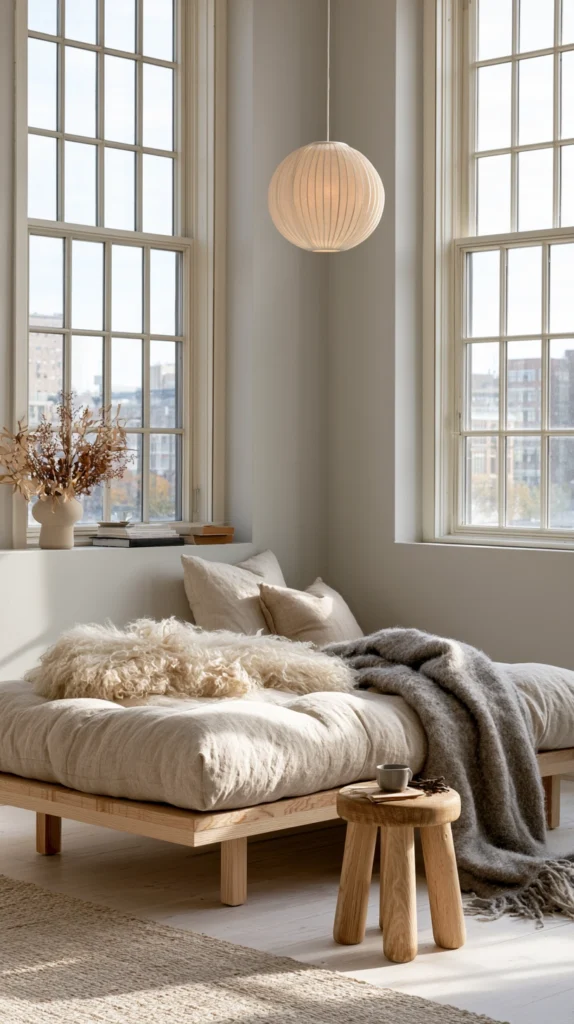
Budget: $200 – $1000
A Scandinavian-influenced minimalist daybed — a clean-lined frame in pale oak or birch, with a single thick cushion in a warm white or oatmeal linen, a sheepskin draped across one end, and a simple wool throw in a warm grey or a dusty sage — is the cosy daybed at its most quietly beautiful and its most specifically Scandi in character. The hygge quality of this piece is immediate — the natural materials, the neutral palette, and the sense of deliberate warmth within deliberate restraint producing a corner that is genuinely inviting without making any effort to advertise the fact.
A pale timber minimalist daybed — $200 – $600. A thick linen cushion in oatmeal or warm white — $80 – $200. A natural sheepskin — $50 – $120. A wool throw in warm grey or dusty sage — $40 – $100. A small solid timber side table — $30 – $80. A warm-toned ceramic lamp — $40 – $100. Total Scandi minimalist daybed: $440 – $1200.
Styling tip: Resist the impulse to add more cushions or more accessories to the Scandi minimalist daybed beyond what the format calls for. The minimalist daybed’s cosy quality is produced by the quality and the warmth of the few materials it uses rather than by the quantity of textiles layered across it. One good sheepskin and one good wool throw communicate hygge more effectively than five cushions of varying quality in the same palette.
13. The Maximalist Layered Daybed
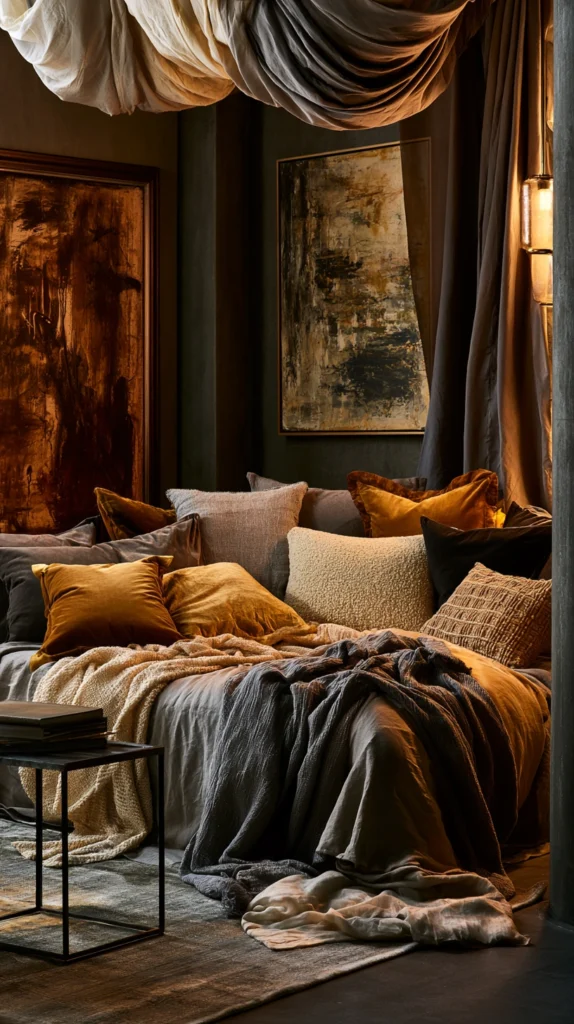
Budget: $300 – $1500
A maximalist daybed — a generous frame covered with an abundance of cushions in every size and textile type the room’s palette accommodates, multiple throws layered over the back and the seat, a canopy above if the room allows it, books stacked on the side table beside a ceramic lamp and a small plant — is the cosy daybed at its most unashamedly committed to the idea that more warmth, more softness, and more textile richness are always better than less.
A generous daybed frame — $300 – $800. Eight to ten cushions in varying sizes, fabrics, and tones within the room’s palette — $15 – $60 each. Two to three throws in complementary materials — $30 – $80 each. A canopy of sheer fabric above — $30 – $80 in fabric. Books, a ceramic lamp, and a small plant beside the daybed — $50 – $150 in total. Total maximalist daybed: $560 – $1,530 for the room’s most unambiguously warm and most specifically generous resting surface.
Styling tip: Maintain one principle of consistency within the maximalist daybed’s abundance — a consistent colour palette, or a consistent material warmth level, or a consistent tonal range — so that the layering reads as deliberately accumulated rather than randomly collected. Maximalism with one consistent principle reads as curated. Maximalism without any consistent principle reads as disorganised. The single consistent thread is what separates the two outcomes.
14. The Fully Realised Cosy Daybed Retreat
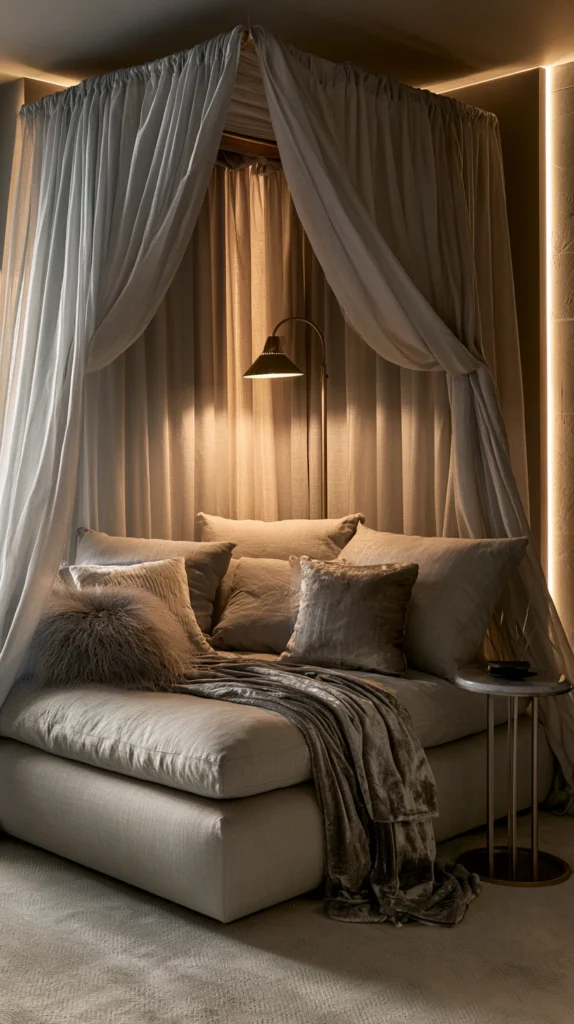
Budget: $600 – $3000
The fully realised cosy daybed retreat — a quality daybed frame in the right material for the room’s aesthetic, a cushion depth and composition that makes lying for two hours genuinely comfortable, a canopy or a partial enclosure that separates the daybed zone from the rest of the room, a dedicated warm light source at the correct height and position for reading, a side table within arm’s reach with a small plant and room for a cup, a woven basket on the floor beside the daybed containing three books and a spare throw, and a textile arrangement layered in at least three different fabrics — is not a piece of furniture that has been placed in a room. It is a destination that has been designed within one.
Daybed frame: $300 – $1000. Cushion arrangement — six to eight pieces: $120 – $400. Canopy or enclosure: $30 – $150. Floor lamp: $60 – $200. Side table: $30 – $100. Plant and ceramic pot: $20 – $60. Woven book basket: $20 – $50. Throws and additional textiles: $80 – $250. Total fully realised daybed retreat: $660 – $2,210.
Styling tip: Assess the daybed retreat from the position of lying on it — head at one end, feet at the other, in the actual resting position the piece was designed to accommodate — before considering the styling complete. The quality of the view from the horizontal position, the quality of the light source at reading angle, and the reachability of the side table from the lying position are the three measures of a daybed retreat that is genuinely successful rather than merely beautiful from the standing assessment that most furniture decisions receive. If all three are correct, the daybed is finished. If any one of them is not, the styling is not yet done.
A cosy daybed that has been genuinely thought about — positioned for the best light, cushioned to the correct depth, given its own dedicated lamp and its own side table, layered with textiles that invite rather than merely decorate, and situated in a position within the room that makes it a genuine destination rather than a secondary seat — is the piece that changes the quality of the home’s daily life more directly and more immediately than almost any other furniture investment.
It asks one thing in return for what it gives. It asks to be used — not preserved, not admired from a distance, not kept tidy for the possibility of a visitor who might happen to sit on it. It asks to be lain on in the afternoon, fully, completely, with a book or without one, for as long as the afternoon allows.
That is what it was made for. Give it the opportunity and it will deliver everything it promised.