15 Butter Yellow Room Ideas for a Warm Cheerful Space
There is a yellow that does not work in interiors — the sharp, acidic yellow that reads as aggressive under artificial light and exhausting in quantity — and there is a yellow that works extraordinarily well, and that yellow is butter. Warm, slightly muted, creamy at its lighter end and golden at its deeper end, butter yellow sits at the intersection of warmth and calm in a way that no other colour on the spectrum quite manages.

It has the emotional temperature of morning light through a thin curtain, of honeycomb held up to the sun, of a kitchen that has been cooking something good for a long time. It communicates cheer without effort and warmth without weight, and it does these things in every room it is applied to with a consistency that more fashionable colours rarely sustain.
The fifteen ideas below cover every room and every application of butter yellow — from a single painted wall to a fully committed room scheme — and each one is built on the principle that butter yellow works best when it is treated as a warm neutral rather than an accent colour. Each idea covers what you will need, what it will cost, and a practical tip to make it genuinely work in a real room rather than a paint manufacturer’s advertisement.
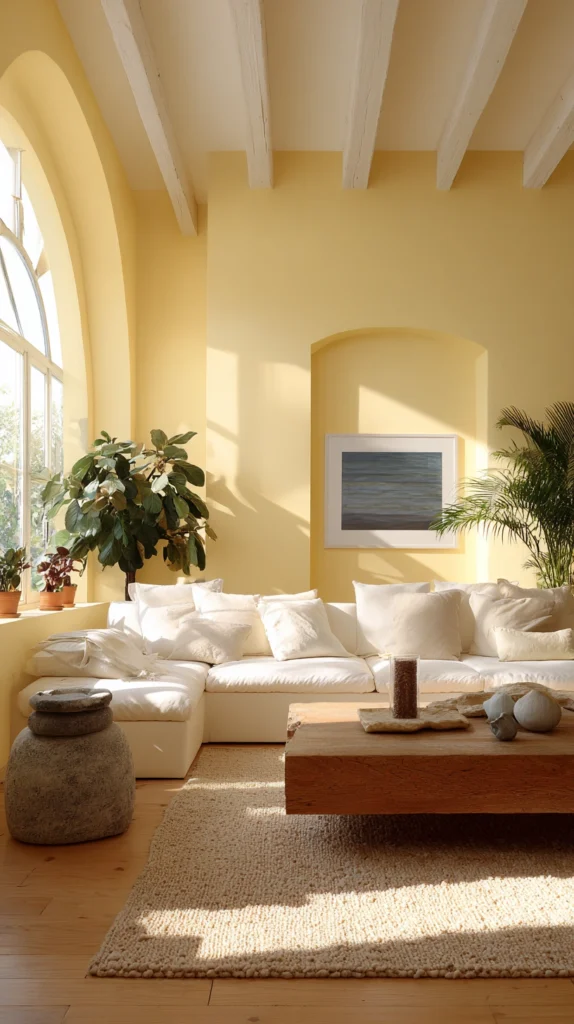
1. The Butter Yellow Living Room Walls
Budget: $50 – $300
A living room painted in butter yellow — all four walls, the ceiling taken one shade lighter, the woodwork in a warm white — is the most committed and the most rewarding application of the colour. It produces a room that feels lit from within even on overcast days, that makes the people sitting in it look warm and well, and that photographs in a way that feels immediately inviting regardless of the furniture or the objects inside it. Butter yellow walls are the room’s permanent sunshine, available in every season and at every hour.
A quality interior paint in a butter yellow tone — Benjamin Moore Hawthorne Yellow, Farrow and Ball Dayroom Yellow, or Little Greene’s Pale Gold are all reliable starting points — costs $30 – $80 per litre in premium brands. A standard living room requires three to four litres for two coats. A 2.5 litre tin of a mid-range alternative costs $25 – $50 and covers the same area with equivalent quality. The ceiling taken one tone lighter — a very pale butter white — costs one additional litre at $15 – $30 and prevents the room from feeling enclosed despite the warm wall colour.
Decorating tip: Test butter yellow paint in a large swatch — at least 40 centimetres square — on the actual wall and observe it at three different times of day before committing to the full room. Butter yellow reads very differently in morning light, midday light, and artificial evening light — the same paint can appear fresh and creamy in the morning and distinctly golden in the evening. Both readings should be acceptable before the full room is painted, because the room will be used in all lighting conditions and the colour will be different in each.
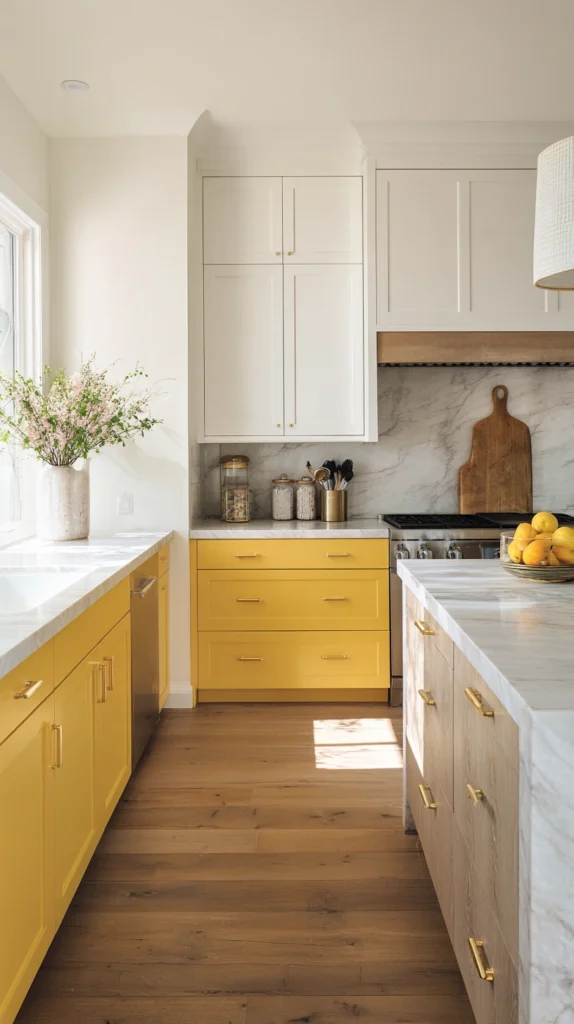
2. The Butter Yellow Kitchen Cabinetry
Budget: $100 – $2000
Kitchen cabinetry painted in butter yellow — either all cabinets in a smaller kitchen, or the lower cabinets with white or cream uppers in a larger one — produces a kitchen that feels warm, vintage, and genuinely welcoming in a way that white or grey cabinetry consistently fails to achieve. The butter yellow kitchen is the aesthetic descendant of the traditional farmhouse kitchen and the Shaker kitchen, and it carries those associations of abundance, generosity, and time spent cooking with genuine pleasure.
Repainting existing kitchen cabinets in a butter yellow chalk paint or specialist kitchen paint costs $80 – $200 in materials for a standard kitchen — the paint, the primer, the fine-grit sandpaper, and the sealing lacquer. A professional repaint of existing cabinetry runs $500 – $1500 depending on the number of doors and the complexity of the profile. New cabinetry specified in a butter yellow factory finish from a bespoke kitchen supplier costs $3000 – $15000 for a full kitchen — but the colour can be achieved on a fraction of that budget by repainting what is already there.
Decorating tip: Pair butter yellow cabinetry with hardware in an aged brass or unlacquered brass finish rather than chrome or brushed nickel. Cool metal tones pull against the warmth of butter yellow and create a colour temperature conflict that registers as slightly wrong without the observer being able to identify why. Warm brass hardware in the same yellow-gold family as the cabinetry colour pulls the whole kitchen into a coherent warm palette that feels resolved rather than assembled.
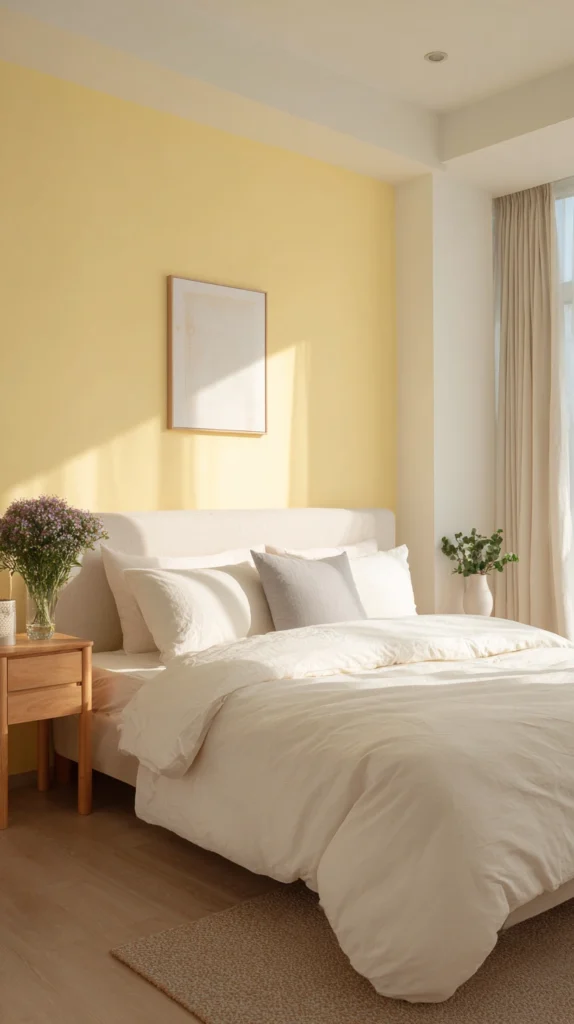
3. The Butter Yellow Bedroom Feature Wall
Budget: $30 – $100
A single butter yellow feature wall behind the bed — the headboard wall, painted while the remaining three walls stay white or a very pale cream — introduces the warmth and the cheer of the colour without the full commitment of a four-wall application. It frames the bed as the room’s focal point, creates a warm backdrop against which bedlinen in white, cream, and natural linen reads beautifully, and produces the particular quality of morning light that makes waking up in a butter yellow room one of the more pleasant domestic experiences available.
A single feature wall requires one to one and a half litres of paint — $15 – $40 depending on brand and quality. The preparation — filling any imperfections, sanding lightly, applying one coat of primer if the existing wall is a significantly different colour — adds $10 – $20 in materials and an hour of time. A second coat applied the following day ensures full coverage and depth of colour. The total investment for a butter yellow bedroom feature wall sits at $25 – $60 — among the most cost-effective single room transformations available.
Decorating tip: Extend the butter yellow feature wall colour onto the ceiling above the bed by approximately 30 centimetres — wrapping it onto the ceiling plane rather than stopping precisely at the wall-ceiling junction. This technique, borrowed from professional interior designers, makes the coloured wall feel architectural rather than applied and creates a sense that the paint was always there rather than added. The 30-centimetre ceiling band costs nothing extra and takes five minutes with a steady hand and a good cutting-in brush.
4. The Butter Yellow Hallway
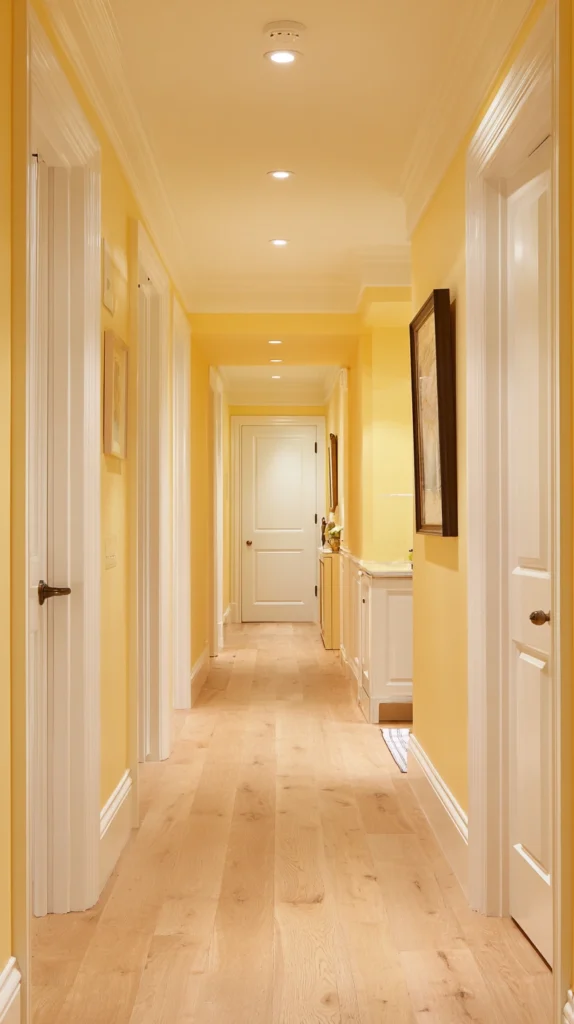
Budget: $40 – $200
A hallway painted in butter yellow is the single most impactful use of the colour in any home because the hallway is the first interior space encountered and the one that sets the emotional tone for everything that follows. A butter yellow hallway communicates warmth from the moment of entry — before a single room has been seen, before a piece of furniture has registered, before the occupant has said a word. It is the home’s first and most persistent impression, and butter yellow makes that impression a consistently cheerful one.
Hallways tend to be long and narrow, which means a single tin of paint — 2.5 litres at $25 – $60 — covers the space adequately in two coats. The woodwork — skirting boards, door frames, and dado rail if present — painted in a warm white rather than a bright white maintains the warm palette and prevents the sharp contrast that bright white woodwork creates against a yellow wall. A warm white gloss for woodwork costs $15 – $30 per litre and is the detail that determines whether the hallway reads as coherently warm or slightly discordant.
Decorating tip: Use an eggshell finish rather than a matt finish in a hallway application of butter yellow. Hallways receive more physical contact — shoulders, bags, hands — than most rooms, and a matt painted wall marks and scuffs in ways that an eggshell finish does not. Eggshell reflects light slightly more than matt, which in a narrow hallway is an additional benefit — the slight sheen catches the light and makes the space feel fractionally wider and brighter than the same paint in a flat finish.
5. The Butter Yellow Ceiling
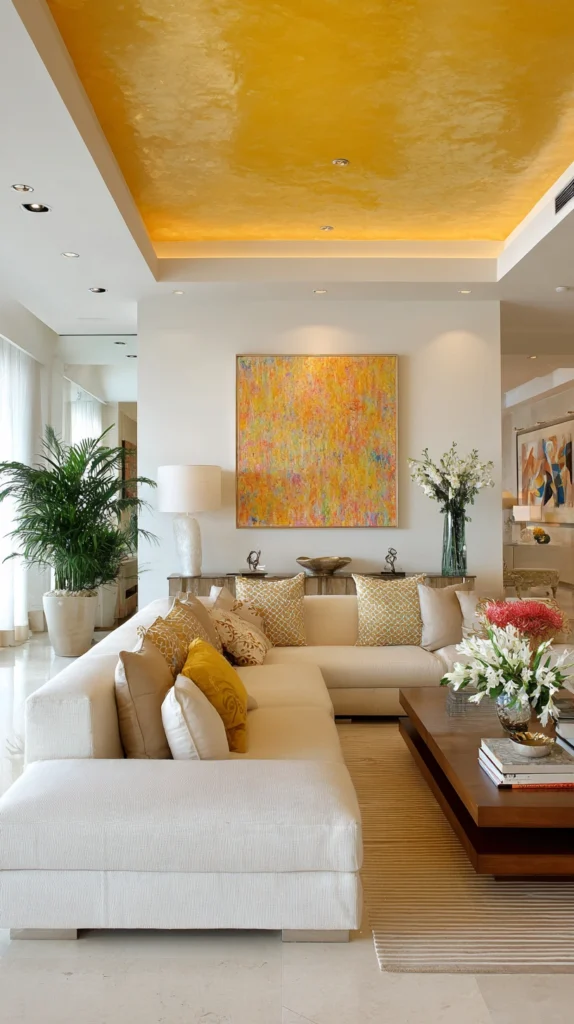
Budget: $30 – $120
A butter yellow ceiling — above white walls, pale grey walls, or natural linen-toned walls — creates a room that feels wrapped in warmth from above in a way that coloured walls alone cannot produce. The yellow ceiling casts a warm reflected light downward onto everything in the room below it — the furniture, the textiles, the faces of the people in the room — producing a golden quality of ambient light that no lightbulb can replicate. It is the interior design equivalent of permanent golden hour, and it costs the price of a tin of paint.
One to two litres of a specialist ceiling paint — which is formulated to be thicker than wall paint, minimising drips and providing even coverage on a horizontal surface — costs $15 – $40 in a butter yellow tone. A standard room ceiling requires one to two litres for two coats. The preparation is the most important step: a clean, grease-free ceiling surface in good repair takes paint evenly and holds colour correctly. Any repairs to the ceiling plaster — $10 – $20 in filler and sandpaper — should be completed before painting.
Decorating tip: Paint the ceiling two shades lighter than the wall colour if applying butter yellow to both ceiling and walls simultaneously. A ceiling and walls in the same butter yellow tone can feel immersive and enclosed — which some rooms suit and others do not. A ceiling two shades lighter lifts the room visually, maintains the warmth of the palette, and gives the scheme the breathing room that a monochromatic application sometimes lacks.
6. The Butter Yellow Dining Room
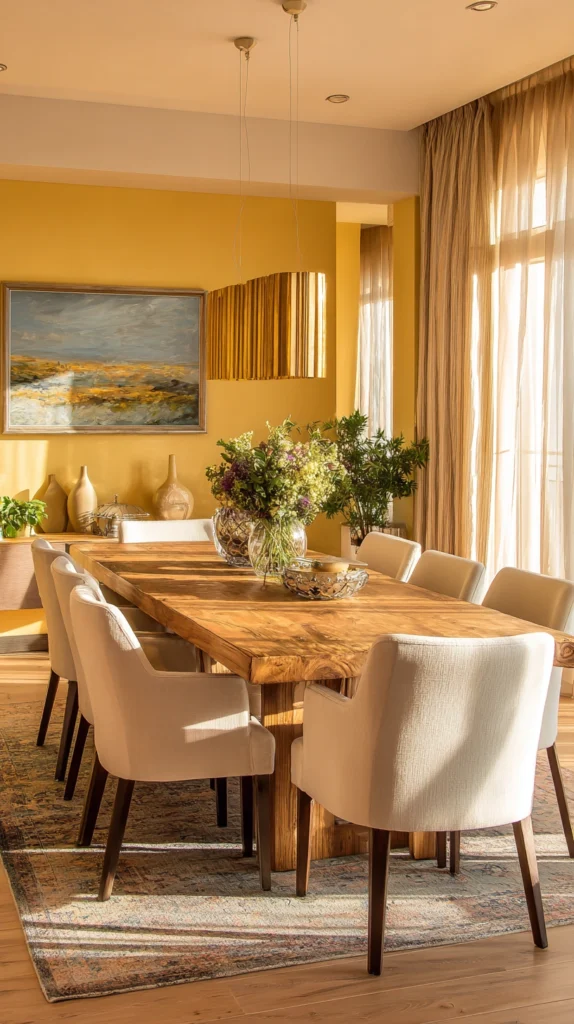
Budget: $60 – $400
A dining room in butter yellow — walls in a warm, medium-depth butter tone, a pendant light in aged brass or warm rattan above the table, and a table setting in white ceramic and natural linen — is one of the most reliably convivial room schemes available. The colour makes food look appetising, makes wine look warm, and makes the people around the table look well — three qualities that a dining room colour scheme should possess and that cooler colours consistently fail to deliver. A butter yellow dining room is a room in which people linger rather than leaving as soon as the meal is finished.
Paint for a standard dining room costs $30 – $80 for two coats of a quality butter yellow. A rattan or bamboo pendant light — $30 – $100 — provides the warm overhead light that complements the wall colour. A set of white ceramic plates — $30 – $80 — reads cleanly against the yellow walls without competing with them. A bunch of flowers or a botanical centrepiece in warm tones — sunflowers, chamomile, dried wheat — reinforces the yellow palette on the table surface for $10 – $30.
Decorating tip: Dim the dining room lighting in a butter yellow room in the evening rather than using it at full brightness. Butter yellow walls under full-brightness artificial light can read as intense in a room designed for intimate dining. The same walls at 40 to 50 percent brightness produce a warm, enveloping glow that is one of the most beautiful effects available in a domestic dining room — and the investment in a dimmer switch is $15 – $30, making it one of the highest-return small investments in this list.
7. The Butter Yellow Children’s Room
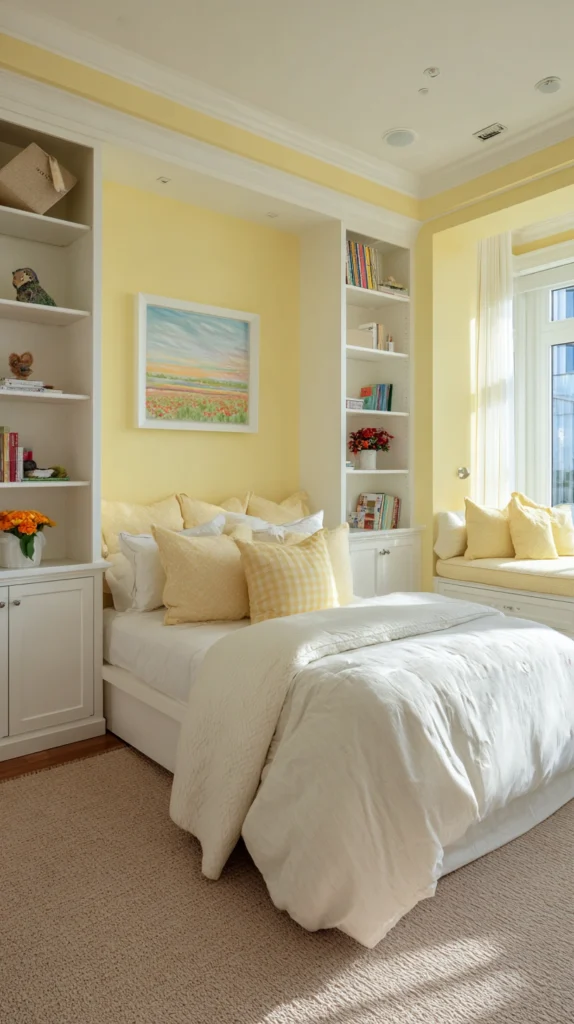
Budget: $40 – $200
A children’s bedroom or playroom in butter yellow is both the most obviously appropriate and the most consistently underchosen colour for a child’s space — parents tend to reach for the brighter, more saturated primary yellows of the standard children’s palette rather than the warmer, quieter butter tone that actually serves a child’s room better. Butter yellow is stimulating without being agitating, warm without being hot, and cheerful without the visual noise that saturated primaries produce in a space where a child is also expected to sleep.
A full room application of butter yellow paint in a child’s room costs $40 – $120 in materials. Furniture in white-painted wood — a classic pairing with butter yellow walls — reads cleanly and maintains the lightness of the scheme. Soft furnishings in white, sage green, and natural linen complement the yellow without competing with it. A large printed botanical or animal artwork on the butter yellow wall — $20 – $60 framed — provides visual interest at child height without introducing a second wall colour.
Decorating tip: Use a washable paint formulation for a children’s room application of butter yellow rather than a standard interior emulsion. Children’s rooms accumulate fingerprints, crayon marks, and the general evidence of active occupation at a rate that standard paint cannot withstand without visible degradation within months. A washable formulation in the same butter yellow tone costs only marginally more than standard paint and can be wiped clean of most marks without losing its finish.
8. The Butter Yellow Bathroom
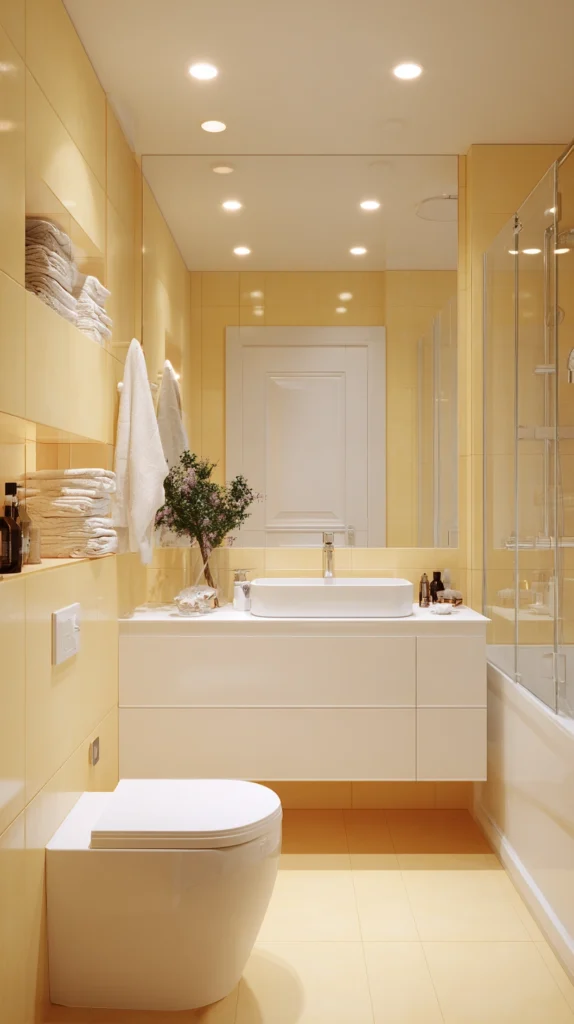
Budget: $30 – $200
A butter yellow bathroom — particularly a smaller bathroom or a cloakroom where the colour wraps all four walls in close proximity — produces a room that feels genuinely warm and genuinely bright regardless of the size of its window or the direction it faces. North-facing bathrooms, which often read as cold and grey regardless of the paint colour applied to them, are transformed by butter yellow in a way that no amount of additional lighting or white tile can achieve. The colour adds warmth that the light cannot provide.
A bathroom application of butter yellow requires a paint formulated for wet rooms — moisture-resistant and mould-inhibiting — which costs $20 – $50 per litre from specialist paint suppliers. A standard bathroom requires one to two litres. White bathroom fittings — the bath, basin, and toilet — read beautifully against butter yellow walls, with the contrast of the white porcelain and the warm yellow producing a classic combination that references the best domestic bathrooms of the early twentieth century without being historically derivative.
Decorating tip: Choose a satin rather than a gloss finish for butter yellow bathroom walls. Gloss paint on bathroom walls reflects light harshly and reveals every imperfection in the wall surface — both effects are undesirable in a bathroom where the goal is a warm, flattering light quality. Satin reflects enough light to prevent the colour from reading as flat in low light conditions while providing a surface that wipes clean and resists moisture without the harsh reflectivity of a gloss finish.
9. The Butter Yellow Home Office
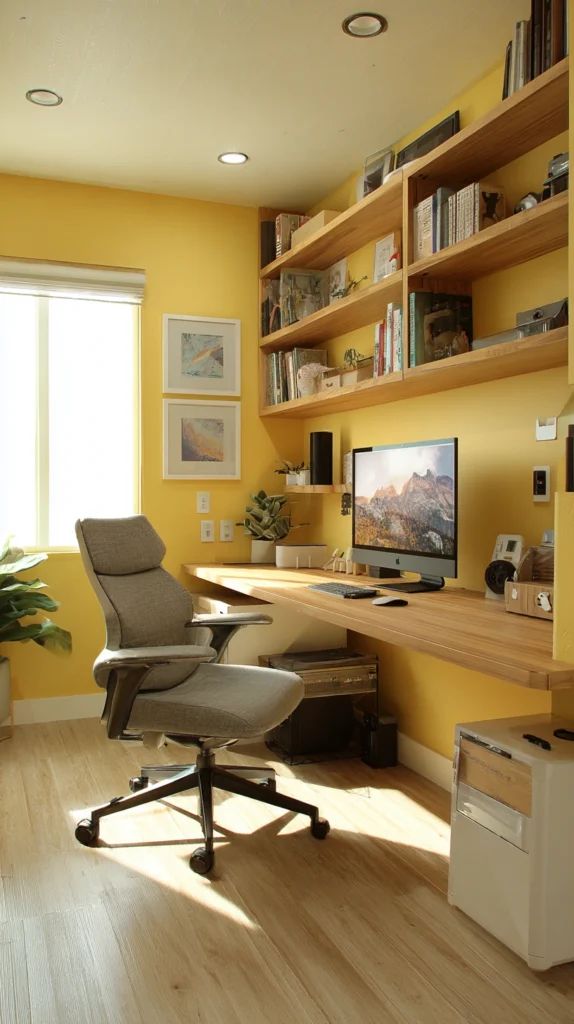
Budget: $30 – $200
A home office in butter yellow is a counterintuitive choice that consistently produces positive results. The conventional wisdom for work spaces tends toward the neutral — grey, white, greige — on the grounds that neutrals are least distracting. Butter yellow challenges this premise productively: it is warm rather than stimulating, it lifts the mood of a space that can become oppressive during long working hours, and it makes natural light feel more abundant than it is — which in a room where a person spends many consecutive hours is not a trivial quality.
Paint for a home office costs $30 – $80 for a standard room. A butter yellow office wall as a backdrop for video calls — positioned behind the desk so that it is visible in the camera frame — produces a warm, professional background that is significantly more flattering and more personal than the grey or white walls that appear in most domestic video call setups. The colour communicates warmth and confidence without being distracting or unconventional.
Decorating tip: Pair butter yellow walls in a home office with warm timber desk furniture rather than white-painted or black-lacquered pieces. White furniture against butter yellow walls produces a high-contrast combination that can feel slightly clinical in a work setting. Warm oak, walnut, or pine desk furniture in the same warm colour temperature as the wall creates a cohesive, enveloping workspace that feels designed rather than assembled from available pieces.
10. The Butter Yellow Furniture Piece
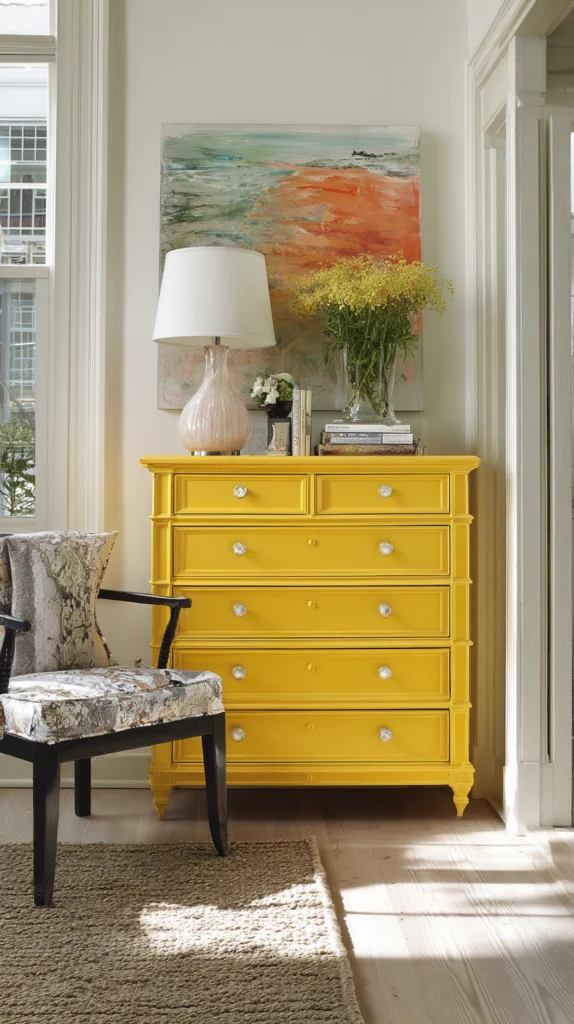
Budget: $30 – $200
A single piece of furniture painted in butter yellow — a chest of drawers, a bedside table, a console, a bookcase, a kitchen chair — introduces the colour into a room without committing to a full wall application. In a room of white walls and neutral furniture, a butter yellow painted chest of drawers is both the focal point and the warmth source simultaneously — it draws the eye, lifts the palette, and communicates that the room has been thought about at the level of the individual object rather than simply arranged.
A chalk paint or furniture paint in a butter yellow tone costs $15 – $40 for a 500ml tin — sufficient to paint a chest of drawers, a chair, or a small console table. Light sanding preparation adds $5 – $10 in sandpaper. A clear wax or water-based varnish to seal the finished piece runs $10 – $20. The total cost of a painted butter yellow furniture piece sits at $30 – $70 — transforming an existing piece rather than replacing it, which is both more economical and more sustainable than purchasing new.
Decorating tip: Paint furniture in butter yellow using a dry brush technique for the final coat — loading the brush lightly and working the paint into the surface with a near-dry brush rather than applying it wet — to create a slightly chalky, slightly uneven finish that reads as aged and artisanal rather than factory-finished. The dry brush technique costs nothing extra and produces a quality of finish that a standard wet coat cannot achieve and that suits butter yellow particularly well.
11. The Butter Yellow Textile Layer
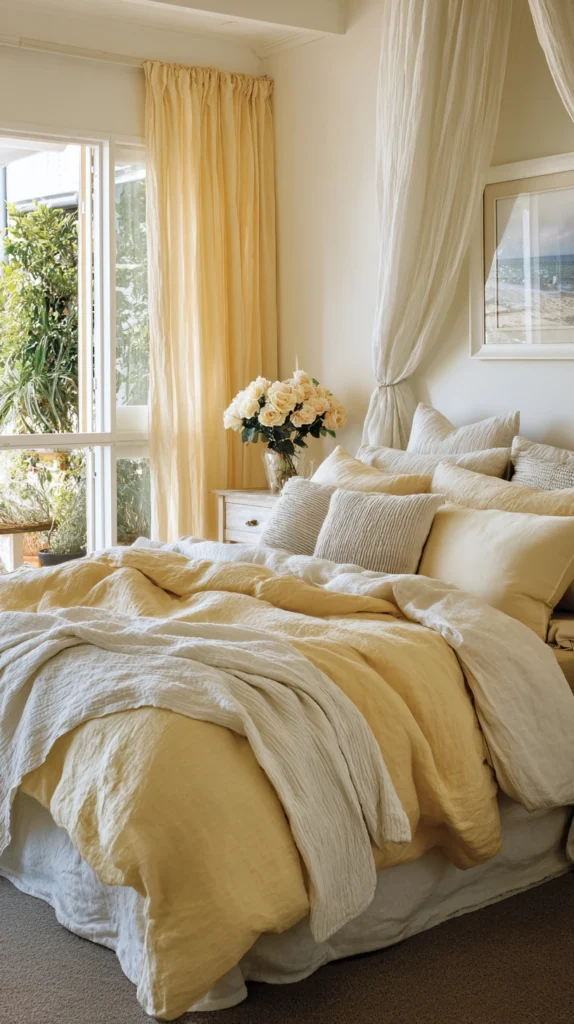
Budget: $40 – $300
A room refreshed with butter yellow through its textiles — a linen sofa throw, a set of cushion covers, a bedroom duvet cover, a set of curtains, or a kitchen tablecloth — introduces the colour warmly and reversibly without paint or permanent commitment. The textile version of butter yellow is slightly softer and more varied in tone than its painted equivalent because fabric absorbs and reflects light differently from a flat wall surface, and this softness makes it a particularly gentle introduction to a colour that some people approach with caution.
A linen throw in butter yellow costs $30 – $80. A set of two cushion covers in a butter yellow washed linen runs $20 – $50. Butter yellow linen curtains for a standard window — $40 – $120 per pair — filter incoming light into a warm golden tone that changes the quality of the room’s illumination as well as its colour. A butter yellow cotton duvet cover — $30 – $80 — makes the bedroom feel warm and generous from the moment of entry.
Decorating tip: Wash butter yellow linen and cotton textiles before their first use and allow them to dry in direct sunlight where possible. An initial hot wash softens the fabric and removes the sizing that gives new textiles a slightly stiff, over-pressed quality. Drying in sunlight gently fades the butter yellow to a slightly more bleached, more natural tone that suits the colour’s aesthetic — which is the sun-washed, honest, unhurried quality of a well-lived domestic interior.
12. The Butter Yellow Kitchen Accessories and Ceramics
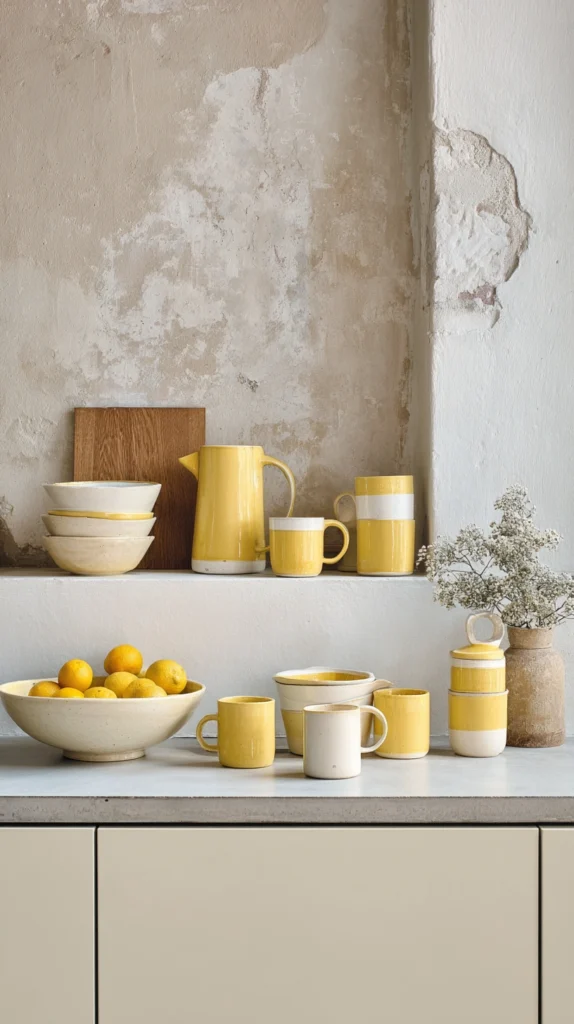
Budget: $20 – $150
A kitchen refreshed with butter yellow through its accessories — a ceramic mixing bowl, a set of mugs, a butter dish, a jug, a fruit bowl, a set of enamel canisters — introduces the colour into the most used room of the house through the objects that are handled most frequently. It is the most tactile application of the colour and the one that produces the most immediate daily pleasure — reaching for a butter yellow mug in the morning produces a different quality of beginning to the day than reaching for a white or grey one.
A ceramic mixing bowl in butter yellow costs $15 – $40. A set of four butter yellow mugs runs $20 – $50. Enamel canisters in a graduated set — $25 – $60 — line the kitchen counter in a colour that reinforces the warmth of the space every time the kitchen is used. A butter yellow ceramic fruit bowl — $15 – $40 — holds whatever fruit is currently in season and functions as a still life on the kitchen counter throughout the year.
Decorating tip: Concentrate the butter yellow kitchen accessories on one surface or one section of the counter rather than distributing them throughout the kitchen. A collection of butter yellow ceramics grouped together reads as a curated palette. The same pieces scattered individually across the full kitchen counter read as a series of unrelated yellow objects. Grouping produces the visual impact of a colour decision. Scattering produces only the impression of yellow things.
13. The Butter Yellow Garden Room or Conservatory
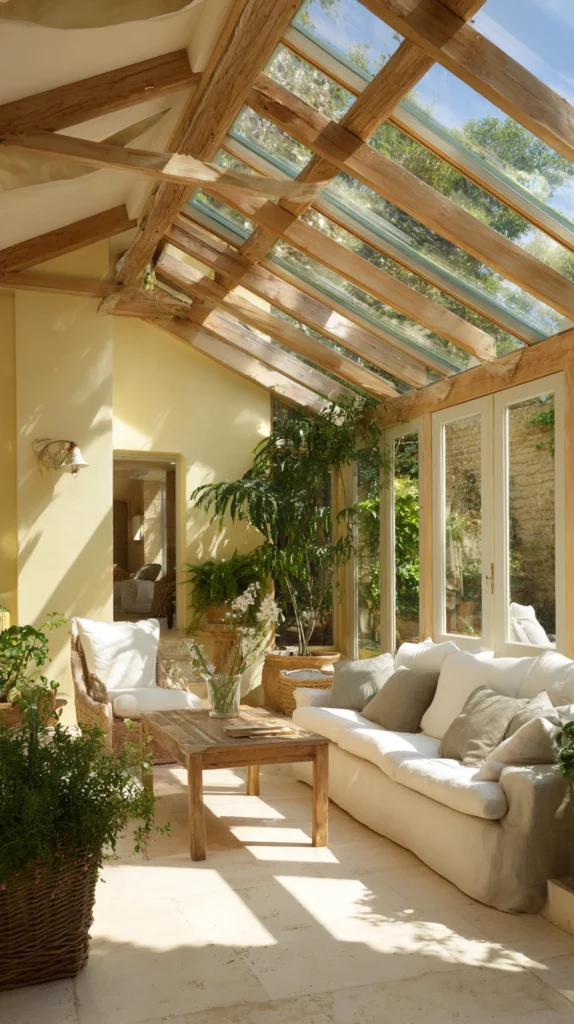
Budget: $60 – $500
A garden room, conservatory, or sunroom painted in butter yellow — the walls, the woodwork of the structure, or both — is the room in which the colour performs most dramatically because the quality of light in a glass-walled space is the most variable and the most responsive to wall colour of any room in the house. On an overcast day, butter yellow walls in a garden room provide warmth that the grey sky outside cannot. On a sunny day, they create an amber-tinted warmth that makes the room feel like a greenhouse of light. In both conditions the colour earns its place.
Paint for a conservatory or garden room — exterior-grade or specialist conservatory formulation where the walls are exposed to condensation — costs $30 – $80 for a standard space. White-painted timber furniture inside a butter yellow garden room reads beautifully in the glass-filtered light and maintains the lightness needed in a room that is already heavily saturated with natural light. Potted plants in terracotta — $20 – $80 in total — reinforce the warm palette with living colour.
Decorating tip: Paint the external faces of a conservatory’s timber frame in a complementary dark green or deep teal rather than white if the structure is a later addition to a period property. Butter yellow interior walls seen through dark-framed glass from the garden produce an image of warmth and light that white-framed glass cannot generate — the dark frame makes the warm interior glow more apparent and creates a more visually resolved relationship between the conservatory and the garden surrounding it.
14. The Butter Yellow and Blue Colour Pairing
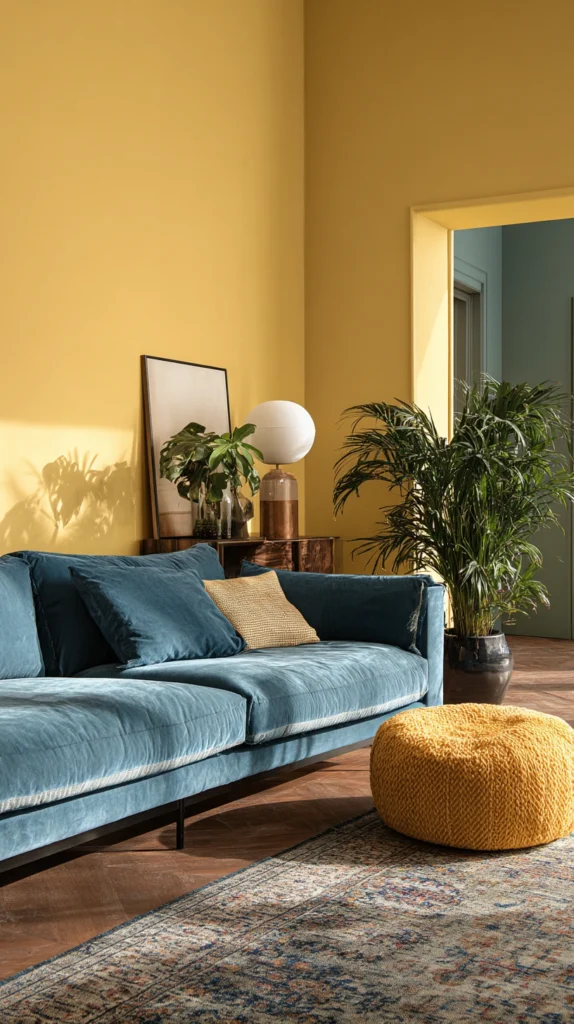
Budget: $50 – $300
Butter yellow and blue — specifically the dusky, slightly greyed blues of the coastal and Scandinavian palette rather than the saturated primary blue — is one of the most naturally harmonious colour pairings in interior design. The warmth of the yellow and the coolness of the blue occupy complementary positions on the colour wheel and in the emotional temperature of a room, and the combination produces an interior that feels simultaneously warm and calm — the two qualities that the best domestic rooms prioritise above all others.
A room with butter yellow walls and blue introduced through soft furnishings — a blue linen sofa, blue ceramic vessels, a blue and white striped rug — costs the price of the paint plus the cost of the blue accessories already chosen for the space. The pairing works in every room: a butter yellow kitchen with blue and white ceramic tiles, a butter yellow bedroom with blue linen bedding, a butter yellow living room with a blue velvet sofa. In each case the yellow warms and the blue calms, and the two in combination produce a room that is more balanced than either colour alone would achieve.
Decorating tip: Choose a blue that contains a small amount of grey rather than a pure saturated blue to pair with butter yellow. A pure cobalt or royal blue beside butter yellow creates a contrast that is too sharp and too primary — it reads as a children’s colour story rather than a sophisticated interior palette. A dusty, slightly greyed cornflower blue, a French navy with a warm undertone, or a pale duck egg all pair with butter yellow in a way that is resolved and adult while maintaining the warmth and cheer that the yellow brings to the combination.
15. The Fully Committed Butter Yellow Room
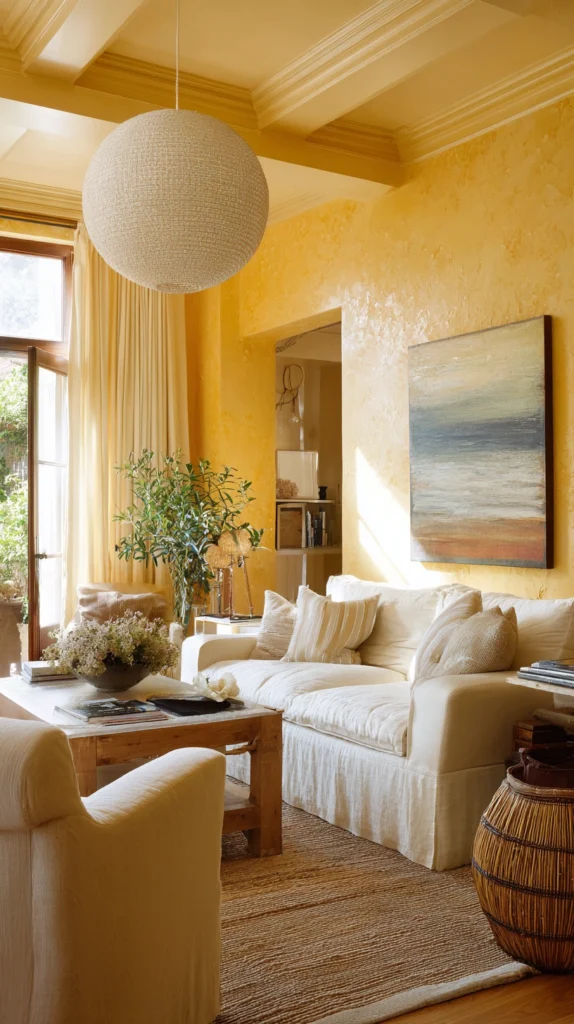
Budget: $100 – $600
The fully committed butter yellow room — walls, ceiling, woodwork, and soft furnishings all held within the same warm yellow-to-cream palette, with brass hardware, warm timber furniture, white ceramic accessories, and natural linen textiles as the only departures from the colour — is the most ambitious and the most rewarding application of the colour on this list. It is a room that has made a decision and held it without apology, and that quality of commitment is itself a form of interior confidence that produces a space that feels genuinely designed rather than decorated.
A full room paint scheme in butter yellow — walls, ceiling, and woodwork — costs $80 – $200 in paint depending on room size and paint quality. Soft furnishings in cream, natural linen, and warm white — a sofa, curtains, a rug — add $200 – $600 for a living room application. Brass hardware and warm timber furniture pieces bring the material palette into the same warm family as the colour for $50 – $200 in total. The whole scheme costs $330 – $1000 for a fully committed butter yellow living room — modest for a room transformation that is genuinely complete rather than partially achieved.
Decorating tip: Introduce one element of contrast into a fully committed butter yellow room rather than holding the entire scheme without relief. A single dark object — a deep navy book on the shelf, a black iron candlestick, a dark timber frame around a print — gives the eye a resting point within the warmth of the room and prevents the monochromatic scheme from reading as overwhelming. One considered dark note is all the contrast a butter yellow room requires to feel balanced rather than saturated.
Whatever application of butter yellow finds its way into the home — a single painted wall or a fully committed room scheme, a painted chest of drawers or a full set of kitchen cabinetry — the principle that holds all fifteen ideas together is the same: butter yellow is a colour that works for the room rather than demanding that the room work for it.
It lifts without imposing, warms without overheating, and cheers without performing. It is the colour most likely to make a room feel like the best version of itself — the version that exists on a Sunday morning in late summer when the light is right and there is nowhere to be — and it does this reliably, generously, and without requiring anything more complicated than the decision to use it.
Choose the shade carefully, test it in the actual light of the actual room, and then commit to it with the confidence it deserves. Butter yellow rewards decisiveness. Give it a wall, a room, or a piece of furniture and it will give the space something that no neutral can provide — genuine warmth, genuine cheer, and the particular quality of a room that feels good to be inside every single day.