14 Alice in Wonderland Party Ideas
There is no party theme that gives a host more creative permission than Alice in Wonderland. The source material is already a celebration of the illogical, the oversized, the mismatched, and the deliberately wrong — which means that every decorating instinct that would be reined in for any other theme is not only permitted here but encouraged.
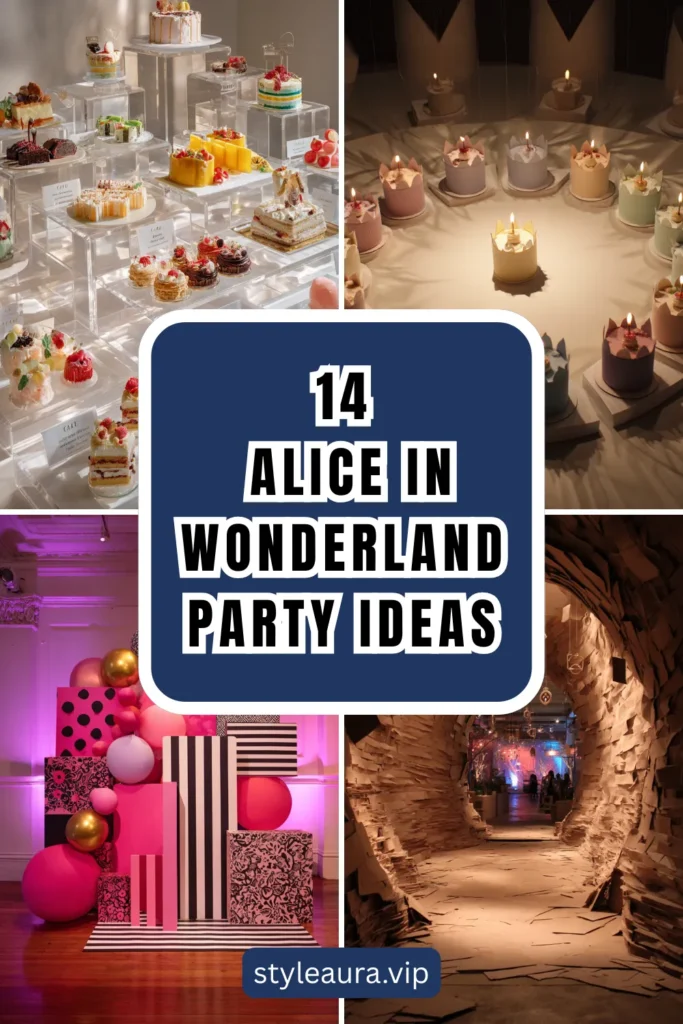
Too many patterns? Correct. Teacups stacked at impossible heights? Essential. A table that makes no sense? Precisely the point. Alice in Wonderland is the theme that rewards the host who commits to the absurdity completely and loses something with every compromise toward the conventional.
Done with genuine imagination, it is also one of the most visually spectacular and most atmospherically complete party themes available — for children and adults equally. The palette, the props, the food names, the activities, and the narrative structure of the afternoon are all already written. The host’s job is simply to bring them to life in a real space with real people and real teacups, as many of them as possible, stacked as high as the table will hold.
1. The Wonderland Colour Palette
Budget: $20 – $100
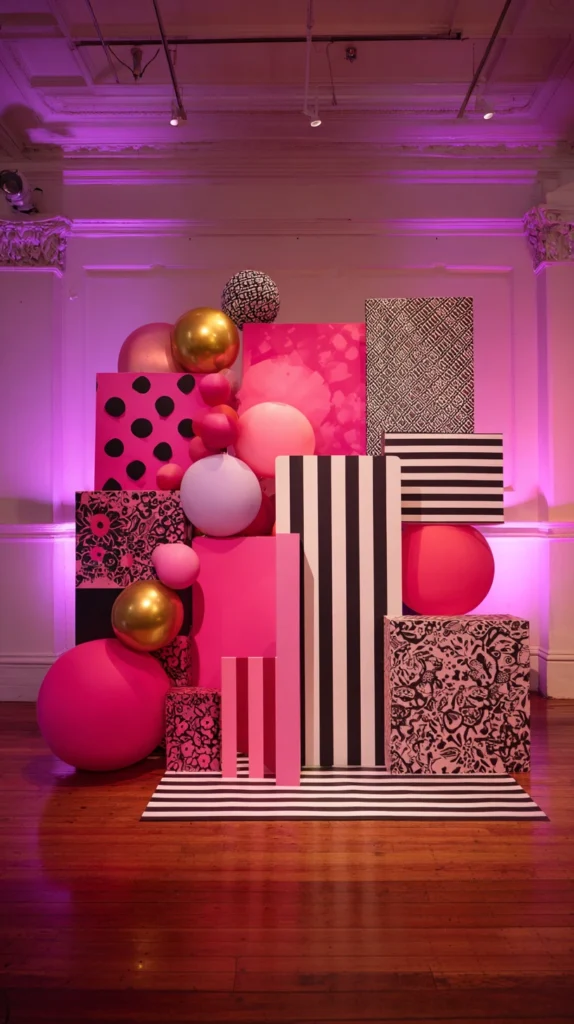
The Alice palette runs in playing card red and black, sky blue, white, gold, and the particular acid tones of a Victorian illustration — chartreuse, magenta, and a deep mushroom purple. It is not a soft or a restrained palette. It is bold, contrasting, and deliberately mismatched, which means the usual rule about limiting colours to two or three does not apply here. Wonderland has as many colours as it needs.
Solid colour balloons in red, black, white, and blue cost $15 – $40 for a party quantity. Matching paper goods in a playing card motif — $15 – $40 for a set. A custom banner reading “Down the Rabbit Hole” or “Curiouser and Curiouser” in a Victorian circus font — $10 – $25 — sets the tone before a single decoration has been noticed.
Party tip: Mix patterns deliberately and consistently throughout the decoration — stripes with polka dots with playing card motifs with floral prints — rather than choosing one pattern and repeating it. The deliberate pattern clash is not an error in Wonderland. It is the design principle. A party where every element shares the same print reads as coordinated. A Wonderland party where every element has a different but equally bold print reads as genuinely through the looking glass.
2. The Mismatched Teacup Installation
Budget: $30 – $200
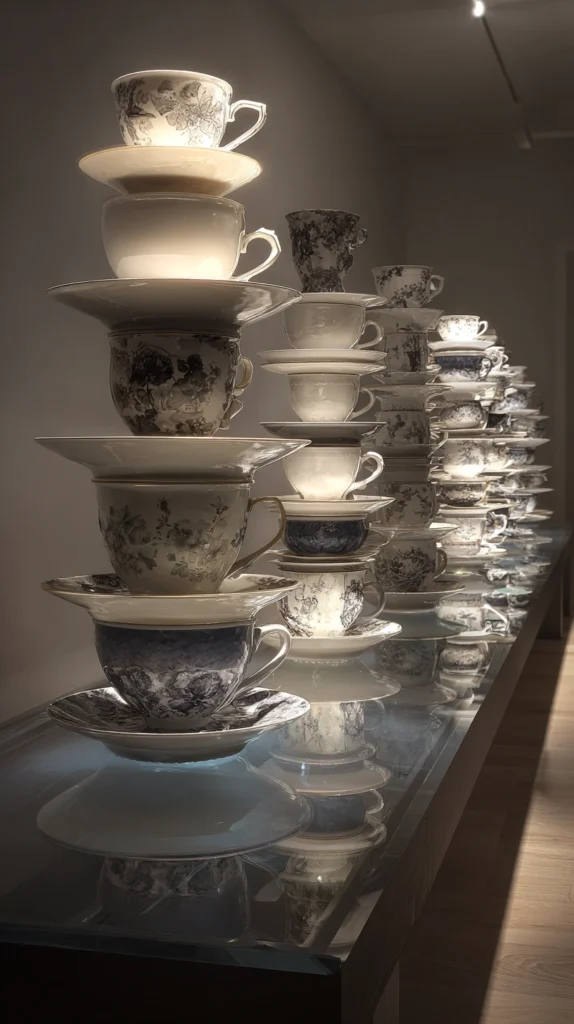
The Mad Hatter’s tea party is the visual heart of any Alice in Wonderland event and the teacup is its primary decorative object. Mismatched teacups and saucers — sourced from charity shops, borrowed from family members, and accumulated from every possible source in every possible pattern — stacked at varying heights across tables, shelves, and surfaces throughout the party space create an installation that is immediately recognisable and immediately immersive.
Mismatched teacups and saucers from charity shops cost $0.50 – $2 each — a collection of thirty to forty cups fills a large table generously for $15 – $80 in total. Teacup towers — cups stacked three or four high on their saucers — are stabilised with a small dot of museum putty between each cup and saucer. A teapot at the centre of each tower, appearing to pour an impossible stream of tea made from yellow ribbon, adds the surreal note that makes the installation Wonderland rather than simply vintage.
Party tip: Include at least one dramatically oversized teacup — a prop version available from theatrical suppliers or made from papier-mâché for $15 – $40 — within the installation. The contrast between the standard teacups and the single enormous one is one of the most direct visual references to the scale confusion of the original story, and it produces an immediate and delighted response from every guest who notices it.
3. The Mad Hatter’s Tea Party Table
Budget: $60 – $400
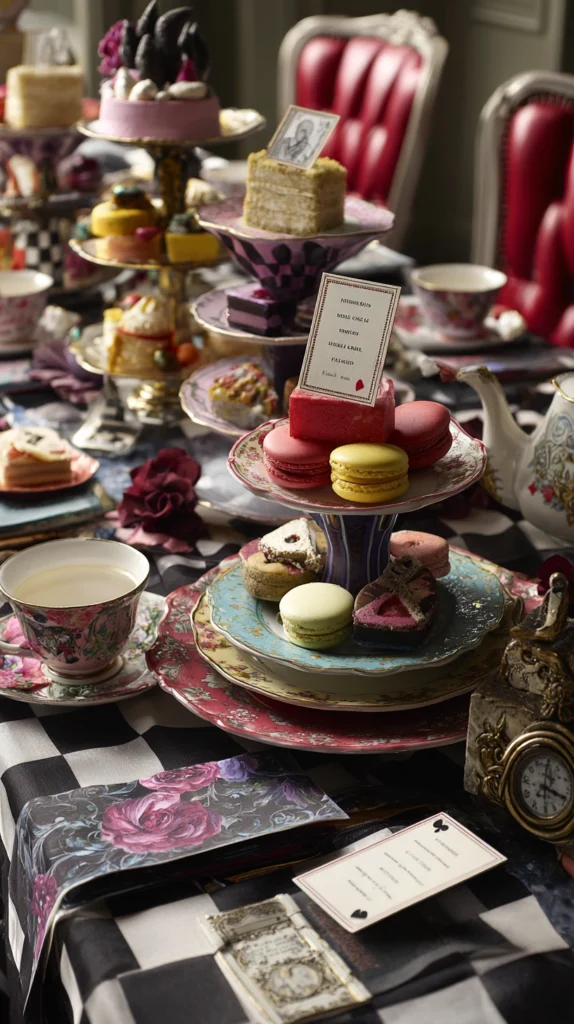
A Mad Hatter’s tea party table — covered in mismatched tablecloths layered over each other, set with mismatched china, scattered with playing cards and pocket watches, labelled with “Eat Me” and “Drink Me” tags on every item, and loaded with tiered cake stands of sandwiches, cakes, and biscuits at every possible height — is the party’s centrepiece installation and its most photographed surface.
Mismatched tablecloths in contrasting patterns — sourced from charity shops or existing household linen for $0 – $30. Tiered cake stands at varying heights — $15 – $35 each, or borrowed — create the vertical drama the table requires. Playing cards scattered across the table surface cost $2 – $5 per pack. Pocket watch props — plastic versions from a costume supplier — run $5 – $15 each. “Eat Me” and “Drink Me” tags printed at home on luggage tags — $3 – $8 for a pack — are attached to every food and drink item on the table.
Party tip: Set the table as though interrupted mid-party — chairs pulled back at odd angles, a teacup tipped on its side, a cake with one slice already missing, a playing card face-down in a puddle of spilled tea made from yellow ribbon. The interrupted, mid-chaos quality of the Mad Hatter’s tea party is more faithful to the source material and more visually interesting than a neatly laid table, and it takes no more time to achieve than a tidy version.
4. The Wonderland Food Menu
Budget: $60 – $300
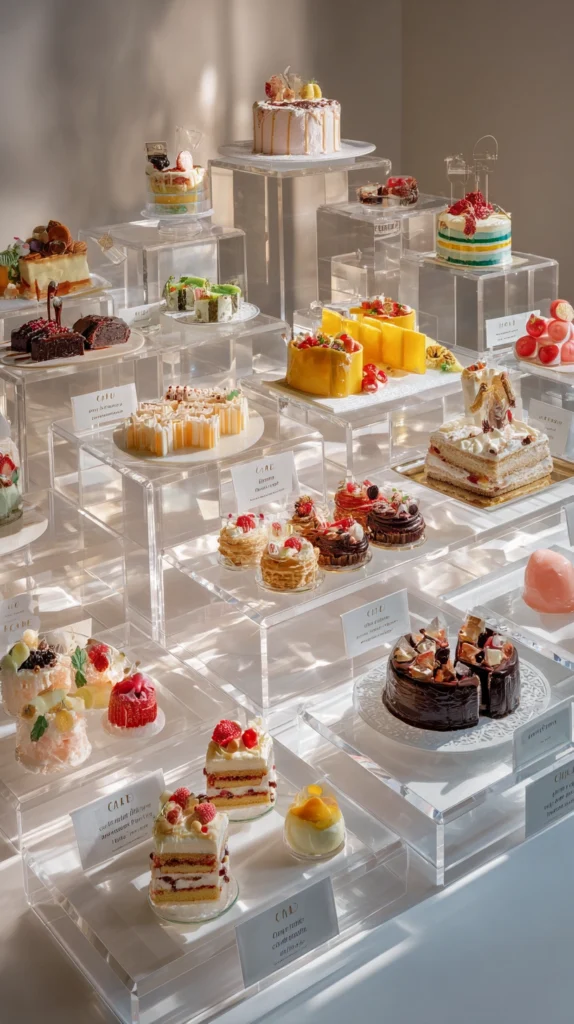
Every food item at an Alice in Wonderland party should be named in the language of Wonderland and labelled accordingly — not because the food itself needs to be unusual but because the naming transforms the ordinary into the extraordinary, which is precisely what the story does with everything it touches.
Eat Me Cakes — small iced fairy cakes with “EAT ME” written in icing. Drink Me Potion — pink lemonade in small bottles with wax-sealed corks and Drink Me labels. Off With Their Heads Strawberries — strawberries with their tops removed and replaced with a crown of white chocolate. Cheshire Cat Grins — banana slices curved into smiles. Unbirthday Cake — a full celebration cake regardless of whether it is anyone’s actual birthday. Food ingredients for twelve guests cost $60 – $150. Labels and tags printed at home add $5 – $10.
Party tip: Include one dish that is genuinely surprising — something that appears to be one thing and is revealed to be another. A “rock cake” that is actually a chocolate truffle. A “mushroom” that is a meringue. A “teacup” made from a chocolate cupcake with a white chocolate handle attached. One dish that subverts expectation is the food table’s equivalent of the White Rabbit — the element that makes guests look twice and look closer.
5. The Drink Me Potion Bar
Budget: $20 – $100
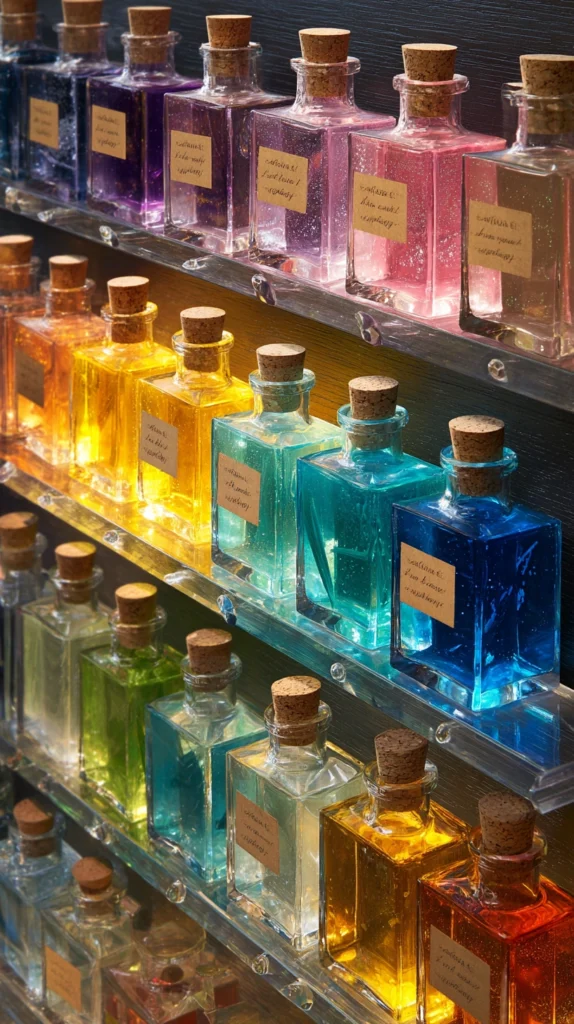
A potion bar — small glass bottles in varying shapes, each containing a different coloured drink, each sealed with a cork and a handwritten Drink Me label, arranged in a crate or on a tiered display — is the Wonderland party’s drinks moment and one of its most interactive elements. Children and adults approach, choose their potion, and discover what it tastes like only after opening it — which is as close to the experience of the original Drink Me bottle as a party can achieve.
Small glass bottles in varying shapes — $1 – $2 each — hold individual portions of flavoured lemonade, fruit juice, or sparkling water coloured with natural food dye. A set of twelve different coloured potions for a children’s party costs $15 – $40 in drinks ingredients. Cork stoppers — $5 – $10 for a bag — seal each bottle. Handwritten Drink Me labels on small brown luggage tags — $3 – $8 for a pack — complete each bottle.
Party tip: Write a different flavour description on each label in deliberately unhelpful Wonderland language — “Tastes of Tuesday” or “Flavour of Second Thoughts” or “The Colour Purple, Probably” — rather than the actual flavour. Guests who must discover the taste by drinking rather than by reading the label have a more active and more Wonderland-appropriate experience than guests given accurate flavour information.
6. The Rabbit Hole Entrance
Budget: $20 – $100
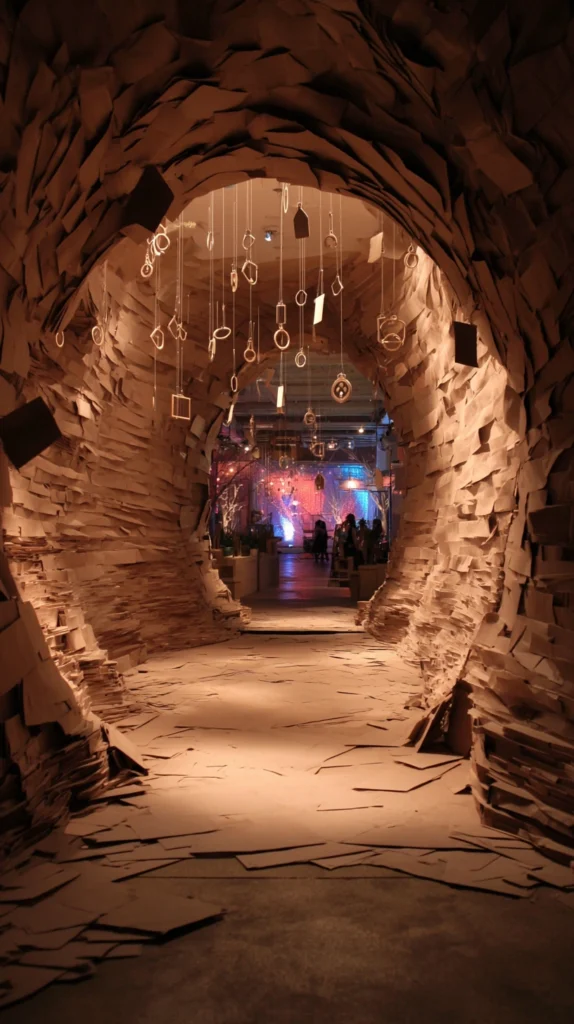
A decorated entrance to the party space — a doorway framed with a large circular rabbit hole arch made from brown and earth-toned paper, with the party space beyond visible through the hole — gives guests the experience of falling into Wonderland from the moment of arrival rather than simply entering a decorated room. The transition from the ordinary world to the party space is the most important moment of any immersive themed party.
A rabbit hole arch made from brown craft paper — $5 – $15 in paper — is cut into a large circle and mounted in the doorway with the ragged, earthy edges of a dug tunnel. Dangling pocket watches, falling playing cards, and floating keys on fishing line hung within the arch frame — $10 – $30 in materials — create the sensation of falling as guests pass through. A sign reading “Down the Rabbit Hole” above the arch — printed or hand-lettered — completes the entrance for under $5.
Party tip: Light the party space slightly more dimly than the approach space so that the transition from the ordinary to the Wonderland side of the rabbit hole is felt as well as seen. Moving from a normally lit corridor into a slightly more dramatically lit, more warmly coloured party space produces a genuine sense of crossing a threshold that full lighting in both spaces cannot achieve.
7. The Wonderland Garden Croquet Game
Budget: $20 – $80
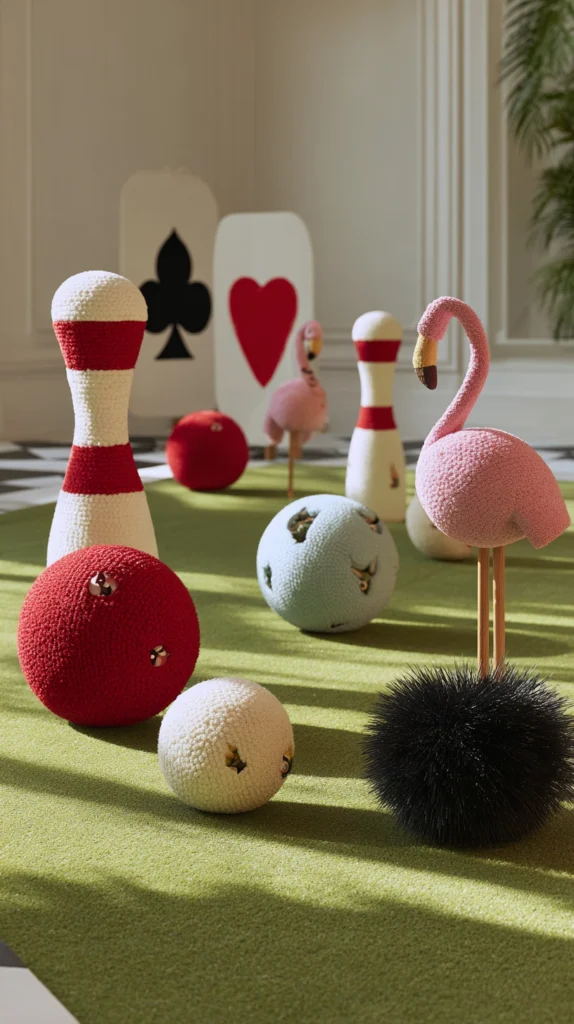
A croquet set styled as the Queen of Hearts’ garden game — with flamingo-shaped cardboard mallets, hedgehog ball covers made from green yarn pompoms, and hoops labelled with playing card suits — gives the party its outdoor game element and its most directly story-referenced activity. The game is simultaneously playable and absurd, which is the correct register for everything that happens in Wonderland.
A standard plastic croquet set — $15 – $40 — provides the functional game underneath the Wonderland styling. Flamingo head cutouts attached to the mallet handles — printed and laminated at home for $5 – $10 — provide the visual reference. Green yarn hedgehog pompoms fitted over the balls — $5 – $10 in yarn — replace the standard balls. A playing card suit label on each hoop — $2 – $5 — ties the game to the broader Wonderland visual language.
Party tip: Assign each guest a playing card rank — Two of Hearts, Five of Clubs, Jack of Diamonds — printed on a card they wear as a name badge throughout the party. Players address each other by card rank during the croquet game rather than by name. The game played in character produces a completely different and considerably more entertaining experience than the same game played without the identity element.
8. The Mad Hatter Hat Decorating Station
Budget: $30 – $120
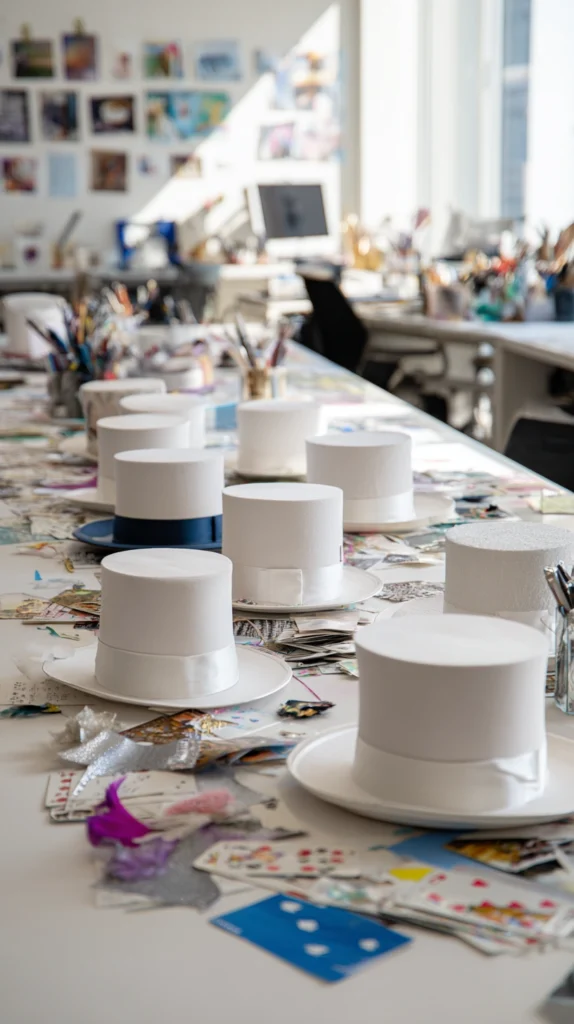
A craft station where every guest decorates their own Mad Hatter top hat — a plain card top hat blank covered in fabric scraps, feathers, ribbons, playing card offcuts, clock face prints, and any other Wonderland object that fits — is the party’s wearable craft element and the one that produces the most individually distinctive and most photographable results.
Plain card top hat blanks — available from craft suppliers — cost $2 – $4 each. Decoration materials — fabric scraps, feathers, ribbon, playing card pieces, printed clock faces, buttons, bows, and gems — cost $15 – $30 for a shared station quantity. Craft glue guns — one per four children, supervised — are the most effective adhesion method for the variety of materials used. A display of reference images — illustrations from the original Tenniel drawings, film stills, and creative examples — gives guests inspiration without prescribing a specific result.
Party tip: Include one deliberately impractical decoration element at the station — an oversized paper flower, a full playing card, a large pocket watch face — that produces a hat so dramatically excessive it could only belong in Wonderland. The guest who commits to the most excessive hat typically produces the most photographed accessory of the afternoon and provides a model of commitment to the aesthetic that other guests find liberating rather than intimidating.
9. The Wonderland Story and Riddle Trail
Budget: $10 – $40
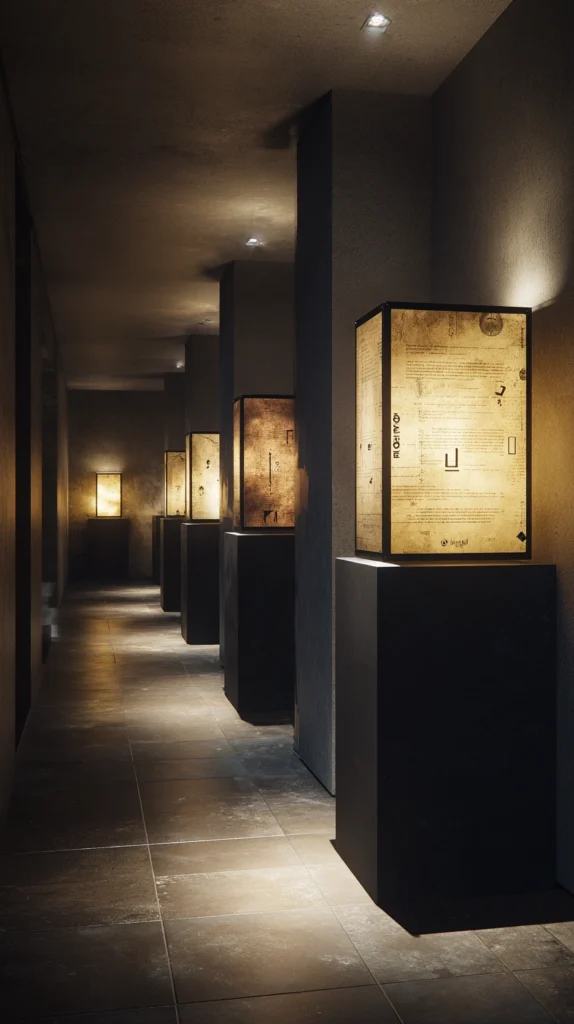
A riddle trail — in which guests follow a sequence of Wonderland-style riddles from location to location through the party space, each riddle leading to the next clue and the final riddle leading to the party food — gives the event its narrative structure and its most intellectually engaging activity. The riddles are written in the style of the Cheshire Cat or the Mad Hatter — illogical, circular, and deliberately unhelpful, but ultimately solvable.
Riddle cards printed on aged or decorated paper — $5 – $10 in printing — are placed at each location. A series of eight to ten riddles covers a typical party space thoroughly and occupies a group of children for twenty to thirty minutes. The final riddle reveals the tea party table, which has been kept from view until this moment — a reveal that produces a response disproportionate to the preparation it requires.
Party tip: Write one riddle that is genuinely, helplessly unsolvable — a riddle whose answer makes perfect sense only in retrospect and from the perspective of Wonderland logic rather than real logic — and place it third in the sequence. A trail that is entirely solvable produces satisfaction but no bewilderment. A trail with one genuine Wonderland riddle at its heart produces the specific and appropriate frustration of being in a world where the rules are different, which is exactly the experience the theme is trying to create.
10. The Wonderland Photo Booth
Budget: $25 – $120
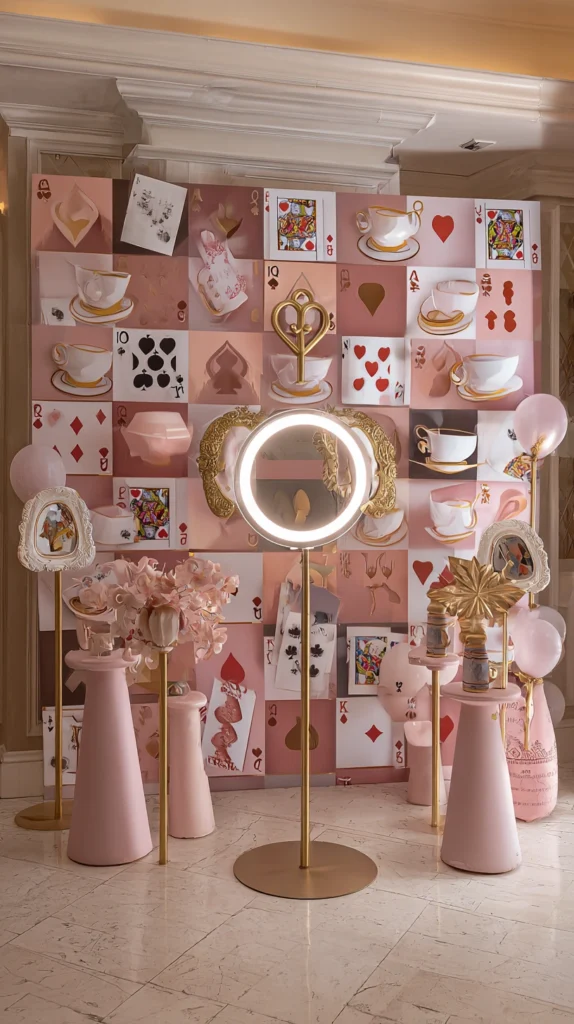
A photo booth — a backdrop of oversized playing cards arranged in a wall pattern, with giant prop teacups, oversized keys, and a selection of character hats including the Mad Hatter’s topper, the White Rabbit’s ears, and the Queen of Hearts’ crown — gives the party its most consistently used installation and its most shareable documentation.
A playing card backdrop — standard playing cards printed at A3 or A2 scale and arranged in a wall grid — costs $20 – $50 in printing. A set of character hat props — $15 – $35 purchased or $10 – $25 made from craft materials. An oversized prop teacup — made from cardboard and painted — costs $10 – $20 in materials and is the booth’s most immediately recognisable prop. A ring light on a tripod — $20 – $50 — ensures consistent illumination.
Party tip: Include a framed mirror in the photo booth with “Who Are You?” written across the top in a dry erase marker — a reference to the Caterpillar’s question that guests can change after each use. A mirror that asks a question produces more active engagement than a static backdrop, and guests who answer the mirror’s question in character before photographing themselves produce images that are more interesting and more individually expressive than standard posed photographs.
11. The Paint the Roses Red Activity
Budget: $15 – $60
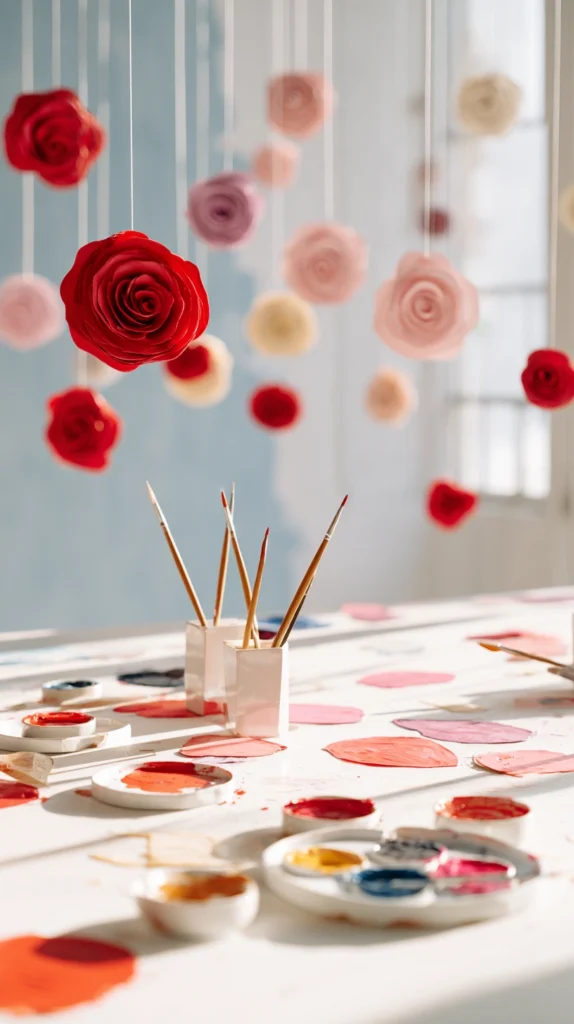
A painting activity in which children paint white paper rose cutouts red — or, in the Wonderland spirit, in any other colour they choose despite the Queen’s orders — is the most directly story-referenced craft activity available for the theme and one of the most accessible for the youngest guests at any Wonderland party.
White paper or card rose cutouts — printed and pre-cut at home for $5 – $10 in paper and printer ink. Red, and any other colour, of washable craft paint — $8 – $20 for a set. Small brushes — $5 – $10 for a set of twelve. The finished roses are displayed on a string line across the party space as a communal installation — $3 – $5 in twine and pegs — and remain as decoration for the duration of the party before going home with their creators.
Party tip: Introduce the activity in character — a flustered card soldier arrives at the station announcing that the Queen is on her way and the roses must be painted red immediately — and maintain the urgency of the scenario throughout the painting session. Children who are painting roses because the Queen is coming paint with considerably more enthusiasm and speed than children who are painting roses because it is the craft activity. The framing costs nothing and transforms the activity’s energy entirely.
12. The Wonderland Character Dress Up Corner
Budget: $20 – $100
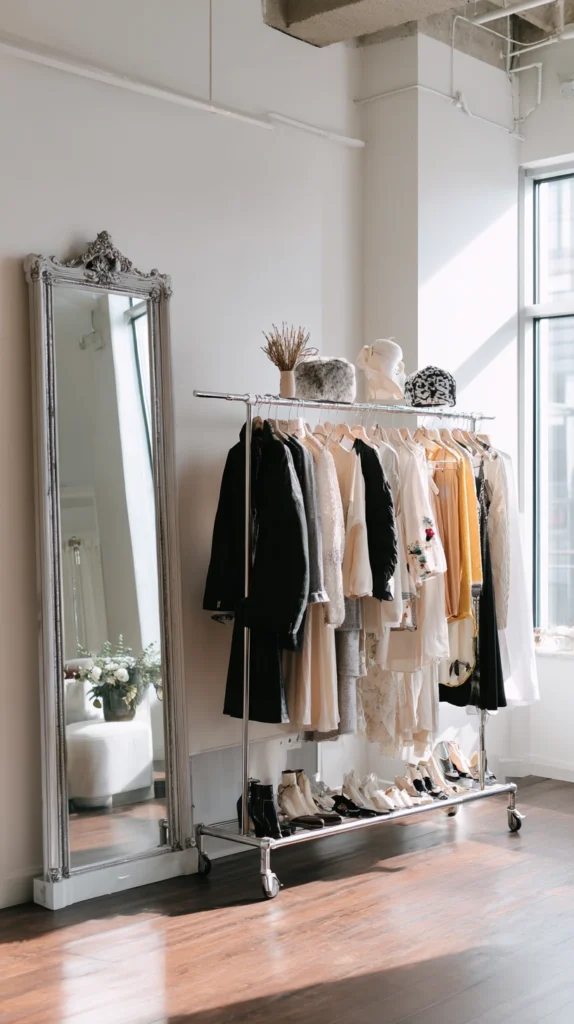
A dress up corner stocked with Wonderland character costumes — a blue Alice dress and white apron, a Mad Hatter’s coat and hat, a Queen of Hearts crown and sceptre, White Rabbit ears and a pocket watch, Cheshire Cat ears and a striped tail — allows guests to inhabit specific characters throughout the party rather than arriving in their own clothes and observing the theme from the outside.
Character costume pieces from a costume supplier or charity shop cost $5 – $20 per character element. A full corner stocked with pieces for five to six characters runs $40 – $120 in total. A large mirror in the corner — $15 – $40 — allows guests to see the full effect of their costume choices. A sign reading “Choose Your Character” above the mirror frames the corner as an official party station rather than an incidental pile of props.
Party tip: Assign the birthday child their character before the party rather than leaving the choice open. A birthday child who arrives as Alice — specifically, intentionally, costumed and introduced as Alice — is the host of the world rather than a guest in it, which is the correct role for the birthday child at any themed party and particularly important at a theme where one character is definitively the protagonist.
13. The Unbirthday Cake Ceremony
Budget: $60 – $300
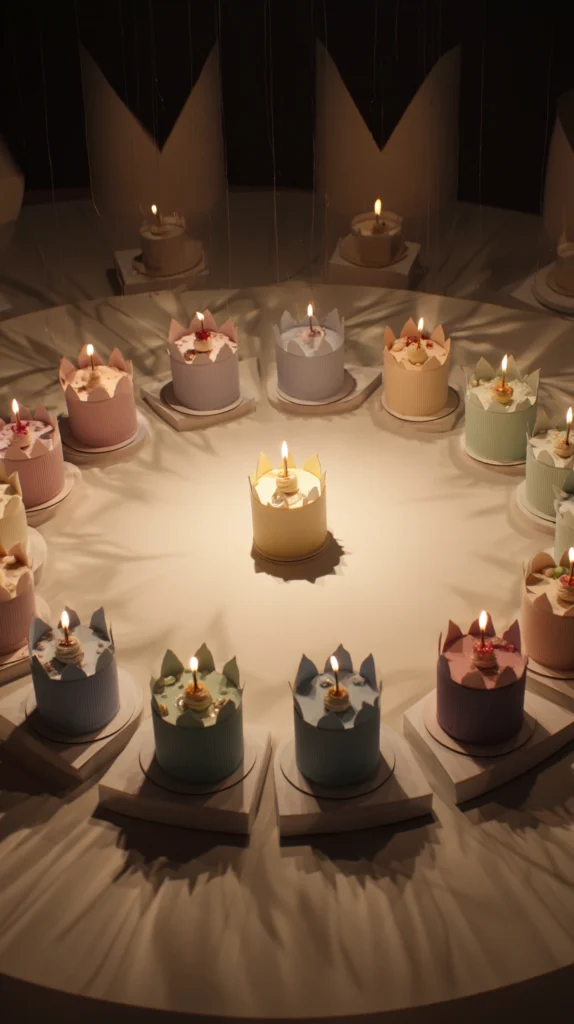
The unbirthday cake ceremony — a full cake celebration for every guest who is not the birthday child, held before the main birthday cake moment — is the Wonderland party’s most uniquely themed event and the one that most directly honours the source material. Every guest who is not celebrating a birthday today — which is, statistically, almost everyone present — is invited to celebrate their unbirthday with a small unbirthday cupcake, a sung unbirthday song, and a paper unbirthday crown.
A batch of twelve small unbirthday cupcakes — iced in the palette colours with a small candle each — costs $15 – $30 in ingredients. Unbirthday paper crowns — printed at home on gold card — cost $3 – $8 for a full set. The unbirthday song — a simplified version of the traditional nursery cadence, adapted to the occasion — is led by the host and takes two minutes. The ceremony is held halfway through the party, between the main activities and the birthday cake moment, as a distinct event with its own brief ceremony.
Party tip: Give the unbirthday cupcakes to every guest except the birthday child — who receives a slightly larger, slightly more elaborately decorated cupcake labelled “Birthday” rather than “Unbirthday” — and frame the distinction as the birthday child’s unique privilege rather than their exclusion from the group celebration. The birthday child who has the birthday cupcake while everyone else has the unbirthday cupcakes is the centre of the distinction rather than outside it.
14. The Wonderland Send-Off and Final Riddle
Budget: $5 – $30
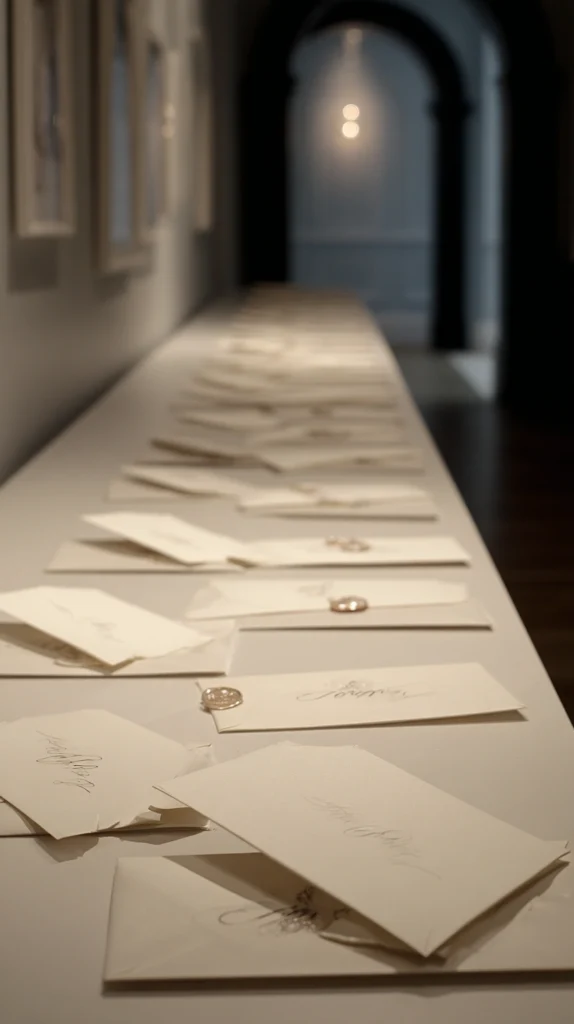
The final moment of the Wonderland party — as guests collect their party bags and prepare to leave — is a send-off through the rabbit hole in reverse: each guest receives a sealed envelope containing a final Wonderland riddle whose answer, when solved at home, reveals a small additional surprise. The envelope is labelled “Open When You Are Back in the Real World” and contains one last message from the Cheshire Cat.
A small envelope per guest — $0.10 – $0.20 each. A printed Cheshire Cat farewell message with a final riddle inside — $3 – $5 for a full set in printing. The answer to the riddle — revealed by the Cheshire Cat’s message to be something the child already possesses, or a small sweet hidden in the party bag — costs whatever the chosen answer requires. The envelope is the last thing each guest receives and the first thing they open in the car on the way home.
Party tip: Make the final riddle’s answer something the guest finds within themselves rather than within the party bag — “the thing you are looking for is the smile you brought into Wonderland and are carrying home” — in the style of the Cheshire Cat’s most unhelpfully helpful observations. A riddle whose answer is an internal quality rather than a physical object produces a moment of genuine reflection that no party bag item can match, and it is precisely the kind of conclusion that the original story reaches after all of its impossible adventures.
Whatever combination of these fourteen ideas makes it into the final party plan, the principle that holds all of them together is the one that holds Wonderland itself together: commit to the illogical, embrace the excessive, and trust that when the rules are suspended entirely in favour of imagination, the result is not chaos but a world that makes a different and better kind of sense.
A Wonderland party that holds back — that chooses only two mismatched patterns, that stacks the teacups only two high, that writes sensible labels for the food — is a party that went to the edge of the rabbit hole and looked down but did not jump.
Jump. Stack the teacups higher. Write the most unhelpful riddles. Drink the potion. The only direction from the rabbit hole is down, and down is exactly where the party is