15 Boho Nursery Ideas for a Relaxed Baby Room
There is a particular quality that the best nurseries share — a sense of warmth and calm that communicates safety without sterility, beauty without fussiness, and a visual gentleness that works equally well for the sleeping infant, the night-feeding parent, and the curious visitor who pauses in the doorway and exhales without quite knowing why.
The boho nursery achieves all of this through a specific set of aesthetic decisions — natural materials, warm neutrals, handmade textures, living plants, and the kind of layered, unhurried decoration that looks as though it accumulated slowly and lovingly rather than arriving in a single shopping order.

It is also, practically speaking, one of the most forgiving nursery aesthetics available. It does not require matching furniture sets or precisely coordinated colour schemes. It thrives on the slightly mismatched, the inherited, the found, and the handmade. A boho nursery built thoughtfully on a modest budget is consistently more beautiful than a conventional nursery assembled at twice the cost, because the aesthetic rewards the organic and the personal in a way that coordinated retail sets never can.
The fifteen ideas below cover every element of the boho nursery — from the walls and the furniture to the textiles and the small details — and each one is built on the principle that a relaxed baby room should feel as good to be in at three in the morning as it does in the golden light of a Sunday afternoon.
1. The Warm Neutral Palette
Budget: $20 – $150
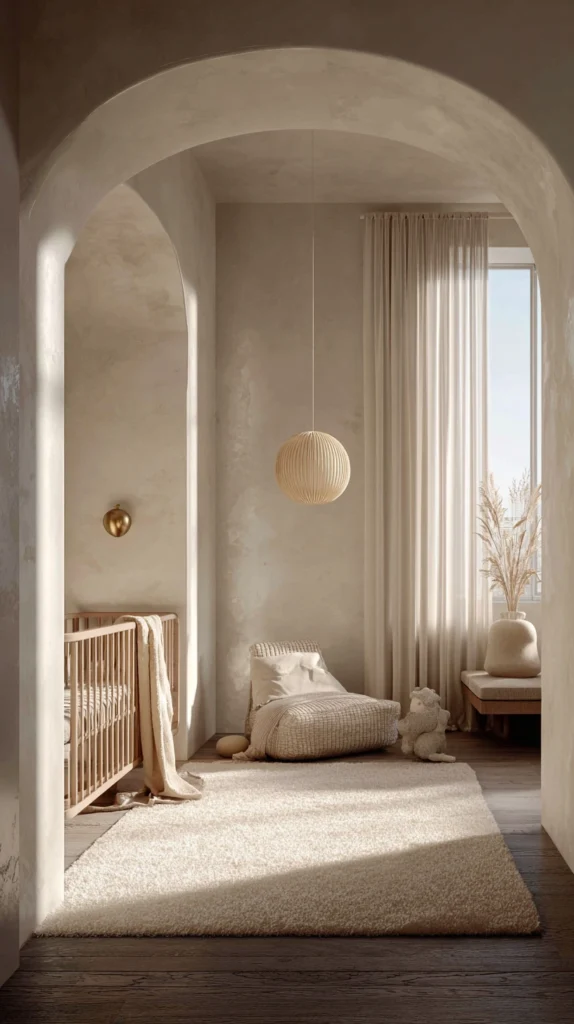
The boho nursery palette runs in warm cream, oatmeal, terracotta, dusty sage, sand, and the particular undyed tone of natural linen — the colours of organic materials in their most honest state. It avoids the cool grey and clinical white of conventional nursery design and replaces them with tones that feel warm under artificial light, which matters considerably in a room used at every hour of the day and night.
A warm white or cream paint for the walls — one shade warmer than standard trade white — costs $20 – $50 per 2.5-litre tin. An accent wall in a warm terracotta or dusty sage — $20 – $50 for a single feature wall — introduces the colour without overwhelming the room’s sense of calm spaciousness. Warm tones in a nursery are not merely aesthetic choices. They are functional ones — a room that reads as warm and calm at 2am produces a different quality of night feeding than one that reads as bright and clinical.
Decorating tip: Paint the nursery ceiling in the same warm white as the walls rather than a standard bright white. A bright white ceiling above warm white walls creates a cool, slightly discordant overhead plane that the eye registers as slightly wrong without being able to identify why. A ceiling in the same warm white as the walls produces a cohesive, enveloping quality that wraps the room consistently from every angle.
2. The Macramé Wall Hanging
Budget: $20 – $150
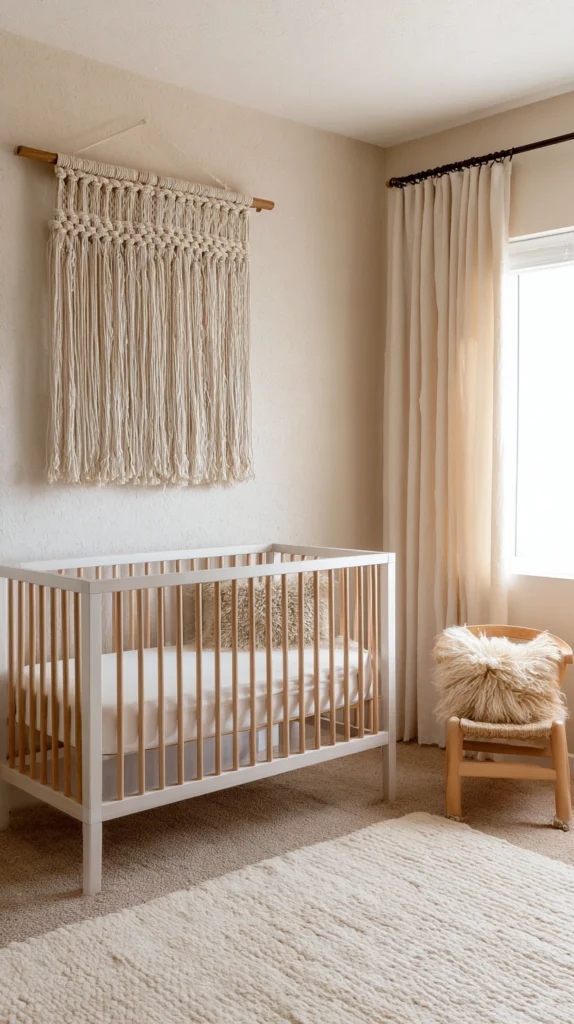
A large macramé wall hanging — positioned above the cot as the room’s focal artwork, or on the wall opposite the window as the surface the eye settles on when entering — is the most quintessentially boho nursery element and one that brings texture, warmth, and handmade quality to the wall in a way that framed prints alone cannot achieve.
A large hand-knotted macramé wall hanging in natural cotton cord costs $40 – $120 from independent makers on craft marketplaces. A medium-sized version — appropriate for a smaller nursery wall — runs $20 – $60. A DIY version made from natural cotton macramé cord — $10 – $20 for a skein — requires only a dowel rod, basic knot techniques available freely online, and an afternoon. The handmade version is not inferior to the purchased one in a boho nursery context. It is, in many ways, more appropriate.
Decorating tip: Hang the macramé at a height that the child will be able to see it clearly from the cot — approximately 30 to 40 centimetres above the top of the cot rail. A wall hanging positioned too high for a lying infant to see is a decoration for adults rather than for the child whose room it inhabits. A hanging within the infant’s sightline is a source of visual interest and gentle stimulation during the waking periods that every nursery room benefits from providing.
3. The Rattan and Wicker Furniture Pieces
Budget: $80 – $600
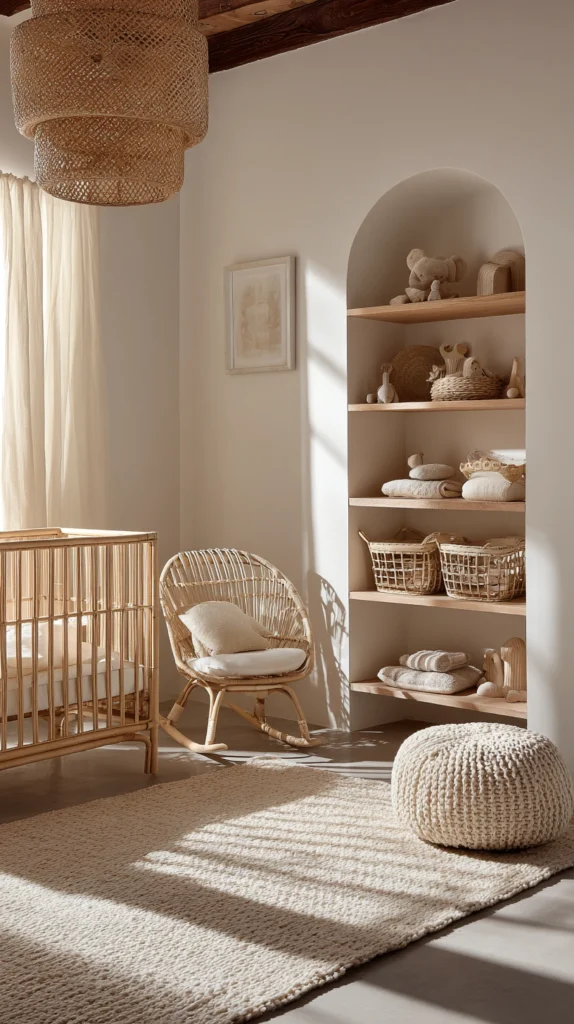
Rattan and wicker furniture — a rattan bassinet, a wicker side table, a rattan storage basket, a woven laundry hamper — bring the material warmth and the visual lightness that are specific to these natural woven materials and that no painted MDF furniture equivalent can replicate. They are also, practically, among the most durable nursery furniture pieces available — rattan and wicker resist the moisture, temperature changes, and physical contact of a nursery environment better than most synthetic alternatives.
A rattan bassinet or Moses basket on a stand costs $80 – $250. A wicker side table beside the nursing chair — $30 – $80 — holds the night-time essentials within reach. A set of woven seagrass or rattan storage baskets in graduated sizes — $20 – $60 for a set of three — organises the nursery’s considerable accumulation of small items in vessels that are beautiful rather than merely functional.
Decorating tip: Mix rattan and wicker with white-painted timber rather than combining all natural materials at the same warmth level. A nursery where every piece of furniture is in a natural woven or raw timber finish can read as warm to the point of heaviness. One or two white-painted pieces — a white cot, white shelves — within a predominantly natural material room provides the lightness that keeps the space feeling airy rather than dense.
4. The Dreamcatcher Collection
Budget: $15 – $100
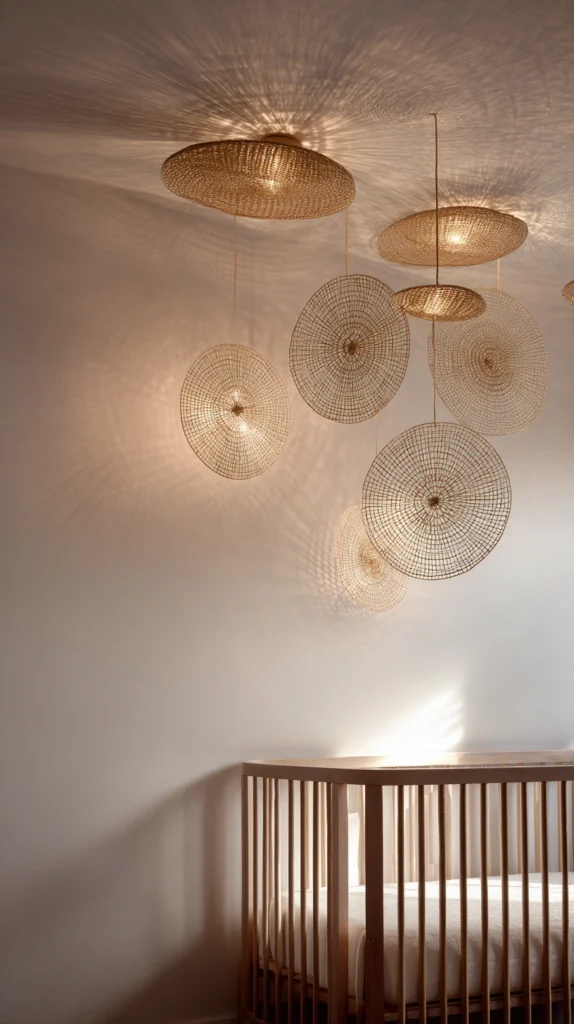
A collection of dreamcatchers — hung at varying heights from the ceiling or arranged on the wall in a loose cluster — is both a decorative element and a culturally resonant one, carrying the symbolism of protection and peaceful sleep that is entirely appropriate for a room in which a child will spend many thousands of hours in various states of rest.
Handmade dreamcatchers from craft marketplaces — in natural feathers, cotton thread, and wooden hoops — cost $8 – $30 each depending on size. A cluster of three at varying sizes — large, medium, and small — hung from the ceiling above the cot or in the room’s quietest corner costs $24 – $90 in total. Natural materials throughout — wooden hoops, undyed cotton cord, natural feathers — keep the dreamcatcher collection within the boho palette without introducing synthetic colours or materials that pull against the room’s warm natural aesthetic.
Decorating tip: Hang the dreamcatcher collection from the ceiling rather than mounting it flat against the wall where possible. A dreamcatcher hanging free from the ceiling moves gently in the air currents produced by an opening door or a ventilation system, and the gentle movement — along with the hanging depth and shadow it creates — is considerably more beautiful and more alive than the same dreamcatchers pinned flat against a surface.
5. The Neutral Linen and Muslin Textile Layer
Budget: $40 – $200
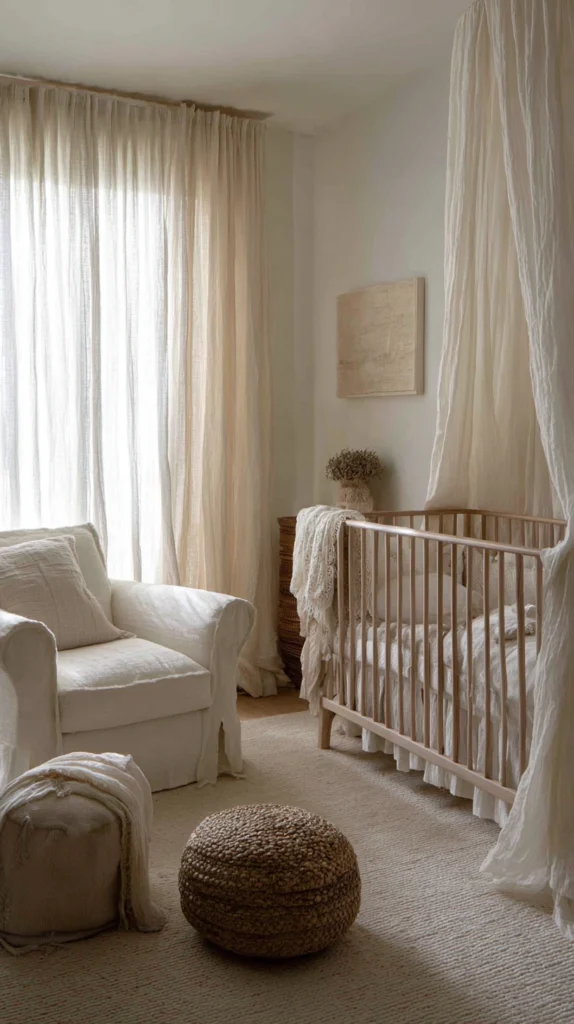
The textile layer of a boho nursery — the cot bedding, the nursing chair cushion, the window curtain, and the floor rug — should be built almost entirely from natural fibres in undyed or lightly dyed tones. Linen, muslin, cotton gauze, and organic cotton all behave differently in the light, absorb colour differently, and create a textile environment that is simultaneously varied in texture and cohesive in tone.
Linen cot bedding in natural or oatmeal — a fitted sheet and a flat sheet — costs $30 – $80 for a quality organic set. Muslin swaddle blankets in a warm neutral — $20 – $40 for a set of three — drape beautifully over the cot rail or the nursing chair arm as both functional and decorative textiles. A sheer linen or cotton muslin curtain panel — $25 – $60 — filters the light to a warm, diffused quality that suits the boho nursery’s visual atmosphere perfectly.
Decorating tip: Wash all nursery textiles before use in a fragrance-free, hypoallergenic detergent and avoid fabric softener entirely. Fabric softener coats natural fibres and reduces both their absorbency and the particular softness that well-washed natural textiles develop over time. A muslin blanket or linen sheet that has been washed multiple times without fabric softener becomes softer with each wash, not stiffer — which is the quality of textile that a boho nursery’s material philosophy is working toward.
6. The Terracotta and Ceramic Accessory Collection
Budget: $30 – $150
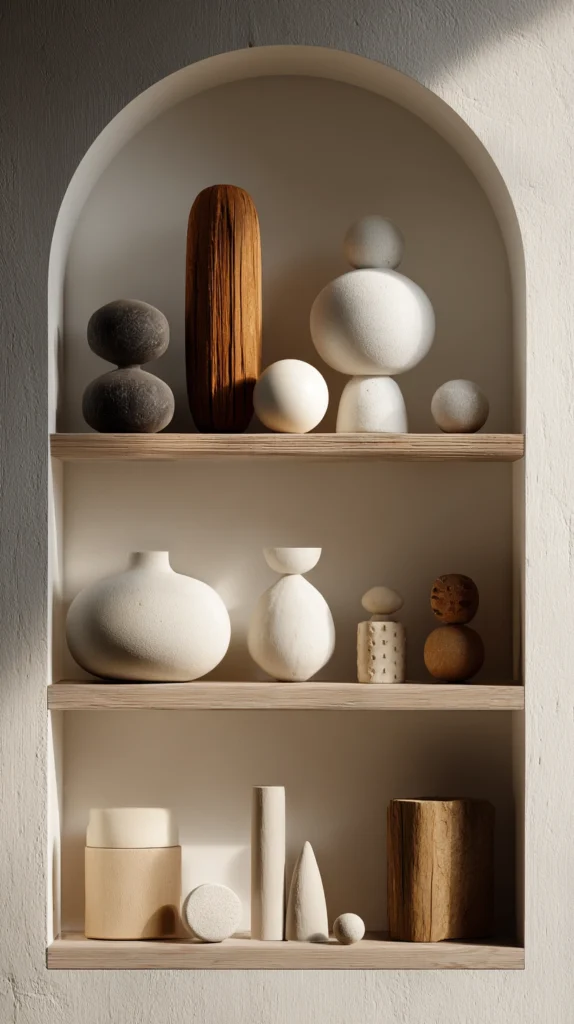
A collection of small terracotta and ceramic accessories — a terracotta pot holding a trailing plant, a ceramic candle holder on the shelf, a small handmade ceramic dish for hair clips and accessories, a ceramic lamp base — brings the warm earthy material story of the boho palette to the nursery’s horizontal surfaces in a form that is both beautiful and genuinely durable.
Terracotta pots in standard sizes cost $3 – $8 each. Handmade ceramic vessels from craft markets or independent makers run $15 – $40 each depending on size and maker. A ceramic lamp base in a warm cream or terracotta tone — $30 – $80 — provides both a light source and a decorative object simultaneously, which is one of the more efficient investments available for a nursery surface. A small collection of four to five ceramic pieces distributed across the nursery’s shelving costs $50 – $120 in total.
Decorating tip: Choose handmade ceramics with visible irregularities — slightly uneven rims, natural colour variations in the glaze, fingerprint marks in the clay — rather than perfectly uniform machine-made alternatives. The imperfection of handmade ceramics is not a flaw in the boho context. It is the quality that most directly communicates the handmade, unhurried aesthetic that the nursery is built on, and it is immediately and instinctively recognisable as such.
7. The Boho Nursery Floor Rug
Budget: $40 – $300
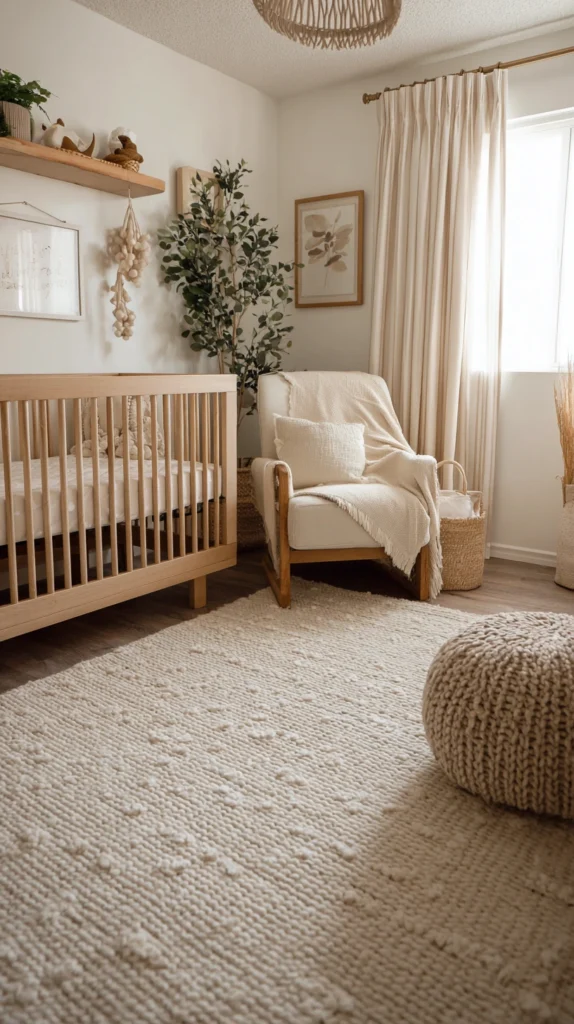
A large floor rug — natural jute, woven cotton in a warm neutral, a vintage-style Berber, or a hand-knotted wool in a muted geometric — is one of the most important elements of the boho nursery because it defines the floor as a warm, textural surface worth spending time on, which a baby spending increasing amounts of time on the floor from around four months onward will benefit from considerably.
A natural jute rug in a standard nursery size costs $40 – $100. A woven cotton rug in an undyed or lightly striped natural tone runs $50 – $120. A hand-knotted wool rug in a muted Beni Ourain or vintage Moroccan style costs $100 – $300 and is the most beautiful and most durable floor covering available for this application. All three options work with the boho palette — the choice between them is primarily about texture, budget, and the particular warmth level the room’s other elements require.
Decorating tip: Choose a rug with a low pile rather than a deep shag for a nursery application. A deep pile rug is comfortable to kneel on during nappy changes and feeding sessions, but it collects dust, is difficult to clean thoroughly, and becomes a tripping hazard as the child begins to pull to standing. A low-pile or flatweave rug is easier to clean, safer underfoot, and maintains its appearance significantly better through the physical demands of a nursery environment.
8. The Canopy Over the Cot
Budget: $20 – $150
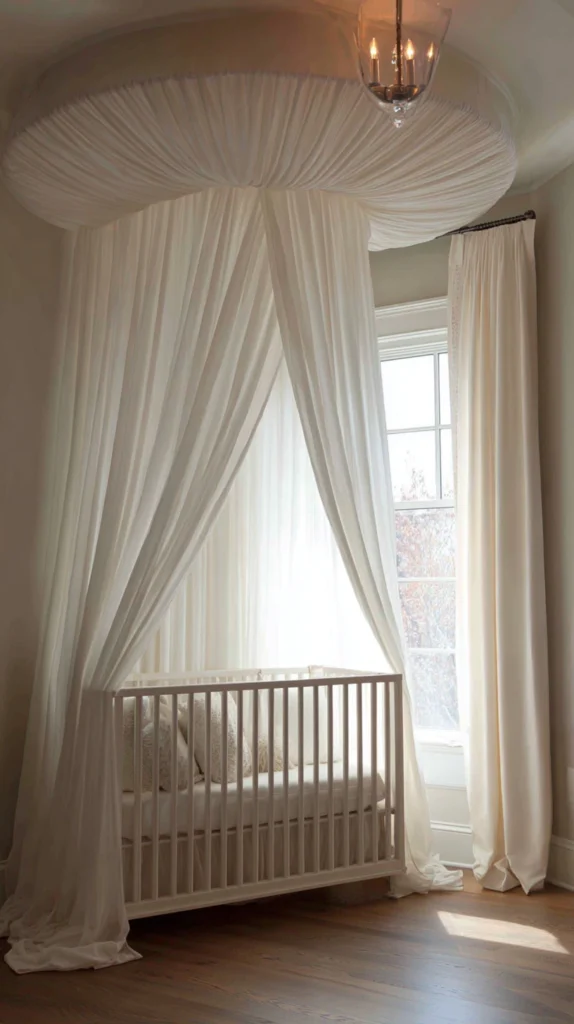
A fabric canopy above the cot — a single length of sheer muslin or gauze gathered at a central ceiling point and falling on both sides of the cot in soft folds — creates the most romantic and most visually complete nursery moment available at any price point. It defines the sleeping space as something set apart, gives the infant a softly filtered view upward, and produces an atmosphere of shelter and warmth that contributes meaningfully to the feeling of the room.
A ceiling canopy holder — a circular ring or a hook to gather the fabric — costs $5 – $20. Several metres of sheer muslin or cotton gauze in a warm white or natural ivory — $3 – $8 per metre, requiring approximately six to eight metres for a generous drape — fills the canopy generously for $18 – $64 in fabric. Total canopy investment sits at $23 – $84 for one of the most photographed and most beloved nursery decorative elements available.
Decorating tip: Ensure the canopy fabric is gathered and secured well above the cot sleeping surface and that no fabric can fall into the sleeping area. A canopy installed correctly — fabric gathered at ceiling height and falling on the outside of the cot rails rather than inside them — is entirely safe. A canopy installed without attention to the fall of the fabric introduces a safety concern that the beauty of the installation does not justify. Install according to the clearance guidelines of the cot manufacturer and common sense.
9. The Botanical and Living Plant Corner
Budget: $30 – $150
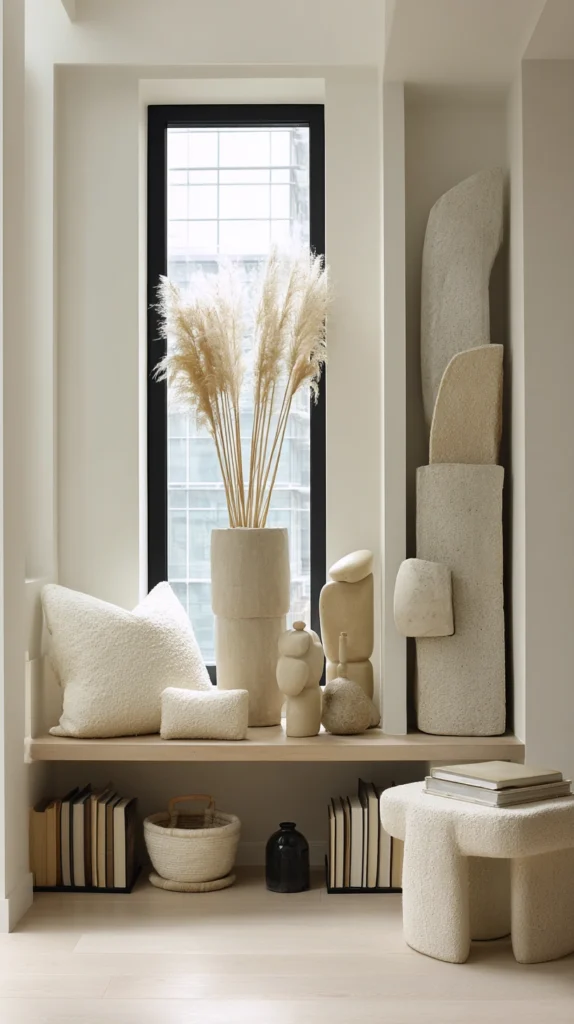
A nursery corner given over to living plants — a large trailing pothos on a high shelf, a monstera in a terracotta pot on the floor, a small succulent cluster on the windowsill, and an air plant on a piece of driftwood on the bookshelf — brings the oxygen, the humidity, and the visual vitality of living things to a room that benefits enormously from all three.
A large pothos or golden pothos — one of the most vigorous, most air-purifying, and most forgiving plants available for indoor conditions — costs $10 – $25. A small monstera in a terracotta pot runs $20 – $50 depending on size. A succulent collection in terracotta pots — $5 – $15 for three to four small plants — adds variety at the windowsill level. The total plant investment for a generous nursery corner sits at $35 – $90 for plants that actively improve the air quality of the room their occupant sleeps in.
Decorating tip: Position all floor-level plants safely outside the reach of a crawling infant — which means anticipating a crawling radius of approximately one metre from any floor surface the child will access. A plant beautiful at floor level in the newborn months becomes a soil-scattering, leaf-chewing hazard at seven months. Position floor plants in corners accessible only to adults, or move them to higher surfaces before the mobile stage arrives, which comes sooner than anyone expects.
10. The Wooden Shelf Display
Budget: $30 – $200
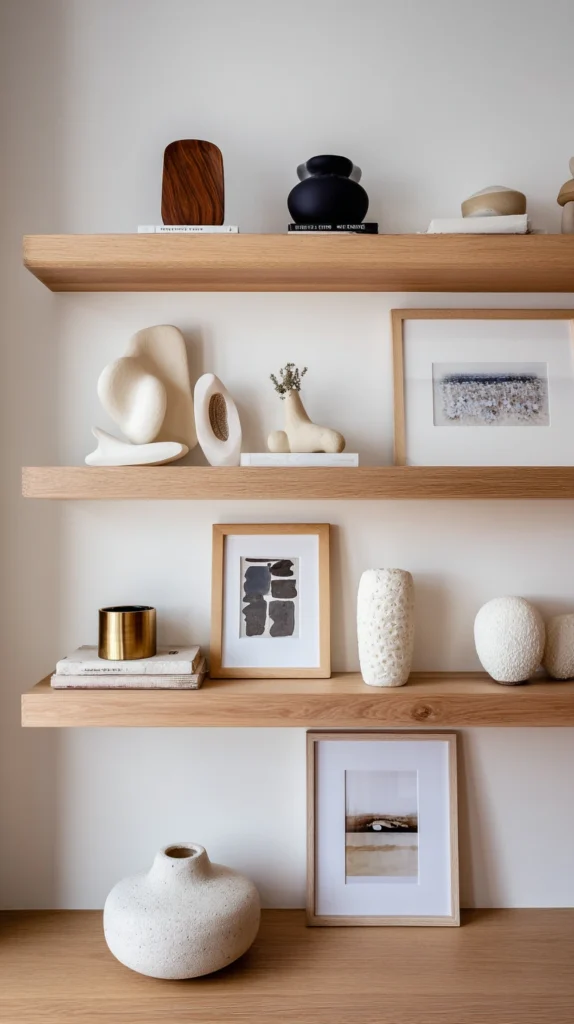
Wooden shelves — floating pine shelves in a natural or lightly oiled finish, or scallop-edged picture ledges in a warm white — provide the nursery’s display surface for the small objects, books, and botanical details that give the boho aesthetic its layered, personal quality. A boho nursery shelf is never purely functional. It holds objects that are there because they are beautiful or meaningful rather than because they need a storage location.
Floating pine shelves in a standard nursery size cost $15 – $40 each. A pair of shelves — one at adult-accessible height for display objects and one at lower height for board books — runs $30 – $80 in timber cost plus $10 – $20 in fixings. The objects displayed on them — a small ceramic animal, a wooden name letter, a dried botanical, a framed print, a tiny potted succulent — cost $30 – $80 in total for a fully styled shelf pair.
Decorating tip: Style the nursery shelves before the baby arrives rather than after, when time and energy are significantly less available. A shelf that is styled during the nesting period — when the motivation and the creative energy for these decisions are at their highest — is considerably more considered and more beautiful than a shelf styled in the fragments of time available in the newborn weeks. Install the shelves, style them properly, and they will be there and beautiful from the first day of the child’s life in the room.
11. The Pampas Grass and Dried Botanical Arrangement
Budget: $15 – $80
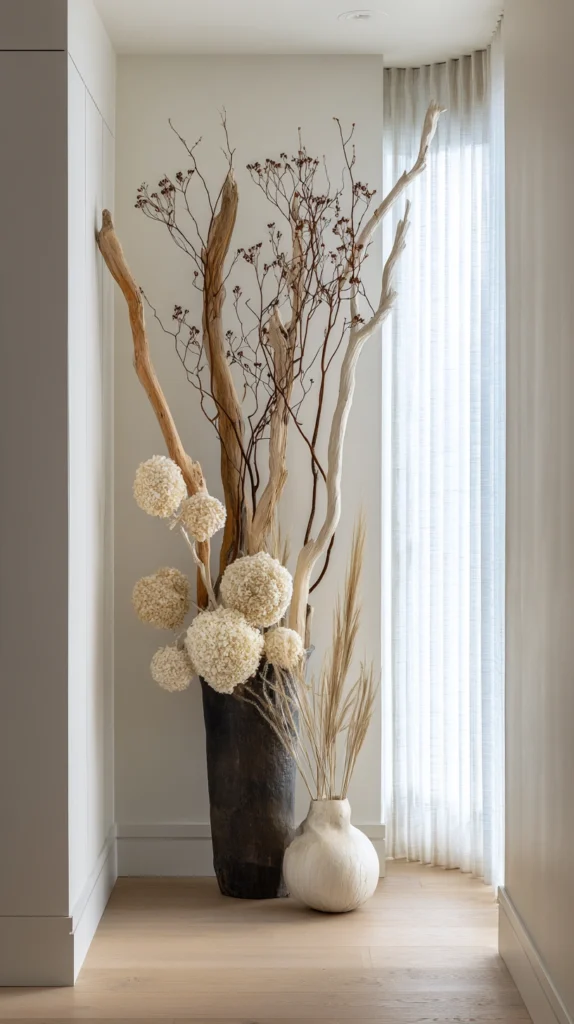
A tall ceramic or terracotta vase placed in the nursery corner and filled with dried pampas grass, bleached wheat stalks, dried bunny tail grass, and cotton stems — in the natural, undyed tones of the boho palette — is the large-scale botanical element that gives the room its vertical interest and its most photographed decorative moment.
Dried pampas grass bundles cost $15 – $40 depending on size and fullness. Dried wheat stalks and bunny tail grass add $8 – $20 for complementary texture within the arrangement. A tall terracotta or cream ceramic floor vase to hold the arrangement — $20 – $60 — is both the vessel and a decorative object in its own right. Total investment for a generous corner botanical arrangement sits at $43 – $120.
Decorating tip: Position the pampas arrangement in a corner that is inaccessible to the child once mobile — behind a chair, in a corner blocked by furniture — rather than in an open floor position. Dried botanicals shed and crumble when handled, producing fine organic particles that are not appropriate for infants to ingest or inhale. A pampas arrangement in an inaccessible corner remains beautiful indefinitely. One within reach of a curious toddler is dismantled within a single morning.
12. The Wooden Mobile Above the Cot
Budget: $20 – $120
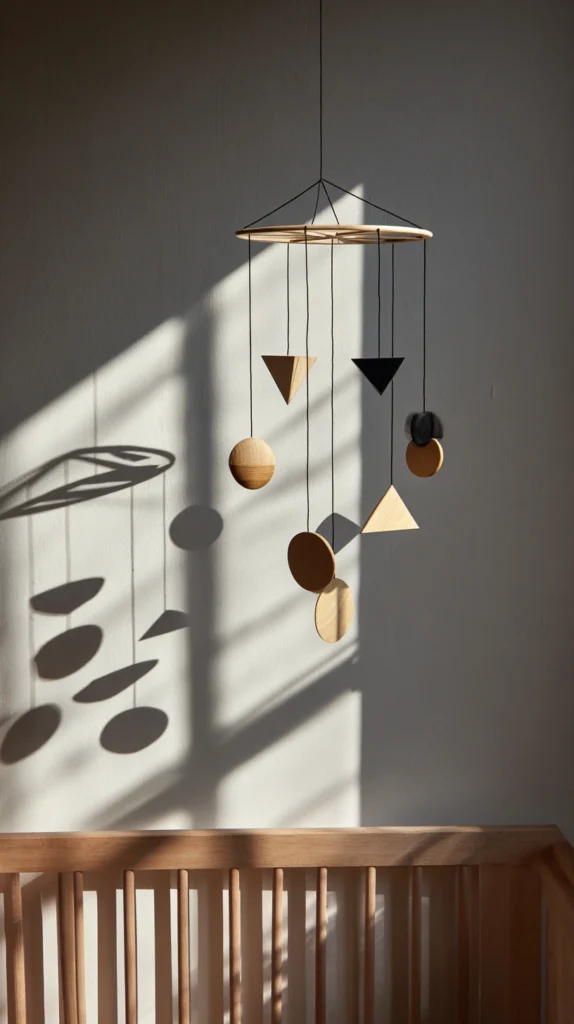
A mobile above the cot — wooden shapes in natural, undyed tones, or geometric forms in warm neutrals, or felt animal shapes in the boho palette, suspended from a wooden or brass arm — provides the visual stimulation that newborns benefit from during awake periods and the decorative moment that the cot position requires from the room’s wider aesthetic.
A handmade wooden mobile in natural beech or birch shapes — clouds, stars, moons, and simple geometric forms — costs $25 – $80 from independent craft makers. A DIY version made from laser-cut wooden shapes — available unfinished from craft suppliers for $10 – $20 — hung on fishing line from a wooden dowel costs $15 – $30 in total and is entirely achievable in an afternoon. The mobile should hang at a height that provides visual interest without being within the infant’s reach — approximately 20 to 30 centimetres above the cot mattress surface.
Decorating tip: Choose a mobile with high-contrast elements within its natural palette — a dark wooden shape alongside a pale one, a black-and-white geometric alongside a warm natural form — because newborns respond most strongly to high contrast rather than colour in the first three months of life. A mobile that is aesthetically beautiful for adults and visually stimulating for a newborn is the correctly calibrated version of this nursery element.
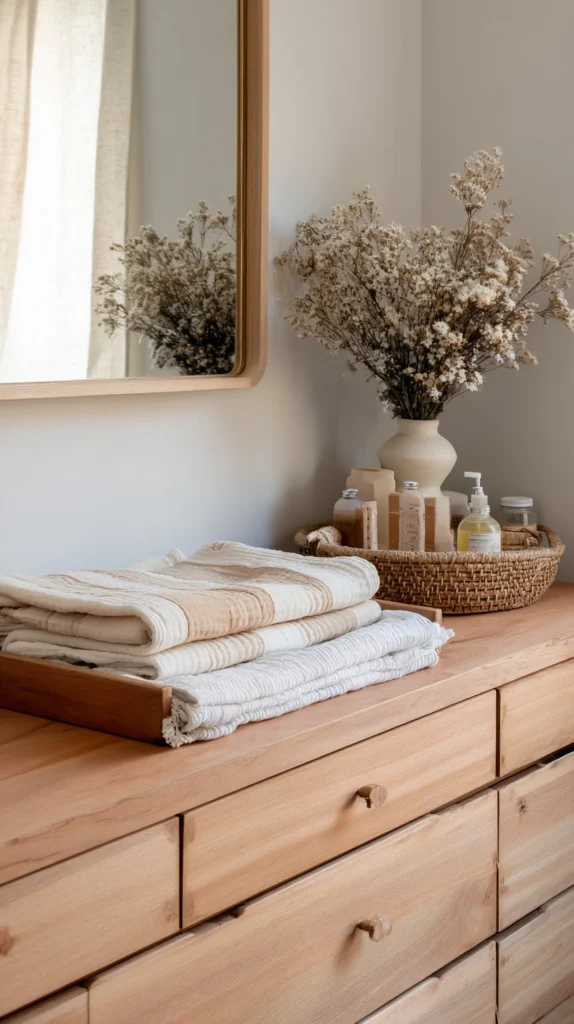
13. The Boho Changing Station
Budget: $50 – $300
A changing station designed with the same aesthetic intention as the rest of the nursery — a changing topper on a natural timber dresser, a wicker basket of nappies and wipes within reach, a small terracotta pot of cotton balls on the shelf above, a muslin cloth draped over the dresser edge — is one of the most used surfaces in the nursery and one of the most consistently neglected from a design perspective.
A natural timber dresser with a changing topper — $100 – $300 for the dresser, $20 – $50 for the topper — is the station’s foundation. A wicker basket for nappies and wipes — $15 – $30 — replaces the standard plastic nappy caddy with something that belongs in the boho aesthetic. A small shelf above the changing surface — $15 – $30 in timber and fixings — holds the cotton balls, the nappy cream, and the small spare essentials within reach.
Decorating tip: Install a small piece of wall art or a botanical print directly in the infant’s sightline above the changing surface — at the height the baby looks when lying flat on the topper. A baby who has something visually interesting to look at during a nappy change is significantly more cooperative during the process than a baby looking at a blank ceiling, which is a practical tip as much as a decorating one.
14. The Soft Lighting System
Budget: $30 – $200
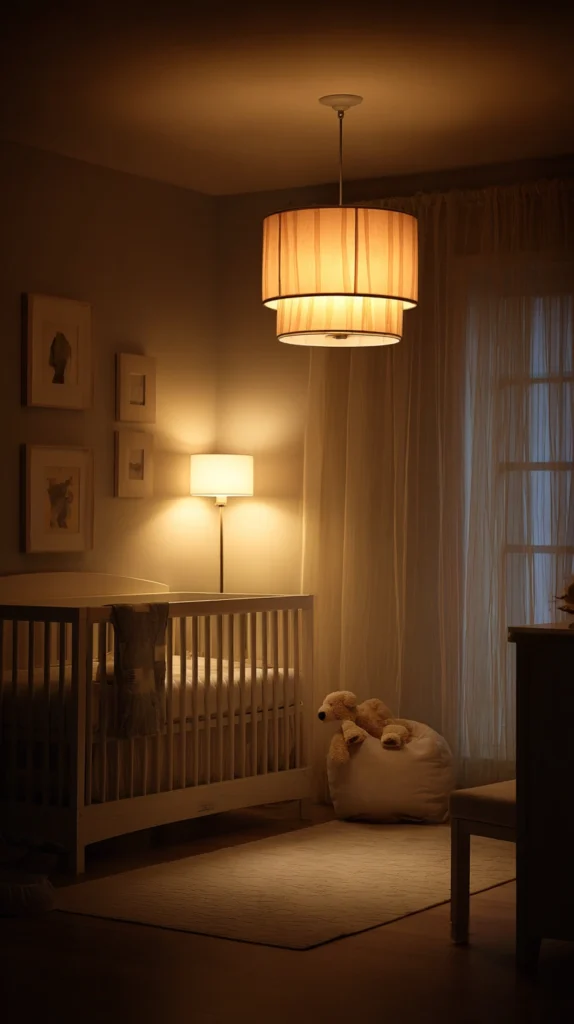
The lighting of a boho nursery is as important as any painted or decorated surface, because the quality of light in a room used at every hour of the night and day determines the atmosphere of the space at its most critical moments — the 3am feed, the 6am waking, the midday nap attempt, and the evening wind-down.
A warm-toned nightlight in a natural material — a salt lamp, a wooden LED nightlight, or a rattan-shaded small lamp — costs $15 – $50 and provides the gentle illumination needed for night feeds without stimulating full wakefulness. A dimmable main light — a rattan or bamboo pendant with a warm LED bulb on a dimmer switch — costs $30 – $80 for the pendant and $15 – $30 for the dimmer installation. String fairy lights in warm white around the cot canopy or along a shelf edge add $10 – $20 for the ambient layer.
Decorating tip: Install a dimmer switch on the nursery’s main light before the baby arrives rather than after. A dimmer switch fitted by an electrician costs $50 – $100 including installation and is the single most practical pre-baby home improvement available — because the ability to reduce the main light to 10 percent brightness for a night feed without turning on a separate lamp is used multiple times every night for the first months of the child’s life.
15. The Personalised Boho Name Sign
Budget: $20 – $100
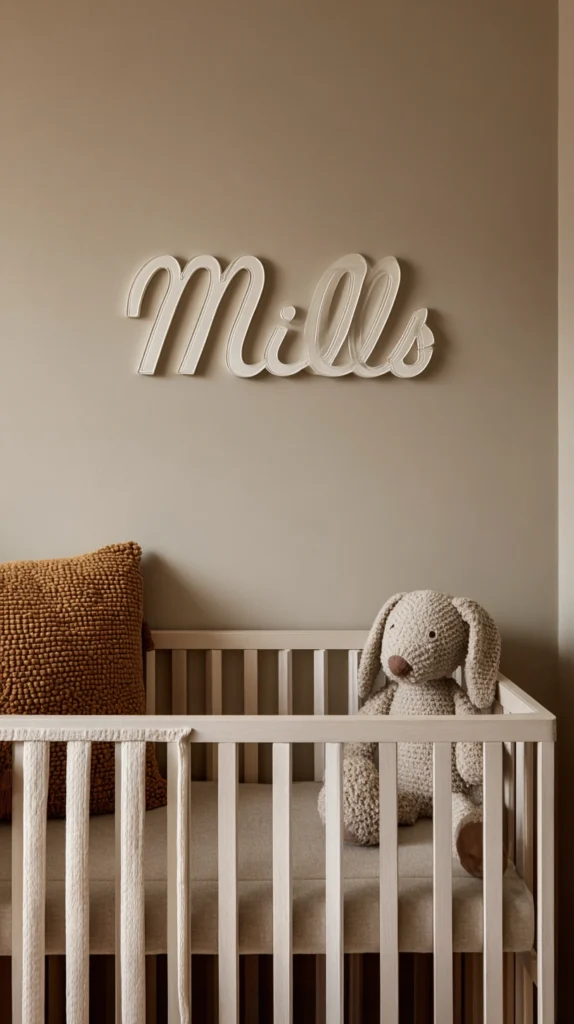
A personalised name sign — wooden letters in a natural or white finish mounted on the wall above the cot or on the bookshelf, or a macramé or woven name banner hung as a textile artwork — gives the boho nursery its most personal element and the one that makes the room unmistakably and specifically the child’s rather than a beautifully decorated generic space.
Wooden name letters in a natural birch or beech finish cost $3 – $8 per letter — a five-letter name sits at $15 – $40 in letters. A macramé name banner woven in natural cotton cord — purchased from an independent maker for $30 – $80 — is the most boho-appropriate version of this element and one that photographs beautifully against a warm-toned nursery wall. A hand-lettered name print in a botanical watercolour style — $10 – $30 framed — is the most accessible version at the lowest cost.
Decorating tip: Install the name sign before the baby’s arrival if the name has been decided, or prepare the mounting position and hardware for installation immediately after. A nursery that is complete before the child arrives — including the name element that makes it specifically theirs — produces a different quality of welcome than a room that is still being assembled in the weeks after birth. The nursery finished before the arrival is a gift to the baby and, more practically, to the parent who will not have the time or energy to finish it afterward.
Whatever combination of these fifteen ideas finds its way into the nursery, the principle that holds all of them together is the same one that makes the boho aesthetic so particularly appropriate for a baby’s room: it is built on warmth, natural materials, handmade quality, and the accumulation of beautiful things chosen with care — and these are exactly the qualities that a child’s first room should communicate from its very first day of use.
A boho nursery is not a room that was assembled. It is a room that was made — made with the particular combination of anticipation and love that precedes a child’s arrival, and designed to grow with the child rather than be dismantled and replaced when the infant stage passes.
Make it warm. Make it natural. Make it personal. And then stand in the doorway at the end of the last day before the baby arrives and let it be exactly what it is — the most carefully prepared and most lovingly made room in the house.