14 Pink Nursery Ideas for Baby Girls
There is a pink that belongs in a nursery, the way morning light belongs in a bedroom — not because convention demands it but because, chosen well and applied with genuine thought, it creates an atmosphere of warmth, softness, and gentle beauty that serves both the sleeping infant and the exhausted parent in equal measure.

The pink nursery has been unfairly reduced, in much contemporary conversation, to its most clichéd version — the hot pink, the cartoon-printed, the aggressively gender-coded room that belongs to a retail catalogue rather than a real child’s life. But the pink nursery at its best is none of those things. It is a room of blush and rose, of pale petal and dusty mauve, of the particular warmth that a carefully chosen pink brings to a room used at every hour of the day and night.
The fourteen ideas below treat the pink nursery as what it should be — a thoughtful, beautiful, genuinely considered room for a new person — and cover every element from the walls and the furniture to the textiles and the finishing details. Each one covers what you will need, what it will cost, and a practical tip to make it genuinely work in a real nursery rather than a styled photograph.
1. The Blush Pink Wall Palette
Budget: $30 – $150
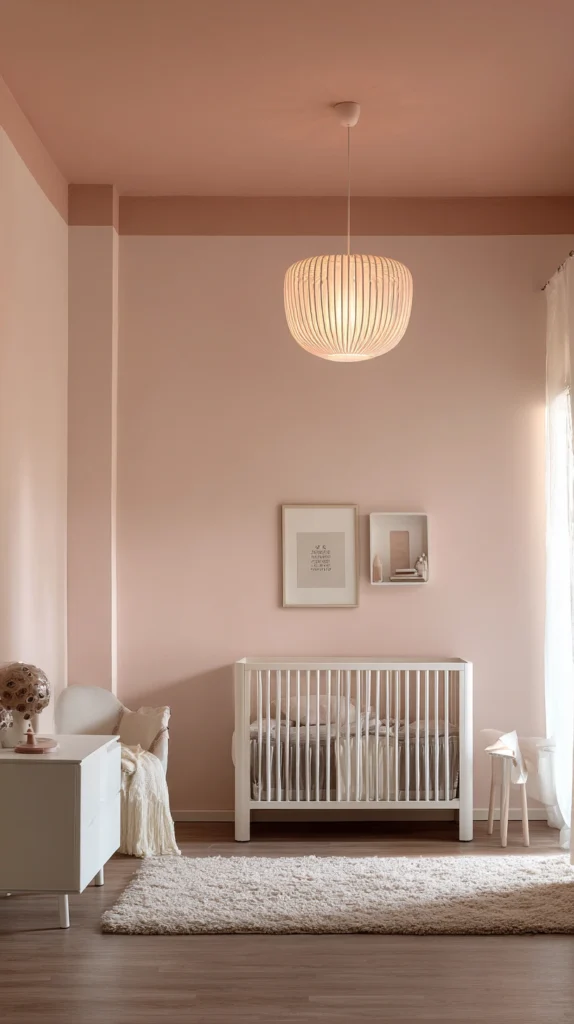
The foundation of a beautiful pink nursery is the wall colour, and the wall colour that works consistently — in morning light, in afternoon shadow, and under the warm artificial light of a night feed — is blush rather than pink. Blush is pink with white in it, with a slight greying or warming that prevents it from reading as saturated or juvenile. It is the colour of the inside of a shell, of a peony at its most open, of the particular warmth of light through thin white curtains on a summer morning.
A quality blush paint — Farrow and Ball Peignoir, Little Greene’s Pale Blush, or Dulux’s Blush Pink — costs $20 – $50 per litre. A standard nursery requires two to three litres for two coats of all four walls. A ceiling taken one shade lighter than the walls — in a barely-there blush white — costs one additional litre at $15 – $30 and prevents the room from feeling enclosed despite the warm wall colour.
Decorating tip: Test blush paint in the nursery at the time of day it will be most used — typically the early morning of a feed or the evening of a bedtime routine — rather than only in the bright light of the afternoon. Blush is one of the colours most sensitive to light source and direction: a blush that reads as warm and beautiful in morning light can read as distinctly peachy in afternoon sun or lavender-tinged under cool artificial light. The correct shade is the one that reads as intended at 3am under a warm nightlight, because that is when the room matters most.
2. The Pink Feature Wall With Neutral Complement
Budget: $20 – $100
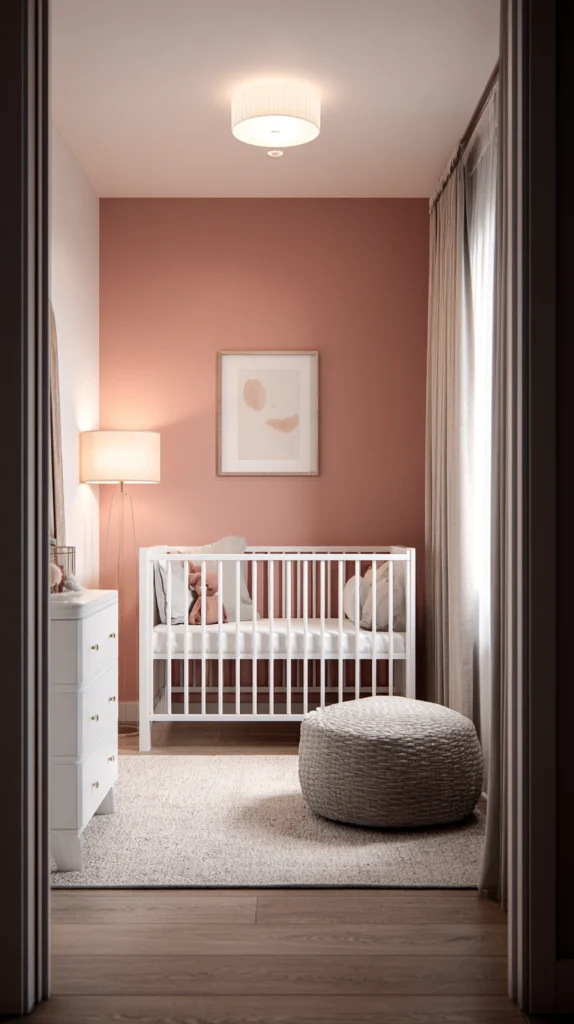
A single pink feature wall — behind the cot, giving the sleeping space its own warm backdrop — with the remaining three walls in a warm white or the palest barely-there blush, is the most versatile and most widely applicable pink nursery approach. It introduces the colour decisively without overwhelming the room, and it leaves the rest of the space light and airy — a quality that small nurseries particularly need.
One to one and a half litres of a mid-depth pink — a dusty rose, a warm antique pink, or a muted raspberry — on the feature wall costs $20 – $50 in paint. The remaining walls in a warm white — not bright white, which reads cold against any pink — cost one additional 2.5-litre tin at $20 – $50. The feature wall should be the first surface seen on entering the room — the wall directly opposite the door — so that the pink impression registers immediately.
Decorating tip: Paint a simple arch shape in the pink on the feature wall rather than colouring the entire wall if the nursery is very small and a full feature wall feels too much. An arch — a softly painted semi-circle centred above the cot, approximately 1.5 metres wide and 1.8 metres tall — creates a framing effect that references the colour without covering the full wall surface, and produces a decorative moment that is both more individual and more beautiful than a straightforward painted rectangle.
3. The Pink and White Cot Bedding Layer
Budget: $40 – $200
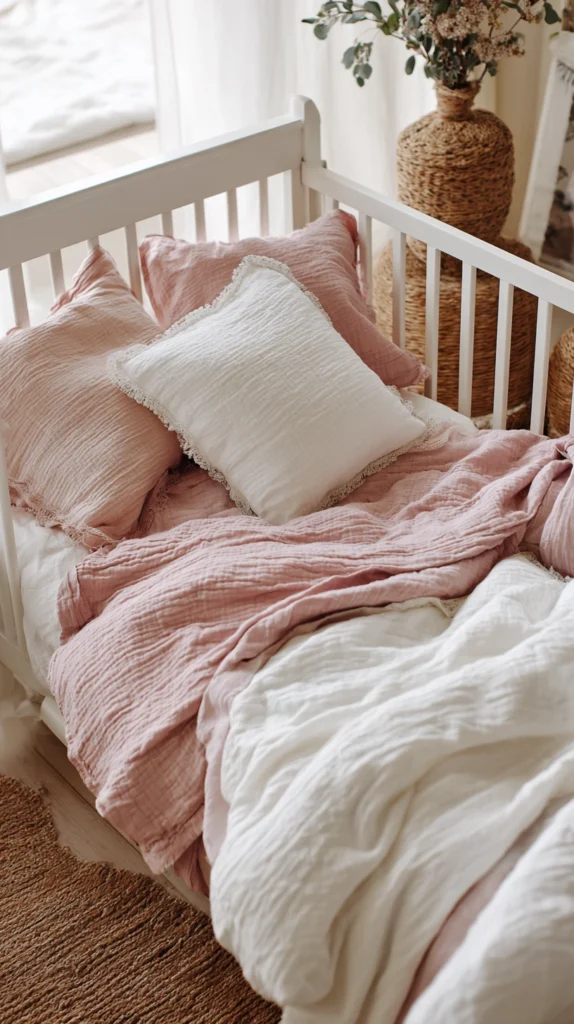
The cot bedding — the fitted sheet, the flat sheet, and the cellular or muslin blanket — is the nursery’s most frequently seen and most frequently touched textile, and the one that contributes most directly to the room’s overall colour atmosphere. Pink and white bedding in natural, breathable fabrics is the most classically resolved pink nursery textile choice, and the combination of white and pink at the sleeping surface reads as clean, soft, and genuinely beautiful.
Organic cotton fitted cot sheets in white cost $15 – $40 each. A cellular blanket in a pale pink or blush tone — $20 – $50 — provides the warmth layer. A cotton muslin flat sheet in a pink-and-white stripe or spot print — $15 – $35 — adds the patterned element at the most intimate level of the bedding. All three in natural fibres rather than synthetic alternatives — the temperature regulation of natural fibres in a cot environment is significantly superior to synthetic equivalents.
Decorating tip: Buy at least three of every cot sheet before the baby arrives. The rate at which cot sheets require washing in the first months of a newborn’s life is significantly higher than any parent who has not previously had a newborn will estimate, and a nursery laundry cycle that requires the same sheet to be washed, dried, and returned to the cot within hours of removal is a source of stress that three sheets per size eliminates completely.
4. The Pink Canopy Over the Cot
Budget: $20 – $150
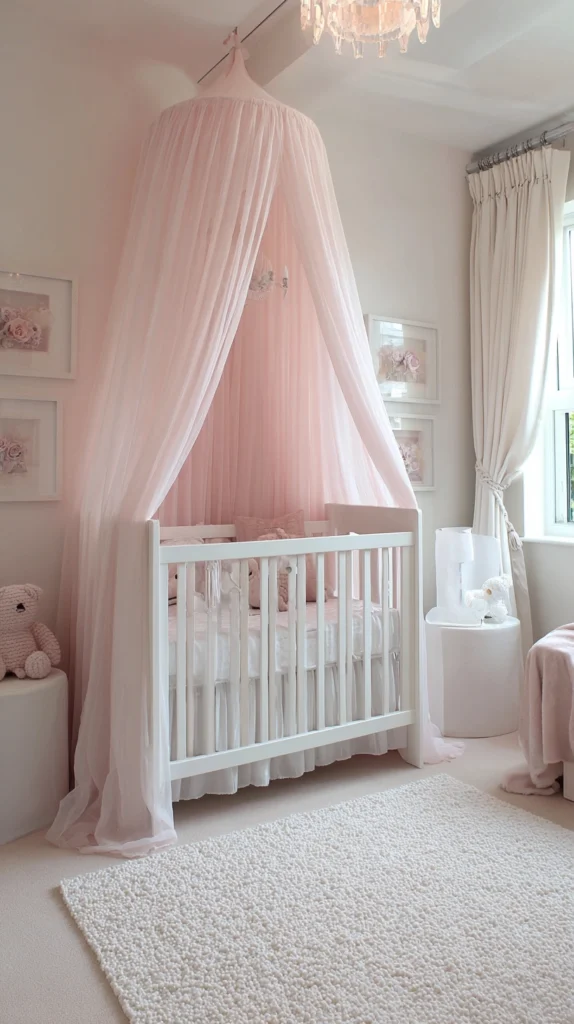
A fabric canopy above the cot — lengths of sheer pink muslin or blush gauze gathered at a central ceiling point and falling on both sides of the sleeping space — is the pink nursery’s most romantic and most photographed decorative moment. It frames the cot as the room’s focal point, creates a sense of sheltered intimacy around the sleeping area, and produces an atmosphere of warmth and protection that suits the purpose of the room precisely.
A ceiling canopy ring or hook costs $5 – $20. Sheer muslin or cotton gauze in blush or pale pink — $3 – $8 per metre — requires six to eight metres for a generous fall on both sides. A gathered knot of the fabric at the ring, with the lengths falling freely on either side of the cot, takes twenty minutes to install and produces an effect that looks considerably more considered and more expensive than its actual cost. Total canopy investment: $23 – $84.
Decorating tip: Use blush or pale pink for the canopy fabric rather than a deeper, more saturated pink. A canopy is a large volume of fabric that dominates the overhead space of the sleeping area, and a deeply saturated pink at that scale can produce a room that feels dense and warm in a way that prevents rather than promotes rest. Blush or pale pink at the same scale reads as weightless and delicate — which is the quality a cot canopy should have above all others.
5. The Pink and Gold Accent Palette
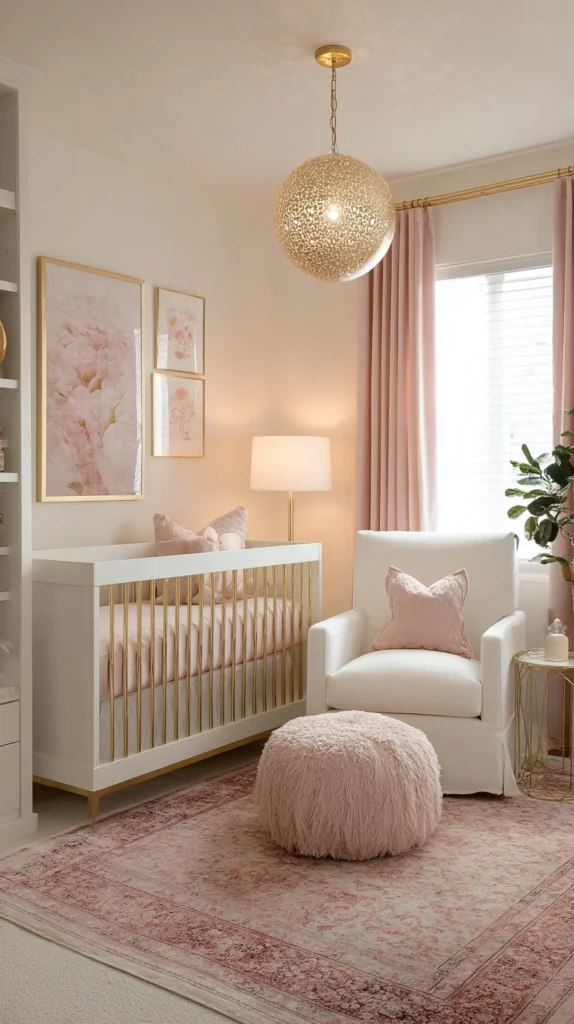
Budget: $30 – $200
Pink and gold in a nursery — blush walls with gold-toned hardware and accessories, warm brass light fittings, gold-framed prints, and a golden mobile above the cot — produces a room that reads as quietly luxurious rather than overtly themed, and that ages well as the child grows from infant to toddler to young child without requiring a complete redecoration at each stage.
Gold picture frames on blush walls — $10 – $25 each. A brass or gold-toned nightlight — $15 – $40. Gold name letter hooks for the wall — $3 – $8 per letter. A golden mobile above the cot — purchased or DIY from gold-sprayed wooden shapes — $20 – $60. The gold accent material distributed across the nursery surfaces costs $48 – $133 in total for a material story that elevates every pink surface it sits beside.
Decorating tip: Use warm gold — closer to aged brass in tone — rather than bright or cool-toned gold throughout the nursery. Bright gold beside pink reads as overtly glamorous in a way that can seem slightly incongruous in a baby’s room. Warm, slightly aged gold beside pink reads as soft, considered, and genuinely beautiful — the specific quality of material combination that suits a nursery environment and that grows with the room as the child grows.
6. The Pink Textile and Cushion Collection
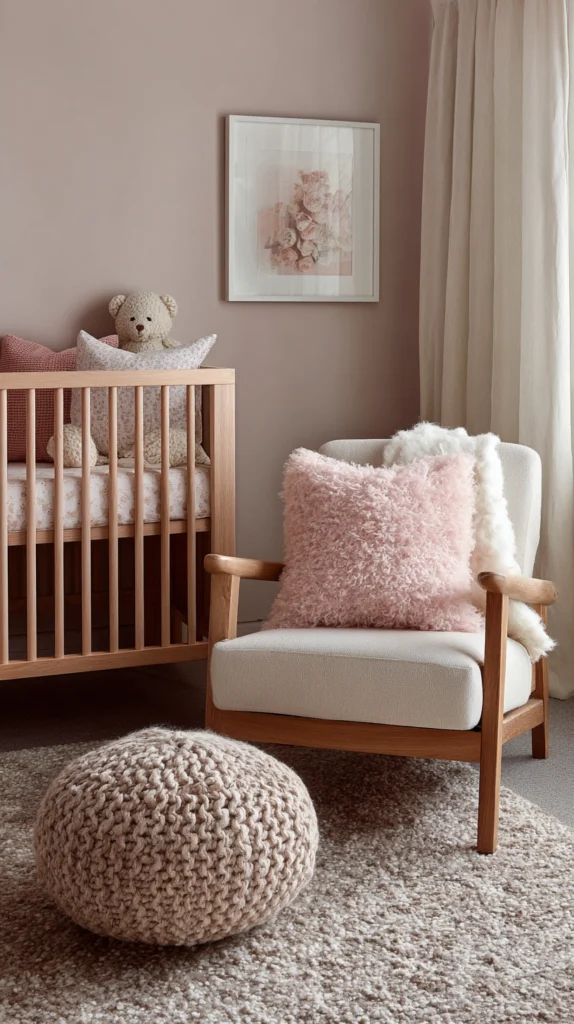
Budget: $40 – $200
The textile layer of a pink nursery — the nursing chair cushion, the window treatment, the decorative cushions on a shelf or in the cot area, the floor rug — builds the colour’s depth and complexity through varying tones and textures of pink rather than a single flat application. A room that contains dusty rose, pale blush, warm mauve, and antique pink in different textile materials reads as rich and layered. A room in a single flat pink reads as one-dimensional.
A linen cushion for the nursing chair in a dusty rose — $25 – $60. A sheer linen or cotton curtain panel in blush — $25 – $60 per panel. A small decorative cushion in a pink botanical print — $20 – $40. A cotton rug in a warm pink tone or a pink-and-white geometric — $40 – $100. The total textile investment for a fully layered pink nursery sits at $110 – $260 — modest for the visual richness it produces when the layers are combined.
Decorating tip: Include at least one textile in a pattern that contains pink alongside other colours — sage, cream, terracotta, or navy — rather than an all-pink pattern. A patterned textile that carries the pink into a wider colour relationship gives the room a reference point for introducing non-pink elements — a sage green plant pot, a terracotta ceramic — and prevents the nursery from reading as a room where every colour decision was made by the same single consideration.
7. The Floral Wallpaper Feature
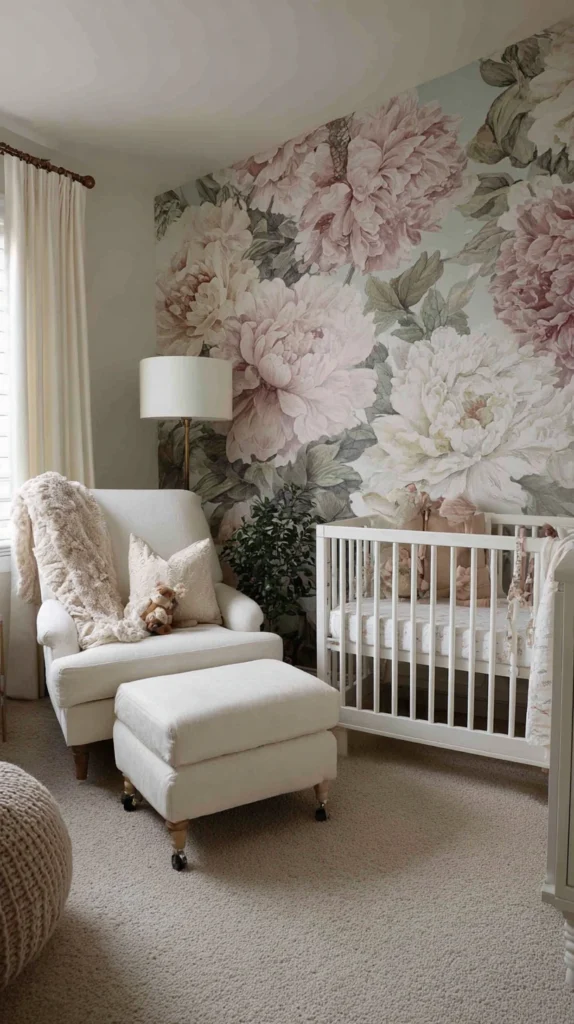
Budget: $40 – $300
A floral wallpaper on the feature wall or inside a painted arch — blowsy botanical prints in pink, blush, and cream, or a delicate small-scale ditsy print in dusty rose and sage — brings pattern to the nursery in the most classically feminine and most naturally beautiful form available, and creates a backdrop for the cot that no single flat colour can produce.
A quality floral wallpaper in a nursery-appropriate scale costs $15 – $50 per roll. A standard nursery feature wall requires two to three rolls depending on pattern repeat and wall dimensions. Hanging the wallpaper — DIY with paste-the-wall paper — costs nothing beyond the paste at $8 – $15 per bucket. A professional paper hanger charges $30 – $60 per roll for a total hanging cost of $60 – $180 for a two-to-three-roll feature wall.
Decorating tip: Choose a wallpaper with a large-scale botanical print rather than a small dense repeat for a nursery application. A large-scale botanical print — individual flowers clearly defined and separated by space — reads as beautiful and intentional from across the room. A small, dense repeat at the same scale reads as a busy texture rather than a pattern, and the individual flowers that make it lovely at close range are lost entirely from the viewing distance of a parent settling a baby in the cot.
8. The Pink Nursery Furniture Choices
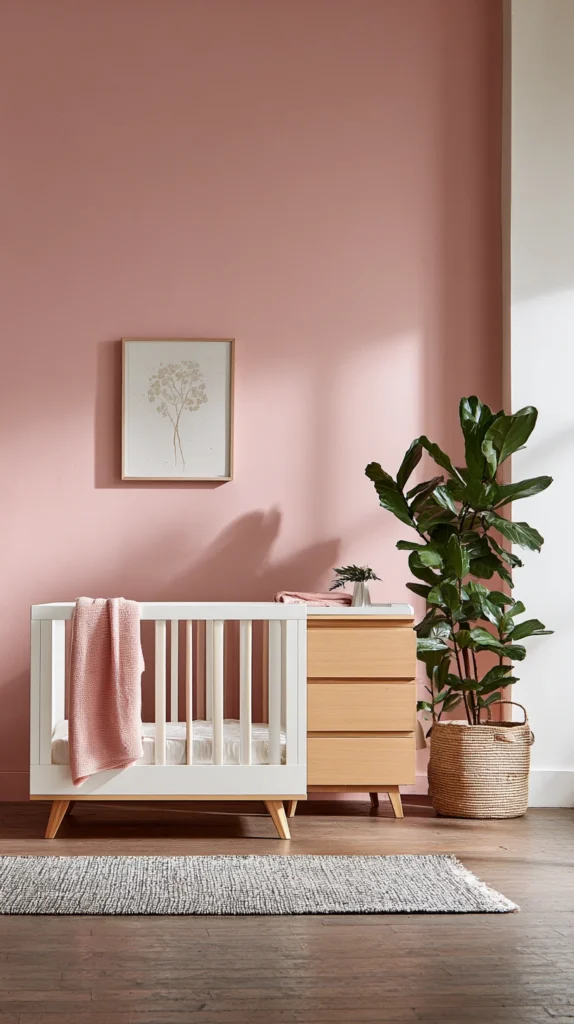
Budget: $200 – $2000
Furniture in a pink nursery works best in two specific finishes — white-painted wood, which reads as clean and light against the pink walls, and natural timber, which provides the warm contrast that prevents the room from becoming too sweet. A pink room furnished entirely in white risks a clinical quality despite the warmth of the wall colour. The same room with one or two natural timber pieces — a pine changing table, an oak bookshelf — is immediately warmer and more resolved.
A white-painted cot costs $150 – $500 depending on quality and brand. A natural timber changing table or dresser — $150 – $400. A white-painted or natural timber nursing chair — $150 – $400. A rattan storage basket or wicker Moses basket on a stand — $50 – $200. The total furniture investment for a fully furnished pink nursery sits at $500 – $1500 — modest for a room that will be used intensively for two to three years and adapted rather than replaced as the child grows.
Decorating tip: Choose furniture that has a use beyond the nursery stage rather than pieces designed exclusively for infants. A changing table that converts to a standard dresser, a cot that converts to a toddler bed, a bookshelf that will serve a school-age child — these are the furniture decisions that make the nursery investment sustainable rather than temporary. Pink walls can be repainted. Good furniture does not need to be replaced.
9. The Botanical and Pink Wall Art Collection
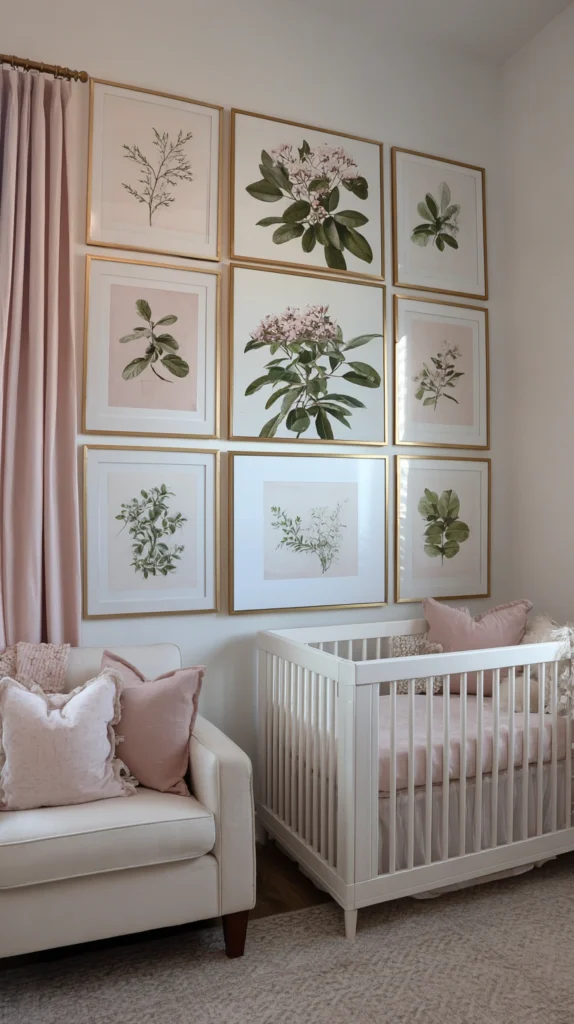
Budget: $20 – $150
A wall art collection in a pink nursery — a mix of botanical prints, abstract watercolours in the pink palette, small framed photographs, and a simple typographic print of the child’s name or a gentle quote — gives the walls their layer of personal meaning and visual interest beyond the colour of the paint or the pattern of the wallpaper.
Botanical prints in pink and sage tones — downloaded free from public domain archives or purchased from independent printmakers for $5 – $20 each. Frames in warm gold or white-painted wood — $5 – $20 each. A gallery arrangement of six to eight frames in varying sizes above the changing table or beside the nursing chair costs $30 – $120 in total for framing and prints. The gallery should include at least one piece that is specific to the child — a print of her name, a birth announcement illustration, a hand or footprint taken in the first weeks.
Decorating tip: Arrange the gallery wall on the floor before committing anything to the wall — laying the frames in their intended arrangement, photographing from above, and using the photograph as a reference when hanging. A gallery wall installed without this floor-test step almost always requires repositioning of at least two to three frames, leaving unnecessary holes in a freshly painted nursery wall and producing a final arrangement that is marginally less considered than one planned from above.
10. The Pink Lighting Scheme
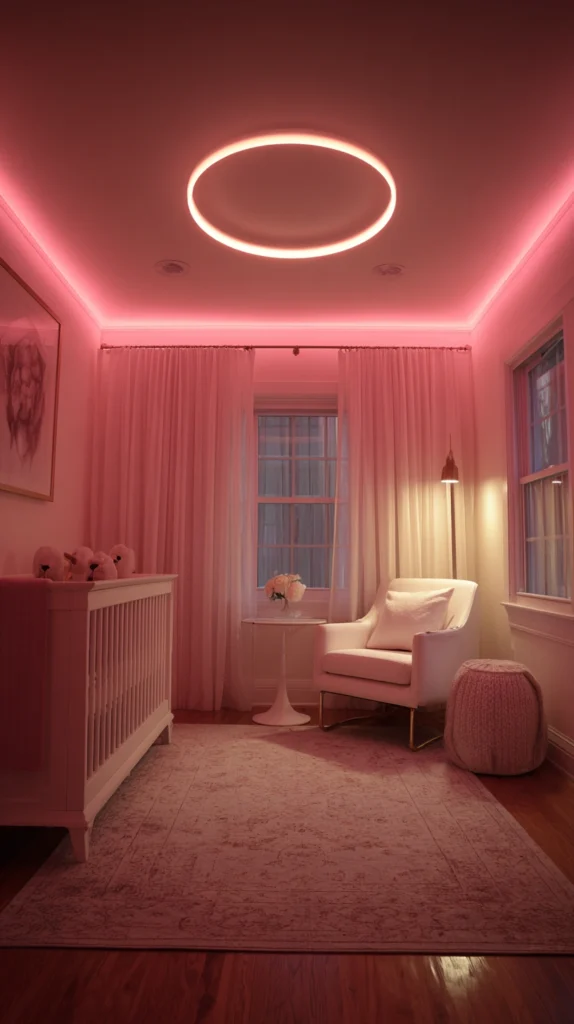
Budget: $30 – $200
The lighting of a pink nursery determines the room’s atmosphere at the hours when it matters most — the night feed, the early morning, the evening wind-down — and a thoughtfully layered lighting scheme is one of the most practical investments a nursery preparation can make. A warm nightlight, a dimmable main pendant, and a small reading light beside the nursing chair cover every lighting requirement of the nursery at every hour.
A pink or blush ceramic nightlight — $15 – $40 — provides the gentle illumination needed for night feeds without stimulating full wakefulness. A rattan or linen-shaded pendant on a dimmer switch — $30 – $80 for the pendant, $15 – $30 for the dimmer — provides the main light source with full range from bright to barely-there. A small clip-on or freestanding reading light beside the nursing chair — $15 – $40 — allows low-level illumination for night feeds without disturbing a settled baby.
Decorating tip: Fit warm LED bulbs — 2700K colour temperature — in every fitting in the pink nursery rather than standard cool white LEDs. Warm LEDs enhance the pink and blush tones of the wall colour and textiles, producing a room that reads as warm and softly beautiful at every hour. Cool white LEDs in the same pink room produce a clinical, slightly blue-toned light that works against every warm colour decision in the space and makes the room feel cold and unwelcoming at the hours when warmth matters most.
11. The Pink and Sage Green Colour Partnership
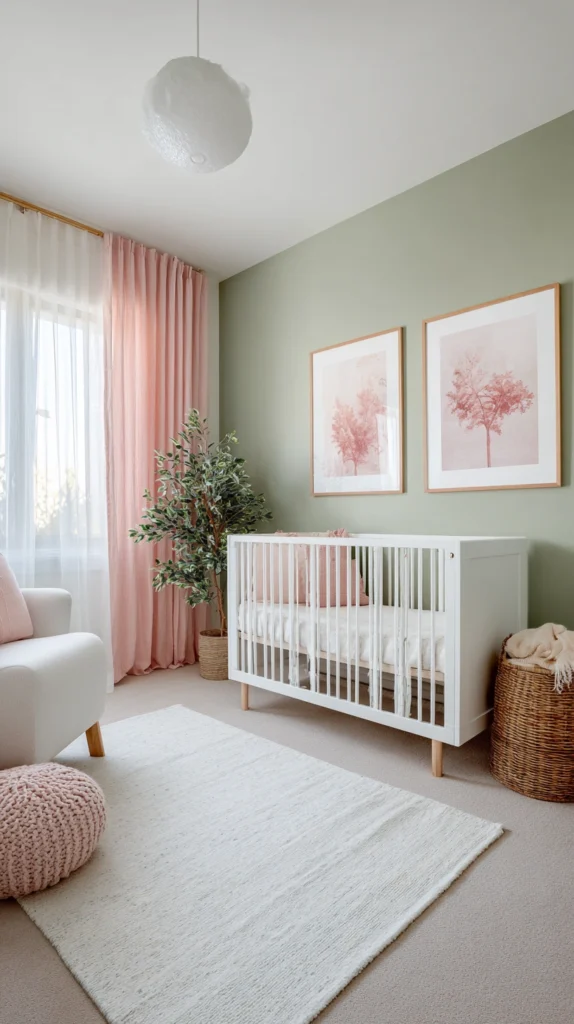
Budget: $40 – $300
Pink and sage green in a nursery — blush walls with sage green plant pots, sage green cushions on a white chair, a sage botanical print beside a pink one on the gallery wall — is the colour pairing that prevents the pink nursery from reading as one-dimensional and introduces the botanical, natural quality that connects the colour palette to the living world beyond the room’s walls.
Sage green ceramic plant pots in a nursery setting cost $5 – $20 each. Sage green cushion covers — $20 – $50 each. A botanical print combining pink flowers and sage green foliage — $10 – $25 framed — is the single piece that most efficiently carries both colours simultaneously. A sage green knitted blanket folded over the cot rail — $25 – $60 — introduces the second colour at the nursery’s central piece of furniture.
Decorating tip: Use sage green as the relief colour rather than a co-equal partner in the pink nursery. A room where pink and sage appear in exactly equal quantities reads as indecisive — a room that could not choose between two directions and ended up halfway between both. A room where pink is clearly dominant and sage appears as the accent reads as deliberately and confidently designed — which is a significant difference achieved simply by managing the proportion of each colour across the room’s surfaces.
12. The Personalised Pink Nursery Details
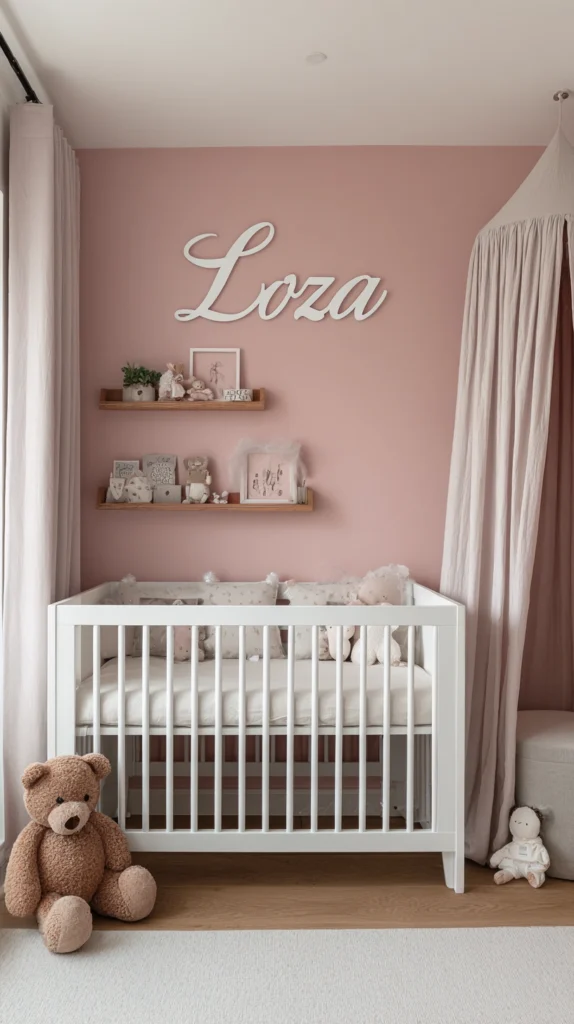
Budget: $20 – $120
The personalised elements of the pink nursery — the child’s name on the wall, a custom birth print, a hand-painted initial above the cot, a name banner in a complementary textile — are the details that transform a beautifully decorated room into a room that belongs specifically and unmistakably to a specific child, and that quality is the most important thing a nursery can have.
Wooden name letters in a white or blush finish — $3 – $8 per letter — mounted above the cot or on the shelf. A custom birth print — date, time, weight, name — in a botanical or abstract frame — $15 – $40 from an online printmaker. A macramé name banner in natural cotton — $30 – $80 from an independent maker. A hand-painted initial on the wall in a complementary tone — achievable with a single pot of paint and a round brush for $5 – $15 in materials.
Decorating tip: Install the name element before the baby arrives if the name has been decided in advance, or prepare the mounting hardware and the art in advance and install it immediately in the first days home. A nursery that is complete from the first night the child sleeps in it — including the name that makes it specifically hers — is a room that carries the full weight of preparation and love from its very first use, and that quality is felt in the room even when it cannot be explicitly identified.
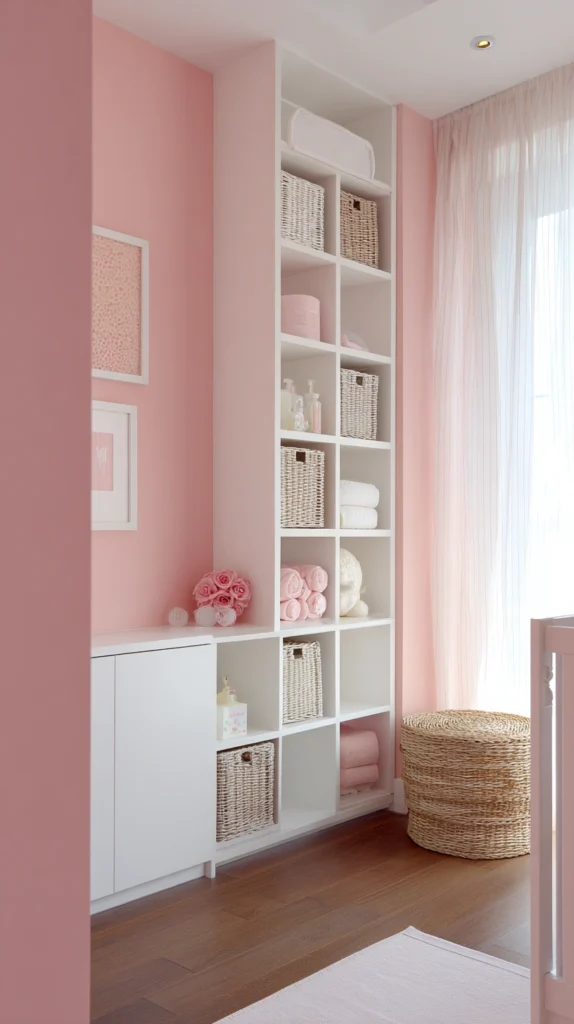
13. The Pink Nursery Storage Solutions
Budget: $30 – $200
Storage in a pink nursery — the containers for nappies, wipes, small clothing items, toys, and the general accumulation of baby equipment — can be made to participate in the room’s aesthetic rather than simply occupying it, through the choice of storage vessels in materials and tones that complement rather than contradict the colour palette.
Woven seagrass or cotton rope baskets in natural or blush tones — $10 – $30 each — replace plastic storage boxes on shelves. A white-painted bookcase with baskets on the lower shelves and displayed objects on the upper ones costs $80 – $200 for the unit and $20 – $60 for the baskets. Linen fabric drawer organisers in a pink or neutral tone — $15 – $30 for a set — bring the colour palette into the drawer level of the changing dresser where it is seen and touched multiple times daily.
Decorating tip: Resist the accumulation of too many storage solutions before the baby arrives — the specific storage requirements of a newborn are significantly different from those of a six-month-old, an eight-month-old, and a twelve-month-old, and the baskets and boxes that perfectly suit the first month may be inadequate, excessive, or entirely wrong for the months that follow. Begin with three or four flexible storage pieces and add specifically as the need becomes clear rather than anticipating every possible requirement before the child has arrived to define them.
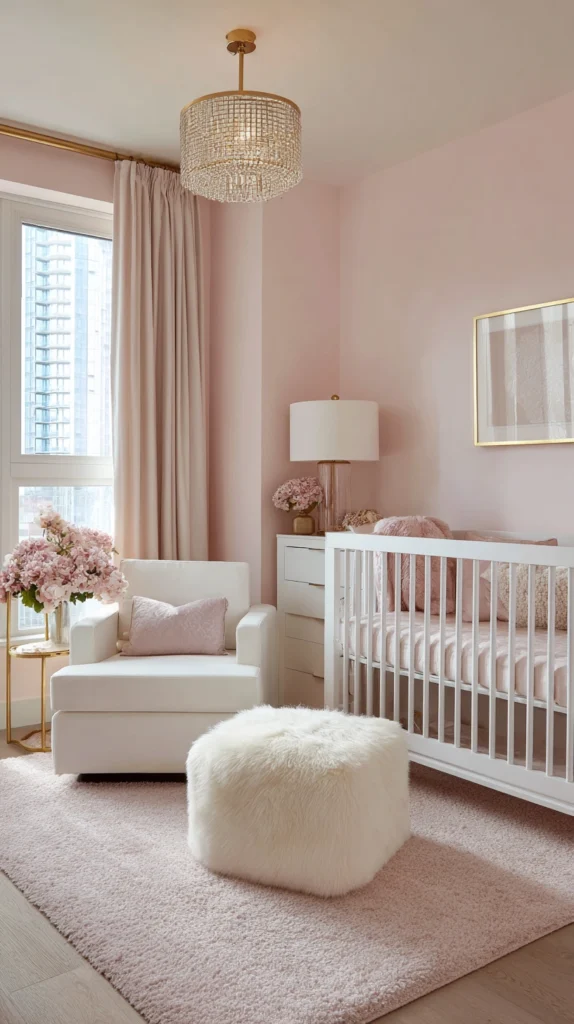
14. The Fully Committed Pink Nursery
Budget: $300 – $2000
The fully committed pink nursery — blush walls, white-painted cot, a canopy of blush muslin above the sleeping space, pink and white bedding in organic cotton, a gallery of botanical prints in the pink and sage palette, warm gold hardware throughout, a rattan nursing chair with a dusty rose cushion, a woven basket of pink blankets in the corner, and a trailing pothos in a blush ceramic pot on the shelf — is the room that makes a parent pause in the doorway in the weeks before the baby arrives and feel, without quite knowing why, that the preparation is complete.
Paint for all walls: $40 – $120. Cot and changing furniture: $300 – $900. Nursing chair: $150 – $400. Textiles — bedding, curtains, rug, cushions: $120 – $300. Wall art and frames: $50 – $150. Lighting: $60 – $150. Plants and ceramics: $30 – $80. Storage baskets: $40 – $100. Personalised details — name letters, birth print: $30 – $80. Total investment for a fully committed pink nursery: $820 – $2280 — the cost of a room made with genuine care for the person who will live in it.
Decorating tip: Photograph the completed nursery before the baby arrives — in the natural light of the morning, with the canopy arranged and the blankets folded and the name on the wall and the plants on the shelf — as a record of the room in its most intentionally prepared state.
The nursery in the months after the baby arrives is a room of beautiful chaos — nappies and muslins and feeding equipment and the general creative disorder of a new life being lived — and the photograph of the room as it was designed and prepared is a document of the particular quality of anticipation and love that preceded the arrival. It is worth having. It is worth taking before the baby comes, because afterward there will not be a moment to notice that it should have been taken.
Whatever combination of these fourteen ideas finds its way into the nursery, the principle that holds all of them together is the same one that should hold any nursery together: the room should be made for the child who will live in it, with warmth and beauty and genuine thought, and it should feel as good to be in at 3am as it does in the golden light of the afternoon.
Pink, chosen and applied with care, achieves exactly this — not because it is the expected colour for a baby girl, but because, at its best, it is the colour of warmth, of softness, and of the particular gentle beauty that a new person’s first room deserves.
Choose it carefully. Layer it generously. Make the room hers completely. She will grow into it and out of it and remember it, in the way that all of us carry the rooms of our earliest years — not as images but as feelings, warm and specific and entirely our own.