15 Understated Home Office Ideas for Elegant Productivity
There is a category of home office that is neither the maximalist creative studio plastered with inspiration boards and competing visual stimuli, nor the sterile white box that prioritizes cleanliness over the warmth that sustained work requires.
It is the understated home office — the workspace that achieves its effect through restraint, through quality, through the careful calibration of every element toward a single purpose: the creation of an environment where focused, elegant work happens naturally and daily, without effort or apology. The understated office does not announce itself.

It does not perform productivity or signal ambition through visible busyness. It simply creates the conditions — the right light, the right materials, the right degree of order and personal warmth — under which good work becomes the path of least resistance rather than something that must be fought for against an environment that is actively working against it.
The principles that produce this kind of space are neither complicated nor expensive, but they require a specific kind of discipline — the discipline of knowing when to stop adding, of recognizing that the best version of a workspace is almost always the one from which one more thing has been removed rather than the one to which one more thing has been added. Here are fifteen ideas for building yours.
1. Choose a Desk That Is Genuinely Beautiful
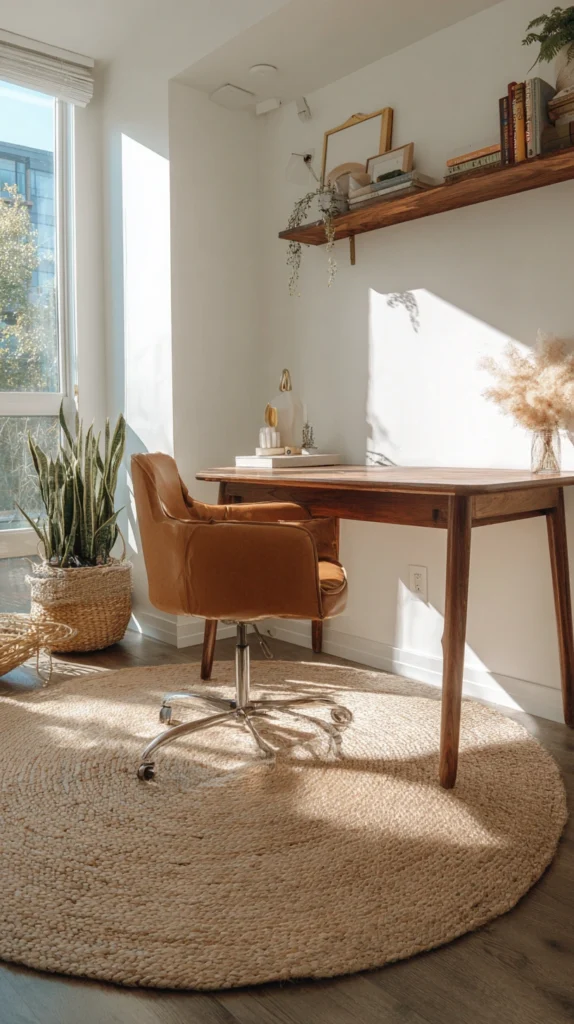
The desk is the home office’s most important piece of furniture and the one whose quality — both in construction and in aesthetic character — has the greatest daily impact on the experience of working in the space. Most people choose a desk based on size, price, and the number of drawers it provides, which produces a desk that is adequate and a workspace that feels merely functional.
The understated home office requires a desk that is also genuinely beautiful — whose material, proportion, and form create a surface that it is a pleasure to sit at regardless of the work being done there.
A solid timber desk in white oak or walnut, with a simple plank top of sufficient thickness that it has visual weight and physical presence. A vintage architect’s drafting table repurposed as a modern workspace.
A custom-built desk in a specific timber species and dimension designed for a specific alcove or wall position. These choices cost more than their mass-market equivalents and produce a workspace whose character and quality are felt every morning when you sit down to begin the day.
2. Edit the Desktop to Absolute Essentials
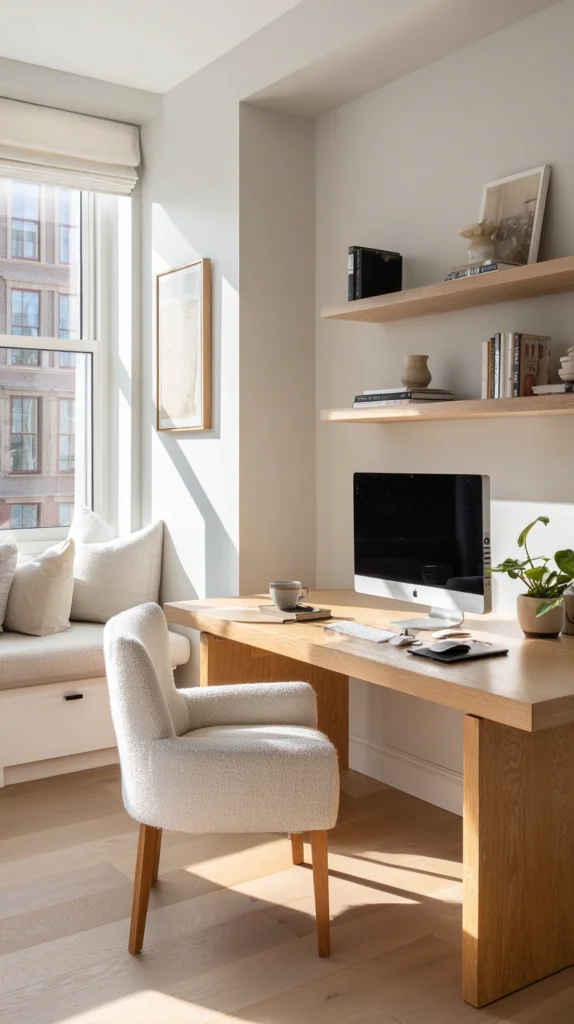
The desktop is the workspace’s primary visual field — the surface that occupies the majority of your visual attention during the working day — and its organization has a more direct impact on the quality of your focus than any other single environmental variable.
The understated home office desktop contains only what is genuinely essential to daily work: the monitor at eye level, the keyboard and mouse in their correct ergonomic positions, a single notebook for handwritten notes, one good pen in a simple holder, and perhaps one small object of personal significance.
Everything else — chargers, cables, reference materials, stationery, secondary devices — lives in a drawer, on a shelf, or in storage, accessed when needed and returned to its place when not.
This level of desktop discipline is not comfortable for most people on the first day of its adoption, and it becomes entirely natural within a week, at which point the difference in daily focus quality that the clear desktop produces makes returning to the previous state feel genuinely unthinkable.
3. Invest in One Exceptional Light Source
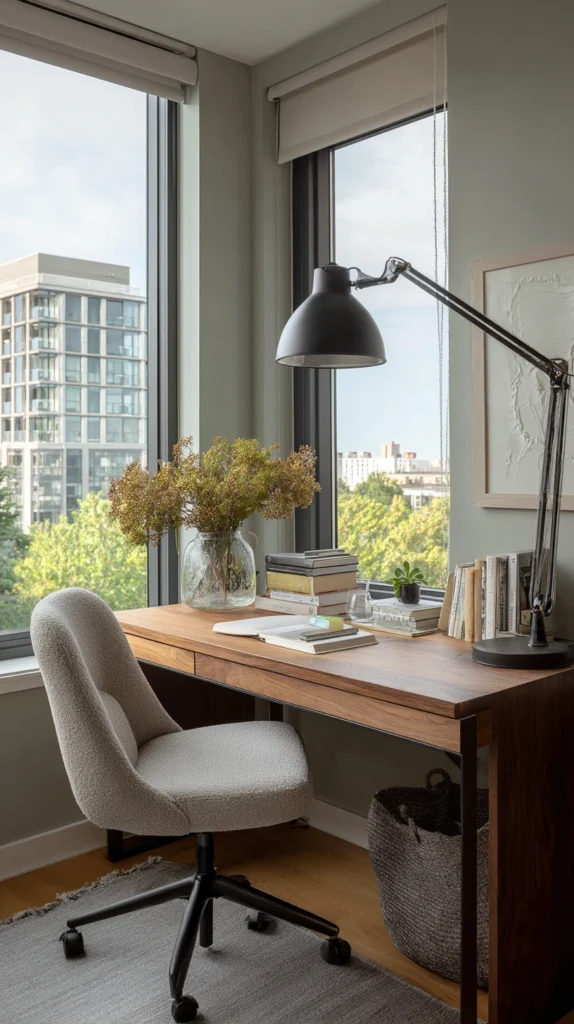
The lighting of a home office is the environmental variable with the greatest impact on the quality and sustainability of the work produced within it, and yet most home offices are lit with whatever overhead fixture was in the room when the office was established and supplemented, if at all, with a desk lamp of no particular quality or consideration.
A single exceptional light source — a floor lamp with an adjustable arm and a shade that directs warm, even light across the desk surface without glare; a wall-mounted articulated reading lamp in a quality brushed brass or matte black finish; a desk lamp of genuine design quality whose combination of directed task illumination and warm ambient spillage creates the right visual conditions for sustained work — changes the office’s daily experience more completely than any furniture purchase of equivalent cost.
Choose a color temperature of 3000K to 3500K for a light that is warm enough to maintain the office’s human quality but clear enough to read and work without strain across a full working day.
4. Use a Neutral Palette with One Grounding Material
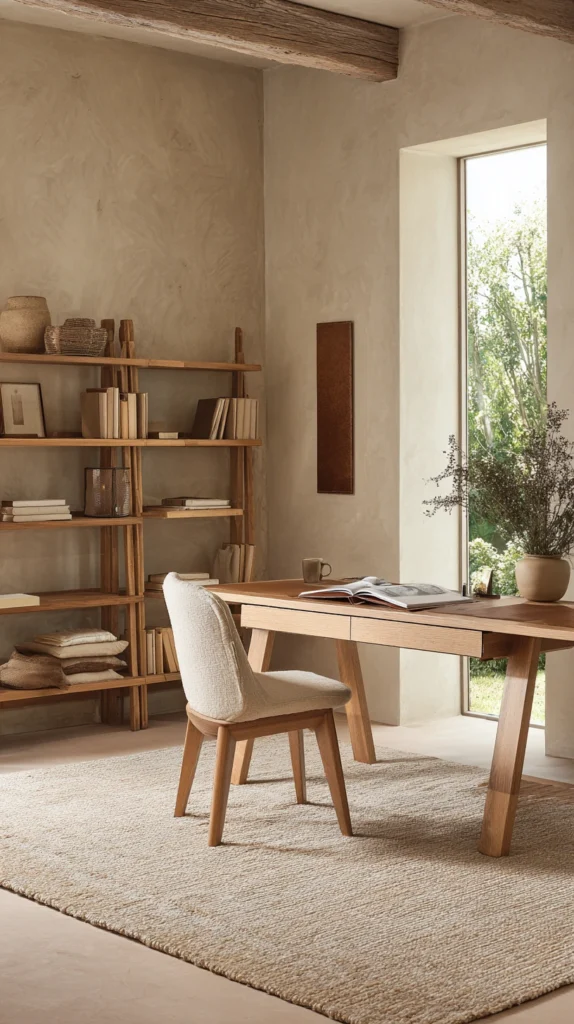
The understated home office palette is built on neutrality — warm whites, soft grays, natural linen tones, the color of plaster and stone and undyed wool — supplemented by one grounding material that provides the visual warmth and material depth that pure neutrality lacks.
Timber is the most universally successful grounding material for a neutral office palette, whether in the desk surface, a timber bookcase, a section of wall paneling, or simply the warm grain of a floorboard visible beneath a natural fiber rug. Leather in a cognac or dark chocolate tone provides a similar grounding quality in a smaller footprint — a leather desk pad, a leather chair, a leather-bound notebook.
Natural stone in a counter or window ledge achieves the same depth through a different material register. The single grounding material, placed with deliberation and allowed to do its work without competition from additional accent materials, gives the neutral palette its specific quality of warmth and visual interest without compromising the restraint that the understated office requires.
5. Position the Desk for Maximum Natural Light
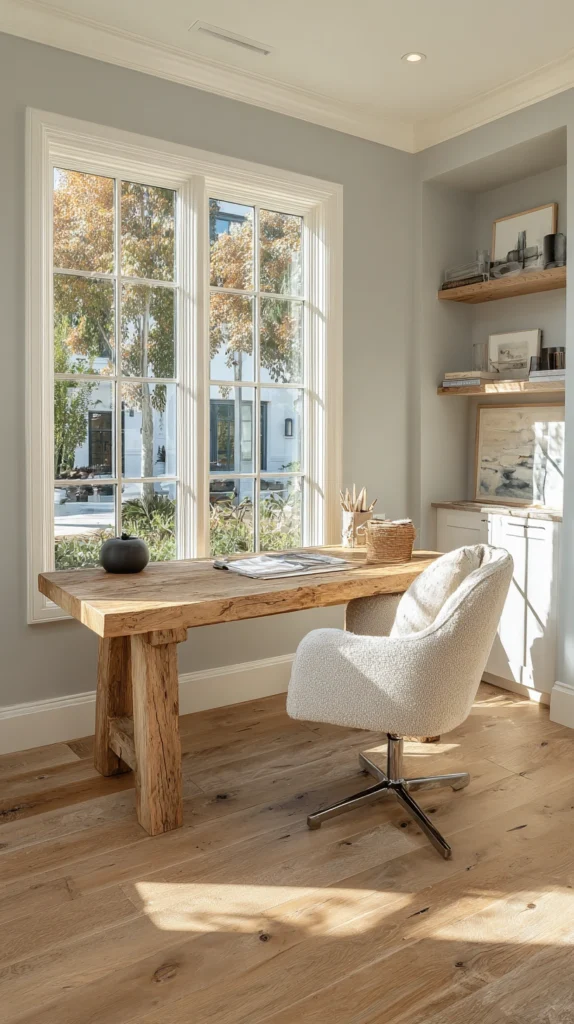
The desk’s position relative to the room’s natural light sources is a decision of significant daily consequence, and it should be made with careful observation of how the light moves through the room across the full working day rather than with reference to the room’s most visually obvious desk position.
Light falling across the desk from the left — for a right-handed worker — is the classical positioning standard because it illuminates the work surface without casting a shadow from the working hand.
Facing a window provides maximum light but risks glare on screens and the distraction of external movement; facing away from the window loses the visual and psychological benefit of the view; positioning the desk perpendicular to the window is often the best compromise, providing generous side lighting without direct glare and maintaining peripheral visual access to natural light without making it the desk’s primary view.
Spend a full day in the room before committing to a desk position, observing the light at every hour of the working day.
6. Incorporate a Single Piece of Meaningful Art
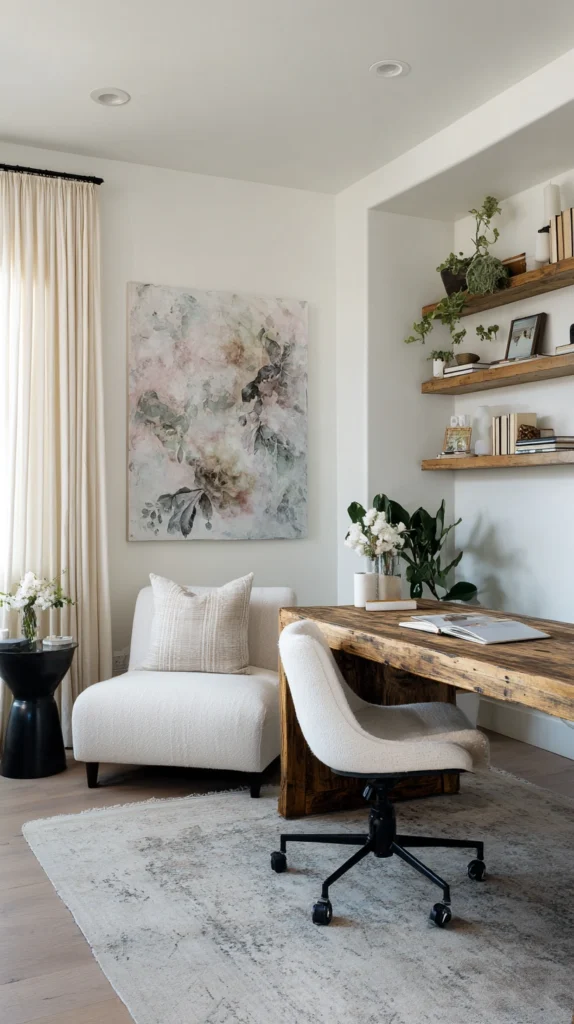
The art in an understated home office serves a specific and limited function — it provides a point of visual rest and personal meaning in the primary visual field of the working day, a single reference point that reminds the worker of what is important beyond the immediate demands of the work — and this specific function is best served by a single significant piece rather than a gallery wall whose visual complexity creates stimulation rather than rest.
Choose a piece whose size is sufficient to read clearly from the desk position — too small and it disappears into the visual noise of the room; too large and it dominates the space — and whose color palette sits harmoniously within the office’s neutral scheme without competing with it.
Botanical illustration, landscape photography, abstract work in a muted palette, and simple line drawing all suit the understated office aesthetic with particular elegance. Hang it where the working eye will encounter it naturally in moments of reflection rather than constantly during periods of focus.
7. Choose Storage That Is Beautiful Enough to Be Visible
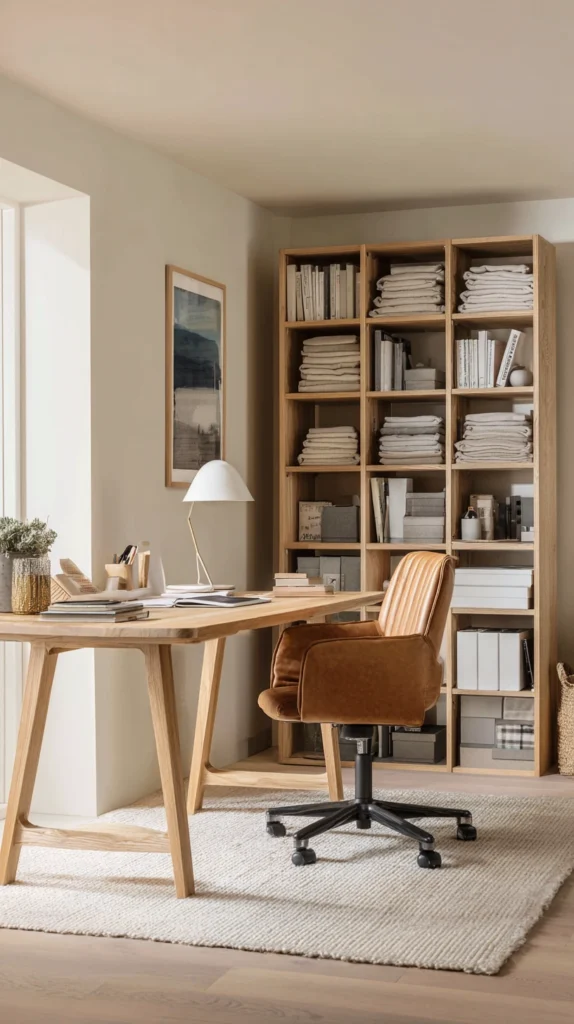
The understated home office’s storage principle is simple: every piece of storage furniture should be beautiful enough to remain visible without compromising the room’s aesthetic.
This principle forces a higher standard of storage selection than the conventional approach — which treats storage furniture as a necessary functional element rather than a designed one, allowing ugly but effective storage to coexist with the more considered elements of the room — and the result is an office where the storage contributes positively to the overall composition rather than being tolerated as a visual compromise. A beautiful timber bookcase with considered proportions.
A simple linen-covered box file system on a floating shelf. A solid ceramic pot used as a pencil and tool holder on the desktop. A leather portfolio case for documents rather than a plastic filing tray. Each of these choices performs the same organizational function as its less beautiful equivalent while adding rather than subtracting from the room’s overall aesthetic quality.
8. Manage Cables Completely and Permanently
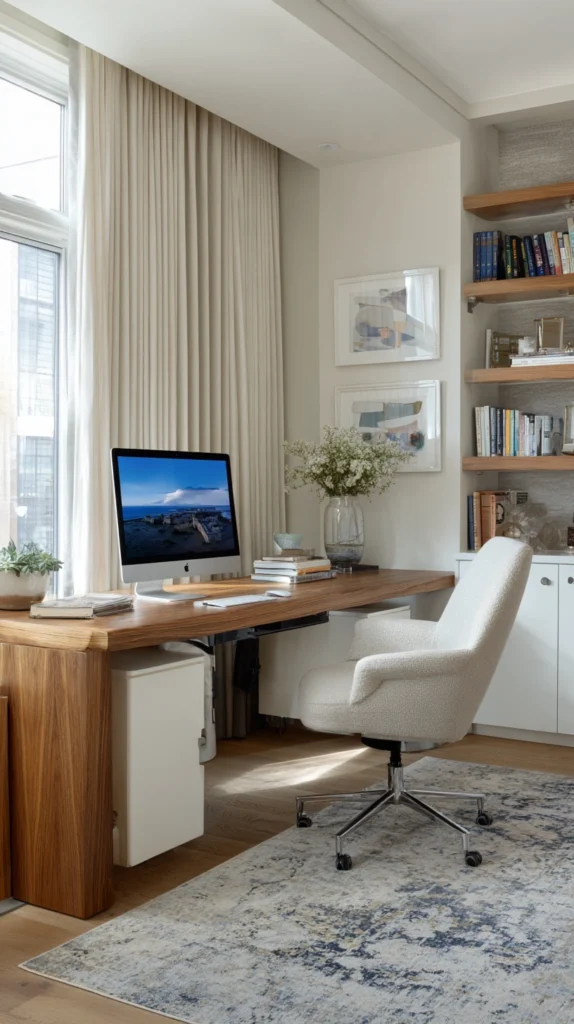
The cable situation behind and beneath a home office desk is one of the most persistent and most corrosive threats to the visual quality of any workspace, and the decision to manage it completely — once, properly, permanently — rather than to live with it as an accepted element of the modern workspace is one that delivers a disproportionate improvement in the office’s daily visual experience.
A cable management channel along the desk’s rear edge, surface-mounted in a color that matches the desk material, routes all cables from devices to a single power strip mounted beneath the desk and concealed from view. Cable clips or spiral wraps organize the cable run from the power strip to the nearest wall outlet into a single, tidy bundle.
Wireless alternatives — a wireless keyboard and mouse, a wireless charging pad for devices — reduce the number of cables requiring management at the desktop level. The completely cable-managed desktop has a clean, considered quality that is immediately apparent and permanently satisfying.
9. Add a Comfortable Secondary Seating Option
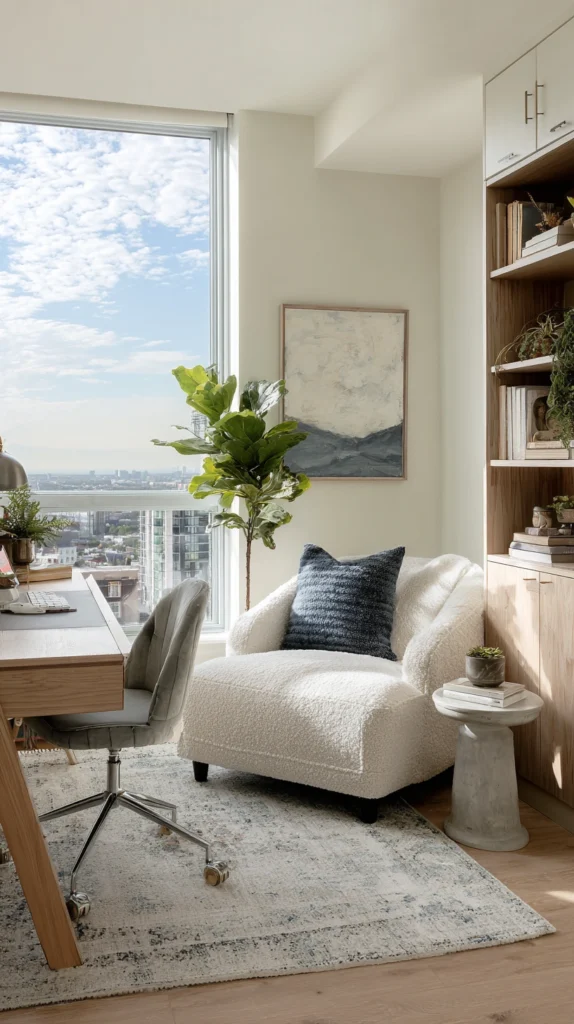
The home office designed around a single desk chair is an office designed for a single mode of working — the active, screen-focused, keyboard-operating mode that characterizes perhaps sixty percent of most knowledge workers’ days.
The remaining forty percent — reading, thinking, planning, reviewing printed materials, taking calls — is often performed more effectively and more comfortably in a different physical position, and providing that position through the addition of a comfortable secondary seat transforms the office’s range and flexibility significantly.
A simple upholstered chair in a natural fabric, positioned in the room’s secondary zone away from the desk, with a small side table beside it for a notebook or a cup of tea, creates a reading and thinking space within the office that is physically and psychologically distinct from the desk zone.
Moving between the desk and the secondary seat throughout the working day introduces the gentle physical movement that research consistently links with improved cognitive performance and sustained attention.
10. Use Scent Deliberately for Focus and Calm
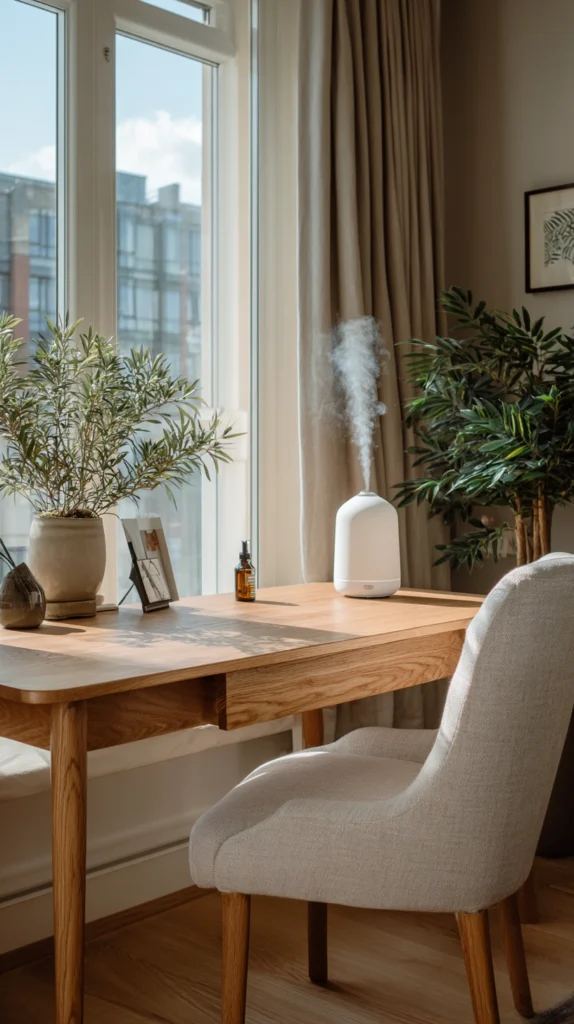
The olfactory environment of a workspace is the dimension of the office that most people never think about and that neuroscience has established is among the most powerful influences on cognitive state and emotional experience.
The use of scent in a home office is not about creating a pleasant smell — it is about using specific aromatic compounds to support specific cognitive states. Rosemary has been shown in multiple studies to enhance memory and alertness and is ideal for the beginning of a focused work session.
Lavender reduces anxiety and supports the calm, settled state that sustained creative or analytical work requires. Citrus scents — lemon, bergamot, grapefruit — are energizing and mood-elevating, useful when energy and motivation are flagging.
A single small diffuser using a high-quality essential oil — not a synthetic fragrance but a genuine botanical extract — introduced deliberately at the beginning of the working day creates an olfactory anchor that the brain learns to associate with the work state, which over time makes the transition into focused work faster and more reliable.
11. Create a Clean Visual Horizon Behind the Desk
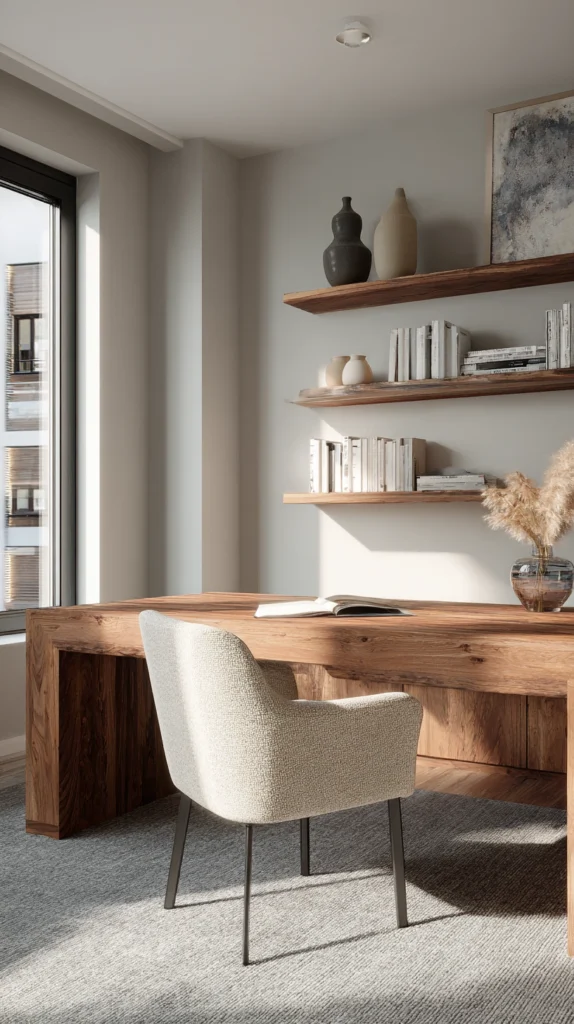
In the era of video calls, the wall behind the desk has acquired a professional significance it never previously possessed — it is the environment that colleagues, clients, and collaborators see in every remote meeting, and its visual quality communicates something about the standards and sensibility of the person sitting in front of it that is registered consciously or unconsciously by everyone on the other side of the screen.
The understated home office creates a clean, considered visual horizon behind the desk: a wall in a carefully chosen paint color, perhaps a single significant artwork or a simple floating shelf with a few beautiful objects, and nothing else.
No piles of boxes, no random accumulation of objects, no laundry visible in a background corner. The visual horizon should be simple enough to register as elegant in a two-inch video call window and interesting enough to reward closer attention from anyone who looks beyond the person in the foreground.
12. Introduce a Plant of Structural Presence
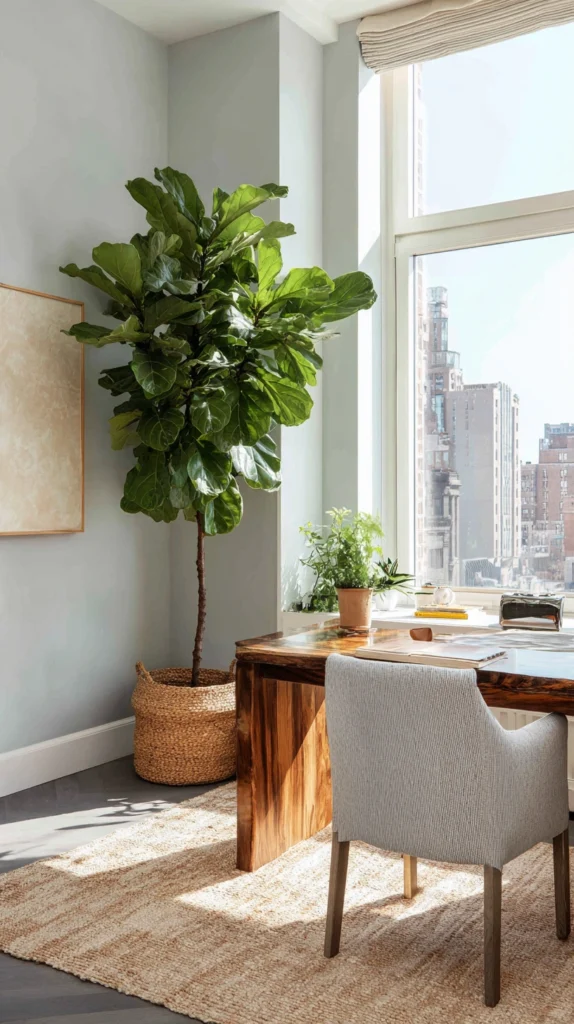
The home office plant is not a small succulent on the corner of the desk — it is a plant of sufficient size and structural presence to read as an architectural element rather than a decorative accessory. A large snake plant in the corner, its vertical form echoing the room’s upright surfaces.
A fiddle-leaf fig beside the window, its broad leaves creating a visual counterpoint to the hard-edged desk and shelving. A trailing pothos trained along a shelf or wall, its organic irregular form introducing a natural line into the room’s predominantly rectilinear geometry.
The plant’s presence in the home office has documented cognitive benefits — reduced stress, improved attention recovery, slight air quality improvement in a sealed room — and visual benefits that are equally significant: the introduction of a living, growing, organically formed element into an environment dominated by rectangular furniture and technological devices creates the specific quality of visual relief that the human nervous system finds genuinely restorative.
13. Establish a Beginning and End Ritual for the Desk
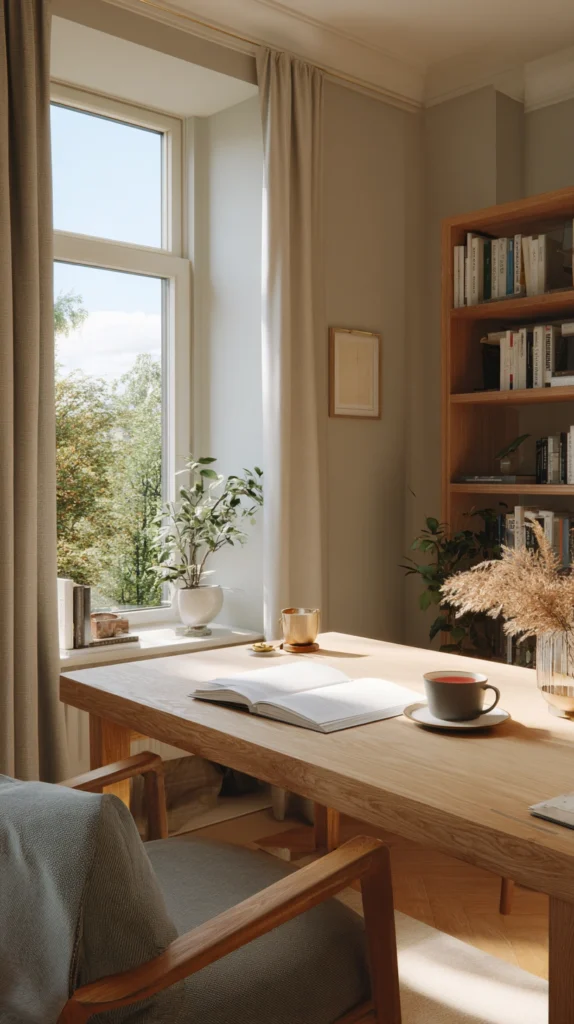
The most beautiful and most functional home office in the world will not produce consistent focus and productivity without the behavioral infrastructure that supports the physical environment, and the most important behavioral element of the home office is the ritual that marks the transition into and out of the working state.
A beginning ritual — clearing the desk of any items that accumulated outside working hours, opening the notebook to a fresh page, making the tea or coffee that will accompany the first hour of work, spending two minutes reviewing the day’s priorities — creates a psychological transition from the domestic to the professional state that the home office’s location within the home cannot create architecturally. An end ritual — clearing the desk back to its baseline, closing notebooks and laptops, turning off the desk lamp — creates the equally important transition in the opposite direction, signaling that the working day has ended and the domestic evening has begun. These rituals cost nothing and produce a more meaningful separation between work and home life than any structural or decorative intervention available.
14. Choose a Chair That Respects Both Ergonomics and Aesthetics
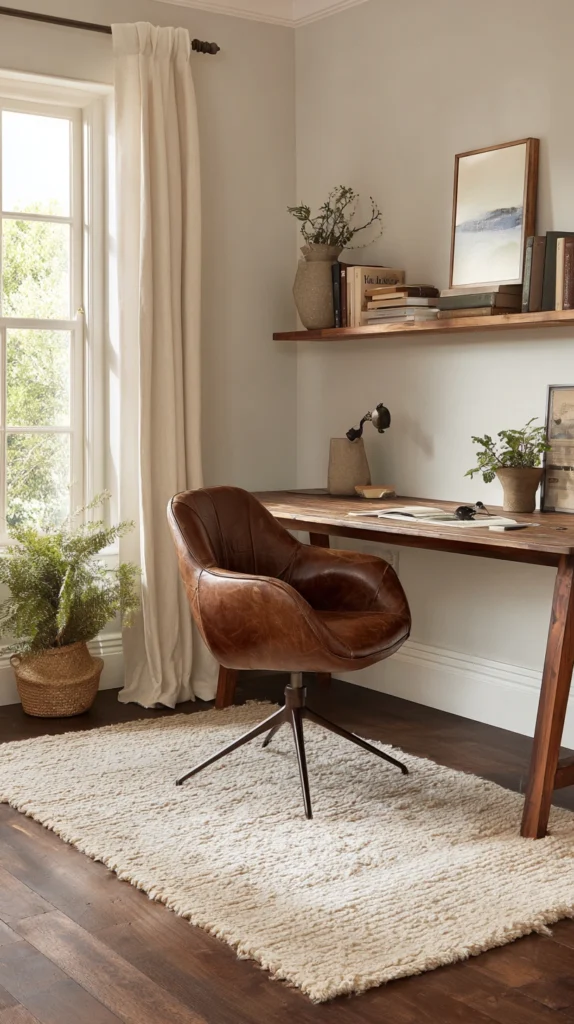
The home office chair is the workspace’s most used piece of furniture and the one most consistently chosen on the basis of price alone, which produces a chair that fails simultaneously as a support system for extended sitting and as an aesthetic element within a carefully considered room.
The understated home office requires a chair that achieves both functions — that provides genuine lumbar support, correct seat height, and adequate armrest positioning for a full working day, and that does so in a form and material that suits the office’s aesthetic language.
Quality ergonomic chairs in natural materials — leather, wool mesh, or a performance fabric in a natural tone — that provide clinical performance in aesthetically considered forms are available at every price point above the budget category, and the additional investment relative to a budget chair is returned within the first year of daily use in reduced back pain, sustained energy, and the daily pleasure of sitting in something that is genuinely good.
15. Let Simplicity Be the Statement
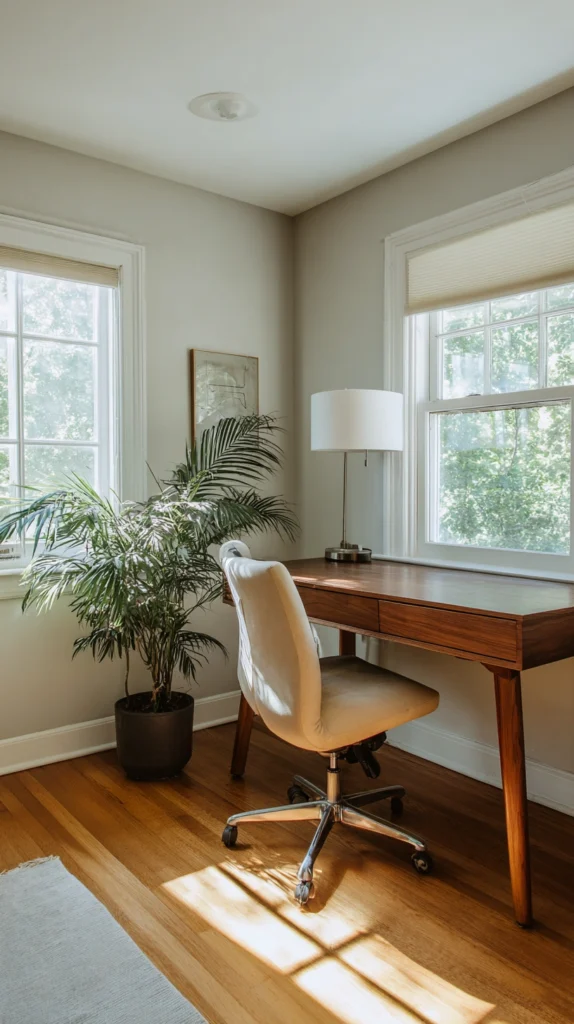
The final and most important principle of the understated home office is the one that holds all the others together: the commitment to letting simplicity be the room’s primary aesthetic statement rather than its default condition.
There is a meaningful difference between a simple room that is simple because nothing interesting has been done to it and a simple room that is simple because someone has made many careful, difficult decisions to achieve and maintain that simplicity.
The understated home office belongs to the second category — its neutrality is intentional, its restraint is earned, its quiet quality is the result of every unnecessary element having been identified and removed, every remaining element having been chosen with genuine care for its specific contribution to the whole.
This kind of simplicity is not modest — it is demanding, it is intelligent, and it produces a workspace of extraordinary quality that improves every year as the habit of restraint deepens and the capacity to recognize what the room needs — and what it definitively does not — becomes more refined and more reliable.