15 Spring Patio Setup Ideas for Cozy Gatherings
The patio has a particular role in the domestic landscape that no other outdoor space quite replicates. It is more intimate than a lawn, more defined than a garden, more deliberate than a terrace that simply extends from the house without specific intention.
A patio is a room that happens to be outside, and like any room it benefits from being set up with genuine care for the people who will use it and the specific pleasures of the season in which they will use it.
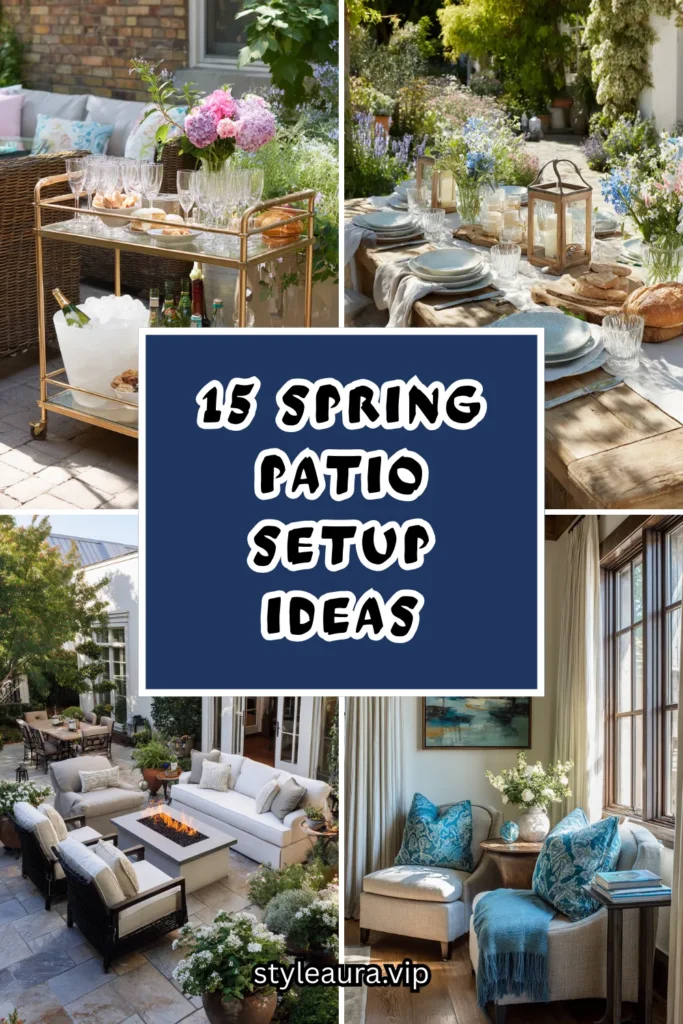
Spring brings a particular quality of anticipation to the patio — the first warm evenings of the year, the light that stays a little later each day, the pleasure of sitting outside in a jacket rather than a coat and feeling the season genuinely beginning. Setting up a spring patio for gathering is about more than furniture and cushions.
It is about creating an environment that makes people want to stay longer than they planned, that produces the kind of relaxed, unhurried conversation that the best outdoor gatherings generate, and that suits the specific mood of early spring — the hope and freshness of the season translated into a physical environment. Here are fifteen ideas for achieving exactly that.
1. Start with a Defined Layout That Creates Flow
The most common patio setup mistake is the arrangement of furniture without a clear spatial logic — chairs and tables placed wherever they fit rather than in a configuration that serves the specific dynamics of gathering.
A well-designed patio layout creates a primary seating zone where the majority of guests will spend their time, a secondary zone for those who want a slightly different vantage point or a quieter conversation, and clear circulation paths between the two zones and between the patio and the house.
The primary seating zone should face the most attractive aspect of the garden or the view, should be positioned to receive the afternoon sun if the patio is used primarily in the late afternoon and evening, and should be arranged so that the maximum number of seats face each other across a central table or coffee table rather than all facing a single direction.
Guests at a gathering orient themselves toward each other, not toward a view, and the furniture arrangement should reflect this social reality rather than the aesthetic preference of a solo occupant.
2. Layer Your Lighting from Multiple Sources
Spring evenings cool quickly and darken gradually, and the patio that transitions well from afternoon sun to evening darkness is the one where multiple lighting sources create a warm, continuous atmosphere rather than a single overhead light that switches the experience from natural to artificial in one flat moment.
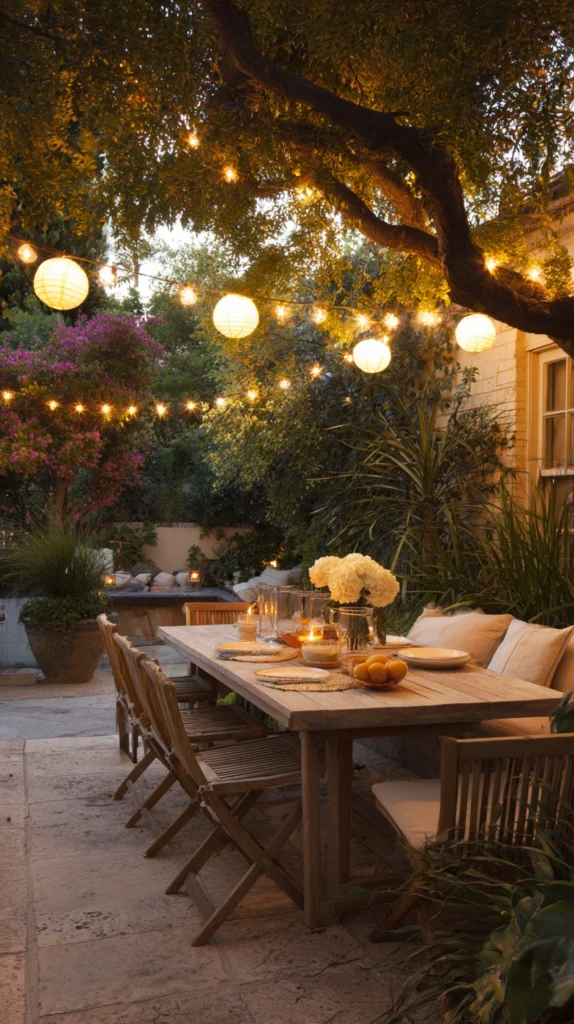
String lights strung between the house wall and a post, a pergola beam, or a tall planting stake are the foundation of spring patio lighting — their warm, point-source quality creates an overhead ambient light that is universally flattering and universally loved.
Add lanterns on the table and at floor level for pools of intimate light at different heights. Solar-powered path lights along the patio’s perimeter define the space after dark and add a secondary layer of warm light at ground level.
A single candle in a storm lantern at the table’s center contributes warmth, movement, and the specific pleasure of an open flame that electrical alternatives approximate but never fully replicate.
3. Invest in a Centerpiece Heat Source
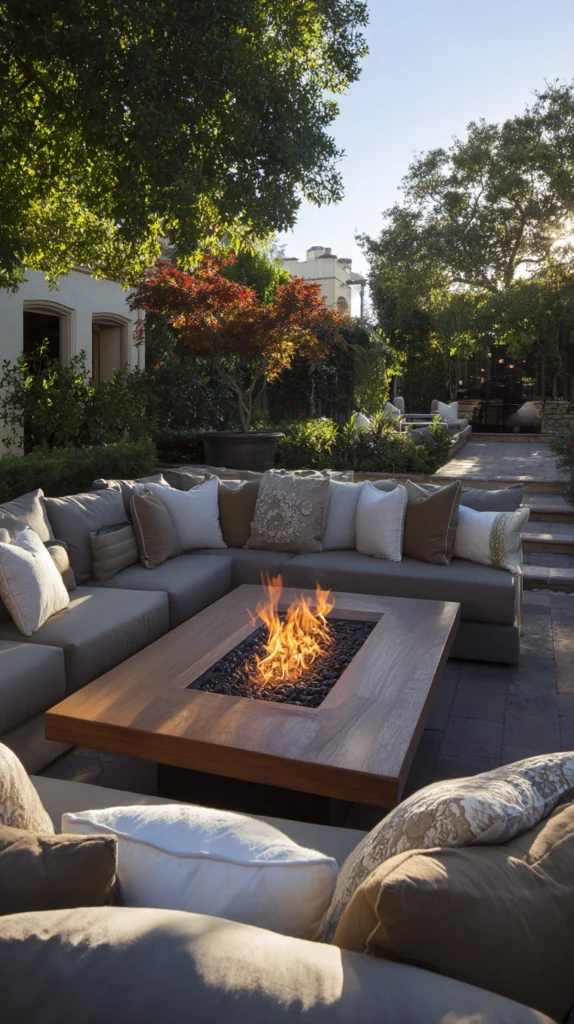
The difference between a spring patio gathering that ends at eight o’clock when the temperature drops and one that continues comfortably until eleven is almost always the presence or absence of a heat source, and the investment in a quality heat source — a fire table, a patio heater, a chiminea, or a simple wood-burning fire bowl — pays for itself in the additional hours of outdoor living it enables over the course of a single spring.
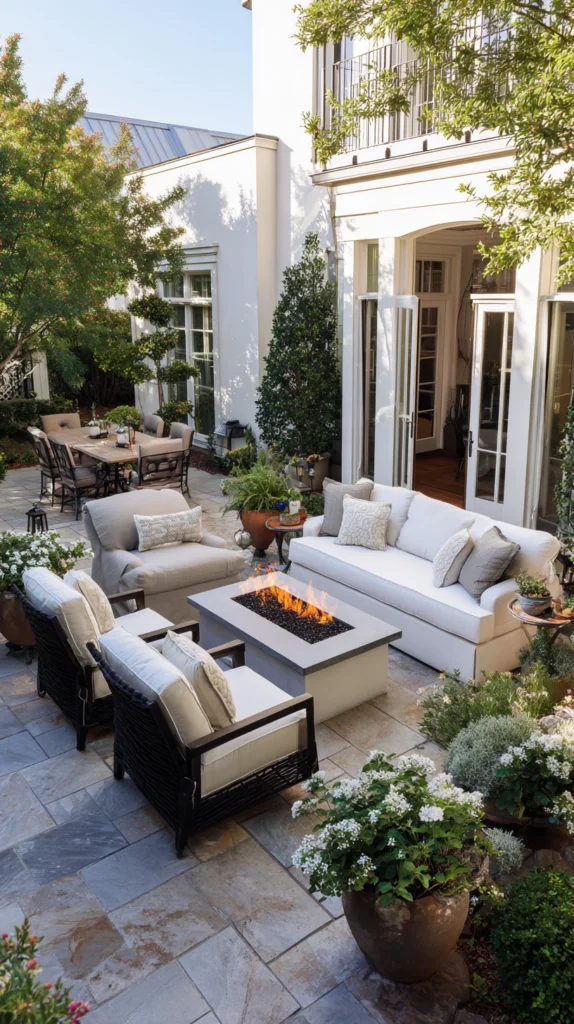
The fire table is the most socially elegant option, because it provides warmth at the level of seated guests, creates a natural gathering point, and adds the visual and sensory pleasure of an open flame without the safety concerns of a freestanding fire in an exposed outdoor space.
A quality propane or natural gas fire table can be turned on and off instantly, adjusted for output, and left running safely for the duration of a gathering. Position it at the center of the seating arrangement so that its warmth radiates equally to every seat, and ensure it is far enough from any overhead canopy or fabric treatment for safe operation.
4. Build a Generous Seating Arrangement
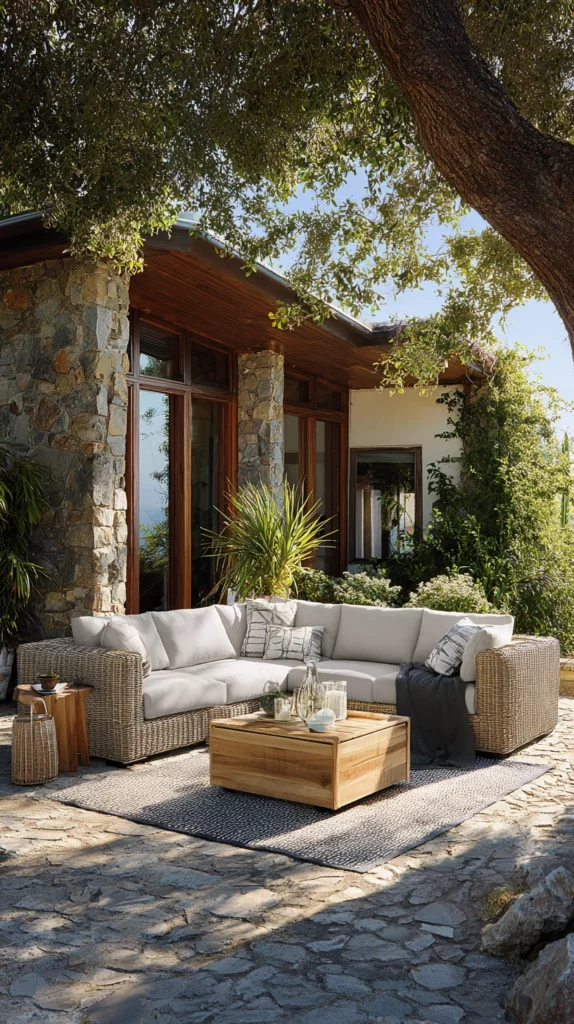
The spring gathering patio is not the place for a minimalist furniture approach — it is the place for a seating arrangement generous enough that everyone present has a comfortable, properly cushioned seat without the awkward negotiations that undersized seating forces.
A modular outdoor sofa with multiple sections, positioned in a U or L configuration around a central fire table or coffee table, is the most efficient way to achieve this generosity within a defined footprint.
Supplement the primary seating arrangement with two or three additional chairs — stackable metal bistro chairs, simple folding chairs in a complementary tone — that can be added to the arrangement when the gathering is larger and stored compactly when not needed.
The key distinction between a patio that feels generous and one that feels cramped is almost never the size of the furniture but the quantity of seating relative to the number of regular guests — the patio that can comfortably seat everyone present without anyone perching on a step or standing at the edge of the group is the one that generates the best gatherings.
5. Create a Dedicated Drinks and Snack Station
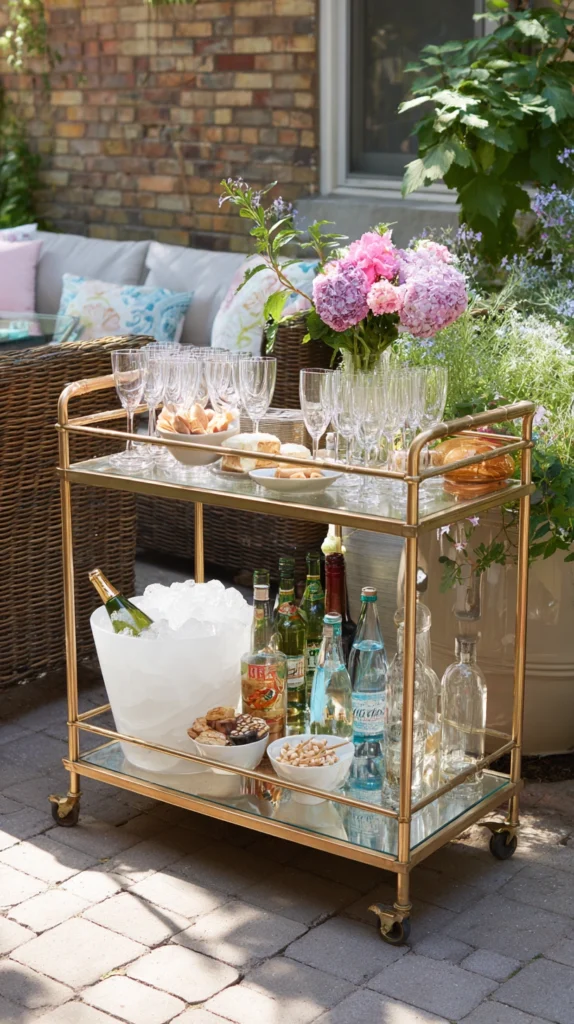
The outdoor bar cart or drinks station has become one of the most essential and most immediately impactful patio additions available, not because the logistics of outdoor entertaining are particularly complex without one, but because the presence of a dedicated drinks zone changes the dynamics of a gathering in a specific and very positive way.
When everything needed — glasses, ice, drinks, snacks, napkins, a bottle opener — is available in a single, clearly designated spot that guests can access independently, the host is freed from the constant back-and-forth between patio and kitchen that otherwise characterizes outdoor entertaining.
Guests serve themselves and each other naturally, the social rhythm of the gathering becomes more fluid, and the patio functions as a self-contained entertaining environment rather than an extension of the kitchen’s operational sphere.
Style the cart with the same care you would give an interior sideboard — a small vase of spring flowers, a few considered objects alongside the functional items — and it becomes a visual feature of the patio as well as a practical one.
6. Add Outdoor Cushions and Throws for Tactile Warmth
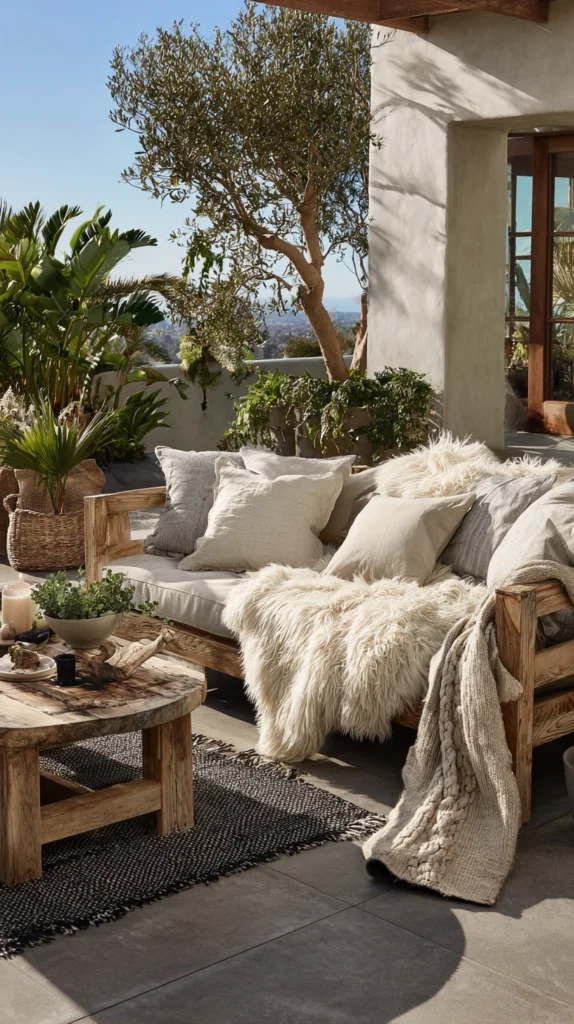
Spring evenings are the season of the outdoor throw — that moment when the warmth of the day has retreated enough to make the air cool but not cold, and a light blanket or cashmere-weight throw draped over the shoulders transforms a slightly uncomfortable evening into a perfect one.
Stock a generous basket or outdoor storage chest near the primary seating zone with enough throws for every guest — more than you think you’ll need, because in practice every person at a spring gathering will eventually reach for one — and choose throws in a soft, lightweight material that folds compactly but provides real warmth when deployed.
Performance fabric throws in an outdoor-rated material are the practical choice; a mix of weights, from a light cotton knit to a slightly warmer wool blend, provides options for the range of temperatures a spring evening can deliver.
Cushions in a weather-resistant fabric should be generous enough that every seat offers a genuinely comfortable sitting experience — not the thin, understuffed pad that is technically a cushion but the substantial, well-filled cushion that makes extended outdoor sitting as comfortable as any indoor alternative.
7. Incorporate Spring Planting Around the Patio Perimeter
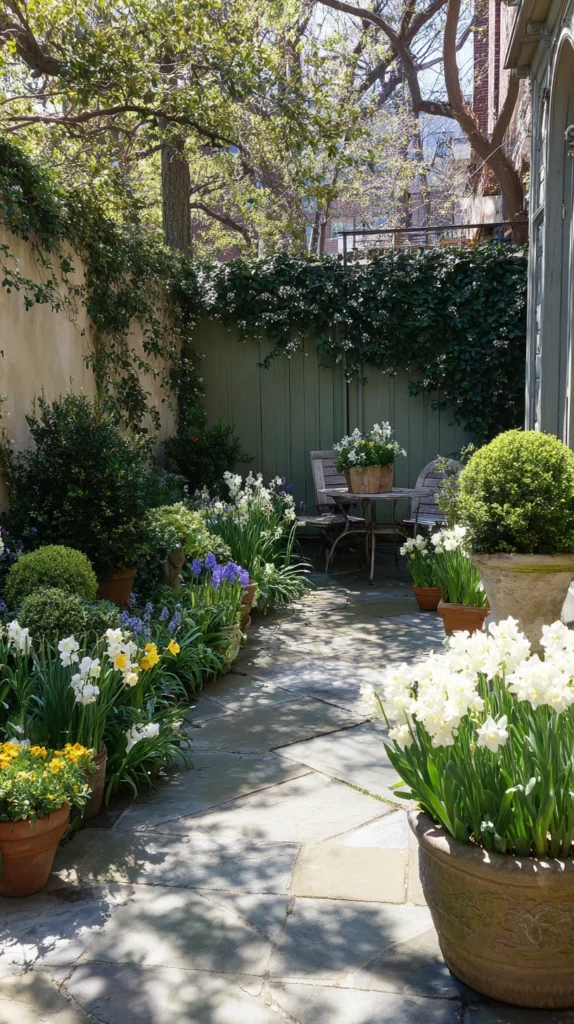
The gathering patio that is surrounded by spring planting — containers of tulips, narcissus, and seasonal bedding around its perimeter, climbing plants on any adjacent wall or fence, herbs and fragrant plants within arm’s reach of the seating — is a fundamentally different experience from the same patio surrounded by bare paving and empty containers.
The planting provides not only the visual beauty of the season but the sensory richness — fragrance, the sound of bees, the movement of plants in any breeze — that makes outdoor gathering feel genuinely connected to the natural world rather than simply located within it.
For spring gatherings specifically, prioritize fragrant plants: hyacinths in containers near the seating, lavender in a raised bed along the patio’s edge, jasmine climbing a nearby structure. The fragrance will be noticed and mentioned by every guest, it costs nothing to maintain once the plants are established, and it contributes more to the atmosphere of the gathering than any purely visual decorating decision of comparable investment.
8. Define the Space with an Outdoor Rug
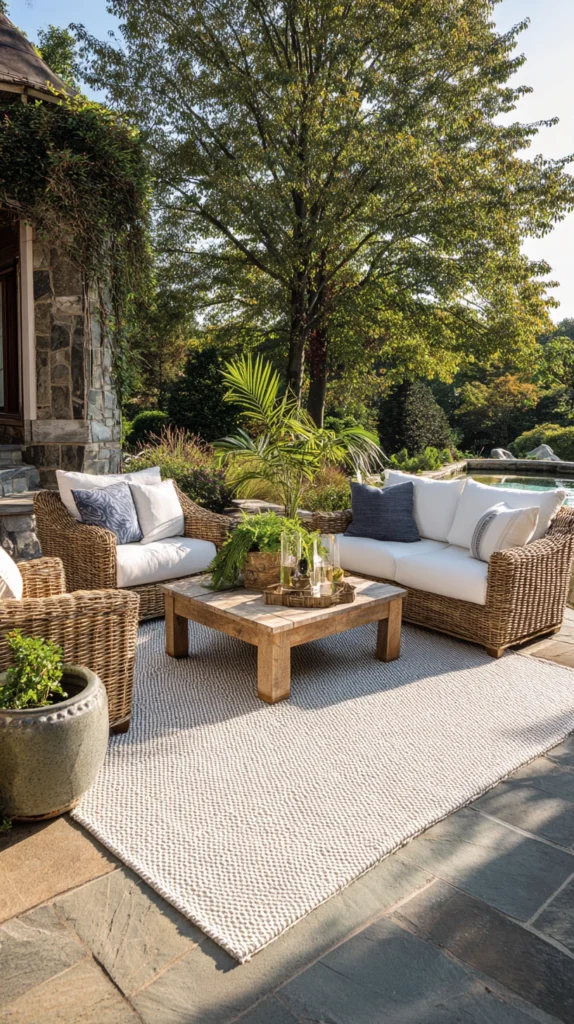
An outdoor rug beneath the primary seating arrangement does several things simultaneously that no other single patio addition can replicate.
It defines the seating zone as a specific, bounded space within the larger patio area, creating the psychological enclosure of a room without any physical walls. It softens the hard surface of the paving beneath, making the sitting experience more comfortable and the sound environment less echoey.
It introduces color, pattern, and textile warmth into an environment that is otherwise dominated by hard materials — stone, metal, timber — and it signals to arriving guests that the area beneath it is where the gathering is centered, providing an immediate spatial orientation that reduces the initial awkwardness of arrival.
Choose a rug in a material rated for outdoor use — polypropylene flatweaves and solution-dyed acrylics are the most durable and most moisture-resistant options — and size it generously enough that all furniture legs in the arrangement rest on it, including when chairs are pulled back from the table.
9. Set a Beautiful Table for Alfresco Dining
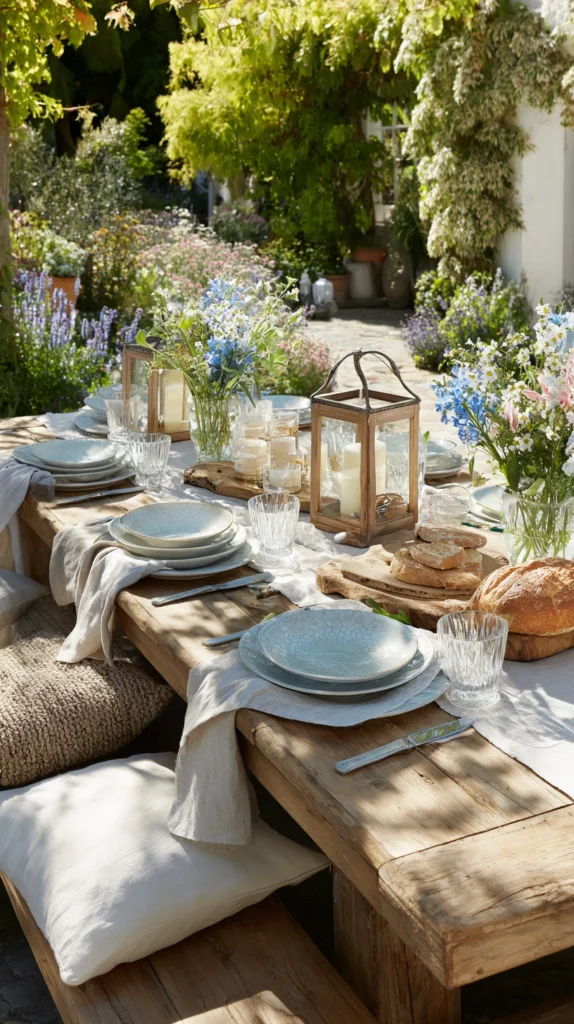
If the spring patio gathering involves food — and most do, because eating outside is one of the season’s most reliable pleasures — the table setting deserves the same care as any interior dining table, with the additional attention that outdoor dining requires.
A tablecloth in a lightweight cotton or linen that will not blow away in a moderate breeze, weighted at the corners or held with clips if the location is exposed. Proper plates, glasses, and cutlery rather than disposable alternatives — even a casual spring gathering feels more generous and more considered when the table setting is real.
A simple centerpiece of spring flowers in a low vessel, candles in storm lanterns that will stay lit in any reasonable outdoor breeze, and a generous bread board or sharing platter at the table’s center create the atmosphere of an occasion rather than an outdoor meal that simply happens to be outside.
These small investments of care and thought are what separate the forgettable outdoor eating experience from the gathering that guests remember with genuine pleasure for months afterward.
10. Use Vertical Space for Planting and Decor
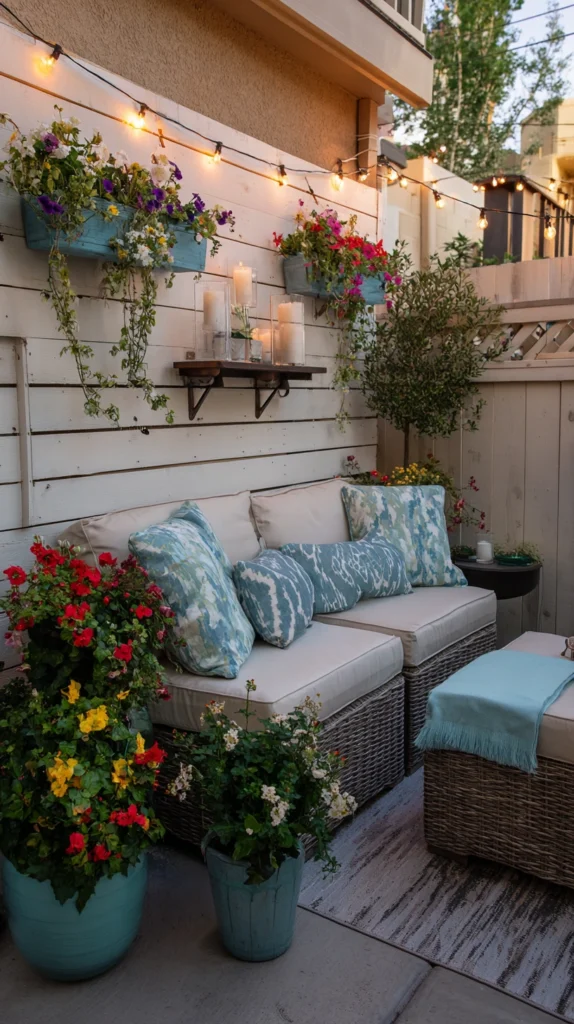
The patio that uses only its floor plan is leaving half its decorative and planting potential unexplored, because the vertical surfaces — walls, fences, railings, pergola beams — offer a continuous surface of additional space that spring decoration and planting can occupy without affecting the floor area that circulation and furniture require.
Wall-mounted planters in terracotta or powder-coated metal, planted with trailing spring flowers and positioned at eye height along the patio’s main wall, bring the season’s color to the vertical plane where it is visible and appreciated from every seat in the arrangement.
String lights and lanterns hung at different heights on vertical surfaces layer the patio’s lighting across its full three-dimensional volume. A simple wall-mounted shelf at counter height provides an additional surface for drinks, candles, and decorative objects. The vertical plane is the patio decorator’s most underused resource, and addressing it as deliberately as the floor plane transforms the space from a surface with furniture on it into a fully decorated room.
11. Create an Intimate Corner for Quieter Conversations
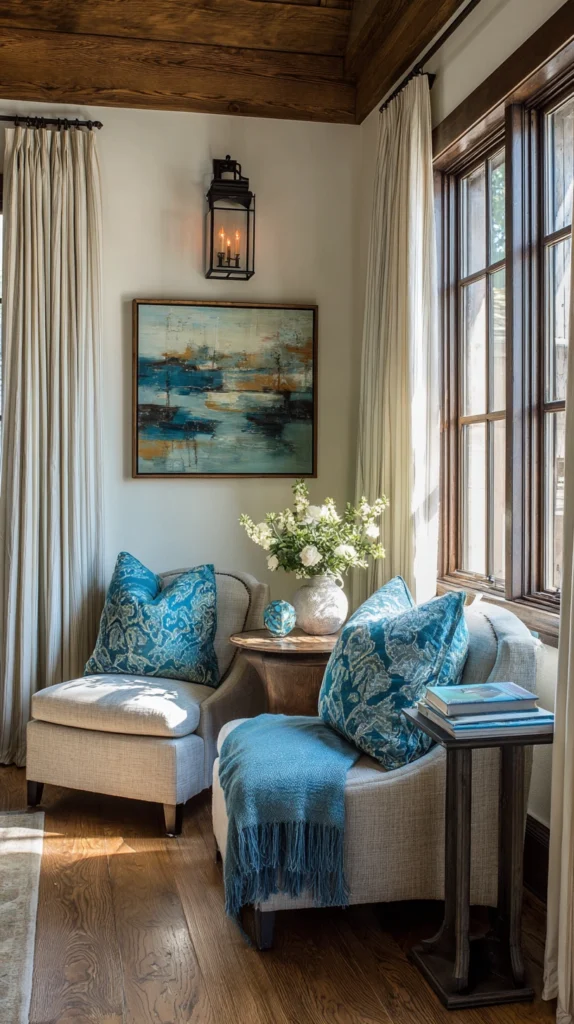
The best gatherings always generate a spectrum of social energy, from the lively central group around the fire table to the quieter pair who have drifted to the edge of the party for a more private exchange.
A dedicated intimate corner within the patio — a small seating arrangement of two chairs and a low table positioned slightly apart from the main group, perhaps screened partially by a planter or a small trellis panel — provides a destination for this quieter social dynamic without requiring anyone to leave the patio entirely.
The corner should feel like a choice rather than an exile — cushioned seats, a small lamp or lantern for its own light source, perhaps a throw draped over one chair in invitation. Its presence gives the gathering a spatial variety that a single undifferentiated seating arrangement cannot provide, and the most memorable conversations of many spring evenings happen in exactly these quieter corners.
12. Introduce a Water Feature for Sensory Atmosphere
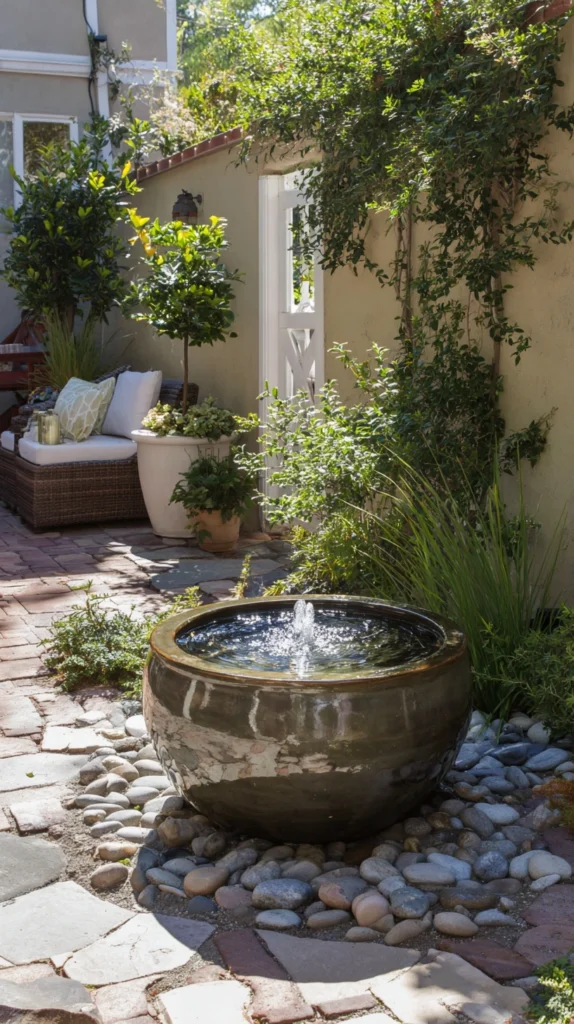
A small water feature — a solar-powered fountain in a ceramic bowl, a simple recirculating stone basin, a contemporary wall-mounted cascade — adds a sensory dimension to the spring patio gathering that is difficult to achieve through any other means.
The sound of moving water is one of the most universally pleasurable acoustic environments available, and in a social gathering context it provides a gentle acoustic backdrop that masks the environmental noise of the surrounding neighborhood — traffic, neighbors, distant sounds — without competing with conversation.
The visual quality of moving water — the reflection of light, the surface movement, the specific quality of attention that water in motion commands without demanding — adds a focal point of natural beauty to the patio that decorative objects alone cannot replicate.
Install the water feature where its sound is most effective — near the primary seating zone but not so close that it drowns conversation — and keep it running from the first warm afternoon until the season’s close.
13. Add a Simple Canopy or Shade Structure
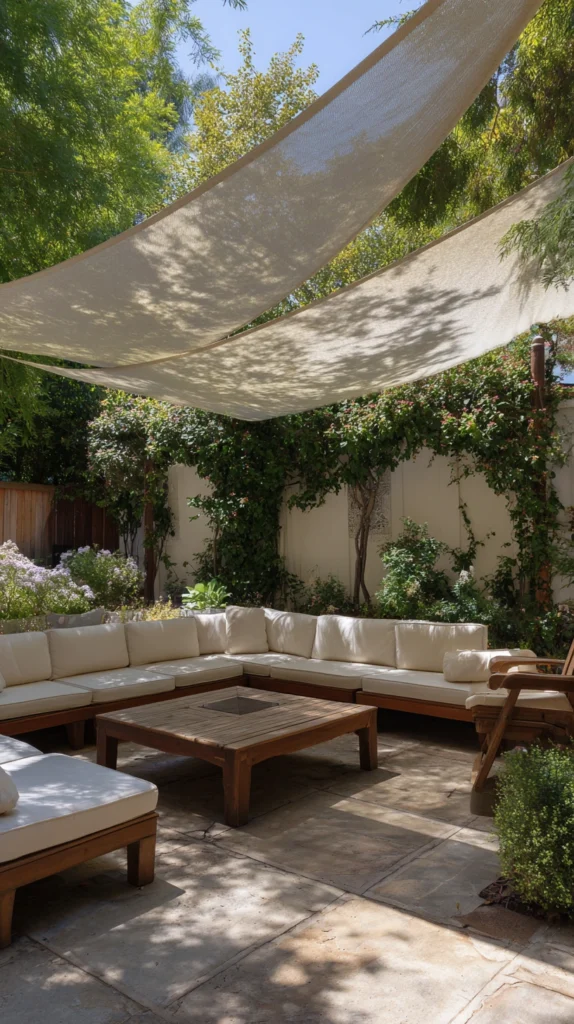
Spring weather is unreliable in the most beautiful way — warm and sunny one hour, overcast and cool the next — and a simple canopy or shade structure over part of the patio provides the flexibility to remain comfortably outside across a wider range of conditions than an exposed patio can accommodate.
A retractable awning mounted on the house wall, a simple sail shade tensioned across the patio’s primary seating zone, or a bamboo overhead canopy on a basic timber pergola structure provides enough overhead cover that a light spring shower becomes an atmospheric backdrop to the gathering rather than a reason to move inside.
The canopy also creates a sense of architectural enclosure overhead that makes the patio feel more like a room — more defined, more intimate, more designed — than the open sky alone can provide, and this sense of enclosure is one of the factors that most reliably encourages guests to settle in and stay longer than a more exposed arrangement would.
14. Style with Spring-Specific Decorative Details
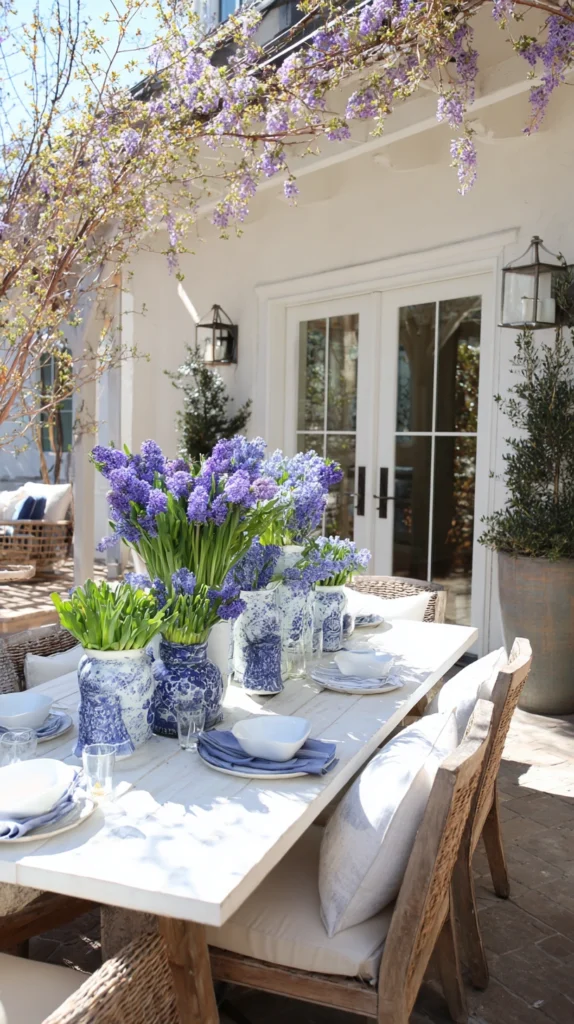
The patio setup for a spring gathering benefits from decorative details that are specifically responsive to the season — objects and arrangements that would not be present in summer or autumn and that connect the gathering to the specific qualities of spring.
A terracotta pot of forced hyacinths on the table whose fragrance fills the surrounding air on a warm evening. A collection of spring branches blossoms in a tall floor vase near the house wall. Small posies of sweet peas in mismatched vintage glasses distributed among the cushions and lanterns of the seating arrangement.
A spring wreath on the garden gate or patio door that announces the season before the gathering has properly begun. These seasonal details do not need to be elaborate or expensive — they simply need to be genuinely of the season, chosen for the specific beauty that spring produces and displayed with the generosity that the season inspires.
15. Prepare the Patio the Day Before
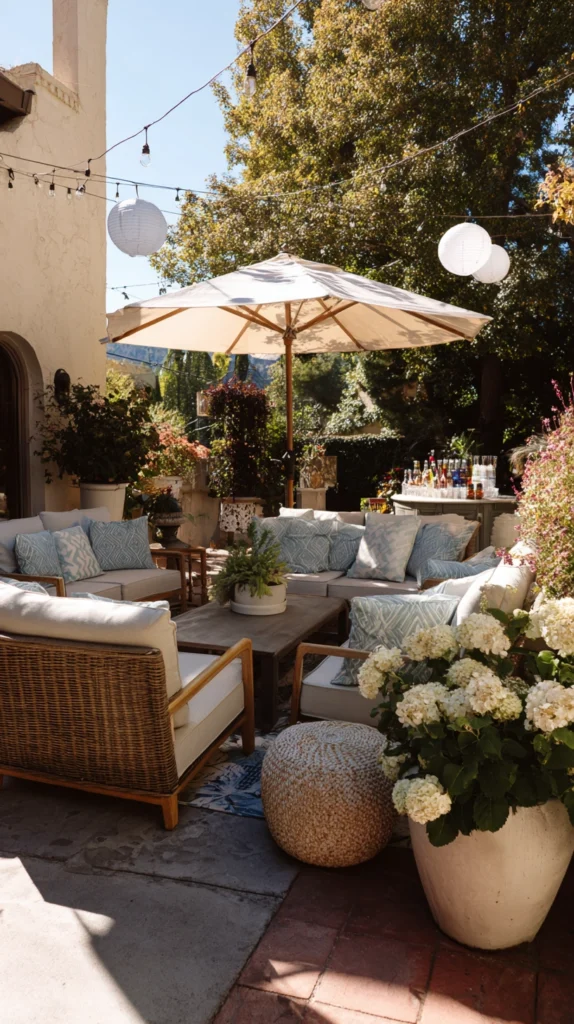
The final spring patio gathering idea is entirely practical and entirely essential: set the patio up the day before the gathering rather than on the day itself. The morning of an outdoor gathering spent arranging furniture, locating cushions, testing lights, filling the drinks station, and adding the last plants and decorative details is a morning of stress that colors the mood of the gathering that follows.
The patio set up and styled the evening before — furniture in position, cushions aired and arranged, lights tested and confirmed working, plants watered and looking their best, table setting ready for the final additions — allows the day of the gathering to begin with the pleasure of seeing the finished space in the morning light, making any small adjustments in a calm and unhurried frame of mind, and greeting the first guests as the host who has everything in hand rather than the host who is still assembling chairs when the bell rings.