15 Orange Bedroom Ideas for a Bold Cozy Retreat
Orange is the bravest color you can bring into a bedroom — and the most rewarding when you get it right. It carries more energy, more warmth, and more personality than any other color on the spectrum. In a bedroom context, that energy translates into something genuinely special: a space that feels alive, enveloping, and deeply cozy in a way that safer neutral palettes simply cannot deliver.

The hesitation most people feel about oranges in the bedroom is understandable. The wrong orange — too bright, too saturated, used without restraint — can feel agitating rather than restful. But the orange family is vast. Burnt orange, terracotta, amber, rust, apricot, and deep pumpkin all sit within this color spectrum, and most of them are not only bedroom-appropriate but genuinely extraordinary as bedroom colors when used with the right companions and the right balance.
Here are 15 orange bedroom ideas that prove this bold, warm color belongs in the most personal room in the house.
1. Burnt Orange Walls with Deep Timber
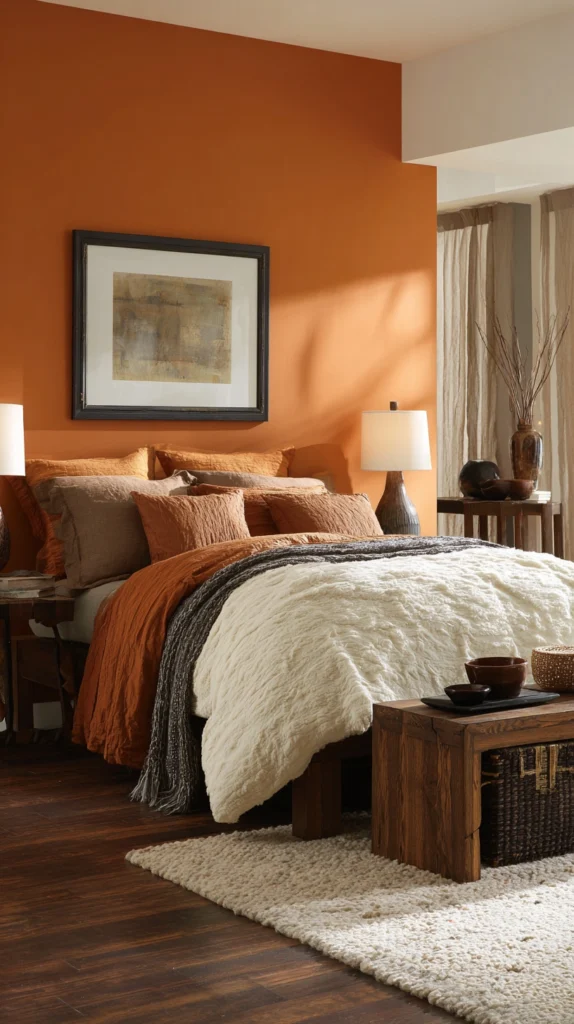
Burnt orange walls — the deep, slightly brown-toned version of orange that references autumn leaves and dry earth rather than traffic cones — paired with dark timber furniture creates a bedroom of extraordinary warmth and natural beauty. The combination of the earthy orange wall color and the richness of dark walnut or oak furniture creates a room that feels like a beautifully designed space in a warm climate — deeply inviting and genuinely restful despite the boldness of the color.
The key is choosing the right tone of orange. A true burnt orange has significant brown in its makeup that prevents it from feeling bright or agitating. It reads as a warm neutral in low light — almost like a very saturated terracotta — while revealing its full orange richness in morning and afternoon sun. Pair with dark timber bed frames, warm linen bedding in cream and caramel, and minimal accessories for a result of quiet, confident elegance.
Pro Tip: Apply burnt orange wall paint in two to three thin coats rather than one or two heavy ones for the most even, rich finish. Orange pigment is notoriously difficult to apply evenly in thick coats — heavy application creates visible brush and roller marks that are particularly obvious in raking light. Thin, even coats built up gradually produce a smooth, consistent finish that does justice to the depth and richness of a strong orange color.
2. Terracotta Orange Bedroom
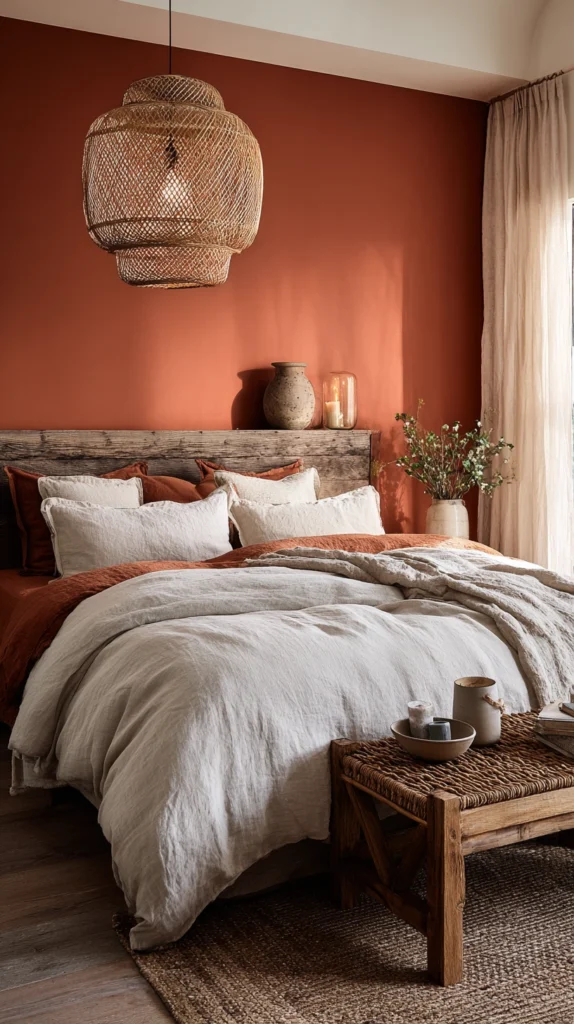
Terracotta is the most naturally beautiful and widely accessible member of the orange color family for bedroom use. Its warm, muted, slightly pinkish-orange tone references baked clay, Mediterranean architecture, and the warm soil of a summer garden — natural references that make it feel grounded and calming rather than bold and stimulating despite its genuine warmth and color depth.
Terracotta walls with natural linen bedding, rattan furniture, and warm timber accessories creates a bedroom that feels like a beautifully considered retreat — the kind of room that appears in travel magazines depicting boutique hotels in southern Europe. The palette is simultaneously warm and restful, bold and completely liveable as a daily bedroom environment.
Pro Tip: Pair terracotta walls with a warm white rather than a bright or cool white for trim, ceiling, and bedding. Cool white alongside terracotta creates a slight discord — the blue undertone of cool white clashes subtly with the warm red-orange undertone of terracotta. Warm white, ivory, and cream all share the same warmth that allows them to sit naturally and harmoniously alongside terracotta without visual tension.
3. Orange Accent Wall Behind the Bed
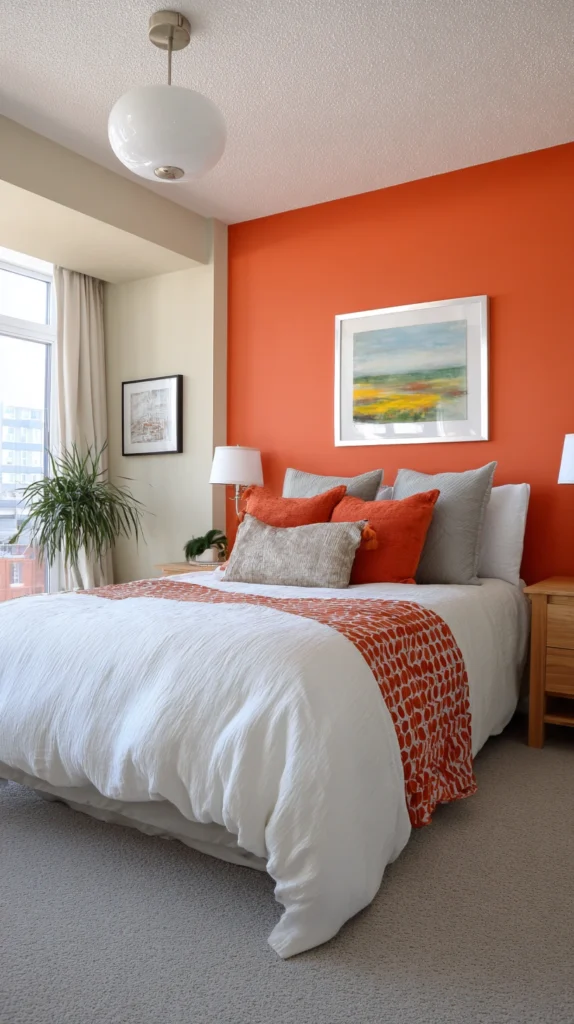
A single orange feature wall — painted in a bold, saturated orange tone directly behind the bed — with the remaining three walls in a neutral warm white or pale putty creates a bedroom with dramatic focal impact that stops well short of the full commitment of four orange walls.
The feature wall frames the bed as the room’s clear focal point and provides a bold backdrop that makes even simple bedding and furniture look considered and deliberate.
This approach allows full exploration of the orange spectrum — from a vivid, saturated true orange through burnt orange, amber, and deep rust — without the risk of an all-orange room feeling overwhelming. The three neutral walls provide the visual breathing space that allows the single orange wall to read as a bold design statement rather than an exhausting sensory experience.
Pro Tip: Extend the orange feature wall color onto the ceiling above the bed — taking it approximately 60 to 80 centimetres from the wall onto the ceiling surface — for a more immersive, canopy-like effect that makes the orange wall feel more resolved and intentional than a flat wall alone. This ceiling extension creates the impression of a colored recess above the bed that adds genuine architectural interest and depth to what would otherwise be a straightforward painted wall.
4. Orange and Navy Bedroom
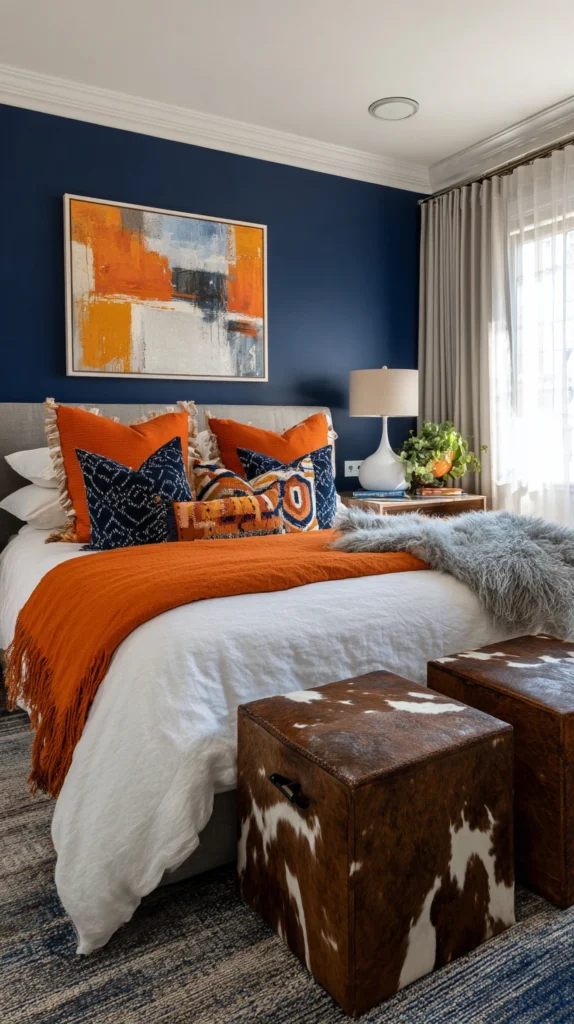
Orange and navy is one of the most classically beautiful color pairings in interior design — the two colors sit opposite each other on the color wheel, which means they intensify each other in a way that adjacent colors cannot. Navy makes orange look more vivid and orange makes navy look richer and deeper — a mutually beneficial relationship that creates a bedroom of extraordinary color depth and confidence.
Deep navy walls with burnt orange bedding accents — cushions, a throw, a lampshade — creates a bedroom of sophisticated, almost masculine richness. Alternatively, orange walls with navy blue accessories and textiles creates the same energy from the opposite starting point. Either way the combination delivers a bedroom that feels bold, considered, and genuinely distinctive.
Pro Tip: Use navy and orange in a ratio of approximately 70 to 30 rather than splitting them equally throughout the room. Equal amounts of two complementary colors create visual competition that tires the eye — one color needs to dominate clearly for the combination to feel resolved and comfortable as a daily living environment. Whether navy dominates and orange accents or orange leads and navy grounds, the clear hierarchy is what makes the pairing work beautifully.
5. Amber Orange Bedroom with Warm Lighting
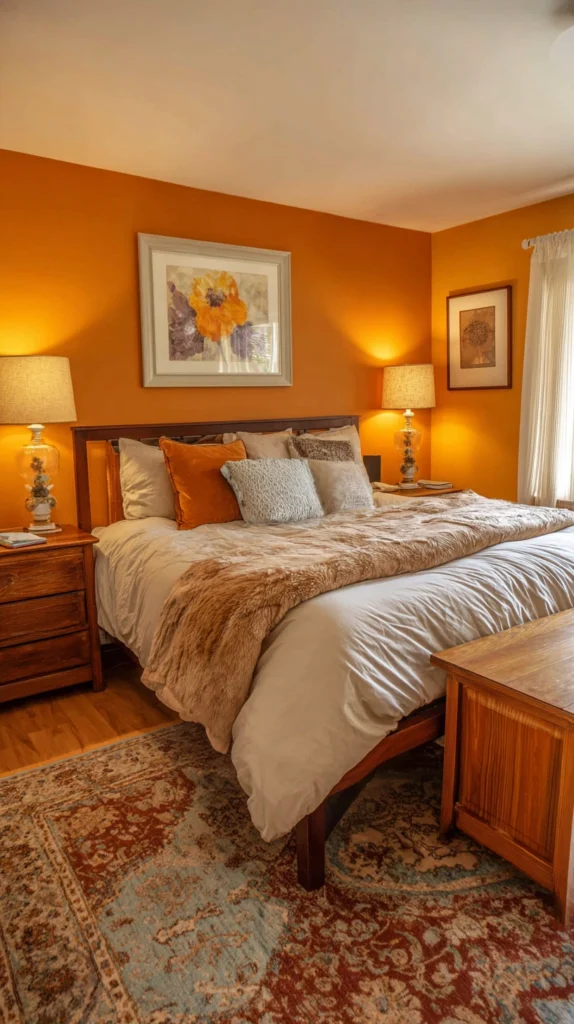
Amber — the warm, golden-orange of honey and autumn light — used as a bedroom wall color creates a room of extraordinary luminosity in evening light. When the natural light fades and warm artificial lighting takes over, amber walls glow with a quality that feels almost candlelit — every surface appears warm, every shadow is golden, and the entire room takes on a quality of intimate, enveloping warmth that is genuinely extraordinary.
The evening quality of an amber bedroom is its defining characteristic and its greatest strength. It is a color that improves as the day progresses — pleasant in morning light, beautiful in afternoon sun, and truly spectacular in the warm glow of evening lamps and bedside lighting. Choose warm-toned bulbs throughout the room to maximise the amber wall’s evening luminosity.
Pro Tip: Install dimmer switches on all lighting circuits in an amber bedroom to allow the light level to be adjusted precisely for the time of day and the mood required. The full beauty of amber walls is revealed at lower light levels — bright overhead lighting washes out the warmth and depth of the color while dimmed, warm-toned lighting at a lower level allows the amber to develop its full, extraordinary richness. Dimmers are one of the most cost-effective upgrades available in any bedroom.
6. Orange and White Bedroom
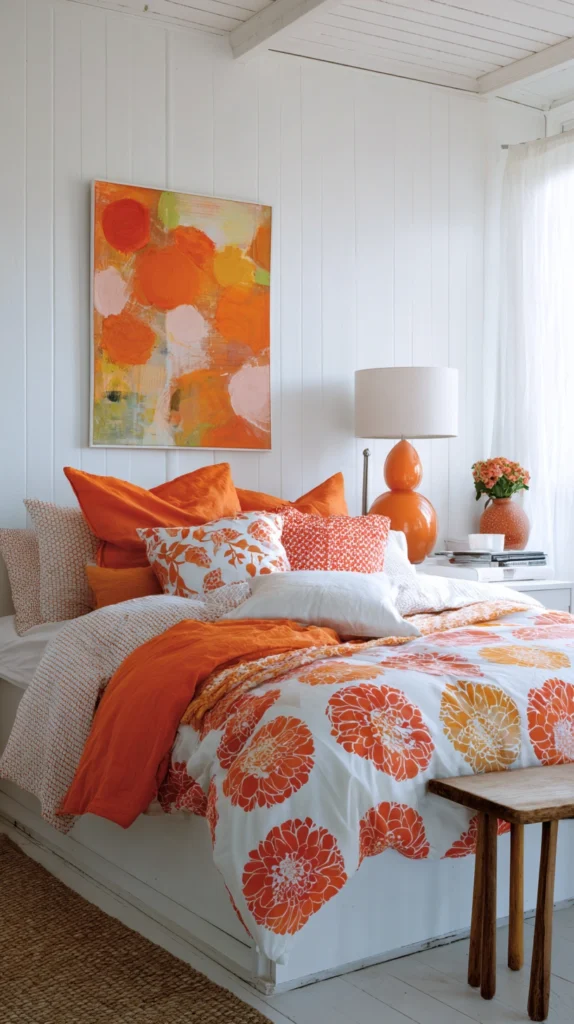
The simplest and most graphic version of orange in a bedroom — bold orange against clean, crisp white — creates a space of high contrast, fresh energy, and contemporary confidence. The white prevents the orange from feeling heavy or oppressive and the orange prevents the white from feeling clinical or cold — the two colors balance each other perfectly in opposite directions.
Orange bedding on a white bed frame, orange cushions on a white linen sofa, orange artwork on white walls — each orange element pops with maximum clarity and vibrancy against the white background. The overall effect is bright, cheerful, and full of energy — a bedroom that feels genuinely uplifting to wake up in every morning without the heaviness that orange can carry when used with darker companions.
Pro Tip: Choose orange accessories and textiles in a consistent tone throughout an orange and white bedroom rather than mixing multiple different orange shades. In a high-contrast palette like orange and white, tonal inconsistency in the orange elements is immediately visible and creates a fragmented, unresolved quality. A single consistent orange tone throughout — all burnt orange, all true orange, or all terracotta — creates the graphic clarity that makes this palette so effective.
7. Rust Orange and Cream Bedroom
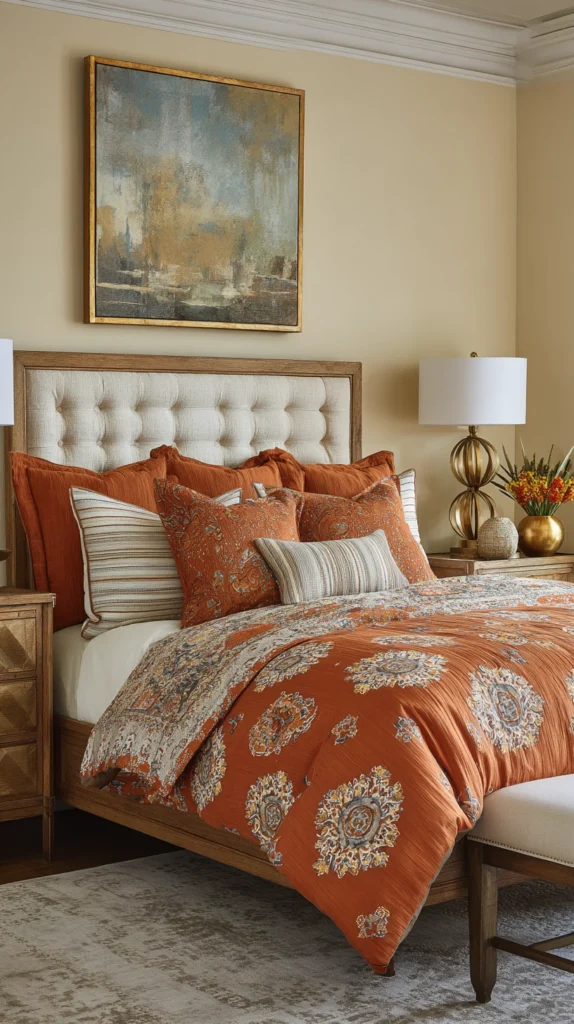
Rust orange — the deepest, most muted, most sophisticated member of the orange family — paired with warm cream creates a bedroom palette of quiet, aged beauty that feels simultaneously vintage and completely contemporary. Rust references old metal, autumn landscapes, and the warm patina of aged materials — natural references that give this palette a depth and authenticity that brighter oranges lack.
Rust orange linen bedding on a natural timber or wrought iron bed frame, cream walls with warm undertones, and accessories in aged brass, natural wood, and soft leather creates a bedroom that looks as though it has been assembled with care over time rather than decorated all at once. The aged, slightly faded quality of rust orange gives a room a lived-in warmth that feels genuinely inviting.
Pro Tip: Introduce aged or antique accessories into a rust and cream bedroom rather than new, perfectly finished pieces. Rust orange as a palette color references the beauty of age and patina — new, shiny accessories in the same room create a jarring contrast between the aged quality of the color palette and the newness of the objects within it.
Antique brass lamps, aged timber frames, vintage ceramic vessels, and worn leather accessories all share the patina quality that rust orange embodies and makes the whole room feel beautifully coherent.
8. Orange Bedroom with Botanical Green
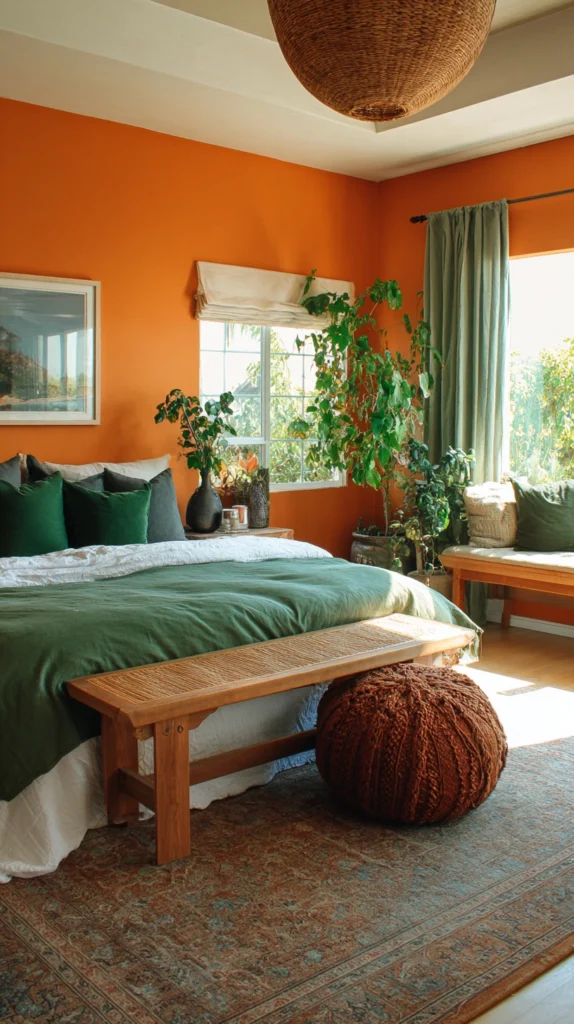
Pairing orange — in any of its warmer, more muted tones — with deep botanical green creates a bedroom palette that references the natural world with extraordinary directness. Orange and green coexist everywhere in nature — autumn leaves against evergreen trees, tropical flowers against dense jungle foliage, marigolds in a summer garden border — and their combination in a bedroom interior feels completely inevitable and organically beautiful.
Deep green velvet cushions on an orange bed, large leafy indoor plants against a terracotta wall, green botanical artwork in a rust orange bedroom — the green provides the cool, restful contrast that prevents orange from becoming overwhelming and creates a balance between warmth and freshness that makes the bedroom genuinely comfortable as a daily living and sleeping environment.
Pro Tip: Choose the green companion for an orange bedroom carefully — warm greens with a slight yellow or olive undertone harmonise most naturally with warm orange tones, while cool blue-greens create a slight discord.
Olive green, hunter green, and moss green all share the warmth that allows them to sit comfortably alongside orange. Teal and cool emerald are better suited to cooler color palettes and can make warm orange tones appear slightly muddy by comparison.
9. Apricot Orange Bedroom
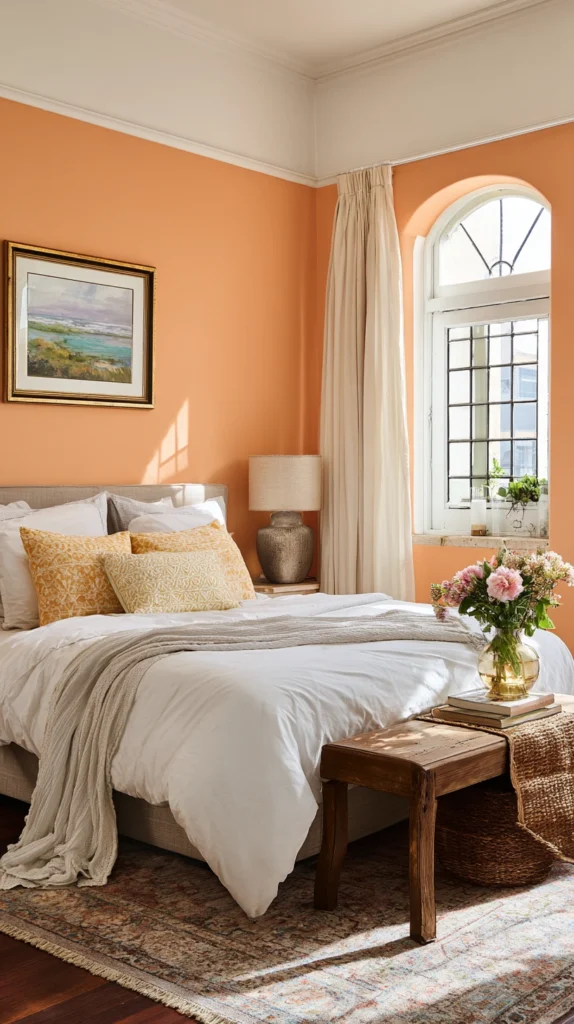
Apricot — the softest, most delicate, most feminine member of the orange family — creates a bedroom of extraordinary warmth and romantic softness that sits at the gentle boundary between peach and orange. It carries all the warmth of the orange family without any of the boldness or intensity that makes brighter oranges challenging in a bedroom context.
Apricot walls with white and cream bedding, soft gold accessories, and warm timber furniture creates a bedroom that feels genuinely sun-kissed — warm, luminous, and deeply inviting without a single element that shouts for attention.
The palette is romantic without being saccharine, warm without being overwhelming, and subtle enough to feel restful while being distinctive enough to feel genuinely special.
Pro Tip: Layer apricot with other soft warm tones — pale peach, warm blush, soft golden yellow — rather than relying solely on apricot and white throughout the room. Apricot in a room of exclusively white and neutral companions can look slightly washed out — it needs other warm tones around it to reveal its full warmth and beauty. Surrounding apricot with complementary warm pastels creates a tonal richness that makes the color glow rather than recede.
10. Orange and Grey Bedroom
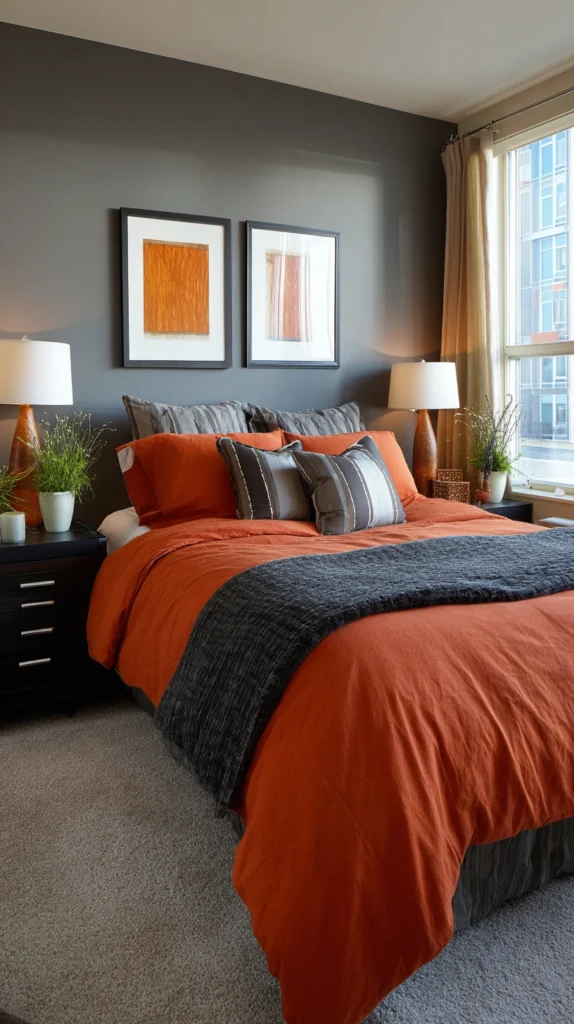
Orange and grey is a contemporary classic pairing that brings together the warmth of orange and the cool sophistication of grey in a combination of genuine balance and visual interest. The grey tempers the energy of the orange — preventing it from feeling overwhelming — while the orange lifts the grey from cool and potentially cold to warm and genuinely inviting.
Mid-toned grey walls with burnt orange bedding accents creates a bedroom that feels modern, considered, and deeply comfortable — the orange warmth preventing the grey from the slight chill it can develop when used without warm companions. Alternatively, orange walls with grey linen bedding and charcoal accessories create the same balance from the opposite starting point with equal success.
Pro Tip: Choose a grey with a warm rather than cool undertone for pairing with orange. Warm greys — those that tend slightly toward taupe or greige in their undertone — share enough of the warmth of orange to sit harmoniously alongside it. Cool blue-grey tones create a more jarring contrast with warm orange that takes the pairing out of the comfortable, sophisticated territory where it performs best and into a visual tension that can feel unsettled rather than dynamic.
11. Dark Orange and Jewel Tone Bedroom
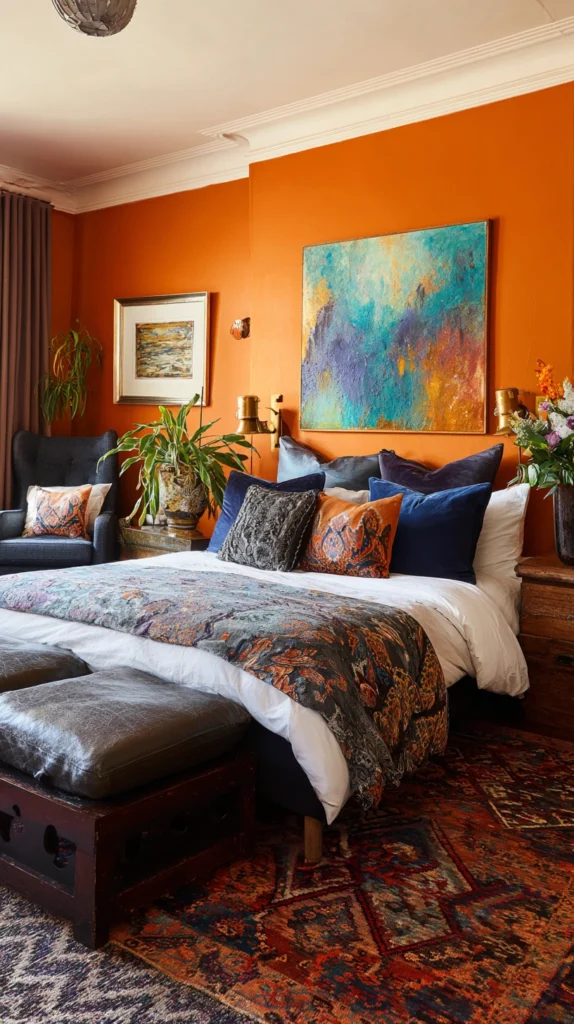
Deep, dark orange — almost brown, almost amber, intensely warm and rich — combined with jewel tones — deep sapphire blue, rich emerald green, warm amethyst purple — creates a bedroom of maximalist opulence that feels genuinely luxurious and deeply enveloping. This is a palette for a bedroom that makes no apology for its richness and its deliberate, full-blooded commitment to color.
Dark orange walls with deep jewel-toned accessories — a sapphire velvet cushion, an emerald green throw, a rich purple artwork — creates a bedroom that glows with color from every surface. The jewel tones do not compete with the dark orange — they amplify it, each color making the others look richer and more saturated than they would appear in isolation.
Pro Tip: Ground a dark orange and jewel tone bedroom with a generous amount of near-black or very deep charcoal in the accessories and furniture to prevent the combination from becoming visually chaotic.
Dark orange alongside multiple jewel tones without a unifying dark anchor can feel overwhelming rather than opulent. Deep charcoal furniture, near-black picture frames, and dark timber all provide the grounding depth that allows the rich colors around them to read as luxurious rather than excessive.
12. Orange Bedroom with Brass and Gold
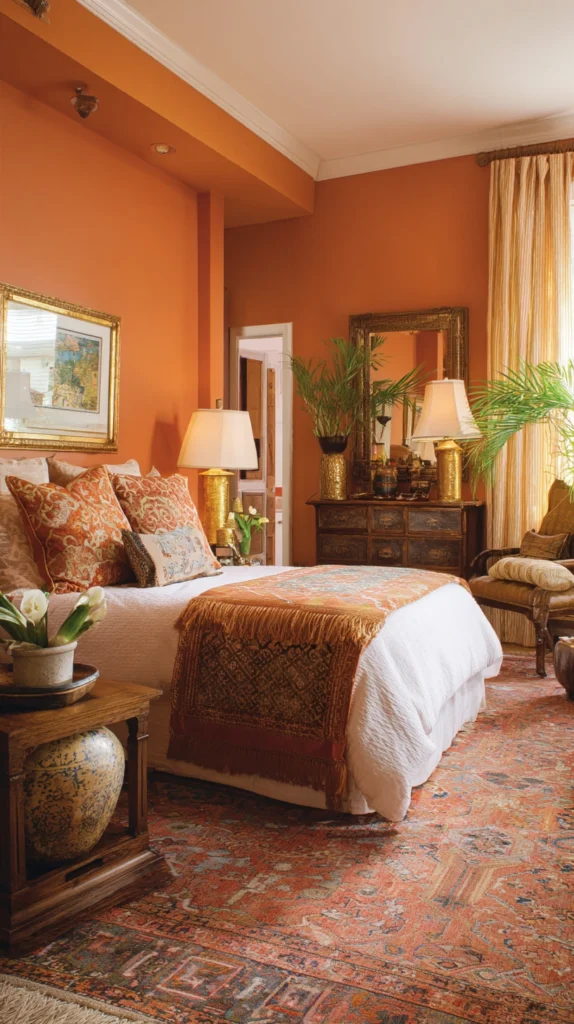
Orange and brass is one of the most naturally harmonious material and color pairings in bedroom design — the warm, golden undertone of brushed brass and the warm richness of orange share the same quality of light that makes them look as though they were always meant to coexist. Every brass detail in an orange bedroom appears to reflect the wall color back into the room, amplifying the warmth from multiple surfaces simultaneously.
Terracotta or burnt orange walls with brushed brass bedside lamps, a brass-framed mirror, brass picture frame hardware, and warm gold-toned accessories creates a bedroom of genuine, layered luxury. The brass details add a quality of considered finishing that elevates the orange palette from simply warm to genuinely opulent — a small investment in brass hardware that transforms the overall quality of the room entirely.
Pro Tip: Mix brushed brass with aged or antique brass rather than using all new, uniform brass finishes throughout the room. A mix of slightly different brass tones — some more golden, some more aged and darker — creates the collected, authentic quality of a room that has been thoughtfully assembled over time. All matching new brass accessories create a showroom quality that lacks the warmth and personality that the orange palette itself is trying to communicate.
13. Orange Ceiling Bedroom
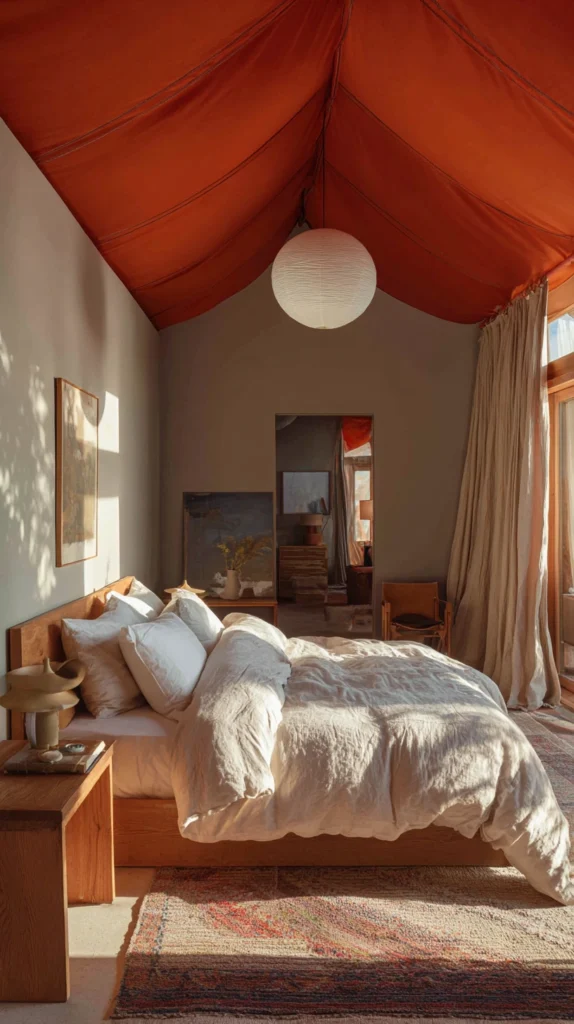
An orange ceiling — particularly in a deep, warm tone like burnt orange, amber, or rust — is one of the most unexpected and genuinely transformative bedroom design decisions available. An orange ceiling wraps the room in warmth from above, creates an extraordinary evening atmosphere as light reflects downward from the colored surface, and gives a bedroom a cocooning, tent-like quality that makes it feel deeply intimate and restful.
The surprise of an orange ceiling against neutral walls — white, soft grey, or warm putty below and vivid warm orange above — creates a bedroom with a confident, distinctive character that guests consistently notice and remember. The ceiling is the one surface in a bedroom that is seen most clearly when lying down — which makes it arguably the most important surface to make beautiful and interesting.
Pro Tip: Use a slightly lighter tone of orange on the ceiling than on any walls in the same room — a ceiling that is one to two shades lighter than the wall color will appear to match at eye level due to the different way light falls on vertical and horizontal surfaces.
An orange ceiling painted in exactly the same shade as the walls will appear noticeably darker than the walls in most lighting conditions — the lighter ceiling tone corrects for this optical effect and creates the balanced, harmonious result that makes the design decision look intentional and resolved.
14. Maximalist Orange Bedroom
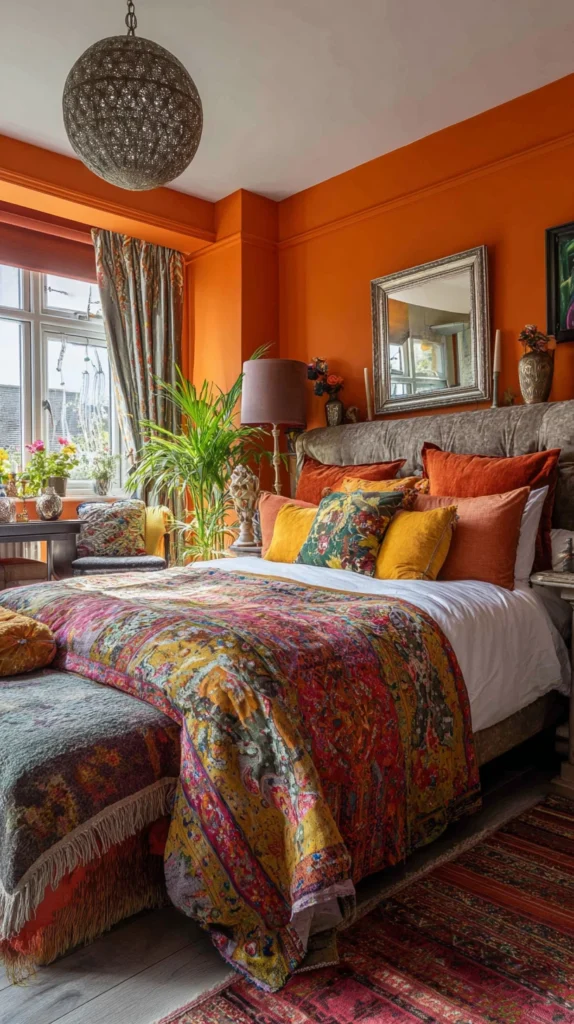
A fully maximalist orange bedroom — orange walls, orange textiles, orange accessories, layered patterns in orange and complementary tones throughout — is the boldest and most committed expression of this color’s potential and the room that makes the most powerful and memorable first impression of any bedroom design on this list.
Maximalism in an orange bedroom works because oranges have the depth and warmth to sustain the layering of multiple patterns, textures, and tones without becoming visually chaotic.
Geometric orange cushions alongside floral orange bedding alongside a striped orange throw — the pattern mixing creates visual richness that pure solid color cannot achieve, and the consistent orange base color across all the varied patterns provides the cohesion that prevents maximalism from tipping into disorder.
Pro Tip: Maintain a consistent color temperature across all orange elements in a maximalist bedroom — ensure that all fabrics, paints, and accessories share the same warm undertone, whether that is the yellow-warm undertone of true orange or the red-warm undertone of rust and terracotta. Mixing warm and cool orange tones within a maximalist palette creates a discord that is visible and unsettling — tonal consistency within the maximalism is what allows the layering to read as deliberately rich rather than accidentally chaotic.
15. Orange and Blush Pink Bedroom
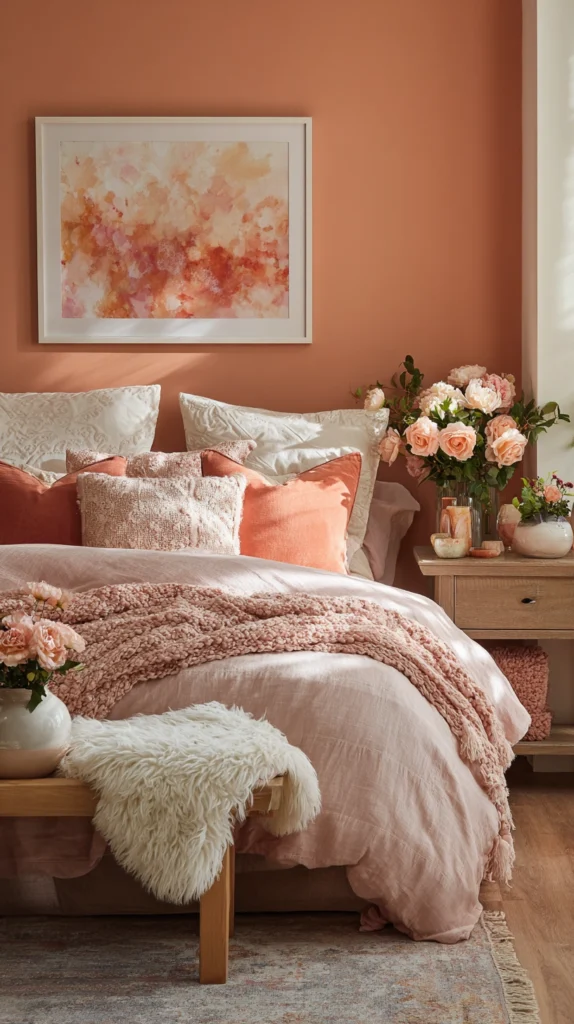
Orange and blush pink is a pairing of extraordinary warmth and romantic beauty — two colors that share the same warm, rosy undertone and sit adjacent to each other in the warm section of the color spectrum. The combination feels simultaneously bold and soft, warm and delicate — a bedroom palette that delivers genuine comfort and genuine beauty in equal measure.
A muted, slightly dusty burnt orange wall alongside blush pink bedding, warm peachy cushions, and soft rose-toned accessories creates a bedroom that feels like a celebration of warm light at its most beautiful — the palette of a perfect sunset translated into a daily living environment. The orange grounds the blush with warmth and depth while the blush softens the orange with romantic delicacy.
Pro Tip: Avoid combining orange and blush pink with any cool-toned neutrals — white with blue undertones, grey with cool undertones, or stark bright white. The entire beauty of the orange and blush pink pairing depends on maintaining a consistently warm temperature throughout every element of the room.
A single cool-toned neutral introduces a temperature discord that disrupts the seamless warmth of the palette. Keep every neutral — walls, ceiling, trim, bedding — on the warm side of the spectrum and the combination will be genuinely extraordinary.
Commit to Orange and Reap the Reward
The bedrooms that people remember are rarely the careful, neutral, risk-free ones. They are the rooms that made a decision — a bold color, a clear point of view, a commitment to warmth and personality over safety and conformity.
Orange, used well, creates exactly that kind of bedroom. Warm enough to feel genuinely cozy, rich enough to feel genuinely luxurious, and bold enough to feel genuinely alive. Choose your orange, commit to it fully, and create the bedroom that safe choices never could.