15 Stunning Navy Tile Bathroom Ideas with Marble and Gold Accents
There is a bathroom color combination that has achieved a status of genuine, durable luxury in contemporary interior design — not the trendy luxury of a color moment that arrives with fanfare and departs within three years, but the specific, enduring luxury of a palette that references the finest hotels, the most admired historic interiors, and the deep chromatic richness of the natural materials from which it draws. Navy, marble, and gold in a bathroom is a palette of this second, more permanent kind.
The navy provides depth and drama — the specific quality of blue-black that reads as sophisticated rather than cold, that makes a small bathroom feel intimate rather than cramped, and that creates the dark, enveloping backdrop against which the white and cream of marble and the warm gleam of gold achieve their maximum visual impact.
The marble provides the surface richness and natural complexity that no manufactured material can replicate — the veining that moves through the white stone like rivers on a map, the cool smoothness of a polished surface, the geological authenticity of a material that took millions of years to form.

The gold provides warmth — the specific warmth of a reflective metallic surface that catches and returns the bathroom’s light with the amber generosity of candlelight. Together, these three elements create a bathroom of unmistakable quality, one that feels genuinely luxurious in the way that genuine luxury feels: not performed, not decorated, but simply, materially, right. Here are fifteen ways to achieve it.
1. Navy Subway Tile with White Carrara Marble Floor
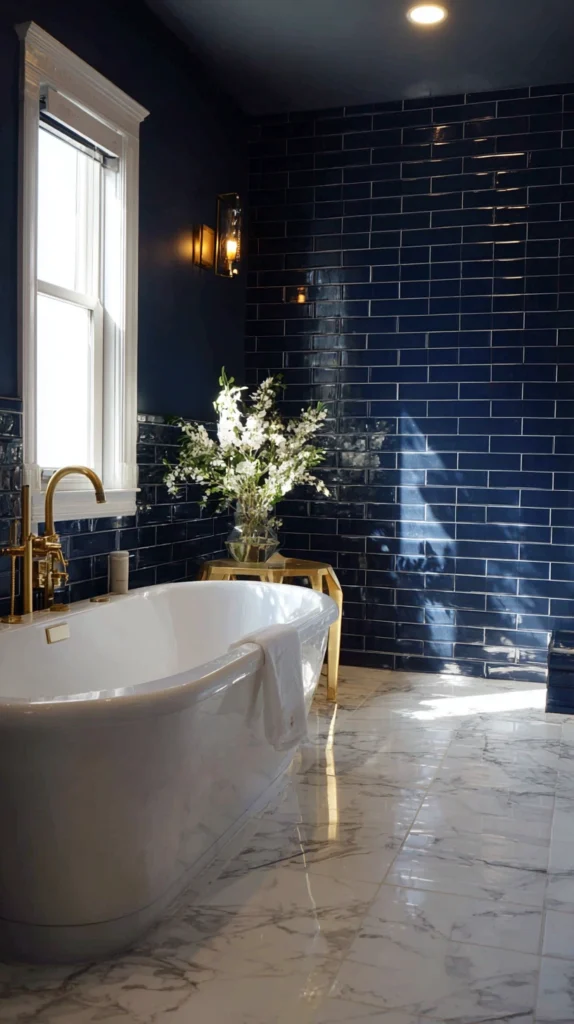
The navy subway tile wall combined with a white Carrara marble floor — the most classical of all marble varieties, with its clean white ground and soft gray veining — is the navy and marble bathroom combination in its most resolved and most historically grounded form.
The horizontal rhythm of the subway tile creates a visual movement across the wall’s surface that anchors the bathroom’s linear architecture, while the Carrara floor’s natural veining introduces the organic complexity that the manufactured regularity of the tile cannot provide.
The contrast between the dark, consistent navy of the wall tiles and the pale, varied surface of the marble floor creates a relationship of maximum chromatic drama — the darkest possible background for the lightest possible floor — that makes both materials appear more beautiful than either would in a more harmonious, less contrasting combination.
Gold fixtures — a freestanding brass mixer tap on the bath, unlacquered brass towel rails, a brushed gold showerhead — complete the palette with the warm metallic element that both the cool navy and the cool marble require to prevent the bathroom from feeling merely sophisticated rather than genuinely warm.
2. Navy Hexagon Mosaic Floor with Marble Wall Panels
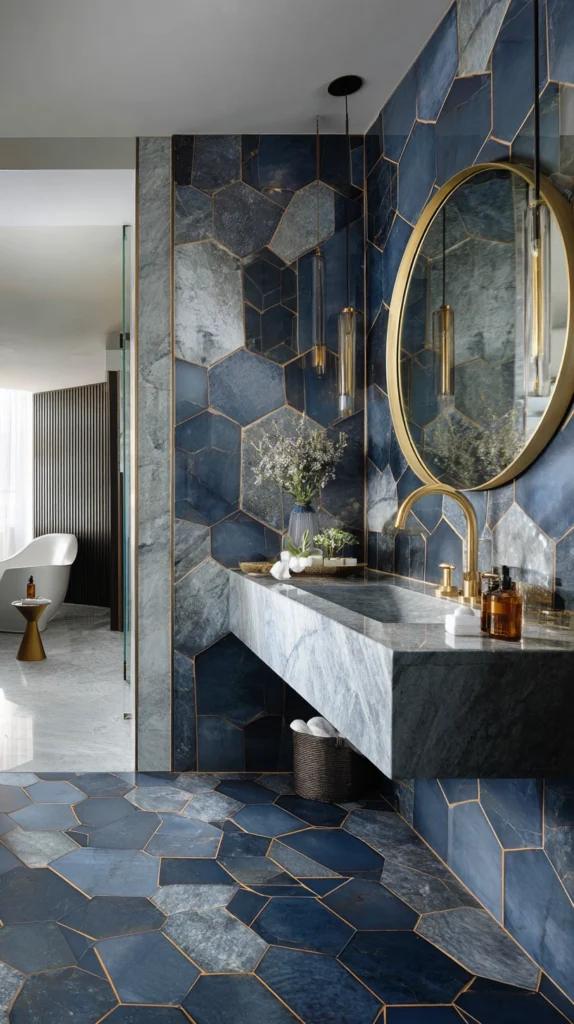
The floor-to-ceiling marble wall panel combined with a navy hexagon mosaic floor creates a bathroom in which the conventional relationship between floor and wall materials is deliberately and beautifully inverted — the marble, typically associated with the horizontal surface, rises up the walls in large, dramatic slabs, while the navy, typically associated with the vertical surface, is mapped onto the floor in the fine geometric pattern of the hexagon mosaic.
The marble wall panels in this configuration should be book-matched — two adjacent slabs from the same block installed side by side so that the veining creates a mirrored composition across the wall — creating a marble surface of extraordinary visual impact that the eye cannot simply dismiss as a background material.
The navy hexagon mosaic floor grounds this marble luxury with its deep, geometric pattern, and the gold grout between the navy hexagons — a choice available from specialist tile grout suppliers — creates a fine grid of warm metallic line across the floor surface that connects the gold of the fixtures to the gold within the marble’s veining.
3. A Navy Feature Wall in a Predominantly White Bathroom
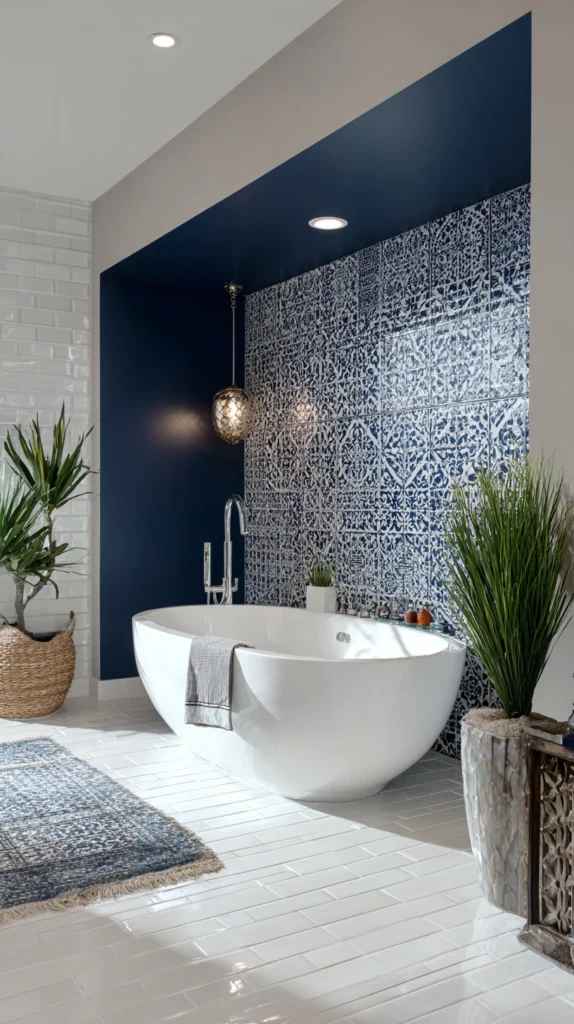
For the bathroom where a full navy tile treatment exceeds the available budget or the owner’s appetite for chromatic commitment, a single navy feature wall — the wall behind the bathtub, the wall facing the bathroom’s entry, or the shower enclosure wall — creates the palette’s drama and depth in a bounded zone that is visible and impactful without overwhelming a bathroom whose remaining surfaces are white or marble.
A navy tile feature wall in an otherwise white bathroom creates a focal point of considerable visual authority — the dark wall recedes behind the bath or the vanity, creating a sense of depth that makes the bathroom appear larger — while the white tiles on the surrounding walls maintain the brightness and visual space that the full-navy bathroom can reduce.
The feature wall’s navy tile should be in a format of sufficient scale to create a genuine wall composition rather than a tile application — large-format subway tiles, a bold hexagon pattern, or a full-height marble effect tile in navy ground.
4. Navy Zellige Tiles with Unlacquered Brass Fixtures
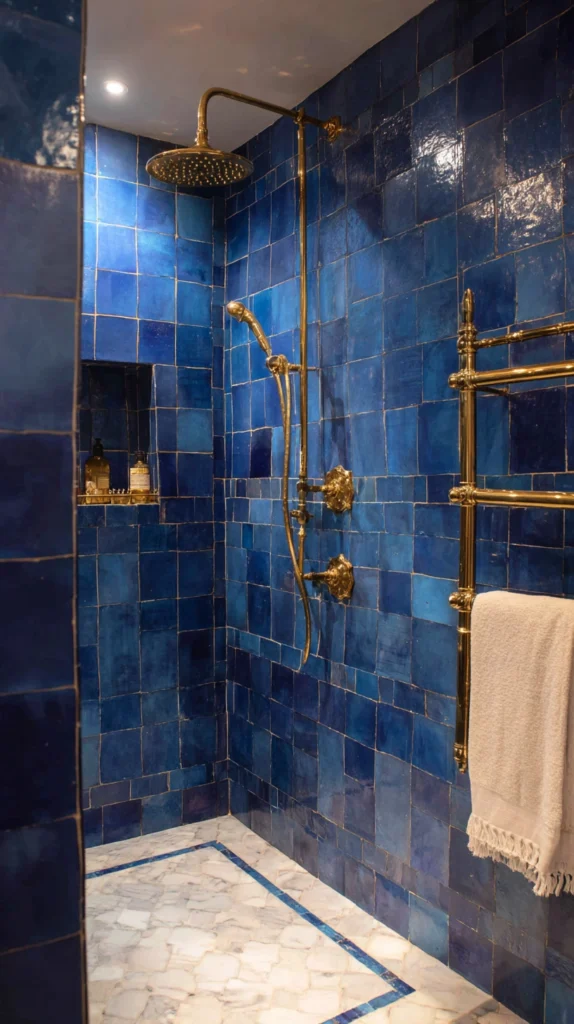
Navy zellige tiles — the Moroccan hand-cut ceramic whose irregular glaze surface creates the shimmering, light-catching mosaic effect that has made zellige one of contemporary interior design’s most sought-after tile varieties — combined with unlacquered brass fixtures creates a bathroom of extraordinary material richness and sensory complexity.
The zellige’s surface irregularity means that the navy is never flat or uniform — it shifts between deep blue-black in the recessed areas of the tile’s surface and a lighter, more turquoise blue where the glaze has pooled thinly over the tile’s raised areas, creating a wall surface that appears to move and change as the bathroom’s light changes through the day.
Against this animated navy surface, the unlacquered brass of the fixtures — faucets, towel rails, mirror frame, shower fittings — provides the warm golden counterpoint that the zellige’s cool blue requires for chromatic balance. The marble element in this combination is best introduced at the floor — a honed Calacatta marble floor provides the pale, veined surface that contrasts maximally with the zellige wall’s dark complexity.
5. A Navy and Marble Shower Enclosure
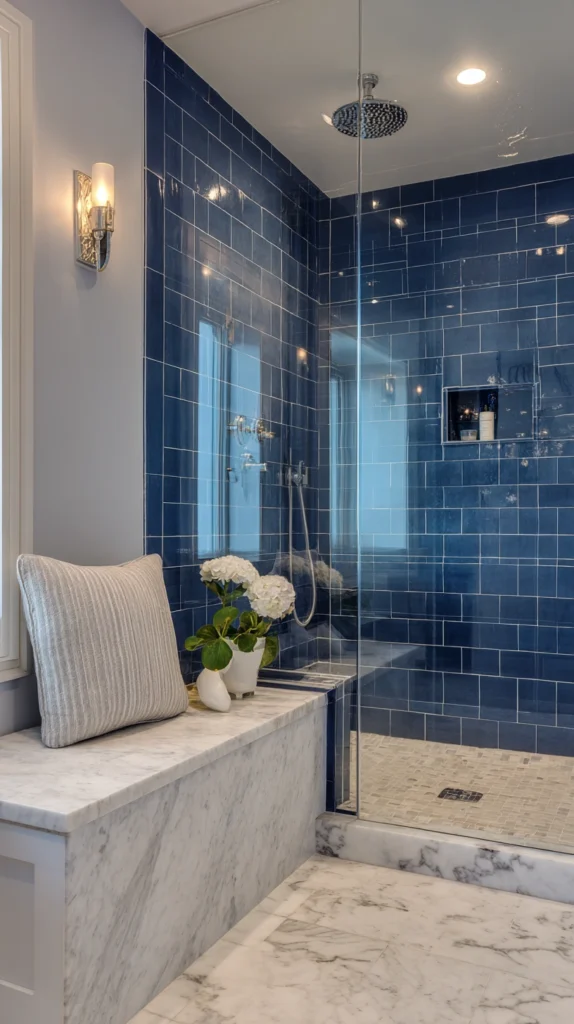
The shower enclosure designed as a dedicated navy and marble interior — navy tile on the three surrounding walls with a marble floor and a marble bench or shelf, separated from the bathroom’s remaining surfaces by a frameless glass screen — creates a shower experience of extraordinary sensory quality that the single-material shower enclosure cannot approach.
The enclosed nature of the shower amplifies the visual impact of the tile — you are within the navy rather than looking at it from across the room — and the marble floor’s cool smoothness under bare feet, combined with the navy tile’s depth, creates a sensory combination that approaches the quality of the finest hotel spa environment.
Gold fixtures within the shower enclosure — a wall-mounted gold showerhead, gold shower controls, a gold-framed recessed shelf — create the warm metallic accents that the shower’s otherwise cool palette requires, and the combination of the three materials within the shower’s intimate enclosure creates a bathroom moment of genuine, memorable luxury.
6. Navy Tile Wainscoting with Marble Above
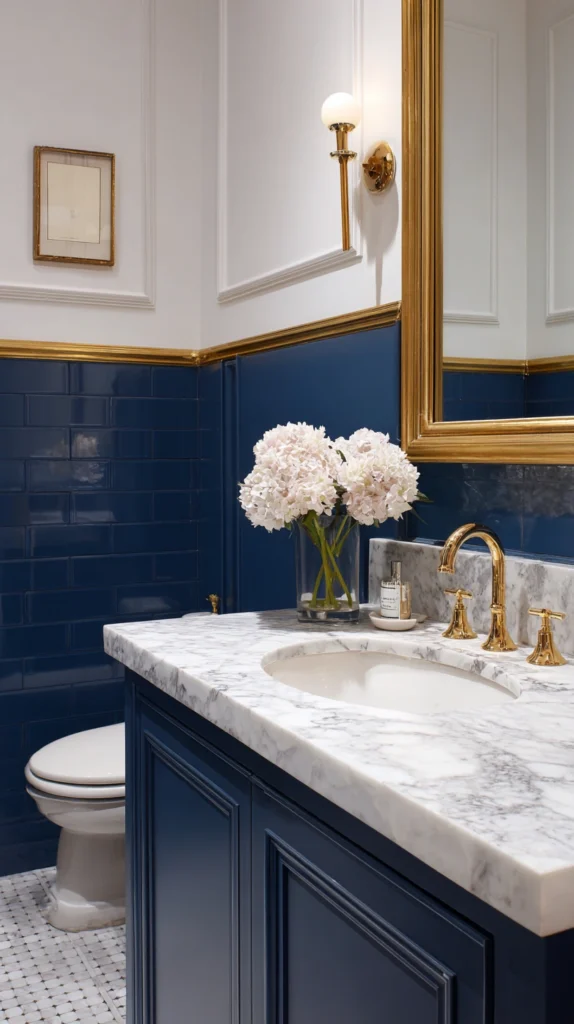
Wainscoting — the traditional practice of tiling or paneling the lower section of a bathroom wall to approximately one meter height, leaving the upper wall in a different material or finish — applied in navy tile with white marble above the wainscot line creates a bathroom with clear material zones that create visual interest and architectural definition without the commitment of a fully tiled wall.
The navy wainscoting provides the bathroom’s grounding element — the dark, weighty lower zone that anchors the room’s visual composition — while the marble or marble-effect upper wall provides the light, complex surface that gives the eye something to travel across above the dark base.
The transition between the navy tile and the marble — a gold profile strip, a pencil molding in brass, or simply a clean tile-to-tile joint — is the composition’s most important detail, and it should be specified and executed with care because the quality of this transition line determines the quality of the entire composition above and below it.
7. A Freestanding Bath on a Navy Tile Floor
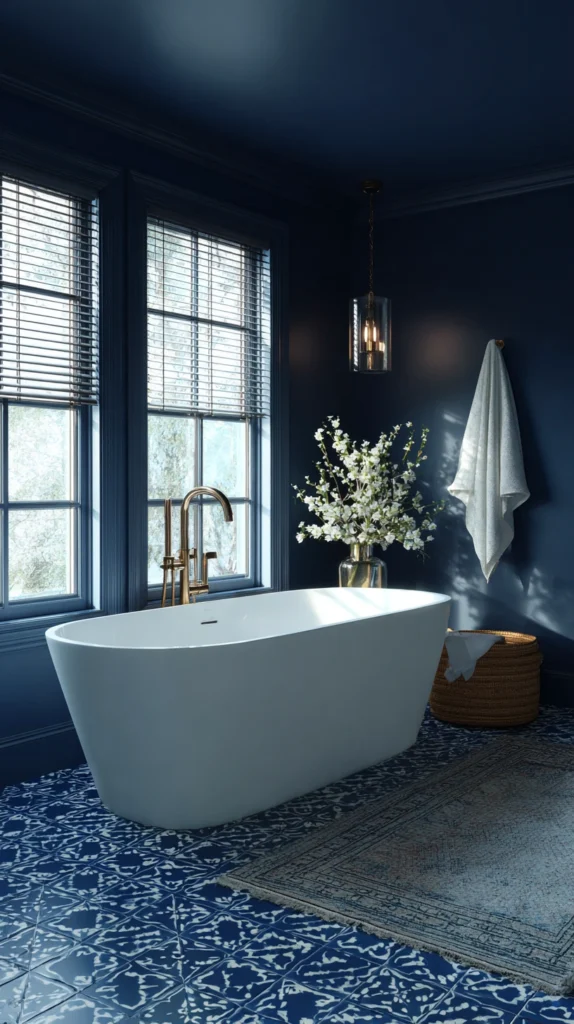
A freestanding bathtub — in white ceramic, cast iron, or stone resin, positioned at the center of the bathroom floor as a sculptural object rather than built into a corner — on a navy tile floor creates one of the most photographically compelling bathroom compositions available, the pale architectural sculpture of the bath standing against the dark geometric surface of the navy floor with a visual drama that built-in bath configurations cannot achieve.
The freestanding bath’s floor-mounted filler tap — a gold or unlacquered brass floor-standing tap whose pipe rises from the navy tile floor beside the bath — creates a sculptural gold element within the dark floor surface that bridges the pale bath and the dark tile with a warm metallic vertical.
White marble walls behind the freestanding bath create the pale, complex backdrop that the navy floor and the white bath required to complete the palette’s three-material composition in a single, resolved bathroom view.
8. Navy Penny Tile Floor with Marble Vanity Top
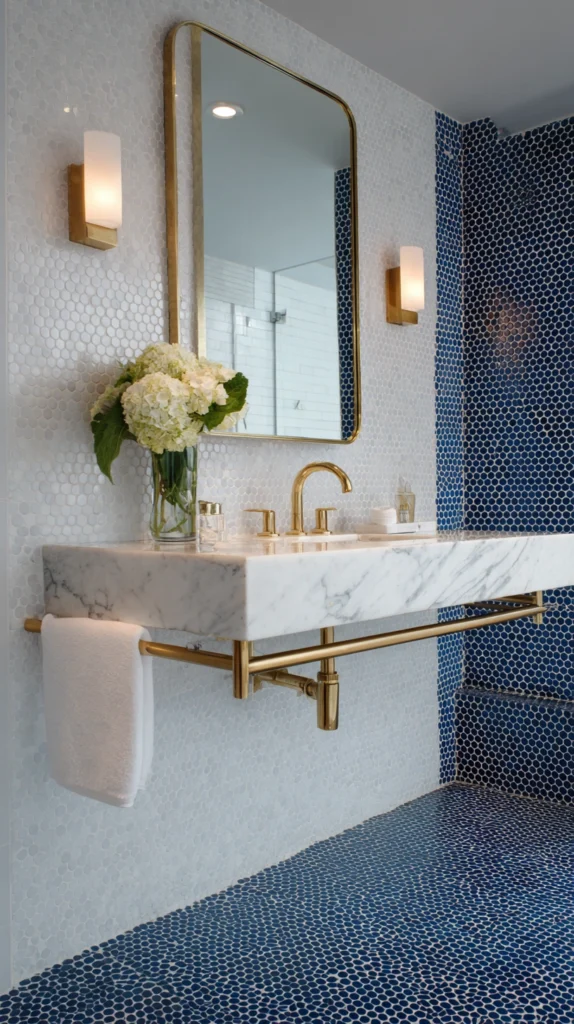
Navy penny round mosaic tiles — the small circular tiles whose grid of fine grout lines creates a textured surface of considerable visual richness — on the bathroom floor combined with a marble vanity top creates a bathroom that achieves material variety at two of the room’s most important surfaces without requiring the full commitment of wall-to-wall navy tile application.
The penny tile floor’s fine, intricate pattern at the lowest surface combines with the marble’s bold veining at counter height to create a vertical progression of two very different natural and manufactured patterns that are unified by their shared color story — the navy of the penny tiles relating to the gray veining of white marble, and the gold of the fixtures relating to the gold veining of the marble’s more amber-toned varieties.
Choose a gold or brass grout for the penny tile floor — the thin lines of metallic grout visible between each circular tile create the gold element at floor level that connects the floor to the gold fixtures without requiring any additional decorative intervention.
9. Navy Scallop or Fan Tiles for Decorative Energy
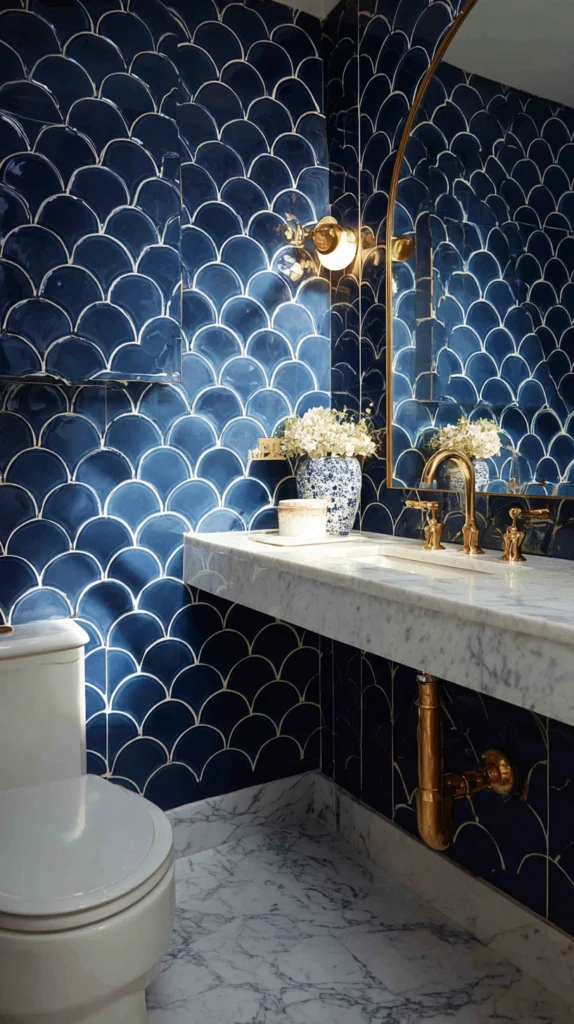
The scallop or fan tile — a tile cut in a curved form that overlaps adjacent tiles in a scale-like pattern, creating a surface of organic, wave-like geometry — in navy creates a bathroom wall of considerable decorative energy and tactile beauty that the standard rectangular or hexagonal tile cannot approach.
The scallop pattern’s curved geometry catches light differently across its convex surface, creating a subtle but continuously shifting shadow pattern that makes the wall appear to move as the bathroom’s light changes.
Combined with a white marble floor — whose natural veining provides a complementary organic complexity at ground level — and gold fixtures that warm the scallop tile’s cool navy, the scallop or fan tile bathroom is one of the most sophisticated and most distinctive bathroom treatments available in the contemporary tile market.
The scale of the scallop tile should be calibrated to the bathroom’s size — small-scale scallops in a compact bathroom, larger scallops in a more generous space.
10. A Navy and Gold Vanity Unit as Bathroom Anchor
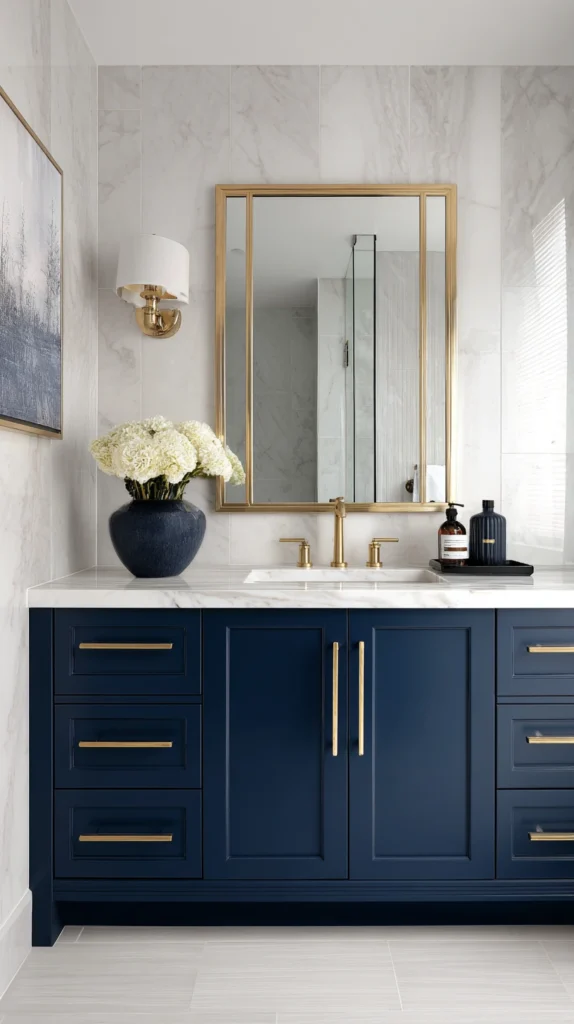
A custom or bespoke vanity unit in navy — a painted or lacquered cabinet in a deep navy blue with a marble top and gold hardware — creates the bathroom’s organizing furniture piece and its primary color statement simultaneously, allowing the surrounding walls and floor to be maintained in lighter, more neutral materials while the navy palette’s depth and drama is concentrated in the room’s most functionally important piece of furniture.
The navy vanity with marble top and gold handles is a complete expression of the palette’s three-material combination in a single object — the cabinet’s dark navy body, the pale marble counter, and the warm gold of the handles creating the chromatic combination in its most concentrated and most accessible form. Wall-mounted gold mirrors above the vanity, gold faucets at the marble counter’s front edge, and gold towel rails on the adjacent wall complete the fixture scheme that makes the navy vanity the visual center of the entire bathroom composition.
11. Navy Tile in a Powder Room for Maximum Impact
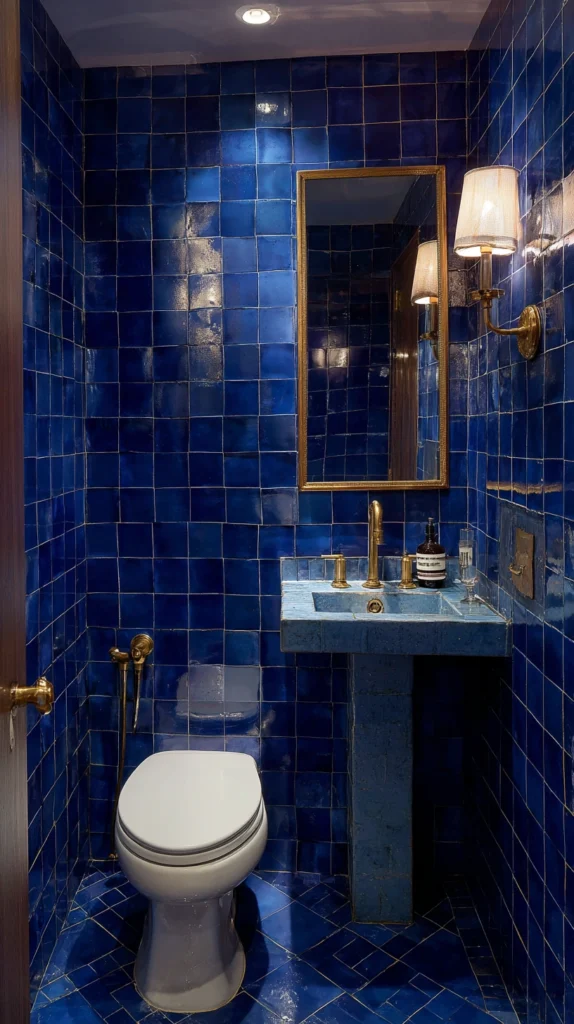
The powder room — the small, secondary bathroom that guests use during a gathering and that does not need to accommodate the full range of bathing and grooming functions that the main bathroom serves — is the ideal location for the maximum expression of the navy, marble, and gold palette.
In a small powder room, every surface is seen at close range and the intimacy of the space amplifies the material quality of every tile, fixture, and fitting beyond what the same materials achieve in a larger bathroom.
A powder room where all four walls and the floor are in navy tile — perhaps different navy tile formats on the floor and walls — with a marble counter sink and gold fixtures creates an experience of total material immersion that the larger bathroom’s greater volume dilutes.
The powder room’s small scale also makes the most expensive material choices — genuine marble, quality unlacquered brass — more financially accessible than in a full bathroom application.
12. Marble Inlay Borders Within Navy Tile Fields
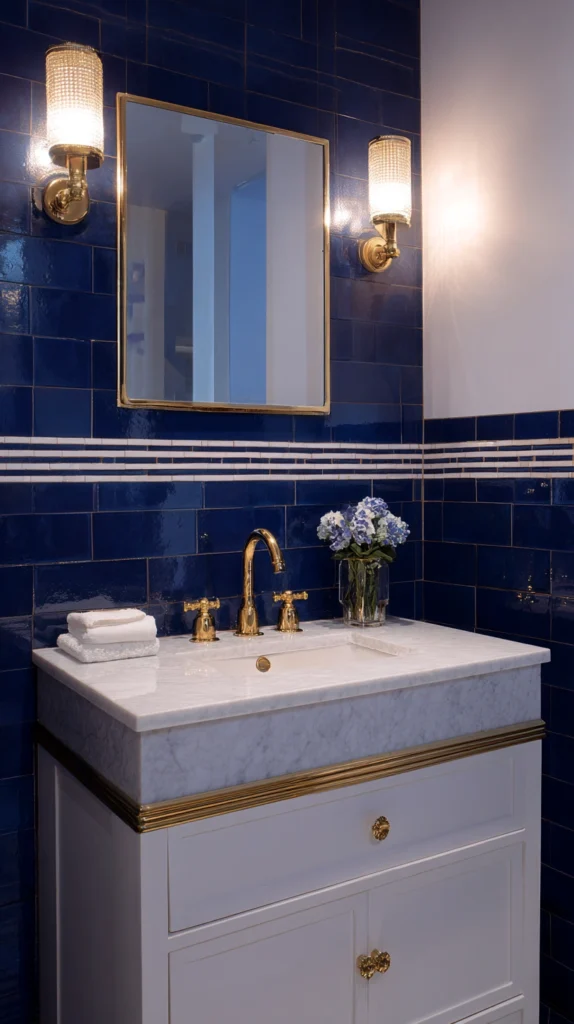
A navy tile field interrupted by inlaid marble border strips — thin bands of white or cream marble set into the navy tile field in a continuous horizontal line at a specific height, or as a framing border around a specific zone — creates a bathroom of considerably greater decorative sophistication than a single-material tile application without the complexity or cost of a full marble installation.
The marble border strips serve as a material transition and a visual breathing moment within the navy tile’s continuous field — a line of pale, veined stone running through the dark tile surface in the manner of a wainscot cap or a decorative dado.
The border strips should be in a marble whose veining includes warm gold or amber tones — Calacatta Gold or Emperador Light — to create the connection to the gold fixtures that the navy tile’s coolness requires at every opportunity within the bathroom’s design.
13. A Navy Tile Bathroom with Brass Fittings Throughout
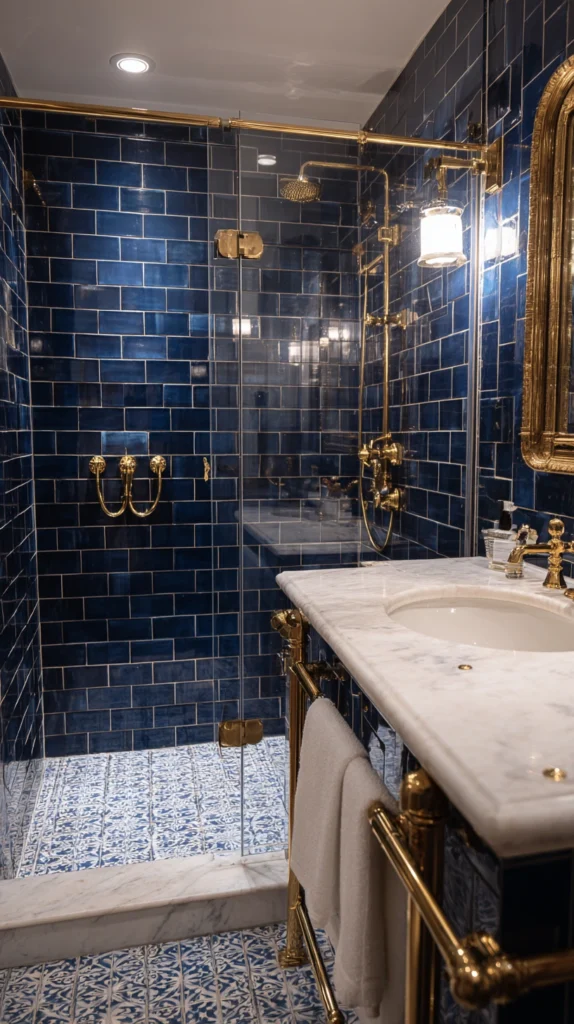
A bathroom where every fixture and fitting is in unlacquered or antique brass — the faucets, the showerhead, the towel rails, the mirror frame, the light fittings, the cabinet handles, the toilet roll holder — creates a bathroom whose gold element is total and immersive rather than selective, and whose relationship with the navy tile is one of the most luxurious and most chromatically complete available.
The consistency of the brass throughout the bathroom creates a metallic environment of considerable warmth that counteracts the coolness of the navy with equal force — the gold and the navy in balance, neither dominating, both at maximum intensity.
The marble provides the neutral, complex middle ground between the two strong elements — its white surface relating to the navy’s cool without sharing its darkness, its gold veining relating to the brass without sharing its warmth.
14. A Vintage-Inspired Navy Bathroom with Period Details
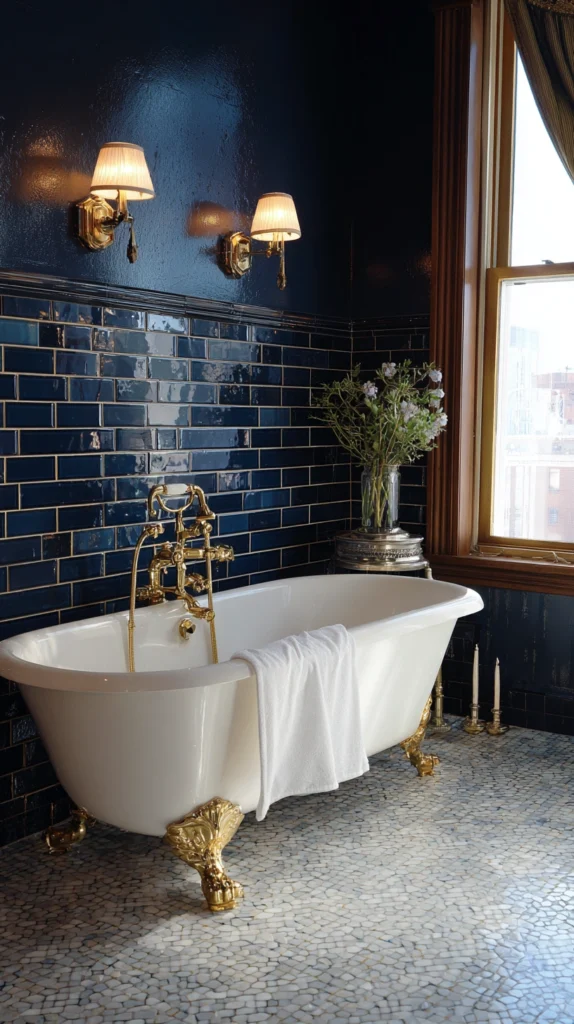
The navy, marble, and gold bathroom palette has deep historical roots — the combination appears in the finest Victorian and Edwardian bathrooms, in the grand hotel bathrooms of the early twentieth century, and in the luxurious bathrooms of the art deco period — and a bathroom that embraces these period associations explicitly creates a space of considerable historical resonance and decorative richness.
Period details that enhance the vintage quality of the navy, marble, and gold palette include: a roll-top bath on brass claw feet, a high-level toilet cistern with a pull chain, a marble-topped washstand with a china basin, hexagonal black and white marble floor tiles with a navy border, brass towel rails of generous proportion, and wall-mounted brass light fittings with opaque white glass shades.
The combination of the deep navy wall tiles, the classic marble floor, and the warm brass of the period fixtures creates a bathroom that could plausibly exist in an Edwardian townhouse while feeling entirely contemporary in its material quality and deliberate design intention.
15. A Navy Bathroom That Commits to the Dark Side Completely
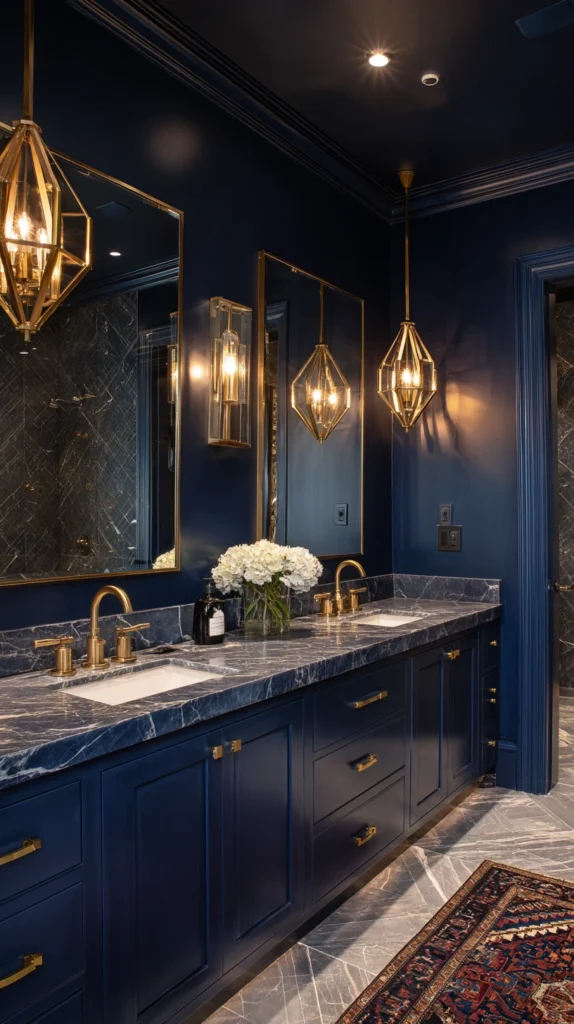
The final navy bathroom idea is the most committed and the most rewarding of all: the bathroom that applies the navy, marble, and gold palette without qualification or compromise — navy on every wall surface, marble on every horizontal surface, gold on every fixture and fitting — creating a bathroom of total, enveloping luxury that is the most complete expression of the palette’s considerable power.
In this bathroom, the navy is not a feature or an accent — it is the room’s fundamental environmental condition, the dark, rich atmosphere within which the marble’s pale complexity and the gold’s warm gleam create their maximum visual impact.
The fully committed navy bathroom has a quality of intimacy and envelopment that no partially applied version can achieve — you are within the color, surrounded by it on every side, and the marble and gold within this dark setting glow with a luminosity that the same materials in a lighter room cannot approach.
This is the bathroom for the homeowner who understands that the most beautiful rooms are almost always the most committed ones — the rooms that pursue their design vision to its logical conclusion without the dilutions and compromises that timidity introduces.