15 Living Room with Fireplace and TV Ideas That Actually Work
The fireplace and the television are the two most contested focal points in any living room — and in most homes they compete directly with each other. The fireplace pulls attention with warmth, light, and the ancient human attraction to an open flame.
The television pulls attention with movement, color, and the modern addiction to screens. Positioning them in relationship to each other — and to the seating that must serve both simultaneously — is one of the most common and most genuinely challenging living room design problems any household faces.
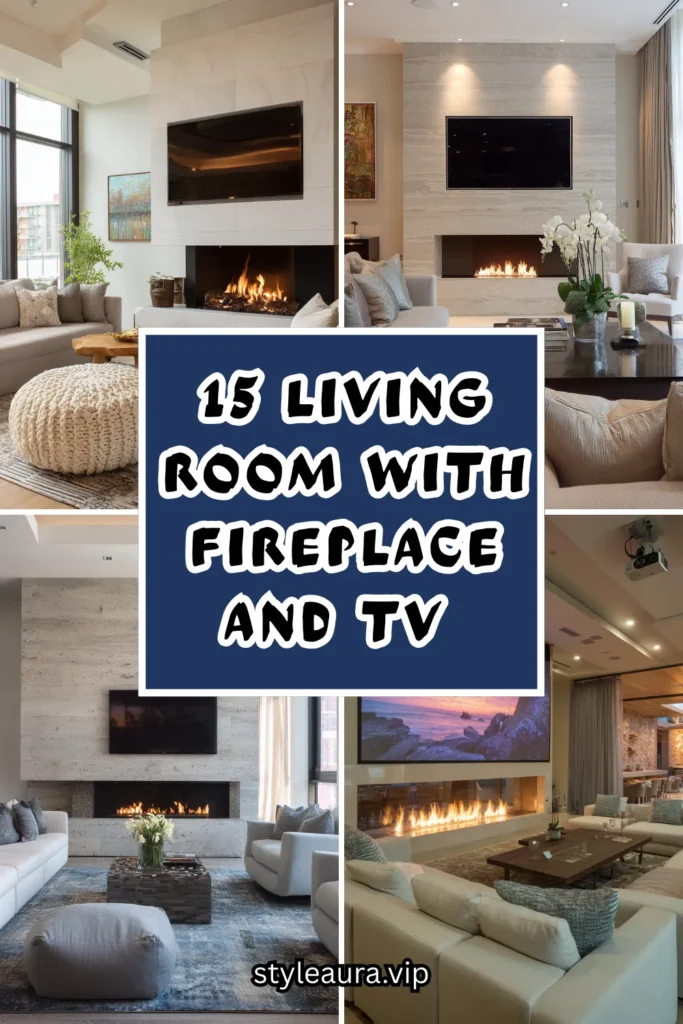
The good news is that the conflict between fireplace and television is entirely solvable. The solutions range from the architecturally ambitious to the pragmatically simple — and every living room configuration has a version of the solution.
Here are 15 living rooms with fireplace and TV ideas that resolve the focal point conflict beautifully.
1. Television Above the Fireplace
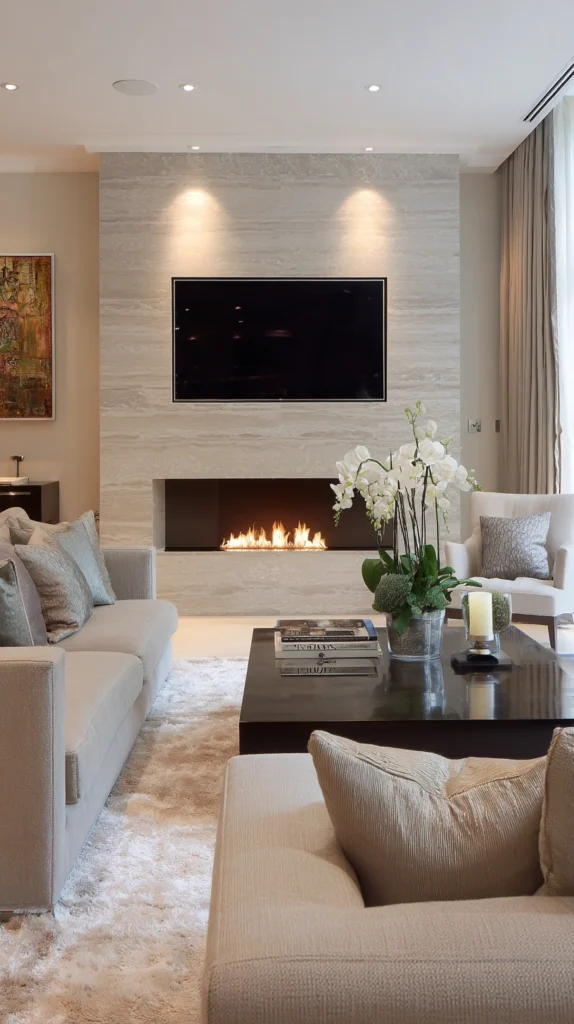
The most widely chosen arrangement — the television mounted directly above the fireplace on the chimney breast — is simultaneously the most space-efficient and the most ergonomically compromised solution.
The chimney breast provides a natural centered mounting surface that positions both focal points on the same wall. The problem is height — a television mounted above a fireplace is almost always too high for comfortable extended viewing and creates genuine neck strain during long viewing sessions.
Pro Tip: If mounting above the fireplace is the only practical option, install a full-motion articulating wall mount rather than a fixed mount — allowing the television to tilt downward toward the seated viewer’s eye level during use. A downward tilt of 10 to 15 degrees significantly reduces the neck strain of looking upward at an elevated screen.
2. Television on the Adjacent Wall
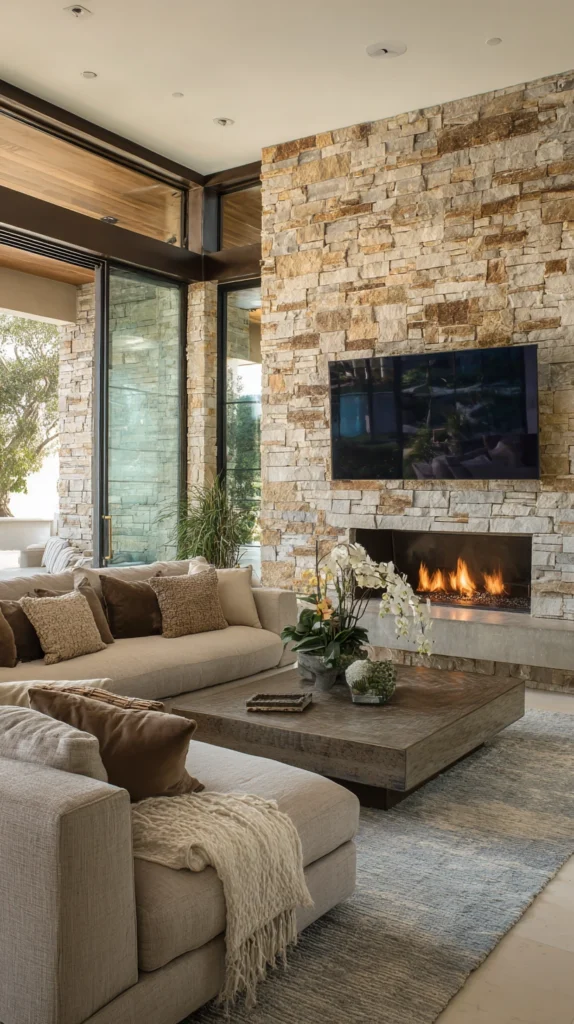
Positioning the television on the wall immediately adjacent to the fireplace at 90 degrees creates a living room with two separate focal points that the seating arrangement can serve simultaneously. The sofa placed at an angle to both walls, or a combination of a sofa facing the television and chairs turned toward the fireplace, accommodates both television watching and fireplace gathering without compromising either activity.
Pro Tip: Install the television on the adjacent wall at the correct viewing height — center of screen at seated eye level — rather than at the height dictated by available wall space or existing electrical outlets. The correct viewing height is non-negotiable for comfortable extended television use and repositioning outlets to the correct height is a modest investment relative to years of improved viewing comfort.
3. Built-In Alcove Television
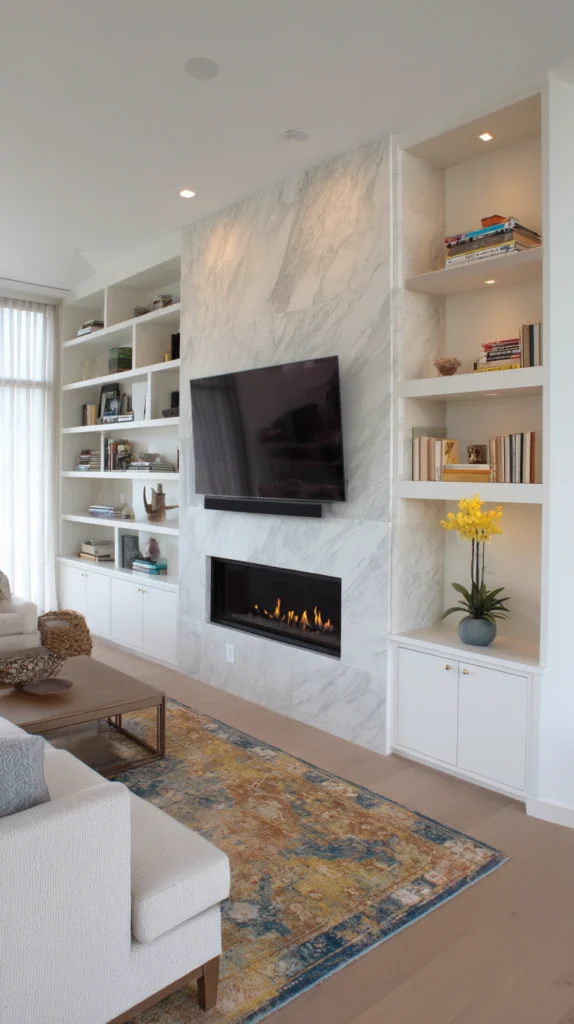
Building the television into a custom alcove unit — a floor-to-ceiling built-in shelving and storage system that incorporates a defined television recess at the correct viewing height — on one side of the chimney breast creates a living room of considerable architectural quality.
The chimney breast alcoves that flank most fireplaces are among the most valuable and most frequently underused architectural spaces in any living room. A well-designed built-in unit transforms them into genuinely beautiful and genuinely useful features.
Pro Tip: Recess the television into the built-in alcove unit by at least 5 to 8 centimetres so that the screen sits within rather than proud of the surrounding joinery. A television that projects forward of the surrounding unit looks like a screen placed in front of furniture rather than integrated within it — losing the architectural quality that makes the built-in alcove solution so visually beautiful.
4. Television Hidden in a Cabinet
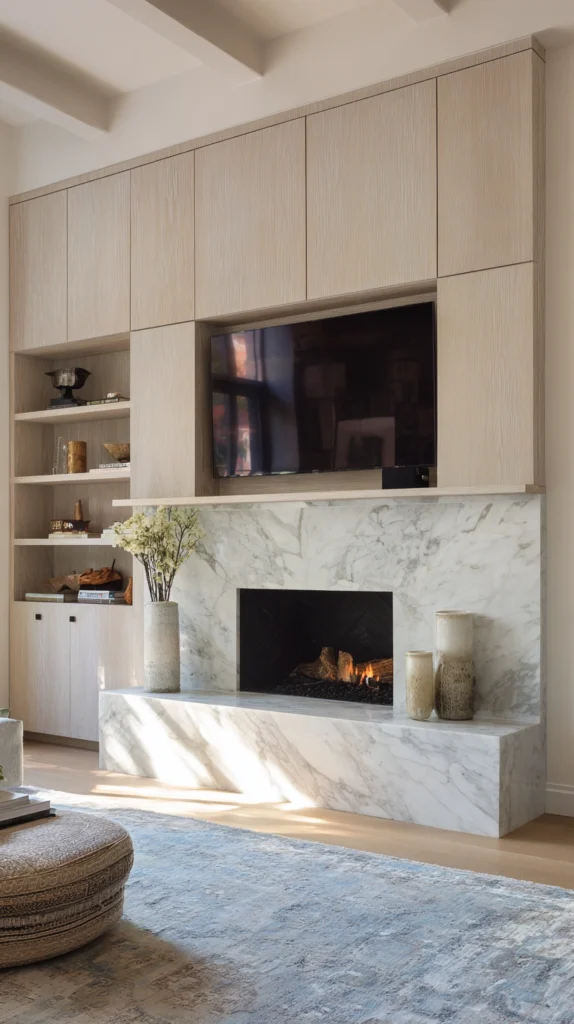
A television concealed within a custom cabinet — with doors that close to hide the screen completely when not in use — creates a living room that reads as a beautiful fireplace-centered room in its natural screen-free state. The cabinet doors present a decorative surface — painted panels, upholstered panels, or artwork panels — that contributes positively to the room’s aesthetics rather than presenting the dark reflective rectangle of an unused screen.
Pro Tip: Install push-to-open or soft-close door mechanisms on a television cabinet rather than conventional handles for a cleaner minimal door face. Handles on a television cabinet draw the eye toward the cabinet even when the television is not in use — undermining the visual resolution of the closed-cabinet solution and partially defeating the purpose of concealing the screen.
5. Media Wall with Integrated Fireplace
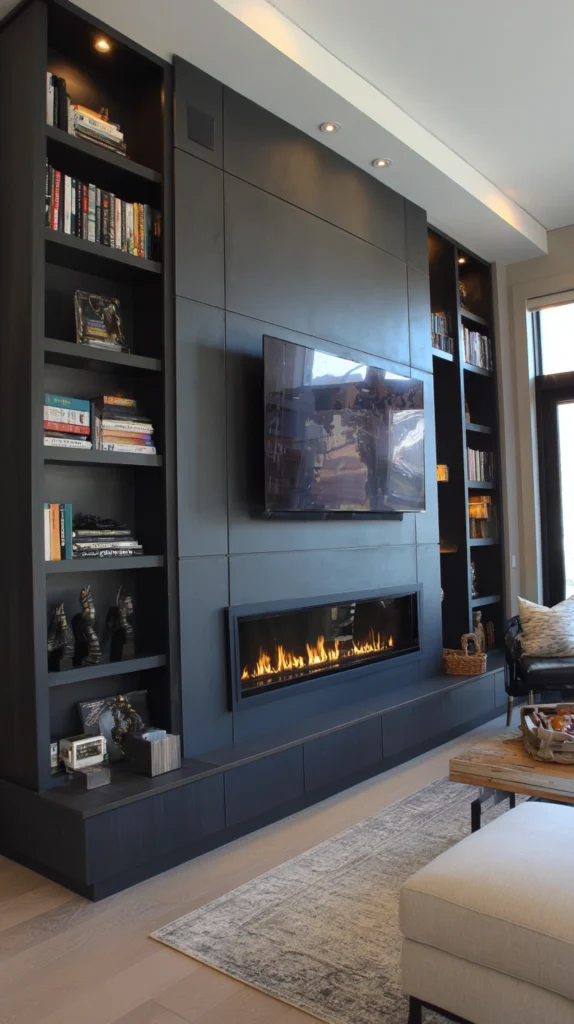
A full-width media wall — a custom built-in installation spanning the entire length of the primary living room wall incorporating both a fireplace and a television within a single architecturally unified composition — creates a focal wall of extraordinary scale and complete functional integration.
The media wall treats the fireplace and the television as equal complementary elements within a single designed composition rather than as competing focal points requiring resolution.
Pro Tip: Specify the media wall design with the television position at the correct viewing height before any other element of the composition is established. The correct viewing height is the non-negotiable starting point from which all other design decisions flow. A media wall designed around the aesthetic of the fireplace with the television position determined last almost always places the screen too high for comfortable extended viewing.
6. Projector Screen Instead of Television
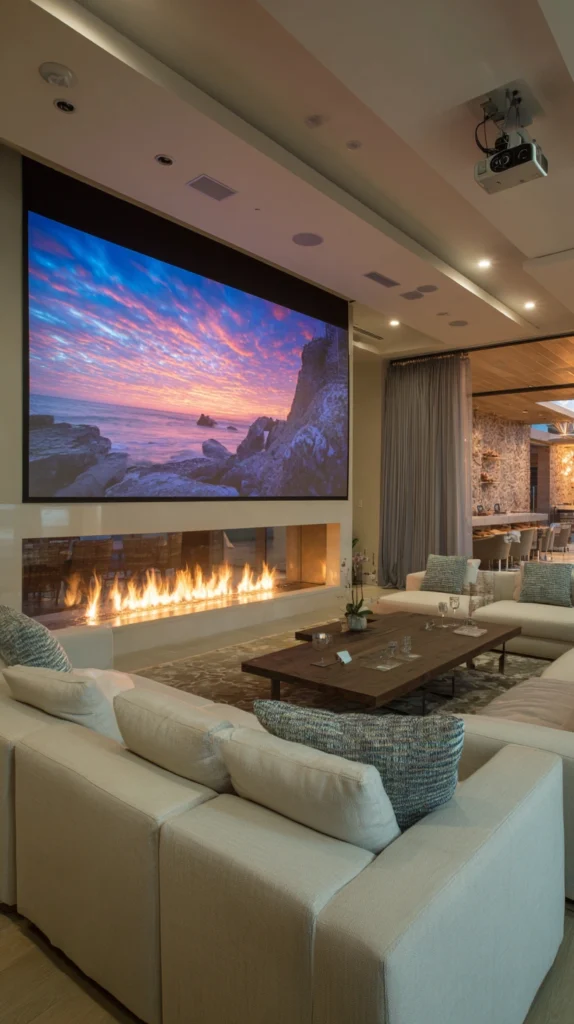
Replacing the conventional television with a ceiling-mounted projector and a retractable screen creates a living room that reads as an entirely fireplace-centered room in its natural state. When the screen is retracted no television rectangle is visible anywhere in the room. When the screen descends the living room transforms into a cinema-quality viewing environment with a screen size that no wall-mounted television can match.
Pro Tip: Choose a short-throw or ultra-short-throw projector for a living room installation where ceiling-to-screen distance is limited. Standard throw projectors require considerable ceiling distance to produce a large image. Short-throw projectors produce large bright images from significantly shorter distances — making ceiling-mounted projector installations practical in rooms of standard ceiling height.
7. Electric Fireplace Below a Television
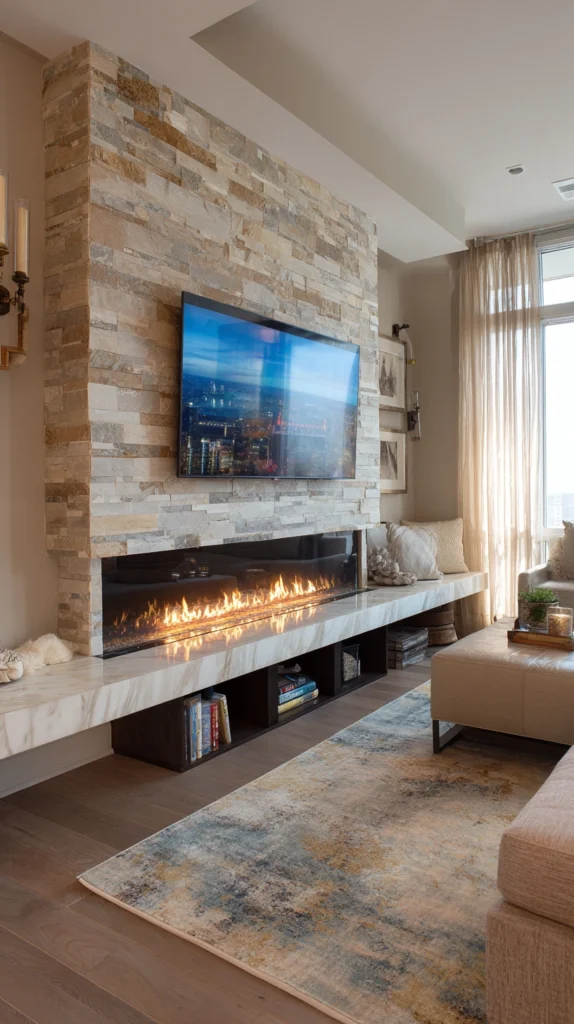
An electric fireplace installed within a custom base unit beneath a wall-mounted television creates a configuration that combines both focal points in a vertically stacked arrangement at the correct height for both fire viewing and television viewing simultaneously. The base unit containing the electric fireplace also provides a practical plinth for the wall-mounted television above it and storage for media equipment and cables.
Pro Tip: Choose an electric fireplace with a high-quality flame effect that replicates the three-dimensional movement and color variation of a genuine wood fire rather than a simple repeated animation loop. The quality of the flame effect is the single most important factor in the credibility and visual pleasure of an electric fireplace installation.
8. Gallery Wall Television Integration
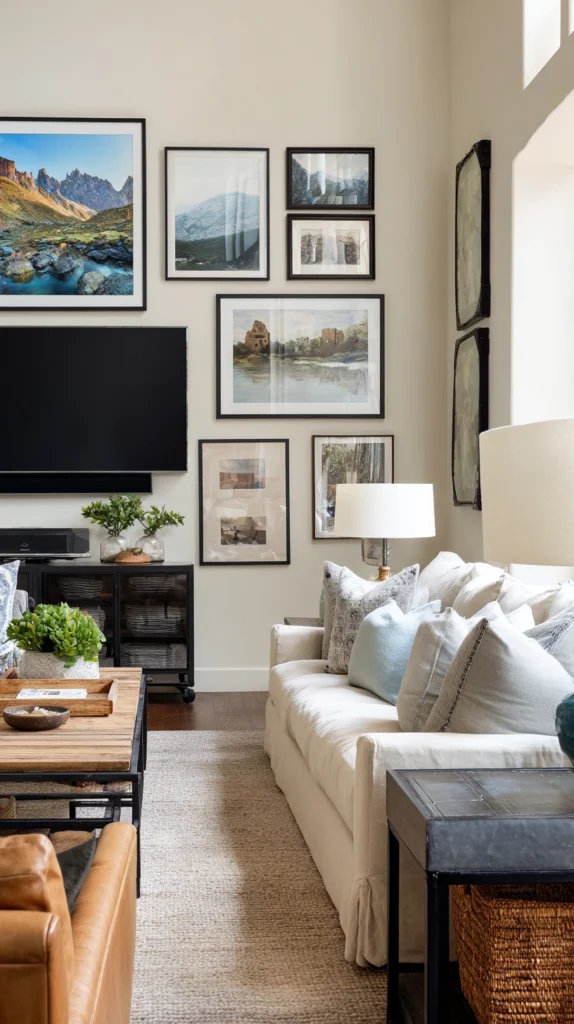
A television integrated into a gallery wall — surrounded by framed artwork, mirrors, and decorative objects arranged in a salon-style hanging composition — creates a living room where the screen is visually absorbed into a larger decorative composition rather than dominating the wall as a single isolated rectangle.
Gallery frames in a single consistent finish — all black, all brass, or all dark timber — create the visual coherence that makes the mixed composition read as a unified deliberate arrangement.
Pro Tip: Use a television with an ambient or gallery mode — displaying artwork or ambient visuals when not actively used for viewing — for a gallery wall integration where the screen continues to contribute to the decorative composition even when switched off from conventional viewing. Samsung Frame televisions and similar gallery-mode TVs display artwork at matched ambient brightness making the screen visually indistinguishable from a framed print.
9. Corner Fireplace with Television on the Opposite Wall
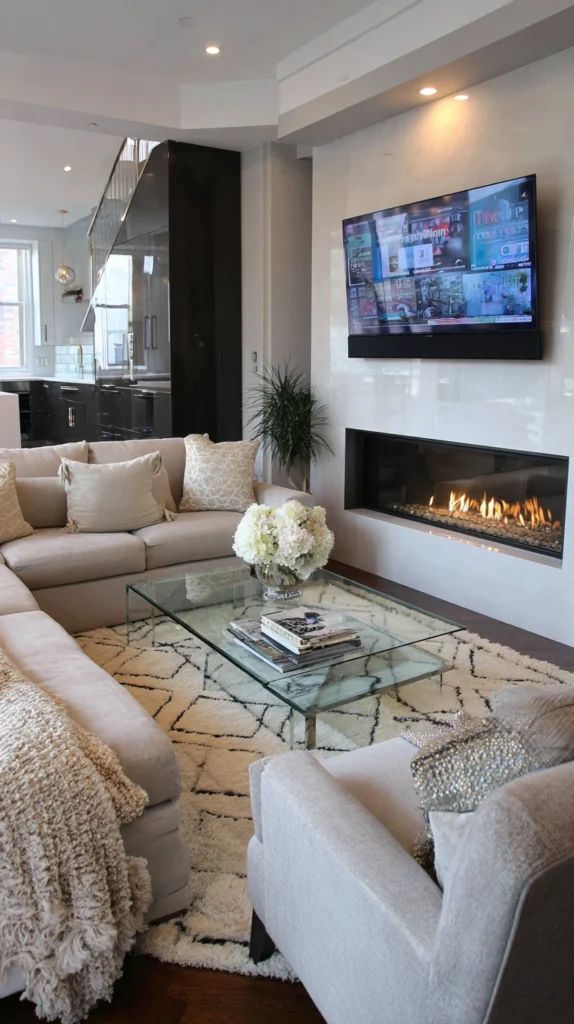
A corner fireplace — positioned diagonally in one corner of the living room rather than centered on a wall — creates a room configuration where the fireplace and the television are naturally separated on different wall surfaces without any architectural compromise. The seating arrangement faces the corner fireplace from a diagonal position with the television positioned on the opposite wall and visible from the same seating without any physical reorientation.
Pro Tip: Position the corner fireplace seating arrangement so that the primary sofa faces the fireplace corner at 45 degrees — with the two flanking walls containing the fireplace and the television respectively visible from the sofa ends. This diagonal seating position provides the most comfortable simultaneous sightlines to both focal points without requiring the seated viewer to turn more than 45 degrees in either direction.
10. Television Mounted on a Swivel Arm
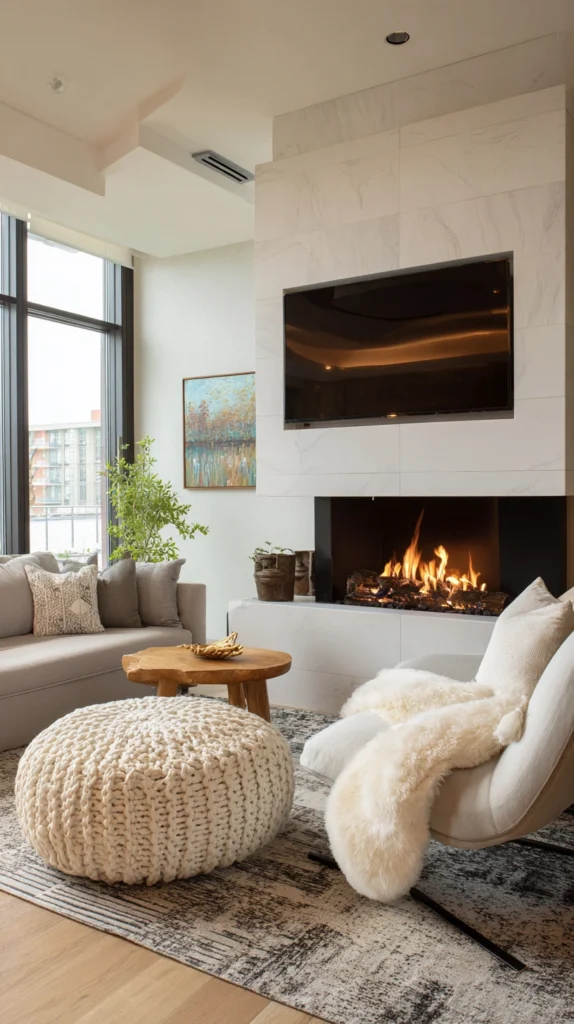
A television mounted on a heavy-duty swivel arm — extending from the wall and capable of rotating the screen through 180 degrees — creates the most flexible fireplace and television arrangement available. The swivel arm allows the television to be positioned toward the seating for viewing, swung away when the fire is the primary focus, and retracted flat against the wall when neither is in use — a single installation serving multiple room configurations without any furniture rearrangement.
Pro Tip: Choose a swivel arm with a weight rating at least double the actual television weight for an arm that operates smoothly, holds its position reliably, and maintains its mechanical integrity through years of regular movement. An arm rated at exactly the television weight operates under full stress loading with every use — the bearings and friction mechanisms deteriorating correspondingly faster than an arm rated at double the actual load.
11. Two-Sided Fireplace Between Rooms
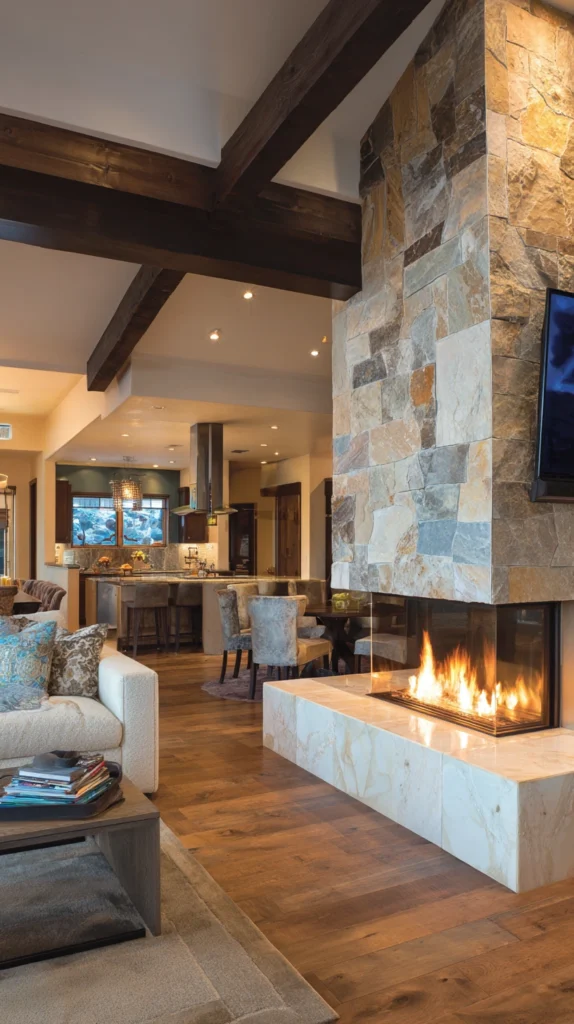
A two-sided fireplace installed in the wall between the living room and an adjacent dining room or kitchen creates a living room configuration where the fireplace occupies an interior wall rather than an exterior chimney breast — freeing the primary television wall from competition with the fire. The two-sided fireplace provides warmth and visual connection between rooms while the television occupies the primary end wall without any competition from the fireplace on the same wall.
Pro Tip: Specify a two-sided fireplace with individual damper controls for each face. A two-sided fireplace without independent face controls creates draught and combustion challenges — the fire draws air from both rooms simultaneously and the combustion dynamics are significantly more complex than a single-face fire. Individual damper controls for each face manage these dynamics effectively.
12. Fireplace Nook with Separate Television Zone
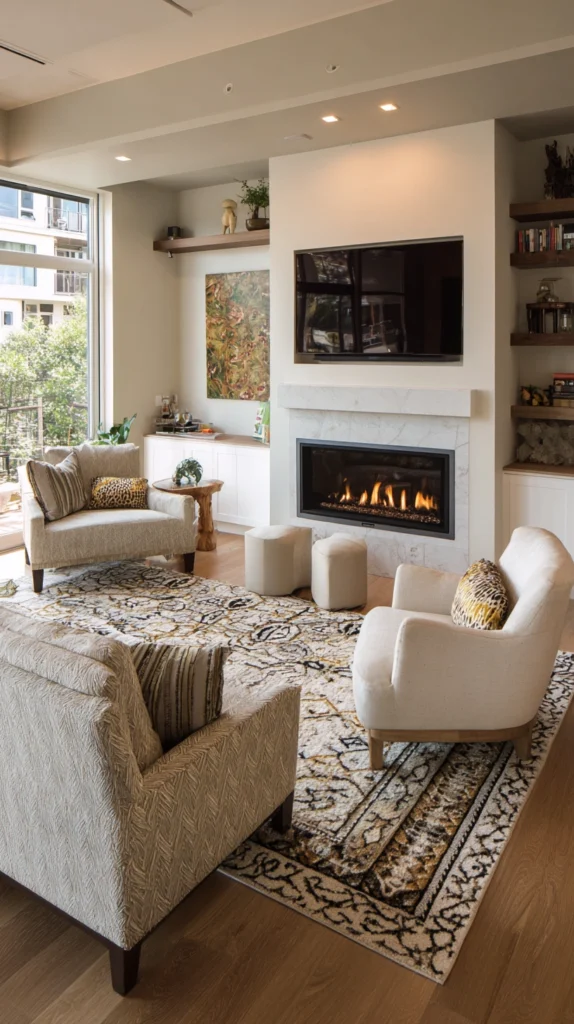
Creating a dedicated fireplace nook — a defined seating area of two or three chairs arranged closely around the fireplace — with the television positioned in a completely separate zone of the larger room creates a living room that functions as two distinct activity spaces within a single room. The fireplace nook provides intimate fire-centered seating. The television zone provides a properly configured viewing environment with appropriate seating, screen height, and viewing distance.
Pro Tip: Define the fireplace nook zone with a rug sized precisely for the nook seating arrangement — encompassing all the chairs with generous margin on all sides. The rug creates the visual and psychological boundary of the nook zone without any physical division. A nook seating arrangement without a defining rug reads as furniture placed near the fireplace rather than as a deliberately configured intimate seating zone.
13. Landscape Television Above a Wide Low Fireplace
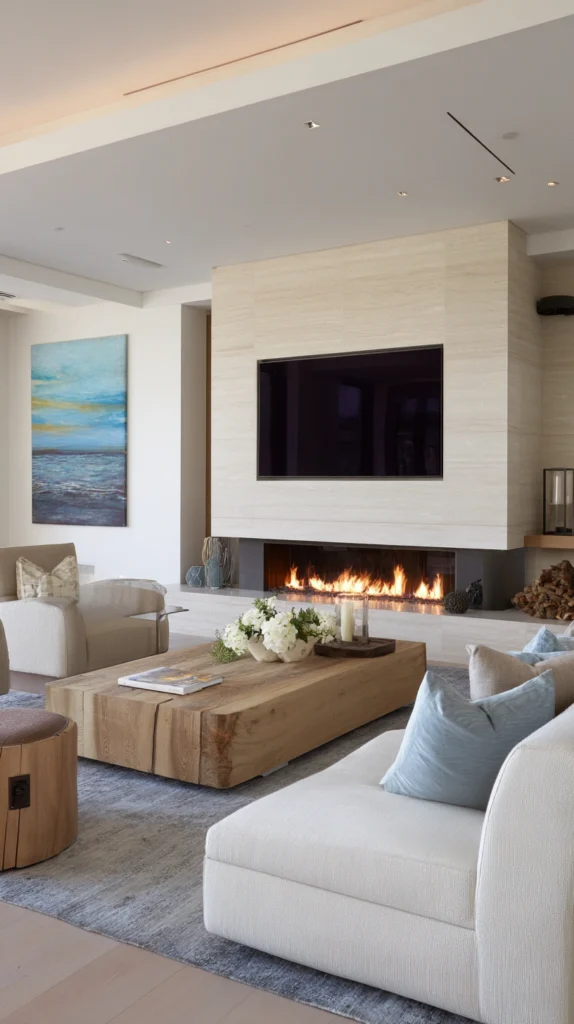
A wide low horizontal fireplace — a landscape-format fire opening significantly wider than it is tall — with a television mounted directly above it creates a configuration where the proportions of the fire and the screen are genuinely complementary. The wide horizontal fire opening mirrors the wide horizontal format of a large screen television above it — the two rectangles relating to each other proportionally in a way that creates a composed considered composition rather than visual competition.
Pro Tip: Maintain a minimum of 20 centimetres of non-combustible wall surface between the top of the fireplace surround and the bottom of the wall-mounted television. Consult the specific fireplace manufacturer’s installation guidelines for the minimum clearance requirements of the specific model — fire opening to combustible material distances vary between fireplace designs and the manufacturer’s specification is the authoritative reference for safe installation.
14. Frameless Television Above a Frameless Fireplace
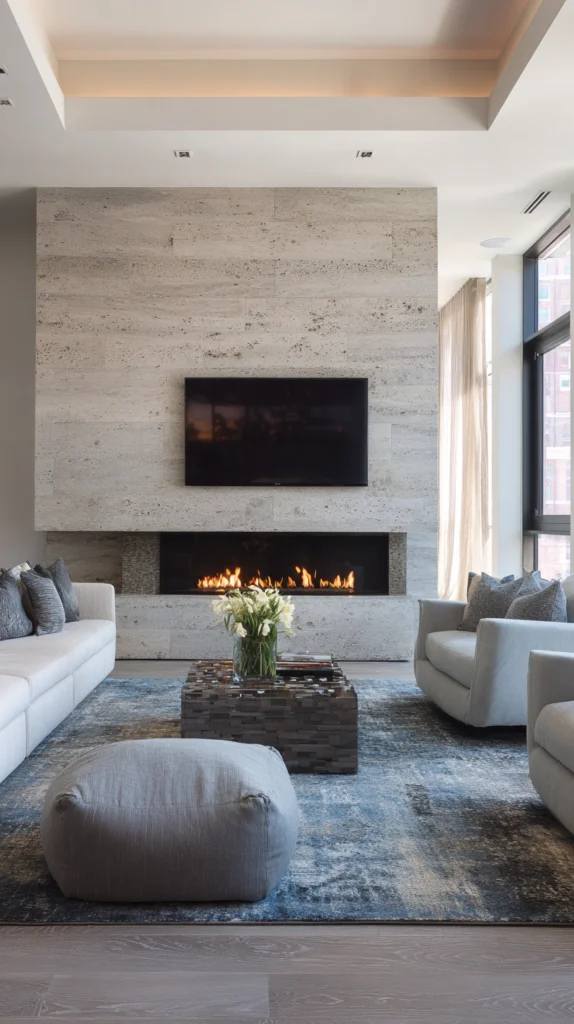
A frameless edge-to-edge television mounted above a frameless minimal fireplace surround creates a focal wall of maximum graphic simplicity and contemporary design confidence. The near-invisible frames of both the television and the fireplace surround eliminate the visual complexity of bordered rectangles stacked on a wall and create a composition of pure clean horizontal planes — the fire opening below and the screen above, both defined by their content rather than their frames.
Pro Tip: Conceal all television cables and media equipment connections within the wall between the television mounting position and the media equipment storage location. Exposed cables descending from a frameless television undermine the clean visual statement of the frameless installation more severely than they would beneath a framed television — the minimal aesthetic depends entirely on the complete absence of any visual interruption to the clean wall plane.
15. Fireplace and Television Separated by a Room Divider
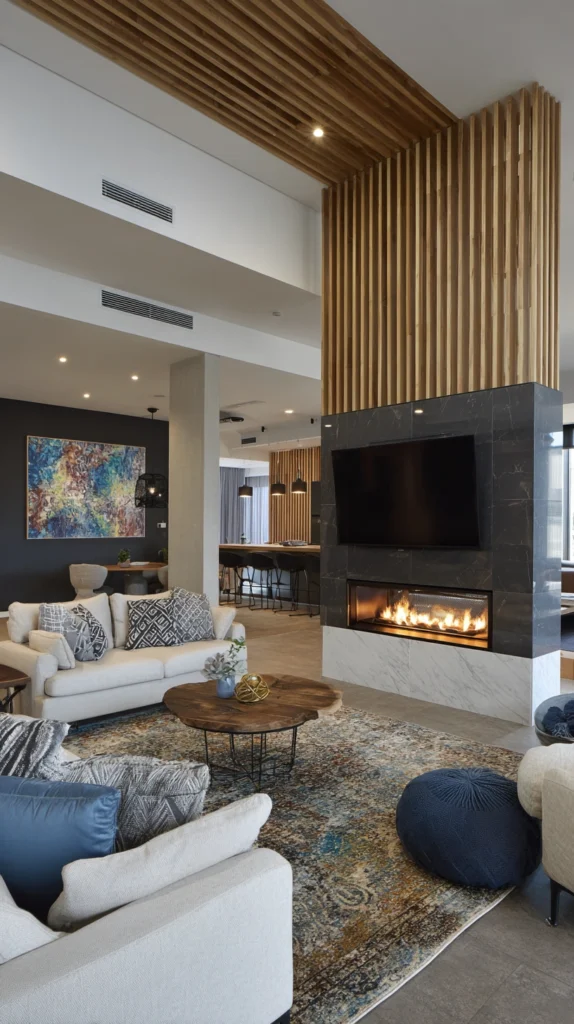
A room divider — a partial height bookshelf, a slatted timber screen, or a custom joinery panel — positioned between the fireplace zone and the television zone of a larger living room creates a visual and psychological separation between the two focal points without physically dividing the space into two entirely separate rooms. The divider defines each zone without enclosing it — maintaining the open quality of the larger living room while resolving the competition between the two focal points.
Pro Tip: Design the room divider at a height that maintains sightlines across the top of the divider from the seating on either side — typically no higher than 150 to 160 centimetres for a divider that defines zones without creating a genuinely enclosed room.
A divider that is too tall creates two enclosed rooms rather than two defined zones within a single open living space — losing the spatial generosity and the visual connection between zones that makes the open plan living room so appealing.
Both Can Win
The fireplace and the television are not natural enemies — they are two different expressions of the same human need for a focal point and a gathering center. The living room designed to accommodate both with genuine intelligence creates a space that serves every occasion — the quiet evening by the fire, the film night with the family, the gathering that naturally finds its center in a room that is warm, beautiful, and completely alive.