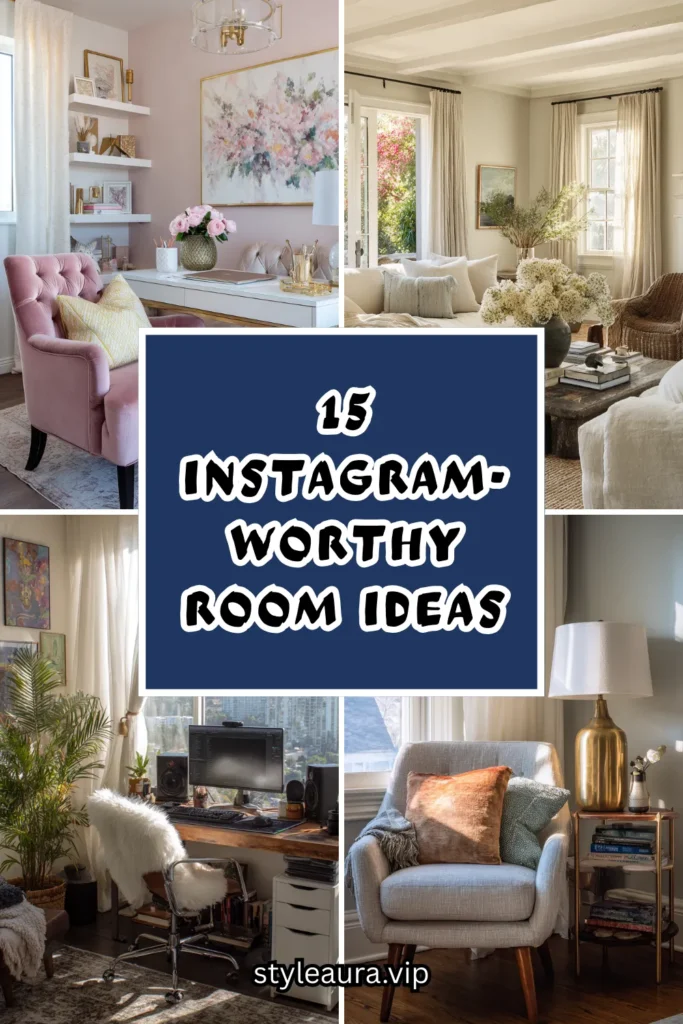
15 Instagram-Worthy Room Ideas for Content Creators
The content creator’s room operates under a dual mandate that most interior design does not have to satisfy simultaneously.
It must be genuinely pleasant to live in — comfortable, functional, personally meaningful, a space that supports the creative work and the daily life of the person who occupies it — and it must also perform on camera, which is an entirely different set of requirements involving background interest, lighting quality, color consistency, and the specific visual language that reads well in the compressed, scrolled-past format of a social media feed.
These two mandates are not in conflict — the best content creator rooms satisfy both completely — but they do require a more deliberate and more technically informed approach to room design than purely personal decoration demands.
The room that is beautiful to live in but visually flat on camera, and the room that photographs spectacularly but is actually uncomfortable and poorly organized for daily use, are both failures by the standards this guide applies.
What follows is a set of fifteen room ideas that achieve both mandates simultaneously — spaces that are genuinely good to be in and genuinely excellent to film in, designed with equal care for the person who inhabits them and the audience who will see them through a lens. Here are fifteen ideas for creating a room that works as hard for your content as it does for your life.
1. Build a Signature Background Wall
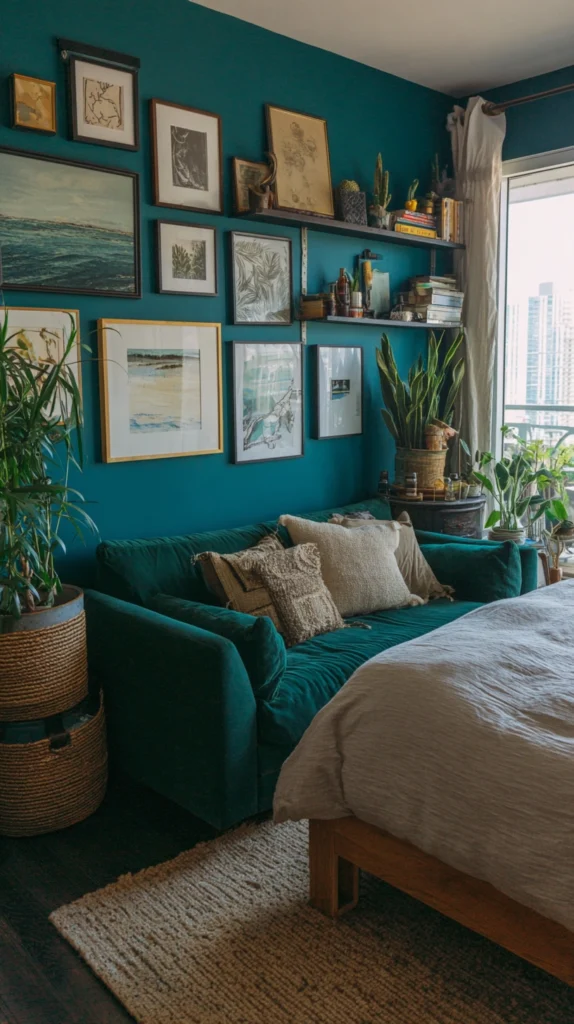
The single most impactful investment a content creator can make in their room’s camera performance is the creation of a signature background wall — a deliberately designed surface that is immediately recognizable as belonging to a specific creator, that provides visual interest and context to every piece of content filmed in front of it, and that communicates through its design the aesthetic values and personality of the person who created it.
The background wall does not need to be elaborate — some of the most effective are remarkably simple — but it needs to be genuinely considered: a specific color chosen for how it reads on camera rather than only how it looks in person, a surface texture that creates depth and shadow in flat lighting, and a visual composition that remains interesting in the background of a talking-head video without competing with the speaker in the foreground.
A large-scale gallery wall with a consistent frame palette, a custom mural in a signature color, a floor-to-ceiling bookcase dressed with deliberate care, or a simple rendered wall in a distinctive tone with a few well-chosen objects — each creates a background of genuine visual authority. Film test footage before committing to a permanent wall treatment and review it on the devices your audience uses to watch your content.
2. Invest in a Window Light Setup
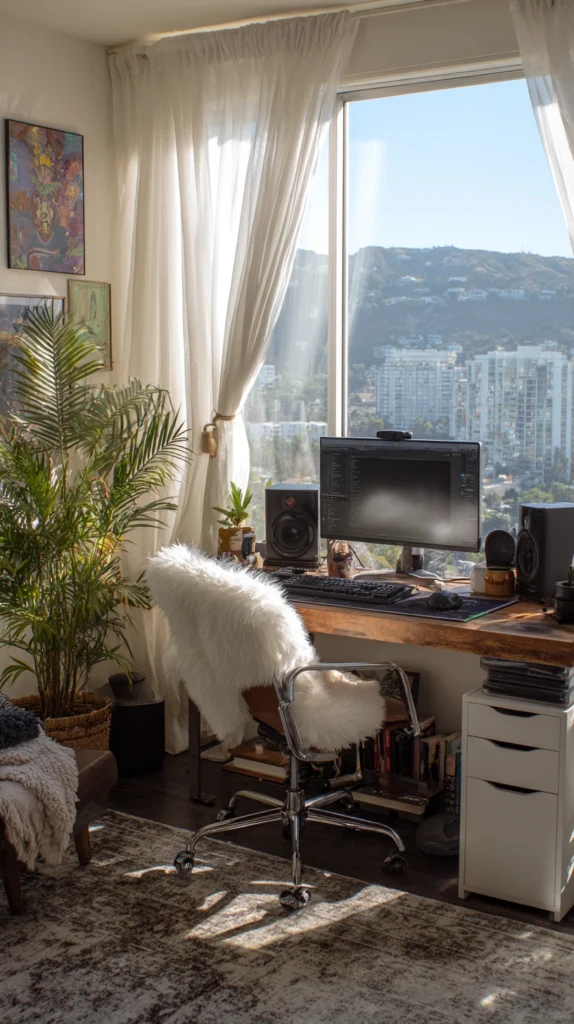
Natural light from a window positioned correctly relative to the camera is the most beautiful, most flattering, and most cost-free lighting upgrade available to any content creator, and understanding how to use it properly is the single most accessible technical improvement that can be made to the room’s content performance.
The window should be to the side of the filming position rather than behind it — a window behind the camera subject creates a silhouette effect that is technically difficult to correct in editing, while a window to the side creates the directional, shadow-defining light that makes faces look three-dimensional and interesting.
A sheer white curtain diffuses direct sunlight into a soft, even illumination that is more flattering than the harsh direct light of unfiltered sun and more consistent through the day as cloud cover changes.
Organize the room’s filming position so that the window is always to the same side for every piece of content — this consistency creates a recognizable lighting signature that audiences associate with your channel even before they consciously register the light quality.
3. Create a Curated Bookcase Background
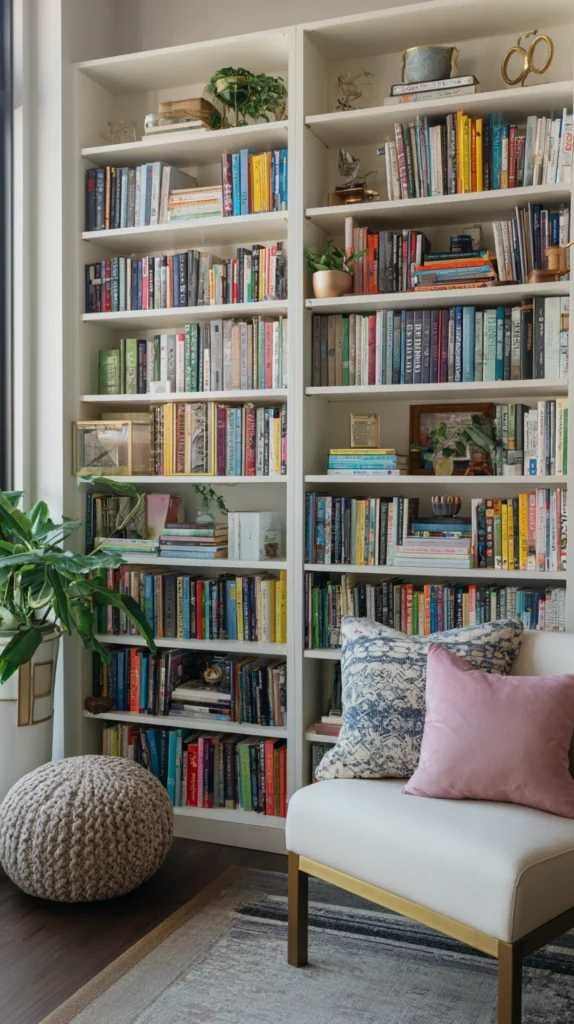
The bookcase background is one of the most universally credible, most universally interesting, and most adaptable content creation backgrounds available, because it communicates intellectual engagement, personal taste, and the accumulated depth of a life spent learning and collecting in a way that no styled surface can manufacture.
A content creator’s bookcase background should be genuine — actual books that have been read, alongside objects of personal significance — but it should also be organized with camera performance in mind. Color-organize at least one section of the shelves so that the books create a deliberate chromatic composition rather than a random color field. Mix books with objects, plants, and small artworks to create visual variety at different depths within the shelf.
Ensure the bookcase is well-lit — a small LED panel directed at the bookcase from above or the side, or a strategically placed lamp beside it, ensures that the books read clearly in the background rather than disappearing into shadow. The depth of field of most camera setups will pleasantly blur the bookcase’s fine detail while maintaining its overall color and texture composition.
4. Design a Corner That Films from Multiple Angles
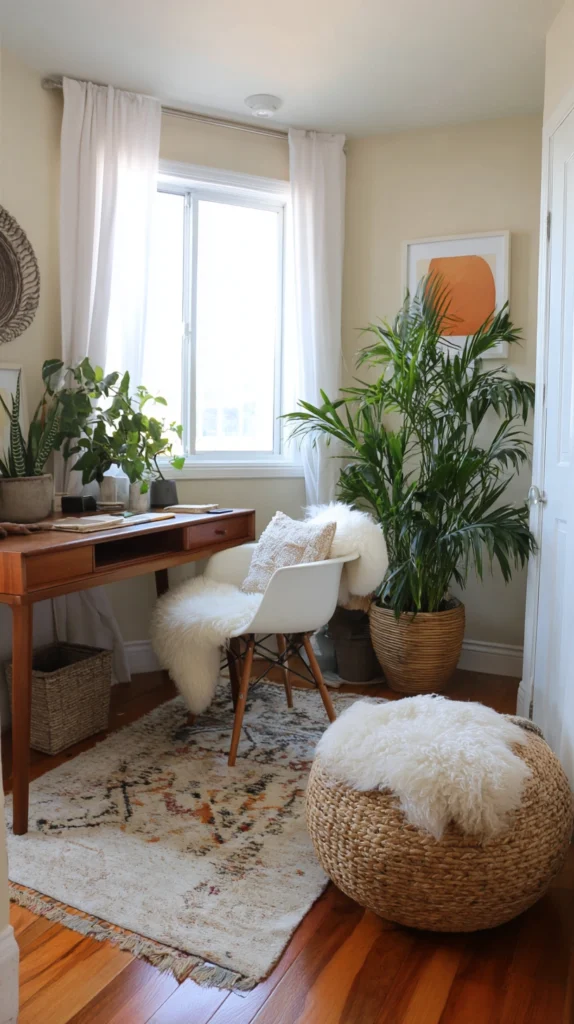
The content creator who films from multiple positions — sitting at a desk for tutorial content, standing for outfit reveals, lying on the floor for lifestyle content — benefits enormously from a room corner designed to be visually interesting from every angle within a ninety-degree arc.
A corner setup with a well-dressed desk on one wall, a seating arrangement on the adjacent wall, and consistent styling elements that appear in the background from every filming position within the corner — the same plants visible in slightly different configurations, the same color palette maintaining consistency across the two walls — creates a versatile filming environment that produces visually coherent content from multiple positions without requiring repositioning, redecorating, or significant lighting adjustment between different content types.
The two walls of the corner should be designed in the same aesthetic language but not identically — slight variation maintains the visual interest that consistency alone cannot provide.
5. Use a Consistent Color Palette Throughout
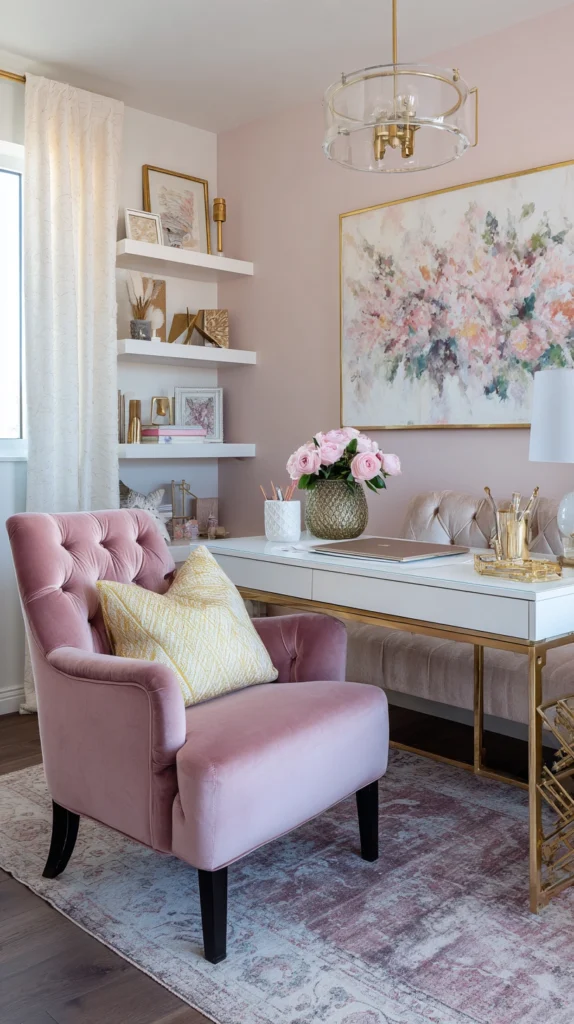
The room that is designed around a consistent, intentional color palette — three to four colors that recur throughout the space in different materials and applications — creates content with an immediately recognizable visual signature that audiences identify with a specific creator’s aesthetic.
The palette choice should reflect the creator’s content niche and personal brand as well as their genuine aesthetic preferences — a beauty creator might choose blush, cream, and gold; a sustainability creator might choose sage green, warm white, and natural timber tones; a design creator might choose a more complex palette of muted, sophisticated tones that communicate aesthetic authority.
Once the palette is established, it should be applied with genuine consistency: the same tones appearing in the wall color, the textile choices, the desk accessories, the planting, and the small objects that dress the room’s surfaces.
This palette consistency makes every piece of content filmed in the room visually coherent with every other piece, creating the feed aesthetic that is one of the most effective tools for audience retention and recognition.
6. Create a Dedicated Flat Lay and Product Photography Surface
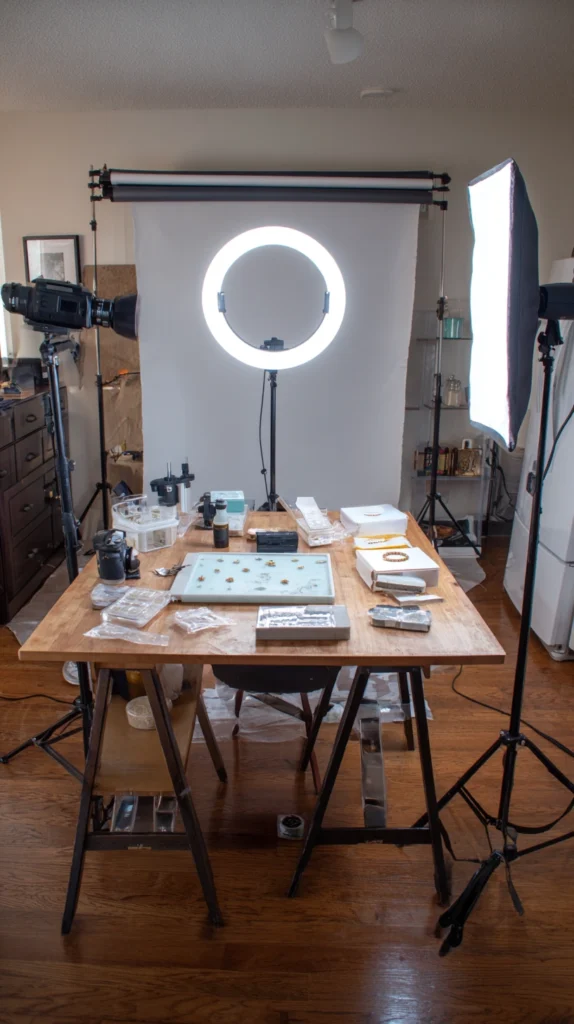
The flat lay — the top-down photograph of arranged objects on a surface, ubiquitous in lifestyle, beauty, fashion, and food content — requires a specific surface setup that most content creator rooms fail to provide adequately.
A dedicated flat lay surface — a section of desktop, a small table, or a pull-out surface at a consistent height — with interchangeable backgrounds stored within reach creates a flat lay station that is always ready for use without the disruption of clearing and preparing an ad hoc surface.
Background options for a versatile flat lay station should include a light surface for dark objects, a dark surface for light objects, a textured surface for lifestyle content, and a smooth surface for product photography.
Good overhead light — a ring light positioned directly above the flat lay surface, or a window with consistent daylight above — is the lighting requirement, and a small overhead arm or stand that keeps the camera directly above the surface is the equipment requirement.
The flat lay station should be positioned within the room’s overall aesthetic composition rather than being an isolated functional corner.
7. Incorporate Mood Lighting for Evening Content
The content creator who films only in daylight is limiting their content schedule to the hours when natural light is available, which in winter months in northern latitudes may be a very narrow window indeed.
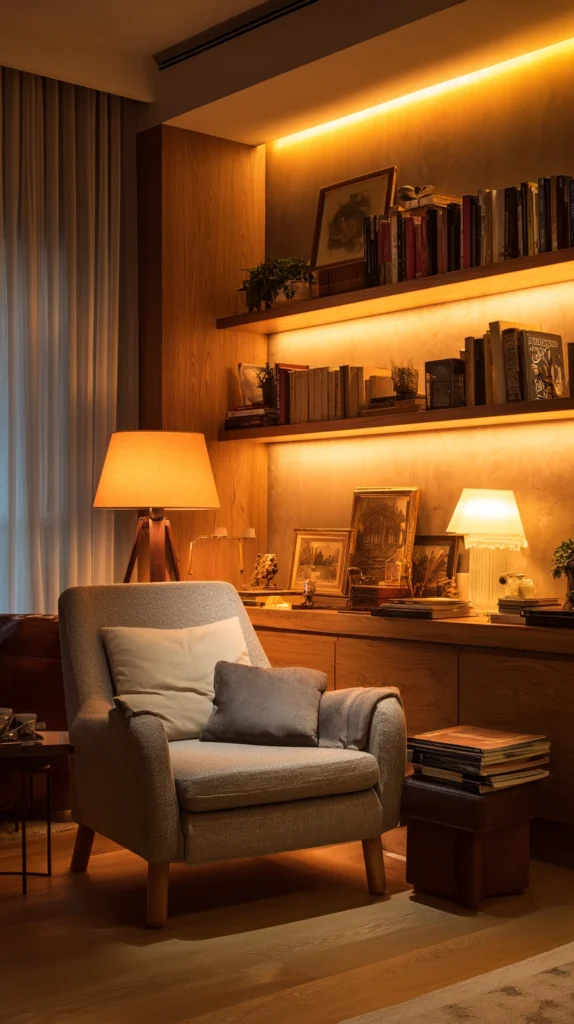
A mood lighting setup that allows the room to be filmed in warm, beautiful artificial light creates the ability to produce evening content — the after-dark aesthetic that has its own specific visual language of warm amber light, intimate atmosphere, and the visible comfort of a well-lit room at night.
A combination of warm-toned LED strip lighting concealed behind furniture or shelving, table lamps with warm bulbs at 2700K, and a ring light or key light for face illumination creates an evening room that is both genuinely beautiful to be in and genuinely beautiful on camera. Dimmer controls on all light sources allow the room’s evening atmosphere to be adjusted from the cozy-intimate to the well-lit-practical depending on the content being produced.
8. Build a Plant Wall or Corner for Organic Texture
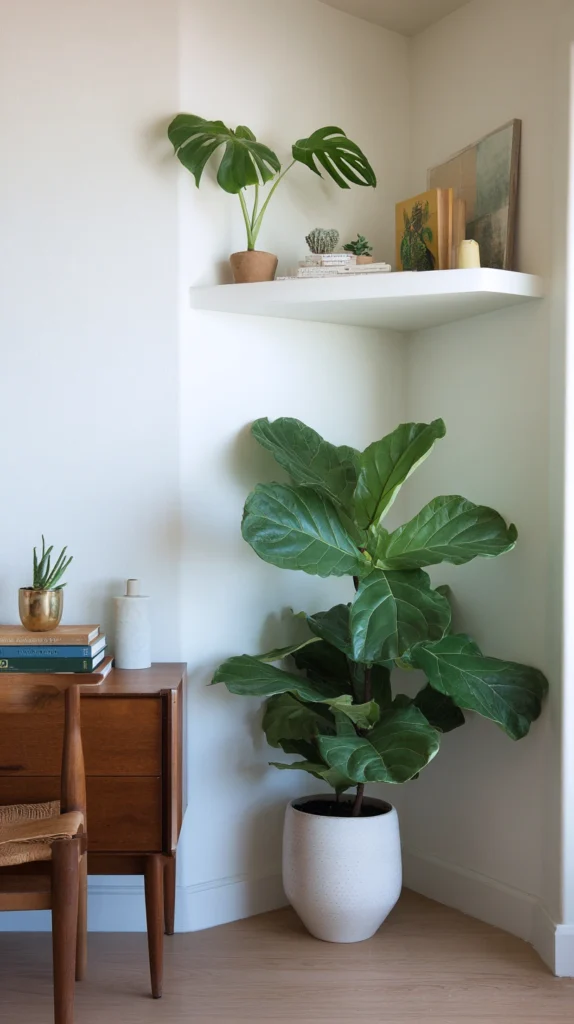
Plant material is one of the most universally positive additions to a content creator’s room background, because it introduces organic texture, natural color variation, and the visual suggestion of care and living environment that audiences respond to with consistent positivity across virtually every content niche.
A plant wall — a systematic arrangement of plants on wall-mounted shelves, in hanging pots, or on a purpose-built vertical planter structure — creates a background of extraordinary organic richness that no styled surface can replicate.
For content purposes, choose plants with interesting leaf forms and textures that read well on camera: large-leaved monsteras and fiddle-leaf figs for scale and drama, trailing pothos and string of pearls for cascading texture, and a selection of smaller plants for density and variety.
Maintain the plants carefully — a dying or yellowing plant in a content background is immediately noticed by audiences and undermines the aesthetic of the entire composition. Position a grow light behind or above the plant arrangement if the room’s natural light is insufficient for healthy growth.
9. Design a Vanity Corner That Doubles as a Filming Set
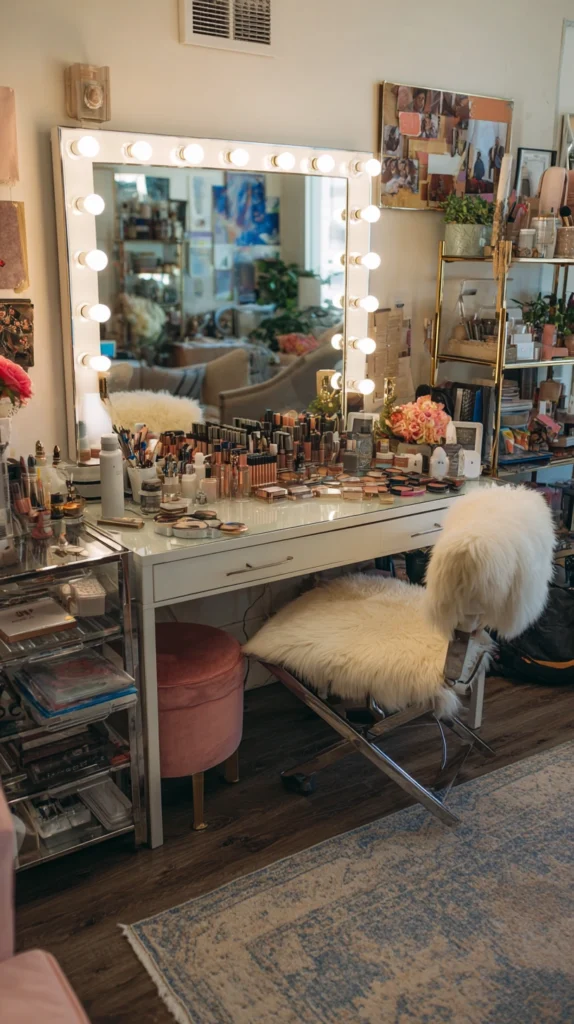
For beauty, lifestyle, and personal care content creators, the vanity corner is both the functional workspace and the primary filming location, and designing it to serve both purposes simultaneously creates the most efficient and most authentic content environment available.
A well-designed content creator vanity has the Hollywood mirror or backlit mirror that provides the excellent face illumination that beauty content requires, a surface large enough to display the products being discussed while leaving space for filming at the front, and a background visible over the creator’s shoulder that is styled with deliberate care — the visible section of room behind a beauty creator communicates as much about their aesthetic as the content being created in front of the camera.
Keep the vanity background consistently styled and change it only seasonally or deliberately, so that returning audiences have a visual orientation point that makes each new video feel familiar and comfortable before it begins.
10. Create a Reading or Lifestyle Nook
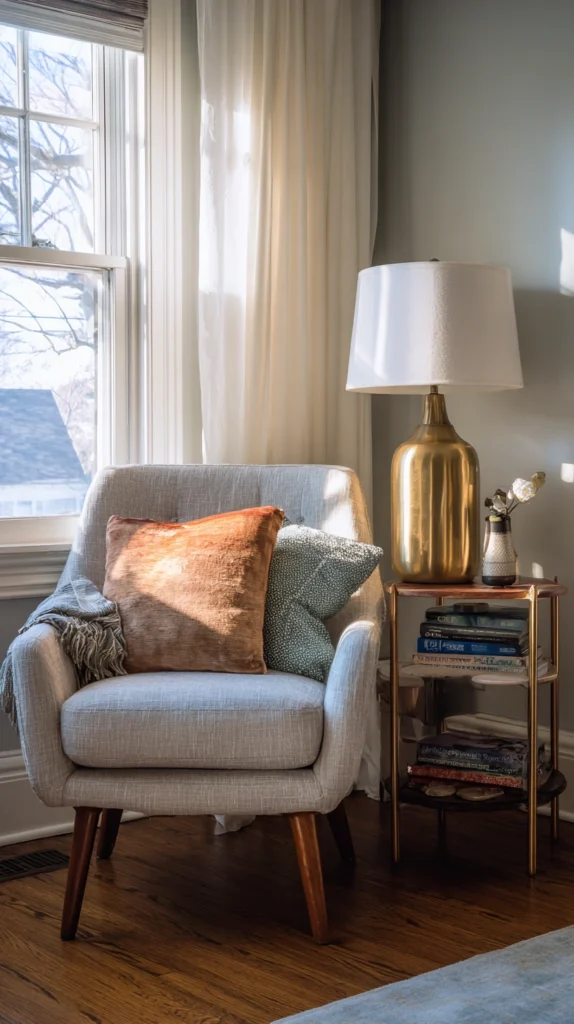
The lifestyle nook — an armchair or floor cushion arrangement in a well-dressed corner, with a side table, a lamp, and a carefully chosen selection of books and objects within the visible frame — creates a versatile filming position for the content types that are most intimate and most personal: reading recommendations, morning routine content, reflective or conversational videos, and the lifestyle content that forms the backbone of many creators’ channels.
The nook should feel genuinely cozy and genuinely personal — not staged, but styled, which is a meaningful distinction — and it should be lit with the warm, directional quality of a good floor or table lamp rather than the flat, undifferentiated light of overhead illumination. A window nearby provides natural light supplementation during daytime filming.
The nook’s background — the two walls of the corner, the shelving or planting visible above and behind the seated position — should be as carefully composed as any other filming background in the room.
11. Use Mirrors Strategically for Depth and Light
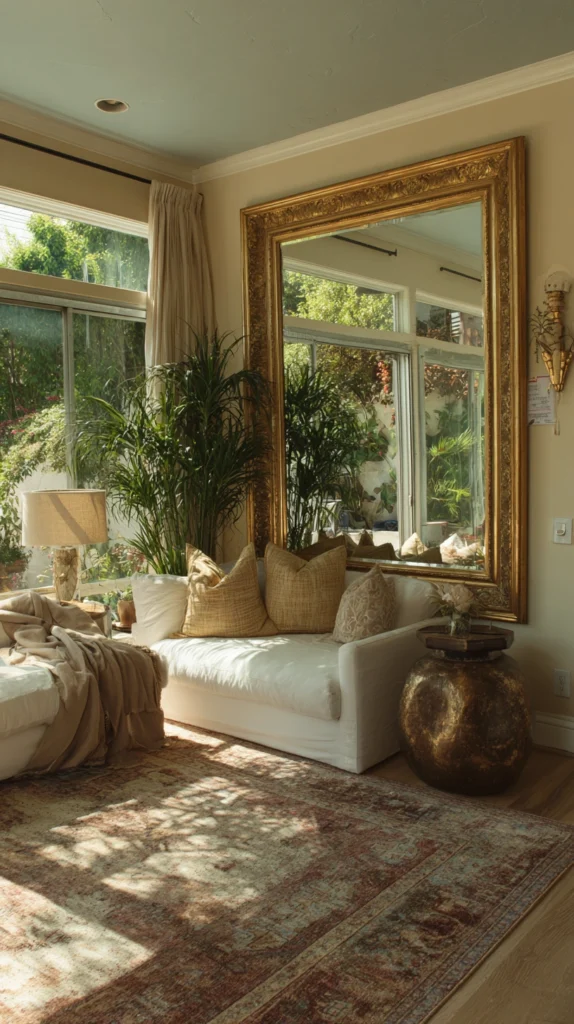
Mirrors are one of the content creator’s most versatile room tools, serving simultaneously as practical functional objects, as light amplifiers that improve the room’s natural illumination, and as visual depth creators that make small rooms appear significantly larger on camera.
A large mirror positioned on the wall opposite the primary window reflects the window’s light back across the room, doubling the effective natural light available to the filming position without any additional equipment.
A mirror positioned partially in frame behind the filming position creates the impression of spatial depth — the reflected room visible in the mirror extends the visual field beyond the actual room’s boundaries. A full-length mirror in the lifestyle or outfit-filming corner is an absolute functional necessity for fashion and lifestyle creators.
Choose mirror frames that suit the room’s aesthetic and are sufficiently interesting to add visual value to the content background — a beautiful vintage mirror frame in the background of a talking-head video contributes more to the background’s composition than a plain frameless mirror of equivalent size.
12. Design a Desk Setup That Performs and Functions
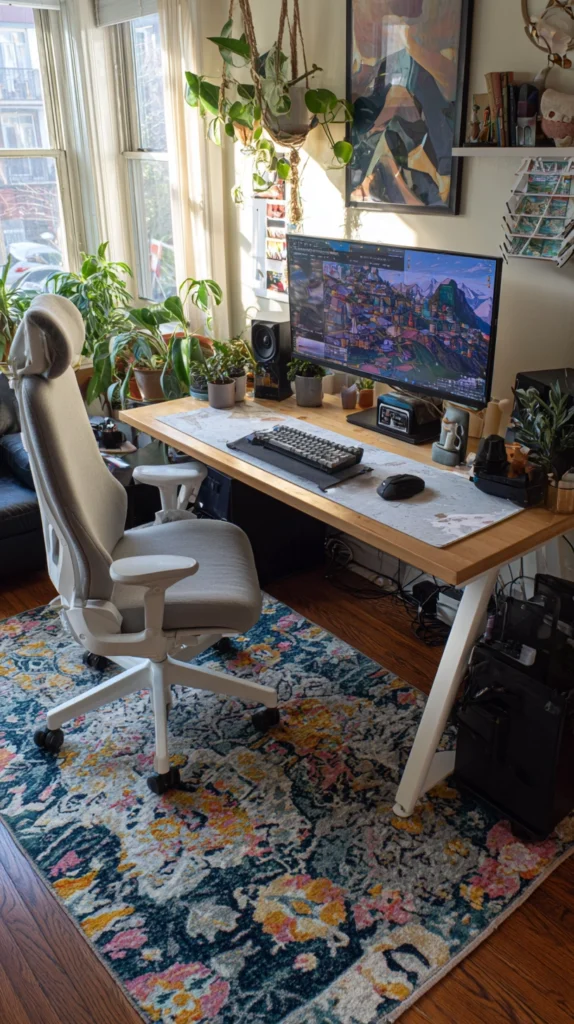
The desk setup is the content creator’s most-filmed and most-scrutinized room element, because tech, gaming, study, and productivity content all center on the desk as both the work environment and the filming location.
A content creator desk should satisfy three requirements simultaneously: it should be genuinely ergonomic and functional for the work being done at it, it should be visually interesting and aesthetically consistent with the room’s overall palette, and it should be organized in a way that communicates the creator’s specific aesthetic values — whether that is the clean, minimal desk of the productivity creator, the warm, plant-filled desk of the lifestyle creator, or the tech-forward setup of the gaming or coding creator.
Cable management is non-negotiable — the content creator desk with visible cable chaos undermines every other aesthetic effort in the room regardless of how well everything else is executed.
A quality desk mat in a material that suits the aesthetic — leather, wool felt, cork — unifies the desk surface visually and provides the clean base layer from which everything else on the desk is styled.
13. Invest in Acoustic Treatment That Looks Intentional
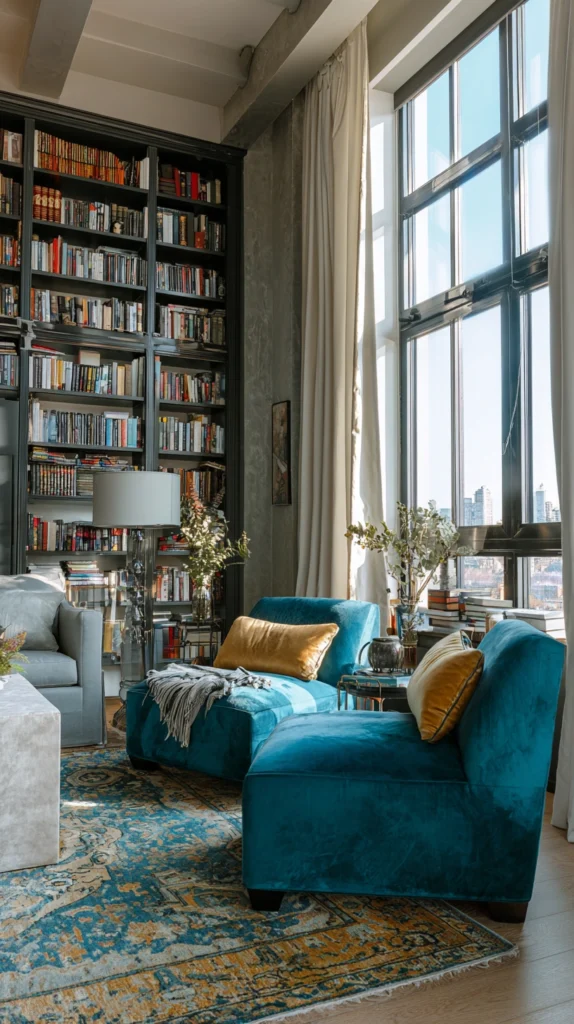
The acoustic quality of a content creator’s room — the degree to which sound recording is affected by echo, reverberation, and the ambient noise of the room’s hard surfaces — is a technical requirement that most creators address with foam panels that are both acoustically effective and visually jarring.
Acoustic treatment that is also aesthetically intentional — fabric wall panels in a color that suits the room’s palette, bookshelves filled with books that absorb sound effectively, heavy curtains and upholstered furniture that reduce reverberation without the institutional appearance of acoustic foam — creates a room that sounds as good as it looks without the visual compromise that conventional acoustic treatment introduces.
A thick rug, a generously upholstered sofa, heavy curtains, and a well-filled bookcase together provide substantial acoustic improvement in a typical room without a single purpose-made acoustic panel in sight.
14. Create a Seasonal Styling System
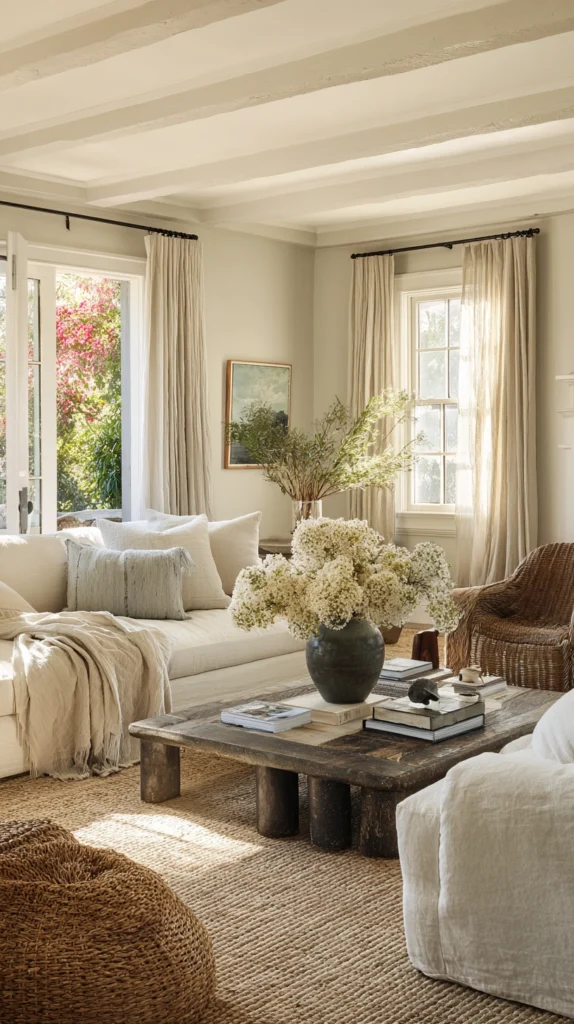
The content creator who maintains a single fixed room aesthetic year-round is missing one of the most powerful content strategies available — the seasonal room transformation that gives audiences a reason to return for the seasonal reveal, that generates consistent seasonal content without requiring fundamental room changes, and that keeps the room feeling fresh and current throughout the calendar year.
A seasonal styling system works by maintaining the room’s foundational elements — wall color, primary furniture, lighting setup — consistently throughout the year while rotating the seasonal accent layer: the plants, the textiles, the small objects, the flowers and botanicals that change with each season. Spring brings fresh flowers, soft greens, and light linens.
Summer brings bold color, tropical plants, and maximum natural light. Autumn brings warm textiles, dried botanicals, and candlelight. Winter brings layered warmth, evergreen branches, and the specific coziness of the darkest months.
Each seasonal transition is a content opportunity, and the accumulated seasonal content creates a rich archive that demonstrates both the room’s versatility and the creator’s design intelligence.
15. Make the Room Genuinely Yours
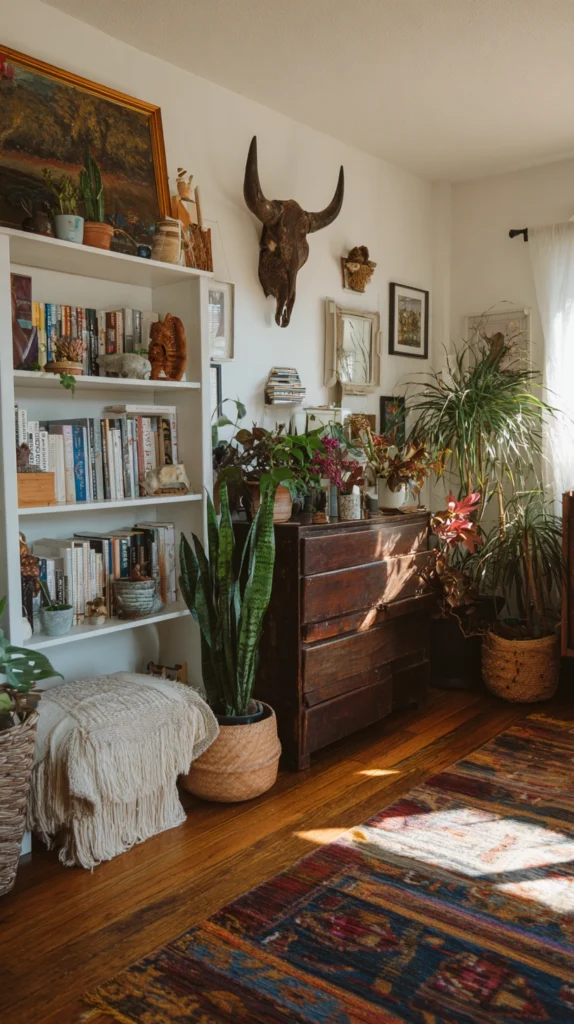
The final and most important content creator room principle is the one that every algorithm optimization guide and every photography tutorial cannot teach and cannot replace: the room should be genuinely, authentically, unmistakably yours.
The content that performs best consistently, across every platform and every niche, is the content that communicates genuine personality — the specific preferences, the specific humor, the specific obsessions and enthusiasms of a particular person who cannot be replicated by anyone else.
A room that is designed to look like someone else’s aesthetic, or to replicate a trending room style without genuine personal connection to it, produces content with the specific quality of inauthenticity that audiences detect immediately and respond to with the absence of engagement that is the content creator’s greatest fear.
The room that is covered in things you actually love, organized in ways that actually make sense to you, decorated with the colors and materials that genuinely give you pleasure every morning — this room creates content of a quality and authenticity that no amount of technical optimization can substitute for, and it is the room that will still be making great content in five years when every current aesthetic trend has moved on and been replaced.