15 Genius Spring Cleaning Caddy Storage Ideas
There is a particular kind of domestic satisfaction that comes from a well-organized cleaning caddy — the kind that makes the cleaning routine feel manageable rather than overwhelming, that allows you to move efficiently through the house without multiple return trips to a central supply point, and that is visually pleasant enough that you do not resent its presence on the counter or under the sink.
The cleaning caddy is one of those objects that most people have but almost nobody has optimized, and the difference between a caddy that was assembled by habit — whatever fit, whatever was cheapest, whatever was nearest — and one that was designed with genuine thought for the specific demands of a cleaning routine is enormous in terms of the daily quality-of-life improvement it delivers.
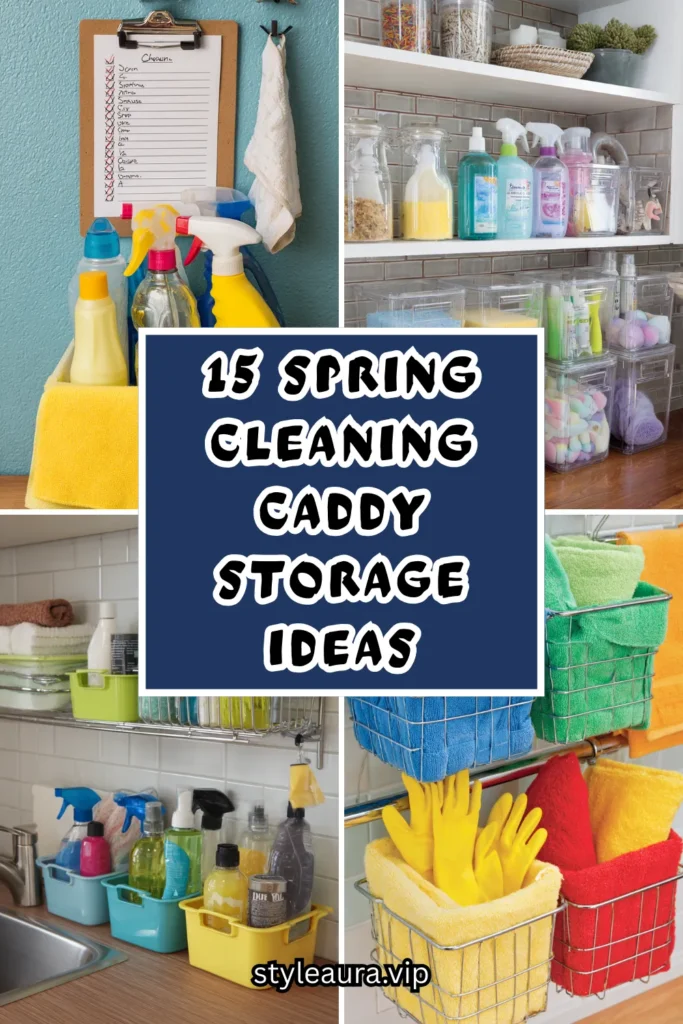
Spring cleaning in particular — the seasonal deep clean that most households attempt at some point between March and May — demands a caddy system that goes beyond the everyday essentials and accommodates the additional products, tools, and equipment that a thorough seasonal clean requires. Getting the caddy right before you begin makes everything that follows faster, more systematic, and considerably more satisfying. Here are fifteen ideas for building a caddy storage system that genuinely works.
1. The Zone-Based Multi-Caddy System
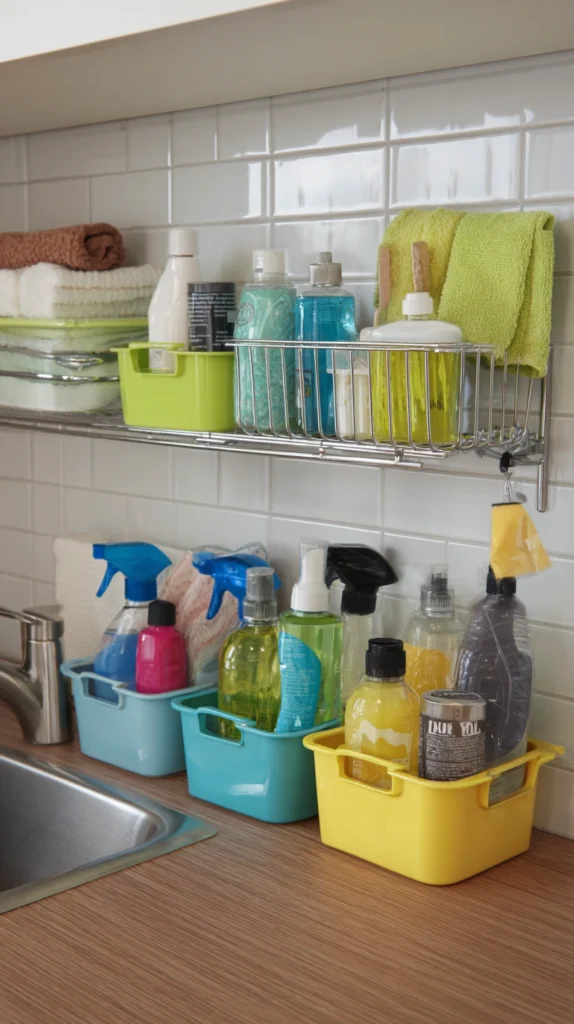
The single most transformative cleaning caddy idea available is also the one that requires the most initial investment of thought: the decision to move from one general-purpose caddy to a zone-based system of multiple caddies, each dedicated to a specific area of the home and stocked with the products and tools that area requires.
A bathroom caddy containing toilet cleaner, bathroom spray, limescale remover, and glass cleaner alongside a toilet brush, grout brush, and microfiber cloths. A kitchen caddy with degreaser, surface spray, oven cleaner, and a scrubbing pad. A living area is caddy with dusting spray, wood polish, glass cleaner, and lint rollers.
Each caddy lives in or near the zone it serves — under the bathroom sink, in the kitchen cupboard nearest the cleaning supplies, on a utility room shelf — so that the products are always where they are needed and the process of beginning to clean any area does not require a trip to a central supply point first. The initial setup requires more organization than a single caddy, but the daily and seasonal payback in efficiency is immediate and consistent.
2. A Caddy with Adjustable Internal Dividers
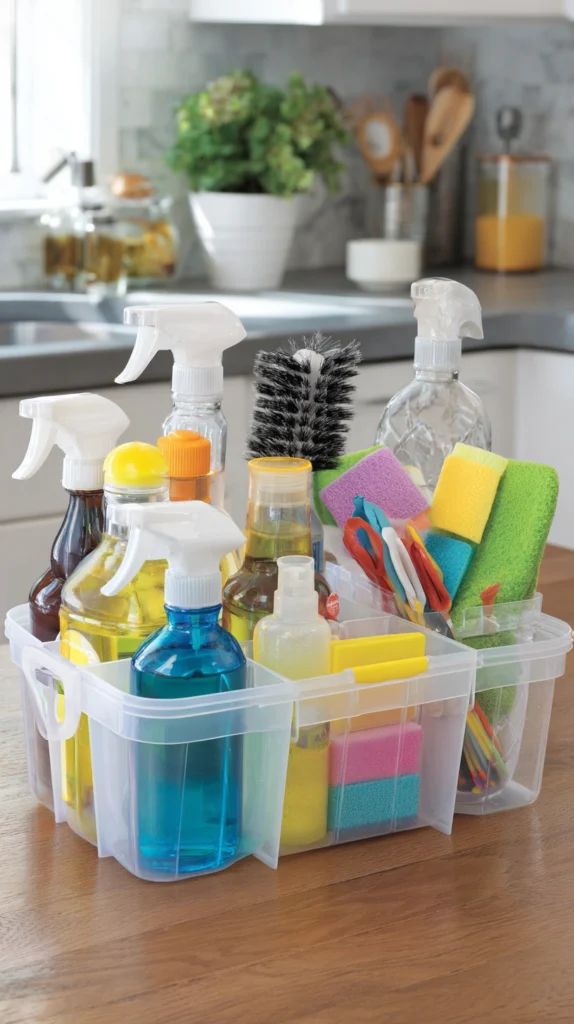
The standard cleaning caddy is a single open container with a handle — a format whose simplicity is also its primary limitation, because the single open compartment allows products to fall against each other, bottles to tip when the caddy is moved, and small items to disappear beneath larger ones where they are forgotten until they are urgently needed. A caddy with adjustable internal dividers — repositionable partitions that create compartments sized to the specific products you want to store — solves all of these problems simultaneously. Products stand upright and separated. Small items have their own defined space.
The arrangement can be reconfigured as your product selection changes without replacing the caddy. Look for dividers that clip or slide into tracks along the caddy’s base, allowing them to be repositioned in seconds, and ensure the divider material is easy to wipe clean — the interior of a cleaning caddy is inevitably exposed to spills and leaks, and difficult-to-clean dividers become a hygiene problem that defeats the organizational purpose.
3. A Tension Rod System Under the Sink
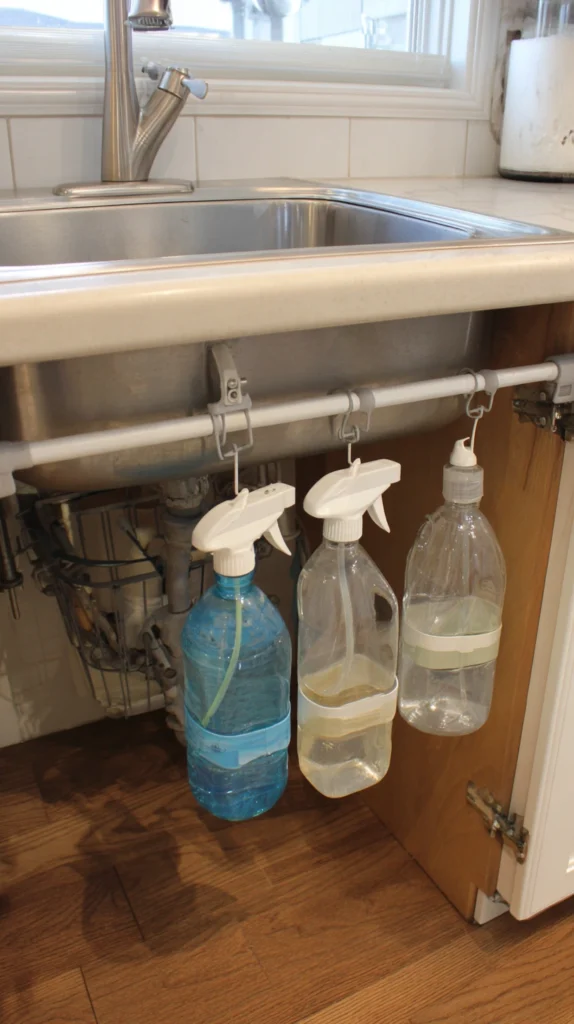
The area under the bathroom or kitchen sink is the cleaning supply storage zone in most homes, and it is almost universally poorly organized — a dark cupboard where bottles accumulate in chaotic layers, where nothing is easily visible or accessible, and where the space between the drain pipe and the cabinet walls is wasted because no standard organizer accommodates the pipe’s intrusion.
The tension rod system addresses this wasted space with elegant simplicity: two horizontal tension rods installed at different heights within the under-sink cabinet, from which spray bottles are hung by their trigger handles, freeing the cabinet floor for caddies, baskets, and the products that cannot be hung.
A spray bottle hanging on a tension rod occupies only the width of its body and is completely visible and accessible, transforming the most chaotic storage zone in the home into a genuinely functional supply station. Add a small turntable on the cabinet floor for items that need to be rotated for access, and the under-sink zone becomes one of the best-organized areas in the house.
4. A Pegboard Supply Wall in the Utility Room
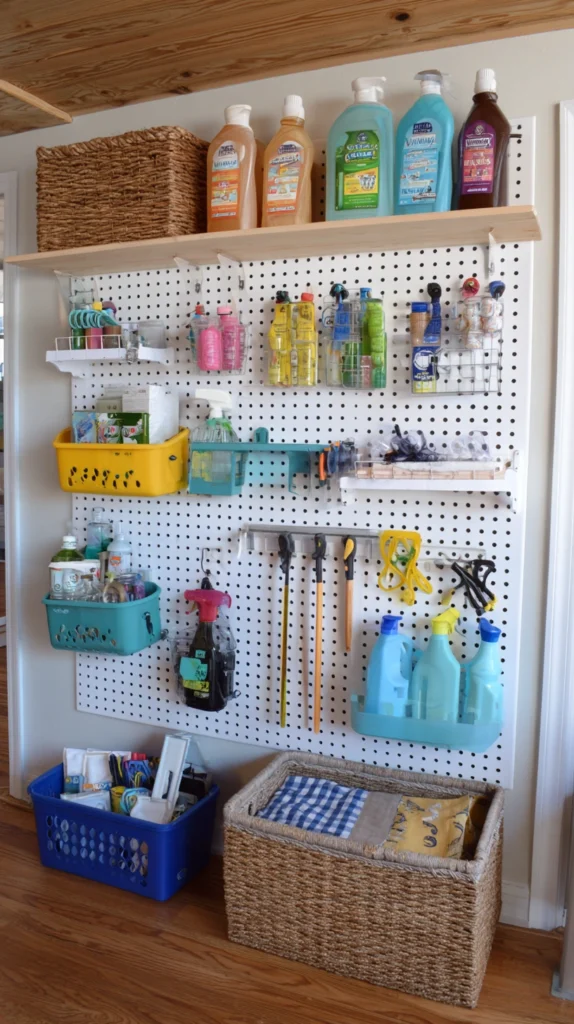
For homes with a utility room, laundry room, or service area where cleaning supplies can be stored centrally, a pegboard system on one wall creates an organizational surface of remarkable versatility that can hold everything from spray bottles to brooms, from a caddy itself to rolls of paper towel, in a visible, accessible, and easily reconfigurable arrangement.
Pegboard hooks, shelves, and baskets designed for the standard pegboard hole pattern are available at every price point and in virtually every configuration, allowing the wall to be organized specifically around your cleaning supplies rather than adapted to a generic organizer system that was not designed for this purpose.
Label each hook or basket zone — either with a label maker or with simple handwritten card labels in a consistent format — so that the return of items to their designated spots after use becomes intuitive rather than deliberate. A well-organized pegboard utility wall is one of those home organization investments whose daily return, in time saved and frustration avoided, compounds significantly over the course of a year.
5. A Stackable Bin System for Different Product Categories
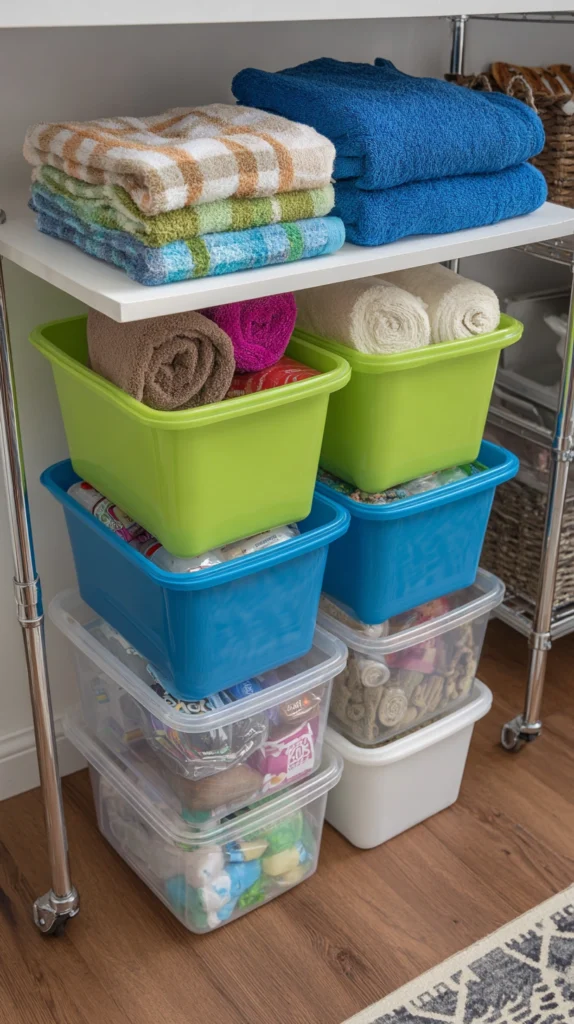
A set of matching stackable bins or baskets — each dedicated to a different category of cleaning product and labeled clearly — creates a central cleaning supply organization system that is both visually coherent and practically efficient. The category division can be as broad or as granular as your product inventory requires: one bin for floor care products, one for bathroom products, one for kitchen products, one for glass and surfaces, one for cloths and sponges, one for specialty products used seasonally.
Stack the bins so that the most frequently used categories are at the top and the seasonal deep-clean products are at the bottom, and bring the relevant bins out onto the counter or floor when beginning a cleaning session rather than leaving them permanently stacked where individual items require the whole stack to be disturbed to access a single product. Matching bins in a consistent color create a visual tidiness on the utility shelf that makes the system pleasant to look at as well as easy to use.
6. A Handled Tote for Room-to-Room Portability
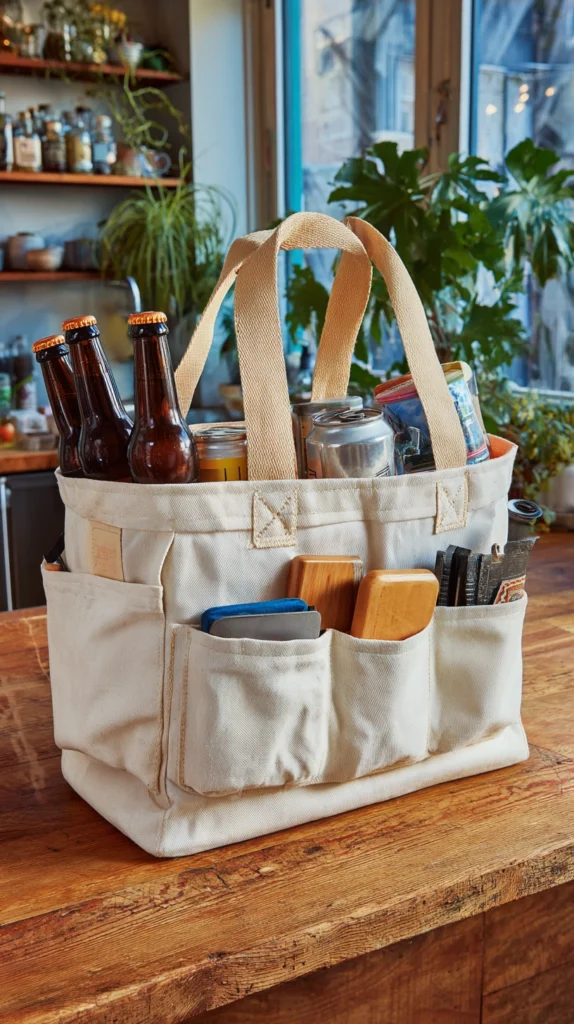
The handled tote — a fabric or woven bag with strong handles and internal pockets — is the organic, low-cost alternative to the plastic cleaning caddy, and in some household contexts it outperforms its rigid-sided counterpart significantly.
A canvas or waxed cotton tote with several external pockets and a spacious central compartment holds an impressive variety of cleaning products and tools in a format that is lighter than most plastic caddies, foldable for flat storage when not in use, and visually pleasant enough to leave on a counter or chair without looking like a piece of cleaning equipment.
The internal pockets accommodate small items — gloves, scrubbing pads, brush heads — that would disappear in an open-compartment caddy, and the central space handles the full-size bottles that require the most capacity. A tote also travels better than a rigid caddy on stairs, around furniture, and between rooms because its flexible sides accommodate awkward shapes and the soft base does not scratch floors or surfaces when set down.
7. Color-Coded Caddies by Room or Function
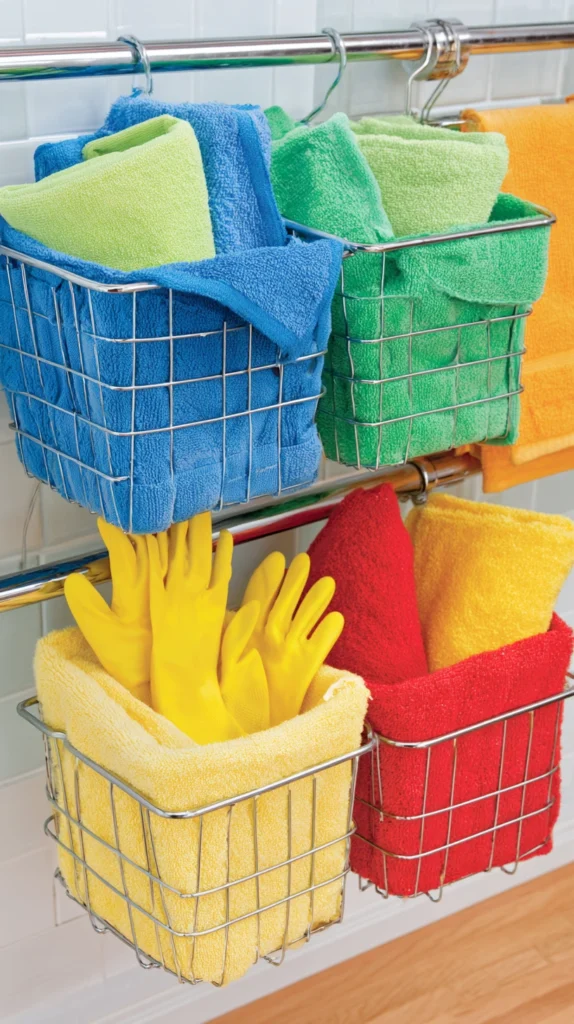
Color coding is one of organizational design’s most effective tools, and applied to a multi-caddy cleaning system it creates an intuitive visual language that removes any ambiguity about which caddy goes where and which products belong in which container. Assign a color to each room or functional zone — blue for the bathroom, yellow for the kitchen, green for the living areas, red for the bedroom — and use caddies, labels, microfiber cloths, and even rubber gloves in the corresponding color for each zone.
The color coding serves a hygienic function alongside the organizational one: clothes and brushes used in the bathroom are clearly differentiated from those used in the kitchen, eliminating the accidental cross-contamination that a single-color system makes possible. Introduce the color coding at the beginning of spring cleaning season and maintain it consistently — within a week, the system becomes entirely intuitive and the organizational benefit is fully self-sustaining.
8. A Rotating Turntable Caddy for Corner Storage
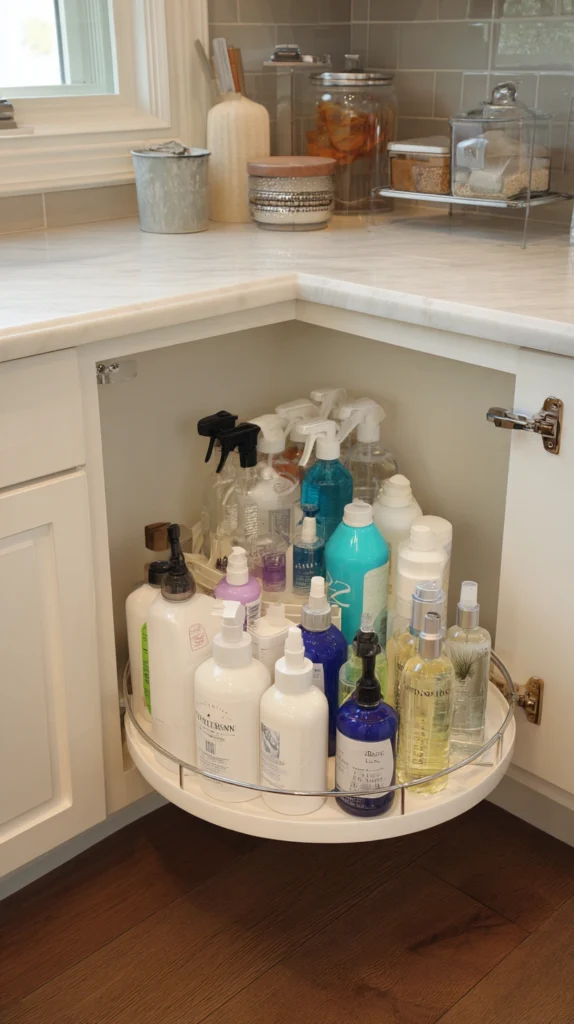
The turntable — a lazy Susan mounted on a cabinet shelf or counter surface — is one of the most practically effective corner storage solutions available for cleaning supplies, because it converts the difficult-to-access rear corners of deep shelves and cabinets into fully accessible storage by rotating the entire contents to face the front.
A full-circle turntable on the floor of a deep under-sink cabinet brings bottles stored at the rear — which in a conventional arrangement are invisible and forgotten — to the front with a simple rotation, eliminating the need to remove the front row of products to access anything behind them.
A double-deck turntable with two rotating levels provides even more capacity in the same footprint. Choose a turntable with a lipped edge that prevents products from sliding off during rotation, and clean it regularly — turntables in cleaning supply storage areas accumulate product residue that needs to be addressed before it becomes a hygiene issue.
9. A Wall-Mounted Magnetic Strip for Metal Tools
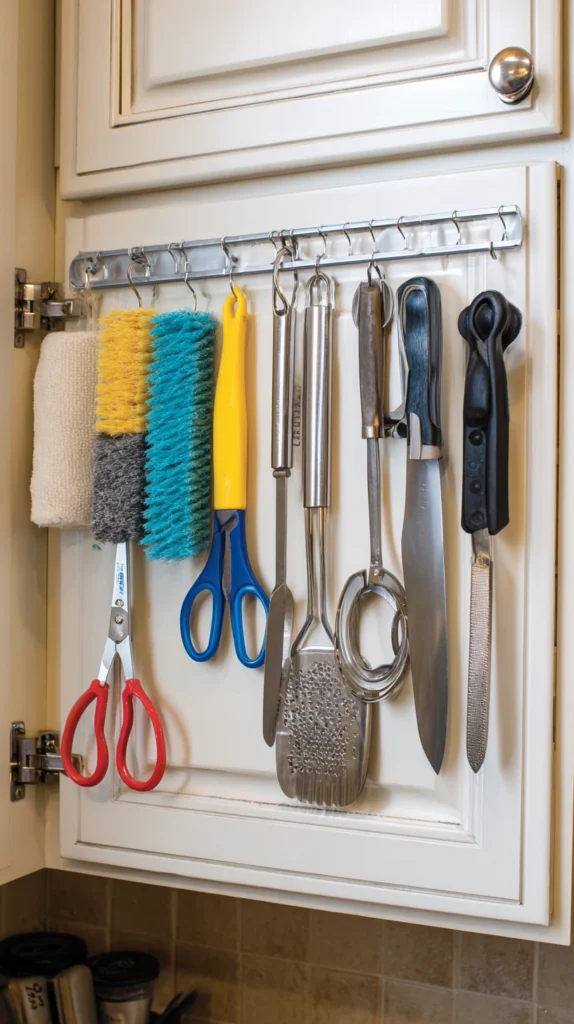
The magnetic wall strip — a neodymium magnetic bar mounted horizontally on a wall or the inside of a cabinet door — is familiar from kitchen knife storage and equally effective for the metal cleaning tools that most households accumulate: metal scrubbing pads, steel wool in various grades, small scissors for cutting cleaning cloths, spare scraper blades, and the metal components of various cleaning devices.
Mounted on the inside of a utility cupboard door or on a pegboard surface, a magnetic strip keeps these small metal items visible, accessible, and separated from the chemical products and soft tools that surround them.
The magnetic strip is also self-organizing in a useful way: items that are not genuinely magnetic will not adhere to it, which means it accepts only the metal items for which it is suited and naturally rejects inappropriate additions to its surface. This self-limiting quality helps maintain the organizational clarity of the storage system around it.
10. A Deep Cleaning Seasonal Caddy in a Dedicated Container
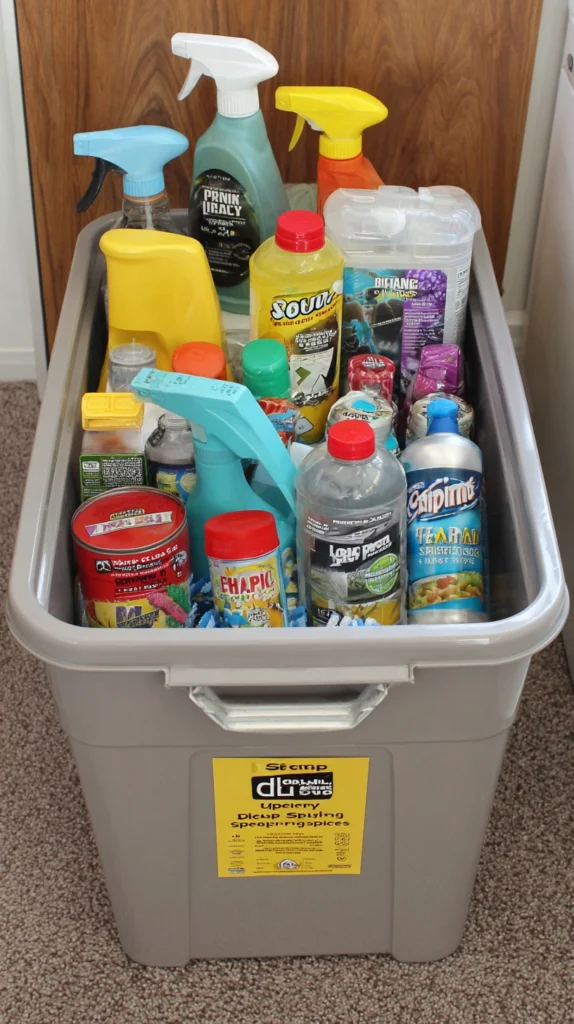
Spring cleaning involves a range of products and tools that are not used in the weekly cleaning routine — oven cleaning chemicals, grout restorer, limescale treatment, upholstery cleaner, carpet stain remover, window cleaning equipment, brass or silver polish — and storing these seasonal items in a dedicated container that is clearly labeled and stored separately from the everyday supplies prevents them from cluttering the weekly caddy while ensuring they are accessible and organized when the seasonal deep clean begins.
A large plastic storage bin with a secure lid, labeled clearly with its contents and stored on a high shelf or in a seasonal storage area, brings all the deep-cleaning products together in a single retrievable unit that comes out once or twice a year and returns to storage when the deep clean is complete.
Review the contents annually at the beginning of spring cleaning season — discard expired or depleted products, replace anything that has run out, and add any new products that the previous year’s cleaning revealed a need for.
11. A Caddy Liner System for Easy Cleaning
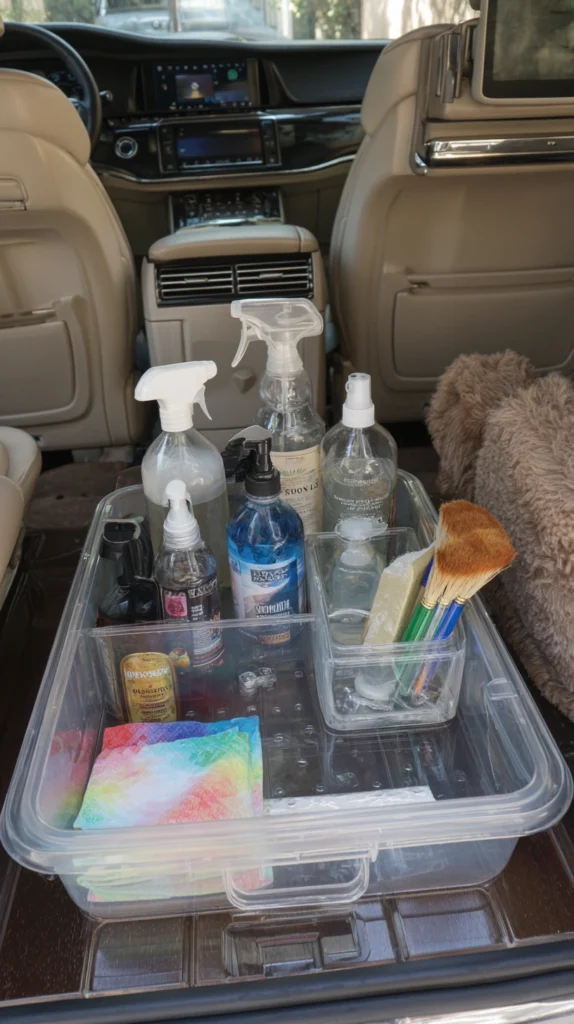
The interior of a cleaning caddy is itself one of the hardest-to-clean surfaces in the home, because product residue, drips, and powder accumulate in its corners and along its base in ways that are difficult to address without removing all the contents and scrubbing with the very products it contains.
The solution is a liner system — a removable insert, either a custom-cut piece of silicone mat or a fitted fabric liner with a waterproof backing — that sits in the caddy’s base and can be removed, wiped, and replaced without disturbing the caddy’s organizational system.
Silicone mats cut to the caddy’s interior dimensions are the most durable and most hygienic liner option, as they can be disinfected without degrading. Fabric liners with a printed pattern add a visual element that makes the caddy interior more pleasant to look into, which is a minor point but one that contributes to the overall quality of the organizational experience.
12. A Broom and Mop Wall Organization System
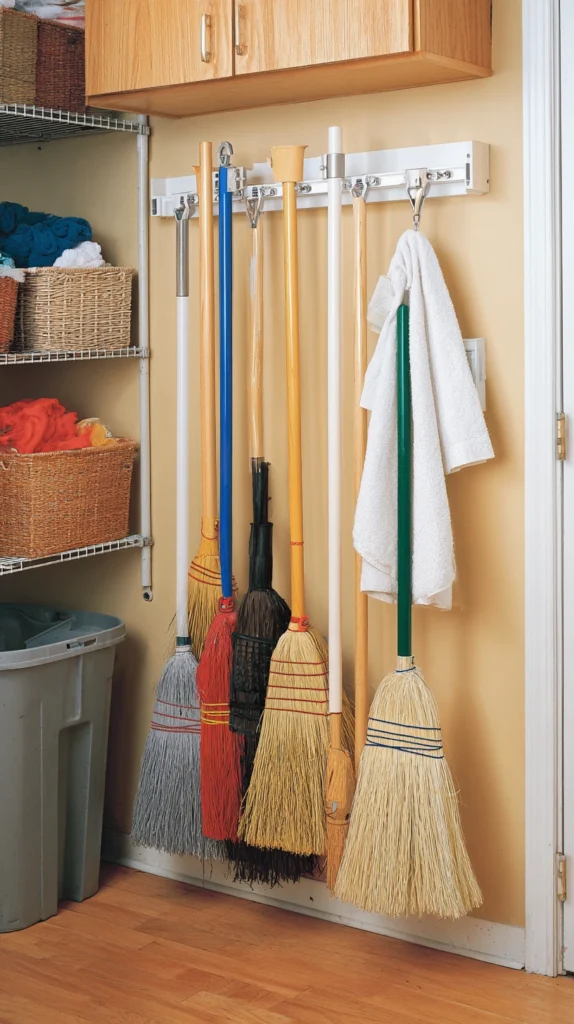
The long-handled cleaning tools — brooms, mops, dustpans, vacuum attachments, and extension handles — present a storage challenge that caddies alone cannot address, and a dedicated wall-mounted organization system for these items transforms the utility area or cleaning cupboard where they live from a chaotic tangle of falling handles into a clean, functional wall display.
Adjustable broom and mop holders — spring-loaded clips or flexible gripper mounts that attach to the wall and hold handles of different diameters — are widely available and installable in minutes, and the visual difference between a wall where these tools are properly mounted and one where they are leaning against the surface is immediate and dramatic.
Organize the holders in a consistent vertical row, arrange the tools from largest to smallest or by frequency of use, and keep a small caddy or shelf below the wall system for the smaller tools and products that relate to these long-handled items.
13. A Clear Container System for Visibility and Stock Management
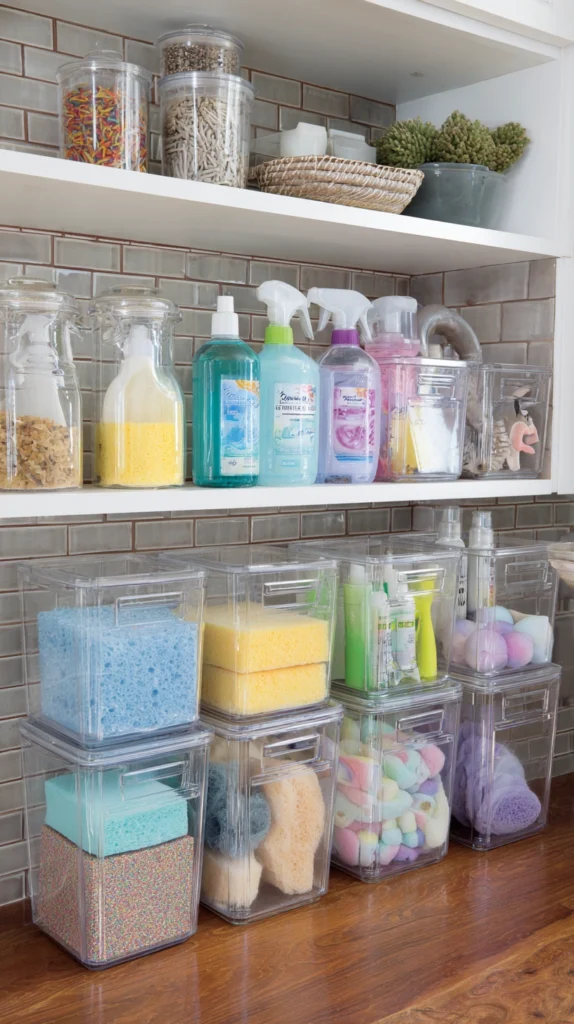
Clear containers for cleaning supplies — transparent caddies, clear stackable bins, see-through drawers — perform a simple but genuinely valuable organizational function: they allow the contents to be seen without being opened, which means that product levels can be monitored, items can be found without a search, and the need to restock becomes visible before the product runs out entirely rather than at the moment it is most urgently needed.
Clear containers are particularly valuable for the products that are used most frequently and that cause the greatest disruption when unexpectedly absent — dish soap, surface spray, cleaning cloths — and for the seasonal products that might otherwise be forgotten between uses. Label the front of each clear container with its designated contents so that when it is empty the restocking information is immediately visible without requiring the container to be inspected.
14. A Charging Station Within the Cleaning Supply Area
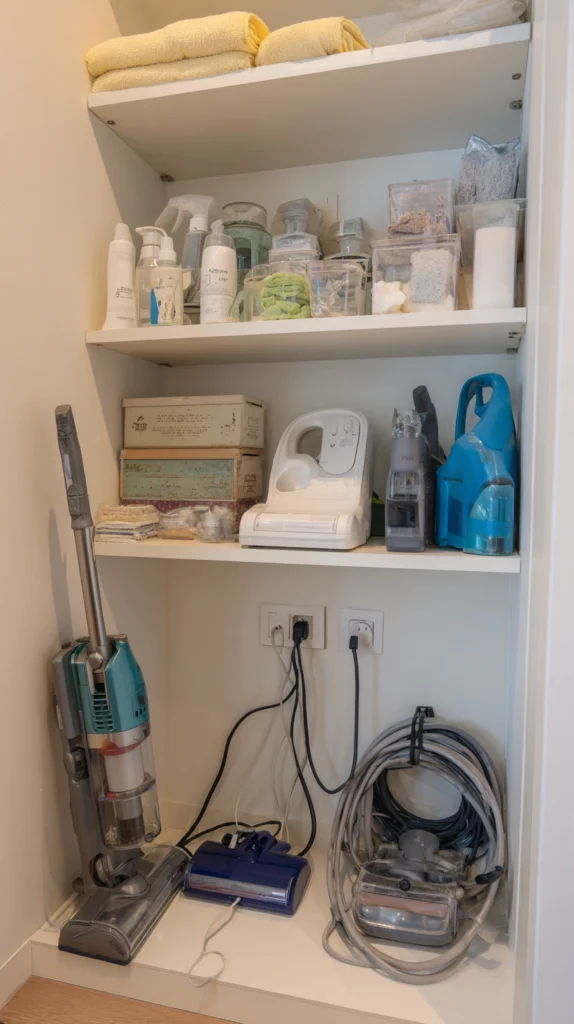
The increasing prevalence of battery-powered cleaning tools — cordless vacuums, electric scrubbers, steam mops with rechargeable batteries, UV sanitizing wands — creates a charging management challenge in the cleaning supply storage area that most organizational systems fail to address.
Integrating a dedicated charging station into the utility room, cleaning cupboard, or cleaning supply area — a power strip mounted at a convenient height, with cables managed through a cable organizer and labeled by the device each cable belongs to — ensures that battery-powered tools are always charged and ready for use when needed and that the charging process does not create a tangle of cables across the floor or counter.
The charging station should be on a shelf or at a counter height that allows the tools to be placed directly on or near the charging point without bending or awkward positioning, and the power strip should be rated for the combined load of all the devices that will be charged simultaneously.
15. A Spring Cleaning Checklist Caddy
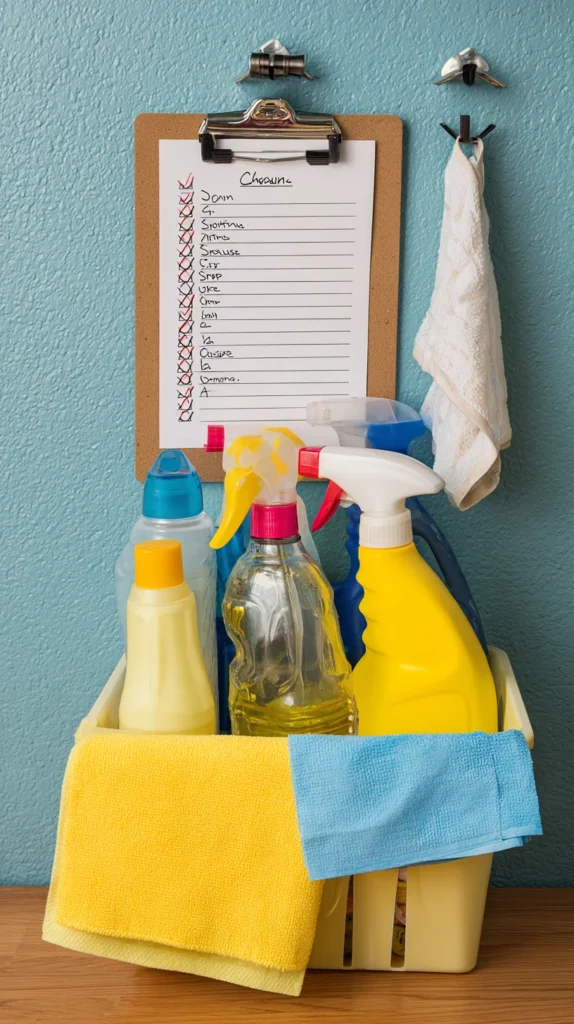
The final and perhaps most practically valuable spring cleaning caddy idea is not an organizational format for products at all but for information — a caddy system built around a detailed spring cleaning checklist that organizes the cleaning process itself alongside the cleaning supplies.
A clipboard or dry-erase board mounted on the front or side of the central cleaning caddy, displaying a checklist of spring cleaning tasks organized by room and broken into manageable sessions, transforms the spring cleaning process from an amorphous and slightly overwhelming annual undertaking into a systematic, trackable project that can be worked through with genuine satisfaction.
Each completed task is crossed off or erased. Each room’s completion is noted. The checklist reveals progress, maintains momentum, and ensures that nothing is forgotten or duplicated across what is typically a multi-day process.
Laminate a printed checklist for reuse across successive years, updating it annually to reflect changes in the home’s layout and cleaning needs, and the caddy becomes the organizational hub of a spring cleaning system that improves every year it is used.