15 DIY Sandbox Ideas Your Kids Will Actually Play In
A sandbox is one of those rare outdoor additions that delivers an almost unreasonable amount of play value for the effort and cost involved. Children who have access to a sandbox will spend hours in it — digging, building, creating, and imagining — in a way that expensive plastic play equipment often fails to inspire after the first few weeks of novelty have worn off.

Building your own sandbox rather than buying a ready-made plastic one gives you complete control over the size, the materials, the aesthetic, and the features. A DIY sandbox can be as simple or as ambitious as your skills and budget allow, and the results are almost always more durable, more attractive, and more personalised than anything available off the shelf.
Here are 15 DIY sandbox ideas ranging from genuinely simple afternoon builds to more ambitious weekend projects — all designed to create a space children will actually want to play in.
1. Classic Timber Frame Sandbox

The classic timber frame sandbox is the starting point for almost every DIY sandbox project and remains one of the most popular for very good reason — it is straightforward to build, uses widely available and affordable materials, and produces a clean, neat result that looks intentional and well-made in any garden.
Cut four lengths of pressure-treated timber to your desired sandbox dimensions — a square of 1.5 to 2 metres per side is ideal for most family gardens — join the corners with screws and metal corner brackets, line the base with landscape fabric to suppress weeds and prevent sand drainage, and fill with clean play sand. The whole project takes a few hours and costs a fraction of any comparable retail sandbox.
Pro Tip: Use timber that is at least 150mm wide for the sides of a classic frame sandbox rather than narrow boards. Wider boards serve as a natural seat around the perimeter of the sandbox — children and adults can perch on the edge comfortably while playing — and they provide significantly more structural rigidity to the frame than narrow boards that flex and distort under lateral pressure from the sand inside.
2. Sandbox with Built-In Bench Seats

Adding built-in bench seats to the corners or sides of a sandbox transforms it from a simple pit of sand into a proper play station with dedicated seating for children who want to sit and build rather than kneeling or standing at the edge. Corner bench seats are particularly effective — they use the corner space efficiently and create a cosy, enclosed quality that children love.
Build the main sandbox frame in the standard way, then construct simple L-shaped bench frames in two opposite corners from the same timber as the main frame. Cap each bench with a smooth plank of timber at seat height, sand all edges thoroughly to remove any rough patches, and finish with a child-safe exterior wood stain or paint in a fun accent color.
Pro Tip: Set bench seat height at approximately 30 to 35 centimetres from the ground for a children’s sandbox — low enough for young children to climb onto independently without assistance but high enough to provide a comfortable seated position for children up to around eight or nine years old. A bench that is too high excludes younger children from using it comfortably and reduces the sandbox’s usefulness for the age group that benefits from it most.
3. Sandbox with a Canopy or Shade Cover
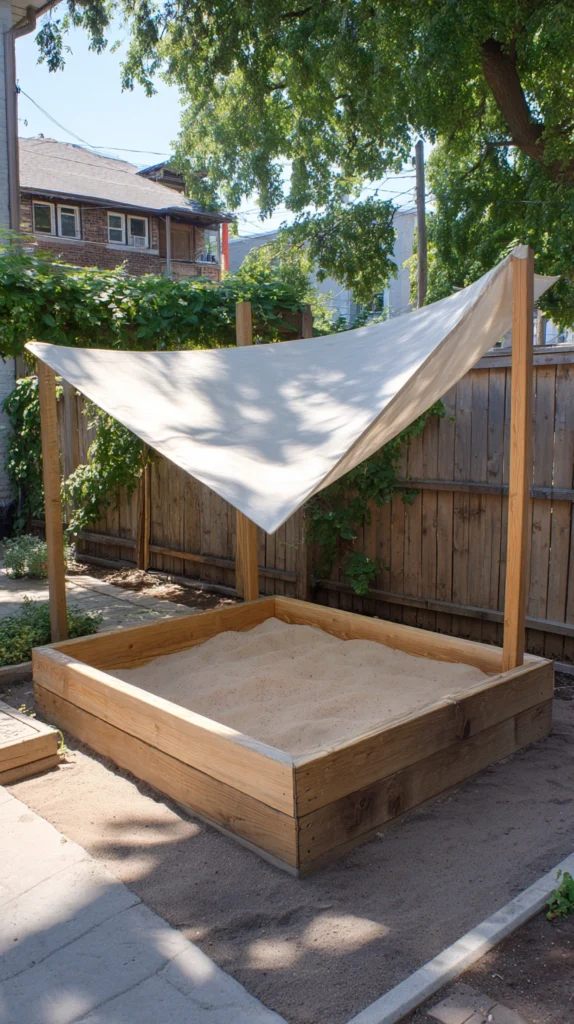
Sun protection is one of the most important practical considerations for any outdoor children’s play space, and a sandbox with a built-in shade canopy keeps the play area cool and comfortable during the hottest parts of the day while also protecting the sand from rain, leaves, and garden debris when not in use.
Build four corner posts into the sandbox frame structure — tall enough to provide comfortable clearance overhead — and span a sail shade, a stretch of UV-resistant canvas, or a simple corrugated perspex panel across the top. A hinged or removable cover design is ideal because it allows the sandbox to be completely sealed when not in use, keeping cats, birds, and weather out of the sand.
Pro Tip: Angle the shade canopy slightly rather than mounting it perfectly horizontal. A slight slope — even just a few degrees — allows rainwater to run off the cover rather than pooling in the centre and eventually sagging, tearing, or depositing a concentrated stream of water into the sandbox every time the cover is disturbed. A simple slope toward one edge with a drip point away from the play area solves this practical problem elegantly.
4. Raised Sandbox Table
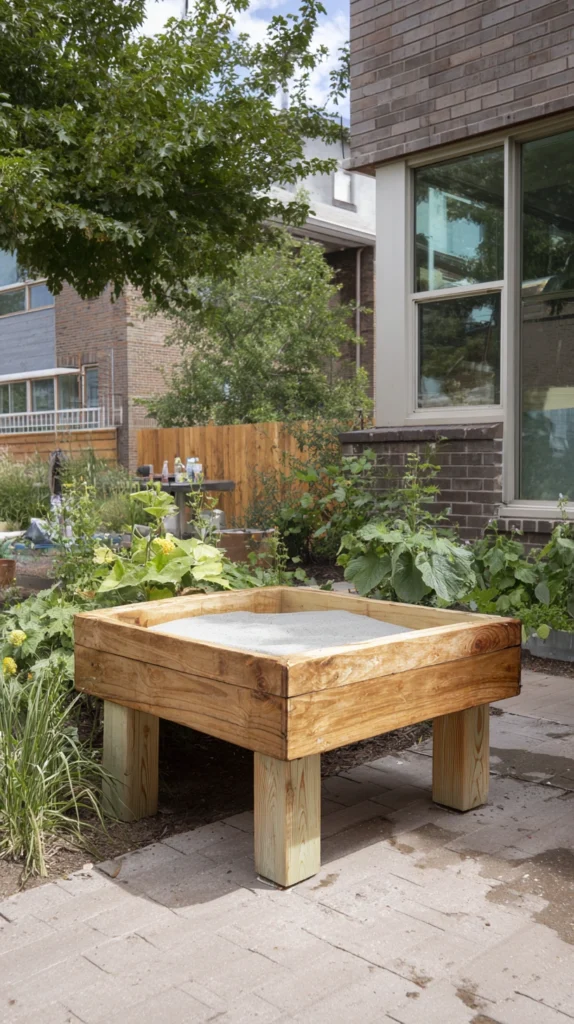
A raised sandbox table — a sandbox built at table height rather than at ground level — is a brilliant solution for younger children who find ground-level sandboxes awkward to access, for gardens with uneven or hard surfaces where digging down is not possible, and for parents who find kneeling at ground level uncomfortable during extended play sessions.
Build a simple rectangular box frame with four legs raising the play surface to around 50 to 60 centimetres — comfortable standing or seated play height for toddlers and young children. Keep the sandbox depth at around 15 to 20 centimetres, which is sufficient for meaningful sand play without the weight of deeper sand making the structure unstable or difficult to move if needed.
Pro Tip: Add a shelf between the legs of a raised sandbox table for storing sand play tools — buckets, spades, moulds, and sieves — directly at the point where they are used. A dedicated storage shelf beneath the sandbox keeps toys organised, prevents them from being scattered around the garden, and means children can access their tools independently without having to search for them before every play session.
5. Log Border Sandbox

A sandbox bordered by a ring of half-buried logs or log rounds instead of sawn timber creates a natural, organic play space that looks like it belongs in the garden rather than sitting on top of it. The rounded forms of natural logs soften the sandbox’s presence in the garden and give it a more woodland, adventure-play quality that suits natural and wildlife-friendly garden designs particularly well.
Source suitable logs from a fallen garden tree, a local sawmill, or a timber merchant and bury them to around a third of their depth in the ground around the sandbox perimeter. The buried portion anchors them firmly in place and the exposed portion forms the sandbox border. Fill the enclosed area with landscape fabric and play sand as with any other sandbox design.
Pro Tip: Choose logs of a consistent diameter for a log border sandbox rather than mixing very thin branches with thick trunk sections. Consistent log diameter creates a visually cohesive border that reads as deliberately designed. Very mixed diameters can look random and unfinished, and logs that are too thin do not provide adequate border height or structural containment for the sand inside the sandbox.
6. Sandbox with Mud Kitchen Attached
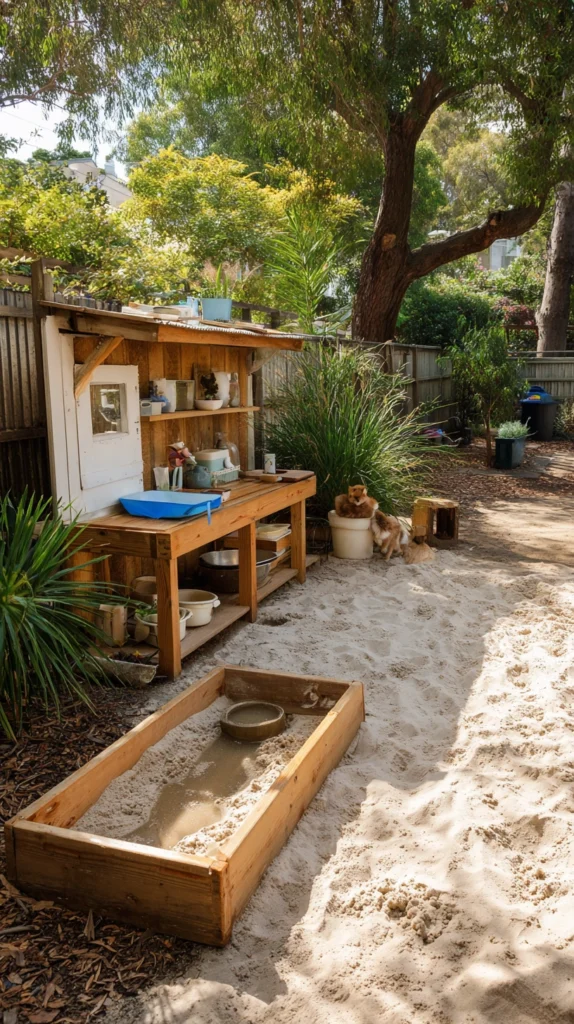
Combining a sandbox with an adjacent mud kitchen — a simple outdoor kitchen setup with a worktop, some shelving, and old pots and pans for mixing, pouring, and creative play — creates an outdoor play station of exceptional play value. Children who have both sand and a mud kitchen available can spend entire days in elaborate imaginative play that combines building, cooking, pouring, and storytelling.
Build the sandbox and the mud kitchen as adjacent but distinct structures — the sandbox for sand play and the mud kitchen positioned immediately beside it for water, mud, and mixing play. A small outdoor tap or a bucket of water nearby completes the setup and turns the combination into one of the most genuinely engaging outdoor play environments a garden can offer.
Pro Tip: Position the mud kitchen on a hard surface — a small area of paving slabs, decking, or compacted gravel — immediately adjacent to the sandbox rather than directly on grass or soil. Mud kitchen play generates significant mess around the working area, and a hard surface makes cleanup considerably faster and easier than trying to deal with muddy, churned-up grass that takes weeks to recover after heavy use.
7. Pirate Ship Sandbox

A sandbox built within a simple timber frame designed to look like a pirate ship — with a pointed prow at one end, timber side panels cut to suggest hull planking, a simple mast with a rope or fabric sail, and perhaps a ship’s wheel mounted at one end — transforms sand play into an imaginative adventure that captures children’s attention far more powerfully than a plain rectangular box of sand.
The construction is more ambitious than a standard frame sandbox but entirely achievable with basic woodworking skills and a weekend of build time. The pirate ship sandbox becomes the focal point of the garden and the most popular play destination for visiting children of all ages — the kind of outdoor feature that children remember and talk about for years.
Pro Tip: Build the structural sandbox element of a pirate ship sandbox to standard dimensions first — ensuring the play space is the correct depth and area for good sand play — and then add the decorative ship elements around and above the functional core. Getting the play space right first ensures the finished sandbox is genuinely good for sand play rather than a decorative structure that happens to contain a small amount of sand as an afterthought.
8. Hexagonal Sandbox
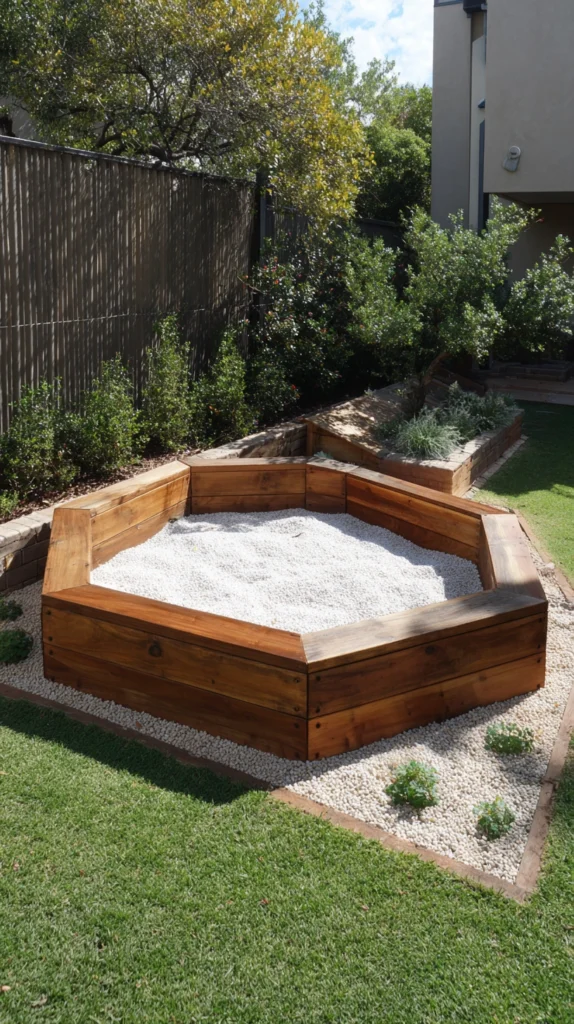
A hexagonal sandbox — six equal sides meeting at consistent angles rather than the standard four-sided square or rectangle — creates a play space with a more interesting, organic shape that sits more naturally in a garden setting and allows more children to access the sand simultaneously from different sides without crowding.
Cut six equal-length timber boards and join them at the correct 120-degree internal angle using angled corner brackets or carefully cut 60-degree mitre joints at each end. The hexagonal form requires a little more precision in the cutting and joining than a standard rectangular sandbox but the finished result is noticeably more interesting and visually appealing in the garden.
Pro Tip: Mark and cut all six sides of a hexagonal sandbox from the same length of timber before assembling any of the joints. Cutting all pieces first and dry-fitting the whole hexagon before driving a single screw allows you to check that all angles are consistent and the hexagon closes properly before committing to the final assembly — a much easier correction to make before assembly than after it.
9. Sandbox with Water Play Table Attached
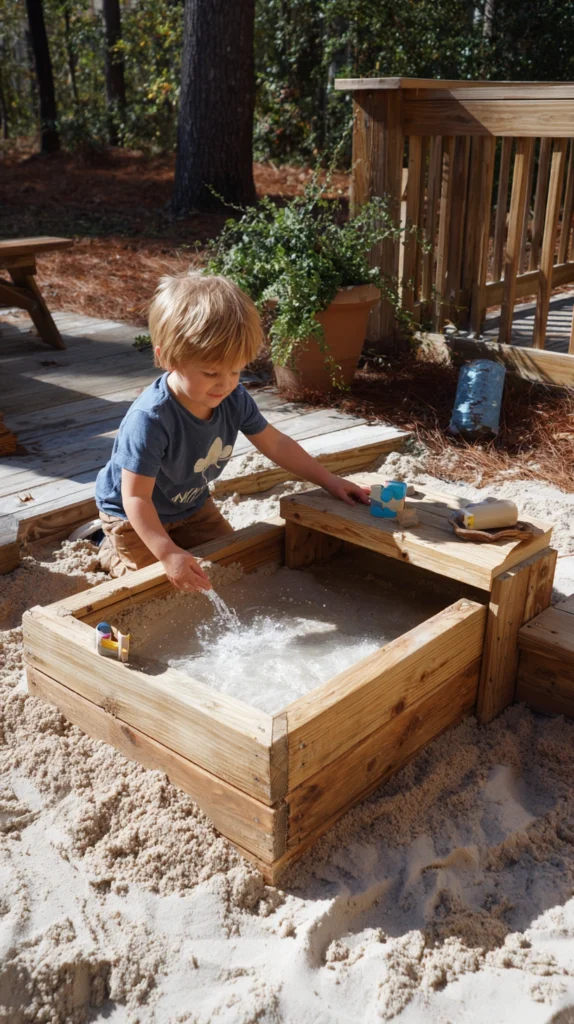
Water play and sand play are natural companions — children instinctively combine the two the moment both are available — and a sandbox with an integrated or directly adjacent water play table gives them the tools to do this in a controlled, designated space that contains the inevitable mess and keeps the play area organised and functional.
Build a standard sandbox frame and attach a simple raised water table — a waterproof tray or basin mounted on legs at the corner of the sandbox — so that children can move seamlessly between sand and water play without leaving the play zone. A small pump or pouring vessel allows water to be transferred from the table into the sand for dam-building, moat-digging, and all the endlessly creative wet sand play that children find so engaging.
Pro Tip: Position the water play table attachment at the corner of the sandbox rather than along the full side. A corner-positioned water table is accessible from both adjacent sandbox sides simultaneously, allowing multiple children to use it at the same time without crowding, and it leaves the longer sides of the sandbox completely unobstructed for children who want to play with dry sand away from the water area.
10. Dinosaur Excavation Sandbox
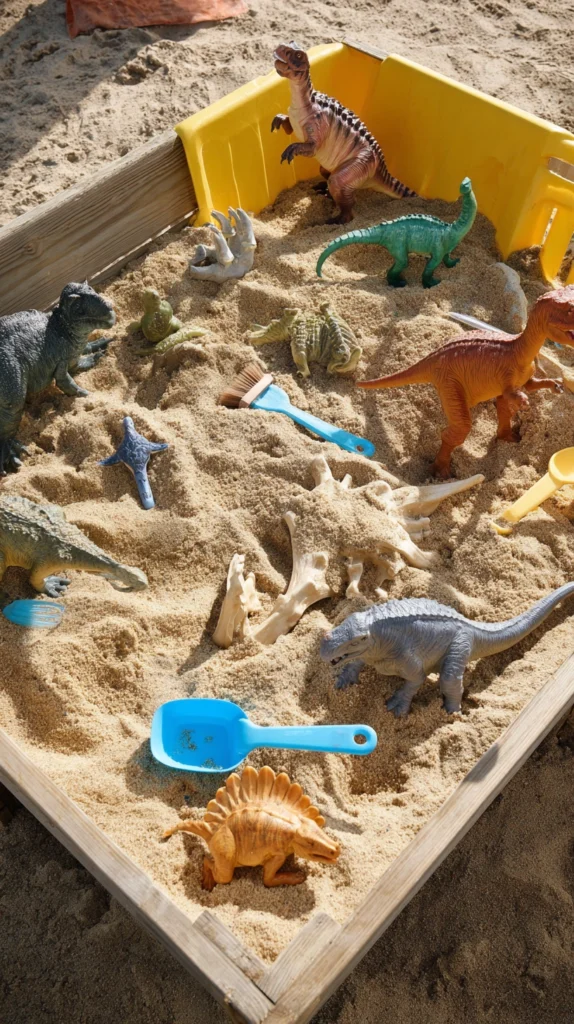
A dinosaur excavation sandbox takes the standard sandbox concept and adds a layer of imaginative theming that turns simple sand play into an organised archaeological adventure. Bury plastic dinosaur bones, fossils, and figurines in the sand before play begins, provide children with brushes, small trowels, and sieves alongside the standard sand tools, and watch the enthusiasm with which they excavate their discoveries.
The sandbox itself can be built to any standard design — the dinosaur theme is delivered through the accessories, the buried objects, and perhaps some simple painted decoration on the timber sides rather than through any special construction. Replenish the buried objects regularly and vary what is hidden to keep the excavation experience fresh and exciting over many play sessions.
Pro Tip: Bury excavation objects at varying depths within the sandbox rather than all at the same level. Objects buried at different depths create a more authentic and engaging excavation experience — some discoveries come easily near the surface while others require more determined digging to uncover. The variation in discovery depth keeps children engaged and motivated throughout the play session far more effectively than objects all buried at a uniform shallow depth.
11. Sandbox with Chalkboard Side Panel
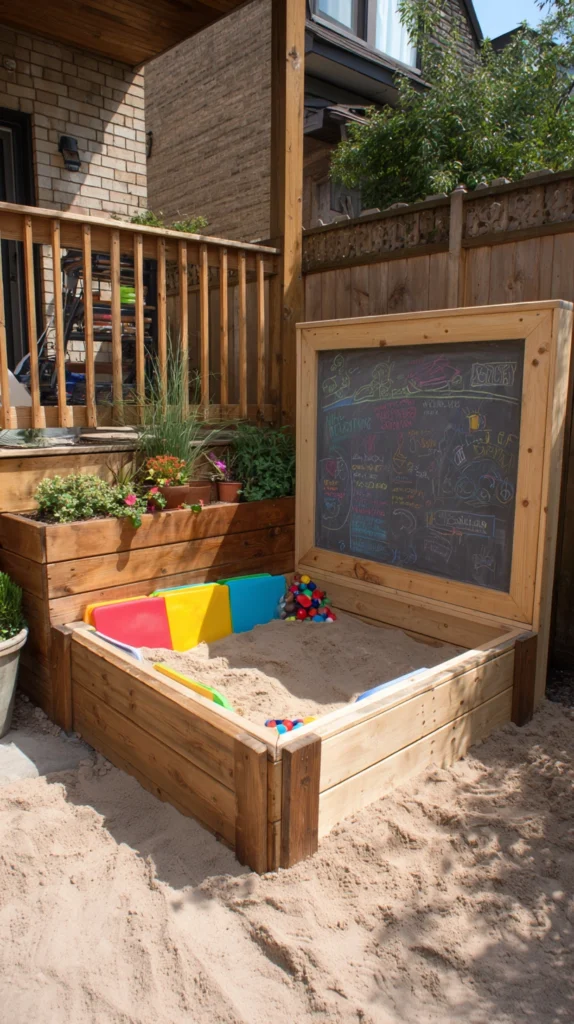
Adding a chalkboard panel to one side of a sandbox frame creates an additional creative play surface that complements sand play brilliantly — children can draw designs in the sand, then draw the same design on the chalkboard, plan their sand constructions on the board before building them, or simply use the chalkboard as a completely independent creative outlet during the same outdoor play session.
Cut a panel of exterior-grade plywood to the dimensions of one sandbox side, prime and paint with two coats of chalkboard paint in your chosen color, and mount it on the exterior face of one sandbox side panel in place of or in addition to the standard timber boarding. Supply chalk in a small weatherproof container attached to the sandbox frame to keep it accessible and prevent it from being lost in the garden.
Pro Tip: Use exterior-grade chalkboard paint rather than standard interior chalkboard paint for a sandbox side panel that will be exposed to weather year-round. Exterior chalkboard paint contains weather-resistant additives that allow the surface to be wiped clean after rain and maintain its chalkboard quality through temperature changes and UV exposure. Standard interior chalkboard paint deteriorates quickly in outdoor conditions and loses its writing surface within a single season.
12. Sandbox with Painted Exterior Decorations

A sandbox with a beautifully painted exterior is one of the simplest and most cost-effective ways to transform a plain timber frame into a genuinely exciting play space that children feel emotionally connected to. The structural build is identical to a standard frame sandbox — the magic is entirely in the decoration applied afterward.
Paint the exterior panels in bright, bold colors and add simple painted scenes — an underwater world, a jungle landscape, a space scene, a farmyard — using exterior paint and basic brushes or stencils. No artistic skill is required for stencilled designs, and even freehand painted scenes with simple shapes and bold colors look wonderful on a children’s sandbox at garden scale.
Pro Tip: Involve children in the painting and decoration of their sandbox wherever possible. Children who have contributed to the creation of their play space develop a stronger sense of ownership and attachment to it than those who simply receive a finished product.
Even very young children can apply base colors or press handprints onto the panels — a personal touch that makes the sandbox genuinely theirs in a way that matters enormously to a child.
13. Sunken In-Ground Sandbox
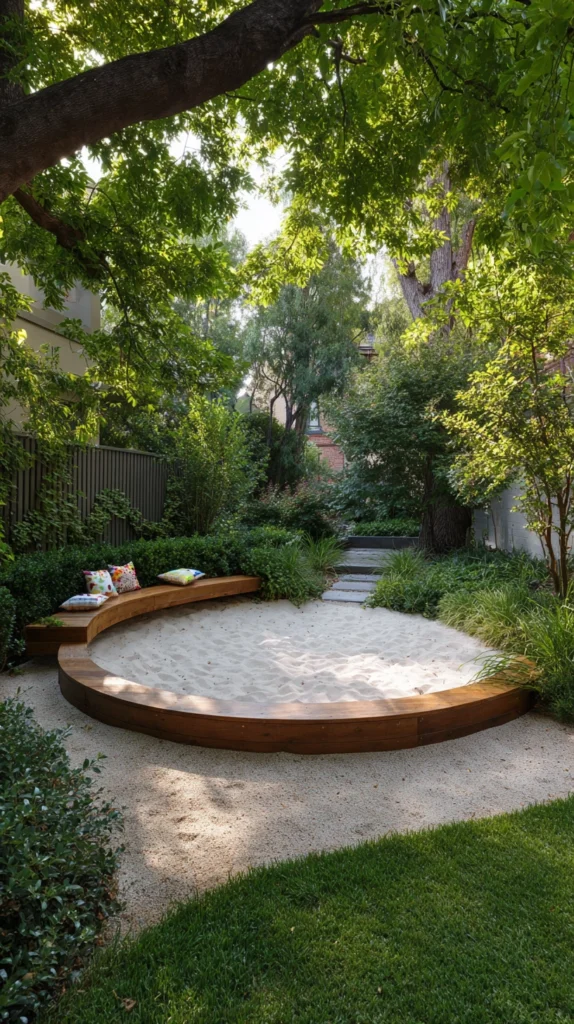
A sunken in-ground sandbox — dug directly into the garden rather than built above ground level — creates the most natural and integrated play space possible, sitting flush with the surrounding lawn or garden surface as though it has always been there. Children love the immersive quality of a sunken sandbox and the lower profile means it is less visually dominant in the garden when not in use.
Excavate the sandbox area to a depth of around 30 to 35 centimetres, line the base and sides with landscape fabric to prevent weed growth and allow drainage, optionally line the sides with timber boards or bricks to prevent the edges from crumbling inward, and fill with clean play sand to just below garden level. A fitted timber cover cut flush with the lawn surface keeps the sand clean and the sandbox invisible when not in use.
Pro Tip: Excavate an in-ground sandbox at least 10 centimetres deeper than the intended sand depth and fill this extra depth with a layer of coarse gravel before adding the landscape fabric and sand. The gravel drainage layer prevents the in-ground sandbox from becoming waterlogged after heavy rain — a common problem with sunken sandboxes that sit in heavy clay soil with poor natural drainage. Good drainage keeps the sand clean, dry, and pleasant to play in rather than becoming a cold, compacted, muddy mess after every rainfall.
14. Turtle or Animal Shaped Sandbox

An animal-shaped sandbox — built in the form of a turtle, a frog, a fish, or any other creature that can be approximated with basic woodworking cuts — brings a level of whimsy and imaginative appeal to the garden that a standard rectangular sandbox simply cannot match. For younger children in particular, a sandbox with a recognisable animal form becomes a character in their imaginative play rather than just a container for sand.
The turtle is the most popular animal sandbox form because the rounded shell shape of the body translates naturally into a sandbox basin and the head, tail, and feet can be added as simple timber cut-outs attached to the main frame.
Cut the circular or oval main body from exterior-grade plywood sides, construct a simple rectangular base frame within, and attach the decorative head and limb cut-outs to the exterior before painting in bright, cheerful colors with exterior paint.
Pro Tip: Sand all cut edges of plywood used in an animal-shaped sandbox with particular thoroughness — especially the decorative cut-out elements like the head, tail, and feet where the jigsaw cuts create curved edges that can leave sharp fibres and splinters.
Children invariably run their hands along every surface of a play structure they are excited about, and any rough edge they encounter will find a small hand immediately. Multiple passes with progressively finer sandpaper on all cut edges makes the finished sandbox genuinely safe for unsupervised play.
15. Sandbox with Canopy and Full Cover System
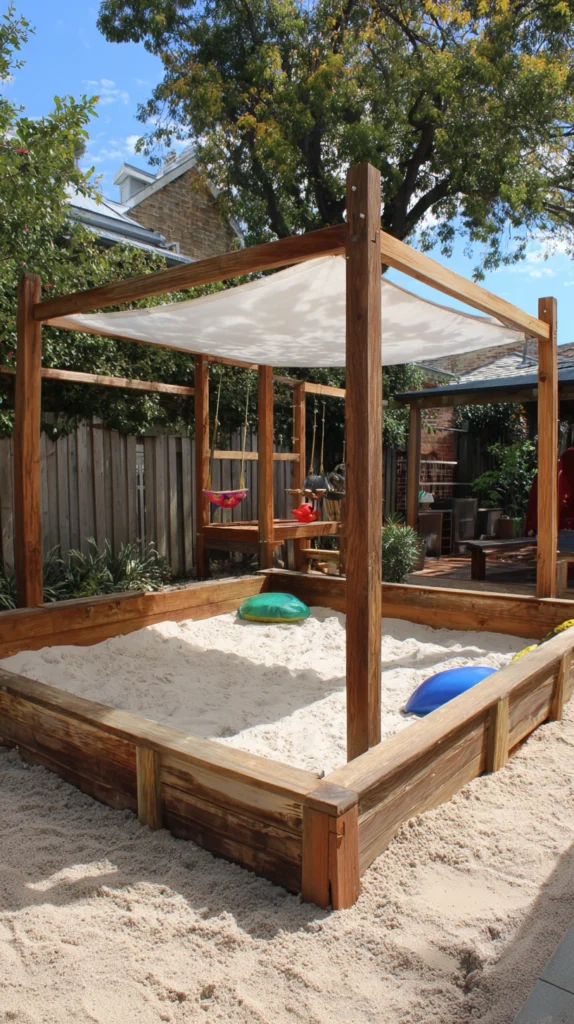
The most complete and practical DIY sandbox design combines a generously sized play area, a permanent shade canopy for sun protection during play, and a full weatherproof cover system that completely seals the sandbox when not in use. This three-element combination addresses every practical challenge of outdoor sandbox ownership simultaneously — UV protection for children, sand protection from weather and animals, and a play space that is ready to use at any moment without preparation.
Build the main sandbox frame to generous dimensions — at least 1.8 by 1.8 metres for a family with multiple children — with four sturdy corner posts rising to canopy height. Span a UV-resistant sail shade or canvas canopy panel across the posts at a slight angle for rain runoff, and construct a fitted hinged timber cover that folds back completely when play is in progress and closes securely with a simple latch when the sandbox is not in use.
Pro Tip: Hinge the full cover of a sandbox with canopy in two separate halves rather than as a single large panel. A single full-width cover becomes unwieldy and heavy to lift — particularly for children who want to access the sandbox independently without adult assistance. Two half-covers that fold back independently in opposite directions are light enough for children to manage themselves from around four years old, which gives them the independence and ownership of their play space that makes them more likely to use it consistently and enthusiastically.
Build It Once, Play In It for Years
A well-built DIY sandbox outlasts any plastic alternative by years — sometimes by decades — and the play value it delivers over that time is genuinely extraordinary. Children who grow up with a good sandbox in the garden carry the memories of it long into adulthood, which says something important about the quality of the play experience it provides.
Choose a design that matches your skill level, your garden space, and the ages of the children who will use it. Build it with good materials, finish it with care, and fill it generously with clean play sand. Everything after that takes care of itself — because children, given a sandbox, will always know exactly what to do with it.