15 Creative Ways to Display Fresh Cut Flowers This Spring
There is a particular kind of generosity that flowers bring to a space. Not the loud generosity of an expensive renovation or a significant purchase, but something quieter and more immediate — the way a handful of stems placed in a container on a kitchen counter can shift the entire atmosphere of a room within seconds of their arrival.
Fresh cut flowers are one of domestic life’s most ancient and persistently satisfying pleasures, and spring is the season when that pleasure is most abundantly available, when garden centers and farmers markets overflow with stems at their most varied and their most beautiful.
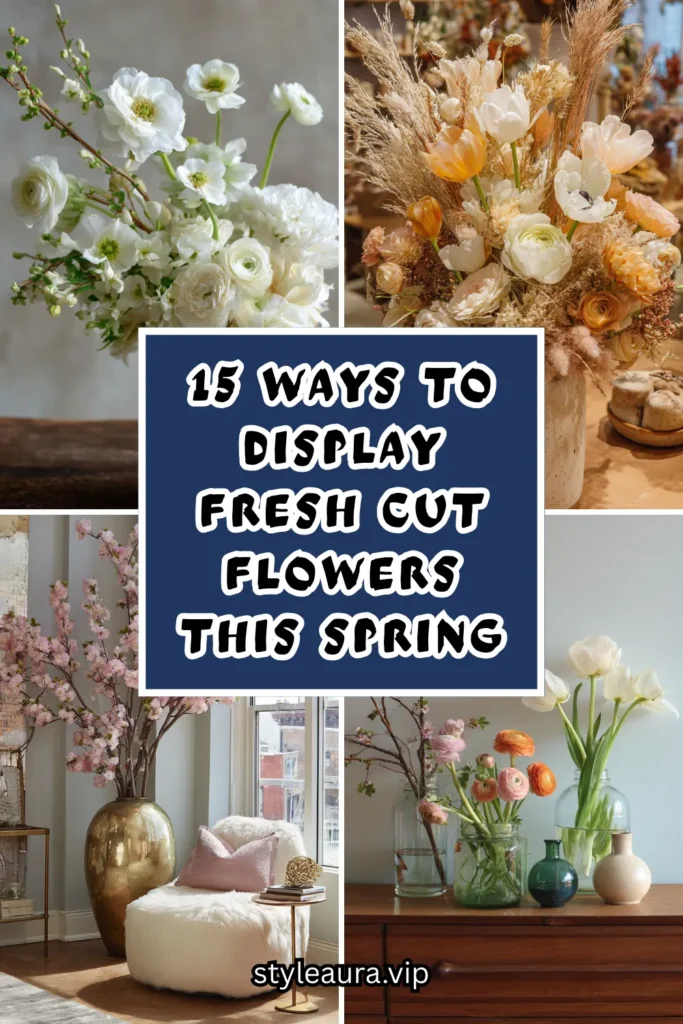
The question of how to display them — how to move beyond the single vase on the dining table and into something more creative, more personal, and more genuinely connected to the particular beauty of what you have in hand — is one that rewards a small investment of thought and a willingness to see the flowers themselves as the starting point of a creative conversation rather than simply an object requiring a container.
Here are fifteen ideas for displaying fresh cut flowers this spring in ways that are inventive, beautiful, and practically achievable.
1. The Single Stem in a Considered Vessel
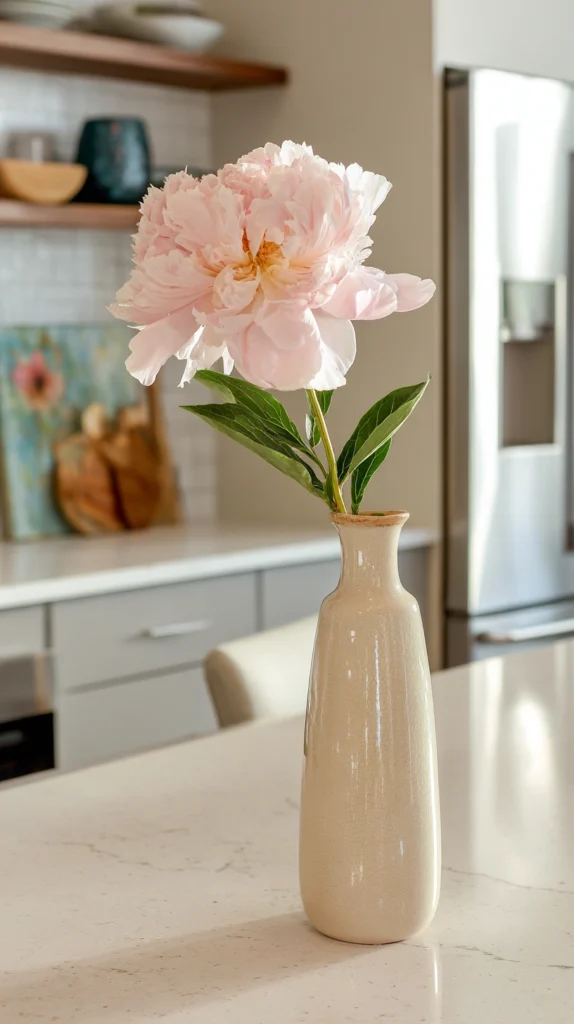
Before exploring complexity, it is worth making the case for the single stem with genuine conviction, because this is an approach that is consistently underestimated and consistently beautiful when executed with attention to the vessel. A single peony in a narrow-necked bottle. One branch of flowering quince in a tall ceramic cylinder.
A single garden rose in a small earthenware jug. The logic of the single stem is that it removes every distraction and asks you to actually look at the flower — its form, its color, its specific quality of light — in a way that an arrangement of many stems rarely permits. The vessel is as important as the stem here, perhaps more so, and the relationship between the two — the proportion, the color contrast or harmony, the way the neck of the container holds or releases the stem — is the whole of the composition.
Collect interesting single vessels over time: small antique bottles, handmade ceramic cups, simple laboratory glass, vintage ink pots. The collection becomes a toolkit for the most effortless spring flower display imaginable.
2. The Low Massed Arrangement for a Dining Table
The tall centerpiece on a dining table is a convention worth questioning, because a tall arrangement between diners creates a visual barrier that conversation must work around rather than through.
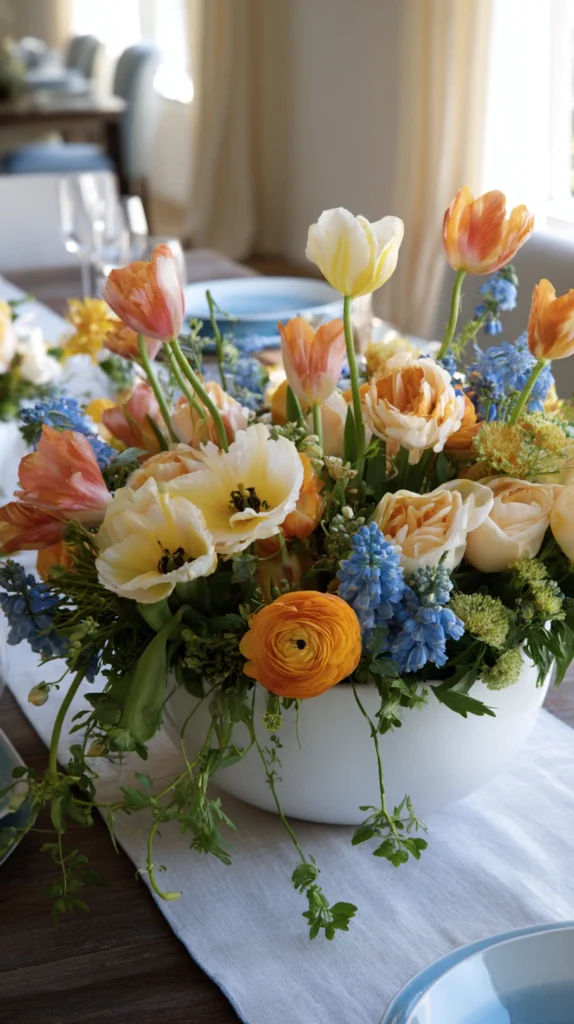
The alternative — a low, generously massed arrangement that sits well below eye level and spreads horizontally across the table’s center — is both more practical and, in the right execution, considerably more beautiful.
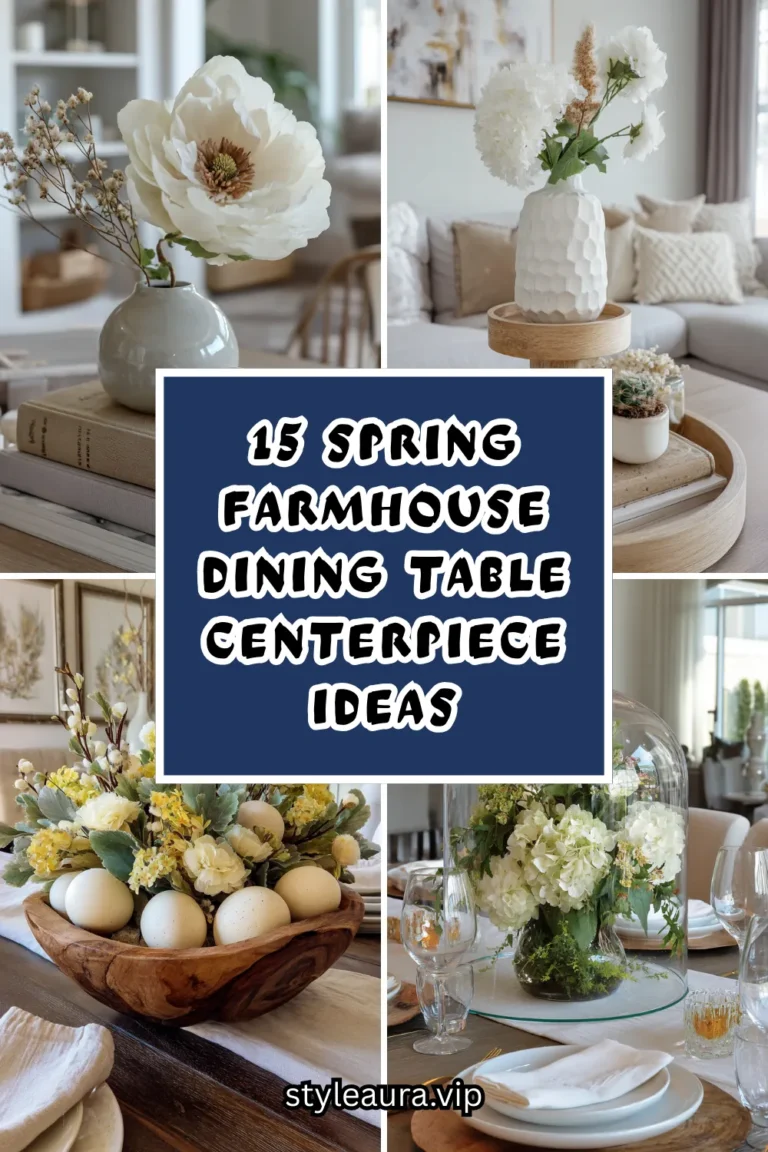
A low bowl or shallow dish, a block of floral foam or a flower frog placed in its base, and a dense gathering of spring stems cut short — ranunculus, anemones, tulips with their heads at different heights, small clusters of muscari tucked between larger blooms — creates a centerpiece that feels abundant and deliberately composed without interrupting the visual and conversational flow across the table.
Add a few stems of something trailing, like vines or small-leafed herbs, to soften the edges and allow the arrangement to feel as though it is spilling naturally outward.
3. The Bud Vase Cluster
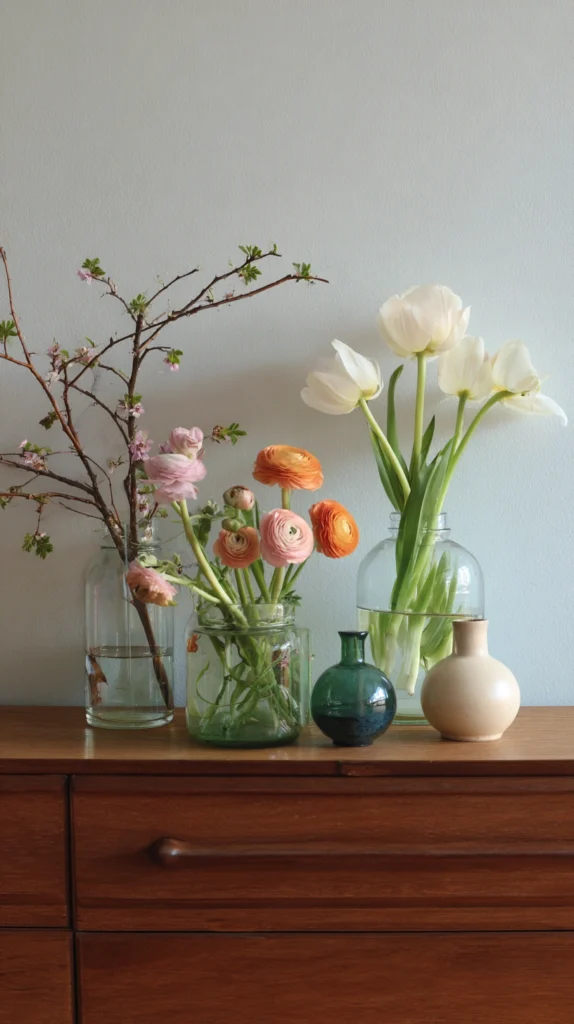
The bud vase cluster has established itself as one of the most beloved contemporary flower display approaches, and its popularity is entirely earned. The concept is simple — a collection of small vases, bottles, and vessels grouped together with single stems or small clusters of flowers in each — but its appeal lies in the way it transforms flower arranging from a skill into a sensibility. You do not need technique or training to create a beautiful bud vase cluster.
You need only an interesting collection of vessels and a willingness to play with height, color, and stem variety until the grouping pleases you. Use the varying neck widths of different vessels to control how each stem sits — narrow necks hold a single stem upright and displayed, wider necks allow a small cluster to spread.
Group the vessels asymmetrically and allow them to overlap slightly, so they read as a composition rather than a row. Edit until the group has a natural rhythm and visual weight that feels resolved.
4. Flowers in Unexpected Kitchen Vessels
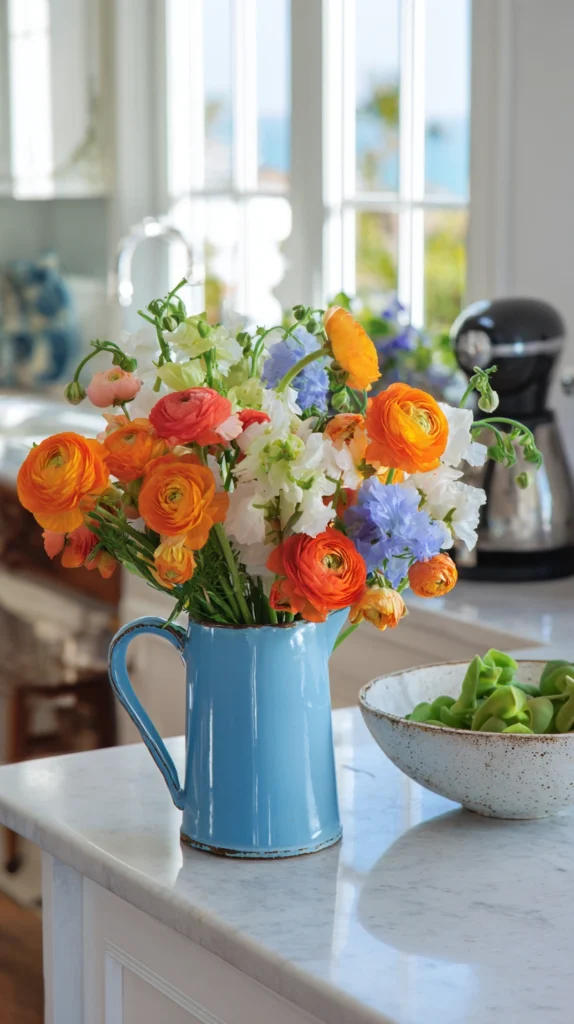
The kitchen is full of containers that have never been asked to hold flowers but would do so beautifully, and discovering this opens up a dimension of spring flower display that feels both playful and genuinely fresh.
A vintage enamel pitcher holding a loose bunch of sweet peas. A ceramic mixing bowl with a generous mass of garden roses floating on its surface. A collection of mismatched mugs each holding a single spring bloom. An old tin can — its label removed or left deliberately for texture — holding a small bundle of tulips or ranunculus.
These kitchen-vessel arrangements have an informal, spontaneous quality that is entirely different from the considered elegance of a dedicated vase, and that informality is precisely what makes them so charming in a kitchen context. They look like something that happened because you had flowers and you had a beautiful object and you put them together without overthinking it, which is often the best possible state in which to make anything.
5. The Hanging Installation
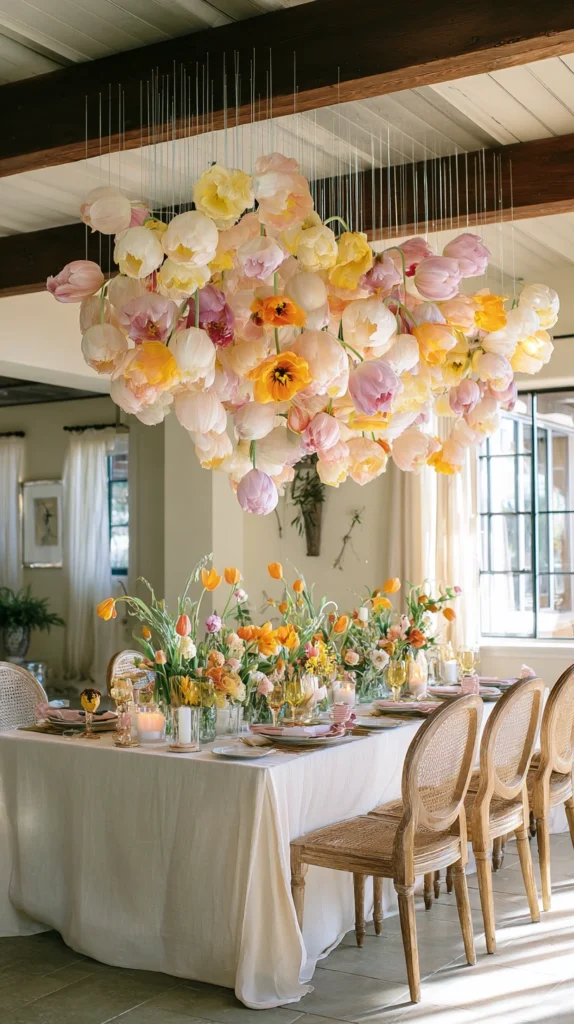
Moving flowers off surfaces and into the air entirely is a display approach that transforms them from decoration into something closer to installation art, and the visual impact of hanging flowers — from a ceiling beam, a curtain rod, a clothes rail, or a purpose-made copper or wooden hanging frame — is immediate and spectacular.
Hanging flower clouds work beautifully for spring events and gatherings, where a temporary installation of suspended bunches of tulips, ranunculus, and flowering branches creates an atmosphere that no table arrangement can replicate.
For everyday use, a simpler version — a single arching branch suspended horizontally from two ceiling hooks with individual blossom stems hanging from it at varying lengths on thin wire — creates a living mobile that moves gently in any airflow and catches light from above in a way that no surface arrangement can achieve. The stems can be in water picks or small test tube vases to extend their life while hanging.
6. The Blossom Branch as Room-Scale Statement
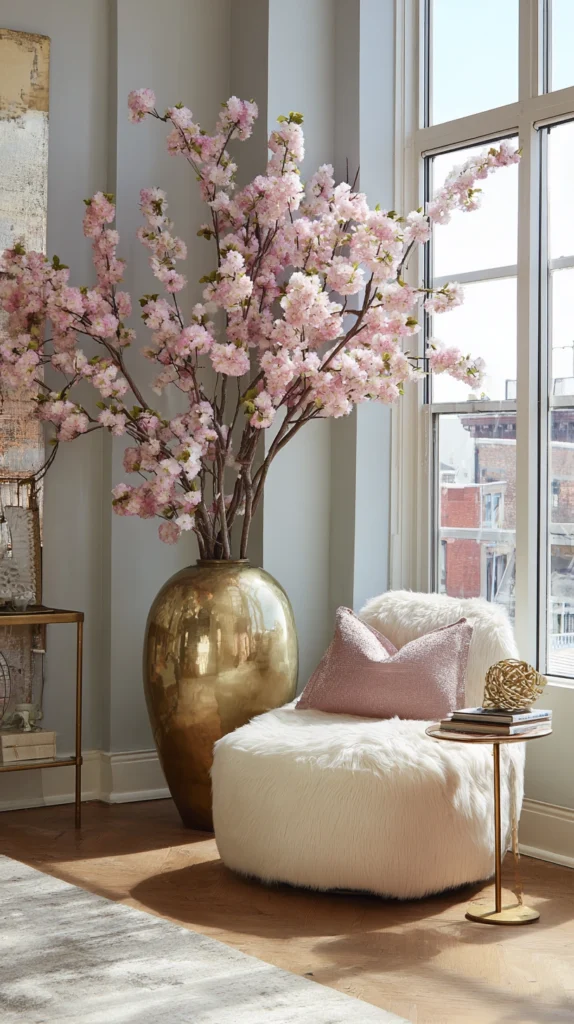
Spring flowering branches — cherry, apple, pear, forsythia, magnolia, quince — are available from florists and garden centers for a few weeks each spring, and the scale at which they should be displayed is significantly larger than most people attempt. A single branch of cherry blossom placed in a small vase looks hesitant.
The same branch, or three branches together, placed in a tall floor vase that positions the blooms at eye level or above, fills a corner of a room with something extraordinary — the specific beauty of blossom, which is available for only a few weeks each year and carries a whole emotional register of seasonal meaning, presented at a scale where it can actually be experienced.
Allow the branches to take up space. Let them extend beyond the vase in multiple directions. Resist the urge to tidy or contain what should be expansive and organic.
7. Flowers Floating in Water
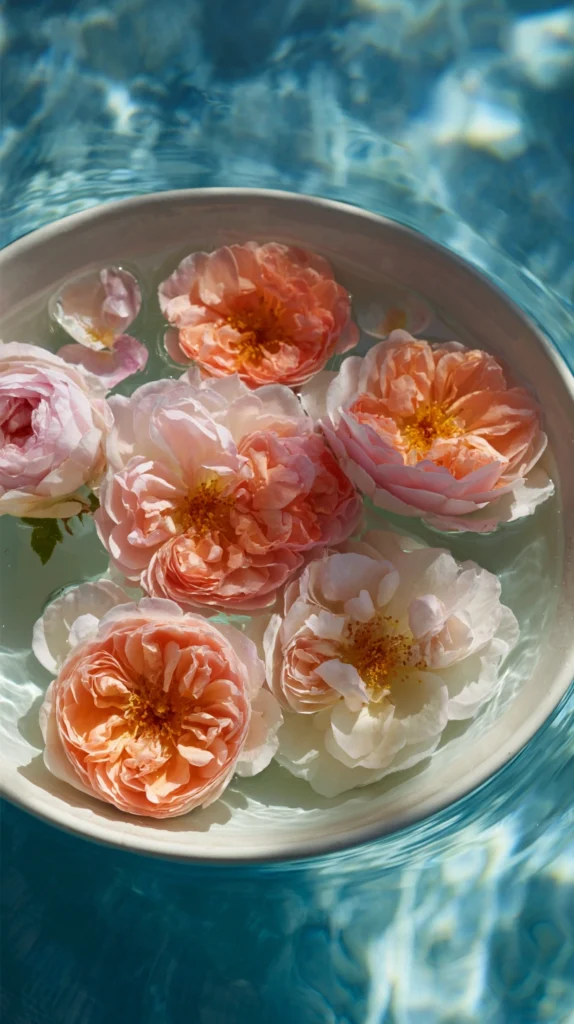
Floating flowers — blooms with their stems cut very short or removed entirely, placed directly on the surface of water in a shallow bowl or wide dish — is one of the simplest and most quietly spectacular display approaches available.
A white ceramic bowl filled with water and a dozen floating garden roses, their petals just touching each other across the water’s surface, creates a centerpiece of real beauty with almost no arranging skill required. The water reflects the colors of the blooms and the light above, adding a luminosity that no dry arrangement can achieve.
Gardenias, camellias, open-faced roses, ranunculus, and large daisy-form flowers all float beautifully. Add floating candles between the blooms for an evening variation that is genuinely breathtaking. Change the water daily and the display will last as long as any conventional arrangement.
8. The Windowsill Progression
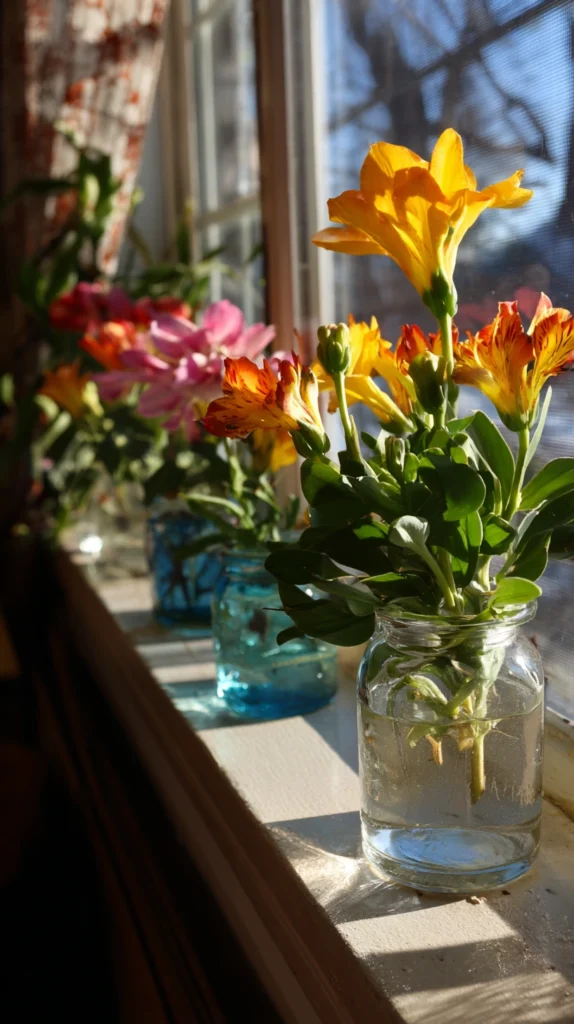
A windowsill lined with individual small vessels, each holding flowers at different stages of bloom — tight bud, half-open, fully open, and the last beautiful stage before the petals begin to fall — creates a living study in the progression of a flower’s life that is deeply satisfying to observe and requires almost no arranging skill to create.
This works particularly well with flowers that have a dramatic opening sequence — peonies moving from tight green ball to paper-soft fully open bloom, ranunculus unfurling in stages, tulips opening flat and then curving backward in their final days. The display acknowledges and celebrates the temporal quality of cut flowers rather than treating their ephemerality as a problem to be managed. The windowsill receives the natural backlighting that makes the varying stages of bloom most clearly visible, and the progression of vessels creates a linear arrangement with a natural rhythm that is visually satisfying from across the room.
9. Flowers Woven into Everyday Objects
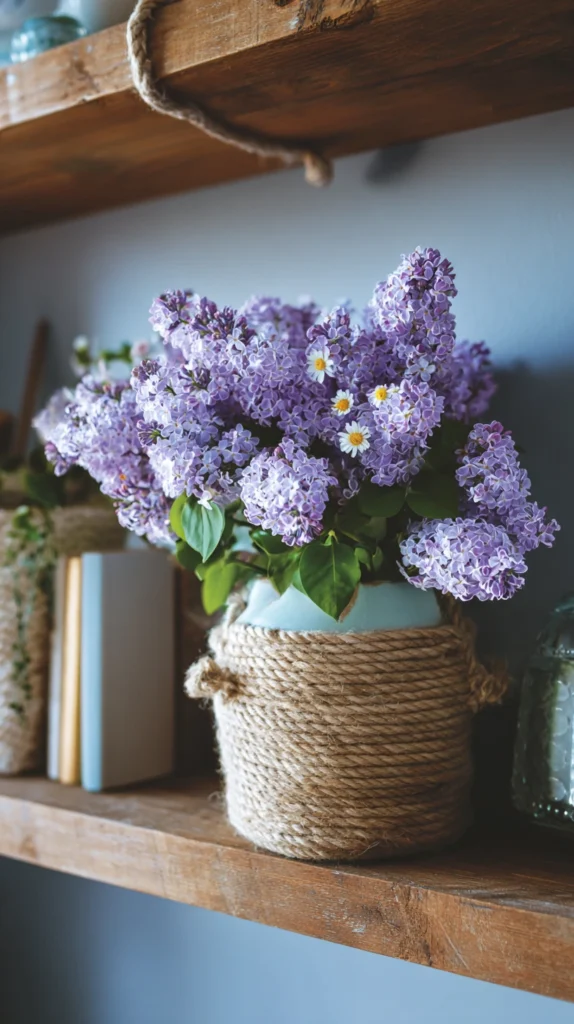
Tucking small stems and blooms into the objects that already populate your home — into the pages of an open book left on a coffee table, woven through the rungs of a wooden ladder shelf, threaded through the handle of a hanging basket, tucked into the folds of a linen napkin at a table setting — integrates flowers into the fabric of daily domestic life in a way that feels spontaneous and genuinely creative.
A single sprig of lilac tucked behind a framed photograph on a shelf. A small daisy placed in the buttonhole of a coat hung by the door. Stems of sweet william woven through a piece of driftwood or a gnarly branch displayed horizontally on a shelf.
These small flower moments scattered through the house create a cumulative effect of spring abundance that is quite different from the effect of several formal arrangements, and they cost almost nothing in either flowers or effort.
10. The Monochromatic Arrangement
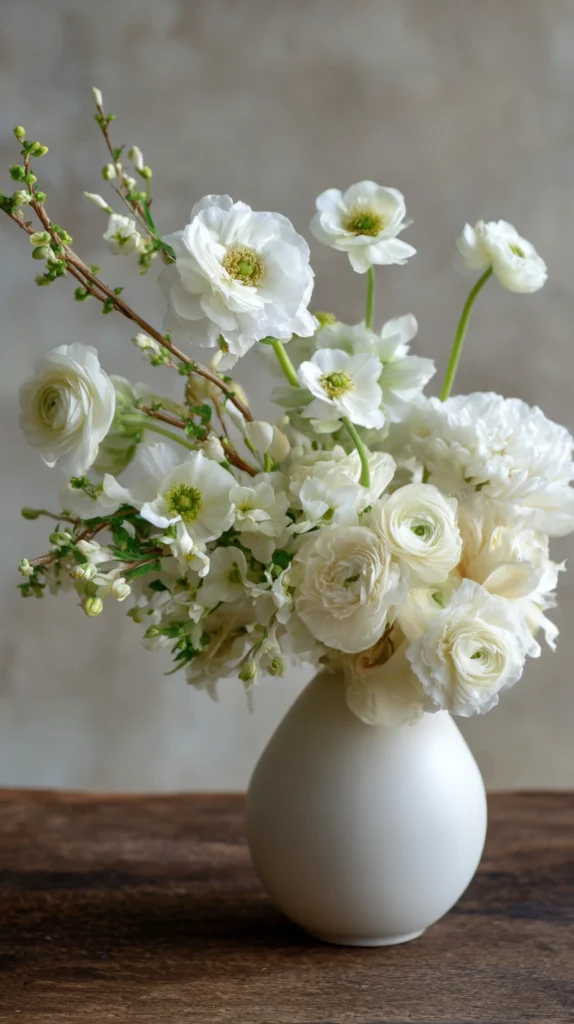
A monochromatic flower arrangement — all blooms within a single color family, from palest to deepest, in a variety of species and textures — is one of those display approaches that looks technically sophisticated but is actually considerably more achievable than a multi-color arrangement, because the color coherence does most of the compositional work for you.
A white arrangement combining white ranunculus, white sweet peas, white anemones with their black centers, white narcissus, and trailing white jasmine has a layered complexity and visual richness that rivals any multi-colored arrangement while being far easier to compose because every decision about placement is guided by the single constraint of color.
For spring, the most beautiful monochromatic palettes are soft peach through apricot, white through cream through the palest blush, and the full range from palest lavender through mid-purple to deep violet. Let the variety of textures and forms within the chosen palette create all the interest the arrangement needs.
11. Flowers in Architectural Vessels
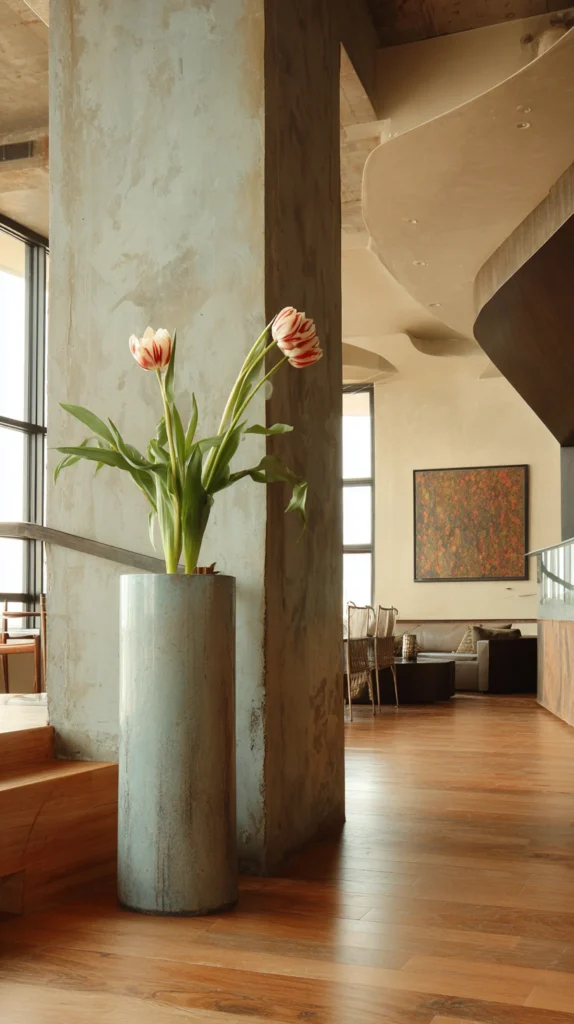
The vessel is half the display, and choosing a vessel that has genuine architectural quality — that has weight, form, and presence independent of the flowers it holds — elevates any arrangement immediately. A tall, narrow concrete cylinder holding a single straight-stemmed tulip. A handmade ceramic vessel with an interesting asymmetrical form holding a loose gathering of garden flowers.
A dark, almost black glazed pot holding a spring arrangement whose pale blooms glow against the dark interior. The relationship between the architectural quality of the vessel and the organic naturalness of the flowers creates a tension that is one of the fundamental pleasures of flower arranging as a visual art. Invest in a small number of genuinely beautiful vessels — from ceramicists, from design stores, from antique markets — and the flowers you place in them will always look better than they would in a standard glass vase.
12. The Kitchen Table Daily Posy
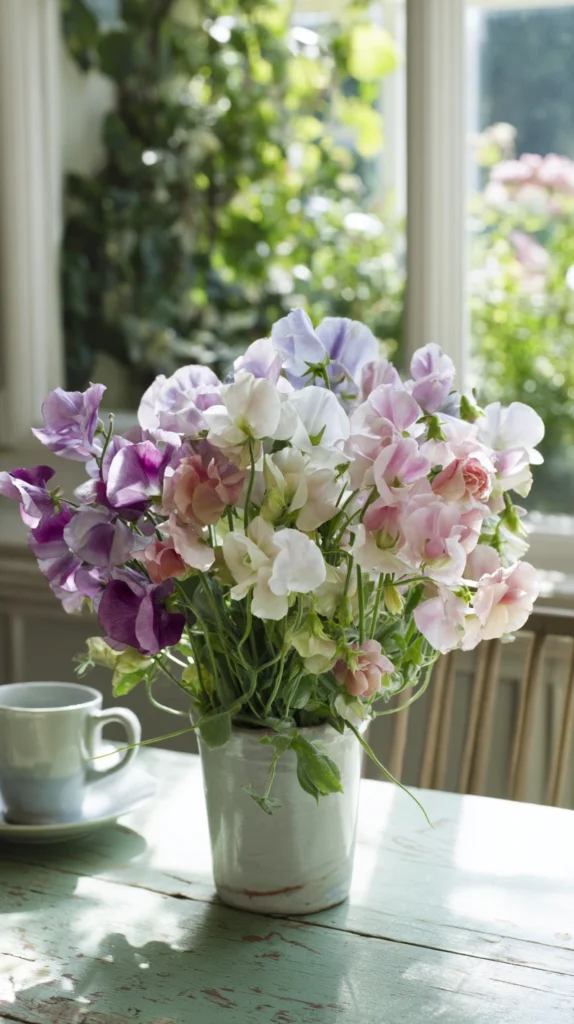
There is a continental European domestic tradition — most visible in French and Italian kitchens — of a small, informal posy of whatever is currently beautiful placed in a simple vessel at the center of the kitchen table, changed every few days as the flowers age and the available blooms change.
This is not a formal arrangement or a considered display — it is simply flowers in the place where you eat and drink and talk and begin and end your days, present as a daily acknowledgment that beauty is worth a small daily effort. The posy should be small enough to be assembled in three minutes and inexpensive enough to be replaced without calculation.
A handful of sweet peas from the garden. Three stems of ranunculus from the weekly market. A few sprigs of flowering herb from the windowsill garden. The practice matters more than any individual iteration of it.
13. Flowers as Part of a Shelf Vignette
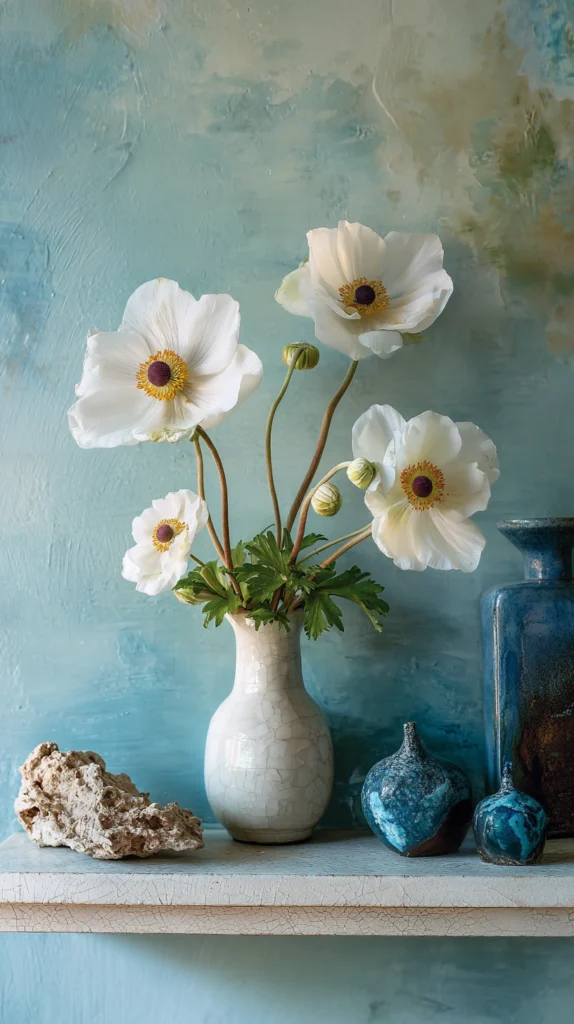
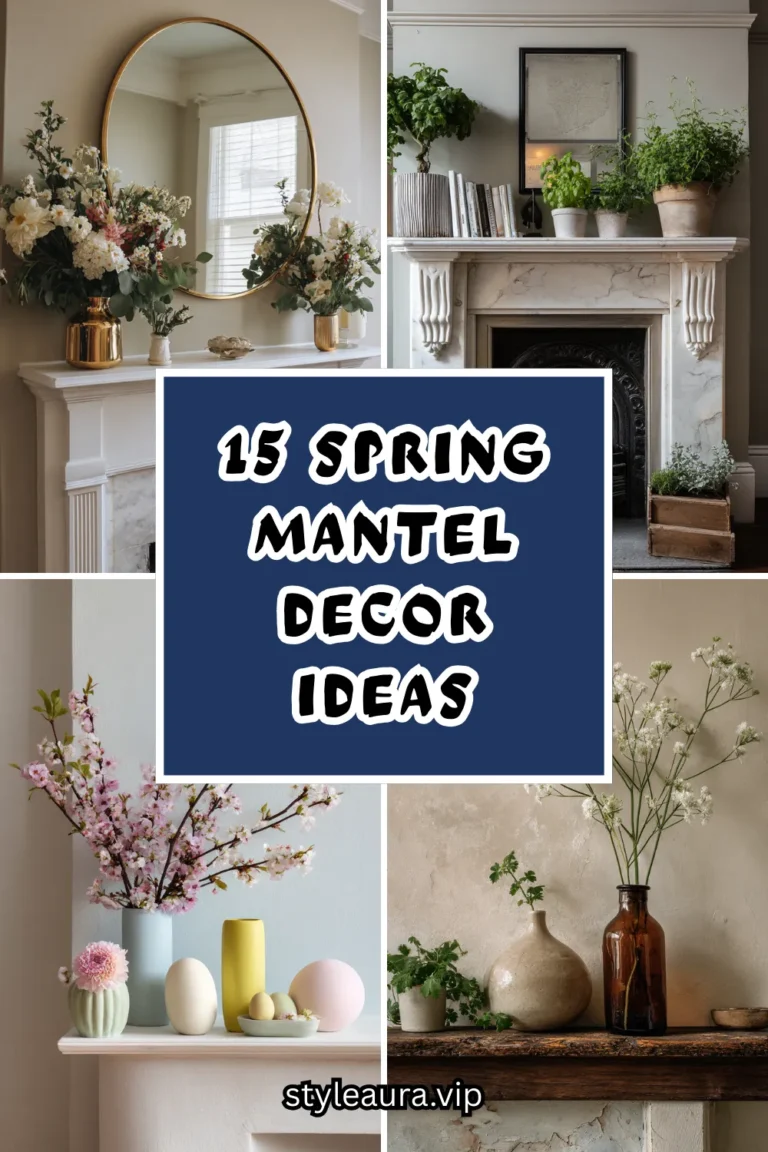
Rather than displaying flowers in isolation, integrating a small vase or bud vase into a shelf vignette — a composed arrangement of books, objects, and botanical elements — creates a display context that makes both the flowers and the surrounding objects more interesting than either would be alone.
A small ceramic vase holding three stems of anemones placed in front of a stack of books, beside a small sculptural object and a candle. A narrow bottle with a single stem of sweet pea positioned between two framed prints on a picture ledge.
The flowers bring the organic, living, temporally limited quality of the natural world into the composed and permanent quality of the shelf arrangement, and the contrast between those two states — living and made, ephemeral and permanent — is what gives the vignette its particular emotional resonance.
14. The Market Bunch Displayed Undisturbed
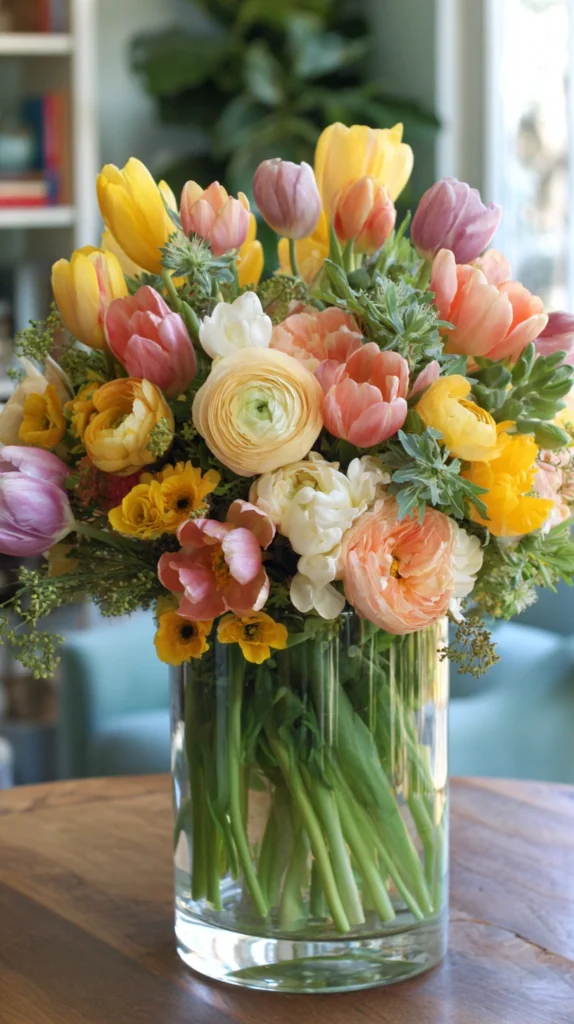
There is an approach to spring flower display that requires the least possible intervention and consistently produces some of the most beautiful results: buying a market bunch of flowers in full commercial wrapping, removing the wrapping, trimming the stems, placing the entire bunch undisturbed into a wide-necked vase, and leaving it exactly as it came.
Market bunches are assembled by growers and florists who understand what looks good together, and the slightly random, generously varied quality of a mixed market bunch — where different heights and species and subtle color variations exist because they were grown and harvested together rather than assembled by design — has a naturalness that arranged flowers sometimes lack. A wide glass cylinder, a generous ceramic pot, or a simple enamel jug is all that is needed. The restraint is the skill.
15. Dried and Fresh Combined
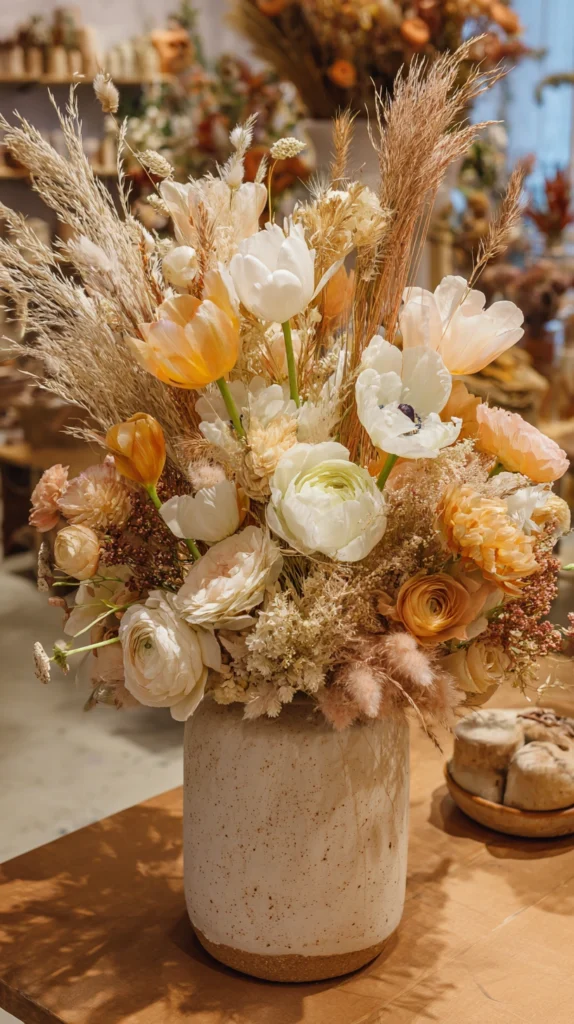
The combination of dried and fresh flowers in a single display is one of spring’s most interesting and most contemporary display approaches, because it plays the permanence and texture of dried material against the color and freshness of living stems in a way that makes both more visually interesting than they would be separately.
A base of dried pampas grass, dried lunaria, preserved eucalyptus, and bleached seedheads provides structure and year-round presence, into which fresh spring stems — tulips, ranunculus, anemones — are inserted when available and removed as they age, leaving the dried structure intact for the next seasonal addition.
This approach is economical, sustainable, and produces a display with a layered complexity that purely fresh arrangements only achieve at considerably greater cost and effort. The dried elements tell the story of seasons past while the fresh blooms announce the season present, and together they create something richer than either alone.